Building a high
performance directory
server in Java
Lessons learned and tips
from the OpenDS project.
Ludovic Poitou
Matthew Smith
Sun Microsystems
#118
AGENDA

> Introduction to the OpenDS project
> Architecture, Design Patterns and Tips
> Experiences with Sun JVM
> Conclusion


                                           2
AGENDA

> Introduction to the OpenDS project
> Architecture, Design Patterns and Tips
> Experiences with Sun JVM
> Conclusion


                                           3
The OpenDS Project


> Released in Open Source in July 2006
  – CDDL
   –   Source code at https://opends.dev.java.net/
> Sponsored by Sun Microsystems
> Written in Java by LDAP experts
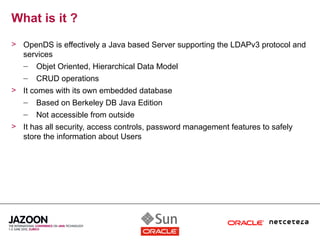
What is it ?
> OpenDS is effectively a Java based Server supporting the LDAPv3 protocol and
  services
  – Objet Oriented, Hierarchical Data Model
   –   CRUD operations
> It comes with its own embedded database
  – Based on Berkeley DB Java Edition
   –   Not accessible from outside
> It has all security, access controls, password management features to safely
  store the information about Users
What is it for ?
> Generic object oriented data store
> White pages and Email Address Book
> Mostly the data store for Identities
  – For Authentication and Authorization
   –   For profiles and personalization
> The underlying infrastructure in all Enterprises
  – Leveraged by Web and Mail infrastructure products
   –   Cornerstone of Identity Management products:
                 Access Management and Federation
                 Provisioning and De-provisioning tools
Who for ?
> Telecom service providers, financial institutions use LDAP directories for
  customer related services (Portal)
  – Storing customers identities, phones, services associated
   –   Building highly available services for 10 Millions, up to 200 Millions users
> But OpenDS can be used as OS naming service, or for SMB
  – OpenSolaris, Solaris, Linux...
   –   Coupled with SAMBA, as a Domain controler
   –   Integrated with Kerberos
   –   White Pages...
> And being 100% pure Java, OpenDS can be embedded in other Java
  applications or Web applications
  – OpenSSO


                                                                                      7
OpenDS 2.2
> Released in December 2009
> LDAPv3 directory server fully standard compliant
   –   Supports many LDAP standard and experimental extensions
   –   Supports Multi Master Replication with 3 different levels of data consistency
   –   Extensive security features
> Improved performances, reliability over OpenDS 1.0
> Installs in 6 clicks and less than 3 minutes
> Several GUI and CLI to manage, monitor the OpenDS server
> Extensive documentation
> Localized in 6 different languages
Performance characteristics
> As for most servers, scalability is extremely important
  – Up to hundreds million of entries
   –   Up to thousands connections
   –   Maximize use of CPUs
> What is the operations throughput ?
> What is the average response time ? The maximum response time ?
> Our basic test
  – 10 M entries, with an average size of 2.6K
   –   2 servers, with Multi-Master replication between them
Searchrate on Sun x4170 box
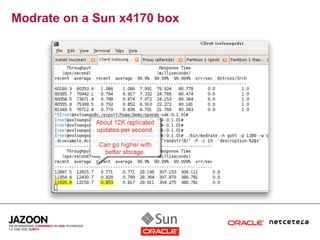
Modrate on a Sun x4170 box
AGENDA

> Introduction to the OpenDS project
> Architecture, Design Patterns and Tips
> Experiences with Sun JVM
> Conclusion


                                           12
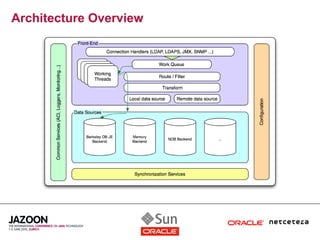
How to reach those results ?
> 2 main aspects
  – Architecture and code
   –   Run-time : JVM and Garbage Collector optimization
> There is a strong relationship between code design and memory optimization
Architecture Overview
Patterns
> Use of Asynchronous I/O
  – Exception for write disk transactions
> Use of Immutable Objects
  – Intrinsic thread safety
   –   Avoid need for defensive copies
> Use of “Factories” over Constructors
  – Avoid creating an object
   –   Ease optimization for common cases
                Example : Most AttributeDescriptions have 0 options
                Example : Attributes generally have 1 value
   –   For immutable objects.


                                                                       15
Patterns
> Producers / Consumers
  – Queues
  –   Thread Pool
  –   Monitors
> Strategies
  – Queue Strategies : ConcurrentLinkedQueue vs LinkedBlockingQueue


                                                                      16
Anti-Patterns
> String concatenation
  – Make sure to use a StringBuilder
   –   Compiler now optimize simple “Aaa” + “Bbb” concatenation
> Avoid very long methods (thousands of lines of code)
> Avoid exposing the concrete representation of an object
   –   Set vs LinkedHashSet.
   –   Not a performance issue, but will require more work when optimizing code
       for performance later
> Try to define only the methods you need.


                                                                              17
Java Collections
> Vector and Hashtable are synchronized for all methods
  – Pay the price even if not necessary
> Some Java collection classes are not synchronized by default
  – ArrayList, LinkedList replace Vector
   –   HashSet, HashMap replace Hashtable
> To synchronize, wrap in a class
> With a “static factory”
   –   Collections.synchronizedList(new ArrayList())
> ConcurrentHashMap, for concurrency
  – But watch when using the iterator


                                                                 18
Critical Sections
> Try to minimise the code and time spent in the critical sections
> But the throughput is limited by the time spent in the largest critical section
   –   Example : LinkedBlockingQueue
                 200 000 operations on x64 processor
                 20 000 operations on the T2000 processor
   –   We use it for the WorkQueue and Access Logs
Caching data
> Using Caches reduce the disk access thus should provide better performances
> But cache eviction add pressure to the GC
   –   When modifying entries
   –   When the cache is too small to hold all data
> A cache is also a contention point
> If you want to cache objects, make sure you cache those that will be reused.
> Alternate possibility, use “thread local” cache.
  – But watch out for the cost (with 1000 threads?)
Server monitoring
> Getting statistics for a server is mandatory
> Beware of contention
   –   Stats are updated frequently
   –   But seldom read
> A strategy could be to keep per thread statistics and collect them on demand
  – Not yet implemented in OpenDS !
AGENDA

> Introduction to the OpenDS project
> Architecture, Design Patterns and Tips
> Experiences with tuning Sun JVM
> Conclusion


                                           22
Performance Tuning

> When dealing with performances, you should consider the whole system
  – Java VM
   –   OS
   –   Hardware : CPU, Memory, Disks, Network...
> In our case, we try to avoid disk I/Os
  – And try to cache as much of the database
> We also want deterministic response times
  – Avoid any Full GC (Stop The World)
   –   Make sure minor GC pauses are as small as possible


                                                                         23
JVM Tuning for OpenDS
> Super Size The Heap !
  – We use 32GB Heaps, sometime
     up to 96GB
  – 2GB for the New Generation (or
     ¼ of heap if < 8GB)
  – -Xms32768M -Xmx32768M
     -Xmn2048M
> Use CMS
  –   -XX:+UseConcMarkSweepGC
  –   -XX:+UseParNewGC
> -XX:MaxTenuringThreshold=1
  – Avoid copy of objects in New Gen


                                       24
Some interesting JVM Options
> -XX:CMSInitiatingOccupancyFraction=70
  – Define the amount of occupancy in Old Gen before starting to collect
   –   Larger = better throughput but higher full GC risk
> -XX:+UseCompressedOops
  – For 64bits JVM, less than 32BG of heap
   –   Will be the default in coming Java 6 updates
> If running on processor with NUMA architecture
  – -XX:+UseNUMA
> -XX:+AggressiveOpts
  – Enables aggressive JIT optimizations, not related to GC


                                                                           25
The Garbage First (G1) GC
> Introduced in the Java HotSpot VM in JDK 7.
> An experimental version of G1 has also been released since Java SE 6 Update
  14.
> G1 is the long-term replacement for HotSpot's low-latency Concurrent Mark-
  Sweep (CMS) GC
> Should be officially supported with Java SE 6 Update 21


                                                                          26
G1 Characteristics
> Future CMS Replacement
  – Server “Style” Garbage Collector
   –   Parallel, Concurrent
   –   Generational
   –   Good Throughput
   –   Compacting
   –   Improved ease-of-use
   –   Predictable (though not hard real-time)
> The main stages consist of remembered set (RS) maintenance, concurrent
  marking, and evacuation pauses.


                                                                           27
JVM Options With G1
> -XX:+UnlockExperimentalVMOptions
  -XX:+UseG1GC
> PauseTime (Hints, Goal with no promise, otherwise use Java Real Time )
   –   -XX:MaxGCPauseMillis=50 (target of 50 milliseconds)
   –   -XX:GCPauseIntervalMillis=1000 (target of 1000 msecs)
> Generation Size
  – -XX:+G1YoungGenSize=512m (for a 512 MB young gen)
> Parallelism
  – -XX:+G1ParallelRSetUpdatingEnabled
   –   -XX:+G1ParallelRSetScanningEnabled


                                                                           28
OpenDS et G1
> Goal: Avoid any Full GC, best control of pauses
> Collaboration between the HotSpot and the OpenDS teams
   –   OpenDS is used as a “Large” reference application
   –   Between 10 and 20 enhancements integrated in G1 following the tests
   –   Performance with large heaps improved by a factor of 10
> We're still discovering it
  – When doing read operations, we see pauses between 10 and 20 ms with
     32GB JVM
  – But we're still seeing Full GC when doing Write operations (More garbage,
     stresses more the Old Gen)
  – Hopefully this will be resolved in next builds


                                                                             29
OpenDS G1 and Searches


                         30
AGENDA

> Introduction to the OpenDS project
> Architecture, Design Patterns and Tips
> Experiences with Sun JVM
> Conclusion


                                           31
Summary
> OpenDS
  – A open source LDAP directory server, 100% pure Java
   –   Easy to install and use
   –   Designed for high performance and high scalability
> We saw some patterns and tips used in the OpenDS project
> Knowing and understanding the JVM and GC is required to build high
  performance server
  – Tuning JVM and GC is an art
   –   Performance engineering is a profession
> Who said that Java is slow ?!


                                                                       32
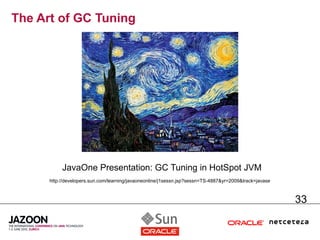
The Art of GC Tuning


           JavaOne Presentation: GC Tuning in HotSpot JVM
      http://developers.sun.com/learning/javaoneonline/j1sessn.jsp?sessn=TS-4887&yr=2009&track=javase


                                                                                                        33
Now...
> Give OpenDS a try
  – http://www.opends.org
> Join our community:
  – Join/Login sur Java.net
   –   http://opends.dev.java.net
   –   Request a Role
   –   Subscribe to the mailing lists
   –   IRC: #opends on freenode.net
> OpenDS is localized in several
  languages. It's community based,
  through online tools. An easy way to
  participate.


                                         34
Ludovic Poitou     blogs.sun.com/Ludo
Sun Microsystems   Ludovic.Poitou@sun.com


Matthew Swift
Sun Microsystems   Matthew.Swift@sun.com

OpenDS_Jazoon2010

  • 1.
    Building a high performancedirectory server in Java Lessons learned and tips from the OpenDS project. Ludovic Poitou Matthew Smith Sun Microsystems #118
  • 2.
    AGENDA > Introduction tothe OpenDS project > Architecture, Design Patterns and Tips > Experiences with Sun JVM > Conclusion 2
  • 3.
    AGENDA > Introduction tothe OpenDS project > Architecture, Design Patterns and Tips > Experiences with Sun JVM > Conclusion 3
  • 4.
    The OpenDS Project >Released in Open Source in July 2006 – CDDL – Source code at https://opends.dev.java.net/ > Sponsored by Sun Microsystems > Written in Java by LDAP experts
  • 5.
    What is it? > OpenDS is effectively a Java based Server supporting the LDAPv3 protocol and services – Objet Oriented, Hierarchical Data Model – CRUD operations > It comes with its own embedded database – Based on Berkeley DB Java Edition – Not accessible from outside > It has all security, access controls, password management features to safely store the information about Users
  • 6.
    What is itfor ? > Generic object oriented data store > White pages and Email Address Book > Mostly the data store for Identities – For Authentication and Authorization – For profiles and personalization > The underlying infrastructure in all Enterprises – Leveraged by Web and Mail infrastructure products – Cornerstone of Identity Management products:  Access Management and Federation  Provisioning and De-provisioning tools
  • 7.
    Who for ? >Telecom service providers, financial institutions use LDAP directories for customer related services (Portal) – Storing customers identities, phones, services associated – Building highly available services for 10 Millions, up to 200 Millions users > But OpenDS can be used as OS naming service, or for SMB – OpenSolaris, Solaris, Linux... – Coupled with SAMBA, as a Domain controler – Integrated with Kerberos – White Pages... > And being 100% pure Java, OpenDS can be embedded in other Java applications or Web applications – OpenSSO 7
  • 8.
    OpenDS 2.2 > Releasedin December 2009 > LDAPv3 directory server fully standard compliant – Supports many LDAP standard and experimental extensions – Supports Multi Master Replication with 3 different levels of data consistency – Extensive security features > Improved performances, reliability over OpenDS 1.0 > Installs in 6 clicks and less than 3 minutes > Several GUI and CLI to manage, monitor the OpenDS server > Extensive documentation > Localized in 6 different languages
  • 9.
    Performance characteristics > Asfor most servers, scalability is extremely important – Up to hundreds million of entries – Up to thousands connections – Maximize use of CPUs > What is the operations throughput ? > What is the average response time ? The maximum response time ? > Our basic test – 10 M entries, with an average size of 2.6K – 2 servers, with Multi-Master replication between them
  • 10.
  • 11.
    Modrate on aSun x4170 box
  • 12.
    AGENDA > Introduction tothe OpenDS project > Architecture, Design Patterns and Tips > Experiences with Sun JVM > Conclusion 12
  • 13.
    How to reachthose results ? > 2 main aspects – Architecture and code – Run-time : JVM and Garbage Collector optimization > There is a strong relationship between code design and memory optimization
  • 14.
  • 15.
    Patterns > Use ofAsynchronous I/O – Exception for write disk transactions > Use of Immutable Objects – Intrinsic thread safety – Avoid need for defensive copies > Use of “Factories” over Constructors – Avoid creating an object – Ease optimization for common cases  Example : Most AttributeDescriptions have 0 options  Example : Attributes generally have 1 value – For immutable objects. 15
  • 16.
    Patterns > Producers /Consumers – Queues – Thread Pool – Monitors > Strategies – Queue Strategies : ConcurrentLinkedQueue vs LinkedBlockingQueue 16
  • 17.
    Anti-Patterns > String concatenation – Make sure to use a StringBuilder – Compiler now optimize simple “Aaa” + “Bbb” concatenation > Avoid very long methods (thousands of lines of code) > Avoid exposing the concrete representation of an object – Set vs LinkedHashSet. – Not a performance issue, but will require more work when optimizing code for performance later > Try to define only the methods you need. 17
  • 18.
    Java Collections > Vectorand Hashtable are synchronized for all methods – Pay the price even if not necessary > Some Java collection classes are not synchronized by default – ArrayList, LinkedList replace Vector – HashSet, HashMap replace Hashtable > To synchronize, wrap in a class > With a “static factory” – Collections.synchronizedList(new ArrayList()) > ConcurrentHashMap, for concurrency – But watch when using the iterator 18
  • 19.
    Critical Sections > Tryto minimise the code and time spent in the critical sections > But the throughput is limited by the time spent in the largest critical section – Example : LinkedBlockingQueue  200 000 operations on x64 processor  20 000 operations on the T2000 processor – We use it for the WorkQueue and Access Logs
  • 20.
    Caching data > UsingCaches reduce the disk access thus should provide better performances > But cache eviction add pressure to the GC – When modifying entries – When the cache is too small to hold all data > A cache is also a contention point > If you want to cache objects, make sure you cache those that will be reused. > Alternate possibility, use “thread local” cache. – But watch out for the cost (with 1000 threads?)
  • 21.
    Server monitoring > Gettingstatistics for a server is mandatory > Beware of contention – Stats are updated frequently – But seldom read > A strategy could be to keep per thread statistics and collect them on demand – Not yet implemented in OpenDS !
  • 22.
    AGENDA > Introduction tothe OpenDS project > Architecture, Design Patterns and Tips > Experiences with tuning Sun JVM > Conclusion 22
  • 23.
    Performance Tuning > Whendealing with performances, you should consider the whole system – Java VM – OS – Hardware : CPU, Memory, Disks, Network... > In our case, we try to avoid disk I/Os – And try to cache as much of the database > We also want deterministic response times – Avoid any Full GC (Stop The World) – Make sure minor GC pauses are as small as possible 23
  • 24.
    JVM Tuning forOpenDS > Super Size The Heap ! – We use 32GB Heaps, sometime up to 96GB – 2GB for the New Generation (or ¼ of heap if < 8GB) – -Xms32768M -Xmx32768M -Xmn2048M > Use CMS – -XX:+UseConcMarkSweepGC – -XX:+UseParNewGC > -XX:MaxTenuringThreshold=1 – Avoid copy of objects in New Gen 24
  • 25.
    Some interesting JVMOptions > -XX:CMSInitiatingOccupancyFraction=70 – Define the amount of occupancy in Old Gen before starting to collect – Larger = better throughput but higher full GC risk > -XX:+UseCompressedOops – For 64bits JVM, less than 32BG of heap – Will be the default in coming Java 6 updates > If running on processor with NUMA architecture – -XX:+UseNUMA > -XX:+AggressiveOpts – Enables aggressive JIT optimizations, not related to GC 25
  • 26.
    The Garbage First(G1) GC > Introduced in the Java HotSpot VM in JDK 7. > An experimental version of G1 has also been released since Java SE 6 Update 14. > G1 is the long-term replacement for HotSpot's low-latency Concurrent Mark- Sweep (CMS) GC > Should be officially supported with Java SE 6 Update 21 26
  • 27.
    G1 Characteristics > FutureCMS Replacement – Server “Style” Garbage Collector – Parallel, Concurrent – Generational – Good Throughput – Compacting – Improved ease-of-use – Predictable (though not hard real-time) > The main stages consist of remembered set (RS) maintenance, concurrent marking, and evacuation pauses. 27
  • 28.
    JVM Options WithG1 > -XX:+UnlockExperimentalVMOptions -XX:+UseG1GC > PauseTime (Hints, Goal with no promise, otherwise use Java Real Time ) – -XX:MaxGCPauseMillis=50 (target of 50 milliseconds) – -XX:GCPauseIntervalMillis=1000 (target of 1000 msecs) > Generation Size – -XX:+G1YoungGenSize=512m (for a 512 MB young gen) > Parallelism – -XX:+G1ParallelRSetUpdatingEnabled – -XX:+G1ParallelRSetScanningEnabled 28
  • 29.
    OpenDS et G1 >Goal: Avoid any Full GC, best control of pauses > Collaboration between the HotSpot and the OpenDS teams – OpenDS is used as a “Large” reference application – Between 10 and 20 enhancements integrated in G1 following the tests – Performance with large heaps improved by a factor of 10 > We're still discovering it – When doing read operations, we see pauses between 10 and 20 ms with 32GB JVM – But we're still seeing Full GC when doing Write operations (More garbage, stresses more the Old Gen) – Hopefully this will be resolved in next builds 29
  • 30.
    OpenDS G1 andSearches 30
  • 31.
    AGENDA > Introduction tothe OpenDS project > Architecture, Design Patterns and Tips > Experiences with Sun JVM > Conclusion 31
  • 32.
    Summary > OpenDS – A open source LDAP directory server, 100% pure Java – Easy to install and use – Designed for high performance and high scalability > We saw some patterns and tips used in the OpenDS project > Knowing and understanding the JVM and GC is required to build high performance server – Tuning JVM and GC is an art – Performance engineering is a profession > Who said that Java is slow ?! 32
  • 33.
    The Art ofGC Tuning JavaOne Presentation: GC Tuning in HotSpot JVM http://developers.sun.com/learning/javaoneonline/j1sessn.jsp?sessn=TS-4887&yr=2009&track=javase 33
  • 34.
    Now... > Give OpenDSa try – http://www.opends.org > Join our community: – Join/Login sur Java.net – http://opends.dev.java.net – Request a Role – Subscribe to the mailing lists – IRC: #opends on freenode.net > OpenDS is localized in several languages. It's community based, through online tools. An easy way to participate. 34
  • 35.
    Ludovic Poitou blogs.sun.com/Ludo Sun Microsystems Ludovic.Poitou@sun.com Matthew Swift Sun Microsystems Matthew.Swift@sun.com