
Session #1.3: OpenComRTOS Internals

                                   Bernhard Sputh
                             bernhard.sputh@altreonic.com

                                     Altreonic NV
                                 Gemeentestraat 61 Bus 1
                                      3210 Linden
                                        Belgium


                                  January 12, 2012


Bernhard Sputh (Altreonic)              Session #1.3        January 12, 2012   1 / 37
Outline of this Workshop


     Session #1.1: The Theoretical foundations of OpenComRTOS
     Session #1.2: Introduction to OpenComRTOS and the
     OpenComRTOS Designer Suite
     Session #1.3: OpenComRTOS Internals
     Session #1.4: Hands on with the OpenComRTOS Designer Suite


  Bernhard Sputh (Altreonic)   Session #1.3          January 12, 2012   2 / 37
1   How OpenComRTOS works Internally
      Interacting Entities in Detail
      Virtual Single Processor (VSP) Programming Model
      Priority Inversion

2   Build Process

3   Extending OpenComRTOS
      Components
      Porting to a new Platform
      Device Drivers

4   Summary


    Bernhard Sputh (Altreonic)    Session #1.3           January 12, 2012   3 / 37
Outline

1   How OpenComRTOS works Internally
      Interacting Entities in Detail
      Virtual Single Processor (VSP) Programming Model
      Priority Inversion

2   Build Process

3   Extending OpenComRTOS
      Components
      Porting to a new Platform
      Device Drivers

4   Summary
OpenComRTOS Paradigms


    Interacting Entities
    Virtual Single Processor (VSP) Programming Model.


 Bernhard Sputh (Altreonic)   Session #1.3              January 12, 2012   5 / 37
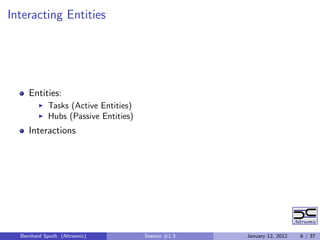
Interacting Entities


     Entities:
            Tasks (Active Entities)
            Hubs (Passive Entities)
     Interactions


  Bernhard Sputh (Altreonic)          Session #1.3   January 12, 2012   6 / 37
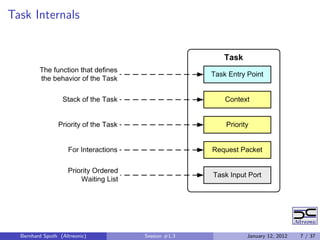
Task Internals


  Bernhard Sputh (Altreonic)   Session #1.3   January 12, 2012   7 / 37
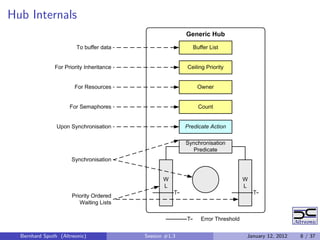
Hub Internals


  Bernhard Sputh (Altreonic)   Session #1.3   January 12, 2012   8 / 37
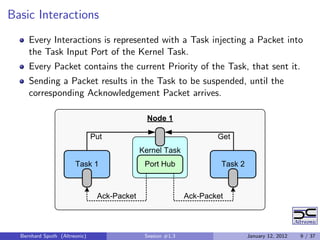
Basic Interactions
     Every Interactions is represented with a Task injecting a Packet into
     the Task Input Port of the Kernel Task.
     Every Packet contains the current Priority of the Task, that sent it.
     Sending a Packet results in the Task to be suspended, until the
     corresponding Acknowledgement Packet arrives.


  Bernhard Sputh (Altreonic)      Session #1.3              January 12, 2012   9 / 37
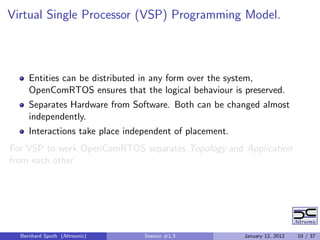
Virtual Single Processor (VSP) Programming Model.


     Entities can be distributed in any form over the system,
     OpenComRTOS ensures that the logical behaviour is preserved.
     Separates Hardware from Software. Both can be changed almost
     independently.
     Interactions take place independent of placement.
For VSP to work OpenComRTOS separates Topology and Application
from each other.


  Bernhard Sputh (Altreonic)     Session #1.3            January 12, 2012   10 / 37
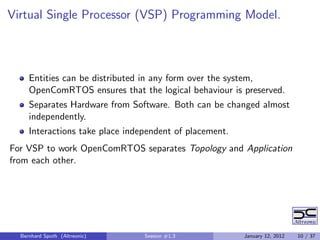
Virtual Single Processor (VSP) Programming Model.


     Entities can be distributed in any form over the system,
     OpenComRTOS ensures that the logical behaviour is preserved.
     Separates Hardware from Software. Both can be changed almost
     independently.
     Interactions take place independent of placement.
For VSP to work OpenComRTOS separates Topology and Application
from each other.


  Bernhard Sputh (Altreonic)     Session #1.3            January 12, 2012   10 / 37
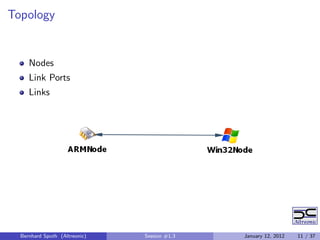
Topology


     Nodes
     Link Ports
     Links


  Bernhard Sputh (Altreonic)   Session #1.3   January 12, 2012   11 / 37
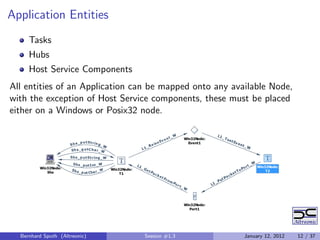
Application Entities
     Tasks
     Hubs
     Host Service Components
All entities of an Application can be mapped onto any available Node,
with the exception of Host Service components, these must be placed
either on a Windows or Posix32 node.


  Bernhard Sputh (Altreonic)    Session #1.3             January 12, 2012   12 / 37
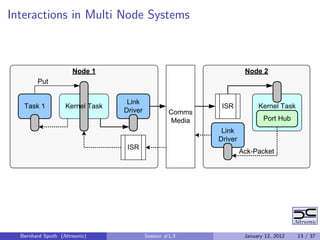
Interactions in Multi Node Systems


  Bernhard Sputh (Altreonic)   Session #1.3   January 12, 2012   13 / 37
Priority Inversion


Definition: “priority inversion is a problematic scenario in scheduling when
a higher priority task is indirectly preempted by a lower priority task
effectively ‘inverting’ the relative priorities of the two tasks.”.
Typically that is caused when s shared resource gets protected with a Lock
/ Mutex, for instance:
     a shared memory buffer that must be read out before new data is
     written in;
     hardware status registers that set a peripheral in a specific state;
     a peripheral that can handle only one request at a time.


  Bernhard Sputh (Altreonic)      Session #1.3              January 12, 2012   14 / 37
Priority Inheritance as Solution


     If Priority Inversion gets detected, the Priority of the lower Priority
     Task get boosted to the level of the higher Priority Task.
     OpenComRTOS supports that on single Node systems.
     OpenComRTOS supports this also system wide, i.e. the location of
     the Task does not matter.


  Bernhard Sputh (Altreonic)       Session #1.3              January 12, 2012   15 / 37
Outline

1   How OpenComRTOS works Internally
      Interacting Entities in Detail
      Virtual Single Processor (VSP) Programming Model
      Priority Inversion

2   Build Process

3   Extending OpenComRTOS
      Components
      Porting to a new Platform
      Device Drivers

4   Summary
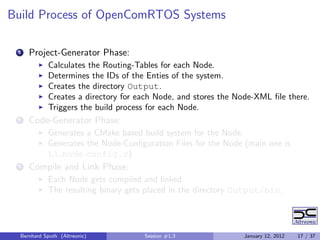
Build Process of OpenComRTOS Systems

 1   Project-Generator Phase:
            Calculates the Routing-Tables for each Node.
            Determines the IDs of the Enties of the system.
            Creates the directory Output.
            Creates a directory for each Node, and stores the Node-XML file there.
            Triggers the build process for each Node.
 2   Code-Generator Phase:
            Generates a CMake based build system for the Node.
            Generates the Node-Configuration Files for the Node (main one is
            L1 node config.c)
 3   Compile and Link Phase:
            Each Node gets compiled and linked.
            The resulting binary gets placed in the directory Output/bin.


  Bernhard Sputh (Altreonic)         Session #1.3              January 12, 2012   17 / 37
Build Process of OpenComRTOS Systems

 1   Project-Generator Phase:
            Calculates the Routing-Tables for each Node.
            Determines the IDs of the Enties of the system.
            Creates the directory Output.
            Creates a directory for each Node, and stores the Node-XML file there.
            Triggers the build process for each Node.
 2   Code-Generator Phase:
            Generates a CMake based build system for the Node.
            Generates the Node-Configuration Files for the Node (main one is
            L1 node config.c)
 3   Compile and Link Phase:
            Each Node gets compiled and linked.
            The resulting binary gets placed in the directory Output/bin.


  Bernhard Sputh (Altreonic)         Session #1.3              January 12, 2012   17 / 37
Build Process of OpenComRTOS Systems

 1   Project-Generator Phase:
            Calculates the Routing-Tables for each Node.
            Determines the IDs of the Enties of the system.
            Creates the directory Output.
            Creates a directory for each Node, and stores the Node-XML file there.
            Triggers the build process for each Node.
 2   Code-Generator Phase:
            Generates a CMake based build system for the Node.
            Generates the Node-Configuration Files for the Node (main one is
            L1 node config.c)
 3   Compile and Link Phase:
            Each Node gets compiled and linked.
            The resulting binary gets placed in the directory Output/bin.


  Bernhard Sputh (Altreonic)         Session #1.3              January 12, 2012   17 / 37
Outline

1   How OpenComRTOS works Internally
      Interacting Entities in Detail
      Virtual Single Processor (VSP) Programming Model
      Priority Inversion

2   Build Process

3   Extending OpenComRTOS
      Components
      Porting to a new Platform
      Device Drivers

4   Summary
Components


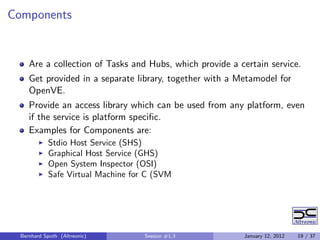
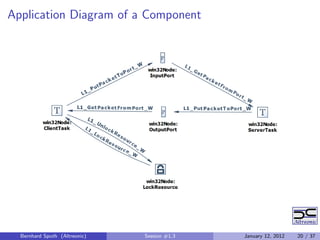
    Are a collection of Tasks and Hubs, which provide a certain service.
    Get provided in a separate library, together with a Metamodel for
    OpenVE.
    Provide an access library which can be used from any platform, even
    if the service is platform specific.
    Examples for Components are:
           Stdio Host Service (SHS)
           Graphical Host Service (GHS)
           Open System Inspector (OSI)
           Safe Virtual Machine for C (SVM


 Bernhard Sputh (Altreonic)        Session #1.3          January 12, 2012   19 / 37
Application Diagram of a Component


  Bernhard Sputh (Altreonic)   Session #1.3   January 12, 2012   20 / 37
Porting to a new Platform


Consists of the following phases:
     Phase 1: Context Switch
     Phase 2: Interrupt Support
     Phase 3: Multi-Node and Integration


  Bernhard Sputh (Altreonic)        Session #1.3   January 12, 2012   21 / 37
Phase 1: Context Switch


     Create a new folder in src/platforms/, and copy the contents of
     src/generic into it.
     Integrate the newly created folder into the build system.
     Map OpenComRTOS data types to platform data types:
            L1    BOOL
            L1    BYTE
            L1    INT16 / L1 UINT16
            L1    INT32 / L1 UINT32
     Fill in the blanks: Context Switch, Enter and Leave Critical Section,
     Initialisation of the Task Context, Starting a Task.
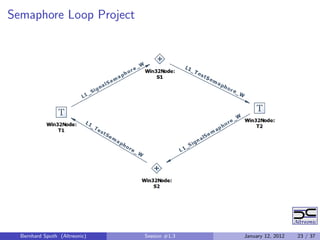
     Test this with a Semaphore Loop Project.


  Bernhard Sputh (Altreonic)          Session #1.3         January 12, 2012   22 / 37
Phase 1: Context Switch


     Create a new folder in src/platforms/, and copy the contents of
     src/generic into it.
     Integrate the newly created folder into the build system.
     Map OpenComRTOS data types to platform data types:
            L1    BOOL
            L1    BYTE
            L1    INT16 / L1 UINT16
            L1    INT32 / L1 UINT32
     Fill in the blanks: Context Switch, Enter and Leave Critical Section,
     Initialisation of the Task Context, Starting a Task.
     Test this with a Semaphore Loop Project.


  Bernhard Sputh (Altreonic)          Session #1.3         January 12, 2012   22 / 37
Phase 1: Context Switch


     Create a new folder in src/platforms/, and copy the contents of
     src/generic into it.
     Integrate the newly created folder into the build system.
     Map OpenComRTOS data types to platform data types:
            L1    BOOL
            L1    BYTE
            L1    INT16 / L1 UINT16
            L1    INT32 / L1 UINT32
     Fill in the blanks: Context Switch, Enter and Leave Critical Section,
     Initialisation of the Task Context, Starting a Task.
     Test this with a Semaphore Loop Project.


  Bernhard Sputh (Altreonic)          Session #1.3         January 12, 2012   22 / 37
Semaphore Loop Project


  Bernhard Sputh (Altreonic)   Session #1.3   January 12, 2012   23 / 37
Phase 2: Interrupt Support


     Implement Interrupt Handling Support: Enter ISR, Leave ISR;
     Implement the Periodic Timer driver;
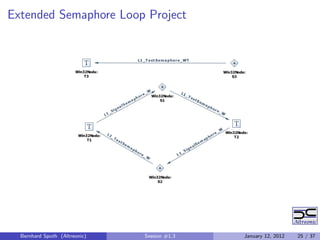
     Extend the previously developed Semaphore Loop Project, with a Task
     that performs a waiting with timeout operation on a new Semaphore.


  Bernhard Sputh (Altreonic)    Session #1.3            January 12, 2012   24 / 37
Extended Semaphore Loop Project


  Bernhard Sputh (Altreonic)   Session #1.3   January 12, 2012   25 / 37
Phase 3: Multi-Node and Integration


     Implement a Link Driver, typically RS232;
     Implement the network endianess adjustment routines. Over a link we
     always use big-endian.
     Implement an Example that connects two Nodes, typically the new
     Platform plus a Win32 / Posix32 Node.
     Implement the remaining device drivers for the target (Link Drivers,
     special IO drivers).
     Adjust OpenVE Metamodel and the Code Generators.


  Bernhard Sputh (Altreonic)     Session #1.3             January 12, 2012   26 / 37
Device Drivers


     Timer-Drivers
     Link-Drivers
     General-Drivers


  Bernhard Sputh (Altreonic)   Session #1.3   January 12, 2012   27 / 37
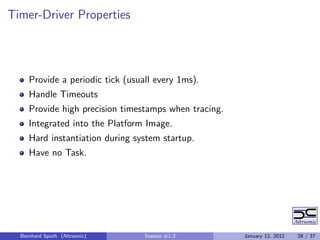
Timer-Driver Properties


     Provide a periodic tick (usuall every 1ms).
     Handle Timeouts
     Provide high precision timestamps when tracing.
     Integrated into the Platform Image.
     Hard instantiation during system startup.
     Have no Task.


  Bernhard Sputh (Altreonic)      Session #1.3         January 12, 2012   28 / 37
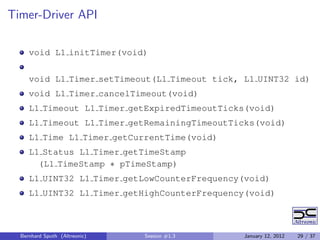
Timer-Driver API

     void L1 initTimer(void)


     void L1 Timer setTimeout(L1 Timeout tick, L1 UINT32 id)
     void L1 Timer cancelTimeout(void)
     L1 Timeout L1 Timer getExpiredTimeoutTicks(void)
     L1 Timeout L1 Timer getRemainingTimeoutTicks(void)
     L1 Time L1 Timer getCurrentTime(void)
     L1 Status L1 Timer getTimeStamp
       (L1 TimeStamp ∗ pTimeStamp)
     L1 UINT32 L1 Timer getLowCounterFrequency(void)
     L1 UINT32 L1 Timer getHighCounterFrequency(void)


  Bernhard Sputh (Altreonic)   Session #1.3    January 12, 2012   29 / 37
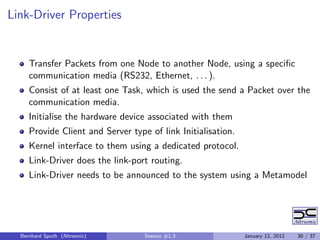
Link-Driver Properties


     Transfer Packets from one Node to another Node, using a specific
     communication media (RS232, Ethernet, . . . ).
     Consist of at least one Task, which is used the send a Packet over the
     communication media.
     Initialise the hardware device associated with them
     Provide Client and Server type of link Initialisation.
     Kernel interface to them using a dedicated protocol.
     Link-Driver does the link-port routing.
     Link-Driver needs to be announced to the system using a Metamodel


  Bernhard Sputh (Altreonic)       Session #1.3               January 12, 2012   30 / 37
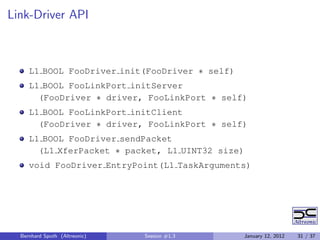
Link-Driver API


     L1 BOOL FooDriver init(FooDriver ∗ self)
     L1 BOOL FooLinkPort initServer
       (FooDriver ∗ driver, FooLinkPort ∗ self)
     L1 BOOL FooLinkPort initClient
       (FooDriver ∗ driver, FooLinkPort ∗ self)
     L1 BOOL FooDriver sendPacket
       (L1 XferPacket ∗ packet, L1 UINT32 size)
     void FooDriver EntryPoint(L1 TaskArguments)


  Bernhard Sputh (Altreonic)   Session #1.3     January 12, 2012   31 / 37
General-Driver Properties


     Implemented as normal user Tasks.
     Full control over the Application Programmer Interface (API).
     Additionally can be implemented like a Host Service Component.
     Interfacing to the Interrupt Request (IRQ) has to be done in the
     platform specific way.


  Bernhard Sputh (Altreonic)     Session #1.3             January 12, 2012   32 / 37
Outline

1   How OpenComRTOS works Internally
      Interacting Entities in Detail
      Virtual Single Processor (VSP) Programming Model
      Priority Inversion

2   Build Process

3   Extending OpenComRTOS
      Components
      Porting to a new Platform
      Device Drivers

4   Summary
Summary


This Lecture covered the following:
     Build process of OpenComRTOS projects;
     The steps involved in porting OpenComRTOS to a new Platform.


  Bernhard Sputh (Altreonic)     Session #1.3        January 12, 2012   34 / 37
Questions?


Bernhard Sputh (Altreonic)      Session #1.3   January 12, 2012   35 / 37
Thank You
for Your attention


http://www.altreonic.com
References


  Bernhard Sputh (Altreonic)   Session #1.3   January 12, 2012   37 / 37

OpenComRTOS 1.4_tutorial_3o4_presentation

  • 1.
    Session #1.3: OpenComRTOSInternals Bernhard Sputh bernhard.sputh@altreonic.com Altreonic NV Gemeentestraat 61 Bus 1 3210 Linden Belgium January 12, 2012 Bernhard Sputh (Altreonic) Session #1.3 January 12, 2012 1 / 37
  • 2.
    Outline of thisWorkshop Session #1.1: The Theoretical foundations of OpenComRTOS Session #1.2: Introduction to OpenComRTOS and the OpenComRTOS Designer Suite Session #1.3: OpenComRTOS Internals Session #1.4: Hands on with the OpenComRTOS Designer Suite Bernhard Sputh (Altreonic) Session #1.3 January 12, 2012 2 / 37
  • 3.
    1 How OpenComRTOS works Internally Interacting Entities in Detail Virtual Single Processor (VSP) Programming Model Priority Inversion 2 Build Process 3 Extending OpenComRTOS Components Porting to a new Platform Device Drivers 4 Summary Bernhard Sputh (Altreonic) Session #1.3 January 12, 2012 3 / 37
  • 4.
    Outline 1 How OpenComRTOS works Internally Interacting Entities in Detail Virtual Single Processor (VSP) Programming Model Priority Inversion 2 Build Process 3 Extending OpenComRTOS Components Porting to a new Platform Device Drivers 4 Summary
  • 5.
    OpenComRTOS Paradigms Interacting Entities Virtual Single Processor (VSP) Programming Model. Bernhard Sputh (Altreonic) Session #1.3 January 12, 2012 5 / 37
  • 6.
    Interacting Entities Entities: Tasks (Active Entities) Hubs (Passive Entities) Interactions Bernhard Sputh (Altreonic) Session #1.3 January 12, 2012 6 / 37
  • 7.
    Task Internals Bernhard Sputh (Altreonic) Session #1.3 January 12, 2012 7 / 37
  • 8.
    Hub Internals Bernhard Sputh (Altreonic) Session #1.3 January 12, 2012 8 / 37
  • 9.
    Basic Interactions Every Interactions is represented with a Task injecting a Packet into the Task Input Port of the Kernel Task. Every Packet contains the current Priority of the Task, that sent it. Sending a Packet results in the Task to be suspended, until the corresponding Acknowledgement Packet arrives. Bernhard Sputh (Altreonic) Session #1.3 January 12, 2012 9 / 37
  • 10.
    Virtual Single Processor(VSP) Programming Model. Entities can be distributed in any form over the system, OpenComRTOS ensures that the logical behaviour is preserved. Separates Hardware from Software. Both can be changed almost independently. Interactions take place independent of placement. For VSP to work OpenComRTOS separates Topology and Application from each other. Bernhard Sputh (Altreonic) Session #1.3 January 12, 2012 10 / 37
  • 11.
    Virtual Single Processor(VSP) Programming Model. Entities can be distributed in any form over the system, OpenComRTOS ensures that the logical behaviour is preserved. Separates Hardware from Software. Both can be changed almost independently. Interactions take place independent of placement. For VSP to work OpenComRTOS separates Topology and Application from each other. Bernhard Sputh (Altreonic) Session #1.3 January 12, 2012 10 / 37
  • 12.
    Topology Nodes Link Ports Links Bernhard Sputh (Altreonic) Session #1.3 January 12, 2012 11 / 37
  • 13.
    Application Entities Tasks Hubs Host Service Components All entities of an Application can be mapped onto any available Node, with the exception of Host Service components, these must be placed either on a Windows or Posix32 node. Bernhard Sputh (Altreonic) Session #1.3 January 12, 2012 12 / 37
  • 14.
    Interactions in MultiNode Systems Bernhard Sputh (Altreonic) Session #1.3 January 12, 2012 13 / 37
  • 15.
    Priority Inversion Definition: “priorityinversion is a problematic scenario in scheduling when a higher priority task is indirectly preempted by a lower priority task effectively ‘inverting’ the relative priorities of the two tasks.”. Typically that is caused when s shared resource gets protected with a Lock / Mutex, for instance: a shared memory buffer that must be read out before new data is written in; hardware status registers that set a peripheral in a specific state; a peripheral that can handle only one request at a time. Bernhard Sputh (Altreonic) Session #1.3 January 12, 2012 14 / 37
  • 16.
    Priority Inheritance asSolution If Priority Inversion gets detected, the Priority of the lower Priority Task get boosted to the level of the higher Priority Task. OpenComRTOS supports that on single Node systems. OpenComRTOS supports this also system wide, i.e. the location of the Task does not matter. Bernhard Sputh (Altreonic) Session #1.3 January 12, 2012 15 / 37
  • 17.
    Outline 1 How OpenComRTOS works Internally Interacting Entities in Detail Virtual Single Processor (VSP) Programming Model Priority Inversion 2 Build Process 3 Extending OpenComRTOS Components Porting to a new Platform Device Drivers 4 Summary
  • 18.
    Build Process ofOpenComRTOS Systems 1 Project-Generator Phase: Calculates the Routing-Tables for each Node. Determines the IDs of the Enties of the system. Creates the directory Output. Creates a directory for each Node, and stores the Node-XML file there. Triggers the build process for each Node. 2 Code-Generator Phase: Generates a CMake based build system for the Node. Generates the Node-Configuration Files for the Node (main one is L1 node config.c) 3 Compile and Link Phase: Each Node gets compiled and linked. The resulting binary gets placed in the directory Output/bin. Bernhard Sputh (Altreonic) Session #1.3 January 12, 2012 17 / 37
  • 19.
    Build Process ofOpenComRTOS Systems 1 Project-Generator Phase: Calculates the Routing-Tables for each Node. Determines the IDs of the Enties of the system. Creates the directory Output. Creates a directory for each Node, and stores the Node-XML file there. Triggers the build process for each Node. 2 Code-Generator Phase: Generates a CMake based build system for the Node. Generates the Node-Configuration Files for the Node (main one is L1 node config.c) 3 Compile and Link Phase: Each Node gets compiled and linked. The resulting binary gets placed in the directory Output/bin. Bernhard Sputh (Altreonic) Session #1.3 January 12, 2012 17 / 37
  • 20.
    Build Process ofOpenComRTOS Systems 1 Project-Generator Phase: Calculates the Routing-Tables for each Node. Determines the IDs of the Enties of the system. Creates the directory Output. Creates a directory for each Node, and stores the Node-XML file there. Triggers the build process for each Node. 2 Code-Generator Phase: Generates a CMake based build system for the Node. Generates the Node-Configuration Files for the Node (main one is L1 node config.c) 3 Compile and Link Phase: Each Node gets compiled and linked. The resulting binary gets placed in the directory Output/bin. Bernhard Sputh (Altreonic) Session #1.3 January 12, 2012 17 / 37
  • 21.
    Outline 1 How OpenComRTOS works Internally Interacting Entities in Detail Virtual Single Processor (VSP) Programming Model Priority Inversion 2 Build Process 3 Extending OpenComRTOS Components Porting to a new Platform Device Drivers 4 Summary
  • 22.
    Components Are a collection of Tasks and Hubs, which provide a certain service. Get provided in a separate library, together with a Metamodel for OpenVE. Provide an access library which can be used from any platform, even if the service is platform specific. Examples for Components are: Stdio Host Service (SHS) Graphical Host Service (GHS) Open System Inspector (OSI) Safe Virtual Machine for C (SVM Bernhard Sputh (Altreonic) Session #1.3 January 12, 2012 19 / 37
  • 23.
    Application Diagram ofa Component Bernhard Sputh (Altreonic) Session #1.3 January 12, 2012 20 / 37
  • 24.
    Porting to anew Platform Consists of the following phases: Phase 1: Context Switch Phase 2: Interrupt Support Phase 3: Multi-Node and Integration Bernhard Sputh (Altreonic) Session #1.3 January 12, 2012 21 / 37
  • 25.
    Phase 1: ContextSwitch Create a new folder in src/platforms/, and copy the contents of src/generic into it. Integrate the newly created folder into the build system. Map OpenComRTOS data types to platform data types: L1 BOOL L1 BYTE L1 INT16 / L1 UINT16 L1 INT32 / L1 UINT32 Fill in the blanks: Context Switch, Enter and Leave Critical Section, Initialisation of the Task Context, Starting a Task. Test this with a Semaphore Loop Project. Bernhard Sputh (Altreonic) Session #1.3 January 12, 2012 22 / 37
  • 26.
    Phase 1: ContextSwitch Create a new folder in src/platforms/, and copy the contents of src/generic into it. Integrate the newly created folder into the build system. Map OpenComRTOS data types to platform data types: L1 BOOL L1 BYTE L1 INT16 / L1 UINT16 L1 INT32 / L1 UINT32 Fill in the blanks: Context Switch, Enter and Leave Critical Section, Initialisation of the Task Context, Starting a Task. Test this with a Semaphore Loop Project. Bernhard Sputh (Altreonic) Session #1.3 January 12, 2012 22 / 37
  • 27.
    Phase 1: ContextSwitch Create a new folder in src/platforms/, and copy the contents of src/generic into it. Integrate the newly created folder into the build system. Map OpenComRTOS data types to platform data types: L1 BOOL L1 BYTE L1 INT16 / L1 UINT16 L1 INT32 / L1 UINT32 Fill in the blanks: Context Switch, Enter and Leave Critical Section, Initialisation of the Task Context, Starting a Task. Test this with a Semaphore Loop Project. Bernhard Sputh (Altreonic) Session #1.3 January 12, 2012 22 / 37
  • 28.
    Semaphore Loop Project Bernhard Sputh (Altreonic) Session #1.3 January 12, 2012 23 / 37
  • 29.
    Phase 2: InterruptSupport Implement Interrupt Handling Support: Enter ISR, Leave ISR; Implement the Periodic Timer driver; Extend the previously developed Semaphore Loop Project, with a Task that performs a waiting with timeout operation on a new Semaphore. Bernhard Sputh (Altreonic) Session #1.3 January 12, 2012 24 / 37
  • 30.
    Extended Semaphore LoopProject Bernhard Sputh (Altreonic) Session #1.3 January 12, 2012 25 / 37
  • 31.
    Phase 3: Multi-Nodeand Integration Implement a Link Driver, typically RS232; Implement the network endianess adjustment routines. Over a link we always use big-endian. Implement an Example that connects two Nodes, typically the new Platform plus a Win32 / Posix32 Node. Implement the remaining device drivers for the target (Link Drivers, special IO drivers). Adjust OpenVE Metamodel and the Code Generators. Bernhard Sputh (Altreonic) Session #1.3 January 12, 2012 26 / 37
  • 32.
    Device Drivers Timer-Drivers Link-Drivers General-Drivers Bernhard Sputh (Altreonic) Session #1.3 January 12, 2012 27 / 37
  • 33.
    Timer-Driver Properties Provide a periodic tick (usuall every 1ms). Handle Timeouts Provide high precision timestamps when tracing. Integrated into the Platform Image. Hard instantiation during system startup. Have no Task. Bernhard Sputh (Altreonic) Session #1.3 January 12, 2012 28 / 37
  • 34.
    Timer-Driver API void L1 initTimer(void) void L1 Timer setTimeout(L1 Timeout tick, L1 UINT32 id) void L1 Timer cancelTimeout(void) L1 Timeout L1 Timer getExpiredTimeoutTicks(void) L1 Timeout L1 Timer getRemainingTimeoutTicks(void) L1 Time L1 Timer getCurrentTime(void) L1 Status L1 Timer getTimeStamp (L1 TimeStamp ∗ pTimeStamp) L1 UINT32 L1 Timer getLowCounterFrequency(void) L1 UINT32 L1 Timer getHighCounterFrequency(void) Bernhard Sputh (Altreonic) Session #1.3 January 12, 2012 29 / 37
  • 35.
    Link-Driver Properties Transfer Packets from one Node to another Node, using a specific communication media (RS232, Ethernet, . . . ). Consist of at least one Task, which is used the send a Packet over the communication media. Initialise the hardware device associated with them Provide Client and Server type of link Initialisation. Kernel interface to them using a dedicated protocol. Link-Driver does the link-port routing. Link-Driver needs to be announced to the system using a Metamodel Bernhard Sputh (Altreonic) Session #1.3 January 12, 2012 30 / 37
  • 36.
    Link-Driver API L1 BOOL FooDriver init(FooDriver ∗ self) L1 BOOL FooLinkPort initServer (FooDriver ∗ driver, FooLinkPort ∗ self) L1 BOOL FooLinkPort initClient (FooDriver ∗ driver, FooLinkPort ∗ self) L1 BOOL FooDriver sendPacket (L1 XferPacket ∗ packet, L1 UINT32 size) void FooDriver EntryPoint(L1 TaskArguments) Bernhard Sputh (Altreonic) Session #1.3 January 12, 2012 31 / 37
  • 37.
    General-Driver Properties Implemented as normal user Tasks. Full control over the Application Programmer Interface (API). Additionally can be implemented like a Host Service Component. Interfacing to the Interrupt Request (IRQ) has to be done in the platform specific way. Bernhard Sputh (Altreonic) Session #1.3 January 12, 2012 32 / 37
  • 38.
    Outline 1 How OpenComRTOS works Internally Interacting Entities in Detail Virtual Single Processor (VSP) Programming Model Priority Inversion 2 Build Process 3 Extending OpenComRTOS Components Porting to a new Platform Device Drivers 4 Summary
  • 39.
    Summary This Lecture coveredthe following: Build process of OpenComRTOS projects; The steps involved in porting OpenComRTOS to a new Platform. Bernhard Sputh (Altreonic) Session #1.3 January 12, 2012 34 / 37
  • 40.
    Questions? Bernhard Sputh (Altreonic) Session #1.3 January 12, 2012 35 / 37
  • 41.
    Thank You for Yourattention http://www.altreonic.com
  • 42.
    References BernhardSputh (Altreonic) Session #1.3 January 12, 2012 37 / 37