


Open Textbooks

              David Wiley
Instructional Psychology & Technology
       Brigham Young University
What Does “Open” Mean?

      Why should we care?

 How will it benefit our students?
1. Education Is Sharing

    the core argument
Teachers Share With Students

       Knowledge and skills
      Feedback and criticism
         Encouragement
Students Share With Teachers

           Questions
          Assignments
              Tests
If There Is No Sharing

   There is no education
Successful Educators

 Share most compeltely
 with the most students
Knowledge is Magical

Can be given without being given away
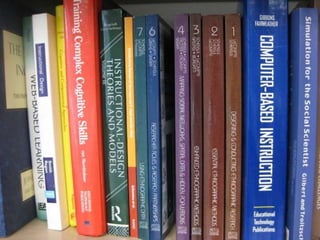
Physical Expressions Are Not

 To give a book you must give it away
Expressions Are Different

To give a book you must give it away
When Expressions Are Digital

    They also become magical
An Indescribable Advance

 The first time in human history
Both Knowledge and Expressions

   Can be given without giving away
Unprecedented Capacity

 We can share as never before
Unprecedented Capacity

We can educate as never before
What Does “Share” Mean?

Online it means copy and distribute
Cost of “Copy”
For one 250 page book:

• Copy by hand - $1,000

• Copy by print on demand - $4.50

• Copy by computer - $0.00084
Cost of “Distribute”
For one 250 page book:

• Distribute by mail - $5.20

• Distribute by internet - $0.00072
Copy and Distribute are “Free”

      This changes everything
Educational Sharing

Also means adapting or editing
Sense-making, Meaning-making

    Connecting to prior knowledge
      Relating to past experience
     (In an appropriate language)
Digital Makes Editing “Free”

 Editing a printed book or magazine
       is difficult and expensive
Free Copy, Distribute, Edit

  We can share as never before
Free Copy, Distribute, Edit

 We can educate as never before
Except We Can’t

© forbids copying, distributing, and editing
© Cancels the Possibilities

 Of digital media and the internet
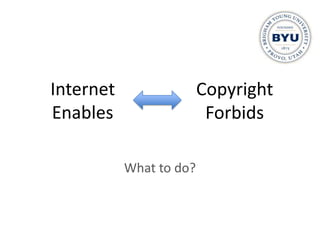
Internet                 Copyright
Enables                   Forbids

           What to do?
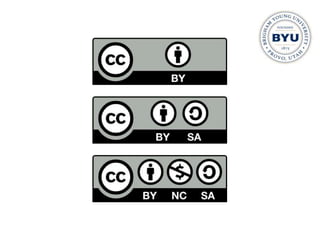
Use copyright to enforce sharing
The 4Rs

    Reuse – copy verbatim
Redistribute – share with others
    Revise – adapt and edit
 Remix – combine with others
Over 400 Million Items

Using CC licenses at end of 2010
The “Open” in OER

Free permission to do the 4Rs
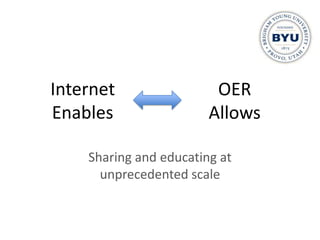
Internet                 OER
Enables                 Allows

    Sharing and educating at
      unprecedented scale
2. The $5 Textbook

 the financial argument
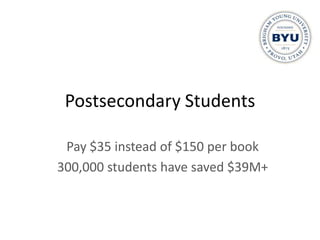
Postsecondary Students

 Pay $35 instead of $150 per book
300,000 students have saved $39M+
Postsecondary Students

 Pay $35 instead of $150 per book
300,000 students have saved $39M+
Project Kaleidoscope (NGLC)

    Preliminary research results
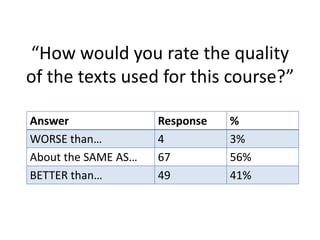
“How would you rate the quality
of the texts used for this course?”

Answer               Response   %
WORSE than…          4          3%
About the SAME AS…   67         56%
BETTER than…         49         41%
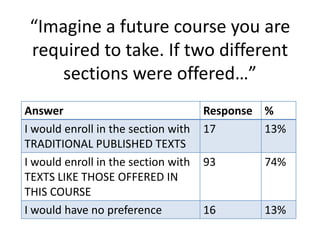
“Imagine a future course you are
 required to take. If two different
    sections were offered…”
Answer                               Response %
I would enroll in the section with   17       13%
TRADITIONAL PUBLISHED TEXTS
I would enroll in the section with   93      74%
TEXTS LIKE THOSE OFFERED IN
THIS COURSE
I would have no preference           16      13%
Utah HS Science Classes

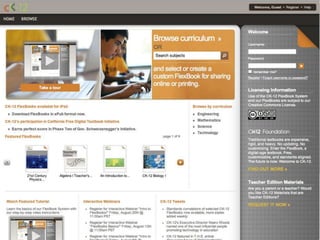
 Teachers adapted CK12 books
     for print or digital use
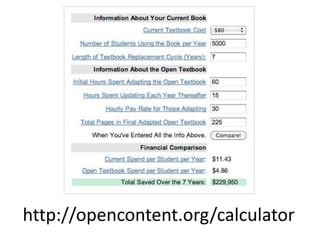
http://opencontent.org/calculator
High Schools

Pay $5 instead of $80 per book
2700 Students in 2011-2012

   1200 students in 2010-2011
Statewide Secondary in 2012

Math 9, Science 9-12, Language Arts 6-12

     Potentially 275,000+ students
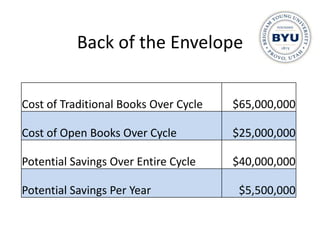
Back of the Envelope


Cost of Traditional Books Over Cycle   $65,000,000

Cost of Open Books Over Cycle          $25,000,000

Potential Savings Over Entire Cycle    $40,000,000

Potential Savings Per Year              $5,500,000
Impact on Learning?

Simple substitution makes no difference
Impact on Learning?

    With PD we will
move the outcomes needle
Pedagogy and OER

Highlighting, annotating, taking notes
Text Marking Strategies

              Adapted from
http://academic.cuesta.edu/acasupp/as/609.htm
Any text marking strategy / system
must make sense to the person using it.
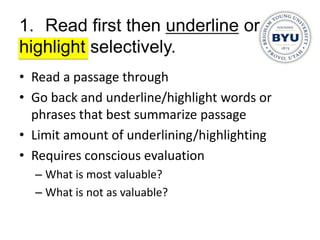
1. Read first then underline or
highlight selectively.
• Read a passage through
• Go back and underline/highlight words or
  phrases that best summarize passage
• Limit amount of underlining/highlighting
• Requires conscious evaluation
  – What is most valuable?
  – What is not as valuable?
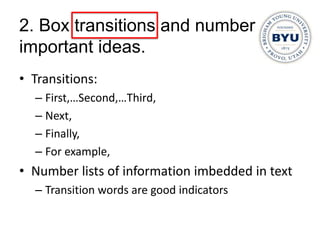
2. Box transitions and number
important ideas.
• Transitions:
  – First,…Second,…Third,
  – Next,
  – Finally,
  – For example,
• Number lists of information imbedded in text
  – Transition words are good indicators
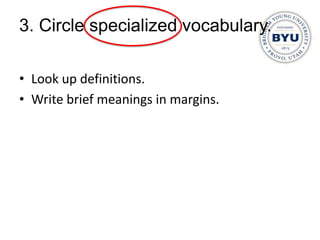
3. Circle specialized vocabulary.

• Look up definitions.
• Write brief meanings in margins.
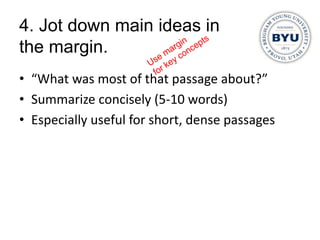
4. Jot down main ideas in
the margin.
• “What was most of that passage about?”
• Summarize concisely (5-10 words)
• Especially useful for short, dense passages
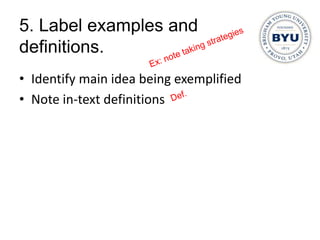
5. Label examples and
definitions.
• Identify main idea being exemplified
• Note in-text definitions
6. Write own ideas in [square
brackets].
• Connections to other passages, class
  discussions, or assignments
• Use top or bottom of page
• Requires active reading and critical thinking
• Will make study more interesting and useful
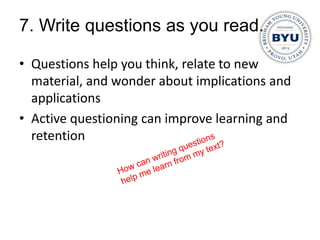
7. Write questions as you read.

• Questions help you think, relate to new
  material, and wonder about implications and
  applications
• Active questioning can improve learning and
  retention
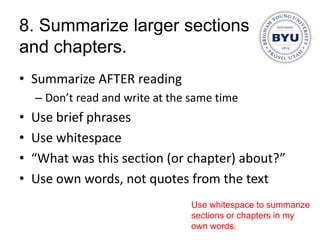
8. Summarize larger sections
and chapters.
• Summarize AFTER reading
    – Don’t read and write at the same time
•   Use brief phrases
•   Use whitespace
•   “What was this section (or chapter) about?”
•   Use own words, not quotes from the text
                                 Use whitespace to summarize
                                 sections or chapters in my
                                 own words.
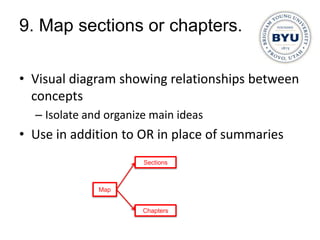
9. Map sections or chapters.

• Visual diagram showing relationships between
  concepts
  – Isolate and organize main ideas
• Use in addition to OR in place of summaries
                       Sections


              Map


                       Chapters
10. Check-mark important
opinions. ✔✔
• Isolate opinions of the author from factual
  statements
• Evaluate importance of opinions
• Use multiple check-marks for more important
  opinions

Open Textbook Training in Arizona

  • 1.
    Open Textbooks David Wiley Instructional Psychology & Technology Brigham Young University
  • 2.
    What Does “Open”Mean? Why should we care? How will it benefit our students?
  • 3.
    1. Education IsSharing the core argument
  • 4.
    Teachers Share WithStudents Knowledge and skills Feedback and criticism Encouragement
  • 5.
    Students Share WithTeachers Questions Assignments Tests
  • 6.
    If There IsNo Sharing There is no education
  • 7.
    Successful Educators Sharemost compeltely with the most students
  • 8.
    Knowledge is Magical Canbe given without being given away
  • 9.
    Physical Expressions AreNot To give a book you must give it away
  • 10.
    Expressions Are Different Togive a book you must give it away
  • 11.
    When Expressions AreDigital They also become magical
  • 14.
    An Indescribable Advance The first time in human history
  • 15.
    Both Knowledge andExpressions Can be given without giving away
  • 16.
    Unprecedented Capacity Wecan share as never before
  • 17.
    Unprecedented Capacity We caneducate as never before
  • 18.
    What Does “Share”Mean? Online it means copy and distribute
  • 19.
    Cost of “Copy” Forone 250 page book: • Copy by hand - $1,000 • Copy by print on demand - $4.50 • Copy by computer - $0.00084
  • 20.
    Cost of “Distribute” Forone 250 page book: • Distribute by mail - $5.20 • Distribute by internet - $0.00072
  • 21.
    Copy and Distributeare “Free” This changes everything
  • 22.
    Educational Sharing Also meansadapting or editing
  • 23.
    Sense-making, Meaning-making Connecting to prior knowledge Relating to past experience (In an appropriate language)
  • 24.
    Digital Makes Editing“Free” Editing a printed book or magazine is difficult and expensive
  • 25.
    Free Copy, Distribute,Edit We can share as never before
  • 26.
    Free Copy, Distribute,Edit We can educate as never before
  • 27.
    Except We Can’t ©forbids copying, distributing, and editing
  • 28.
    © Cancels thePossibilities Of digital media and the internet
  • 29.
    Internet Copyright Enables Forbids What to do?
  • 31.
    Use copyright toenforce sharing
  • 32.
    The 4Rs Reuse – copy verbatim Redistribute – share with others Revise – adapt and edit Remix – combine with others
  • 34.
    Over 400 MillionItems Using CC licenses at end of 2010
  • 35.
    The “Open” inOER Free permission to do the 4Rs
  • 36.
    Internet OER Enables Allows Sharing and educating at unprecedented scale
  • 37.
    2. The $5Textbook the financial argument
  • 39.
    Postsecondary Students Pay$35 instead of $150 per book 300,000 students have saved $39M+
  • 40.
    Postsecondary Students Pay$35 instead of $150 per book 300,000 students have saved $39M+
  • 41.
    Project Kaleidoscope (NGLC) Preliminary research results
  • 42.
    “How would yourate the quality of the texts used for this course?” Answer Response % WORSE than… 4 3% About the SAME AS… 67 56% BETTER than… 49 41%
  • 43.
    “Imagine a futurecourse you are required to take. If two different sections were offered…” Answer Response % I would enroll in the section with 17 13% TRADITIONAL PUBLISHED TEXTS I would enroll in the section with 93 74% TEXTS LIKE THOSE OFFERED IN THIS COURSE I would have no preference 16 13%
  • 45.
    Utah HS ScienceClasses Teachers adapted CK12 books for print or digital use
  • 46.
  • 47.
    High Schools Pay $5instead of $80 per book
  • 48.
    2700 Students in2011-2012 1200 students in 2010-2011
  • 49.
    Statewide Secondary in2012 Math 9, Science 9-12, Language Arts 6-12 Potentially 275,000+ students
  • 50.
    Back of theEnvelope Cost of Traditional Books Over Cycle $65,000,000 Cost of Open Books Over Cycle $25,000,000 Potential Savings Over Entire Cycle $40,000,000 Potential Savings Per Year $5,500,000
  • 51.
    Impact on Learning? Simplesubstitution makes no difference
  • 52.
    Impact on Learning? With PD we will move the outcomes needle
  • 53.
    Pedagogy and OER Highlighting,annotating, taking notes
  • 54.
    Text Marking Strategies Adapted from http://academic.cuesta.edu/acasupp/as/609.htm
  • 55.
    Any text markingstrategy / system must make sense to the person using it.
  • 56.
    1. Read firstthen underline or highlight selectively. • Read a passage through • Go back and underline/highlight words or phrases that best summarize passage • Limit amount of underlining/highlighting • Requires conscious evaluation – What is most valuable? – What is not as valuable?
  • 57.
    2. Box transitionsand number important ideas. • Transitions: – First,…Second,…Third, – Next, – Finally, – For example, • Number lists of information imbedded in text – Transition words are good indicators
  • 58.
    3. Circle specializedvocabulary. • Look up definitions. • Write brief meanings in margins.
  • 59.
    4. Jot downmain ideas in the margin. • “What was most of that passage about?” • Summarize concisely (5-10 words) • Especially useful for short, dense passages
  • 60.
    5. Label examplesand definitions. • Identify main idea being exemplified • Note in-text definitions
  • 61.
    6. Write ownideas in [square brackets]. • Connections to other passages, class discussions, or assignments • Use top or bottom of page • Requires active reading and critical thinking • Will make study more interesting and useful
  • 62.
    7. Write questionsas you read. • Questions help you think, relate to new material, and wonder about implications and applications • Active questioning can improve learning and retention
  • 63.
    8. Summarize largersections and chapters. • Summarize AFTER reading – Don’t read and write at the same time • Use brief phrases • Use whitespace • “What was this section (or chapter) about?” • Use own words, not quotes from the text Use whitespace to summarize sections or chapters in my own words.
  • 64.
    9. Map sectionsor chapters. • Visual diagram showing relationships between concepts – Isolate and organize main ideas • Use in addition to OR in place of summaries Sections Map Chapters
  • 65.
    10. Check-mark important opinions.✔✔ • Isolate opinions of the author from factual statements • Evaluate importance of opinions • Use multiple check-marks for more important opinions

Editor's Notes

  • #11 CC By Photo by David Wiley
  • #13 CC licensedphoto http://www.flickr.com/photos/62693815@N03/6277209256/