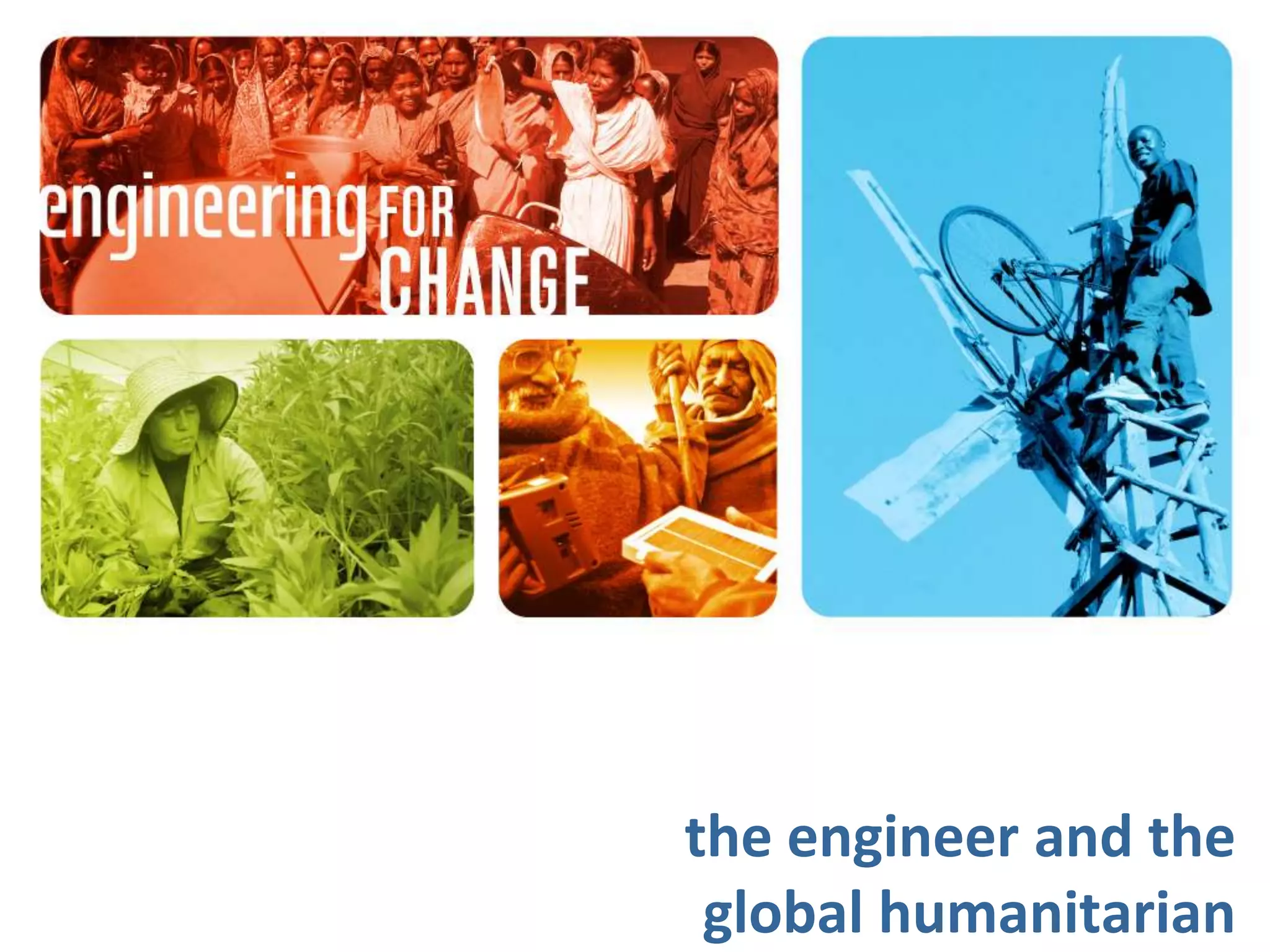
the engineer and the global humanitarian
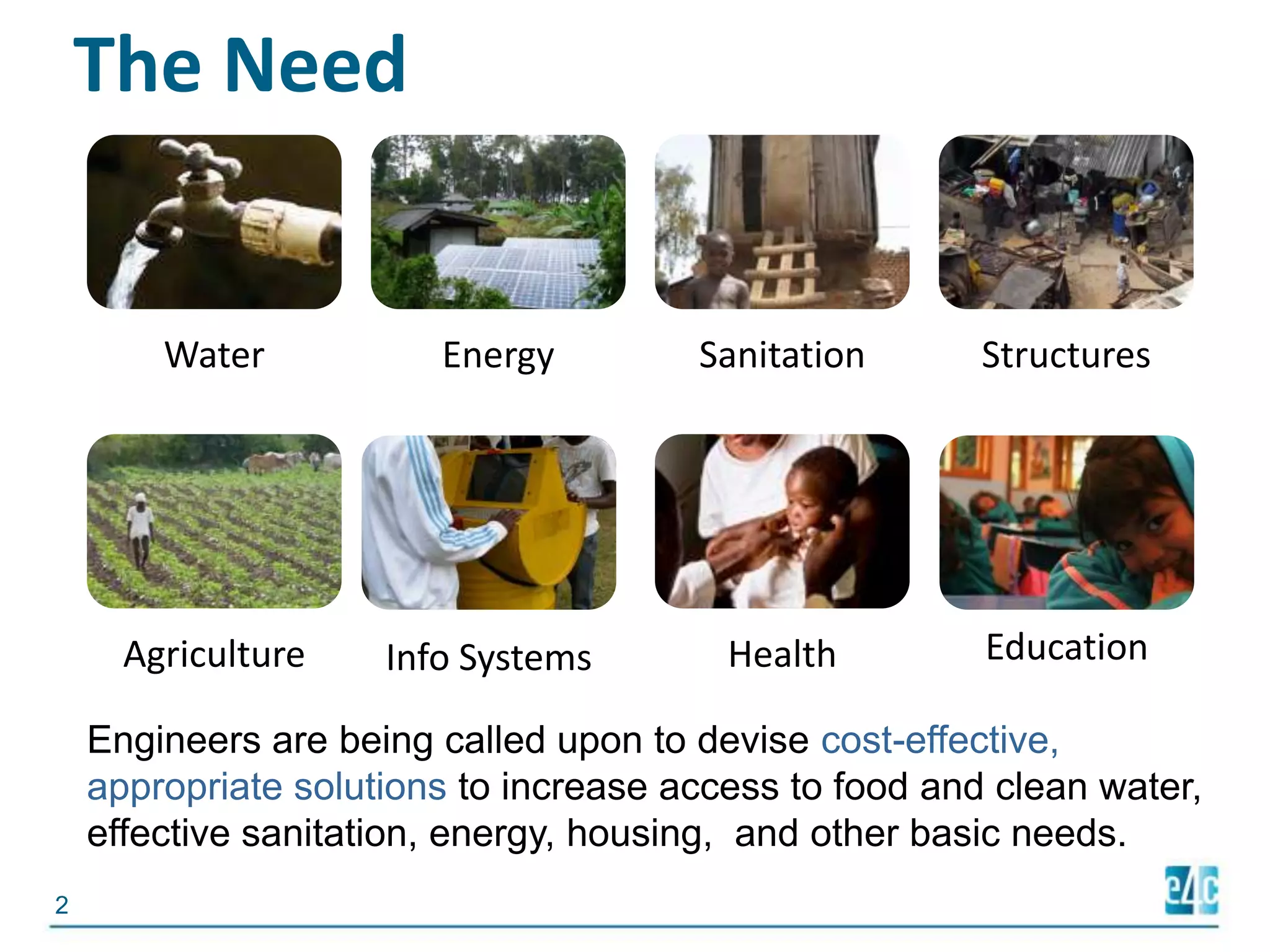
The NeedEngineers are being called upon to devise cost-effective, appropriate solutions to increase access to food and clean water, effective sanitation, energy, housing,  and other basic needs.
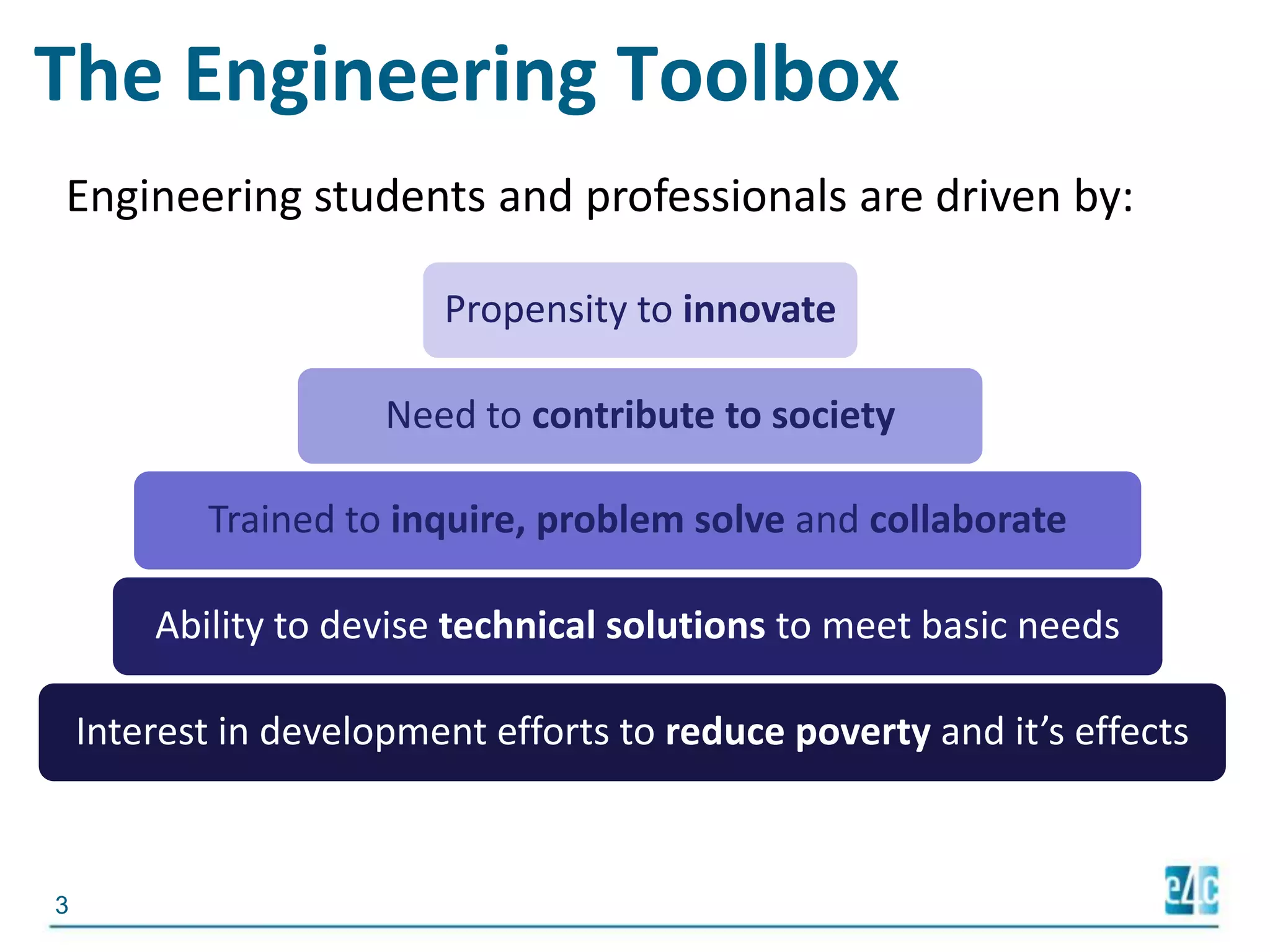
The Engineering ToolboxEngineering students and professionals are driven by:
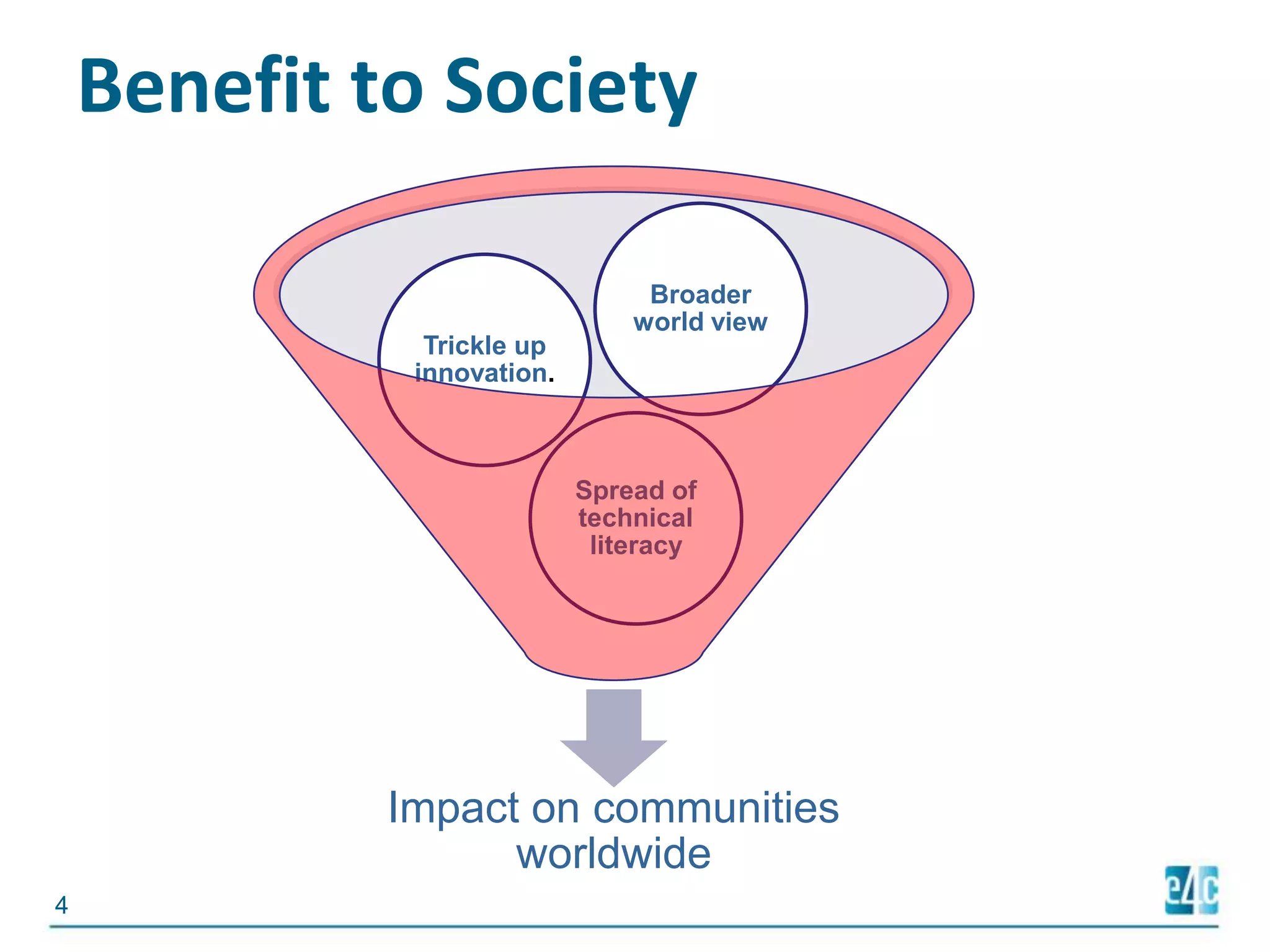
Benefit to Society
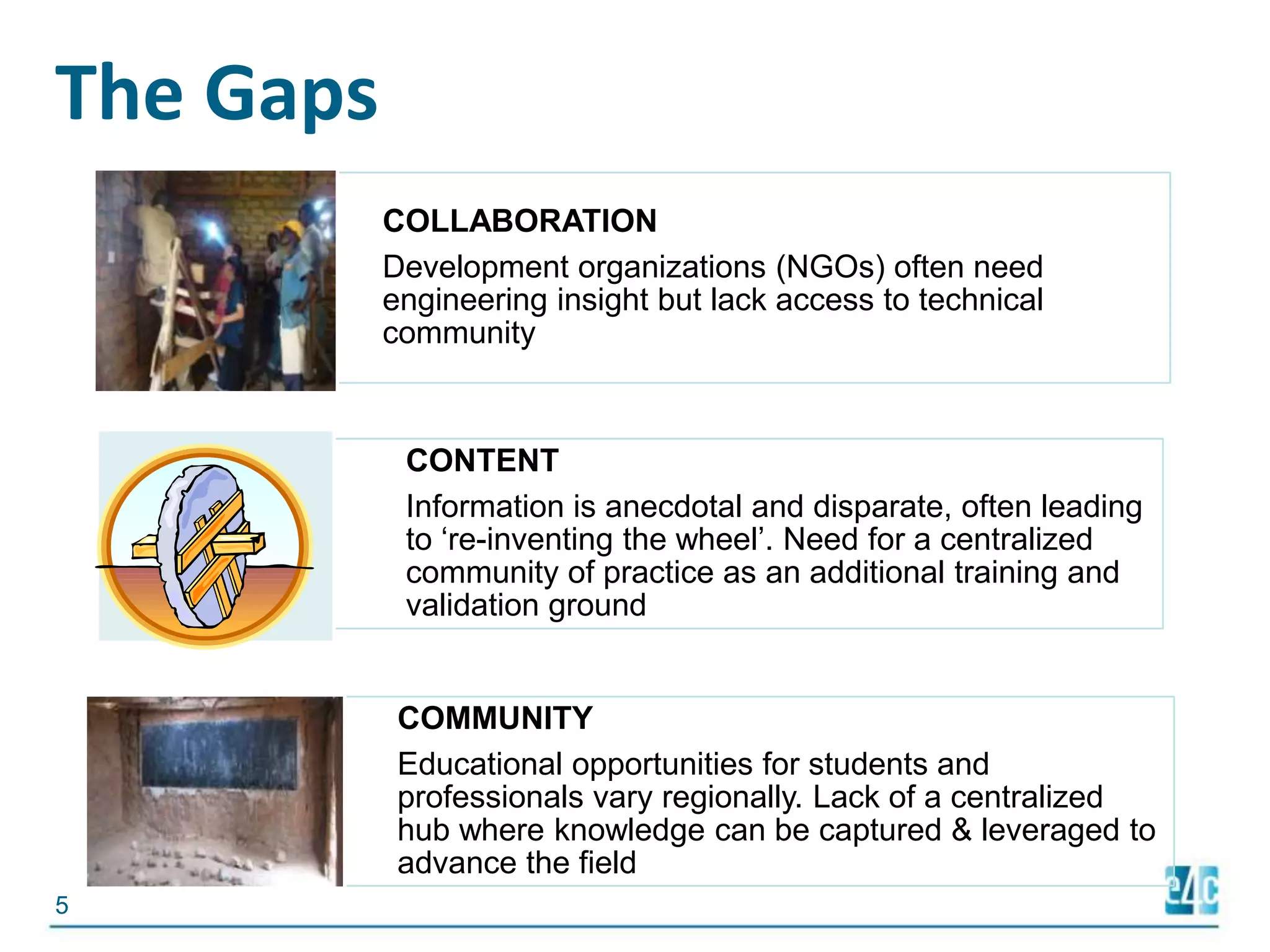
The Gaps
The OpportunityBuild a “network” that brings volunteer engineers across professions together to work as virtual teams with local organizations, schools and communitiesAggregate content and be an open knowledge source for a range of workable solutions for meeting basic community needs. Be a resource for developing effective solutions that could be adapted and improved across diverse communities and regionsHighlight how engineers and the engineering profession play a critical role in addressing quality of life issuesVirtually connect educators and students to on-the-ground projects and identify opportunities for service learning
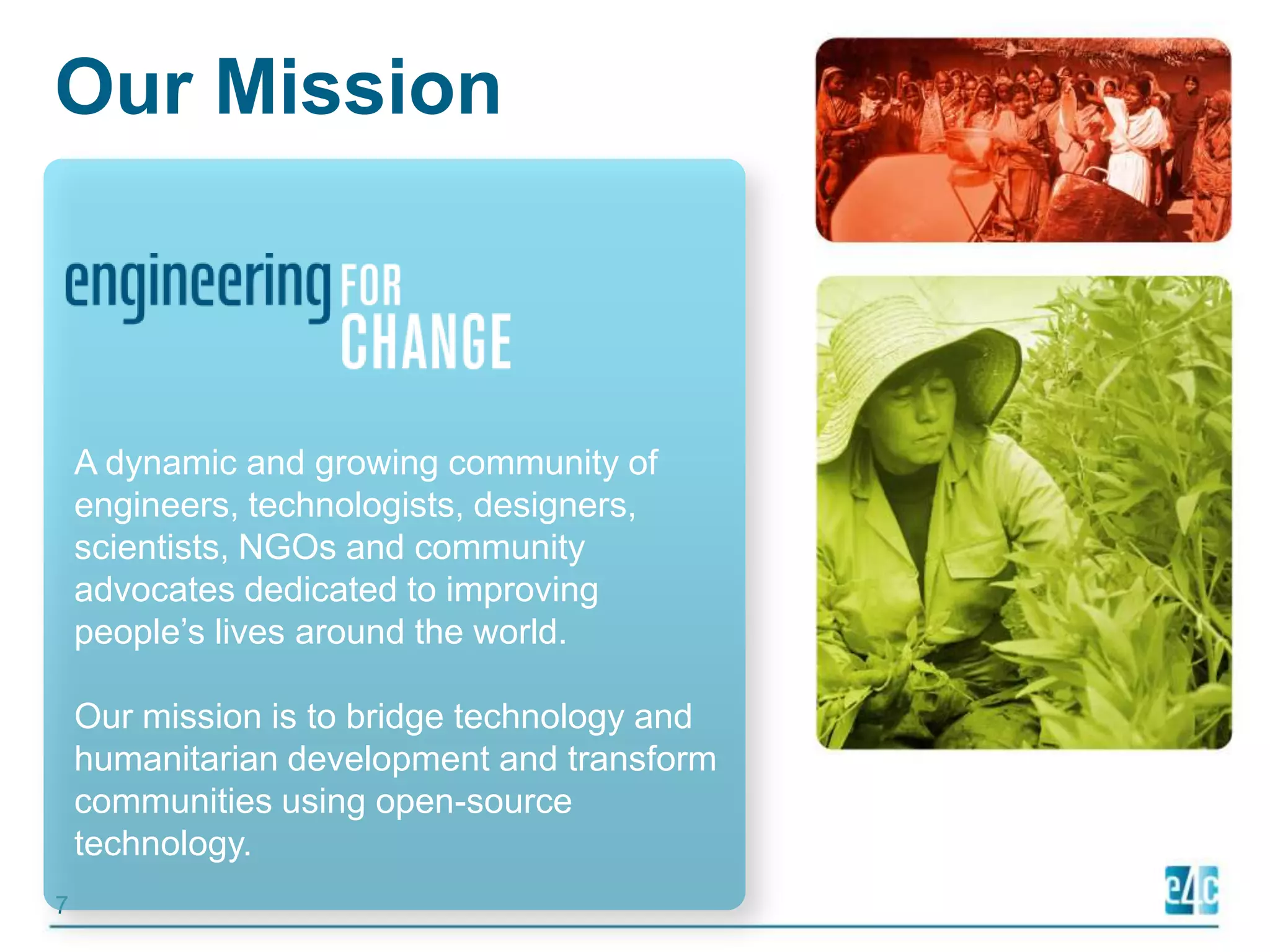
Our MissionA dynamic and growing community of engineers, technologists, designers, scientists, NGOs and community advocates dedicated to improving people’s lives around the world.  Our mission is to bridge technology and humanitarian development and transform communities using open-source technology.
Design PrinciplesAppropriate technology development involves co-creating innovative solutions that are sustainable, affordable andreliable.Develop appropriate solutions, not technologiesConsider the contextCreate transparent technologiesEmbrace the marketDesign for DIY (Do It Yourself)
Develop appropriate solutions, not technologiesGoal: Design meaningful and innovative solutions that are desirable to your constituents and serve their needs.Techniques: 	- Understand communities’ needs, hopes and aspirations 	for the future: Needs assessment	- Capture peoples’ stories: interviews, video, group-	sessions, one-on-one visits	- Research: what other approaches have been 	effective/ineffective
Consider the contextGoal: Design solutions that are feasible for the  community.Techniques:	-outline the constraints by considering context 	(social, 	technical, economic, cultural)- get personal experience: spend a week living on $2 a 	day to begin to understand the trade-offs 	- identify patterns and brainstorm ideas	- share ideas with the end users to get frequent 	feedback/input and incorporate input to co-create and 	whiteboard solutions- supplement your team with experts
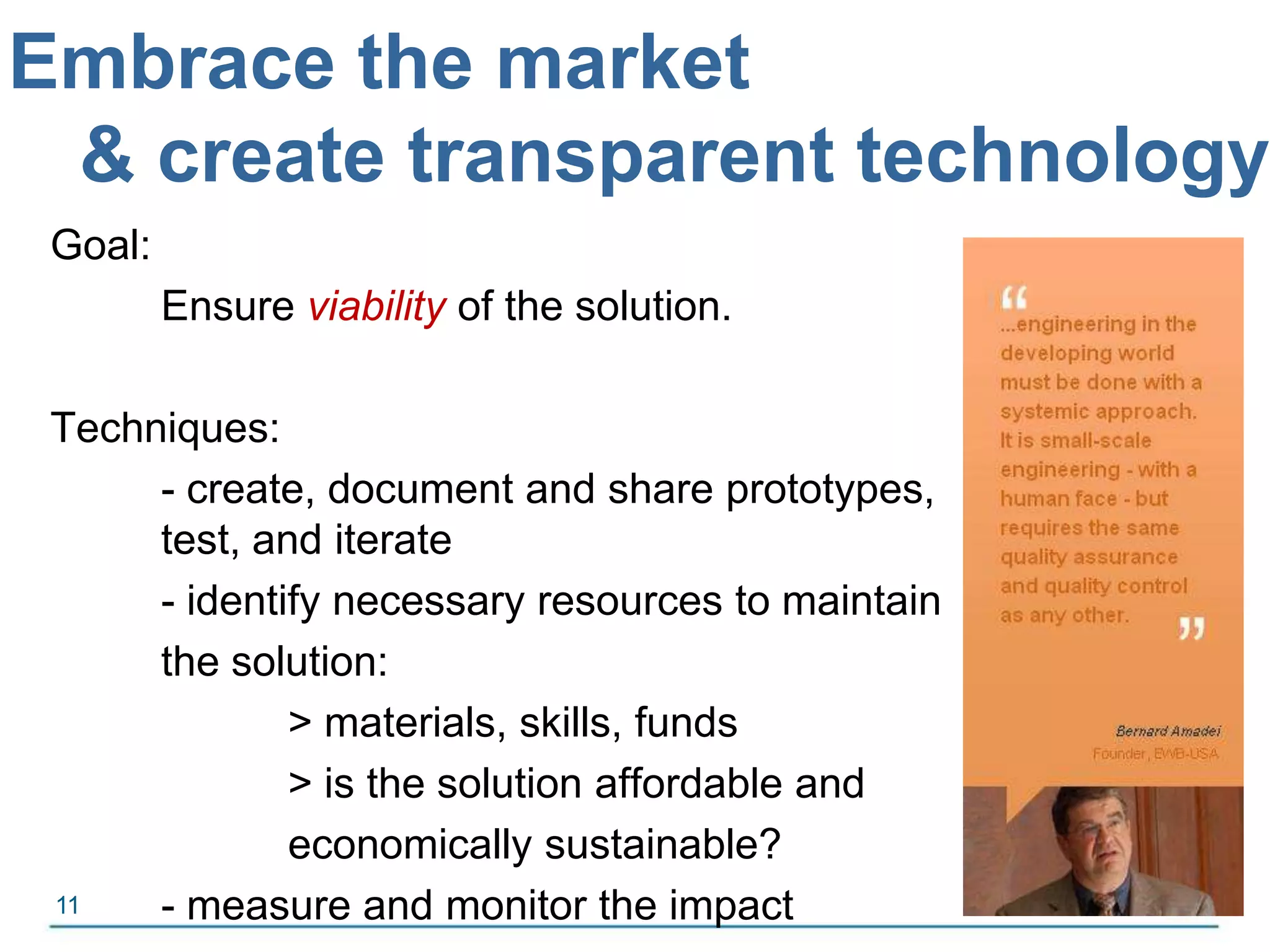
Embrace the market& create transparent technologyGoal:Ensure viability of the solution.Techniques:- create, document and share prototypes, 	test, and iterate	-identify necessary resources to maintain the solution:	> materials, skills, funds		> is the solution affordable and	economically sustainable?	- measure and monitor the impact
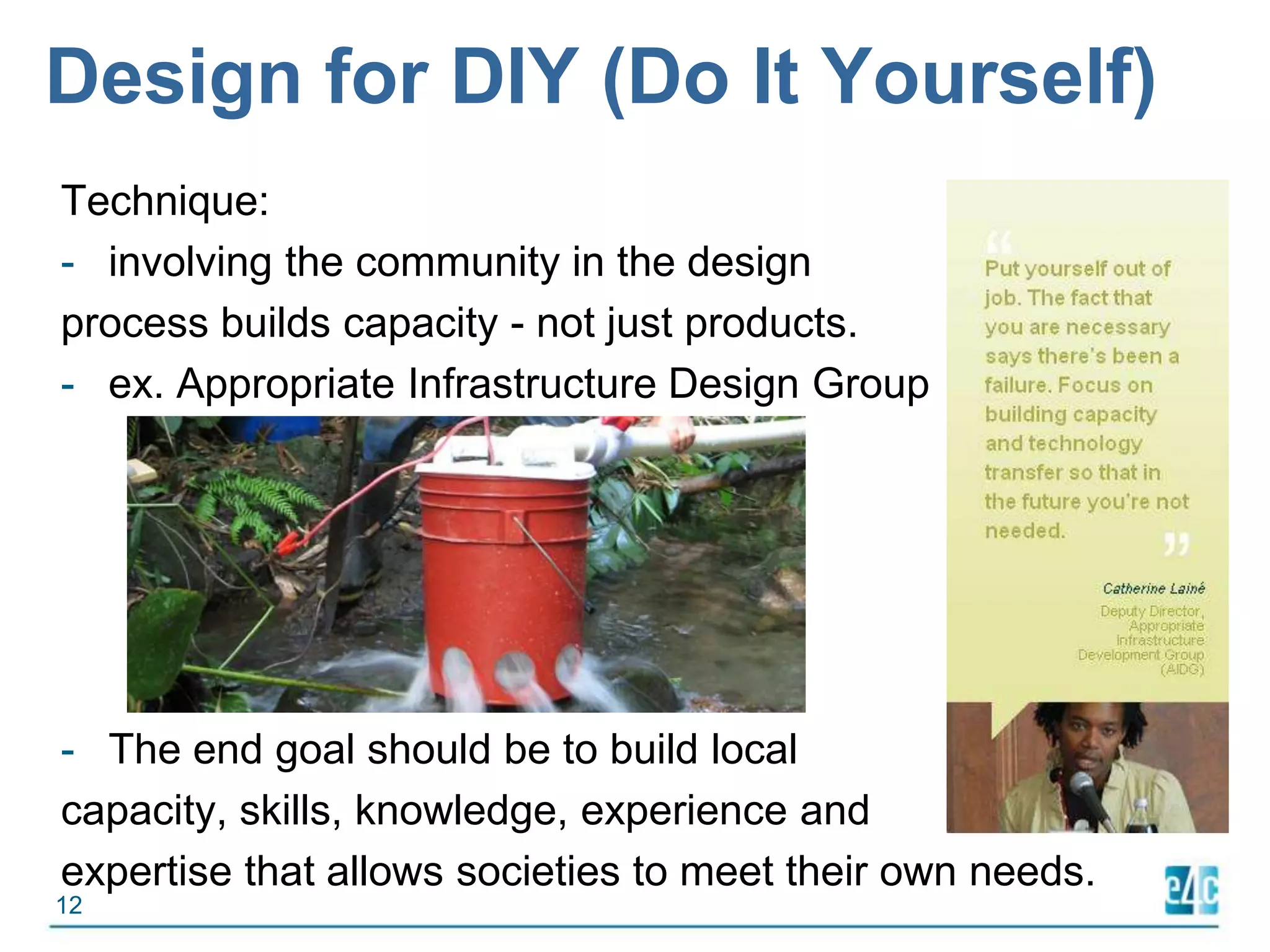
Design for DIY (Do It Yourself)Technique:involving the community in the design process builds capacity - not just products. ex. Appropriate Infrastructure Design Group
The end goal should be to build local capacity, skills, knowledge, experience and expertise that allows societies to meet their own needs.
Solution Development:Case study  CHALLENGE:Newborn babies often face hypothermia: they are not able to regulate their own body temperature, and can’t stay warm. How to prevent hypothermia in rural clinics in the developing world?
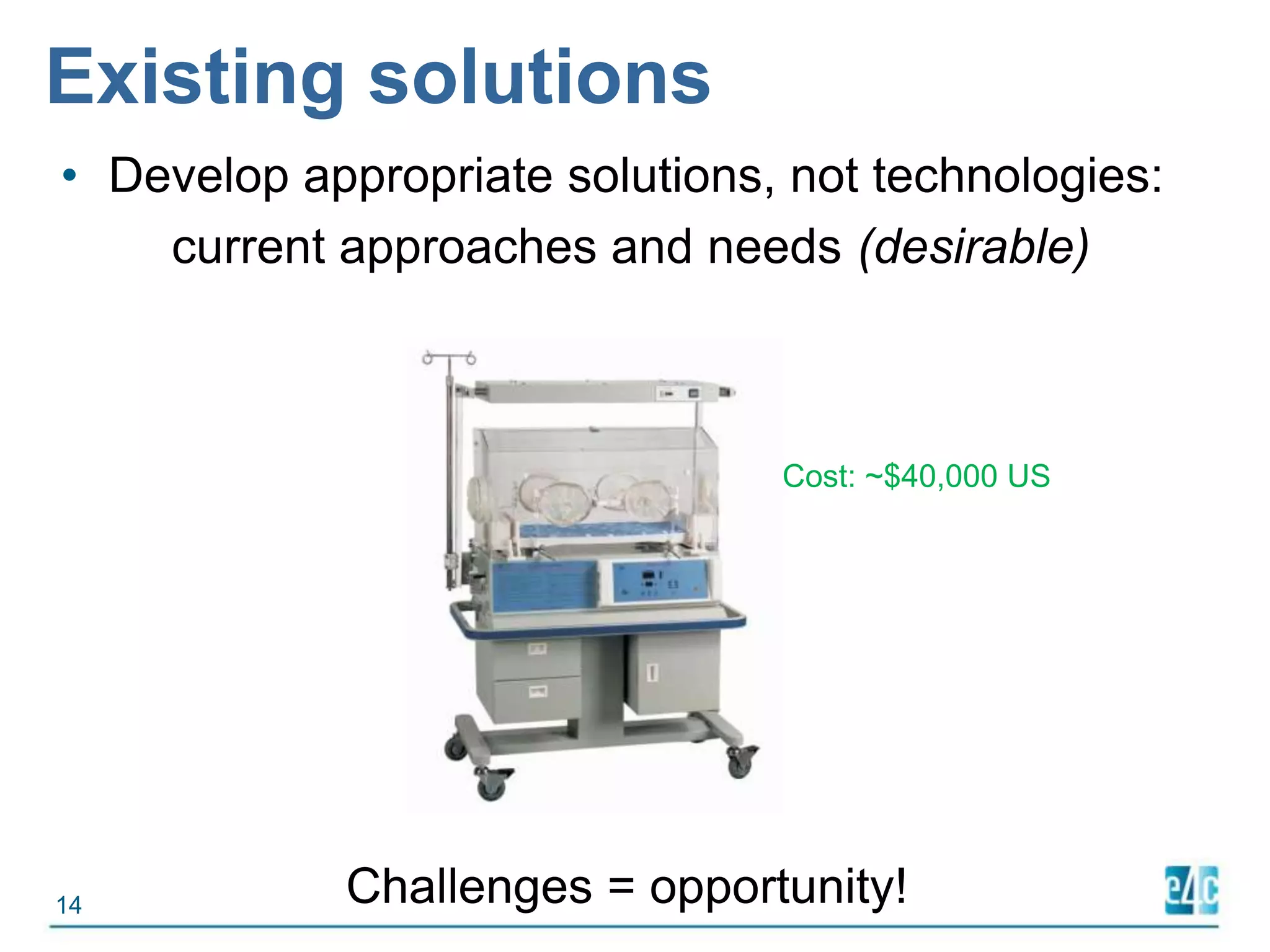
Existing solutionsDevelop appropriate solutions, not technologies:current approaches and needs (desirable)Challenges = opportunity! Cost: ~$40,000 US
Solution DevelopmentConsidering the context: > Constraints:	- Cost		- Training 		- MaintenanceGoal: Design solution that is simple to make, to use, understand and maintain (feasible)
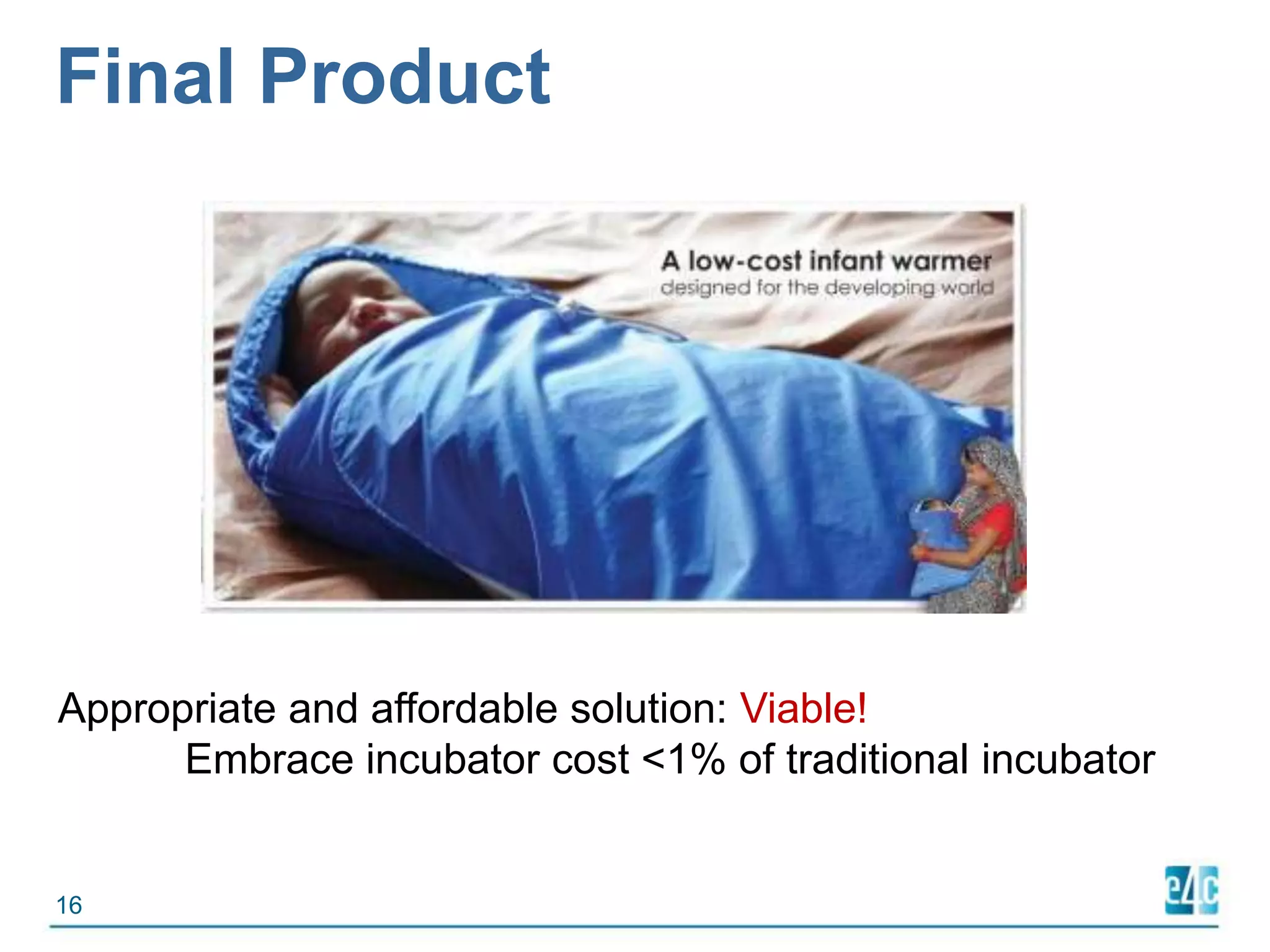
Final ProductAppropriate and affordable solution: Viable!	Embrace incubator cost <1% of traditional incubator
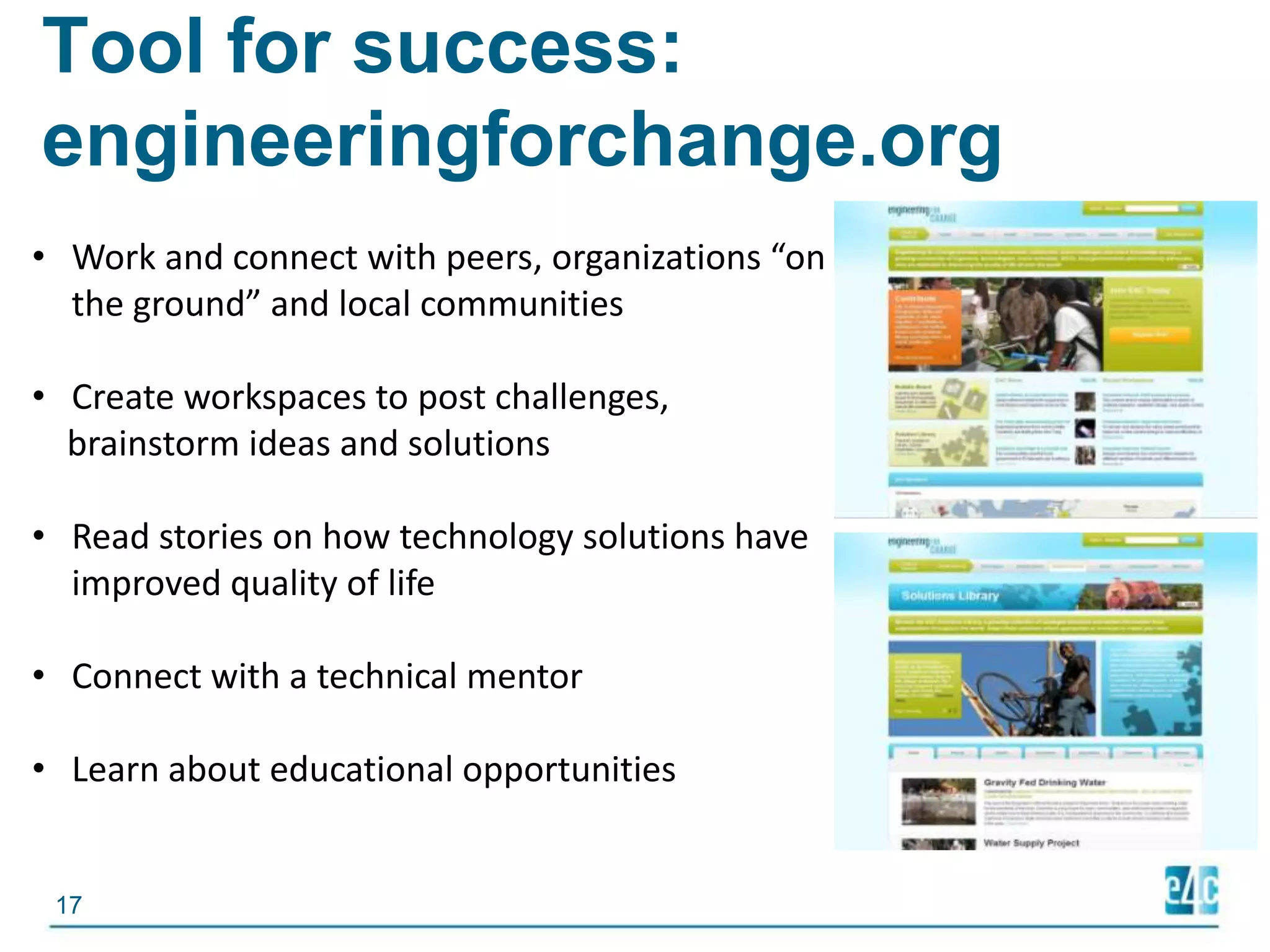
Tool for success: engineeringforchange.orgWork and connect with peers, organizations “on the ground” and local communities
Create workspaces to post challenges,     brainstorm ideas and solutionsRead stories on how technology solutions have improved quality of life
Connect with a technical mentor
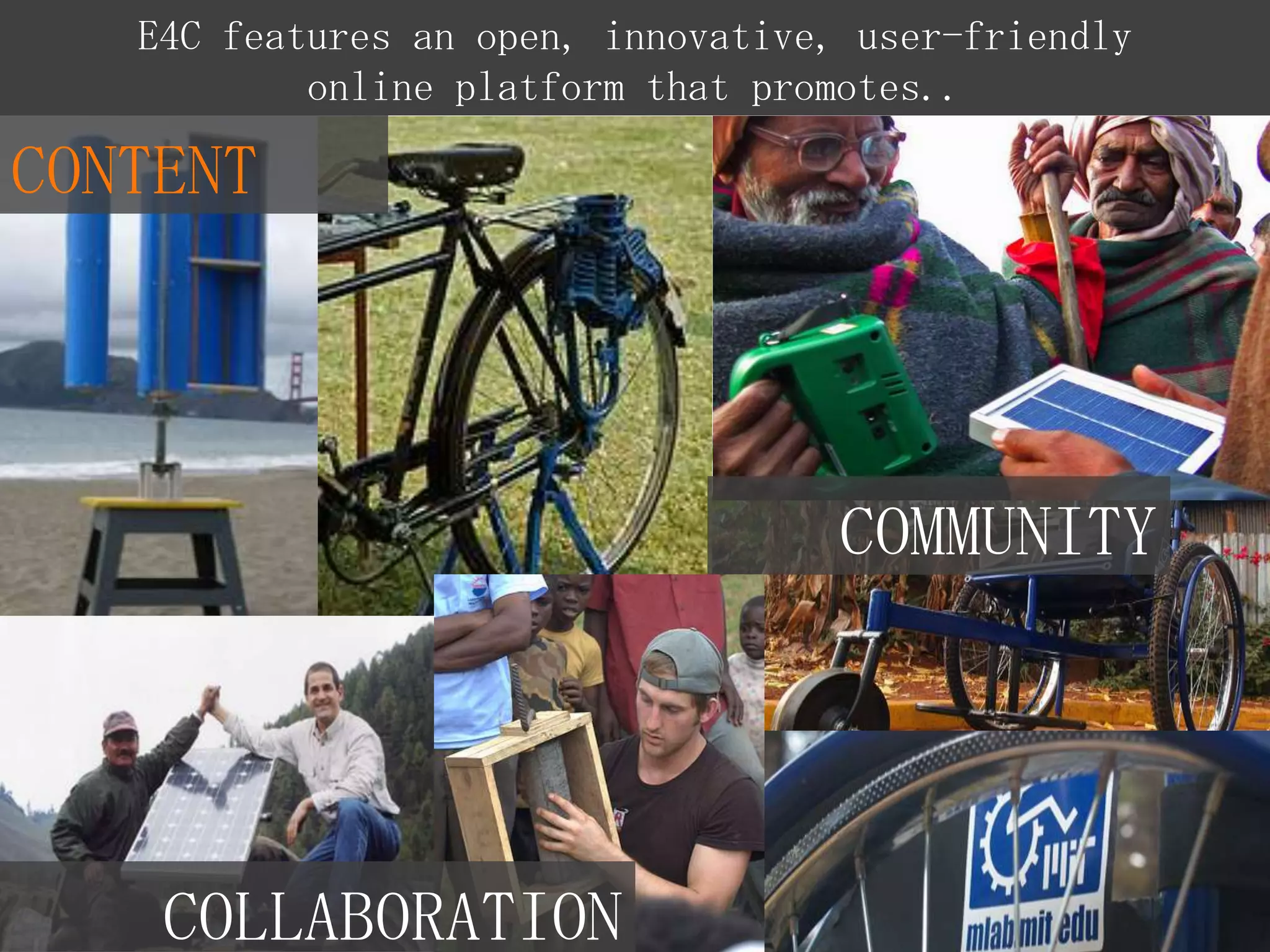
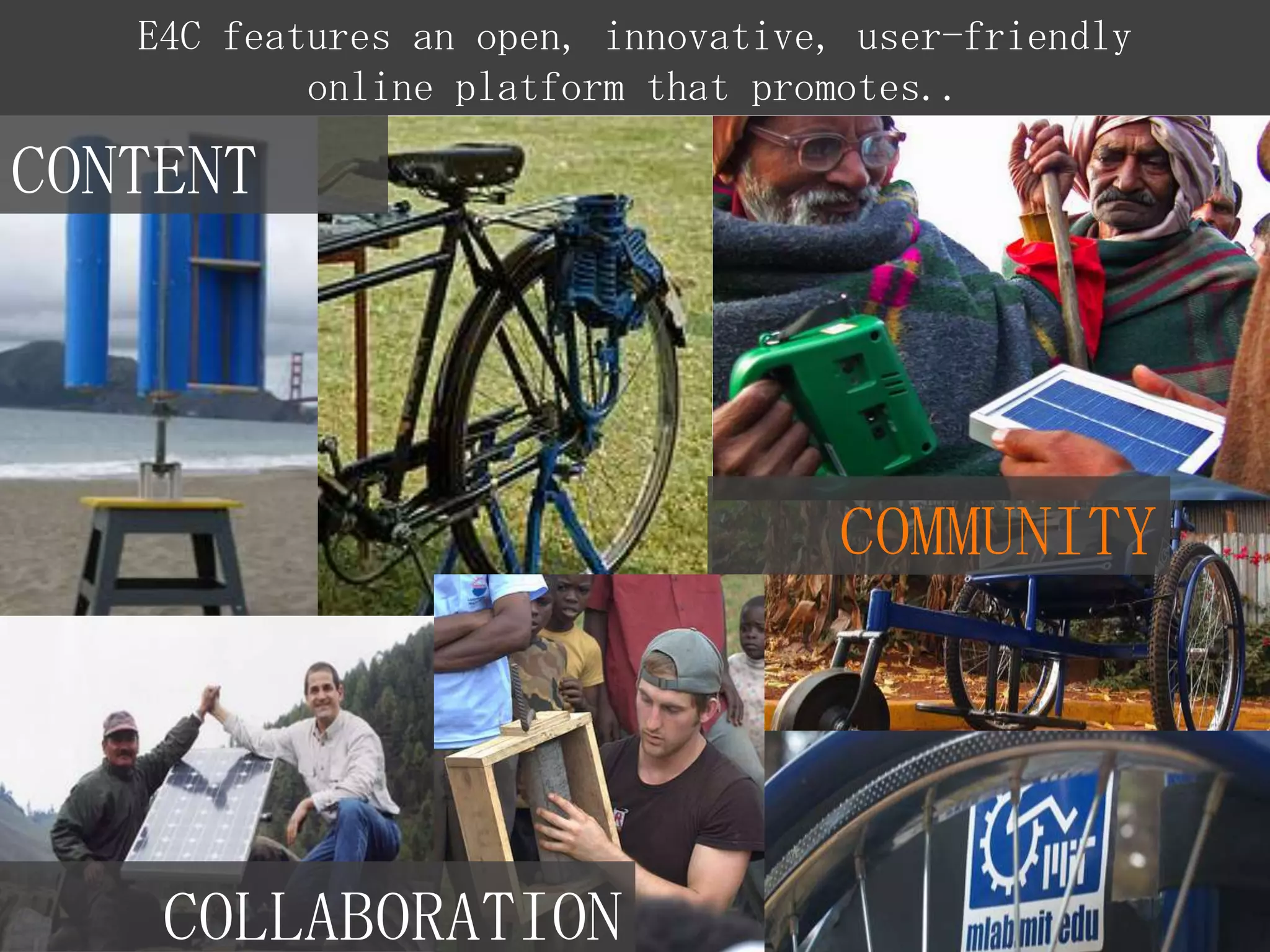
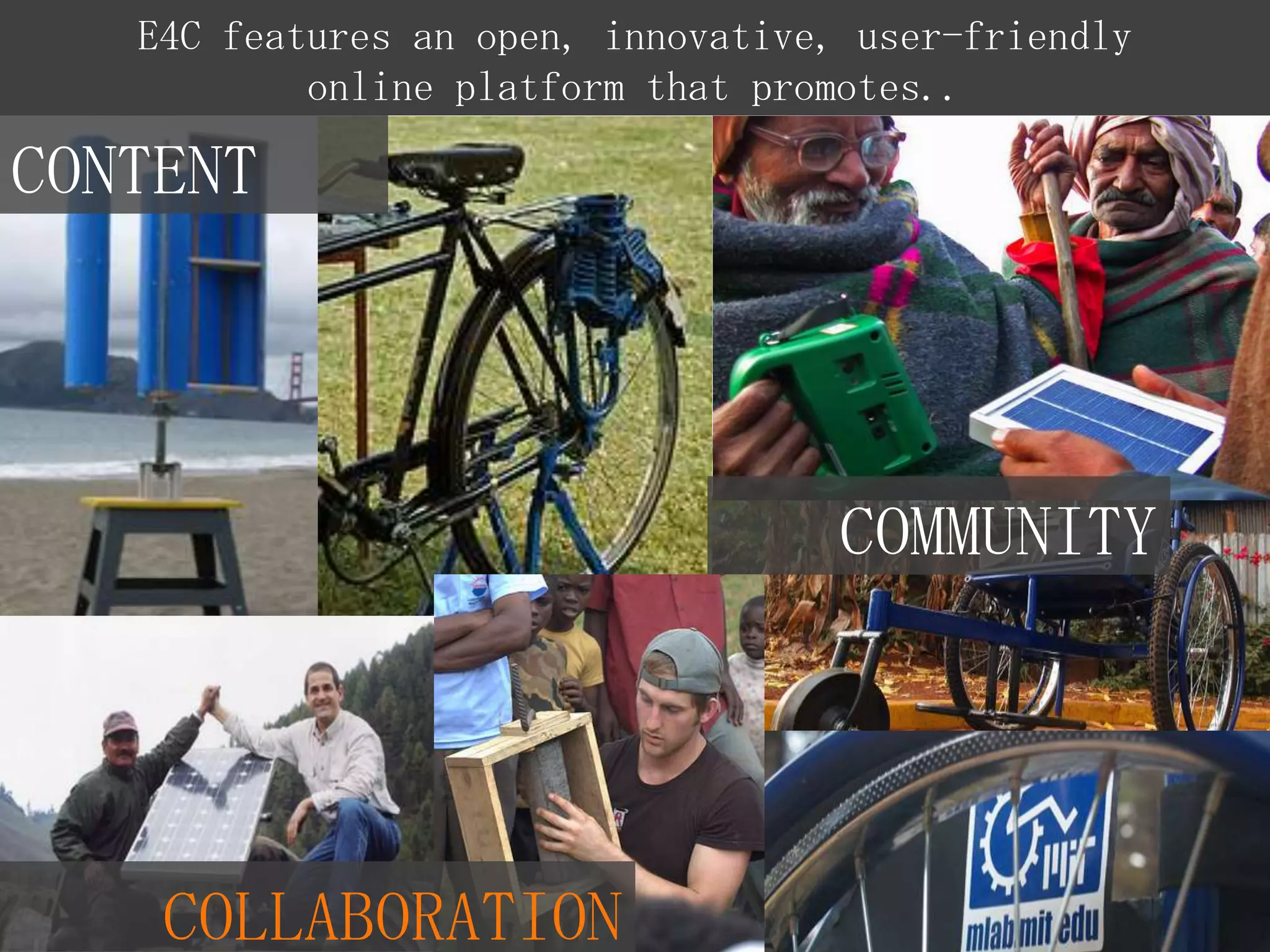
Learn about educational opportunities E4C features an open, innovative, user-friendly online platform that promotes..CONTENTCOMMUNITYCOLLABORATION18
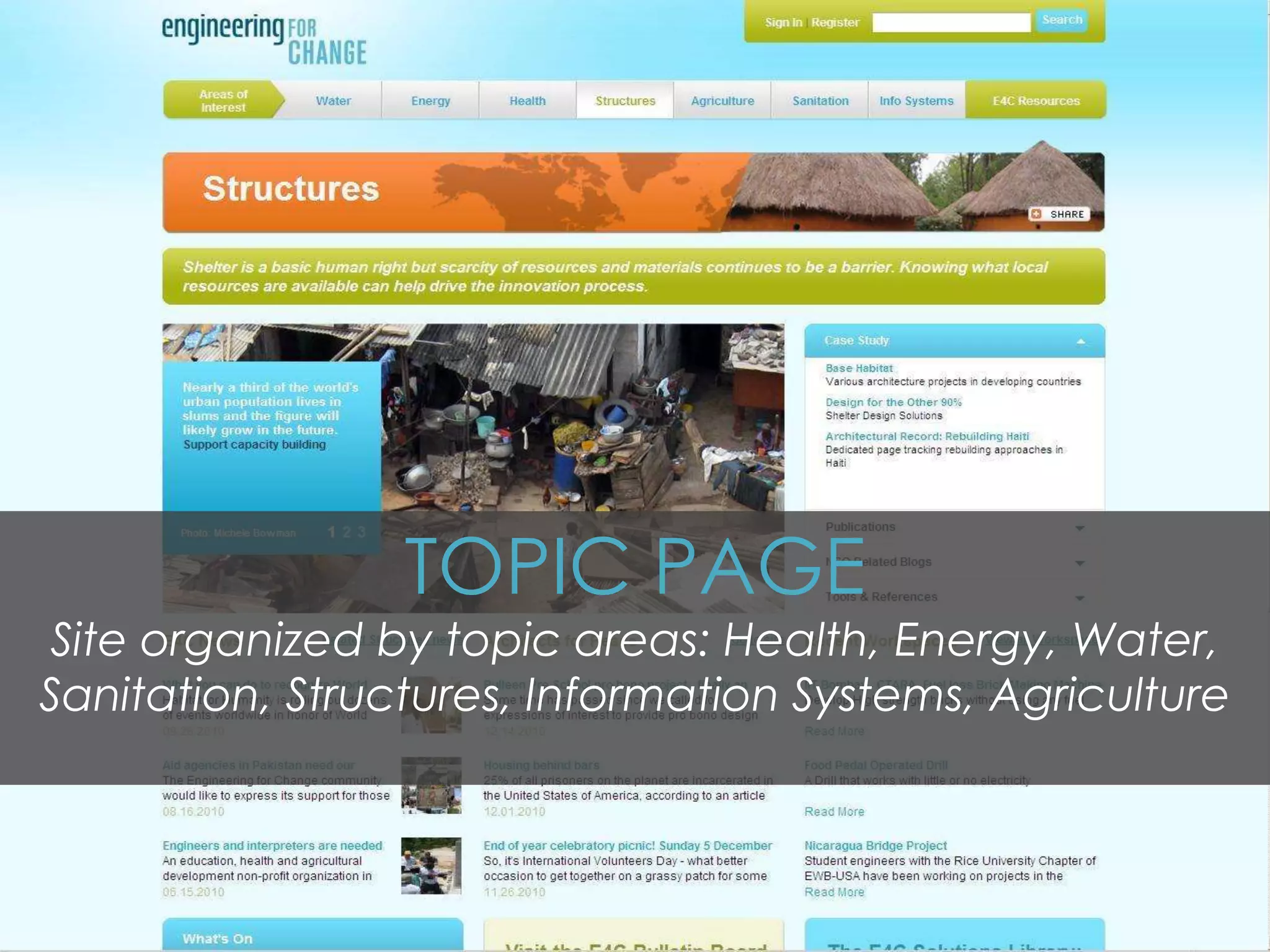
TOPIC PAGESite organized by topic areas: Health, Energy, Water, Sanitation, Structures, Information Systems, Agriculture
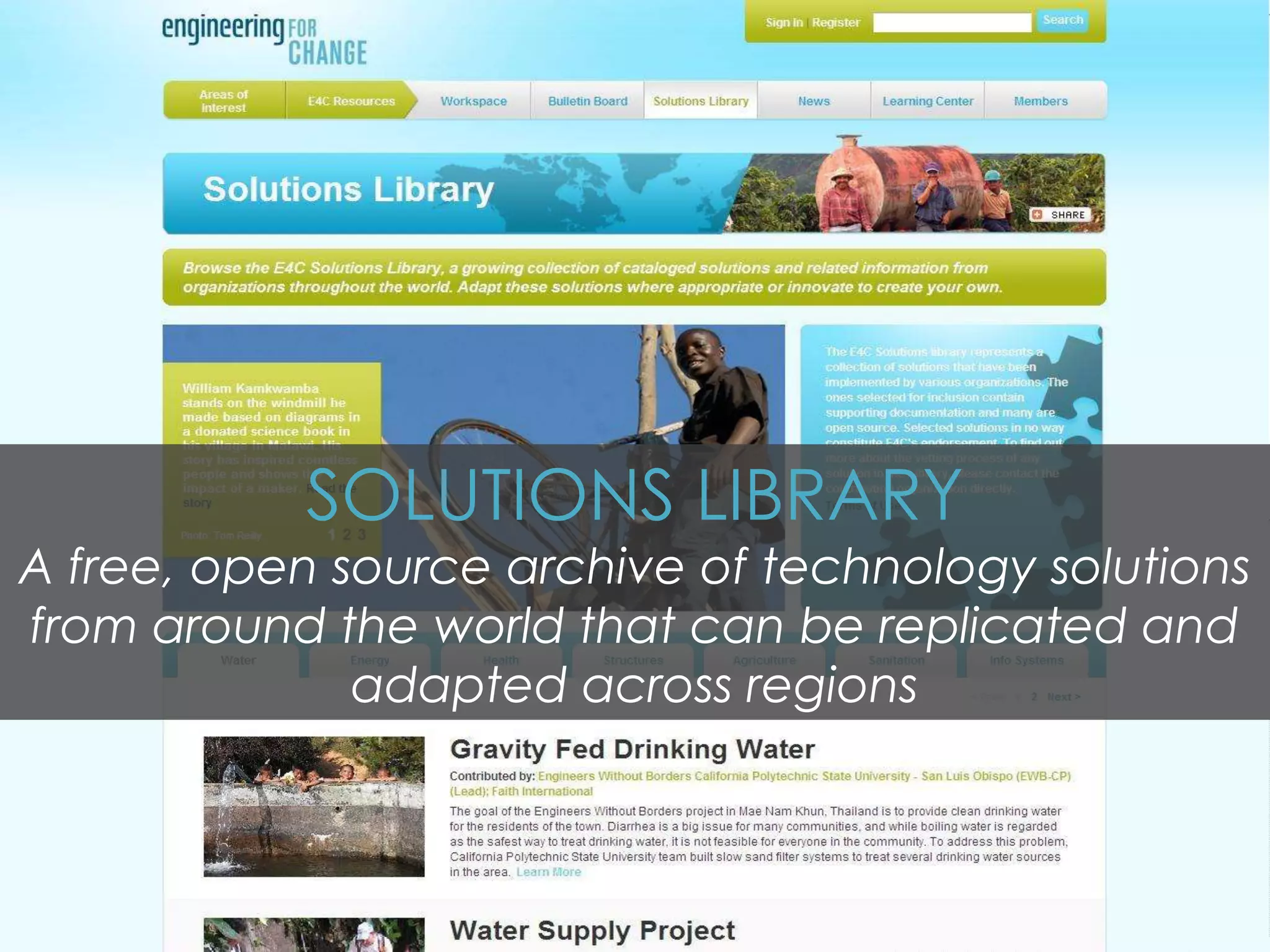
SOLUTIONS LIBRARYA free, open source archive of technology solutions from around the world that can be replicated and adapted across regions
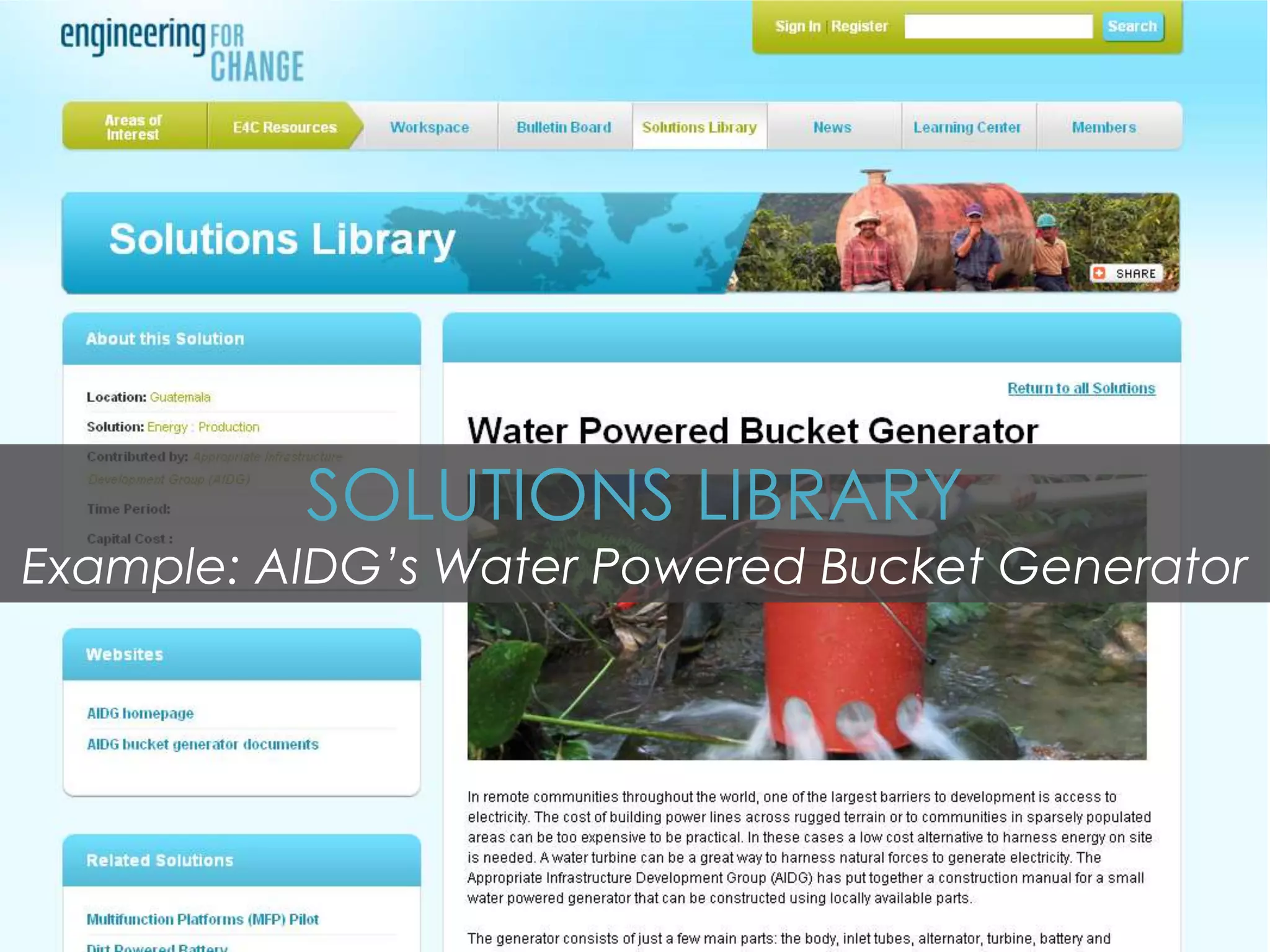
SOLUTIONS LIBRARYExample: AIDG’s Water Powered Bucket Generator
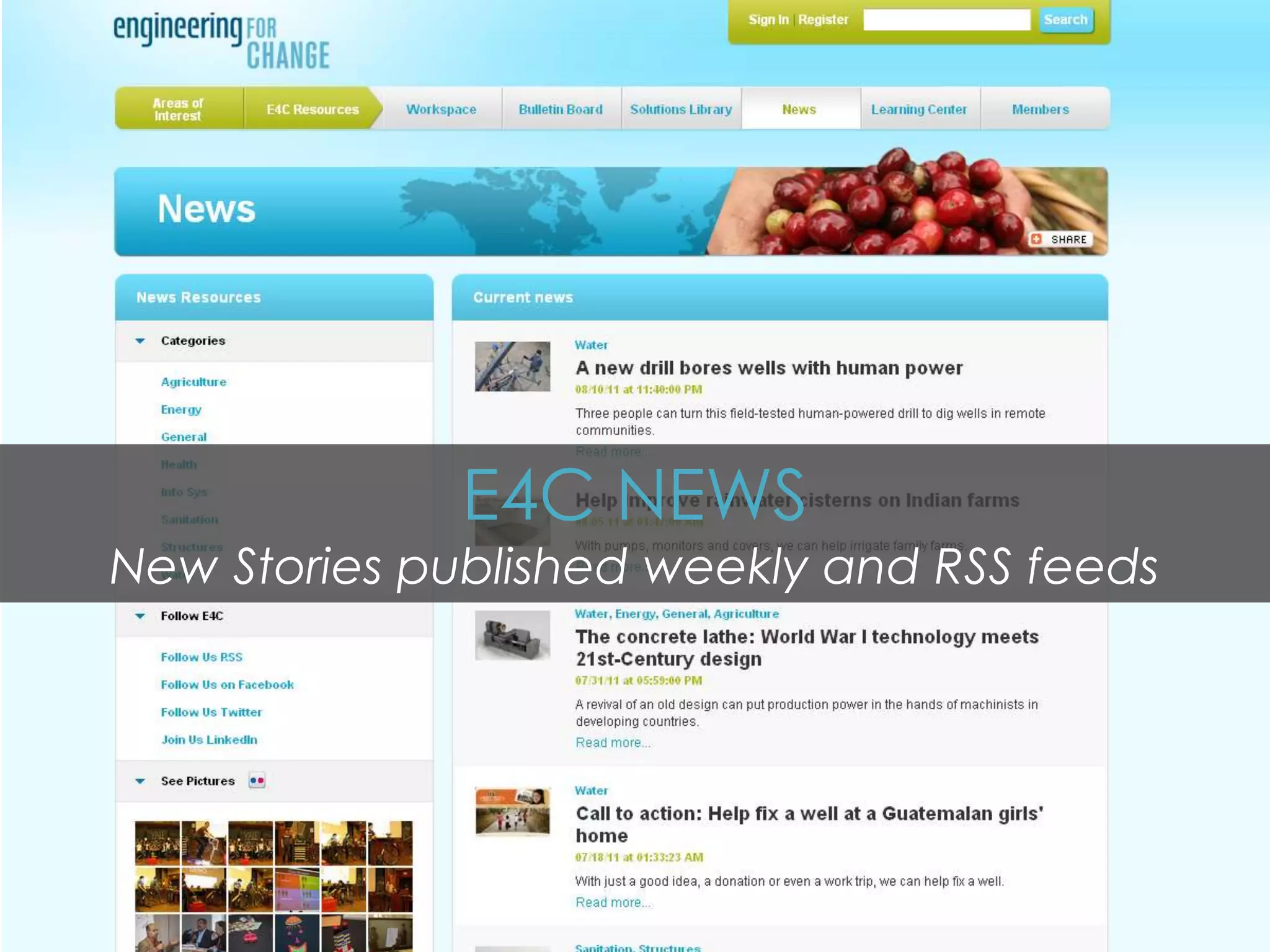
E4C NEWSNew Stories published weekly and RSS feeds
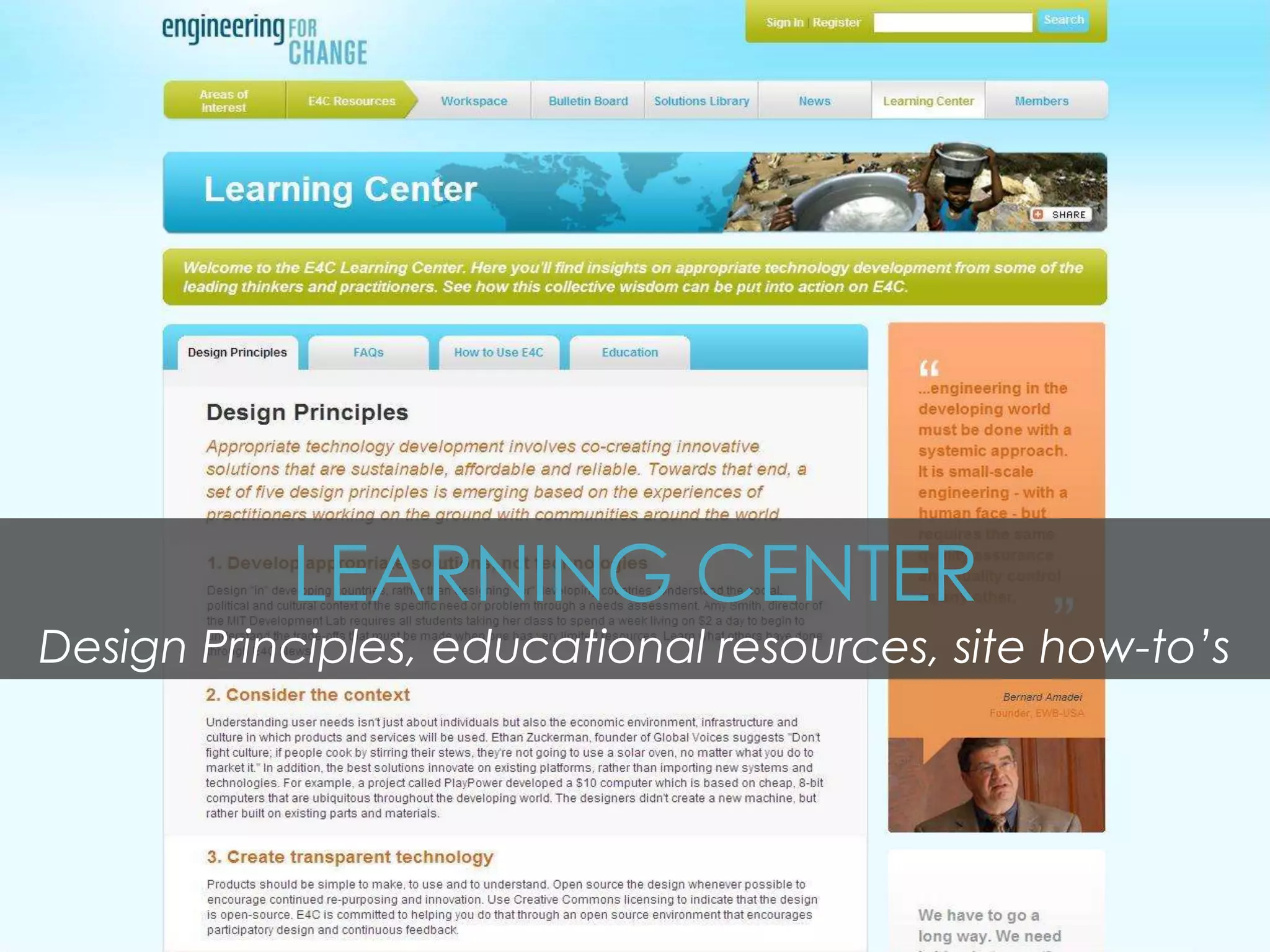
LEARNING CENTERDesign Principles, educational resources, site how-to’s
E4C features an open, innovative, user-friendly online platform that promotes..CONTENTCOMMUNITYCOLLABORATION24
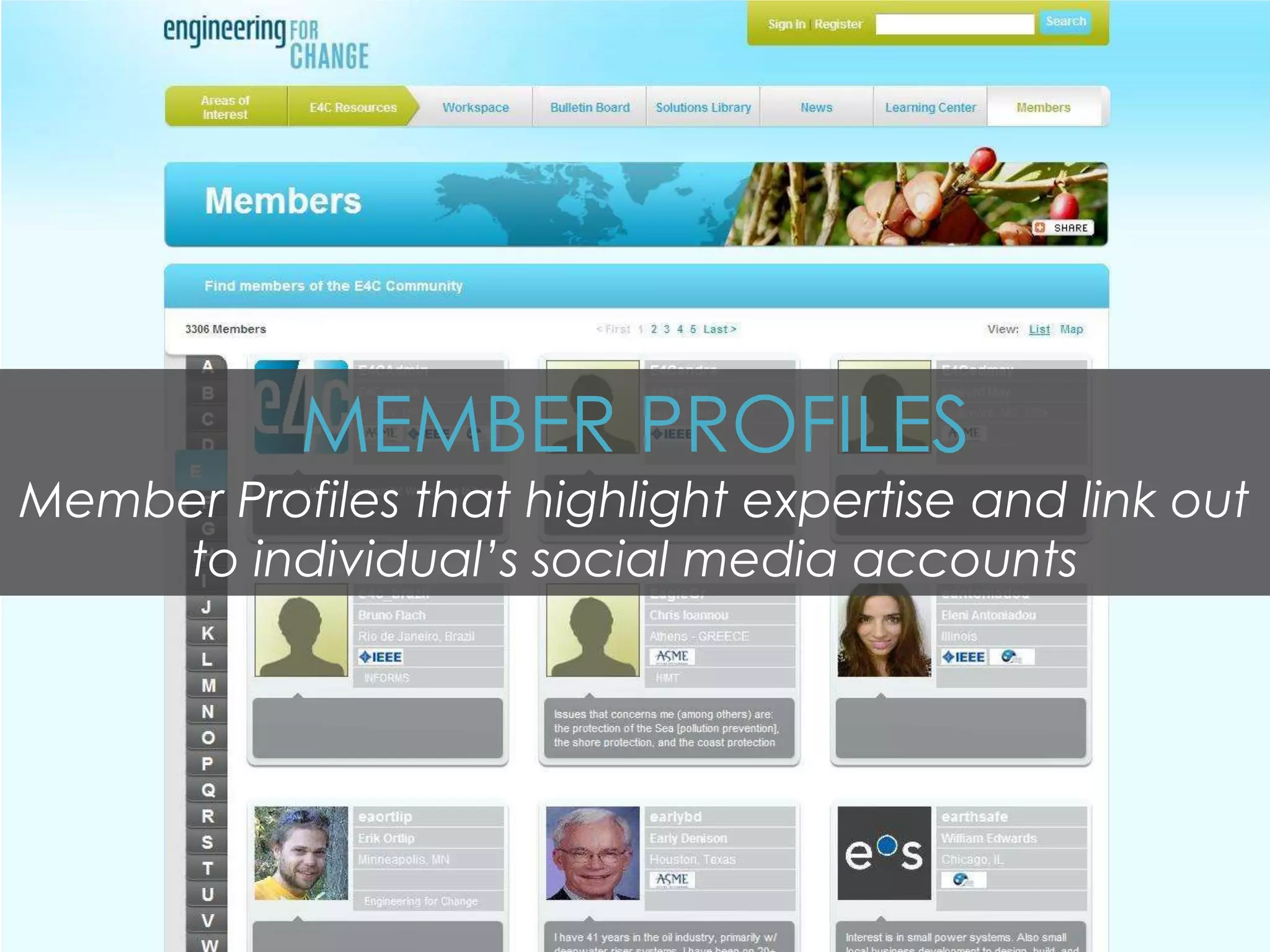
MEMBER PROFILESMember Profiles that highlight expertise and link out to individual’s social media accounts
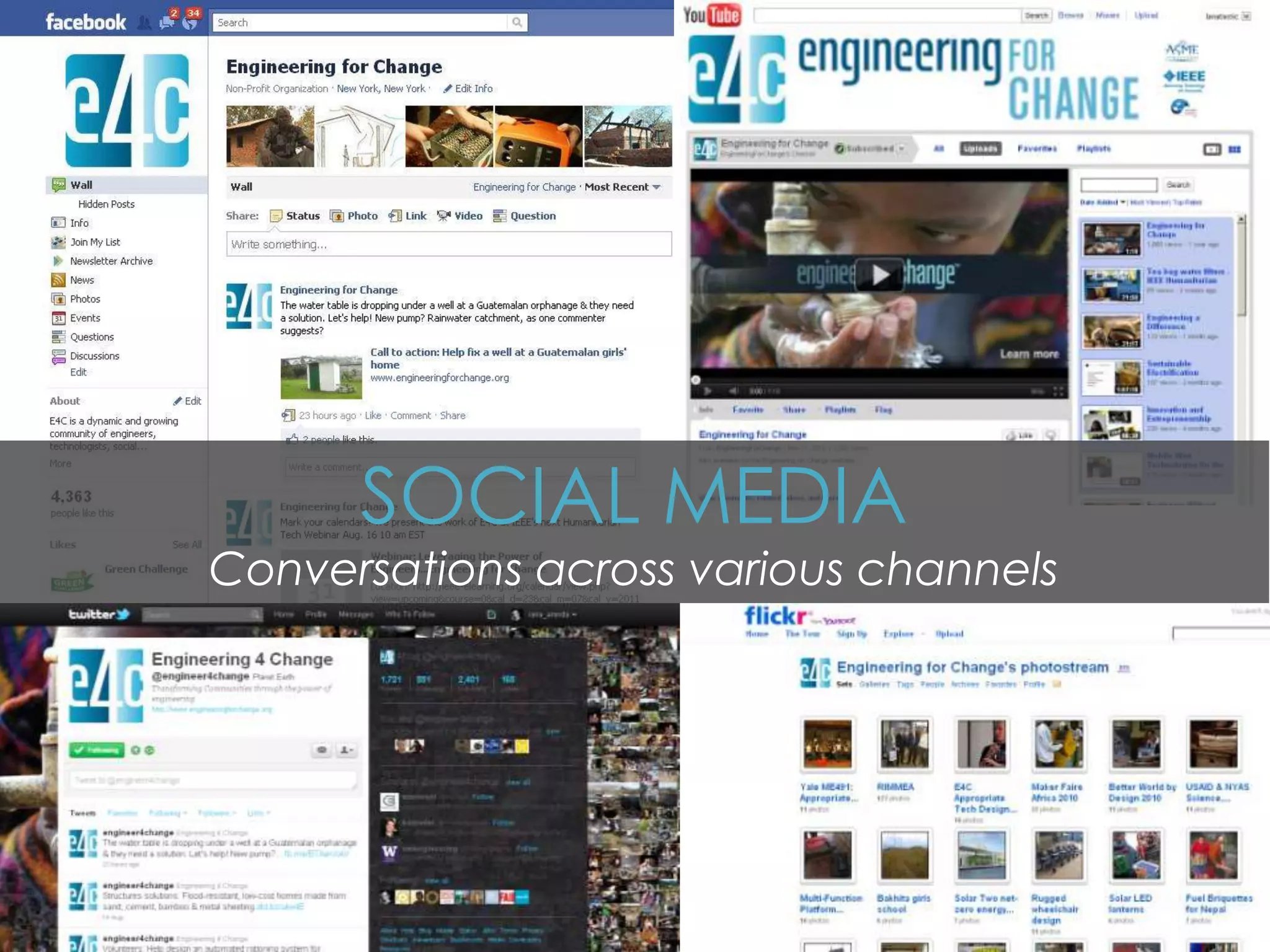
SOCIAL MEDIAConversations across various channels
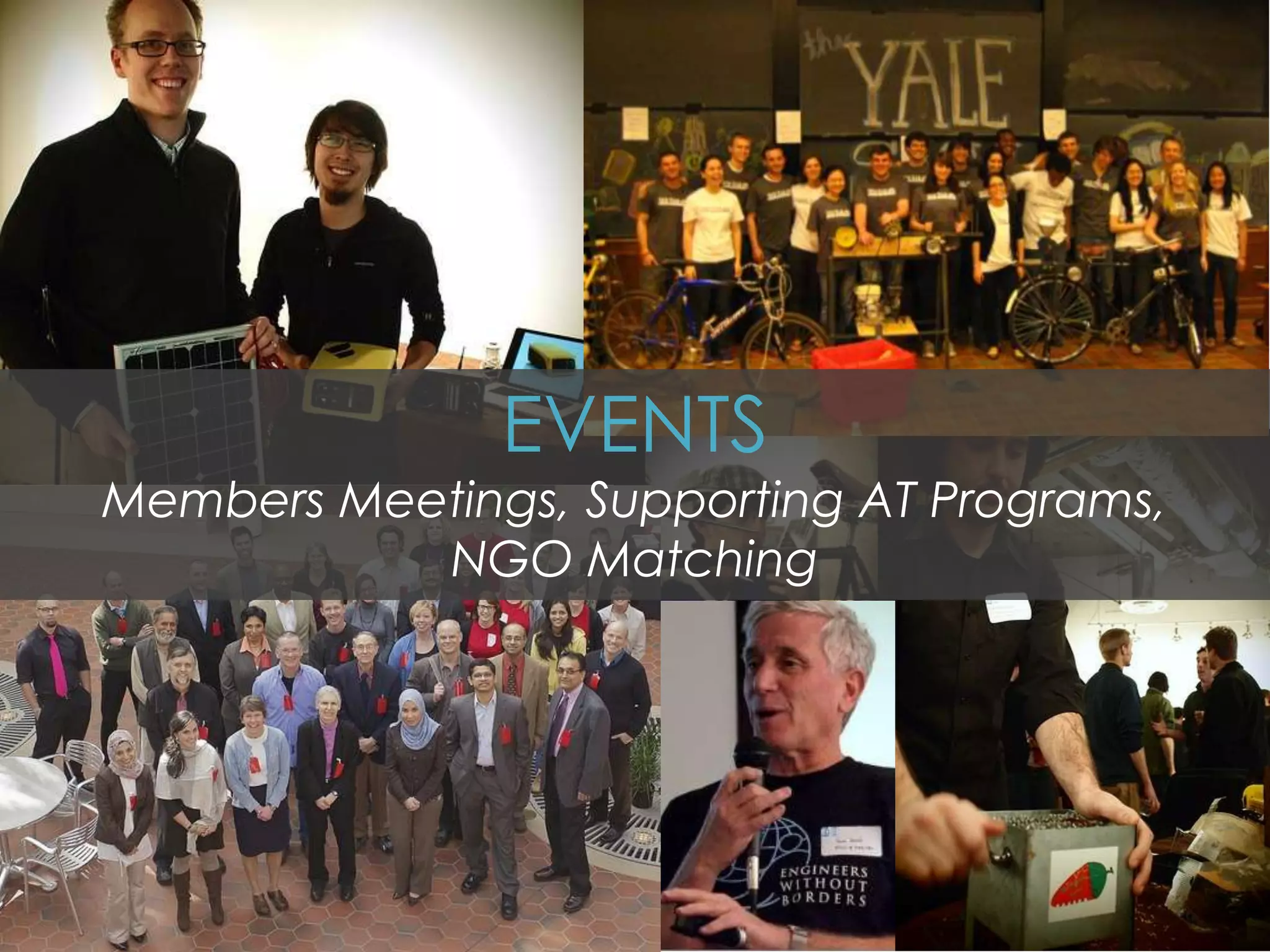
EVENTSMembers Meetings, Supporting AT Programs,NGO Matching
E4C features an open, innovative, user-friendly online platform that promotes..CONTENTCOMMUNITYCOLLABORATION28
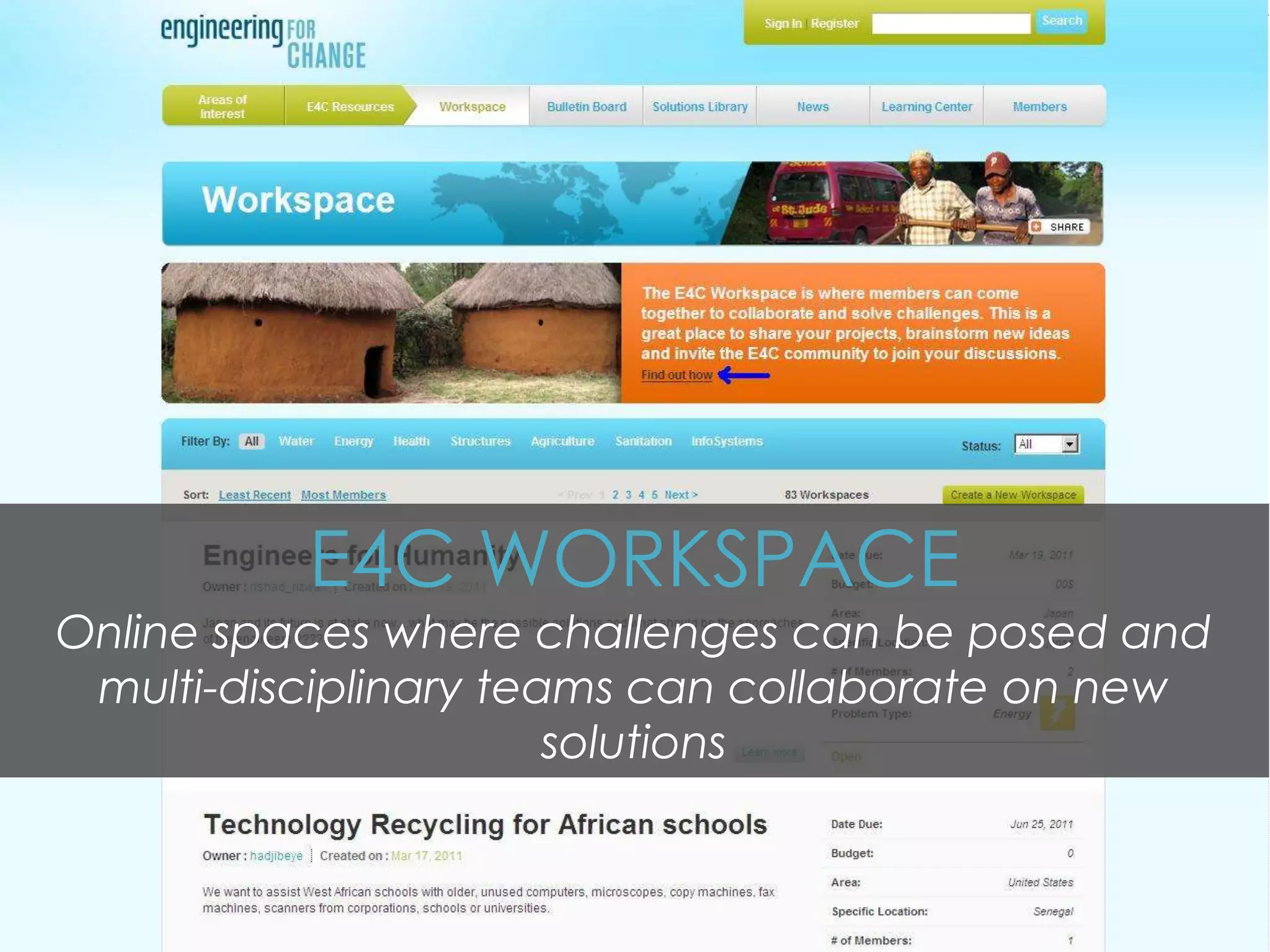
E4C WORKSPACEOnline spaces where challenges can be posed and multi-disciplinary teams can collaborate on new solutions
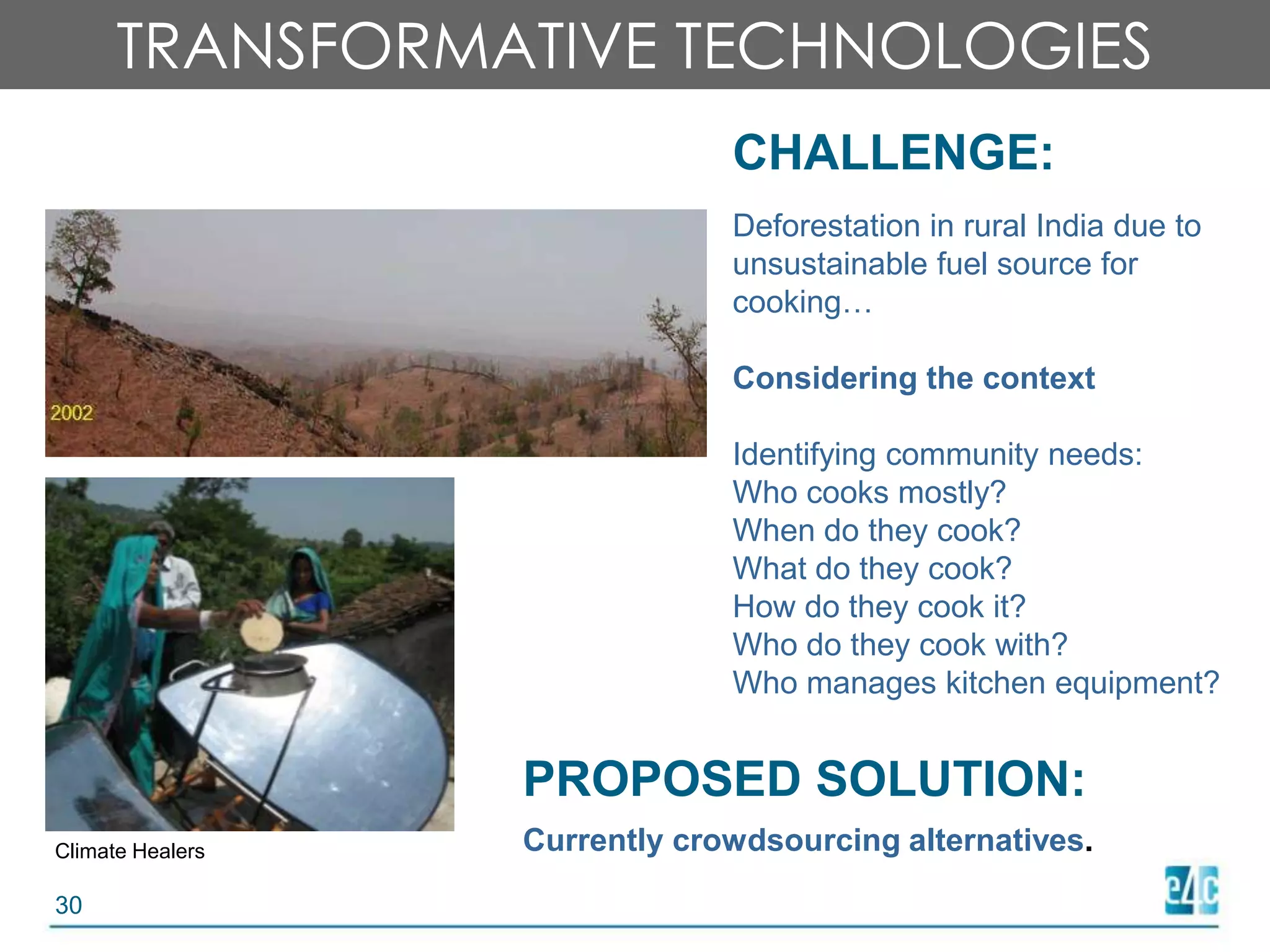
TRANSFORMATIVE TECHNOLOGIESCHALLENGE:Deforestation in rural India due to unsustainable fuel source for cooking…Considering the contextIdentifying community needs:Who cooks mostly?When do they cook? 	What do they cook?How do they cook it?Who do they cook with?Who manages kitchen equipment? Proposed Solution:Currently crowdsourcing alternatives.Climate Healers
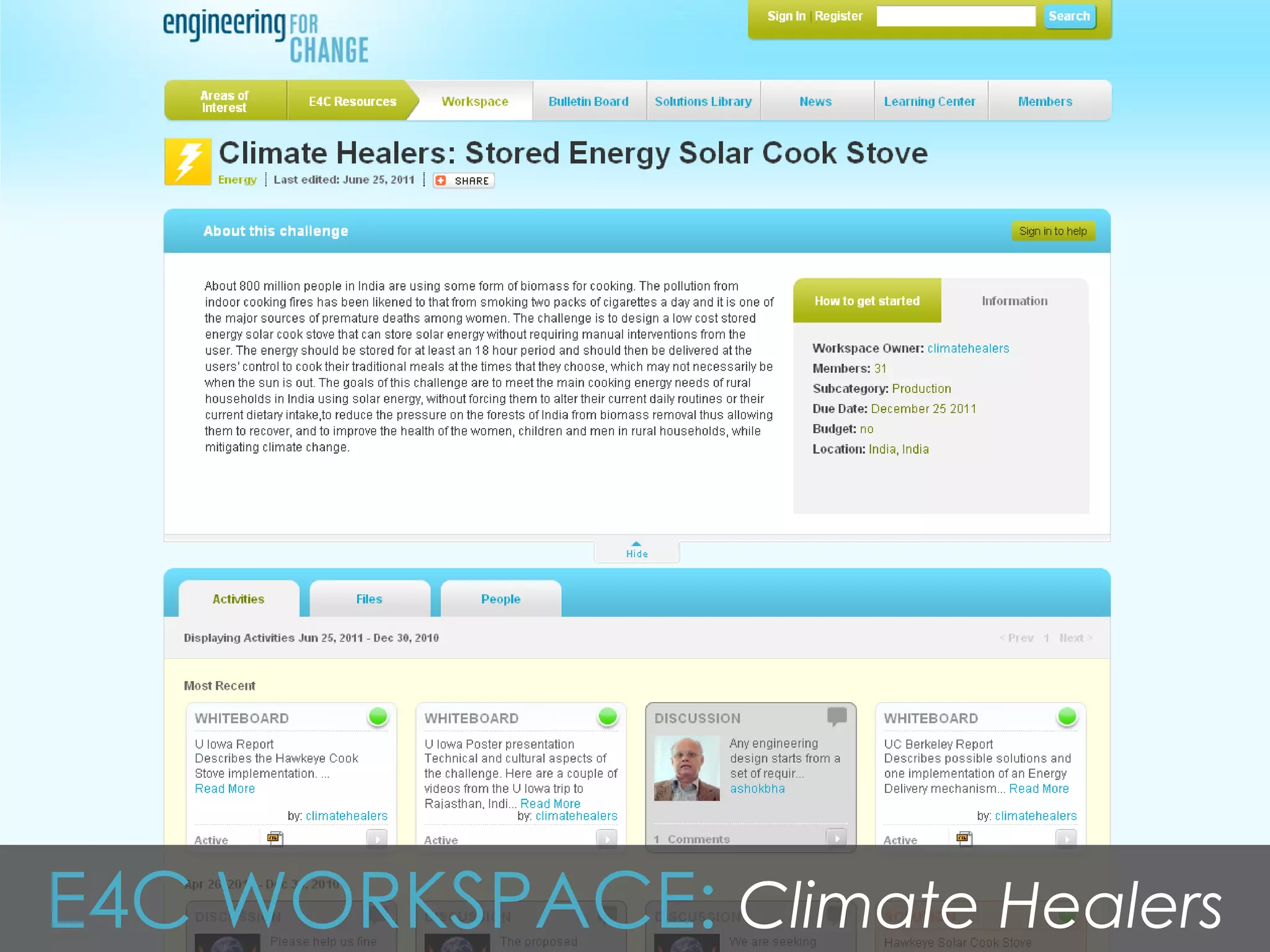
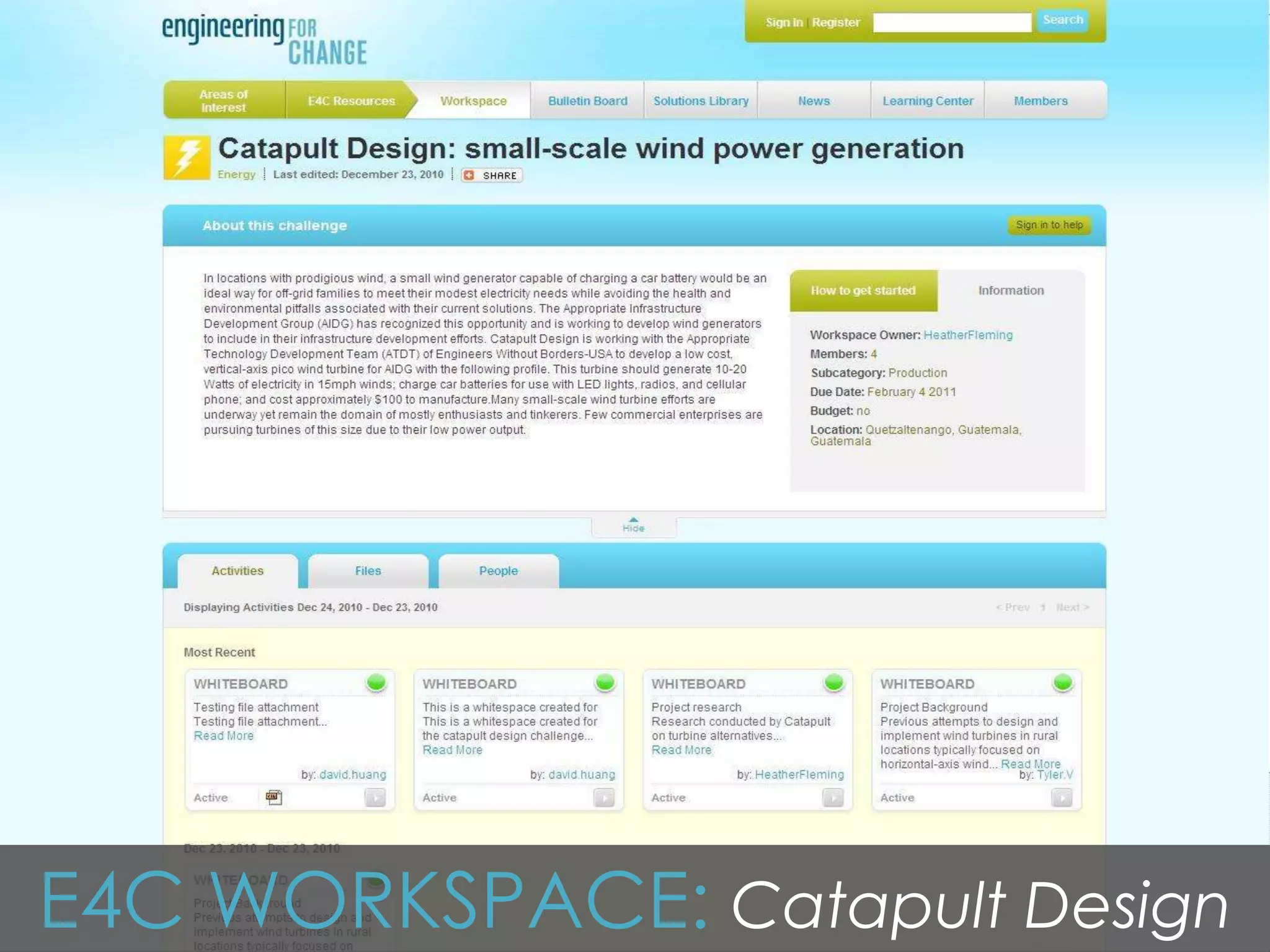
E4C WORKSPACE: Climate Healers
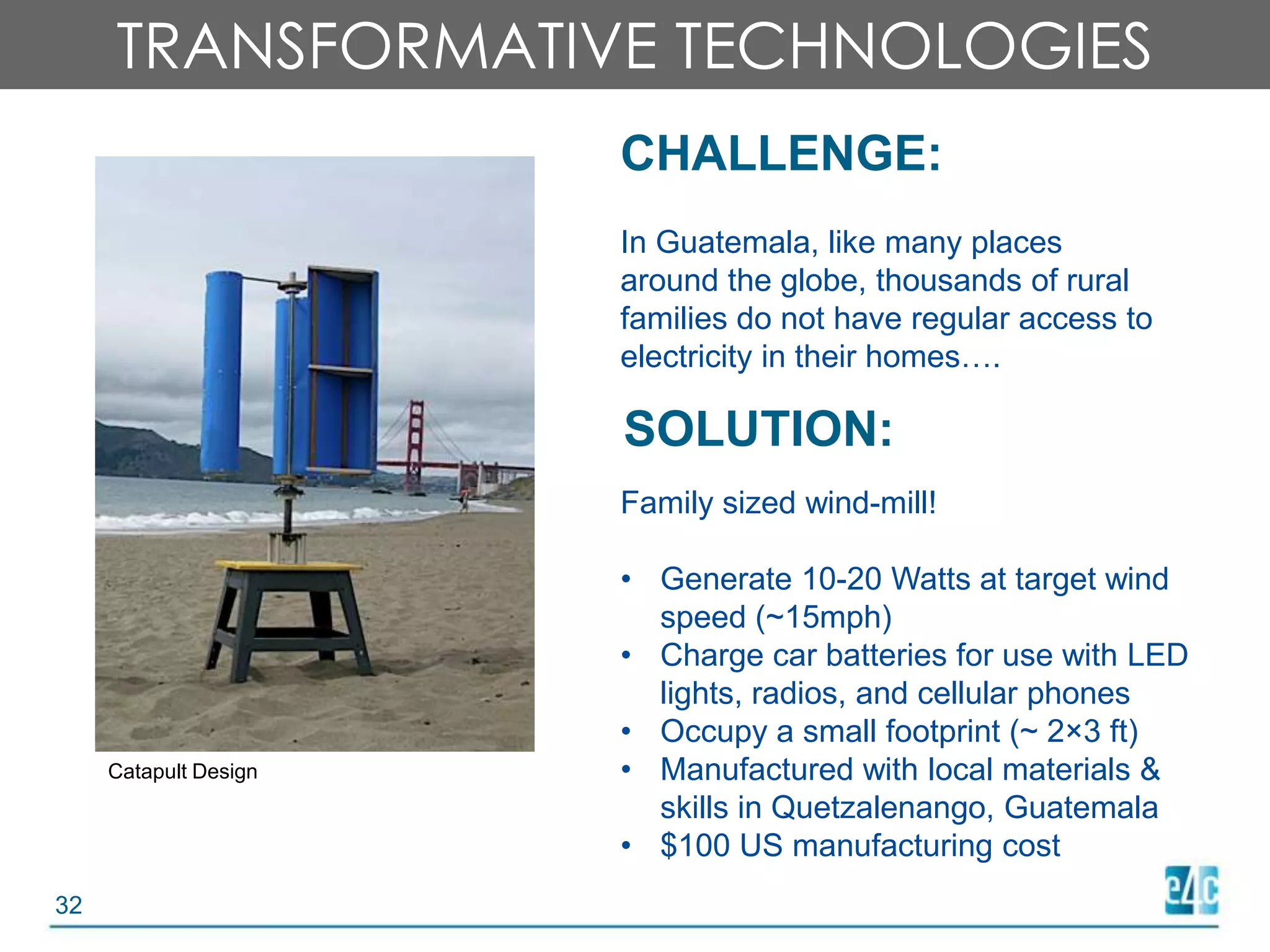
TRANSFORMATIVE TECHNOLOGIESCHALLENGE:In Guatemala, like many places around the globe, thousands of rural families do not have regular access to electricity in their homes….Solution:Family sized wind-mill!Generate 10-20 Watts at target wind speed (~15mph)
Charge car batteries for use with LED lights, radios, and cellular phones
Occupy a small footprint (~ 2×3 ft)
Manufactured with local materials & skills in Quetzalenango, Guatemala
$100 US manufacturing costCatapult Design

E4C presentation ieee humanitarian tech webinar aug 2011

  • 1.
    the engineer andthe global humanitarian
  • 2.
    The NeedEngineers arebeing called upon to devise cost-effective, appropriate solutions to increase access to food and clean water, effective sanitation, energy, housing, and other basic needs.
  • 3.
    The Engineering ToolboxEngineeringstudents and professionals are driven by:
  • 4.
  • 5.
  • 6.
    The OpportunityBuild a“network” that brings volunteer engineers across professions together to work as virtual teams with local organizations, schools and communitiesAggregate content and be an open knowledge source for a range of workable solutions for meeting basic community needs. Be a resource for developing effective solutions that could be adapted and improved across diverse communities and regionsHighlight how engineers and the engineering profession play a critical role in addressing quality of life issuesVirtually connect educators and students to on-the-ground projects and identify opportunities for service learning
  • 7.
    Our MissionA dynamicand growing community of engineers, technologists, designers, scientists, NGOs and community advocates dedicated to improving people’s lives around the world. Our mission is to bridge technology and humanitarian development and transform communities using open-source technology.
  • 8.
    Design PrinciplesAppropriate technologydevelopment involves co-creating innovative solutions that are sustainable, affordable andreliable.Develop appropriate solutions, not technologiesConsider the contextCreate transparent technologiesEmbrace the marketDesign for DIY (Do It Yourself)
  • 9.
    Develop appropriate solutions,not technologiesGoal: Design meaningful and innovative solutions that are desirable to your constituents and serve their needs.Techniques: - Understand communities’ needs, hopes and aspirations for the future: Needs assessment - Capture peoples’ stories: interviews, video, group- sessions, one-on-one visits - Research: what other approaches have been effective/ineffective
  • 10.
    Consider the contextGoal:Design solutions that are feasible for the community.Techniques: -outline the constraints by considering context (social, technical, economic, cultural)- get personal experience: spend a week living on $2 a day to begin to understand the trade-offs - identify patterns and brainstorm ideas - share ideas with the end users to get frequent feedback/input and incorporate input to co-create and whiteboard solutions- supplement your team with experts
  • 11.
    Embrace the market&create transparent technologyGoal:Ensure viability of the solution.Techniques:- create, document and share prototypes, test, and iterate -identify necessary resources to maintain the solution: > materials, skills, funds > is the solution affordable and economically sustainable? - measure and monitor the impact
  • 12.
    Design for DIY(Do It Yourself)Technique:involving the community in the design process builds capacity - not just products. ex. Appropriate Infrastructure Design Group
  • 13.
    The end goalshould be to build local capacity, skills, knowledge, experience and expertise that allows societies to meet their own needs.
  • 14.
    Solution Development:Case study CHALLENGE:Newborn babies often face hypothermia: they are not able to regulate their own body temperature, and can’t stay warm. How to prevent hypothermia in rural clinics in the developing world?
  • 15.
    Existing solutionsDevelop appropriatesolutions, not technologies:current approaches and needs (desirable)Challenges = opportunity! Cost: ~$40,000 US
  • 16.
    Solution DevelopmentConsidering thecontext: > Constraints: - Cost - Training - MaintenanceGoal: Design solution that is simple to make, to use, understand and maintain (feasible)
  • 17.
    Final ProductAppropriate andaffordable solution: Viable! Embrace incubator cost <1% of traditional incubator
  • 18.
    Tool for success:engineeringforchange.orgWork and connect with peers, organizations “on the ground” and local communities
  • 19.
    Create workspaces topost challenges, brainstorm ideas and solutionsRead stories on how technology solutions have improved quality of life
  • 20.
    Connect with atechnical mentor
  • 21.
    Learn about educationalopportunities E4C features an open, innovative, user-friendly online platform that promotes..CONTENTCOMMUNITYCOLLABORATION18
  • 22.
    TOPIC PAGESite organizedby topic areas: Health, Energy, Water, Sanitation, Structures, Information Systems, Agriculture
  • 23.
    SOLUTIONS LIBRARYA free,open source archive of technology solutions from around the world that can be replicated and adapted across regions
  • 24.
    SOLUTIONS LIBRARYExample: AIDG’sWater Powered Bucket Generator
  • 25.
    E4C NEWSNew Storiespublished weekly and RSS feeds
  • 26.
    LEARNING CENTERDesign Principles,educational resources, site how-to’s
  • 27.
    E4C features anopen, innovative, user-friendly online platform that promotes..CONTENTCOMMUNITYCOLLABORATION24
  • 28.
    MEMBER PROFILESMember Profilesthat highlight expertise and link out to individual’s social media accounts
  • 29.
  • 30.
    EVENTSMembers Meetings, SupportingAT Programs,NGO Matching
  • 31.
    E4C features anopen, innovative, user-friendly online platform that promotes..CONTENTCOMMUNITYCOLLABORATION28
  • 32.
    E4C WORKSPACEOnline spaceswhere challenges can be posed and multi-disciplinary teams can collaborate on new solutions
  • 33.
    TRANSFORMATIVE TECHNOLOGIESCHALLENGE:Deforestation inrural India due to unsustainable fuel source for cooking…Considering the contextIdentifying community needs:Who cooks mostly?When do they cook? What do they cook?How do they cook it?Who do they cook with?Who manages kitchen equipment? Proposed Solution:Currently crowdsourcing alternatives.Climate Healers
  • 34.
  • 35.
    TRANSFORMATIVE TECHNOLOGIESCHALLENGE:In Guatemala,like many places around the globe, thousands of rural families do not have regular access to electricity in their homes….Solution:Family sized wind-mill!Generate 10-20 Watts at target wind speed (~15mph)
  • 36.
    Charge car batteriesfor use with LED lights, radios, and cellular phones
  • 37.
    Occupy a smallfootprint (~ 2×3 ft)
  • 38.
    Manufactured with localmaterials & skills in Quetzalenango, Guatemala
  • 39.
    $100 US manufacturingcostCatapult Design
  • 40.
  • 41.
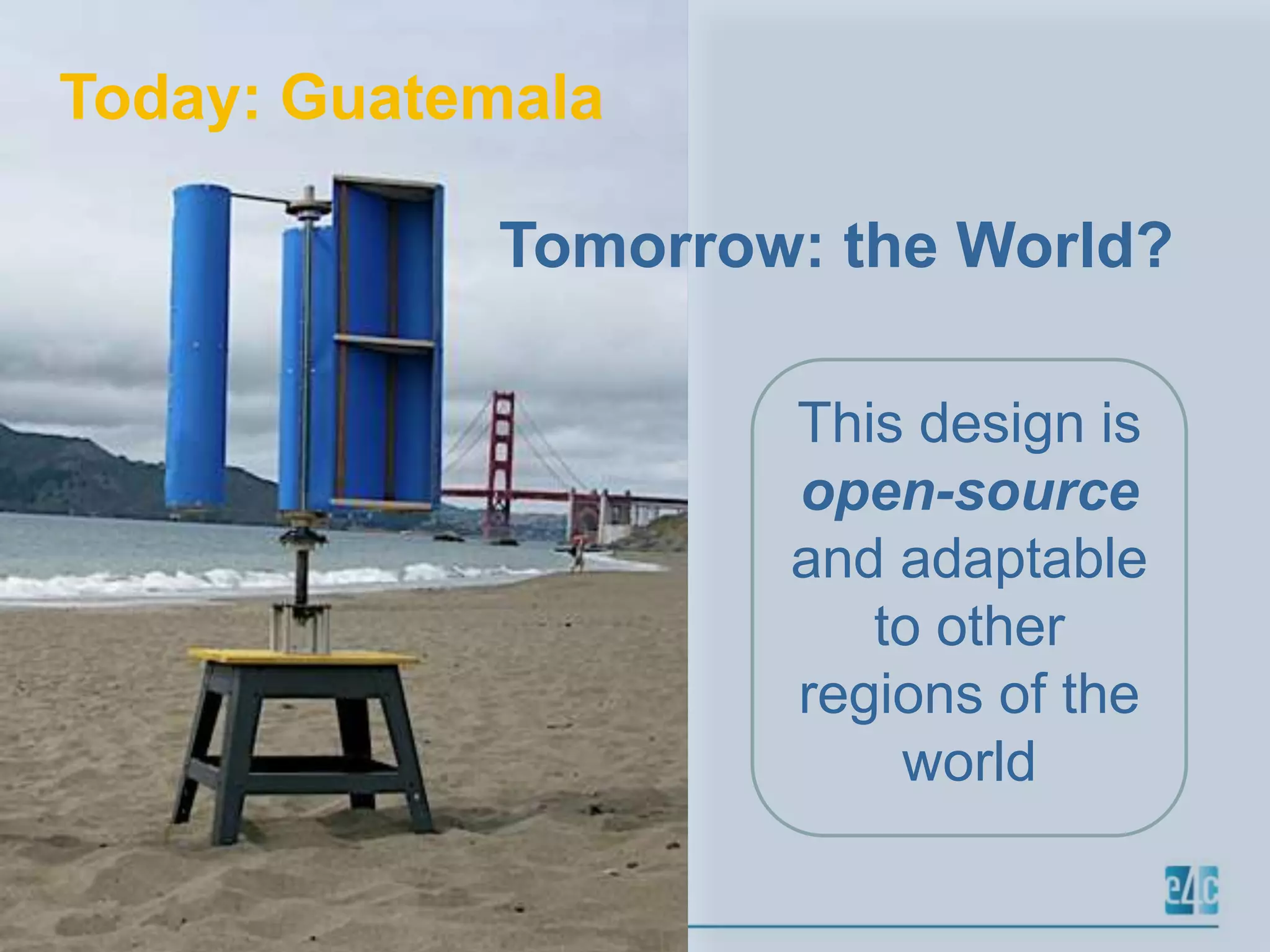
    Today: GuatemalaTomorrow: theWorld?This design is open-source and adaptable to other regions of the world
  • 42.
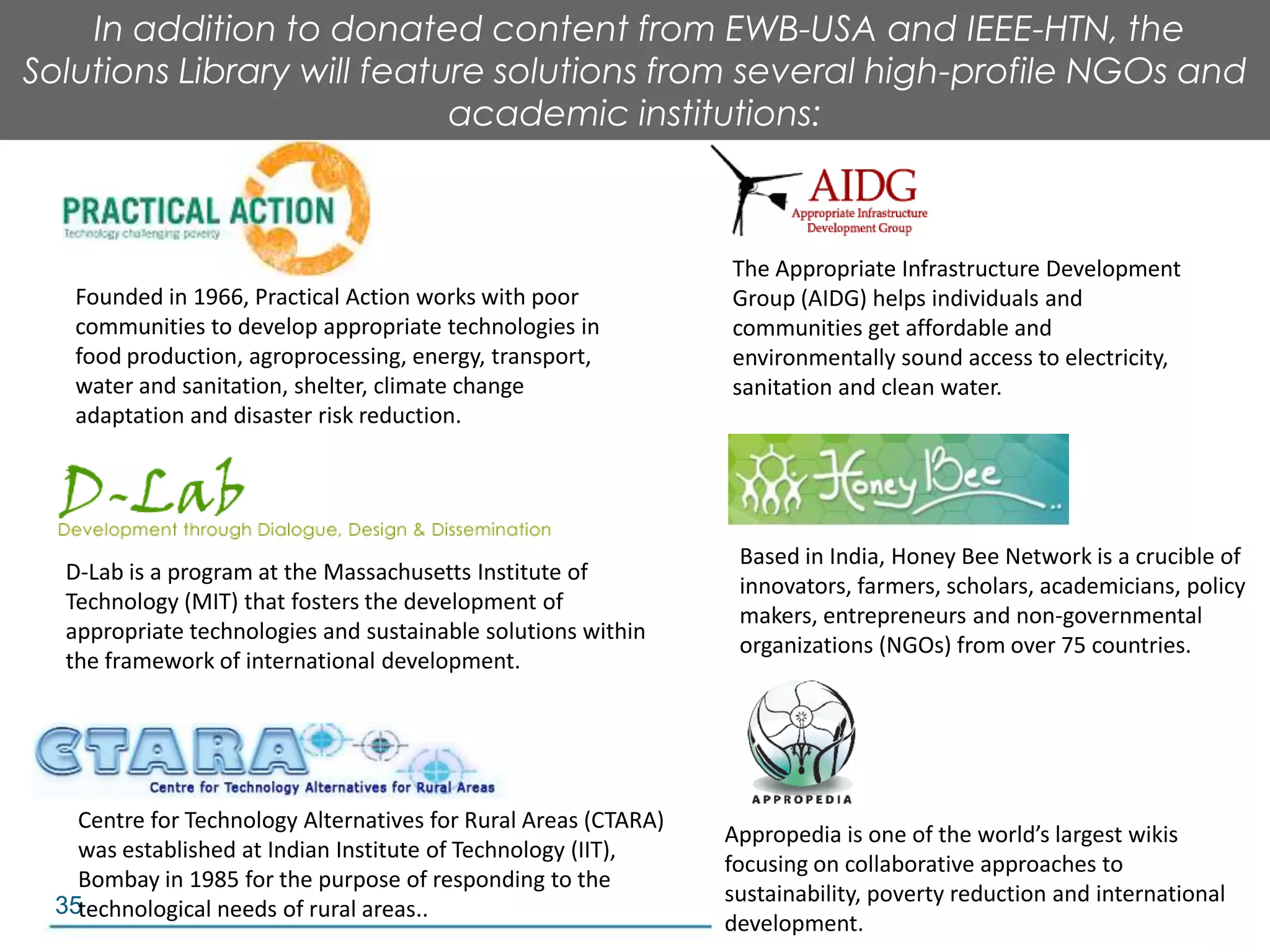
    In additionto donated content from EWB-USA and IEEE-HTN, the Solutions Library will feature solutions from several high-profile NGOs and academic institutions:The Appropriate Infrastructure Development Group (AIDG) helps individuals and communities get affordable and environmentally sound access to electricity, sanitation and clean water. Founded in 1966, Practical Action works with poor communities to develop appropriate technologies in food production, agroprocessing, energy, transport, water and sanitation, shelter, climate change adaptation and disaster risk reduction. Based in India, Honey Bee Network is a crucible of innovators, farmers, scholars, academicians, policy makers, entrepreneurs and non-governmental organizations (NGOs) from over 75 countries. D-Lab is a program at the Massachusetts Institute of Technology (MIT) that fosters the development of appropriate technologies and sustainable solutions within the framework of international development.Centre for Technology Alternatives for Rural Areas (CTARA) was established at Indian Institute of Technology (IIT), Bombay in 1985 for the purpose of responding to the technological needs of rural areas..Appropedia is one of the world’s largest wikis focusing on collaborative approaches to sustainability, poverty reduction and international development.
  • 43.
    Programs to SupportContent and Community GrowthPartnership developmentworking with local NGOs to articulate challenges and with universities to advance curriculum, student projects and ventures for social impact
  • 44.
    Expand E4C’s reachwith greater information access and communication exchange (e.g. mobile apps and SMS text messaging capability)
  • 45.
    Continue to buildan extensive solutions library with cutting-edge search capabilities and expert & user reviews
  • 46.
    Tell the storiesof engineers & scientists and their impactful work on humanitarian challenges through articles, videos and podcasts targeting the public and K-12 students and educators
  • 47.
    New E4C programs:conferences, traveling exhibits, standards development and a fellows programThe E4C CoalitionFOUNDING PARTNERS:SUPPORTERS:Join the partnership & be a part of the vision!
  • 48.
    Transforming communities throughthe power of engineering.38iana@engineeringforchange.org
  • 49.
    Thank-You.Questions?Use the questionbox on your screen to pose a question.Contact Information:Iana Aranda, E4Ciana@engineeringforchange.org

Editor's Notes

  • #3 Needs @ the BoP: 4 Billion people living on less than $4/day
  • #4 The proof: Engaged in supporting de-centralized development programs such as Engineers Without Borders-USASeeking academic programs and service learning opportunities for appropriate, sustainable technology designInvolved in social entrepreneurship and corporate social responsibility programs
  • #5 1. heightened sensitivity to global perspectives2. Design for extreme affordability 3. Power of product to lift out of poverty
  • #6 In 2009 ASME invested in research to identify engineering solutions for the BoPbased on existing NGO work and academic insights in the field.There were a significant number of solutions identified, but a great number of gaps as well.
  • #7 The opportunities resonated with IEEE and EWB-USA. And an agreement was reached to establish E4C.
  • #9 The report that provided insight into the gaps existing in this space also yielded some best practices which E4C adopted as guiding Design Principles for appropriate tech development.
  • #10 Design &quot;in&quot; developing countries, rather than designing &quot;for&quot; developing countries. Understand the social, political and cultural context of the specific need or problem through a needs assessmentIndia tap story
  • #11 Understanding user needs isn&apos;t just about individuals but also the economic environment, infrastructure and culture in which products and services will be used.&gt; Amy Smith, director of the MIT Development Lab requires all students taking her class to spend a week living on $2 a day to begin to understand the trade-offs that must be made when one has very limited resources. Learn what others have done through E4C News.&gt; Ethan Zuckerman, founder of Global Voices suggests &quot;Don&apos;t fight culture; if people cook by stirring their stews, they&apos;re not going to use a solar oven, no matter what you do to market it.&quot; The best solutions innovate on existing platforms, rather than importing new systems and technologies. &gt; Example:a project called PlayPower developed a $10 computer which is based on cheap, 8-bit computers that are ubiquitous throughout the developing world. The designers didn&apos;t create a new machine, but rather built on existing parts and materials.
  • #12 Products should be simple to make, to use and to understand. Open source the design whenever possible to encourage continued re-purposing and innovation. &gt; Use Creative Commons licensing to indicate that the design is open-source and encourages participatory design and continuous feedback.Solutions should be designed for price, not created then priced at cost. For a technology or tool to be truly effective, it must be affordable relative to the local economy. &gt; example, AIDFI, a Philippine non-profit, manufactures a water pump for local villages capable of pushing water from a concrete reservoir up a hill at a 40 degree slope. The basic pump technology isn&apos;t new, but AIDFI enhanced the design by using inexpensive and locally available materials such as door hinges. The bottom line: to reduce costs, remove unnecessary materials and source locally.Define and Track IndicatorsWhat do you expect to see happening if the solutions were impacting the lives of people? What would indicate success? Indicators help you measure the effects of your solutions. Can be: - positive or negative - intended or unintended.
  • #13 The most successful products and designs are those that are co-created with the end users. Involving the community in the design process builds capacity, - not just products. Peter Haas, founder of the Appropriate Infrastructure Design Group notes &quot;There are geniuses in every village ready to make significant changes to their environment; they just don&apos;t have the access to tools, resources or time.&quot; The end goal should be to build local capacity, skills, knowledge, experience and expertise that allows societies to meet their own needs.
  • #19 The gaps identified earlier are E4C main focus areas. The 3 Cs of E4C.