Open Source Technology 
A brief introduction 
By 
 Resham Acharya 
 M Sc IT III semester Fall 2014 
 LBEF, SMU DE Roll No 13308097362
What is Open Source
vs. Open Source 
Software 
 Proprietary Software: 
Have to pay the software if want to use 
Eg. Microsoft Office, Photoshop, Windows 7 
Open Source Software: 
 Free to use 
 Provides the original source code of software so that 
advanced users can modify it to make work better for them. 
 Example: Linus, Mozill Firefox 3.0 , OpenOffice.Org
Proprietary 
vs. Open Source Software 
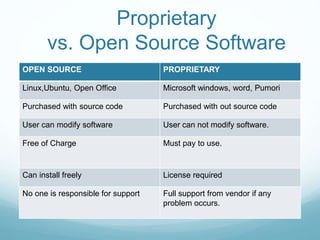
OPEN SOURCE PROPRIETARY 
Linux,Ubuntu, Open Office Microsoft windows, word, Pumori 
Purchased with source code Purchased with out source code 
User can modify software User can not modify software. 
Free of Charge Must pay to use. 
Can install freely License required 
No one is responsible for support Full support from vendor if any 
problem occurs.
Free vs.Open Source 
Software 
FREE SOFTWARES OPEN SOURCE SOFTWARES 
• Freedom to run program for any 
purpose 
• Freedom to study about program 
• Freedom to distribute copes of 
software. 
• Freedom to modify/improve 
program and release 
improvements to public 
• It has distribution of License. 
• Availability of Source Code. 
• Free Distribution 
• Integrity of Authors Source Code.
Some Examples.. 
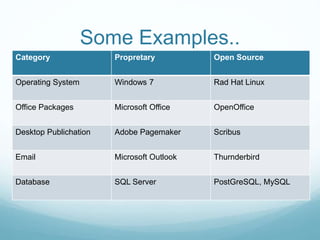
Category Propretary Open Source 
Operating System Windows 7 Rad Hat Linux 
Office Packages Microsoft Office OpenOffice 
Desktop Publichation Adobe Pagemaker Scribus 
Email Microsoft Outlook Thurnderbird 
Database SQL Server PostGreSQL, MySQL
History of Open Source.. 
 1960-70-Software Sharing culture is US Culture 
 1976- Bill Gates’ “Open Letter to Hobbyists” advocating that software should be paid for 
including royalties. 
 Early 80s LISP programming language taken by MIS to dismay of hackers. 
 January 1984- Richard Stallman quit job at MIT and started to wrok on GNU , a set of 
programming tools. 
 1986-Free Software Foundation was born. 
 1990-Bringing ‘Free software to the corporate world with Cygnus. 
 1991- Linus Torvalds distributed Unix like Kernal and encouraged everyone, Kernal was 
leter names “ Linux” 
 1992- Xfree86 was born, started to develop linux for desktop level 
 1993- Debina and Slackware as implementations of GNU/Linus ware born.
History.. 
 1994-Apache , popular webserver was borned. 
 1995- Red hast was born. 
 1997-GNU/Linus grabbed 25% of server market. 
 1997-GNOME desktop manager was born. 
 1998- Netscape released open source of its browser. 
 1998- the term :Open Source’ was coined. 
 1999-Rat Hast was transformed into corporation. Linux” started not to charge 
for its software but for support services.
Benefits & Drawbacks 
Benefits: 
 Availability of Source Code. 
 Product does not depend on vendor. 
 Customization and Control make easy. 
Drawbacks: 
Not Generally straight forward to use. 
Require training to operate it. 
Incompatibility Issue during installation/operation 
Software quality assurance process is not widely transparent. 
No financial Incentive
Benefits of FOSS 
 Economy and affordability. 
 No license and maintenance fee. 
 Stability and Security 
 Data integrity – No Viruses. 
 Open Standard, interoperability, portability. 
 Can be converted /localized easily. 
 User Freedoms-Freedom to use , study, modify 
particular software.
Our Status 
 Nepali users are using on pirated illegal copies of software. 
 They prefer to use free software. 
 Initiated by FOSS Nepal Community initiated by few people in 2005. 
 Nepal Open Source Klub was organized in 2008. 
 Some products like Nepalinux, ubatunepal, Chitwanix are introducted by some 
organizations. 
 Software freedom day 2005 , turn out to be turning point for open source. 
 Most ISP are using open source tool like linux, MySQL PHP, Apache. 
 Some educational institute initiated Foss Community and trying to aware Nepali people. 
 So our status is on initial state.
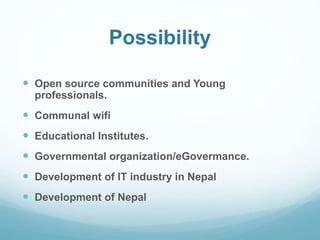
Possibility 
 Open source communities and Young 
professionals. 
 Communal wifi 
 Educational Institutes. 
 Governmental organization/eGovermance. 
 Development of IT industry in Nepal 
 Development of Nepal
Any Queries ? 
 “Use Open Source, Promote Open Source”. 
 “Lets build eNepal” 
Thank you !

Open Source Possibility in Nepal

  • 1.
    Open Source Technology A brief introduction By  Resham Acharya  M Sc IT III semester Fall 2014  LBEF, SMU DE Roll No 13308097362
  • 2.
  • 3.
    vs. Open Source Software  Proprietary Software: Have to pay the software if want to use Eg. Microsoft Office, Photoshop, Windows 7 Open Source Software:  Free to use  Provides the original source code of software so that advanced users can modify it to make work better for them.  Example: Linus, Mozill Firefox 3.0 , OpenOffice.Org
  • 4.
    Proprietary vs. OpenSource Software OPEN SOURCE PROPRIETARY Linux,Ubuntu, Open Office Microsoft windows, word, Pumori Purchased with source code Purchased with out source code User can modify software User can not modify software. Free of Charge Must pay to use. Can install freely License required No one is responsible for support Full support from vendor if any problem occurs.
  • 5.
    Free vs.Open Source Software FREE SOFTWARES OPEN SOURCE SOFTWARES • Freedom to run program for any purpose • Freedom to study about program • Freedom to distribute copes of software. • Freedom to modify/improve program and release improvements to public • It has distribution of License. • Availability of Source Code. • Free Distribution • Integrity of Authors Source Code.
  • 6.
    Some Examples.. CategoryPropretary Open Source Operating System Windows 7 Rad Hat Linux Office Packages Microsoft Office OpenOffice Desktop Publichation Adobe Pagemaker Scribus Email Microsoft Outlook Thurnderbird Database SQL Server PostGreSQL, MySQL
  • 7.
    History of OpenSource..  1960-70-Software Sharing culture is US Culture  1976- Bill Gates’ “Open Letter to Hobbyists” advocating that software should be paid for including royalties.  Early 80s LISP programming language taken by MIS to dismay of hackers.  January 1984- Richard Stallman quit job at MIT and started to wrok on GNU , a set of programming tools.  1986-Free Software Foundation was born.  1990-Bringing ‘Free software to the corporate world with Cygnus.  1991- Linus Torvalds distributed Unix like Kernal and encouraged everyone, Kernal was leter names “ Linux”  1992- Xfree86 was born, started to develop linux for desktop level  1993- Debina and Slackware as implementations of GNU/Linus ware born.
  • 8.
    History..  1994-Apache, popular webserver was borned.  1995- Red hast was born.  1997-GNU/Linus grabbed 25% of server market.  1997-GNOME desktop manager was born.  1998- Netscape released open source of its browser.  1998- the term :Open Source’ was coined.  1999-Rat Hast was transformed into corporation. Linux” started not to charge for its software but for support services.
  • 9.
    Benefits & Drawbacks Benefits:  Availability of Source Code.  Product does not depend on vendor.  Customization and Control make easy. Drawbacks: Not Generally straight forward to use. Require training to operate it. Incompatibility Issue during installation/operation Software quality assurance process is not widely transparent. No financial Incentive
  • 10.
    Benefits of FOSS  Economy and affordability.  No license and maintenance fee.  Stability and Security  Data integrity – No Viruses.  Open Standard, interoperability, portability.  Can be converted /localized easily.  User Freedoms-Freedom to use , study, modify particular software.
  • 11.
    Our Status Nepali users are using on pirated illegal copies of software.  They prefer to use free software.  Initiated by FOSS Nepal Community initiated by few people in 2005.  Nepal Open Source Klub was organized in 2008.  Some products like Nepalinux, ubatunepal, Chitwanix are introducted by some organizations.  Software freedom day 2005 , turn out to be turning point for open source.  Most ISP are using open source tool like linux, MySQL PHP, Apache.  Some educational institute initiated Foss Community and trying to aware Nepali people.  So our status is on initial state.
  • 12.
    Possibility  Opensource communities and Young professionals.  Communal wifi  Educational Institutes.  Governmental organization/eGovermance.  Development of IT industry in Nepal  Development of Nepal
  • 13.
    Any Queries ?  “Use Open Source, Promote Open Source”.  “Lets build eNepal” Thank you !