Apache Shindig, from Server Side Portlets to 
          Open Social Gadgets

                           Tyrell Perera 
       (Product Manager WSO2 Gadget Server and WSO2 Mashup Server)


                                   &
                                     
                         Nuwan Bandara 
                 (Software Engineer, WSO2 Gadget Server)
                                      
Outline
•   The Role of Portals in SOA
•   The Google Gadgets Specification
•   Apache Shindig
•   A Case Study


The Role of Portals in Today's 
       Service Oriented World


An SOA is ...
• Essentially a collection of 
  – self contained, 
  – pluggable, 
  – loosely coupled services


• Which have 
  – well­defined interfaces and 
  – functionality 
                            
Therefore, a Service is ...
• A function that is 
  – self­contained and 
  – immune to the context or state of other services 


• These services can communicate with each 
  other


Services are ...
• Software agents which are the building blocks 
  of SOAs 
• They are self­contained, which means they 
  should not be modified
• Individually, they may or may not have a 
  presentation layer

• But the end users need a unified view to make 
  use of all this!
                        
A Portal Framework (a)
• Provides presentation capabilities for these 
  software agents
• It is also responsible for providing 
  – the required resources and 
  – environment for proper functioning of the 
    components plugged into it


A Portal Framework (b)
• Is also an extra layer in the architecture that 
  provides 
  – A standard (presentation) interface for business 
    logic, that is 
  – Independent of programming languages or 
    platforms


A Portal Framework (c)
• The portal not only presents the application 
  logic contained in the software agents 
• But can be used to coordinate different, loosely 
  coupled services into a single concrete service,
  – by providing the gluing framework


Ideally ...
• A portal should be able to bring together,
• services and their presentation logic, created using 
  any platform
  – Java
  – PHP
  – .Net
  – Etc.,
• running anywhere in the world,
• to provide a single unified view to the end user
                             
But ...
• Most portal technologies restrict developers of 
  Portlets in to a platform, one way or the other
  – If you want your Service to appear in a JSR­168 
    Portal, you better learn JSR­168
• Services should be self contained and 
• interoperability is a big deal in SOA!
  – A Portal is no exception


Then again ...
• Portals are rendered in the browser, aren't 
  they?
• In essence, a Portlet's output finally reaches 
  the user as HTML, Javascript or any browser 
  friendly medium 


What If?
• We can write a Portlet and give its URL to the 
  Portal? 
• The Portal only needs to know this URL and 
  nothing else?


Then ...

• Let's talk about Gadgets :)


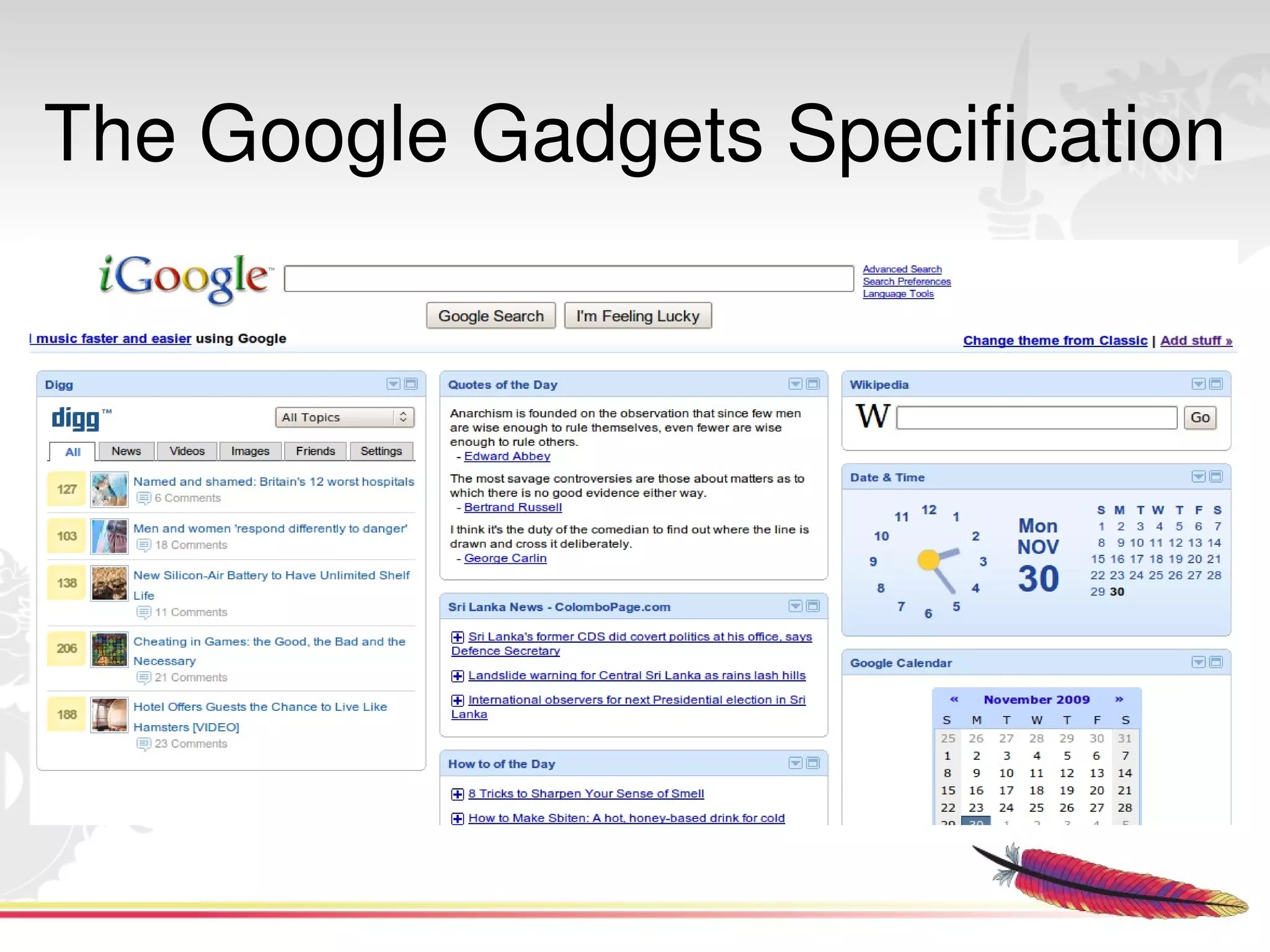
The Google Gadgets Specification


The Google Gadgets Specification
• Gadgets are web­based software components based on HTML, 
  CSS, and JavaScript
• They allow developers to easily write useful web applications that 
  work anywhere on the web without modification 
• They are defined using a declarative XML syntax that is processed 
  by a gadget server into a format that allows them to be embedded 
  into various contexts: 
  – standalone web pages, web applications, even other gadgets. 


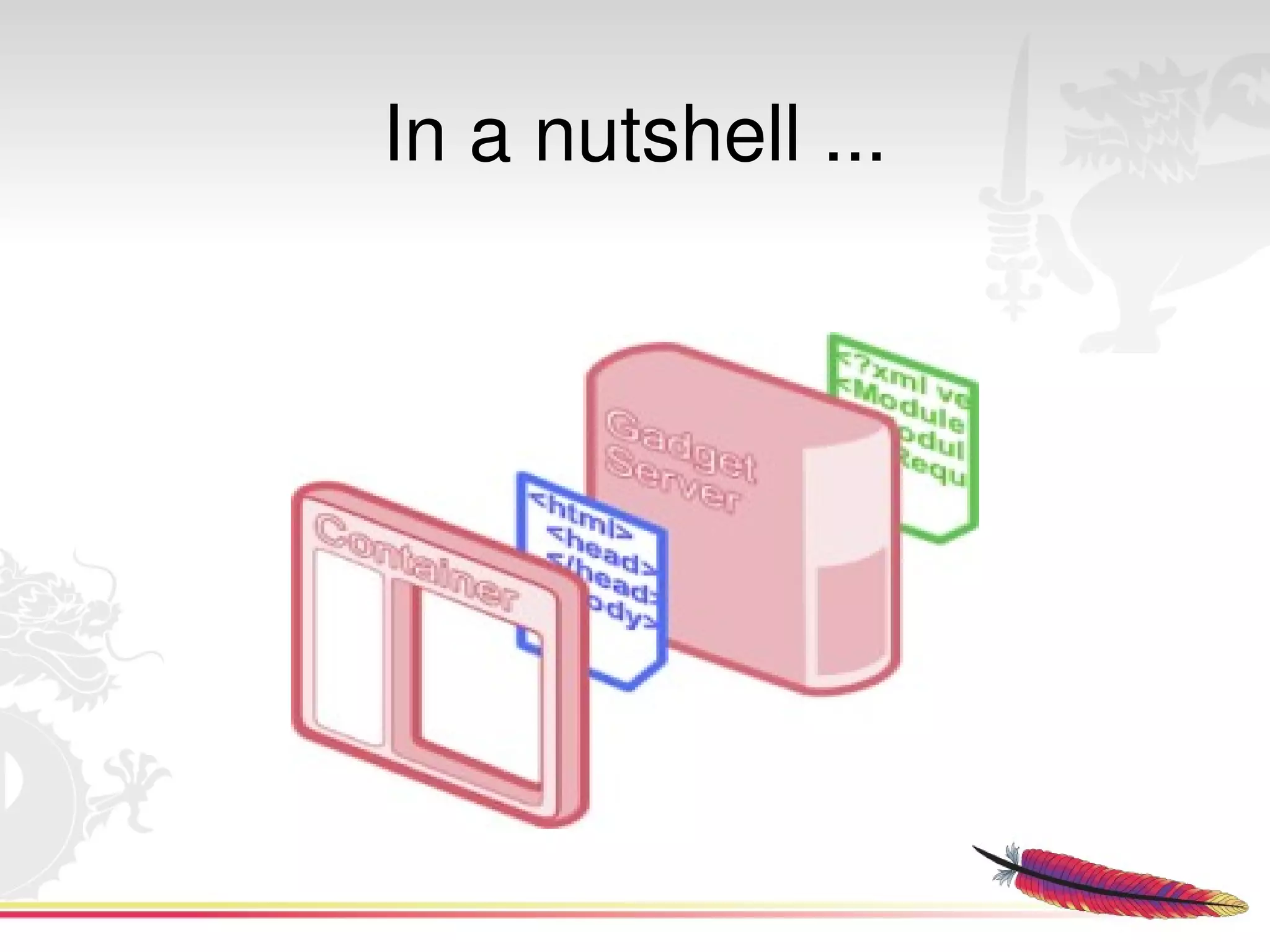
• A gadget and its XML are synonymous. The gadget XML contains 
  all information needed to identify and render a web application. 
                                      
A Gadget Container (Portal)
• A context into which a gadget is embedded is called a 
  gadget container 
• The container is responsible for managing the gadgets' 
  layout and controls, 
• as well as supporting various functionality on behalf of the 
  gadget
  – Maximise (or Canvas view)
  – Passing the user's locale (for i18n)
  – Storing user preferences
  – Authentication ...
                                   
Gadgets


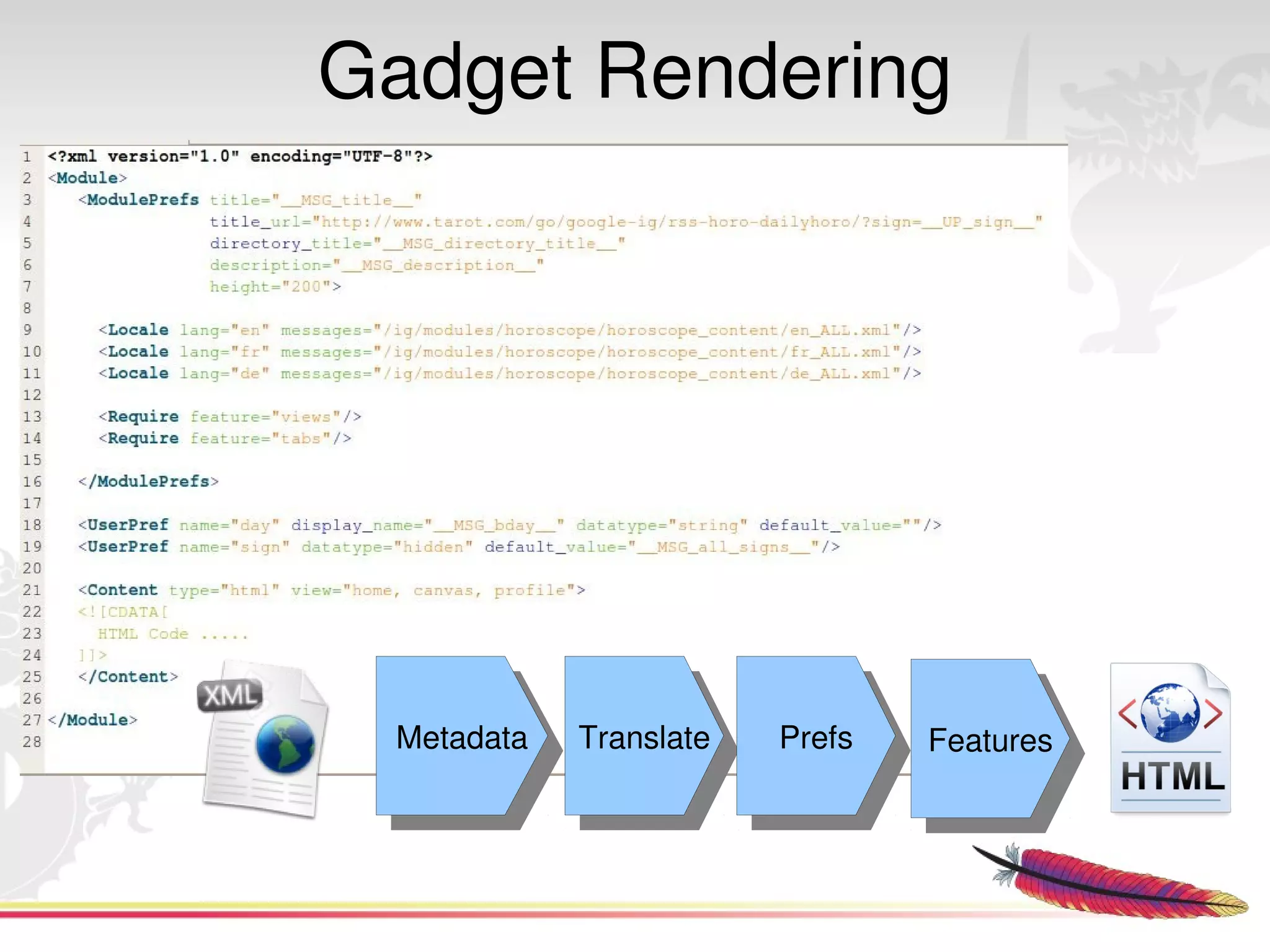
    Gadgets are specified in XML. The first line is the standard way to start an XML file. This must be the first 
•
    line in the file
    The <Module> tag indicates that this XML file contains a gadget
•
    The <ModulePrefs> tag contains information about the gadget such as its title, description, author, and other 
•
    optional features
    The line <Content type="html"> indicates that the gadget's content type is HTML
•
    <![CDATA[ ...insert HTML here... ]]> is used to enclose HTML when a gadget's content type is html. It tells 
•
    the gadget parser that the text within the CDATA section should not be treated as XML. The CDATA section 
    typically contains HTML and JavaScript
     </Content> signifies the end of the Content section
•
      </Module> signifies the end of the gadget definition  
         
•
In a nutshell ...


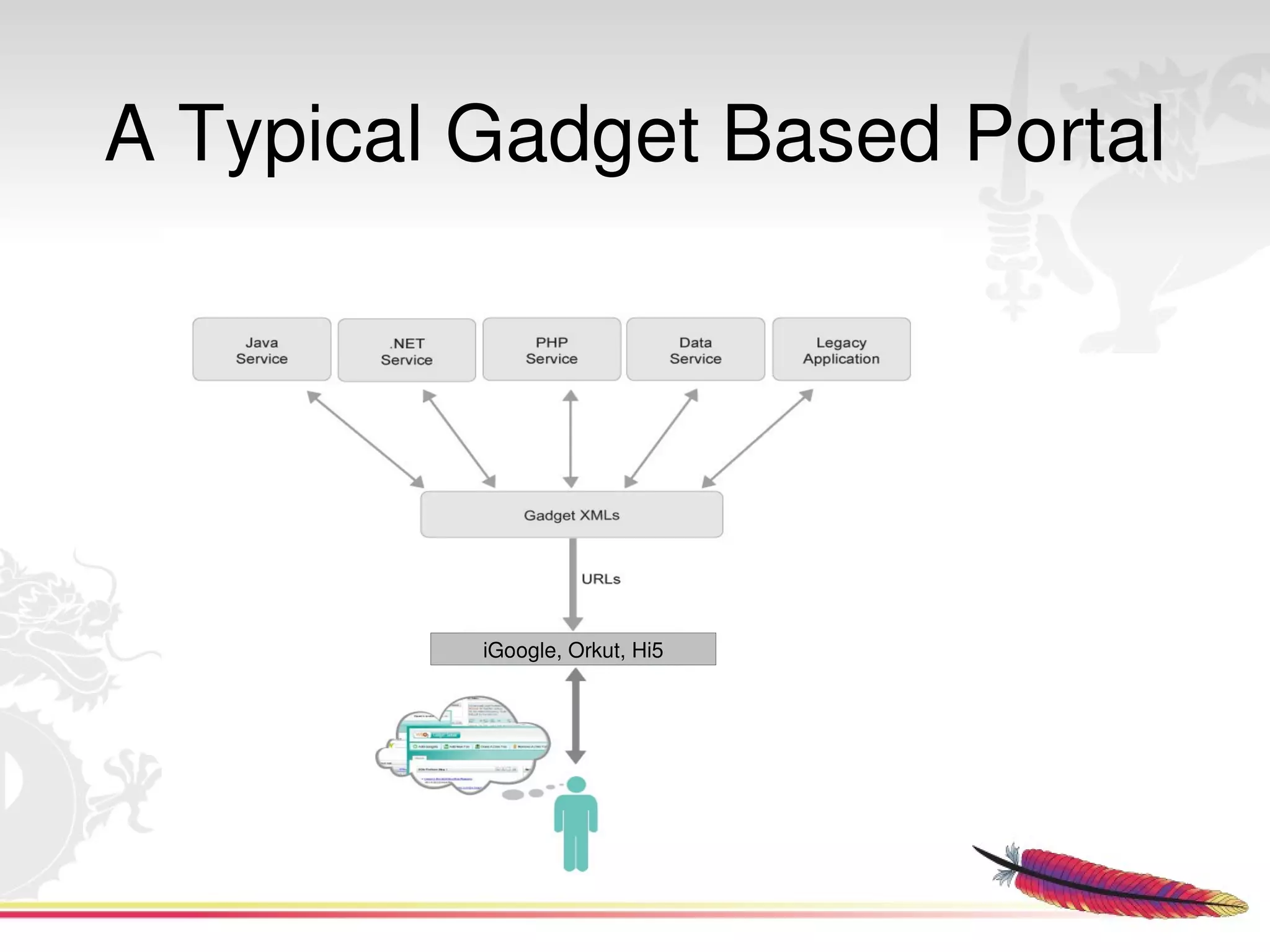
A Typical Gadget Based Portal


              iGoogle, Orkut, Hi5


Apache Shindig
• Apache Shindig (a word meaning party)
• Originally started by Google in 2007 
      • as a reference container for hosting OpenSocial 
        compatible widgets in any website 
• A port of Google's iGoogle gadget container
• Supports
  – The Google Gadgets Specification and
  – The OpenSocial Specification
                                
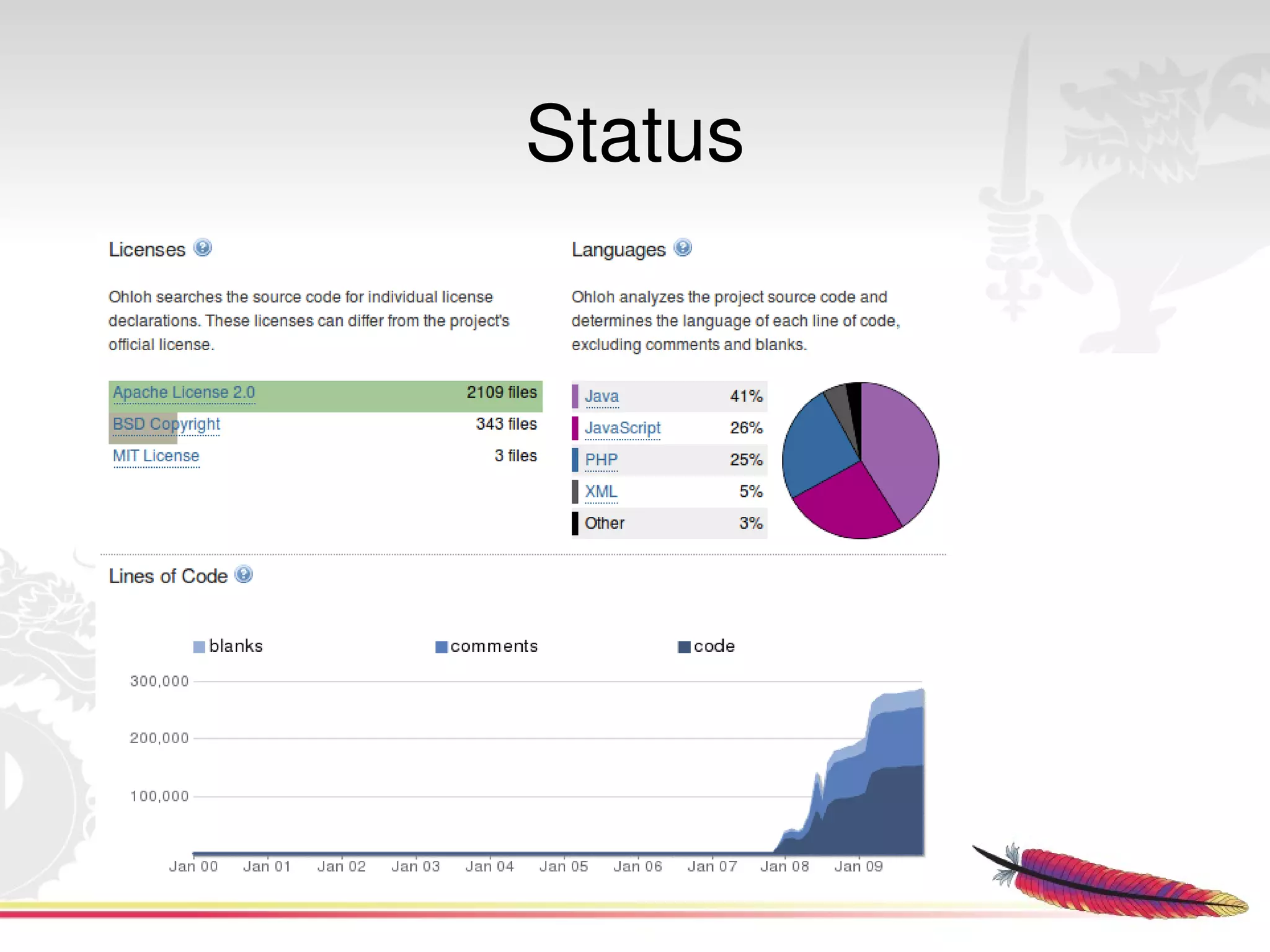
Status


Who's using it?
• LinkedIn
• hi5
• Partuza, based on PHP Apache Shindig
• WSO2 Gadget Server, based on Java Apache 
  Shindig
• etc.,


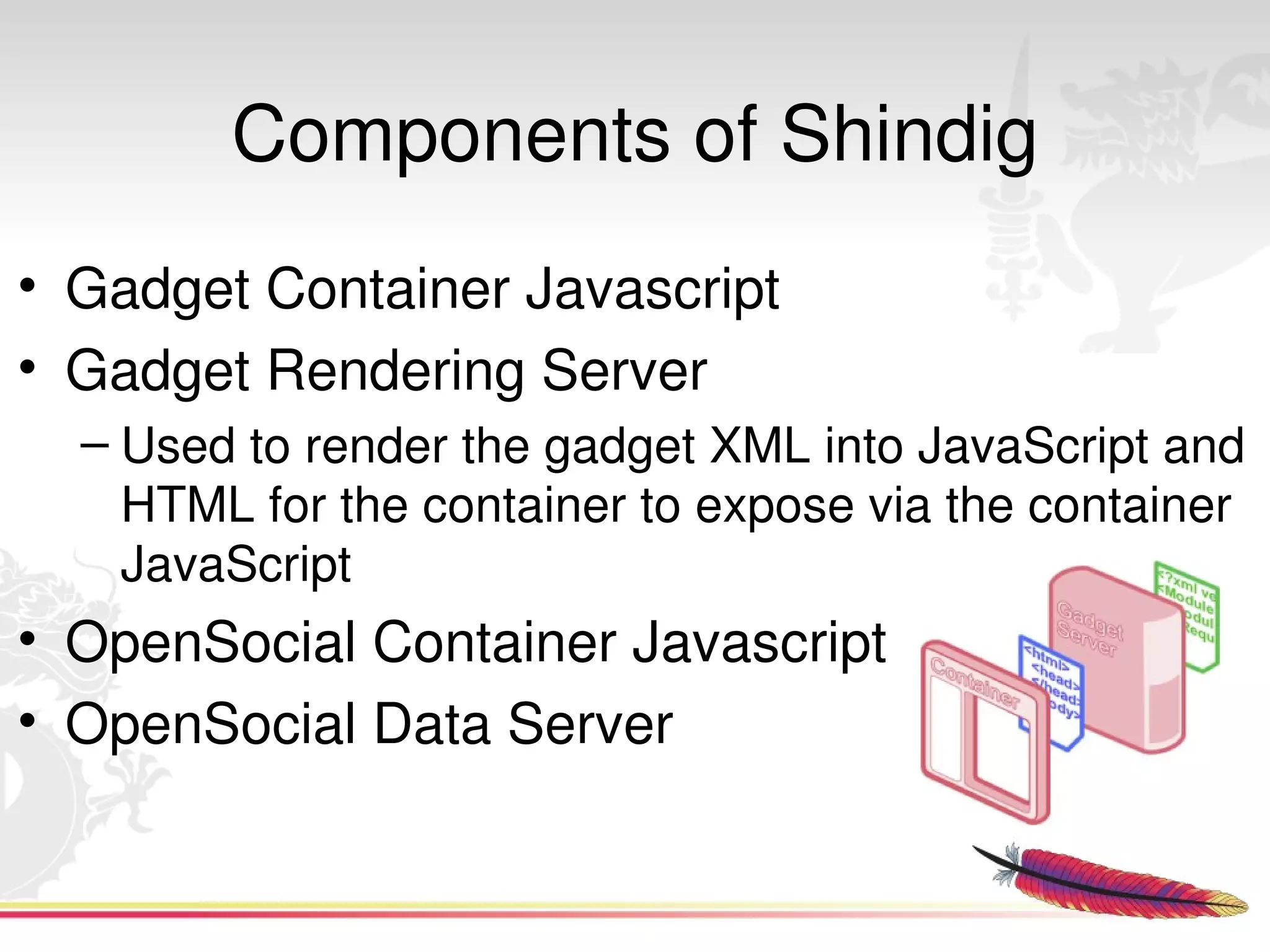
Components of Shindig
• Gadget Container Javascript
• Gadget Rendering Server
  – Used to render the gadget XML into JavaScript and 
    HTML for the container to expose via the container 
    JavaScript
• OpenSocial Container Javascript
• OpenSocial Data Server

                           
Gadget Rendering


     Metadata
      Metadata   Translate
                  Translate   Prefs
                               Prefs   Features
                                        Features


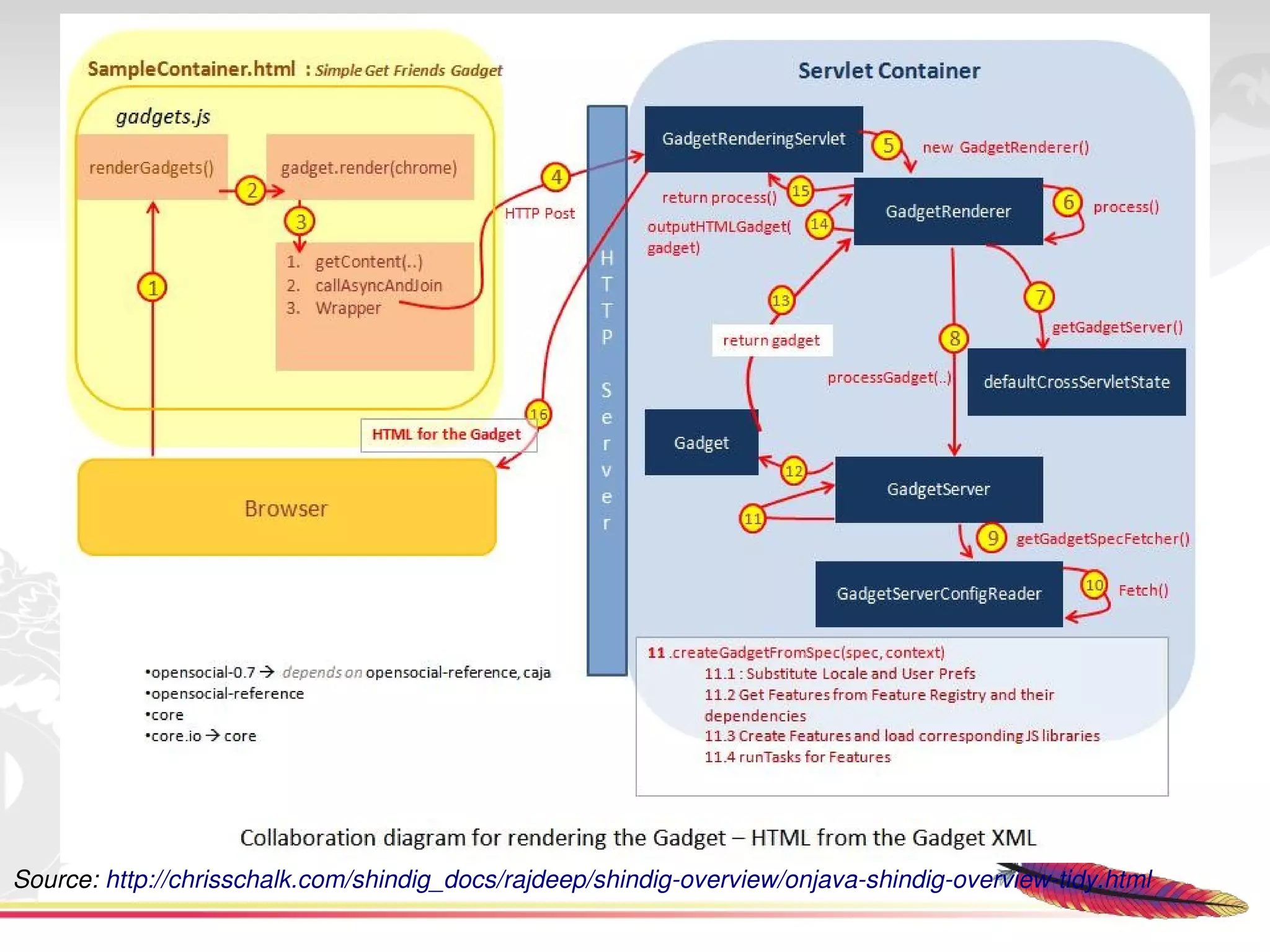
Source: http://chrisschalk.com/shindig_docs/rajdeep/shindig­overview/onjava­shindig­overview­tidy.html
                                                         
Our Experience With Apache Shindig


What we did with shindig
• We used shindig to host our portlets
      • The provided XML is rendered in to an HTML and 
        returned to the browser
• We let shindig do the communication for us
      • Shindig handled gadget specific settings, cross­domain 
        calls etc.
• We made shindig, a component in our server 
  space
      • We bundled it in our OSGi environment
                                
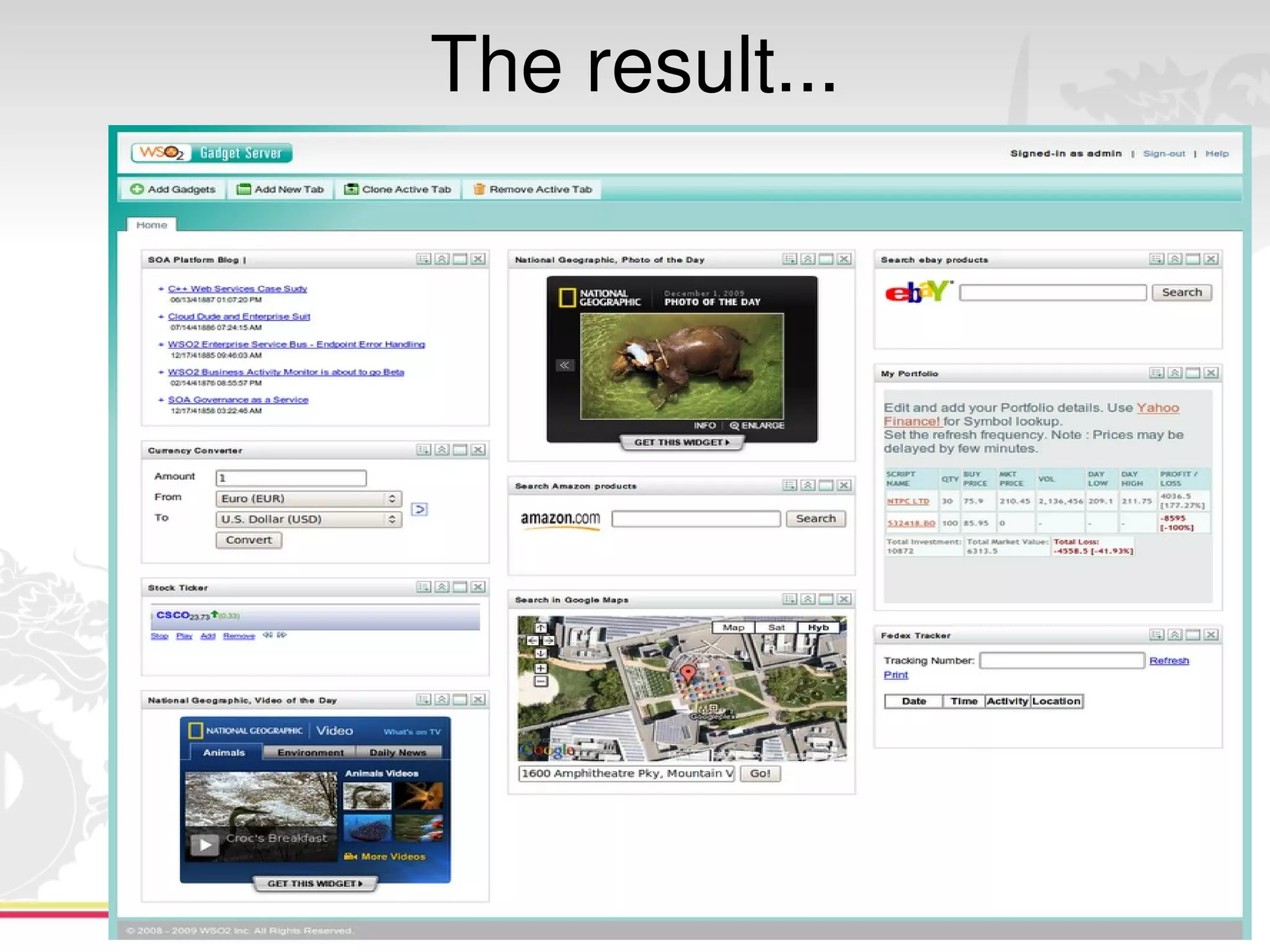
The result...


Other bits and pieces of Tech we 
                used
• For thousands of lines of javascript jQuery helped
      • With jQuery the rendered iFrames were smoothly 
        sortable 
• We used OSGi to bundle up everything
      • Rather than using shindig as a deployed web­app we 
        OSGi­fied it, so it would work in harmony with other 
        modules in the portal server
• We heavily used Apache web services stack


Tweaks we did to make it fast
• We enabled caching
      • We enabled caching in shindig so the gadgets are 
        refreshed without a delay
• We made the gadget metadata to be fetched in 
  one go
• The gadget preferences were loaded 
  asynchronously


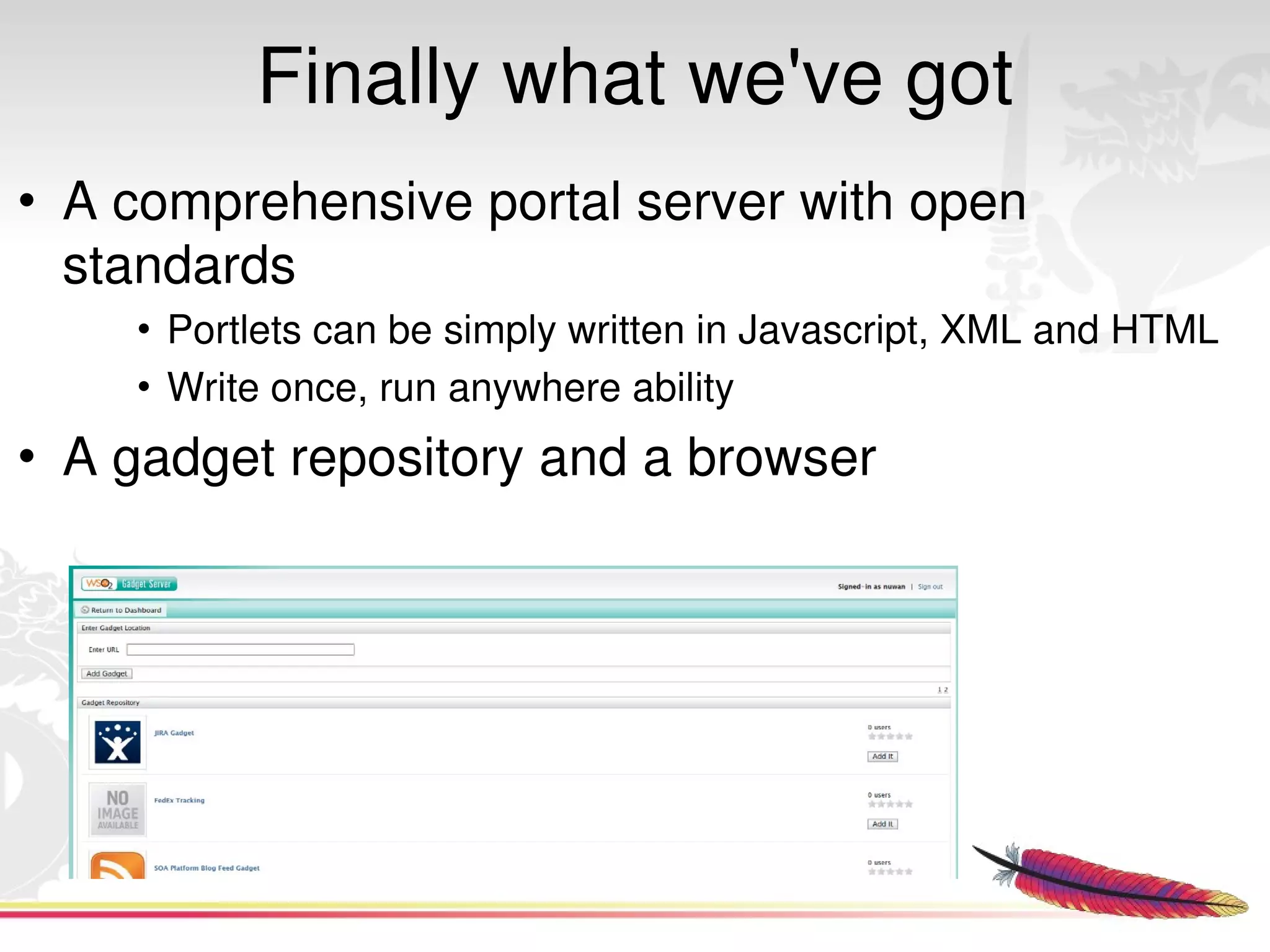
Finally what we've got
• A comprehensive portal server with open 
  standards
      • Portlets can be simply written in Javascript, XML and HTML
      • Write once, run anywhere ability
• A gadget repository and a browser


What's next
• Enable open social features in shindig
      • By supporting open­social features in shindig in the 
        container level we believe an enterprise portal can be 
        more interactive
• Provide single sign­on for all the gadgets in 
  container level
      • By implementing a single sign­on framework via shindig 
        features


More Information
• Google Gadgets Specification 
  http://code.google.com/apis/gadgets/docs/spec.html
• Open Social http://code.google.com/apis/opensocial/
• Gadgets Developer Reference 
  http://code.google.com/apis/gadgets/docs/dev_guide.html
• Apache Shindig Project Page http://incubator.apache.org/shindig/
• WSO2 Gadget Server Project Page http://wso2.org/projects/gadget­server


Q&A


Shindig Apachecon Asia 09