


Senator(retd.) Dean Florez, 20 Million Minds
Foundation
Dr. Barbara Illowsky, De Anza College
Dr. Michelle Pilati, Rio Hondo College
April 30, 2013
Open Education, MOOCs, &
Student Access
Collaborate Window Overview
Audio & Video
Participants
Chat
Tech Support available at:
1-760-744-1150 ext. 1537, 1554, 1542
Welcome
Please introduce yourself in the chat
window.
Your hosts:
– Una Daly, Community College Outreach Director at Open
Courseware Consortium
– James Glapa-Grossklag, President of CCCOER Advisory
Board; Dean, College of Canyons
.
Agenda
• Community Colleges and Open Ed
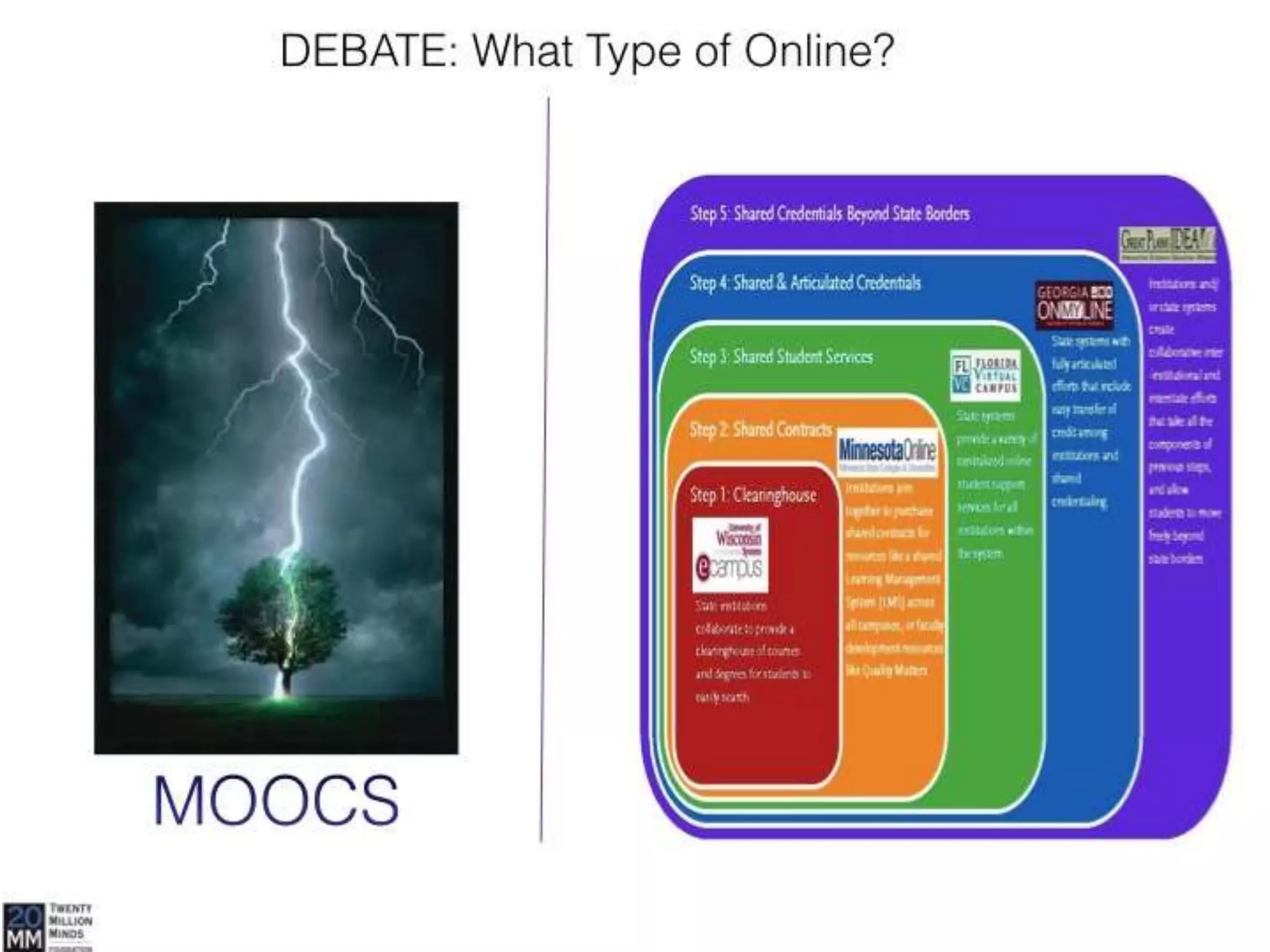
• Rebooting Higher Ed in California
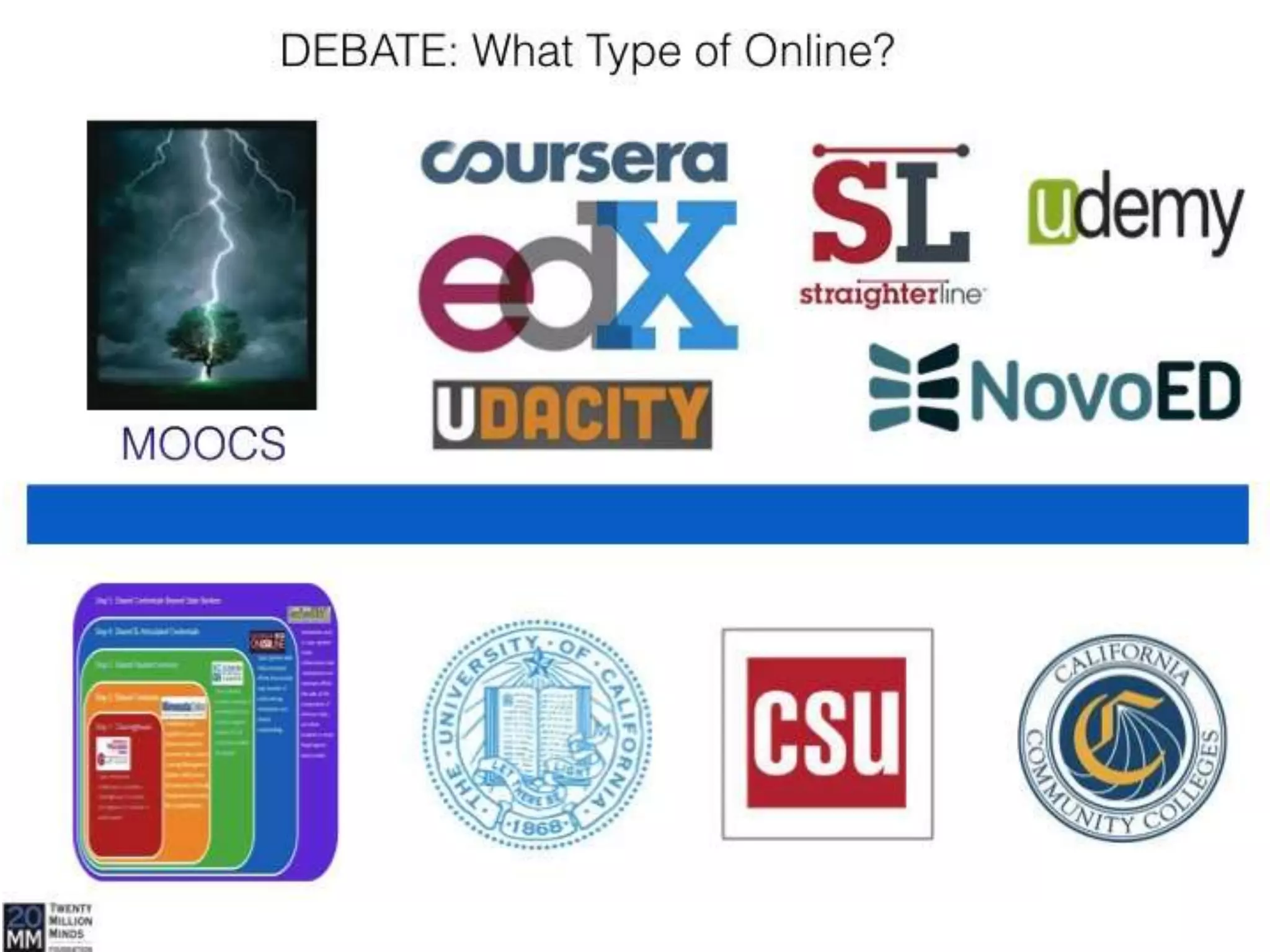
• OER and MOOCs
• Academic Senate & OER council
• Choosing our next webinar
• Q & A
CCCOER Mission
• Promote adoption of OER to enhance
teaching and learning
–Expand access to education
–Support professional development
–Advance community college mission
Funded by the William & Flora
Hewlett Foundation
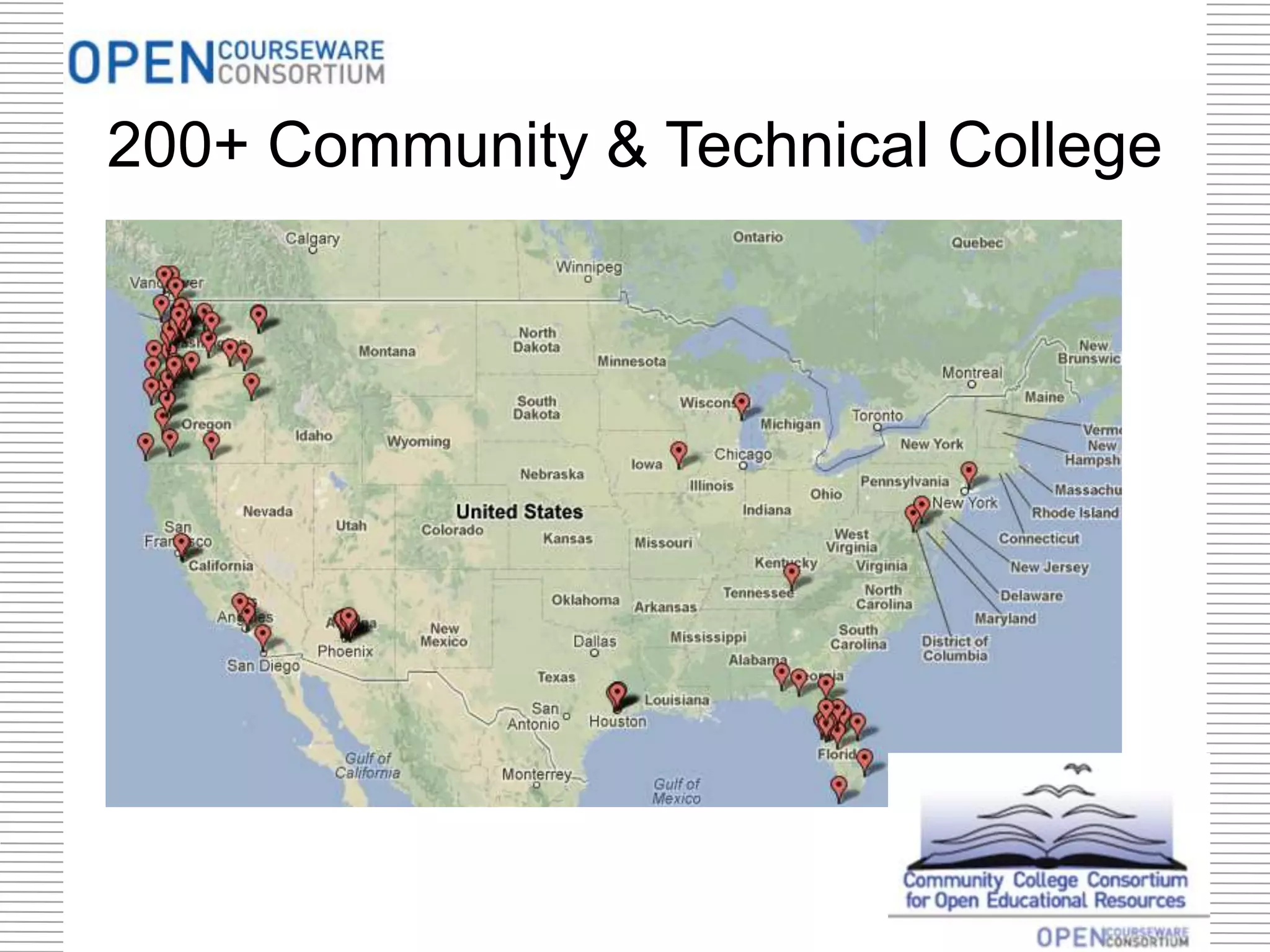
200+ Community & Technical College
How to Get Involved?
 Join the CCCOER advisory list
 Participate in our community of interest
 Attend our free monthly webinars
 Visit our website to find resources
 Invite us to conduct faculty training
 Become a member of the OCWC
oerconsortium.org
james.glapa-grossklag@canyons.edu
unatdaly@ocwconsortium.org
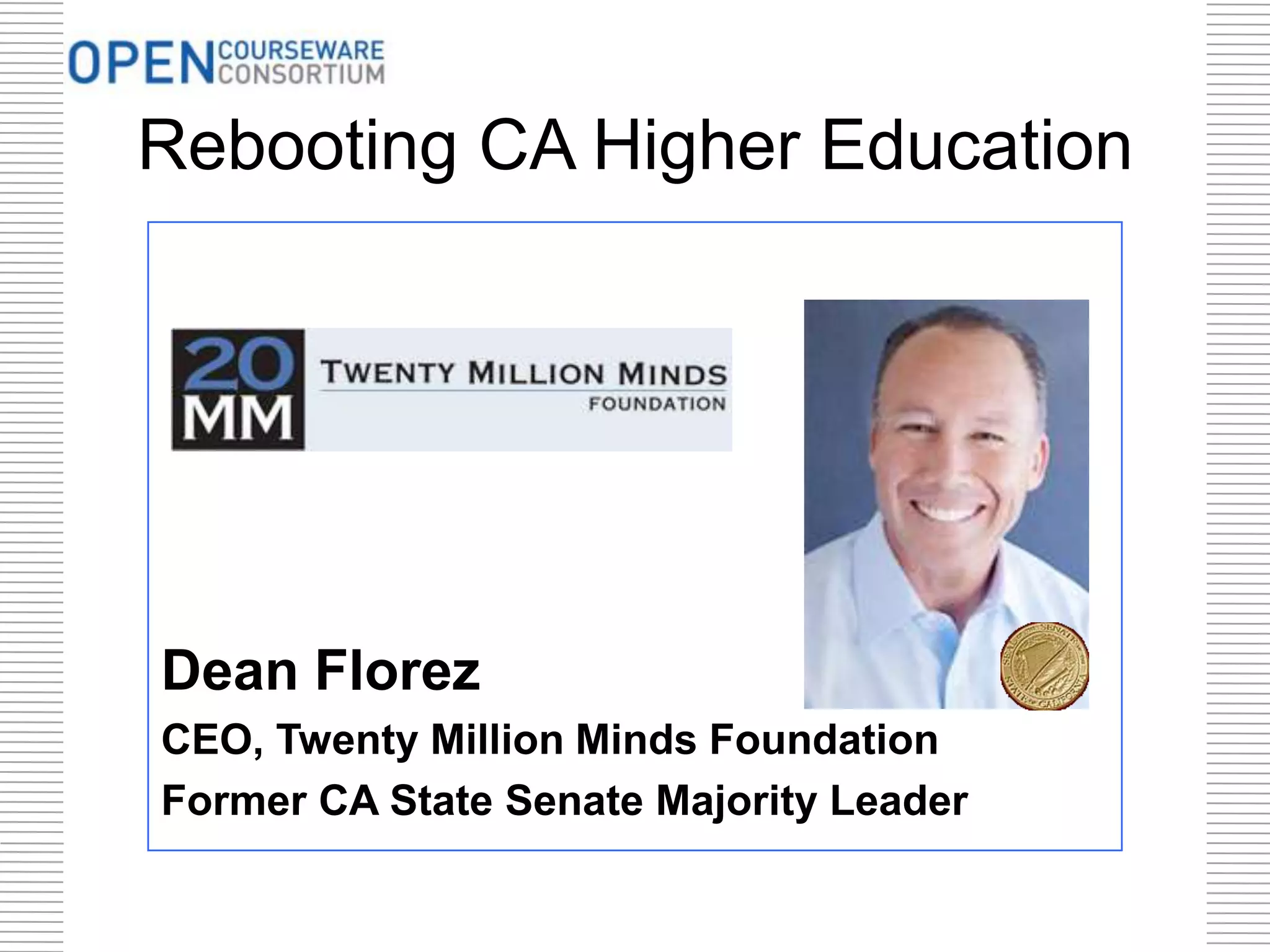
Rebooting CA Higher Education
Dean Florez
CEO, Twenty Million Minds Foundation
Former CA State Senate Majority Leader
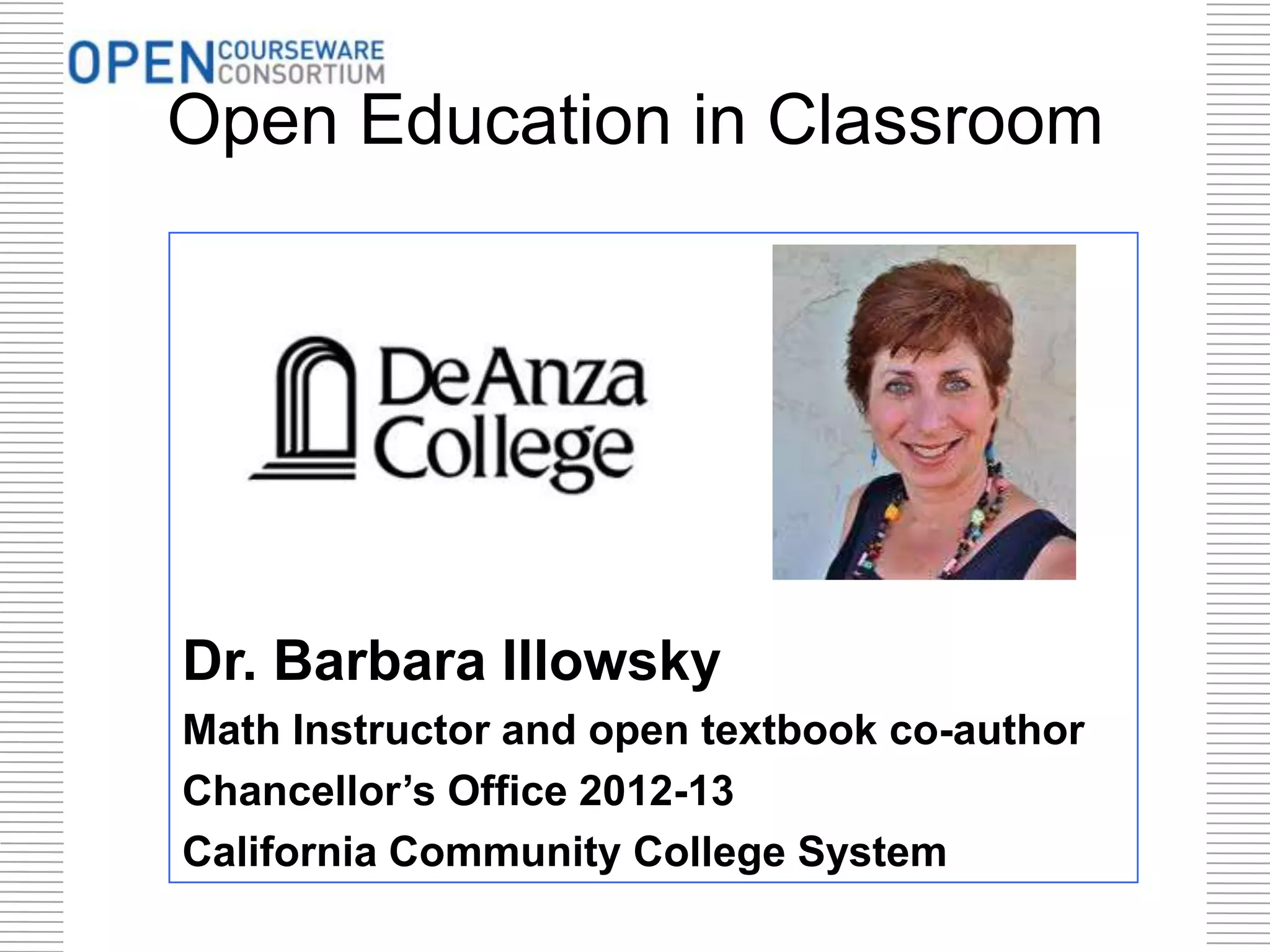
Open Education in Classroom
Dr. Barbara Illowsky
Math Instructor and open textbook co-author
Chancellor’s Office 2012-13
California Community College System
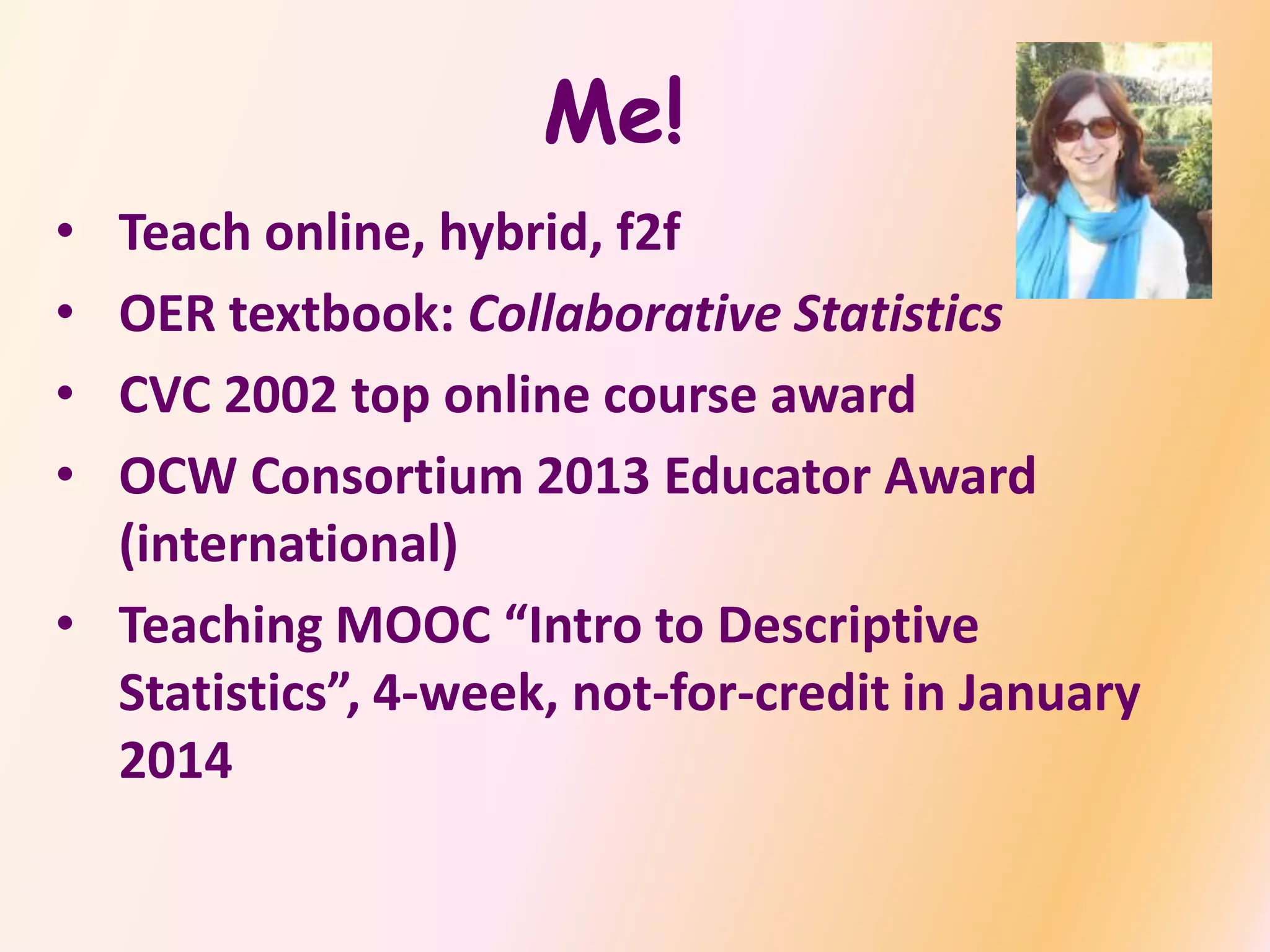
Me!
• Teach online, hybrid, f2f
• OER textbook: Collaborative Statistics
• CVC 2002 top online course award
• OCW Consortium 2013 Educator Award
(international)
• Teaching MOOC “Intro to Descriptive
Statistics”, 4-week, not-for-credit in January
2014
Open Educational Resources
(OER)
“Teaching, learning, and research resources that
reside in the public domain or have been
released under an intellectual property license
that permits their free use or repurposing by
others.”
U.S Department of Education
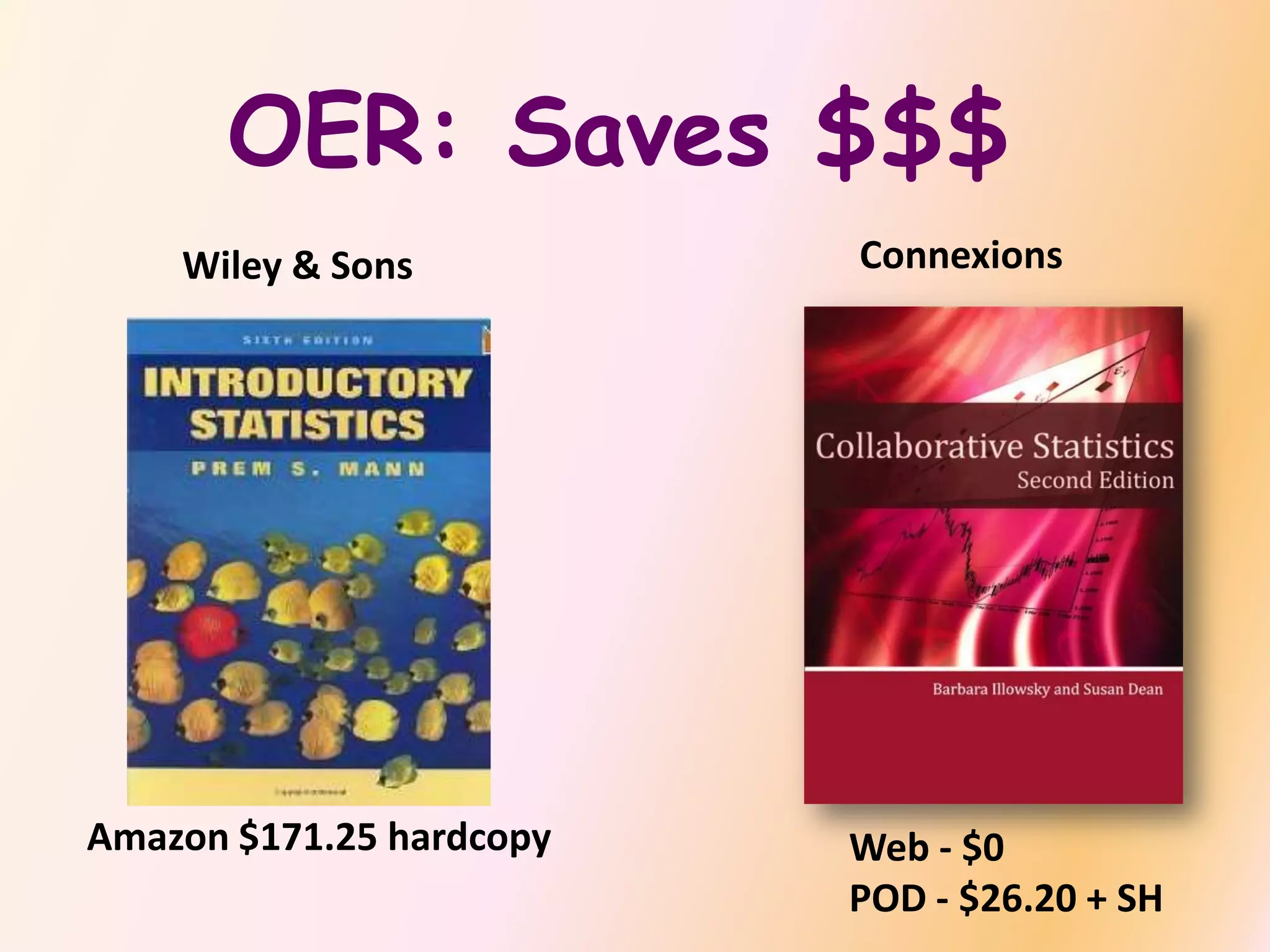
OER: Saves $$$
Amazon $171.25 hardcopy Web - $0
POD - $26.20 + SH
Wiley & Sons Connexions
De Anza College
student savings…
for just one
course:
> $1,000,000
OER: Free to
Choose
• provides faculty with more choices
for their courses
• allows for permission-free editing
and adaptation
• promotes customization
• eliminates forced publisher revisions
OER: Adoption
Concerns
• Faculty awareness of OER is low
• Difficulty of finding materials
• Standards for quality vary
• Lack of ancillaries
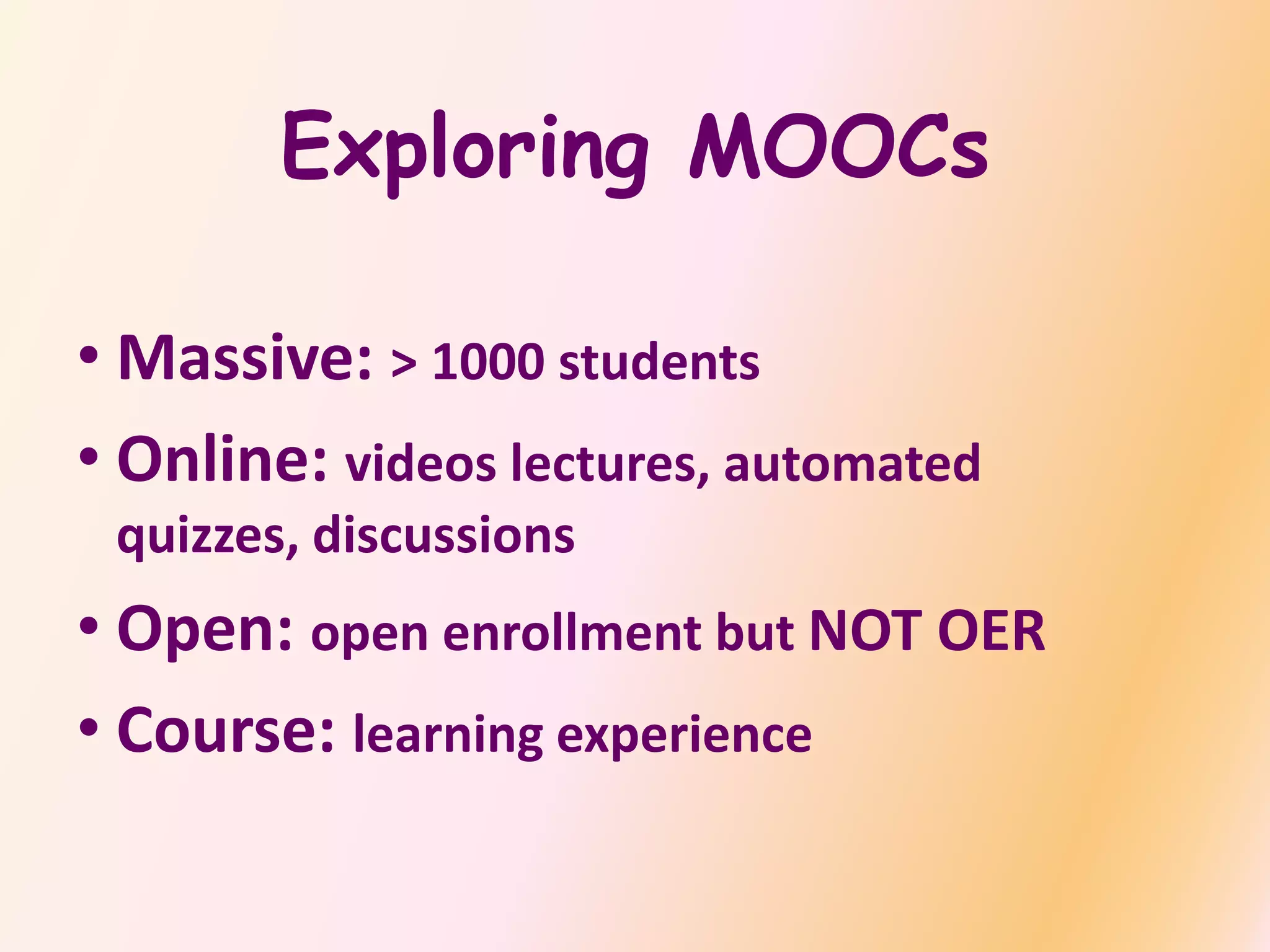
Exploring MOOCs
• Massive: > 1000 students
• Online: videos lectures, automated
quizzes, discussions
• Open: open enrollment but NOT OER
• Course: learning experience
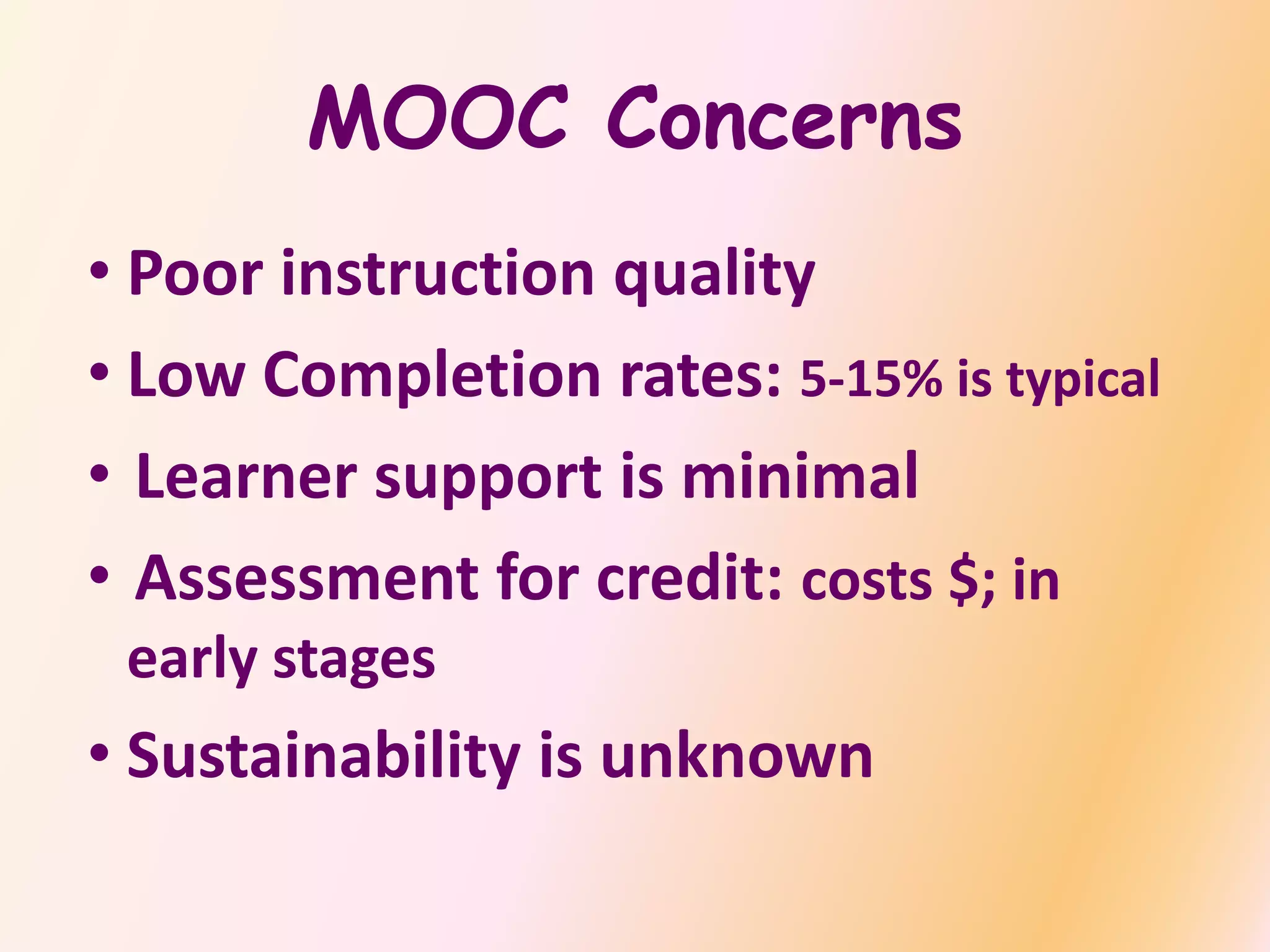
MOOC Concerns
• Poor instruction quality
• Low Completion rates: 5-15% is typical
• Learner support is minimal
• Assessment for credit: costs $; in
early stages
• Sustainability is unknown
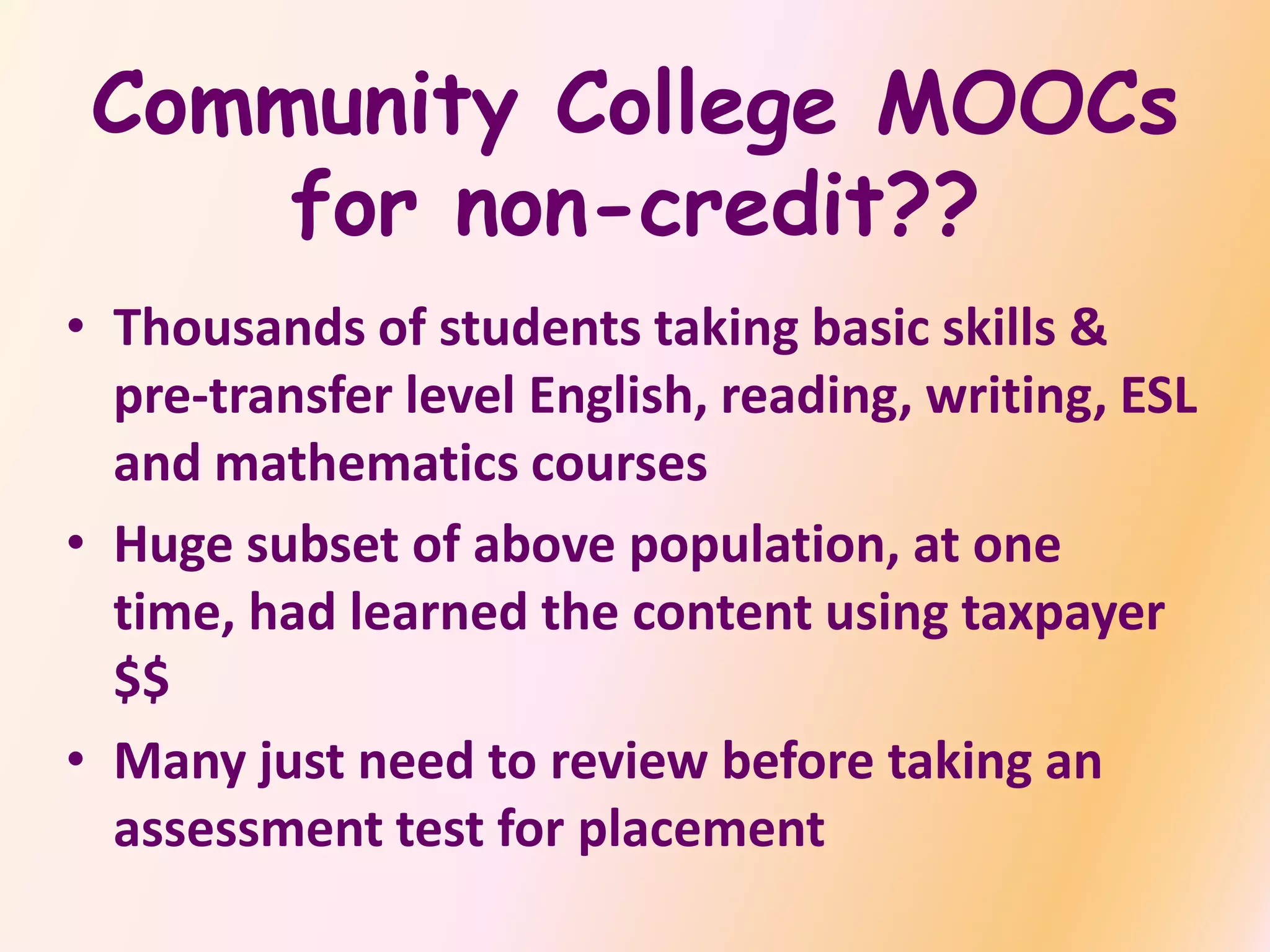
Community College MOOCs
for non-credit??
• Thousands of students taking basic skills &
pre-transfer level English, reading, writing, ESL
and mathematics courses
• Huge subset of above population, at one
time, had learned the content using taxpayer
$$
• Many just need to review before taking an
assessment test for placement
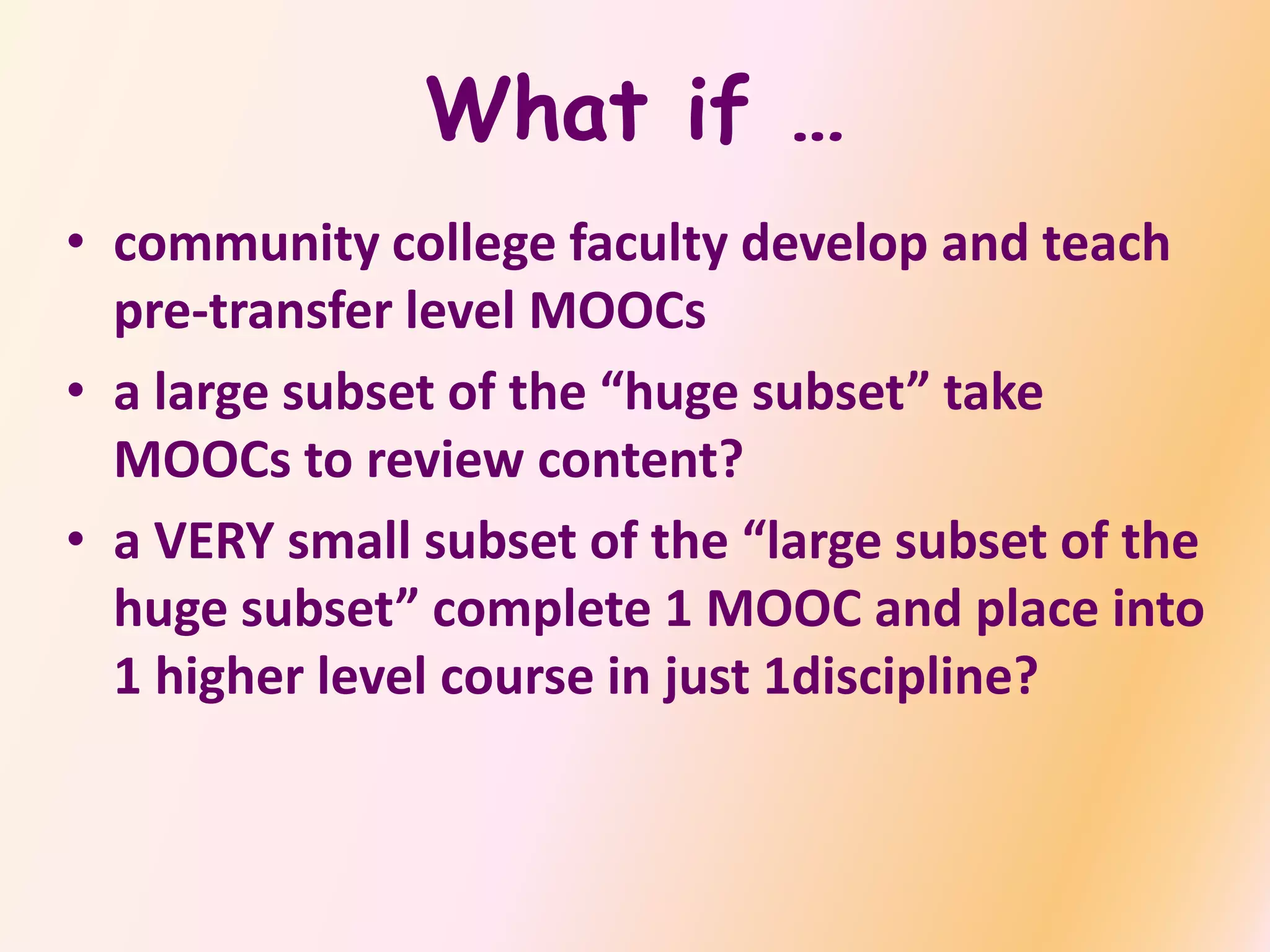
What if …
• community college faculty develop and teach
pre-transfer level MOOCs
• a large subset of the “huge subset” take
MOOCs to review content?
• a VERY small subset of the “large subset of the
huge subset” complete 1 MOOC and place into
1 higher level course in just 1discipline?
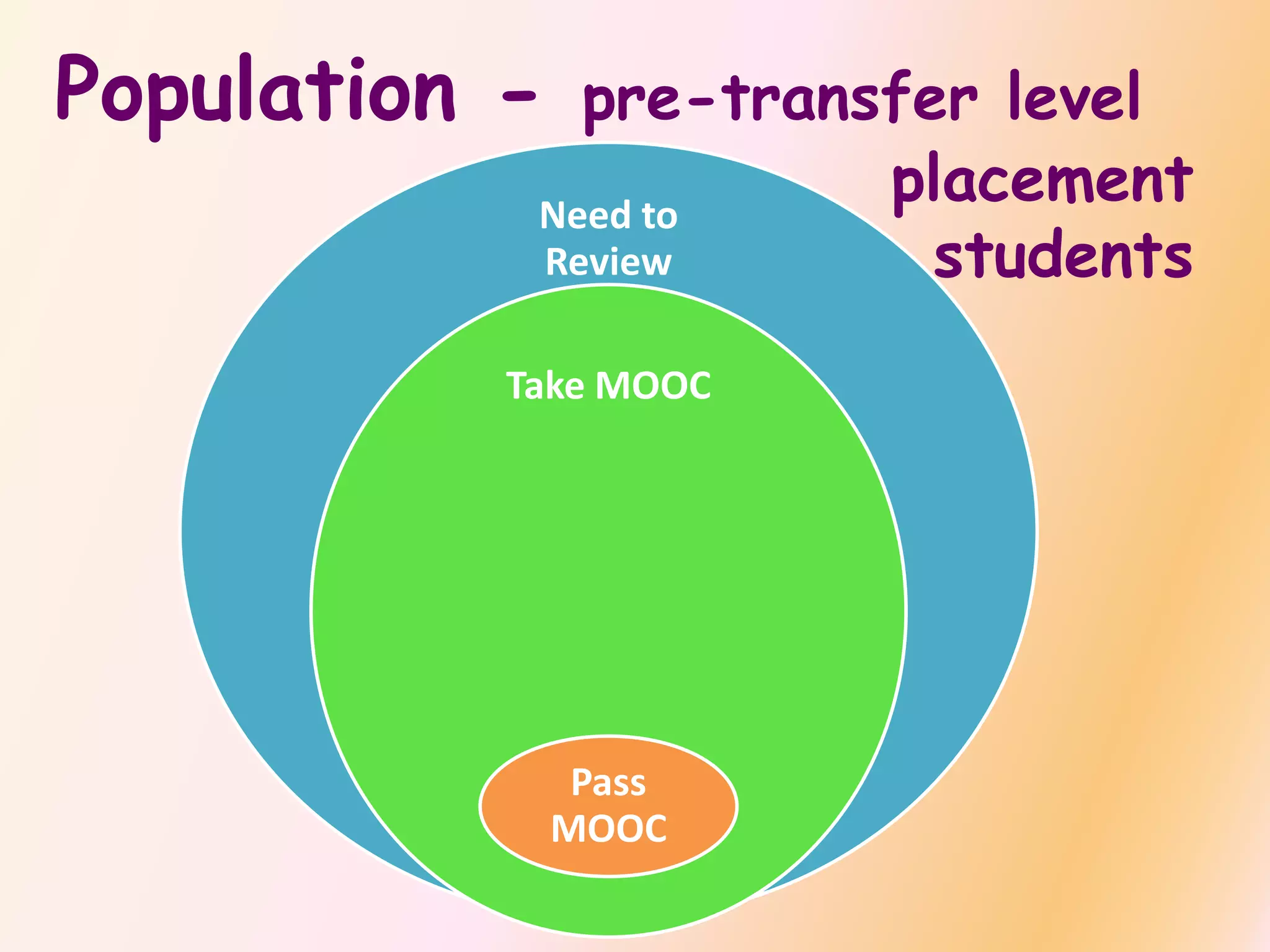
Need to
Review
Take MOOC
Pass
MOOC
Population - pre-transfer level
placement
students
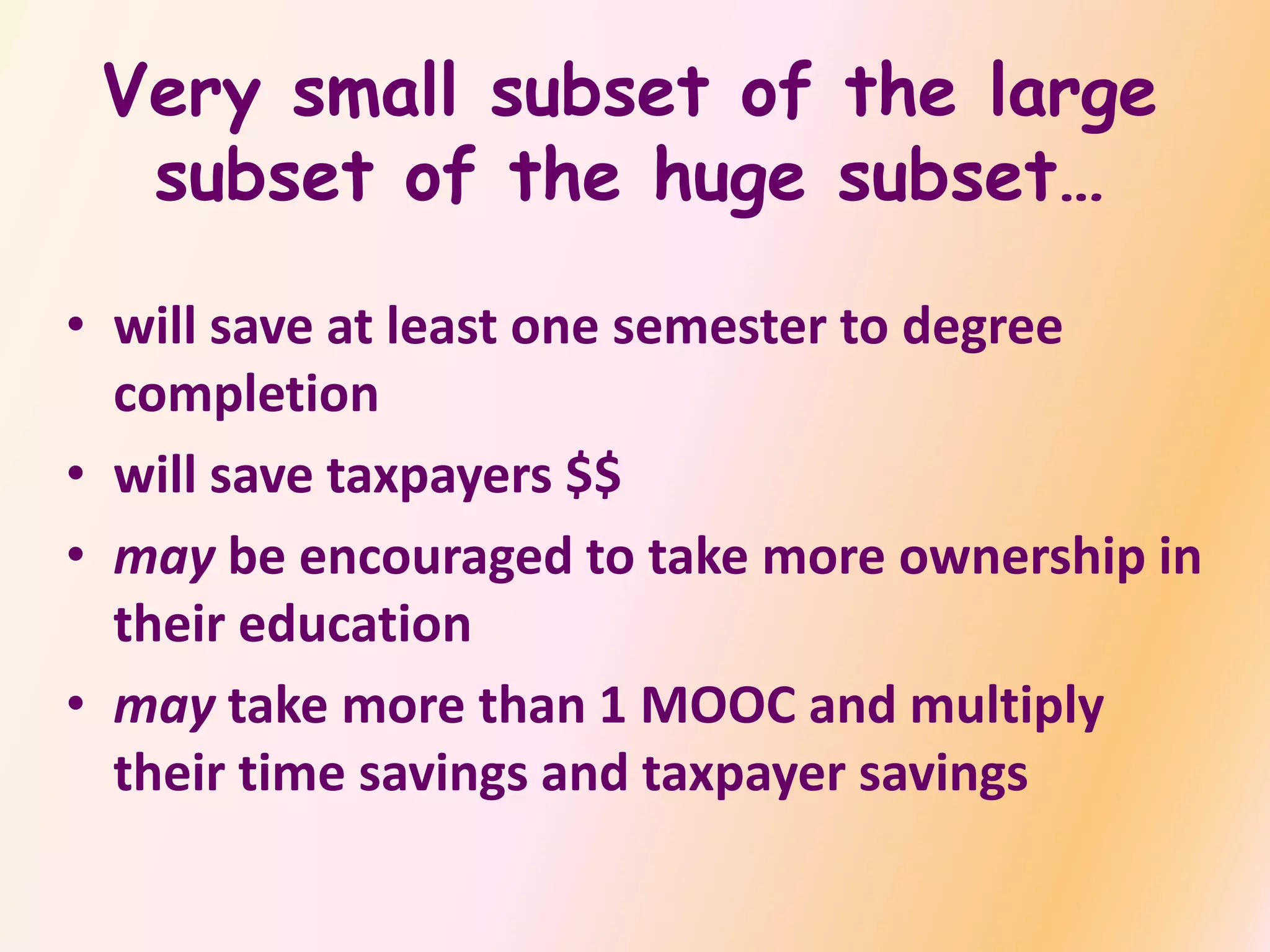
Very small subset of the large
subset of the huge subset…
• will save at least one semester to degree
completion
• will save taxpayers $$
• may be encouraged to take more ownership in
their education
• may take more than 1 MOOC and multiply
their time savings and taxpayer savings
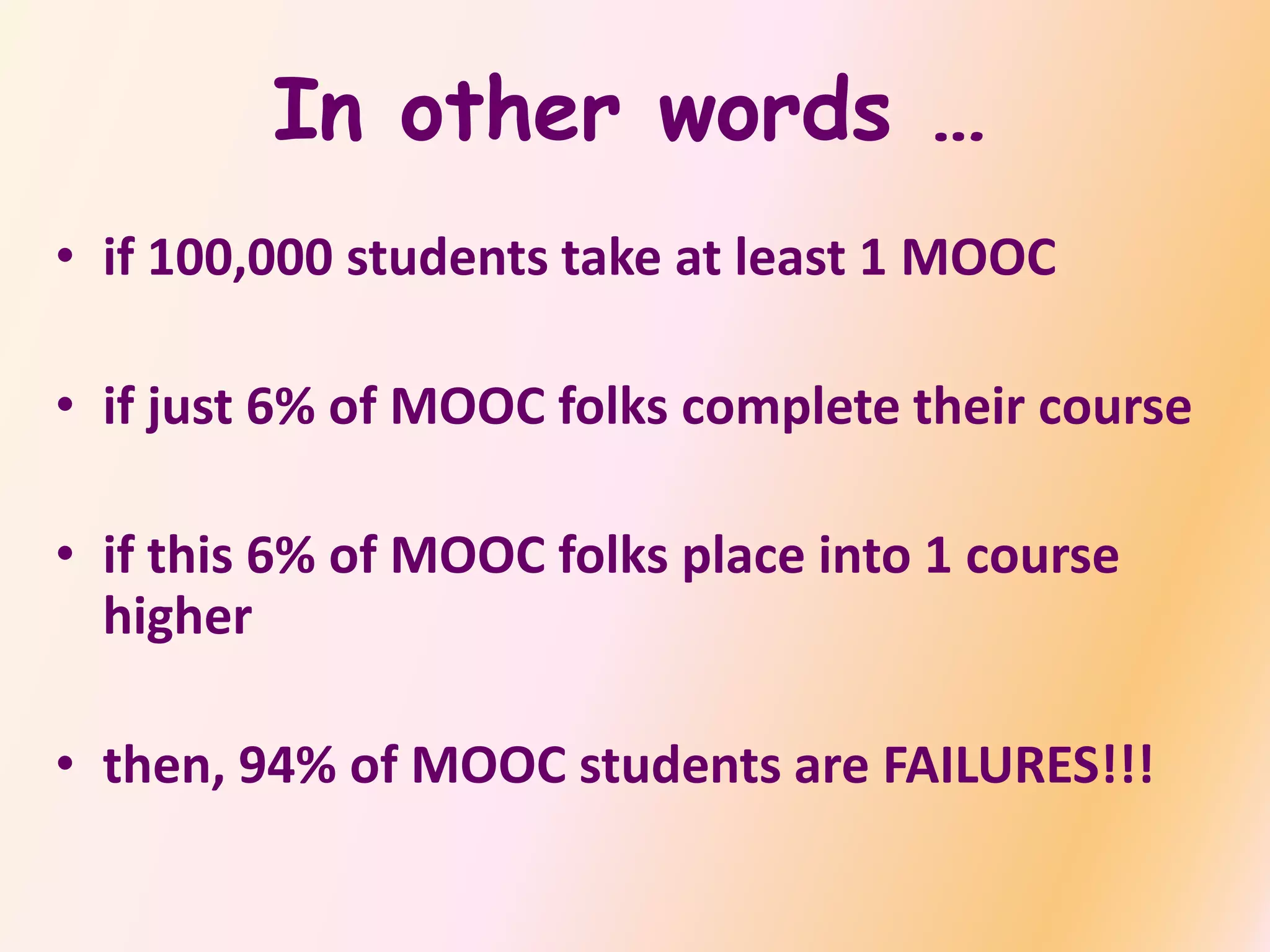
In other words …
• if 100,000 students take at least 1 MOOC
• if just 6% of MOOC folks complete their course
• if this 6% of MOOC folks place into 1 course
higher
• then, 94% of MOOC students are FAILURES!!!
BUT …
… 6000 students have succeeded!!!!!
… and maybe will have a …
shorter time to completion?
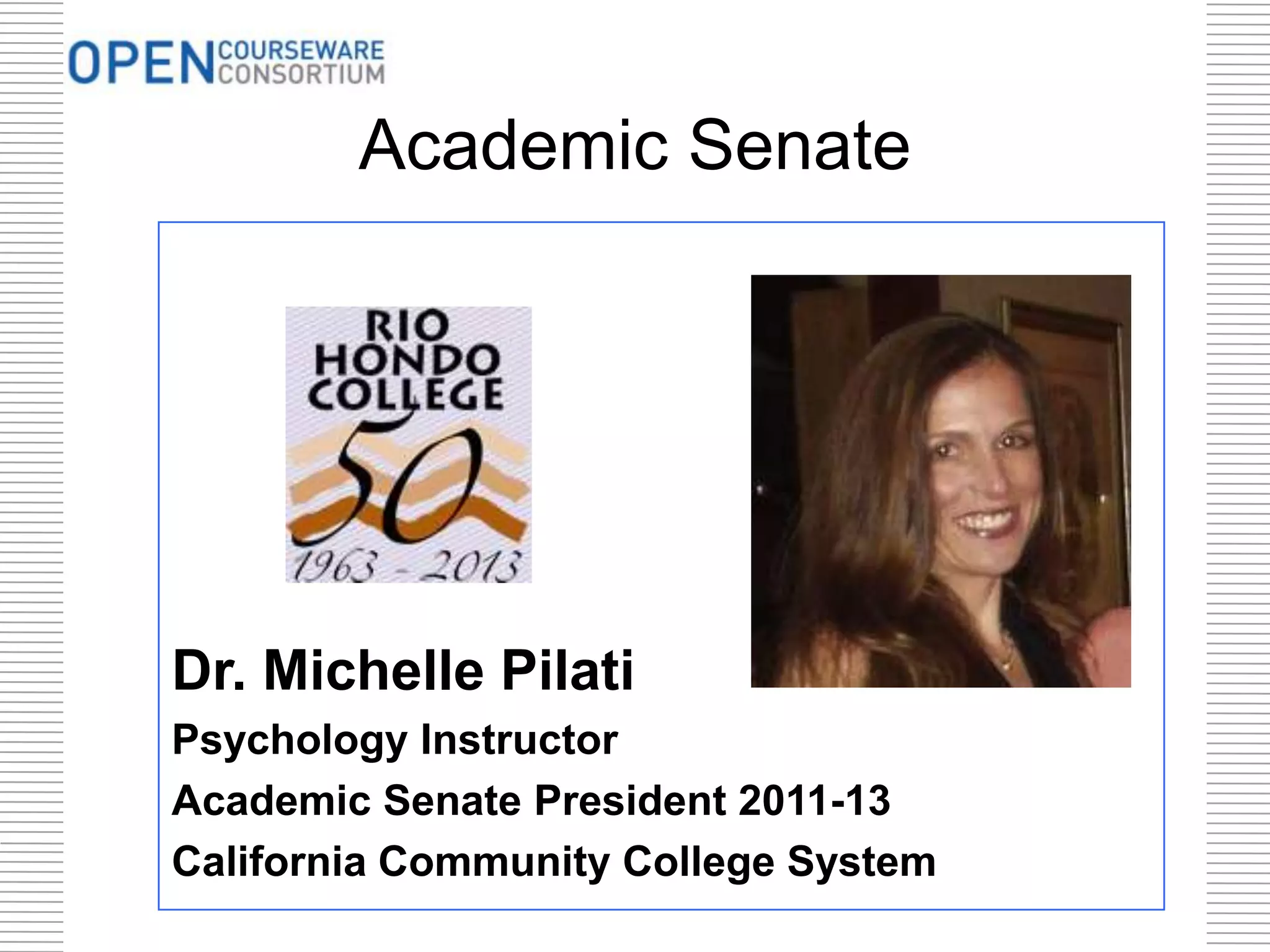
Academic Senate
Dr. Michelle Pilati
Psychology Instructor
Academic Senate President 2011-13
California Community College System
CALIFORNIA’S AGENDA FOR OPEN EDUCATION,
MOOCS, AND STUDENT ACCESS
Thoughts on the implementation
of SB 1052/1053
Access issues?
MOOCs and the California
Community Colleges
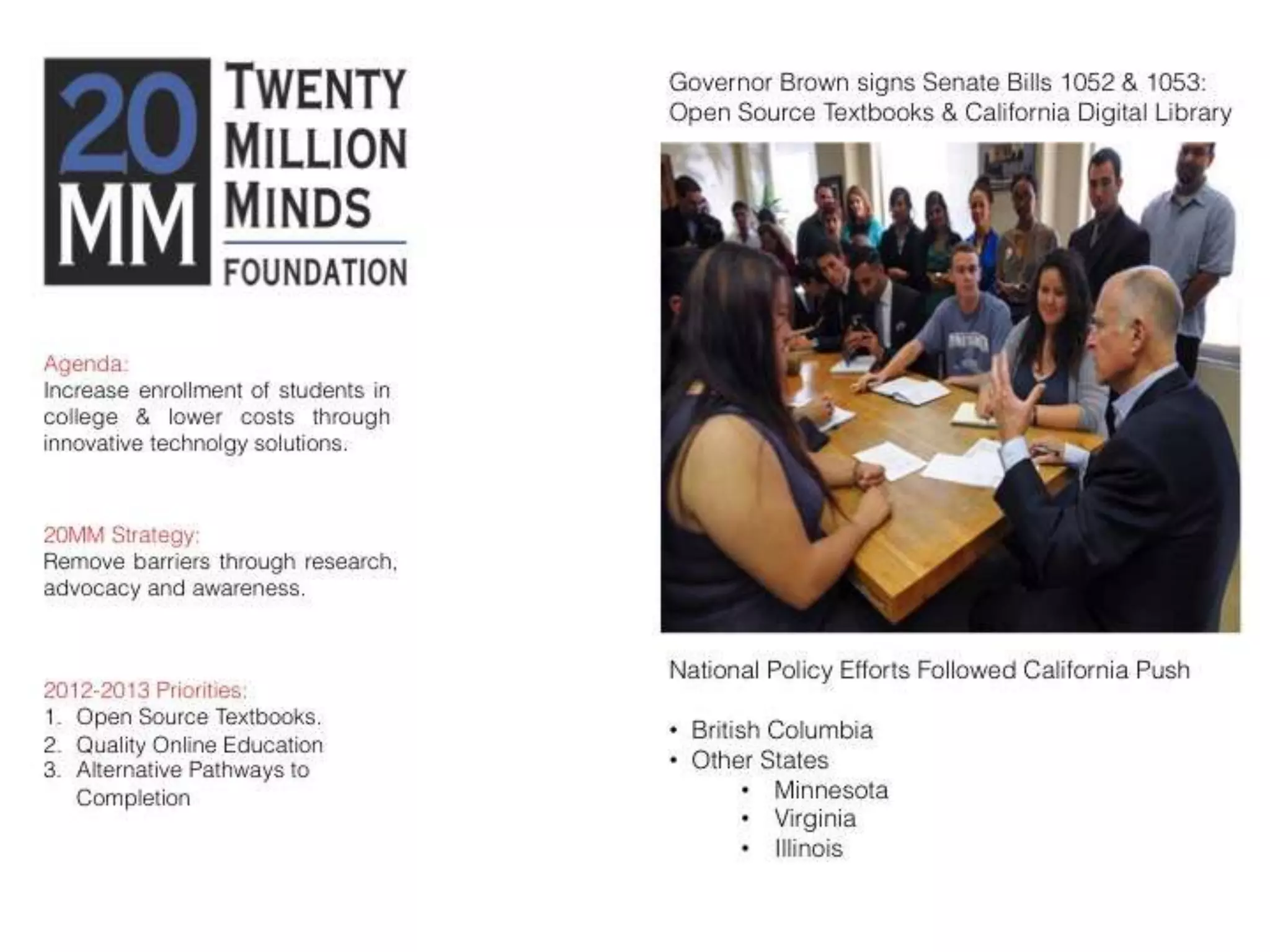
SB 1052 AND SB 1053
 Establish an intersegmental OER library and
a council to facilitate populating the library
and ensuring its use
 Members “appointed” to the California Open
Education Resources Council (COERC)
 Next steps
 Challenges
ACCESS ISSUES
 Since 2008
 Funding declines (“workload reduction”)
 Increased demand
 Today
 Proposition 30
 Recovering economy
 Declining access issues
ADDRESSING “ACCESS” ISSUES
 Increase success
 Online retention and success lags behind that of
onsite
 Increase online success >>> Increase access
 Increase access to existing courses – online
and onsite
 Students want access to courses, not
pathways to unit accumulation
ONLINE AS THE ACCESS ANSWER?
 Presumes equal access to technology
 Presumes equal success
 Differential outcomes exacerbated in the
online environment
 Online investment needs to focus on quality
as a means of increasing success
MOOCS AND THE CCC
 Currently: A pathway to credit for MOOCs
exists:
 “Credit by exam”
 “Traditional” MOOCs are not a replacement
for credit-bearing courses
 MOOOs
 Massive Open Online Offerings
 “Courses” result in a transcripted outcome,
qualify for financial aid, and are taught by
qualified faculty
COURSES IN THE CCCS
 Require “regular effective contact”
 Regulatory requirement (Title 5)
 Not “correspondence courses”
 Necessary to qualify for financial aid
 Able to document last date of attendance
MOOOS AND THE CCCS
 Replacement
 No.
 Offer an alternative
 Pre-assessment
 Possible supplement
 A means to increase “access”?
 Perhaps – increase success >>> increase
access
 Perhaps – high-quality content and auto-graded
assessments make a SLIGHTLY larger class
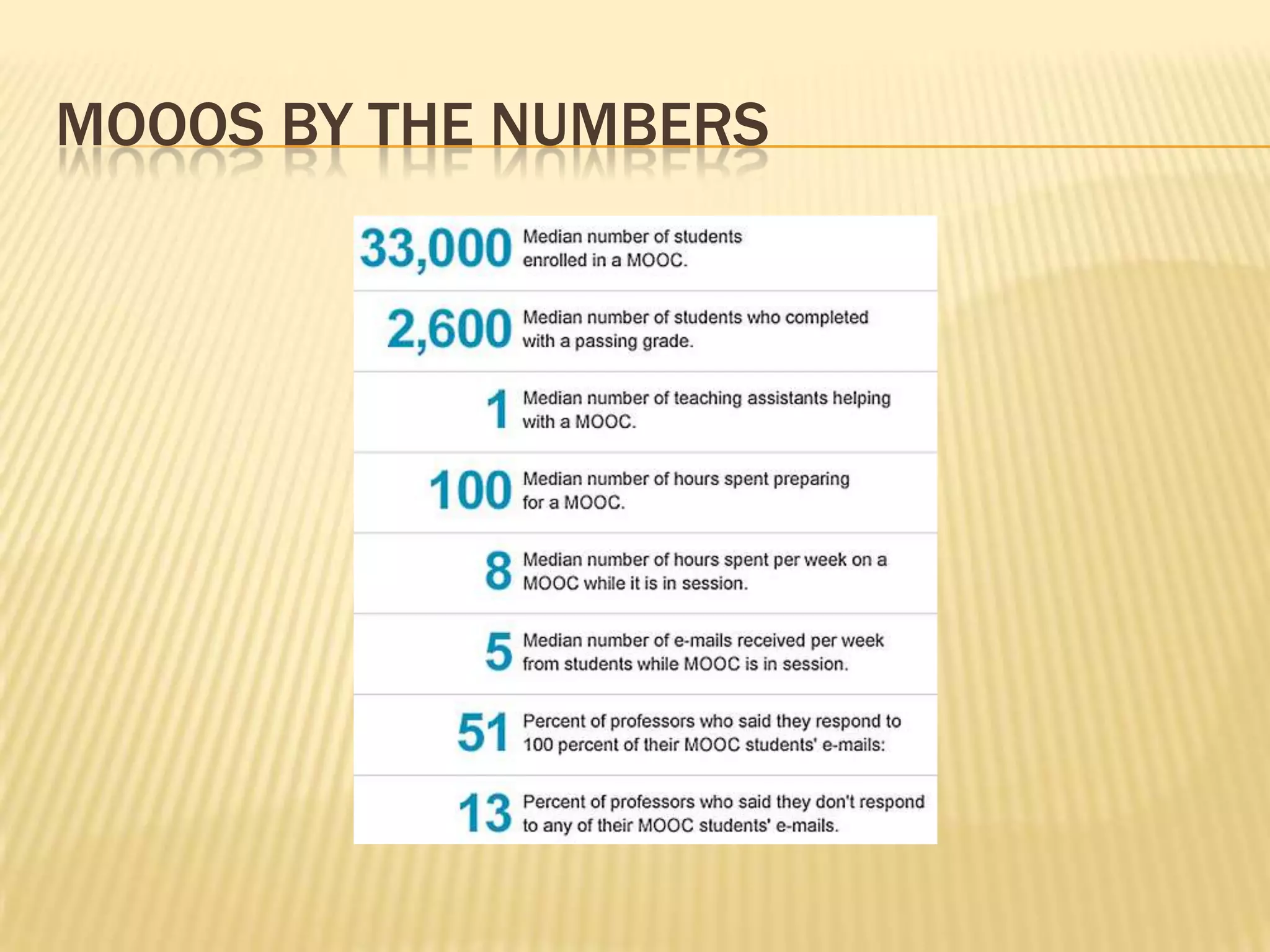
MOOOS BY THE NUMBERS
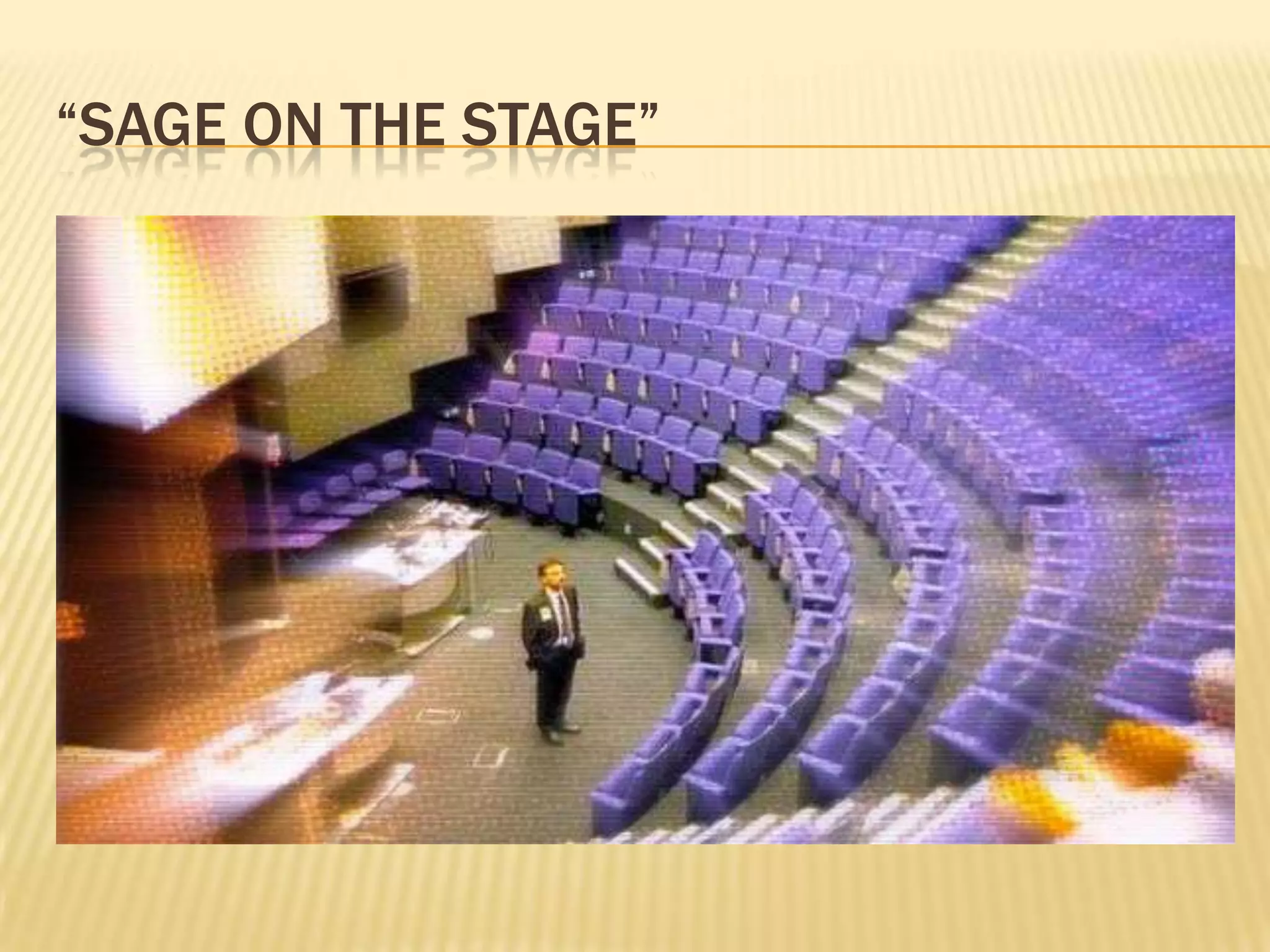
“SAGE ON THE STAGE”
FINAL THOUGHTS
 CCC-developed MOOOs that capture how
we teach.
 MOOO as a collection of the highest quality
online learning objects that the state invests
in and is available for use by all. (A LOOC?)
 Increase access by investing in success.
 Increase/simplify access to existing course
offerings.
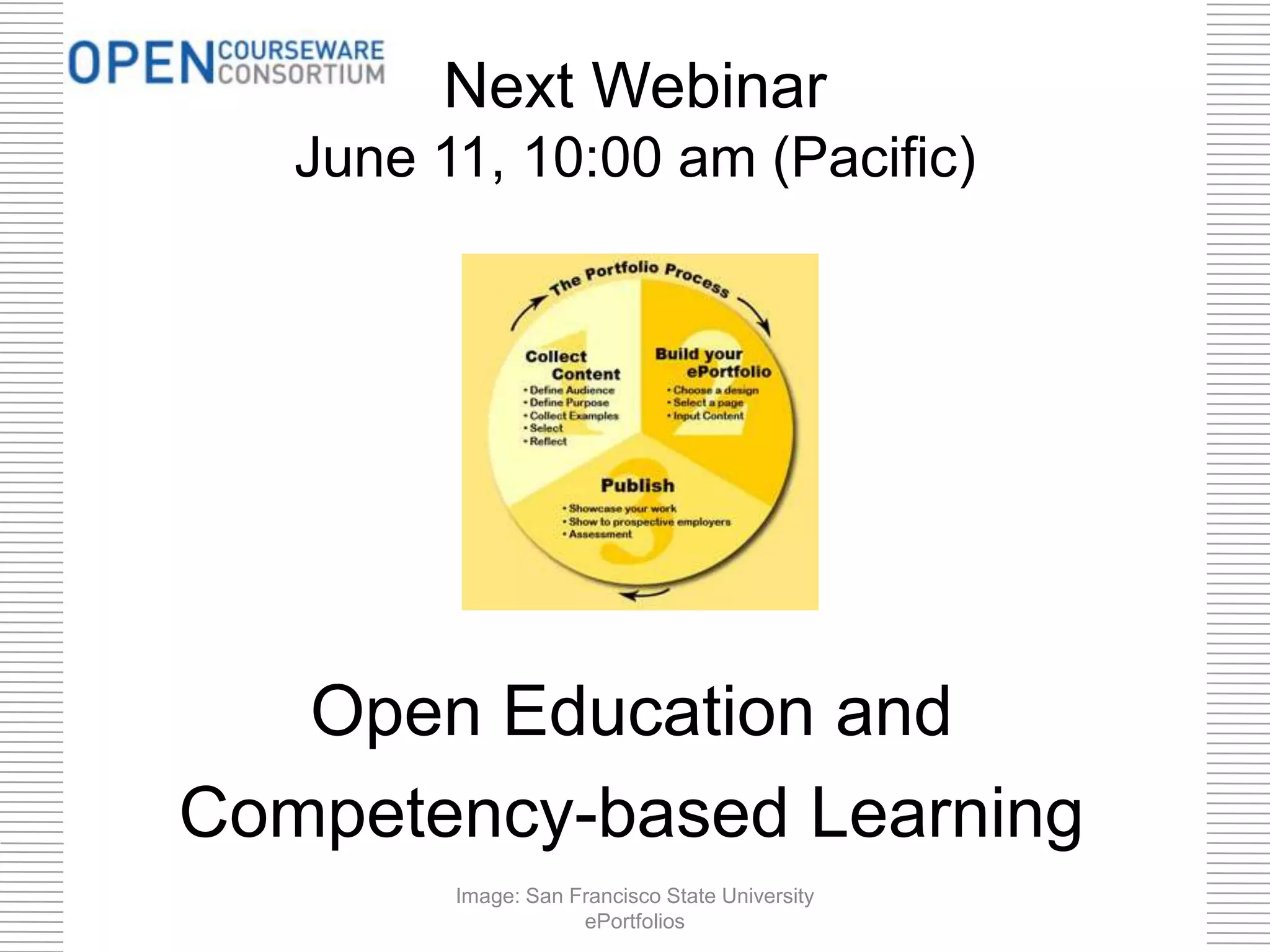
Next Webinar
June 11, 10:00 am (Pacific)
Open Education and
Competency-based Learning
Image: San Francisco State University
ePortfolios
Thank you for attending!
Please type your question in the chat window or
raise your hand to speak
Contact Information
Una Daly, unatdaly@ocwconsortium.org
James Glapa-Grossklag, James.Glapa-Grossklag@canyons.edu
Dean Florez, dean@20mmf.org
Barbara Illowsky, illowskybarbara@deanza.edu
Michelle Pilati, mpilati@riohondo.edu
Share
http://www.flickr.com/photos/opensourceway/4424154829/in/photostream/
IMG_4591 http://www.flickr.com/photos/bionicteaching/4700979984/ cc-by-sa
La belle tzigane http://www.flickr.com/photos/joyoflife/21063837 cc-by-sa
Asian Library Interior 5 http://www.flickr.com/photos/ubclibrary/453351638/ cc-by-nc-sa
Petru http://www.flickr.com/photos/joyoflife/23724427/ cc-by-nc-sa
Opensourceways http://www.flickr.com/photos/opensourceway/4371000710/ cc-by-sa
Photo credits:

Open Education, MOOCS, & Student Access

  • 1.
    Senator(retd.) Dean Florez,20 Million Minds Foundation Dr. Barbara Illowsky, De Anza College Dr. Michelle Pilati, Rio Hondo College April 30, 2013 Open Education, MOOCs, & Student Access
  • 2.
    Collaborate Window Overview Audio& Video Participants Chat Tech Support available at: 1-760-744-1150 ext. 1537, 1554, 1542
  • 3.
    Welcome Please introduce yourselfin the chat window. Your hosts: – Una Daly, Community College Outreach Director at Open Courseware Consortium – James Glapa-Grossklag, President of CCCOER Advisory Board; Dean, College of Canyons .
  • 4.
    Agenda • Community Collegesand Open Ed • Rebooting Higher Ed in California • OER and MOOCs • Academic Senate & OER council • Choosing our next webinar • Q & A
  • 5.
    CCCOER Mission • Promoteadoption of OER to enhance teaching and learning –Expand access to education –Support professional development –Advance community college mission Funded by the William & Flora Hewlett Foundation
  • 6.
    200+ Community &Technical College
  • 8.
    How to GetInvolved?  Join the CCCOER advisory list  Participate in our community of interest  Attend our free monthly webinars  Visit our website to find resources  Invite us to conduct faculty training  Become a member of the OCWC oerconsortium.org james.glapa-grossklag@canyons.edu unatdaly@ocwconsortium.org
  • 9.
    Rebooting CA HigherEducation Dean Florez CEO, Twenty Million Minds Foundation Former CA State Senate Majority Leader
  • 24.
    Open Education inClassroom Dr. Barbara Illowsky Math Instructor and open textbook co-author Chancellor’s Office 2012-13 California Community College System
  • 25.
    Me! • Teach online,hybrid, f2f • OER textbook: Collaborative Statistics • CVC 2002 top online course award • OCW Consortium 2013 Educator Award (international) • Teaching MOOC “Intro to Descriptive Statistics”, 4-week, not-for-credit in January 2014
  • 26.
    Open Educational Resources (OER) “Teaching,learning, and research resources that reside in the public domain or have been released under an intellectual property license that permits their free use or repurposing by others.” U.S Department of Education
  • 27.
    OER: Saves $$$ Amazon$171.25 hardcopy Web - $0 POD - $26.20 + SH Wiley & Sons Connexions
  • 28.
    De Anza College studentsavings… for just one course: > $1,000,000
  • 29.
    OER: Free to Choose •provides faculty with more choices for their courses • allows for permission-free editing and adaptation • promotes customization • eliminates forced publisher revisions
  • 30.
    OER: Adoption Concerns • Facultyawareness of OER is low • Difficulty of finding materials • Standards for quality vary • Lack of ancillaries
  • 31.
    Exploring MOOCs • Massive:> 1000 students • Online: videos lectures, automated quizzes, discussions • Open: open enrollment but NOT OER • Course: learning experience
  • 32.
    MOOC Concerns • Poorinstruction quality • Low Completion rates: 5-15% is typical • Learner support is minimal • Assessment for credit: costs $; in early stages • Sustainability is unknown
  • 33.
    Community College MOOCs fornon-credit?? • Thousands of students taking basic skills & pre-transfer level English, reading, writing, ESL and mathematics courses • Huge subset of above population, at one time, had learned the content using taxpayer $$ • Many just need to review before taking an assessment test for placement
  • 34.
    What if … •community college faculty develop and teach pre-transfer level MOOCs • a large subset of the “huge subset” take MOOCs to review content? • a VERY small subset of the “large subset of the huge subset” complete 1 MOOC and place into 1 higher level course in just 1discipline?
  • 35.
    Need to Review Take MOOC Pass MOOC Population- pre-transfer level placement students
  • 36.
    Very small subsetof the large subset of the huge subset… • will save at least one semester to degree completion • will save taxpayers $$ • may be encouraged to take more ownership in their education • may take more than 1 MOOC and multiply their time savings and taxpayer savings
  • 37.
    In other words… • if 100,000 students take at least 1 MOOC • if just 6% of MOOC folks complete their course • if this 6% of MOOC folks place into 1 course higher • then, 94% of MOOC students are FAILURES!!!
  • 38.
    BUT … … 6000students have succeeded!!!!! … and maybe will have a …
  • 39.
    shorter time tocompletion?
  • 40.
    Academic Senate Dr. MichellePilati Psychology Instructor Academic Senate President 2011-13 California Community College System
  • 41.
    CALIFORNIA’S AGENDA FOROPEN EDUCATION, MOOCS, AND STUDENT ACCESS Thoughts on the implementation of SB 1052/1053 Access issues? MOOCs and the California Community Colleges
  • 42.
    SB 1052 ANDSB 1053  Establish an intersegmental OER library and a council to facilitate populating the library and ensuring its use  Members “appointed” to the California Open Education Resources Council (COERC)  Next steps  Challenges
  • 43.
    ACCESS ISSUES  Since2008  Funding declines (“workload reduction”)  Increased demand  Today  Proposition 30  Recovering economy  Declining access issues
  • 44.
    ADDRESSING “ACCESS” ISSUES Increase success  Online retention and success lags behind that of onsite  Increase online success >>> Increase access  Increase access to existing courses – online and onsite  Students want access to courses, not pathways to unit accumulation
  • 45.
    ONLINE AS THEACCESS ANSWER?  Presumes equal access to technology  Presumes equal success  Differential outcomes exacerbated in the online environment  Online investment needs to focus on quality as a means of increasing success
  • 46.
    MOOCS AND THECCC  Currently: A pathway to credit for MOOCs exists:  “Credit by exam”  “Traditional” MOOCs are not a replacement for credit-bearing courses  MOOOs  Massive Open Online Offerings  “Courses” result in a transcripted outcome, qualify for financial aid, and are taught by qualified faculty
  • 47.
    COURSES IN THECCCS  Require “regular effective contact”  Regulatory requirement (Title 5)  Not “correspondence courses”  Necessary to qualify for financial aid  Able to document last date of attendance
  • 48.
    MOOOS AND THECCCS  Replacement  No.  Offer an alternative  Pre-assessment  Possible supplement  A means to increase “access”?  Perhaps – increase success >>> increase access  Perhaps – high-quality content and auto-graded assessments make a SLIGHTLY larger class
  • 49.
    MOOOS BY THENUMBERS
  • 50.
  • 51.
    FINAL THOUGHTS  CCC-developedMOOOs that capture how we teach.  MOOO as a collection of the highest quality online learning objects that the state invests in and is available for use by all. (A LOOC?)  Increase access by investing in success.  Increase/simplify access to existing course offerings.
  • 52.
    Next Webinar June 11,10:00 am (Pacific) Open Education and Competency-based Learning Image: San Francisco State University ePortfolios
  • 53.
    Thank you forattending! Please type your question in the chat window or raise your hand to speak Contact Information Una Daly, unatdaly@ocwconsortium.org James Glapa-Grossklag, James.Glapa-Grossklag@canyons.edu Dean Florez, dean@20mmf.org Barbara Illowsky, illowskybarbara@deanza.edu Michelle Pilati, mpilati@riohondo.edu
  • 54.
    Share http://www.flickr.com/photos/opensourceway/4424154829/in/photostream/ IMG_4591 http://www.flickr.com/photos/bionicteaching/4700979984/ cc-by-sa Labelle tzigane http://www.flickr.com/photos/joyoflife/21063837 cc-by-sa Asian Library Interior 5 http://www.flickr.com/photos/ubclibrary/453351638/ cc-by-nc-sa Petru http://www.flickr.com/photos/joyoflife/23724427/ cc-by-nc-sa Opensourceways http://www.flickr.com/photos/opensourceway/4371000710/ cc-by-sa Photo credits:

Editor's Notes

  • #3 ELLUMINATE/CCC Conference Opening Script [Start recording…] Welcome to the ________ Webinar for DAY, MONTH, YEAR [sponsored by]. [If applicable] Today’s guests come to us from _______ in ____, ___. I will introduce them shortly, but first I want to go over a few details about this [Elluminate/CCC Confer] session for those who are new to [Elluminate/CCC Confer].DetailsAt the upper left of your screen, you should see the Participants window, which lists the participants in this session. You can use the icons underneath this window to:Raise your hand if you have a question or comment and you wish to speakThere are also happy and sad faces and an applaud icon Below the Participants window is the Chat window to the center-left of this screen where you can type a question or comment into the box at any time. You can also send a private message to another participant at any time, but please be aware that moderators can see all private messages.Below the chat area is the Audio window in the bottom left of the screen. Click on the raised your hand button to let us know you would like to speak. You can use a head set or your phone for audio chat. If you are using a microphone and have been recognized to speak, Click the button with the microphone on it and begin speaking. Remember to click the button again when you finish speaking so that someone else can have a turn. You can control your mic and volume levels with the sliders. And if you are having trouble with your headset or microphone, you can access the Audio Setup Wizard from the Tools menu on the top toolbar. From Tools, select Audio, and then Audio Setup Wizard, and follow the on-screen instructions.[CCC Confer ONLY] If you are using the telephone to speak, Click on the phone handset below the microphone and audio volume sliders. The call-number and pin will then appear in a dialog box.
  • #50 http://chronicle.com/article/The-Professors-Behind-the-MOOC/137905/#id=results