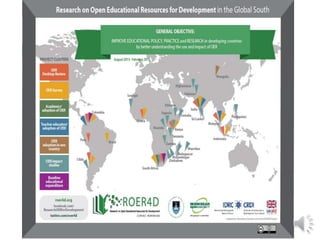
Open Education: research from
the South
Dr Glenda Cox
Senior Lecturer
Centre for Innovation in Learning and Teaching
University of Cape Town
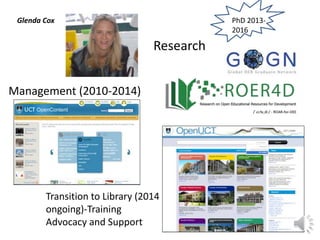
Transition to Library (2014
ongoing)-Training
Advocacy and Support
Management (2010-2014)
Research
PhD 2013-
2016
Glenda Cox
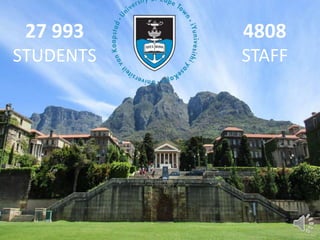
27 993
STUDENTS
4808
STAFF
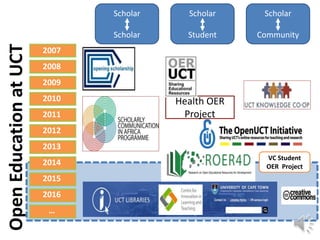
OpenEducationatUCT Scholar
Scholar
Scholar
Student
Scholar
Community
2007
2008
2009
2010
2011
2012
2013
2014
2015
2016
…
VC Student
OER Project
Health OER
Project
Research into the Social and
Cultural acceptability of Open
Educational Resources (OER) in the
Global South (South Africa)
Glenda Cox
Senior Lecturer, Centre for Innovation in Learning and
Teaching (CILT), University of Cape Town
Henry Trotter
Researcher, CILT
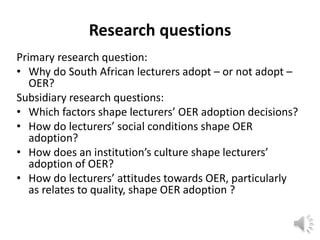
Research questions
Primary research question:
• Why do South African lecturers adopt – or not adopt –
OER?
Subsidiary research questions:
• Which factors shape lecturers’ OER adoption decisions?
• How do lecturers’ social conditions shape OER
adoption?
• How does an institution’s culture shape lecturers’
adoption of OER?
• How do lecturers’ attitudes towards OER, particularly
as relates to quality, shape OER adoption ?
University Profiles UCT UFH UNISA
Student access Residential Residential Distance
Student numbers 26 000 11 000 400 000+
Location Urban Rural Dispersed
Approach Traditional Traditional Comprehensive
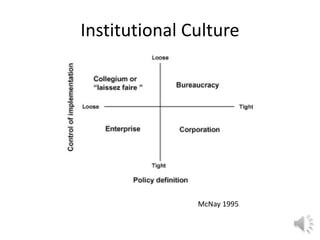
Institutional culture Collegial Bureaucratic Managerial
Copyright owner of
teaching materials
Lecturers Institution Institution
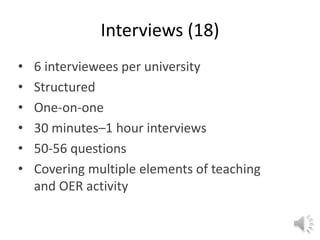
• 6 interviewees per university
• Structured
• One-on-one
• 30 minutes–1 hour interviews
• 50-56 questions
• Covering multiple elements of teaching
and OER activity
Interviews (18)
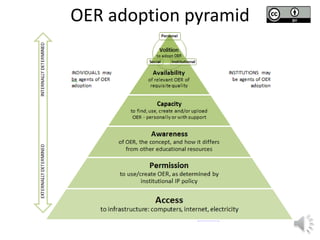
OER adoption pyramid
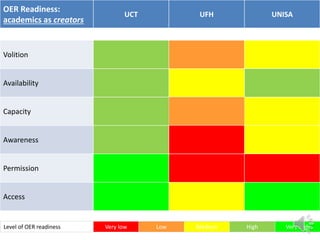
OER Readiness:
academics as creators
UCT UFH UNISA
Volition
Availability
Capacity
Awareness
Permission
Access
Level of OER readiness Very low Low Medium High Very high
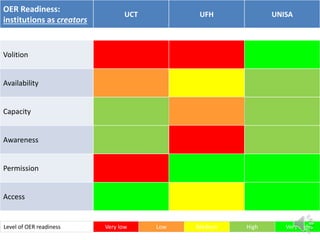
OER Readiness:
institutions as creators
UCT UFH UNISA
Volition
Availability
Capacity
Awareness
Permission
Access
Level of OER readiness Very low Low Medium High Very high
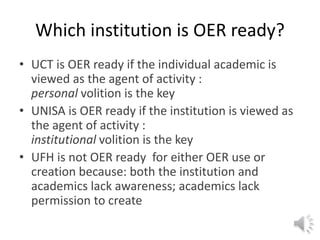
Which institution is OER ready?
• UCT is OER ready if the individual academic is
viewed as the agent of activity :
personal volition is the key
• UNISA is OER ready if the institution is viewed as
the agent of activity :
institutional volition is the key
• UFH is not OER ready for either OER use or
creation because: both the institution and
academics lack awareness; academics lack
permission to create
Explaining Volition
Attitudes towards OER
This study also revealed more personal concerns
about sharing from the interviews at the three
institutions.
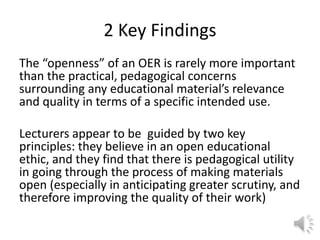
2 Key Findings
The “openness” of an OER is rarely more important
than the practical, pedagogical concerns
surrounding any educational material’s relevance
and quality in terms of a specific intended use.
Lecturers appear to be guided by two key
principles: they believe in an open educational
ethic, and they find that there is pedagogical utility
in going through the process of making materials
open (especially in anticipating greater scrutiny, and
therefore improving the quality of their work)
EXPLAINING THE RELATIONS BETWEEN
CULTURE, STRUCTURE AND AGENCY IN
LECTURERS’ CONTRIBUTION AND NON-
CONTRIBUTION TO OPEN
EDUCATIONAL RESOURCES IN A HIGHER
EDUCATION INSTITUTION
Thesis Title:
C
o
n
t
e
x
t
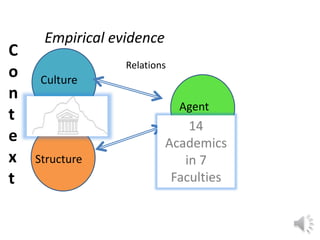
Enabler and Barriers to contribution of OER
Culture
Relations
Empirical evidence
C
o
n
t
e
x
t
Structure
Agent
14
Academics
in 7
Faculties
Institutional Culture
McNay 1995
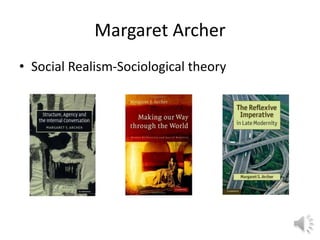
Margaret Archer
• Social Realism-Sociological theory
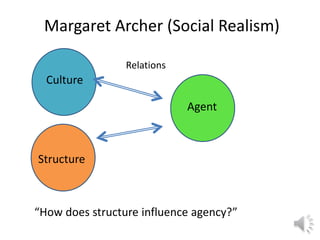
Culture
Relations
Structure
Agent
“How does structure influence agency?”
Margaret Archer (Social Realism)
Ultimate concerns
Ultimate
Concerns
Projects Practice
...Individuals develop
and define their
ultimate concerns,
those internal goods
that they care about
most (Archer 2007:42)
...develop course (s)
of action to realise
that concern by
elaborating a
project...
Translated into
a set of
practices
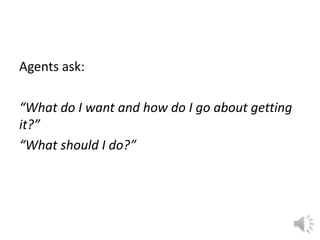
Agents ask:
“What do I want and how do I go about getting
it?”
“What should I do?”
Culture Mediated
process
through
internal
conver-
sations
Structure
Agent
(Ultimate
concerns)
Margaret Archer (Social Realism)
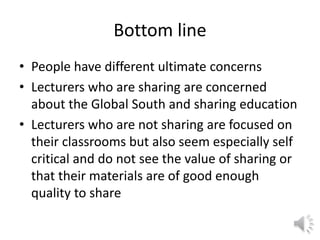
Bottom line
• People have different ultimate concerns
• Lecturers who are sharing are concerned
about the Global South and sharing education
• Lecturers who are not sharing are focused on
their classrooms but also seem especially self
critical and do not see the value of sharing or
that their materials are of good enough
quality to share
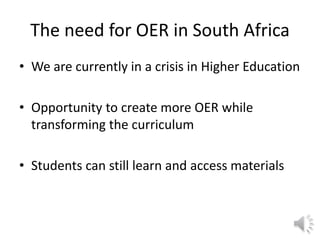
The need for OER in South Africa
• We are currently in a crisis in Higher Education
• Opportunity to create more OER while
transforming the curriculum
• Students can still learn and access materials
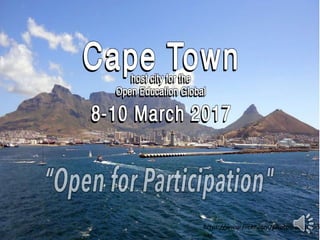
Cape Town: host city for the OEC 2017
(7-10 March)
https://www.flickr.com/photos/barbouria
ns/
Celebrations and Communities
Years10CELEBRATING
ROER4D SP4 slides prepared by:
Henry Trotter – henry.trotter@uct.ac.za / trotterhenry@hotmail.com
UCT image: https://www.flickr.com/photos/barbourians/

Open education a view from the south

Editor's Notes

  • #3 VOLUNTARY contribution of openly licensed materials No mandate.
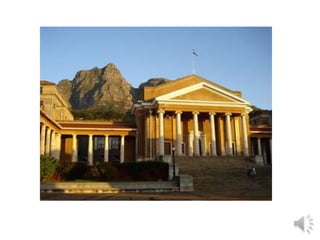
  • #4 University on the slopes of Table Mountain (Devil’s peak in the background) This research was done at UCT a medium size; 27 993 students and 4808 staff including 1000 permanent academics across the seven faculties
  • #5 The local organizing committee is from the University of Cape Town 27 993 students and 4808 staff Residential with increasing blended and online approaches
  • #6 UCT the home of Open… Add 2016 and IP Law- Tobias CC legal Lead SA
  • #11 We travelled to the other universities and conducted workshops on OER and Creative Commons. These universities have quite different characteristics, as the table shows.
  • #12 After conducting the workshops, we interviewed 6 staff members at each university on their teaching and OER in/activities.
  • #13 As we were conducting our research, it became clear that a number of factors shaped OER adoption decisions at these universities. But 6 of them stood out as having a “determinative” effect on OER activity and its potential. These are factors which, if you ask, “can OER activity proceed here without them?”, the answer would be “no”. So we developed what we call The OER Adoption Pyramid.
  • #14 In this second one, this shows OER readiness when the academic is taken as OER creators. Here the key feature is that UFH and UNISA possess copyright over academics’ teaching materials, so academics are not able to create and share OER from their teaching materials. They do not have permission.
  • #15 This third OER readiness table looks at institutions as creators, which shows challenges for a university like UCT (which has given copyright over teaching materials to the academics), challenges for UFH (which lacks awareness and volition) and real opportunities for UNISA which has developed an OER Strategy to potentially (in the future) share its IP assets as OER materials. (There is no need for a table showing institutions as users, because institutions do not typically “use” educational resources; rather academics do that.)
  • #19 While the ethic behind this openness may correspond with a potential user’s personal educational values, it does not override the necessity that the materials meet other subjective standards of relevance, utility and quality.
  • #21 Open culture and open philosophy but Lack of awareness. Institutions are not always supportive of sharing and do not have a culture of sharing OER is premised on the simple and powerful idea that the world’s knowledge is a public good and that technology in general and the World Wide Web in particular provides an extraordinary opportunity for everyone to share, use, and reuse knowledge’ (Hewlett Foundation) Not everyone has access, Digital divide between Global south and North, Lack of ability and skills There is a general feeling that quality will improve if materials are available for peer scrutiny But there are concerns about the readiness of materials That some materials may be of poor quality Different views on a quality check: one says up to author and user /other says a quality check would protect the institution and the individual Policy versus academic freedom in fact the opposite was the case contributors liked the fact that they could choose…9 said policy would NOT enable them Policy and reward would not enable non-contributors, 2 Contributors were enabled by small grants and others said grants are useful Pedagogy: Using OER can give students more options. Academics can use and share OER an move towards Open practice However, many academics do not want to change their pedagogical practice
  • #22 14 academics- 7 contributing, 7 not Interviews and also questionnaires that I will explain a little later Range of age, gender and rank
  • #25 Archer (2003) is concerned with the burning question: “ How does structure influence agency?” Social theorists have tried to theorise the relationship between the two. Is there a process or causal mechanism that links the two? Archer (2003) argues that it is the properties and powers of agents that is key to the process. 3 stages: structure and culture objectively shape the situations that agents confront involuntarily-and posses poweres of constraints and enablements 2. Subjects have concerns and are subjective in their responses Courses of action are produced through the reflexive deliberations of subjects who subjectively determine their practical projects in relation to their objective circumstances.
  • #28 Agents have various ways of foreseeing or anticipating challenges, and also acting strategically to discover ways around constraints, “agents have to diagnose their situations, they have to identify their own interests, and they must design projects they deem appropriate to attaining their ends”(Archer 2003; p9). How do they do this? According to Archer they do this via ‘the internal conversation’ which Archer defines as “the modality through which reflexivity towards self, society and the relationship between them is exercised” and she argues it is this reflexivity that is the most important of personal emergent properties. Archer (2003) argues that ‘human reflexivity is central to the process of mediation”.