



HACKATHON
LEYLA NASIB
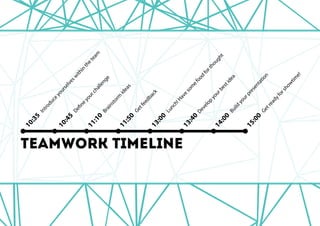
10:35
Introduceyourselvesw
ithin
theteam
11:10
Brainstorm
ideas
11:50
Getfeedback13:00
Lunch!Havesom
efood
forthought
13:40
Develop
yourbestidea
14:00
Build
yourpresentation
15:00
Getreadyforshow
tim
e!
TEAMWORK TIMELINE
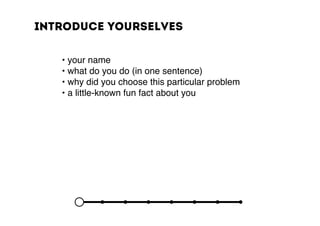
Introduce yourselves
	 	 • your name
	 	 • what do you do (in one sentence)
	 	 • why did you choose this particular problem
	 	 • a little-known fun fact about you
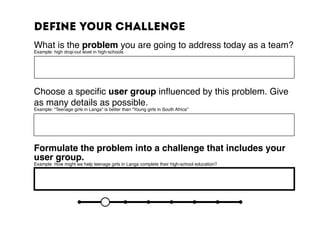
Define your challenge
What is the problem you are going to address today as a team?
Example: high drop-out level in high-schools
Choose a specific user group influenced by this problem. Give
as many details as possible.
Example: “Teenage girls in Langa” is better than “Young girls in South Africa”
Formulate the problem into a challenge that includes your
user group.
Example: How might we help teenage girls in Langa complete their high-school education?
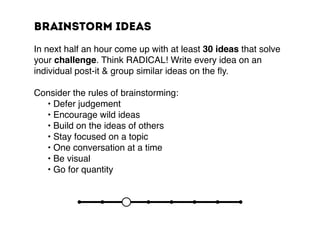
Brainstorm ideas
In next half an hour come up with at least 30 ideas that solve
your challenge. Think RADICAL! Write every idea on an
individual post-it & group similar ideas on the fly.
Consider the rules of brainstorming:
	 • Defer judgement
	 • Encourage wild ideas
	 • Build on the ideas of others
	 • Stay focused on a topic
	 • One conversation at a time
	 • Be visual
	 • Go for quantity
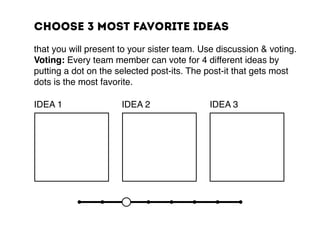
Choose 3 most favorite ideas
that you will present to your sister team. Use discussion & voting.
Voting: Every team member can vote for 4 different ideas by
putting a dot on the selected post-its. The post-it that gets most
dots is the most favorite.
IDEA 1 IDEA 2 IDEA 3
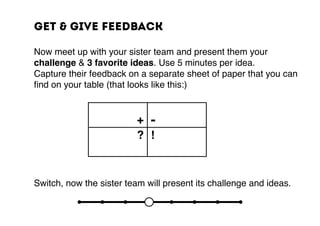
Get & give feedback
Now meet up with your sister team and present them your
challenge & 3 favorite ideas. Use 5 minutes per idea.
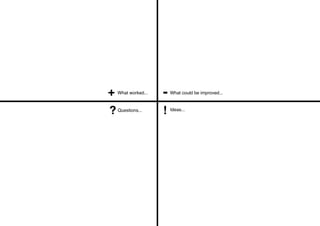
Capture their feedback on a separate sheet of paper that you can
find on your table (that looks like this:)
Switch, now the sister team will present its challenge and ideas.
-+
? !
Lunch!Have some food for thought
Develop your best idea
	 1. Based on the feedback you got, choose the best idea
	 2. Develop it:
	 	 	 • vision
	 	 	 • impact
	 	 	 • who could make it happen? (people, organizations)
	 	 	 • how could it be economically sustainable?
Build your presentation
Be creative! Use flip-chart paper, prototyping, roleplaying, storytelling.
Make sure to cover:
Problem
	 	 1. Describe the challenge that you are addressing
	 	 2. Explain why it’s interesting and important to solve
Solution
		3. Give it a name
	 	 4. Describe it in one sentence
	 	 Example: “Uusi is a mobile service that helps poor people find jobs”
		5. Describe how it works (you could use a scenario or a storyboard)
	 	 6. Explain the impact of your solution, benefits and value to the user
		7. Explain how it could be implemented:
	 	 	 • who could make it happen
	 	 	 • how could it be economically sustainable
SHOWTIME!
Sources used IN this handout:
	 d.school  - An introduction to design thinking
	 http://dschool.stanford.edu/
	 OpenIdeo: Tips on Brainstorming
	 http://www.openideo.com/fieldnotes/openideo-team-notes/sev	
	 en-tips-on-better-brainstorming
What worked... What could be improved...
Questions... Ideas...
-+
? !

Handout from the Open Design Hackathon event in Cape Town, South Africa

  • 1.
  • 2.
  • 3.
    Introduce yourselves • your name • what do you do (in one sentence) • why did you choose this particular problem • a little-known fun fact about you
  • 4.
    Define your challenge Whatis the problem you are going to address today as a team? Example: high drop-out level in high-schools Choose a specific user group influenced by this problem. Give as many details as possible. Example: “Teenage girls in Langa” is better than “Young girls in South Africa” Formulate the problem into a challenge that includes your user group. Example: How might we help teenage girls in Langa complete their high-school education?
  • 5.
    Brainstorm ideas In nexthalf an hour come up with at least 30 ideas that solve your challenge. Think RADICAL! Write every idea on an individual post-it & group similar ideas on the fly. Consider the rules of brainstorming: • Defer judgement • Encourage wild ideas • Build on the ideas of others • Stay focused on a topic • One conversation at a time • Be visual • Go for quantity
  • 6.
    Choose 3 mostfavorite ideas that you will present to your sister team. Use discussion & voting. Voting: Every team member can vote for 4 different ideas by putting a dot on the selected post-its. The post-it that gets most dots is the most favorite. IDEA 1 IDEA 2 IDEA 3
  • 7.
    Get & givefeedback Now meet up with your sister team and present them your challenge & 3 favorite ideas. Use 5 minutes per idea. Capture their feedback on a separate sheet of paper that you can find on your table (that looks like this:) Switch, now the sister team will present its challenge and ideas. -+ ? !
  • 8.
  • 9.
    Develop your bestidea 1. Based on the feedback you got, choose the best idea 2. Develop it: • vision • impact • who could make it happen? (people, organizations) • how could it be economically sustainable?
  • 10.
    Build your presentation Becreative! Use flip-chart paper, prototyping, roleplaying, storytelling. Make sure to cover: Problem 1. Describe the challenge that you are addressing 2. Explain why it’s interesting and important to solve Solution 3. Give it a name 4. Describe it in one sentence Example: “Uusi is a mobile service that helps poor people find jobs” 5. Describe how it works (you could use a scenario or a storyboard) 6. Explain the impact of your solution, benefits and value to the user 7. Explain how it could be implemented: • who could make it happen • how could it be economically sustainable
  • 11.
  • 12.
    Sources used INthis handout: d.school - An introduction to design thinking http://dschool.stanford.edu/ OpenIdeo: Tips on Brainstorming http://www.openideo.com/fieldnotes/openideo-team-notes/sev en-tips-on-better-brainstorming
  • 13.
    What worked... Whatcould be improved... Questions... Ideas... -+ ? !