PRESENTED by; Tavneet Kaur
MBA-2B
1911105
PRESENTED TO: MBA-2B
ESTABLISHMENT
 Founded on 14th September 1960 in Baghdad, Iraq
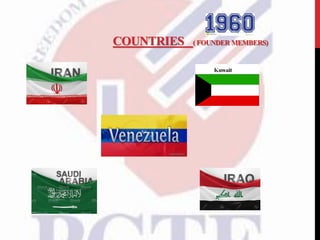
 Founding members- Iran, Iraq, Kuwait, Saudi Arabia and Venezuela
 Since 1965 headquartered in Vienna, Austria
 Founders- Juan Pablo Perez Alfonzo , Abdullah Tariki.
 OPEC is an intergovernmental organisation.
HISTORY
THE 1960s –
OPEC’s Secretariat 1st in Geneva and then in Vienna.
It adopted a “Declaratory Statement of Petroleum Policy -1968.
OPEC membership grew to 10 by 1969.
THE 1970s –
Oil prices rose in the market.
Establishment of the OFID in 1976.
OPEC membership grew to 13 by 1975.
THE 2000s –
Oil was used increasingly.
OPEC become famous in oil sector.
Establishment of stable energy markets, sustainable developments.
One country joined OPEC in 2005.
2010 until now –
Prices stable b/w 2011 and mid 2014
Demand growing in Asian countries and shrinking in OECD.
Seek stability in market and cooperation with its customers.
 Powerful player in global supply of oil.
 OPEC control oil prices- by increasing or reduce production
 Oil prices as high as possible - maintain shares
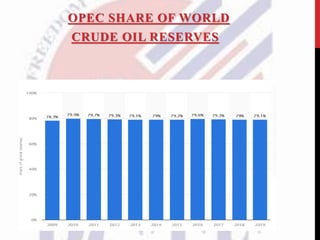
 74.9% of crude oil reserves- 2019
OBJECTIVES
1. To co-ordinate the policies among member countries.
2. Ensure stabilization of oil market to secure prices for petroleum producers;
a. An efficient, regular supply of petroleum to consuming nations,
b. Fair return on capital to those investing in the industry.
3. Steady income to producers.
4. Growth of economy and its GDP.
COUNTRIES ( FOUNDER MEMBERS)
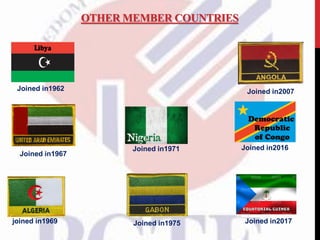
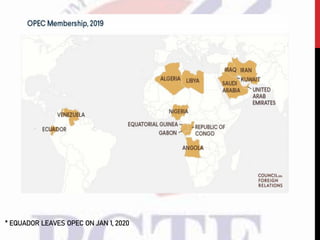
OTHER MEMBER COUNTRIES
joined in1969
Joined in2016
Joined in1962
Joined in1967
Joined in2017
Joined in1971
Joined in1975
Joined in2007
* EQUADOR LEAVES OPEC ON JAN 1, 2020
OPEC SHARE OF WORLD
CRUDE OIL RESERVES
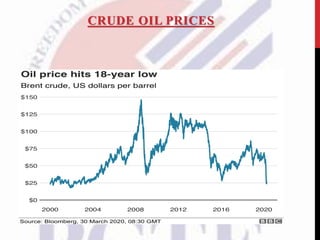
CRUDE OIL PRICES
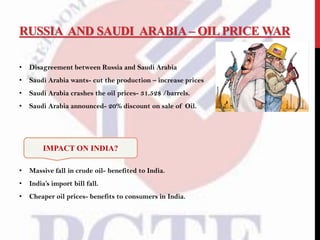
RUSSIA AND SAUDI ARABIA – OIL PRICE WAR
• Disagreement between Russia and Saudi Arabia
• Saudi Arabia wants- cut the production – increase prices
• Saudi Arabia crashes the oil prices- 31.52$ /barrels.
• Saudi Arabia announced- 20% discount on sale of Oil.
• Massive fall in crude oil- benefited to India.
• India’s import bill fall.
• Cheaper oil prices- benefits to consumers in India.
IMPACT ON INDIA?
COVID-19 IMPACT?
• Combine effect of price war and COVID–19
• All transports has been suspended.
• Supply and demand imbalances.
• Crude oil to fall below $10/ barrel
• Other oil exporting nations- bankrupt
CONCLUSION
OPEC goals: stable prices, secure supply and sufficient investment.
After covid-19 impact:
• Oil industry needs support from resp. government- survive
• Short run- use cash reserves to sail
• Long run- risk and struggle
• Need to realign their business
FUTURE
 Fossil Fuels will remain the world’s dominant energy source.
 Oil and Gas will - leading roles in meeting world energy demand.
 Russian oil industry not able to restore oil production quickly.
www.opec.org
www.investopedia.com
www.ourenergypolicy.com
www.energy.economictimes.com
www.wikipedia.org
www.cfr.org
www.businesswire.com
OPEC slideshare (2020)

OPEC slideshare (2020)

  • 1.
    PRESENTED by; TavneetKaur MBA-2B 1911105 PRESENTED TO: MBA-2B
  • 2.
    ESTABLISHMENT  Founded on14th September 1960 in Baghdad, Iraq  Founding members- Iran, Iraq, Kuwait, Saudi Arabia and Venezuela  Since 1965 headquartered in Vienna, Austria  Founders- Juan Pablo Perez Alfonzo , Abdullah Tariki.  OPEC is an intergovernmental organisation.
  • 3.
    HISTORY THE 1960s – OPEC’sSecretariat 1st in Geneva and then in Vienna. It adopted a “Declaratory Statement of Petroleum Policy -1968. OPEC membership grew to 10 by 1969. THE 1970s – Oil prices rose in the market. Establishment of the OFID in 1976. OPEC membership grew to 13 by 1975.
  • 4.
    THE 2000s – Oilwas used increasingly. OPEC become famous in oil sector. Establishment of stable energy markets, sustainable developments. One country joined OPEC in 2005. 2010 until now – Prices stable b/w 2011 and mid 2014 Demand growing in Asian countries and shrinking in OECD. Seek stability in market and cooperation with its customers.
  • 5.
     Powerful playerin global supply of oil.  OPEC control oil prices- by increasing or reduce production  Oil prices as high as possible - maintain shares  74.9% of crude oil reserves- 2019
  • 6.
    OBJECTIVES 1. To co-ordinatethe policies among member countries. 2. Ensure stabilization of oil market to secure prices for petroleum producers; a. An efficient, regular supply of petroleum to consuming nations, b. Fair return on capital to those investing in the industry. 3. Steady income to producers. 4. Growth of economy and its GDP.
  • 7.
  • 8.
    OTHER MEMBER COUNTRIES joinedin1969 Joined in2016 Joined in1962 Joined in1967 Joined in2017 Joined in1971 Joined in1975 Joined in2007
  • 9.
    * EQUADOR LEAVESOPEC ON JAN 1, 2020
  • 10.
    OPEC SHARE OFWORLD CRUDE OIL RESERVES
  • 11.
  • 12.
    RUSSIA AND SAUDIARABIA – OIL PRICE WAR • Disagreement between Russia and Saudi Arabia • Saudi Arabia wants- cut the production – increase prices • Saudi Arabia crashes the oil prices- 31.52$ /barrels. • Saudi Arabia announced- 20% discount on sale of Oil. • Massive fall in crude oil- benefited to India. • India’s import bill fall. • Cheaper oil prices- benefits to consumers in India. IMPACT ON INDIA?
  • 13.
    COVID-19 IMPACT? • Combineeffect of price war and COVID–19 • All transports has been suspended. • Supply and demand imbalances. • Crude oil to fall below $10/ barrel • Other oil exporting nations- bankrupt
  • 14.
    CONCLUSION OPEC goals: stableprices, secure supply and sufficient investment. After covid-19 impact: • Oil industry needs support from resp. government- survive • Short run- use cash reserves to sail • Long run- risk and struggle • Need to realign their business
  • 15.
    FUTURE  Fossil Fuelswill remain the world’s dominant energy source.  Oil and Gas will - leading roles in meeting world energy demand.  Russian oil industry not able to restore oil production quickly.
  • 16.