Linking Data & Actions
      On the web
      On the web


   RESTfest 2012
Introduction
• Stuart Charlton (@svrc)

• Independent Consultant on cloud, REST,
  agile delivery, and IT strategy

• Weblog: Stu Says Stuff
  http://www.stucharlton.com/blog

• Many thanks to commenters and twitterers on this
  topic
DisclaimerS
•   This is a sequel (of sorts) to my 2011 WS-REST Keynote

•   Mostly this is my naïve and incomplete thinking on how
    to progress the state of the art.

•   Heavily in debt to ideas from Miro Samek (Statecharts)
    & Alex Champandard (Game AI), and Jim Webber /
    Savas Parastadtitis / Ian Robinson (REST in Practice)

•   I haven’t shared code to back this stuff up so cannot be
    trusted to be correct or even sane ... but bear with me, I
    think it’s at least going to be entertaining.
Background
• The Web Architecture has been an immense success...

    • ... and yet, we can do better.

• There’s a need to design the software for the
  write side of the web to scale and become nearly as
  serendipitous as the read side

    • Is this even possible?

•   “There’s no write side of the web really....
    ... no, in fact, it‘s all GETs”
My Claims
• The Web architecture’s core strength is in encouraging small
  pieces of independent agreement to be linked together and
  shared; we’re missing some agreements for writes

• The Web architecture encourages clients to be designed as
  agents in a dynamic information space

• There are practical approaches to programming agents in a
  dynamic environment

• It should be possible to create a general purpose media type
  for systems to manipulate state on the web, in lieu of more
  specific media types.
Why?
Why?

• Troublesome Growth in Centralized Services

    • e.g. Facebook, Twitter, Google+

•   Centralization occurs in part because of a limitation of
    the current web architecture

    •   This is why we have 4 or 5 incompatible “like” buttons
        everywhere
Why?
• REST APIs and Integration

 • Custom media types are the current approach...

 • ... but this generally is a transitory solution

 • “RESTful” design thrashing due to lack of prescriptive
   guidance

   • Would be reduced with more generic media types
     (e.g. as with HTML, AtomPub)
Why?
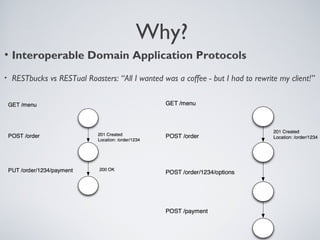
• Interoperable Domain Application Protocols
•   RESTbucks vs RESTual Roasters: “All I wanted was a coffee - but I had to rewrite my client!”
Why?

• Programming models matter

 • In particular, the client’s model of how it interacts
   with the server

 • We’re still often stuck on
   client method = network method (dynamic RPC)
Programming
Or Scripts vs. Agents
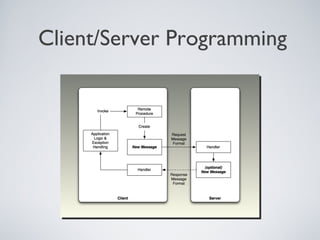
Client/Server Programming
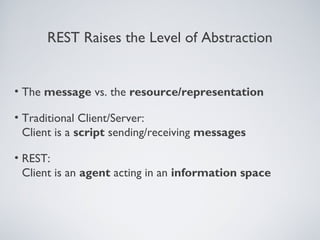
REST Raises the Level of Abstraction


• The message vs. the resource/representation

• Traditional Client/Server:
  Client is a script sending/receiving messages

• REST:
  Client is an agent acting in an information space
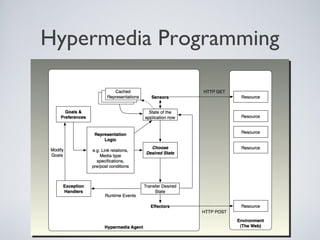
Hypermedia Programming
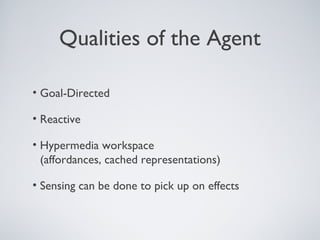
Qualities of the Agent

• Goal-Directed

• Reactive

• Hypermedia workspace
  (affordances, cached representations)

• Sensing can be done to pick up on effects
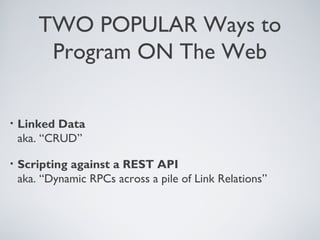
TWO POPULAR Ways to
         Program ON The Web


•   Linked Data
    aka. “CRUD”

•   Scripting against a REST API
    aka. “Dynamic RPCs across a pile of Link Relations”
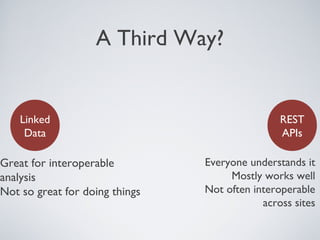
A Third Way?


    Linked                                      REST
     Data                                       APIs

Great for interoperable         Everyone understands it
analysis                             Mostly works well
Not so great for doing things   Not often interoperable
                                            across sites
Requirements
•   Need to be able to describe actions
    •   An action is a desired side-effect ; not an HTTP method
    •   Build higher level behaviors while maintaining uniformity of
        protocol
•   Preferably describe these serendipitously
    •   Searchable, linkable, follow-your-nose
•   Preferably without tight coupling to HTTP methods
    •   One server’s action may require a single POST,
        another’s may require PUT-POST-POST
•   Present and process data in a uniform way (ala. linked data)
    •   Express requirements, assertions and conditions
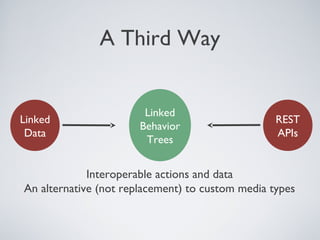
A Third Way


                        Linked
Linked                                            REST
                       Behavior
 Data                                             APIs
                        Trees


             Interoperable actions and data
An alternative (not replacement) to custom media types
Behavior Tree
•   A constrained hierarchical finite state machine (HFSM)
•   Approach to programming Game Agent AI (Halo 2, 3, GTA)
•   Constrained, how?
    •   Goal-oriented HFSM
    •   Reusable sub-states to enable “programming by difference”
    •   Patterns for common programming constructs
Behavior Trees On the Web
•   Specifying dynamic behavior as a search problem

•   A behavior tree is effectively a process flow that’s
    assembled by a crawler and
    executed by depth first search

•   More complexity, potentially evolvability & less
    programming
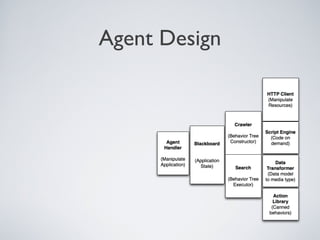
Agent Design
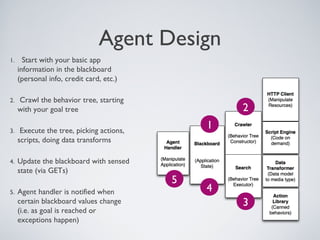
Agent Design
1.     Start with your basic app
     information in the blackboard
     (personal info, credit card, etc.)

2.   Crawl the behavior tree, starting
     with your goal tree                           2
3.    Execute the tree, picking actions,
                                               1
     scripts, doing data transforms

4.   Update the blackboard with sensed
     state (via GETs)
                                           5
5.   Agent handler is notified when            4
     certain blackboard values change              3
     (i.e. as goal is reached or
     exceptions happen)
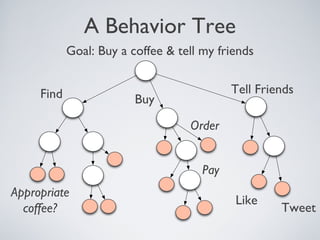
A Behavior Tree
            Goal: Buy a coffee & tell my friends


     Find                                   Tell Friends
                         Buy

                                   Order


                                      Pay
Appropriate
                                            Like
  coffee?                                            Tweet
A Behavior Tree


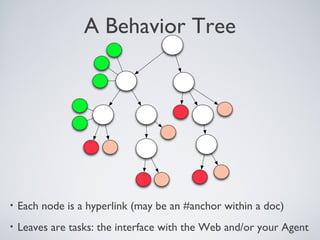
•   Each node is a hyperlink (may be an #anchor within a doc)
•   Leaves are tasks: the interface with the Web and/or your Agent
Distributed & linked
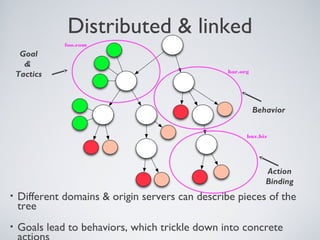
              foo.com
     Goal
      &
                                                  bar.org
    Tactics


                                                            Behavior


                                                        buz.biz


                                                               Action
                                                               Binding
•   Different domains & origin servers can describe pieces of the
    tree
•   Goals lead to behaviors, which trickle down into concrete
Atomic Tasks
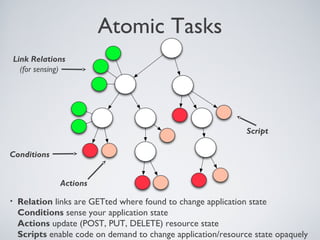
    Link Relations
      (for sensing)


                                                                Script

Conditions


                 Actions

•    Relation links are GETted where found to change application state
     Conditions sense your application state
     Actions update (POST, PUT, DELETE) resource state
     Scripts enable code on demand to change application/resource state opaquely
Composite Tasks
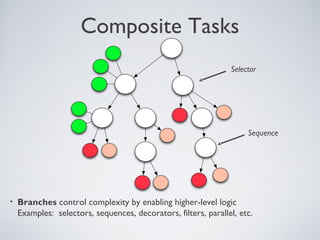
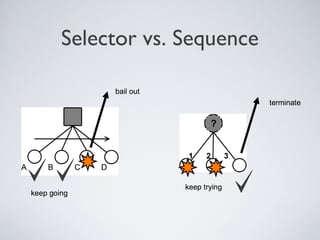
                                                                Selector


                                                                     Sequence


•   Branches control complexity by enabling higher-level logic
    Examples: selectors, sequences, decorators, filters, parallel, etc.
Selector vs. Sequence
Example
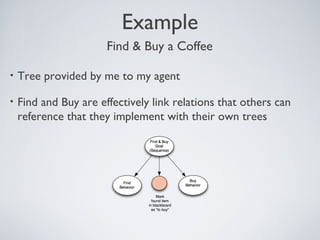
                       Find & Buy a Coffee

•   Tree provided by me to my agent

•   Find and Buy are effectively link relations that others can
    reference that they implement with their own trees
Example
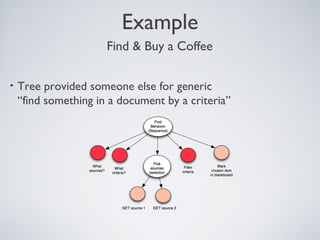
                      Find & Buy a Coffee

•   Tree provided someone else for generic
    “find something in a document by a criteria”
Example
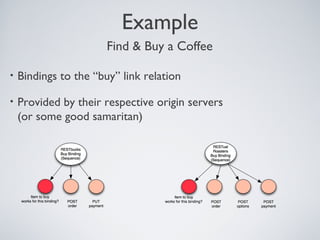
                       Find & Buy a Coffee

•   Bindings to the “buy” link relation

•   Provided by their respective origin servers
    (or some good samaritan)
Example
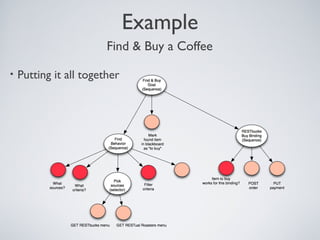
                        Find & Buy a Coffee

•   Putting it all together
Summary

• The Web architecture encourages clients to be designed as
  agents in a dynamic information space


• There are practical approaches to programming agents in
  a dynamic environment (blackboard, search, crawler)


• Linked behavior trees may be a general purpose media
  type for systems to manipulate state on the web, in lieu of
  more specific media types

Linking Data and Actions on the Web

  • 1.
    Linking Data &Actions On the web On the web RESTfest 2012
  • 2.
    Introduction • Stuart Charlton(@svrc) • Independent Consultant on cloud, REST, agile delivery, and IT strategy • Weblog: Stu Says Stuff http://www.stucharlton.com/blog • Many thanks to commenters and twitterers on this topic
  • 3.
    DisclaimerS • This is a sequel (of sorts) to my 2011 WS-REST Keynote • Mostly this is my naïve and incomplete thinking on how to progress the state of the art. • Heavily in debt to ideas from Miro Samek (Statecharts) & Alex Champandard (Game AI), and Jim Webber / Savas Parastadtitis / Ian Robinson (REST in Practice) • I haven’t shared code to back this stuff up so cannot be trusted to be correct or even sane ... but bear with me, I think it’s at least going to be entertaining.
  • 4.
    Background • The WebArchitecture has been an immense success... • ... and yet, we can do better. • There’s a need to design the software for the write side of the web to scale and become nearly as serendipitous as the read side • Is this even possible? • “There’s no write side of the web really.... ... no, in fact, it‘s all GETs”
  • 5.
    My Claims • TheWeb architecture’s core strength is in encouraging small pieces of independent agreement to be linked together and shared; we’re missing some agreements for writes • The Web architecture encourages clients to be designed as agents in a dynamic information space • There are practical approaches to programming agents in a dynamic environment • It should be possible to create a general purpose media type for systems to manipulate state on the web, in lieu of more specific media types.
  • 6.
  • 7.
    Why? • Troublesome Growthin Centralized Services • e.g. Facebook, Twitter, Google+ • Centralization occurs in part because of a limitation of the current web architecture • This is why we have 4 or 5 incompatible “like” buttons everywhere
  • 8.
    Why? • REST APIsand Integration • Custom media types are the current approach... • ... but this generally is a transitory solution • “RESTful” design thrashing due to lack of prescriptive guidance • Would be reduced with more generic media types (e.g. as with HTML, AtomPub)
  • 9.
    Why? • Interoperable DomainApplication Protocols • RESTbucks vs RESTual Roasters: “All I wanted was a coffee - but I had to rewrite my client!”
  • 10.
    Why? • Programming modelsmatter • In particular, the client’s model of how it interacts with the server • We’re still often stuck on client method = network method (dynamic RPC)
  • 11.
  • 12.
  • 13.
    REST Raises theLevel of Abstraction • The message vs. the resource/representation • Traditional Client/Server: Client is a script sending/receiving messages • REST: Client is an agent acting in an information space
  • 14.
  • 15.
    Qualities of theAgent • Goal-Directed • Reactive • Hypermedia workspace (affordances, cached representations) • Sensing can be done to pick up on effects
  • 16.
    TWO POPULAR Waysto Program ON The Web • Linked Data aka. “CRUD” • Scripting against a REST API aka. “Dynamic RPCs across a pile of Link Relations”
  • 17.
    A Third Way? Linked REST Data APIs Great for interoperable Everyone understands it analysis Mostly works well Not so great for doing things Not often interoperable across sites
  • 18.
    Requirements • Need to be able to describe actions • An action is a desired side-effect ; not an HTTP method • Build higher level behaviors while maintaining uniformity of protocol • Preferably describe these serendipitously • Searchable, linkable, follow-your-nose • Preferably without tight coupling to HTTP methods • One server’s action may require a single POST, another’s may require PUT-POST-POST • Present and process data in a uniform way (ala. linked data) • Express requirements, assertions and conditions
  • 19.
    A Third Way Linked Linked REST Behavior Data APIs Trees Interoperable actions and data An alternative (not replacement) to custom media types
  • 20.
    Behavior Tree • A constrained hierarchical finite state machine (HFSM) • Approach to programming Game Agent AI (Halo 2, 3, GTA) • Constrained, how? • Goal-oriented HFSM • Reusable sub-states to enable “programming by difference” • Patterns for common programming constructs
  • 21.
    Behavior Trees Onthe Web • Specifying dynamic behavior as a search problem • A behavior tree is effectively a process flow that’s assembled by a crawler and executed by depth first search • More complexity, potentially evolvability & less programming
  • 22.
  • 23.
    Agent Design 1. Start with your basic app information in the blackboard (personal info, credit card, etc.) 2. Crawl the behavior tree, starting with your goal tree 2 3. Execute the tree, picking actions, 1 scripts, doing data transforms 4. Update the blackboard with sensed state (via GETs) 5 5. Agent handler is notified when 4 certain blackboard values change 3 (i.e. as goal is reached or exceptions happen)
  • 24.
    A Behavior Tree Goal: Buy a coffee & tell my friends Find Tell Friends Buy Order Pay Appropriate Like coffee? Tweet
  • 25.
    A Behavior Tree • Each node is a hyperlink (may be an #anchor within a doc) • Leaves are tasks: the interface with the Web and/or your Agent
  • 26.
    Distributed & linked foo.com Goal & bar.org Tactics Behavior buz.biz Action Binding • Different domains & origin servers can describe pieces of the tree • Goals lead to behaviors, which trickle down into concrete
  • 27.
    Atomic Tasks Link Relations (for sensing) Script Conditions Actions • Relation links are GETted where found to change application state Conditions sense your application state Actions update (POST, PUT, DELETE) resource state Scripts enable code on demand to change application/resource state opaquely
  • 28.
    Composite Tasks Selector Sequence • Branches control complexity by enabling higher-level logic Examples: selectors, sequences, decorators, filters, parallel, etc.
  • 29.
  • 30.
    Example Find & Buy a Coffee • Tree provided by me to my agent • Find and Buy are effectively link relations that others can reference that they implement with their own trees
  • 31.
    Example Find & Buy a Coffee • Tree provided someone else for generic “find something in a document by a criteria”
  • 32.
    Example Find & Buy a Coffee • Bindings to the “buy” link relation • Provided by their respective origin servers (or some good samaritan)
  • 33.
    Example Find & Buy a Coffee • Putting it all together
  • 34.
    Summary • The Webarchitecture encourages clients to be designed as agents in a dynamic information space • There are practical approaches to programming agents in a dynamic environment (blackboard, search, crawler) • Linked behavior trees may be a general purpose media type for systems to manipulate state on the web, in lieu of more specific media types