OO Design Principles
                                                                João Miguel Pereira
                                                                  http://jpereira.eu
                                                                                                   March 2012
OO Design Principles by João Miguel Pereira is licensed under a Creative Commons Attribution-NonCommercial-ShareAlike 3.0
                                                                                                      Unported License.
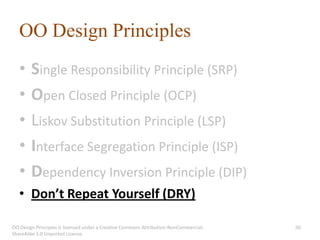
OO Design Principles
   •    Single Responsibility Principle (SRP)
   •    Open Closed Principle (OCP)
   •    Liskov Substitution Principle (LSP)
   •    Interface Segregation Principle (ISP)
   •    Dependency Inversion Principle (DIP)
   •    Don’t Repeat Yourself (DRY)
OO Design Principles is licensed under a Creative Commons Attribution-NonCommercial-   2
ShareAlike 3.0 Unported License.
OO Design Principles
   •    Single Responsibility Principle (SRP)
   •    Open Closed Principle (OCP)
   •    Liskov Substitution Principle (LSP)
   •    Interface Segregation Principle (ISP)
   •    Dependency Inversion Principle (DIP)
   •    Don’t Repeat Yourself (DRY)
OO Design Principles is licensed under a Creative Commons Attribution-NonCommercial-   3
ShareAlike 3.0 Unported License.
Single Responsibility Principle
   • Tom DeMarco and Meilir Page-Jones call it
     Cohesion
          – The Practical Guide to Structured Systems
            Design, 2d. ed., Meilir PageJones, Yourdon Press
            Computing Series, 1988
            http://amzn.to/book_TPGSS
          – Structured Analysis and System Specification, Tom
            DeMarco, Yourdon Press Computing Series, 1979
             http://amzn.to/book_SASS

OO Design Principles is licensed under a Creative Commons Attribution-NonCommercial-   4
ShareAlike 3.0 Unported License.
Single Responsibility Principle


      There shouldn’t never be more than one
           reason for a class to change!

                       Robert C. Martin http://www.objectmentor.com/resources/articles/srp.pdf


OO Design Principles is licensed under a Creative Commons Attribution-NonCommercial-      5
ShareAlike 3.0 Unported License.
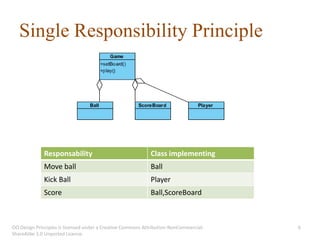
Single Responsibility Principle


              Responsability                                Class implementing
              Move ball                                     Ball
              Kick Ball                                     Player
              Score                                         Ball,ScoreBoard


OO Design Principles is licensed under a Creative Commons Attribution-NonCommercial-   6
ShareAlike 3.0 Unported License.
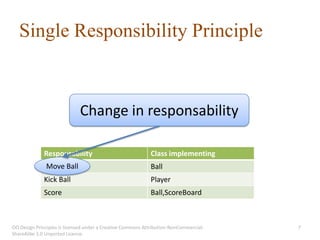
Single Responsibility Principle


                             Change in responsability

              Responsability                                Class implementing
              Move Ball
              Move ball                                     Ball
              Kick Ball                                     Player
              Score                                         Ball,ScoreBoard


OO Design Principles is licensed under a Creative Commons Attribution-NonCommercial-   7
ShareAlike 3.0 Unported License.
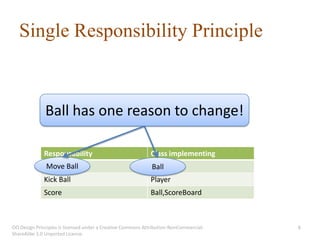
Single Responsibility Principle


              Ball has one reason to change!

              Responsability                                Class implementing
              Move Ball
              Move ball                                     Ball
                                                            Ball
              Kick Ball                                     Player
              Score                                         Ball,ScoreBoard


OO Design Principles is licensed under a Creative Commons Attribution-NonCommercial-   8
ShareAlike 3.0 Unported License.
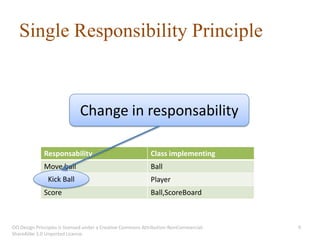
Single Responsibility Principle


                             Change in responsability

              Responsability                                Class implementing
              Move ball                                     Ball
               Kick Ball
              Kick Ball                                     Player
              Score                                         Ball,ScoreBoard


OO Design Principles is licensed under a Creative Commons Attribution-NonCommercial-   9
ShareAlike 3.0 Unported License.
Single Responsibility Principle


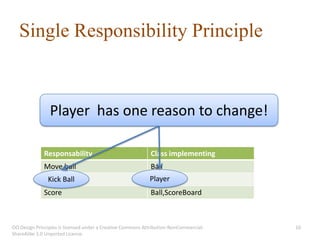
                Player has one reason to change!

              Responsability                                Class implementing
              Move ball                                     Ball
               Kick Ball
              Kick Ball                                     Player
                                                            Player
              Score                                         Ball,ScoreBoard


OO Design Principles is licensed under a Creative Commons Attribution-NonCommercial-   10
ShareAlike 3.0 Unported License.
Single Responsibility Principle


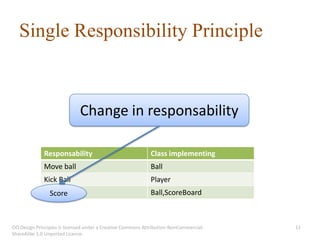
                             Change in responsability

              Responsability                                Class implementing
              Move ball                                     Ball
              Kick Ball                                     Player
              Score
                Score                                       Ball,ScoreBoard


OO Design Principles is licensed under a Creative Commons Attribution-NonCommercial-   11
ShareAlike 3.0 Unported License.
Single Responsibility Principle

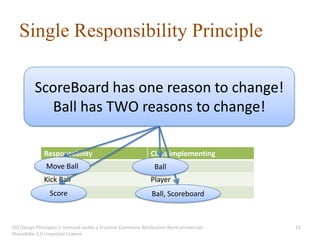
         ScoreBoard has one reason to change!
            Ball has TWO reasons to change!

              Responsability                                Class implementing
              Move Ball
              Move ball                                     Ball
                                                             Ball
              Kick Ball                                     Player
              Score
                Score                                       Ball,ScoreBoard
                                                            Ball, Scoreboard


OO Design Principles is licensed under a Creative Commons Attribution-NonCommercial-   12
ShareAlike 3.0 Unported License.
Single Responsibility Principle
   • Avoid responsibility coupling by giving a
     class/module a single reason to change
   • Every line of code should only focus on
     carrying out that single responsibility


OO Design Principles is licensed under a Creative Commons Attribution-NonCommercial-   13
ShareAlike 3.0 Unported License.
Single Responsibility Principle
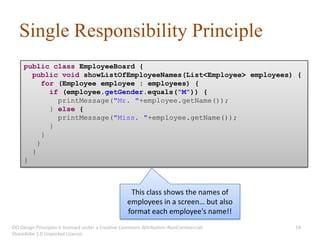
     public class EmployeeBoard {
       public void showListOfEmployeeNames(List<Employee> employees) {
           for (Employee employee : employees) {
             if (employee.getGender.equals("M")) {
               printMessage("Mr. "+employee.getName());
             } else {
               printMessage("Miss. "+employee.getName());
             }
           }
         }
       }
     }


                                                   This class shows the names of
                                                  employees in a screen… but also
                                                  format each employee's name!!
OO Design Principles is licensed under a Creative Commons Attribution-NonCommercial-   14
ShareAlike 3.0 Unported License.
Single Responsibility Principle
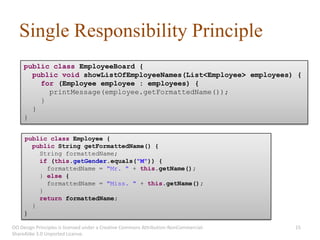
     public class EmployeeBoard {
       public void showListOfEmployeeNames(List<Employee> employees) {
         for (Employee employee : employees) {
           printMessage(employee.getFormattedName());
         }
       }
     }

     public class Employee {
       public String getFormattedName() {
         String formattedName;
         if (this.getGender.equals("M")) {
           formattedName = "Mr. " + this.getName();
         } else {
           formattedName = "Miss. " + this.getName();
         }
         return formattedName;
       }
     }

OO Design Principles is licensed under a Creative Commons Attribution-NonCommercial-   15
ShareAlike 3.0 Unported License.
Single Responsibility Principle
   • Read the article:
          – http://www.objectmentor.com/resources/articles/
            srp.pdf


OO Design Principles is licensed under a Creative Commons Attribution-NonCommercial-   16
ShareAlike 3.0 Unported License.
OO Design Principles
   •    Single Responsibility Principle (SRP)
   •    Open Closed Principle (OCP)
   •    Liskov Substitution Principle (LSP)
   •    Interface Segregation Principle (ISP)
   •    Dependency Inversion Principle (DIP)
   •    Don’t Repeat Yourself (DRY)
OO Design Principles is licensed under a Creative Commons Attribution-NonCommercial-   17
ShareAlike 3.0 Unported License.
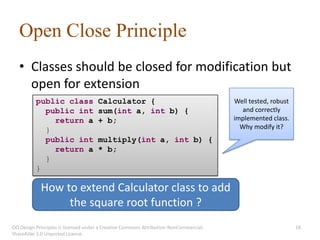
Open Close Principle
   • Classes should be closed for modification but
     open for extension
          public class               Calculator {                                      Well tested, robust
            public int               sum(int a, int b) {                                 and correctly
              return a               + b;                                              implemented class.
            }                                                                            Why modify it?
            public int               multiply(int a, int b) {
              return a               * b;
            }
          }

            How to extend Calculator class to add
                 the square root function ?
OO Design Principles is licensed under a Creative Commons Attribution-NonCommercial-                         18
ShareAlike 3.0 Unported License.
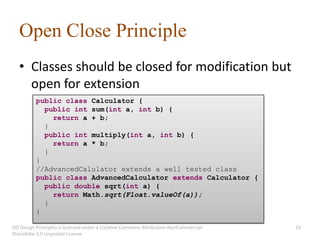
Open Close Principle
   • Classes should be closed for modification but
     open for extension
          public class Calculator {
            public int sum(int a, int b) {
              return a + b;
            }
            public int multiply(int a, int b) {
              return a * b;
            }
          }
          //AdvancedCalulator extends a well tested class
          public class AdvancedCalculator extends Calculator {
            public double sqrt(int a) {
              return Math.sqrt(Float.valueOf(a));
            }
          }

OO Design Principles is licensed under a Creative Commons Attribution-NonCommercial-   19
ShareAlike 3.0 Unported License.
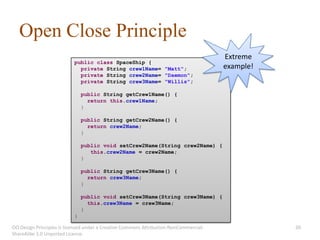
Open Close Principle
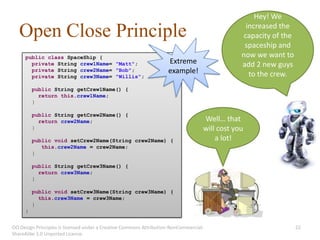
                                                                                       Extreme
                           public class SpaceShip {
                             private String crew1Name= "Matt";                         example!
                             private String crew2Name= "Daemon";
                             private String crew3Name= "Willis";

                               public String getCrew1Name() {
                                 return this.crew1Name;
                               }

                               public String getCrew2Name() {
                                 return crew2Name;
                               }

                               public void setCrew2Name(String crew2Name) {
                                  this.crew2Name = crew2Name;
                               }

                               public String getCrew3Name() {
                                 return crew3Name;
                               }

                               public void setCrew3Name(String crew3Name) {
                                 this.crew3Name = crew3Name;
                               }
                           }

OO Design Principles is licensed under a Creative Commons Attribution-NonCommercial-              20
ShareAlike 3.0 Unported License.
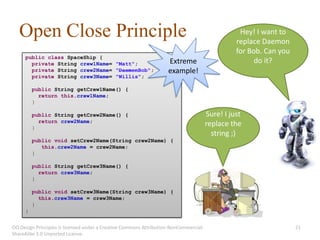
Open Close Principle                                                                           Hey! I want to
                                                                                                 replace Daemon
                                                                                                 for Bob. Can you
     public class SpaceShip {
       private String crew1Name= "Matt";                            Extreme                            do it?
       private String crew2Name= "DaemonBob";                       example!
       private String crew3Name= "Willis";

         public String getCrew1Name() {
           return this.crew1Name;
         }

         public String getCrew2Name() {                                                Sure! I just
           return crew2Name;
         }
                                                                                       replace the
                                                                                         string ;)
         public void setCrew2Name(String crew2Name) {
            this.crew2Name = crew2Name;
         }

         public String getCrew3Name() {
           return crew3Name;
         }

         public void setCrew3Name(String crew3Name) {
           this.crew3Name = crew3Name;
         }
     }


OO Design Principles is licensed under a Creative Commons Attribution-NonCommercial-                                21
ShareAlike 3.0 Unported License.
Hey! We
                                                                                                 increased the
   Open Close Principle                                                                         capacity of the
                                                                                                spaceship and
     public class SpaceShip {                                                                  now we want to
       private String crew1Name= "Matt";                            Extreme                    add 2 new guys
       private String crew2Name= "Bob";                             example!                      to the crew.
       private String crew3Name= "Willis";

         public String getCrew1Name() {
           return this.crew1Name;
         }

         public String getCrew2Name() {
           return crew2Name;                                                       Well… that
         }                                                                         will cost you
         public void setCrew2Name(String crew2Name) {                                  a lot!
            this.crew2Name = crew2Name;
         }

         public String getCrew3Name() {
           return crew3Name;
         }

         public void setCrew3Name(String crew3Name) {
           this.crew3Name = crew3Name;
         }
     }


OO Design Principles is licensed under a Creative Commons Attribution-NonCommercial-                              22
ShareAlike 3.0 Unported License.
Open Close Principle
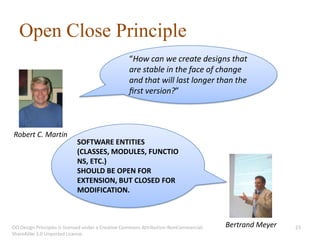
                                                   “How can we create designs that
                                                   are stable in the face of change
                                                   and that will last longer than the
                                                   first version?”


Robert C. Martin
                            SOFTWARE ENTITIES
                            (CLASSES, MODULES, FUNCTIO
                            NS, ETC.)
                            SHOULD BE OPEN FOR
                            EXTENSION, BUT CLOSED FOR
                            MODIFICATION.


OO Design Principles is licensed under a Creative Commons Attribution-NonCommercial-   Bertrand Meyer   23
ShareAlike 3.0 Unported License.
Open Close Principle
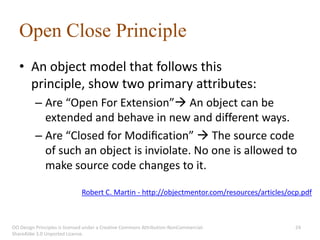
   • An object model that follows this
     principle, show two primary attributes:
          – Are “Open For Extension” An object can be
            extended and behave in new and different ways.
          – Are “Closed for Modification”  The source code
            of such an object is inviolate. No one is allowed to
            make source code changes to it.

                              Robert C. Martin - http://objectmentor.com/resources/articles/ocp.pdf


OO Design Principles is licensed under a Creative Commons Attribution-NonCommercial-          24
ShareAlike 3.0 Unported License.
OO Design Principles
   •    Single Responsibility Principle (SRP)
   •    Open Closed Principle (OCP)
   •    Liskov Substitution Principle (LSP)
   •    Interface Segregation Principle (ISP)
   •    Dependency Inversion Principle (DIP)
   •    Don’t Repeat Yourself (DRY)
OO Design Principles is licensed under a Creative Commons Attribution-NonCommercial-   25
ShareAlike 3.0 Unported License.
Liskov Substitution Principle


           What is wanted here is something like the following
       substitution property: If for each object o1 of type S there is
       an object o2 of type T such that for all programs P defined in
          terms of T, the behavior of P is unchanged when o1 is
        substituted for o2 then S is a subtype of T." - BarbaraLiskov, Data
                         Abstraction and Hierarchy, SIGPLAN Notices, 23,5 (May, 1988)


OO Design Principles is licensed under a Creative Commons Attribution-NonCommercial-    26
ShareAlike 3.0 Unported License.
Liskov Substitution Principle


         FUNCTIONS THAT USE POINTERS OR REFERENCES TO BASE
           CLASSES MUST BE ABLE TO USE OBJECTS OF DERIVED
              CLASSES WITHOUT KNOWING IT. – Robert C. Martin
                            http://www.objectmentor.com/resources/articles/lsp.pdf


OO Design Principles is licensed under a Creative Commons Attribution-NonCommercial-   27
ShareAlike 3.0 Unported License.
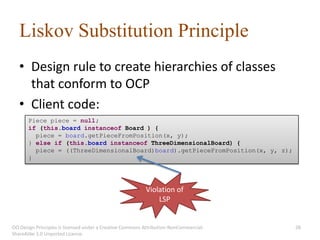
Liskov Substitution Principle
   • Design rule to create hierarchies of classes
     that conform to OCP
   • Client code:
       Piece piece = null;
       if (this.board instanceof Board ) {
         piece = board.getPieceFromPosition(x, y);
       } else if (this.board instanceof ThreeDimensionalBoard) {
         piece = ((ThreeDimensionalBoard)board).getPieceFromPosition(x, y, z);
       }


                                                          Violation of
                                                              LSP


OO Design Principles is licensed under a Creative Commons Attribution-NonCommercial-   28
ShareAlike 3.0 Unported License.
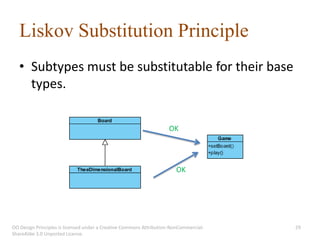
Liskov Substitution Principle
   • Subtypes must be substitutable for their base
     types.


                                                                    OK


                                                                       OK


OO Design Principles is licensed under a Creative Commons Attribution-NonCommercial-   29
ShareAlike 3.0 Unported License.
Liskov Substitution Principle
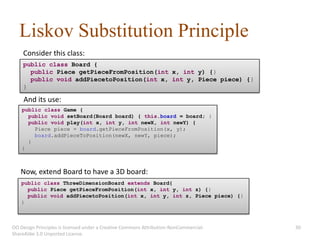
    Consider this class:
    public class Board {
      public Piece getPieceFromPosition(int x, int y) {}
      public void addPiecetoPosition(int x, int y, Piece piece) {}
    }

     And its use:
    public class Game {
      public void setBoard(Board board) { this.board = board; }
      public void play(int x, int y, int newX, int newY) {
        Piece piece = board.getPieceFromPosition(x, y);
        board.addPieceToPosition(newX, newY, piece);
      }
    }


   Now, extend Board to have a 3D board:
    public class ThreeDimensionBoard extends Board{
      public Piece getPieceFromPosition(int x, int y, int z) {}
      public void addPiecetoPosition(int x, int y, int z, Piece piece) {}
    }


OO Design Principles is licensed under a Creative Commons Attribution-NonCommercial-   30
ShareAlike 3.0 Unported License.
Liskov Substitution Principle

     Running….
     public void main(String args[]) {
       Board board = new Board();
       Game game = new Game();
       game.setBoard(board);
       game.play(0, 0, 0, 2); //Ok
       Board threeDimensionalBoard = new ThreeDimensionBoard();
       game.setBoard(threeDimensionalBoard);
       game.play(0, 0, 0, 2); ////And the z and newZ
     }


                                                                           Compiling, running but not working!

                                     Discussions http://c2.com/cgi/wiki?LiskovSubstitutionPrinciple
OO Design Principles is licensed under a Creative Commons Attribution-NonCommercial-                        31
ShareAlike 3.0 Unported License.
Liskov Substitution Principle
   • Read the article:
          – http://www.objectmentor.com/resources/articles
            /lsp.pdf


OO Design Principles is licensed under a Creative Commons Attribution-NonCommercial-   32
ShareAlike 3.0 Unported License.
OO Design Principles
   •    Single Responsibility Principle (SRP)
   •    Open Closed Principle (OCP)
   •    Liskov Substitution Principle (LSP)
   •    Interface Segregation Principle (ISP)
   •    Dependency Inversion Principle (DIP)
   •    Don’t Repeat Yourself (DRY)
OO Design Principles is licensed under a Creative Commons Attribution-NonCommercial-   33
ShareAlike 3.0 Unported License.
Interface Segregation Principle

         Clients should not be forced to depend
            on methods that they do not use.
                           Robert. C. Martin - http://www.objectmentor.com/resources/articles/isp.pdf


                                                                        Interface does not necessarily
                                                                             means Java Interface


OO Design Principles is licensed under a Creative Commons Attribution-NonCommercial-                     34
ShareAlike 3.0 Unported License.
Interface Segregation Principle
   • ‘Fat’ and polluted interfaces should be splitted
     into smaller and specific interfaces, achieving
     high cohesive interfaces
   • Clients should only depend on methods they
     use, thus reducing coupling


OO Design Principles is licensed under a Creative Commons Attribution-NonCommercial-   35
ShareAlike 3.0 Unported License.
Interface Segregation Principle


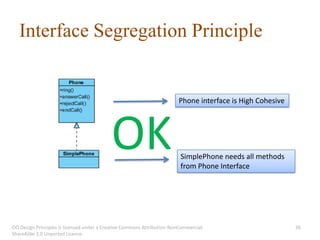
                                                                         Phone interface is High Cohesive


                                           OK                            SimplePhone needs all methods
                                                                         from Phone Interface


OO Design Principles is licensed under a Creative Commons Attribution-NonCommercial-                        36
ShareAlike 3.0 Unported License.
Interface Segregation Principle

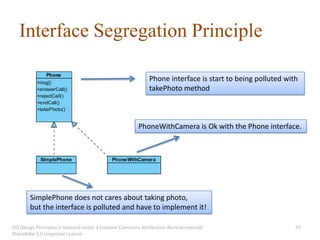
                                                            Phone interface is start to being polluted with
                                                            takePhoto method


                                                       PhoneWithCamera is Ok with the Phone interface.


       SimplePhone does not cares about taking photo,
       but the interface is polluted and have to implement it!

OO Design Principles is licensed under a Creative Commons Attribution-NonCommercial-                      37
ShareAlike 3.0 Unported License.
Interface Segregation Principle
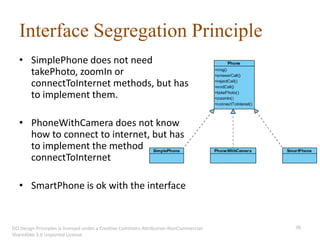
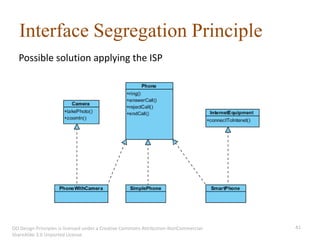
   • SimplePhone does not need
     takePhoto, zoomIn or
     connectToInternet methods, but has
     to implement them.

   • PhoneWithCamera does not know
     how to connect to internet, but has
     to implement the method
     connectToInternet

   • SmartPhone is ok with the interface


OO Design Principles is licensed under a Creative Commons Attribution-NonCommercial-   38
ShareAlike 3.0 Unported License.
Interface Segregation Principle
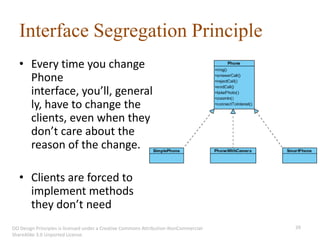
   • Every time you change
     Phone
     interface, you’ll, general
     ly, have to change the
     clients, even when they
     don’t care about the
     reason of the change.

   • Clients are forced to
     implement methods
     they don’t need
OO Design Principles is licensed under a Creative Commons Attribution-NonCommercial-   39
ShareAlike 3.0 Unported License.
Interface Segregation Principle
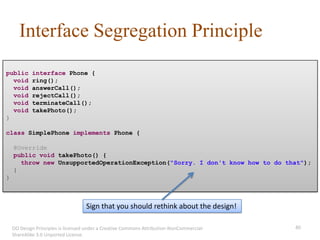
public      interface Phone {
  void      ring();
  void      answerCall();
  void      rejectCall();
  void      terminateCall();
  void      takePhoto();
}

class SimplePhone implements Phone {

    @Override
    public void takePhoto() {
      throw new UnsupportedOperationException("Sorry. I don't know how to do that");
    }
}


                                    Sign that you should rethink about the design!

    OO Design Principles is licensed under a Creative Commons Attribution-NonCommercial-   40
    ShareAlike 3.0 Unported License.
Interface Segregation Principle
  Possible solution applying the ISP


OO Design Principles is licensed under a Creative Commons Attribution-NonCommercial-   41
ShareAlike 3.0 Unported License.
OO Design Principles
   •    Single Responsibility Principle (SRP)
   •    Open Closed Principle (OCP)
   •    Liskov Substitution Principle (LSP)
   •    Interface Segregation Principle (ISP)
   •    Dependency Inversion Principle (DIP)
   •    Don’t Repeat Yourself (DRY)
OO Design Principles is licensed under a Creative Commons Attribution-NonCommercial-   42
ShareAlike 3.0 Unported License.
Dependency Inversion Principle
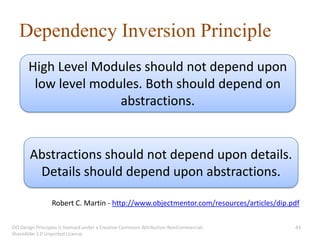
       High Level Modules should not depend upon
        low level modules. Both should depend on
                      abstractions.


       Abstractions should not depend upon details.
        Details should depend upon abstractions.

                 Robert C. Martin - http://www.objectmentor.com/resources/articles/dip.pdf

OO Design Principles is licensed under a Creative Commons Attribution-NonCommercial-    43
ShareAlike 3.0 Unported License.
Dependency Inversion Principle
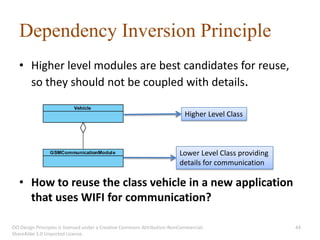
   • Higher level modules are best candidates for reuse,
     so they should not be coupled with details.

                                                                           Higher Level Class


                                                                         Lower Level Class providing
                                                                         details for communication

   • How to reuse the class vehicle in a new application
     that uses WIFI for communication?

OO Design Principles is licensed under a Creative Commons Attribution-NonCommercial-                   44
ShareAlike 3.0 Unported License.
Dependency Inversion Principle
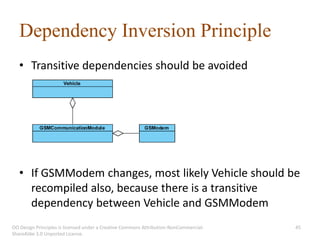
   • Transitive dependencies should be avoided


   • If GSMModem changes, most likely Vehicle should be
     recompiled also, because there is a transitive
     dependency between Vehicle and GSMModem
OO Design Principles is licensed under a Creative Commons Attribution-NonCommercial-   45
ShareAlike 3.0 Unported License.
Dependency Inversion Principle
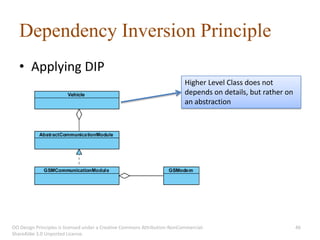
   • Applying DIP
                                                                           Higher Level Class does not
                                                                           depends on details, but rather on
                                                                           an abstraction


OO Design Principles is licensed under a Creative Commons Attribution-NonCommercial-                           46
ShareAlike 3.0 Unported License.
Dependency Inversion Principle
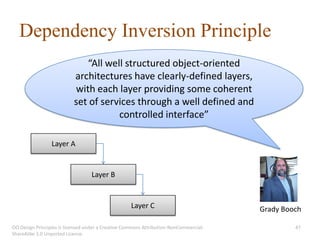
                              “All well structured object-oriented
                           architectures have clearly-defined layers,
                           with each layer providing some coherent
                           set of services through a well defined and
                                      controlled interface”

                 Layer A


                                  Layer B


                                                    Layer C                            Grady Booch

OO Design Principles is licensed under a Creative Commons Attribution-NonCommercial-            47
ShareAlike 3.0 Unported License.
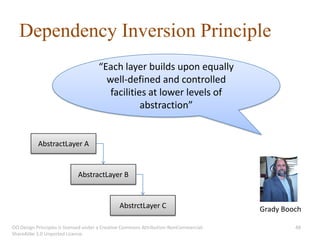
Dependency Inversion Principle
                                     “Each layer builds upon equally
                                       well-defined and controlled
                                        facilities at lower levels of
                                                 abstraction”


           AbstractLayer A


                            AbstractLayer B


                                               AbstrctLayer C                          Grady Booch

OO Design Principles is licensed under a Creative Commons Attribution-NonCommercial-            48
ShareAlike 3.0 Unported License.
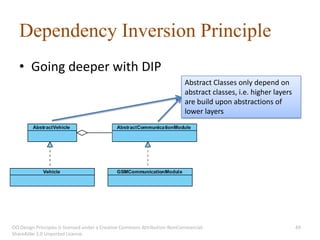
Dependency Inversion Principle
   • Going deeper with DIP
                                                                           Abstract Classes only depend on
                                                                           abstract classes, i.e. higher layers
                                                                           are build upon abstractions of
                                                                           lower layers


OO Design Principles is licensed under a Creative Commons Attribution-NonCommercial-                              49
ShareAlike 3.0 Unported License.
OO Design Principles
   •    Single Responsibility Principle (SRP)
   •    Open Closed Principle (OCP)
   •    Liskov Substitution Principle (LSP)
   •    Interface Segregation Principle (ISP)
   •    Dependency Inversion Principle (DIP)
   • Don’t Repeat Yourself (DRY)

OO Design Principles is licensed under a Creative Commons Attribution-NonCommercial-   50
ShareAlike 3.0 Unported License.
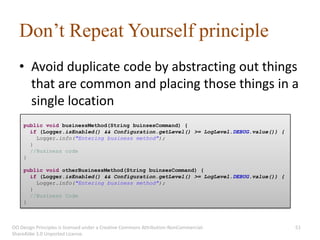
Don’t Repeat Yourself principle
   • Avoid duplicate code by abstracting out things
     that are common and placing those things in a
     single location
     public void businessMethod(String buinsesCommand) {
       if (Logger.isEnabled() && Configuration.getLevel() >= LogLevel.DEBUG.value()) {
         Logger.info("Entering business method");
       }
       //Business code
     }

     public void otherBusinessMethod(String buinsesCommand) {
       if (Logger.isEnabled() && Configuration.getLevel() >= LogLevel.DEBUG.value()) {
         Logger.info("Entering business method");
       }
       //Business Code
     }


OO Design Principles is licensed under a Creative Commons Attribution-NonCommercial-     51
ShareAlike 3.0 Unported License.
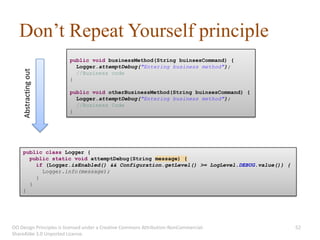
Don’t Repeat Yourself principle
                         public void businessMethod(String buinsesCommand) {
                           Logger.attemptDebug("Entering business method");
     Abstracting out


                           //Business code
                         }

                         public void otherBusinessMethod(String buinsesCommand) {
                           Logger.attemptDebug("Entering business method");
                           //Business Code
                         }


    public class Logger {
      public static void attemptDebug(String message) {
        if (Logger.isEnabled() && Configuration.getLevel() >= LogLevel.DEBUG.value()) {
          Logger.info(message);
        }
      }
    }


OO Design Principles is licensed under a Creative Commons Attribution-NonCommercial-      52
ShareAlike 3.0 Unported License.
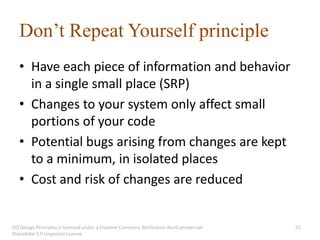
Don’t Repeat Yourself principle
   • Have each piece of information and behavior
     in a single small place (SRP)
   • Changes to your system only affect small
     portions of your code
   • Potential bugs arising from changes are kept
     to a minimum, in isolated places
   • Cost and risk of changes are reduced


OO Design Principles is licensed under a Creative Commons Attribution-NonCommercial-   53
ShareAlike 3.0 Unported License.

OO design principles

  • 1.
    OO Design Principles João Miguel Pereira http://jpereira.eu March 2012 OO Design Principles by João Miguel Pereira is licensed under a Creative Commons Attribution-NonCommercial-ShareAlike 3.0 Unported License.
  • 2.
    OO Design Principles • Single Responsibility Principle (SRP) • Open Closed Principle (OCP) • Liskov Substitution Principle (LSP) • Interface Segregation Principle (ISP) • Dependency Inversion Principle (DIP) • Don’t Repeat Yourself (DRY) OO Design Principles is licensed under a Creative Commons Attribution-NonCommercial- 2 ShareAlike 3.0 Unported License.
  • 3.
    OO Design Principles • Single Responsibility Principle (SRP) • Open Closed Principle (OCP) • Liskov Substitution Principle (LSP) • Interface Segregation Principle (ISP) • Dependency Inversion Principle (DIP) • Don’t Repeat Yourself (DRY) OO Design Principles is licensed under a Creative Commons Attribution-NonCommercial- 3 ShareAlike 3.0 Unported License.
  • 4.
    Single Responsibility Principle • Tom DeMarco and Meilir Page-Jones call it Cohesion – The Practical Guide to Structured Systems Design, 2d. ed., Meilir PageJones, Yourdon Press Computing Series, 1988 http://amzn.to/book_TPGSS – Structured Analysis and System Specification, Tom DeMarco, Yourdon Press Computing Series, 1979  http://amzn.to/book_SASS OO Design Principles is licensed under a Creative Commons Attribution-NonCommercial- 4 ShareAlike 3.0 Unported License.
  • 5.
    Single Responsibility Principle There shouldn’t never be more than one reason for a class to change! Robert C. Martin http://www.objectmentor.com/resources/articles/srp.pdf OO Design Principles is licensed under a Creative Commons Attribution-NonCommercial- 5 ShareAlike 3.0 Unported License.
  • 6.
    Single Responsibility Principle Responsability Class implementing Move ball Ball Kick Ball Player Score Ball,ScoreBoard OO Design Principles is licensed under a Creative Commons Attribution-NonCommercial- 6 ShareAlike 3.0 Unported License.
  • 7.
    Single Responsibility Principle Change in responsability Responsability Class implementing Move Ball Move ball Ball Kick Ball Player Score Ball,ScoreBoard OO Design Principles is licensed under a Creative Commons Attribution-NonCommercial- 7 ShareAlike 3.0 Unported License.
  • 8.
    Single Responsibility Principle Ball has one reason to change! Responsability Class implementing Move Ball Move ball Ball Ball Kick Ball Player Score Ball,ScoreBoard OO Design Principles is licensed under a Creative Commons Attribution-NonCommercial- 8 ShareAlike 3.0 Unported License.
  • 9.
    Single Responsibility Principle Change in responsability Responsability Class implementing Move ball Ball Kick Ball Kick Ball Player Score Ball,ScoreBoard OO Design Principles is licensed under a Creative Commons Attribution-NonCommercial- 9 ShareAlike 3.0 Unported License.
  • 10.
    Single Responsibility Principle Player has one reason to change! Responsability Class implementing Move ball Ball Kick Ball Kick Ball Player Player Score Ball,ScoreBoard OO Design Principles is licensed under a Creative Commons Attribution-NonCommercial- 10 ShareAlike 3.0 Unported License.
  • 11.
    Single Responsibility Principle Change in responsability Responsability Class implementing Move ball Ball Kick Ball Player Score Score Ball,ScoreBoard OO Design Principles is licensed under a Creative Commons Attribution-NonCommercial- 11 ShareAlike 3.0 Unported License.
  • 12.
    Single Responsibility Principle ScoreBoard has one reason to change! Ball has TWO reasons to change! Responsability Class implementing Move Ball Move ball Ball Ball Kick Ball Player Score Score Ball,ScoreBoard Ball, Scoreboard OO Design Principles is licensed under a Creative Commons Attribution-NonCommercial- 12 ShareAlike 3.0 Unported License.
  • 13.
    Single Responsibility Principle • Avoid responsibility coupling by giving a class/module a single reason to change • Every line of code should only focus on carrying out that single responsibility OO Design Principles is licensed under a Creative Commons Attribution-NonCommercial- 13 ShareAlike 3.0 Unported License.
  • 14.
    Single Responsibility Principle public class EmployeeBoard { public void showListOfEmployeeNames(List<Employee> employees) { for (Employee employee : employees) { if (employee.getGender.equals("M")) { printMessage("Mr. "+employee.getName()); } else { printMessage("Miss. "+employee.getName()); } } } } } This class shows the names of employees in a screen… but also format each employee's name!! OO Design Principles is licensed under a Creative Commons Attribution-NonCommercial- 14 ShareAlike 3.0 Unported License.
  • 15.
    Single Responsibility Principle public class EmployeeBoard { public void showListOfEmployeeNames(List<Employee> employees) { for (Employee employee : employees) { printMessage(employee.getFormattedName()); } } } public class Employee { public String getFormattedName() { String formattedName; if (this.getGender.equals("M")) { formattedName = "Mr. " + this.getName(); } else { formattedName = "Miss. " + this.getName(); } return formattedName; } } OO Design Principles is licensed under a Creative Commons Attribution-NonCommercial- 15 ShareAlike 3.0 Unported License.
  • 16.
    Single Responsibility Principle • Read the article: – http://www.objectmentor.com/resources/articles/ srp.pdf OO Design Principles is licensed under a Creative Commons Attribution-NonCommercial- 16 ShareAlike 3.0 Unported License.
  • 17.
    OO Design Principles • Single Responsibility Principle (SRP) • Open Closed Principle (OCP) • Liskov Substitution Principle (LSP) • Interface Segregation Principle (ISP) • Dependency Inversion Principle (DIP) • Don’t Repeat Yourself (DRY) OO Design Principles is licensed under a Creative Commons Attribution-NonCommercial- 17 ShareAlike 3.0 Unported License.
  • 18.
    Open Close Principle • Classes should be closed for modification but open for extension public class Calculator { Well tested, robust public int sum(int a, int b) { and correctly return a + b; implemented class. } Why modify it? public int multiply(int a, int b) { return a * b; } } How to extend Calculator class to add the square root function ? OO Design Principles is licensed under a Creative Commons Attribution-NonCommercial- 18 ShareAlike 3.0 Unported License.
  • 19.
    Open Close Principle • Classes should be closed for modification but open for extension public class Calculator { public int sum(int a, int b) { return a + b; } public int multiply(int a, int b) { return a * b; } } //AdvancedCalulator extends a well tested class public class AdvancedCalculator extends Calculator { public double sqrt(int a) { return Math.sqrt(Float.valueOf(a)); } } OO Design Principles is licensed under a Creative Commons Attribution-NonCommercial- 19 ShareAlike 3.0 Unported License.
  • 20.
    Open Close Principle Extreme public class SpaceShip { private String crew1Name= "Matt"; example! private String crew2Name= "Daemon"; private String crew3Name= "Willis"; public String getCrew1Name() { return this.crew1Name; } public String getCrew2Name() { return crew2Name; } public void setCrew2Name(String crew2Name) { this.crew2Name = crew2Name; } public String getCrew3Name() { return crew3Name; } public void setCrew3Name(String crew3Name) { this.crew3Name = crew3Name; } } OO Design Principles is licensed under a Creative Commons Attribution-NonCommercial- 20 ShareAlike 3.0 Unported License.
  • 21.
    Open Close Principle Hey! I want to replace Daemon for Bob. Can you public class SpaceShip { private String crew1Name= "Matt"; Extreme do it? private String crew2Name= "DaemonBob"; example! private String crew3Name= "Willis"; public String getCrew1Name() { return this.crew1Name; } public String getCrew2Name() { Sure! I just return crew2Name; } replace the string ;) public void setCrew2Name(String crew2Name) { this.crew2Name = crew2Name; } public String getCrew3Name() { return crew3Name; } public void setCrew3Name(String crew3Name) { this.crew3Name = crew3Name; } } OO Design Principles is licensed under a Creative Commons Attribution-NonCommercial- 21 ShareAlike 3.0 Unported License.
  • 22.
    Hey! We increased the Open Close Principle capacity of the spaceship and public class SpaceShip { now we want to private String crew1Name= "Matt"; Extreme add 2 new guys private String crew2Name= "Bob"; example! to the crew. private String crew3Name= "Willis"; public String getCrew1Name() { return this.crew1Name; } public String getCrew2Name() { return crew2Name; Well… that } will cost you public void setCrew2Name(String crew2Name) { a lot! this.crew2Name = crew2Name; } public String getCrew3Name() { return crew3Name; } public void setCrew3Name(String crew3Name) { this.crew3Name = crew3Name; } } OO Design Principles is licensed under a Creative Commons Attribution-NonCommercial- 22 ShareAlike 3.0 Unported License.
  • 23.
    Open Close Principle “How can we create designs that are stable in the face of change and that will last longer than the first version?” Robert C. Martin SOFTWARE ENTITIES (CLASSES, MODULES, FUNCTIO NS, ETC.) SHOULD BE OPEN FOR EXTENSION, BUT CLOSED FOR MODIFICATION. OO Design Principles is licensed under a Creative Commons Attribution-NonCommercial- Bertrand Meyer 23 ShareAlike 3.0 Unported License.
  • 24.
    Open Close Principle • An object model that follows this principle, show two primary attributes: – Are “Open For Extension” An object can be extended and behave in new and different ways. – Are “Closed for Modification”  The source code of such an object is inviolate. No one is allowed to make source code changes to it. Robert C. Martin - http://objectmentor.com/resources/articles/ocp.pdf OO Design Principles is licensed under a Creative Commons Attribution-NonCommercial- 24 ShareAlike 3.0 Unported License.
  • 25.
    OO Design Principles • Single Responsibility Principle (SRP) • Open Closed Principle (OCP) • Liskov Substitution Principle (LSP) • Interface Segregation Principle (ISP) • Dependency Inversion Principle (DIP) • Don’t Repeat Yourself (DRY) OO Design Principles is licensed under a Creative Commons Attribution-NonCommercial- 25 ShareAlike 3.0 Unported License.
  • 26.
    Liskov Substitution Principle What is wanted here is something like the following substitution property: If for each object o1 of type S there is an object o2 of type T such that for all programs P defined in terms of T, the behavior of P is unchanged when o1 is substituted for o2 then S is a subtype of T." - BarbaraLiskov, Data Abstraction and Hierarchy, SIGPLAN Notices, 23,5 (May, 1988) OO Design Principles is licensed under a Creative Commons Attribution-NonCommercial- 26 ShareAlike 3.0 Unported License.
  • 27.
    Liskov Substitution Principle FUNCTIONS THAT USE POINTERS OR REFERENCES TO BASE CLASSES MUST BE ABLE TO USE OBJECTS OF DERIVED CLASSES WITHOUT KNOWING IT. – Robert C. Martin http://www.objectmentor.com/resources/articles/lsp.pdf OO Design Principles is licensed under a Creative Commons Attribution-NonCommercial- 27 ShareAlike 3.0 Unported License.
  • 28.
    Liskov Substitution Principle • Design rule to create hierarchies of classes that conform to OCP • Client code: Piece piece = null; if (this.board instanceof Board ) { piece = board.getPieceFromPosition(x, y); } else if (this.board instanceof ThreeDimensionalBoard) { piece = ((ThreeDimensionalBoard)board).getPieceFromPosition(x, y, z); } Violation of LSP OO Design Principles is licensed under a Creative Commons Attribution-NonCommercial- 28 ShareAlike 3.0 Unported License.
  • 29.
    Liskov Substitution Principle • Subtypes must be substitutable for their base types. OK OK OO Design Principles is licensed under a Creative Commons Attribution-NonCommercial- 29 ShareAlike 3.0 Unported License.
  • 30.
    Liskov Substitution Principle Consider this class: public class Board { public Piece getPieceFromPosition(int x, int y) {} public void addPiecetoPosition(int x, int y, Piece piece) {} } And its use: public class Game { public void setBoard(Board board) { this.board = board; } public void play(int x, int y, int newX, int newY) { Piece piece = board.getPieceFromPosition(x, y); board.addPieceToPosition(newX, newY, piece); } } Now, extend Board to have a 3D board: public class ThreeDimensionBoard extends Board{ public Piece getPieceFromPosition(int x, int y, int z) {} public void addPiecetoPosition(int x, int y, int z, Piece piece) {} } OO Design Principles is licensed under a Creative Commons Attribution-NonCommercial- 30 ShareAlike 3.0 Unported License.
  • 31.
    Liskov Substitution Principle Running…. public void main(String args[]) { Board board = new Board(); Game game = new Game(); game.setBoard(board); game.play(0, 0, 0, 2); //Ok Board threeDimensionalBoard = new ThreeDimensionBoard(); game.setBoard(threeDimensionalBoard); game.play(0, 0, 0, 2); ////And the z and newZ } Compiling, running but not working! Discussions http://c2.com/cgi/wiki?LiskovSubstitutionPrinciple OO Design Principles is licensed under a Creative Commons Attribution-NonCommercial- 31 ShareAlike 3.0 Unported License.
  • 32.
    Liskov Substitution Principle • Read the article: – http://www.objectmentor.com/resources/articles /lsp.pdf OO Design Principles is licensed under a Creative Commons Attribution-NonCommercial- 32 ShareAlike 3.0 Unported License.
  • 33.
    OO Design Principles • Single Responsibility Principle (SRP) • Open Closed Principle (OCP) • Liskov Substitution Principle (LSP) • Interface Segregation Principle (ISP) • Dependency Inversion Principle (DIP) • Don’t Repeat Yourself (DRY) OO Design Principles is licensed under a Creative Commons Attribution-NonCommercial- 33 ShareAlike 3.0 Unported License.
  • 34.
    Interface Segregation Principle Clients should not be forced to depend on methods that they do not use. Robert. C. Martin - http://www.objectmentor.com/resources/articles/isp.pdf Interface does not necessarily means Java Interface OO Design Principles is licensed under a Creative Commons Attribution-NonCommercial- 34 ShareAlike 3.0 Unported License.
  • 35.
    Interface Segregation Principle • ‘Fat’ and polluted interfaces should be splitted into smaller and specific interfaces, achieving high cohesive interfaces • Clients should only depend on methods they use, thus reducing coupling OO Design Principles is licensed under a Creative Commons Attribution-NonCommercial- 35 ShareAlike 3.0 Unported License.
  • 36.
    Interface Segregation Principle Phone interface is High Cohesive OK SimplePhone needs all methods from Phone Interface OO Design Principles is licensed under a Creative Commons Attribution-NonCommercial- 36 ShareAlike 3.0 Unported License.
  • 37.
    Interface Segregation Principle Phone interface is start to being polluted with takePhoto method PhoneWithCamera is Ok with the Phone interface. SimplePhone does not cares about taking photo, but the interface is polluted and have to implement it! OO Design Principles is licensed under a Creative Commons Attribution-NonCommercial- 37 ShareAlike 3.0 Unported License.
  • 38.
    Interface Segregation Principle • SimplePhone does not need takePhoto, zoomIn or connectToInternet methods, but has to implement them. • PhoneWithCamera does not know how to connect to internet, but has to implement the method connectToInternet • SmartPhone is ok with the interface OO Design Principles is licensed under a Creative Commons Attribution-NonCommercial- 38 ShareAlike 3.0 Unported License.
  • 39.
    Interface Segregation Principle • Every time you change Phone interface, you’ll, general ly, have to change the clients, even when they don’t care about the reason of the change. • Clients are forced to implement methods they don’t need OO Design Principles is licensed under a Creative Commons Attribution-NonCommercial- 39 ShareAlike 3.0 Unported License.
  • 40.
    Interface Segregation Principle public interface Phone { void ring(); void answerCall(); void rejectCall(); void terminateCall(); void takePhoto(); } class SimplePhone implements Phone { @Override public void takePhoto() { throw new UnsupportedOperationException("Sorry. I don't know how to do that"); } } Sign that you should rethink about the design! OO Design Principles is licensed under a Creative Commons Attribution-NonCommercial- 40 ShareAlike 3.0 Unported License.
  • 41.
    Interface Segregation Principle Possible solution applying the ISP OO Design Principles is licensed under a Creative Commons Attribution-NonCommercial- 41 ShareAlike 3.0 Unported License.
  • 42.
    OO Design Principles • Single Responsibility Principle (SRP) • Open Closed Principle (OCP) • Liskov Substitution Principle (LSP) • Interface Segregation Principle (ISP) • Dependency Inversion Principle (DIP) • Don’t Repeat Yourself (DRY) OO Design Principles is licensed under a Creative Commons Attribution-NonCommercial- 42 ShareAlike 3.0 Unported License.
  • 43.
    Dependency Inversion Principle High Level Modules should not depend upon low level modules. Both should depend on abstractions. Abstractions should not depend upon details. Details should depend upon abstractions. Robert C. Martin - http://www.objectmentor.com/resources/articles/dip.pdf OO Design Principles is licensed under a Creative Commons Attribution-NonCommercial- 43 ShareAlike 3.0 Unported License.
  • 44.
    Dependency Inversion Principle • Higher level modules are best candidates for reuse, so they should not be coupled with details. Higher Level Class Lower Level Class providing details for communication • How to reuse the class vehicle in a new application that uses WIFI for communication? OO Design Principles is licensed under a Creative Commons Attribution-NonCommercial- 44 ShareAlike 3.0 Unported License.
  • 45.
    Dependency Inversion Principle • Transitive dependencies should be avoided • If GSMModem changes, most likely Vehicle should be recompiled also, because there is a transitive dependency between Vehicle and GSMModem OO Design Principles is licensed under a Creative Commons Attribution-NonCommercial- 45 ShareAlike 3.0 Unported License.
  • 46.
    Dependency Inversion Principle • Applying DIP Higher Level Class does not depends on details, but rather on an abstraction OO Design Principles is licensed under a Creative Commons Attribution-NonCommercial- 46 ShareAlike 3.0 Unported License.
  • 47.
    Dependency Inversion Principle “All well structured object-oriented architectures have clearly-defined layers, with each layer providing some coherent set of services through a well defined and controlled interface” Layer A Layer B Layer C Grady Booch OO Design Principles is licensed under a Creative Commons Attribution-NonCommercial- 47 ShareAlike 3.0 Unported License.
  • 48.
    Dependency Inversion Principle “Each layer builds upon equally well-defined and controlled facilities at lower levels of abstraction” AbstractLayer A AbstractLayer B AbstrctLayer C Grady Booch OO Design Principles is licensed under a Creative Commons Attribution-NonCommercial- 48 ShareAlike 3.0 Unported License.
  • 49.
    Dependency Inversion Principle • Going deeper with DIP Abstract Classes only depend on abstract classes, i.e. higher layers are build upon abstractions of lower layers OO Design Principles is licensed under a Creative Commons Attribution-NonCommercial- 49 ShareAlike 3.0 Unported License.
  • 50.
    OO Design Principles • Single Responsibility Principle (SRP) • Open Closed Principle (OCP) • Liskov Substitution Principle (LSP) • Interface Segregation Principle (ISP) • Dependency Inversion Principle (DIP) • Don’t Repeat Yourself (DRY) OO Design Principles is licensed under a Creative Commons Attribution-NonCommercial- 50 ShareAlike 3.0 Unported License.
  • 51.
    Don’t Repeat Yourselfprinciple • Avoid duplicate code by abstracting out things that are common and placing those things in a single location public void businessMethod(String buinsesCommand) { if (Logger.isEnabled() && Configuration.getLevel() >= LogLevel.DEBUG.value()) { Logger.info("Entering business method"); } //Business code } public void otherBusinessMethod(String buinsesCommand) { if (Logger.isEnabled() && Configuration.getLevel() >= LogLevel.DEBUG.value()) { Logger.info("Entering business method"); } //Business Code } OO Design Principles is licensed under a Creative Commons Attribution-NonCommercial- 51 ShareAlike 3.0 Unported License.
  • 52.
    Don’t Repeat Yourselfprinciple public void businessMethod(String buinsesCommand) { Logger.attemptDebug("Entering business method"); Abstracting out //Business code } public void otherBusinessMethod(String buinsesCommand) { Logger.attemptDebug("Entering business method"); //Business Code } public class Logger { public static void attemptDebug(String message) { if (Logger.isEnabled() && Configuration.getLevel() >= LogLevel.DEBUG.value()) { Logger.info(message); } } } OO Design Principles is licensed under a Creative Commons Attribution-NonCommercial- 52 ShareAlike 3.0 Unported License.
  • 53.
    Don’t Repeat Yourselfprinciple • Have each piece of information and behavior in a single small place (SRP) • Changes to your system only affect small portions of your code • Potential bugs arising from changes are kept to a minimum, in isolated places • Cost and risk of changes are reduced OO Design Principles is licensed under a Creative Commons Attribution-NonCommercial- 53 ShareAlike 3.0 Unported License.