

Hands-on practice:
two ways to run a project
The Ball-Point Game Reloaded
The Ball-Point Game

Facts:
○ game author is Boris Bloger
○ introduced at Spring Scrum Gathering
  2008 in Chicago by Tobias Mayer
○ simulates Scrum process
How it looks like?


Team members pass the balls
amongst the whole team.


When the ball goes throw all team
members it is produced.
Rules

The basic rules are:
○ The balls must have air time
○ Balls that hit the floor don’t count, and have to be
   returned to the starting point to get them back in play
○ No balls to your direct neighbour
○ Start point = End point (i.e. the container)
○ Iteration = 2 minutes
○ In between = 1 minute, to review and plan
○ Play 5 iterations
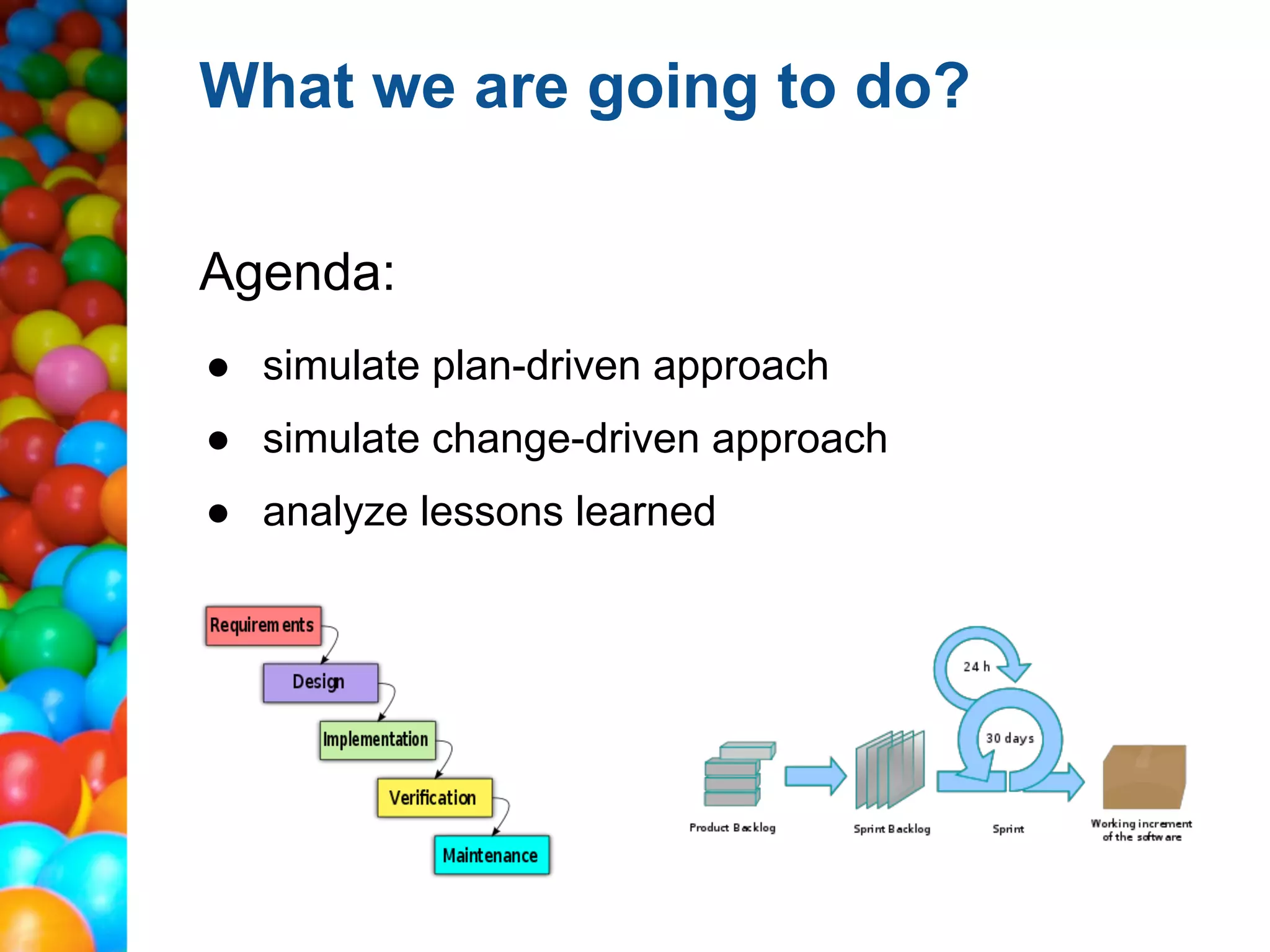
What we are going to do?

Agenda:
● simulate plan-driven approach
● simulate change-driven approach
● analyze lessons learned
So we need
two sets of rules
       for
  two different
  approaches!
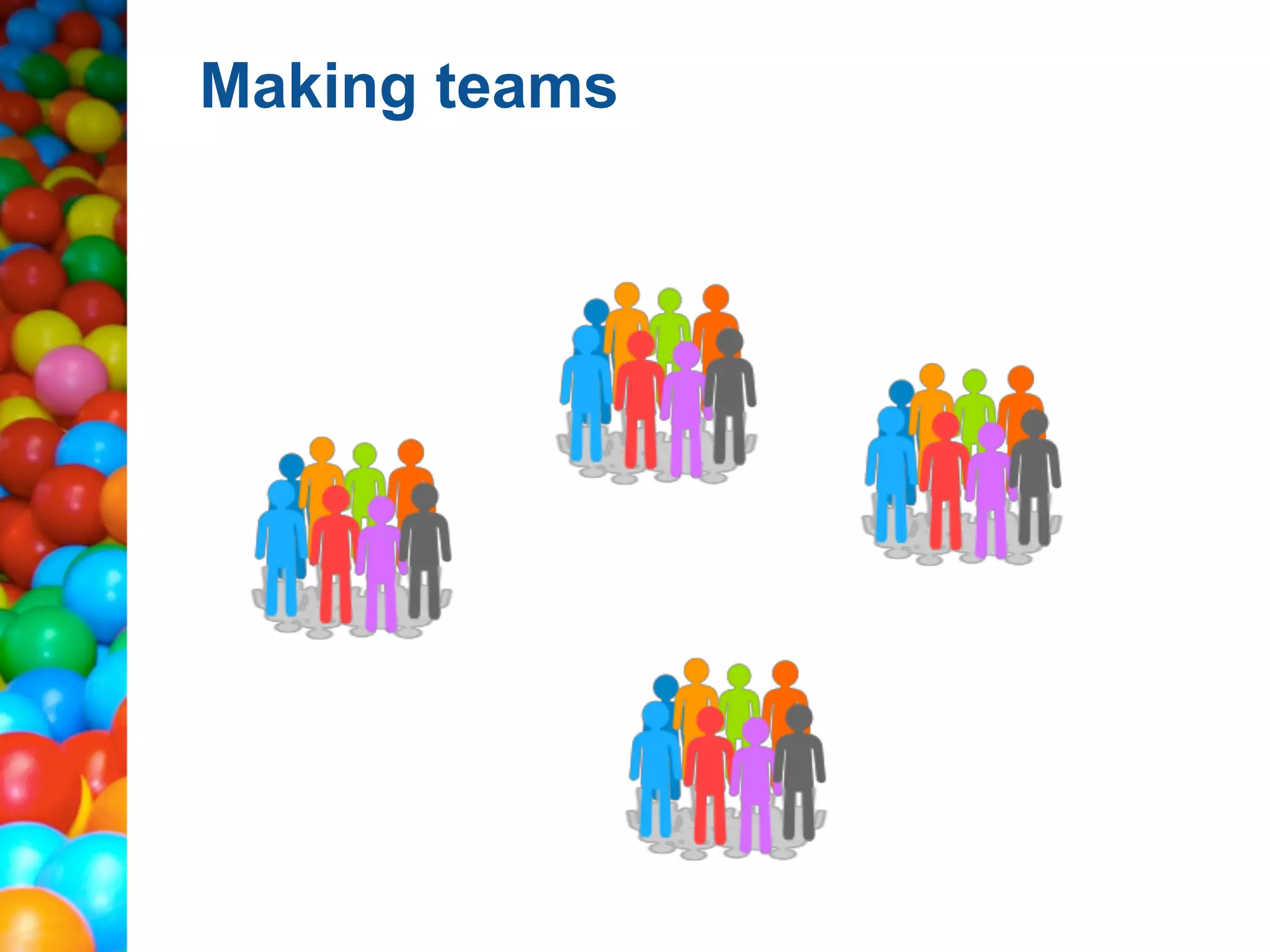
Making teams
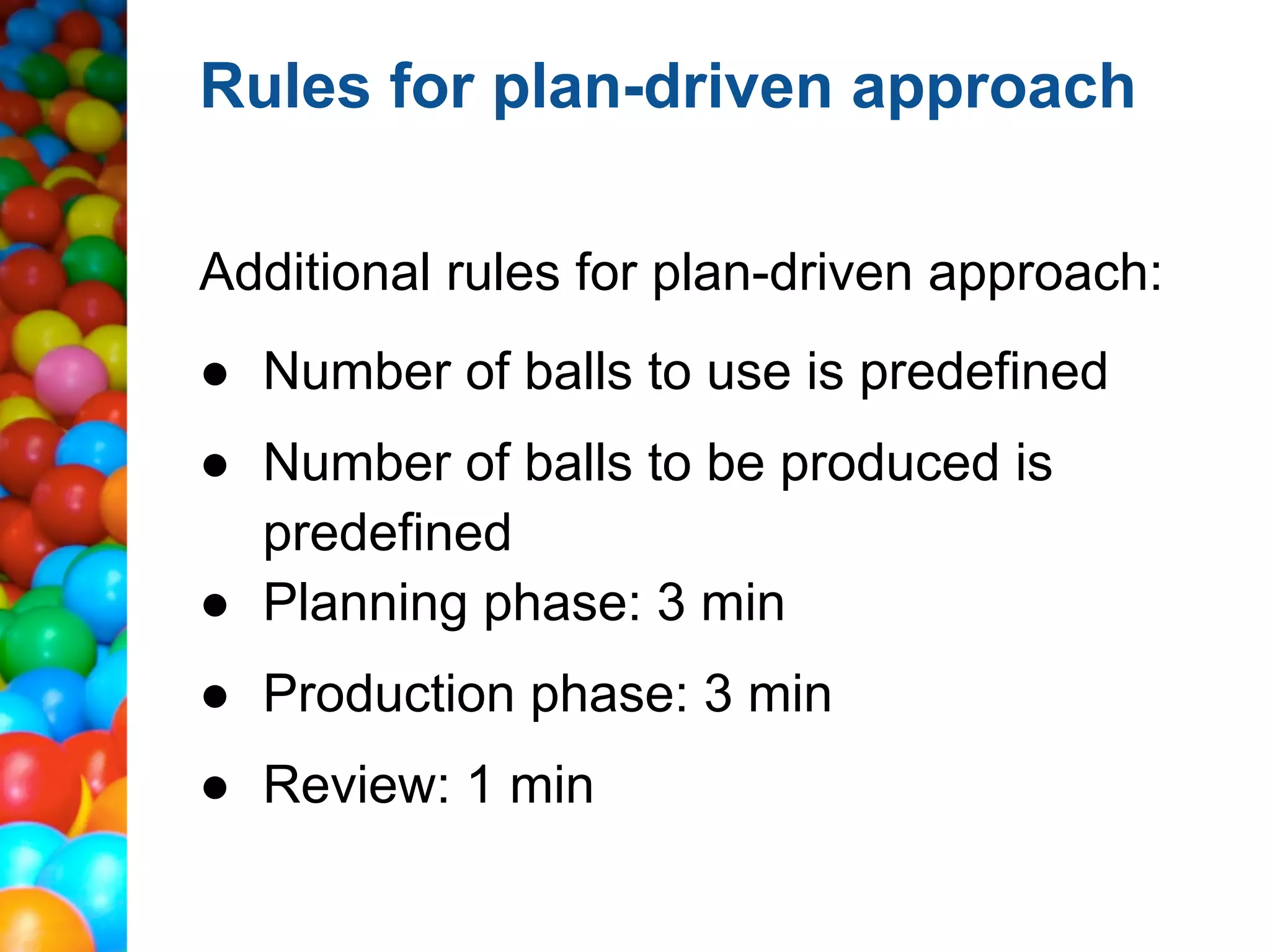
Rules for plan-driven approach

Additional rules for plan-driven approach:
● Number of balls to use is predefined
● Number of balls to be produced is
  predefined
● Planning phase: 3 min
● Production phase: 3 min
● Review: 1 min
Rules reloaded

The basic rules are:
○ The balls must have air time
○ Balls that hit the floor don’t count, and have to be returned to
    the starting point to get them back in play
○ No balls to your direct neighbour
○ Balls must be touched by hand
○ The ball is produced when it passed through all team members
○ Teams can use whatever it wants during the production phase
○ The team can not change its process during production phase
○ Teams are accountable for counting the produced balls quantity
Plan-driven approach
retrospective
● What happened?
● Did you want to change the process?
● What will happen if the production
  phase lasts for 15 minutes?
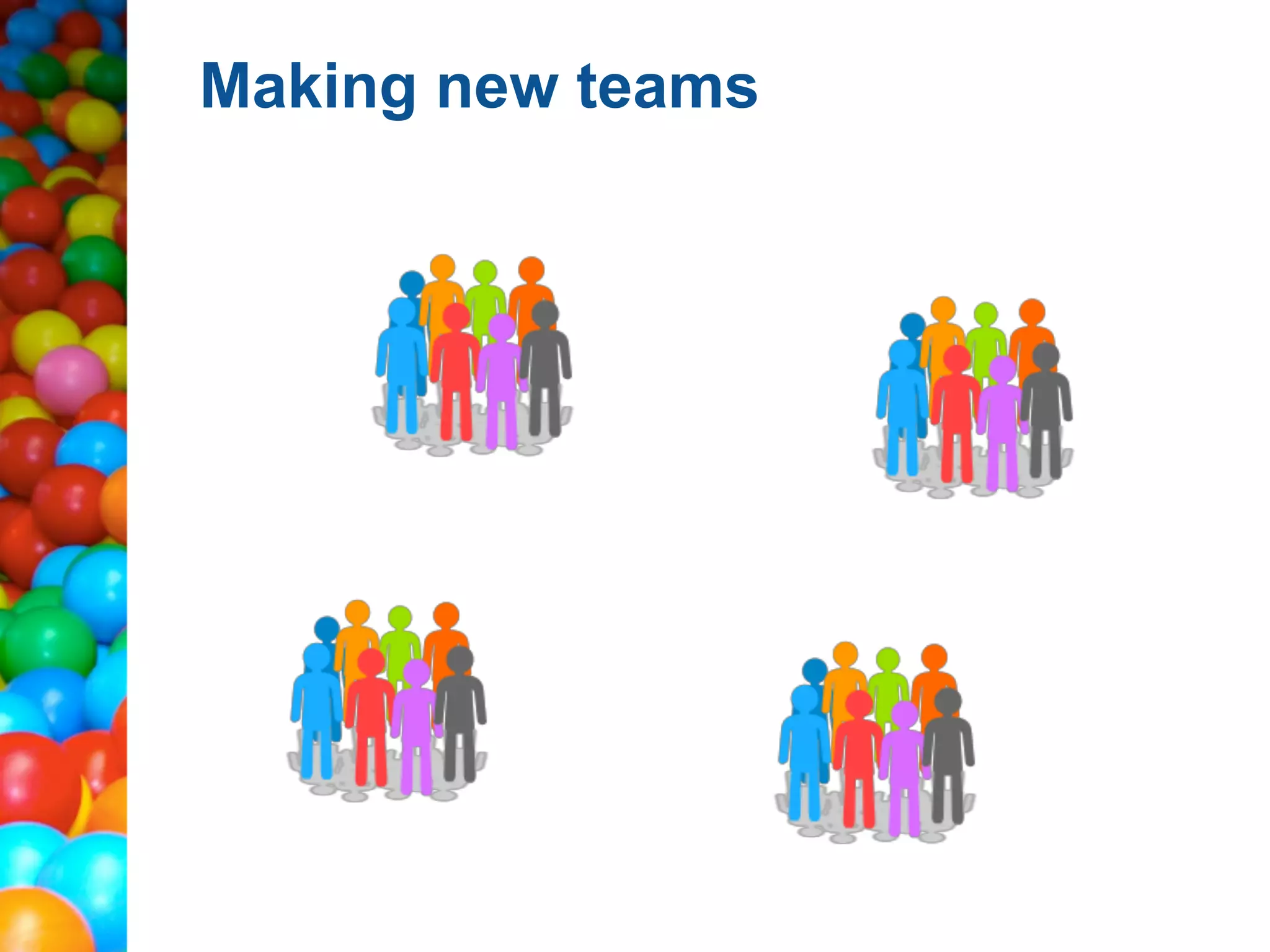
Making new teams
Rules for change-driven
approach
Rules for change-driven approach:
● Team can use as much balls as it likes
● Team defines the quantity of balls it is
  committed to produce
● Planning phase: 1 min
● Production phase: 1 min
● Review: 1 min
● Play 3-5 iterations
Rules reloaded

The basic rules are:
○ The balls must have air time
○ Balls that hit the floor don’t count, and have to be returned to
    the starting point to get them back in play
○ No balls to your direct neighbour
○ Balls must be touched by hand
○ The ball is produced when it passed through all team members
○ Teams can use whatever it wants during the production phase
○ The team can not change its process during production phase
○ Teams are accountable for counting the produced balls
    quantity
Change-driven approach
retrospective
● And what happened at this time?
● Did you want to change the process?
● Did you change it? How?
● What was the iteration that felt great?
Lessons learned

What did you learn today?


                  …

                       Fill it by yourself!
But think about…

● What made the teamwork?
● How time pressure affects the team?
● How did you improve as a team?
● In what simulation production process
  is more cost effective?
● Why the team began to show more
  predictable result?
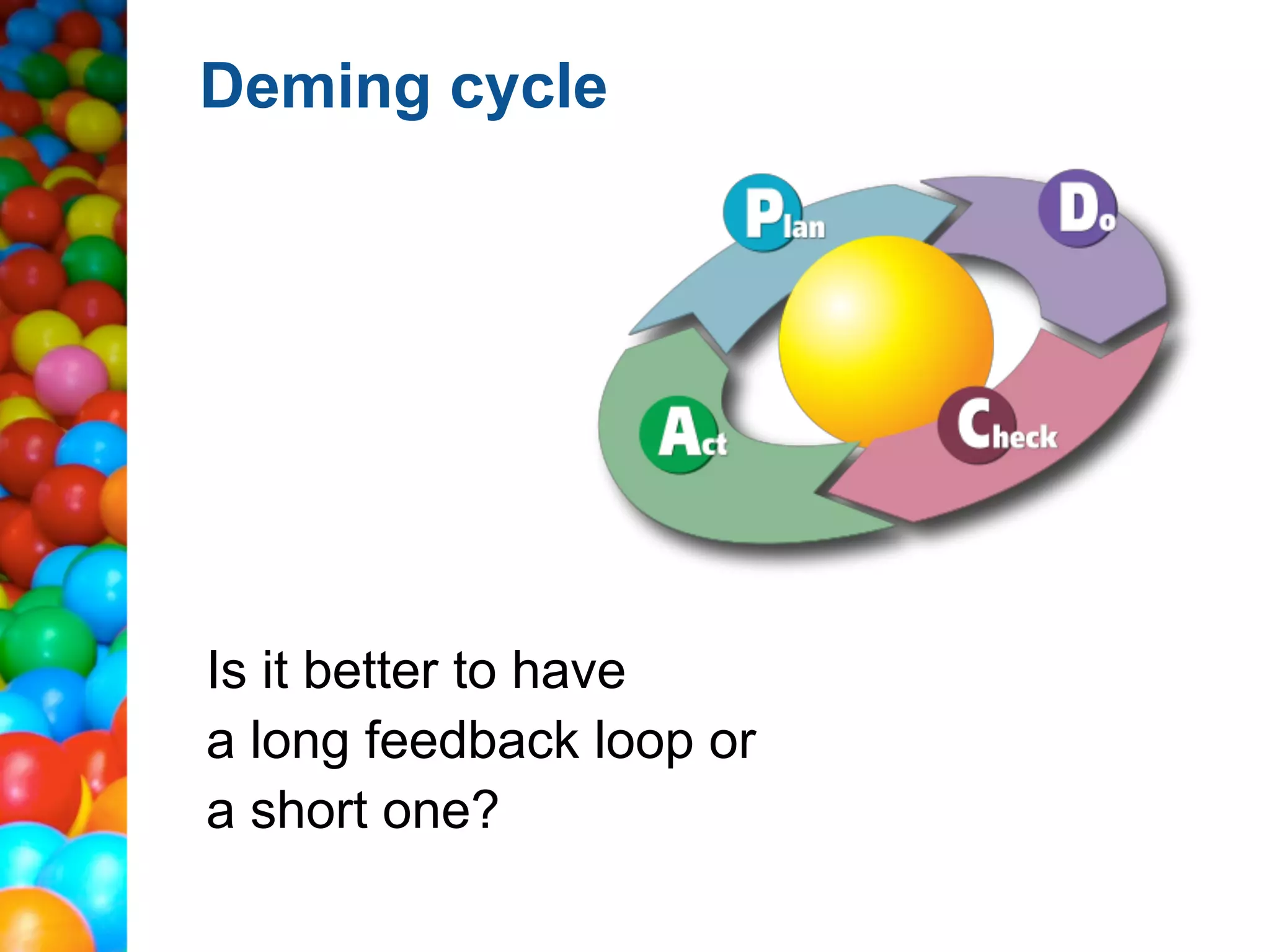
Deming cycle


Is it better to have
a long feedback loop or
a short one?
Links

The Classic Ball-Point Game description:
● http://goo.gl/NfHhd
● http://goo.gl/r6Qnu
Deming Cycle:
● http://en.wikipedia.org/wiki/PDCA
Scrum:
● http://www.scrum.org/scrumguides
Contacts


Leave feedback: http://meetu.ps/dvJCn


Contact me: http://about.me/NetRat


Rate me: http://spkr8.com/t/12711
Credits

Materials used in the presentation:
● photo by Adrian Cockle
● Wikipedia: http://www.wikipedia.org/
● Open Clip Art Library: http://openclipart.org/
Thank You!

Hands-on practice: two ways to run a project

  • 1.
    Hands-on practice: two waysto run a project The Ball-Point Game Reloaded
  • 3.
    The Ball-Point Game Facts: ○game author is Boris Bloger ○ introduced at Spring Scrum Gathering 2008 in Chicago by Tobias Mayer ○ simulates Scrum process
  • 4.
    How it lookslike? Team members pass the balls amongst the whole team. When the ball goes throw all team members it is produced.
  • 5.
    Rules The basic rulesare: ○ The balls must have air time ○ Balls that hit the floor don’t count, and have to be returned to the starting point to get them back in play ○ No balls to your direct neighbour ○ Start point = End point (i.e. the container) ○ Iteration = 2 minutes ○ In between = 1 minute, to review and plan ○ Play 5 iterations
  • 6.
    What we aregoing to do? Agenda: ● simulate plan-driven approach ● simulate change-driven approach ● analyze lessons learned
  • 7.
    So we need twosets of rules for two different approaches!
  • 8.
  • 9.
    Rules for plan-drivenapproach Additional rules for plan-driven approach: ● Number of balls to use is predefined ● Number of balls to be produced is predefined ● Planning phase: 3 min ● Production phase: 3 min ● Review: 1 min
  • 10.
    Rules reloaded The basicrules are: ○ The balls must have air time ○ Balls that hit the floor don’t count, and have to be returned to the starting point to get them back in play ○ No balls to your direct neighbour ○ Balls must be touched by hand ○ The ball is produced when it passed through all team members ○ Teams can use whatever it wants during the production phase ○ The team can not change its process during production phase ○ Teams are accountable for counting the produced balls quantity
  • 11.
    Plan-driven approach retrospective ● Whathappened? ● Did you want to change the process? ● What will happen if the production phase lasts for 15 minutes?
  • 12.
  • 13.
    Rules for change-driven approach Rulesfor change-driven approach: ● Team can use as much balls as it likes ● Team defines the quantity of balls it is committed to produce ● Planning phase: 1 min ● Production phase: 1 min ● Review: 1 min ● Play 3-5 iterations
  • 14.
    Rules reloaded The basicrules are: ○ The balls must have air time ○ Balls that hit the floor don’t count, and have to be returned to the starting point to get them back in play ○ No balls to your direct neighbour ○ Balls must be touched by hand ○ The ball is produced when it passed through all team members ○ Teams can use whatever it wants during the production phase ○ The team can not change its process during production phase ○ Teams are accountable for counting the produced balls quantity
  • 15.
    Change-driven approach retrospective ● Andwhat happened at this time? ● Did you want to change the process? ● Did you change it? How? ● What was the iteration that felt great?
  • 16.
    Lessons learned What didyou learn today? … Fill it by yourself!
  • 17.
    But think about… ●What made the teamwork? ● How time pressure affects the team? ● How did you improve as a team? ● In what simulation production process is more cost effective? ● Why the team began to show more predictable result?
  • 18.
    Deming cycle Is itbetter to have a long feedback loop or a short one?
  • 19.
    Links The Classic Ball-PointGame description: ● http://goo.gl/NfHhd ● http://goo.gl/r6Qnu Deming Cycle: ● http://en.wikipedia.org/wiki/PDCA Scrum: ● http://www.scrum.org/scrumguides
  • 20.
    Contacts Leave feedback: http://meetu.ps/dvJCn Contactme: http://about.me/NetRat Rate me: http://spkr8.com/t/12711
  • 21.
    Credits Materials used inthe presentation: ● photo by Adrian Cockle ● Wikipedia: http://www.wikipedia.org/ ● Open Clip Art Library: http://openclipart.org/
  • 22.