Selecting for
   Quality
Learning
          Resource
           Network


   Your one-stop source for
standards-aligned electronic
         learning resources
Electronic Learning
Resources

Software, Internet, video, &
 online courses
Six subject areas
2600 posted reviews
250/yearly
Free
Web Information Links


• Reviews of 5,200 free and
  commercial-free web sites
• Primary, secondary, &
  reference materials
• Free software and web tools
• iPad & Android Apps
Electronic Learning
Assessment Resources


Data assessment and
 warehouses (39)
Online Course
  Reviews
Not everything you read
 on the Internet is true.


Or why all educational resources
               should be vetted.
Virginia Textbook Scandal

Our Virginia: Past and Present
  4th grade history text

Black soldiers fought for the South
6K died at the Battle of Bull Run
  Actually, 22K

Hundreds of factual errors
Virginia’s review committee did not include
 any trained historians
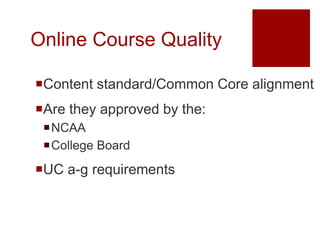
Online Course Quality

Content standard/Common Core alignment
Are they approved by the:
 NCAA
 College Board
UC a-g requirements
Self- Reviewing Resources

Just like you do now for high school
 textbooks.
CCSESA TTSC Survey

Online Credit Recovery Programs


August 2010
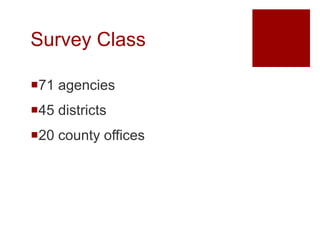
Survey Class

71 agencies
45 districts
20 county offices
Describe the Selection
Process

Vendor demonstrations
Committee review
Open bid to vendors
UC approved
Cost
Standards for Online
Courses

Southern Regional Education Board
iNACOL
Texas Virtual School Network
California Learning Resource Network
California Online Course
Reviews
• Search for standards
• CA stakeholder group selects and updates
  iNACOL’s standards
• Collaboration with TxVSN & iNACOL
• iNACOL national stakeholder group
• iNACOL published, October 2012
iNACOL/TxVSN/CLRN
Online Course Standards
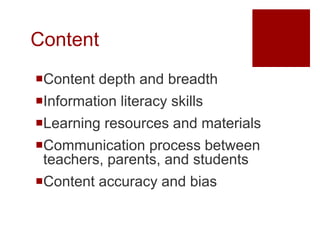
Content
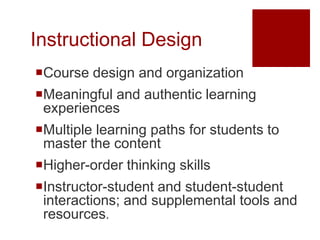
Instructional Design
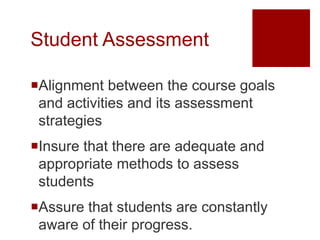
Student Assessment
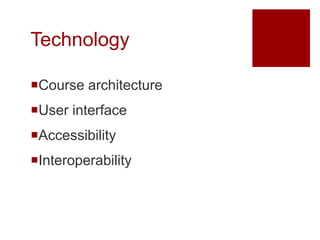
Technology
Course Evaluation and Support
Content
Content depth and breadth
Information literacy skills
Learning resources and materials
Communication process between
 teachers, parents, and students
Content accuracy and bias
Instructional Design
Course design and organization
Meaningful and authentic learning
 experiences
Multiple learning paths for students to
 master the content
Higher-order thinking skills
Instructor-student and student-student
 interactions; and supplemental tools and
 resources.
Student Assessment

Alignment between the course goals
 and activities and its assessment
 strategies
Insure that there are adequate and
 appropriate methods to assess
 students
Assure that students are constantly
 aware of their progress.
Technology

Course architecture
User interface
Accessibility
Interoperability
Course Evaluation and
Support

Evaluating course effectiveness
Accreditation
Teacher and Student preparation and
 support
CLRN Online Course
Reviews

HS ELA & Math courses
Common Core and the original
 recipe standards.
National standards for online
 courses
Expanding to HSS, Science, &
 VPA during spring, 2012
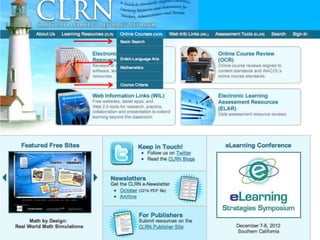
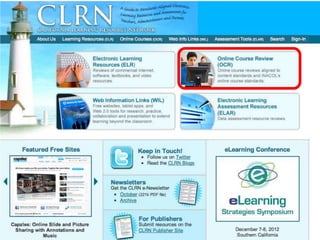
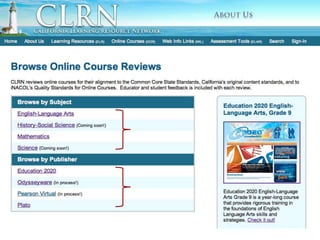
CLRN Home Page
CLRN Home 2
OCR Browse All
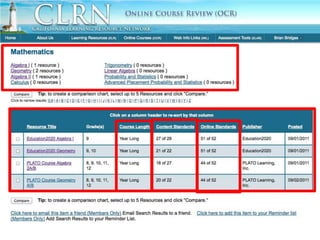
Math Browse
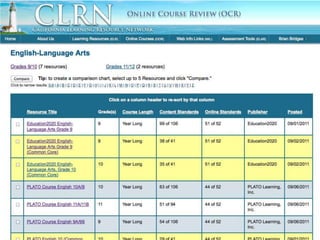
ELA Browse
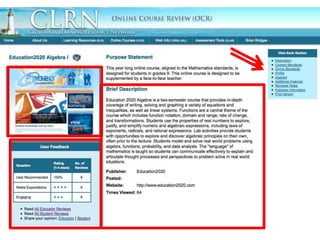
Individual Course Review
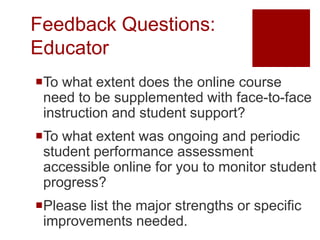
Feedback Questions:
Educator
To what extent does the online course
 need to be supplemented with face-to-face
 instruction and student support?
To what extent was ongoing and periodic
 student performance assessment
 accessible online for you to monitor student
 progress?
Please list the major strengths or specific
 improvements needed.
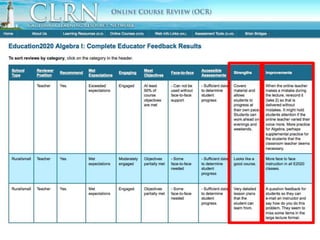
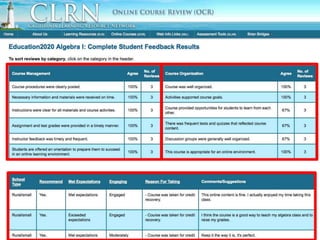
User Feedback: Complete Results
Feedback Questions:
           Student
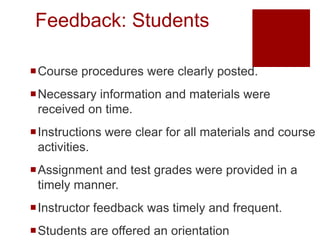
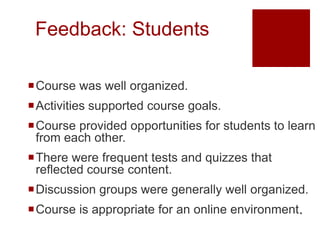
Feedback: Students

Course procedures were clearly posted.
Necessary information and materials were
 received on time.
Instructions were clear for all materials and course
 activities.
Assignment and test grades were provided in a
 timely manner.
Instructor feedback was timely and frequent.
Students are offered an orientation
Feedback: Students

Course was well organized.
Activities supported course goals.
Course provided opportunities for students to learn
 from each other.
There were frequent tests and quizzes that
 reflected course content.
Discussion groups were generally well organized.
Course is appropriate for an online environment.
User Feedback: Complete Results
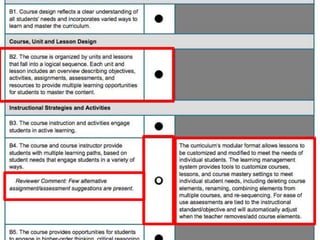
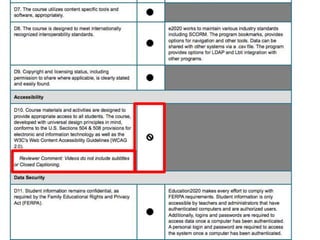
Individual
Course: Online
    Standards
       Display
Standards Display 2
Has CLRN
reviewed your
   courses?
December 7th and 8th, 2012

Hilton Orange County/Costa Mesa


       http://elearns.org
           @elearns

Online symposium

Editor's Notes

  • #10 How do you know whether an online course is high quality or if it addresses your state's academic content standards? Are the instructors for your students' courses certificated and have they received professional development to address the very different learning experiences observed online? Can you be assured that the NCAA will accept courses taken by your school's athletes to qualify them for college sports? Are Advanced Placement courses rigorous and meet the expectations of the College Board? Will the University of California accept student transcripts listing the online courses taken by your students?
  • #11 Just as your district keeps tabs on content and instruction for each course, the same expectations should exist for online courses. How can you know that a course addresses all the content standards for a subject so that your students are prepared for state-mandated testing? Do you and your staff pilot each course and participate in all the activities so that you can verify the content standards and guarantee that a course meets California's social content review?
  • #29 Graphic should be clickable.