



Online Payment Fraud Detection
with Azure Machine Learning
Stefano Tempesta | Microsoft MVP
VP of Engineering @ EF Education First
@stefanotempesta
Agenda
 Intro to Azure Machine Learning
 Payment Fraud Detection
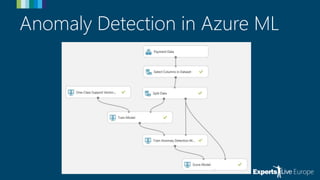
 Anomaly Detection in Azure ML
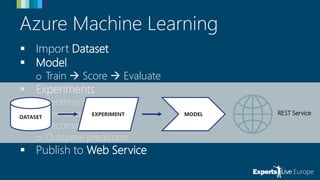
 Import Dataset
 Model
o Train  Score  Evaluate
 Experiments
o Sentiment analysis
o Demand estimation
o Recommendations
o Outcome prediction
 Publish to Web Service
Azure Machine Learning
MODEL REST Service
DATASET
EXPERIMENT
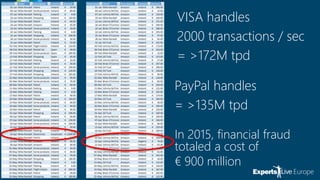
VISA handles
2000 transactions / sec
= >172M tpd
PayPal handles
= >135M tpd
In 2015, financial fraud
totaled a cost of
€ 900 million
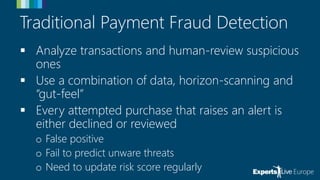
Traditional Payment Fraud Detection
 Analyze transactions and human-review suspicious
ones
 Use a combination of data, horizon-scanning and
“gut-feel”
 Every attempted purchase that raises an alert is
either declined or reviewed
o False positive
o Fail to predict unware threats
o Need to update risk score regularly
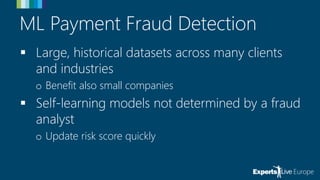
ML Payment Fraud Detection
 Large, historical datasets across many clients
and industries
o Benefit also small companies
 Self-learning models not determined by a fraud
analyst
o Update risk score quickly
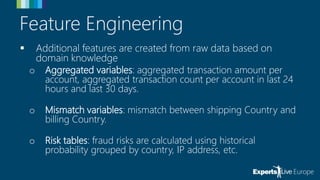
Feature Engineering
 Additional features are created from raw data based on
domain knowledge
o Aggregated variables: aggregated transaction amount per
account, aggregated transaction count per account in last 24
hours and last 30 days.
o Mismatch variables: mismatch between shipping Country and
billing Country.
o Risk tables: fraud risks are calculated using historical
probability grouped by country, IP address, etc.
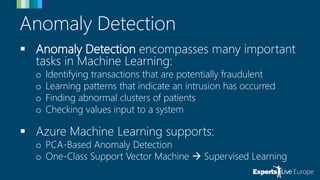
Anomaly Detection
 Anomaly Detection encompasses many important
tasks in Machine Learning:
o Identifying transactions that are potentially fraudulent
o Learning patterns that indicate an intrusion has occurred
o Finding abnormal clusters of patients
o Checking values input to a system
 Azure Machine Learning supports:
o PCA-Based Anomaly Detection
o One-Class Support Vector Machine  Supervised Learning
Anomaly Detection in Azure ML
Thank you Sponsors!
Vielen Dank!
/in/stefanotempesta
@stefanotempesta

Online Payment Fraud Detection with Azure Machine Learning

  • 1.
    Online Payment FraudDetection with Azure Machine Learning Stefano Tempesta | Microsoft MVP VP of Engineering @ EF Education First @stefanotempesta
  • 2.
    Agenda  Intro toAzure Machine Learning  Payment Fraud Detection  Anomaly Detection in Azure ML
  • 3.
     Import Dataset Model o Train  Score  Evaluate  Experiments o Sentiment analysis o Demand estimation o Recommendations o Outcome prediction  Publish to Web Service Azure Machine Learning MODEL REST Service DATASET EXPERIMENT
  • 5.
    VISA handles 2000 transactions/ sec = >172M tpd PayPal handles = >135M tpd In 2015, financial fraud totaled a cost of € 900 million
  • 6.
    Traditional Payment FraudDetection  Analyze transactions and human-review suspicious ones  Use a combination of data, horizon-scanning and “gut-feel”  Every attempted purchase that raises an alert is either declined or reviewed o False positive o Fail to predict unware threats o Need to update risk score regularly
  • 7.
    ML Payment FraudDetection  Large, historical datasets across many clients and industries o Benefit also small companies  Self-learning models not determined by a fraud analyst o Update risk score quickly
  • 8.
    Feature Engineering  Additionalfeatures are created from raw data based on domain knowledge o Aggregated variables: aggregated transaction amount per account, aggregated transaction count per account in last 24 hours and last 30 days. o Mismatch variables: mismatch between shipping Country and billing Country. o Risk tables: fraud risks are calculated using historical probability grouped by country, IP address, etc.
  • 9.
    Anomaly Detection  AnomalyDetection encompasses many important tasks in Machine Learning: o Identifying transactions that are potentially fraudulent o Learning patterns that indicate an intrusion has occurred o Finding abnormal clusters of patients o Checking values input to a system  Azure Machine Learning supports: o PCA-Based Anomaly Detection o One-Class Support Vector Machine  Supervised Learning
  • 10.
  • 11.
  • 12.

Editor's Notes

  • #7 The traditional approach to tackling this problem is to use rules or logic statements to query transactions and to direct suspicious transactions through to human review. While there is some variation, it is notable that over 90 percent of online fraud detection platforms still use this method, including platforms used by banks and payment gateways. While this is effective to some degree, in cases where there is a sufficient gap between an order being received and goods being shipped, it is also incredibly costly and far slower than alternatives. The “rules” in these platform use a combination of data, horizon-scanning and gut-feel. The system is backed with manual reviews to confirm experts’ decisions. If we take the recent reports of an abundance of Turkish credit cards available on the darknet due to the publicized data breach in Turkey: businesses recognize the increased risk of Turkish cards as fraudulent and can simply add a rule to review any transactions from Turkish credit cards Following this, every attempted purchase made by such a card raises an alert and is declined or reviewed. However, this raises two significant issues. The first is that such a generalized rule may turn away millions of legitimate customers, ultimately losing the business money and jeopardizing customer relations. Secondly, while this can deter future threats after such fraud has been found, it fails to identify or predict potential threats that businesses are not aware of. These rules tend to produce binary results, deeming transactions as either good or bad and failing to consider anything in between. And until the rules are manually reviewed, the system will continue to prevent such transactions as those from Turkish credit cards, even if the risk or threat is no longer prominent.
  • #8 Machine learning works on the basis of large, historical datasets that have been created using a collection of data across many clients and industries. Even companies that only process a relatively small number of transactions are able to take full advantage of the data sets for their vertical, allowing them to get accurate decisions on each transaction. This aggregation of data provides a highly accurate set of training data, and the access to this information allows businesses to choose the right model to optimize the levels of recall and precision that they provide: out of all the transactions the model predicts to be fraudulent (recall), what proportion of these actually are (precision)? Within the datasets, features are constructed. These are data points such as the age and value of the customer account, as well as the origin of the credit card. There can be hundreds of features and each contributes, to varying extents, towards the fraud probability. Note, the degree in which each feature contributes to the fraud score is not determined by a fraud analyst, but is generated by the artificial intelligence of the machine which is driven by the training set. So, in regards to the Turkish card fraud, if the use of Turkish cards to commit fraud is proven to be high, the fraud weighting of a transaction that uses a Turkish credit card will be equally so. However, if this were to diminish, the contribution level would parallel. Simply put, these models self-learn without explicit programming such as with manual review.
  • #9 To enhance the predictive power of the ML algorithms, an important step is feature engineering, where additional features are created from raw data based on domain knowledge. For example, if an account has not made a big purchase in the last month, then a thousand-dollar transaction all of a sudden could be suspicious. The new features generated in this scenario include: Aggregated variables, such as aggregated transaction amount per account, aggregated transaction count per account in last 24 hours and last 30 days; Mismatch variables: such as mismatch between shippingCountry and billingCountry, which potentially indicates abnormal behavior. Risk tables: fraud risks are calculated using historical probability grouped by country, state, IPAddress, etc
  • #10 This module is designed for use in scenarios where it is easy to obtain training data from one class, such as valid transactions, but difficult to obtain sufficient samples of the targeted anomalies. For example, if you need to detect fraudulent transaction, you might not have enough examples of fraud to train the mode, but have many examples of good transactions. However, if you use the PCA-Based Anomaly Detection module, you can train the model using the available features to determine what constitutes a "normal" class, and then use distance metrics to identify cases that represent anomalies. Principal Component Analysis, which is frequently abbreviated to PCA, is an established technique in machine learning that can be applied to feature selection and classification. PCA is frequently used in exploratory data analysis because it reveals the inner structure of the data and explains the variance in the data. PCA works by analyzing data that contains multiple variables, all possibly correlated, and determining some combination of values that best captures the differences in outcomes. It then outputs the combination of values into a new set of values called principal components. In the case of anomaly detection, for each new input, the anomaly detector first computes its projection on the eigenvectors, and then computes the normalized reconstruction error. This normalized error is the anomaly score. The higher the error, the more anomalous the instance is. You can use the One-Class Support Vector Model module to create an anomaly detection model. This module is particularly useful in scenarios where you have a lot of "normal" data and not many cases of the anomalies you are trying to detect. For example, if you need to detect fraudulent transactions, you might not have many examples of fraud that you could use to train a typically classification model, but you might have many examples of good transactions.