http://www.ecocycle.co.jp
Remediation of Soil and Groundwater Contaminants
Volatile Organic Compounds(VOCs)
Petroleum Hydrocarbons (BTEX, etc.)
Cyanide, Heavy Metals, Pesticides
Dioxins, PCBs, etc.
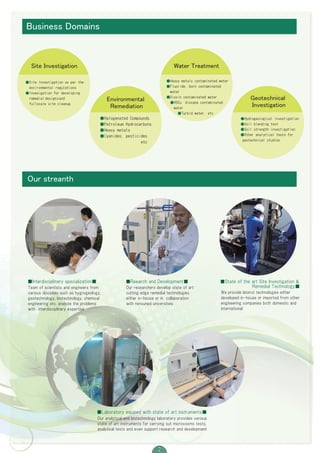
Business Domains
Our streanth
■Interdisciplinary specialization■
Team of scientists and engineers from
various disciplies such as hygrogeology,
geotechnology, biotechnology, chemical
engineering etc. analyze the problems
with interdisciplinary expertise
■Laboratory equiped with state of art instruments■
Our analytical and biotechnology laboratory provides various
state of art instruments for carrying out microcosms tests,
analytical tests and even support research and development
■Reearch and Development■
Our researchers develop state of art
cutting edge remedial technologies
either in-house or in collaboration
with renouned universities
■State of the art Site Investigation &
Remedial Technology■
We provide laterst technologies either
developed in-house or imported from other
engineering companies both domestic and
international
Site Investigation
Environmental
Remediation
Water Treatment
Geotechnical
Investigation
●Site Investigation as per the
environmental regulations
●Invesigation for developing
remedial designsand
fullscale site cleanup
●Halogenated Compounds
●Petroleum Hydrocarbons
●Heavy metals
●Cyanides, pesticides
etc
●Heavy metals contaminated water
●Fluoride, born contaminated
water
●Dioxin contaminated water
●VOCs, dioxane contaminated
water
●Turbid water, etc
●Hydrogeological Investigation
●Soil blending test
●Soil strength investigation
●Other analytical tests for
geotechnical studies
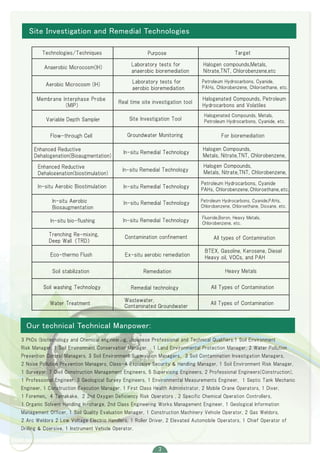
Site Investigation and Remedial Technologies
Technologies/Techniques Purpose Target
Halogenated Compounds, Petroleum
Hydrocarbons and Volatiles
Real time site investigation tool
Membrane Interphase Probe
(MIP)
Variable Depth Sampler Site Investigation Tool
Halogenated Compounds, Metals,
Petroleum Hydrocarbons, Cyanide, etc.
Flow-through Cell Groundwater Monitoring For bioremediation
Enhanced Reductive
Dehalogenation(biostimulation)
In-situ Aerobic Biostimulation
Petroleum Hydrocarbons, Cyanide
PAHs, Chlorobenzene, Chloroethane,etc.
In-situ Aerobic
Biosaugmentation
In-situ bio-flushing
Fluoride,Boron, Heavy Metals,
Chlorobenzene, etc.
Trenching Re-mixing,
Deep Wall(TRD)
Contamination confinement All types of Contamination
Anaerobic Microcosm(IH)
Aerobic Microcosm (IH)
Laboratory tests for
aerobic bioremediation
Laboratory tests for
anaerobic bioremediation
Halogen compounds,Metals,
Nitrate,TNT, Chlorobenzene,etc
Eco-thermo Flush
BTEX, Gasoline, Kerosene, Diesel
Heavy oil, VOCs, and PAH
Soil stabilization Remediation Heavy Metals
Soil washing Technology Remedial technology All Types of Contamination
Water Treatment
Wastewater,
Contaminated Groundwater
All Types of Contamination
Halogen Compounds,
Metals, Nitrate,TNT, Chlorobenzene,
Halogen Compounds,
Metals, Nitrate,TNT, Chlorobenzene,
In-situ Remedial Technology
Ex-situ aerobic remediation
Enhanced Reductive
Dehalogenation(Bioaugmentation)
Petroleum Hydrocarbons, Cyanide,
PAHs, Chlorobenzene, Chloroethane, etc.
Petroleum Hydrocarbons, Cyanide,PAHs,
Chlorobenzene, Chloroethane, Dioxane, etc.
3 PhDs (biotecnology and Chemical engineering, Japanese Professional and Technical Qualifiers:1 Soil Environment
Risk Manager, 1 Soil Environment Conservation Manager, 1 Land Environmental Protection Manager, 2 Water Pollution
Prevention Control Managers, 3 Soil Environment Supervision Managers、3 Soil Contamination Investigation Managers,
2 Noise Pollution Prevention Managers, Class-A Explosive Security & Handling Manager, 1 Soil Environment Risk Manager,
1 Surveyor, 7 Civil Construction Management Engineers, 5 Supervising Engineers, 2 Professional Engineers(Construction),
1 Professional Engineer, 3 Geological Survey Engineers, 1 Environmental Measurements Engineer, 1 Septic Tank Mechanic
Engineer, 1 Construction Execution Manager, 1 First Class Health Administrator, 2 Mobile Crane Operators, 1 Diver,
1 Foremen、4 Tamakake, 2 2nd Oxygen Deficiency Risk Operators , 2 Specific Chemical Operation Controllers,
1 Organic Solvent Handling In-charge, 2nd Class Engineering Works Management Engineer, 1 Geological Information
Management Officer, 1 Soil Quality Evaluation Manager, 1 Construction Machinery Vehicle Operator, 2 Gas Weldors,
2 Arc Weldors 2 Low Voltage Electric Handlers, 1 Roller Driver, 2 Elevated Automobile Operators, 1 Chief Operator of
Drilling & Coersive, 1 Instrument Vehicle Operator.
Our technical Technical Manpower:
DDeellhhii
MMuummbbaaii
HHyyddeerraabbaadd
中 台 印度
Taichung
Chunan
Taipei
Tainang
Kaoshun
Nanjin.
Shanghai
Chungking
Beijing
■Taiwan Office■
20-50-7 Nanjing East Road,
Zhongshan district
Taipei City, Taiwan
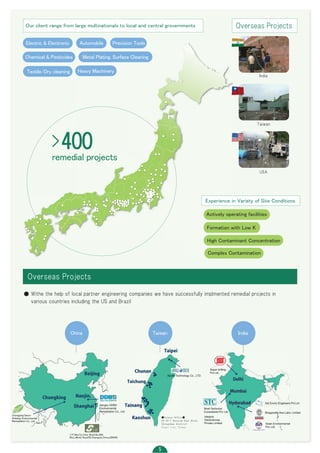
Our client range from large multinationals to local and central grovernments
Electric & Electronic Automobile Precision Tools
Chemical & Pesticides Metal Plating, Surface Cleaning
Textile/Dry cleaning Heavy Machinery
Overseas Projects
India
Taiwan
USA
>400
remedial projects
Overseas Projects
Experience in Variety of Site Conditions
Actively operating facilities
Formation with Low K
High Contaminant Concentration
Complex Contamination
● Withe the help of local partner engineering companies we have successfully implmented remedial projects in
various countries including the US and Brazil
China Taiwan India
11F,WanTai Inter Build,No.480,
WuLuMuQi Road(N),Shanghai,China,200040
List of biostimulants/bioaugmetation agents developed by our scientists:
K1
K2
K3 K4 K5
K6
K1 K2 K3 K4 K5 K6
3D ditribution of contamination (VOCs)
※EcoCycle is a recognized and certified Site Investigation agency by Ministry of Environment (Reg. No. 2014-3-17)
●EcoCycle believes detailed site investigation is very important for successful site remediation●
Why detailed site investigation is required?
Detailed site investigation gives in depth knowledge on contmination
and site hydrogeology. This helps develop the best remedial designs
and read total cost and time of remediation with great accuracy.
Site assessment and
investigation as per the
regulations
Obtaining additional data for
Remedial Design development
Site assessment Detail Investigation
Site investigation
What we know
What we know
What we know
●History of Hazardous Chemicals use, Storage,
leakage etc
●History of Land Usage, surrounding facilities
●Surface Soil sampling & soil Gas Analysis
●Investigation of ground water contamination
・Extent of Contamination
・Type of Contaminants,Concentration,etc.
Hydrogeology
・Possibility of Site Contamination
・Area Mapping for Site Investigation
●Assess contamination & geological features
【Contamination distribution】
        ・Contamination Source and pathway
       ・Contamination distribution with Depth
Vedose zone conditions
       l
   【Hydrogeology】
       ・Presence of clay lense and distribution of Organic Matter
       ・Soil Permeability, tightness, etc.
【Validation of influencing parameters for Remedial Measures】 
       ・ORP、pH Effect of Co-contaminant
       ・Buried Objects, etc.
・Appropriate Remedial Options
・Estimation of Remedial Cost
・Other Data Required for
 Remedial Plan and Execution
Important
Real time site investigation tool : Membrane interphase probe
In-situ Pilot TestLaboratory Test
Feasibility of Remedial
Option is Assessed
in the Laboratory
In-situ Pilot Test for
Obtainining Testing
the Remediaal Option
Full Scale Remediation
Remedial Design/
Total cleanup plan
Whatweknow
Whatweknow
●Various remedial options are tested
in the laboratory using contaminated
soil and groundwater samples
・Remedial options
・Extend and rate of
degradation
・Chemical and biological
factors affecting
remediation Possible factors
affecting remediation etc.
Biostimulant
Sorbed Mass
Remedial
Implementation
Remediation
Guarantee
(Cost Cap)
Achieve the Objectives
within the Client Budget
Special injection techniques are selected based on
the site hydrogeology and contamination circumstances
to propage nutrients evevly thouroghoughout target
areas for effective bioremediation
Special Injection Technique
Halogenated Compounds
Remedial Measures
Petroleum hydrocarbons,
Cyanide Remedial Measures
Heavy Metal Remedial
Measures
8~9 Pages
10~11 Pages
12~13 Pages
●In-Situ/On site pilot test is carried
out to find out the effectiveness of
selected remedial measures and
obtaining additional site data for
full-scale remedial design
●Full scale remedial design and plan is
develped based on the site investigation
data and pilot test results.. The plan
gives detaild remedial design,
schedule, goal, cost and time for
total cleanup
・Effectiveness of selected t
echnology
・Cost and time for total
cleanup
・Possible trouble shooting
expected during full scale
cleanup
The depth
(m)
Harmless by-products
Injection
Bioremediation of Chlorinated compounds
Bioremediation(Biostimulation)
Bioremediation is an environmental friendly remedial technology where indigenous microbes are
stimulated by injecting propriatory nutrients such as EDC/EDC-E. These microbes degrade the toxic
compounds into harmless water and carbon dioxide. The biostimulants are made of food-grade ingredients
and environmentally safe as they are completely biodegradable.
Degradation Pathway
Remedial Execution Image
Nutrients Patented Products of EcoCycle
Tetrachloroethylene
PCE
Trichloroethylene
TCE
Dichloroethylene
DCE
Vinyl chloride 
VC
Ethylene
Groundwater flow
Pollution
Nutritional
Source
Purified Groundwater
Active Microbial
Zone for Contaminant
Degradation
Carbon dioxide,
Water
Short Remedial span
(3-12 months)
Degrades High Contaminant
Concentration
Environmentally friendly
Low-cost
Applied with Simple
Equipment
Merits
EDC is soluble in water and it propagates easily along the target volume upon injection into the subsurface.
In addition, nutrients are easily consumed by microbes resulting quick formation of anaerobic conditions in
subsurface and stimulating effective microorganisms.
Upon injection of EDC, the sorbed mass of DNAPL is dissolved into the groundwater and thereby available
for biodegradation. A fine combination of nutrients also stimulates a wide range of microbial
consortium capable of degrading contamination of high concentration.
EDC is safe as it is made from food materials.It is biodegradable and therefore will not remain in the
subsurface after total cleanup of the site
The cost of bioremediation is <1/3 of traditional methods such as dig and dispose
Remedial measure is possible under the factories in operation or under the buildings.
ElutionElution
Bioflushing
Chemical Oxidation
Other Remedial Techniques
VOCs are degraded by an application of Oxidant(Per sulfates, peroxides, etc.). Oxidation is a preferred medhod to
treat high concentration contaminants with short time remedial goal.
Bioflushing is an appropriate quick remedial measure targeting high concentrated/complex contaminants
adsorbed to subsurface soil. Injection of bioflushing solvents dissolves the sorbed mass which can be pumped up
and treated on site. The remaining contamination would be treated with bioremediation until the concentration
drops below environmental standard.
Target Contaminants
BioFlush-X
For the sites
that need quicker
remedial measures
Appropriate Site
Appropriate Site
Appropriate Site
Appropriate Site
・High Contaminant
Concentration
     
・Good permeability, short time remedial target
・Less effective in silty and organic
formations
・Complex contaminants such as VOCs, Benzene
・Contamination in unsaturated zone
Volatile compounds in the vadose zone are extracted
by creating vacuum and trapped in the activated
carbon filters.
・Vadose zone contamination
・To meet short remedial time requirements
・Applicable for running facilities such as factories/buildings
・For Vedose zone
Lime Mixing Process
Soil Vapor Extraction
Contaminated soil is mixed with lime to raise soil temperature and evoparize the VOCs. The fumes are
trapped and treated with activated carbon filters.
Permeable Layer
Groundwater Flow
Aquitard
Bioflush-X
Injection Unit
Sorbed
Mass
Pump and treat
Unit
Sorbed Contaminants
Soil
Magnification
Image of Soil Cross-section
Aquifer
Unsaturated Layer
Image of Gas recovery Gas Liquid
Separation
Activated Carbon
Treatment Column
Blower
Halogenated organic compounds such as Tetrachloroethylene, Trichloroethylene, Trichloroethane,
Carbontetrachloride, Dichloroethylene, Dichloroethane, Dichloromethane, Vinyl Chloride, TNT, Chlorobenzene,
nitrate and nitrites, perchlorates, and metals, etc.
Bioremediation of Petroleum Hydrocarbons and Cyanides
Bioremediation(Biostimulation)
Bioremediation(Bioaugmentation)
GreenClean is a Nutrient Source for Aerobic Microorganisms
Suitable Site
Green clean is dissolved in water rich with dissolved oxygen and injected
subsurface to stimulate native aerobic microbial consortium capable of degrading
the contaminants
・For low concetration of contaminants
・Over burden saturated zone
・Cheap remedial alternative to match the low budget
・Effective option for remediation of contamination below active facilities
and buildings.
・Product is registered in US EPA National Emergency Response Plan Product Inventory
・Registered in Ministry of Land, Infrastructure and Transport , Japan
■Case studies■ Number of Sites:Applied >100 sites in Japan
Contaminants:BTEX, Gasoline, Kerosene, Diesel, Heavy Oil,
Lubricating Oil, etc.
When indigenous microbes are not capable of degrading the petroleum hydrocabon contamination
effectively, effective microobial consortium is injected into the subsurface to stimulate degradation.
Gasoline Stand
Saturated Layer
Acquitard
Groundwater FlowGroundwater Flow
HAR Nutrients
Injection Tank
Contamination
Microbial ActivationMicrobial Consortium
Dissolved
Oxygen Injection unit
Dissolved Oxygen
Alternative methods of
creating aerobic conditions:
air sparking, injecting oxygen
releasing agents, etc.
Benzene
Cyanide Compounds
Mono& Dichlorinated
Compounds
Dioxane
Harmless Degradation
by-products
OleoBact
Water
Water
Target Contaminants
Petroleum Hydrocarbons, Benzene, Toluene, Xylene, Ethyl benzene, Gasoline,
Kerosene, Diesel (Light Oils), Heavy Oils, and Chlorinated Aromatics, Vinyl Chloride, Dioxane, Poly Aromatic
Hydrocarbons, and Cyanide Compounds.
Oxidants (Hydrogen Peroxide or Sodium Persulfate, etc.) are mixed or injected into the overburden soil/groundwater
to degrade target contaminants.
Soil contaminated with petroleum hydrocarbon is mixed with GeenClean-X and bio-pile is created. Areobic condition is created by
sucking air into the pile. The process stimulates native aerobic microflora and the temperature of the pile rises steadily.
Once the temperature corsses 50 degrees centrigrade, thermophiles kick into action to degrade target compounds.
Appropriate Site
・BTEX (benzene, etc.),Fuel Oils(Gasoline, Kerosene,
 Diesel, Heavy oil), PAHs, VOCs, etc. contaminants
・Contamination found in unsaturated zone and clay/silty soil
・Higher contaminant concentrations
・Site accessible for excavation and on site treatment
Appropriate Site
・Conatminants that are difficult to insoluble in water/difficult to degrade microbiologically.
・Effective for Ferrocyanide/Ferricyanides, Dioxins, PCBs etc.
Appropriate Site
・Light Oils
・Low to moderate contaminant concentration
・Both saturated and unsaturated zones
・Mixture of contaminants, VOCs and Oils
・Short time remedial targets
・Where silt/clay, organic matter is low
Flushing Agent
Contaminated Soil
Source of nutrients, air
EcoThermo Pile
Pump and treat unit
Groundwater Flow Direction
Aqcuitard
Thermophilic bacteria
degrades difficult to
degrade contaminants by
normal bacteria
VOC contaminants, air
Bioflushing agent
injection unit
Suitable for
remediation at
gasoline stands,
etc.
Site Remdiation by Chemical Oxidation
EcoThermo Flush
Cyanides (ferri and ferro cyanides) are produced during coal gasification. They are almost insoluble in water and
persistent contaminants. Bioflushing is applied to remediate such sites. In this process metal-cyanide dissolving
substances are injected subsurface to mobilize the sorbed/insoluble mass followed by pumping and treating the
dissoved phase. At subsequent phase bioremediation is used to degrade trace remaining contamination.
Bioflushing
●
Dissolved mass
 Required NanoLite Earth is designed and applied
depend on the site conditions and type of metals
and concentration of metal contaminants.
Heavy Metal Stabilizing Agent NanoLite Earth
NanoLite Earth is a material that adsorbs ionized and soluble heavy metals in soil making it insoluble in soil-water system
preventing the elution of heavy metals shaping into the groundwater. It is applicable for all types of metals with high
adsorption rates. This material is made from natural minerals. Unlike mixing cement based stabilizing agent, NanoLite does
not impact natural soil properties.
Heavy Metal Contamination
Soil Heavy Metal Stabilization Technology
●Adsorption by Layered Double Hydroxide●Adsorption by Clay Minerals
Hydroxide ions in clay
minerals adsorb most of the
heavy metals stabilizing soil.
●Adsorption by Natural Minerals
Heavy metals such as Lead,
Cadmium, etc. are adsorbed to
negative ions of natural
minerals.
Trench Barrier Application
Barrier
Impermeable Layer
Heavy metals are adsorbed to double
hydroxide layers by complexation
mechanism.
Oxygen
Stem
Leaf
Brown Rice
pH AdjustBefore Standard*0.5 Standard*1.0
Brown Rice, Leaf, Stem Cd content
Comparison of Before and After Treatment
Example of Remedial On site Stabilization Application
Application of NanoLite to the paddy
field contaminated with Cadmium in Japan
1 Month After Rice Planting
・NanoLite Earth Treatment → 
Fast Improvement
            Cd Control Effect
・Only pH Agents→ Inhibition Effect
was Observed
Paddy Field Rejuvenation Study(USA) Change in Total Cadmium
Purified
Groundwater
Groundwater
contaminated
with heavy metals
Containment enclosure or wall is made in order to shut-off or arrest contaminated groundwater flow to the surrounding areas.
Source:Soil Pollution Prevention Guidelines for SMEs(Environment Bureau, Tokyo Metropolitan Govt.)
Merits of TRD Construction
●Effective method of containing contaminated groundwater. Also applied in waste disposal facilities.
●Low-cost in-situ groundwater arrest wall is constructed by using on site excavated soil, water and other construction materials.
●Possible to construct excellent and continuous impermeable wall even in high N formations.
●Can be implemented when:N values <100, gravel size <100mm, application depth of up to 60m and wall thickness of 450-850mm.
Target Contaminants
Hexavalent Chromium, Lead, Cadmium, Arsenic, Selenium, PAHs, etc.
Containment
Soil Washing
Contaminants
Soil washing with solvents
Small Particles
Soil Particle
Soil Particle
Soil Particle
Soil Particle
Heavy Metal Soil Washing Equipment
Since fine particles have larger surface area,
Heavy metals are adsorbed to fine particles.
By selectively screening fine particles and subsequent
washing the contamination can be removed.
Depending upon the type of heavy metal and
concentration, soil adsorption condition the
removal rate may varie.
Water wash=Particle
Size Classification
Contaminants are
adsorbed to soil
fine particles
Soil Adsorbed Contaminants
Pavement
Monitoring Well Monitoring well
Impermeable wall
Concrete (>10cm)
Asphalt(>>3cm)
Arrest rain water
Check for any
water leakage
Check for groundwater
contamination if any
Impermeable Layer
Arrest groundwater
flow
Soil that is
contaminated
Groundwater Flow Direction
Groundwater
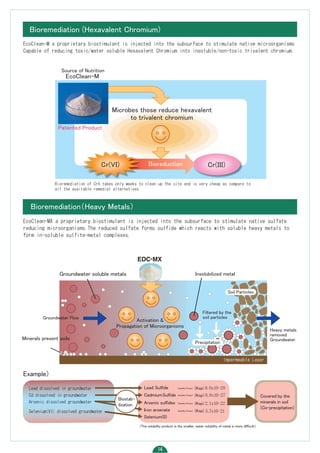
Bioremediation (Hexavalent Chromium)
Bioremediation(Heavy Metals)
EcoClean-M a proprietary biostimulant is injected into the subsurface to stimulate native microorganisms
Capable of reducing toxic/water soluble Hexavalent Chromium into insoluble/non-toxic trivalent chromium.
EcoClean-MX a proprietary biostimulant is injected into the subsurface to stimulate native sulfate
reducing microorganisms.The reduced sulfate forms sulfide which reacts with soluble heavy metals to
form in-soluble sulfite-metal complexes.
Source of Nutrition
EcoClean-M
Patented Product
Bioreduction
Microbes those reduce hexavalent
to trivalent chromium
Cr(VI) Cr(III)
Solubility Product
Solubility Product
Solubility Product
Solubility Product
(The solubility product is the smaller, water solubility of metal is more difficult)
Example)
Biostab-
ilization
Selenium(VI) dissolved groundwater
Arsenic dissolved groundwater
Cd dissolved in groundwater
Lead dissolved in groundwater
Selenium(0)
Arsenic sulfides
Iron arsenate
CadmiumSulfide
Lead Sulfide
Covered by the
minerals in soil
(Co-precipitation)
Activation &
Propagation of Microorganisms
Minerals present soils
Impermeable Layer
Filtered by the
soil particles
Heavy metals
removed
Groundwater
Insolubilized metal
Groundwater Flow
Groundwater soluble metals
Bioremediation of Cr6 takes only weeks to clean up the site and is very cheap as compare to
all the available remedial alternatives
(Ksp)
(Ksp)
(Ksp)
(Ksp)
Soil Particles
Precipitation
Water Treatment Technology
EcoCycle works on wastewater and groundwater treatment of various hazardous substances and supports the
client based on their variety of water treatment needs.
Some of the Water Treatment Examples
Flow of Approach
Factory Wastewater
Treatment
Demolition of
the Incinerators Sludge Dredging
Soil Contamination
Countermeasures
We undertake installing, operation
and maintenance of water treatment
plants in the factories
Equipment for concentration of DXNs
wastewater from demolition of
Incinerator plants
Equipment for sludge classification of
dredging and evaporation and water
treatment
Equipment for Pumping &Treatment
of VOCs, Heavy Metals, Pesticides,
and Oil containing wastewater,
nutrients injection and for soil washing
We collect the wastewater/sludge from the client and give the best solution upon testing in our laboratory.
We design water treatment plant of coagulative precipitation, pressure filtration, adsorption,
evaporation, sludge removal, etc. depend on the wastewater/sludge characteristics
Consultation on
Client Issues
Sample Collection
and Laboratory
Testing
Process Flow
Design
Plant Supply
and Operation
We procure the necessary equipment for the water treatment plan with our partner companies
We submit the water treatment plant operation manual and trouble shooting guide upon plant
installation and demonstration at the client site.
■Tokyo Head Office■ ■Laboratory■
〒103-0007  Nihonbashi Hamacho Building 2-28-1 Nihonbashi Hamacho, Chuo-ku, Tokyo  TEL:03-6661-1875
       In-charge:Tsujie   TEL:080-8691-6034  E-mail:tsujie@ecocycle.co.jp
       International:Iso   TEL:090-5688-2502  E-mail:iso@ecocycle.co.jp
■West Japan Office■
〒530-0002  1402, Wakasugi Osaka Station front building , 2-3-13 Sonezakishinchi, Osaka City, Osaka-fu
TEL:06-6342-0441    
       In-charge:Fujisawa TEL:090-5687-2043  E-mail:fujisawa@ecocycle.co.jp
        
20170626
EcoCycle Corporation

One stopsolution

  • 1.
    http://www.ecocycle.co.jp Remediation of Soiland Groundwater Contaminants Volatile Organic Compounds(VOCs) Petroleum Hydrocarbons (BTEX, etc.) Cyanide, Heavy Metals, Pesticides Dioxins, PCBs, etc.
  • 2.
    Business Domains Our streanth ■Interdisciplinaryspecialization■ Team of scientists and engineers from various disciplies such as hygrogeology, geotechnology, biotechnology, chemical engineering etc. analyze the problems with interdisciplinary expertise ■Laboratory equiped with state of art instruments■ Our analytical and biotechnology laboratory provides various state of art instruments for carrying out microcosms tests, analytical tests and even support research and development ■Reearch and Development■ Our researchers develop state of art cutting edge remedial technologies either in-house or in collaboration with renouned universities ■State of the art Site Investigation & Remedial Technology■ We provide laterst technologies either developed in-house or imported from other engineering companies both domestic and international Site Investigation Environmental Remediation Water Treatment Geotechnical Investigation ●Site Investigation as per the environmental regulations ●Invesigation for developing remedial designsand fullscale site cleanup ●Halogenated Compounds ●Petroleum Hydrocarbons ●Heavy metals ●Cyanides, pesticides etc ●Heavy metals contaminated water ●Fluoride, born contaminated water ●Dioxin contaminated water ●VOCs, dioxane contaminated water ●Turbid water, etc ●Hydrogeological Investigation ●Soil blending test ●Soil strength investigation ●Other analytical tests for geotechnical studies
  • 3.
    Site Investigation andRemedial Technologies Technologies/Techniques Purpose Target Halogenated Compounds, Petroleum Hydrocarbons and Volatiles Real time site investigation tool Membrane Interphase Probe (MIP) Variable Depth Sampler Site Investigation Tool Halogenated Compounds, Metals, Petroleum Hydrocarbons, Cyanide, etc. Flow-through Cell Groundwater Monitoring For bioremediation Enhanced Reductive Dehalogenation(biostimulation) In-situ Aerobic Biostimulation Petroleum Hydrocarbons, Cyanide PAHs, Chlorobenzene, Chloroethane,etc. In-situ Aerobic Biosaugmentation In-situ bio-flushing Fluoride,Boron, Heavy Metals, Chlorobenzene, etc. Trenching Re-mixing, Deep Wall(TRD) Contamination confinement All types of Contamination Anaerobic Microcosm(IH) Aerobic Microcosm (IH) Laboratory tests for aerobic bioremediation Laboratory tests for anaerobic bioremediation Halogen compounds,Metals, Nitrate,TNT, Chlorobenzene,etc Eco-thermo Flush BTEX, Gasoline, Kerosene, Diesel Heavy oil, VOCs, and PAH Soil stabilization Remediation Heavy Metals Soil washing Technology Remedial technology All Types of Contamination Water Treatment Wastewater, Contaminated Groundwater All Types of Contamination Halogen Compounds, Metals, Nitrate,TNT, Chlorobenzene, Halogen Compounds, Metals, Nitrate,TNT, Chlorobenzene, In-situ Remedial Technology In-situ Remedial Technology In-situ Remedial Technology In-situ Remedial Technology In-situ Remedial Technology Ex-situ aerobic remediation Enhanced Reductive Dehalogenation(Bioaugmentation) Petroleum Hydrocarbons, Cyanide, PAHs, Chlorobenzene, Chloroethane, etc. Petroleum Hydrocarbons, Cyanide,PAHs, Chlorobenzene, Chloroethane, Dioxane, etc. 3 PhDs (biotecnology and Chemical engineering, Japanese Professional and Technical Qualifiers:1 Soil Environment Risk Manager, 1 Soil Environment Conservation Manager, 1 Land Environmental Protection Manager, 2 Water Pollution Prevention Control Managers, 3 Soil Environment Supervision Managers、3 Soil Contamination Investigation Managers, 2 Noise Pollution Prevention Managers, Class-A Explosive Security & Handling Manager, 1 Soil Environment Risk Manager, 1 Surveyor, 7 Civil Construction Management Engineers, 5 Supervising Engineers, 2 Professional Engineers(Construction), 1 Professional Engineer, 3 Geological Survey Engineers, 1 Environmental Measurements Engineer, 1 Septic Tank Mechanic Engineer, 1 Construction Execution Manager, 1 First Class Health Administrator, 2 Mobile Crane Operators, 1 Diver, 1 Foremen、4 Tamakake, 2 2nd Oxygen Deficiency Risk Operators , 2 Specific Chemical Operation Controllers, 1 Organic Solvent Handling In-charge, 2nd Class Engineering Works Management Engineer, 1 Geological Information Management Officer, 1 Soil Quality Evaluation Manager, 1 Construction Machinery Vehicle Operator, 2 Gas Weldors, 2 Arc Weldors 2 Low Voltage Electric Handlers, 1 Roller Driver, 2 Elevated Automobile Operators, 1 Chief Operator of Drilling & Coersive, 1 Instrument Vehicle Operator. Our technical Technical Manpower:
  • 4.
    DDeellhhii MMuummbbaaii HHyyddeerraabbaadd 中 台 印度 Taichung Chunan Taipei Tainang Kaoshun Nanjin. Shanghai Chungking Beijing ■TaiwanOffice■ 20-50-7 Nanjing East Road, Zhongshan district Taipei City, Taiwan Our client range from large multinationals to local and central grovernments Electric & Electronic Automobile Precision Tools Chemical & Pesticides Metal Plating, Surface Cleaning Textile/Dry cleaning Heavy Machinery Overseas Projects India Taiwan USA >400 remedial projects Overseas Projects Experience in Variety of Site Conditions Actively operating facilities Formation with Low K High Contaminant Concentration Complex Contamination ● Withe the help of local partner engineering companies we have successfully implmented remedial projects in various countries including the US and Brazil China Taiwan India 11F,WanTai Inter Build,No.480, WuLuMuQi Road(N),Shanghai,China,200040
  • 5.
    List of biostimulants/bioaugmetationagents developed by our scientists:
  • 6.
    K1 K2 K3 K4 K5 K6 K1K2 K3 K4 K5 K6 3D ditribution of contamination (VOCs) ※EcoCycle is a recognized and certified Site Investigation agency by Ministry of Environment (Reg. No. 2014-3-17) ●EcoCycle believes detailed site investigation is very important for successful site remediation● Why detailed site investigation is required? Detailed site investigation gives in depth knowledge on contmination and site hydrogeology. This helps develop the best remedial designs and read total cost and time of remediation with great accuracy. Site assessment and investigation as per the regulations Obtaining additional data for Remedial Design development Site assessment Detail Investigation Site investigation What we know What we know What we know ●History of Hazardous Chemicals use, Storage, leakage etc ●History of Land Usage, surrounding facilities ●Surface Soil sampling & soil Gas Analysis ●Investigation of ground water contamination ・Extent of Contamination ・Type of Contaminants,Concentration,etc. Hydrogeology ・Possibility of Site Contamination ・Area Mapping for Site Investigation ●Assess contamination & geological features 【Contamination distribution】         ・Contamination Source and pathway        ・Contamination distribution with Depth Vedose zone conditions        l    【Hydrogeology】        ・Presence of clay lense and distribution of Organic Matter        ・Soil Permeability, tightness, etc. 【Validation of influencing parameters for Remedial Measures】         ・ORP、pH Effect of Co-contaminant        ・Buried Objects, etc. ・Appropriate Remedial Options ・Estimation of Remedial Cost ・Other Data Required for  Remedial Plan and Execution Important Real time site investigation tool : Membrane interphase probe
  • 7.
    In-situ Pilot TestLaboratoryTest Feasibility of Remedial Option is Assessed in the Laboratory In-situ Pilot Test for Obtainining Testing the Remediaal Option Full Scale Remediation Remedial Design/ Total cleanup plan Whatweknow Whatweknow ●Various remedial options are tested in the laboratory using contaminated soil and groundwater samples ・Remedial options ・Extend and rate of degradation ・Chemical and biological factors affecting remediation Possible factors affecting remediation etc. Biostimulant Sorbed Mass Remedial Implementation Remediation Guarantee (Cost Cap) Achieve the Objectives within the Client Budget Special injection techniques are selected based on the site hydrogeology and contamination circumstances to propage nutrients evevly thouroghoughout target areas for effective bioremediation Special Injection Technique Halogenated Compounds Remedial Measures Petroleum hydrocarbons, Cyanide Remedial Measures Heavy Metal Remedial Measures 8~9 Pages 10~11 Pages 12~13 Pages ●In-Situ/On site pilot test is carried out to find out the effectiveness of selected remedial measures and obtaining additional site data for full-scale remedial design ●Full scale remedial design and plan is develped based on the site investigation data and pilot test results.. The plan gives detaild remedial design, schedule, goal, cost and time for total cleanup ・Effectiveness of selected t echnology ・Cost and time for total cleanup ・Possible trouble shooting expected during full scale cleanup The depth (m)
  • 8.
    Harmless by-products Injection Bioremediation ofChlorinated compounds Bioremediation(Biostimulation) Bioremediation is an environmental friendly remedial technology where indigenous microbes are stimulated by injecting propriatory nutrients such as EDC/EDC-E. These microbes degrade the toxic compounds into harmless water and carbon dioxide. The biostimulants are made of food-grade ingredients and environmentally safe as they are completely biodegradable. Degradation Pathway Remedial Execution Image Nutrients Patented Products of EcoCycle Tetrachloroethylene PCE Trichloroethylene TCE Dichloroethylene DCE Vinyl chloride  VC Ethylene Groundwater flow Pollution Nutritional Source Purified Groundwater Active Microbial Zone for Contaminant Degradation Carbon dioxide, Water Short Remedial span (3-12 months) Degrades High Contaminant Concentration Environmentally friendly Low-cost Applied with Simple Equipment Merits EDC is soluble in water and it propagates easily along the target volume upon injection into the subsurface. In addition, nutrients are easily consumed by microbes resulting quick formation of anaerobic conditions in subsurface and stimulating effective microorganisms. Upon injection of EDC, the sorbed mass of DNAPL is dissolved into the groundwater and thereby available for biodegradation. A fine combination of nutrients also stimulates a wide range of microbial consortium capable of degrading contamination of high concentration. EDC is safe as it is made from food materials.It is biodegradable and therefore will not remain in the subsurface after total cleanup of the site The cost of bioremediation is <1/3 of traditional methods such as dig and dispose Remedial measure is possible under the factories in operation or under the buildings.
  • 9.
    ElutionElution Bioflushing Chemical Oxidation Other RemedialTechniques VOCs are degraded by an application of Oxidant(Per sulfates, peroxides, etc.). Oxidation is a preferred medhod to treat high concentration contaminants with short time remedial goal. Bioflushing is an appropriate quick remedial measure targeting high concentrated/complex contaminants adsorbed to subsurface soil. Injection of bioflushing solvents dissolves the sorbed mass which can be pumped up and treated on site. The remaining contamination would be treated with bioremediation until the concentration drops below environmental standard. Target Contaminants BioFlush-X For the sites that need quicker remedial measures Appropriate Site Appropriate Site Appropriate Site Appropriate Site ・High Contaminant Concentration       ・Good permeability, short time remedial target ・Less effective in silty and organic formations ・Complex contaminants such as VOCs, Benzene ・Contamination in unsaturated zone Volatile compounds in the vadose zone are extracted by creating vacuum and trapped in the activated carbon filters. ・Vadose zone contamination ・To meet short remedial time requirements ・Applicable for running facilities such as factories/buildings ・For Vedose zone Lime Mixing Process Soil Vapor Extraction Contaminated soil is mixed with lime to raise soil temperature and evoparize the VOCs. The fumes are trapped and treated with activated carbon filters. Permeable Layer Groundwater Flow Aquitard Bioflush-X Injection Unit Sorbed Mass Pump and treat Unit Sorbed Contaminants Soil Magnification Image of Soil Cross-section Aquifer Unsaturated Layer Image of Gas recovery Gas Liquid Separation Activated Carbon Treatment Column Blower Halogenated organic compounds such as Tetrachloroethylene, Trichloroethylene, Trichloroethane, Carbontetrachloride, Dichloroethylene, Dichloroethane, Dichloromethane, Vinyl Chloride, TNT, Chlorobenzene, nitrate and nitrites, perchlorates, and metals, etc.
  • 10.
    Bioremediation of PetroleumHydrocarbons and Cyanides Bioremediation(Biostimulation) Bioremediation(Bioaugmentation) GreenClean is a Nutrient Source for Aerobic Microorganisms Suitable Site Green clean is dissolved in water rich with dissolved oxygen and injected subsurface to stimulate native aerobic microbial consortium capable of degrading the contaminants ・For low concetration of contaminants ・Over burden saturated zone ・Cheap remedial alternative to match the low budget ・Effective option for remediation of contamination below active facilities and buildings. ・Product is registered in US EPA National Emergency Response Plan Product Inventory ・Registered in Ministry of Land, Infrastructure and Transport , Japan ■Case studies■ Number of Sites:Applied >100 sites in Japan Contaminants:BTEX, Gasoline, Kerosene, Diesel, Heavy Oil, Lubricating Oil, etc. When indigenous microbes are not capable of degrading the petroleum hydrocabon contamination effectively, effective microobial consortium is injected into the subsurface to stimulate degradation. Gasoline Stand Saturated Layer Acquitard Groundwater FlowGroundwater Flow HAR Nutrients Injection Tank Contamination Microbial ActivationMicrobial Consortium Dissolved Oxygen Injection unit Dissolved Oxygen Alternative methods of creating aerobic conditions: air sparking, injecting oxygen releasing agents, etc. Benzene Cyanide Compounds Mono& Dichlorinated Compounds Dioxane Harmless Degradation by-products OleoBact Water Water
  • 11.
    Target Contaminants Petroleum Hydrocarbons,Benzene, Toluene, Xylene, Ethyl benzene, Gasoline, Kerosene, Diesel (Light Oils), Heavy Oils, and Chlorinated Aromatics, Vinyl Chloride, Dioxane, Poly Aromatic Hydrocarbons, and Cyanide Compounds. Oxidants (Hydrogen Peroxide or Sodium Persulfate, etc.) are mixed or injected into the overburden soil/groundwater to degrade target contaminants. Soil contaminated with petroleum hydrocarbon is mixed with GeenClean-X and bio-pile is created. Areobic condition is created by sucking air into the pile. The process stimulates native aerobic microflora and the temperature of the pile rises steadily. Once the temperature corsses 50 degrees centrigrade, thermophiles kick into action to degrade target compounds. Appropriate Site ・BTEX (benzene, etc.),Fuel Oils(Gasoline, Kerosene,  Diesel, Heavy oil), PAHs, VOCs, etc. contaminants ・Contamination found in unsaturated zone and clay/silty soil ・Higher contaminant concentrations ・Site accessible for excavation and on site treatment Appropriate Site ・Conatminants that are difficult to insoluble in water/difficult to degrade microbiologically. ・Effective for Ferrocyanide/Ferricyanides, Dioxins, PCBs etc. Appropriate Site ・Light Oils ・Low to moderate contaminant concentration ・Both saturated and unsaturated zones ・Mixture of contaminants, VOCs and Oils ・Short time remedial targets ・Where silt/clay, organic matter is low Flushing Agent Contaminated Soil Source of nutrients, air EcoThermo Pile Pump and treat unit Groundwater Flow Direction Aqcuitard Thermophilic bacteria degrades difficult to degrade contaminants by normal bacteria VOC contaminants, air Bioflushing agent injection unit Suitable for remediation at gasoline stands, etc. Site Remdiation by Chemical Oxidation EcoThermo Flush Cyanides (ferri and ferro cyanides) are produced during coal gasification. They are almost insoluble in water and persistent contaminants. Bioflushing is applied to remediate such sites. In this process metal-cyanide dissolving substances are injected subsurface to mobilize the sorbed/insoluble mass followed by pumping and treating the dissoved phase. At subsequent phase bioremediation is used to degrade trace remaining contamination. Bioflushing ● Dissolved mass
  • 12.
     Required NanoLite Earthis designed and applied depend on the site conditions and type of metals and concentration of metal contaminants. Heavy Metal Stabilizing Agent NanoLite Earth NanoLite Earth is a material that adsorbs ionized and soluble heavy metals in soil making it insoluble in soil-water system preventing the elution of heavy metals shaping into the groundwater. It is applicable for all types of metals with high adsorption rates. This material is made from natural minerals. Unlike mixing cement based stabilizing agent, NanoLite does not impact natural soil properties. Heavy Metal Contamination Soil Heavy Metal Stabilization Technology ●Adsorption by Layered Double Hydroxide●Adsorption by Clay Minerals Hydroxide ions in clay minerals adsorb most of the heavy metals stabilizing soil. ●Adsorption by Natural Minerals Heavy metals such as Lead, Cadmium, etc. are adsorbed to negative ions of natural minerals. Trench Barrier Application Barrier Impermeable Layer Heavy metals are adsorbed to double hydroxide layers by complexation mechanism. Oxygen Stem Leaf Brown Rice pH AdjustBefore Standard*0.5 Standard*1.0 Brown Rice, Leaf, Stem Cd content Comparison of Before and After Treatment Example of Remedial On site Stabilization Application Application of NanoLite to the paddy field contaminated with Cadmium in Japan 1 Month After Rice Planting ・NanoLite Earth Treatment →  Fast Improvement             Cd Control Effect ・Only pH Agents→ Inhibition Effect was Observed Paddy Field Rejuvenation Study(USA) Change in Total Cadmium Purified Groundwater Groundwater contaminated with heavy metals
  • 13.
    Containment enclosure orwall is made in order to shut-off or arrest contaminated groundwater flow to the surrounding areas. Source:Soil Pollution Prevention Guidelines for SMEs(Environment Bureau, Tokyo Metropolitan Govt.) Merits of TRD Construction ●Effective method of containing contaminated groundwater. Also applied in waste disposal facilities. ●Low-cost in-situ groundwater arrest wall is constructed by using on site excavated soil, water and other construction materials. ●Possible to construct excellent and continuous impermeable wall even in high N formations. ●Can be implemented when:N values <100, gravel size <100mm, application depth of up to 60m and wall thickness of 450-850mm. Target Contaminants Hexavalent Chromium, Lead, Cadmium, Arsenic, Selenium, PAHs, etc. Containment Soil Washing Contaminants Soil washing with solvents Small Particles Soil Particle Soil Particle Soil Particle Soil Particle Heavy Metal Soil Washing Equipment Since fine particles have larger surface area, Heavy metals are adsorbed to fine particles. By selectively screening fine particles and subsequent washing the contamination can be removed. Depending upon the type of heavy metal and concentration, soil adsorption condition the removal rate may varie. Water wash=Particle Size Classification Contaminants are adsorbed to soil fine particles Soil Adsorbed Contaminants Pavement Monitoring Well Monitoring well Impermeable wall Concrete (>10cm) Asphalt(>>3cm) Arrest rain water Check for any water leakage Check for groundwater contamination if any Impermeable Layer Arrest groundwater flow Soil that is contaminated Groundwater Flow Direction Groundwater
  • 14.
    Bioremediation (Hexavalent Chromium) Bioremediation(HeavyMetals) EcoClean-M a proprietary biostimulant is injected into the subsurface to stimulate native microorganisms Capable of reducing toxic/water soluble Hexavalent Chromium into insoluble/non-toxic trivalent chromium. EcoClean-MX a proprietary biostimulant is injected into the subsurface to stimulate native sulfate reducing microorganisms.The reduced sulfate forms sulfide which reacts with soluble heavy metals to form in-soluble sulfite-metal complexes. Source of Nutrition EcoClean-M Patented Product Bioreduction Microbes those reduce hexavalent to trivalent chromium Cr(VI) Cr(III) Solubility Product Solubility Product Solubility Product Solubility Product (The solubility product is the smaller, water solubility of metal is more difficult) Example) Biostab- ilization Selenium(VI) dissolved groundwater Arsenic dissolved groundwater Cd dissolved in groundwater Lead dissolved in groundwater Selenium(0) Arsenic sulfides Iron arsenate CadmiumSulfide Lead Sulfide Covered by the minerals in soil (Co-precipitation) Activation & Propagation of Microorganisms Minerals present soils Impermeable Layer Filtered by the soil particles Heavy metals removed Groundwater Insolubilized metal Groundwater Flow Groundwater soluble metals Bioremediation of Cr6 takes only weeks to clean up the site and is very cheap as compare to all the available remedial alternatives (Ksp) (Ksp) (Ksp) (Ksp) Soil Particles Precipitation
  • 15.
    Water Treatment Technology EcoCycleworks on wastewater and groundwater treatment of various hazardous substances and supports the client based on their variety of water treatment needs. Some of the Water Treatment Examples Flow of Approach Factory Wastewater Treatment Demolition of the Incinerators Sludge Dredging Soil Contamination Countermeasures We undertake installing, operation and maintenance of water treatment plants in the factories Equipment for concentration of DXNs wastewater from demolition of Incinerator plants Equipment for sludge classification of dredging and evaporation and water treatment Equipment for Pumping &Treatment of VOCs, Heavy Metals, Pesticides, and Oil containing wastewater, nutrients injection and for soil washing We collect the wastewater/sludge from the client and give the best solution upon testing in our laboratory. We design water treatment plant of coagulative precipitation, pressure filtration, adsorption, evaporation, sludge removal, etc. depend on the wastewater/sludge characteristics Consultation on Client Issues Sample Collection and Laboratory Testing Process Flow Design Plant Supply and Operation We procure the necessary equipment for the water treatment plan with our partner companies We submit the water treatment plant operation manual and trouble shooting guide upon plant installation and demonstration at the client site.
  • 16.
    ■Tokyo Head Office■■Laboratory■ 〒103-0007  Nihonbashi Hamacho Building 2-28-1 Nihonbashi Hamacho, Chuo-ku, Tokyo  TEL:03-6661-1875        In-charge:Tsujie   TEL:080-8691-6034  E-mail:tsujie@ecocycle.co.jp        International:Iso   TEL:090-5688-2502  E-mail:iso@ecocycle.co.jp ■West Japan Office■ 〒530-0002  1402, Wakasugi Osaka Station front building , 2-3-13 Sonezakishinchi, Osaka City, Osaka-fu TEL:06-6342-0441            In-charge:Fujisawa TEL:090-5687-2043  E-mail:fujisawa@ecocycle.co.jp          20170626 EcoCycle Corporation