What is OneCode? A major step toward a better Dania Beach Protecting neighborhoods, lifestyle-not changing them Attracting quality redevelopment  More shopping and employment opportunities Increasing property values A code meant for everyone to use
What is OneCode? An update of an outdated, confusing and disorganized code User-oriented features Implements CRA Plan to advance investment & redevelopment in CRA LAC  RAC One Code for One City
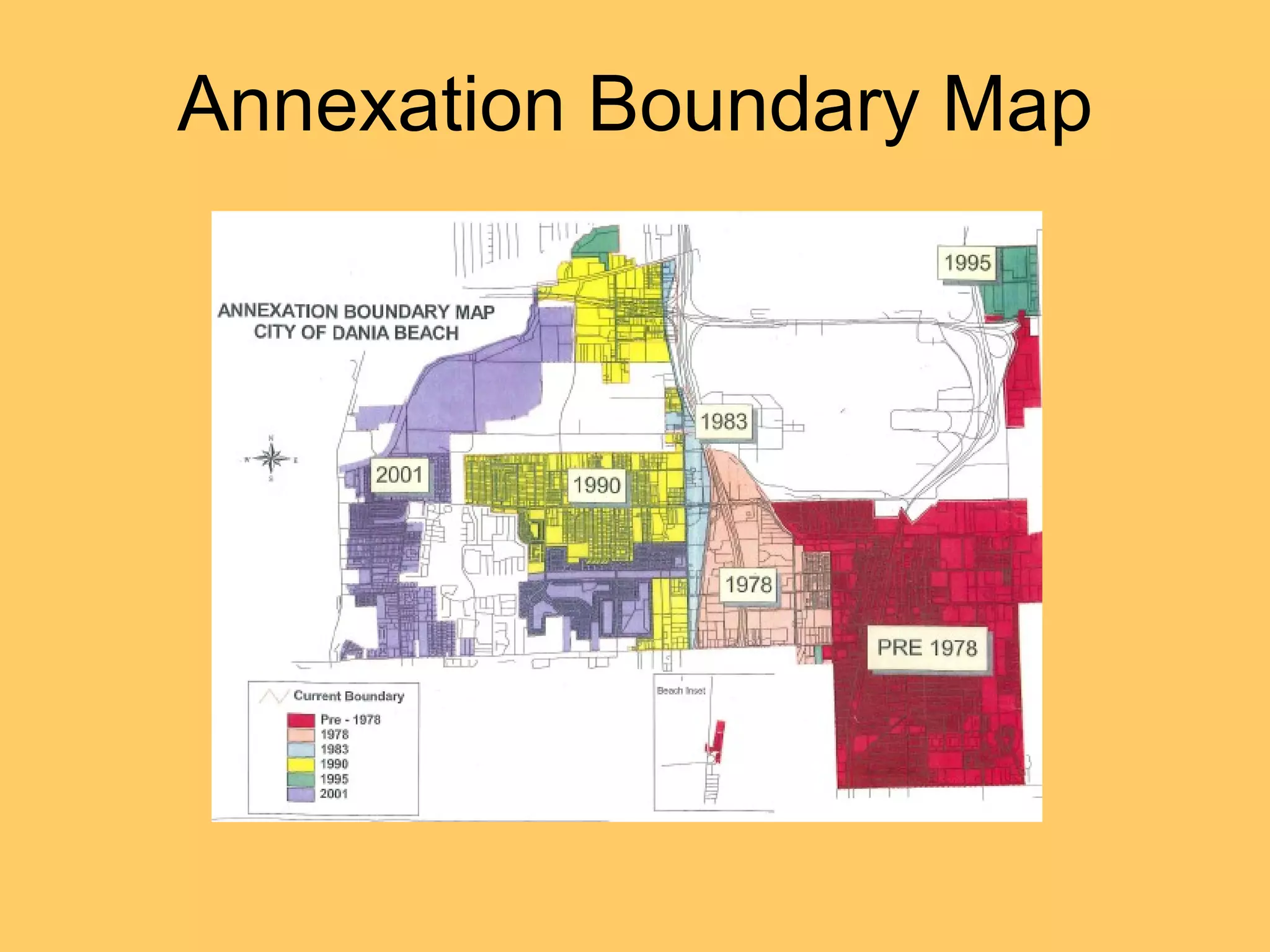
Annexation Boundary Map
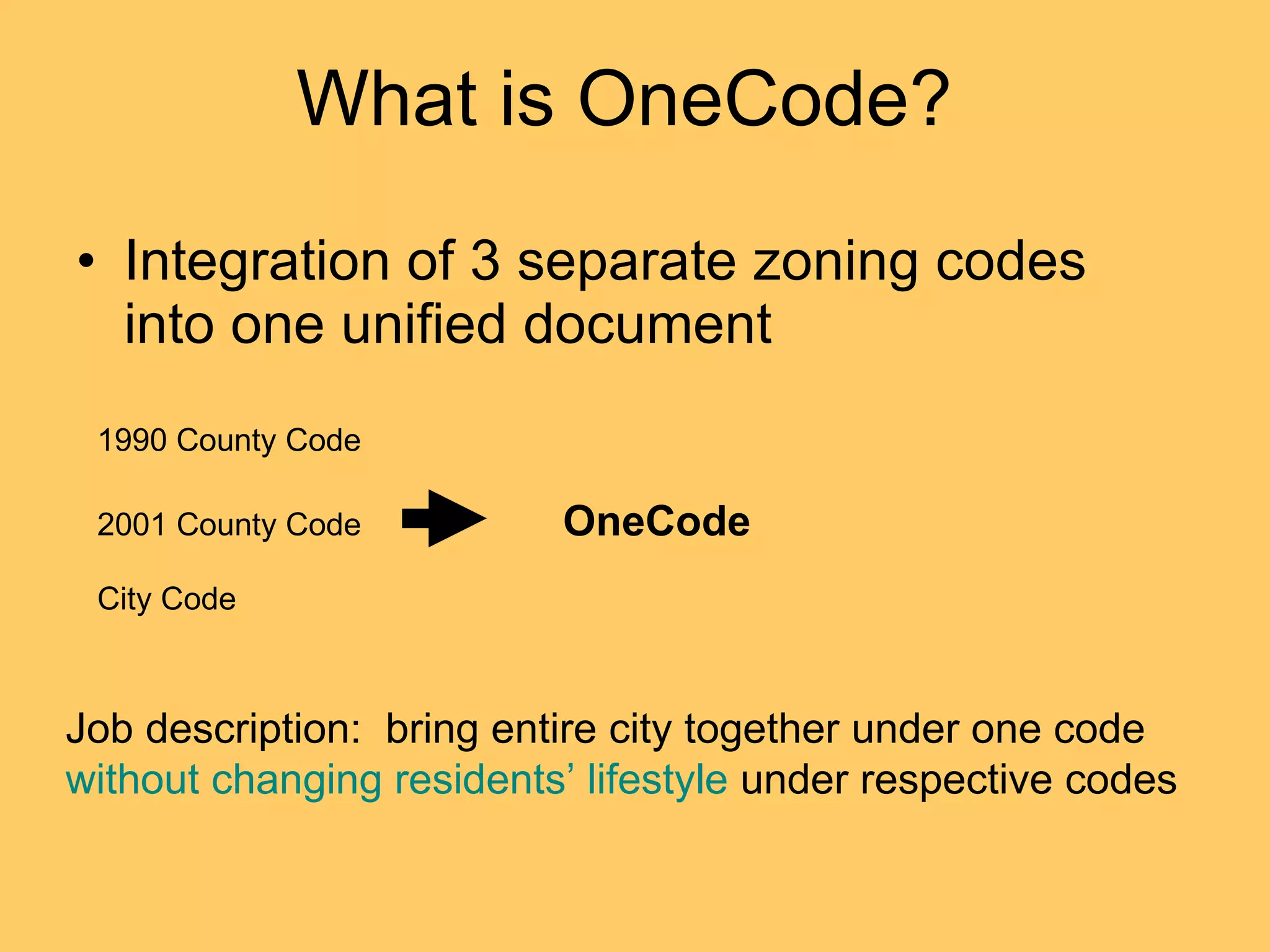
What is OneCode?  Integration of 3 separate zoning codes into one unified document 1990 County Code 2001 County Code City Code OneCode Job description:  bring entire city together under one code  without changing residents’ lifestyle  under respective codes
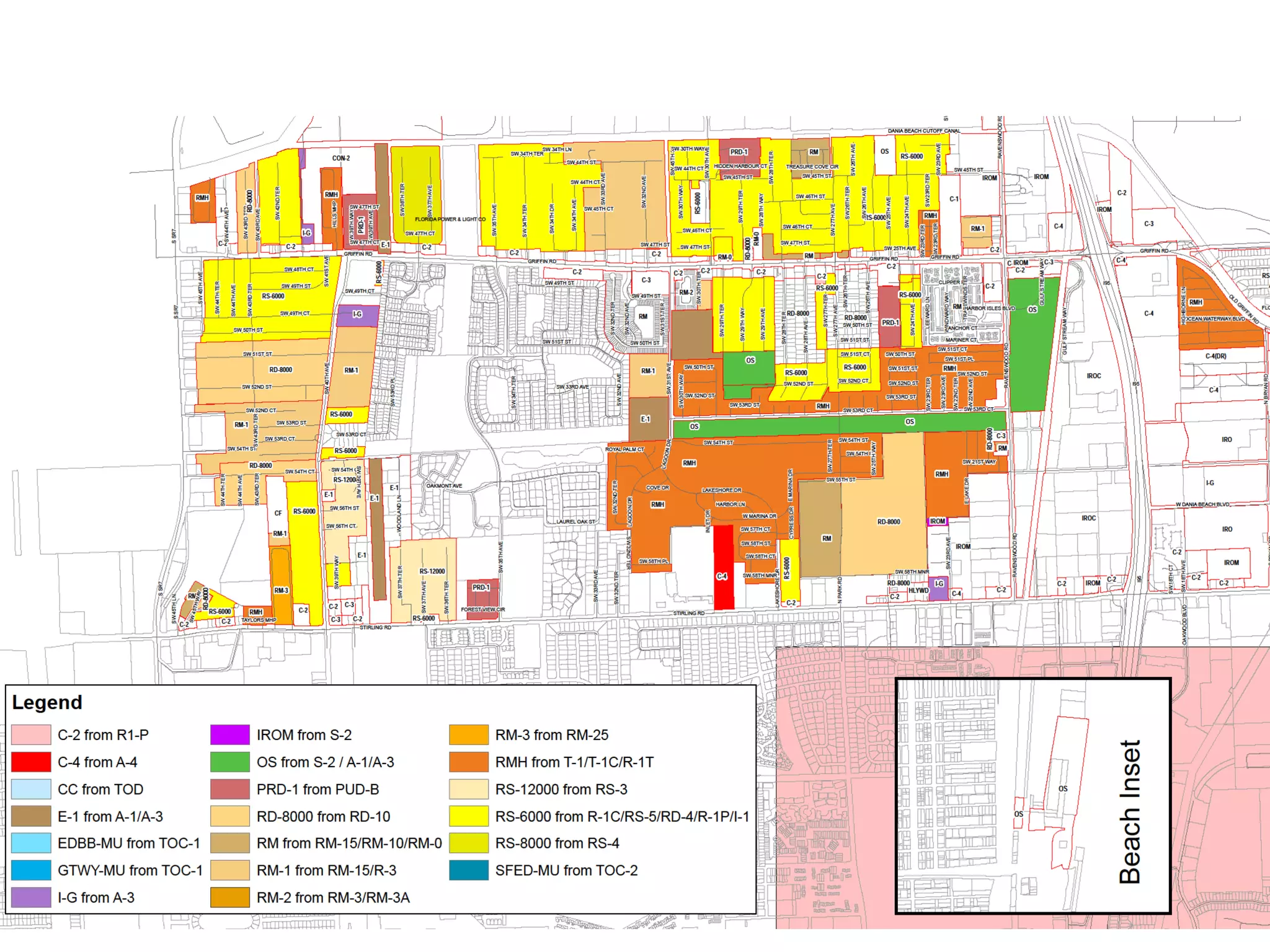
Annexed Area  Rezoning Replace County districts with City districts  No boundary changes Perception vs. reality Account for minor differences No change in lifestyle
 
Gathering Citizen Input City hosted 5 workshops to identify the community’s preferences and provide code information May 5, 2009  May 13, 2009  June 2, 2009 August 18, 2009 (City Commission) August 19, 2009 (Marine AdvisoryBd) –
Getting the Word Out Mailouts Email Fliers at City Hall, City Parks Newspaper:  Dania Press, Sun Sentinel Internet BSO Message Board Cable channel
Community Appearance Topics Community appearance topics we asked you about: Boat Lifts & Pilings  Sheds Fences, Walls & Hedges  Boats, RVs & Utility Trailers Commercial Vehicles Parking Other Comments
What OneCode Is  Not OneCode does NOT change what a resident can do with property OneCode does NOT change what can be built next to you, or across the street from you OneCode does NOT require residents or existing businesses to make expensive improvements
What OneCode Is  Not OneCode does NOT increase your parking requirement (it may actually decrease it) OneCode does NOT reduce your permitted signage OneCode does NOT reduce business opportunities or development potential OneCode does NOT change impact fees OneCode is NOT a re-do of the entire City Code
Code Changes Emergency generators for nonresidential uses Waiver of separation requirements between establishments licensed to serve liquor on premises Temporary signage for garage sales & special events Procedure for approving temporary uses Phasing of community amenities SFR in RMH Auto repair, rental in IROM
Streamlined development review process Allow MHs after natural disaster Allow SFR that are nonconforming as to setbacks, etc. to rebuild Updated concurrency regulations Missing industrial, RO signage standards  Carport encroachments in R Districts Pain clinics Consolidate RM, PUD A & B, PRD-1 Code Changes
Community Redevelopment Area Parking regulations off-site and centralized parking (in-lieu) on-street parking updated, competitive parking requirements shared parking for mixed uses parking studies
Community Redevelopment Area More of each lot is developable Require  buildings close to street Build entire frontage of lot Less emphasis on land assemblage  Streetscape requirements Off-site open space (in-lieu)
Community Redevelopment Area  Incentives are focused on: public parking usable open space workforce housing green building
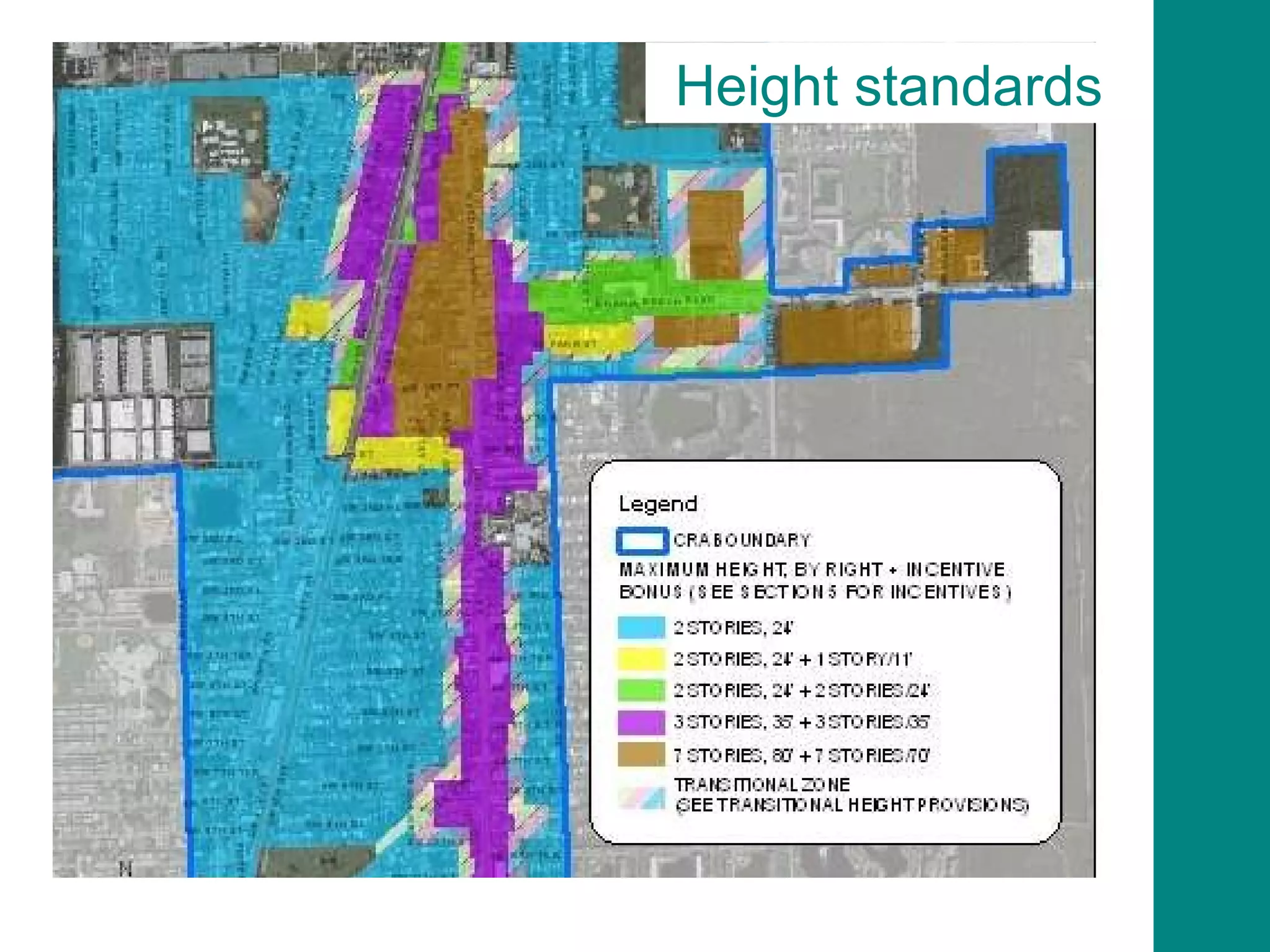
Height standards
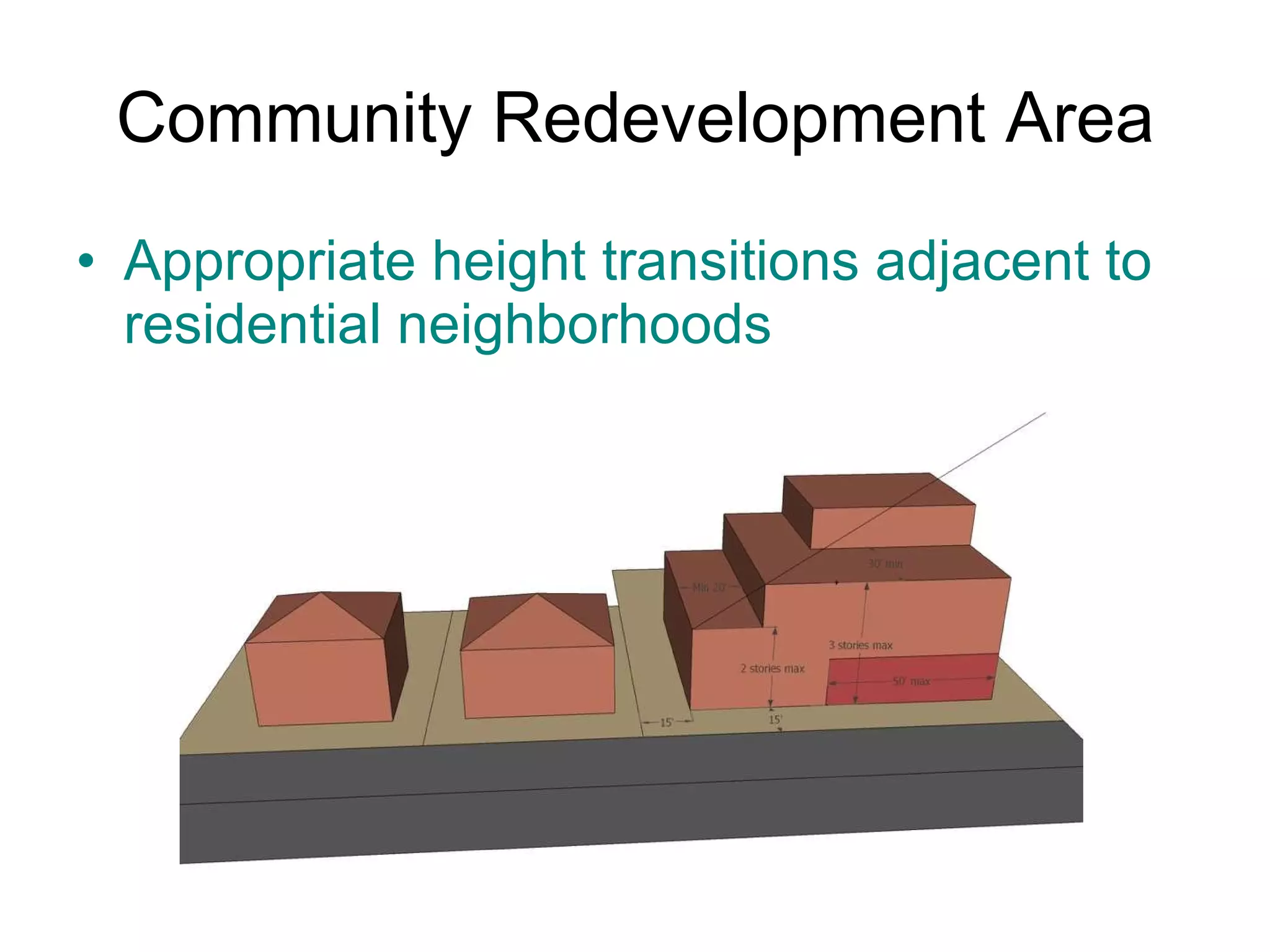
Community Redevelopment Area Appropriate height transitions adjacent to  residential neighborhoods
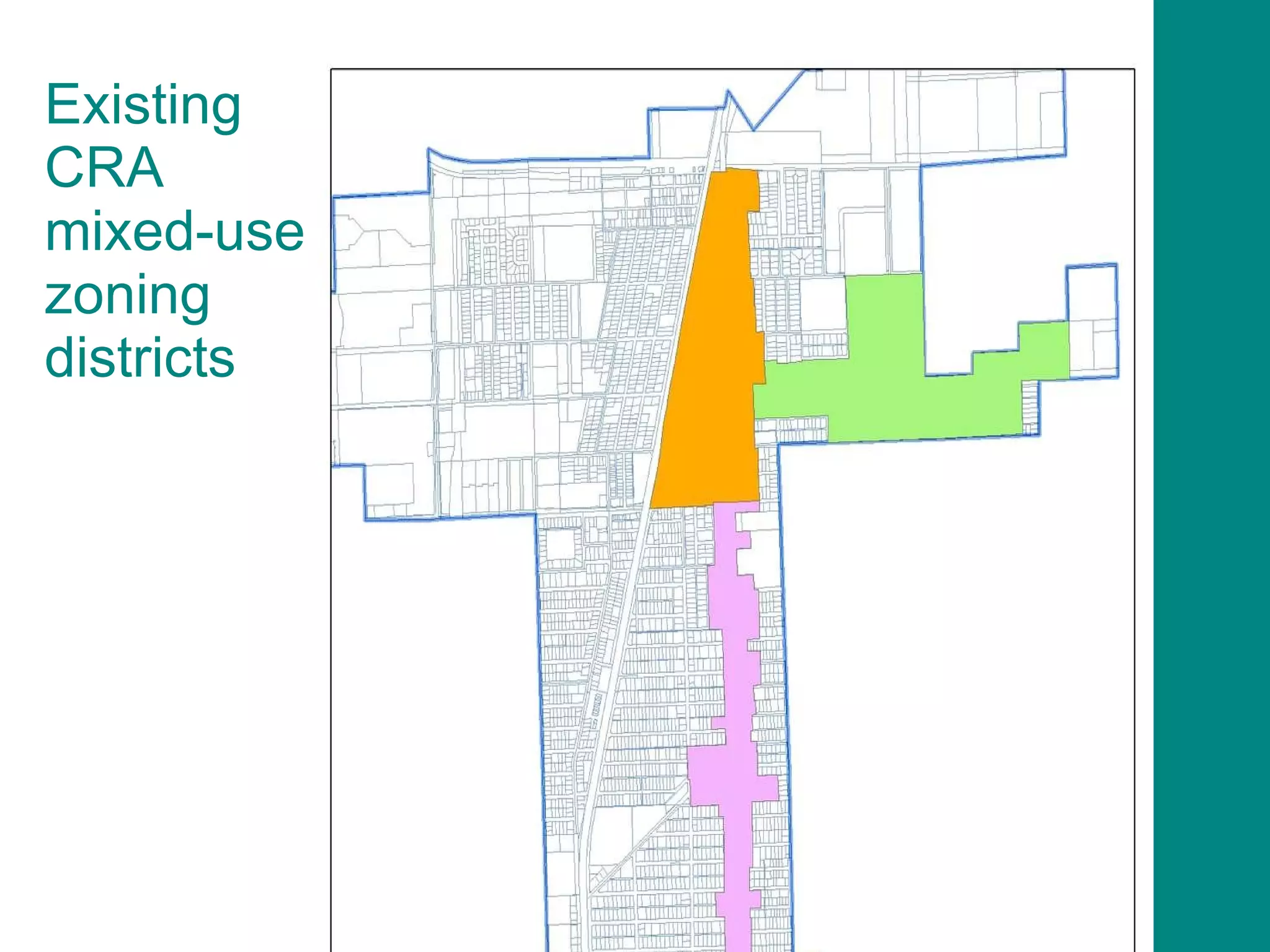
Existing CRA  mixed-use zoning districts
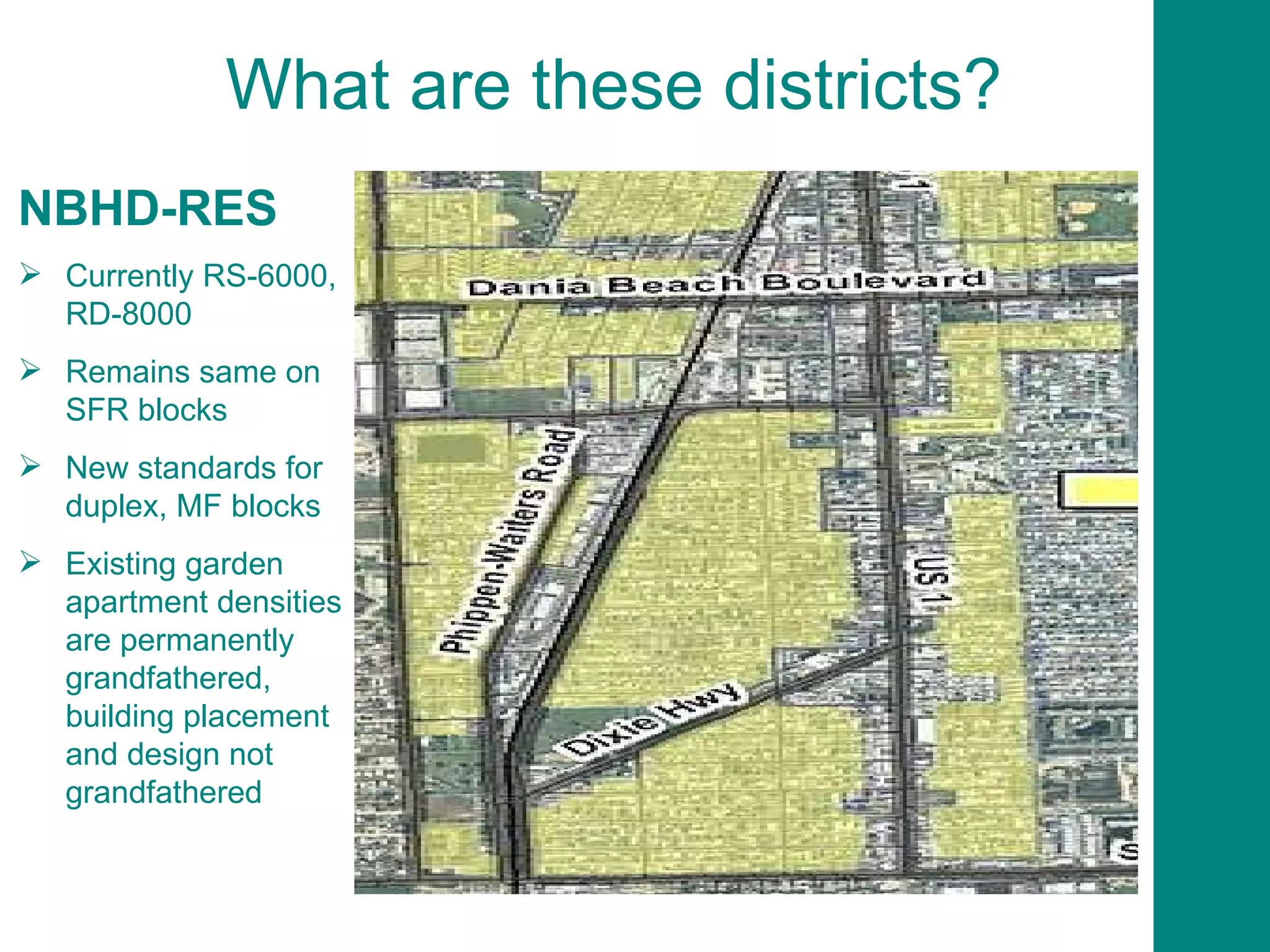
NBHD-RES Currently RS-6000, RD-8000 Remains same on SFR blocks New standards for duplex, MF blocks Existing garden apartment densities are permanently grandfathered, building placement and design not grandfathered What are these districts?
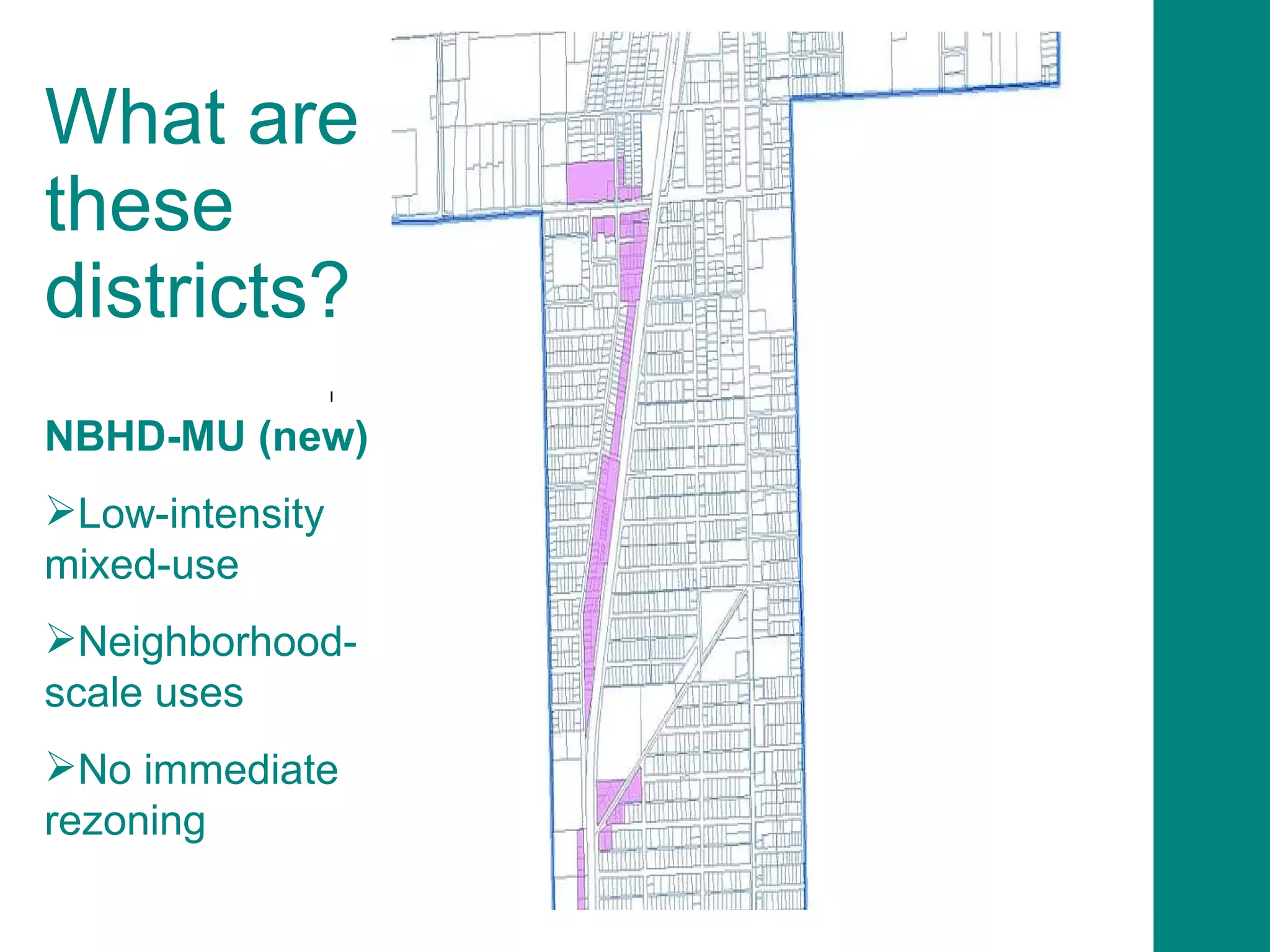
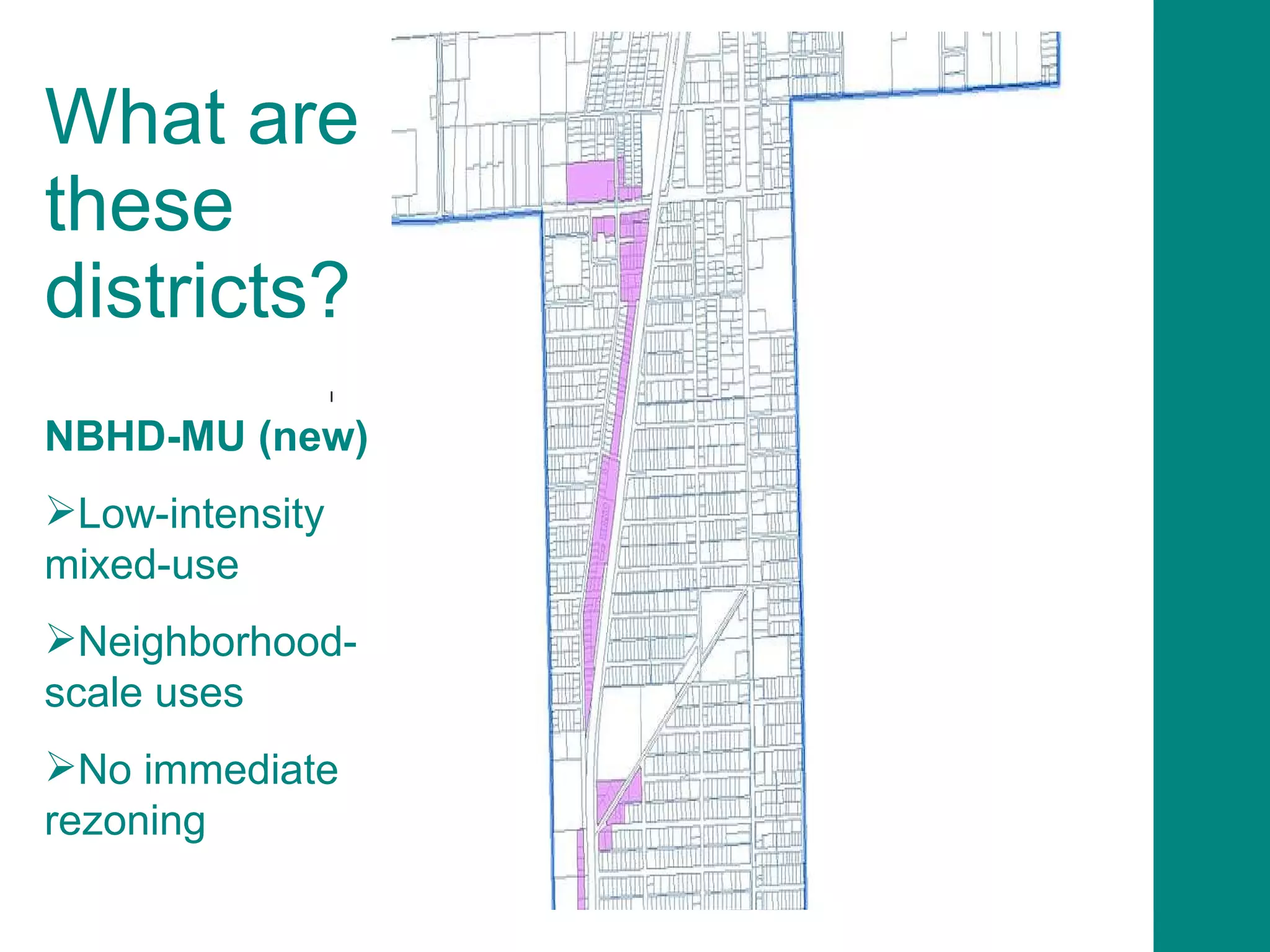
What are these districts? NBHD-MU (new) Low-intensity mixed-use Neighborhood-scale uses No immediate rezoning
Table of Contents Part 1 – Use Regulations Part 2 – Site Development Regulations Part 3 – Special Zoning Districts Part 4 – Subdivisions; Streets  Part 5 – Signage and Design Regulations Part 6 – Development Review Procedures Part 7 – Administration Part 8 – Technical Appendix
Next Step Sign Code Update  (December) Mobility Strategy  (December) RAC amendment  (October adoption) Final phase rezonings  (December) CC Expansion Griffin Corridor (CRA) NBHD-MU
 
What are these districts? NBHD-MU (new) Low-intensity mixed-use Neighborhood-scale uses No immediate rezoning
 
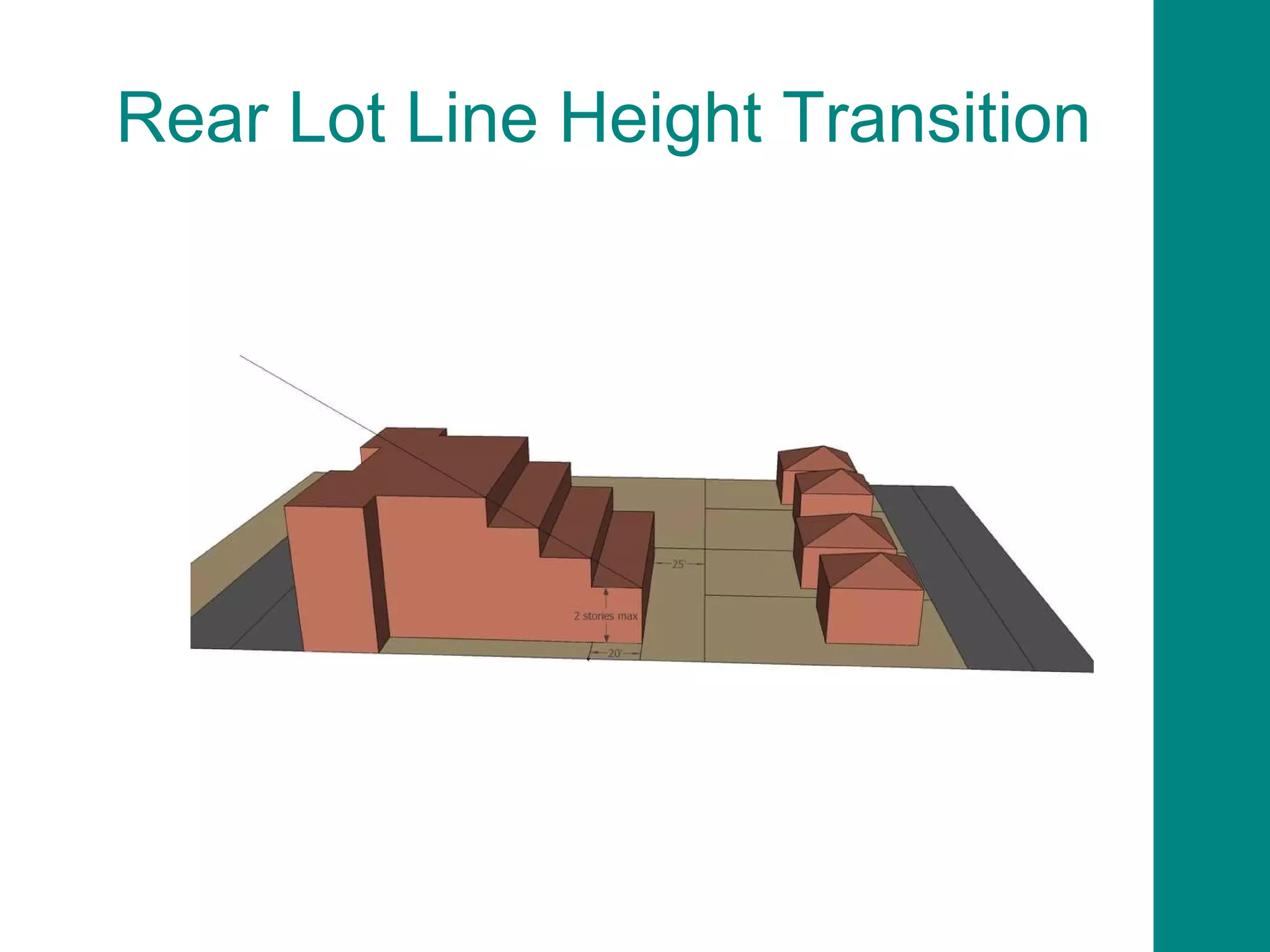
Rear Lot Line Height Transition
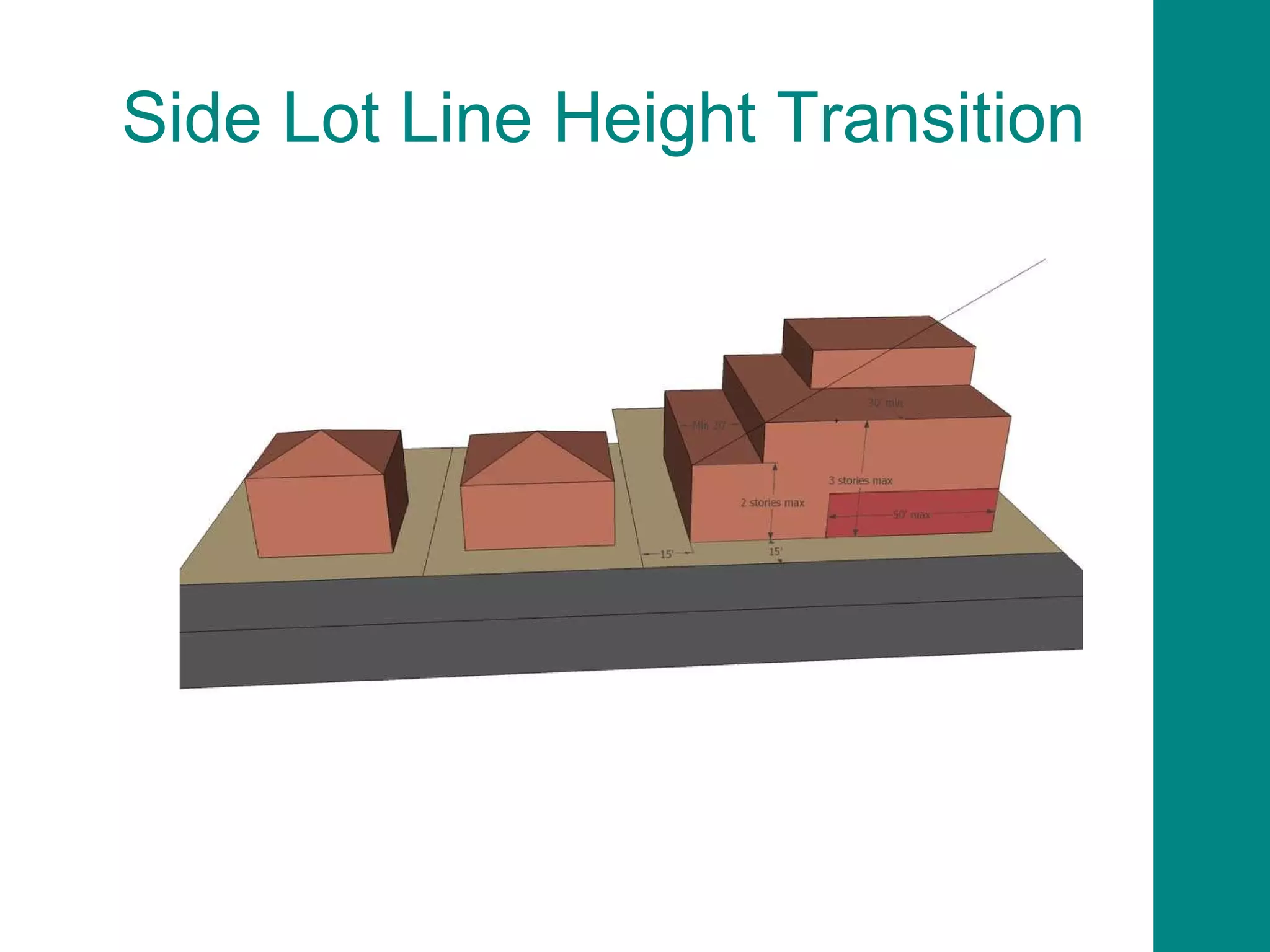
Side Lot Line Height Transition
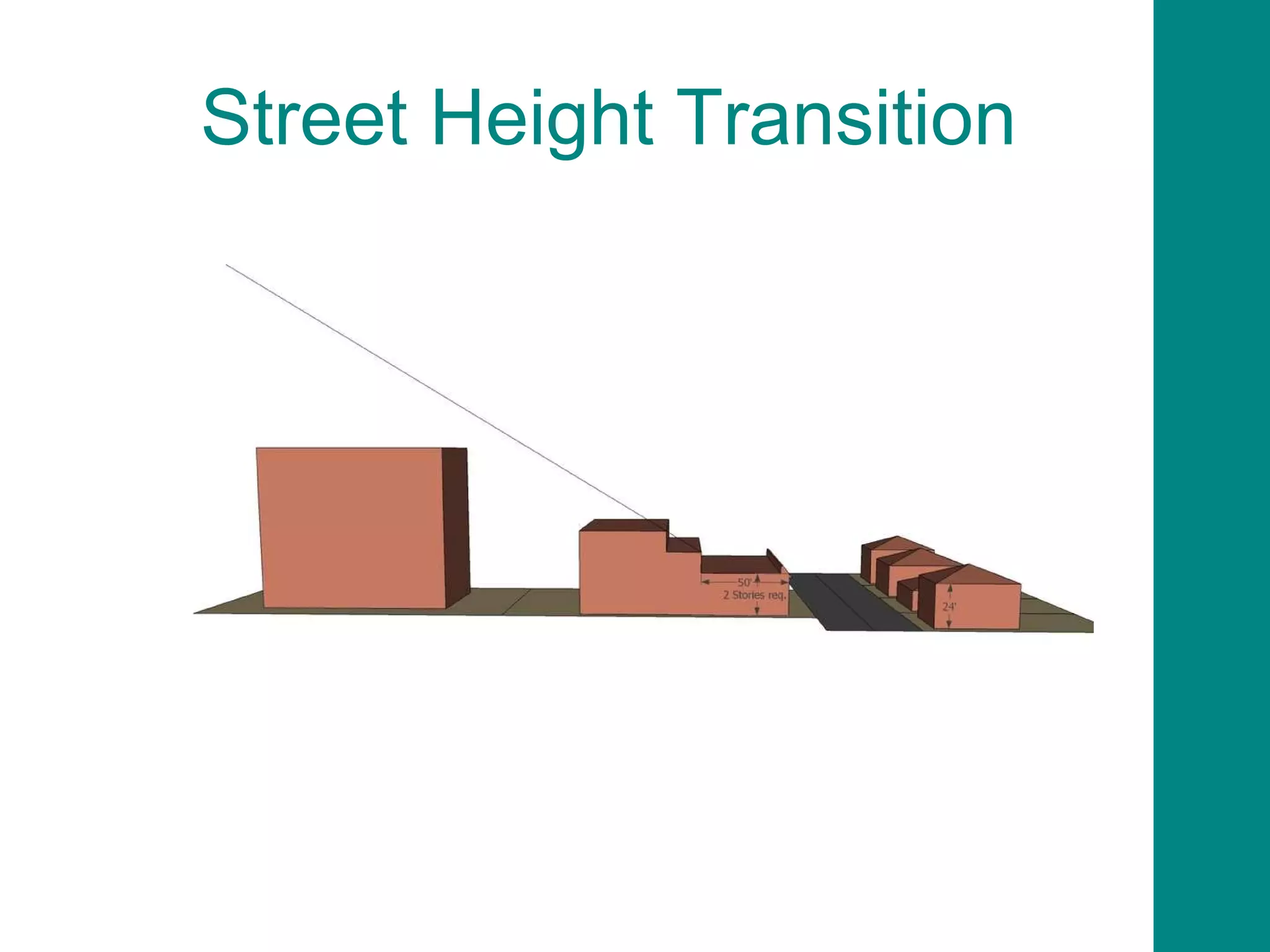
Street Height Transition
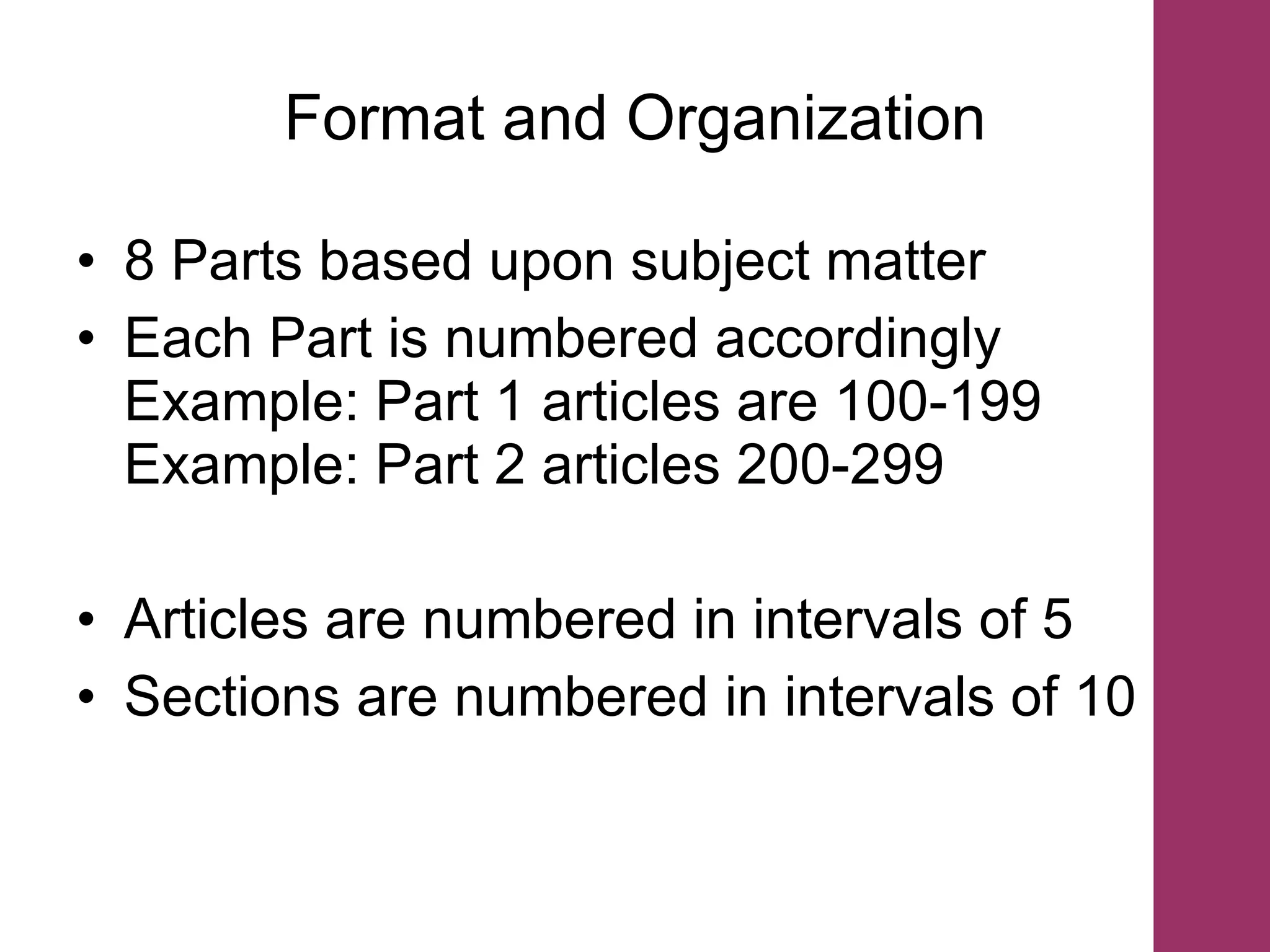
Format and Organization 8 Parts based upon subject matter Each Part is numbered accordingly  Example: Part 1 articles are 100-199  Example: Part 2 articles 200-299 Articles are numbered in intervals of 5 Sections are numbered in intervals of 10
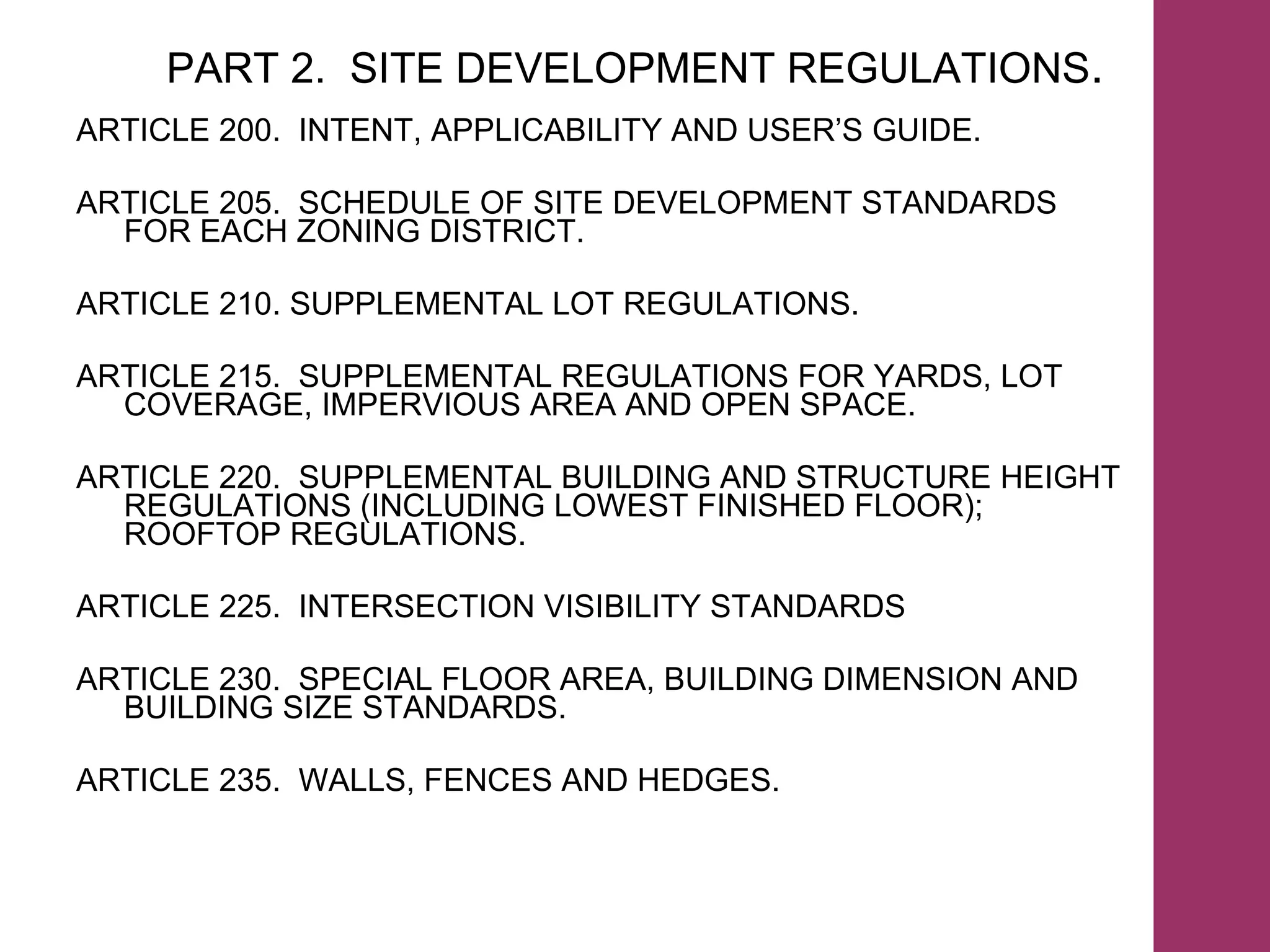
PART 2.  SITE DEVELOPMENT REGULATIONS . ARTICLE 200.  INTENT, APPLICABILITY AND USER’S GUIDE. ARTICLE 205.  SCHEDULE OF SITE DEVELOPMENT STANDARDS  FOR EACH ZONING DISTRICT. ARTICLE 210. SUPPLEMENTAL LOT REGULATIONS. ARTICLE 215.  SUPPLEMENTAL REGULATIONS FOR YARDS, LOT COVERAGE, IMPERVIOUS AREA AND OPEN SPACE. ARTICLE 220.  SUPPLEMENTAL BUILDING AND STRUCTURE HEIGHT REGULATIONS (INCLUDING LOWEST FINISHED FLOOR); ROOFTOP REGULATIONS. ARTICLE 225.  INTERSECTION VISIBILITY STANDARDS ARTICLE 230.  SPECIAL FLOOR AREA, BUILDING DIMENSION AND BUILDING SIZE STANDARDS. ARTICLE 235.  WALLS, FENCES AND HEDGES.
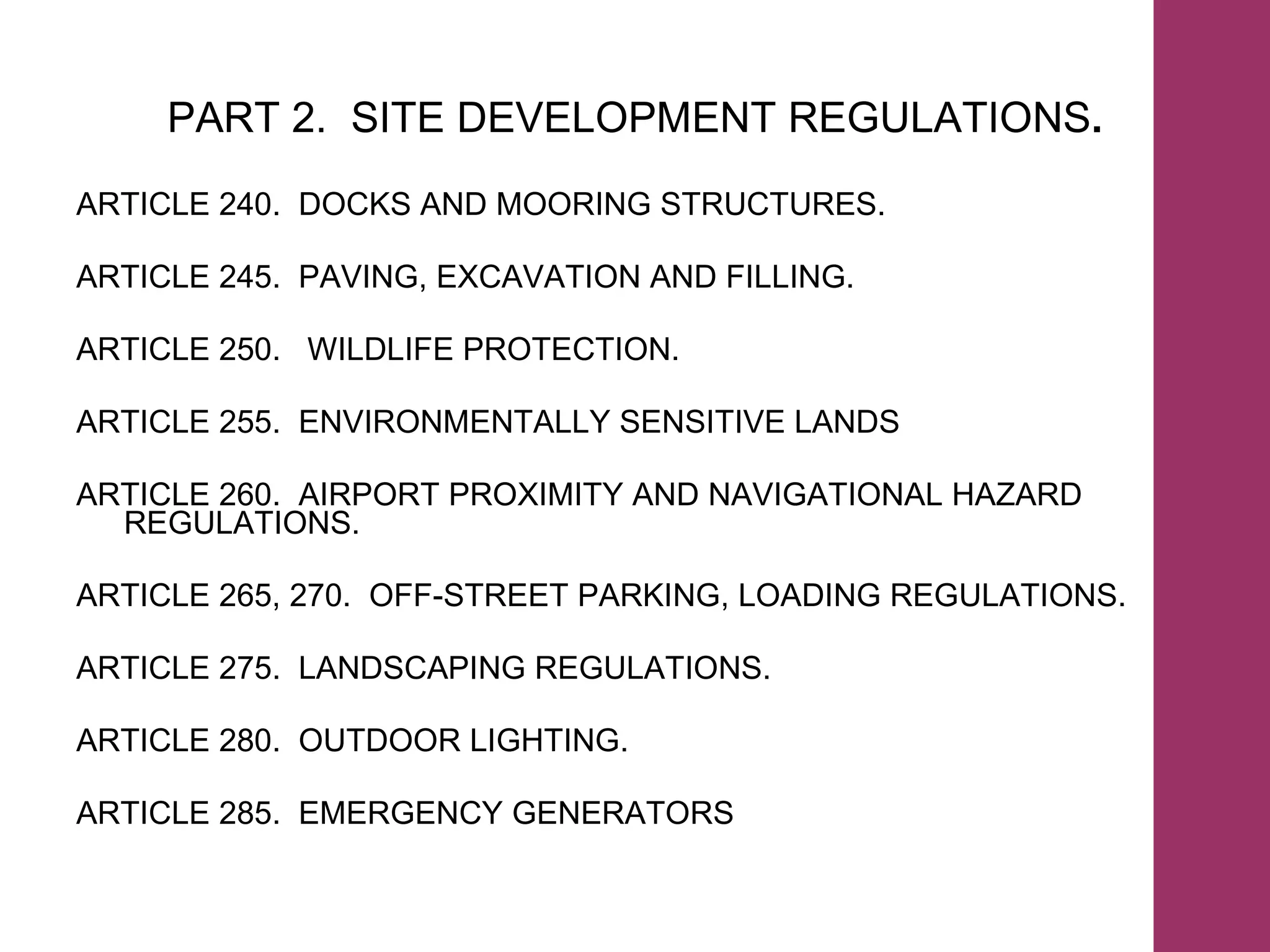
PART 2.  SITE DEVELOPMENT REGULATIONS . ARTICLE 240.  DOCKS AND MOORING STRUCTURES. ARTICLE 245.  PAVING, EXCAVATION AND FILLING.  ARTICLE 250.  WILDLIFE PROTECTION. ARTICLE 255.  ENVIRONMENTALLY SENSITIVE LANDS ARTICLE 260.  AIRPORT PROXIMITY AND NAVIGATIONAL HAZARD REGULATIONS. ARTICLE 265, 270.  OFF-STREET PARKING, LOADING REGULATIONS. ARTICLE 275.  LANDSCAPING REGULATIONS. ARTICLE 280.  OUTDOOR LIGHTING. ARTICLE 285.  EMERGENCY GENERATORS
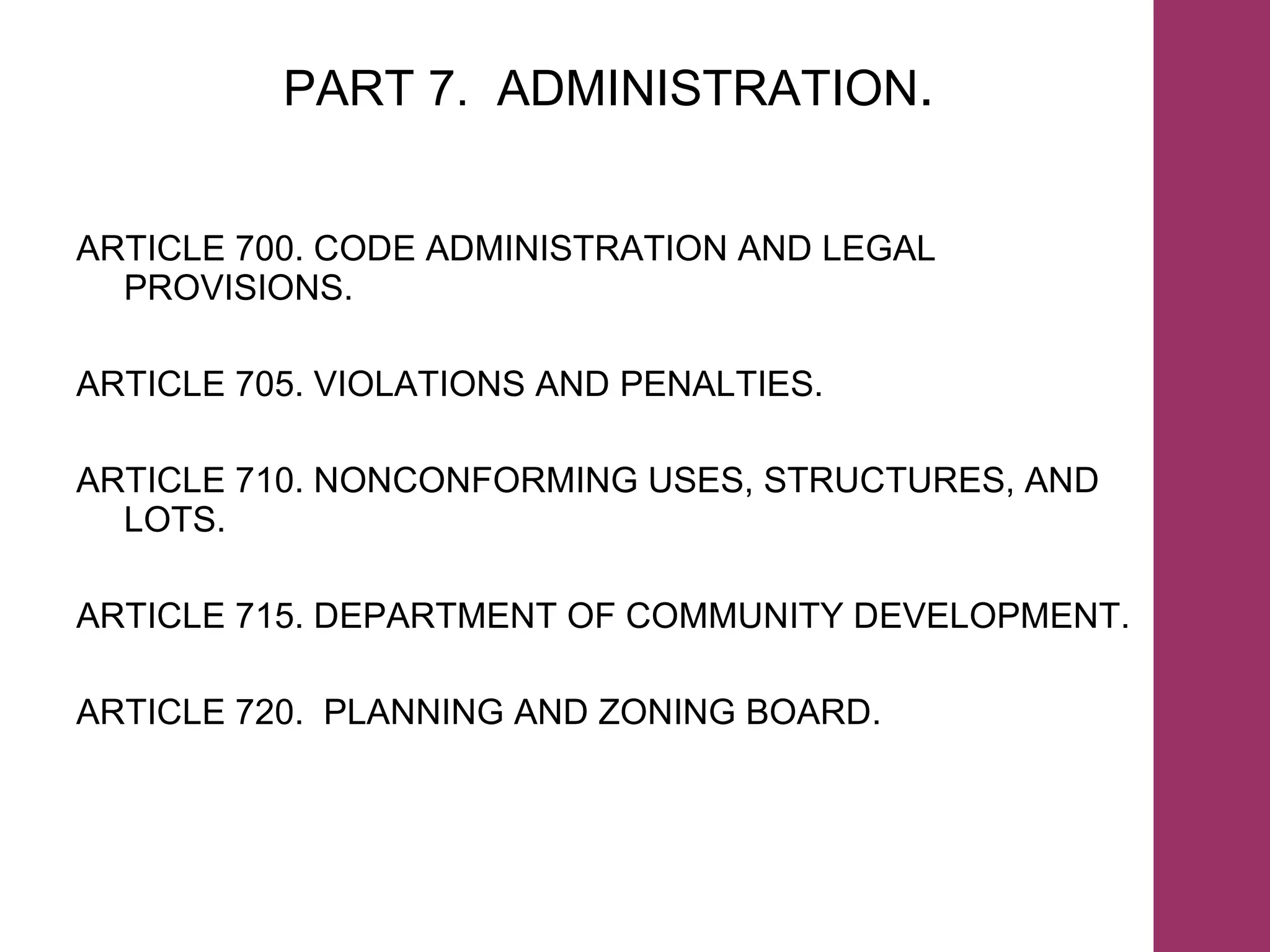
PART 7.  ADMINISTRATION . ARTICLE 700. CODE ADMINISTRATION AND LEGAL PROVISIONS. ARTICLE 705. VIOLATIONS AND PENALTIES. ARTICLE 710. NONCONFORMING USES, STRUCTURES, AND LOTS. ARTICLE 715. DEPARTMENT OF COMMUNITY DEVELOPMENT. ARTICLE 720.  PLANNING AND ZONING BOARD.
Part 8. Technical Appendix Concurrency Impact fees Telecommunication towers Tree abuse Tree protection Schedule of required street widths
How to provide feedback Tonight Email city staff Call city staff Sign-in-sheet so that we may update you Planning & Zoning Department Contact Information: Phone Number: 954.924.6805 ext. 3643 Fax Number: 954.922.2687
 
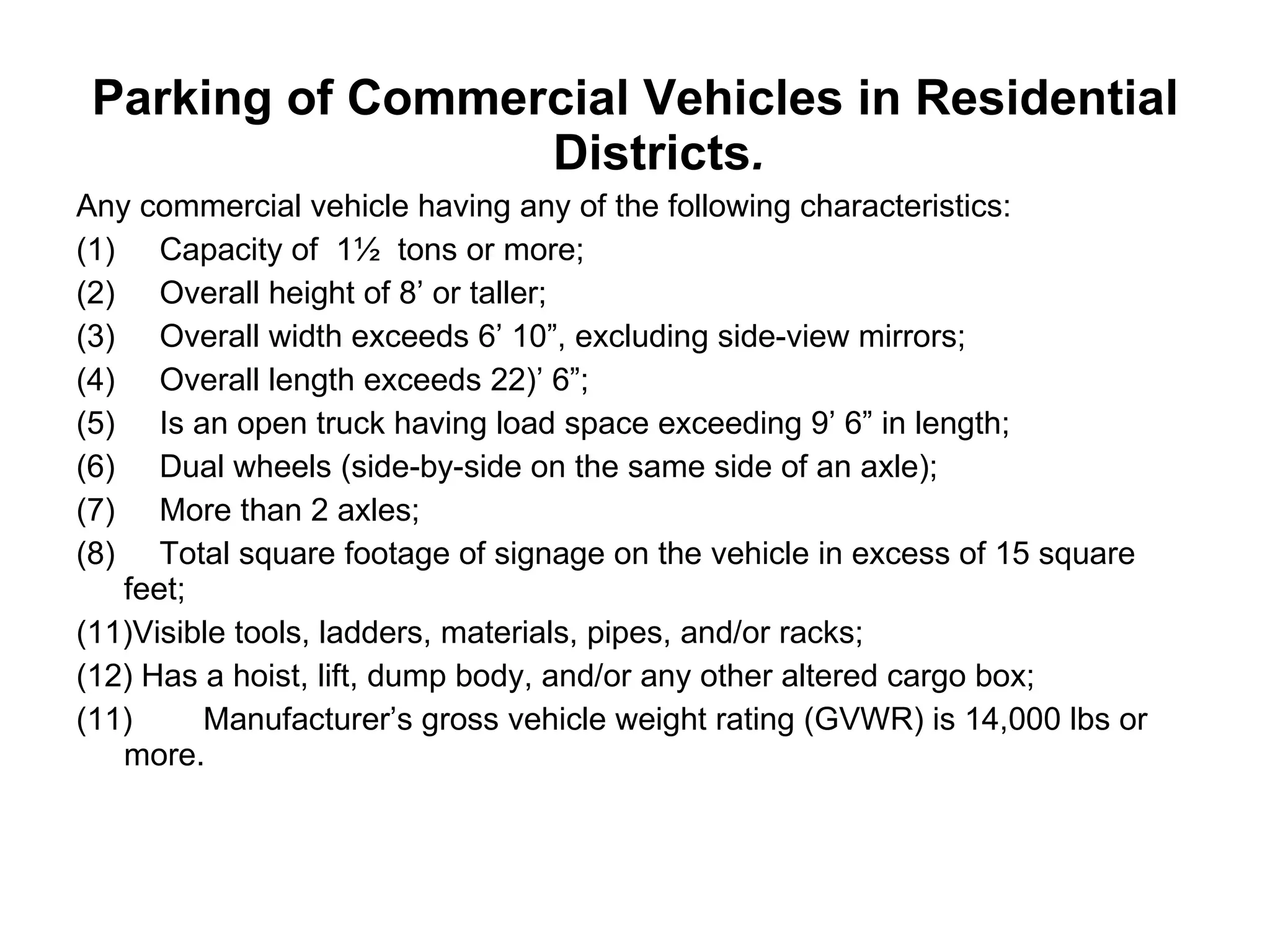
Parking of Commercial Vehicles in Residential Districts . Any commercial vehicle having any of the following characteristics: (1)     Capacity of  1½  tons or more;  (2)     Overall height of 8’ or taller; (3)     Overall width exceeds 6’ 10”, excluding side-view mirrors; (4)     Overall length exceeds 22)’ 6”; (5)     Is an open truck having load space exceeding 9’ 6” in length; (6)     Dual wheels (side-by-side on the same side of an axle); (7)     More than 2 axles; (8)     Total square footage of signage on the vehicle in excess of 15 square feet; Visible tools, ladders, materials, pipes, and/or racks; Has a hoist, lift, dump body, and/or any other altered cargo box; (11) Manufacturer’s gross vehicle weight rating (GVWR) is 14,000 lbs or more.
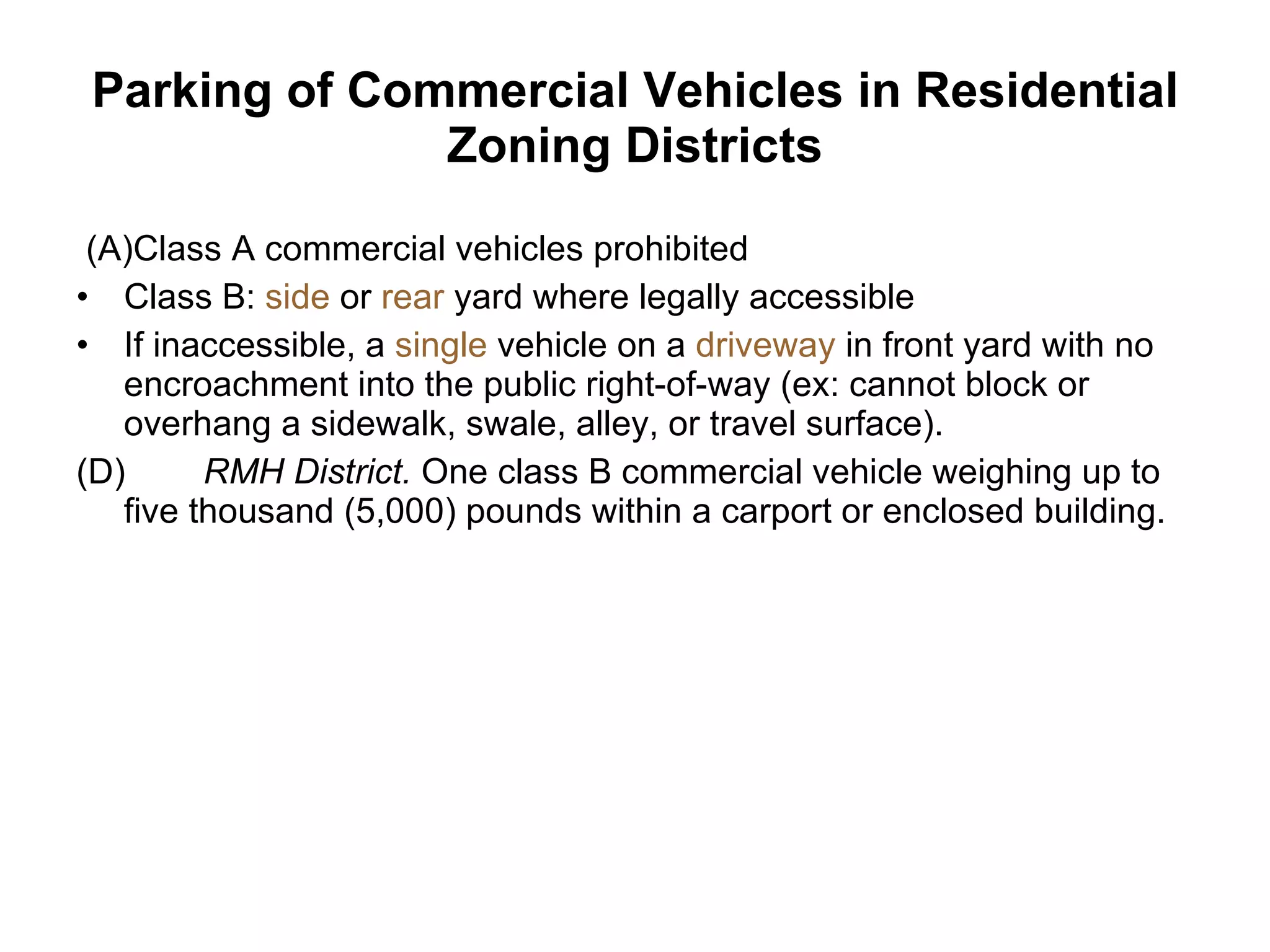
Parking of Commercial Vehicles in Residential Zoning Districts   (A)Class A commercial vehicles prohibited Class B:  side  or  rear  yard where legally accessible If inaccessible, a  single  vehicle on a  driveway  in front yard with no encroachment into the public right-of-way (ex: cannot block or overhang a sidewalk, swale, alley, or travel surface).  (D) RMH District.  One class B commercial vehicle weighing up to five thousand (5,000) pounds within a carport or enclosed building.    
Parking of Recreational Vehicles in Residential Zoning Districts   Includes special purpose vehicle, trailer, utility trailer and/or boat (A) Permitted locations.  (1) In the side yard or rear yard.  (2) On the driveway in the front yard if side or rear yard is legally inaccessible (but cannot encroach into public right-of-way.  Must be be oriented perpendicular to the street, except where parked on a paved circular driveway.  (3) No parking in the public road right-of-way.
(B) Maximum height :  13.5 feet unless within in enclosed garage. (C) Maximum length and width:  30 feet by 10 feet in width unless within enclosed, roofed and walled permanent structure. (D) Special purpose vehicles:  Permitted only within a wholly enclosed garage. (E) Mobile homes.  Parking, storage not permitted. RMH District: 1 boat and 1 recreational vehicle per  dwelling unit, not encroaching onto a street or visually obstructing vehicle egress from contiguous properties.  All boats twelve (12) fee t  or longer must be secured onto a currently licensed boat trailer.  Boats and recreational vehicles shall not be stored within a required parking space. Maximum number :  1 each utility trailer, recreational vehicle and boat per dwelling unit, outside of enclosed permanent structure.  Parking in front yard when authorized by subsec. (A)  limited to 1  of the following:  1 utility trailer or boat secured to a trailer, or 1 recreational vehicle.
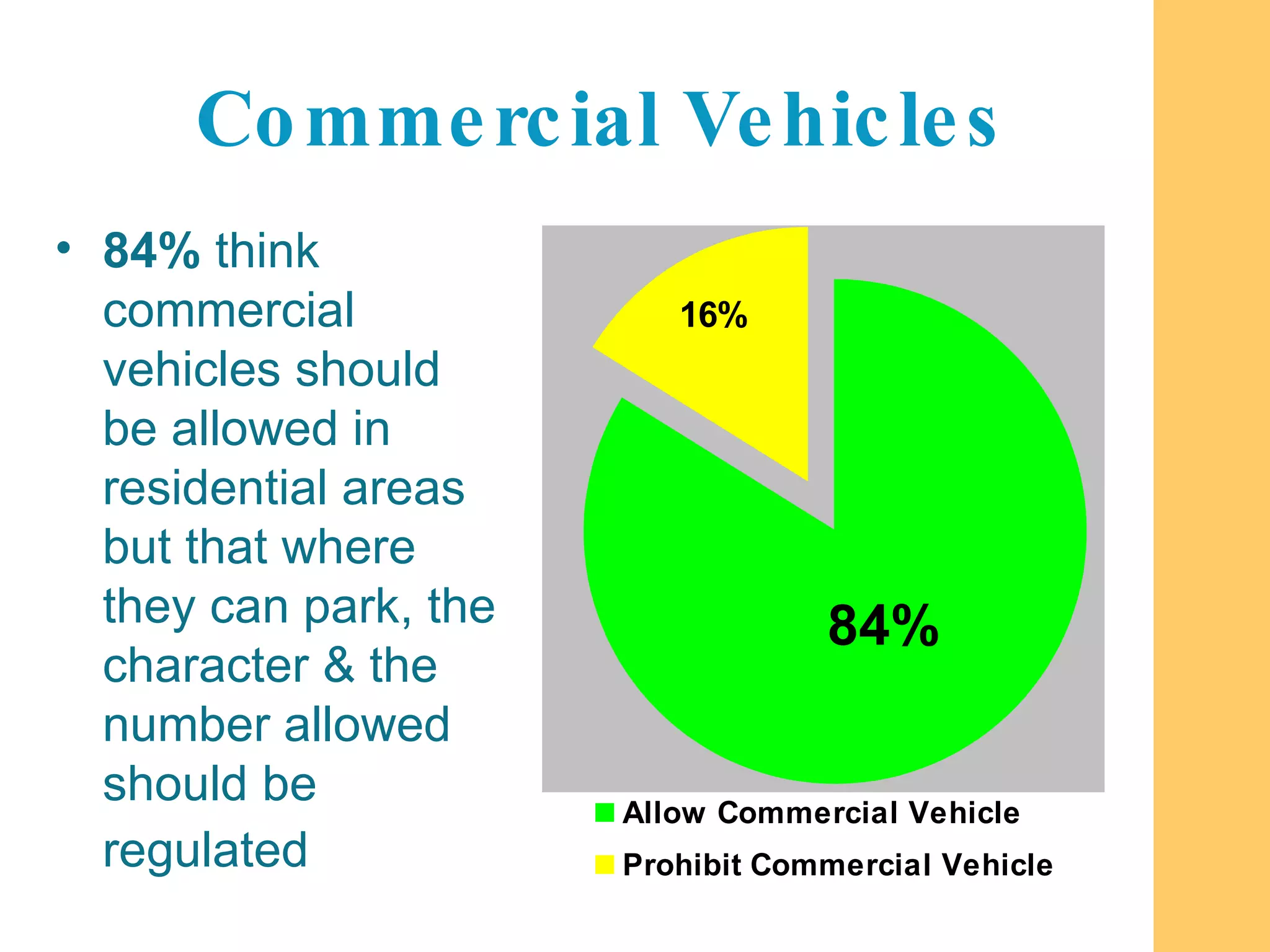
Commercial Vehicles 84%  think commercial vehicles should be allowed in residential areas but that where they can park, the character & the number allowed should be regulated   84%
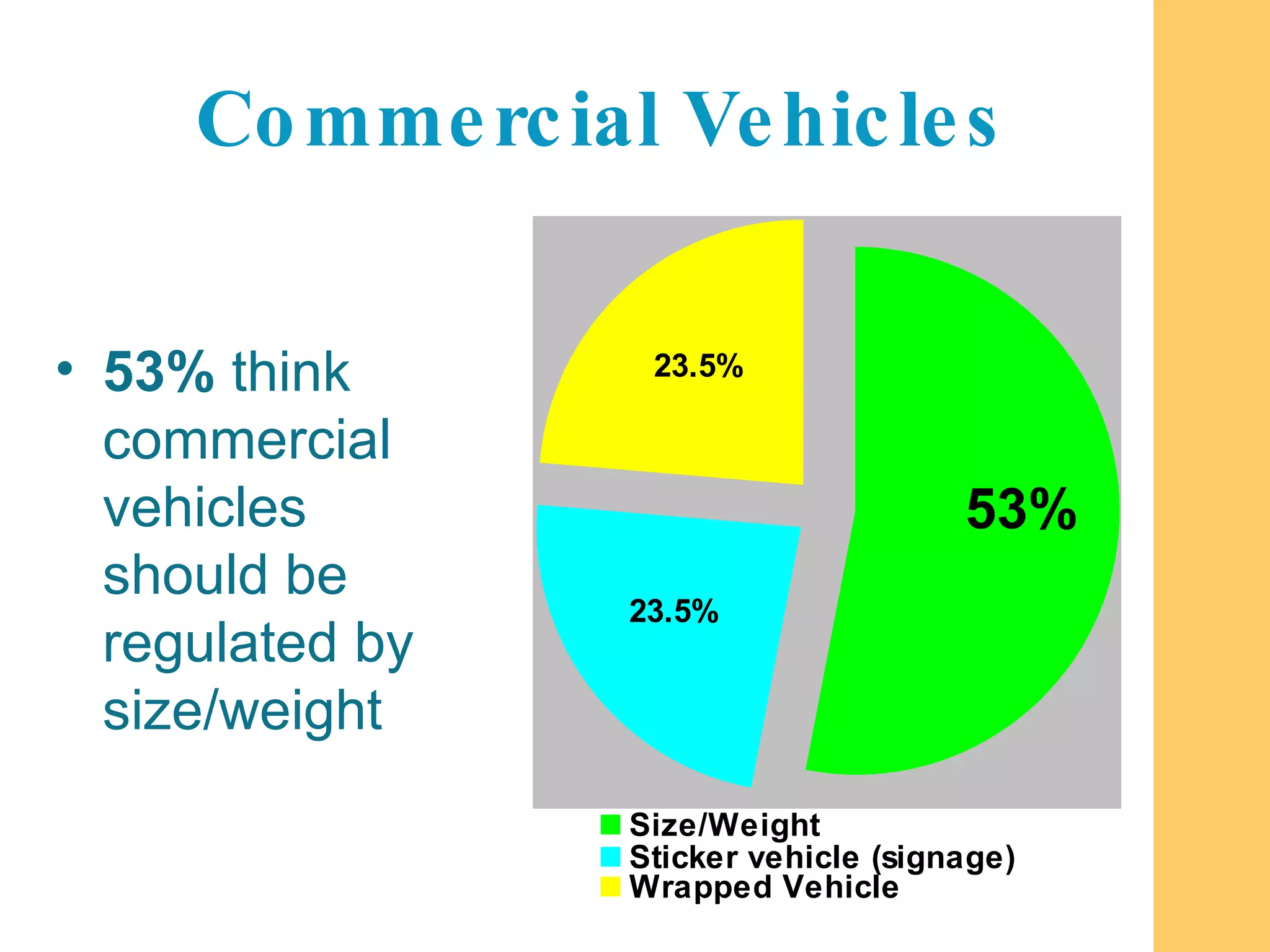
Commercial Vehicles 53%  think commercial vehicles should be regulated by size/weight 53%
OneCode:  Commercial Vehicles Defined  - vehicle primarily for transportation of property, equipment or persons for hire other than a passenger vehicle, as well as any vehicle (including a passenger vehicle) with advertised markings in excess of 3 sq ft per side or per vehicle top Police cars, ambulances and fire trucks are not classified as commercial vehicles
OneCode:  Commercial Vehicles Size  –up to Class 3 (max 14,000 lbs) in residential districts Number  – no limit Screening  – required Parking  – garage, side yard, rear yard, & driveway; however only 1 vehicle in the front yard (must be in driveway) Surface  – paved surface only required for commercial vehicles parked in the front yard Setback  –min 5 ft from any property line

OneCode: Residential Parking Surface Swale  – will not prohibit parking in the swale Parking Surface  – paved surface maintained in good repair; parking in yard allowed but not on grass. Existing off-street gravel parking can remain until substantial property improvements are made or surface is in disrepair, then must replace with hard surface Alternative Parking Surface  – allow for alternative pervious surfaces for homes built by 06/26/2005
OneCode: Boatlifts, docks, pilings Boat Lifts & Pilings  – require no side setback, allowed to project at least 5 ft into waterway but not more than 10% of waterway width or 20 ft, whichever is less Boathouses  – not allowed in setback area or within or over any public waterway; subject to accessory building height standards Docks  – require no side setback, allowed to extend a max of 5 ft into waterway, unless waterway is greater than 50 ft in width, then may extend up to 10% of waterway width or 20 ft, whichever is less
OneCode:  Docking, deck height Boats along Docks  – allowed to extend a max of 30% of waterway width measured from property line Docking along Private Dock  – docking along private dock without permission of owner is prohibited, unless person/vessel in distress  Deck Height  – cannot exceed 3 ft above mean high tide or same level of adjacent property if said property’s deck is more than 3 ft above mean high tide
OneCode:  Accessory structures Setbacks  – min 5 ft setback from side & rear; (attached structures subject to front & side setbacks for principal structure & min 10 ft rear setback Height  – max height of 10 ft or 14 ft to top of peaked roof, whichever is less Separation  – min distance of 10 ft between principal & detached accessory buildings Floor Area  – cannot exceed 40% of principal structures gross floor area or 750 sqft, whichever is less Kitchens  – prohibited in accessory buildings
OneCode:   Fences, Walls & Hedges Height  – fences, walls & hedges can be max of 4 ft along front yard (street side yard), max of 6 ft along side & rear yards Around Swimming Pools  – min height of 4 ft for fences & walls  Setback  – walls, fences & hedges are allowed in setback areas
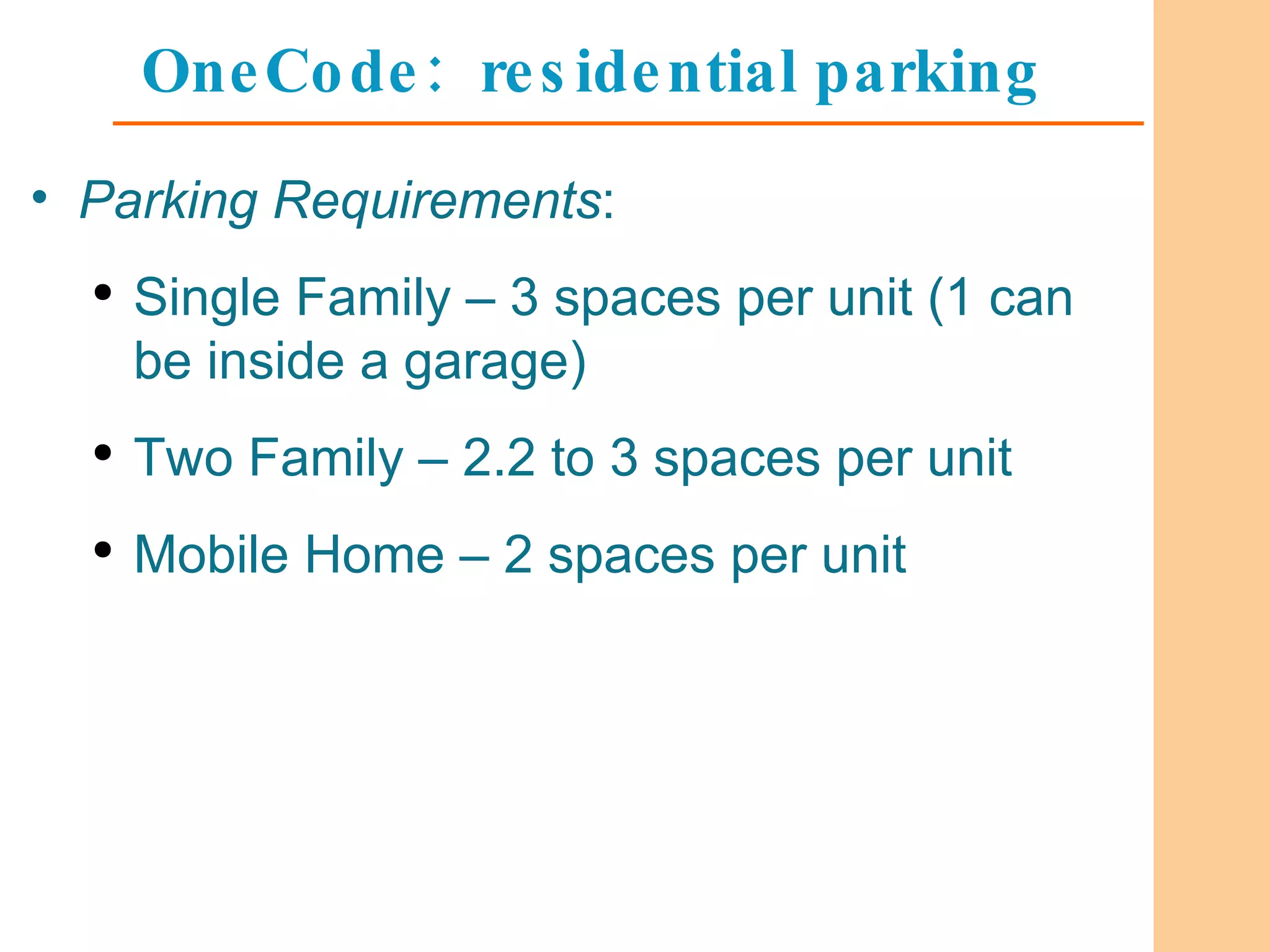
OneCode:  residential parking Parking Requirements : Single Family – 3 spaces per unit (1 can be inside a garage) Two Family – 2.2 to 3 spaces per unit Mobile Home – 2 spaces per unit
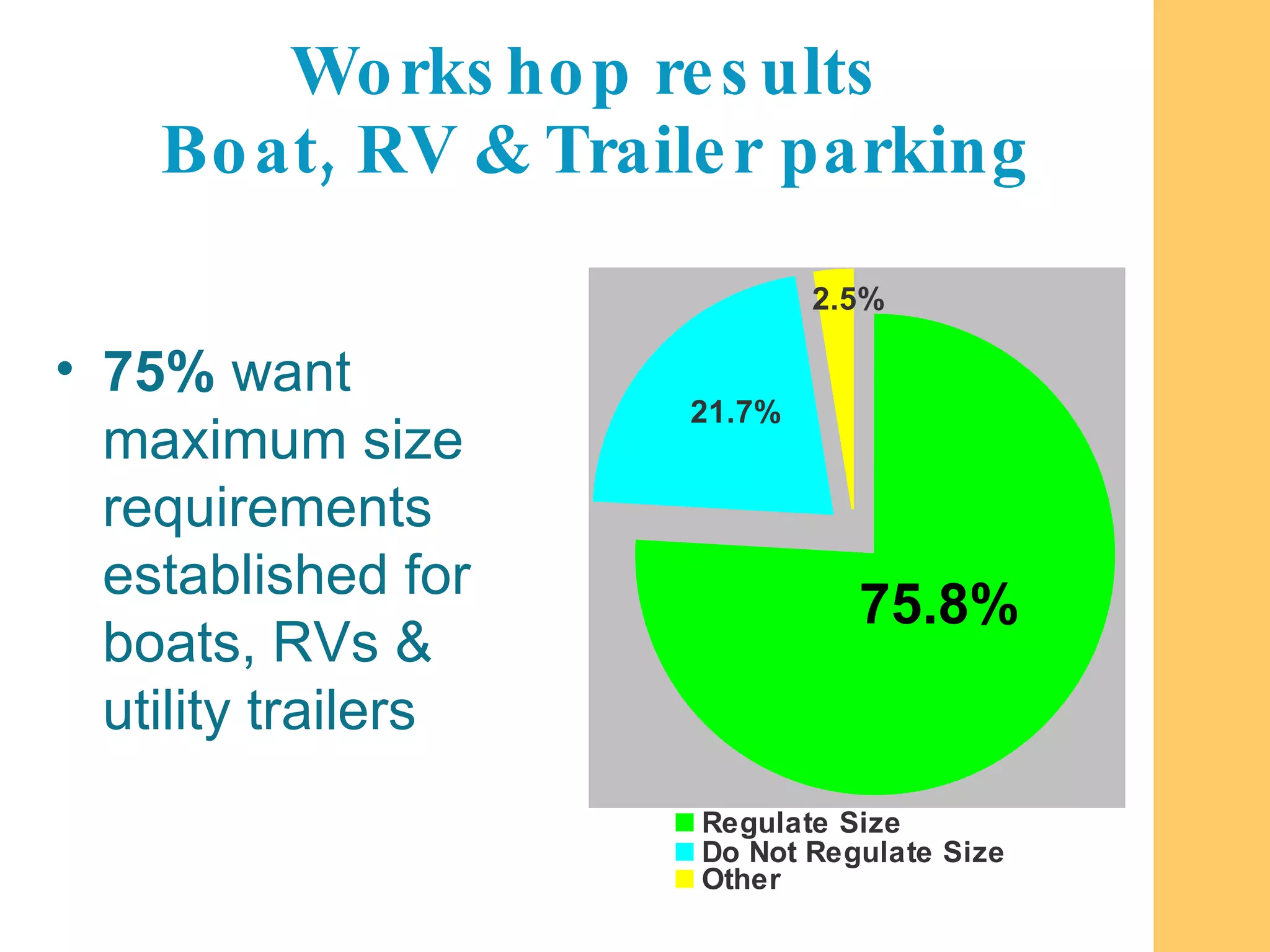
Workshop results  Boat, RV & Trailer parking 75%  want maximum size requirements established for boats, RVs & utility trailers 75.8%
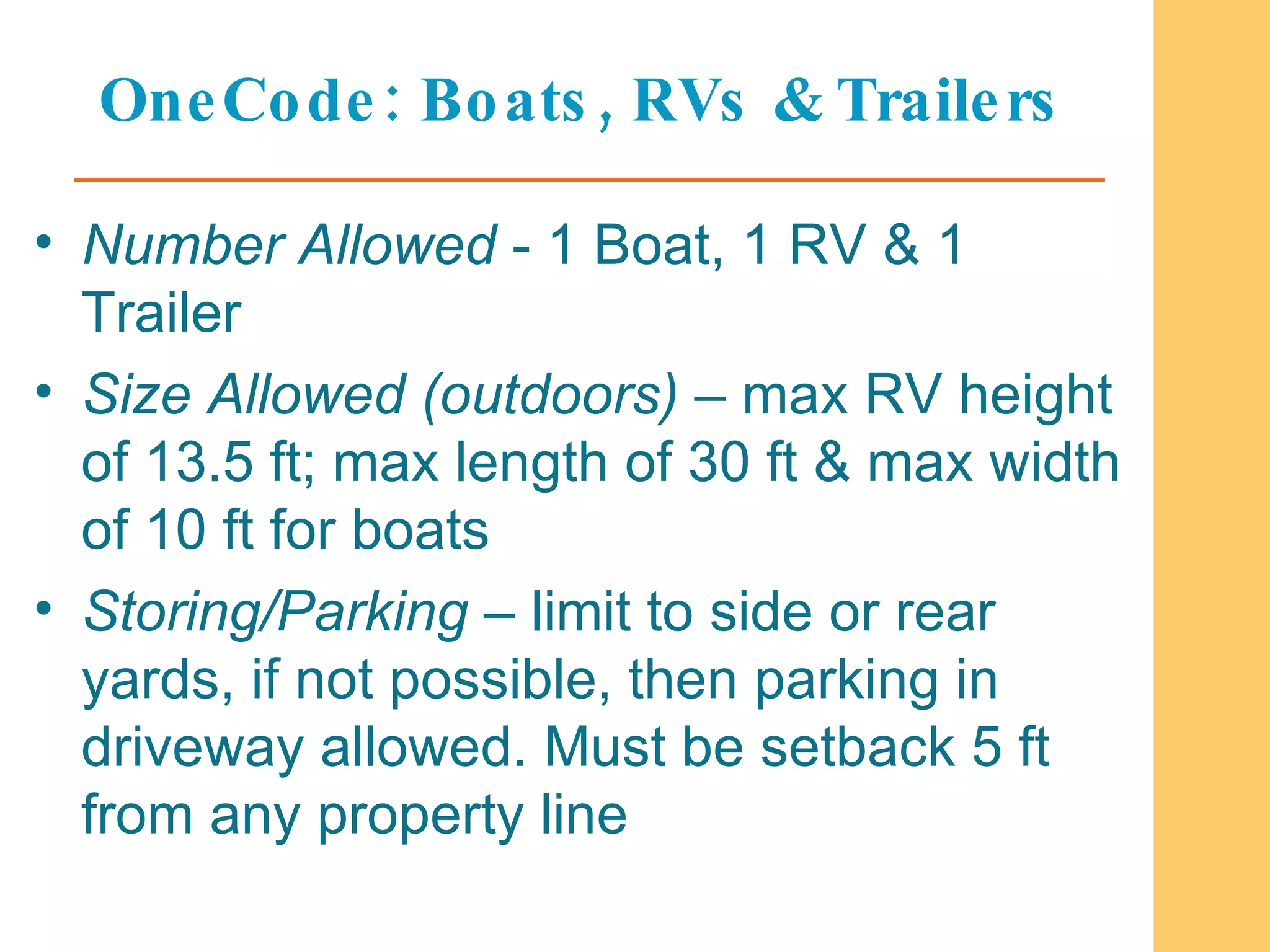
OneCode: Boats, RVs & Trailers Number Allowed  - 1 Boat, 1 RV & 1 Trailer Size Allowed (outdoors)  – max RV height of 13.5 ft; max length of 30 ft & max width of 10 ft for boats Storing/Parking  – limit to side or rear yards, if not possible, then parking in driveway allowed. Must be setback 5 ft from any property line
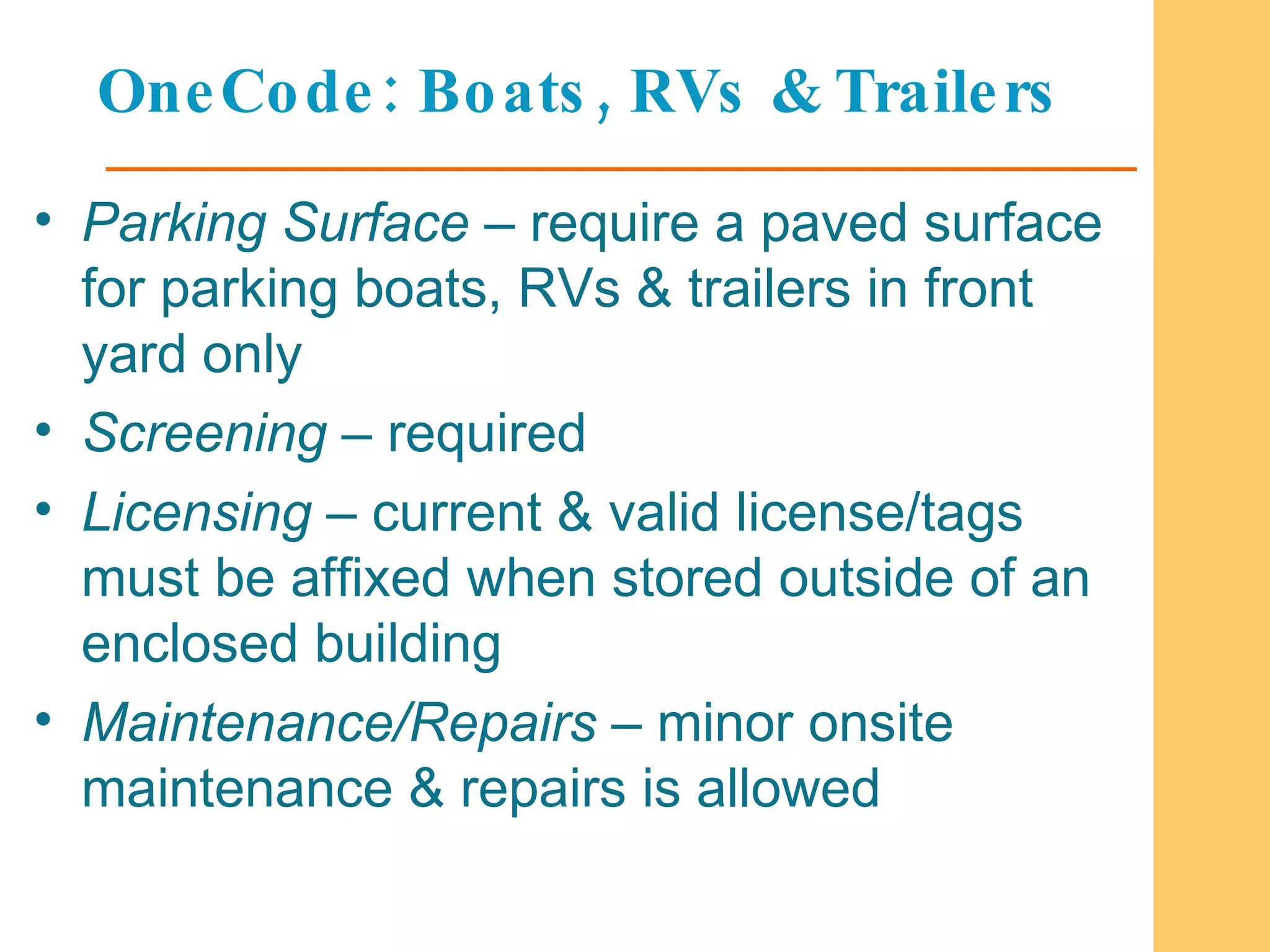
OneCode: Boats, RVs & Trailers Parking Surface  – require a paved surface for parking boats, RVs & trailers in front yard only Screening  – required Licensing  – current & valid license/tags must be affixed when stored outside of an enclosed building Maintenance/Repairs  – minor onsite maintenance & repairs is allowed
 
What do the new districts do? Urban intensity: height, density, lot coverage Urban form: parking in rear, buildings closer to street, wide sidewalks, small or zero side yards, vertical (structured) parking  Mixing of uses, outdoor dining Basic design standards Flexible parking for mixed uses
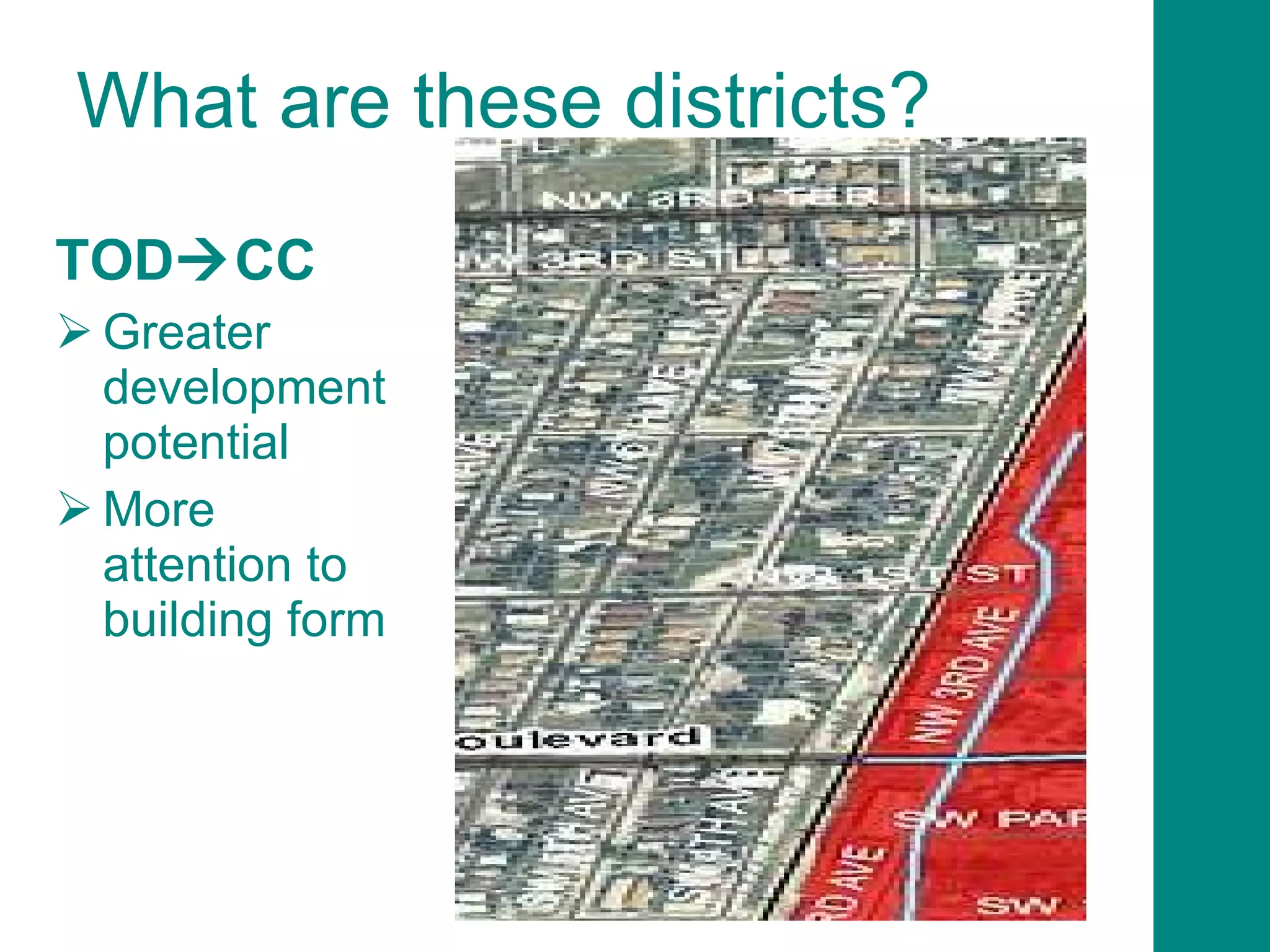
What are these districts? TOD  CC Greater development potential  More attention to building form
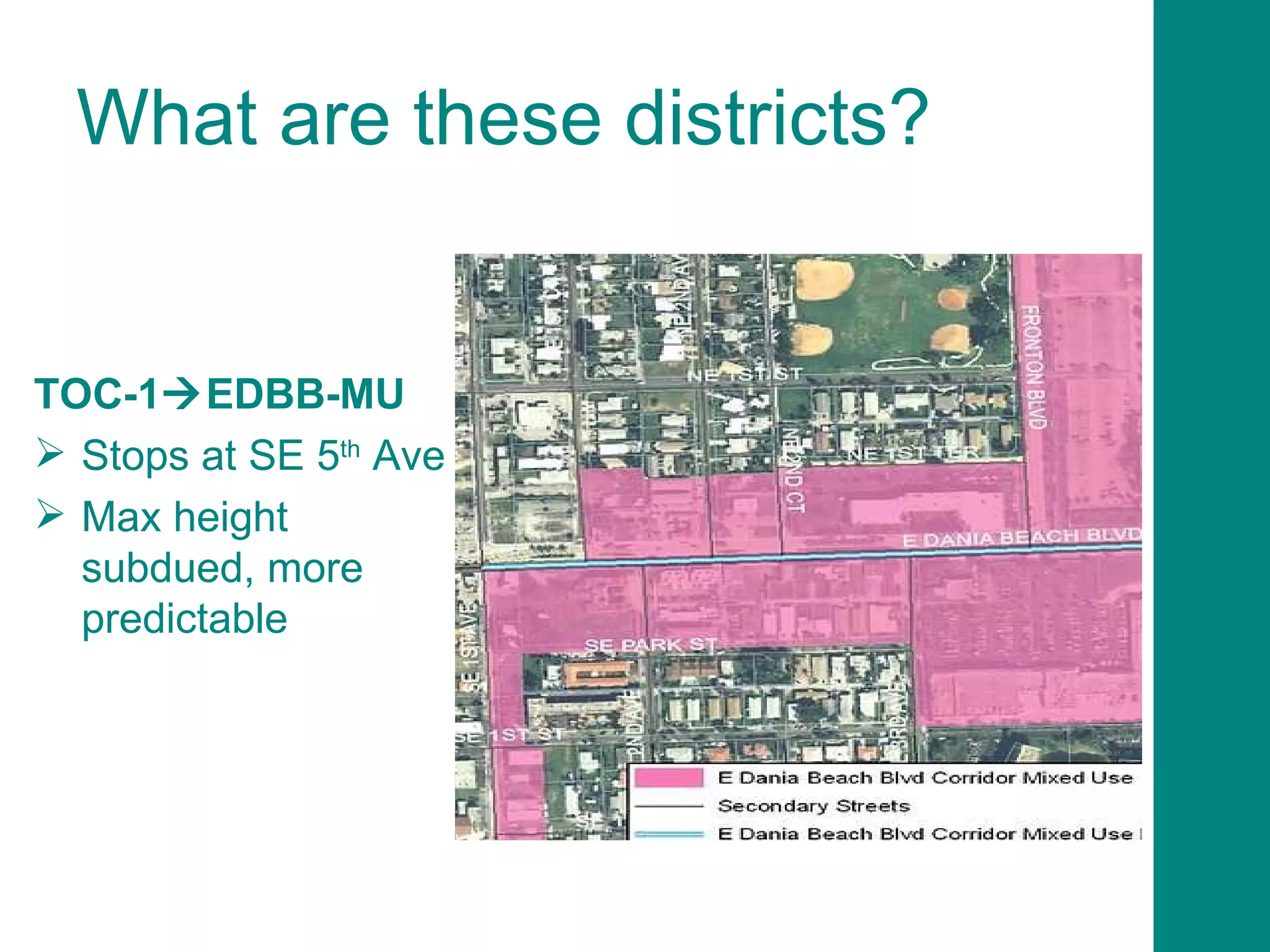
What are these districts? TOC-1  EDBB-MU Stops at SE 5 th  Ave Max height subdued, more predictable
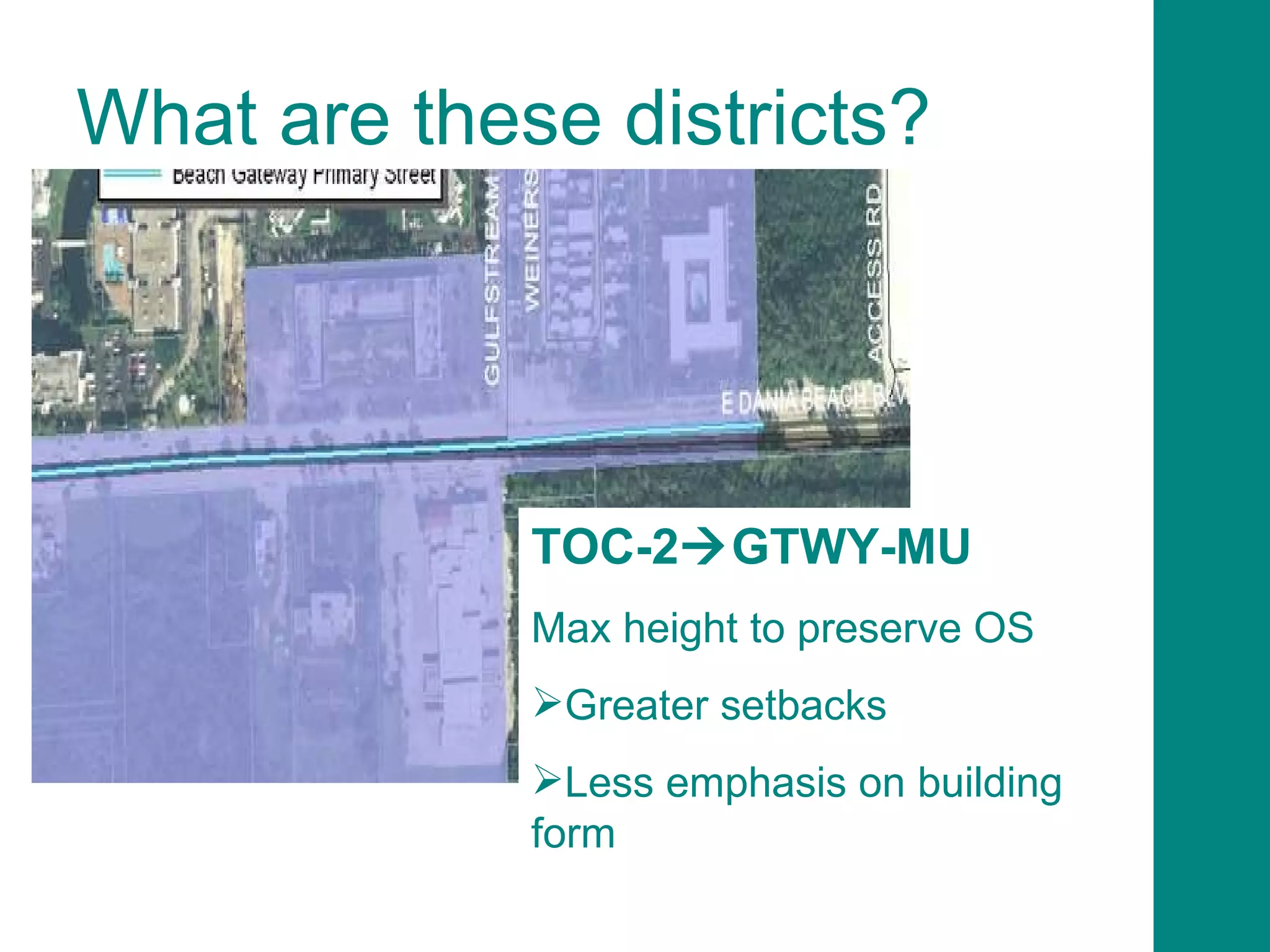
What are these districts? TOC-2  GTWY-MU Max height to preserve OS Greater setbacks Less emphasis on building form
What are these districts? TOC-2    SFED-MU Enhance residential transitions Reduce setbacks not adjacent to residential


One code final presentation 8 18_10

  • 1.
    What is OneCode?A major step toward a better Dania Beach Protecting neighborhoods, lifestyle-not changing them Attracting quality redevelopment More shopping and employment opportunities Increasing property values A code meant for everyone to use
  • 2.
    What is OneCode?An update of an outdated, confusing and disorganized code User-oriented features Implements CRA Plan to advance investment & redevelopment in CRA LAC  RAC One Code for One City
  • 3.
  • 4.
    What is OneCode? Integration of 3 separate zoning codes into one unified document 1990 County Code 2001 County Code City Code OneCode Job description: bring entire city together under one code without changing residents’ lifestyle under respective codes
  • 5.
    Annexed Area Rezoning Replace County districts with City districts No boundary changes Perception vs. reality Account for minor differences No change in lifestyle
  • 6.
  • 7.
    Gathering Citizen InputCity hosted 5 workshops to identify the community’s preferences and provide code information May 5, 2009 May 13, 2009 June 2, 2009 August 18, 2009 (City Commission) August 19, 2009 (Marine AdvisoryBd) –
  • 8.
    Getting the WordOut Mailouts Email Fliers at City Hall, City Parks Newspaper: Dania Press, Sun Sentinel Internet BSO Message Board Cable channel
  • 9.
    Community Appearance TopicsCommunity appearance topics we asked you about: Boat Lifts & Pilings Sheds Fences, Walls & Hedges Boats, RVs & Utility Trailers Commercial Vehicles Parking Other Comments
  • 10.
    What OneCode Is Not OneCode does NOT change what a resident can do with property OneCode does NOT change what can be built next to you, or across the street from you OneCode does NOT require residents or existing businesses to make expensive improvements
  • 11.
    What OneCode Is Not OneCode does NOT increase your parking requirement (it may actually decrease it) OneCode does NOT reduce your permitted signage OneCode does NOT reduce business opportunities or development potential OneCode does NOT change impact fees OneCode is NOT a re-do of the entire City Code
  • 12.
    Code Changes Emergencygenerators for nonresidential uses Waiver of separation requirements between establishments licensed to serve liquor on premises Temporary signage for garage sales & special events Procedure for approving temporary uses Phasing of community amenities SFR in RMH Auto repair, rental in IROM
  • 13.
    Streamlined development reviewprocess Allow MHs after natural disaster Allow SFR that are nonconforming as to setbacks, etc. to rebuild Updated concurrency regulations Missing industrial, RO signage standards Carport encroachments in R Districts Pain clinics Consolidate RM, PUD A & B, PRD-1 Code Changes
  • 14.
    Community Redevelopment AreaParking regulations off-site and centralized parking (in-lieu) on-street parking updated, competitive parking requirements shared parking for mixed uses parking studies
  • 15.
    Community Redevelopment AreaMore of each lot is developable Require buildings close to street Build entire frontage of lot Less emphasis on land assemblage Streetscape requirements Off-site open space (in-lieu)
  • 16.
    Community Redevelopment Area Incentives are focused on: public parking usable open space workforce housing green building
  • 17.
  • 18.
    Community Redevelopment AreaAppropriate height transitions adjacent to residential neighborhoods
  • 19.
    Existing CRA mixed-use zoning districts
  • 20.
    NBHD-RES Currently RS-6000,RD-8000 Remains same on SFR blocks New standards for duplex, MF blocks Existing garden apartment densities are permanently grandfathered, building placement and design not grandfathered What are these districts?
  • 21.
    What are thesedistricts? NBHD-MU (new) Low-intensity mixed-use Neighborhood-scale uses No immediate rezoning
  • 22.
    Table of ContentsPart 1 – Use Regulations Part 2 – Site Development Regulations Part 3 – Special Zoning Districts Part 4 – Subdivisions; Streets Part 5 – Signage and Design Regulations Part 6 – Development Review Procedures Part 7 – Administration Part 8 – Technical Appendix
  • 23.
    Next Step SignCode Update (December) Mobility Strategy (December) RAC amendment (October adoption) Final phase rezonings (December) CC Expansion Griffin Corridor (CRA) NBHD-MU
  • 24.
  • 25.
    What are thesedistricts? NBHD-MU (new) Low-intensity mixed-use Neighborhood-scale uses No immediate rezoning
  • 26.
  • 27.
    Rear Lot LineHeight Transition
  • 28.
    Side Lot LineHeight Transition
  • 29.
  • 30.
    Format and Organization8 Parts based upon subject matter Each Part is numbered accordingly Example: Part 1 articles are 100-199 Example: Part 2 articles 200-299 Articles are numbered in intervals of 5 Sections are numbered in intervals of 10
  • 31.
    PART 2. SITE DEVELOPMENT REGULATIONS . ARTICLE 200. INTENT, APPLICABILITY AND USER’S GUIDE. ARTICLE 205. SCHEDULE OF SITE DEVELOPMENT STANDARDS FOR EACH ZONING DISTRICT. ARTICLE 210. SUPPLEMENTAL LOT REGULATIONS. ARTICLE 215. SUPPLEMENTAL REGULATIONS FOR YARDS, LOT COVERAGE, IMPERVIOUS AREA AND OPEN SPACE. ARTICLE 220. SUPPLEMENTAL BUILDING AND STRUCTURE HEIGHT REGULATIONS (INCLUDING LOWEST FINISHED FLOOR); ROOFTOP REGULATIONS. ARTICLE 225. INTERSECTION VISIBILITY STANDARDS ARTICLE 230. SPECIAL FLOOR AREA, BUILDING DIMENSION AND BUILDING SIZE STANDARDS. ARTICLE 235. WALLS, FENCES AND HEDGES.
  • 32.
    PART 2. SITE DEVELOPMENT REGULATIONS . ARTICLE 240. DOCKS AND MOORING STRUCTURES. ARTICLE 245. PAVING, EXCAVATION AND FILLING. ARTICLE 250. WILDLIFE PROTECTION. ARTICLE 255. ENVIRONMENTALLY SENSITIVE LANDS ARTICLE 260. AIRPORT PROXIMITY AND NAVIGATIONAL HAZARD REGULATIONS. ARTICLE 265, 270. OFF-STREET PARKING, LOADING REGULATIONS. ARTICLE 275. LANDSCAPING REGULATIONS. ARTICLE 280. OUTDOOR LIGHTING. ARTICLE 285. EMERGENCY GENERATORS
  • 33.
    PART 7. ADMINISTRATION . ARTICLE 700. CODE ADMINISTRATION AND LEGAL PROVISIONS. ARTICLE 705. VIOLATIONS AND PENALTIES. ARTICLE 710. NONCONFORMING USES, STRUCTURES, AND LOTS. ARTICLE 715. DEPARTMENT OF COMMUNITY DEVELOPMENT. ARTICLE 720. PLANNING AND ZONING BOARD.
  • 34.
    Part 8. TechnicalAppendix Concurrency Impact fees Telecommunication towers Tree abuse Tree protection Schedule of required street widths
  • 35.
    How to providefeedback Tonight Email city staff Call city staff Sign-in-sheet so that we may update you Planning & Zoning Department Contact Information: Phone Number: 954.924.6805 ext. 3643 Fax Number: 954.922.2687
  • 36.
  • 37.
    Parking of CommercialVehicles in Residential Districts . Any commercial vehicle having any of the following characteristics: (1)     Capacity of 1½ tons or more; (2)     Overall height of 8’ or taller; (3)     Overall width exceeds 6’ 10”, excluding side-view mirrors; (4)     Overall length exceeds 22)’ 6”; (5)     Is an open truck having load space exceeding 9’ 6” in length; (6)     Dual wheels (side-by-side on the same side of an axle); (7)     More than 2 axles; (8)     Total square footage of signage on the vehicle in excess of 15 square feet; Visible tools, ladders, materials, pipes, and/or racks; Has a hoist, lift, dump body, and/or any other altered cargo box; (11) Manufacturer’s gross vehicle weight rating (GVWR) is 14,000 lbs or more.
  • 38.
    Parking of CommercialVehicles in Residential Zoning Districts   (A)Class A commercial vehicles prohibited Class B: side or rear yard where legally accessible If inaccessible, a single vehicle on a driveway in front yard with no encroachment into the public right-of-way (ex: cannot block or overhang a sidewalk, swale, alley, or travel surface). (D) RMH District. One class B commercial vehicle weighing up to five thousand (5,000) pounds within a carport or enclosed building.    
  • 39.
    Parking of RecreationalVehicles in Residential Zoning Districts   Includes special purpose vehicle, trailer, utility trailer and/or boat (A) Permitted locations. (1) In the side yard or rear yard. (2) On the driveway in the front yard if side or rear yard is legally inaccessible (but cannot encroach into public right-of-way. Must be be oriented perpendicular to the street, except where parked on a paved circular driveway. (3) No parking in the public road right-of-way.
  • 40.
    (B) Maximum height: 13.5 feet unless within in enclosed garage. (C) Maximum length and width: 30 feet by 10 feet in width unless within enclosed, roofed and walled permanent structure. (D) Special purpose vehicles: Permitted only within a wholly enclosed garage. (E) Mobile homes. Parking, storage not permitted. RMH District: 1 boat and 1 recreational vehicle per dwelling unit, not encroaching onto a street or visually obstructing vehicle egress from contiguous properties. All boats twelve (12) fee t or longer must be secured onto a currently licensed boat trailer. Boats and recreational vehicles shall not be stored within a required parking space. Maximum number : 1 each utility trailer, recreational vehicle and boat per dwelling unit, outside of enclosed permanent structure. Parking in front yard when authorized by subsec. (A) limited to 1 of the following: 1 utility trailer or boat secured to a trailer, or 1 recreational vehicle.
  • 41.
    Commercial Vehicles 84% think commercial vehicles should be allowed in residential areas but that where they can park, the character & the number allowed should be regulated 84%
  • 42.
    Commercial Vehicles 53% think commercial vehicles should be regulated by size/weight 53%
  • 43.
    OneCode: CommercialVehicles Defined - vehicle primarily for transportation of property, equipment or persons for hire other than a passenger vehicle, as well as any vehicle (including a passenger vehicle) with advertised markings in excess of 3 sq ft per side or per vehicle top Police cars, ambulances and fire trucks are not classified as commercial vehicles
  • 44.
    OneCode: CommercialVehicles Size –up to Class 3 (max 14,000 lbs) in residential districts Number – no limit Screening – required Parking – garage, side yard, rear yard, & driveway; however only 1 vehicle in the front yard (must be in driveway) Surface – paved surface only required for commercial vehicles parked in the front yard Setback –min 5 ft from any property line
  • 45.
    OneCode: Residential ParkingSurface Swale – will not prohibit parking in the swale Parking Surface – paved surface maintained in good repair; parking in yard allowed but not on grass. Existing off-street gravel parking can remain until substantial property improvements are made or surface is in disrepair, then must replace with hard surface Alternative Parking Surface – allow for alternative pervious surfaces for homes built by 06/26/2005
  • 46.
    OneCode: Boatlifts, docks,pilings Boat Lifts & Pilings – require no side setback, allowed to project at least 5 ft into waterway but not more than 10% of waterway width or 20 ft, whichever is less Boathouses – not allowed in setback area or within or over any public waterway; subject to accessory building height standards Docks – require no side setback, allowed to extend a max of 5 ft into waterway, unless waterway is greater than 50 ft in width, then may extend up to 10% of waterway width or 20 ft, whichever is less
  • 47.
    OneCode: Docking,deck height Boats along Docks – allowed to extend a max of 30% of waterway width measured from property line Docking along Private Dock – docking along private dock without permission of owner is prohibited, unless person/vessel in distress Deck Height – cannot exceed 3 ft above mean high tide or same level of adjacent property if said property’s deck is more than 3 ft above mean high tide
  • 48.
    OneCode: Accessorystructures Setbacks – min 5 ft setback from side & rear; (attached structures subject to front & side setbacks for principal structure & min 10 ft rear setback Height – max height of 10 ft or 14 ft to top of peaked roof, whichever is less Separation – min distance of 10 ft between principal & detached accessory buildings Floor Area – cannot exceed 40% of principal structures gross floor area or 750 sqft, whichever is less Kitchens – prohibited in accessory buildings
  • 49.
    OneCode: Fences, Walls & Hedges Height – fences, walls & hedges can be max of 4 ft along front yard (street side yard), max of 6 ft along side & rear yards Around Swimming Pools – min height of 4 ft for fences & walls Setback – walls, fences & hedges are allowed in setback areas
  • 50.
    OneCode: residentialparking Parking Requirements : Single Family – 3 spaces per unit (1 can be inside a garage) Two Family – 2.2 to 3 spaces per unit Mobile Home – 2 spaces per unit
  • 51.
    Workshop results Boat, RV & Trailer parking 75% want maximum size requirements established for boats, RVs & utility trailers 75.8%
  • 52.
    OneCode: Boats, RVs& Trailers Number Allowed - 1 Boat, 1 RV & 1 Trailer Size Allowed (outdoors) – max RV height of 13.5 ft; max length of 30 ft & max width of 10 ft for boats Storing/Parking – limit to side or rear yards, if not possible, then parking in driveway allowed. Must be setback 5 ft from any property line
  • 53.
    OneCode: Boats, RVs& Trailers Parking Surface – require a paved surface for parking boats, RVs & trailers in front yard only Screening – required Licensing – current & valid license/tags must be affixed when stored outside of an enclosed building Maintenance/Repairs – minor onsite maintenance & repairs is allowed
  • 54.
  • 55.
    What do thenew districts do? Urban intensity: height, density, lot coverage Urban form: parking in rear, buildings closer to street, wide sidewalks, small or zero side yards, vertical (structured) parking Mixing of uses, outdoor dining Basic design standards Flexible parking for mixed uses
  • 56.
    What are thesedistricts? TOD  CC Greater development potential More attention to building form
  • 57.
    What are thesedistricts? TOC-1  EDBB-MU Stops at SE 5 th Ave Max height subdued, more predictable
  • 58.
    What are thesedistricts? TOC-2  GTWY-MU Max height to preserve OS Greater setbacks Less emphasis on building form
  • 59.
    What are thesedistricts? TOC-2  SFED-MU Enhance residential transitions Reduce setbacks not adjacent to residential
  • 60.
  • 61.
  • 62.
  • 63.
  • 64.
  • 65.

Editor's Notes

  • #8 Before writing the OneCode, we wanted to find out what is important to you and the character of your neighborhood, so that OneCode reflects your values, which is what we did during the May 5 th and May 13 th workshops…asked you to comment and vote on 6 specific topics and left the 7 th topic open for you to identify any code related issues of concern to you
  • #9 Before writing the OneCode, we wanted to find out what is important to you and the character of your neighborhood, so that OneCode reflects your values, which is what we did during the May 5 th and May 13 th workshops…asked you to comment and vote on 6 specific topics and left the 7 th topic open for you to identify any code related issues of concern to you
  • #10 Specifically we asked you about the topics you see listed here…
  • #42 84% of you think commercial vehicles should be allowed in residential areas; however, you also think that where they are allowed to park, the character and the number of commercial vehicles allowed should be regulated
  • #43 53% of you think commercial vehicles should be regulated by at least size and weight
  • #44 This is the proposed definition for commercial vehicles, which is any vehicle designed or used primarily for the transportation of property, equipment or persons for hire other than a passenger vehicle as defined below, as well as any vehicle (including a passenger vehicle) that contains advertised markings in excess of 3 square feet per side or per vehicle top.  Commercial vehicles include, but are not limited to, tractor-trailers and any parts thereof, construction equipment, trucks with bucket lifts, wreckers, tow trucks or other vehicles equipped with a hoist or other mechanical equipment designed to perform a similar function, busses, taxicabs, step vans, utility trucks, flatbed trucks, limousines and any vehicle commonly recognized as a commercial vehicle.  Police cars, ambulances and fire trucks are not classified as commercial vehicles. As you can see by reviewing the commercial vehicle code summary and proposed regulation sheet, this definition is a combination and expansion of the existing definitions and is based on the feedback you gave us.
  • #45 Based on your input the proposed regulations for commercial vehicles are… You voted on general aspects of these proposed regulations, and momentarily we would like to get your input on the more specific regulations being proposed here. Again, all of this information can be found on the commercial vehicle code summary and proposed regulation sheet. For some of these items the existing codes are very similar, so the proposed regulations reflect a minor to nil change, in other instances it is a considerable change in the current regulation, which is why we will be asking you to complete a questionnaire shortly.
  • #46 You can find all of this information on the parking code summary and proposed regulation sheet. For these items the existing codes are very similar, as such these proposed regulations reflect a minor to nil change in the current regulation.
  • #47 Based on your input the proposed regulation for boat lifts and pilings is… Additionally, these are the proposed regulations for other marine standards, such as boathouses, docks, decks and docked boats. You can find all of this information on the marine standards code summary and proposed regulation sheet. For these items the existing codes are very similar, as such these proposed regulations reflect a minor to nil change in the current regulation.
  • #48 Again, the marine standards sheet has a summary of the existing code and these proposed regulations
  • #49 Based on your input the proposed regulation for setbacks of sheds and accessory structures is… Additionally, these are the proposed regulations for other accessory structure standards, such as height, separation, floor area and kitchens. You can find all of this information on the sheds and accessory structure code summary and proposed regulation sheet. For these items the existing codes are very similar, as such these proposed regulations reflect a minor to nil change in the current regulation.
  • #50 Based on your input the proposed height regulation for fences, walls and hedges is… Additionally, these are the proposed regulations for other fences, walls and hedges standards, such as height around swimming pools and setback information. You can find all of this information on the sheds and accessory structure code summary and proposed regulation sheet. For these items the existing codes are very similar, as such these proposed regulations reflect a minor to nil change in the current regulation.
  • #51 Again, for these items the existing codes are very similar, as such these proposed regulations reflect a minor to nil change in the current regulation. All of this information can be found on the parking code summary and proposed regulation sheet.
  • #52 75% want maximum size limitations established for boats, RVs and utility trailers
  • #53 Based on your input the proposed regulations for boats, RVs and utility trailers are… You voted on general aspects of these proposed regulations, and momentarily we would like to get your input on the more specific regulations being proposed here. All of this information can be found on the boats, RVs and utility trailer code summary and proposed regulation sheet. For some of these items the existing codes are very similar, so the proposed regulations reflect a minor to nil change, in other instances it is a considerable change in the current regulation, which is why we will be asking you to complete a questionnaire shortly.
  • #54 Again, you can find this information on the boats, RVs and utility trailer code summary and proposed regulation sheet. After we review the results and proposed regulation for commercial vehicles, we will pass out a questionnaire to gather your input on these proposed Boat, RV, and trailer regulations as well as the proposed regs for commercial vehicles, as we would like to get your input on aspects of these proposed regs.