Carlo Pescio @CarloPescio http://physicsofsoftware.com
Carlo Pescio
On Growth and Software
(or: applying some Physics of Software)
Carlo Pescio @CarloPescio http://physicsofsoftware.com
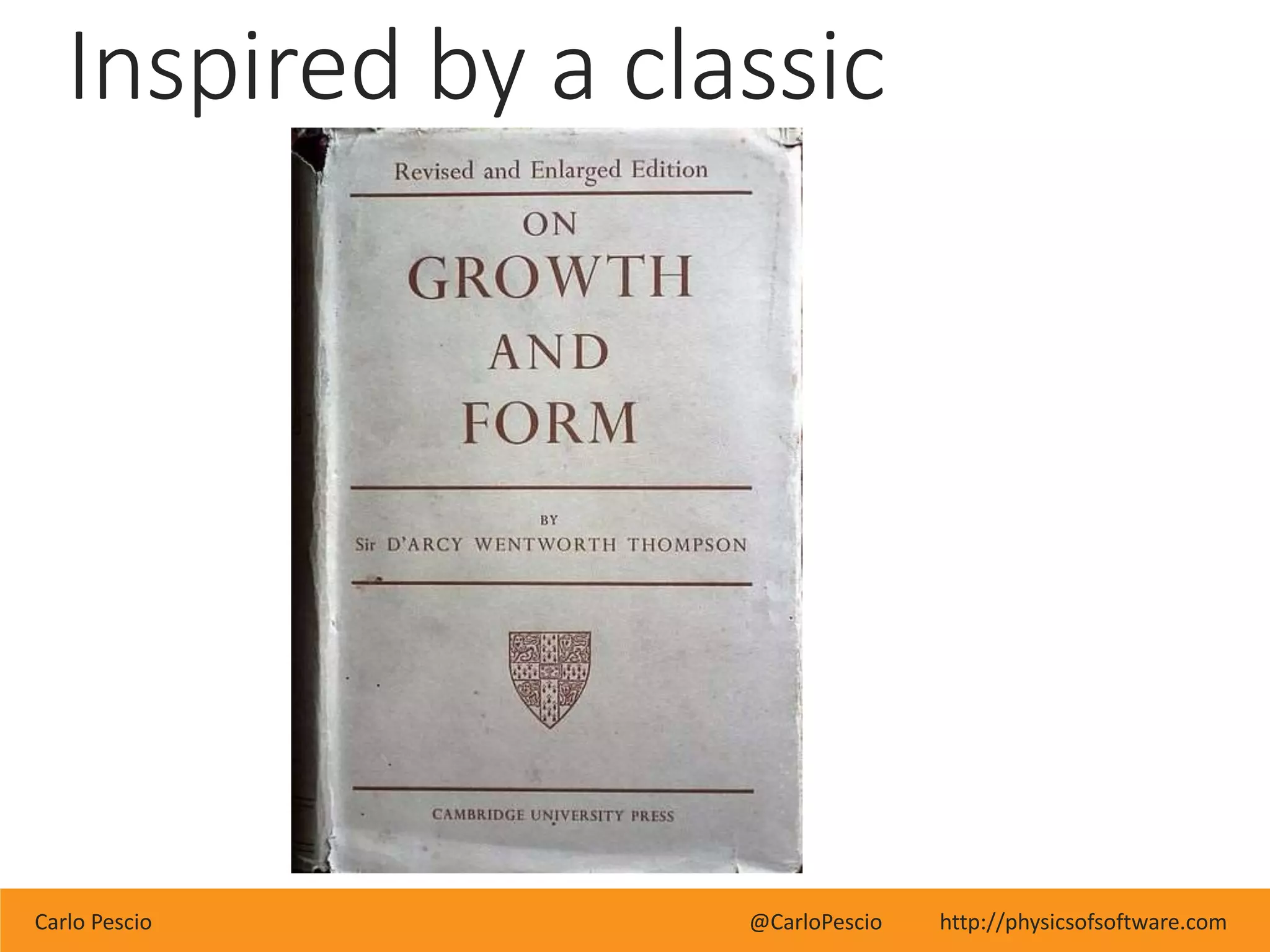
Inspired by a classic
Carlo Pescio @CarloPescio http://physicsofsoftware.com
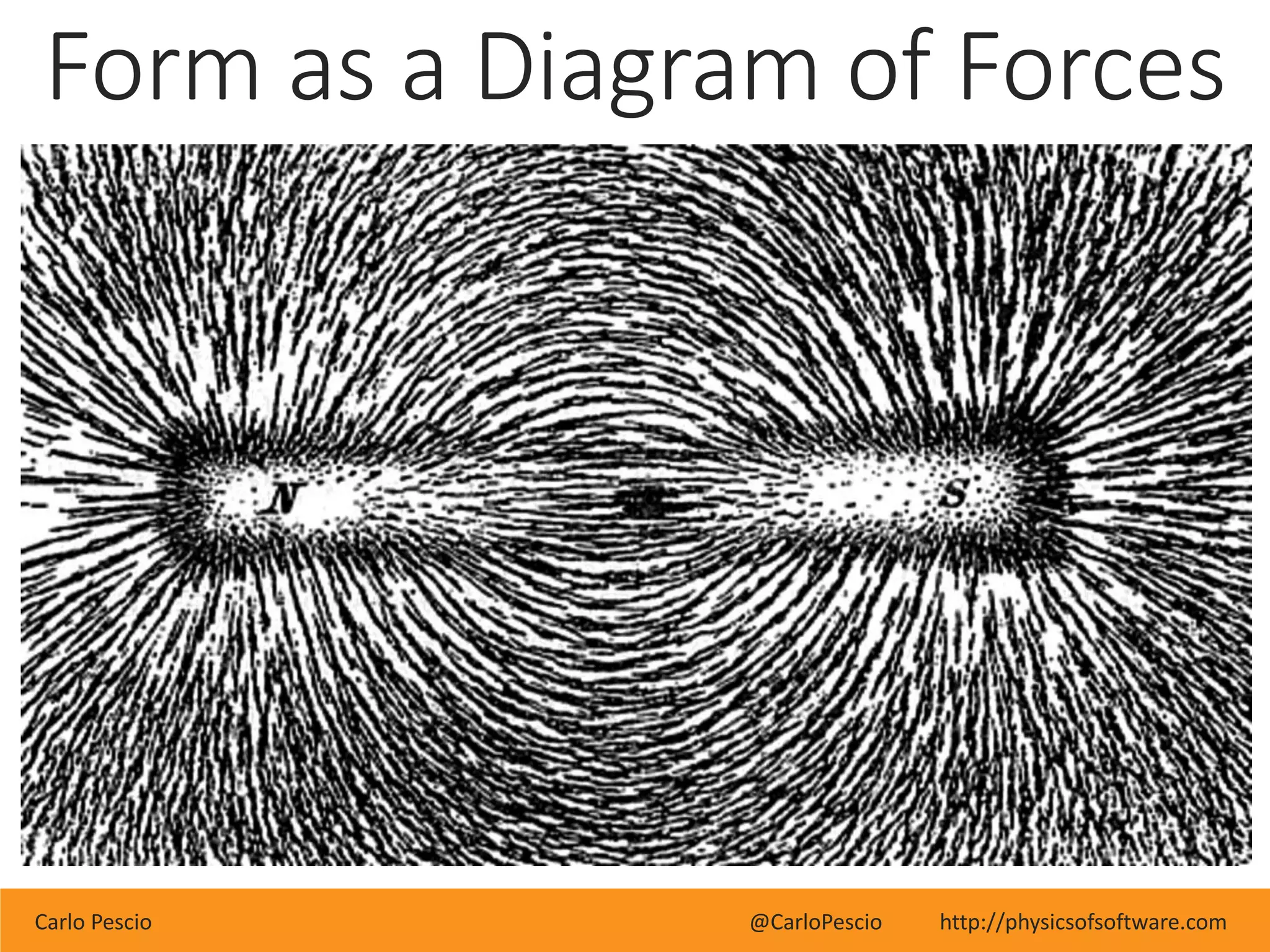
Form as a Diagram of Forces
Carlo Pescio @CarloPescio http://physicsofsoftware.com
Form as a Recipe for Reaction
My own little step – don’t blame D’Arcy 
Material and shape encode reactions to “forces”
Carlo Pescio @CarloPescio http://physicsofsoftware.com
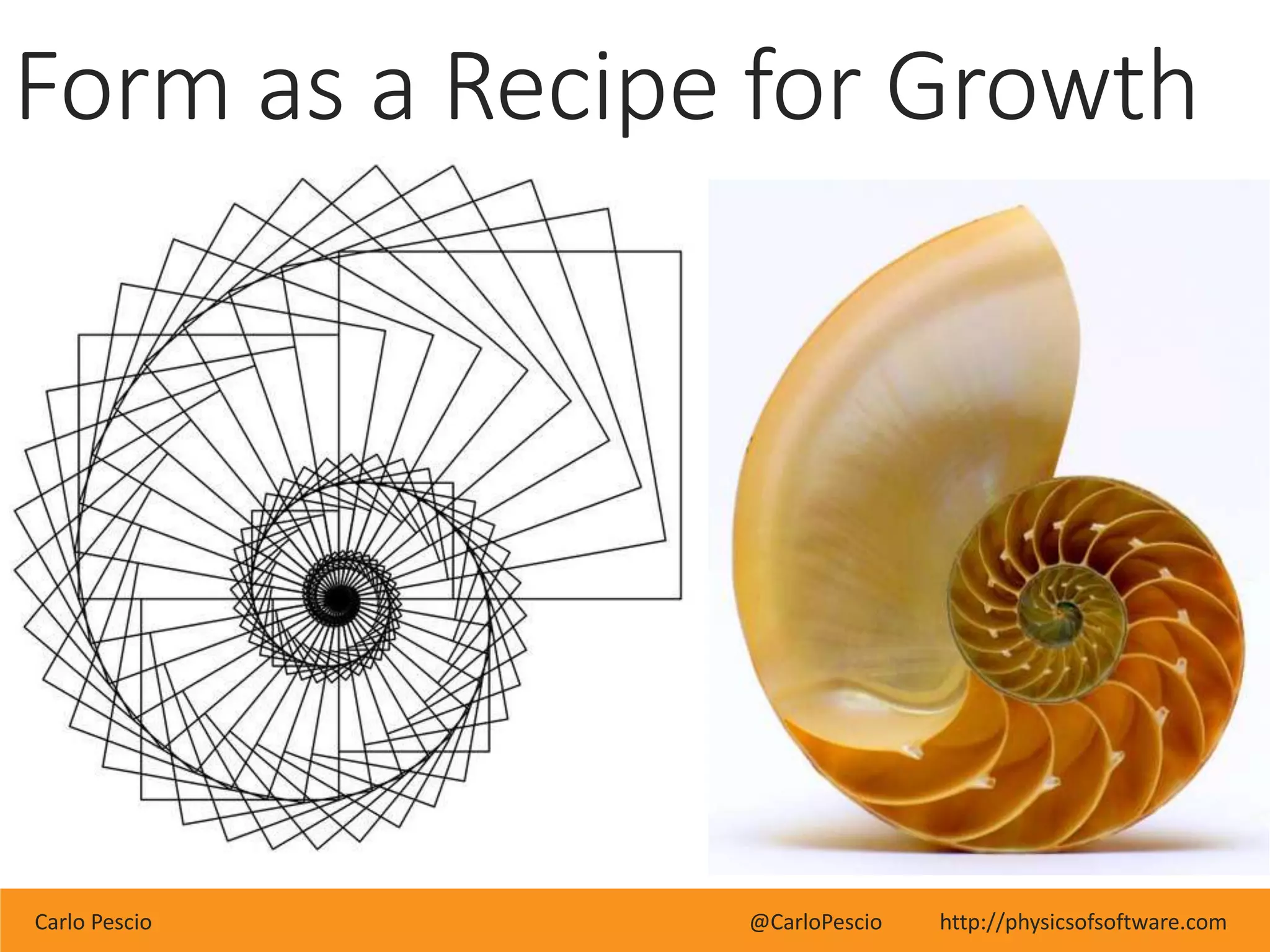
Form as a Recipe for Growth
Carlo Pescio @CarloPescio http://physicsofsoftware.com
Good ol’ book
+ - U
U
Carlo Pescio @CarloPescio http://physicsofsoftware.com
The ring binder
U
D
D
U
U
C
C
Carlo Pescio @CarloPescio http://physicsofsoftware.com
Growth Model
Carlo Pescio @CarloPescio http://physicsofsoftware.com
Growth Model
Carlo Pescio @CarloPescio http://physicsofsoftware.com
[Mis]Aligned Growth Model
(ideal) growth in
decision space
(actual) growth in
artifact space
Carlo Pescio @CarloPescio http://physicsofsoftware.com
“Growth” in computing
Extensibility Scalability
C/D features in code C/D run-time load
Code as artifacts Run-time behavior
C/D feature -> C/D load ->
C/D artifact C/D machines / CPU
Carlo Pescio @CarloPescio http://physicsofsoftware.com
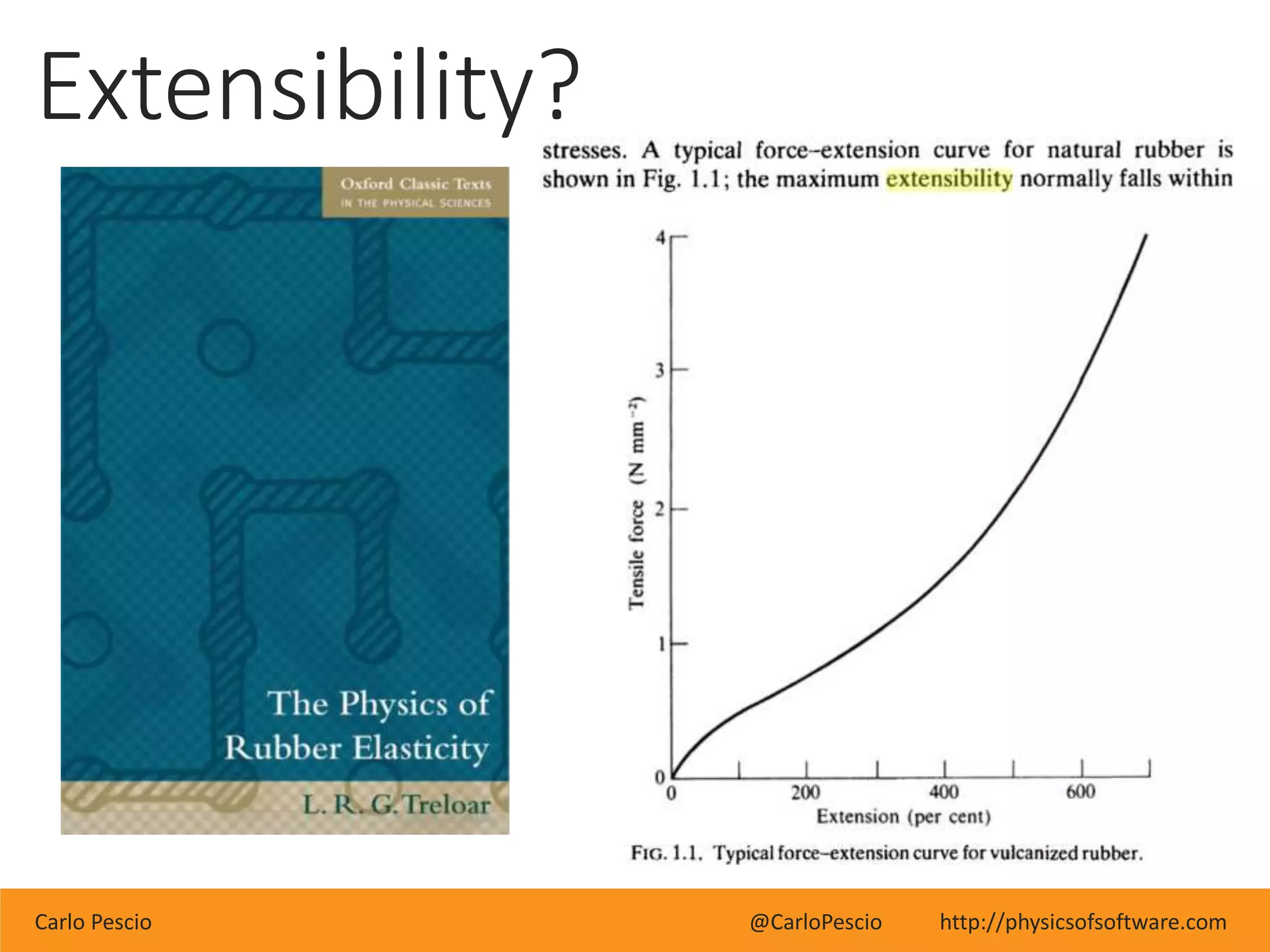
Extensibility?
Carlo Pescio @CarloPescio http://physicsofsoftware.com
Symmetry in Growth [model]
Create feature
Delete feature
decision space
Create artifacts
Delete artifacts
artifact space
Carlo Pescio @CarloPescio http://physicsofsoftware.com
Why bother???
- Product families
- Plug-in architectures, 3rd party modules
- Modular understanding
- “zero impact” evolution
Carlo Pescio @CarloPescio http://physicsofsoftware.com
In practice?
A simple, specific problem
with a specific growth model.
Lessons here apply to similar growth models.
Not everything will / should follow this model.
The final shape is not universal
the method of investigation kinda is
Carlo Pescio @CarloPescio http://physicsofsoftware.com
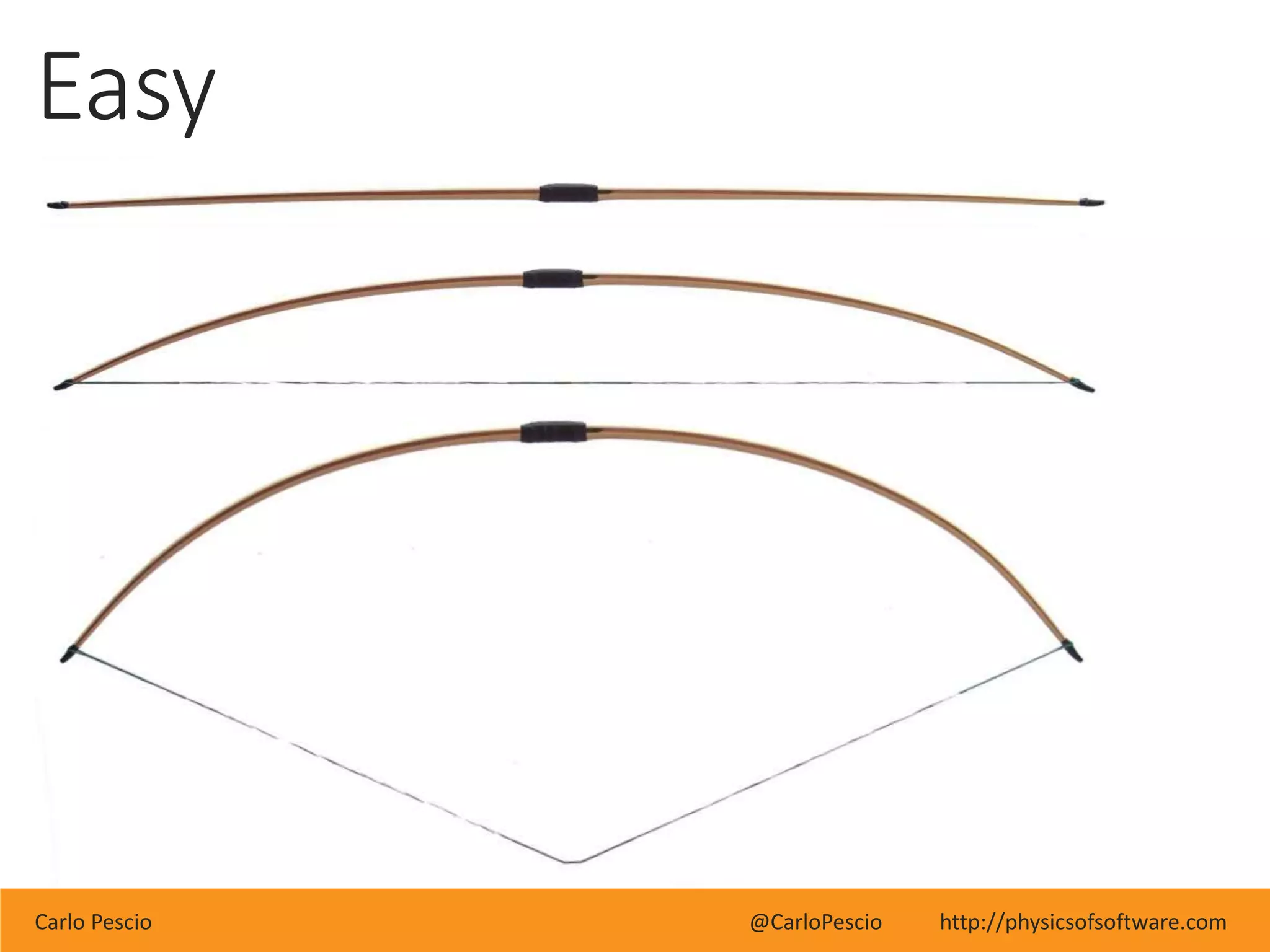
Easy
Carlo Pescio @CarloPescio http://physicsofsoftware.com
Some physics required 
Carlo Pescio @CarloPescio http://physicsofsoftware.com
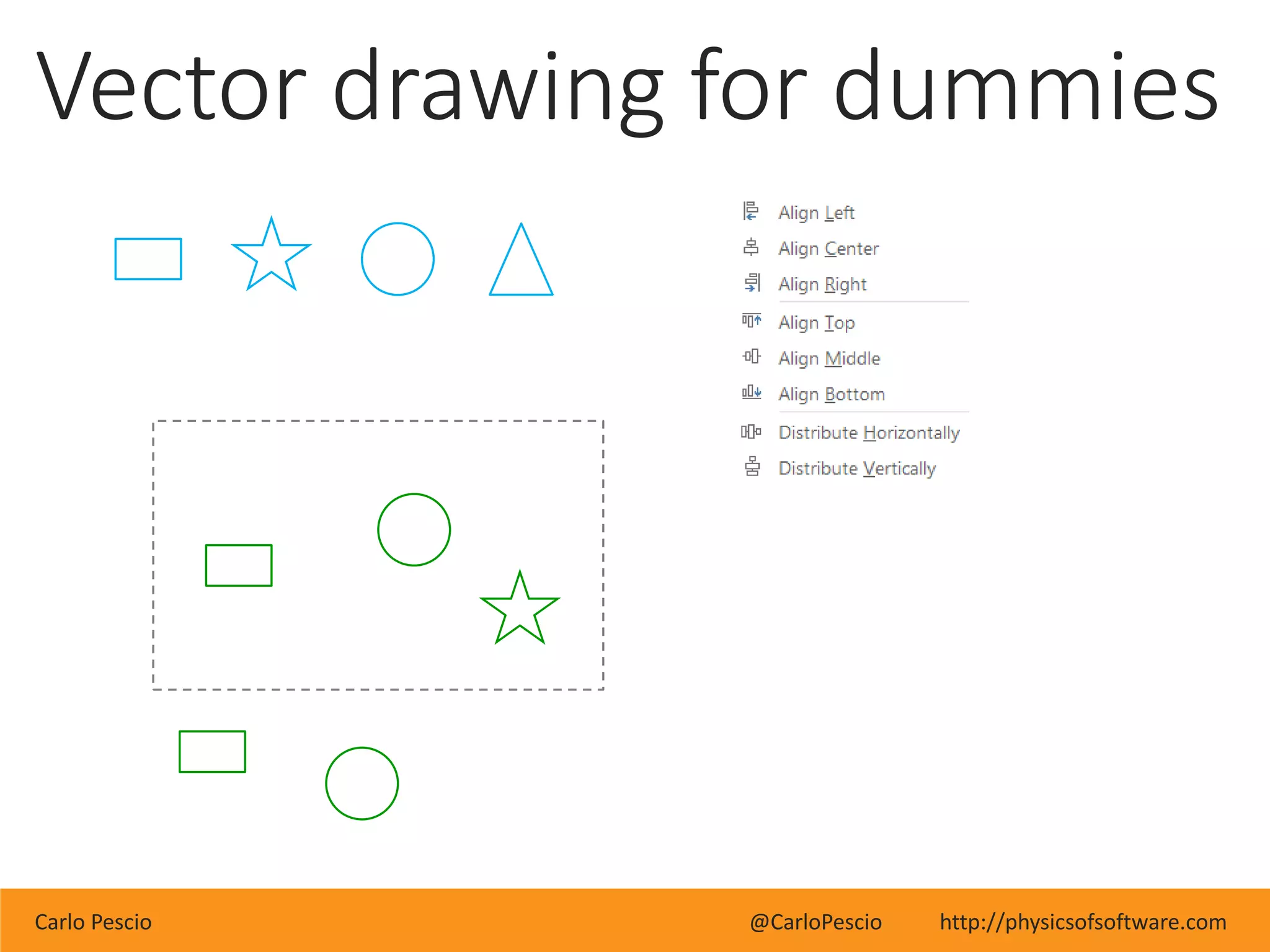
Vector drawing for dummies
Carlo Pescio @CarloPescio http://physicsofsoftware.com
Growth Model
- New shape types will come over time
- New behaviors will come over time
- Behaviors can be composed out of a fixed core
- That entire menu only requires {bounding box, move}
I’m dealing only with geometry right now
Carlo Pescio @CarloPescio http://physicsofsoftware.com
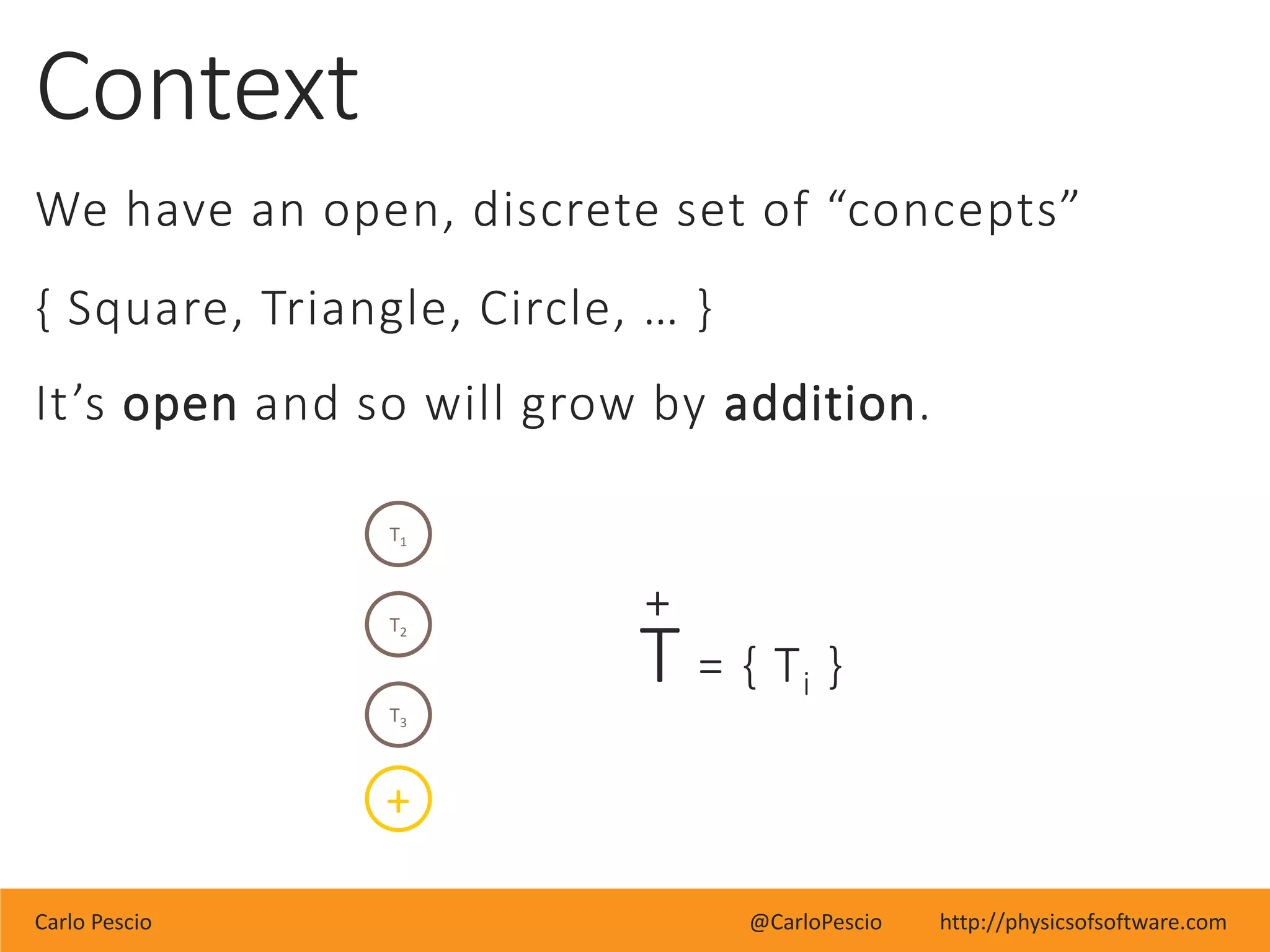
Context
We have an open, discrete set of “concepts”
{ Square, Triangle, Circle, … }
It’s open and so will grow by addition.
T3
T2
T1
+
+
T = { Ti }
Carlo Pescio @CarloPescio http://physicsofsoftware.com
In code?
How do we mirror in code?
• N types: OK
• N classes: OK
• N objects / prototypes: OK
• through closures / records of functions: ok as well
• Case classes: Maybe
• 1 sum type: NO
+
T = { Ti }
N trivial classes (Scala)
class Point( var x : Float,
var y : Float ) {}
class Box( var topLeft : Point,
var bottomRight : Point ) {}
class Circle( var center : Point,
var radius : Float ) {}
class Square( var topLeft : Point,
var side : Float ) {}
+
1 sum type (Haskell): nope
type Point = (Float,Float)
type Radius = Float
type Side = Float
data Shape =
Circle Point Radius |
Square Point Side
+ U
Carlo Pescio @CarloPescio http://physicsofsoftware.com
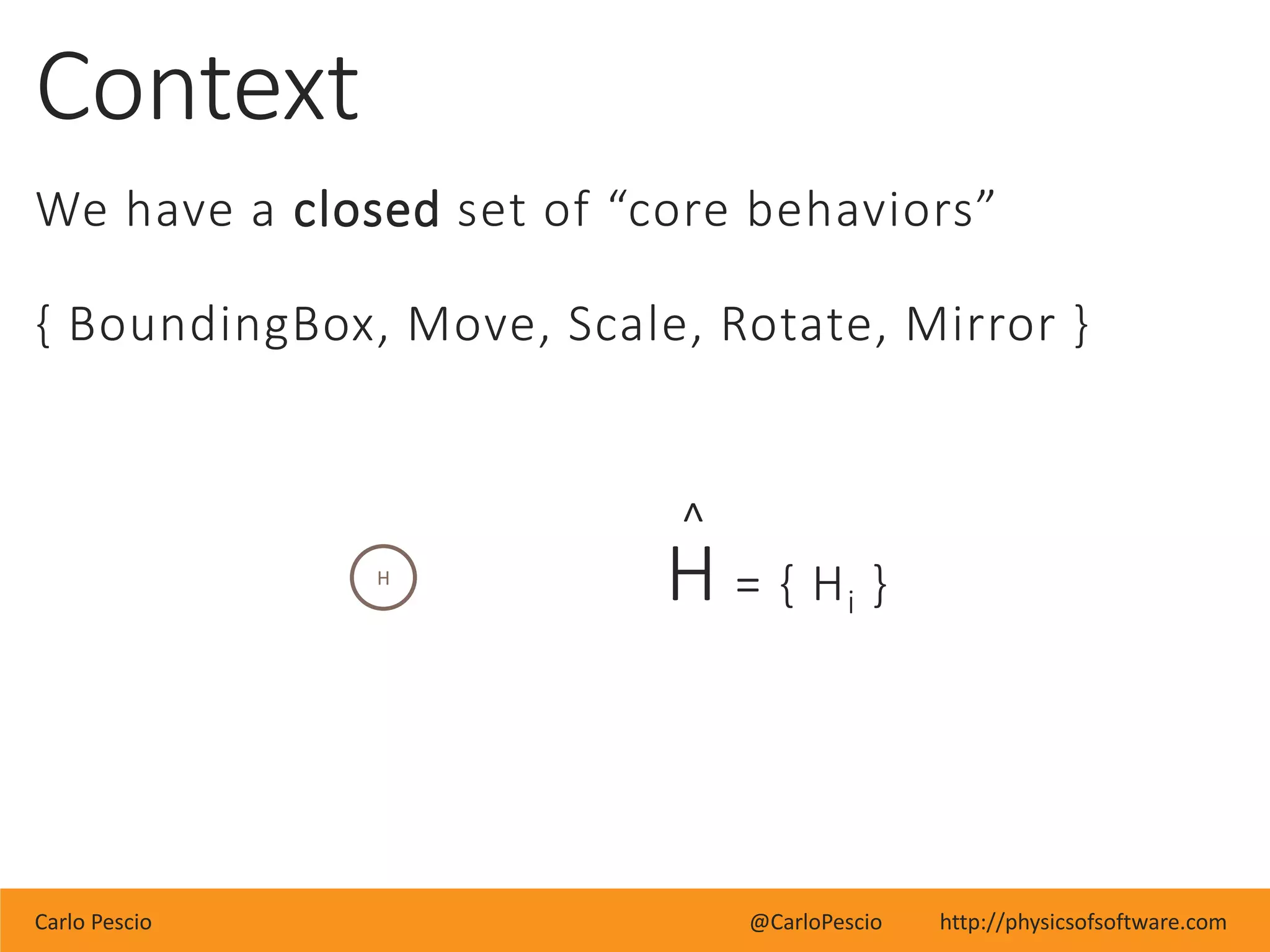
Context
We have a closed set of “core behaviors”
{ BoundingBox, Move, Scale, Rotate, Mirror }
^
H = { Hi }H
Carlo Pescio @CarloPescio http://physicsofsoftware.com
Context
“Core behaviors” depends on concepts.
More precisely: when we create/delete a concept,
we create/delete its implementation of core
behaviors.
^
Ti
C/D > HTi
T3
T2
T1
+
HT3
HT2
HT1
+
Carlo Pescio @CarloPescio http://physicsofsoftware.com
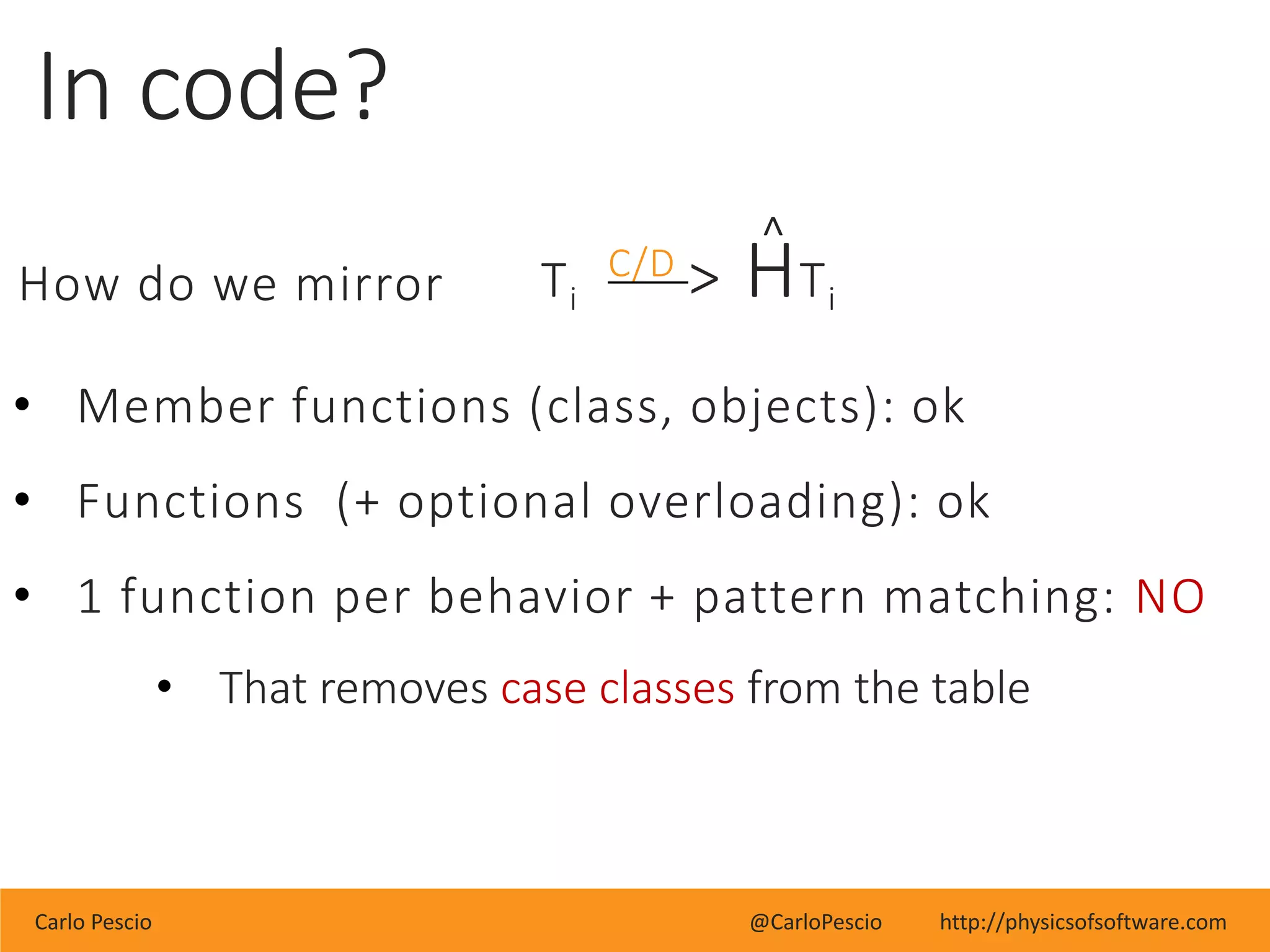
In code?
How do we mirror
• Member functions (class, objects): ok
• Functions (+ optional overloading): ok
• 1 function per behavior + pattern matching: NO
• That removes case classes from the table
^
Ti
C/D > HTi
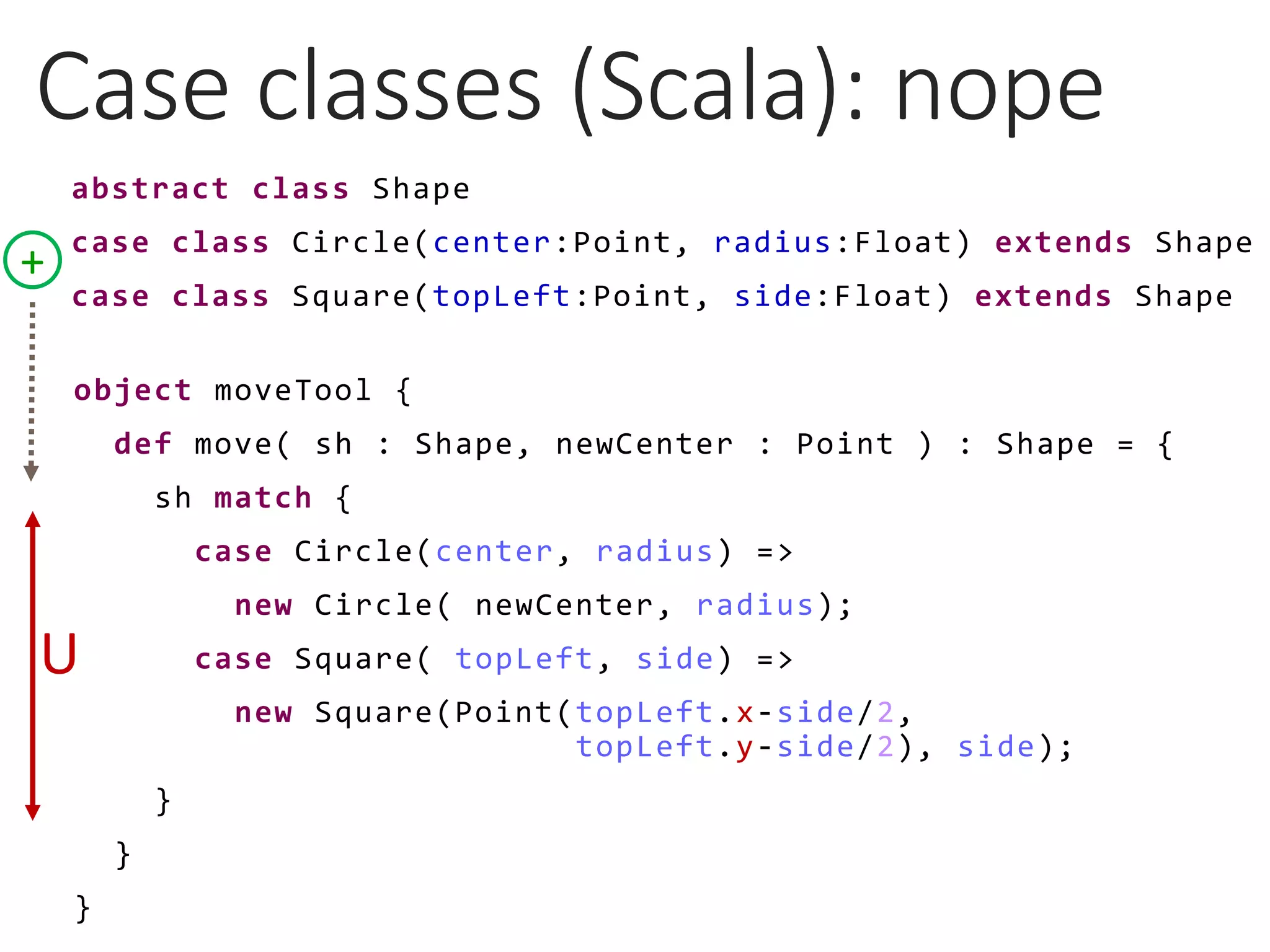
Case classes (Scala): nope
abstract class Shape
case class Circle(center:Point, radius:Float) extends Shape
case class Square(topLeft:Point, side:Float) extends Shape
+
U
object moveTool {
def move( sh : Shape, newCenter : Point ) : Shape = {
sh match {
case Circle(center, radius) =>
new Circle( newCenter, radius);
case Square( topLeft, side) =>
new Square(Point(topLeft.x-side/2,
topLeft.y-side/2), side);
}
}
}
Carlo Pescio @CarloPescio http://physicsofsoftware.com
Context
We can:
a) create instances of those concepts and keep
them available for selection
b) select some of those instances (mixed
concepts) from a bounding box
c) apply composite behaviors to those (mixed)
instances
Carlo Pescio @CarloPescio http://physicsofsoftware.com
Context
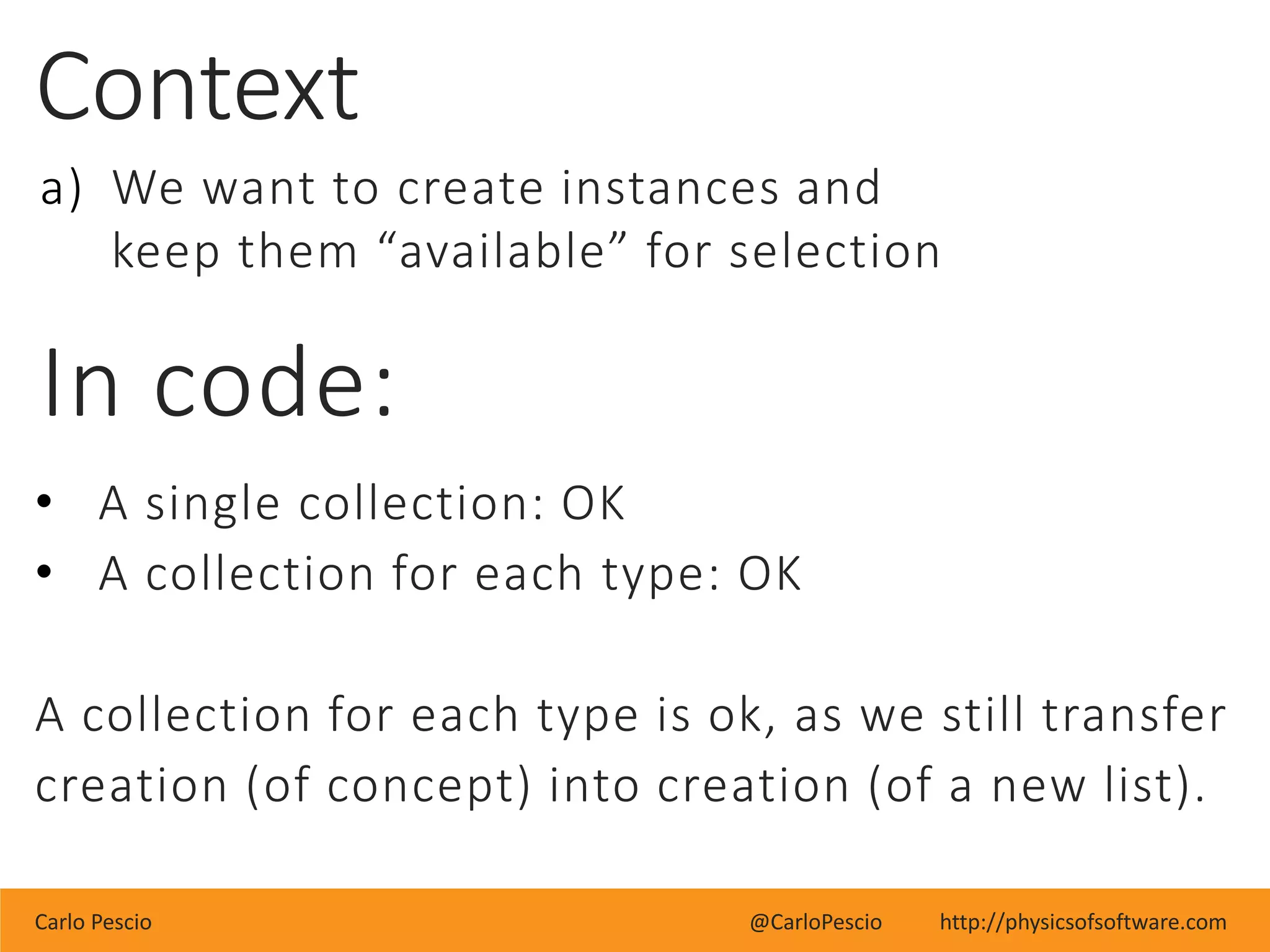
a) We want to create instances and
keep them “available” for selection
In code:
• A single collection: OK
• A collection for each type: OK
A collection for each type is ok, as we still transfer
creation (of concept) into creation (of a new list).
Carlo Pescio @CarloPescio http://physicsofsoftware.com
Context
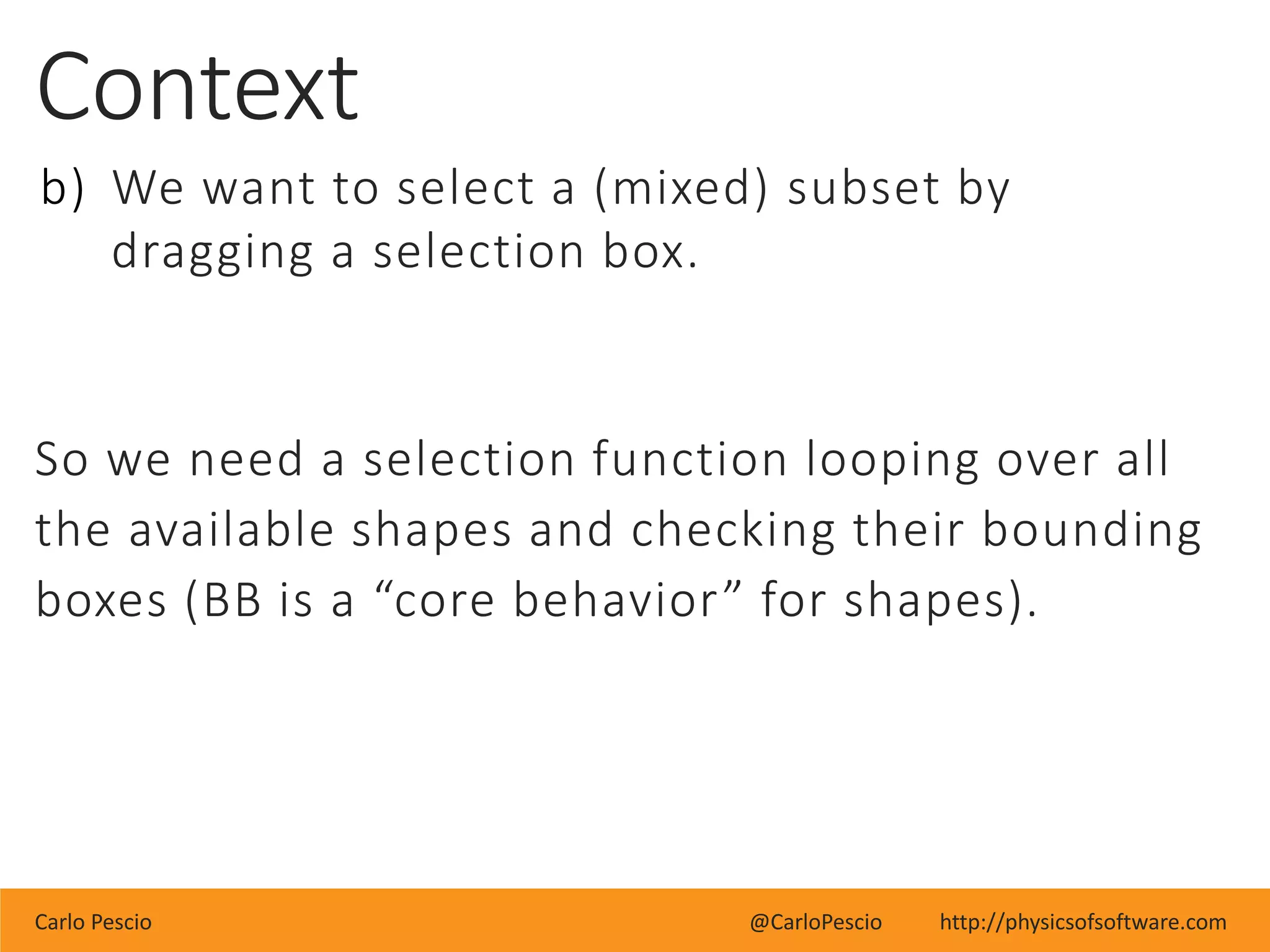
b) We want to select a (mixed) subset by
dragging a selection box.
So we need a selection function looping over all
the available shapes and checking their bounding
boxes (BB is a “core behavior” for shapes).
Carlo Pescio @CarloPescio http://physicsofsoftware.com
selection
box
f
selection
1 collection per type won’t work anymore
+
+
U
Same reasoning applies
to any of the composite
behaviors
shapes
selected
shapes
Carlo Pescio @CarloPescio http://physicsofsoftware.com
Context
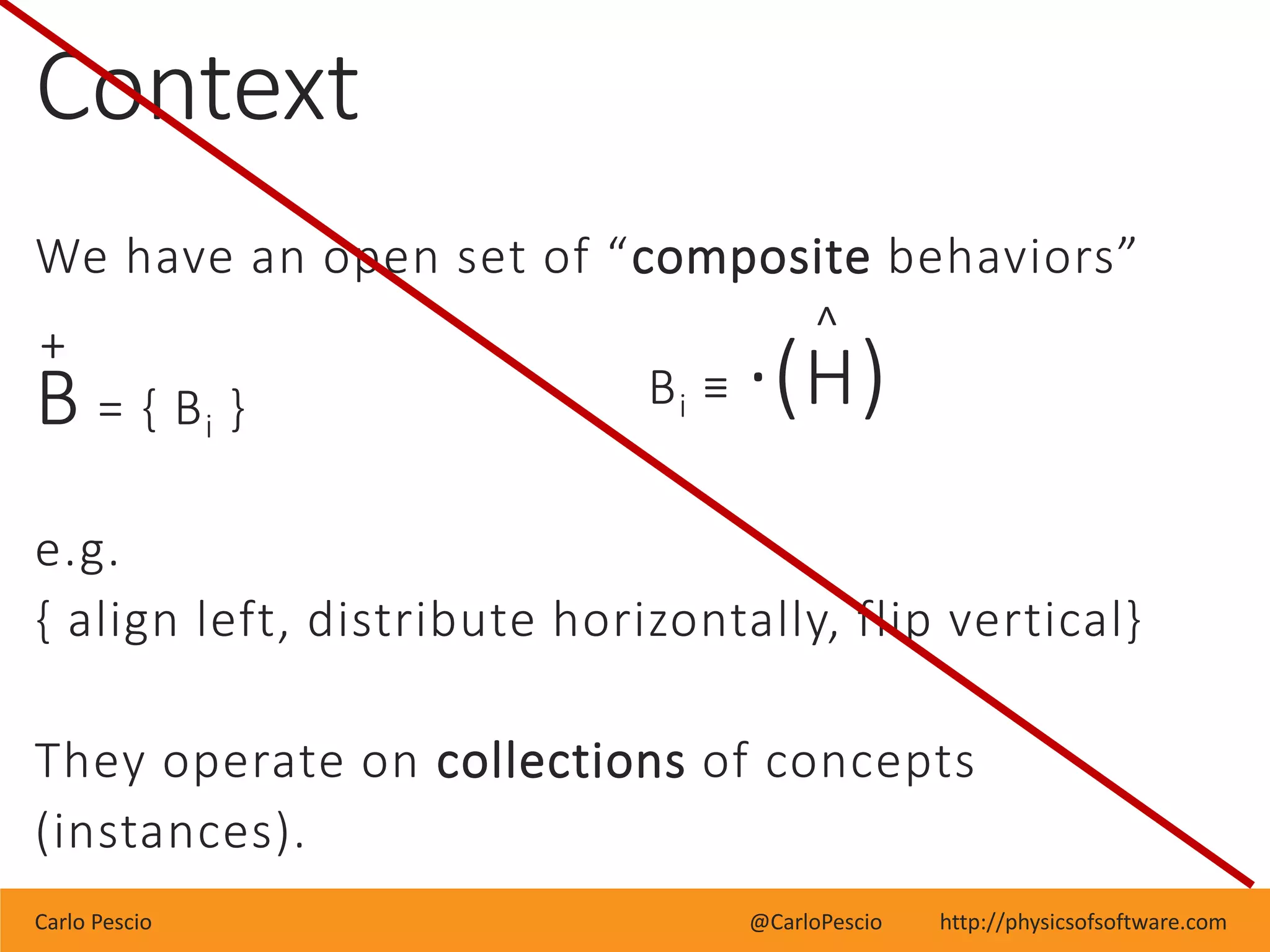
We have an open set of “composite behaviors”
+
B = { Bi }
e.g.
{ align left, distribute horizontally, flip vertical}
They operate on collections of concepts
(instances).
^
Bi ≡ ·(H)
Carlo Pescio @CarloPescio http://physicsofsoftware.com
Context
+
T = { Ti }
*
+
B = { Bi }
^ +
(HTi)
·
C/D
Two problems with Bi here:
1) Works on a set of shapes
(same as selection)
2) Composed from a set of
type-dependent core
behaviors (same as
selection w/ BB)
Carlo Pescio @CarloPescio http://physicsofsoftware.com
A single collection of shapes
That would require either:
• A dynamic language
• mixing types is natural
• A way to form a placeholder type as substitute
for the individual types:
• Base type + subtypes
• Base class / interface + derived classes
• [objects as] Records of closures
• Existential types / Abstract types
Carlo Pescio @CarloPescio http://physicsofsoftware.com
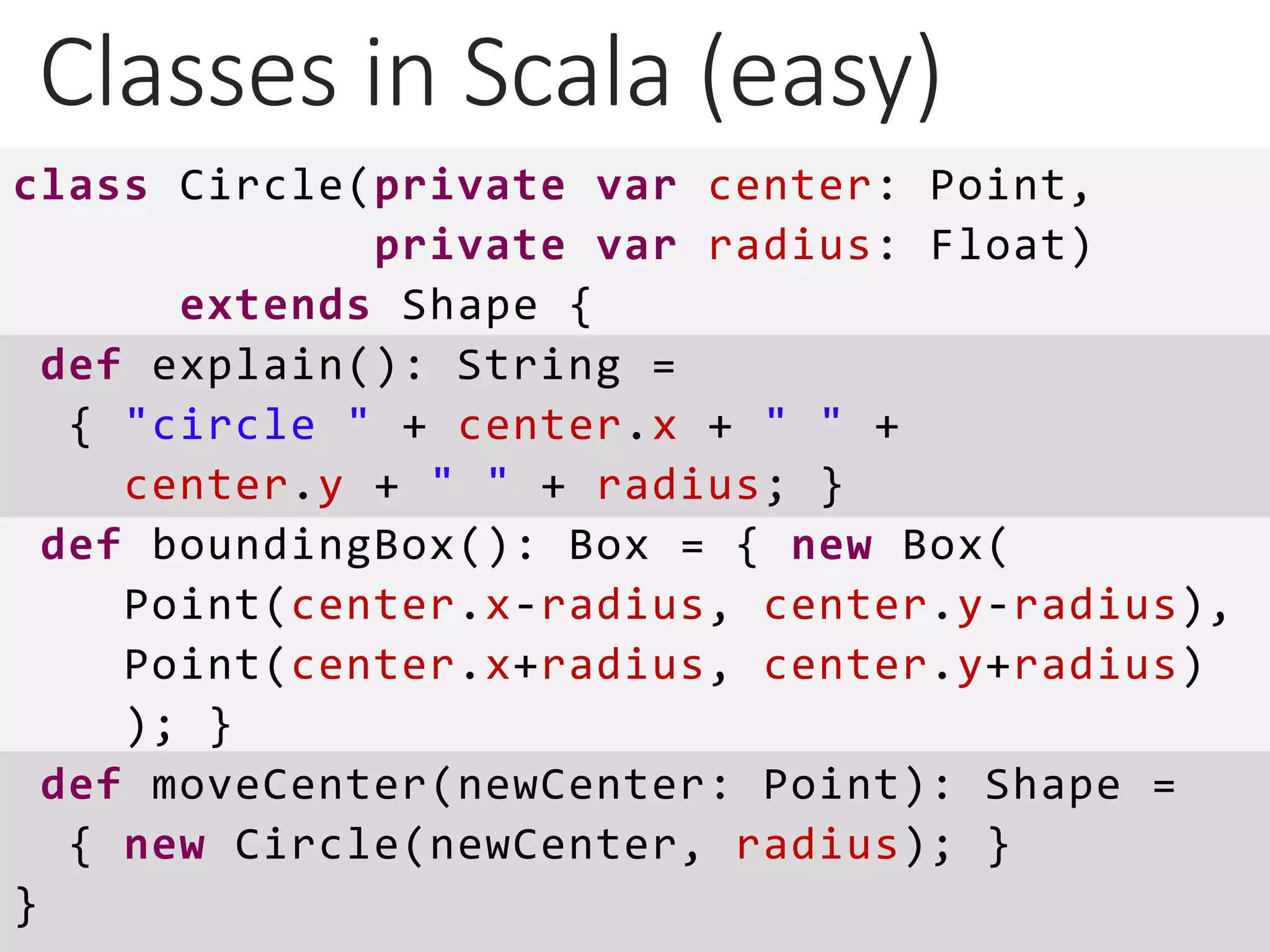
Classes in Scala (easy)
abstract class Shape {
def explain() : String;
def boundingBox() : Box;
def moveCenter(newCenter:Point) :
Shape;
}
Classes in Scala (easy)
class Circle(private var center: Point,
private var radius: Float)
extends Shape {
def explain(): String =
{ "circle " + center.x + " " +
center.y + " " + radius; }
def boundingBox(): Box = { new Box(
Point(center.x-radius, center.y-radius),
Point(center.x+radius, center.y+radius)
); }
def moveCenter(newCenter: Point): Shape =
{ new Circle(newCenter, radius); }
}
Classes in Scala (easy)
class Square(private var topLeft: Point,
private var side: Float)
extends Shape {
def explain(): String =
{ "square " + topLeft.x + " " +
topLeft.y + " " + side; }
def boundingBox(): Box = { new Box(
topLeft,
Point(topLeft.x+side, topLeft.y+side)); }
def moveCenter(newCenter: Point): Shape =
{ new Square(Point(topLeft.x-side/2,
topLeft.y-side/2), side); }
}
Classes in Scala (easy)
object MainObject {
def main(args: Array[String]): Unit = {
val c1 = new Circle( Point(1,1), 4 ) ;
val s1 = new Square( Point(0,0), 4 ) ;
val sh : List[Shape] = List( c1, s1 );
var d : String = sh.map( s =>
s.moveCenter(Point(5,5)).explain()
).reduce((s1,s2) => s1 + " ; " + s2) ;
println( d ) ;
}
}
Records of Closures (Haskell)
type Point = (Float,Float)
type Box = (Point,Point)
data Shape = Shape {
explain :: String,
boundingBox :: Box,
moveCenter :: Point -> Shape
}
Records of Closures (Haskell)
circle :: Point -> Float -> Shape
circle (x,y) r =
Shape explain boundingBox moveCenter
where
explain = "circle " ++ show x ++ " "
++ show y ++ " " ++ show r
boundingBox = ( (x-r, y-r),
(x+r, y+r) )
moveCenter (x1,y1) = circle (x1, y1) r
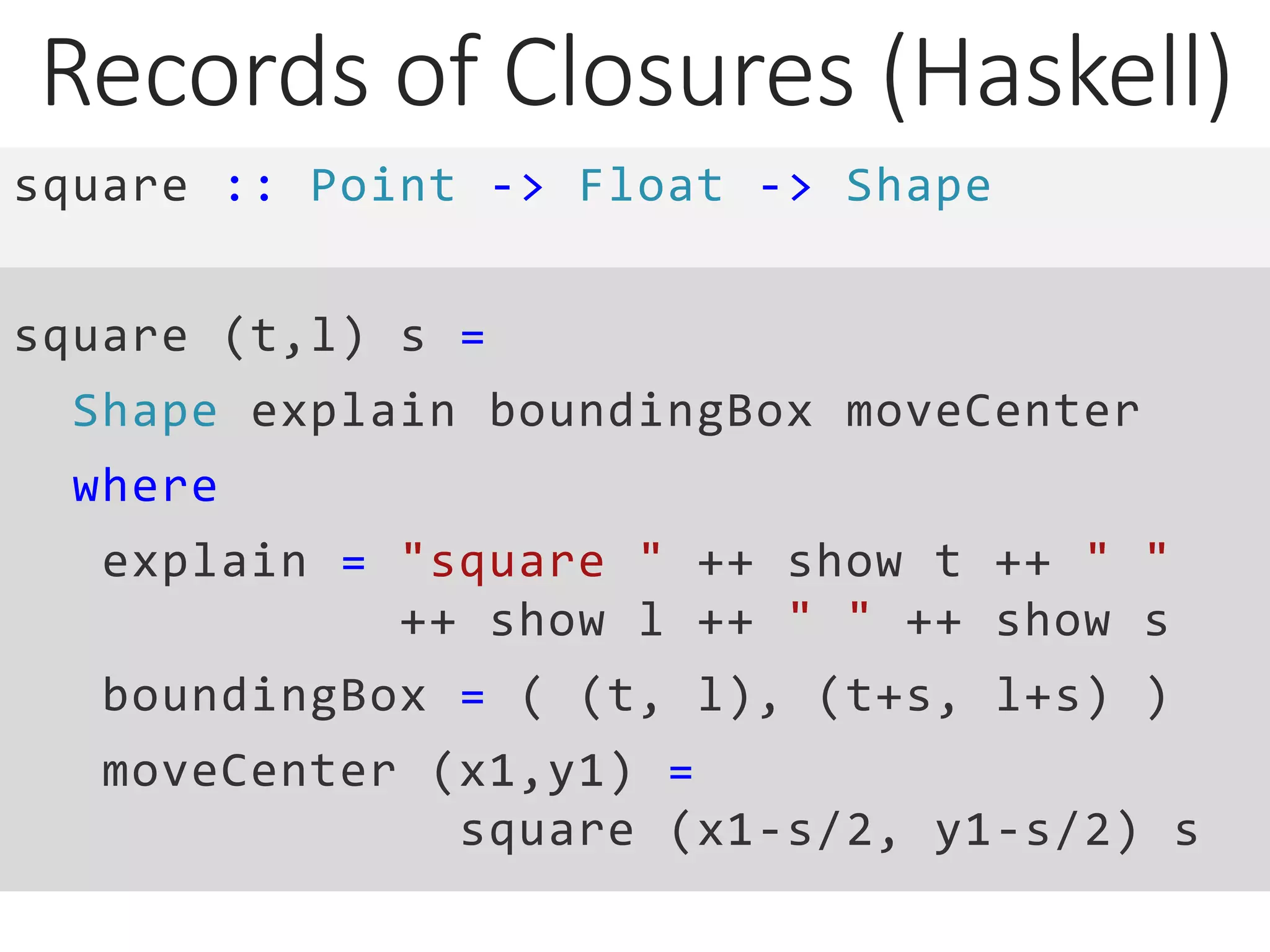
Records of Closures (Haskell)
square :: Point -> Float -> Shape
square (t,l) s =
Shape explain boundingBox moveCenter
where
explain = "square " ++ show t ++ " "
++ show l ++ " " ++ show s
boundingBox = ( (t, l), (t+s, l+s) )
moveCenter (x1,y1) =
square (x1-s/2, y1-s/2) s
Carlo Pescio @CarloPescio http://physicsofsoftware.com
Records of Closures (Haskell)
main = do
let c1 = circle (1,1) 3
let s1 = square (1,1) 3
let sh = [ c1, s1 ]
putStrLn
(concat ( map (s ->
(explain (moveCenter s (5,5)))
++ " ; ") sh ) )
Existential type (Haskell)
type Point = (Float,Float)
type Box = (Point,Point)
class ShapeTC a where
explain :: a -> String
boundingBox :: a -> Box
moveCenter :: a -> Point -> Shape
data Shape = forall a. ShapeTC a => Shape a
instance ShapeTC Shape where
explain (Shape shape) = explain shape
boundingBox (Shape shape) = boundingBox shape
moveCenter (Shape shape) = moveCenter shape
Existential type (Haskell)
data Circle = Circle Point Float
instance ShapeTC Circle where
explain (Circle (x,y) r ) =
"circle " ++ show x ++ " " ++ show y ++
" " ++ show r
boundingBox (Circle (x,y) r) =
( (x-r, y-r), (x+r, y+r) )
moveCenter (Circle (x,y) r) (x1,y1) =
circle (x1, y1) r
circle :: Point -> Float -> Shape
circle (x,y) r = Shape (Circle (x,y) r)
Existential type (Haskell)
data Square = Square Point Float
instance ShapeTC Square where
explain (Square (t,l) s) =
"square " ++ show t ++ " " ++ show l ++
" " ++ show s
boundingBox (Square (t,l) s) =
( (t, l), (t+s, l+s) )
moveCenter (Square (t,l) s) (x1,y1) =
square (x1-s/2, y1-s/2) s
square :: Point -> Float -> Shape
square (t,l) s = Shape (Square (t,l) s)
Existential type (Haskell)
main = do
let c1 = circle (2,2) 3
let s1 = square (2,2) 3
let sh = [ c1, s1 ]
putStrLn
(concat ( map (s ->
(explain (moveCenter s (6,6)))
++ " ; ") sh ) )
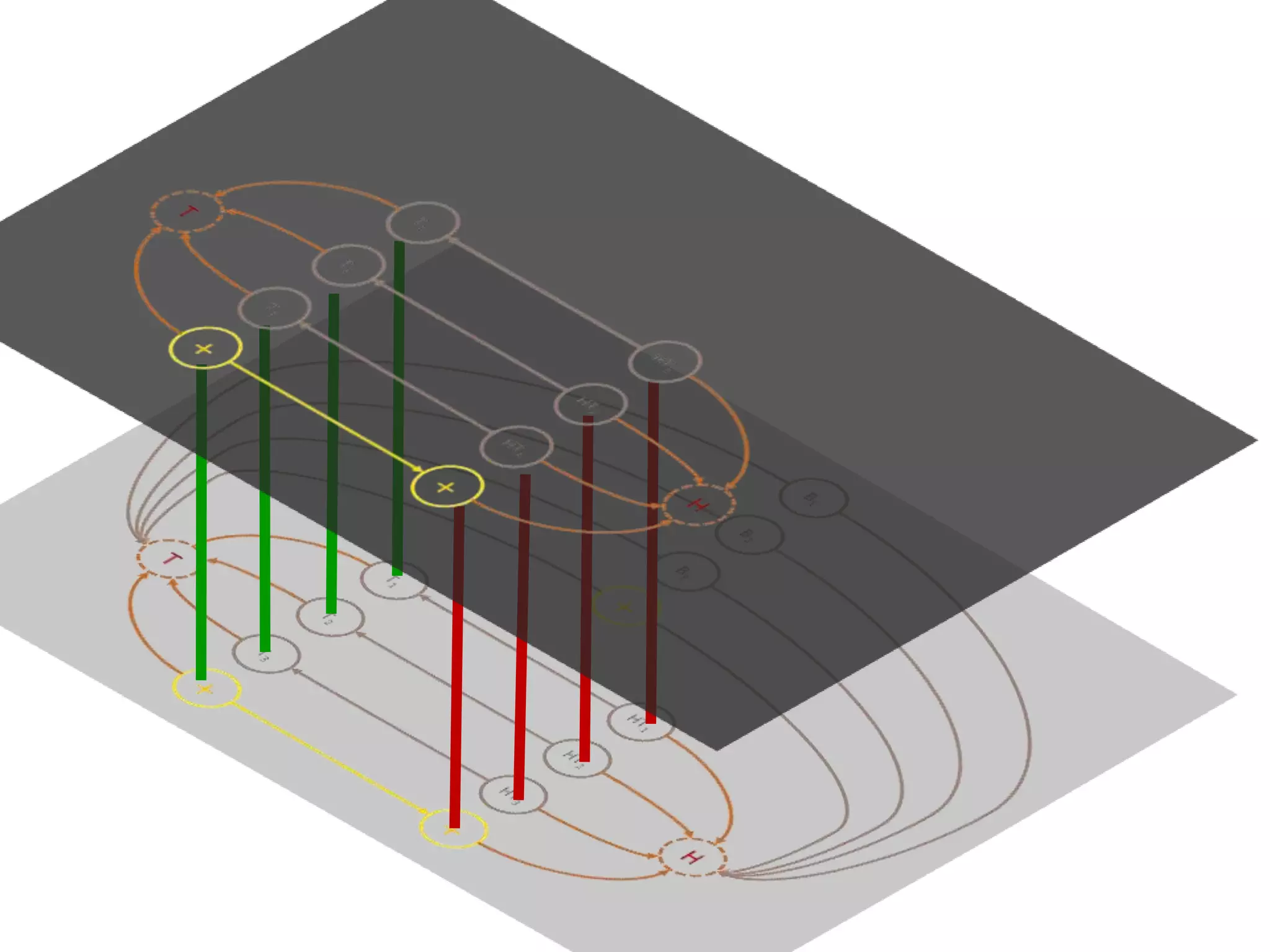
“misaligned” growth model
B3
B2
B1
+
T3
T2
T1
+
HT3
HT2
HT1
+
UU
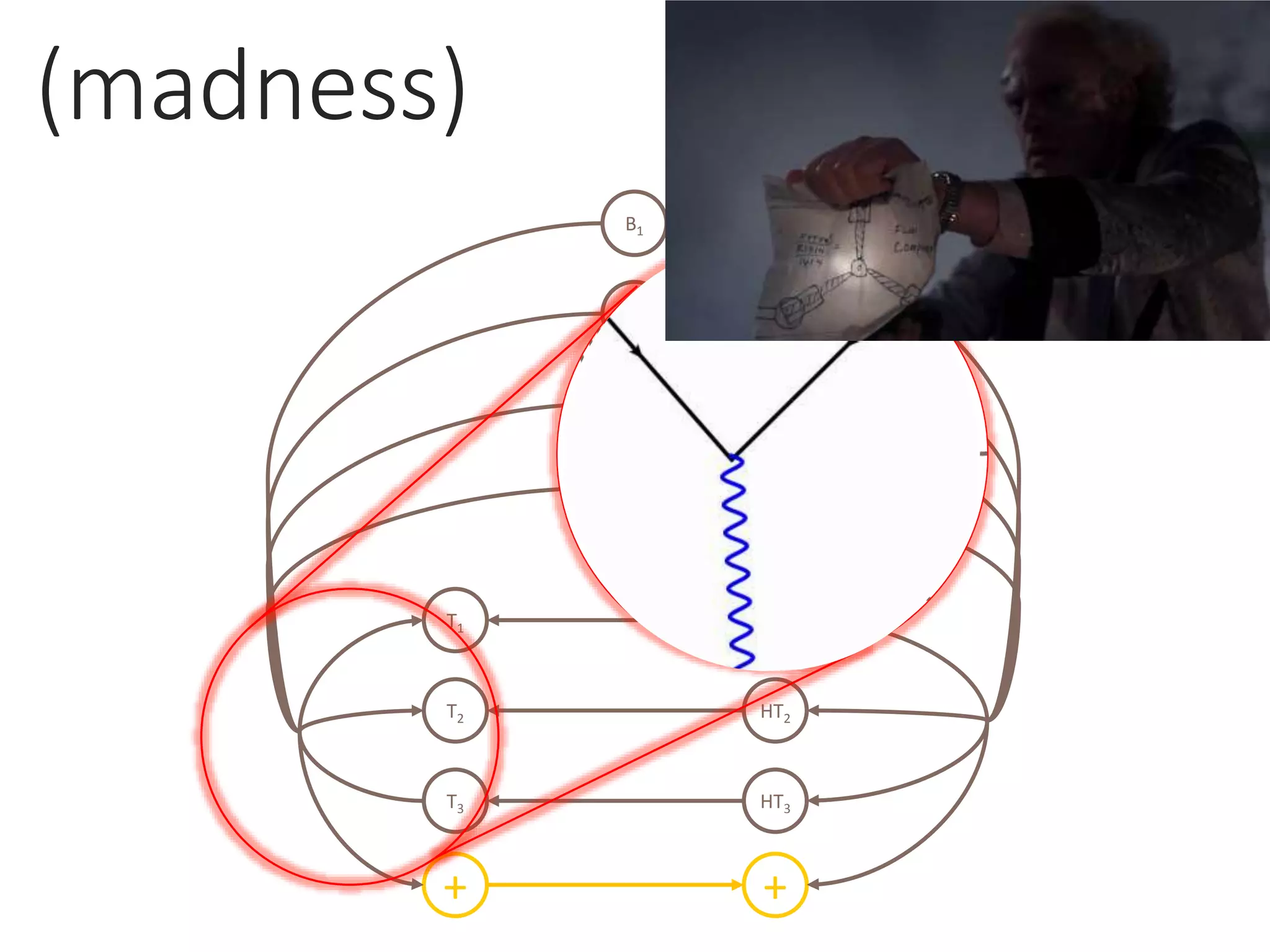
(madness)
B3
B2
B1
+
T3
T2
T1
+
HT3
HT2
HT1
+
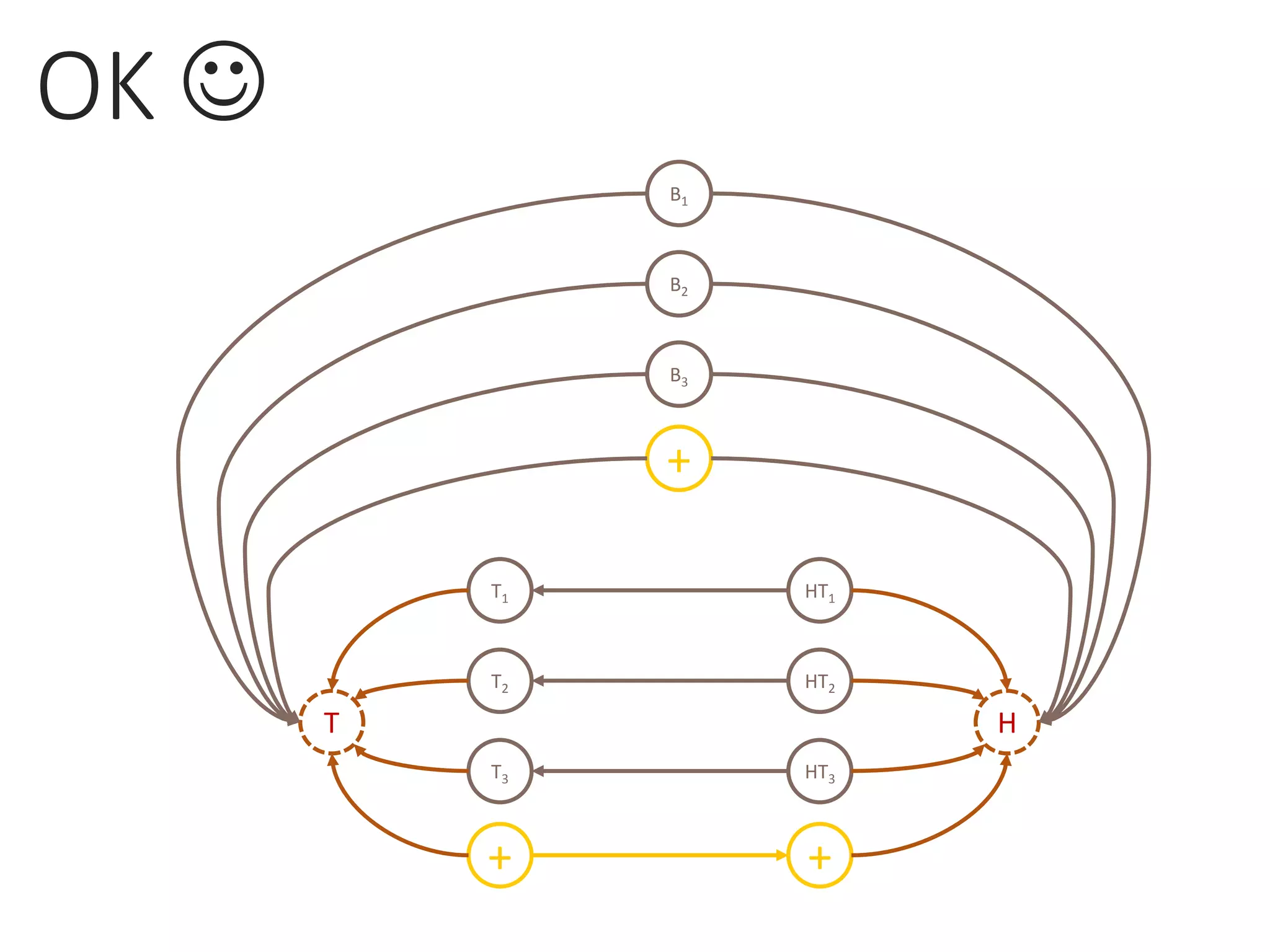
OK 
H
B3
B2
B1
+
T
T3
T2
T1
+
HT3
HT2
HT1
+
Carlo Pescio @CarloPescio http://physicsofsoftware.com
Work in progress
^
Ha = { Hi }
+
T = { Ti }
*
+
B = { Bi }
^ +
HTi
·
C/D
^
Ta
+
T = { Ti }
*
+
B = { Bi }
^ +
(HTi)
·
C/D
Carlo Pescio @CarloPescio http://physicsofsoftware.com
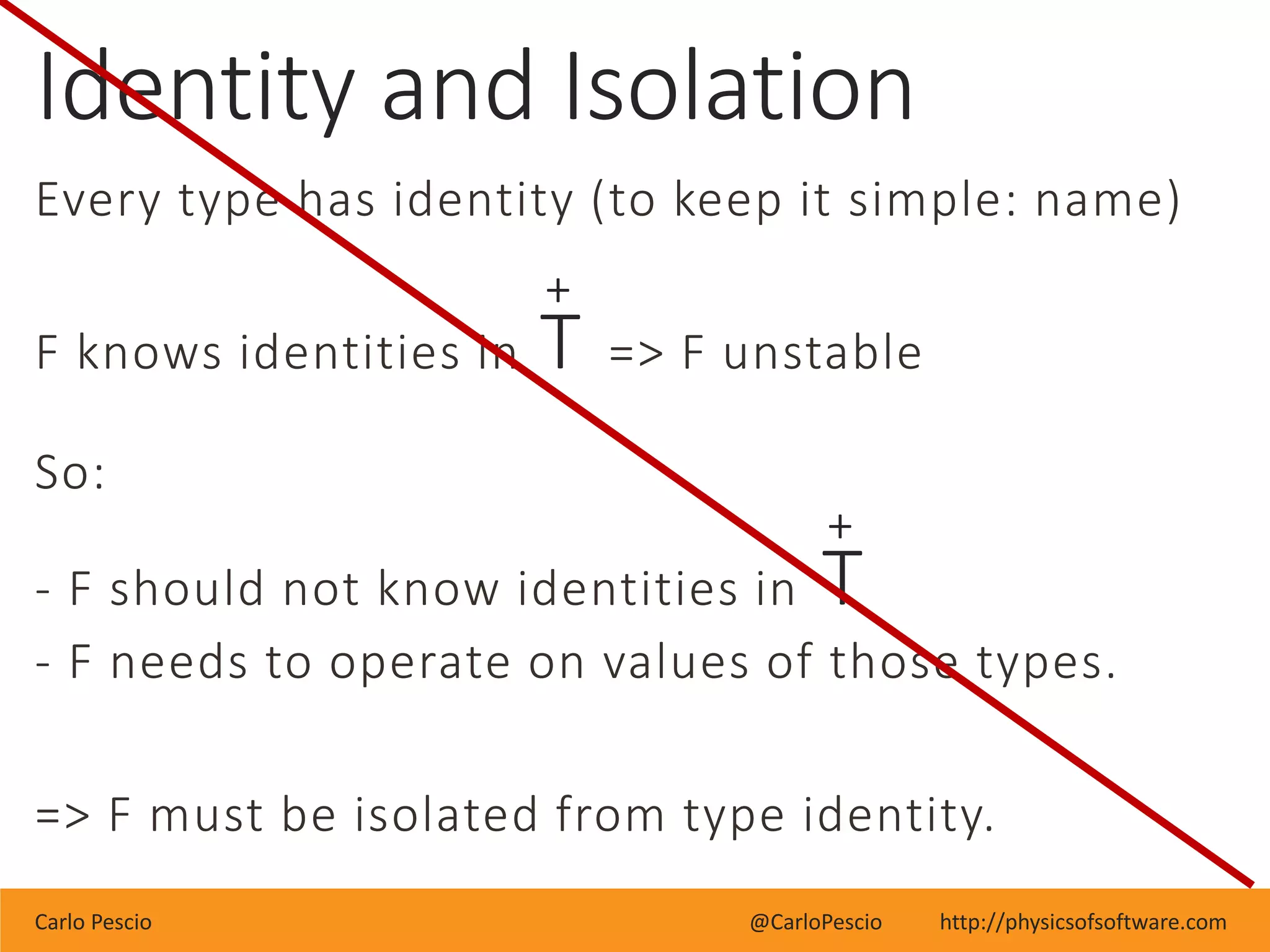
Every type has identity (to keep it simple: name)
F knows identities in => F unstable
So:
- F should not know identities in
- F needs to operate on values of those types.
=> F must be isolated from type identity.
Identity and Isolation
+
T
+
T
Carlo Pescio @CarloPescio http://physicsofsoftware.com
Common techniques for isolation:
- Add a new “abstract type” Ta, make every Ti an
instance or subtype of Ta
- Requires late binding as F will only know Ta
- Relationship between Ti and Ta can be implicit
(structural conformance)
- Add a new concrete type Tc exposing only
functions, and bind every instance of Ti to an
instance of Tc
- That’s again providing late binding as F won’t know
the identity of the functions it’s calling
Isolation Techniques
Carlo Pescio @CarloPescio http://physicsofsoftware.com
structures vs paradigms
Carlo Pescio @CarloPescio http://physicsofsoftware.com
OO
SUCKS!
Carlo Pescio @CarloPescio http://physicsofsoftware.com
Get your trick question ready
1. The next time someone shows you a decent use
for OO-like polymorphism & encapsulation, what
can you say?
what about serialization in multiple formats?
Carlo Pescio @CarloPescio http://physicsofsoftware.com
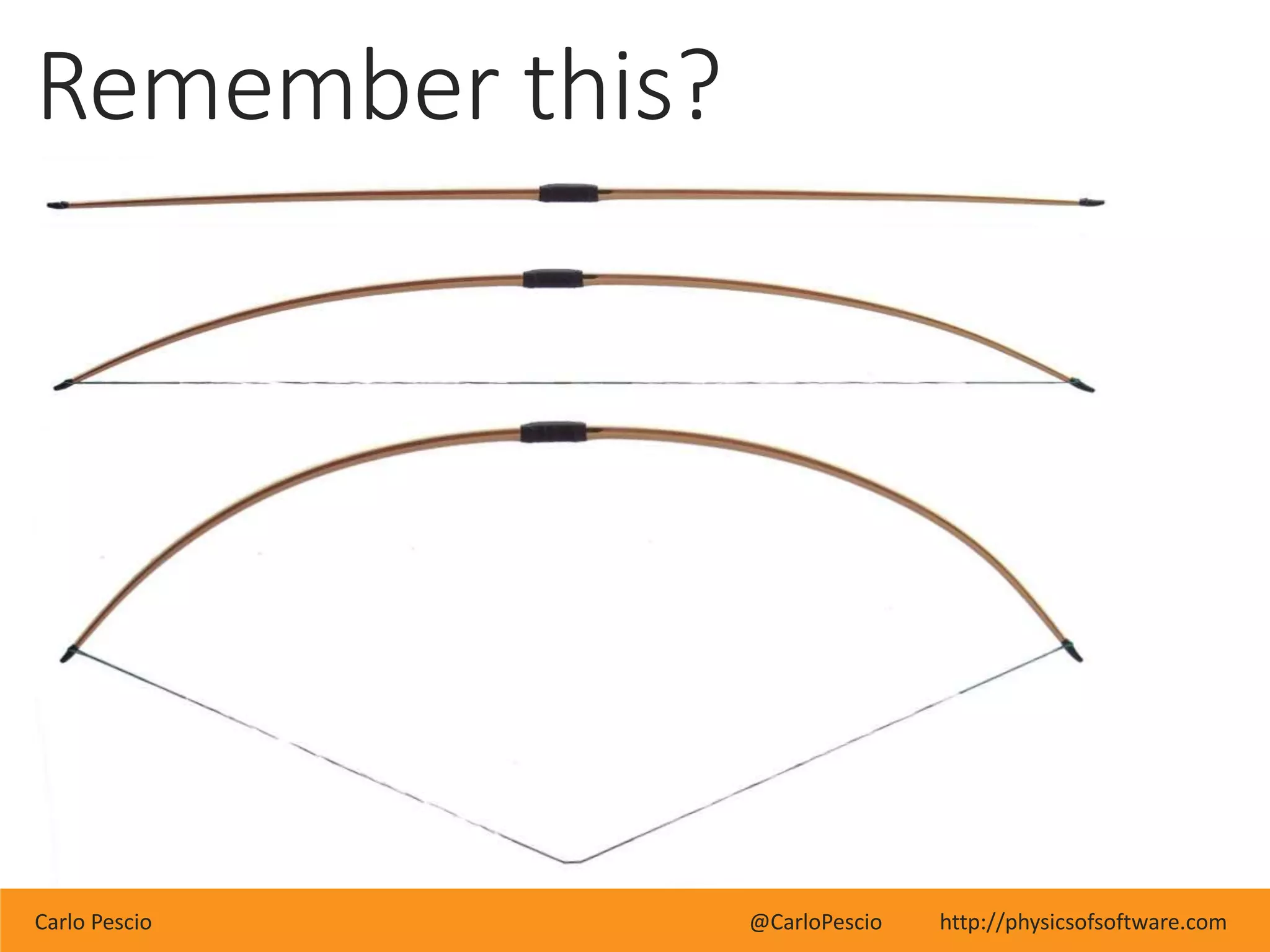
Remember this?
Carlo Pescio @CarloPescio http://physicsofsoftware.com
Elastic yet bent !?
Carlo Pescio @CarloPescio http://physicsofsoftware.com
We only have geometry so far
I want rendering (new core behaviors!)
I may want only geometry
I may want only rendering
I may want both
=> Geometry and Rendering in distinct artifacts
Breaking the growth model
Carlo Pescio @CarloPescio http://physicsofsoftware.com
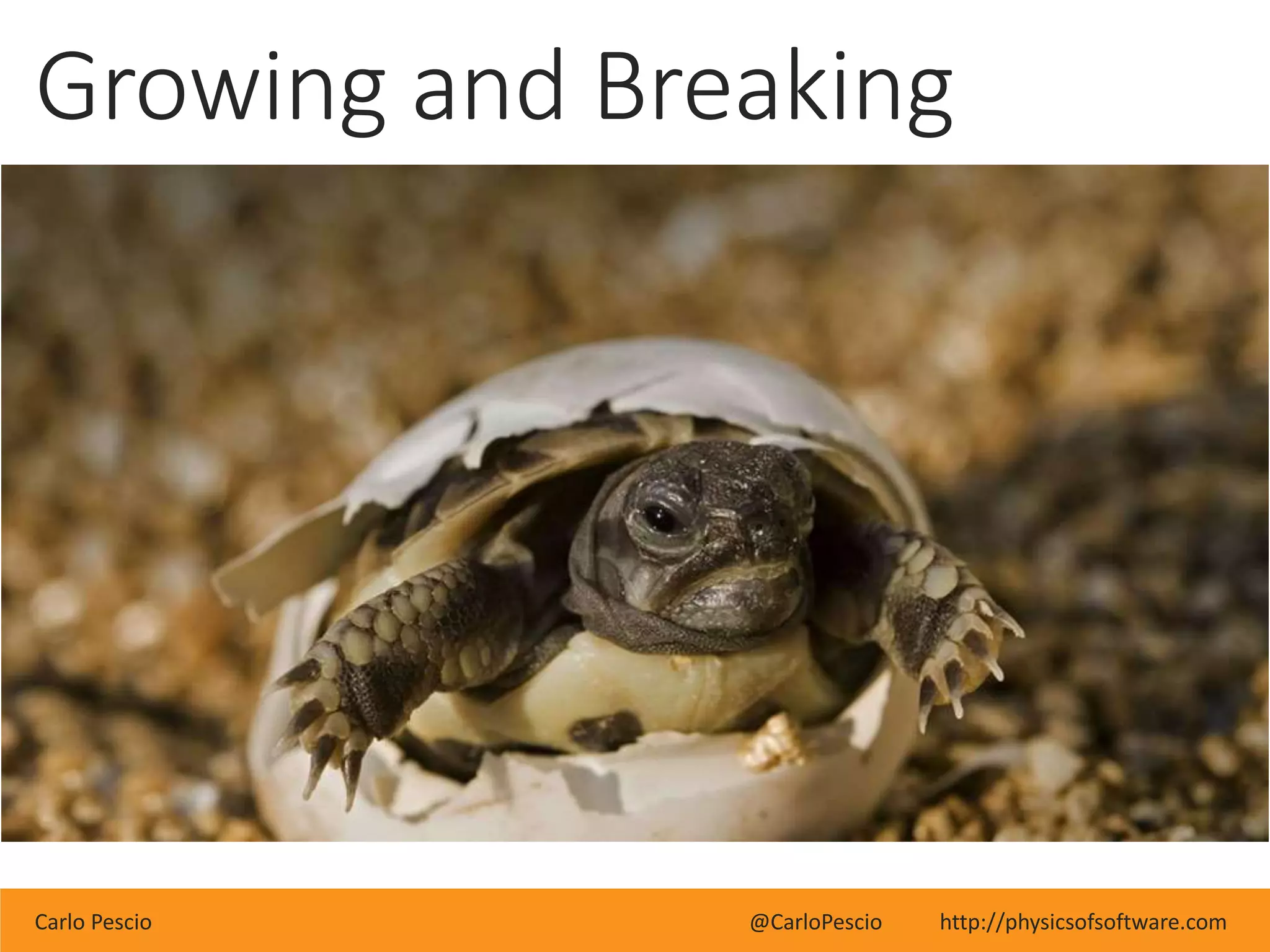
Growing and Breaking
partial class Circle
{
private readonly Point center;
private readonly double radius;
public Circle( Point center, double radius )
{
this.center = center;
this.radius = radius;
}
}
interface Shape
{
Shape Move(Point newCenter);
}
partial class Circle : Shape
{
public Shape Move(Point newCenter)
{
return new Circle(newCenter, radius);
}
}
interface Drawing
{
void Render();
}
partial class Circle : Drawing
{
public void Render()
{
Console.WriteLine(
"I'm a Circle with radius " +
radius.ToString());
}
}
static void Main(string[] args)
{
Shape c = new Circle(new Point(10, 10), 5);
Drawing d = c as Drawing;
d.Render();
}
constraint
Shape => Drawing
Carlo Pescio @CarloPescio http://physicsofsoftware.com
“Design Process”
I didn’t use
- Design principles
- Patterns
- Tests
- Religion
I only aimed for symmetry
- Features growth model
- Artifacts growth model
Break a symmetry
to get a symmetry 
Carlo Pescio @CarloPescio http://physicsofsoftware.com
…Monads 
Or polymorphism
Or existential types
Or type system constraints
Or many things yet to be invented
Just by understanding forces 
You may have invented…
Carlo Pescio @CarloPescio http://physicsofsoftware.com
Get in touch
@CarloPescio
carlo.pescio@gmail.com
http://physicsofsoftware.com
/forum

On Growth and Software

  • 1.
    Carlo Pescio @CarloPesciohttp://physicsofsoftware.com Carlo Pescio On Growth and Software (or: applying some Physics of Software)
  • 2.
    Carlo Pescio @CarloPesciohttp://physicsofsoftware.com Inspired by a classic
  • 3.
    Carlo Pescio @CarloPesciohttp://physicsofsoftware.com Form as a Diagram of Forces
  • 4.
    Carlo Pescio @CarloPesciohttp://physicsofsoftware.com Form as a Recipe for Reaction My own little step – don’t blame D’Arcy  Material and shape encode reactions to “forces”
  • 5.
    Carlo Pescio @CarloPesciohttp://physicsofsoftware.com Form as a Recipe for Growth
  • 6.
    Carlo Pescio @CarloPesciohttp://physicsofsoftware.com Good ol’ book + - U U
  • 7.
    Carlo Pescio @CarloPesciohttp://physicsofsoftware.com The ring binder U D D U U C C
  • 8.
    Carlo Pescio @CarloPesciohttp://physicsofsoftware.com Growth Model
  • 9.
    Carlo Pescio @CarloPesciohttp://physicsofsoftware.com Growth Model
  • 10.
    Carlo Pescio @CarloPesciohttp://physicsofsoftware.com [Mis]Aligned Growth Model (ideal) growth in decision space (actual) growth in artifact space
  • 11.
    Carlo Pescio @CarloPesciohttp://physicsofsoftware.com “Growth” in computing Extensibility Scalability C/D features in code C/D run-time load Code as artifacts Run-time behavior C/D feature -> C/D load -> C/D artifact C/D machines / CPU
  • 12.
    Carlo Pescio @CarloPesciohttp://physicsofsoftware.com
  • 13.
    Carlo Pescio @CarloPesciohttp://physicsofsoftware.com Extensibility?
  • 14.
    Carlo Pescio @CarloPesciohttp://physicsofsoftware.com Symmetry in Growth [model] Create feature Delete feature decision space Create artifacts Delete artifacts artifact space
  • 15.
    Carlo Pescio @CarloPesciohttp://physicsofsoftware.com Why bother??? - Product families - Plug-in architectures, 3rd party modules - Modular understanding - “zero impact” evolution
  • 16.
    Carlo Pescio @CarloPesciohttp://physicsofsoftware.com In practice? A simple, specific problem with a specific growth model. Lessons here apply to similar growth models. Not everything will / should follow this model. The final shape is not universal the method of investigation kinda is
  • 17.
    Carlo Pescio @CarloPesciohttp://physicsofsoftware.com Easy
  • 18.
    Carlo Pescio @CarloPesciohttp://physicsofsoftware.com Some physics required 
  • 19.
    Carlo Pescio @CarloPesciohttp://physicsofsoftware.com Vector drawing for dummies
  • 20.
    Carlo Pescio @CarloPesciohttp://physicsofsoftware.com Growth Model - New shape types will come over time - New behaviors will come over time - Behaviors can be composed out of a fixed core - That entire menu only requires {bounding box, move} I’m dealing only with geometry right now
  • 21.
    Carlo Pescio @CarloPesciohttp://physicsofsoftware.com Context We have an open, discrete set of “concepts” { Square, Triangle, Circle, … } It’s open and so will grow by addition. T3 T2 T1 + + T = { Ti }
  • 22.
    Carlo Pescio @CarloPesciohttp://physicsofsoftware.com In code? How do we mirror in code? • N types: OK • N classes: OK • N objects / prototypes: OK • through closures / records of functions: ok as well • Case classes: Maybe • 1 sum type: NO + T = { Ti }
  • 23.
    N trivial classes(Scala) class Point( var x : Float, var y : Float ) {} class Box( var topLeft : Point, var bottomRight : Point ) {} class Circle( var center : Point, var radius : Float ) {} class Square( var topLeft : Point, var side : Float ) {} +
  • 24.
    1 sum type(Haskell): nope type Point = (Float,Float) type Radius = Float type Side = Float data Shape = Circle Point Radius | Square Point Side + U
  • 25.
    Carlo Pescio @CarloPesciohttp://physicsofsoftware.com Context We have a closed set of “core behaviors” { BoundingBox, Move, Scale, Rotate, Mirror } ^ H = { Hi }H
  • 26.
    Carlo Pescio @CarloPesciohttp://physicsofsoftware.com Context “Core behaviors” depends on concepts. More precisely: when we create/delete a concept, we create/delete its implementation of core behaviors. ^ Ti C/D > HTi T3 T2 T1 + HT3 HT2 HT1 +
  • 27.
    Carlo Pescio @CarloPesciohttp://physicsofsoftware.com In code? How do we mirror • Member functions (class, objects): ok • Functions (+ optional overloading): ok • 1 function per behavior + pattern matching: NO • That removes case classes from the table ^ Ti C/D > HTi
  • 28.
    Case classes (Scala):nope abstract class Shape case class Circle(center:Point, radius:Float) extends Shape case class Square(topLeft:Point, side:Float) extends Shape + U object moveTool { def move( sh : Shape, newCenter : Point ) : Shape = { sh match { case Circle(center, radius) => new Circle( newCenter, radius); case Square( topLeft, side) => new Square(Point(topLeft.x-side/2, topLeft.y-side/2), side); } } }
  • 29.
    Carlo Pescio @CarloPesciohttp://physicsofsoftware.com Context We can: a) create instances of those concepts and keep them available for selection b) select some of those instances (mixed concepts) from a bounding box c) apply composite behaviors to those (mixed) instances
  • 30.
    Carlo Pescio @CarloPesciohttp://physicsofsoftware.com Context a) We want to create instances and keep them “available” for selection In code: • A single collection: OK • A collection for each type: OK A collection for each type is ok, as we still transfer creation (of concept) into creation (of a new list).
  • 31.
    Carlo Pescio @CarloPesciohttp://physicsofsoftware.com Context b) We want to select a (mixed) subset by dragging a selection box. So we need a selection function looping over all the available shapes and checking their bounding boxes (BB is a “core behavior” for shapes).
  • 32.
    Carlo Pescio @CarloPesciohttp://physicsofsoftware.com selection box f selection 1 collection per type won’t work anymore + + U Same reasoning applies to any of the composite behaviors shapes selected shapes
  • 33.
    Carlo Pescio @CarloPesciohttp://physicsofsoftware.com Context We have an open set of “composite behaviors” + B = { Bi } e.g. { align left, distribute horizontally, flip vertical} They operate on collections of concepts (instances). ^ Bi ≡ ·(H)
  • 34.
    Carlo Pescio @CarloPesciohttp://physicsofsoftware.com Context + T = { Ti } * + B = { Bi } ^ + (HTi) · C/D Two problems with Bi here: 1) Works on a set of shapes (same as selection) 2) Composed from a set of type-dependent core behaviors (same as selection w/ BB)
  • 35.
    Carlo Pescio @CarloPesciohttp://physicsofsoftware.com A single collection of shapes That would require either: • A dynamic language • mixing types is natural • A way to form a placeholder type as substitute for the individual types: • Base type + subtypes • Base class / interface + derived classes • [objects as] Records of closures • Existential types / Abstract types
  • 36.
    Carlo Pescio @CarloPesciohttp://physicsofsoftware.com Classes in Scala (easy) abstract class Shape { def explain() : String; def boundingBox() : Box; def moveCenter(newCenter:Point) : Shape; }
  • 37.
    Classes in Scala(easy) class Circle(private var center: Point, private var radius: Float) extends Shape { def explain(): String = { "circle " + center.x + " " + center.y + " " + radius; } def boundingBox(): Box = { new Box( Point(center.x-radius, center.y-radius), Point(center.x+radius, center.y+radius) ); } def moveCenter(newCenter: Point): Shape = { new Circle(newCenter, radius); } }
  • 38.
    Classes in Scala(easy) class Square(private var topLeft: Point, private var side: Float) extends Shape { def explain(): String = { "square " + topLeft.x + " " + topLeft.y + " " + side; } def boundingBox(): Box = { new Box( topLeft, Point(topLeft.x+side, topLeft.y+side)); } def moveCenter(newCenter: Point): Shape = { new Square(Point(topLeft.x-side/2, topLeft.y-side/2), side); } }
  • 39.
    Classes in Scala(easy) object MainObject { def main(args: Array[String]): Unit = { val c1 = new Circle( Point(1,1), 4 ) ; val s1 = new Square( Point(0,0), 4 ) ; val sh : List[Shape] = List( c1, s1 ); var d : String = sh.map( s => s.moveCenter(Point(5,5)).explain() ).reduce((s1,s2) => s1 + " ; " + s2) ; println( d ) ; } }
  • 40.
    Records of Closures(Haskell) type Point = (Float,Float) type Box = (Point,Point) data Shape = Shape { explain :: String, boundingBox :: Box, moveCenter :: Point -> Shape }
  • 41.
    Records of Closures(Haskell) circle :: Point -> Float -> Shape circle (x,y) r = Shape explain boundingBox moveCenter where explain = "circle " ++ show x ++ " " ++ show y ++ " " ++ show r boundingBox = ( (x-r, y-r), (x+r, y+r) ) moveCenter (x1,y1) = circle (x1, y1) r
  • 42.
    Records of Closures(Haskell) square :: Point -> Float -> Shape square (t,l) s = Shape explain boundingBox moveCenter where explain = "square " ++ show t ++ " " ++ show l ++ " " ++ show s boundingBox = ( (t, l), (t+s, l+s) ) moveCenter (x1,y1) = square (x1-s/2, y1-s/2) s
  • 43.
    Carlo Pescio @CarloPesciohttp://physicsofsoftware.com Records of Closures (Haskell) main = do let c1 = circle (1,1) 3 let s1 = square (1,1) 3 let sh = [ c1, s1 ] putStrLn (concat ( map (s -> (explain (moveCenter s (5,5))) ++ " ; ") sh ) )
  • 44.
    Existential type (Haskell) typePoint = (Float,Float) type Box = (Point,Point) class ShapeTC a where explain :: a -> String boundingBox :: a -> Box moveCenter :: a -> Point -> Shape data Shape = forall a. ShapeTC a => Shape a instance ShapeTC Shape where explain (Shape shape) = explain shape boundingBox (Shape shape) = boundingBox shape moveCenter (Shape shape) = moveCenter shape
  • 45.
    Existential type (Haskell) dataCircle = Circle Point Float instance ShapeTC Circle where explain (Circle (x,y) r ) = "circle " ++ show x ++ " " ++ show y ++ " " ++ show r boundingBox (Circle (x,y) r) = ( (x-r, y-r), (x+r, y+r) ) moveCenter (Circle (x,y) r) (x1,y1) = circle (x1, y1) r circle :: Point -> Float -> Shape circle (x,y) r = Shape (Circle (x,y) r)
  • 46.
    Existential type (Haskell) dataSquare = Square Point Float instance ShapeTC Square where explain (Square (t,l) s) = "square " ++ show t ++ " " ++ show l ++ " " ++ show s boundingBox (Square (t,l) s) = ( (t, l), (t+s, l+s) ) moveCenter (Square (t,l) s) (x1,y1) = square (x1-s/2, y1-s/2) s square :: Point -> Float -> Shape square (t,l) s = Shape (Square (t,l) s)
  • 47.
    Existential type (Haskell) main= do let c1 = circle (2,2) 3 let s1 = square (2,2) 3 let sh = [ c1, s1 ] putStrLn (concat ( map (s -> (explain (moveCenter s (6,6))) ++ " ; ") sh ) )
  • 48.
  • 49.
  • 50.
  • 51.
    Carlo Pescio @CarloPesciohttp://physicsofsoftware.com Work in progress ^ Ha = { Hi } + T = { Ti } * + B = { Bi } ^ + HTi · C/D ^ Ta + T = { Ti } * + B = { Bi } ^ + (HTi) · C/D
  • 52.
    Carlo Pescio @CarloPesciohttp://physicsofsoftware.com Every type has identity (to keep it simple: name) F knows identities in => F unstable So: - F should not know identities in - F needs to operate on values of those types. => F must be isolated from type identity. Identity and Isolation + T + T
  • 53.
    Carlo Pescio @CarloPesciohttp://physicsofsoftware.com Common techniques for isolation: - Add a new “abstract type” Ta, make every Ti an instance or subtype of Ta - Requires late binding as F will only know Ta - Relationship between Ti and Ta can be implicit (structural conformance) - Add a new concrete type Tc exposing only functions, and bind every instance of Ti to an instance of Tc - That’s again providing late binding as F won’t know the identity of the functions it’s calling Isolation Techniques
  • 54.
    Carlo Pescio @CarloPesciohttp://physicsofsoftware.com structures vs paradigms
  • 55.
    Carlo Pescio @CarloPesciohttp://physicsofsoftware.com OO SUCKS!
  • 56.
    Carlo Pescio @CarloPesciohttp://physicsofsoftware.com Get your trick question ready 1. The next time someone shows you a decent use for OO-like polymorphism & encapsulation, what can you say? what about serialization in multiple formats?
  • 57.
    Carlo Pescio @CarloPesciohttp://physicsofsoftware.com Remember this?
  • 58.
    Carlo Pescio @CarloPesciohttp://physicsofsoftware.com Elastic yet bent !?
  • 59.
    Carlo Pescio @CarloPesciohttp://physicsofsoftware.com We only have geometry so far I want rendering (new core behaviors!) I may want only geometry I may want only rendering I may want both => Geometry and Rendering in distinct artifacts Breaking the growth model
  • 61.
    Carlo Pescio @CarloPesciohttp://physicsofsoftware.com Growing and Breaking
  • 62.
    partial class Circle { privatereadonly Point center; private readonly double radius; public Circle( Point center, double radius ) { this.center = center; this.radius = radius; } } interface Shape { Shape Move(Point newCenter); } partial class Circle : Shape { public Shape Move(Point newCenter) { return new Circle(newCenter, radius); } } interface Drawing { void Render(); } partial class Circle : Drawing { public void Render() { Console.WriteLine( "I'm a Circle with radius " + radius.ToString()); } } static void Main(string[] args) { Shape c = new Circle(new Point(10, 10), 5); Drawing d = c as Drawing; d.Render(); } constraint Shape => Drawing
  • 63.
    Carlo Pescio @CarloPesciohttp://physicsofsoftware.com “Design Process” I didn’t use - Design principles - Patterns - Tests - Religion I only aimed for symmetry - Features growth model - Artifacts growth model Break a symmetry to get a symmetry 
  • 64.
    Carlo Pescio @CarloPesciohttp://physicsofsoftware.com …Monads  Or polymorphism Or existential types Or type system constraints Or many things yet to be invented Just by understanding forces  You may have invented…
  • 65.
    Carlo Pescio @CarloPesciohttp://physicsofsoftware.com Get in touch @CarloPescio carlo.pescio@gmail.com http://physicsofsoftware.com /forum