
By omid minooee
Bureau of Indian standard act,1986
The monopolistic and restrictive trade practices
act,1969 is an important piece of economic legislation
designed to ensure that the operation of the economic
system does not result in the concentration of economic
power to the common detriment.

The act came into force from 1st June ,1970 and has been
amended in 1970
Mrtp act ,1969,aims to prevent concentration of economic power to the common

detriment, provide for control of monopolies and probation of

monopolistic, restrictive and unfair trade practice, and protect consumer interest.

Monopolistic trade practice is that which represents abuse of market power in the

production and marketing of goods and services by eliminating potential

competitors from market and taking advantages of the control over the market by

charging unreasonably high prices, preventing or reducing competition ,limiting

technical development, deteriorating product quality or by adopting unfair or

deceptive trade practices…..
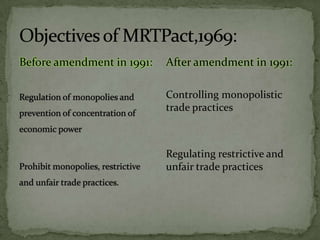
Before amendment in 1991:   After amendment in 1991:

                            Controlling monopolistic
                            trade practices


                            Regulating restrictive and
                            unfair trade practices
It means in order to maximize profit and to increase market
power, certain business firms unreasonably charge high
prices to prevent competition in the production and
distribution of goods by adopting unfair trade practices.


It is a trade practice which represents the abuse of the market
power by charging unreasonably high prices
1.Regulation of production and fixing the term of sale

2.Prohibiting any action that restricts competition,


3.Fixing standards for goods produced.
A trade practice which restricts or reduces competition may

be termed as restrictive trade practices and it harm the

consumer interest.

Because of their adverse effect on the consumer and public

interest ,they are sought to be regulated in almost every

country of the world .
1.The practice shall not be repeated


2.The agreement shall not be void and shall stand

modified in such a manner as may be specified in the

order
Unfair trade practice means a trade practice which ,for

the purpose of promoting the sale, use or supply of any

goods or for the provision of any service, adopts any

unfair or deceptive practice
*.the practice shall not be repeated.


*.any agreement relating to such an utp shall be void or
shall stand modified in such a manner as may be
directed by the commission.
The MRTPs act, besides adversely affecting
                                              Conclusion
economic growth, blunted Indian
                                              On
companies’ ability to grow, consolidate and
                                              MRTPs
improve competitiveness.
                                              act,1969
This has had a very dampening effect on

their global competitiveness.
   INDIAN STANDARDS INSTITUTION [now known as BUREAU OF INDIAN

    STANDARDS( BIS)] set up on 6 JANUARY 1947


   BIS is functioning under MINISTRY OF CONSUMER AFFAIRS, FOOD AND
    PUBLIC DISTRIBUTION, GOVT OF INDIA as a statutory body under BIS
    ACT, 1986 with effect from 1 APRIL 1987


   NATIONAL STANDARDS BODY of INDIA
*.Harmonious, development of standardization and
quality control in national and international arena

*.Certification schemes for products and systems

*.Growth and development of Indian
industry, commerce and exports

*.Consumer protection
An Act to provide for the establishment of a Bureau for the
harmonious development of the
activities of standardization, marking and quality certification of
goods and for matters connected
therewith or incidental thereto.
BE it enacted by Parliament in the Thirty-seventh year of the
Republic of India as follows:-
Comment: The Act seeks to provide for the for the harmonious
development of the activities of
standardization, marking and quality certification of goods and for
matters connected therewith or
incidental thereto.
1.Short title, extent and commencement.- (1) This Act may be called
the Bureau of Indian
Standards Act, 1986.
(2) It extends to the whole India.
(3) It shall come into force on such date{1-4-1987 ! vide Notification
No.S.O.272(E), dated 31-3-
1987, Gazette of India, Extraordinary, 1987, Part II, section 3(ii)} as the
Central Government may,
by notification in the official Gazette, appoint.


2.definitions:
3.Establishment and incorporation of Bureau of Indian
Standards.
4.Constitution of Executive Committee.
5.Constitution of the Advisory committees and other committees.-
6.Vacancies, etc., not to invalidate proceedings of Bureau Executive Committee, etc.- No act
or
proceedings of the Bureau the Executive Committee or any Committee constituted under
section
5 shall be invalid merely by reason of-
(a) any vacancy in, or any defect in the constitution of the Bureau or the Committee; or
(b) any defect in the appointment of a person acting as a member of the Bureau or
Committee; or
(c) any irregularity in the procedure of the Bureau or the Committee not affecting the merits
of the
case.
7.Director General of the Bureau.- (1) The Central Government shall appoint a Director General
the Bureau.

(2) The terms and conditions of service of the Director-General the Bureau shall be such as may

be prescribed.

(3) Subject to the general superintendence and control of the Bureau, the Director-General of the

Bureau shall be Chief Executive Authority of the Bureau.

(4) The Director-General of the Bureau shall exercise and discharge such of the powers and

duties of the Bureau as may be determined by regulations.

8.Officers and employees of the Bureau.- (1) The Bureau may appoint such other officers and
employees as it considers necessary for the efficient discharge of its functions under this Act.

(2) The terms and conditions of service of officers and employees of the Bureau appointed under

sub-section (1) shall be as may be determined by reclamations.
9.Transfer of assets, liabilities and employees of Indian Standards
Institution.
(1) On and from
the date of establishment of the Bureau,
(2) Notwithstanding anything contained in the Industrial Disputes
Act, 1947(14 of 1947) or in any
other law for the time being in force, the absorption of any employee by
the Bureau in its regular
service under this section shall not entitle such employees to any
compensation under that Act or
other law and so such claim be entertained by any court, tribunal or other
authority.
10.Functions of the Bureau.-
11.Prohibition of improper use of Standard Mark.-
12.Prohibition of use of certain names, etc.-
13.Prohibition of registration in certain cases.-
14.Compulsory use of Standard Mark for articles and
processes to certain scheduled industries.-
If the Central Government, after consulting the
Bureau, is of the opinion that it is necessary or
expedient so to do, in the public interest, it may, by order
published in the Official Gazette,-
15.Grant of license.- (1) The Bureau may, by
order, grant, renew, suspend or cancel a license in
such manner as may be determined by regulations.
(2) The grant or renewal of the license under sub-section
(1) shall be subject to such conditions
and on payment of such fees as may be determined by
regulations.
16.Appeal.- (1) Any person aggrieved by an order made under section 15 may prefer an appeal

to the Central Government within such period as may be prescribed.

(2) No appeal shall be admitted if it is preferred after the expiry of the period prescribed therefore:

Provided that an appeal may be admitted after the expiry of the period prescribed therefore if the

appellant satisfies the Central Government that he had sufficient cause of for not preferring, the

appeal within the prescribed period.

(3) Every appeal made under this section shall be made in such form and shall be accompanied

by a copy of the order appealed against and by such fees as may be prescribed.

(4) The procedure for disposing of an appeal shall be such as may be prescribed:

Provided that
17.Grants and loans by the Central Government
18.Fund.-
19.Borrowing powers of the bureau.-
20.Budget.-
21.Annual report.-
22.Accounts and audit.-
23.Annual report to be laid before Parliament.- The
Central Government shall cause the annual
report to be laid, as soon as may be after it is
received, before each House of Parliament.
24.Power of Central Government to issue directions.-
25.Inspecting officer.
26.Power to search and seizure.-
27.Delegation
28.Power to obtain information.-
29.Savings.-
30.Certain matters to be kept confidential.-
31.Members, officers and employees of the Bureau to be
public servants.-
32.Protection of action taken in good faith.-
33.Penalty for improper use of Standard Mark, etc.-
34.Cognizance of offences by courts.-
35.Offences by companies.-
36.Authentication or orders and other instruments of
the Bureau.-
37.Power to make rules.-
38.Power to make regulations.-
39.Rules and regulations to be laid before Parliament.-
40.Act not to affect operation of certain Acts.-

41.Power to remove difficulties.-

42.Repeal and saving.-

business law

  • 1.
  • 2.
    Bureau of Indianstandard act,1986
  • 3.
    The monopolistic andrestrictive trade practices act,1969 is an important piece of economic legislation designed to ensure that the operation of the economic system does not result in the concentration of economic power to the common detriment. The act came into force from 1st June ,1970 and has been amended in 1970
  • 4.
    Mrtp act ,1969,aimsto prevent concentration of economic power to the common detriment, provide for control of monopolies and probation of monopolistic, restrictive and unfair trade practice, and protect consumer interest. Monopolistic trade practice is that which represents abuse of market power in the production and marketing of goods and services by eliminating potential competitors from market and taking advantages of the control over the market by charging unreasonably high prices, preventing or reducing competition ,limiting technical development, deteriorating product quality or by adopting unfair or deceptive trade practices…..
  • 5.
    Before amendment in1991: After amendment in 1991: Controlling monopolistic trade practices Regulating restrictive and unfair trade practices
  • 6.
    It means inorder to maximize profit and to increase market power, certain business firms unreasonably charge high prices to prevent competition in the production and distribution of goods by adopting unfair trade practices. It is a trade practice which represents the abuse of the market power by charging unreasonably high prices
  • 7.
    1.Regulation of productionand fixing the term of sale 2.Prohibiting any action that restricts competition, 3.Fixing standards for goods produced.
  • 8.
    A trade practicewhich restricts or reduces competition may be termed as restrictive trade practices and it harm the consumer interest. Because of their adverse effect on the consumer and public interest ,they are sought to be regulated in almost every country of the world .
  • 9.
    1.The practice shallnot be repeated 2.The agreement shall not be void and shall stand modified in such a manner as may be specified in the order
  • 10.
    Unfair trade practicemeans a trade practice which ,for the purpose of promoting the sale, use or supply of any goods or for the provision of any service, adopts any unfair or deceptive practice
  • 11.
    *.the practice shallnot be repeated. *.any agreement relating to such an utp shall be void or shall stand modified in such a manner as may be directed by the commission.
  • 12.
    The MRTPs act,besides adversely affecting Conclusion economic growth, blunted Indian On companies’ ability to grow, consolidate and MRTPs improve competitiveness. act,1969 This has had a very dampening effect on their global competitiveness.
  • 13.
    INDIAN STANDARDS INSTITUTION [now known as BUREAU OF INDIAN STANDARDS( BIS)] set up on 6 JANUARY 1947  BIS is functioning under MINISTRY OF CONSUMER AFFAIRS, FOOD AND PUBLIC DISTRIBUTION, GOVT OF INDIA as a statutory body under BIS ACT, 1986 with effect from 1 APRIL 1987  NATIONAL STANDARDS BODY of INDIA
  • 14.
    *.Harmonious, development ofstandardization and quality control in national and international arena *.Certification schemes for products and systems *.Growth and development of Indian industry, commerce and exports *.Consumer protection
  • 15.
    An Act toprovide for the establishment of a Bureau for the harmonious development of the activities of standardization, marking and quality certification of goods and for matters connected therewith or incidental thereto. BE it enacted by Parliament in the Thirty-seventh year of the Republic of India as follows:- Comment: The Act seeks to provide for the for the harmonious development of the activities of standardization, marking and quality certification of goods and for matters connected therewith or incidental thereto.
  • 16.
    1.Short title, extentand commencement.- (1) This Act may be called the Bureau of Indian Standards Act, 1986. (2) It extends to the whole India. (3) It shall come into force on such date{1-4-1987 ! vide Notification No.S.O.272(E), dated 31-3- 1987, Gazette of India, Extraordinary, 1987, Part II, section 3(ii)} as the Central Government may, by notification in the official Gazette, appoint. 2.definitions:
  • 17.
    3.Establishment and incorporationof Bureau of Indian Standards. 4.Constitution of Executive Committee. 5.Constitution of the Advisory committees and other committees.- 6.Vacancies, etc., not to invalidate proceedings of Bureau Executive Committee, etc.- No act or proceedings of the Bureau the Executive Committee or any Committee constituted under section 5 shall be invalid merely by reason of- (a) any vacancy in, or any defect in the constitution of the Bureau or the Committee; or (b) any defect in the appointment of a person acting as a member of the Bureau or Committee; or (c) any irregularity in the procedure of the Bureau or the Committee not affecting the merits of the case.
  • 18.
    7.Director General ofthe Bureau.- (1) The Central Government shall appoint a Director General the Bureau. (2) The terms and conditions of service of the Director-General the Bureau shall be such as may be prescribed. (3) Subject to the general superintendence and control of the Bureau, the Director-General of the Bureau shall be Chief Executive Authority of the Bureau. (4) The Director-General of the Bureau shall exercise and discharge such of the powers and duties of the Bureau as may be determined by regulations. 8.Officers and employees of the Bureau.- (1) The Bureau may appoint such other officers and employees as it considers necessary for the efficient discharge of its functions under this Act. (2) The terms and conditions of service of officers and employees of the Bureau appointed under sub-section (1) shall be as may be determined by reclamations.
  • 19.
    9.Transfer of assets,liabilities and employees of Indian Standards Institution. (1) On and from the date of establishment of the Bureau, (2) Notwithstanding anything contained in the Industrial Disputes Act, 1947(14 of 1947) or in any other law for the time being in force, the absorption of any employee by the Bureau in its regular service under this section shall not entitle such employees to any compensation under that Act or other law and so such claim be entertained by any court, tribunal or other authority.
  • 20.
    10.Functions of theBureau.- 11.Prohibition of improper use of Standard Mark.- 12.Prohibition of use of certain names, etc.- 13.Prohibition of registration in certain cases.- 14.Compulsory use of Standard Mark for articles and processes to certain scheduled industries.- If the Central Government, after consulting the Bureau, is of the opinion that it is necessary or expedient so to do, in the public interest, it may, by order published in the Official Gazette,-
  • 21.
    15.Grant of license.-(1) The Bureau may, by order, grant, renew, suspend or cancel a license in such manner as may be determined by regulations. (2) The grant or renewal of the license under sub-section (1) shall be subject to such conditions and on payment of such fees as may be determined by regulations.
  • 22.
    16.Appeal.- (1) Anyperson aggrieved by an order made under section 15 may prefer an appeal to the Central Government within such period as may be prescribed. (2) No appeal shall be admitted if it is preferred after the expiry of the period prescribed therefore: Provided that an appeal may be admitted after the expiry of the period prescribed therefore if the appellant satisfies the Central Government that he had sufficient cause of for not preferring, the appeal within the prescribed period. (3) Every appeal made under this section shall be made in such form and shall be accompanied by a copy of the order appealed against and by such fees as may be prescribed. (4) The procedure for disposing of an appeal shall be such as may be prescribed: Provided that
  • 23.
    17.Grants and loansby the Central Government 18.Fund.- 19.Borrowing powers of the bureau.- 20.Budget.- 21.Annual report.- 22.Accounts and audit.- 23.Annual report to be laid before Parliament.- The Central Government shall cause the annual report to be laid, as soon as may be after it is received, before each House of Parliament.
  • 24.
    24.Power of CentralGovernment to issue directions.- 25.Inspecting officer. 26.Power to search and seizure.- 27.Delegation 28.Power to obtain information.- 29.Savings.- 30.Certain matters to be kept confidential.- 31.Members, officers and employees of the Bureau to be public servants.-
  • 25.
    32.Protection of actiontaken in good faith.- 33.Penalty for improper use of Standard Mark, etc.- 34.Cognizance of offences by courts.- 35.Offences by companies.- 36.Authentication or orders and other instruments of the Bureau.- 37.Power to make rules.- 38.Power to make regulations.- 39.Rules and regulations to be laid before Parliament.-
  • 26.
    40.Act not toaffect operation of certain Acts.- 41.Power to remove difficulties.- 42.Repeal and saving.-