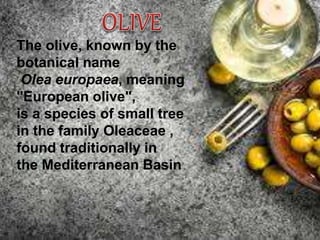
The olive, known by the
botanical name
Olea europaea, meaning
"European olive",
is a species of small tree
in the family Oleaceae ,
found traditionally in
the Mediterranean Basin.
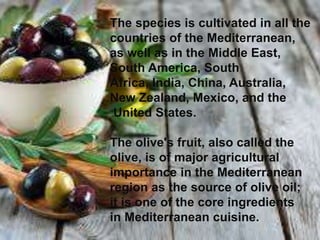
The species is cultivated in all the
countries of the Mediterranean,
as well as in the Middle East,
South America, South
Africa, India, China, Australia,
New Zealand, Mexico, and the
United States.
The olive's fruit, also called the
olive, is of major agricultural
importance in the Mediterranean
region as the source of olive oil;
it is one of the core ingredients
in Mediterranean cuisine.
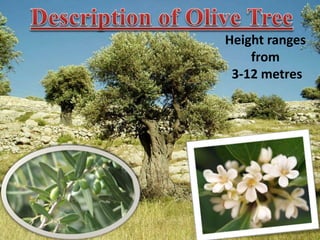
Height ranges
from
3-12 metres
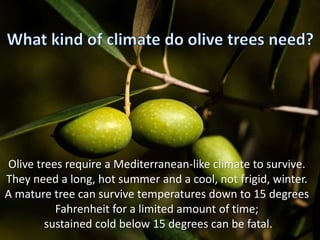
Olive trees require a Mediterranean-like climate to survive.
They need a long, hot summer and a cool, not frigid, winter.
A mature tree can survive temperatures down to 15 degrees
Fahrenheit for a limited amount of time;
sustained cold below 15 degrees can be fatal.
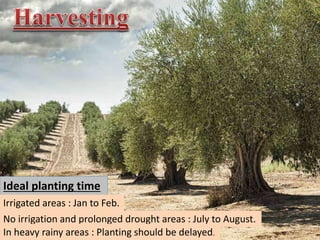
Ideal planting time
Irrigated areas : Jan to Feb.
No irrigation and prolonged drought areas : July to August.
In heavy rainy areas : Planting should be delayed.
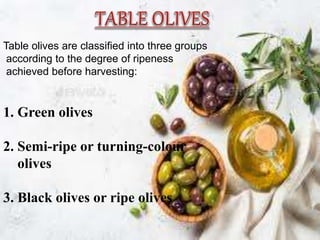
Table olives are classified into three groups
according to the degree of ripeness
achieved before harvesting:
1. Green olives
2. Semi-ripe or turning-colour
olives
3. Black olives or ripe olives
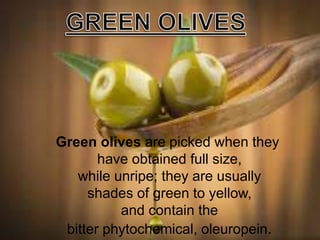
Green olives are picked when they
have obtained full size,
while unripe; they are usually
shades of green to yellow,
and contain the
bitter phytochemical, oleuropein.
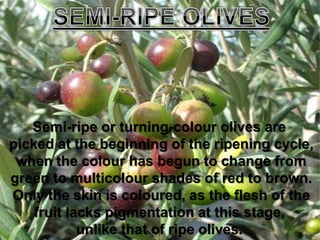
Semi-ripe or turning-colour olives are
picked at the beginning of the ripening cycle,
when the colour has begun to change from
green to multicolour shades of red to brown.
Only the skin is coloured, as the flesh of the
fruit lacks pigmentation at this stage,
unlike that of ripe olives.
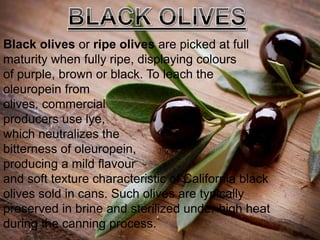
Black olives or ripe olives are picked at full
maturity when fully ripe, displaying colours
of purple, brown or black. To leach the
oleuropein from
olives, commercial
producers use lye,
which neutralizes the
bitterness of oleuropein,
producing a mild flavour
and soft texture characteristic of California black
olives sold in cans. Such olives are typically
preserved in brine and sterilized under high heat
during the canning process.
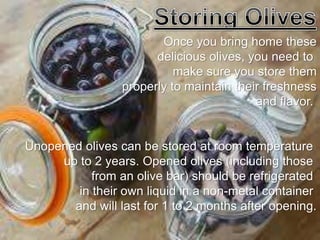
Once you bring home these
delicious olives, you need to
make sure you store them
properly to maintain their freshness
and flavor.
Unopened olives can be stored at room temperature
up to 2 years. Opened olives (including those
from an olive bar) should be refrigerated
in their own liquid in a non-metal container
and will last for 1 to 2 months after opening.
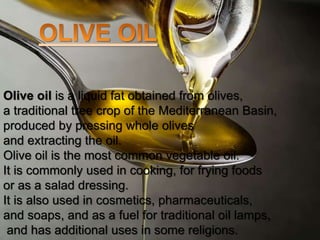
Olive oil is a liquid fat obtained from olives,
a traditional tree crop of the Mediterranean Basin,
produced by pressing whole olives
and extracting the oil.
Olive oil is the most common vegetable oil.
It is commonly used in cooking, for frying foods
or as a salad dressing.
It is also used in cosmetics, pharmaceuticals,
and soaps, and as a fuel for traditional oil lamps,
and has additional uses in some religions.
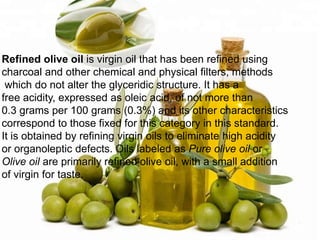
Refined olive oil is virgin oil that has been refined using
charcoal and other chemical and physical filters, methods
which do not alter the glyceridic structure. It has a
free acidity, expressed as oleic acid, of not more than
0.3 grams per 100 grams (0.3%) and its other characteristics
correspond to those fixed for this category in this standard.
It is obtained by refining virgin oils to eliminate high acidity
or organoleptic defects. Oils labeled as Pure olive oil or
Olive oil are primarily refined olive oil, with a small addition
of virgin for taste.
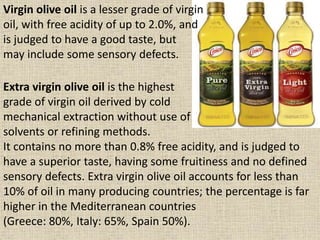
Virgin olive oil is a lesser grade of virgin
oil, with free acidity of up to 2.0%, and
is judged to have a good taste, but
may include some sensory defects.
Extra virgin olive oil is the highest
grade of virgin oil derived by cold
mechanical extraction without use of
solvents or refining methods.
It contains no more than 0.8% free acidity, and is judged to
have a superior taste, having some fruitiness and no defined
sensory defects. Extra virgin olive oil accounts for less than
10% of oil in many producing countries; the percentage is far
higher in the Mediterranean countries
(Greece: 80%, Italy: 65%, Spain 50%).
Olive oils are labeled based on their extraction
processes and acidity. EVOO is the highest-
quality type, as its made through a process called
cold pressing, where oil is extracted from olives
using pressure and not heated over a specific
temperature.
Basically, cold pressing is the best way to keep
olives' healthy antioxidants and monounsaturated
fats in the oil. It also keeps the most olive flavor
and has a lower acidity.
EVOO also has a low smoke point – meaning it doesn’t take
a high temperature for it to start smoking.
Pure olive oil has been refined. It's lower in quality,
meaning a cheaper price.
Olives

Olives

  • 2.
    The olive, knownby the botanical name Olea europaea, meaning "European olive", is a species of small tree in the family Oleaceae , found traditionally in the Mediterranean Basin.
  • 3.
    The species iscultivated in all the countries of the Mediterranean, as well as in the Middle East, South America, South Africa, India, China, Australia, New Zealand, Mexico, and the United States. The olive's fruit, also called the olive, is of major agricultural importance in the Mediterranean region as the source of olive oil; it is one of the core ingredients in Mediterranean cuisine.
  • 4.
  • 5.
    Olive trees requirea Mediterranean-like climate to survive. They need a long, hot summer and a cool, not frigid, winter. A mature tree can survive temperatures down to 15 degrees Fahrenheit for a limited amount of time; sustained cold below 15 degrees can be fatal.
  • 6.
    Ideal planting time Irrigatedareas : Jan to Feb. No irrigation and prolonged drought areas : July to August. In heavy rainy areas : Planting should be delayed.
  • 7.
    Table olives areclassified into three groups according to the degree of ripeness achieved before harvesting: 1. Green olives 2. Semi-ripe or turning-colour olives 3. Black olives or ripe olives
  • 8.
    Green olives arepicked when they have obtained full size, while unripe; they are usually shades of green to yellow, and contain the bitter phytochemical, oleuropein.
  • 9.
    Semi-ripe or turning-colourolives are picked at the beginning of the ripening cycle, when the colour has begun to change from green to multicolour shades of red to brown. Only the skin is coloured, as the flesh of the fruit lacks pigmentation at this stage, unlike that of ripe olives.
  • 10.
    Black olives orripe olives are picked at full maturity when fully ripe, displaying colours of purple, brown or black. To leach the oleuropein from olives, commercial producers use lye, which neutralizes the bitterness of oleuropein, producing a mild flavour and soft texture characteristic of California black olives sold in cans. Such olives are typically preserved in brine and sterilized under high heat during the canning process.
  • 11.
    Once you bringhome these delicious olives, you need to make sure you store them properly to maintain their freshness and flavor. Unopened olives can be stored at room temperature up to 2 years. Opened olives (including those from an olive bar) should be refrigerated in their own liquid in a non-metal container and will last for 1 to 2 months after opening.
  • 12.
    Olive oil isa liquid fat obtained from olives, a traditional tree crop of the Mediterranean Basin, produced by pressing whole olives and extracting the oil. Olive oil is the most common vegetable oil. It is commonly used in cooking, for frying foods or as a salad dressing. It is also used in cosmetics, pharmaceuticals, and soaps, and as a fuel for traditional oil lamps, and has additional uses in some religions.
  • 13.
    Refined olive oilis virgin oil that has been refined using charcoal and other chemical and physical filters, methods which do not alter the glyceridic structure. It has a free acidity, expressed as oleic acid, of not more than 0.3 grams per 100 grams (0.3%) and its other characteristics correspond to those fixed for this category in this standard. It is obtained by refining virgin oils to eliminate high acidity or organoleptic defects. Oils labeled as Pure olive oil or Olive oil are primarily refined olive oil, with a small addition of virgin for taste.
  • 14.
    Virgin olive oilis a lesser grade of virgin oil, with free acidity of up to 2.0%, and is judged to have a good taste, but may include some sensory defects. Extra virgin olive oil is the highest grade of virgin oil derived by cold mechanical extraction without use of solvents or refining methods. It contains no more than 0.8% free acidity, and is judged to have a superior taste, having some fruitiness and no defined sensory defects. Extra virgin olive oil accounts for less than 10% of oil in many producing countries; the percentage is far higher in the Mediterranean countries (Greece: 80%, Italy: 65%, Spain 50%).
  • 16.
    Olive oils arelabeled based on their extraction processes and acidity. EVOO is the highest- quality type, as its made through a process called cold pressing, where oil is extracted from olives using pressure and not heated over a specific temperature. Basically, cold pressing is the best way to keep olives' healthy antioxidants and monounsaturated fats in the oil. It also keeps the most olive flavor and has a lower acidity. EVOO also has a low smoke point – meaning it doesn’t take a high temperature for it to start smoking. Pure olive oil has been refined. It's lower in quality, meaning a cheaper price.