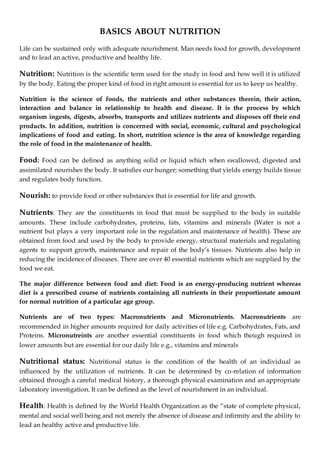
BASICS ABOUT NUTRITION
Life can be sustained only with adequate nourishment. Man needs food for growth, development
and to lead an active, productive and healthy life.
Nutrition: Nutrition is the scientific term used for the study in food and how well it is utilized
by the body. Eating the proper kind of food in right amount is essential for us to keep us healthy.
Nutrition is the science of foods, the nutrients and other substances therein, their action,
interaction and balance in relationship to health and disease. It is the process by which
organism ingests, digests, absorbs, transports and utilizes nutrients and disposes off their end
products. In addition, nutrition is concerned with social, economic, cultural and psychological
implications of food and eating. In short, nutrition science is the area of knowledge regarding
the role of food in the maintenance of health.
Food: Food can be defined as anything solid or liquid which when swallowed, digested and
assimilated nourishes the body. It satisfies our hunger; something that yields energy builds tissue
and regulates body function.
Nourish: to provide food or other substances that is essential for life and growth.
Nutrients: They are the constituents in food that must be supplied to the body in suitable
amounts. These include carbohydrates, proteins, fats, vitamins and minerals (Water is not a
nutrient but plays a very important role in the regulation and maintenance of health). These are
obtained from food and used by the body to provide energy, structural materials and regulating
agents to support growth, maintenance and repair of the body’s tissues. Nutrients also help in
reducing the incidence of diseases. There are over 40 essential nutrients which are supplied by the
food we eat.
The major difference between food and diet: Food is an energy-producing nutrient whereas
diet is a prescribed course of nutrients containing all nutrients in their proportionate amount
for normal nutrition of a particular age group.
Nutrients are of two types: Macronutrients and Micronutrients. Macronutrients are
recommended in higher amounts required for daily activities of life e.g. Carbohydrates, Fats, and
Proteins. Micronutreints are another essential constituents in food which though required in
lower amounts but are essential for our daily life e.g., vitamins and minerals
Nutritional status: Nutritional status is the condition of the health of an individual as
influenced by the utilization of nutrients. It can be determined by co-relation of information
obtained through a careful medical history, a thorough physical examination and an appropriate
laboratory investigation. It can be defined as the level of nourishment in an individual.
Health: Health is defined by the World Health Organization as the “state of complete physical,
mental and social well being and not merely the absence of disease and infirmity and the ability to
lead an healthy active and productive life.
The essential requisites or dimensions or criterias of health include the following: (How is
nutrition linked to health?)
 Achievement of optimal growth and development reflecting the full expression of one’s
genetic potential
 Maintenance of structural integrity and functional efficiency of body tissues necessary for
active and productive life.
 Ability to withstand the inevitable process of aging with minimal disability and functional
impairment.
 Ability to combat diseases such as resisting infections, preventing the onset and retard the
progress of degenerative diseases and resisting the effects of environmental toxins and
pollutants.
 Mental well being
 Spiritual well being
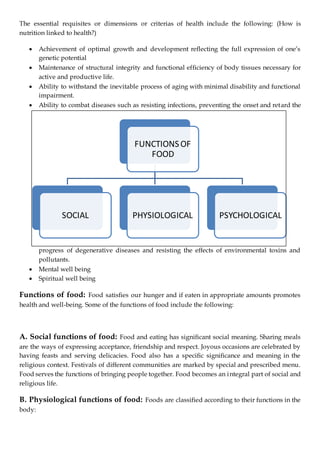
Functions of food: Food satisfies our hunger and if eaten in appropriate amounts promotes
health and well-being. Some of the functions of food include the following:
A. Social functions of food: Food and eating has significant social meaning. Sharing meals
are the ways of expressing acceptance, friendship and respect. Joyous occasions are celebrated by
having feasts and serving delicacies. Food also has a specific significance and meaning in the
religious context. Festivals of different communities are marked by special and prescribed menu.
Food serves the functions of bringing people together. Food becomes an integral part of social and
religious life.
B. Physiological functions of food: Foods are classified according to their functions in the
body:
FUNCTIONSOF
FOOD
SOCIAL PHYSIOLOGICAL PSYCHOLOGICAL
i. Energy-yielding: Energy giving function of the body is performed mainly by two nutrients
which are carbohydrates and fats. The energy released by burning of these two nutrients in
the body is helpful in performing the various activities. One gram of carbohydrate gives 4
Kcal of energy and 1 gram of fats provides 9 Kcal of energy. Carbohydrates usually
provide 60-70% of the total calories in our diets. Some amount of carbohydrate is needed
for the proper utilisation of fat in the body. Presence of carbohydrates in the diet prevents
the body from breaking down too much fat for energy. These nutrients are also called as
body fuels (e.g., cereals, pulses, nuts and oilseeds, roots and tubers, sugar, fats and oils)
ii. Body Building: Foods rich in protein are called body-building foods. They are classified
into two groups-
a) Milk, egg, fish and meat: They are rich proteins of high biological value. These
proteins have all the essential amino acids in correct proportions for the synthesis of
body tissues.
b) Pulses, oilseeds and nuts: They are rich in protein but may not contain all the
essential amino acids required by the human body.
iii. Protection: The term ‘protection’ in food functions refers to the role in preventing
infections by ensuring proper functioning of the body responsible for fighting infections.
Food and nutrients helps in rapid recovery in case of developing any infection/illness. A
person eating a poor diet would take much longer to recover. Protective foods are rich in
vitamins and minerals as well as proteins of high biological value
iv. Regulation and maintenance of health: The regulatory function refers to the food in
controlling the body processes such as beating of the heart, maintenance of body
temperature and contraction of the muscles. Food also helps in preventing degenerative
diseases because of the presence of the phytochemicals and antioxidants. Food plays an
important role in the prevention of cancer, heart diseases and in controlling diabetes.
C. Psychological functions of food: Food satisfies certain emotional needs of human
beings and acts a s a source of security. An infant learns security from the way his mother
feeds him. Similarly, a growing child gains confidence and a feeling of belonging when he
knows that there is food in the house and he will be fed. People feel reasonable secure
when they have enough food stored up to take care of them during scarcity. Food is also
an outlet for emotion. As a relief from tension, one may not eat or over-eat. For some
people, loneliness and boredom are relieved by continuous nibbling at food. Food is also
used a weapon when an insecure child to eat thereby drawing the attention of the parents
especially the mother.
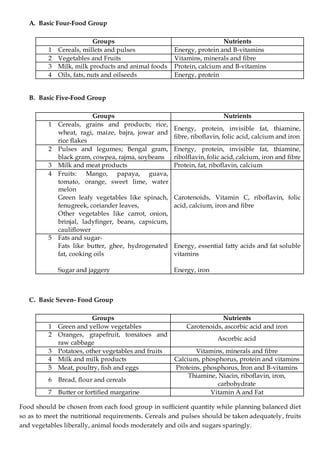
Food Groups: Foods have been classified into different groups depending upon the nutritive
value for the convenience of planning diets. Food groups like “Basic four”, Basic Five” and Basic
Seven” can be used for planning diets as per convenience.
A. Basic Four-Food Group
Groups Nutrients
1 Cereals, millets and pulses Energy, protein and B-vitamins
2 Vegetables and Fruits Vitamins, minerals and fibre
3 Milk, milk products and animal foods Protein, calcium and B-vitamins
4 Oils, fats, nuts and oilseeds Energy, protein
B. Basic Five-Food Group
Groups Nutrients
1 Cereals, grains and products; rice,
wheat, ragi, maize, bajra, jowar and
rice flakes
Energy, protein, invisible fat, thiamine,
fibre, riboflavin, folic acid, calcium and iron
2 Pulses and legumes; Bengal gram,
black gram, cowpea, rajma, soybeans
Energy, protein, invisible fat, thiamine,
ribolflavin, folic acid, calcium, iron and fibre
3 Milk and meat products Protein, fat, riboflavin, calcium
4 Fruits: Mango, papaya, guava,
tomato, orange, sweet lime, water
melon
Green leafy vegetables like spinach,
fenugreek, coriander leaves,
Other vegetables like carrot, onion,
brinjal, ladyfinger, beans, capsicum,
cauliflower
Carotenoids, Vitamin C, riboflavin, folic
acid, calcium, iron and fibre
5 Fats and sugar-
Fats like butter, ghee, hydrogenated
fat, cooking oils
Sugar and jaggery
Energy, essential fatty acids and fat soluble
vitamins
Energy, iron
C. Basic Seven- Food Group
Groups Nutrients
1 Green and yellow vegetables Carotenoids, ascorbic acid and iron
2 Oranges, grapefruit, tomatoes and
raw cabbage
Ascorbic acid
3 Potatoes, other vegetables and fruits Vitamins, minerals and fibre
4 Milk and milk products Calcium, phosphorus, protein and vitamins
5 Meat, poultry, fish and eggs Proteins, phosphorus, Iron and B-vitamins
6 Bread, flour and cereals
Thiamine, Niacin, riboflavin, iron,
carbohydrate
7 Butter or fortified margarine Vitamin A and Fat
Food should be chosen from each food group in sufficient quantity while planning balanced diet
so as to meet the nutritional requirements. Cereals and pulses should be taken adequately, fruits
and vegetables liberally, animal foods moderately and oils and sugars sparingly.
History of Nutrition
The science of nutrition had its beginnings in the late 18th century with the discovery of the
respiratory gases and especially the studies on the nature and the quantification of energy
metabolism by Lavoisier, a Frenchman, often referred to as the “Father of the Science of nutrition”
Table: Scientists and eminent persons and their contribution to Nutrition Science
Year
Scientist/ Eminent
people
Contribution
400 BC Hippocrates
Referred to as the “Father of Medicine”; stated that everybody is
same, no matter what they have been eating or where they have
been eating, or where they have lived.
He is famous for saying “Let food be thy medicine and medicine be thy
food”
1500’s Leonardo Da Vinci
Compared the process of metabolism of the body to the burning of
candle
1716-
1794
Dr. James Lind
A pioneer of hygiene, he stressed on the importance of good
ventilation, cleanliness, fumigation, clean bedding, fresh water by
distilling sea water and the consumption of fruits and vegetables
to prevent scurvy
1770-
1794
Lavoisier
Studied energy metabolism and nature of respiration.
Referred as “Father of Science of Nutrition” and “Father of
Chemistry”
1820 Coindet Used iodine in the treatment of goitre
1824 Shutter Use of cod liver oil in the treatment of rickets
1838 Mulder Introduced the term protein means to take first place
1840 Justus Liebig
He was the first to point out the chemicals made up of
carbohydrates, fats and proteins.
1843-
1851
Dr. Stephen
Babcock
An agricultural test known for his Babcock test which determines
dairy butterfat in milk and cheese processing. He is also known for
the single-grain experiment that eventually led to the
development of nutrition as science.
1849 Regnault Determined Respiratory quotient
1873-
1900
Atwater Energy output studied using human respiration calorimeter
1906 Hopkins Found out vitamins as “accessory factors of the diet”
1912 Funk Coined the term “vitamine”
1921 Tanner Tryptophan can cure pellagra
1927 Adolf Otto Synthesized Vitamin D
1930s William Cumming Identified essential amino acids
1858-
1930
Christian Eijkman
He identified diseases by studying cells and tissues under a
microscope. He also noticed that some of the people living in Java
developed beriberi, a disease which leads to heart problems and
paralysis
1934 Dam Discovered Vitamin K
1937 Royal Lee
Conceived endocardiograph, a tool for graphical heart sounds and
a means for measuring nutritional status
Table: Brief History of Nutrition Research in India
 Beri-beri inquiry was started in 1918 under the guidance of Sir Mc Carrison at Coonoor in
South India.
 Patwardhan “the first Indian director” of Nutrition Research laboratories expanded the
scope of nutrition research programme to clinical, biochemical and public health aspects
 M. S. Swaminathan, “the father of green revolution” was awarded World Food Prize in
1987
 The adoption of National Nutrition Policy (NNP) by the government under the Department
of Women & Child
 A Task Force on Micronutrients (Vitamin A and Iron) was constituted in 1995 for
accelerating the control of vitamin A and Iron deficiency disorders
 A Food and Nutrition Council (FNC) was constituted in November 1997
 The National Rural Health Mission, a National effort at ensuring effective healthcare,
especially to the poor and vulnerable sections of the society was launched on 12th April,
2005 in India
How foods were used as part of treatment? (A brief history)
Year Scientists/ Eminent
people
Contribution
1716-1794 Dr. James Lind
A pioneer of hygiene, he stressed on the importance of
good ventilation, cleanliness, fumigation, clean
bedding, fresh water by distilling sea water and the
consumption of fruits and vegetables to prevent scurvy
1713 Lerney Recognised iron as constituent of body
1820 Coindet Iodides were used as the treatment of goitre
1824 Shutter Use of cod liver oil in the treatment of rickets
1895 Baumann Discovered the presence of iodine in thyroid gland
1887 Takaki Investigation showed that addition of meat, vegetables,
condensed milk and barley to a ration based mainly on
raw milled rice helped to prevent the occurrence of
beri- beri among sailors in the Japanese Navy
1905 Pakelharing Diet based on bread, rice flour, egg albumin, casein,
lard and a mixture of fats, mice did not survive. A small
amount of milk fed to the above helped to promote
growth.
1905-1912 Folin Studied protein metabolism
1906 & 1912 Hopkins, Osborne and
Mendel
Showed that rat did not grow on a purified diet
containing zein (a protein from maize) as the sole
source of protein. Chemical analysis revealed that zein
did not contain tryptophan and lysine. They showed
that when these two amino acids were added to zein,
rats grew well.
1915 Goldberger Found protein of milk and egg to a poor maize diet can
prevent pellagra.
1921 Tanner Tryptophan can cure pellagra
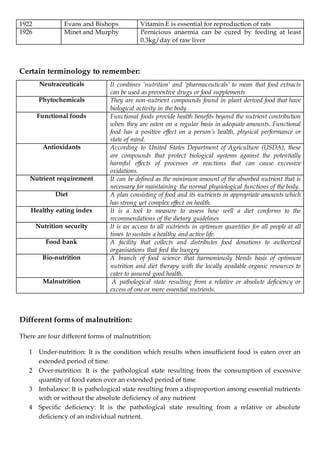
1922 Evans and Bishops Vitamin E is essential for reproduction of rats
1926 Minet and Murphy Pernicious anaemia can be cured by feeding at least
0.3kg/day of raw liver
Certain terminology to remember:
Neutraceuticals It combines ‘nutrition’ and ‘pharmaceuticals’ to mean that food extracts
can be used as preventive drugs or food supplements
Phytochemicals They are non-nutrient compounds found in plant derived food that have
biological activity in the body
Functional foods Functional foods provide health benefits beyond the nutrient contribution
when they are eaten on a regular basis in adequate amounts. Functional
food has a positive effect on a person’s health, physical performance or
state of mind.
Antioxidants According to United States Department of Agriculture (USDA), these
are compounds that protect biological systems against the potentially
harmful effects of processes or reactions that can cause excessive
oxidations.
Nutrient requirement It can be defined as the minimum amount of the absorbed nutrient that is
necessary for maintaining the normal physiological functions of the body.
Diet A plan consisting of food and its nutrients in appropriate amounts which
has strong yet complex effect on health.
Healthy eating index It is a tool to measure to assess how well a diet conforms to the
recommendations of the dietary guidelines
Nutrition security It is an access to all nutrients in optimum quantities for all people at all
times to sustain a healthy and active life.
Food bank A facility that collects and distributes food donations to authorized
organisations that feed the hungry
Bio-nutrition A branch of food science that harmoniously blends basis of optimum
nutrition and diet therapy with the locally available organic resources to
cater to assured good health.
Malnutrition A pathological state resulting from a relative or absolute deficiency or
excess of one or more essential nutrients.
Different forms of malnutrition:
There are four different forms of malnutrition:
1 Under-nutrition: It is the condition which results when insufficient food is eaten over an
extended period of time.
2 Over-nutrition: It is the pathological state resulting from the consumption of excessive
quantity of food eaten over an extended period of time
3 Imbalance: It is pathological state resulting from a disproportion among essential nutrients
with or without the absolute deficiency of any nutrient
4 Specific deficiency: It is the pathological state resulting from a relative or absolute
deficiency of an individual nutrient.

Basic about nutrition

  • 1.
    BASICS ABOUT NUTRITION Lifecan be sustained only with adequate nourishment. Man needs food for growth, development and to lead an active, productive and healthy life. Nutrition: Nutrition is the scientific term used for the study in food and how well it is utilized by the body. Eating the proper kind of food in right amount is essential for us to keep us healthy. Nutrition is the science of foods, the nutrients and other substances therein, their action, interaction and balance in relationship to health and disease. It is the process by which organism ingests, digests, absorbs, transports and utilizes nutrients and disposes off their end products. In addition, nutrition is concerned with social, economic, cultural and psychological implications of food and eating. In short, nutrition science is the area of knowledge regarding the role of food in the maintenance of health. Food: Food can be defined as anything solid or liquid which when swallowed, digested and assimilated nourishes the body. It satisfies our hunger; something that yields energy builds tissue and regulates body function. Nourish: to provide food or other substances that is essential for life and growth. Nutrients: They are the constituents in food that must be supplied to the body in suitable amounts. These include carbohydrates, proteins, fats, vitamins and minerals (Water is not a nutrient but plays a very important role in the regulation and maintenance of health). These are obtained from food and used by the body to provide energy, structural materials and regulating agents to support growth, maintenance and repair of the body’s tissues. Nutrients also help in reducing the incidence of diseases. There are over 40 essential nutrients which are supplied by the food we eat. The major difference between food and diet: Food is an energy-producing nutrient whereas diet is a prescribed course of nutrients containing all nutrients in their proportionate amount for normal nutrition of a particular age group. Nutrients are of two types: Macronutrients and Micronutrients. Macronutrients are recommended in higher amounts required for daily activities of life e.g. Carbohydrates, Fats, and Proteins. Micronutreints are another essential constituents in food which though required in lower amounts but are essential for our daily life e.g., vitamins and minerals Nutritional status: Nutritional status is the condition of the health of an individual as influenced by the utilization of nutrients. It can be determined by co-relation of information obtained through a careful medical history, a thorough physical examination and an appropriate laboratory investigation. It can be defined as the level of nourishment in an individual. Health: Health is defined by the World Health Organization as the “state of complete physical, mental and social well being and not merely the absence of disease and infirmity and the ability to lead an healthy active and productive life.
  • 2.
    The essential requisitesor dimensions or criterias of health include the following: (How is nutrition linked to health?)  Achievement of optimal growth and development reflecting the full expression of one’s genetic potential  Maintenance of structural integrity and functional efficiency of body tissues necessary for active and productive life.  Ability to withstand the inevitable process of aging with minimal disability and functional impairment.  Ability to combat diseases such as resisting infections, preventing the onset and retard the progress of degenerative diseases and resisting the effects of environmental toxins and pollutants.  Mental well being  Spiritual well being Functions of food: Food satisfies our hunger and if eaten in appropriate amounts promotes health and well-being. Some of the functions of food include the following: A. Social functions of food: Food and eating has significant social meaning. Sharing meals are the ways of expressing acceptance, friendship and respect. Joyous occasions are celebrated by having feasts and serving delicacies. Food also has a specific significance and meaning in the religious context. Festivals of different communities are marked by special and prescribed menu. Food serves the functions of bringing people together. Food becomes an integral part of social and religious life. B. Physiological functions of food: Foods are classified according to their functions in the body: FUNCTIONSOF FOOD SOCIAL PHYSIOLOGICAL PSYCHOLOGICAL
  • 3.
    i. Energy-yielding: Energygiving function of the body is performed mainly by two nutrients which are carbohydrates and fats. The energy released by burning of these two nutrients in the body is helpful in performing the various activities. One gram of carbohydrate gives 4 Kcal of energy and 1 gram of fats provides 9 Kcal of energy. Carbohydrates usually provide 60-70% of the total calories in our diets. Some amount of carbohydrate is needed for the proper utilisation of fat in the body. Presence of carbohydrates in the diet prevents the body from breaking down too much fat for energy. These nutrients are also called as body fuels (e.g., cereals, pulses, nuts and oilseeds, roots and tubers, sugar, fats and oils) ii. Body Building: Foods rich in protein are called body-building foods. They are classified into two groups- a) Milk, egg, fish and meat: They are rich proteins of high biological value. These proteins have all the essential amino acids in correct proportions for the synthesis of body tissues. b) Pulses, oilseeds and nuts: They are rich in protein but may not contain all the essential amino acids required by the human body. iii. Protection: The term ‘protection’ in food functions refers to the role in preventing infections by ensuring proper functioning of the body responsible for fighting infections. Food and nutrients helps in rapid recovery in case of developing any infection/illness. A person eating a poor diet would take much longer to recover. Protective foods are rich in vitamins and minerals as well as proteins of high biological value iv. Regulation and maintenance of health: The regulatory function refers to the food in controlling the body processes such as beating of the heart, maintenance of body temperature and contraction of the muscles. Food also helps in preventing degenerative diseases because of the presence of the phytochemicals and antioxidants. Food plays an important role in the prevention of cancer, heart diseases and in controlling diabetes. C. Psychological functions of food: Food satisfies certain emotional needs of human beings and acts a s a source of security. An infant learns security from the way his mother feeds him. Similarly, a growing child gains confidence and a feeling of belonging when he knows that there is food in the house and he will be fed. People feel reasonable secure when they have enough food stored up to take care of them during scarcity. Food is also an outlet for emotion. As a relief from tension, one may not eat or over-eat. For some people, loneliness and boredom are relieved by continuous nibbling at food. Food is also used a weapon when an insecure child to eat thereby drawing the attention of the parents especially the mother. Food Groups: Foods have been classified into different groups depending upon the nutritive value for the convenience of planning diets. Food groups like “Basic four”, Basic Five” and Basic Seven” can be used for planning diets as per convenience.
  • 4.
    A. Basic Four-FoodGroup Groups Nutrients 1 Cereals, millets and pulses Energy, protein and B-vitamins 2 Vegetables and Fruits Vitamins, minerals and fibre 3 Milk, milk products and animal foods Protein, calcium and B-vitamins 4 Oils, fats, nuts and oilseeds Energy, protein B. Basic Five-Food Group Groups Nutrients 1 Cereals, grains and products; rice, wheat, ragi, maize, bajra, jowar and rice flakes Energy, protein, invisible fat, thiamine, fibre, riboflavin, folic acid, calcium and iron 2 Pulses and legumes; Bengal gram, black gram, cowpea, rajma, soybeans Energy, protein, invisible fat, thiamine, ribolflavin, folic acid, calcium, iron and fibre 3 Milk and meat products Protein, fat, riboflavin, calcium 4 Fruits: Mango, papaya, guava, tomato, orange, sweet lime, water melon Green leafy vegetables like spinach, fenugreek, coriander leaves, Other vegetables like carrot, onion, brinjal, ladyfinger, beans, capsicum, cauliflower Carotenoids, Vitamin C, riboflavin, folic acid, calcium, iron and fibre 5 Fats and sugar- Fats like butter, ghee, hydrogenated fat, cooking oils Sugar and jaggery Energy, essential fatty acids and fat soluble vitamins Energy, iron C. Basic Seven- Food Group Groups Nutrients 1 Green and yellow vegetables Carotenoids, ascorbic acid and iron 2 Oranges, grapefruit, tomatoes and raw cabbage Ascorbic acid 3 Potatoes, other vegetables and fruits Vitamins, minerals and fibre 4 Milk and milk products Calcium, phosphorus, protein and vitamins 5 Meat, poultry, fish and eggs Proteins, phosphorus, Iron and B-vitamins 6 Bread, flour and cereals Thiamine, Niacin, riboflavin, iron, carbohydrate 7 Butter or fortified margarine Vitamin A and Fat Food should be chosen from each food group in sufficient quantity while planning balanced diet so as to meet the nutritional requirements. Cereals and pulses should be taken adequately, fruits and vegetables liberally, animal foods moderately and oils and sugars sparingly.
  • 5.
    History of Nutrition Thescience of nutrition had its beginnings in the late 18th century with the discovery of the respiratory gases and especially the studies on the nature and the quantification of energy metabolism by Lavoisier, a Frenchman, often referred to as the “Father of the Science of nutrition” Table: Scientists and eminent persons and their contribution to Nutrition Science Year Scientist/ Eminent people Contribution 400 BC Hippocrates Referred to as the “Father of Medicine”; stated that everybody is same, no matter what they have been eating or where they have been eating, or where they have lived. He is famous for saying “Let food be thy medicine and medicine be thy food” 1500’s Leonardo Da Vinci Compared the process of metabolism of the body to the burning of candle 1716- 1794 Dr. James Lind A pioneer of hygiene, he stressed on the importance of good ventilation, cleanliness, fumigation, clean bedding, fresh water by distilling sea water and the consumption of fruits and vegetables to prevent scurvy 1770- 1794 Lavoisier Studied energy metabolism and nature of respiration. Referred as “Father of Science of Nutrition” and “Father of Chemistry” 1820 Coindet Used iodine in the treatment of goitre 1824 Shutter Use of cod liver oil in the treatment of rickets 1838 Mulder Introduced the term protein means to take first place 1840 Justus Liebig He was the first to point out the chemicals made up of carbohydrates, fats and proteins. 1843- 1851 Dr. Stephen Babcock An agricultural test known for his Babcock test which determines dairy butterfat in milk and cheese processing. He is also known for the single-grain experiment that eventually led to the development of nutrition as science. 1849 Regnault Determined Respiratory quotient 1873- 1900 Atwater Energy output studied using human respiration calorimeter 1906 Hopkins Found out vitamins as “accessory factors of the diet” 1912 Funk Coined the term “vitamine” 1921 Tanner Tryptophan can cure pellagra 1927 Adolf Otto Synthesized Vitamin D 1930s William Cumming Identified essential amino acids 1858- 1930 Christian Eijkman He identified diseases by studying cells and tissues under a microscope. He also noticed that some of the people living in Java developed beriberi, a disease which leads to heart problems and paralysis 1934 Dam Discovered Vitamin K 1937 Royal Lee Conceived endocardiograph, a tool for graphical heart sounds and a means for measuring nutritional status
  • 6.
    Table: Brief Historyof Nutrition Research in India  Beri-beri inquiry was started in 1918 under the guidance of Sir Mc Carrison at Coonoor in South India.  Patwardhan “the first Indian director” of Nutrition Research laboratories expanded the scope of nutrition research programme to clinical, biochemical and public health aspects  M. S. Swaminathan, “the father of green revolution” was awarded World Food Prize in 1987  The adoption of National Nutrition Policy (NNP) by the government under the Department of Women & Child  A Task Force on Micronutrients (Vitamin A and Iron) was constituted in 1995 for accelerating the control of vitamin A and Iron deficiency disorders  A Food and Nutrition Council (FNC) was constituted in November 1997  The National Rural Health Mission, a National effort at ensuring effective healthcare, especially to the poor and vulnerable sections of the society was launched on 12th April, 2005 in India How foods were used as part of treatment? (A brief history) Year Scientists/ Eminent people Contribution 1716-1794 Dr. James Lind A pioneer of hygiene, he stressed on the importance of good ventilation, cleanliness, fumigation, clean bedding, fresh water by distilling sea water and the consumption of fruits and vegetables to prevent scurvy 1713 Lerney Recognised iron as constituent of body 1820 Coindet Iodides were used as the treatment of goitre 1824 Shutter Use of cod liver oil in the treatment of rickets 1895 Baumann Discovered the presence of iodine in thyroid gland 1887 Takaki Investigation showed that addition of meat, vegetables, condensed milk and barley to a ration based mainly on raw milled rice helped to prevent the occurrence of beri- beri among sailors in the Japanese Navy 1905 Pakelharing Diet based on bread, rice flour, egg albumin, casein, lard and a mixture of fats, mice did not survive. A small amount of milk fed to the above helped to promote growth. 1905-1912 Folin Studied protein metabolism 1906 & 1912 Hopkins, Osborne and Mendel Showed that rat did not grow on a purified diet containing zein (a protein from maize) as the sole source of protein. Chemical analysis revealed that zein did not contain tryptophan and lysine. They showed that when these two amino acids were added to zein, rats grew well. 1915 Goldberger Found protein of milk and egg to a poor maize diet can prevent pellagra. 1921 Tanner Tryptophan can cure pellagra
  • 7.
    1922 Evans andBishops Vitamin E is essential for reproduction of rats 1926 Minet and Murphy Pernicious anaemia can be cured by feeding at least 0.3kg/day of raw liver Certain terminology to remember: Neutraceuticals It combines ‘nutrition’ and ‘pharmaceuticals’ to mean that food extracts can be used as preventive drugs or food supplements Phytochemicals They are non-nutrient compounds found in plant derived food that have biological activity in the body Functional foods Functional foods provide health benefits beyond the nutrient contribution when they are eaten on a regular basis in adequate amounts. Functional food has a positive effect on a person’s health, physical performance or state of mind. Antioxidants According to United States Department of Agriculture (USDA), these are compounds that protect biological systems against the potentially harmful effects of processes or reactions that can cause excessive oxidations. Nutrient requirement It can be defined as the minimum amount of the absorbed nutrient that is necessary for maintaining the normal physiological functions of the body. Diet A plan consisting of food and its nutrients in appropriate amounts which has strong yet complex effect on health. Healthy eating index It is a tool to measure to assess how well a diet conforms to the recommendations of the dietary guidelines Nutrition security It is an access to all nutrients in optimum quantities for all people at all times to sustain a healthy and active life. Food bank A facility that collects and distributes food donations to authorized organisations that feed the hungry Bio-nutrition A branch of food science that harmoniously blends basis of optimum nutrition and diet therapy with the locally available organic resources to cater to assured good health. Malnutrition A pathological state resulting from a relative or absolute deficiency or excess of one or more essential nutrients. Different forms of malnutrition: There are four different forms of malnutrition: 1 Under-nutrition: It is the condition which results when insufficient food is eaten over an extended period of time. 2 Over-nutrition: It is the pathological state resulting from the consumption of excessive quantity of food eaten over an extended period of time 3 Imbalance: It is pathological state resulting from a disproportion among essential nutrients with or without the absolute deficiency of any nutrient 4 Specific deficiency: It is the pathological state resulting from a relative or absolute deficiency of an individual nutrient.