Articles
www.thelancet.com Published online May 18, 2017 http://dx.doi.org/10.1016/S0140-6736(17)30818-8	 1
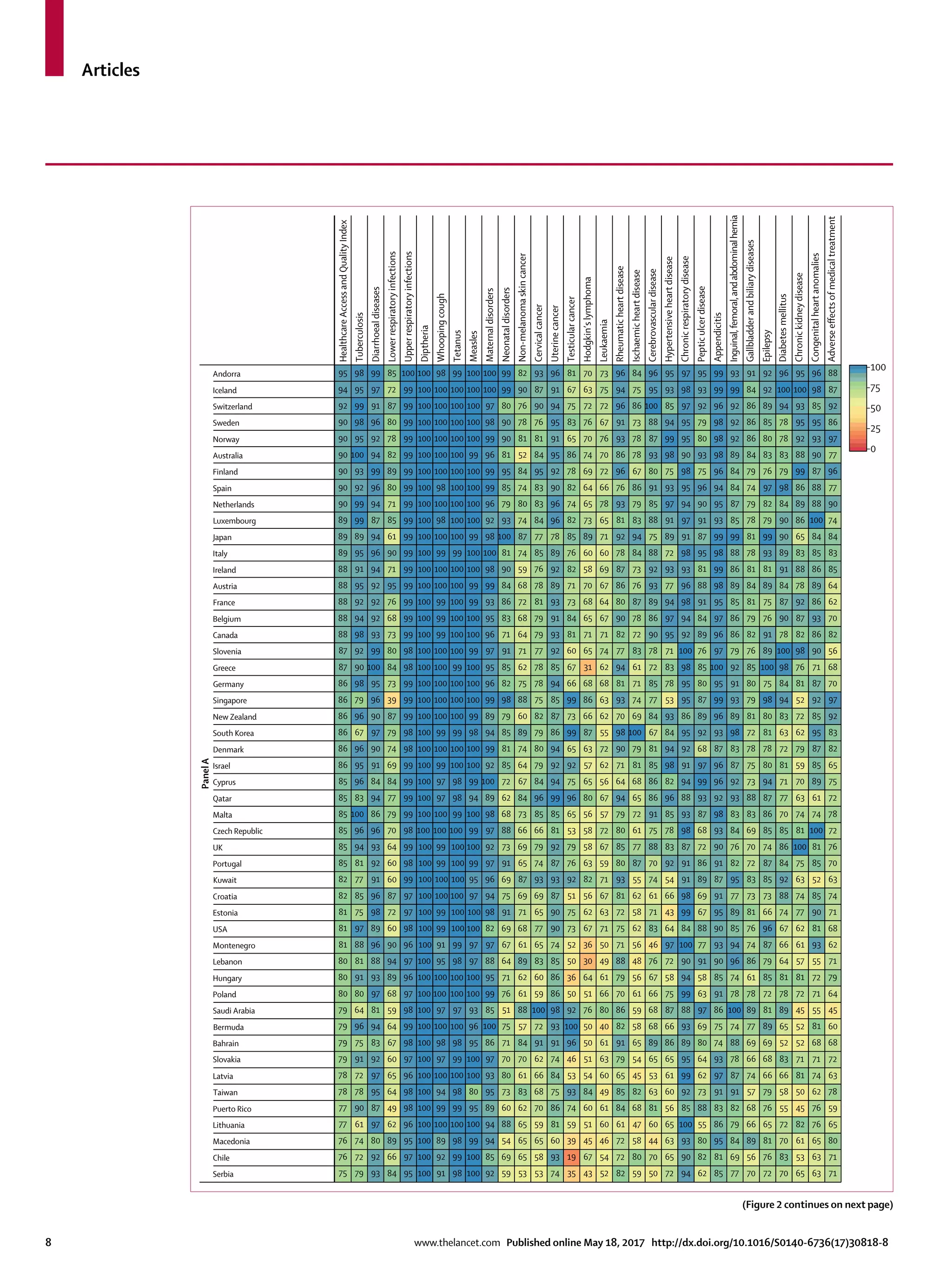
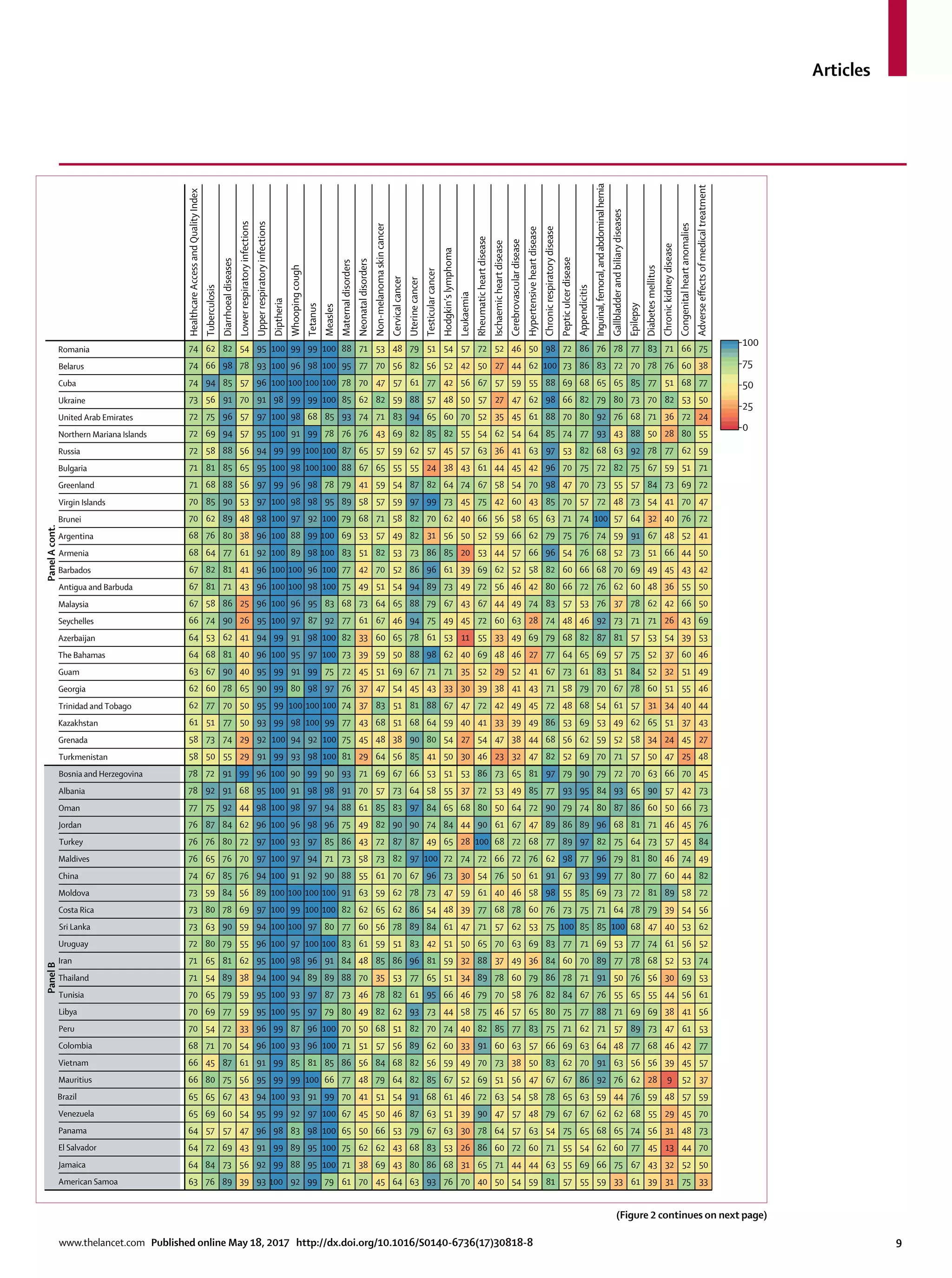
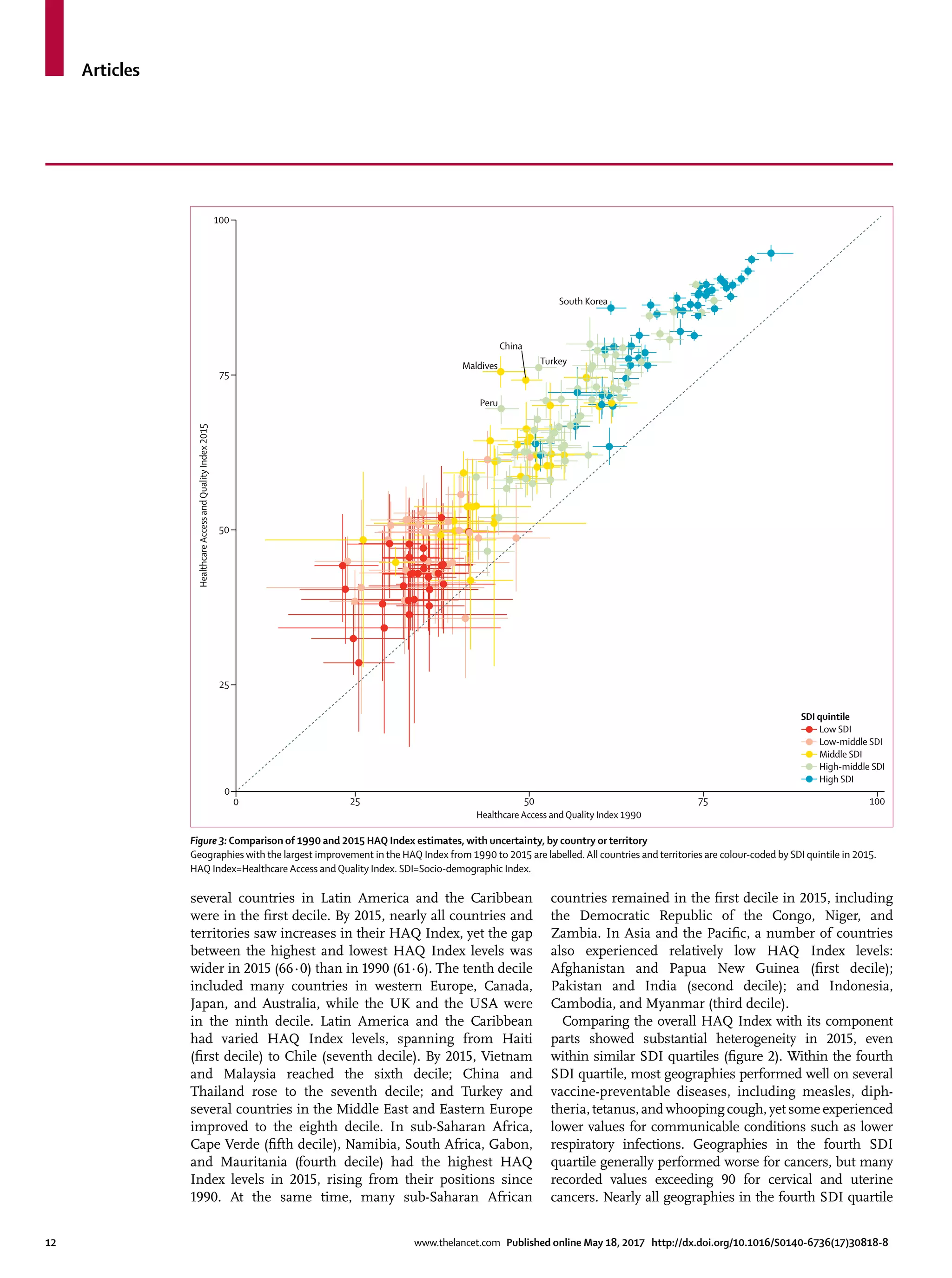
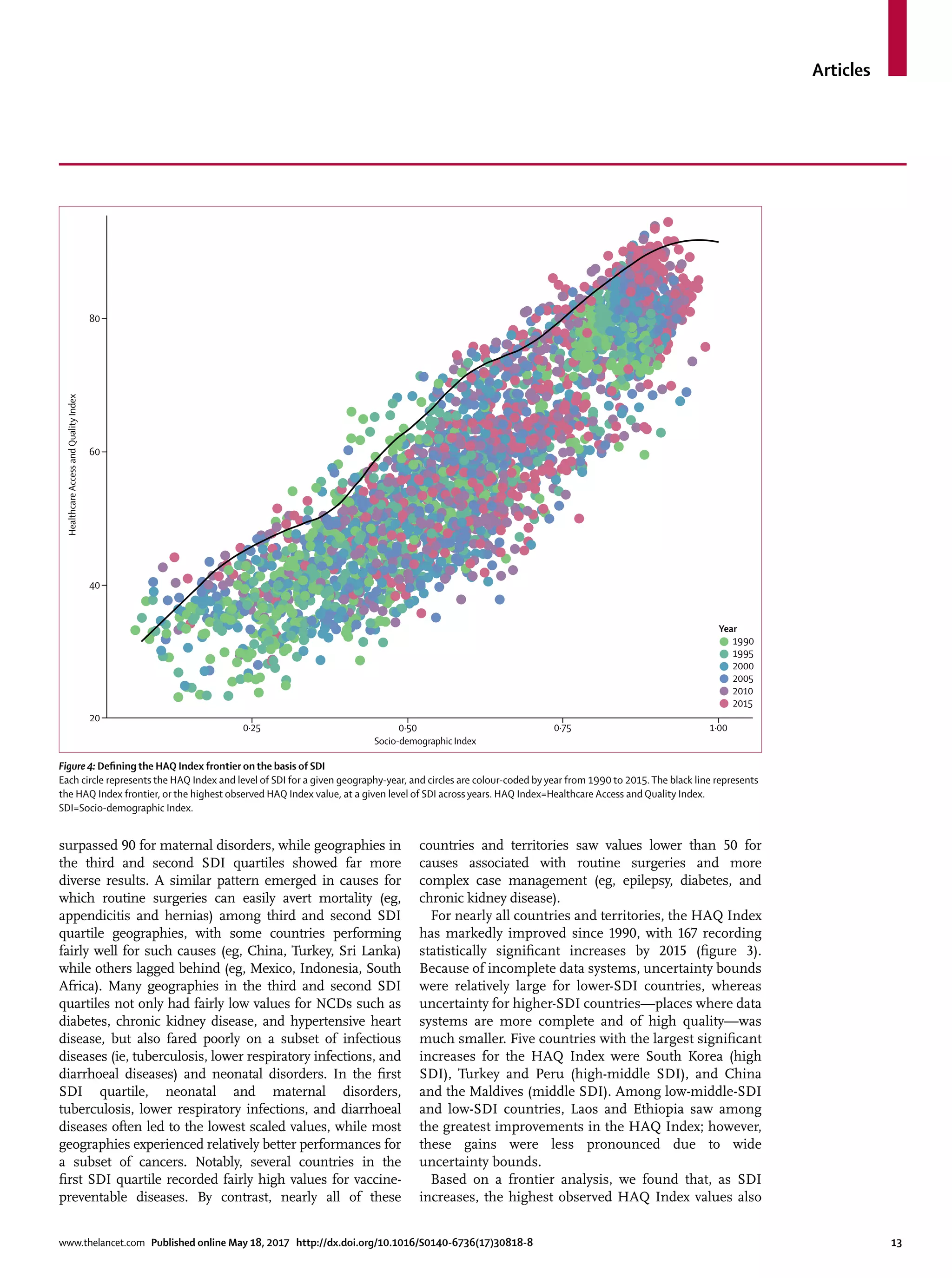
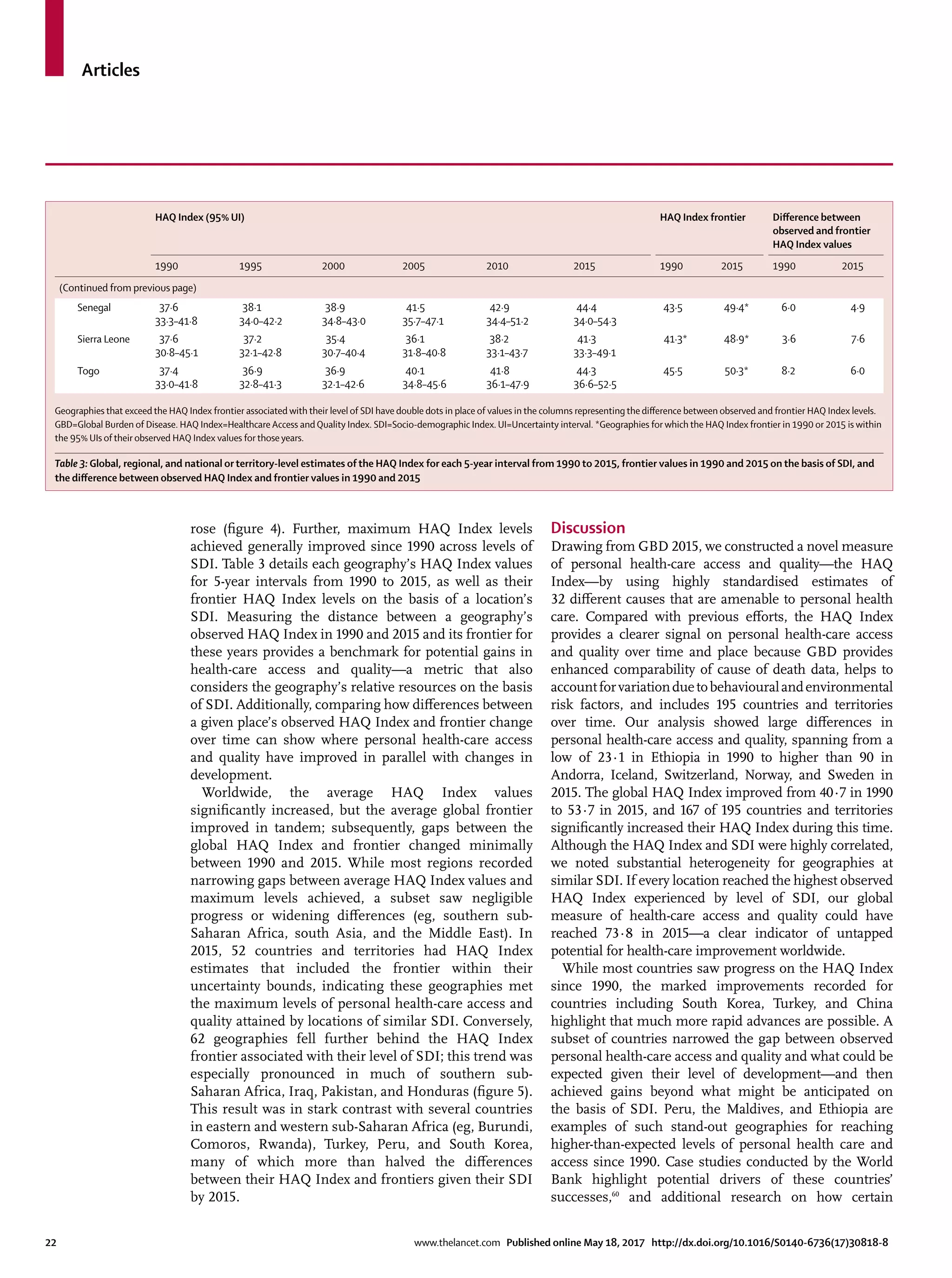
Healthcare Access and Quality Index based on mortality from
causes amenable to personal health care in 195 countries and
territories, 1990–2015: a novel analysis from the Global
Burden of Disease Study 2015
GBD 2015 Healthcare Access and Quality Collaborators*
Summary
Background National levels of personal health-care access and quality can be approximated by measuring mortality
rates from causes that should not be fatal in the presence of effective medical care (ie, amenable mortality). Previous
analyses of mortality amenable to health care only focused on high-income countries and faced several methodological
challenges. In the present analysis, we use the highly standardised cause of death and risk factor estimates generated
through the Global Burden of Diseases, Injuries, and Risk Factors Study (GBD) to improve and expand the
quantification of personal health-care access and quality for 195 countries and territories from 1990 to 2015.
Methods We mapped the most widely used list of causes amenable to personal health care developed by Nolte and
McKee to 32 GBD causes. We accounted for variations in cause of death certification and misclassifications
through the extensive data standardisation processes and redistribution algorithms developed for GBD. To isolate
the effects of personal health-care access and quality, we risk-standardised cause-specific mortality rates for each
geography-year by removing the joint effects of local environmental and behavioural risks, and adding back the
global levels of risk exposure as estimated for GBD 2015. We employed principal component analysis to create a
single, interpretable summary measure–the Healthcare Quality and Access (HAQ) Index–on a scale of 0 to 100.
The HAQ Index showed strong convergence validity as compared with other health-system indicators, including
health expenditure per capita (r=0·88), an index of 11 universal health coverage interventions (r=0·83), and human
resources for health per 1000 (r=0·77). We used free disposal hull analysis with bootstrapping to produce a frontier
based on the relationship between the HAQ Index and the Socio-demographic Index (SDI), a measure of overall
development consisting of income per capita, average years of education, and total fertility rates. This frontier
allowed us to better quantify the maximum levels of personal health-care access and quality achieved across the
development spectrum, and pinpoint geographies where gaps between observed and potential levels have
narrowed or widened over time.
Findings Between 1990 and 2015, nearly all countries and territories saw their HAQ Index values improve;
nonetheless, the difference between the highest and lowest observed HAQ Index was larger in 2015 than in 1990,
ranging from 28·6 to 94·6. Of 195 geographies, 167 had statistically significant increases in HAQ Index levels
since 1990, with South Korea, Turkey, Peru, China, and the Maldives recording among the largest gains by 2015.
Performance on the HAQ Index and individual causes showed distinct patterns by region and level of development,
yet substantial heterogeneities emerged for several causes, including cancers in highest-SDI countries; chronic
kidney disease, diabetes, diarrhoeal diseases, and lower respiratory infections among middle-SDI countries; and
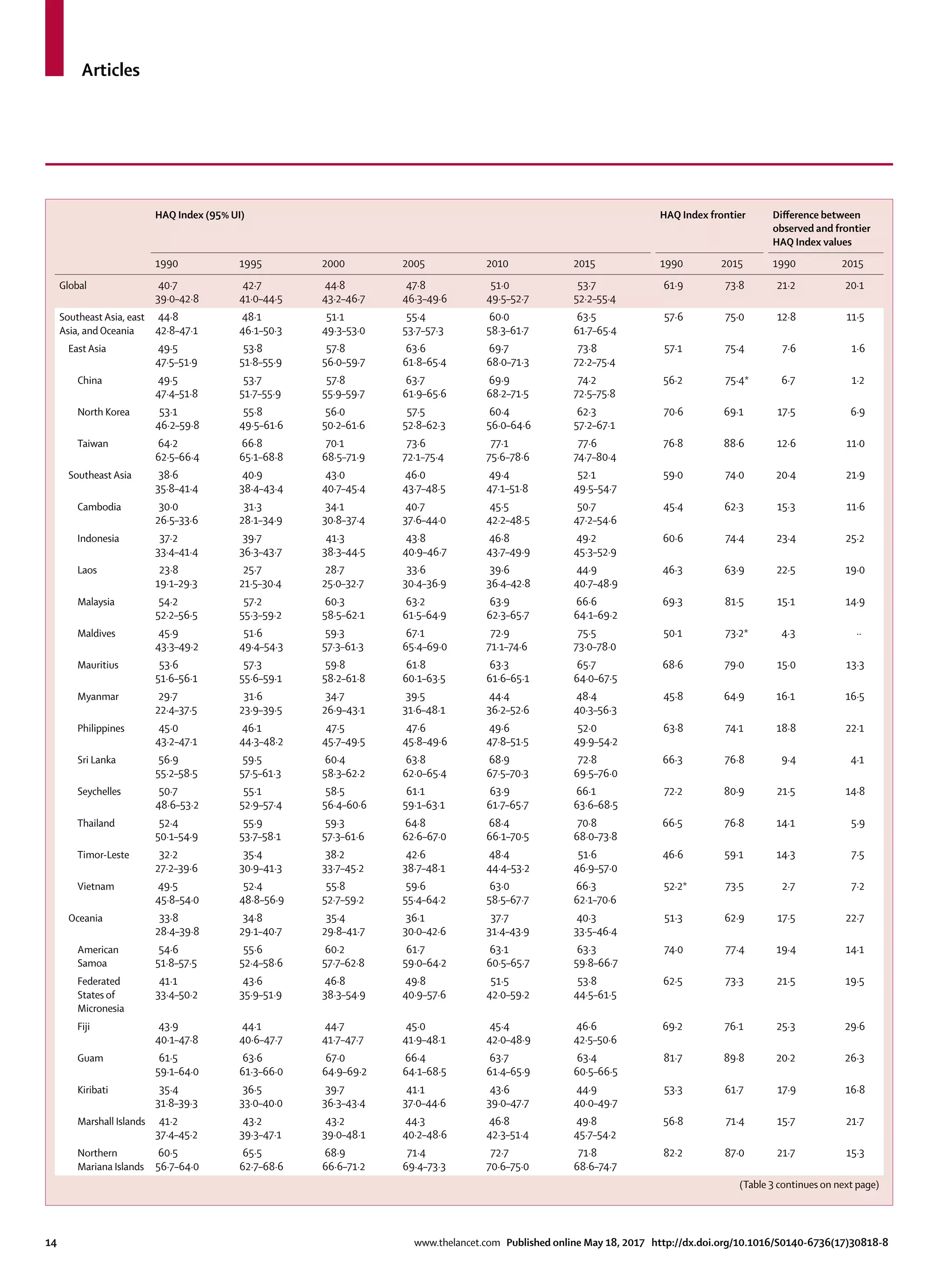
measles and tetanus among lowest-SDI countries. While the global HAQ Index average rose from 40·7
(95% uncertainty interval, 39·0–42·8) in 1990 to 53·7 (52·2–55·4) in 2015, far less progress occurred in narrowing
the gap between observed HAQ Index values and maximum levels achieved; at the global level, the difference
between the observed and frontier HAQ Index only decreased from 21·2 in 1990 to 20·1 in 2015. If every country
and territory had achieved the highest observed HAQ Index by their corresponding level of SDI, the global average
would have been 73·8 in 2015. Several countries, particularly in eastern and western sub-Saharan Africa, reached
HAQ Index values similar to or beyond their development levels, whereas others, namely in southern sub-Saharan
Africa, the Middle East, and south Asia, lagged behind what geographies of similar development attained between
1990 and 2015.
Interpretation This novel extension of the GBD Study shows the untapped potential for personal health-care access and
quality improvement across the development spectrum. Amid substantive advances in personal health care at the
national level, heterogeneous patterns for individual causes in given countries or territories suggest that few places
have consistently achieved optimal health-care access and quality across health-system functions and therapeutic
areas. This is especially evident in middle-SDI countries, many of which have recently undergone or are currently
experiencing epidemiological transitions. The HAQ Index, if paired with other measures of health-system
Published Online
May 18, 2017
http://dx.doi.org/10.1016/
S0140-6736(17)30818-8
See Online/Comment
http://dx.doi.org/10.1016/
S0140-6736(17)31289-8
*Collaborators listed at the end
of the Article
Correspondence to:
Prof Christopher J L Murray,
Institute for Health Metrics and
Evaluation, University of
Washington, 2301 5th Avenue,
Suite 600, Seattle,WA 98121,
USA
cjlm@uw.edu
Articles
2	 www.thelancet.com Published online May 18, 2017 http://dx.doi.org/10.1016/S0140-6736(17)30818-8
Introduction
Quantifying how much personal health care can
improve population health and ultimately health-system
performance is a crucial undertaking, particularly
following the inclusion of universal health coverage (UHC)
in the Sustainable Development Goals (SDGs).1
Mortality
from causes considered amenable to personal health care
serve as an important proxy of health-care access and
quality (panel),4,6–8
and thus can be used to benchmark
dimensions of health-system performance and to identify
untapped potential for advancing personal health-care
access and quality.9–12
Much debate exists concerning the
relative contributions of personal health care, population-
level health initiatives, and social determinants to
population health.13–16
Studies show that access to high-
quality health care substantially improves many health
outcomes, including infectious diseases (eg, tuberculosis
and measles);17–19
maternal and neonatal disorders;20,21
Research in context
Evidence before this study
Inthe last several decades, various studies have used measures of
amenable mortality, or deathsthat could be avoided inthe
presence of high-quality personal health care,to garner signals
about health-system delivery, effectiveness, and performance.
Rutstein and colleagues developed an initial list of conditions
from which death was “unnecessary and untimely” duringthe
late 1970s, whileCharlton and colleagues werethe firstto apply
this conceptto population-level analyses in England andWales.
Although variations of amenable cause lists existtoday,the most
widely used cause list of 33 conditions was developed and further
honed by Nolte and McKee duringthe early-to-mid 2000s. Such
analyses of health-care access and quality, as approximated by
amenable mortality, have been limitedto Europe,Organisation
for EconomicCo-operation and Development (OECD) countries,
and country-specific assessments, includingtheUSA,Australia,
and New Zealand.These studies acknowledge several
methodological challengesthat may impedethe policy utility
and applications oftheir results. Heterogeneity in cause of death
certification and misclassification, even for countries with
complete vital registration systems, can hinder comparability of
results overtime and place. Further, researchers commonly
acknowledgethat variations in measured amenable mortality
rates may be more reflective of differences in underlying risk
factor exposure ratherthantrue differences in personal
health-care access and quality.
Added value of this study
TheGlobal Burden of Diseases, Injuries, and Risk Factors Study
(GBD) provides an appropriate analytic frameworkthrough
whichthese main challenges in approximating personal
health-care access and quality can be addressed. First,the
extensive cause of death data processing and standardisation
that occur withinGBD allow forthe systematic identification and
redress of cause of death certification errors or misclassification.
These adjustments are conducted across all geographies and
overtime, accounting for known misclassification patterns and
applying well established redistribution algorithms for causes
designatedto so-called garbage codes, or causes of deaththat
could not or should not be classified as underlying causes of
death. Second, we draw onGBD’s comparative risk assessment
analysesto risk-standardise national cause-specific mortality
ratesto global levels of risk exposure;this step helpsto remove
variations in death rates dueto risk exposure ratherthan
differences in personal health-care access and quality.Third, we
constructthe HealthcareAccess andQuality (HAQ) Index based
on risk-standardised cause-specific death ratesto facilitate
comparisons overtime and by geography. Finally, we produced a
HAQ Index frontierto enable a better understanding ofthe
maximum observed levels ofthe HAQ Index acrossthe
development spectrum, and what untapped potential for
improving personal health-care access and quality may exist
given a country orterritory’s current resources.
Implications of all the available evidence
Our results pointto substantive gains for advancing personal
health-care access and qualitythroughoutthe world since 1990.
However,the gap between places withthe highest and lowest
HAQ Index in 1990 increased by 2015, suggestingthat
geographic inequalities in personal health-care access and quality
might be onthe rise. In 2015, countries in western Europe
generally hadthe highest HAQ Index values while geographies in
sub-SaharanAfrica andOceania mainly sawthe lowest, further
emphasisingthese disparities.A number of countries achieved
improvements inthe HAQ Indexthat exceededthe average
found fortheir development level, identifying possible success
stories in markedly advancing personal health-care access and
quality atthe national level. Based on our frontier analysis, many
countries andterritories currently experience untapped potential
for improving health-care access and quality, onthe basis oftheir
development, a findingthat could betransformative for
prioritising particular health-sector reforms, pinpointing
cause-specifictherapeutic areasthat require more policy
attention, and monitoring overall progresstoward universal
health coverage.
characteristics such as intervention coverage, could provide a robust avenue for tracking progress on universal health
coverage and identifying local priorities for strengthening personal health-care quality and access throughout the world.
Funding Bill & Melinda Gates Foundation.
Copyright © The Author(s). Published by Elsevier Ltd. This is an Open Access article under the CC BY 4.0 license.
Articles
www.thelancet.com Published online May 18, 2017 http://dx.doi.org/10.1016/S0140-6736(17)30818-8	 3
several cancers (eg, testicular, skin, and cervical cancers);22,23
and many non-communicable diseases (NCDs) such as
cerebrovascular disease (stroke),24
diabetes,25
and chronic
kidney disease.26
Consequently, assessing mortality rates
from these conditions, which are considered amenable to
personal health care,4,6–8
can provide vital insights into
accesstoandquality of healthcareworldwide.Assessments
of both mortality and disease burden attributable to risk
factors modifiable through public health programmes and
policy (eg, tobacco taxation), combined with access to high-
quality personal health care, can provide a more complete
picture of the potential avenues for health improvement.
In the late 1970s, Rutstein and colleagues first introduced
the idea of “unnecessary, untimely deaths”, proposing a
list of causes from which death should not occur with
timely and effective medical care.6
Eventually termed
“amenable mortality”, this approach has been modified
and extended since, with researchers refining the list of
included conditions by accounting for advances in medical
care, the introduction of new interventions, and improved
knowledge of cause-specific epidemiology.7,8,27–29
Numerous
studies have subsequently assessed amenable mortality
trends over time, by sex, and across ages in different
populations;2,10,11,30–33
examples include analyses showing
variations in amenable mortality within the European
Union and Organisation for Economic Co-operation and
Development (OECD),3,34
and how much the US health
system has lagged behind other higher-income
countries.30,31
Some studies also extended the set of
amenable conditions to include those targeted by public
health pro­grammes.31
The most widely cited and utilised
list of causes amenable to personal health care is that of
Nolte and McKee,4
which has been extensively used in
Europe, the USA, and other OECD countries.9,11,30,31,35
Previously, several technical challenges have emerged
concerning the quantification of mortality from con­
ditions amenable to personal health care and its use for
understanding overall health-care access and quality. First,
discrepancies in cause of death certification practices and
misclassification over time and across geographies affect
comparisons of amenable mortality.4,36
Second, observed
geographic and temporal variations in deaths from
selected amenable causes (eg, stroke and heart disease)
might be attributed partly differences in risk factor
exposure (eg, diet, high BMI, and physical activity) rather
than actual differences in access to quality personal health
care.Public health programmes and policies might modify
these risks in well-functioning health systems, but risk
variation can still confound the measurement of personal
health-care access and quality. Third, much of this work
has occurred in higher-income settings, with few studies
applying the concept of amenable mortality as a
mechanism for assessing access and quality to personal
health care in lower-resource settings. Other critiques
involve weak correlations between observed trends and
variations in amenable mortality and indicators of health-
care provision and spending, although this result could
Panel: Context and definitions
With the present analysis, we use the Global Burden of Diseases, Injuries, and Risk Factors
Study (GBD) to approximate average levels of personal health-care access and quality for
195 countries and territories from 1990 to 2015. Here we define key concepts frequently
used in the literature focused on assessing health-care quality and how they relate to GBD
terminology:
Avertable burden refers to disease burden that could be avoided in the presence of
high-quality personal health care in addition to disease burden that could be prevented
through effective public health (ie, non-personal) interventions.
Amenable burden entails disease burden that could be avoided in the presence of
high-quality personal health care.2,3
To be considered a cause amenable to personal health
care, effective interventions must exist for the disease.4
The most widely used and cited
list of causes amenable to health care is that of Nolte and McKee.
Preventable burden involves disease burden that could be avoided through public health
programmes or policies focused on wider determinants of health, such as behavioural and
lifestyle influences, environmental factors, and socioeconomic status.2,3
For some causes,
both personal health care and public health programmes and policies can reduce burden.
Within the GBD framework, we have two related terms: attributable and avoidable
burden.5
Attributable burden refers to the difference in disease burden observed at present and
burden that would have been observed in a population if past exposure was at the lowest
level of risk.
Avoidable burden concerns the reduction in future disease burden if observed levels of
risk factor exposure today were decreased to a counterfactual level.
For this study, we use the definition of amenable burden and focus on amenable mortality
to provide a signal on approximate average levels of national personal health-care access
and quality. Future analyses facilitated through the GBD study aim to provide more
comprehensive assessments of health systems using amenable burden and preventable
burden.
Garbage codes refer to causes certified by physicians on death certificates that cannot or
should not be considered the actual underlying causes of death. Examples include risk
factors like hypertension, non-fatal conditions like yellow nails, and causes that are on
the final steps of a disease pathway (eg, certifying cardiopulmonary arrest as the cause
when ischaemic heart disease is the true underlying cause of death). A vital strength of
the GBD Study is its careful identification of garbage codes by cause, over time, and
across locations, and subsequent redistribution to underlying causes based on the GBD
cause list.
Risk-standardisation involves removing the joint effects of environmental and
behavioural risk exposure on cause-specific mortality rates at the country or territory level
for each year of analysis, and then adding back the global average of environmental and
behavioural risk exposure for every geography-year.The goal of risk-standardisation is to
eliminate geographic or temporal differences in cause-specific mortality due to variations
in risk factors that are not immediately targeted by personal health care—and thus
provide comparable measures of outcomes amenable to personal health-care access and
quality over place and time.
Frontier analysis refers to the approach used for ascertaining the highest achieved values
on the Healthcare Access and Quality Index (HAQ Index) on the basis of development
status, as measured by the Socio-demographic Index (SDI).The HAQ Index frontier
delineates the maximum HAQ Index reached by a location as it relates to SDI; if a country
or territory falls well below the frontier value given its level SDI, this finding suggests that
greater gains in personal health-care access and quality should be possible based on the
country or territory’s place on the development spectrum.
Articles
4	 www.thelancet.com Published online May 18, 2017 http://dx.doi.org/10.1016/S0140-6736(17)30818-8
occur if health-care quality is heterogeneous within
countries.37–40
Additionally, existing lists might exclude
causes for which health care can avert death, such as the
effects of trauma care on various injuries,4,41,42
and the ages
at which personal health care can reduce mortality, namely
beyond the age of 75.43,44
The goal of this analysis is to use estimates of mortality
amenable to personal health care from the Global Burden
of Diseases, Injuries, and Risk Factors Study 2015
(GBD 2015) to approximate access to and quality of
personal health care in 195 countries and territories from
1990 to 2015. Quantifying access to and quality of personal
health care has many policy uses, and no consistent
measures of personal health-care access and quality
currently list across the development spectrum; for
instance, the World Bank coverage index only includes
three interventions,45
and the 2010–11 International Labour
Organization’s indicator of formal health coverage covered
93 countries, with substantial data missingness for sub-
Saharan Africa.46
The highly standardised cause of death
estimates generated through GBD,47
along with risk factor
exposure,48
can address several limitations associated with
previous studies of amenable mortality. GBD provides
comprehensive, comparable estimates of cause-specific
death rates by geography, year, age, and sex through its
extensive data correction processes to account for
variations in cause of death certification.47
The
quantification of risk exposure and risk-attributable deaths
due to 79 risk factors through GBD allows us to account for
variations in risk exposure across geographies and time,48
and thus helps to isolate variations in death rates due to
personal health-care access and quality. We also examine
the relationship between our measure of health-care access
and quality, as defined by risk-standardised mortality rates
amenable to health care, across development levels, as
reflected by the Socio-demographic Index (SDI). Finally,
we produce a frontier of maximum levels of personal
health-care access and quality observed on the basis of
SDI, which allows us to quantify the potential for further
improvement in relation to development status.
Methods
Overview
We employed the most widely cited and used framework
for assessing mortality amenable to personal health
care.4,9,11,30,31,35
The Nolte and McKee cause list does not
include all possible causes for which health care can
improve survival; however, it does provide a set of
conditions for which there is a reasonable consensus that
personal health care has a major effect (table 1). Starting
with this list, our analysis followed four steps: mapping
the Nolte and McKee cause list to GBD causes; risk-
standardising mortality rates to remove variations in death
rates not easily addressed through personal health care;
computing a summary measure of personal health-care
access and quality using principal component analysis
(PCA); and assessing the highest recorded levels of health-
care access and quality across the development spectrum.
This study draws from GBD 2015 results; further detail
on GBD 2015 data and methods are available
Amenable age
range (years)
Communicable, maternal, neonatal, and nutritional diseases
Tuberculosis 0–74
Diarrhoea, lower respiratory, and other common infectious diseases
Diarrhoeal diseases 0–14
Lower respiratory infections 0–74
Upper respiratory infections 0–74
Diphtheria 0–74
Whooping cough 0–14
Tetanus 0–74
Measles 1–14
Maternal disorders 0–74
Neonatal disorders 0–74
Non-communicable diseases
Neoplasms
Colon and rectum cancer 0–74
Non-melanoma skin cancer (squamous-cell
carcinoma)
0–74
Breast cancer 0–74
Cervical cancer 0–74
Uterine cancer 0–44
Testicular cancer 0–74
Hodgkin’s lymphoma 0–74
Leukaemia 0–44
Cardiovascular diseases
Rheumatic heart disease 0–74
Ischaemic heart disease 0–74
Cerebrovascular disease 0–74
Hypertensive heart disease 0–74
Chronic respiratory diseases 1–14
Digestive diseases
Peptic ulcer disease 0–74
Appendicitis 0–74
Inguinal, femoral, and abdominal hernia 0–74
Gallbladder and biliary diseases 0–74
Neurological disorders
Epilepsy 0–74
Diabetes, urogenital, blood, and endocrine diseases
Diabetes mellitus 0–49
Chronic kidney disease 0–74
Other non-communicable diseases
Congenital heart anomalies 0–74
Injuries
Unintentional injuries
Adverse effects of medical treatment 0–74
The age groups for which mortality is regarded as amenable to health care are
listed. Causes are ordered on the basis of the GBD cause list and corresponding
cause group hierarchies. GBD=Global Burden of Disease.
Table 1: Causes for which mortality is amenable to health care mapped
to GBD 2015 causes
Articles
www.thelancet.com Published online May 18, 2017 http://dx.doi.org/10.1016/S0140-6736(17)30818-8	 5
elsewhere.47–50
For the present analysis, a vital strength of
GBD is its careful evaluation and correction of cause of
death certification problems and misclassification at the
national level. In the GBD, we systematically identified
causes of death that could not or should not be underlying
causes of death (so-called garbage codes), and applied
established statistical algorithms to correct for and
redistribute these deaths.51
Our study complies with the Guidelines for Accurate
and Transparent Health Estimates Reporting
(GATHER);52
additional information on the data and
modelling strategies used can be found in the appendix.
Mappingthe Nolte and McKee amenable cause listtothe
GBD cause list
Drawing from Nolte and McKee’s list of 33 causes
amenable to personal health care,4,9,11,30,31,35
we mapped
these conditions to the GBD cause list based on
corresponding International Classification of Diseases
(ICD) codes (appendix p 18). In GBD, thyroid diseases
and benign prostatic hyperplasia are part of a larger
residual category and thus were excluded. Diphtheria and
tetanus are separate causes in GBD so we reported them
individually. Because of its extensive processes used to
consistently map and properly classify ICD causes over
time,47,53
GBD supported the assessment of 32 causes on
the Nolte and McKee cause list from 1990 to 2015.
Age-standardised risk-standardised death rates
Some variation in death rates for amenable causes are
due to differences in behavioural and environmental risk
exposure rather than differences in personal health-care
access and quality.48,54,55
Using the wide range of risk
factors assessed by GBD,48
we risk-standardised death
rates to the global level of risk exposure.48
We did not risk-
standardise for variations in metabolic risk factors directly
targeted by personal health care: systolic blood pressure,
total cholesterol, and fasting plasma glucose. For example,
stroke deaths due to high systolic blood pressure are
amenable to primary care management of hypertension.
To risk-standardise death rates, we removed the joint
effects of national behavioural and environmental risk
levels calculated in GBD, and added back the global levels
of risk exposure:
where mjascy is the death rate from cause j in age a, sex s,
location c, and year y; mrjascy is the risk-standardised death
rate; JPAFjascy is the joint population attributable fraction
(PAF) for cause j, in age a, sex s, country c, and year y for
all behavioural and environmental risks included in
GBD; and JPAFjasgy is the joint PAF for cause j, in age a,
sex s, and year y at the global level.
GBD provides joint PAF estimation for multiple risks
combined, which takes into account the mediation of
different risks through each other. Further detail on
joint PAF computation is available in the appendix
(pp 5–8).
We used the GBD world population standard to
calculate age-standardised risk-standardised death rates
from each cause regarded as amenable to health care.47
We did not risk-standardise death rates from diarrhoeal
diseases as mortality attributable to unsafe water and
sanitation was not computed for high-SDI locations;
such standardisation could lead to higher risk-
standardised death rates in those countries compared
with countries where mortality was attributed to unsafe
water and sanitation.48
With all causes for which no PAFs
are estimated in GBD, such as neonatal disorders and
testicular cancer, risk-standardised death rates equalled
observed death rates.
The effects of risk-standardisation are highlighted by
comparing the log of age-standardised mortality rates to
Source and year Geographies
represented
HAQ Index construction
PCA
weighted
EFA
weighted
Geometric
mean
Mean
Health expenditure per capita GBD 2015 195 0·884 0·880 0·854 0·864
Hospital beds (per 1000) GBD 2015 195 0·700 0·683 0·625 0·650
UHC tracer index of 11 interventions GBD 2015 188 0·826 0·820 0·812 0·818
Physicians, nurses, and midwives per 1000 WHO 2010 73 0·769 0·755 0·725 0·732
Proportion of population with formal health coverage ILO 2010–11 93 0·808 0·798 0·773 0·781
Coverage index of three primary health-care interventions World Bank 2015 123 0·601 0·589 0·557 0·570
The universal health coverage tracer index of 11 interventions included coverage of four childhood vaccinations (BCG, measles, three doses of diphtheria-pertussis-tetanus,
and three doses of polio vaccines); skilled birth attendance; coverage of at least one and four antenatal care visits; met need for family planning with modern contraception;
tuberculosis case detection rates; insecticide-treated net coverage; and antiretroviral therapy coverage for populations living with HIV.TheWorld Bank coverage index
included coverage of three interventions: three doses of diphtheria-pertussis-tetanus vaccine; at least four antenatal care visits; and children with diarrhoea receiving
appropriate treatment. HAQ Index=Healthcare Access and Quality Index. PCA=principal components analysis. EFA=exploratory factor analysis. GBD=Global Burden of
Disease. UHC=universal health coverage. ILO=International Labour Organization.
Table 2: Correlations between different constructions of the HAQ Index and existing indicators of health-care access or quality
See Online for appendix
mrjascy =mjascy (
1 – JPAFjasgy
1 – JPAFjascy
)
Articles
6	 www.thelancet.com Published online May 18, 2017 http://dx.doi.org/10.1016/S0140-6736(17)30818-8
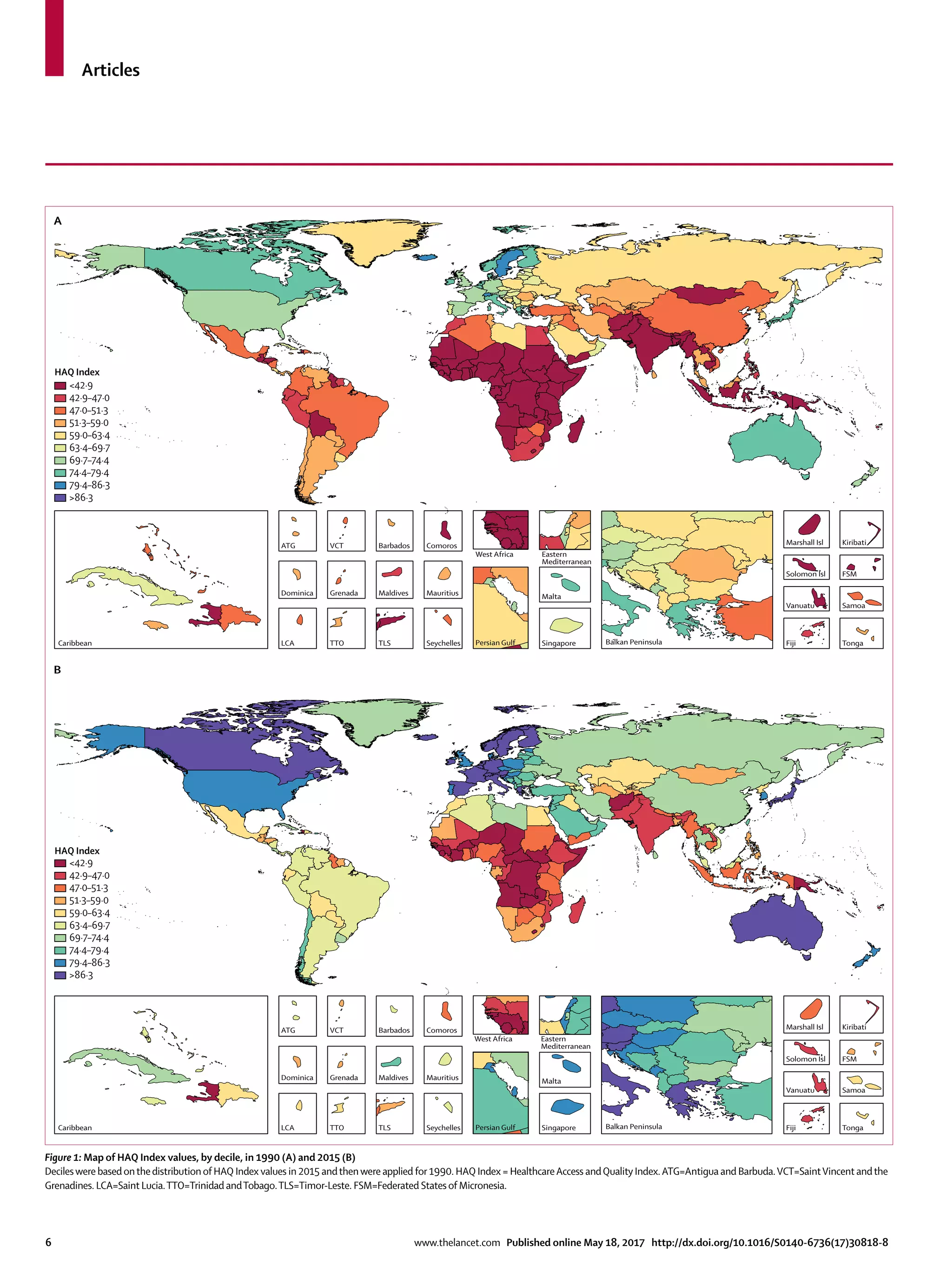
Figure 1: Map of HAQ Index values, by decile, in 1990 (A) and 2015 (B)
Decileswere basedonthedistributionof HAQ Index values in 2015 andthenwere applied for 1990. HAQ Index = HealthcareAccess andQuality Index.ATG=Antigua and Barbuda.VCT=SaintVincent andthe
Grenadines. LCA=Saint Lucia.TTO=Trinidad andTobago.TLS=Timor-Leste. FSM=Federated Statesof Micronesia.
Balkan PeninsulaPersian Gulf
A
B
Caribbean LCA
Dominica
ATG
TTO
Grenada
VCT
TLS
Maldives
Barbados
Seychelles
Mauritius
Comoros
West Africa Eastern
Mediterranean
Malta
Singapore Tonga
Samoa
FSM
Fiji
Solomon Isl
Marshall Isl
Vanuatu
Kiribati
Balkan PeninsulaCaribbean LCA
Dominica
ATG
TTO
Grenada
VCT
TLS
Maldives
Barbados
Seychelles
Mauritius
Comoros
West Africa Eastern
Mediterranean
Malta
Singapore Tonga
Samoa
FSM
Fiji
Solomon Isl
Marshall Isl
Vanuatu
Kiribati
<42·9
42·9–47·0
47·0–51·3
51·3–59·0
59·0–63·4
63·4–69·7
69·7–74·4
74·4–79·4
79·4–86·3
>86·3
Persian Gulf
<42·9
42·9–47·0
47·0–51·3
51·3–59·0
59·0–63·4
63·4–69·7
69·7–74·4
74·4–79·4
79·4–86·3
>86·3
HAQ Index
HAQ Index
Articles
www.thelancet.com Published online May 18, 2017 http://dx.doi.org/10.1016/S0140-6736(17)30818-8	 7
the log of age-standardised risk-standardised mortality
rates for amenable causes (appendix p 14). For each SDI
quintile, many countries had differing levels of age-
standardised mortality rates but their risk-standardised
mortality rates were similar, demonstrating how
underlying local risk exposure can skew measures of
mortality amenable to personal health care.
Construction ofthe Healthcare Access andQuality Index
based on age-standardised risk standardised death rates
To construct the Healthcare Access and Quality (HAQ)
Index, we first rescaled the log age-standardised risk-
standardised death rate by cause to a scale of 0 to 100
such that the highest observed value from 1990 to 2015
was 0 and the lowest was 100. To avoid the effects of
fluctuating death rates in small populations on rescaling,
we excluded populations less than 1 million population
from setting minimum and maximum values. Any
location with a cause-specific death rate below the
minimum or above the maximum from 1990 to 2015 was
set to 100 or 0, respectively.
Because each included cause provided some signal on
average levels of personal health-care access and quality,
we explored four approaches to construct the HAQ
Index: PCA, exploratory factor analysis, arithmetic mean,
and geometric mean. Details on these four approaches
are in the appendix (pp 7, 8, 21, 22). All four measures
were highly correlated, with Spearman’s rank order
correlations exceeding rs=0·98. We selected the PCA-
derived HAQ Index because it provided the strongest
correlations with six other currently available cross-
country measures of access to care or health-system
inputs(table2).ThreeindicatorscamefromtheGBDStudy
2015: health expenditure per capita, hospital beds
per 1000, and the UHC tracer intervention index, a
composite measure of 11 UHC tracer interventions (four
childhood vaccinations; skilled birth attendance; coverage
of at least one and four antenatal care visits; met need for
family planning with modern contraception; tuberculosis
case detection rates; insecticide-treated net coverage; and
antiretroviral therapy coverage for populations living
with HIV).56
Three indicators came from WHO
(physicians, nurses, and midwives per 1000),57
the
International Labour Organization,46
and the World Bank
(coverage index based on diphtheria-pertussis-tetanus
vaccine coverage, coverage of at least four antenatal care
visits, and proportion of children with diarrhoea receiving
appropriate treatment).45
All indicators had correlation
coefficients greater than 0·60, and three exceeded 0·80
(health expenditure per capita, the UHC tracer index,
and International Labour Organization formal health
coverage).
The appendix (pp 21, 22) provides final rescaled PCA
weights derived from the first five components that
collectively accounted for more than 80% of the variance
in cause-specific measures. Colon and breast cancer had
negative PCA weights, which implied higher death rates
were associated with better access and quality of care;
because this cannot be true we set these weights to zero
in the final PCA-derived HAQ Index. The appendix
(p 15) compares each geography’s HAQ Index in 2015
with the log of its age-standardised risk-standardised
mortality rates.
Quantifying maximum levels of the HAQ Index across
the development spectrum
To better understand maximum levels of personal health-
care access and quality potentially achievable across the
development spectrum, we produced a frontier based on
the relationship between the HAQ Index and SDI. We
tested both stochastic frontier analysis models and data
envelopment analysis; however, the relationship between
SDI and the HAQ Index did not fit standard stochastic
frontier analysis models,58
and data envelopment analysis
cannot account for measurement error and is sensitive to
outliers.59
To generate a frontier fit that closely follows the
observed HAQ Index and allowed for measurement error,
we used free disposal hull analysis on 1000 bootstrapped
samples of the data.58
Every bootstrap included a subset
of locations produced by randomly sampling (with
replacement) from all GBD geographies. The final HAQ
Index value was drawn from the uncertainty distribution
for each location-year, with outliers removed by excluding
super-efficient units; additional methodological detail can
be found in the appendix (pp 9–12). Last, we used a Loess
regression to produce a smooth frontier for each five-year
interval from 1990 to 2015. For every geography, we report
the maximum possible HAQ Index value on the basis of
SDI in 1990 and 2015, while values for all years can be
found in the appendix (pp 23–28).
Uncertainty analysis
GBD aims to propagate all sources of uncertainty
through its estimation process,47,48
which results in
uncertainty intervals (UIs) accompanying each point
estimate of death by cause, geography, year, age group,
and sex. We computed the HAQ Index for each
geography-year based on 1000 draws from the posterior
distribution for each included cause of death. We report
95% UIs based on the ordinal 25th and 975th draws for
each quantity of interest.
Role of the funding source
The funder of the study had no role in study design, data
collection, data analysis, data interpretation, or writing of
the report. The corresponding author had full access to
all the data in the study and had final responsibility for
the decision to submit for publication.
Results
Distinct geographic patterns emerged for overall HAQ
Index levels and gains from 1990 to 2015 (figure 1).
Andorra and Iceland had the highest HAQ Index in 1990,
whereas most of sub-Saharan Africa and south Asia and
Articles
8	 www.thelancet.com Published online May 18, 2017 http://dx.doi.org/10.1016/S0140-6736(17)30818-8
19
30
31
35
36
36
39
39
40
43
43
44
45
45
45
45
45
46
46
46
47
48
49
49
49
50
50
50
50
50
50
50
51
51
51
51
51
52
52
52
52
52
52
52
52
53
53
53
53
53
53
53
54
54
54
54
54
55
55
55
55
55
55
56
56
56
56
56
56
56
56
57
57
57
57
57
58
58
58
58
58
58
58
5858
58
59
59
59
59
59
59
59
59
59
59
59
60
60
60
60
60
60
60
60
60
60
60
60
60
60
60
60
60
61
61
61
61
61
61
61
61
61
61
61
61
61
61
61
61
61
61
62
62
62
62
62
62
62
62
62
62
62
62
62
62
62
62
62
62
62
63
63
63
63
63
63
63
63
63
63
63
63
63
63
63
63
64
64
64
64
64
64
64
64
64
64
64
64
64
64
64
64
65
65
65
65
65
65
65
65
65
65
65
65
65
65
65
65
65
65
65
65
65
65
65
65
65
65
65
65
65
65
66
66
66
66
66
66
66
66
66
66
6666
66
66
66
66
66
67
67
67
67
67
67
67
67
67
67
67
67
67
67
67
67
67
67
67
68
68
68
68
68
68
68
68
68
68
68
68
68
68
68
68
68
68
68
68
68
68
69
69
69
69
69
69
69
69
69
69
69
69
69
69
69
69
70
70
70
70
70
70
70
70
70
70
70
70
70
70
70
70
70
70
70
70
70
71
71
71
71
7171
71
71
71
71
71
71
71
71
71
71
71
71
71
71
71
71
71
71
71
71 71
72
72
72
72
72
72
72
72
72
72
72
72
72
72
72
72
72
72
72
72
72
72
72
72
72
72
7272
72
72
72
72
72
72
73
73
73
73
73
73
73
73
73
73
73
73
73
73
73
73
74
74
74
74
74 74
74
74
74
74
74
74
74
74
74
74
74
74
74
74
74
74
74
74
74
74
74
74
74
74
75
75
75
75
75 75
75
75
75
75
75
75 75
75
75
75
75
75
75
75
75
75
75
75
75
76
76
76
76
76
76
76
76
76
76
76
76
76
76
76
76
76
76
76
76
76
76
76
76
76
76
76
77
77
77
77
77
77
77
77
77
77
77
77
77
77
77
77
77
77
77
78
78
78
78
78
7878
78
78
78
78
78
78
78
78
78
78
78
78
78
78
78
7878
78
78
78
78
78
78
78
78
79
79
79
79
79
79
79
79
79
79
79
79
79
79
79
79
79
79
79
79
79
79
79
79
79
79
79
79
79
79
79
79
79
79
80
80
80
80
80
80
80
80
80
80
80
80
80
80
80
80
80
80
80
80
80
80
80
80
80
80
80
80
80
81
81
81
81
81
81
81
81
81
81
81
81
81
81
81
81
81
81
81
81
81
81
81
81
81
81
81
81
81
8181
81
81
81
81
81
81
81
81
81
81
81
82
82
82
82
82
82
82
82
82
82
82
82
82
82
82
82
82
82
82
82
82
82
82
82
82
83
83
83
83
83
83
83
83
83
83
83
83
83
83
83
83
83
83
83
83
83
83
83
83
83
83
84
84
84
84
84
84
84
84
84
84
84
84
84
84
84
84
84
84
84
84
84
84
84
84
84
84
84
84
84
84
84
84
84
84
85
85
85
85
85
85
85
85
85
85
85
85
85
85
85
85
85
85
85
85
85
85
85
85
85
8585
85
85
85
85
85
85
85
85
85
85
85
85
85
85
85
85
85
85
85
85
85
85
86
86
86
86
86
86
86
86
86
86
86
86
86
86
86
86
86
8686
86
86
86
86
86
86
86
86
86
86
86
86
86
86
86
86
86
86
86
86
86
86
86
86
87
87
87
87
87
87
87
87
87
87
87
87
87
87
87
87
87
87
87
87
87
87
87
87
87
87
87
87
87
87
87
87
87
87
87
87
87
88
88
88
88
88
88
88
88
88
88
88
88
88
88
88
88
88
88
88
88
88
88
88
88
88
88
88
88
88
88
88
89
89
89
8989
89
89
89
89
89
89
89
89
89
89
89
89
89
89
89
89
89
89
89
89
89
89
89
89
89
89
89
89
89
89
89
89
89
89
90
90
90
90
90
90
90
90
90
90
90
90
90
90
90
90
90
90
90
90
90
90
90
90
90
90
90
90
90
90
90
90
90
90
90
90
90
91
91
91
91
91
91
91
91
91
91
91
91
91
91
91
91
91
91
91
91
91
91
91
91
91
91
91
91
91
91
91
91
91
91
91
91
91
92
92
92
92
92
92
92
92
92
92
92
92
92
92
92
92
92
92
92
92
92
92
92
92
92
92
92
92
92
92
92
92
92
92
92
92
92
92
92
92
92
92
92
92
92
92
93
93
93
93
93
93
93
93
93
93
93
93
93
93
93
93
93
93
93
93
93
93
93
93
93
93
93
93
93
93
93
93
93
93
93
93
93
93
93
93
93
93
93
93
93
93
93
94
94
94
94
94
94
94
94
94
94
94
94
94
94
94
94
94
94
94
94
94
94
94
94
94
94
94
94
94
94
94
94
94
94
94
94
94
95
95
95
95 95
95
9595
95
95
95
95
95
95
95
95
95
95
95
95
95
95
95
95
95
95
95
95
95
95
95
95
95
95
95
95
95
95
95
95
95
95
95
95
95
96
96
96
96
96
96 96
96
96
96
96
96
96
96
96
96
96
96
96
96
96
96
96
96
96
96
96
96
96
96
96
96
96
96
96
96
96
96
96
96
96
96
96
96
96
96
97
97
97
97
97
97
97
97
97
97
97
97
97
97
97
97
97
97
97
97
97
97
97
97
97
97
97
97
97
97
97
97
97
97
97
97
97
97
97
97
98
98
98
98
98
98
98
98
98
98
98
98
98
98
98
98
98
98
98
98
98
98
98
98
98
98
98
98
98
98
98
98
98
98
98
98
98
98
98
98
98
98
98
98
98
98
98
98
98
98
98
98
98
98
98
98
98
99
99
99
99
99
99
99
99
99
99
99
99
99
99
99
99
99
99
99
99
99
99
99
99
99
99
99
99
99
99
99
99
9999
99
99
99
99
99
99
99
99
99
99
99
99
99
99
99
99
99
99
99
99
99
99
99
99
99
99
99
99
99
99
99
99
99 99
99
99
99
99
99
99
99
99
99
99
99
99
99
99
99
99
99
99
99
99
100
100
100100
100
100
100100
100
100
100
100
100
100
100
100
100
100
100
100
100
100
100
100
100
100
100
100
100
100
100
100
100 100
100
100
100
100
100
100
100
100
100
100
100
100
100
100
100
100
100
100
100
100
100
100
100
100
100
100
100
100
100
100
100
100
100
100
100
100
100100
100
100
100
100
100
100
100
100
100
100
100
100
100
100
100
100
100
100
100
100
100
100
100
100
100
100
100
100
100
100
100
100
100
100
100
100
100
100
100
100
100
100
100
100
100
100
100
100
100
100
100
100
100
100
100
100
100
100
100
100
100
100
100
100
100
100
100
100
100
100
100
100
100
100
100
100
100
100
100
100
100
100
100
100
100
100
100
100
100
100
100
Serbia
Chile
Macedonia
Lithuania
Puerto Rico
Taiwan
Latvia
Slovakia
Bahrain
Bermuda
Saudi Arabia
Poland
Hungary
Lebanon
Montenegro
USA
Estonia
Croatia
Kuwait
Portugal
UK
Czech Republic
Malta
Qatar
Cyprus
Israel
Denmark
South Korea
New Zealand
Singapore
Germany
Greece
Slovenia
Canada
Belgium
France
Austria
Ireland
Italy
Japan
Luxembourg
Netherlands
Spain
Finland
Australia
Norway
Sweden
Switzerland
Iceland
Andorra
HealthcareAccessandQualityIndex
Tuberculosis
Diarrhoealdiseases
Lowerrespiratoryinfections
Upperrespiratoryinfections
Diptheria
Whoopingcough
Tetanus
Measles
Maternaldisorders
Neonataldisorders
Non-melanomaskincancer
Cervicalcancer
Uterinecancer
Testicularcancer
Hodgkin’slymphoma
Leukaemia
Rheumaticheartdisease
Ischaemicheartdisease
Cerebrovasculardisease
Hypertensiveheartdisease
Chronicrespiratorydisease
Pepticulcerdisease
Appendicitis
Inguinal,femoral,andabdominalhernia
Gallbladderandbiliarydiseases
Epilepsy
Diabetesmellitus
Chronickidneydisease
Congenitalheartanomalies
Adverseeffectsofmedicaltreatment
0
25
50
75
100
PanelA
(Figure 2 continues on next page)
Articles
www.thelancet.com Published online May 18, 2017 http://dx.doi.org/10.1016/S0140-6736(17)30818-8	 9
11
20
23
24
24
24
25
25
26 26
27
27
27
27
27
28
28
29
29
29
29
30
30
31
31
32
32
32
33
3333
33
34
34
35
35
36
36
36
37
37
37
37
37
38
38
38
38
38
38
39
39
39
39
39
40
40
40
40
40
40
40
41
41
41
41
41
41
41
41
41
41
42
42
42
42
42
42
42
42
42
43
43
43
43
43
43
43
43
43
43
43
43
44
44
44
44
44
4444
45
45
45
45
45
45
45
45
45
45
45
46
46 46
46
46
46
46
46
47
47
47
47
47
47
47
47
47
48
48
48
48
48
48
48
48
48
48
48
49
49
49
49
49
49
49
49
4949
49
50
50
50
50
50
50
50
50
50 50
50
50
50
50
50
51
51
51
51
51
51
51
51
51
51
51
51
51
5152
52
52
52
52
52
52
52
52 52
52
52
52
52
53
53
53
53
53
53
53
53
53
53
53
53
53
53
54
54
54
54
54
54
54
54
54
54
54
54
54
54
55
55
55
55
55
55
55
55
55
55
56
56
56
56
56
56
56
56
56
56
56
57
57
57
57
57
57
57
57
57
57
57
57
57
57
57
57
57
57
57 57
57
57
58
58
58
58 58
58
58
58
58
58
58
59
59
59
59
59
59
59
59
59
59
59
59
60
60
60
60
60
60
60
60
60
60
61
61
61
61
61
61
61
61
61
61
62
62
62
62
62
62
62
62
62
62
62
62
62
62
62
62
62
62
6263 63 63
63
63
63
64
64
64
64
64
64
64
64
64
64
65
65
65
65
65
65
65
65
65
65
65
65
66
66
66
66
66
66
66
66
66
66
66
67
6767
67
67
67
67
67
67
67
67
67
67
6767
67
68
68
68
68
68
68
68
68
68
68
68
68
68
68
68
68
68
68
69
69
6969
69
69
69
69
69
69
69
69
69
69
70
70
70
70
70
70
70
70
70 70
70
70
70
70
70
70 70
70
70
70
71
71
71
7171
71
71
71
71
71
71
71
7171
71
71
72
72
72
72
72
72
72
72
72
72
72
72
72
72
72
72
72
73
7373
73
73
73
73
73
73
73
73
73
73
73
73
74
74
74
74
74
74
74
74
74
74
74
74
74
75
75
75
75
75
75
75
75
75
75
75
76
76
76
76
76
76
76
76
76
76
76
76
77
77
77
77
77
77
77
77
77
77
77
77
77
77
78
78
78
78
78
78
78
78
78
78
78
79
79
79
79
79
79
79
79
80
80
80
80
80
80
80
81
81
81
81
81
81
81
82
82
82
82
82
8282
82
82
82
82
82
82
82
82
82
82
82
83
83
83
83
83
83
83
83
84
84
85
85
85
85
85
85
85
85
85
85
85
86
86
86
86
86
86
87
87
87
87
88
88
88
88
88
88
88
88
88
88
88
88
89
89
89
89
90
90
90
90
90
91
91
91
91
9191
91
92 92
92
92
92
92
92
92
93
93
93
93
93
94
94
94
94
94
94
94
94
95
95
95
95
95
95
95
95
95
95
96
96
96
96
96
96
96
96
96
96
96
96
96
96
97
97
97
97
97
97
97
97
97
98
98
98
98
98
98
98
98
98
98
98
98
98
98
98
98
98
98
98
99
99
99
99
99
99
99
99
99
99
99
99
99
99
99
99
99
99
100
100
100
100
100
100
100
100
100
100
100
100
100
100
100
100
100
100
100
100
100
100
100
100100
100
100
100
100
100
100
100
100
100
100
100
100
100
100
100
100
100
100
Turkmenistan
Grenada
Kazakhstan
Trinidad and Tobago
Georgia
Guam
The Bahamas
Azerbaijan
Seychelles
Malaysia
Antigua and Barbuda
Barbados
Armenia
Argentina
Brunei
Virgin Islands
Greenland
Bulgaria
Russia
Northern Mariana Islands
United Arab Emirates
Ukraine
Cuba
Belarus
Romania
HealthcareAccessandQualityIndex
Tuberculosis
Diarrhoealdiseases
Lowerrespiratoryinfections
Upperrespiratoryinfections
Diptheria
Whoopingcough
Tetanus
Measles
Maternaldisorders
Neonataldisorders
Non-melanomaskincancer
Cervicalcancer
Uterinecancer
Testicularcancer
Hodgkin’slymphoma
Leukaemia
Rheumaticheartdisease
Ischaemicheartdisease
Cerebrovasculardisease
Hypertensiveheartdisease
Chronicrespiratorydisease
Pepticulcerdisease
Appendicitis
Inguinal,femoral,andabdominalhernia
Gallbladderandbiliarydiseases
Epilepsy
Diabetesmellitus
Chronickidneydisease
Congenitalheartanomalies
Adverseeffectsofmedicaltreatment
0
25
50
75
100
9
1326
28
28
29
30
30
30
31
31
31 32
32
3333
33
33
3435
36
37
37
37
38
38
38
38
39
39
39
39
39
39
40
40
40
40
41
41
42
42
42
43
43
4343
43
43
44
44
44
44
44
44
44
44
44
45
45
45
45
45
45
45
45
45
46 46
46
46
46
46
46
46
46
47
47
47
47
47
47
47
47
48
48
48
48
48
48
48
49
49
49
49
49
49
49
50
50
50
50
50
5050
50
50
50
50
51
51
51
51
51
51
51
51
51
52
52
52 52
52
53 53
53
53
53
53
53
53
53
53
53
53 54
54
54
54
54
54
54
54
54
54
54
54
55
55
55
55
55
55
55
55
55
55
56
56
56
56
56
56
56
56
56
56
5656
56
56
56
56
57
57
57
57
57
57
57
57
57
57
57
57
57
57
57
58
58
58
58
58
58
58
59
59
59 59
59
59
59
59
59
59
59
59
59
59
60
60
60
60
60
60
60
60
60
60
60
60
61
61
61
61
61
61
61
61
61
61
61
61
61
61
61
62
62
62
62
62
62
62
62
62
62
62
62
62
62
62
62
62
62
63
63
63
63
63
63
63
63
63
63
63
63
63
63
63 64
64
64
64
64
64
64
64
64
64
64 6565
65
65
65
65
65
65
65 65
65
65
65
65
65
65
65
65
65
65
66
66
66
66
66
66
66
66
66
66
66
67
67
67
67
67
67
67
67
67
67
67
67
6767
67
68
68
68
68
68
68
68
68
68
68
68
68
68
68
68
68
68
69
69
6969
69
69
69
69
69
69
69
69
69
69
69
70
70
70
7070
70
70
70
70
70
70
70
70
70
70
70
70
70
70
70
70
70
71
71
71
71
71
71
71
71
71
71
71
71
71
71
71
71
71
72
72
72
72
72
72
72 72
72
72
72
72
72
72
72
72
72
73
7373
73
73
73
73
73
73
73
73
73
73
73
73
73
73
73
73
73
74
74
74
74
74
74
74
74
74
75
75
75
75
75
75
75
75
75
75
75
75
75
76
76
76
76
76
76
7676
76
76
76
76
76
76
76
76
76
77
77
77
77
77
77
77
77
77
77
77
77
77
77
77
77
77
77
77
7878
78
78
78
78
78
78
78
78
78
78
78
79
79
79
79
79
79
79
79
79
79
79
79
79
79
80
80
80
80
80
80
80
80
80
80
80
80
81
81
81
81
81
81
81
81
82
82
82
82
82
82
82
82
82
82
82
82
83
83
83
83
83 83
83
83
84
84
84
84
84
84
84
84
84
84
84
84
85
85
85
85
85
85
85
85
85
85
85
85
86
86
86
86
86
86
86
86
86
86
86
87
87
87
87
87
87
87
87
88
88
88
88
88
88
89
89
89
89
89
89
89
89
89
89
89
89
89
89
89
90
90
9090
90
90
90
90
90
90
90
91
91
91
91
91
91
91
91
91
91
91
91
91
91
91
92
92
92
92
92
92
92
93
93
93
93
93
93
93
93
93
93
93
94
94
94
94
94
94
94
95
95
95
95
95
95
95
95
95
95
95
96
96
96
96
96
96
96
96
96
96
96
96
96
96
96
97
97
97
97
97
97
97
97
97
97
97
97
97
97
97
98
98
98
98
98
98 98
98
98
98
99
99
99
99
99
99
99
99
99
99
99
99
99
100
100
100
100
100
100
100
100
100
100
100
100100
100
100
100
100
100
100
100
100
100
100
100 100
100 100
100
100100
100
100
100
100
100
100
100
American Samoa
Jamaica
El Salvador
Panama
Venezuela
Brazil
Mauritius
Vietnam
Colombia
Libya
Peru
Tunisia
Thailand
Iran
Uruguay
Sri Lanka
Costa Rica
Moldova
China
Maldives
Jordan
Turkey
Oman
Albania
Bosnia and Herzegovina
PanelAcont.PanelB
(Figure 2 continues on next page)
Articles
10	 www.thelancet.com Published online May 18, 2017 http://dx.doi.org/10.1016/S0140-6736(17)30818-8
HealthcareAccessandQualityIndex
Tuberculosis
Diarrhoealdiseases
Lowerrespiratoryinfections
Upperrespiratoryinfections
Diptheria
Whoopingcough
Tetanus
Measles
Maternaldisorders
Neonataldisorders
Non-melanomaskincancer
Cervicalcancer
Uterinecancer
Testicularcancer
Hodgkin’slymphoma
Leukaemia
Rhaeumaticheartdisease
Ischaemicheartdisease
Cerebrovasculardisease
Hypertensiveheartdisease
Chronicrespiratorydisease
Pepticulcerdisease
Appendicitis
Inguinal,femoral,andabdominalhernia
Gallbladderandbiliarydiseases
Epilepsy
Diabetesmellitus
Chronickidneydisease
Congenitalheartanomalies
Adverseeffectsofmedicaltreatment
0
25
50
75
100
7 9
13
14
1415 1516
18
19 19
20
20
21
21
21
23
23
23
24
24
24
24
24
24
24
24
24
2424
24
25
2525
25
25
25
25
26
26
26
26
27
27
27
27
27
27
27
27
27
27
27
28
28
28
28
28
29
29
29
2929
29
29
29
30
30
30
30
30
30
30
31
31
31
31
31
31
31 31
31
31
31
31
31
31
3232
32
32
33
33
33
33
33
33
33
34
34
34
34
34
34
34
34
35
35
35
35
35
35
35
35
35
35
36
36
36
36
36
36
36
36
36
36
37
37
37
37
37
37
37
37
37
37
37
38
38
38
38
38
38
38
38
38
38
38
38
38
38
39
39
39
39
39
39
39
39
40
40
40
40
40
40
40
40
40
40
40
40
41
41
41
41
41
41
41
41
41
41
42
42
42
42
42
42
42
42
42
42
42
42
42
42
43
43
43
43
43
43
43
43
43
44 44
44
44
44
44
44
44
44
44
44 44
44
45
45
45
45
45
45
45
45
45
45
45
46
46
46
46
46 46
46
46
46
46
46
46
46
46
46
47
47
47
47
47
47
47
47
47
47
47
47
47
47
47
47
47
47
47
47
47
47
47
47
48
48
48
48
48
48
48
48
48
48
48
4848
4949
49
49
49
49
49
49
49
49
49
49
50
50
50 50
50
50
50 50
50
50
50
50 50
50
51
51
51
51
51
51
51
51
51
51
51
51
51
51
52
52
52
5252
52
52
52
52
52
52
52
52
52
52
53
53
53
53
53
53
53
53
53
53
53
53
53
53
53
53
53
54
54
54
54
54
54
54
54
54
54
54
54
54
54
54
54
54
54
54
54
54
54
54
54
54
5454 54
54
54
55
55
55
55
55
55
55
55
55
55
56
56
5656
56
56
56
56
56
56
56
56
56
57
57
57
57
57
57
57
57
57
57
57
57
57
58
58
58
58
58
58
58
58
58
58
58
58
58
58
58
58
58
58
58
59
59
59
59
59
59
59
59
59
59
59
59
59
59
59
59
60
60
60
60
60
60
60
60
60
61
61
61
61
61
61
61
61
61
61
61
62
62
62
62
62
6262
62
62
62
62
62
62
62
62
62
62
62
62
63
63
63
63
63
63
63
63
63
63
63
63
63
63
63
63
63
64
64
64
64
64
64
64
64
64
64
64
64
65
65
65
65
65
65
65
65
65
65
65
65
65
65
65
65
65
66
66
66
66
66 66
66
66
66
66
66
66
67
67
67
67
67 67
67
67
68
68
68
68
68
68
68
68
68
68
68
69
69
69
69
69
69
7070
70
70
70
70
70
70
70
70
71
71
71
71
71
71
72
72
72
72
72
72
7272
72
72
73
73
73
73
73
73
74
74 74
74
75
75
75
75
75
75
75
75
75 75
75
75
76
76
76
76
76
77
77
77
77
77
77
77
78
78
78
78
78
78
78 78
79
79
79
79
80
80
80
81
81
81 82
82
82
82
82
82
82
82
83
83
83
83
83
83
84
84
85
85
85
85
86
86 86
86
86
87
87
87
87
87
87 87
87
87 87
88
88
88
8888
88
88
88
89
89
89
89
89
89
89
89
89
89
89
90
90
90
90
90
90
90
90
9191
91
91
91
91
91
92
92
92
92
92
92
92
93
93
93
93
93
93
93
94
94
94
94
94
94
94
94
95
95
95
95 95
96
96
96
96
97
97
97
98
98
98
98
98
98
98
98
98
98
98
98
98
98
98
99
99
99
99
99
99
99
99
99
99
99
99
99
99
99
99
99
100
100
100
100
100
100
100
100
100
100
100
100
100
100
100
100
100
100
Swaziland
Fiji
Indonesia
Guyana
Botswana
Gabon
Philippines
South Africa
Namibia
Federated States of Micronesia
Suriname
Saint Vincent and the Grenadines
Dominica
Belize
Mongolia
Bolivia
Kyrgyzstan
Paraguay
Egypt
Ecuador
Tonga
Samoa
Uzbekistan
Dominican Republic
Saint Lucia
Mexico
5
10
12
14
16
16
16
18
18
19
19
19
20
20
21
21
21
21
22
23
23
23
23
24
24
24
2526
26
26
27
27
27
27
27
27
27
27
28
28
28
28
29
29
30
30
30
30
30
30
30
30
30
30
31
31
31
32
32
32
32
32
32
33
33
33
33
33
33
33
33
33
33
33
34
34
34
34
34
34
34
34
35
35
35
35
35
35
35
35
35
35
35
35
36
36
36
36
36
36
36
37
37
37
37
37
37
37
37
37
37
37
37
38
38
38
38
38
38
38
38
38
39
39
39
39
39
39
39
39
39
39
39
40
40
40
40
40
40
40
40
40
41
41
41
41
41
41
41
42
42
42
42
42
42
42
42
42
43
43
43
43
43
43
43
43
43
43
43
43
44
44
44
44
44
44
44
44
44
44
44
44
45
45
45
45
45
45
45
45
45
45
45
45
45
45
45
45
4545
46
46
46
46
46
46 46
46
46
46
46
47
47
47
47
47
47
47
47
47
47
47
47
47
48
48
48
48
48
48
48
48
48
48
48
48
48
48
48
4848
4848
48
49
49
4949
49
49
49
49
49
49
49
49
49
50
50
50
50
50
50
50
50
50
50 50
50
50 50
50
50
51
51
51
51
51
51
51
51
51
51
51
51
5151
51
51
51
51
51
51
51
52
52
52
52
52
52
52
52
52
52
52
52
52
53
53
53
53
53
53
53
53
53
53
53
53
53
53
53
53
53
53
54
54
54
54
54
54
54
54
54
54
54
54
54
54
54
55
55
55
55
55
55
55
55
55
55
55
55
55
56
56
56
56
56
56
56
56
56
56
56
56
56
57
57
57
57
57
5757
57
57
57
57
57
57
57
57
57
57
57
57
57
58
58
58
58
58
58
58
58
58
58
59 59
59
59
59
59
59
59
59
59
59
59
59
60
60
60
60
60
60
60
60
60
60
61
61
61
61
61
61
61
61
61
61
61
61
62
62
62
62
62
62
62
6262
62
62
62
62
63
63
63
63
63
63
63 63
63
64
64
64
64
64
64
64
64
64
64
64
64
64
64
64
64
64
64
65
65
65
65
65
65
66
66
66
66
66
66
66
66
67
67
6767
67
67
67
68
68
68
68
68
68
68
68
68
68
68
69
69
69
70
70
70
70
70
70
70
70
70
71
71
71
71
71
71
71
71
71
71
71
71
72
72
72
72 72
72
72
72
72
72
72
72
72
72
72
72
73
73
73
73
74
74
74
74
74
74
74
74
75
75
75
75
75
75
75
75
76
76
76
76
76
76
76
76
76
76
7777
77
77
77
77
77
77
77
78
78
78
78
78
79
79
79
79
79
79
79
79
79
79
80
80
80
80
80
80
80
80
80
80
81
81
81
81
81
81
81
81
81
82
82
82
83
83
83
83
83
83
83
83
83
84
84
84
84
84
84
84
84
84
84
84
85
85
85
85
85
85
85
86
86
86
86
86
86
86
87
87
88 88
88
88
88
88
88
89
89
89
89
89
89
89
89
89
89
90
90
90
90
90
90
90
90
91
91
91
91
91 92
92
92
92
92
92
93
93
93
93
93
93
93
94
94
94
94
94
9595
95
95
95
95
96
96
97
97
97
97
98
98
98
98
98
98
98
98
98
99
99
99
99
99
99
99
99
99
99
99
99
99
100
100
100
100
100
100
100
Equatorial Guinea
Kenya
Zimbabwe
São Tomé and Príncipe
Ghana
Marshall Islands
Sudan
Cambodia
Nepal
Nigeria
Timor-Leste
Bangladesh
Bhutan
Honduras
Guatemala
Tajikistan
Iraq
Morocco
North Korea
Cape Verde
Algeria
Nicaragua
Palestine
Syria
PanelCPanelBcont.
(Figure 2 continues on next page)
Articles
www.thelancet.com Published online May 18, 2017 http://dx.doi.org/10.1016/S0140-6736(17)30818-8	 11
HealthcareAccessandQualityIndex
Tuberculosis
Diarrhoealdiseases
Lowerrespiratoryinfections
Upperrespiratoryinfections
Diptheria
Whoopingcough
Tetanus
Measles
Maternaldisorders
Neonataldisorders
Non-melanomaskincancer
Cervicalcancer
Uterinecancer
Testicularcancer
Hodgkin’slymphoma
Leukaemia
Rheumaticheartdisease
Ischaemicheartdisease
Cerebrovasculardisease
Hypertensiveheartdisease
Chronicrespiratorydisease
Pepticulcerdisease
Appendicitis
Inguinal,femoral,andabdominalhernia
Gallbladderandbiliarydiseases
Epilepsy
Diabetesmellitus
Chronickidneydisease
Congenitalheartanomalies
Adverseeffectsofmedicaltreatment
0
25
50
75
100
5
6
7
9 11
11
11 13
13
14
15
15
16
16
16
17
18
18
18
18
18
19
19
19
19
1919
20
20
20
21
21
21 21
21 22
22
22
22
22
22
23
23
23
23
23
23 23
24
24
24
24
25
25
25
25
26
26
26
26
26
2626
26
26
26
26
26
26
27
27
27
27
27 27
27
28
28
28
29
29
29
29
29
29
2929
29
29
29
29
30
30
30
30
30
30
30
30
31
31
31
31
31
31 31
32
32
32
32
33
33
33
33
33
33
34
34
34
34
35
35
35
35
35
35
35
35
35
35
35
35
35
36
36
36
36
36
36
36
36 36
36
36
36
36 36
36
36
37
37
37
37
3737
3737
37
37
38
38
38
38
38
38
38
38
38
38
38
38
39
39
39
39
39
39
39
40
40
40
40
40
40
40
40
40
40
41
41
41
41
41
41
41
41
41
41
42
42
42
42
42
42
42
42
42
42
42 42
42
42
43
43
43
43
43
43
4343
43
43
43
43
43
43
43
44
44
44
44
4444
44
44
44
44 44
45
45
45
45
45
45
46
46
46
46
46
46
47
47
47
4747
47
47 47
47
47
47
47
48
48
48
48
48
48
48
49
49
49
49
50
50
50
50
50
50
51
51
51
51 52
52
52
52
52
53
53
54
54
54
55
55 55
55
56
56
56
56
56
56
56
57
57
57
57
57
58
58
58
58
58
5959
59
59
59
59
59
60
60
60
60
60
61
61
62
6363
63
63
63
63
64
64
64
64
64 65
65
65
66
66
67 67
67
67
68
68
68 68
68
69
69
69
69
69
70
70
70
70
70
70
71
71
71
71
71
72
72
72
7373
73
73
73
74
74 74
74
75
7575
76
76
76
76
76
76
76
77
77
77
77
77
78
79
79
79
80
80
81
82
82
83
84
84
85
86
89
90
91 91
92
93
93
93
93
95
96
96
96
96
97
97
97
98
98 98
98
98
99
Lesotho
Papua New Guinea
Angola
Zambia
Pakistan
Solomon Islands
Vanuatu
Congo (Brazzaville)
Cameroon
Djibouti
India
Kiribati
Laos
Myanmar
6 7
10
11 12
12
13
13
13
13
13
1414
14
14 14
14
15
15
16
16
17
17
17
17
17
17
18
18
18
18
18
18
18
18
18
19
19
19
19
19
19
19 19
19
19
20
20
20
20
20
20
20
20
20
20
21
21
21
21
21
21
21
21
21
21
21
21
21
21
22
22
22
22
22
22
22
22
22
22
22
23
23
23
23
23
23
23
23
23
23
23
23
24
24
24 24
24
24
24
24
24
24
24
24
24
24
25
25
25
25
2525
25
25
25
25
25
25
25
26
26
26
26
26 26
26
26
26
26
26
27
27
27
27
27
27
27
27
27
27
27
27
28
28
28
28
28
28
28
28
28
28
28
28
28
28
28
28
29
29
29
29
29
29
29
29
29
29
29
29
29
29 29
30
30
30
30
30
30
30
30
30
30
30
30
30
30
30
30
30
30
30
31
31
31
31
31
31
31
31
31
31
31
31
31
31
31
31
32
32
32
32
32
32
32
32
32
32
32
32
32
32
32
32
32
33
33
33
33
33
33
33
33
33
33
33
33
33
33
33
33
33
33
33
33
34
34
34
34
34
34
34
34
34
34
34
34
34
34
34
34
34
34
34
34
34
35
35
35
35
35
35
35
35
35
35
35
35
35 35
35
35
35
35
35
35
35 36
36
36
36
36
3636
36
36
36
36
36
36
36 36
36
37
37
37
37
37
37
37
37
37
37
37
37
37
37
37
37
37
37
37
37
38
38
38
38
38
38
38
38
38
38
38
38
38
38
38
38
38
38
38
38
3838
38
38
38
38
38
38
39
39
39
39
39
39
39
39
39
39
39
39
39
39
39
39
39
39
39
39
40
40
40
40
40
40
40
40
40
40
40
40
40
40
40
40
40
40
40
40
40
40
40
41
41
41
41
41
41
41
41
41
41
41
41
41
41
41
41
41
41
42
42
42
42
42
42
42
42
42
42
42
42
42
42
42
42
42
42
42
42
42
42
43
43
43
43
43
43
43
43
43
43
43
43
43
43
43
43
43
43
43
43
43
43
44
44
44
44
44
44
44
44
44
44
44
44
44
44
44
44
44
44
44
44
44
44
44
44
44
45
45
45
45
45
45
45
45
45
45
45
45
45
45
45
45
45
45
45
45
45
45
45
45
46
46
46
46
46
46
46
46
46
46
46
46
46
47
47
47
47
47
47
47
47
47
47
47
47
47
47
47
48
48
48
48
48
48
48
48
48
48
48
48
48
4848
48
48
48
48
48
48
48
48
48
49
49
49
49 49
49
49
49
49
49
49
49
49
49
49
49
49
50
50
50
50
50
50
50 50
50
50
50
50
50
50
50 50
50
50
50
50
51
51
51
51
51
51
51
51
51
51
51
51
51
51
51
51
51
51
51
51
51
51
51
52
52
52 52
52
52
52
52
52
52
52
52
52
52
52
52
52
52
52
53
53
53
53
53
53
54
54
54
54
54
54
54
54
54
54
54
55
55
55
55
55
55
55
55
55
56
56 56
56
56
56
56
56
56
56
56
56
56
56
56
56
56
5657
57
57
57
57
57
57
57
57
57
57
57
57
57
57
58
58
58
58
58
58
58
58
58
58
58
59
59
59
59
59
59
59
59
59
59
59
60
60
60
60
60
60
60
61
61
61 61
61
61
61
61
61
61
61 61
61
61
61
62
62
62
62
62
62
62
62
63
63
63
63
63
63
63
63
64
64
64
64
64
64
64
64
64 64
64
64
64 65
65
65
65
65
65
65
65
65
65
65
66
66
66
66
66
66
66
66
66
66
66
66
66
66
66
66
66
67
67
67
67
67
67
67
68
68
68
68
68
68
68
68
69
69
69
69
69
69
69
69
69
69
69
70
70
70
70
70
70
71
71
72
72
72
72
72
72
73
73
73
73
73
73
73
73
73
74
74
74
74
74
74
75
75
75
75
75
75
75
75
76
76
76
76
77
77
77
77
77
77
77
77
78
78
78
78
78
78
78
78
78
79
79
79
79
79
80
81
81
81
81
81
81
81
82
82
82
82
82
82
82
82
83
83
83
84
84
84
84
85
86
86
87
87
87
87
88
88
89
89
90
90
91
91
91
91
91
92
92
92
92
93
93
93
93
94
94
94
95
95
95
95
96
96
96
96
96
96
96
96
97
97
97
97
98
98
98
98
98
99
100
Central African Republic
Afghanistan
Somalia
Guinea−Bissau
Chad
Eritrea
Haiti
Guinea
South Sudan
DR Congo
Burundi
Niger
Sierra Leone
Côte d’Ivoire
Burkina Faso
Uganda
Benin
Mozambique
Madagascar
Ethiopia
Togo
Senegal
Liberia
Mali
Malawi
Comoros
Rwanda
Yemen
The Gambia
Tanzania
Mauritania
PanelCcont.PanelD
Figure 2: Figure 2: Performance of the HAQ Index and 25 individual causes by the fourth SDI quartile (A), third SDI quartile (B), second SDI quartile (C),
and first SDI quartile (D) in 2015
In addition to the HAQ Index, all causes presented in this figure are scaled 0 to 100, with 100 being the “best” value (ie, lowest observed age-standardised
risk-standardised mortality rate by cause) and 0 being the “worst value” (ie, highest observed age-standardised risk-standardised mortality rate by cause) between
1990 and 2015.Within each SDI quartile, countries and geographies are ordered by their HAQ Index in 2015. HAQ Index=Healthcare Access and Quality Index.
SDI=Socio-demographic Index.
Articles
12	 www.thelancet.com Published online May 18, 2017 http://dx.doi.org/10.1016/S0140-6736(17)30818-8
several countries in Latin America and the Caribbean
were in the first decile. By 2015, nearly all countries and
territories saw increases in their HAQ Index, yet the gap
between the highest and lowest HAQ Index levels was
wider in 2015 (66·0) than in 1990 (61·6). The tenth decile
included many countries in western Europe, Canada,
Japan, and Australia, while the UK and the USA were
in the ninth decile. Latin America and the Caribbean
had varied HAQ Index levels, spanning from Haiti
(first decile) to Chile (seventh decile). By 2015, Vietnam
and Malaysia reached the sixth decile; China and
Thailand rose to the seventh decile; and Turkey and
several countries in the Middle East and Eastern Europe
improved to the eighth decile. In sub-Saharan Africa,
Cape Verde (fifth decile), Namibia, South Africa, Gabon,
and Mauritania (fourth decile) had the highest HAQ
Index levels in 2015, rising from their positions since
1990. At the same time, many sub-Saharan African
countries remained in the first decile in 2015, including
the Democratic Republic of the Congo, Niger, and
Zambia. In Asia and the Pacific, a number of countries
also experienced relatively low HAQ Index levels:
Afghanistan and Papua New Guinea (first decile);
Pakistan and India (second decile); and Indonesia,
Cambodia, and Myanmar (third decile).
Comparing the overall HAQ Index with its component
parts showed substantial heterogeneity in 2015, even
within similar SDI quartiles (figure 2). Within the fourth
SDI quartile, most geographies performed well on several
vaccine-preventable diseases, including measles, diph­
theria, tetanus, and whooping cough, yet some experienced
lower values for communicable conditions such as lower
respiratory infections. Geographies in the fourth SDI
quartile generally performed worse for cancers, but many
recorded values exceeding 90 for cervical and uterine
cancers. Nearly all geographies in the fourth SDI quartile
Figure 3: Comparison of 1990 and 2015 HAQ Index estimates, with uncertainty, by country or territory
Geographies with the largest improvement in the HAQ Index from 1990 to 2015 are labelled. All countries and territories are colour-coded by SDI quintile in 2015.
HAQ Index=Healthcare Access and Quality Index. SDI=Socio-demographic Index.
0
0
25 50 75 100
Healthcare Access and Quality Index 1990
HealthcareAccessandQualityIndex2015
75
100
South Korea
Maldives Turkey
Peru
50
25
China
SDI quintile
Low SDI
Low-middle SDI
Middle SDI
High-middle SDI
High SDI
Articles
www.thelancet.com Published online May 18, 2017 http://dx.doi.org/10.1016/S0140-6736(17)30818-8	 13
surpassed 90 for maternal disorders, while geographies in
the third and second SDI quartiles showed far more
diverse results. A similar pattern emerged in causes for
which routine surgeries can easily avert mortality (eg,
appendicitis and hernias) among third and second SDI
quartile geographies, with some countries performing
fairly well for such causes (eg, China, Turkey, Sri Lanka)
while others lagged behind (eg, Mexico, Indonesia, South
Africa). Many geographies in the third and second SDI
quartiles not only had fairly low values for NCDs such as
diabetes, chronic kidney disease, and hypertensive heart
disease, but also fared poorly on a subset of infectious
diseases (ie, tuberculosis, lower respiratory infections, and
diarrhoeal diseases) and neonatal disorders. In the first
SDI quartile, neonatal and maternal disorders,
tuberculosis, lower respiratory infections, and diarrhoeal
diseases often led to the lowest scaled values, while most
geographies experienced relatively better performances for
a subset of cancers. Notably, several countries in the
first SDI quartile recorded fairly high values for vaccine-
preventable diseases. By contrast, nearly all of these
countries and territories saw values lower than 50 for
causes associated with routine surgeries and more
complex case management (eg, epilepsy, diabetes, and
chronic kidney disease).
For nearly all countries and territories, the HAQ Index
has markedly improved since 1990, with 167 recording
statistically significant increases by 2015 (figure 3).
Because of incomplete data systems, uncertainty bounds
were relatively large for lower-SDI countries, whereas
uncertainty for higher-SDI countries—places where data
systems are more complete and of high quality—was
much smaller. Five countries with the largest significant
increases for the HAQ Index were South Korea (high
SDI), Turkey and Peru (high-middle SDI), and China
and the Maldives (middle SDI). Among low-middle-SDI
and low-SDI countries, Laos and Ethiopia saw among
the greatest improvements in the HAQ Index; however,
these gains were less pronounced due to wide
uncertainty bounds.
Based on a frontier analysis, we found that, as SDI
increases, the highest observed HAQ Index values also
Figure 4: Defining the HAQ Index frontier on the basis of SDI
Each circle represents the HAQ Index and level of SDI for a given geography-year, and circles are colour-coded by year from 1990 to 2015. The black line represents
the HAQ Index frontier, or the highest observed HAQ Index value, at a given level of SDI across years. HAQ Index=Healthcare Access and Quality Index.
SDI=Socio-demographic Index.
0·25 0·50 0·75 1·00
20
HealthcareAccessandQualityIndex
Socio-demographic Index
40
60
80
Year
1990
1995
2000
2005
2010
2015
Articles
14	 www.thelancet.com Published online May 18, 2017 http://dx.doi.org/10.1016/S0140-6736(17)30818-8
HAQ Index (95% UI) HAQ Index frontier Difference between
observed and frontier
HAQ Index values
1990 1995 2000 2005 2010 2015 1990 2015 1990 2015
Global 40·7
39·0–42·8
42·7
41·0–44·5
44·8
43·2–46·7
47·8
46·3–49·6
51·0
49·5–52·7
53·7
52·2–55·4
61·9 73·8 21·2 20·1
Southeast Asia, east
Asia, and Oceania
44·8
42·8–47·1
48·1
46·1–50·3
51·1
49·3–53·0
55·4
53·7–57·3
60·0
58·3–61·7
63·5
61·7–65·4
57·6 75·0 12·8 11·5
East Asia 49·5
47·5–51·9
53·8
51·8–55·9
57·8
56·0–59·7
63·6
61·8–65·4
69·7
68·0–71·3
73·8
72·2–75·4
57·1 75·4 7·6 1·6
China 49·5
47·4–51·8
53·7
51·7–55·9
57·8
55·9–59·7
63·7
61·9–65·6
69·9
68·2–71·5
74·2
72·5–75·8
56·2 75·4* 6·7 1·2
North Korea 53·1
46·2–59·8
55·8
49·5–61·6
56·0
50·2–61·6
57·5
52·8–62·3
60·4
56·0–64·6
62·3
57·2–67·1
70·6 69·1 17·5 6·9
Taiwan 64·2
62·5–66·4
66·8
65·1–68·8
70·1
68·5–71·9
73·6
72·1–75·4
77·1
75·6–78·6
77·6
74·7–80·4
76·8 88·6 12·6 11·0
Southeast Asia 38·6
35·8–41·4
40·9
38·4–43·4
43·0
40·7–45·4
46·0
43·7–48·5
49·4
47·1–51·8
52·1
49·5–54·7
59·0 74·0 20·4 21·9
Cambodia 30·0
26·5–33·6
31·3
28·1–34·9
34·1
30·8–37·4
40·7
37·6–44·0
45·5
42·2–48·5
50·7
47·2–54·6
45·4 62·3 15·3 11·6
Indonesia 37·2
33·4–41·4
39·7
36·3–43·7
41·3
38·3–44·5
43·8
40·9–46·7
46·8
43·7–49·9
49·2
45·3–52·9
60·6 74·4 23·4 25·2
Laos 23·8
19·1–29·3
25·7
21·5–30·4
28·7
25·0–32·7
33·6
30·4–36·9
39·6
36·4–42·8
44·9
40·7–48·9
46·3 63·9 22·5 19·0
Malaysia 54·2
52·2–56·5
57·2
55·3–59·2
60·3
58·5–62·1
63·2
61·5–64·9
63·9
62·3–65·7
66·6
64·1–69·2
69·3 81·5 15·1 14·9
Maldives 45·9
43·3–49·2
51·6
49·4–54·3
59·3
57·3–61·3
67·1
65·4–69·0
72·9
71·1–74·6
75·5
73·0–78·0
50·1 73·2* 4·3 ··
Mauritius 53·6
51·6–56·1
57·3
55·6–59·1
59·8
58·2–61·8
61·8
60·1–63·5
63·3
61·6–65·1
65·7
64·0–67·5
68·6 79·0 15·0 13·3
Myanmar 29·7
22·4–37·5
31·6
23·9–39·5
34·7
26·9–43·1
39·5
31·6–48·1
44·4
36·2–52·6
48·4
40·3–56·3
45·8 64·9 16·1 16·5
Philippines 45·0
43·2–47·1
46·1
44·3–48·2
47·5
45·7–49·5
47·6
45·8–49·6
49·6
47·8–51·5
52·0
49·9–54·2
63·8 74·1 18·8 22·1
Sri Lanka 56·9
55·2–58·5
59·5
57·5–61·3
60·4
58·3–62·2
63·8
62·0–65·4
68·9
67·5–70·3
72·8
69·5–76·0
66·3 76·8 9·4 4·1
Seychelles 50·7
48·6–53·2
55·1
52·9–57·4
58·5
56·4–60·6
61·1
59·1–63·1
63·9
61·7–65·7
66·1
63·6–68·5
72·2 80·9 21·5 14·8
Thailand 52·4
50·1–54·9
55·9
53·7–58·1
59·3
57·3–61·6
64·8
62·6–67·0
68·4
66·1–70·5
70·8
68·0–73·8
66·5 76·8 14·1 5·9
Timor-Leste 32·2
27·2–39·6
35·4
30·9–41·3
38·2
33·7–45·2
42·6
38·7–48·1
48·4
44·4–53·2
51·6
46·9–57·0
46·6 59·1 14·3 7·5
Vietnam 49·5
45·8–54·0
52·4
48·8–56·9
55·8
52·7–59·2
59·6
55·4–64·2
63·0
58·5–67·7
66·3
62·1–70·6
52·2* 73·5 2·7 7·2
Oceania 33·8
28·4–39·8
34·8
29·1–40·7
35·4
29·8–41·7
36·1
30·0–42·6
37·7
31·4–43·9
40·3
33·5–46·4
51·3 62·9 17·5 22·7
American
Samoa
54·6
51·8–57·5
55·6
52·4–58·6
60·2
57·7–62·8
61·7
59·0–64·2
63·1
60·5–65·7
63·3
59·8–66·7
74·0 77·4 19·4 14·1
Federated
States of
Micronesia
41·1
33·4–50·2
43·6
35·9–51·9
46·8
38·3–54·9
49·8
40·9–57·6
51·5
42·0–59·2
53·8
44·5–61·5
62·5 73·3 21·5 19·5
Fiji 43·9
40·1–47·8
44·1
40·6–47·7
44·7
41·7–47·7
45·0
41·9–48·1
45·4
42·0–48·9
46·6
42·5–50·6
69·2 76·1 25·3 29·6
Guam 61·5
59·1–64·0
63·6
61·3–66·0
67·0
64·9–69·2
66·4
64·1–68·5
63·7
61·4–65·9
63·4
60·5–66·5
81·7 89·8 20·2 26·3
Kiribati 35·4
31·8–39·3
36·5
33·0–40·0
39·7
36·3–43·4
41·1
37·0–44·6
43·6
39·0–47·7
44·9
40·0–49·7
53·3 61·7 17·9 16·8
Marshall Islands 41·2
37·4–45·2
43·2
39·3–47·1
43·2
39·0–48·1
44·3
40·2–48·6
46·8
42·3–51·4
49·8
45·7–54·2
56·8 71·4 15·7 21·7
Northern
Mariana Islands
60·5
56·7–64·0
65·5
62·7–68·6
68·9
66·6–71·2
71·4
69·4–73·3
72·7
70·6–75·0
71·8
68·6–74·7
82·2 87·0 21·7 15·3
(Table 3 continues on next page)
Articles
www.thelancet.com Published online May 18, 2017 http://dx.doi.org/10.1016/S0140-6736(17)30818-8	 15
HAQ Index (95% UI) HAQ Index frontier Difference between
observed and frontier
HAQ Index values
1990 1995 2000 2005 2010 2015 1990 2015 1990 2015
(Continued from previous page)
Papua New
Guinea
32·0
24·9–39·7
33·0
25·7–40·7
33·4
26·2–41·6
34·0
26·5–42·7
35·8
27·7–43·7
38·6
29·9–46·6
48·7 58·8 16·7 20·2
Samoa 50·9
45·4–55·4
53·6
48·3–58·6
56·5
51·8–62·1
58·6
54·5–63·5
60·7
56·9–65·1
62·1
57·6–66·8
63·4 73·8 12·4 11·7
Solomon
Islands
33·4
25·5–41·6
35·7
27·6–44·3
38·3
30·3–46·6
38·0
30·0–46·6
40·1
31·7–48·8
43·1
34·5–51·8
48·5 60·2 15·1 17·1
Tonga 55·0
50·9–58·6
56·3
53·0–59·4
57·3
54·3–60·2
58·4
55·2–61·2
60·1
56·7–63·4
62·1
58·0–65·6
63·8 73·2 8·8 11·1
Vanuatu 36·4
28·3–44·3
37·4
28·5–46·3
38·3
30·0–47·4
38·4
30·4–46·1
41·1
32·7–49·0
43·1
34·9–50·2
52·8 66·4 16·3 23·2
Central Europe,
eastern Europe, and
central Asia
57·5
56·2–59·0
55·9
54·5–57·5
58·4
57·1–60·0
60·8
59·4–62·4
65·4
64·1–66·8
68·5
67·3–69·9
76·7 85·3 19·2 16·7
Central Asia 50·7
49·2–52·5
49·2
47·6–51·0
50·7
48·9–52·6
52·4
50·8–54·3
56·6
55·0–58·4
59·9
58·4–61·6
72·3 78·2 21·6 18·3
Armenia 56·8
54·8–59·1
55·6
53·5–58·0
59·0
56·9–61·5
60·0
57·9–62·6
63·7
61·7–66·2
67·5
65·5–70·0
71·7 80·6 14·9 13·1
Azerbaijan 52·9
50·8–55·1
51·8
49·7–54·0
53·6
51·4–55·6
55·4
53·5–57·5
59·9
57·9–62·1
64·5
62·6–66·5
74·0 83·3 21·1 18·8
Georgia 58·4
56·4–60·6
60·2
58·0–62·2
60·9
58·4–63·0
60·7
58·7–62·6
60·8
58·8–62·9
62·1
60·0–64·2
76·1 81·1 17·7 19·1
Kazakhstan 55·1
53·5–56·9
49·9
48·2–51·9
51·3
49·6–53·3
51·9
50·1–54·0
57·9
56·3–59·8
61·1
59·2–63·3
75·5 84·7 20·4 23·6
Kyrgyzstan 52·5
50·6–54·5
51·7
49·8–53·9
52·4
50·6–54·5
54·6
52·6–56·6
57·7
55·9–59·6
60·4
58·4–62·2
71·5 73·6 19·0 13·2
Mongolia 42·3
39·8–45·0
42·1
39·7–44·9
44·7
42·3–47·4
50·9
47·6–53·5
54·9
51·1–57·4
58·5
54·8–61·2
64·4 76·8 22·1 18·3
Tajikistan 48·7
46·8–51·2
48·1
45·8–50·3
48·6
46·4–51·2
51·7
49·7–54·1
55·4
53·4–57·8
58·6
56·7–60·7
63·8 70·0 15·1 11·4
Turkmenistan 47·1
44·8–49·5
47·7
45·4–50·1
48·8
46·5–51·1
51·1
48·8–53·7
54·5
52·4–57·0
58·1
56·0–60·4
71·7 82·6 24·6 24·6
Uzbekistan 51·9
49·9–54·1
51·7
49·5–53·9
54·0
51·9–56·2
56·1
53·9–58·4
59·2
57·1–61·6
62·3
60·2–64·5
67·1 76·5 15·3 14·2
Central Europe 60·6
59·3–62·2
63·4
62·1–64·8
67·5
66·2–68·8
70·5
69·3–71·8
73·8
72·6–74·9
77·1
76·0–78·2
76·2 86·4 15·6 9·3
Albania 62·4
60·6–64·2
65·1
63·3–67·0
68·5
66·7–70·4
71·6
69·7–73·4
75·3
73·1–77·2
78·2
76·0–80·2
69·7 79·1* 7·3 0·9
Bosnia and
Herzegovina
60·9
59·2–62·9
62·1
60·4–64·0
68·8
67·1–70·5
72·1
70·2–73·6
75·3
73·0–76·9
78·2
75·9–79·9
62·5* 79·3* 1·6 1·0
Bulgaria 63·0
61·7–64·5
63·2
61·9–64·7
64·8
63·5–66·3
66·7
65·3–68·2
67·9
66·4–69·3
71·4
69·6–73·1
76·6 84·8 13·6 13·5
Croatia 68·8
67·5–70·0
70·4
69·2–71·8
73·4
72·2–74·6
76·8
75·6–77·9
78·9
77·9–80·0
81·6
80·5–82·7
75·0 82·9 6·2 1·2
Czech Republic 68·3
67·1–69·7
73·2
72·1–74·3
77·1
75·8–78·1
79·2
78·0–80·3
81·8
80·9–82·8
84·8
83·9–85·7
83·0 90·2 14·7 5·3
Hungary 64·6
63·4–66·0
67·2
66·0–68·5
71·0
69·9–72·2
73·7
72·6–74·8
76·1
75·1–77·2
79·6
78·2–81·0
78·4 87·6 13·8 8·0
Macedonia 61·9
60·3–63·9
63·4
61·9–65·3
67·0
65·7–68·5
69·9
68·4–71·3
74·2
72·7–75·5
76·0
73·8–78·0
74·1 81·1 12·2 5·1
Montenegro 70·2
68·0–72·2
70·2
68·7–71·9
69·9
68·3–71·4
74·4
73·0–75·8
78·2
76·9–79·6
80·7
79·0–82·3
75·8 84·0 5·6 3·3
Poland 62·1
60·8–63·6
65·4
64·2–66·8
70·8
69·5–72·0
73·8
72·4–75·0
76·3
75·1–77·5
79·6
78·2–81·0
76·8 88·8 14·7 9·2
Romania 58·3
56·8–60·0
60·0
58·6–61·6
64·2
62·8–65·7
67·2
65·6–68·6
71·1
69·7–72·5
74·4
72·7–76·0
76·1 84·0 17·8 9·6
(Table 3 continues on next page)
Articles
16	 www.thelancet.com Published online May 18, 2017 http://dx.doi.org/10.1016/S0140-6736(17)30818-8
HAQ Index (95% UI) HAQ Index frontier Difference between
observed and frontier
HAQ Index values
1990 1995 2000 2005 2010 2015 1990 2015 1990 2015
(Continued from previous page)
Serbia 64·2
62·1–66·4
64·4
62·8–66·3
66·6
65·1–68·3
69·4
67·9–71·0
73·1
71·8–74·3
75·4
74·2–76·7
74·4 81·9 10·2 6·5
Slovakia 66·6
65·0–68·2
69·4
67·8–70·9
70·8
69·2–72·2
72·2
70·7–73·6
74·9
73·6–76·2
78·6
77·3–79·9
77·3 88·5 10·7 9·9
Slovenia 71·2
70·1–72·4
72·8
71·6–74·2
76·4
75·3–77·5
79·8
78·8–80·8
84·3
83·4–85·3
87·4
86·5–88·4
80·4 88·0* 9·2 0·6
Eastern Europe 61·7
60·4–63·1
58·2
56·7–59·8
60·4
59·0–62·0
63·4
61·9–65·0
68·9
67·7–70·2
71·9
70·6–73·2
79·4 87·2 17·7 15·3
Belarus 63·9
62·1–65·7
63·2
61·4–65·1
65·6
63·4–67·4
68·0
66·0–69·7
71·7
70·2–73·3
74·4
72·8–76·1
75·8 87·4 11·9 13·0
Estonia 65·8
64·5–67·2
62·5
61·0–64·1
67·4
66·0–68·9
71·4
70·1–72·8
77·5
76·4–78·6
81·4
80·1–82·6
77·3 88·3 11·5 6·9
Latvia 65·7
64·5–67·1
62·4
61·0–64·0
68·7
67·5–70·1
70·7
69·4–72·0
74·4
73·2–75·7
77·7
76·3–79·3
79·0 88·4 13·2 10·6
Lithuania 67·0
65·8–68·3
64·2
62·8–65·6
69·6
68·5–71·0
70·2
69·0–71·6
73·6
72·5–74·9
76·6
75·5–77·9
77·6 87·0 10·6 10·4
Moldova 59·6
58·1–61·4
56·0
54·3–57·9
60·8
59·0–62·5
64·8
62·9–66·7
66·8
65·1–68·4
73·1
71·2–74·9
72·8 76·7 13·2 3·6
Russia 61·4
60·0–62·9
57·6
56·1–59·4
59·7
58·3–61·3
62·9
61·4–64·6
68·5
67·1–69·9
71·7
70·3–73·1
81·1 88·1 19·8 16·4
Ukraine 62·8
61·3–64·5
59·4
57·8–61·2
62·0
60·6–63·8
64·4
62·9–66·1
70·5
69·2–72·0
72·7
70·8–74·5
76·7 85·0 13·9 12·4
High-income 71·1
70·2–72·2
74·6
73·6–75·6
77·2
76·3–78·2
79·6
78·8–80·5
81·6
80·8–82·4
83·1
82·3–83·8
83·3 90·0 12·2 7·0
High-income Asia
Pacific
72·6
71·3–73·8
77·2
76·2–78·3
79·8
78·8–80·8
83·3
82·4–84·2
86·0
85·2–86·8
87·4
86·7–88·2
82·6 90·0 10·0 2·6
Brunei 62·0
60·1–64·0
64·3
62·4–66·2
66·7
65·1–68·6
68·6
67·0–70·3
69·5
68·0–71·2
70·0
68·3–71·8
83·0 91·3 21·0 21·3
Japan 78·3
77·4–79·2
80·7
79·8–81·6
82·9
82·1–83·7
85·6
84·9–86·3
87·8
87·2–88·6
89·0
88·3–89·8
84·5 90·4 6·2 1·3
South Korea 61·7
59·6–63·9
70·5
69·0–72·2
74·6
73·4–76·0
80·4
79·3–81·6
83·9
82·9–84·9
85·8
84·7–87·0
77·3 89·0 15·6 3·2
Singapore 67·4
66·2–68·8
72·8
71·6–74·1
77·3
76·2–78·5
80·8
79·8–81·9
84·2
83·3–85·1
86·3
85·3–87·3
77·3 89·6 9·9 3·3
Australasia 77·2
76·2–78·2
80·1
79·2–81·1
82·9
82·1–83·8
85·3
84·6–86·1
87·4
86·7–88·1
89·1
88·4–89·8
84·5 90·8 7·3 1·7
Australia 78·0
77·0–79·1
80·8
79·8–81·8
83·7
82·9–84·6
86·2
85·4–86·9
88·2
87·5–88·9
89·8
89·1–90·6
84·7 91·0 6·7 1·1
New Zealand 74·2
73·2–75·2
77·6
76·6–78·6
80·0
79·2–80·9
82·5
81·7–83·4
84·2
83·4–85·0
86·2
85·4–87·2
83·4 89·9 9·2 3·6
Western Europe 73·2
72·3–74·2
76·8
76·0–77·8
79·9
79·0–80·8
82·9
82·1–83·7
84·9
84·2–85·6
86·8
86·0–87·5
80·9 88·8 7·7 2·1
Andorra 84·7
82·7–87·9
88·0
86·0–92·2
91·1
89·4–93·5
92·6
91·1–94·4
94·0
92·5–95·5
94·6
93·3–96·0
85·8* 91·2* 1·1 ··
Austria 74·4
73·2–75·5
78·2
77·1–79·2
81·6
80·7–82·5
84·2
83·4–85·0
86·1
85·3–86·9
88·2
87·3–89·0
83·2 90·0 8·8 1·8
Belgium 75·4
74·3–76·6
78·8
77·9–79·8
81·6
80·6–82·6
84·6
83·6–85·4
86·3
85·4–87·1
87·9
86·8–88·8
82·6 89·6 7·2 1·8
Cyprus 72·0
70·6–73·5
73·4
72·2–74·7
76·4
75·0–77·5
79·2
78·1–80·3
82·6
81·6–83·7
85·3
84·2–86·4
78·2 89·5 6·1 4·2
Denmark 76·6
75·5–77·7
77·2
76·1–78·2
79·5
78·4–80·5
81·9
81·0–82·8
83·6
82·7–84·6
85·7
84·7–86·7
85·6 90·9 9·0 5·2
Finland 75·4
74·3–76·6
78·8
77·8–79·9
82·0
81·0–82·9
84·5
83·5–85·3
87·2
86·4–88·1
89·6
88·6–90·5
83·0 90·2* 7·6 0·6
France 74·3
73·2–75·4
77·5
76·5–78·5
80·3
79·4–81·3
84·2
83·4–85·1
85·7
84·9–86·5
87·9
86·9–88·9
79·0 86·7* 4·8 ··
(Table 3 continues on next page)
Articles
www.thelancet.com Published online May 18, 2017 http://dx.doi.org/10.1016/S0140-6736(17)30818-8	 17
HAQ Index (95% UI) HAQ Index frontier Difference between
observed and frontier
HAQ Index values
1990 1995 2000 2005 2010 2015 1990 2015 1990 2015
(Continued from previous page)
Germany 73·1
72·0–74·3
77·1
76·1–78·2
80·6
79·4–81·6
83·2
82·0–84·1
84·9
83·9–85·7
86·4
85·4–87·3
83·5 90·6 10·4 4·3
Greece 76·5
75·6–77·6
79·5
78·7–80·5
82·2
81·4–83·0
84·4
83·6–85·2
85·2
84·4–86·0
87·0
86·1–87·9
77·0* 85·9* 0·5 ··
Iceland 81·9
81·0–83·0
84·2
83·3–85·2
87·1
86·1–88·0
89·8
88·9–90·6
92·1
91·2–92·8
93·6
92·9–94·4
83·1 90·3* 1·2 ··
Ireland 75·6
74·5–76·7
78·4
77·3–79·5
79·6
78·5–80·7
83·5
82·6–84·4
86·0
85·2–86·9
88·4
87·5–89·3
79·0 90·0 3·3 1·6
Israel 71·3
70·2–72·5
74·3
73·2–75·3
77·5
76·2–78·6
80·3
79·0–81·4
83·7
82·5–84·6
85·5
84·2–86·5
80·3 87·1 9·0 1·6
Italy 76·2
75·3–77·2
79·1
78·2–80·0
82·5
81·7–83·4
85·5
84·7–86·3
87·5
86·8–88·2
88·7
87·8–89·6
81·8 88·1* 5·5 ··
Luxembourg 74·5
73·4–75·7
78·8
77·9–79·9
82·2
81·3–83·1
84·9
84·1–85·8
87·5
86·6–88·3
89·3
88·4–90·2
83·6 90·9 9·1 1·6
Malta 74·7
73·5–76·0
76·8
75·6–78·0
78·9
77·8–80·1
81·4
80·3–82·6
82·9
81·8–83·9
85·1
84·0–86·1
74·9* 84·5* 0·1 ··
Netherlands 79·2
78·2–80·2
80·8
79·7–81·8
82·1
81·0–83·1
85·1
84·1–86·0
88·2
87·4–88·9
89·5
88·6–90·4
83·2 90·3* 4·0 0·8
Norway 77·5
76·5–78·6
81·0
80·1–82·0
82·8
81·8–83·7
85·9
85·1–86·8
88·0
87·2–88·9
90·5
89·6–91·4
85·9 91·6 8·4 1·1
Portugal 67·2
66·1–68·6
71·5
70·4–72·7
74·7
73·7–75·8
79·7
78·7–80·7
81·9
81·1–82·9
84·5
83·6–85·5
71·4 80·5* 4·1 ··
Spain 73·9
73·0–75·0
78·1
77·3–79·0
81·4
80·6–82·3
84·1
83·4–84·9
87·2
86·5–87·8
89·6
88·8–90·3
74·7* 85·7* 0·8 ··
Sweden 80·4
79·5–81·4
83·9
83·0–84·8
85·7
84·9–86·6
87·0
86·2–87·9
88·7
87·9–89·7
90·5
89·6–91·4
82·9 90·2* 2·4 ··
Switzerland 81·4
80·5–82·3
83·4
82·6–84·3
85·4
84·7–86·2
88·2
87·5–88·9
90·1
89·5–90·8
91·8
90·9–92·6
86·4 91·4* 5·0 ··
UK 74·3
73·2–75·3
76·6
75·7–77·6
78·4
77·5–79·3
80·6
79·8–81·4
82·7
82·0–83·5
84·6
83·8–85·4
83·4 90·3 9·2 5·7
Southern Latin
America
57·6
56·3–59·3
61·1
59·8–62·6
64·7
63·3–66·1
66·7
65·4–68·1
68·1
66·9–69·4
70·0
68·8–71·3
73·4 82·6 15·7 12·5
Argentina 57·4
56·0–59·1
60·3
59·0–61·9
63·5
62·1–65·0
65·3
64·0–66·8
66·6
65·3–67·9
68·4
67·1–69·7
73·3 81·9 15·9 13·5
Chile 58·8
57·4–60·4
64·2
62·7–65·6
69·2
67·7–70·5
72·0
70·5–73·3
73·9
72·6–75·1
76·0
74·5–77·4
73·8 84·5 15·0 8·5
Uruguay 60·8
59·4–62·2
63·1
61·9–64·6
67·1
65·7–68·4
68·7
67·4–70·0
70·6
69·2–71·9
72·0
70·5–73·5
72·5 79·7 11·7 7·7
High-income
North America
74·0
73·0–75·1
76·3
75·3–77·3
78·1
77·3–79·0
79·2
78·3–80·1
80·9
80·1–81·7
81·8
81·0–82·7
88·5 91·5 14·4 9·7
Canada 78·9
78·0–79·9
80·7
79·8–81·6
83·2
82·2–84·0
84·7
83·9–85·5
86·3
85·5–87·1
87·6
86·8–88·5
88·1 91·6 9·2 4·0
Greenland 59·0
56·5–62·0
62·3
59·8–65·2
64·3
62·0–67·5
65·8
63·5–68·9
68·1
66·0–71·3
71·0
68·7–74·1
72·5 81·0 13·6 10·0
USA 73·7
72·7–74·8
76·0
75·0–77·0
77·8
76·9–78·7
78·8
77·9–79·7
80·5
79·6–81·3
81·3
80·5–82·2
88·5 91·5 14·8 10·2
Latin America and
Caribbean
46·5
44·9–48·5
50·8
49·2–52·6
54·6
53·0–56·4
57·4
55·8–59·1
59·6
58·0–61·3
61·9
60·4–63·5
65·4 75·3 18·9 13·4
Caribbean 42·4
40·2–44·9
45·9
43·9–48·1
48·8
46·6–51·0
50·8
48·6–53·3
52·3
49·9–54·7
54·5
51·9–57·2
68·5 74·9 26·1 20·4
Antigua and
Barbuda
56·6
54·6–58·7
57·8
55·9–59·9
60·3
58·4–62·5
62·5
60·5–64·6
64·9
63·0–66·9
66·7
64·6–68·9
79·2 87·0 22·6 20·3
The Bahamas 50·9
48·2–53·6
54·1
51·7–56·6
57·0
54·6–59·4
59·9
57·5–62·2
62·1
59·7–64·5
63·9
61·0–66·7
77·9 86·6 27·0 22·7
Barbados 55·9
53·7–58·4
59·5
57·5–61·9
62·6
60·5–64·8
64·3
62·4–66·1
65·5
63·6–67·5
66·8
64·4–69·3
75·6 82·8 19·7 16·0
(Table 3 continues on next page)
Articles
18	 www.thelancet.com Published online May 18, 2017 http://dx.doi.org/10.1016/S0140-6736(17)30818-8
HAQ Index (95% UI) HAQ Index frontier Difference between
observed and frontier
HAQ Index values
1990 1995 2000 2005 2010 2015 1990 2015 1990 2015
(Continued from previous page)
Belize 49·7
47·3–52·2
50·5
48·2–53·1
50·6
48·1–53·2
53·7
51·3–56·4
56·3
53·9–58·7
58·3
55·6–61·3
61·4 74·8 11·7 16·5
Bermuda 60·8
58·9–62·8
64·8
62·9–66·6
71·6
69·7–73·5
74·1
72·4–75·8
77·0
75·2–78·6
79·0
77·0–81·0
86·9 91·1 26·0 12·1
Cuba 64·1
62·7–65·7
65·2
63·9–66·8
67·7
66·4–69·0
70·5
69·3–71·8
72·1
71·0–73·4
73·5
72·3–74·9
74·8 81·5 10·7 7·9
Dominica 53·0
50·7–55·4
54·6
52·3–57·0
57·7
55·5–59·9
59·0
56·8–61·3
58·5
56·1–60·8
58·1
55·2–61·0
72·0 80·4 19·0 22·3
Dominican
Republic
47·9
45·8–50·2
52·2
50·1–54·4
56·6
54·4–58·7
58·6
56·4–60·5
60·8
58·5–62·6
62·5
60·2–64·5
64·1 75·6 16·2 13·1
Grenada 49·4
46·3–52·5
52·8
50·3–55·4
54·0
51·5–56·5
55·1
52·5–57·5
57·0
54·5–59·6
58·3
55·2–61·2
67·3 80·5 17·9 22·2
Guyana 39·3
36·9–42·0
41·3
38·9–44·1
42·5
39·9–45·1
44·7
42·2–47·8
47·0
44·2–50·0
49·8
46·7–53·2
62·7 74·4 23·4 24·6
Haiti 24·9
21·2–28·9
29·2
25·7–33·1
32·7
29·0–36·8
34·8
30·4–39·0
35·9
31·5–40·3
38·5
33·7–43·5
48·2 54·6 23·3 16·1
Jamaica 55·0
52·6–57·4
58·0
55·5–60·5
59·5
56·8–61·9
62·2
59·1–64·8
62·9
59·7–65·5
63·7
60·1–66·5
71·2 77·7 16·2 14·1
Puerto Rico 64·5
62·9–66·2
66·1
64·7–67·6
69·8
68·6–71·3
72·6
71·3–73·9
74·0
72·9–75·3
76·6
75·1–78·1
81·7 89·6 17·2 13·0
Saint Lucia 49·7
47·1–52·5
53·0
50·8–55·4
56·0
53·9–58·2
58·5
56·2–60·7
61·1
58·7–63·5
62·5
59·3–65·4
69·9 79·4 20·2 16·9
SaintVincent
and the
Grenadines
50·4
47·9–53·1
51·4
49·0–53·7
53·0
50·8–55·3
55·2
53·2–57·6
56·7
54·5–59·0
57·5
54·7–60·2
71·0 80·0 20·5 22·5
Suriname 46·7
44·4–49·0
48·6
46·2–51·0
49·5
47·2–52·1
51·0
48·4–53·5
53·5
51·0–56·0
56·7
53·9–59·5
67·5 76·7 20·8 20·0
Trinidad and
Tobago
51·6
49·6–53·7
53·5
51·5–55·6
55·8
53·8–57·8
58·6
56·7–60·7
60·5
58·4–62·6
62·1
59·4–64·6
75·5 86·4 23·9 24·4
Virgin Islands,
USA
60·4
58·5–62·6
63·1
61·3–65·1
65·8
63·9–67·7
68·8
66·9–70·6
69·8
67·7–71·7
70·2
67·9–72·4
81·2 89·9 20·8 19·7
Andean Latin
America
43·2
41·2–45·6
47·0
45·1–49·3
53·5
51·5–55·5
58·1
56·1–60·1
60·9
59·1–62·9
64·1
62·1–65·9
64·9 75·6 21·7 11·5
Bolivia 40·5
37·6–43·6
43·8
41·2–46·8
48·5
46·2–51·2
53·3
50·7–55·8
56·4
53·5–59·2
59·2
55·9–62·7
56·6 72·6 16·1 13·4
Ecuador 45·4
43·5–47·7
48·7
46·8–50·9
53·5
51·3–55·6
56·1
53·9–58·3
58·6
56·3–60·7
61·2
58·8–63·6
66·2 75·7 20·8 14·5
Peru 45·9
43·6–48·4
49·8
47·5–52·2
57·1
54·8–59·3
62·7
60·5–64·7
65·9
63·7–67·9
69·6
67·0–71·8
66·7 76·8 20·8 7·2
Central Latin
America
47·6
45·9–49·6
52·2
50·5–54·1
55·8
54·1–57·5
58·3
56·5–59·9
60·2
58·5–61·9
62·4
60·8–64·1
66·6 76·1 19·0 13·7
Colombia 51·1
49·5–53·2
54·9
53·3–56·6
58·4
56·8–60·1
61·6
59·9–63·2
64·4
62·5–66·2
67·8
65·8–69·7
67·1 76·5 16·0 8·6
Costa Rica 62·1
60·4–63·6
62·8
61·1–64·4
65·4
63·8–67·1
68·6
67·0–70·1
70·8
69·1–72·3
72·9
70·9–74·6
68·6 78·0 6·5 5·1
El Salvador 44·3
41·9–46·8
49·0
46·8–51·3
55·3
53·1–57·6
59·6
56·8–61·8
62·2
58·8–64·6
64·4
61·2–66·9
57·2 73·0 12·9 8·6
Guatemala 40·1
37·9–42·5
44·4
42·3–46·8
48·7
46·6–51·0
51·3
48·9–53·5
53·2
50·8–55·5
55·7
52·7–58·8
50·7 66·9 10·6 11·2
Honduras 42·3
40·0–44·8
45·7
42·9–48·6
47·6
43·8–51·2
49·5
45·3–53·4
51·8
47·7–56·0
53·9
49·9–57·8
51·5 69·5 9·1 15·6
Mexico 49·2
47·6–51·2
54·1
52·4–55·9
57·4
55·6–59·1
59·1
57·4–60·7
60·5
58·9–62·1
62·6
61·0–64·2
68·9 77·6 19·7 15·1
Nicaragua 49·7
47·5–52·1
51·7
49·7–53·8
55·5
53·4–57·6
58·8
56·5–60·9
61·8
59·3–63·9
64·3
61·8–66·7
53·1 68·9 3·4 4·7
(Table 3 continues on next page)
Articles
www.thelancet.com Published online May 18, 2017 http://dx.doi.org/10.1016/S0140-6736(17)30818-8	 19
HAQ Index (95% UI) HAQ Index frontier Difference between
observed and frontier
HAQ Index values
1990 1995 2000 2005 2010 2015 1990 2015 1990 2015
(Continued from previous page)
Panama 52·9
50·7–55·2
56·7
54·6–58·7
59·8
57·6–61·8
61·3
58·9–63·5
62·2
59·7–64·3
64·4
61·4–67·0
71·6 79·9 18·7 15·5
Venezuela 53·1
51·4–54·9
55·6
53·8–57·5
59·3
57·5–61·0
62·3
60·7–64·0
64·2
62·5–65·8
64·7
62·2–66·9
71·4 78·5 18·3 13·8
Tropical Latin
America
50·1
48·3–52·0
53·7
52·0–55·6
56·9
55·3–58·7
59·8
58·3–61·4
62·5
61·0–64·1
64·7
63·2–66·5
63·7 74·7 13·7 10·0
Brazil 50·1
48·3–52·0
53·8
52·0–55·6
57·0
55·4–58·7
59·9
58·4–61·6
62·6
61·2–64·3
64·9
63·4–66·7
63·8 74·7 13·8 9·8
Paraguay 53·0
50·7–55·4
55·1
52·9–57·5
56·6
54·0–58·9
57·4
54·8–59·9
58·6
56·1–61·0
60·4
57·4–63·2
61·7 74·0 8·7 13·6
North Africa and
Middle East
43·8
41·9–46·0
46·5
44·5–48·6
49·9
48·0–51·9
52·8
51·0–54·8
55·7
53·9–57·7
58·4
56·5–60·5
55·7 72·3 11·9 13·8
Afghanistan 24·7
18·6–32·0
24·5
18·5–31·6
24·8
18·7–31·7
27·1
21·2–33·5
29·4
23·5–35·7
32·5
26·6–38·6
38·0 47·6 13·3 15·1
Algeria 48·2
45·5–51·1
52·6
49·9–55·2
56·2
53·7–58·7
59·6
57·3–62·1
62·2
59·9–64·3
63·7
61·3–66·3
58·3 71·4 10·1 7·6
Bahrain 59·7
57·4–62·2
63·2
60·6–65·6
67·3
64·9–69·7
71·3
69·0–73·4
77·2
75·1–79·1
79·0
76·2–81·7
71·8 82·3 12·1 3·3
Egypt 45·0
42·5–47·5
49·3
47·1–51·7
54·4
52·4–56·4
56·9
54·8–58·7
58·2
56·2–60·1
61·0
58·7–63·1
58·0 73·0 12·9 12·0
Iran 54·6
51·5–57·6
59·6
56·5–62·3
63·5
60·9–65·6
65·7
62·6–68·6
68·9
65·4–72·3
71·1
67·9–74·2
60·0 77·5 5·4 6·4
Iraq 51·1
47·5–54·4
50·7
47·4–54·0
51·8
48·4–55·0
54·4
50·4–58·0
57·2
53·2–61·3
60·1
55·8–64·3
53·2* 70·1 2·1 10·0
Jordan 59·1
56·2–61·9
62·0
59·2–64·8
65·0
62·6–67·3
68·4
66·4–70·3
74·3
72·8–75·8
76·5
74·4–78·4
63·1 76·3* 4·0 ··
Kuwait 71·7
70·1–73·3
71·4
70·0–72·8
74·9
73·6–76·1
75·7
74·5–77·0
77·7
76·4–78·9
82·0
79·9–84·0
76·0 88·5 4·3 6·4
Lebanon 58·7
55·3–62·2
63·4
60·1–66·5
68·5
65·2–71·7
73·1
69·7–76·4
77·0
73·4–80·9
80·0
76·0–84·3
69·5 80·5* 10·9 0·6
Libya 60·0
57·3–62·8
63·7
61·2–66·4
65·4
63·1–67·8
67·1
64·9–69·3
69·7
67·4–72·0
69·9
67·2–72·6
61·5* 74·0 1·4 4·1
Morocco 44·0
40·7–47·3
47·8
44·7–51·1
52·6
49·2–56·0
55·6
51·4–59·1
58·7
54·1–62·8
61·3
56·6–66·0
49·4 63·0* 5·4 1·7
Palestine 61·8
57·8–65·5
65·6
62·3–68·6
68·3
66·2–70·4
68·7
66·6–70·5
69·0
66·3–71·5
70·5
67·2–74·1
55·8* 69·4* ·· ··
Oman 66·1
62·0–70·4
71·4
67·6–74·9
74·4
71·3–77·0
76·2
74·2–78·0
72·9
71·0–75·1
77·1
74·6–80·1
54·3* 78·6* ·· 1·5
Qatar 70·8
68·1–73·3
71·3
68·8–73·8
73·1
70·9–75·6
77·5
75·0–79·7
83·1
80·7–85·3
85·2
82·0–88·3
72·9* 84·5* 2·1 ··
Saudi Arabia 63·4
61·1–65·8
66·8
64·8–68·8
71·2
69·6–72·7
74·2
72·8–75·6
77·0
75·6–78·4
79·4
77·7–81·1
65·4* 81·0* 2·0 1·6
Sudan 36·6
32·4–41·0
38·8
34·1–43·2
42·0
37·2–46·7
44·9
40·1–49·6
47·4
42·6–52·5
50·1
45·0–55·1
46·6 56·4 10·0 6·4
Syria 58·2
54·9–61·2
63·1
59·5–66·2
68·2
65·3–70·7
71·4
69·0–73·4
73·8
71·9–75·5
74·6
72·1–77·0
52·1* 70·4* ·· ··
Tunisia 53·0
50·3–55·7
56·9
54·2–59·4
61·4
59·0–64·0
64·5
61·6–67·4
67·4
64·3–70·7
70·1
66·6–73·8
59·1 74·3 6·1 4·3
Turkey 51·3
48·8–53·9
55·4
53·0–57·8
62·4
60·3–64·4
68·6
66·7–70·6
74·3
72·4–75·9
76·2
74·3–78·1
65·2 75·9* 13·9 ··
United Arab
Emirates
56·9
52·7–61·0
60·8
57·3–64·3
64·7
61·9–67·8
69·0
66·7–71·3
71·4
68·1–74·6
72·2
68·0–76·3
73·7 89·2 16·8 17·1
Yemen 35·2
27·7–43·5
38·0
30·3–46·6
41·3
32·8–50·0
44·5
36·1–53·3
47·8
38·8–56·0
49·6
40·4–57·6
37·0* 54·1* 1·8 4·5
(Table 3 continues on next page)
Articles
20	 www.thelancet.com Published online May 18, 2017 http://dx.doi.org/10.1016/S0140-6736(17)30818-8
HAQ Index (95% UI) HAQ Index frontier Difference between
observed and frontier
HAQ Index values
1990 1995 2000 2005 2010 2015 1990 2015 1990 2015
(Continued from previous page)
South Asia 30·7
28·5–33·3
32·9
30·8–35·2
35·1
32·9–37·6
38·1
36·0–40·5
41·1
39·0–43·4
44·4
42·3–46·7
48·5 66·3 17·7 21·9
Bangladesh 32·6
29·5–35·7
35·8
32·8–38·8
39·6
36·8–42·4
44·3
41·7–47·2
48·7
46·1–51·4
51·7
48·4–54·9
47·0 61·1 14·4 9·4
Bhutan 34·6
30·4–38·8
37·6
33·9–41·7
42·3
38·6–45·8
46·2
42·4–49·8
50·1
46·4–53·9
52·7
48·5–56·7
47·3 65·9 12·7 13·2
India 30·7
28·4–33·5
33·1
30·8–35·6
35·3
32·9–37·9
38·2
36·0–40·7
41·2
38·9–43·6
44·8
42·6–47·2
48·8 68·4 18·0 23·6
Nepal 34·0
30·2–38·1
37·1
33·8–40·5
41·6
38·6–44·6
45·7
42·3–49·1
48·2
44·2–52·1
50·8
46·7–55·0
44·4 55·7 10·4 4·9
Pakistan 36·5
33·3–40·3
35·6
32·2–39·3
36·3
32·9–40·1
38·1
34·9–41·9
41·2
37·5–45·1
43·1
39·2–47·1
47·2 60·7 10·6 17·7
Sub-Saharan Africa 32·3
29·7–35·2
33·5
31·2–36·1
34·6
32·4–36·9
37·4
35·3–39·7
40·5
38·4–42·9
42·2
39·6–44·9
46·6 52·3 14·3 10·1
Central
sub-SaharanAfrica
31·1
25·9–36·8
32·1
27·0–37·4
33·0
27·8–37·8
35·7
30·0–41·0
37·2
30·9–42·7
38·6
31·8–45·6
45·7 48·1 14·6 9·5
Angola 25·8
12·2–43·4
28·1
12·9–45·2
31·2
15·3–47·8
35·6
18·3–51·1
37·7
18·7–52·1
40·7
20·3–54·9
46·1 55·3 20·3 14·6
Central African
Republic
25·5
20·3–30·6
25·8
19·1–33·9
26·7
18·2–37·7
28·0
18·3–39·8
28·8
18·6–40·9
28·6
17·4–41·3
44·0 47·3 18·6 18·7
Congo
(Brazzaville)
32·2
26·9–38·0
31·4
26·8–36·4
33·3
28·7–38·4
39·3
34·4–44·5
41·2
34·9–47·1
43·5
34·2–52·7
53·6 65·5 21·4 22·0
DR Congo 35·6
29·2–42·6
36·1
30·7–41·5
36·2
31·1–41·0
38·1
33·0–43·0
39·3
33·8–44·8
40·4
33·1–49·0
44·7 45·2* 9·1 4·8
Equatorial
Guinea
26·1
12·0–45·2
27·5
12·5–46·7
35·4
17·5–50·6
42·9
23·0–55·3
45·6
25·6–57·1
48·4
27·9–59·4
46·4 72·5 20·4 24·1
Gabon 39·1
34·9–43·4
40·1
36·1–44·4
41·8
37·1–46·3
44·1
39·1–48·9
48·4
42·3–54·2
51·4
42·7–59·0
61·1 74·0 22·0 22·6
Eastern
sub-SaharanAfrica
29·6
27·1–32·7
31·2
28·6–34·1
33·8
31·3–36·6
37·5
35·0–40·1
40·5
37·4–43·6
42·4
38·6–46·2
43·1 49·9 13·5 7·5
Burundi 23·5
17·0–31·9
23·4
18·3–29·1
27·0
22·3–31·7
35·5
30·5–40·3
40·5
34·2–47·3
40·4
31·6–48·9
39·9 45·3* 16·4 4·9
Comoros 32·7
23·7–41·6
34·3
27·9–40·1
38·4
33·8–42·9
44·1
39·2–48·8
47·2
41·6–52·5
47·7
39·6–55·2
46·0 50·5* 13·3 2·8
Djibouti 38·9
30·8–47·1
38·8
29·0–48·0
39·4
28·6–50·4
40·9
29·7–51·4
43·2
31·3–54·1
44·7
33·1–54·8
48·9 60·2 10·0 15·4
Eritrea 28·9
24·4–33·9
35·3
29·8–41·2
38·0
29·2–47·1
38·8
27·6–49·5
37·8
26·4–48·5
38·1
25·6–49·9
41·5 48·9* 12·7 10·9
Ethiopia 23·1
19·1–28·2
26·8
22·8–31·5
30·6
26·3–35·8
34·9
30·9–39·6
40·4
34·3–47·0
44·2
35·2–52·6
36·8 48·1* 13·7 3·9
Kenya 42·6
39·3–45·6
42·3
39·1–45·7
44·0
40·7–47·4
46·4
43·1–49·6
47·5
44·3–50·6
48·7
45·2–52·2
49·5 61·1 6·8 12·4
Madagascar 34·8
31·0–38·7
36·5
32·6–43·3
38·7
34·1–47·3
41·6
36·5–49·4
42·5
35·5–50·3
43·7
34·9–53·1
46·4 50·8* 11·6 7·1
Malawi 34·7
29·9–39·6
35·4
28·8–42·4
36·5
29·1–43·1
40·6
34·1–46·8
44·3
37·8–50·5
47·0
38·4–55·1
42·4 48·4* 7·7 1·4
Mozambique 33·2
29·0–37·5
35·1
30·9–39·3
36·4
31·4–41·8
39·6
33·4–46·2
40·9
33·9–48·9
43·0
33·7–53·2
31·5* 47·1* ·· 4·1
Rwanda 29·9
25·4–34·4
23·3
18·5–27·7
30·4
25·4–35·0
42·6
37·4–47·9
47·0
40·4–53·6
47·8
39·0–55·8
43·3 51·0* 13·4 3·2
Somalia 29·1
13·9–45·8
29·3
14·8–46·3
30·1
14·9–47·3
31·8
15·9–49·6
33·3
16·0–50·0
34·2
17·2–50·8
35·5* 38·6* 6·4 4·4
South Sudan 33·4
17·2–47·6
34·7
18·0–49·6
37·5
19·8–52·3
39·0
20·5–53·5
38·8
17·9–53·6
38·8
18·8–53·2
38·0* 46·4* 4·6 7·6
(Table 3 continues on next page)
Articles
www.thelancet.com Published online May 18, 2017 http://dx.doi.org/10.1016/S0140-6736(17)30818-8	 21
HAQ Index (95% UI) HAQ Index frontier Difference between
observed and frontier
HAQ Index values
1990 1995 2000 2005 2010 2015 1990 2015 1990 2015
(Continued from previous page)
Tanzania 39·9
36·0–44·1
41·0
36·7–45·6
43·1
38·0–48·3
46·7
40·2–52·3
48·8
39·9–56·5
49·9
39·0–59·0
47·0 54·6* 7·2 4·6
Uganda 34·0
28·8–40·9
33·9
28·1–41·4
35·2
30·2–41·2
38·2
33·6–43·3
41·4
34·9–48·6
42·9
33·6–53·7
43·2 51·3* 9·2 8·3
Zambia 37·4
32·6–42·2
34·6
29·6–39·9
34·3
29·4–39·0
35·5
31·1–40·2
37·4
32·2–42·6
41·6
33·9–50·1
49·0 60·7 11·6 19·2
Southern
sub-SaharanAfrica
44·8
42·2–47·3
46·7
44·0–49·2
43·4
40·6–46·2
43·1
40·2–46·1
46·3
43·5–49·1
49·2
46·6–51·9
65·3 74·8 20·5 25·6
Botswana 44·9
27·6–58·1
45·4
24·3–59·3
43·7
20·5–59·4
43·9
21·8–60·3
48·6
26·0–62·5
51·1
28·0–63·6
55·4* 73·9 10·5 22·9
Lesotho 40·8
35·3–46·9
41·8
36·4–48·4
39·4
33·0–45·2
33·2
27·9–38·4
34·4
27·4–41·6
35·7
26·1–45·9
49·1 65·1 8·4 29·3
Namibia 41·8
38·1–45·6
41·9
37·9–45·7
39·9
34·6–45·2
43·5
37·3–49·2
50·4
43·8–57·3
53·7
44·7–61·5
58·0 72·9 16·2 19·2
South Africa 45·6
42·7–48·4
47·9
45·4–50·4
44·8
41·8–48·1
45·2
41·6–48·7
49·4
46·0–52·8
52·0
49·2–54·9
69·7 77·1 24·1 25·1
Swaziland 41·5
35·7–47·6
45·7
38·7–54·2
40·7
33·3–47·5
35·1
27·8–42·1
37·8
28·9–47·8
41·9
30·7–54·5
55·0 73·3 13·5 31·4
Zimbabwe 48·1
43·8–52·9
49·5
41·1–57·0
45·4
36·8–52·2
41·8
34·4–48·6
42·1
35·8–48·2
48·7
40·1–57·3
56·0 66·6 7·9 17·9
Western
sub-SaharanAfrica
35·3
31·3–39·3
36·2
33·1–39·4
37·0
34·3–40·2
39·7
36·9–42·7
43·3
40·2–46·3
44·8
40·9–48·1
46·2 53·3 10·9 8·5
Benin 36·9
32·9–41·2
37·0
32·8–41·3
37·3
32·7–42·2
40·4
34·5–46·5
41·5
33·0–49·9
43·0
32·8–52·9
42·8 49·7* 5·9 6·7
Burkina Faso 32·9
28·9–37·4
34·1
29·8–38·7
36·0
31·6–40·7
40·3
35·4–45·2
42·7
36·2–49·4
42·9
33·8–51·5
33·1* 45·2* 0·2 2·3
Cameroon 38·3
34·6–42·2
37·7
33·5–41·8
37·2
32·3–42·6
41·0
36·1–46·4
42·5
35·6–49·1
44·4
35·0–53·3
48·9 60·4 10·6 16·0
CapeVerde 50·1
47·4–52·6
49·3
45·3–53·2
50·8
45·5–56·2
53·7
49·2–58·4
57·9
55·6–60·3
61·7
58·1–64·9
48·3* 67·6 ·· 5·8
Chad 35·6
30·8–40·6
35·2
30·8–40·3
32·1
27·1–37·4
34·1
26·9–41·1
36·3
26·8–46·1
37·7
27·1–48·2
38·1* 47·5* 2·5 9·8
Côte d’Ivoire 35·5
31·4–39·4
33·2
28·5–38·3
34·4
29·2–39·7
37·6
32·4–42·5
40·7
34·2–47·2
42·4
33·7–50·8
46·3 51·5 10·8 9·2
The Gambia 41·3
32·1–50·4
42·4
35·2–49·7
43·3
38·6–48·2
45·6
41·6–50·1
47·7
43·2–52·5
49·7
43·1–56·3
45·2* 49·0* 4·0 ··
Ghana 34·8
28·3–40·9
38·5
33·9–43·3
40·3
35·4–45·5
44·2
38·5–50·4
47·3
38·8–55·7
49·7
40·0–58·8
49·8 64·2 15·0 14·6
Guinea 32·6
28·6–36·9
33·6
29·6–37·9
34·0
30·1–38·3
37·0
32·6–41·5
37·6
32·6–43·0
38·6
30·7–46·6
40·4 47·1 7·8 8·5
Guinea-Bissau 32·7
15·3–46·7
33·1
14·7–47·3
33·6
15·7–48·2
33·3
14·9–48·3
35·1
16·2–49·1
36·3
15·0–50·2
40·8* 47·8* 8·1 11·5
Liberia 34·7
28·9–40·5
37·1
32·3–41·9
39·5
34·7–44·7
41·7
37·0–46·7
43·2
38·2–48·5
45·4
37·8–52·9
43·9 47·3* 9·2 1·9
Mali 32·7
28·8–37·0
33·8
29·9–37·9
37·7
33·7–42·0
43·5
39·2–47·8
44·4
39·2–49·9
45·6
38·1–53·2
35·1* 44·8* 2·4 ··
Mauritania 37·3
33·3–41·4
38·9
34·8–43·5
42·9
38·5–47·8
46·9
42·1–52·7
49·6
43·5–55·4
52·0
43·8–60·3
46·6 53·4* 9·2 1·4
Niger 31·8
26·9–36·9
33·1
28·6–37·9
34·6
30·3–38·9
37·7
33·2–42·3
40·3
34·7–45·5
41·0
32·3–48·9
32·6* 38·2* 0·8 ··
Nigeria 38·3
31·2–45·4
39·7
34·4–45·0
40·6
36·2–45·4
43·1
38·4–47·9
48·8
43·2–54·4
51·3
43·2–57·0
48·2 61·4 9·9 10·1
SãoTomé and
Príncipe
41·3
37·8–45·2
41·9
38·0–45·7
42·8
39·3–46·8
44·0
39·3–48·4
47·3
40·9–53·7
49·6
40·7–58·6
48·1 58·8 6·8 9·2
(Table 3 continues on next page)
Articles
22	 www.thelancet.com Published online May 18, 2017 http://dx.doi.org/10.1016/S0140-6736(17)30818-8
rose (figure 4). Further, maximum HAQ Index levels
achieved generally improved since 1990 across levels of
SDI. Table 3 details each geography’s HAQ Index values
for 5-year intervals from 1990 to 2015, as well as their
frontier HAQ Index levels on the basis of a location’s
SDI. Measuring the distance between a geography’s
observed HAQ Index in 1990 and 2015 and its frontier for
these years provides a benchmark for potential gains in
health-care access and quality—a metric that also
considers the geography’s relative resources on the basis
of SDI. Additionally, comparing how differences between
a given place’s observed HAQ Index and frontier change
over time can show where personal health-care access
and quality have improved in parallel with changes in
development.
Worldwide, the average HAQ Index values
significantly increased, but the average global frontier
improved in tandem; subsequently, gaps between the
global HAQ Index and frontier changed minimally
between 1990 and 2015. While most regions recorded
narrowing gaps between average HAQ Index values and
maximum levels achieved, a subset saw negligible
progress or widening differences (eg, southern sub-
Saharan Africa, south Asia, and the Middle East). In
2015, 52 countries and territories had HAQ Index
estimates that included the frontier within their
uncertainty bounds, indicating these geographies met
the maximum levels of personal health-care access and
quality attained by locations of similar SDI. Conversely,
62 geographies fell further behind the HAQ Index
frontier associated with their level of SDI; this trend was
especially pronounced in much of southern sub-
Saharan Africa, Iraq, Pakistan, and Honduras (figure 5).
This result was in stark contrast with several countries
in eastern and western sub-Saharan Africa (eg, Burundi,
Comoros, Rwanda), Turkey, Peru, and South Korea,
many of which more than halved the differences
between their HAQ Index and frontiers given their SDI
by 2015.
Discussion
Drawing from GBD 2015, we constructed a novel measure
of personal health-care access and quality—the HAQ
Index—by using highly standardised estimates of
32 different causes that are amenable to personal health
care. Compared with previous efforts, the HAQ Index
provides a clearer signal on personal health-care access
and quality over time and place because GBD provides
enhanced comparability of cause of death data, helps to
accountforvariationduetobehaviouralandenvironmental
risk factors, and includes 195 countries and territories
over time. Our analysis showed large differences in
personal health-care access and quality, spanning from a
low of 23·1 in Ethiopia in 1990 to higher than 90 in
Andorra, Iceland, Switzerland, Norway, and Sweden in
2015. The global HAQ Index improved from 40·7 in 1990
to 53·7 in 2015, and 167 of 195 countries and territories
significantly increased their HAQ Index during this time.
Although the HAQ Index and SDI were highly correlated,
we noted substantial heterogeneity for geographies at
similar SDI. If every location reached the highest observed
HAQ Index experienced by level of SDI, our global
measure of health-care access and quality could have
reached 73·8 in 2015—a clear indicator of untapped
potential for health-care improvement worldwide.
While most countries saw progress on the HAQ Index
since 1990, the marked improvements recorded for
countries including South Korea, Turkey, and China
highlight that much more rapid advances are possible. A
subset of countries narrowed the gap between observed
personal health-care access and quality and what could be
expected given their level of development—and then
achieved gains beyond what might be anticipated on
the basis of SDI. Peru, the Maldives, and Ethiopia are
examples of such stand-out geographies for reaching
higher-than-expected levels of personal health care and
access since 1990. Case studies conducted by the World
Bank highlight potential drivers of these countries’
successes,60
and additional research on how certain
HAQ Index (95% UI) HAQ Index frontier Difference between
observed and frontier
HAQ Index values
1990 1995 2000 2005 2010 2015 1990 2015 1990 2015
(Continued from previous page)
Senegal 37·6
33·3–41·8
38·1
34·0–42·2
38·9
34·8–43·0
41·5
35·7–47·1
42·9
34·4–51·2
44·4
34·0–54·3
43·5 49·4* 6·0 4·9
Sierra Leone 37·6
30·8–45·1
37·2
32·1–42·8
35·4
30·7–40·4
36·1
31·8–40·8
38·2
33·1–43·7
41·3
33·3–49·1
41·3* 48·9* 3·6 7·6
Togo 37·4
33·0–41·8
36·9
32·8–41·3
36·9
32·1–42·6
40·1
34·8–45·6
41·8
36·1–47·9
44·3
36·6–52·5
45·5 50·3* 8·2 6·0
Geographies that exceed the HAQ Index frontier associated with their level of SDI have double dots in place of values in the columns representing the difference between observed and frontier HAQ Index levels.
GBD=Global Burden of Disease. HAQ Index=Healthcare Access and Quality Index. SDI=Socio-demographic Index. UI=Uncertainty interval. *Geographies for which the HAQ Index frontier in 1990 or 2015 is within
the 95% UIs of their observed HAQ Index values for those years.
Table 3: Global, regional, and national or territory-level estimates of the HAQ Index for each 5-year interval from 1990 to 2015, frontier values in 1990 and 2015 on the basis of SDI, and
the difference between observed HAQ Index and frontier values in 1990 and 2015
Articles
www.thelancet.com Published online May 18, 2017 http://dx.doi.org/10.1016/S0140-6736(17)30818-8	 23
Figure 5: Map of the gap between observed HAQ Index and frontier values in 1990 (A) and 2015 (B)
Difference in observed HAQ Index and frontier values were the highest levels achieved by geographies of similar SDI in a given year. HAQ Index=Healthcare Access and Quality Index.
SDI=Socio-demographic Index. ATG=Antigua and Barbuda.VCT=SaintVincent and the Grenadines. LCA=Saint Lucia.TTO=Trinidad andTobago.TLS=Timor-Leste. FSM=Federated States of Micronesia.
A
B
PersianGulfCaribbean LCA
Dominica
ATG
TTO
Grenada
VCT
TLS
Maldives
Barbados
Seychelles
Mauritius
Comoros
West Africa Eastern
Mediterranean
Malta
Singapore Balkan Peninsula Tonga
Samoa
FSM
Fiji
Solomon Isl
Marshall Isl
Vanuatu
Kiribati
PersianGulfCaribbean LCA
Dominica
ATG
TTO
Grenada
VCT
TLS
Maldives
Barbados
Seychelles
Mauritius
Comoros
West Africa Eastern
Mediterranean
Malta
Singapore Balkan Peninsula Tonga
Samoa
FSM
Fiji
Solomon Isl
Marshall Isl
Vanuatu
Kiribati
10–13
13–17
17–21
21–25
>25
<1
1–3
3–5
5–7
7–10
10–13
13–17
17–21
21–25
>25
<1
1–3
3–5
5–7
7–10
Difference between observed
and frontier HAQ Index values
Difference between observed
and frontier HAQ Index values
Articles
24	 www.thelancet.com Published online May 18, 2017 http://dx.doi.org/10.1016/S0140-6736(17)30818-8
health-system attributes, including financing
arrangements, provider ownership, and stewardship
functions, are related to personal health-care access and
quality is warranted. Separating out measures of access
from quality of care received would be ideal, especially
because programmatic and policy options to address
barriers in access and quality can differ across and within
countries. Nonetheless, such information measured in a
consistent manner is rarely available.34,46,57,60
Several geographies had minimal gains in reducing the
difference between their observed HAQ Index and the
highest levels achieved at a similar SDI—a warning sign
that heightened health-care access and quality is not an
inevitable product of increased development. Further,
a subset of countries in southern sub-Saharan Africa,
south Asia, and the Middle East saw widening gaps
between HAQ Index values in 2015 and the frontier
reached by countries of comparable SDI. These findings
could reflect several challenges faced by these countries,
including subnational inequalities in both wealth and
health-care options; and recent or rapid epidemiological
transitions wherein the health-care sector and cause-
specific services offered trail behind the diseases
afflicting populations. Along with examining the drivers
of greater-than-expected gains, future studies should
strive to understand why other countries are lagging
behind—and how they can pursue advancing health-care
access and quality for all individuals.
Improving personal health-care access and quality is an
important priority in the SDG era, emphasising the
potential utility of the HAQ Index for SDG monitoring. At
present, the UHC target—SDG 3.8—focuses mainly on
so-called tracer interventions in the areas of maternal and
child health, reproductive health, and a subset of infectious
diseases,61
and thus fails to adequately capture the vital
role of personal health care for NCDs and injuries. The
HAQ Index provides a more comprehensive measure that
reflects health-system capacity for effectively detecting
risk for, managing, and preventing early death from a
range of conditions. Combining the HAQ Index, coverage
of health interventions, and prevalence of risk factors that
are modifiable through public health initiatives could
provide a more robust mechanism for tracking UHC
progress across multiple dimensions of health-system
action.
Health systems can provide differential access and
quality across therapeutic areas and levels of care. The
HAQ Index reflects the average experience as captured
by included conditions, and does not currently
distinguish between diseases more strongly related to
primary or secondary care. Our PCA weights suggest
some conditions are less highly correlated with other
causes, including colon cancer, breast cancer, testicular
cancer, non-melanoma skin cancer, or diphtheria. The
comparatively low weights on these outcomes could
reflect measurement error, residual challenges in risk
standardisation, or health-system heterogeneity by level
of care. Subnational work that identifies variation in
personal health-care access and quality within a particular
health-system structure, and that uses multi-method
approaches to view the health system from the
perspective of patients and frontline providers,62,63
may
help elucidate whether some health-system components
function distinctly from its average. For example, access
to and quality of oncology care might be relatively distinct
from other health-system dimensions and, where
appropriate treatment is contingent on specialists or
particular equipment, such as radiotherapy for cancer,
even a temporary loss of these resources may substantially
affect outcomes.64
Conversely, access to high-quality
primary care services, which enable early detection of
conditions that are fatal if diagnosed at later stages, can
be shaped by different factors, such as flexibility of clinic
hours or types of insurance providers accepted.65
Mortality amenableto personal health care and mortality
attributableto modifiable behavioural and environmental
risk factors
For the present study, we based the HAQ Index on the list
of causes established by Nolte and McKee,4,9,11,30,31,35
and did
not systematically re-examine scientific literature to update
causes for which personal health care can significantly
improve outcomes. Conducting this kind of systematic
review is crucial to identifying additional causes for
inclusion in the HAQ Index. Numerous causes should be
considered, and would likely result in adding antiretroviral
therapy for HIV, artemisinin-based combination therapies
for malaria, treatment of hepatitis C, and improvements in
emergency and trauma care, among others.41,42,66–69
Expanding the amenable cause list should be determined
by clear criteria that define when health care sufficiently
reduces cause-specific mortality and thus provides a strong
enough signal about access and quality. Such additions
will probably improve the HAQ Index, though the nature
of PCA estimation and its measurement of common
variance across 32 causes may not substantially change
future results. This analysis stemmed from existing
scientific literature on mortality amenable to health care,
but personal health care also can have profound effects on
non-fatal health outcomes (eg, hip replacement for
oesteoarthritis or surgery for cataracts). Future updates of
the HAQ Index should consider incorporating measures
of non-fatal conditions amenable to personal health care,
which would then capture health-system capacity to deliver
health gains through improved functional health status.
Understanding how much mortality or disease burden
is avertable based on providing access to high-quality
personal health care and modifying behavioural and
environmental risks through public health initiatives is
of high policy interest. GBD currently assesses mortality
and burden attributable to a large set of risk factors,
which supplies useful insights on the potential of risk
modification to improve health. Quantification of the
full potential of personal health care to reduce burden
Articles
www.thelancet.com Published online May 18, 2017 http://dx.doi.org/10.1016/S0140-6736(17)30818-8	 25
by cause would provide an important additional piece
of policy-relevant information. Controlling for other
factors through statistical modelling, such as income and
educational attainment, we could examine how much
cause-specific variation relates to the HAQ Index. Such
work would help to pinpoint opportunities for national
and subnational progress through health-system
improvements, which would likely include public health
programmes and policies as well as the organisation and
delivery of personal health services across levels of care.
Moving to performance measurement
In estimating the HAQ Index frontier by SDI,58
we
quantified the gap between observed personal health-
care access and quality and levels potentially achievable
at a given level of SDI. With these analyses, we lay the
foundation for a refined assessment of health-system
performance. The World Health Report 2000, which
sought to evaluate health-system performance by
country,70
estimated the contribution of health systems
for improving healthy life expectancy while statistically
controlling for other factors. As suggested by Nolte and
McKee,9,71
using a measure more directly related to
health-system actions, such as mortality amenable to
personal health care, could reduce the need to control for
other factors in health-system performance assessment.
The World Health Report 2000 framework used five broad
dimensions—average levels of health, inequalities in
health, average levels of health-system performance,
inequalities in responsiveness, and fair financing—and
then compared overall health system attainment based
on a frontier for health expenditure per capita.71
Our
current analysis only focused on the contribution of
personal health care to mortality and the potential for
improvement in this domain relative to development. In
the future, GBD could support examining subnational
health inequalities and expanding into health finance
quantification of financial risk protection. A stronger
empirical basis for assessing these three domains of
health-system performance would also facilitate testing a
range of efficiency and performance models.
Our frontier analysis showed that the highest observed
HAQ Index levels, as achieved by geographies with an
SDI of 0·8 or higher, steadily shifted higher over time.
This expansion of health-care access and quality may
reflect a rising share of GDP allocated to health among
high-SDI countries. However, the frontier estimate for
GDP per capita spent on health points to a similar shift
upward at high expenditure. One explanation of this trend
is new medical technologies and programmes, which
could be driving an overall upward shift in health-care
access and quality achievable in well financed systems.
Another potential explanation is innovation in health-care
organisation, such as the creation of centralised stroke
care units in major cities.72
A more detailed examination
of these changes may further elucidate how investing in
medicalinnovationscanaffecthealth-systemperformance.
In particular, this might shed light on the association
between investment in health-care resources and
outcomes, a relationship that is unlikely to be linear. For
instance, audits have identified three main factors
underlying maternal deaths: sub­standard care, delays in
care, and problems with blood transfusions.73
Addressing
the latter requires a different type of intervention, namely
investments in infrastructure, than the former two factors.
Such knowledge is of particular importance in the SDG
era, as some studies point to advances in medical
technology and innovation as the primary pathway for
elevating health alongside increasing development.74
HAQ Index compared to other measures of access and
quality of care
Detailed results on HAQ Index components seem
consistent with previous, albeit limited, studies on health-
care performance. Within Europe, Nordic countries
performed especially well, corresponding with past work
on a composite measure of public health policies.75
Country
performance on diabetes aligned with earlier work on
diabetes mortality and incidence,25
wherein country-level
differences were largely explained by known health-system
changes, such as substantial improvements in several
Baltic states during the late 1990s. In Latin America,
Costa Rica’s relatively high HAQ Index (72·9), as compared
with nearby countries (eg, Nicaragua [64·3],
Guatemala [55·7]), is consistent with its designation as an
original “good health at low cost” country.76
In view of the paucity of standard health-care access and
quality measures, assessing HAQ Index validity compared
to other indicators was challenging. In this analysis, we
identified three measures of health-system resources and
three measures of intervention coverage that included
at least 70 countries. These correlations, which all
exceeded 0·60, offer some evidence of convergent validity
but do not provide criterion validity.77,78
Nonetheless, these
results are encouraging and stand in contrast to previous
studies done in limited settings.37–40
In comparison with
past work,9,11,31
the moderately high correlation with other
health-care indicators might be due to our efforts to risk-
standardise mortality amenable to health care; PCA
weighting of different amenable conditions; and the
inclusion of a substantively larger, more diverse set of
health systems across the development spectrum.
Additional validation analyses are needed to compare
HAQ Index performance with other measures of health-
care access and quality; such validation exercises might be
more feasible at the subnational level with greater data
density, such as states in the USA.79
Limitations
This analysis has a number of limitations beyond those
already described. First, many limitations experienced in
GBD cause of death estimation are applicable to this
study.47
Second, our risk-standardisation procedure might
not represent all possible risk-outcome pairs as they
Articles
26	 www.thelancet.com Published online May 18, 2017 http://dx.doi.org/10.1016/S0140-6736(17)30818-8
pertain to included causes of amenable mortality
(eg, determinants of testicular cancer or neonatal
disorders).48
With its annual updates, GBD aims to improve
upon its comparative risk assessment, and thus HAQ
Index assessment is likely to be improved alongside
advances in risk quantification. Third, two causes received
negative weights in the PCA analysis and were
subsequently excluded. One potential explanation for this
is that joint PAFs for these causes may underestimate risk-
attributable mortality in high-SDI countries (eg, the effects
of diet, obesity, and physical inactivity for breast cancer).
However, given the high Spearman’s rank order correlation
between the average of all 32 causes and the HAQ Index,
excluding these causes from the PCA likely had minimal
effect on our results. Fourth, we used PCA to construct the
HAQ Index based on age-standardised risk-standardised
death rates from the 32 causes. Alternative methods for
index construction led to highly correlated results, but
exact rankings somewhat varied. We subsequently view
exact rank orders as less useful than comparing a given
geography’s HAQ Index values over time, to countries of
similar SDI, and relative to the HAQ Index frontier. Fifth,
while the HAQ Index offers a more robust indicator of
overall health-care access and quality than currently
available measures, it does not directly capture effects of
personal health care on causes without substantial
mortality (eg, depression, hip oesteoarthritis, and
cataracts). The effects of health care on both fatal and non-
fatal conditions may be highly correlated, but incorporating
how access and quality of care explicitly affect non-fatal
outcomes would improve measurement. Sixth, GBD
corrections for cause of death misclassifications (so-called
garbage codes) varies substantially by geography and thus
can affect results. Even among high-SDI countries, GBD
showed substantial variation for the proportion of
amenable deaths assigned to garbage codes, ranging from
7·9% in Finland to 39·8% in Portugal (appendix p 19).
Seventh, for countries with complete or nearly complete
vital registration (VR) data and few deaths misclassified
based on ICD codes, the HAQ Index may be more robust
and less prone to high levels of uncertainty than for
countries with lower-quality or non-existent VR data.
Mortality estimates that heavily draw from verbal autopsy
data or other modelling approaches have larger UIs. Our
results for most of sub-Saharan Africa, for example,
include wide UIs and thus few countries recorded HAQ
Index values that statistically differed from the regional
mean. Eighth, we rescale the log age-standardised risk-
standardised death rate for each cause from 0 to 100 using
the observed range across countries from 1990 to 2015, but
achieving 100 does not mean that additional improvement
is not possible. Subsequently, the HAQ Index range
reported here is relative to national achievements to date,
and these thresholds may rise if or when improved
personal health-care access and quality occurs for given
causes. Ninth, the HAQ Index does not currently capture
subnational inequalities in personal health-care access and
quality, which might emerge on the basis of geographic
location or socioeconomic status, among other factors.
Future efforts to quantify these measures with greater
geospatial resolution should be prioritised.
Conclusions
Our analysis demonstrates that a policy-relevant summary
measure of personal health-care access and quality can be
derived from GBD. This novel measure supports the first-
ever comparable assessment of personal health-care
access and quality across 195 countries and territories,
over time, and along the development spectrum. The
HAQ Index considerably advances previous efforts to
approximate personal health-care access and quality by
systematically adjusting for cause of death certification
biases and misclassification, risk-standardising death
rates across geographies, and applying PCA to identify
common dimensions of health-care access and quality
associated with multiple conditions. Globally, most
countries and territories recorded gains in personal
health-care access and quality from 1990 to 2015, yet many
still experienced levels that fell well below what has been
achieved by geographies at a similar development status.
Amid calls to improve monitoring of UHC and overall
health-system performance, the HAQ Index provides a
strong basis for benchmarking progress toward greater
access and higher-quality personal health care alongside
country-level gains in resources to achieve these aims.
GBD 2015 Healthcare Access and Quality Collaborators
Ryan M Barber, Nancy Fullman, Reed J D Sorensen, Thomas Bollyky,
Martin McKee, Ellen Nolte, Amanuel Alemu Abajobir,
Kalkidan Hassen Abate, Cristiana Abbafati, Kaja M Abbas,
Foad Abd-Allah, Abdishakur M Abdulle, Ahmed Abdulahi Abdurahman,
Semaw Ferede Abera, Biju Abraham, Girmatsion Fisseha Abreha,
Kelemework Adane, Ademola Lukman Adelekan,
Ifedayo Morayo O Adetifa, Ashkan Afshin, Arnav Agarwal,
Sanjay Kumar Agarwal, Sunilkumar Agarwal, Anurag Agrawal,
Aliasghar Ahmad Kiadaliri, Alireza Ahmadi, Kedir Yimam Ahmed,
Muktar Beshir Ahmed, Rufus Olusola Akinyemi, Tomi F Akinyemiju,
Nadia Akseer, Ziyad Al-Aly, Khurshid Alam, Noore Alam,
Sayed Saidul Alam, Zewdie Aderaw Alemu, Kefyalew Addis Alene,
Lily Alexander, Raghib Ali, Syed Danish Ali, Reza Alizadeh-Navaei,
Ala’a Alkerwi, François Alla, Peter Allebeck, Christine Allen,
Rajaa Al-Raddadi, Ubai Alsharif, Khalid A Altirkawi,
Elena Alvarez Martin, Nelson Alvis-Guzman, Azmeraw T Amare,
Erfan Amini, Walid Ammar, Joshu Amo-Adjei, Yaw Ampem Amoako,
Benjamin O Anderson, Sofia Androudi, Hossein Ansari,
Mustafa Geleto Ansha, Carl Abelardo T Antonio, Johan Ärnlöv,
Al Artaman, Hamid Asayesh, Reza Assadi, Ayalew Astatkie,
Tesfay Mehari Atey, Suleman Atique, Niguse Tadele Atnafu,
Sachin R Atre, Leticia Avila-Burgos, Euripide Frinel G Arthur Avokpaho,
Beatriz Paulina Ayala Quintanilla, Ashish Awasthi,
Nebiyu Negussu Ayele, Peter Azzopardi, Huda Omer Ba Saleem,
Till Bärnighausen, Umar Bacha, Alaa Badawi, Amitava Banerjee,
Aleksandra Barac, Miguel A Barboza, Suzanne L Barker-Collo,
Lope H Barrero, Sanjay Basu, Bernhard T Baune, Kaleab Baye,
Yibeltal Tebekaw Bayou, Shahrzad Bazargan-Hejazi, Neeraj Bedi,
Ettore Beghi, Yannick Béjot, Aminu K Bello, Derrick A Bennett,
Isabela M Bensenor, Adugnaw Berhane, Eduardo Bernabé,
Oscar Alberto Bernal, Addisu Shunu Beyene, Tariku Jibat Beyene,
Zulfiqar A Bhutta, Sibhatu Biadgilign, Boris Bikbov, Sait Mentes Birlik,
Charles Birungi, Stan Biryukov, Donal Bisanzio,
Habtamu Mellie Bizuayehu, Dipan Bose, Michael Brainin,
Articles
www.thelancet.com Published online May 18, 2017 http://dx.doi.org/10.1016/S0140-6736(17)30818-8	 27
Michael Brauer, Alexandra Brazinova, Nicholas J K Breitborde,
Hermann Brenner, Zahid A Butt, Rosario Cárdenas,
Lucero Cahuana-Hurtado, Ismael Ricardo Campos-Nonato, Josip Car,
Juan Jesus Carrero, Daniel Casey, Valeria Caso,
Carlos A Castañeda-Orjuela, Jacqueline Castillo Rivas,
Ferrán Catalá-López, Pedro Cecilio, Kelly Cercy, Fiona J Charlson,
Alan Z Chen, Adrienne Chew, Mirriam Chibalabala,
Chioma Ezinne Chibueze, Vesper Hichilombwe Chisumpa,
Abdulaal A Chitheer, Rajiv Chowdhury, Hanne Christensen,
Devasahayam Jesudas Christopher, Liliana G Ciobanu,
Massimo Cirillo, Megan S Coggeshall, Leslie Trumbull Cooper,
Monica Cortinovis, John A Crump, Koustuv Dalal, Hadi Danawi,
Lalit Dandona, Rakhi Dandona, Paul I Dargan, Jose das Neves,
Gail Davey, Dragos V Davitoiu, Kairat Davletov, Diego De Leo,
Liana C Del Gobbo, Borja del Pozo-Cruz, Robert P Dellavalle,
Kebede Deribe, Amare Deribew, Don C Des Jarlais, Subhojit Dey,
Samath D Dharmaratne, Daniel Dicker, Eric L Ding, Klara Dokova,
E Ray Dorsey, Kerrie E Doyle, Manisha Dubey, Rebecca Ehrenkranz,
Christian Lycke Ellingsen, Iqbal Elyazar, Ahmadali Enayati,
Sergey Petrovich Ermakov, Babak Eshrati, Alireza Esteghamati,
Kara Estep, Thomas Fürst, Imad D A Faghmous,
Fanuel Belayneh Bekele Fanuel, Emerito Jose Aquino Faraon,
Talha A Farid, Carla Sofia e Sa Farinha, Andre Faro, Maryam S Farvid,
Farshad Farzadfar, Valery L Feigin, Andrea B Feigl,
Seyed-Mohammad Fereshtehnejad, Jefferson G Fernandes,
João C Fernandes, Tesfaye Regassa Feyissa, Florian Fischer,
Christina Fitzmaurice, Thomas D Fleming, Nataliya Foigt,
Kyle J Foreman, Mohammad H Forouzanfar, Richard C Franklin,
Joseph Frostad, Tsegaye Tewelde G/hiwot, Emmanuela Gakidou,
Ketevan Gambashidze, Amiran Gamkrelidze, Wayne Gao,
Alberto L Garcia-Basteiro, Teshome Gebre,
Amanuel Tesfay Gebremedhin, Mengistu Welday Gebremichael,
Alemseged Aregay Gebru, Amha Admasie Gelaye, Johanna M Geleijnse,
Ricard Genova-Maleras, Katherine B Gibney, Ababi Zergaw Giref,
Melkamu Dedefo Gishu, Giorgia Giussani, William W Godwin,
Audra Gold, Ellen M Goldberg, Philimon N Gona, Amador Goodridge,
Sameer Vali Gopalani, Atsushi Goto, Nicholas Graetz, Felix Greaves,
Max Griswold, Peter Imre Guban, Harish Chander Gugnani,
Prakash C Gupta, Rahul Gupta, Rajeev Gupta, Tanush Gupta,
Vipin Gupta, Tesfa Dejenie Habtewold, Nima Hafezi-Nejad,
Demewoz Haile, Alemayehu Desalegne Hailu, Gessessew Bugssa Hailu,
Alex Hakuzimana, Randah Ribhi Hamadeh, Mitiku Teshome Hambisa,
Samer Hamidi, Mouhanad Hammami, Graeme J Hankey, Yuantao Hao,
Hilda L Harb, Habtamu Abera Hareri, Josep Maria Haro,
Mohammad Sadegh Hassanvand, Rasmus Havmoeller, Roderick J Hay,
Simon I Hay, Delia Hendrie, Ileana Beatriz Heredia-Pi, Hans W Hoek,
Masako Horino, Nobuyuki Horita, H Dean Hosgood, Aung Soe Htet,
Guoqing Hu, Hsiang Huang, John J Huang, Bethany M Huntley,
Chantal Huynh, Kim Moesgaard Iburg, Bogdan Vasile Ileanu,
Kaire Innos, Asnake Ararsa Irenso, Nader Jahanmehr,
Mihajlo B Jakovljevic, Peter James, Spencer Lewis James,
Mehdi Javanbakht, Sudha P Jayaraman, Achala Upendra Jayatilleke,
Panniyammakal Jeemon, Vivekanand Jha, Denny John,
Catherine Johnson, Sarah C Johnson, Jost B Jonas, Knud Juel,
Zubair Kabir, Yogeshwar Kalkonde, Ritul Kamal, Haidong Kan,
Andre Karch, Corine Kakizi Karema, Seyed M Karimi, Amir Kasaeian,
Nicholas J Kassebaum, Anshul Kastor, Srinivasa Vittal Katikireddi,
Konstantin Kazanjan, Peter Njenga Keiyoro, Laura Kemmer,
Andrew Haddon Kemp, Andre Pascal Kengne, Amene Abebe Kerbo,
Maia Kereselidze, Chandrasekharan Nair Kesavachandran,
Yousef Saleh Khader, Ibrahim Khalil, Abdur Rahman Khan,
Ejaz Ahmad Khan, Gulfaraz Khan, Young-Ho Khang,
Abdullah Tawfih Abdullah Khoja, Irma Khonelidze,
Jagdish Khubchandani, Getiye Dejenu Kibret, Daniel Kim, Pauline Kim,
Yun Jin Kim, Ruth W Kimokoti, Yohannes Kinfu, Niranjan Kissoon,
Miia Kivipelto, Yoshihiro Kokubo, Anneli Kolk, Dhaval Kolte,
Jacek A Kopec, Soewarta Kosen, Parvaiz A Koul, Ai Koyanagi,
Michael Kravchenko, Sanjay Krishnaswami, Kristopher J Krohn,
Barthelemy Kuate Defo, Burcu Kucuk Bicer, Ernst J Kuipers,
Veena S Kulkarni, G Anil Kumar, Fekede Asefa Kumsa, Michael Kutz,
Hmwe H Kyu, Anton Carl Jonas Lager, Aparna Lal,
Dharmesh Kumar Lal, Ratilal Lalloo, Tea Lallukka, Qing Lan,
Sinead M Langan, Van C Lansingh, Heidi J Larson, Anders Larsson,
Dennis Odai Laryea, Asma Abdul Latif,
Alicia Elena Beatriz Lawrynowicz, Janet L Leasher, James Leigh,
Mall Leinsalu, Cheru Tesema Leshargie, Janni Leung, Ricky Leung,
Miriam Levi, Xiaofeng Liang, Stephen S Lim, Margaret Lind, Shai Linn,
Steven E Lipshultz, Patrick Liu, Yang Liu, Loon-Tzian Lo,
Giancarlo Logroscino, Alan D Lopez, Scott A Lorch, Paulo A Lotufo,
Rafael Lozano, Raimundas Lunevicius, Ronan A Lyons,
Erlyn Rachelle King Macarayan, Mark T Mackay,
Hassan Magdy Abd El Razek, Mohammed Magdy Abd El Razek,
Mahdi Mahdavi, Azeem Majeed, Reza Malekzadeh,
Deborah Carvalho Malta, Lorenzo G Mantovani, Tsegahun Manyazewal,
Chabila C Mapoma, Wagner Marcenes, Guy B Marks, Neal Marquez,
Jose Martinez-Raga, Melvin Barrientos Marzan, João Massano,
Manu Raj Mathur, Pallab K Maulik, Mohsen Mazidi, Colm McAlinden,
John J McGrath, Claire McNellan, Peter A Meaney, Alem Mehari,
Man Mohan Mehndiratta, Toni Meier, Alemayehu B Mekonnen,
Kidanu Gebremariam Meles, Ziad A Memish, Melkamu Merid
Mengesha, Desalegn Tadese Mengiste, Mubarek Abera Mengistie,
Bereket Gebremichael Menota, George A Mensah, Seid Tiku Mereta,
Atte Meretoja, Tuomo J Meretoja, Haftay Berhane Mezgebe,
Renata Micha, Anoushka Millear, Edward J Mills, Shawn Minnig,
Mojde Mirarefin, Erkin M Mirrakhimov, Charles N Mock,
Karzan Abdulmuhsin Mohammad, Shafiu Mohammed,
Sanjay K Mohanty, Ali H Mokdad, Glen Liddell D Mola,
Mariam Molokhia, Lorenzo Monasta, Marcella Montico,
Maziar Moradi-Lakeh, Paula Moraga, Lidia Morawska, Rintaro Mori,
Mark Moses, Ulrich O Mueller, Srinivas Murthy, Kamarul Imran Musa,
Jean B Nachega, Chie Nagata, Gabriele Nagel, Mohsen Naghavi,
Aliya Naheed, Luigi Naldi, Vinay Nangia, Bruno Ramos Nascimento,
Ionut Negoi, Sudan Prasad Neupane, Charles R Newton, Marie Ng,
Frida Namnyak Ngalesoni, Josephine Wanjiku Ngunjiri, Grant Nguyen,
Dina Nur Anggraini Ningrum, Sandra Nolte, Marika Nomura,
Ole F Norheim, Bo Norrving, Jean Jacques N Noubiap,
Carla Makhlouf Obermeyer, Felix Akpojene Ogbo, In-Hwan Oh,
Anselm Okoro, Olanrewaju Oladimeji, Andrew Toyin Olagunju,
Pedro R Olivares, Helen E Olsen, Bolajoko Olubukunola Olusanya,
Jacob Olusegun Olusanya, John Nelson Opio, Eyal Oren, Alberto Ortiz,
Richard H Osborne, Majdi Osman, Mayowa O Owolabi, Mahesh PA,
Amanda W Pain, Smita Pakhale, Elizabeth Palomares Castillo,
Adrian Pana, Christina Papachristou, Mahboubeh Parsaeian, Tejas Patel,
George C Patton, Deepak Paudel, Vinod K Paul, Neil Pearce,
David M Pereira, Rogelio Perez-Padilla, Fernando Perez-Ruiz,
Norberto Perico, Konrad Pesudovs, Max Petzold,
Michael Robert Phillips, David M Pigott, Julian David Pillay,
Christine Pinho, Suzanne Polinder, Constance D Pond, V Prakash,
Manorama Purwar, Mostafa Qorbani, D Alex Quistberg, Amir Radfar,
Anwar Rafay, Kazem Rahimi, Vafa Rahimi-Movaghar,
Mahfuzar Rahman, Mohammad Hifz Ur Rahman, Rajesh Kumar Rai,
Usha Ram, Saleem M Rana, Zane Rankin, Paturi Vishnupriya Rao,
Puja C Rao, Salman Rawaf, Maria Albertina Santiago Rego,
Marissa Reitsma, Giuseppe Remuzzi, Andre M N N Renzaho,
Serge Resnikoff, Satar Rezaei, Mohammad Sadegh Rezai,
Antonio L Ribeiro, Hirbo Shore Roba, Mohammad Bagher Rokni,
Luca Ronfani, Gholamreza Roshandel, Gregory A Roth,
Dietrich Rothenbacher, Nawal K Roy, Perminder S Sachdev,
Ben Benasco Sackey, Mohammad Yahya Saeedi, Saeid Safiri,
Rajesh Sagar, Mohammad Ali Sahraian, Muhammad Muhammad Saleh,
Joshua A Salomon, Abdallah M Samy, Juan Ramon Sanabria,
Maria Dolores Sanchez-Niño, Logan Sandar, Itamar S Santos,
João Vasco Santos, Milena M Santric Milicevic,
Rodrigo Sarmiento-Suarez, Benn Sartorius, Maheswar Satpathy,
Miloje Savic, Monika Sawhney, Mete I Saylan, Ben Schöttker,
Aletta E Schutte, David C Schwebel, Soraya Seedat,
Abdulbasit Musa Seid, Canaan Negash Seifu, Sadaf G Sepanlou,
Berrin Serdar, Edson E Servan-Mori, Tesfaye Setegn,
Katya Anne Shackelford, Amira Shaheen, Saeid Shahraz,
Masood Ali Shaikh, Marina Shakh-Nazarova, Mansour Shamsipour,
Sheikh Mohammed Shariful Islam, Jayendra Sharma, Rajesh Sharma,
Jun She, Sara Sheikhbahaei, Jiabin Shen, Peilin Shi, Mika Shigematsu,
Articles
28	 www.thelancet.com Published online May 18, 2017 http://dx.doi.org/10.1016/S0140-6736(17)30818-8
Min-Jeong Shin, Rahman Shiri, Haitham Shoman, Mark G Shrime,
Ephrem Lejore Sibamo Sibamo, Inga Dora Sigfusdottir,
Diego Augusto Santos Silva, Dayane Gabriele Alves Silveira,
Shireen Sindi, Abhishek Singh, Jasvinder A Singh, Om Prakash Singh,
Prashant Kumar Singh, Virendra Singh, Abiy Hiruye Sinke,
Aklilu Endalamaw Sinshaw, Vegard Skirbekk, Karen Sliwa,
Alison Smith, Eugene Sobngwi, Samir Soneji, Joan B Soriano,
Tatiane Cristina Moraes Sousa, Luciano A Sposato,
Chandrashekhar T Sreeramareddy, Vasiliki Stathopoulou, Nicholas Steel,
Caitlyn Steiner, Sabine Steinke, Mark Andrew Stokes, Saverio Stranges,
Mark Strong, Konstantinos Stroumpoulis, Lela Sturua,
Muawiyyah Babale Sufiyan, Rizwan Abdulkader Suliankatchi,
Jiandong Sun, Patrick Sur, Soumya Swaminathan, Bryan L Sykes,
Rafael Tabarés-Seisdedos, Karen M Tabb, Getachew Redae Taffere,
Roberto Tchio Talongwa, Musharaf Tarajia, Mohammad Tavakkoli,
Nuno Taveira, Stephanie Teeple, Teketo Kassaw Tegegne,
Arash Tehrani-Banihashemi, Tesfalidet Tekelab, Dejen Yemane Tekle,
Girma Temam Shifa, Abdullah Sulieman Terkawi,
Azeb Gebresilassie Tesema, JS Thakur, Alan J Thomson, Taavi Tillmann,
Tenaw Yimer Tiruye, Ruoyan Tobe-Gai, Marcello Tonelli,
Roman Topor-Madry, Miguel Tortajada, Christopher Troeger,
Thomas Truelsen, Abera Kenay Tura, Uche S Uchendu,
Kingsley N Ukwaja, Eduardo A Undurraga, Chigozie Jesse Uneke,
Olalekan A Uthman, Job F M van Boven, Rita Van Dingenen,
Santosh Varughese, Tommi Vasankari,
Narayanaswamy Venketasubramanian, Francesco S Violante,
Sergey K Vladimirov, Vasiliy Victorovich Vlassov, Stein Emil Vollset,
Theo Vos, Joseph A Wagner, Tolassa Wakayo, Stephen G Waller,
Judd L Walson, Haidong Wang, Yuan-Pang Wang, David A Watkins,
Elisabete Weiderpass, Robert G Weintraub, Chi-Pang Wen,
Andrea Werdecker, Joshua Wesana, Ronny Westerman,
Harvey A Whiteford, James D Wilkinson, Charles Shey Wiysonge,
Belete Getahun Woldeyes, Charles D A Wolfe, Sungho Won,
Abdulhalik Workicho, Shimelash Bitew Workie, Mamo Wubshet,
Denis Xavier, Gelin Xu, Ajit Kumar Yadav, Mohsen Yaghoubi,
Bereket Yakob, Lijing L Yan, Yuichiro Yano, Mehdi Yaseri,
Hassen Hamid Yimam, Paul Yip, Naohiro Yonemoto, Seok-Jun Yoon,
Mustafa Z Younis, Chuanhua Yu, Zoubida Zaidi, Maysaa El Sayed Zaki,
Carlos Zambrana-Torrelio, Tomas Zapata, Zerihun Menlkalew Zenebe,
Sanjay Zodpey, Leo Zoeckler, Liesl Joanna Zuhlke,
Christopher J L Murray.
Affiliations
Institute for Health Metrics and Evaluation (R M Barber BS,
N Fullman MPH, R J D Sorensen MPH, A Afshin MD, L Alexander BA,
C Allen BA, S Biryukov BS, Prof M Brauer ScD, D Casey BA,
K Cercy BS, F J Charlson PhD, A Z Chen BS, A Chew ND,
M S Coggeshall BA, Prof L Dandona MD, R Dandona PhD,
D Dicker BS, R Ehrenkranz MPH, K Estep MPA, C Fitzmaurice MD,
T D Fleming BS, K J Foreman PhD, J Frostad MPH,
Prof E Gakidou PhD, W W Godwin BS, A Gold MSc, E M Goldberg BS,
N Graetz MPH, M Griswold MS, Prof S I Hay DSc, B M Huntley BA,
C Huynh BA, C Johnson PhD, S C Johnson MSc, N J Kassebaum MD,
L Kemmer PhD, I Khalil MD, P Kim BA, K J Krohn BA, M Kutz BS,
H H Kyu PhD, H J Larson PhD, Prof S Lim PhD, M Lind MPHc,
P Liu BA, N Marquez BA, C McNellan BA, A Millear BA, S Minnig MSc,
M Mirarefin MPH, Prof A H Mokdad PhD, M Moradi-Lakeh MD,
M Moses MHS, Prof M Naghavi PhD, M Ng PhD, G Nguyen MPH,
H E Olsen MA, A W Pain MPH, D M Pigott DPhil, C Pinho BA,
Z Rankin BS, P C Rao MPH, M Reitsma BS, G A Roth MD,
L Sandar BS, K A Shackelford BA, A Smith BA, C Steiner MPH,
P Sur BA, S Teeple BA, C Troeger MPH, Prof S E Vollset DrPH,
Prof T Vos PhD, J A Wagner BS, H Wang PhD,
Prof H A Whiteford PhD, L Zoeckler BA, Prof C J L Murray DPhil),
Division of Hematology, Department of Medicine (C Fitzmaurice MD),
Harborview Injury Prevention and Research Center (C N Mock PhD,
D A Quistberg PhD), Department of Anesthesiology & Pain Medicine,
(D A Quistberg PhD), University of Washington, Seattle, WA, USA
(Prof B O Anderson MD, J Leung PhD, J L Walson MD, D A Watkins
MD); Council on Foreign Relations, Washington DC, Washington DC,
USA (T Bollyky JD); European Observatory on Health Systems and
Policies (E Nolte PhD), Department of Infectious Disease Epidemiology
(H J Larson PhD), London School of Hygiene & Tropical Medicine,
London, UK (Prof M McKee DSc, I M O Adetifa PhD,
I D A Faghmous MPH, S M Langan PhD, Prof N Pearce PhD); School of
Public Health (A A Abajobir MPH, F J Charlson PhD, J Leung PhD,
Prof H A Whiteford PhD), School of Dentistry (Prof R Lalloo PhD),
University of Queensland, Brisbane, QLD, Australia
(Prof J J McGrath MD); College of Health Sciences, Department of
Epidemiology, ICT and e-Learning Coordinator (M B Ahmed MPH),
Jimma University, Jimma, Ethiopia (K H Abate MS, T T Ghiwot MPH,
A T Gebremedhin MPH, M A Mengistie MS, S T Mereta PhD,
T Wakayo MS, A Workicho MPH); La Sapienza, University of Rome,
Rome, Italy (C Abbafati PhD); Virginia Tech, Blacksburg, VA, USA
(Prof K M Abbas PhD); Department of Neurology, Cairo University,
Cairo, Egypt (Prof F Abd-Allah MD); New York University Abu Dhabi,
Abu Dhabi, United Arab Emirates (A M Abdulle PhD); Uro-Oncology
Research Center (E Amini MD), Endocrinology and Metabolism
Population Sciences Institute Research Institute (E Amini MD,
Prof A Esteghamati MD, S Sheikhbahaei MD, N Hafezi-Nejad MD,
A Kasaeian PhD), Non-Communicable Diseases Research Center
(F Farzadfar MD, M Parsaeian PhD), Department of Epidemiology and
Biostatistics, School of Public Health (M Parsaeian PhD), Center for Air
Pollution Research (M S Hassanvand PhD), Institute for Environmental
Research (M Shamsipour PhD), Hematology-Oncology and Stem Cell
Transplantation Research Center (A Kasaeian PhD), Digestive Diseases
Research Institute (Prof R Malekzadeh MD, G Roshandel PhD,
S G Sepanlou PhD), Sina Trauma and Surgery Research Center
(Prof V Rahimi-Movaghar MD), MS Research Center, Neuroscience
Institute (M A Sahraian MD), Tehran University of Medical Sciences,
Tehran, Iran (A A Abdurahman PhD, Prof M B Rokni PhD); School of
Public Health (S F Abera MSc, G F Abreha MPH, K G Meles MPH,
G R Taffere PhD), College of Health Sciences (D T Mengiste MS),
Department of Medical Microbiology and Immunology (K Adane MS),
Mekelle University, Mekelle, Ethiopia (T M Atey MS, M W Gebremichael
MS, A A Gebru MPH, G B Hailu MSc, H B Mezgebe MS, D Y Tekle MS,
A G Tesema MPH, Z M Zenebe MS); Food Security and Institute for
Biological Chemistry and Nutrition, University of Hohenheim, Stuttgart,
Germany (S F Abera MSc); NMSM Governement College Kalpetta,
Kerala, India (Prof B Abraham MPhil); Public Health Promotion
Alliance, Osogbo, Nigeria (A L Adelekan MPH); University of Ibadan,
Ibadan, Nigeria (A L Adelekan MPH, R O Akinyemi PhD);
KEMRI-Wellcome Trust Research Programme, Kilifi, Kenya
(I M O Adetifa PhD, A Deribew PhD); Dalla Lana School of Public
Health (N Akseer MSc), Department of Nutritional Sciences, Faculty of
Medicine (A Badawi PhD), University of Toronto, Toronto, ON, Canada
(A Agarwal BHSc); McMaster University, Hamilton, ON, Canada
(A Agarwal BHSc); All India Institute of Medical Sciences, New Delhi,
India (Prof S K Agarwal, V K Paul MD, R Sagar MD, M Satpathy PhD);
National Institute of Occupational Health (ICMR), Ahmedabad, India
(S Agarwal PhD); CSIR - Institute of Genomics and Integrative Biology,
Delhi, India (A Agrawal PhD); Department of Internal Medicine, Baylor
College of Medicine, Houston, TX, USA (A Agrawal PhD); Department
of Clinical Sciences Lund, Orthopedics, Clinical Epidemiology Unit
(A Ahmad Kiadaliri PhD), Skane University Hospital, Department of
Clinical Sciences Lund, Neurology, Lund University, Lund, Sweden
(Prof B Norrving PhD); School of Public Health (S Rezaei PhD),
Kermanshah University of Medical Sciences, Kermanshah, Iran
(A Ahmadi PhD); Debre Markos University, Debre Markos, Ethiopia
(K Y Ahmed MPH, Z A Alemu MPH, G D Kibret MPH,
C T Leshargie MPH, T K Tegegne MPH, T Y Tiruye MPH); Newcastle
University, Newcastle upon Tyne, UK (R O Akinyemi PhD); Department
of Epidemiology (T F Akinyemiju PhD), University of Alabama at
Birmingham, Birmingham, AL, USA (D C Schwebel PhD); Centre for
Global Child Health, The Hospital for Sick Children, Toronto, ON,
Canada (N Akseer, Z A Bhutta PhD); Washington University in Saint
Louis, St. Louis, MO, USA (Z Al-Aly MD); Murdoch Childrens Research
Institute (K Alam PhD), University of Melbourne, Melbourne, VIC,
Australia (K Alam PhD); The University of Sydney, Sydney, NSW,
Australia (K Alam PhD); Department of Health, Queensland, Brisbane,
QLD, Australia (N Alam MAppEpid); International Centre for Diarrhoeal
Disease Research (ICDDR), Bangladesh, Dhaka, Bangladesh
(S S Alam MSc, A Naheed PhD, S M Shariful Islam PhD); Department
Articles
www.thelancet.com Published online May 18, 2017 http://dx.doi.org/10.1016/S0140-6736(17)30818-8	 29
of Epidemiology and Biostatistics, Institute of Public Health
(K A Alene MPH), University of Gondar, Gondar, Ethiopia
(A B Mekonnen MS); Nuffield Department of Medicine
(D Bisanzio PhD, A Deribew PhD), Oxford Big Data Institute, Li Ka
Shing Centre for Health Information and Discovery (Prof S I Hay DSc),
University of Oxford, Oxford, UK (R Ali FRCP, D A Bennett PhD,
Prof V Jha DM, K Rahimi DM); University of London, London, UK
(S D Ali BA); SIR management consultants, Oxford, UK (S D Ali BA);
Institute and Faculty of Actuaries, Oxford, UK (S D Ali BA);
Gastrointestinal Cancer Research Center (R Alizadeh-Navaei PhD),
Mazandaran University of Medical Sciences, Sari, Iran (M S Rezai MD);
Luxembourg Institute of Health (LIH), Strassen, Luxembourg
(A Alkerwi PhD, S Stranges PhD); School of Public Health, University of
Lorraine, Nancy, France (Prof F Alla PhD); Department of Public Health
Sciences (P Allebeck PhD), Division of Family Medicine and Primary
Care, Department of Neurobiology, Care Science and Society
(Prof J Ärnlöv PhD), Department of Clinical Science, Intervention and
Technology (Prof J J Carrero PhD), Department of Neurobiology, Care
Sciences and Society (NVS) (S Fereshtehnejad PhD), Aging Research
Center (Prof M Kivipelto PhD), Department of Medical Epidemiology
and Biostatistics (E Weiderpass PhD), Karolinska Institutet, Stockholm,
Sweden (R Havmoeller PhD, S Sindi PhD); Ministry of Health, Jeddah,
Saudi Arabia (R Al-Raddadi PhD); Department of Psychosomatic
Medicine, Center for Internal Medicine and Dermatology (S Nolte PhD),
Charité University Medicine Berlin, Berlin, Germany (U Alsharif MPH,
C Papachristou PhD); King Saud University, Riyadh, Saudi Arabia
(K A Altirkawi MD); Spanish Observatory on Drugs, Government
Delegation for the National Plan on Drugs, Ministry of Health, Social
Policy and Equality, Madrid, Spain (E Alvarez Martin PhD); Universidad
de Cartagena, Cartagena de Indias, Colombia (Prof N Alvis-Guzman PhD);
School of Medicine (A T Amare MPH, Prof B T Baune PhD), University
of Adelaide, Adealaide, SA, Australia (A T Olagunju MS,
L G Ciobanu MS); College of Medicine and Health Sciences
(A T Amare MPH), Bahir Dar University, Bahir Dar, Ethiopia
(T Setegn MPH); Ministry of Public Health, Beirut, Lebanon
(W Ammar PhD, H L Harb MPH); African Population and Health
Research Center, Nairobi, Kenya (J Amo-Adjei PhD); University of Cape
Coast, Cape Coast, Ghana (J Amo-Adjei PhD); Department of Medicine
(Y A Amoako FWACP), Komfo Anokye Teaching Hospital, Kumasi,
Ghana (D O Laryea MD); University of Thessaly, Larissa, Greece
(Prof S Androudi MD); Health Promotion Research Center, Department
of Epidemiology and Biostatistics, Zahedan University of Medical
Sciences, Zahedan, Iran (H Ansari PhD); West Hararghe Zonal Health
Department, Chiro, Ethiopia (M G Ansha MPH); Department of Health
Policy and Administration, College of Public Health
(C A T Antonio MD), College of Public Health (E J A Faraon MD),
University of the Philippines Manila, Manila, Philippines; School of
Health and Social Studies, Dalarna University, Falun, Sweden
(Prof J Ärnlöv PhD); University of Manitoba, Winnipeg, MB, Canada
(A Artaman PhD); Department of Medical Emergency, School of
Paramedic, Qom University of Medical Sciences, Qom, Iran
(H Asayesh PhD); Mashhad University of Medical Sciences, Mashhad,
Iran (R Assadi PhD); Hawassa University, Hawassa, Ethiopia
(A Astatkie PhD, F B B Fanuel MPH); Graduate Institute of Biomedical
Informatics (S Atique MS), College of Medical Science and Technology,
Taipei Medical University, Taipei, Taiwan (D N A Ningrum MPH); Mizan
Tepi University, Mizan Teferi, Ethiopia (N T Atnafu MS, H H Yimam
MPH); PMA 2020, Mizan Teferi, Ethiopia (N T Atnafu MS); Clinical
Trials Unit, BJ Medical College - Johns Hopkins University, Pune, India
(S R Atre PhD); National Institute of Public Health, Cuernavaca, Mexico
(L Avila-Burgos PhD); Institut de Recherche Clinique du Bénin (IRCB),
Cotonou, Benin (E F G A Avokpaho MPH); Laboratoire d’Etudes et de
Recherche-Action en Santé (LERAS Afrique), Parakou, Benin
(E F G A Avokpaho MPH); The Judith Lumley Centre for Mother, Infant
and Family Health Research, La Trobe University, Melbourne, VIC,
Australia (B P Ayala Quintanilla PhD); Peruvian National Institute of
Health, Lima, Peru (B P Ayala Quintanilla PhD); Sanjay Gandhi
Postgraduate Institute of Medical Sciences, Lucknow, India
(A Awasthi PhD); Ministry of Health, Addis Ababa, Ethiopia
(N N Ayele MPH); Department of Paediatrics (P Azzopardi MEpi),
Murdoch Childrens Research Institute (K Alam PhD, P Azzopardi MEpi,
R G Weintraub MBBS, Prof G C Patton MD), Department of Paediatrics
(P Azzopardi MEpi), Melbourne School of Population and Global Health
(Prof A D Lopez PhD), Department of Medicine (A Meretoja PhD),
University of Melbourne, Melbourne, VIC, Australia (K Alam PhD);
Wardliparingga Aboriginal Research Unit, South Australian Health and
Medical Research Institute, Adelaide, SA, Australia (P Azzopardi MEpi);
Centre for International Health, Burnet Institute, Melbourne, VIC,
Australia (P Azzopardi MEpi); Faculty of Medicine and Health Sciences,
Aden University, Aden, Yemen (Prof H O Ba Saleem PhD); Department
of Global Health and Population (Prof T Bärnighausen MD,
A B Feigl ScD, J A Salomon PhD), Department of Epidemiology
(P James ScD), Department of Nutrition (M S Farvid PhD), Harvard T.H.
Chan School of Public Health, (I R Campos-Nonato PhD, E L Ding ScD),
Harvard Medical School, Harvard University, Boston, MA, USA
(M Osman MD, M G Shrime MD); Africa Health Research Institute,
Mtubatuba, South Africa (Prof T Bärnighausen MD); Institute of Public
Health, Heidelberg University, Heidelberg, Germany
(Prof T Bärnighausen MD, S Mohammed PhD); School of Health
Sciences, University of Management and Technology, Lahore, Pakistan
(U Bacha PhD); Public Health Agency of Canada, Toronto, ON, Canada
(A Badawi PhD); Farr Institute of Health Informatics Research
(A Banerjee DPhil), Institute of Epidemiology & Health
(T Tillmann MSc), University College London, London, UK
(C Birungi MS); Faculty of Medicine (A Barac PhD), Institute of Social
Medicine (M M Santric Milicevic PhD), Centre School of Public Health
and Health Management, Faculty of Medicine
(M M Santric Milicevic PhD), University of Belgrade, Belgrade, Serbia;
Hospital Dr. Rafael A. Calderón Guardia, CCSS, San Jose, Costa Rica
(M A Barboza MD); Universidad de Costa Rica, San Pedro, Costa Rica
(M A Barboza MD); School of Psychology (S L Barker-Collo PhD),
University of Auckland, Auckland, New Zealand (B del Pozo-Cruz PhD);
Department of Industrial Engineering, School of Engineering, Pontificia
Universidad Javeriana, Bogota, Colombia (L H Barrero ScD); Stanford
University, Stanford, CA, USA (S Basu PhD, L C Del Gobbo PhD);
School of Public Health (K Deribe MPH, A D Hailu MPH), Addis Ababa
University, Addis Ababa, Ethiopia (K Baye PhD, T J Beyene MS,
A Z Giref PhD, D Haile MPH, H A Hareri MS, B G Menota MS,
G Temam Shifa MPH, B G Woldeyes MPH); Jhpiego-Ethiopia, Addis
Ababa, Ethiopia (Y T Bayou PhD); College of Medicine, Charles R.
Drew University of Medicine and Science, Los Angeles, CA, USA
(Prof S Bazargan-Hejazi PhD); David Geffen School of Medicine,
University of California at Los Angeles, Los Angeles, CA, USA
(Prof S Bazargan-Hejazi PhD); College of Public Health and Tropical
Medicine, Jazan, Saudi Arabia (N Bedi MD); IRCCS - Istituto di Ricerche
Farmacologiche Mario Negri, Milan, Italy (E Beghi MD,
G Giussani BiolD); University Hospital and Medical School of Dijon,
University of Burgundy, Dijon, France (Prof Y Béjot PhD); University of
Alberta, Edmonton, AB, Canada (A K Bello PhD); Internal Medicine
Department (Prof I S Santos PhD), University of Sao Paulo, Sao Paulo,
Brazil (I M Bensenor PhD, Prof P A Lotufo DrPH); College of Health
Sciences (A Berhane PhD), Debre Berhan University, Debre Berhan,
Ethiopia (T D Habtewold MS); Division of Health and Social Care
Research (Prof C D Wolfe MD), King’s College London, London, UK
(E Bernabé PhD, Prof R J Hay DM, M Molokhia PhD); University Andes,
Bogota, Colombia (O A Bernal PhD); College of Health and Medical
Sciences (A S Beyene MPH, M T Hambisa MPH,
M M Mengesha MPH, H S Roba MPH, A M Seid MS), Haramaya
University, Dire Dawa, Ethiopia (M D Gishu MS, A A Irenso MPH,
F A Kumsa MPH, A K Tura MPH); Division of Human Nutrition
(J M Geleijnse PhD), Wageningen University, Wageningen, Netherlands
(T J Beyene MS); Centre of Excellence in Women and Child Health, Aga
Khan University, Karachi, Pakistan (Z A Bhutta PhD); Independent
Public Health Consultants, Addis Ababa, Ethiopia (S Biadgilign MPH);
IRCCS - Istituto di Ricerche Farmacologiche Mario Negri, Bergamo,
Italy (B Bikbov MD, M Cortinovis Biotech D, Prof G Remuzzi MD);
GBS-CIDP International Foundation, Menemen, Turkey (S M Birlik BS);
Debre Markos University, Debre Markos town, Ethiopia
(H M Bizuayehu MPH); World Bank, Washington DC, DC, USA
(D Bose PhD); Danube-University Krems, Krems, Austria
(Prof M Brainin PhD); University of British Columbia, Vancouver, BC,
Canada (Prof M Brauer ScD, Prof N Kissoon MD, J A Kopec PhD,
Articles
30	 www.thelancet.com Published online May 18, 2017 http://dx.doi.org/10.1016/S0140-6736(17)30818-8
S Murthy MD); Faculty of Health Sciences and Social Work, Department
of Public Health, Trnava University, Trnava, Slovakia (A Brazinova PhD);
International Neurotrauma Research Organization, Vienna, Austria
(A Brazinova PhD); College of Medicine (J Shen PhD), Ohio State
University, Columbus, OH, USA (Prof N J K Breitborde PhD); Division
of Clinical Epidemiology and Ageing Research (B Schöttker MPH),
German Cancer Research Center, Heidelberg, Germany
(Prof H Brenner MD); Al Shifa Trust Eye Hospital, Rawalpindi, Pakistan
(Z A Butt PhD); Metropolitan Autonomous University, Mexico City,
Mexico (R Cárdenas ScD); National Institute of Public Health,
Cuernavaca, Mexico (L Cahuana-Hurtado PhD, I R Campos-Nonato PhD,
I B Heredia-Pi PhD, R Lozano MD, Prof E E Servan-Mori MSc); Nanyang
Technological University, Singapore, Singapore (J Car PhD); Stroke Unit,
University of Perugia, Perugia, Italy (V Caso MD); Colombian National
Health Observatory, Instituto Nacional de Salud, Bogota, Colombia
(C A Castañeda-Orjuela MSc); Epidemiology and Public Health
Evaluation Group, Public Health Department, Universidad Nacional de
Colombia, Bogota, Colombia (C A Castañeda-Orjuela MSc); Caja
Costarricense de Seguro Social, San Jose, Costa Rica
(Prof J Castillo Rivas MPH); Universidad de Costa Rica, San Pedro,
Montes de Oca, Costa Rica (Prof J Castillo Rivas MPH); Department of
Medicine, University of Valencia/INCLIVA Health Research Institute
and CIBERSAM, Valencia, Spain (F Catalá-López PhD); Clinical
Epidemiology Program, Ottawa Hospital Research Institute, Ottawa,
ON, Canada (F Catalá-López PhD); Independent Collaborator, Porto,
Portugal (P Cecilio MS); Queensland Centre for Mental Health Research,
Brisbane, QLD, Australia (F J Charlson PhD, Prof H A Whiteford PhD);
Crowd Watch Africa, Lusaka, Zambia (M Chibalabala BS); National
Center for Child Health and Development, Setagaya ku, Japan
(C E Chibueze PhD); University of Zambia, Lusaka, Zambia
(V H Chisumpa MPhil, C C Mapoma PhD); University of
Witwatersrand, Johannesburg, South Africa (V H Chisumpa MPhil);
Ministry of Health, Baghdad, Iraq (A A Chitheer FETP); Department of
Public Health and Primary Care, University of Cambridge, Cambridge,
UK (R Chowdhury PhD); Bispebjerg University Hospital, Copenhagen,
Denmark (Prof H Christensen DMSCi); Christian Medical College,
Vellore, India (Prof D J Christopher MD, Prof S Varughese DM); School
of Medicine (A T Amare MPH, Prof B T Baune PhD); University of
Salerno, Baronissi, Italy (Prof M Cirillo MD); Mayo Clinic, Jacksonville,
FL, USA (L T Cooper MD); Centre for International Health, Dunedin
School of Medicine, University of Otago, Dunedin, New Zealand
(Prof J A Crump MD); Centre for Injury Prevention and Safety
Promotion, School of Health and Medical Sciences, Orebro University,
Orebro, Sweden (Prof K Dalal PhD); Walden University, Minneapolis,
MN, USA (H Danawi PhD); Centre for Control of Chronic Conditions
(P Jeemon PhD), Public Health Foundation of India, New Delhi, India
(Prof L Dandona MD, R Dandona PhD); Guy’s and St. Thomas’ NHS
Foundation Trust, London, UK (P I Dargan FRCP); i3S - Instituto de
Investigação e Inovação em Saúde (J das Neves PhD), INEB - Instituto
de Engenharia Biomédica (J das Neves PhD), Faculty of Medicine,
University of Porto, Porto, Portugal (J Massano MD, J V Santos BHlthSc);
Wellcome Trust Brighton & Sussex Centre for Global Health Research,
Brighton, UK (Prof G Davey MD); University of Medicine and Pharmacy
Bucharest, Bucharest, Romania (D V Davitoiu PhD); Republican
Institute of Cardiology and Internal Diseases, Almaty, Kazakhstan
(K Davletov PhD); School of Public Health, Kazakh National Medical
University, Almaty, Kazakhstan (K Davletov PhD); Griffith University,
Brisbane, QLD, Australia (Prof D De Leo DSc); University of Colorado
School of Medicine and the Colorado School of Public Health, Aurora,
CO, USA (R P Dellavalle MD); Brighton and Sussex Medical School,
Brighton, UK (K Deribe MPH); Mount Sinai Beth Israel, New York, NY,
USA (Prof D C Des Jarlais PhD); Icahn School of Medicine at Mount
Sinai, New York City, NY, USA (Prof D C Des Jarlais PhD); Indian
Institute of Public Health-Delhi, Public Health Foundation of India,
Gurgaon, India (S Dey PhD, Prof S Zodpey PhD); Department of
Community Medicine, Faculty of Medicine, University of Peradeniya,
Peradeniya, Sri Lanka (S D Dharmaratne MD); Department of Social
Medicine, Faculty of Public Health, Medical University - Varna, Varna,
Bulgaria (K Dokova PhD); University of Rochester Medical Center,
Rochester, NY, USA (E R Dorsey MD); RMIT University, Bundoora, VIC,
Australia (Prof K E Doyle PhD); Australian National University,
Canberra, ACT, Australia (Prof K E Doyle PhD); International Institute
for Population Sciences, Mumbai, India (M Dubey MPhil,
A Kastor MPhil, S K Mohanty MD, M H U Rahman MPhil, Prof U Ram
PhD, A Singh PhD, A K Yadav MPhil); Center for Disease Burden
(Prof S E Vollset), Norwegian Institute of Public Health, Oslo, Norway
(C L Ellingsen MD, M Savic PhD, Prof V Skirbekk PhD); Eijkman-
Oxford Clinical Research Unit, Jakarta, Indonesia (I Elyazar PhD);
School of Public Health and Health Sciences Research Center, Sari, Iran
(Prof A Enayati PhD); The Institute of Social and Economic Studies of
Population, Russian Academy of Sciences, Moscow, Russia
(Prof S P Ermakov DSc); Federal Research Institute for Health
Organization and Informatics, Ministry of Health of the Russian
Federation, Moscow, Russia (Prof S P Ermakov DSc); Ministry of Health
and Medical Education, Tehran, Iran (B Eshrati PhD); Arak University of
Medical Sciences, Arak, Iran (B Eshrati PhD); Department of Infectious
Disease Epidemiology (T Fürst PhD), Imperial College London, London,
UK (K J Foreman PhD, F Greaves PhD, Prof A Majeed MD,
Prof S Rawaf MD); Department of Epidemiology and Public Health
(T Fürst PhD), Swiss Tropical and Public Health Institute, Basel,
Switzerland (C K Karema MSc); University of Basel, Basel, Switzerland
(T Fürst PhD); Wolaita Sodo University, Wolaita Sodo, Ethiopia
(F B B Fanuel MPH, A A Kerbo MPH, C N Seifu MS,
E L S Sibamo MPH); Department of Health, Manila, Philippines
(E J A Faraon MD); University of Louisville, Louisville, KY, USA
(T A Farid MD, A R Khan MD); DGS Directorate General of Health,
Lisboa, Portugal (C S E S Farinha MSc); Universidade Aberta, Lisboa,
Portugal (C S E S Farinha MSc); Federal University of Sergipe, Aracaju,
Brazil (Prof A Faro PhD); Harvard/MGH Center on Genomics,
Vulnerable Populations, and Health Disparities, Mongan Institute for
Health Policy, Massachusetts General Hospital, Boston, MA, USA
(M S Farvid PhD); National Institute for Stroke and Applied
Neurosciences, Auckland University of Technology, Auckland, New
Zealand (V L Feigin PhD); Institute of Education and Sciences, German
Hospital Oswaldo Cruz, Sao Paulo, Brazil (Prof J G Fernandes PhD);
CBQF - Center for Biotechnology and Fine Chemistry - Associate
Laboratory, Faculty of Biotechnology, Catholic University of Portugal,
Porto, Portugal (J C Fernandes PhD); Wollega University, Nekemte,
Ethiopia (T R Feyissa MPH, T Tekelab MS); School of Public Health,
Bielefeld University, Bielefeld, Germany (F Fischer PhD);
Fred Hutchinson Cancer Research Center, Seattle, WA, USA
(C Fitzmaurice MD); Institute of Gerontology, Academy of Medical
Science, Kyiv, Ukraine (N Foigt PhD); Seattle Genetics, Seattle, WA, USA
(M H Forouzanfar PhD); James Cook University, Townsville, QLD,
Australia (R C Franklin PhD); National Center for Disease Control and
Public Health, Tbilisi, Georgia (K Gambashidze MS, K Kazanjan MS,
M Kereselidze PhD, I Khonelidze MPA, M Shakh-Nazarova MS,
L Sturua PhD); National Center for Disease Control & Public Health,
Tbilisi, Georgia (A Gamkrelidze PhD); Health Policy (Prof C Wen PhD),
National Health Research Institute, Taipei, Taiwan (W Gao PhD);
Manhiça Health Research Center, Manhiça, Mozambique
(A L Garcia-Basteiro MSc); Barcelona Institute for Global Health,
Barcelona, Spain (A L Garcia-Basteiro MSc); The Task Force for Global
Health, Decatur, GA, USA (T Gebre PhD); Ludwig Maximilians
University, Munich, Germany (A T Gebremedhin MPH); Kilte Awlaelo
Health and Demographic Surveillance System, Mekelle, Ethiopia
(A A Gebru MPH, G B Hailu MSc); Wolaita Sodo University, Sodo,
Ethiopia (A A Gelaye MPH); Directorate General for Public Health,
Regional Health Council, Madrid, Spain (R Genova-Maleras MS);
National School of Public Health, Madrid, Spain (R Genova-Maleras MS);
The Peter Doherty Institute for Infection and Immunity, University of
Melbourne & The Royal Melbourne Hospital, Melbourne, VIC, Australia
(K B Gibney FRACP); Kersa Health and Demographic Surveillance
System, Harar, Ethiopia (M D Gishu MS); University of Massachusetts
Boston, Boston, MA, USA (Prof P N Gona PhD); Instituto de
Investigaciones Cientificas y Servicios de Alta Tecnologia - INDICASAT-
AIP, Cuidad del Saber, Panama (A Goodridge PhD); Department of
Health and Social Affairs, Government of the Federated States of
Micronesia, Palikir, Federated States of Micronesia (S V Gopalani MPH);
Division of Epidemiology, Center for Public Health Sciences, National
Cancer Center, Tokyo, Japan (A Goto PhD); Public Health England,
London, UK (F Greaves PhD, Prof N Steel PhD); Stockholm County
Articles
www.thelancet.com Published online May 18, 2017 http://dx.doi.org/10.1016/S0140-6736(17)30818-8	 31
Council Surveillance and Analysis Centre for Epidemiology and
Community Medicine, Solna, Sweden (P I Guban MSc); Departments of
Microbiology and Epidemiology & Biostatistics, Saint James School of
Medicine, The Quarter, Anguilla (Prof H C Gugnani PhD); Healis -
Sekhsaria Institute for Public Health, Navi Mumbai, India (P C Gupta DSc);
West Virginia Bureau for Public Health, Charleston, WV, USA
(R Gupta MD); Eternal Heart Care Centre and Research Institute, Jaipur,
India (R Gupta PhD); Montefiore Medical Center, Bronx, NY, USA
(T Gupta MD); Department of Anthropology, University of Delhi, Delhi,
India (V Gupta PhD); Department of Psychiatry, University Medical
Center Groningen (Prof H W Hoek MD), University of Groningen,
Groningen, Netherlands (T D Habtewold MS, A K Tura MPH,
J F M van Boven PhD); Department of Global Public Health and Primary
Care (Prof S E Vollset), University of Bergen, Bergen, Norway (A D
Hailu MPH, Prof O F Norheim PhD); Faculty of Health Sciences, Hatter
Institute for Cardiovascular Research in Africa (Prof K Sliwa PhD),
University of Cape Town, Cape Town, South Africa (A Hakuzimana
MPH, A P Kengne PhD, J J N Noubiap MD, D A Watkins MD); Euclid
University, Banjul, The Gambia (A Hakuzimana MPH); Arabian Gulf
University, Manama, Bahrain (Prof R R Hamadeh DPhil); Hamdan Bin
Mohammed Smart University, Dubai, United Arab Emirates
(S Hamidi DrPH); Wayne County Department of Health and Human
Services, Detroit, MI, USA (M Hammami MD); School of Medicine and
Pharmacology, University of Western Australia, Perth, WA, Australia
(Prof G J Hankey MD); Harry Perkins Institute of Medical Research,
Nedlands, WA, Australia (Prof G J Hankey MD); Western Australian
Neuroscience Research Institute, Nedlands, WA, Australia
(Prof G J Hankey MD); School of Public Health, Sun Yat-sen University,
Guangzhou, China (Prof Y Hao PhD); College of Health and Medical
Science (A S Beyene MPH), Haramaya University, Harar, Ethiopia
(T A Hassen MS, F A Kumsa MPH, A A Irenso MPH); International
Foundation for Dermatology, London, UK (Prof R J Hay DM); Centre for
Population Health Research, Curtin University, Bentley, WA, Australia
(D Hendrie MA); Department of Epidemiology, Mailman School of
Public Health (Prof H W Hoek MD), Columbia University, New York,
NY, USA (Prof V Skirbekk PhD); Department of Health and Human
Services, Nevada Division of Public and Behavioral Health, Carson City,
NV, USA (M Horino MPH); Department of Pulmonology, Yokohama
City University Graduate School of Medicine, Yokohama, Japan
(N Horita MD); Albert Einstein College of Medicine, Bronx, NY, USA
(Prof H D Hosgood PhD); International Relations Division, Ministry of
Health, Nay Pyi Taw, Myanmar (A S Htet MPhil); University of Oslo,
Oslo, Norway (A S Htet MPhil, S P Neupane PhD); Department of
Epidemiology and Health Statistics, School of Public Health, Central
South University, Changsha, China (G Hu PhD); Cambridge Health
Alliance, Cambridge, MA, USA (H Huang MD); Yale University,
New Haven, CT, USA (J J Huang MD, E R K Macarayan PhD); Aarhus
University, Aarhus, Denmark (K M Iburg PhD); Bucharest University of
Economic Studies, Bucharest, Romania (B V Ileanu PhD, A Pana MPH);
National Institute for Health Development, Tallinn, Estonia
(K Innos PhD, M Leinsalu PhD); School of Public Health
(N Jahanmehr PhD), Ophthalmic Research Center (M Yaseri PhD),
Shahid Beheshti University of Medical Sciences, Tehran, Iran; Faculty of
Medical Sciences, University of Kragujevac, Kragujevac, Serbia
(Prof M B Jakovljevic PhD); Denver Health/University of Colorado,
Denver, CO, USA (S L James MD); University of Aberdeen, Aberdeen,
UK (M Javanbakht PhD); Department of Surgery, Virginia
Commonwealth University, Richmond, VA, USA (S P Jayaraman MD);
Postgraduate Institute of Medicine, Colombo 07, Sri Lanka
(A U Jayatilleke PhD); Institute of Violence and Injury Prevention,
Colombo 08, Sri Lanka (A U Jayatilleke PhD); Centre for Chronic
Disease Control, New Delhi, India (P Jeemon PhD); Centre for Control
of Chronic Conditions (P Jeemon PhD), Public Health Foundation of
India, Guragon, India (G A Kumar PhD); George Institute for Global
Health, New Delhi, India (Prof V Jha DM); International Center for
Research on Women, New Delhi, India (D John MPH); Department of
Ophthalmology, Medical Faculty Mannheim, Ruprecht-Karls-University
Heidelberg, Mannheim, Germany (Prof J B Jonas MD); The National
Institute of Public Health, Copenhagen, Denmark (Prof K Juel PhD);
University College Cork, Cork, Ireland (Z Kabir PhD); Society for
Education, Action and Research in Community Health, Gadchiroli, India
(Y Kalkonde MD); CSIR - Indian Institute of Toxicology Research,
Lucknow, India (R Kamal MSc, C N Kesavachandran PhD); Department
of Pulmonary Medicine, Zhongshan Hospital (J She MD), Fudan
University, Shanghai, China (H Kan MD); Epidemiological and
Statistical Methods Research Group, Helmholtz Centre for Infection
Research, Braunschweig, Germany (A Karch MD); Hannover-
Braunschweig Site, German Center for Infection Research,
Braunschweig, Germany (A Karch MD); Quality and Equity Health Care,
Kigali, Rwanda (C K Karema MSc); University of Washington Tacoma,
Tacoma, WA, USA (S M Karimi PhD); Department of Anesthesiology &
Pain Medicine, Seattle Children’s Hospital, Seattle, WA, USA
(N J Kassebaum MD); University of Glasgow, Glasgow, UK
(S V Katikireddi PhD); Institute of Tropical and Infectious Diseases,
Nairobi, Kenya (P N Keiyoro PhD); School of Continuing and Distance
Education, Nairobi, Kenya (P N Keiyoro PhD); Farr Institute
(Prof R A Lyons MD), Swansea University, Swansea, UK
(Prof A H Kemp PhD); Woolcock Institute of Medical Research
(G B Marks PhD), University of Sydney, Camperdown, NSW, Australia
(Prof A H Kemp PhD); South African Medical Research Council, Cape
Town, South Africa (A P Kengne PhD); Jordan University of Science and
Technology, Irbid, Jordan (Prof Y S Khader ScD); Health Services
Academy, Islamabad, Pakistan (E A Khan MD); Department of
Microbiology and Immunology, College of Medicine & Health Sciences,
United Arab Emirates University, Al Ain, United Arab Emirates
(G Khan PhD); College of Medicine (Prof Y Khang MD), Graduate
School of Public Health (Prof S Won PhD), Seoul National University,
Seoul, South Korea; Mohammed Ibn Saudi University, Riyadh, Saudi
Arabia (A T A Khoja MD); Ball State University, Muncie, IN, USA
(J Khubchandani PhD); Department of Health Sciences, Northeastern
University, Boston, MA, USA (Prof D Kim DrPH); Southern University
College, Skudai, Malaysia (Y J Kim PhD); Simmons College, Boston,
MA, USA (R W Kimokoti MD); Centre for Research & Action in Public
Health, Faculty of Health, University of Canberra, Canberra, ACT,
Australia (Y Kinfu PhD); Department of Preventive Cardiology, National
Cerebral and Cardiovascular Center, Suita, Japan (Y Kokubo PhD);
Department of Pediatrics, Faculty of Medicine, University of Tartu, Tartu,
Estonia (A Kolk PhD); Division of Cardiology, Brown University,
Providence, RI, USA (D Kolte MD); Center for Community
Empowerment, Health Policy and Humanities, NIHRD, Jakarta,
Indonesia (S Kosen MD); Sher-i-Kashmir Institute of Medical Sciences,
Srinagar, India (Prof P A Koul MD); Research and Development Unit,
Parc Sanitari Sant Joan de Deu (CIBERSAM), Barcelona, Spain
(Prof J M Haro PhD, A Koyanagi MD); Research Center of Neurology,
Moscow, Russia (M Kravchenko PhD); Oregon Health and Science
University, Portland, OR, USA (S Krishnaswami MD); Department of
Demography and Public Health Research Institute
(Prof B Kuate Defo PhD), Department of Social and Preventive
Medicine, School of Public Health (Prof B Kuate Defo PhD), University
of Montreal, Montreal, QC, Canada; Institute of Public Health,
Hacettepe University, Ankara, Turkey (B Kucuk Bicer PhD); Department
of Public Health (S Polinder PhD), Erasmus MC, University Medical
Center Rotterdam, Rotterdam, Netherlands (Prof E J Kuipers PhD);
Arkansas State University, State University, AR, USA
(V S Kulkarni PhD); Centre for Epidemiology and Community Medicine,
Stockholm County Council, Solna, Sweden (A C J Lager PhD); National
Centre for Epidemiology and Population Health, The Australian National
University, Canberra, ACT, Australia (A Lal PhD); Centre for Control of
Chronic Conditions (P Jeemon PhD), Public Health Foundation of India,
Gurgaon, India ( D K Lal MD, M R Mathur PhD); Finnish Institute of
Occupational Health, Work Organizations, Work Disability Program,
Department of Public Health, Faculty of Medicine (T Lallukka PhD,
R Shiri PhD), University of Helsinki, Helsinki, Finland (T J Meretoja PhD);
National Cancer Institute, Rockville, MD, USA (Q Lan PhD); Help Me
See, Inc, New York, NY, USA (V C Lansingh PhD); Instituo Mexicano de
Oftalmologia, Queretaro, Mexico (V C Lansingh PhD); Department of
Medical Sciences, Uppsala University, Uppsala, Sweden
(Prof A Larsson PhD); Department of Zoology, Lahore College for
Women University, Lahore, Pakistan (A A Latif PhD); Instituto Nacional
de Epidemiología Dr. Juan H. Jara, Mar del Plata, Argentina
(A E B Lawrynowicz MPH); College of Optometry, Nova Southeastern
University, Fort Lauderdale, FL, USA (J L Leasher OD); Woolcock
Articles
32	 www.thelancet.com Published online May 18, 2017 http://dx.doi.org/10.1016/S0140-6736(17)30818-8
Institute of Medical Research (G B Marks PhD), University of Sydney,
Sydney, NSW, Australia (J Leigh PhD, A B Mekonnen MS); Stockholm
Centre for Health and Social Change, Södertörn University, Stockholm,
Sweden (M Leinsalu PhD); State University of New York, Albany,
Rensselaer, NY, USA (R Leung PhD); Tuscany Regional Centre for
Occupational Injuries and Diseases, Florence, Italy (M Levi PhD);
Chinese Center for Disease Control and Prevention, Beijing, China
(Prof X Liang MD); University of Haifa, Haifa, Israel (Prof S Linn MD);
School of Medicine, Wayne State University, Detroit, MI, USA
(Prof S E Lipshultz MD, Prof J D Wilkinson MD); Children’s Hospital of
Michigan, Detroit, MI, USA (Prof S E Lipshultz MD,
Prof J D Wilkinson MD); Emory University, Atlanta, GA, USA
(Prof Y Liu PhD, Prof M R Phillips MD); UnionHealth Associates, LLC,
St. Louis, MO, USA (L Lo MD); Alton Mental Health Center, Alton, IL,
USA (L Lo MD); University of Bari, Bari, Italy (Prof G Logroscino PhD);
Children’s Hospital of Philadelphia, University of Pennsylvania School
of Medicine, Philadelphia, PA, USA (S A Lorch MD); Aintree University
Hospital National Health Service Foundation Trust, Liverpool, UK
(Prof R Lunevicius PhD); School of Medicine, University of Liverpool,
Liverpool, UK (Prof R Lunevicius PhD); Royal Children’s Hospital,
Melbourne, VIC, Australia (M T Mackay MBBS, R G Weintraub MBBS);
Mansoura Faculty of Medicine, Mansoura, Egypt
(H Magdy Abd El Razek MBBCH); Aswan University Hospital, Aswan
Faculty of Medicine, Aswan, Egypt (M Magdy Abd El Razek MBBCh);
Institute of Health Policy and Management, Erasmus University
Rotterdam, Rotterdam, Netherlands (M Mahdavi PhD); Social Security
Organization Research Institute, Tehran, Iran (M Mahdavi PhD);
Faculdade de Medicna (Prof M A S Rego PhD), Universidade Federal de
Minas Gerais, Belo Horizonte, Brazil (Prof D C Malta PhD); University
of Milano Bicocca, Monza, Italy (Prof L G Mantovani DSc); Ethiopian
Public Health Association, Addis Ababa, Ethiopia (T Manyazewal PhD);
Division of Population and Patient Health, King’s College London
Dental Institute, London, UK (Prof W Marcenes PhD); Hospital
Universitario Doctor Peset, Valencia, Spain (J Martinez-Raga PhD); CEU
Cardinal Herrera University, Moncada, Spain (J Martinez-Raga PhD);
University of the East Ramon Magsaysay Memorial Medical Center,
Quezon City, Philippines (M B Marzan MSc); Hospital Pedro Hispano/
ULS Matosinhos, Matosinhos, Portugal (J Massano MD); George
Institute for Global Health India, New Delhi, India (P K Maulik PhD);
Key State Laboratory of Molecular Developmental Biology, Institute of
Genetics and Developmental Biology, Chinese Academy of Sciences,
Beijing, China (M Mazidi PhD); University Hospitals Bristol NHS
Foundation Trust, Bristol, UK (C McAlinden PhD); Public Health Wales,
Swansea, UK (C McAlinden PhD); Perelman School of Medicine,
University of Pennsylvania, Philadelphia, PA, USA (P A Meaney MD);
Children’s Hospital of Philadelphia, Philadelphia, PA, USA
(P A Meaney MD); College of Medicine, Howard University,
Washington, DC, USA (A Mehari MD); Janakpuri Superspecialty
Hospital, New Delhi, India (Prof M M Mehndiratta DM); Martin Luther
University Halle-Wittenberg, Halle (Saale), Germany (T Meier PhD);
Saudi Ministry of Health, Riyadh, Saudi Arabia (Prof Z A Memish MD);
College of Medicine, Alfaisal University, Riyadh, Saudi Arabia
(Prof Z A Memish MD); Center for Translation Research and
Implementation Science, National Heart, Lung, and Blood Institute,
National Institutes of Health, Bethesda, MD, USA (G A Mensah MD);
Department of Neurology (A Meretoja PhD), Comprehensive Cancer
Center, Breast Surgery Unit (T J Meretoja PhD), Helsinki University
Hospital, Helsinki, Finland; Friedman School of Nutrition Science and
Policy (R Micha PhD), Tufts University, Boston, MA, USA (P Shi PhD);
University of Ottawa, Ottawa, ON, Canada (E J Mills PhD); Hunger
Action Los Angeles, Los Angeles, CA, USA (M Mirarefin MPH); Kyrgyz
State Medical Academy, Bishkek, Kyrgyzstan
(Prof E M Mirrakhimov PhD); National Center of Cardiology and
Internal Disease, Bishkek, Kyrgyzstan (Prof E M Mirrakhimov PhD);
University of Salahaddin, Erbil, Iraq (K A Mohammad PhD); Health
Systems and Policy Research Unit, Ahmadu Bello University, Zaria,
Nigeria (S Mohammed PhD); Reproductive Health and ObGyn School of
Medicine and Health Sciences, University of Papua New Guinea,
Boroko, Papua New Guinea (Prof G L D Mola DPH); Institute for
Maternal and Child Health, IRCCS Burlo Garofolo, Trieste, Italy
(L Monasta DSc, M Montico MSc, L Ronfani PhD); Department of
Community Medicine, Gastrointestinal and Liver Disease Research
Center (GILDRC), Preventative Medicine and Public Health Research
Center (M Moradi-Lakeh MD), Preventive Medicine and Public Health
Research Center (A Tehrani-Banihashemi PhD), Iran University of
Medical Sciences, Tehran, Iran; International Laboratory for Air Quality
and Health (L Morawska PhD), School of Public Health and Social Work
(J Sun PhD), Queensland University of Technology, Brisbane, QLD,
Australia (P Moraga PhD); National Center for Child Health and
Development, Setagaya, Japan (R Mori PhD); Competence Center
Mortality-Follow-Up of the German National Cohort (A Werdecker PhD),
Federal Institute for Population Research, Wiesbaden, Germany
(Prof U O Mueller PhD, R Westerman PhD); School of Medical Sciences,
University of Science Malaysia, Kubang Kerian, Malaysia (K I Musa MD);
Graduate School of Public Health, University of Pittsburgh, Pittsburgh,
PA, USA (Prof J B Nachega PhD); Stellenbosch University, Cape Town,
South Africa (Prof J B Nachega PhD, Prof S Seedat PhD,
Prof C S Wiysonge PhD); Johns Hopkins Bloomberg School of Public
Health, Baltimore, MD, USA (Prof J B Nachega PhD); National Center
for Child Health and Development, Setagaya-ku, Japan (C Nagata PhD);
Institute of Epidemiology and Medical Biometry
(Prof D Rothenbacher MD), Ulm University, Ulm, Germany
(Prof G Nagel PhD); Azienda Ospedaliera Papa Giovanni XXIII,
Bergamo, Italy (Prof L Naldi MD); Suraj Eye Institute, Nagpur, India
(V Nangia MD); Hospital das Clinicas da Universidade Federal de Minas
Gerais, Belo Horizonte, Brazil (Prof B R Nascimento PhD,
Prof A L Ribeiro MD); Hospital Universitário Ciências Médicas, Belo
Horizonte, Brazil (Prof B R Nascimento PhD); Carol Davila University of
Medicine and Pharmacy Bucharest, Bucharest, Romania (I Negoi PhD);
KEMRI Wellcome Trust, Kilifi, Kenya (Prof C R Newton MD); Ministry
of Health and Social Welfare, Dar es Salaam, Tanzania
(F N Ngalesoni MSc); University of Nairobi, Nairobi, Kenya
(J W Ngunjiri PhD); Department of Public Health, Semarang State
University, Semarang City, Indonesia (D N A Ningrum MPH);
Population Health Strategic Research Centre, School of Health and
Social Development (S Nolte PhD), Deakin University, Burwood, VIC,
Australia (Prof M A Stokes PhD); National Institute of Public Health,
Saitama, Japan (M Nomura PhD); Medical Diagnostic Centre, Yaounde,
Cameroon (J J N Noubiap MD); Center for Research on Population and
Health, Faculty of Health Sciences, American University of Beirut,
Beirut, Lebanon (Prof C M Obermeyer DSc); Centre for Health Research
(F A Ogbo MPH), Western Sydney University, Penrith, NSW, Australia
(Prof A M N Renzaho PhD); Department of Preventive Medicine, School
of Medicine, Kyung Hee University, Seoul, South Korea (Prof I Oh PhD);
Society for Family Health, Abuja, Nigeria (A Okoro MPH); Human
Sciences Research Council (HSRC), South Africa and University of
KwaZulu-Natal, Durban, South Africa (O Oladimeji MS); Universidad
Autonoma de Chile, Talca, Chile (Prof P R Olivares PhD); Center for
Healthy Start Initiative, Lagos, Nigeria (B O Olusanya PhD,
J O Olusanya MBA); Lira District Local Government, Lira Municipal
Council, Uganda (J N Opio MPH); University of Arizona, Tucson, AZ,
USA (Prof E Oren PhD); IIS-Fundacion Jimenez Diaz-UAM, Madrid,
Spain (Prof A Ortiz PhD); Population Health Strategic Research Centre,
School of Health and Social Development (S Nolte PhD), Deakin
University, Geelong, VIC, Australia (Prof R H Osborne PhD); YBank,
Cambridge, MA, USA (M Osman MD); Department of Medicine,
Ibadan, Nigeria (M O Owolabi Dr Med); Blossom Specialist Medical
Center, Ibadan, Nigeria (M O Owolabi Dr Med); JSS Medical College,
JSS University, Mysore, India (Prof M PA DNB); The Ottawa Hospital
Research Institute, Ottawa, ON, Canada (S Pakhale MD); Ministry of
Health, Mexico City, Mexico (E Palomares Castillo PhD); Universidad
Nacional Autónoma de México (UNAM), Mexico City, Mexico
(E Palomares Castillo PhD); Mount Sinai Health System, New York, NY,
USA (T Patel MD); UK Department for International Development,
Lalitpur, Nepal (D Paudel PhD); REQUIMTE/LAQV, Laboratório de
Farmacognosia, Departamento de Química, Faculdade de Farmácia,
Universidade do Porto, Porto, Portugal (Prof D M Pereira PhD); National
Institute of Respiratory Diseases, Mexico City, Mexico
(Prof R Perez-Padilla MD); Hopsital Universitario Cruces,
OSI EE-Cruces, Baracaldo, Spain (F Perez-Ruiz PhD); Biocruces Health
Research Institute, Baracaldo, Spain (F Perez-Ruiz PhD); Flinders
University, Adelaide, SA, Australia (Prof K Pesudovs PhD); Health
Articles
www.thelancet.com Published online May 18, 2017 http://dx.doi.org/10.1016/S0140-6736(17)30818-8	 33
Metrics Unit, University of Gothenburg, Gothenburg, Sweden
(Prof M Petzold PhD); University of the Witwatersrand, Johannesburg,
South Africa (Prof M Petzold PhD); Shanghai Jiao Tong University
School of Medicine, Shanghai, China (Prof M R Phillips MD); Durban
University of Technology, Durban, South Africa (J D Pillay PhD);
University of Newcastle, Callaghan, NSW, Australia
(Prof C D Pond PhD); Charotar University of Science and Technology,
Anand, India (Prof V Prakash MPT); Intergrowth 21st Study Research
Centre, Nagpur, India (Prof M Purwar MD); Non-communicable
Diseases Research Center, Alborz University of Medical Sciences, Karaj,
Iran (M Qorbani PhD); A T Still University, Kirksville, MO, USA
(A Radfar MD); Contech International Health Consultants, Lahore,
Pakistan (A Rafay MS, Prof S M Rana PhD); Contech School of Public
Health, Lahore, Pakistan (A Rafay MS, Prof S M Rana PhD); Research
and Evaluation Division, BRAC, Dhaka, Bangladesh (M Rahman PhD);
Society for Health and Demographic Surveillance, Suri, India
(R K Rai MPH); Diabetes Research Society, Hyderabad, India
(Prof P V Rao MD); Diabetes Research Center, Hyderabad, India
(Prof P V Rao MD); Azienda Socio-Sanitaria Territoriale, Papa Giovanni
XXIII, Bergamo, Italy (Prof G Remuzzi MD); Department of Biomedical
and Clinical Sciences L. Sacco, University of Milan, Milan, Italy
(Prof G Remuzzi MD); Brien Holden Vision Institute
(Prof S Resnikoff MD), School of Optometry and Vision Science
(Prof S Resnikoff MD), University of New South Wales, Randwick, NSW,
Australia (Prof P S Sachdev MD); Golestan Research Center of
Gastroenterology and Hepatology, Golestan University of Medical
Sciences, Gorgan, Iran (G Roshandel PhD); Holmusk, Singapore,
Singapore (N K Roy MS); Duke-NUS Medical School, Singapore,
Singapore (N K Roy MS); Prince of Wales Hospital, Randwick, NSW,
Australia (Prof P S Sachdev MD); World Health Organization, Accra,
Ghana (B B Sackey MS); Ministry of Health, Riyadh, Saudi Arabia
(M Y Saeedi PhD); Managerial Epidemiology Research Center, Maragheh
University of Medical Sciences, Maragheh, Iran (S Safiri PhD);
Development Research and Projects Center, Abuja, Nigeria
(M M Saleh MPH); Ain Shams University, Cairo, Egypt
(A M Samy PhD); J Edwards School of Medicine, Marshall Univeristy,
Huntington, WV, USA (J R Sanabria MD); Case Western Reserve
University, Cleveland, OH, USA (J R Sanabria MD); IIS-Fundacion
Jimenez Diaz, Madrid, Spain (M D Sanchez-Niño PhD); Universidad
Ciencias Aplicadas y Ambientales, Bogotá, Colombia
(R Sarmiento-Suarez MPH); Public Health Medicine, School of Nursing
and Public Health (Prof B Sartorius PhD), Discipline of Public Health
Medicine, School of Nursing and Public Health (B Yakob PhD),
University of KwaZulu-Natal, Durban, South Africa; UKZN
Gastrointestinal Cancer Research Centre, South African Medical
Research Council (SAMRC), Cape Town, South Africa
(Prof B Sartorius PhD); Marshall University, Huntington, WV, USA
(M Sawhney PhD); Bayer Turkey, Istanbul, Turkey (M I Saylan PhD);
Institute of Health Care and Social Sciences, FOM University, Essen,
Germany (B Schöttker MPH); Hypertension in Africa Research Team
(HART), North-West University, Potchefstroom, South Africa
(Prof A E Schutte PhD); South African Medical Research Council,
Potchefstroom, South Africa (Prof A E Schutte PhD); University of
Colorado, Aurora, CO, USA (B Serdar PhD); Department of Public
Health, An-Najah University, Nablus, Palestine (A Shaheen PhD); Tufts
Medical Center, Boston, MA, USA (Prof S Shahraz PhD); Independent
Consultant, Karachi, Pakistan (M A Shaikh MD); Ministry of Health,
Thimphu, Bhutan (J Sharma MPH); Indian Institute of Technology
Ropar, Rupnagar, India (R Sharma MA); Research Institute at
Nationwide Children’s Hospital, Columbus, OH, USA (J Shen PhD);
National Institute of Infectious Diseases, Tokyo, Japan
(M Shigematsu PhD); Sandia National Laboratories, Albuquerque, NM,
USA (M Shigematsu PhD); Department of Public Health Science,
Graduate School (Prof M Shin PhD), Department of Preventive
Medicine, College of Medicine (S Yoon PhD), Korea University, Seoul,
South Korea; Imperial College London, UK (H Shoman MPH);
Reykjavik University, Reykjavik, Iceland (I D Sigfusdottir PhD); Federal
University of Santa Catarina, Florianopolis, Brazil (D A S Silva PhD);
Brasília University, Brasília, Brazil (D G A Silveira MD); University of
Alabama at Birmingham and Birmingham Veterans Affairs Medical
Center, Birmingham, AL, USA (J A Singh MD); Department of
Medicine, Institute of Medical Sciences, Banaras Hindu University,
Varanasi, India (O P Singh PhD); Institute for Human Development,
New Delhi, India (P K Singh PhD); Asthma Bhawan, Jaipur, India
(V Singh MD); Ethiopian Medical Association, Addis Ababa, Ethiopia
(A H Sinke MD); University of Gondar, Ethiopia, Gondar, Ethiopia
(A E Sinshaw MS); University of Yaoundé, Yaoundé, Cameroon
(Prof E Sobngwi PhD); Yaoundé Central Hospital, Yaoundé, Cameroon
(Prof E Sobngwi PhD); Dartmouth College, Hanover, NH, USA
(S Soneji PhD); Instituto de Investigación Hospital Universitario de la
Princesa, Universidad Autónoma de Madrid, Madrid, Spain
(Prof J B Soriano PhD); National School of Public Health/Oswaldo Cruz
Foundation, Rio de Janeiro, Brazil (Prof T C M Sousa MPH);
Department of Clinical Neurological Sciences, Western University,
London, ON, Canada (L A Sposato MD); Department of Community
Medicine, International Medical University, Kuala Lumpur, Malaysia
(C T Sreeramareddy MD); Attikon University Hospital, Athens, Greece
(V Stathopoulou PhD); University of East Anglia, Norwich, UK
(Prof N Steel PhD); Department of Dermatology, University Hospital
Muenster, Muenster, Germany (S Steinke DrMed); School of Health and
Related Research, University of Sheffield, Sheffield, UK (M Strong PhD);
Alexandra General Hospital of Athens, Athens, Greece (K Stroumpoulis
PhD); Centre Hospitalier Public du Cotentin, Cherbourg, France
(K Stroumpoulis PhD); Ahmadu Bello University, Zaria, Zaria, Nigeria
(M B Sufiyan MBA); Ministry of Health, Kingdom of Saudi Arabia,
Riyadh, Saudi Arabia (R A Suliankatchi MD); University of Southern
Queensland, Institute for Resilient Regions, Springfield, QLD, Australia
(J Sun PhD); Indian Council of Medical Research, Chennai, India
(S Swaminathan MD); Departments of Criminology, Law & Society,
Sociology, and Public Health, University of California, Irvine, Irvine, CA,
USA (Prof B L Sykes PhD); Department of Medicine, University of
Valencia, INCLIVA Health Research Institute and CIBERSAM, Valencia,
Spain (Prof R Tabarés-Seisdedos PhD); School of Social Work, University
of Illinois at Urbana-Champaign, Champaign, IL, USA (K M Tabb PhD);
Ministry of Health, MINSANTE, Yaounde, Cameroon (R T Talongwa
MD); Instituto Conmemorativo Gorgas de Estudios de la Salud, Panama
City, Panama (M Tarajia MD); New York Medical Center, Valhalla, NY,
USA (M Tavakkoli MD); Instituto Superior de Ciências da Saúde Egas
Moniz, Almada, Portugal (Prof N Taveira PhD); Faulty of Pharmacy,
Universidade de Lisboa, Lisboa, Portugal (Prof N Taveira PhD);
University of Newcastle, Newcastle, New South Wales, Australia
(T Tekelab MS); Arba Minch University, Arba Minch, Ethiopia
(G Temam Shifa MPH); Department of Anesthesiology, University of
Virginia, Charlottesville, VA, USA (A S Terkawi MD); Department of
Anesthesiology, King Fahad Medical City, Riyadh, Saudi Arabia
(A S Terkawi MD); Outcomes Research Consortium, Cleveland Clinic,
Cleveland, OH, USA (A S Terkawi MD); School of Public Health, Post
Graduate Institute of Medical Education and Research, Chandigarh,
India (Prof J Thakur MD); Adaptive Knowledge Management, Victoria,
BC, Canada (A J Thomson PhD); National Center for Child Health and
Development, Tokyo, Japan (R Tobe-Gai PhD); University of Calgary,
Calgary, AB, Canada (Prof M Tonelli MD); Institute of Public Health,
Faculty of Health Sciences, Jagiellonian University Medical College,
Kraków, Poland (R Topor-Madry PhD); Faculty of Health Sciences,
Wroclaw Medical University, Wroclaw, Poland (R Topor-Madry PhD);
Hospital Universitario Dr. Peset, Valencia, Spain (M Tortajada PhD);
Department of Neurology, Rigshospitalet, University of Copenhagen,
Copenhagen, Denmark (T Truelsen DMSc); Department of Veterans
Affairs, Washington DC, DC, USA (U S Uchendu MD); Department of
Internal Medicine, Federal Teaching Hospital, Abakaliki, Nigeria
(K N Ukwaja MD); Brandeis University, Waltham, MA, USA
(E A Undurraga PhD); Ebonyi State University, Abakaliki, Nigeria
(C J Uneke PhD); Warwick Medical School, University of Warwick,
Coventry, UK (O A Uthman PhD); Joint Research Centre, European
Commission, Ispra, Italy (R Van Dingenen PhD); UKK Institute for
Health Promotion Research, Tampere, Finland (Prof T Vasankari PhD);
Raffles Neuroscience Centre, Raffles Hospital, Singapore, Singapore
(N Venketasubramanian FRCP); University of Bologna, Bologna, Italy
(Prof F S Violante MD); Federal Research Institute for Health
Organization and Informatics, Moscow, Russia (S K Vladimirov PhD);
National Research University Higher School of Economics, Moscow,
Russia (Prof V V Vlassov MD); Uniformed Services University of Health
Articles
34	 www.thelancet.com Published online May 18, 2017 http://dx.doi.org/10.1016/S0140-6736(17)30818-8
Sciences, Bethesda, MD, USA (Prof S G Waller MD); Natural History
Museum, London, UK (J L Walson MD); University of Sao Paulo Medical
School, Sao Paulo, Brazil (Y Wang PhD); Department of Research,
Cancer Registry of Norway, Institute of Population-Based Cancer
Research, Oslo, Norway (E Weiderpass PhD); Department of
Community Medicine, Faculty of Health Sciences, University of Tromsø,
The Arctic University of Norway, Tromsø, Norway (E Weiderpass PhD);
Genetic Epidemiology Group, Folkhälsan Research Center, Helsinki,
Finland (E Weiderpass PhD); Ghent University, Gent, Belgium
(J Wesana MPH); Mountains of the Moon University, Fort Portal,
Uganda (J Wesana MPH); German National Cohort Consortium,
Heidelberg, Germany (R Westerman PhD); South African Medical
Research Council, Cochrane South Africa, Cape Town, South Africa
(Prof C S Wiysonge PhD); National Institute for Health Research
Comprehensive Biomedical Research Centre, Guy’s & St. Thomas’ NHS
Foundation Trust and King’s College London, London, UK
(Prof C D Wolfe MD); Ghent University, Ghent, Belgium
(A Workicho MPH); Wolaita Sodo University, Wolaita Sodo, Ethiopia
(S B Workie MPH); St Paul’s Hospital Millenium Medical College, Addis
Ababa, Ethiopia (M Wubshet Terefe PhD); Addis Continental Institute of
Public Health, Addis Ababa, Ethiopia (M Wubshet Terefe PhD);
St. John’s Medical College and Research Institute, Bangalore, India
(Prof D Xavier MD); Department of Neurology, Jinling Hospital, Nanjing
University School of Medicine, Nanjing, China (Prof G Xu PhD);
University of Saskatchewan, Saskatoon, SK, Canada (M Yaghoubi MA);
Global Health Research Center, Duke Kunshan University, Kunshan,
China (Prof L L Yan PhD); Department of Preventive Medicine,
Northwestern University, Chicago, IL, USA (Y Yano MD); Uro-Oncology
Research Center (E Amini MD), Endocrinology and Metabolism
Population Sciences Institute (Prof A Esteghamati MD,
S Sheikhbahaei MD), Non-Communicable Diseases Research Center
(F Farzadfar MD, M Parsaeian PhD), Endocrinology and Metabolism
Research Center (N Hafezi-Nejad MD), Center for Air Pollution
Research, Institute for Environmental Research (M S Hassanvand PhD),
Hematology-Oncology and Stem Cell Transplantation Research Center
(A Kasaeian PhD), Digestive Diseases Research Institute
(Prof R Malekzadeh MD, G Roshandel PhD, S G Sepanlou PhD), Sina
Trauma and Surgery Research Center (Prof V Rahimi-Movaghar MD),
MS Research Center, Neuroscience Institute (M A Sahraian MD),
Institute for Environmental Research (M Shamsipour PhD), Tehran
University of Medical Sciences, Terhan, Iran (M Yaseri PhD); Social
Work and Social Administration Department (Prof P Yip PhD), The
Hong Kong Jockey Club Centre for Suicide Research and Prevention
(Prof P Yip PhD), University of Hong Kong, Hong Kong, China;
Department of Biostatistics, School of Public Health, Kyoto University,
Kyoto, Japan (N Yonemoto MPH); Jackson State University, Jackson, MS,
USA (Prof M Z Younis DrPH); Department of Epidemiology and
Biostatistics, School of Public Health (Prof C Yu PhD), Global Health
Institute (Prof C Yu PhD), Wuhan University, Wuhan, China; University
Hospital, Setif, Algeria (Prof Z Zaidi PhD); Faculty of Medicine,
Mansoura University, Mansoura, Egypt (Prof M E Zaki PhD); EcoHealth
Alliance, New York, NY, USA (C Zambrana-Torrelio MSc); Instituto de
Ecologia-Bolivia, La Paz, Bolivia (C Zambrana-Torrelio MSc); World
Health Organization, Windhoek, Namibia (T Zapata MD); and Red Cross
War Memorial Children’s Hospital, Cape Town, South Africa
(L J Zuhlke PhD).
Contributors
CJLM and NF prepared the first draft of the report. RMB conducted risk-
standardisation analyses, computed indices, and led sensitivity analyses.
RJDS developed methods for the frontier analysis. CJLM conceived of
this study and provided overall guidance, with key inputs from TB, MM,
and EN. CJLM and NF finalised the manuscript based on reviewer
feedback. All other authors provided data or developed models, reviewed
results, initiated modelling infrastructure, or reviewed and contributed
to this manuscript.
Declaration of interests
HEO was supported by the National Science Foundation Graduate
Research Fellowship Program. MDS-N was supported by Miguel Servet
contract MS14/00133 (ISCIII, Spanish Government). ALR receives an
unrestricted scholarship from CNPq, the Brazilian Research Agency.
MOO is supported by the National Institute of Health (grant number
U54 HG007479). JdN was supported in his contribution to this work by a
Fellowship from Fundação para a Ciência e a Tecnologia, Portugal
(SFRH/BPD/92934/2013). Imperial College London is grateful for
support from the NW London National Institute for Health Research
(NIHR) Collaboration for Leadership in Applied Health Research and
Care. JMcG is supported by the National Health and Medical Research
Council John Cade Fellowship in Mental Health Research (APP1056929)
and the Danish National Research Foundation Niels Bohr Professorship.
LLY is partly supported by the National Natural Sciences Foundation of
China (grant numbers 71233001 and 71490732). AB received institutional
support from the Ministry of Education, Science and Technological
Development (project number III45005). AES is funded by the Medical
Research Council of South Africa, and the South African Research Chair
Initiative by the Department of Science and Technology. KD is funded by
the Wellcome Trust Intermediate Fellowship in Public Health and
Tropical Medicine (grant number 201900). This research was supported
by the NIHR Biomedical Research Centre at Guy’s and St Thomas’ NHS
Foundation Trust and King’s College London. The views expressed are
those of the author(s) and not necessarily those of the NHS, the NIHR,
or the Department of Health. SI is supported by a Postdoctoral Research
Fellowship funded by The George Institute for Global Health. CW’s
research was funded by the NIHR Collaboration for Leadership in
Applied Health Research and Care South London at King’s College
Hospital NHS Foundation Trust. The views expressed are those of the
author(s) and not necessarily those of the NHS, the NIHR, or the
Department of Health. The research was funded by the NIHR
Biomedical Research Centre based at Guy’s and St Thomas’ NHS
Foundation Trust and King’s College London. The views expressed are
those of the author(s) and not necessarily those of the NHS, the NIHR or
the Department of Health. DB is supported by Bill & Melinda Gates
Foundation (grant numbers OPP1068048 and OPP1106023). TL is
supported by the Academy of Finland (grant numbers 287488 and
294096). UM was funded by the German National Cohort BMBF (grant
number 0IER1301/22). RB acknowledged funding from the Brien Holden
Vision Institute. All other authors declare no competing interests.
Acknowledgments
We thank the countless individuals who have contributed to the Global
Burden of Disease Study 2015 in various capacities.
References
1	 United Nations. Transforming our World: the 2030 Agenda for
Sustainable Development. New York, NY, USA: UN, 2015.
2	 Tobias M, Yeh L-C. How much does health care contribute to health
gain and to health inequality? Trends in amenable mortality in
New Zealand 1981–2004. Aust N Z J Public Health 2009; 33: 70–78.
3	 Gay JG, Paris V, Devaux M, de Looper M. Mortality Amenable to
Health Care in 31 OECD Countries. Paris: Organisation for Economic
Co-operation and Development, 2011. http://www.oecd-ilibrary.org/
content/workingpaper/5kgj35f9f8s2-en (accessed Dec 23, 2016).
4	 Nolte E, McKee M. Does healthcare save lives? Avoidable mortality
revisited. London, UK: Nuffield Trust, 2004.
5	 Murray CJ, Lopez AD. On the comparable quantification of health
risks: lessons from the Global Burden of Disease Study.
Epidemiol Camb Mass 1999; 10: 594–605.
6	 Rutstein DD, Berenberg W, Chalmers TC, et al. Measuring the
Quality of Medical Care. N Engl J Med 1976; 294: 582–88.
7	 Charlton JR, Velez R. Some international comparisons of mortality
amenable to medical intervention. Br Med J Clin Res Ed 1986;
292: 295–301.
8	 Holland W. Avoidable death as a measure of quality.
Int J Qual Health Care 1990; 2: 227–33.
9	 Nolte E, McKee M. Measuring the health of nations: analysis of
mortality amenable to health care. BMJ 2003; 327: 1129.
10	 Treurniet HF, Boshuizen HC, Harteloh PPM. Avoidable mortality
in Europe (1980–1997): a comparison of trends.
J Epidemiol Community Health 2004; 58: 290–95.
11	 Nolte E, McKee M. Variations in amenable mortality—trends in
16 high-income nations. Health Policy Amst Neth 2011; 103: 47–52.
12	 Petrie D, Tang KK. Relative health performance in BRICS over the
past 20 years: the winners and losers. Bull World Health Organ 2014;
92: 396–404.
Articles
www.thelancet.com Published online May 18, 2017 http://dx.doi.org/10.1016/S0140-6736(17)30818-8	 35
13	 McKeown T. The role of medicine: dream, mirage or nemesis?
Oxford, UK: Blackwell, 1979.
14	 Illich I. Medical Nemesis: the Appropriation of Health. London,
UK: Calder and Boyars, 1975.
15	 McKinlay JB, McKinlay SM. The questionable contribution of medical
measures to the decline of mortality in the United States in the
twentieth century. Milbank Mem Fund Q Health Soc 1977; 55: 405–28.
16	 Mackenbach JP. The contribution of medical care to mortality
decline: McKeown revisited. J Clin Epidemiol 1996; 49: 1207–13.
17	 Dye C, Fengzeng Z, Scheele S, Williams B. Evaluating the impact of
tuberculosis control: number of deaths prevented by short-course
chemotherapy in China. Int J Epidemiol 2000; 29: 558–64.
18	 Borgdorff MW, Floyd K, Broekmans JF. Interventions to reduce
tuberculosis mortality and transmission in low- and middle-income
countries. Bull World Health Organ 2002; 80: 217–27.
19	 Koenig MA, Khan MA, Wojtyniak B, et al. Impact of measles
vaccination on childhood mortality in rural Bangladesh.
Bull World Health Organ 1990; 68: 441–47.
20	 Campbell OM, Graham WJ. Strategies for reducing maternal
mortality: getting on with what works. Lancet 2006; 368: 1284–99.
21	 Adam T, Lim SS, Mehta S, et al. Cost effectiveness analysis of
strategies for maternal and neonatal health in developing countries.
BMJ 2005; 331: 1107.
22	 Richards MA, Stockton D, Babb P, Coleman MP. How many deaths
have been avoided through improvements in cancer survival?
BMJ 2000; 320: 895–98.
23	 Stockton D, Davies T, Day N, McCann J. Retrospective study of reasons
for improved survival in patients with breast cancer in east Anglia:
earlier diagnosis or better treatment. BMJ 1997; 314: 472–75.
24	 Ebrahim S, Harwood R. Stroke: Epidemiology, Evidence and Clinical
Practice, 2nd edn. Oxford; New York: Oxford University Press, 1999.
25	 Nolte E, Bain C, McKee M. Diabetes as a tracer condition in
international benchmarking of health systems. Diabetes Care 2006;
29: 1007–11.
26	 Tonelli M, Wiebe N, Culleton B, et al. Chronic kidney disease and
mortality risk: a systematic review. J Am Soc Nephrol 2006;
17: 2034–47.
27	 Rutstein DD, Berenberg W, Chalmers TC, Fishman AP, Perrin EB,
Zuidema GD. Measuring the quality of medical care: second
revision of tables of indexes. N Engl J Med 1980; 302: 1146.
28	 Holland WW. The ‘avoidable death’ guide to Europe. Health Policy
1986; 6: 115–17.
29	 Mackenbach JP, Looman CW, Kunst AE, Habbema JD,
van der Maas PJ. Post-1950 mortality trends and medical care:
gains in life expectancy due to declines in mortality from conditions
amenable to medical intervention in The Netherlands.
Soc Sci Med 1988; 27: 889–94.
30	 Nolte E, McKee CM. Measuring the health of nations: updating an
earlier analysis. Health Aff (Millwood) 2008; 27: 58–71.
31	 Nolte E, McKee CM. In amenable mortality—deaths avoidable
through health care—progress in the US lags that of
three European countries. Health Aff (Millwood) 2012; 31: 2114–22.
32	 Manuel DG, Mao Y. Avoidable Mortality in the United States and
Canada, 1980–1996. Am J Public Health 2002; 92: 1481–84.
33	 Niti M, Ng TP. Temporal trends and ethnic variations in amenable
mortality in Singapore 1965-1994: the impact of health care in
transition. Int J Epidemiol 2001; 30: 966–73.
34	 OECD. Health at a Glance: Europe 2016. State of the Health in
the EU Cycle. Paris, France: Organisation for Economic
Cooperation and Development, 2016.
35	 Nolte E, Scholz R, Shkolnikov V, McKee M. The contribution of
medical care to changing life expectancy in Germany and Poland.
Soc Sci Med 2002; 55: 1905–21.
36	 Kelson M, Farebrother M. The effect of inaccuracies in death
certification and coding practices in the European Economic
Community (EEC) on international cancer mortality statistics.
Int J Epidemiol 1987; 16: 411–14.
37	 Mackenbach JP. Health care expenditure and mortality from
amenable conditions in the European Community.
Health Policy Amst Neth 1991; 19: 245–55.
38	 Poikolainen K, Eskola J. Health services resources and their relation
to mortality from causes amenable to health care intervention:
a cross-national study. Int J Epidemiol 1988; 17: 86–89.
39	 Pampalon R. Avoidable mortality in Québec and its regions.
Soc Sci Med 1982 1993; 37: 823–31.
40	 Mackenbach JP, Kunst AE, Looman CW, Habbema JD,
van der Maas PJ. Regional differences in mortality from conditions
amenable to medical intervention in The Netherlands: a comparison
of four time periods. J Epidemiol Community Health 1988; 42: 325–32.
41	 Harris AR, Thomas SH, Fisher GA, Hirsch DJ. Murder and
medicine: the lethality of criminal assault 1960-1999. Homicide Stud
2002; 6: 128–66.
42	 Lecky F, Woodford M, Yates D. Trends in trauma care in England
and Wales 1989–97. Lancet 2000; 355: 1771–75.
43	 Modig K, Andersson T, Drefahl S, Ahlbom A. Age-specific trends in
morbidity, mortality and case-fatality from cardiovascular disease,
myocardial infarction and stroke in advanced age: evaluation in the
Swedish population. PLoS One 2013; 8: e64928.
44	 Endreseth BH, Romundstad P, Myrvold HE, Bjerkeset T, Wibe A,
The Norwegian Rectal Cancer Group. Rectal cancer treatment of the
elderly. Colorectal Dis 2006; 8: 471–79.
45	 The Primary Health Care Performance Initiative (PHCPI). Coverage
Index. Sept 17, 2015. http://phcperformanceinitiative.org/indicator/
coverage-index (accessed Dec 23, 2016).
46	 International Labour Organization. World Social Security Report
2010/2011: Providing coverage times of crisis and beyond. Geneva,
Switzerland: International Labour Organization, 2010.
47	 Wang H, Naghavi M, Allen C, et al. Global, regional, and national
life expectancy, all-cause mortality, and cause-specific mortality for
249 causes of death, 1980–2015: a systematic analysis for the Global
Burden of Disease Study 2015. Lancet 2016; 388: 1459–544.
48	 Forouzanfar MH, Afshin A, Alexander LT, et al. Global, regional,
and national comparative risk assessment of 79 behavioural,
environmental and occupational, and metabolic risks or clusters of
risks, 1990–2015: a systematic analysis for the Global Burden of
Disease Study 2015. Lancet 2016; 388: 1659–724.
49	 Vos T, Allen C, Arora M, et al. Global, regional, and national
incidence, prevalence, and years lived with disability for
310 diseases and injuries, 1990–2015: a systematic analysis for the
Global Burden of Disease Study 2015. Lancet 2016; 388: 1545–602.
50	 Kassebaum NJ, Arora M, Barber RM, et al. Global, regional,
and national disability-adjusted life-years (DALYs) for 315 diseases
and injuries and healthy life expectancy (HALE), 1990–2015:
a systematic analysis for the Global Burden of Disease Study 2015.
Lancet 2016; 388: 1603–58.
51	 Naghavi M, Makela S, Foreman K, O’Brien J, Pourmalek F,
Lozano R. Algorithms for enhancing public health utility of national
causes-of-death data. Popul Health Metr 2010; 8: 9.
52	 Stevens GA, Alkema L, Black RE, et al. Guidelines for Accurate and
Transparent Health Estimates Reporting: the GATHER statement.
Lancet 2016; 388: e19–e23.
53	 Lozano R, Naghavi M, Foreman K, et al. Global and regional
mortality from 235 causes of death for 20 age groups in 1990 and
2010: a systematic analysis for the Global Burden of Disease Study
2010. Lancet 2012; 380: 2095–128.
54	 Forouzanfar MH, Alexander L, Anderson HR, et al. Global,
regional, and national comparative risk assessment of
79 behavioural, environmental and occupational, and metabolic
risks or clusters of risks in 188 countries, 1990–2013: a systematic
analysis for the Global Burden of Disease Study 2013. Lancet 2015;
386: 2287–323.
55	 Lim SS, Vos T, Flaxman AD, et al. A comparative risk assessment
of burden of disease and injury attributable to 67 risk factors and
risk factor clusters in 21 regions, 1990–2010: a systematic analysis
for the Global Burden of Disease Study 2010. Lancet 2012;
380: 2224–60.
56	 Lim SS, Allen K, Bhutta ZA, et al. Measuring the health-related
Sustainable Development Goals in 188 countries: a baseline analysis
from the Global Burden of Disease Study 2015. Lancet 2016;
388: 1813–50.
57	 WHO. Global Health Observatory. World Health Organization.
http://www.who.int/gho/database/en/ (accessed Sept 10, 2015).
58	 Bogetoft P, Otto L. Benchmarking with data envelopment analysis,
stochastic frontier analysis, and R, 2011 edition. New York, NY,
USA: Springer, 2013.
59	 Hwang S-N, Lee H-S, Zhu J. Handbook of operations analytics
using data envelopment analysis. Berlin: Springer, 2016.
Articles
36	 www.thelancet.com Published online May 18, 2017 http://dx.doi.org/10.1016/S0140-6736(17)30818-8
60	 Smith OK, Cortez RA, Tandon A, Nagpal S, Cotlear D. Going
universal: how 24 developing countries are implementing universal
health coverage reforms from the bottom up. The World Bank,
2015. http://documents.worldbank.org/curated/
en/936881467992465464/Going-universal-how-24-developing-
countries-are-implementing-universal-health-coverage-reforms-
from-the-bottom-up (accessed Dec 3, 2016).
61	 IAEG-SDGs. Report of the Inter-Agency and Expert Group on the
Sustainable Development Goal Indicators. Economic and Social
Council, 2016 http://unstats.un.org/unsd/statcom/47th-session/
documents/2016-2-SDGs-Rev1-E.pdf (accessed Nov 18, 2016).
62	 McKee M, Nolte E. Measuring and evaluating performance.
In: Health systems in low- and middle-income countries. Oxford,
UK: Oxford University Press, 2011.
63	 Risso-Gill I, Balabanova D, Majid F, et al. Understanding the
modifiable health systems barriers to hypertension management in
Malaysia: a multi-method health systems appraisal approach.
BMC Health Serv Res 2015; 15: 254.
64	 Burki TK. Radiotherapy challenges in Uganda. Lancet Oncol 2016;
17: e185.
65	 Schoen C, Osborn R, Huynh PT, et al. Primary Care And Health-
system performance: Adults’ Experiences In Five Countries.
Health Aff (Millwood) 2004; published online Oct 28. DOI:10.1377/
hlthaff.w4.487.
66	 Bartlett JA, DeMasi R, Quinn J, Moxham C, Rousseau F.
Overview of the effectiveness of triple combination therapy in
antiretroviral-naive HIV-1 infected adults. AIDS 2001; 15: 1369–77.
67	 Baird JK. Effectiveness of antimalarial drugs. N Engl J Med 2005;
352: 1565–77.
68	 Group IAS. Artesunate combinations for treatment of malaria:
meta-analysis. Lancet 2004; 363: 9–17.
69	 Strader DB, Wright T, Thomas DL, Seeff LB. Diagnosis, management,
and treatment of hepatitis C. Hepatology 2004; 39: 1147–71.
70	 WHO. The World Health Report 2000. Health systems: improving
performance. Geneva, Switzerland: World Health Organization,
2000.
71	 McKee M. The World Health Report 2000: 10 years on.
Health Policy Plan 2010; 25: 346–8.
72	 Morris S, Hunter RM, Ramsay AIG, et al. Impact of centralising
acute stroke services in English metropolitan areas on mortality and
length of hospital stay: difference-in-differences analysis. BMJ 2014;
349: g4757.
73	 Merali HS, Lipsitz S, Hevelone N, et al. Audit-identified avoidable
factors in maternal and perinatal deaths in low resource settings:
a systematic review. BMC Pregnancy Childbirth 2014; 14: 280.
74	 Jamison DT, Summers LH, Alleyne G, et al. Global health 2035:
a world converging within a generation. Lancet 2013; 382: 1898–955.
75	 Mackenbach JP, McKee M. A comparative analysis of health policy
performance in 43 European countries. Eur J Public Health 2013;
23: 195–201.
76	 Halstead S, Walsh J, Warren K. Good health at low cost. Bellagio:
Rockefeller Foundation, 1985.
77	 Campbell DT, Fiske DW. Convergent and discriminant validation by
the multitrait-multimethod matrix. Psychol Bull 1959; 56: 81–105.
78	 Carmines EG, Zeller RA. Reliability and Validity Assessment.
Beverly Hills, CA, USA and London, UK: SAGE Publications, 1979.
79	 McCarthy D, Radley D, Hayes S. Aiming higher: results from a
scorecard on state health-system performance, 2015 Edition.
Washington DC: The Commonwealth Fund, 2015.

Δείκτης Ποιότητας και Διαθεσιμότητας της Ιατροφαρμακευτικής Περίθαλψης (Healthcare Access and Quality Index)

  • 1.
    Articles www.thelancet.com Published onlineMay 18, 2017 http://dx.doi.org/10.1016/S0140-6736(17)30818-8 1 Healthcare Access and Quality Index based on mortality from causes amenable to personal health care in 195 countries and territories, 1990–2015: a novel analysis from the Global Burden of Disease Study 2015 GBD 2015 Healthcare Access and Quality Collaborators* Summary Background National levels of personal health-care access and quality can be approximated by measuring mortality rates from causes that should not be fatal in the presence of effective medical care (ie, amenable mortality). Previous analyses of mortality amenable to health care only focused on high-income countries and faced several methodological challenges. In the present analysis, we use the highly standardised cause of death and risk factor estimates generated through the Global Burden of Diseases, Injuries, and Risk Factors Study (GBD) to improve and expand the quantification of personal health-care access and quality for 195 countries and territories from 1990 to 2015. Methods We mapped the most widely used list of causes amenable to personal health care developed by Nolte and McKee to 32 GBD causes. We accounted for variations in cause of death certification and misclassifications through the extensive data standardisation processes and redistribution algorithms developed for GBD. To isolate the effects of personal health-care access and quality, we risk-standardised cause-specific mortality rates for each geography-year by removing the joint effects of local environmental and behavioural risks, and adding back the global levels of risk exposure as estimated for GBD 2015. We employed principal component analysis to create a single, interpretable summary measure–the Healthcare Quality and Access (HAQ) Index–on a scale of 0 to 100. The HAQ Index showed strong convergence validity as compared with other health-system indicators, including health expenditure per capita (r=0·88), an index of 11 universal health coverage interventions (r=0·83), and human resources for health per 1000 (r=0·77). We used free disposal hull analysis with bootstrapping to produce a frontier based on the relationship between the HAQ Index and the Socio-demographic Index (SDI), a measure of overall development consisting of income per capita, average years of education, and total fertility rates. This frontier allowed us to better quantify the maximum levels of personal health-care access and quality achieved across the development spectrum, and pinpoint geographies where gaps between observed and potential levels have narrowed or widened over time. Findings Between 1990 and 2015, nearly all countries and territories saw their HAQ Index values improve; nonetheless, the difference between the highest and lowest observed HAQ Index was larger in 2015 than in 1990, ranging from 28·6 to 94·6. Of 195 geographies, 167 had statistically significant increases in HAQ Index levels since 1990, with South Korea, Turkey, Peru, China, and the Maldives recording among the largest gains by 2015. Performance on the HAQ Index and individual causes showed distinct patterns by region and level of development, yet substantial heterogeneities emerged for several causes, including cancers in highest-SDI countries; chronic kidney disease, diabetes, diarrhoeal diseases, and lower respiratory infections among middle-SDI countries; and measles and tetanus among lowest-SDI countries. While the global HAQ Index average rose from 40·7 (95% uncertainty interval, 39·0–42·8) in 1990 to 53·7 (52·2–55·4) in 2015, far less progress occurred in narrowing the gap between observed HAQ Index values and maximum levels achieved; at the global level, the difference between the observed and frontier HAQ Index only decreased from 21·2 in 1990 to 20·1 in 2015. If every country and territory had achieved the highest observed HAQ Index by their corresponding level of SDI, the global average would have been 73·8 in 2015. Several countries, particularly in eastern and western sub-Saharan Africa, reached HAQ Index values similar to or beyond their development levels, whereas others, namely in southern sub-Saharan Africa, the Middle East, and south Asia, lagged behind what geographies of similar development attained between 1990 and 2015. Interpretation This novel extension of the GBD Study shows the untapped potential for personal health-care access and quality improvement across the development spectrum. Amid substantive advances in personal health care at the national level, heterogeneous patterns for individual causes in given countries or territories suggest that few places have consistently achieved optimal health-care access and quality across health-system functions and therapeutic areas. This is especially evident in middle-SDI countries, many of which have recently undergone or are currently experiencing epidemiological transitions. The HAQ Index, if paired with other measures of health-system Published Online May 18, 2017 http://dx.doi.org/10.1016/ S0140-6736(17)30818-8 See Online/Comment http://dx.doi.org/10.1016/ S0140-6736(17)31289-8 *Collaborators listed at the end of the Article Correspondence to: Prof Christopher J L Murray, Institute for Health Metrics and Evaluation, University of Washington, 2301 5th Avenue, Suite 600, Seattle,WA 98121, USA cjlm@uw.edu
  • 2.
    Articles 2 www.thelancet.com Publishedonline May 18, 2017 http://dx.doi.org/10.1016/S0140-6736(17)30818-8 Introduction Quantifying how much personal health care can improve population health and ultimately health-system performance is a crucial undertaking, particularly following the inclusion of universal health coverage (UHC) in the Sustainable Development Goals (SDGs).1 Mortality from causes considered amenable to personal health care serve as an important proxy of health-care access and quality (panel),4,6–8 and thus can be used to benchmark dimensions of health-system performance and to identify untapped potential for advancing personal health-care access and quality.9–12 Much debate exists concerning the relative contributions of personal health care, population- level health initiatives, and social determinants to population health.13–16 Studies show that access to high- quality health care substantially improves many health outcomes, including infectious diseases (eg, tuberculosis and measles);17–19 maternal and neonatal disorders;20,21 Research in context Evidence before this study Inthe last several decades, various studies have used measures of amenable mortality, or deathsthat could be avoided inthe presence of high-quality personal health care,to garner signals about health-system delivery, effectiveness, and performance. Rutstein and colleagues developed an initial list of conditions from which death was “unnecessary and untimely” duringthe late 1970s, whileCharlton and colleagues werethe firstto apply this conceptto population-level analyses in England andWales. Although variations of amenable cause lists existtoday,the most widely used cause list of 33 conditions was developed and further honed by Nolte and McKee duringthe early-to-mid 2000s. Such analyses of health-care access and quality, as approximated by amenable mortality, have been limitedto Europe,Organisation for EconomicCo-operation and Development (OECD) countries, and country-specific assessments, includingtheUSA,Australia, and New Zealand.These studies acknowledge several methodological challengesthat may impedethe policy utility and applications oftheir results. Heterogeneity in cause of death certification and misclassification, even for countries with complete vital registration systems, can hinder comparability of results overtime and place. Further, researchers commonly acknowledgethat variations in measured amenable mortality rates may be more reflective of differences in underlying risk factor exposure ratherthantrue differences in personal health-care access and quality. Added value of this study TheGlobal Burden of Diseases, Injuries, and Risk Factors Study (GBD) provides an appropriate analytic frameworkthrough whichthese main challenges in approximating personal health-care access and quality can be addressed. First,the extensive cause of death data processing and standardisation that occur withinGBD allow forthe systematic identification and redress of cause of death certification errors or misclassification. These adjustments are conducted across all geographies and overtime, accounting for known misclassification patterns and applying well established redistribution algorithms for causes designatedto so-called garbage codes, or causes of deaththat could not or should not be classified as underlying causes of death. Second, we draw onGBD’s comparative risk assessment analysesto risk-standardise national cause-specific mortality ratesto global levels of risk exposure;this step helpsto remove variations in death rates dueto risk exposure ratherthan differences in personal health-care access and quality.Third, we constructthe HealthcareAccess andQuality (HAQ) Index based on risk-standardised cause-specific death ratesto facilitate comparisons overtime and by geography. Finally, we produced a HAQ Index frontierto enable a better understanding ofthe maximum observed levels ofthe HAQ Index acrossthe development spectrum, and what untapped potential for improving personal health-care access and quality may exist given a country orterritory’s current resources. Implications of all the available evidence Our results pointto substantive gains for advancing personal health-care access and qualitythroughoutthe world since 1990. However,the gap between places withthe highest and lowest HAQ Index in 1990 increased by 2015, suggestingthat geographic inequalities in personal health-care access and quality might be onthe rise. In 2015, countries in western Europe generally hadthe highest HAQ Index values while geographies in sub-SaharanAfrica andOceania mainly sawthe lowest, further emphasisingthese disparities.A number of countries achieved improvements inthe HAQ Indexthat exceededthe average found fortheir development level, identifying possible success stories in markedly advancing personal health-care access and quality atthe national level. Based on our frontier analysis, many countries andterritories currently experience untapped potential for improving health-care access and quality, onthe basis oftheir development, a findingthat could betransformative for prioritising particular health-sector reforms, pinpointing cause-specifictherapeutic areasthat require more policy attention, and monitoring overall progresstoward universal health coverage. characteristics such as intervention coverage, could provide a robust avenue for tracking progress on universal health coverage and identifying local priorities for strengthening personal health-care quality and access throughout the world. Funding Bill & Melinda Gates Foundation. Copyright © The Author(s). Published by Elsevier Ltd. This is an Open Access article under the CC BY 4.0 license.
  • 3.
    Articles www.thelancet.com Published onlineMay 18, 2017 http://dx.doi.org/10.1016/S0140-6736(17)30818-8 3 several cancers (eg, testicular, skin, and cervical cancers);22,23 and many non-communicable diseases (NCDs) such as cerebrovascular disease (stroke),24 diabetes,25 and chronic kidney disease.26 Consequently, assessing mortality rates from these conditions, which are considered amenable to personal health care,4,6–8 can provide vital insights into accesstoandquality of healthcareworldwide.Assessments of both mortality and disease burden attributable to risk factors modifiable through public health programmes and policy (eg, tobacco taxation), combined with access to high- quality personal health care, can provide a more complete picture of the potential avenues for health improvement. In the late 1970s, Rutstein and colleagues first introduced the idea of “unnecessary, untimely deaths”, proposing a list of causes from which death should not occur with timely and effective medical care.6 Eventually termed “amenable mortality”, this approach has been modified and extended since, with researchers refining the list of included conditions by accounting for advances in medical care, the introduction of new interventions, and improved knowledge of cause-specific epidemiology.7,8,27–29 Numerous studies have subsequently assessed amenable mortality trends over time, by sex, and across ages in different populations;2,10,11,30–33 examples include analyses showing variations in amenable mortality within the European Union and Organisation for Economic Co-operation and Development (OECD),3,34 and how much the US health system has lagged behind other higher-income countries.30,31 Some studies also extended the set of amenable conditions to include those targeted by public health pro­grammes.31 The most widely cited and utilised list of causes amenable to personal health care is that of Nolte and McKee,4 which has been extensively used in Europe, the USA, and other OECD countries.9,11,30,31,35 Previously, several technical challenges have emerged concerning the quantification of mortality from con­ ditions amenable to personal health care and its use for understanding overall health-care access and quality. First, discrepancies in cause of death certification practices and misclassification over time and across geographies affect comparisons of amenable mortality.4,36 Second, observed geographic and temporal variations in deaths from selected amenable causes (eg, stroke and heart disease) might be attributed partly differences in risk factor exposure (eg, diet, high BMI, and physical activity) rather than actual differences in access to quality personal health care.Public health programmes and policies might modify these risks in well-functioning health systems, but risk variation can still confound the measurement of personal health-care access and quality. Third, much of this work has occurred in higher-income settings, with few studies applying the concept of amenable mortality as a mechanism for assessing access and quality to personal health care in lower-resource settings. Other critiques involve weak correlations between observed trends and variations in amenable mortality and indicators of health- care provision and spending, although this result could Panel: Context and definitions With the present analysis, we use the Global Burden of Diseases, Injuries, and Risk Factors Study (GBD) to approximate average levels of personal health-care access and quality for 195 countries and territories from 1990 to 2015. Here we define key concepts frequently used in the literature focused on assessing health-care quality and how they relate to GBD terminology: Avertable burden refers to disease burden that could be avoided in the presence of high-quality personal health care in addition to disease burden that could be prevented through effective public health (ie, non-personal) interventions. Amenable burden entails disease burden that could be avoided in the presence of high-quality personal health care.2,3 To be considered a cause amenable to personal health care, effective interventions must exist for the disease.4 The most widely used and cited list of causes amenable to health care is that of Nolte and McKee. Preventable burden involves disease burden that could be avoided through public health programmes or policies focused on wider determinants of health, such as behavioural and lifestyle influences, environmental factors, and socioeconomic status.2,3 For some causes, both personal health care and public health programmes and policies can reduce burden. Within the GBD framework, we have two related terms: attributable and avoidable burden.5 Attributable burden refers to the difference in disease burden observed at present and burden that would have been observed in a population if past exposure was at the lowest level of risk. Avoidable burden concerns the reduction in future disease burden if observed levels of risk factor exposure today were decreased to a counterfactual level. For this study, we use the definition of amenable burden and focus on amenable mortality to provide a signal on approximate average levels of national personal health-care access and quality. Future analyses facilitated through the GBD study aim to provide more comprehensive assessments of health systems using amenable burden and preventable burden. Garbage codes refer to causes certified by physicians on death certificates that cannot or should not be considered the actual underlying causes of death. Examples include risk factors like hypertension, non-fatal conditions like yellow nails, and causes that are on the final steps of a disease pathway (eg, certifying cardiopulmonary arrest as the cause when ischaemic heart disease is the true underlying cause of death). A vital strength of the GBD Study is its careful identification of garbage codes by cause, over time, and across locations, and subsequent redistribution to underlying causes based on the GBD cause list. Risk-standardisation involves removing the joint effects of environmental and behavioural risk exposure on cause-specific mortality rates at the country or territory level for each year of analysis, and then adding back the global average of environmental and behavioural risk exposure for every geography-year.The goal of risk-standardisation is to eliminate geographic or temporal differences in cause-specific mortality due to variations in risk factors that are not immediately targeted by personal health care—and thus provide comparable measures of outcomes amenable to personal health-care access and quality over place and time. Frontier analysis refers to the approach used for ascertaining the highest achieved values on the Healthcare Access and Quality Index (HAQ Index) on the basis of development status, as measured by the Socio-demographic Index (SDI).The HAQ Index frontier delineates the maximum HAQ Index reached by a location as it relates to SDI; if a country or territory falls well below the frontier value given its level SDI, this finding suggests that greater gains in personal health-care access and quality should be possible based on the country or territory’s place on the development spectrum.
  • 4.
    Articles 4 www.thelancet.com Publishedonline May 18, 2017 http://dx.doi.org/10.1016/S0140-6736(17)30818-8 occur if health-care quality is heterogeneous within countries.37–40 Additionally, existing lists might exclude causes for which health care can avert death, such as the effects of trauma care on various injuries,4,41,42 and the ages at which personal health care can reduce mortality, namely beyond the age of 75.43,44 The goal of this analysis is to use estimates of mortality amenable to personal health care from the Global Burden of Diseases, Injuries, and Risk Factors Study 2015 (GBD 2015) to approximate access to and quality of personal health care in 195 countries and territories from 1990 to 2015. Quantifying access to and quality of personal health care has many policy uses, and no consistent measures of personal health-care access and quality currently list across the development spectrum; for instance, the World Bank coverage index only includes three interventions,45 and the 2010–11 International Labour Organization’s indicator of formal health coverage covered 93 countries, with substantial data missingness for sub- Saharan Africa.46 The highly standardised cause of death estimates generated through GBD,47 along with risk factor exposure,48 can address several limitations associated with previous studies of amenable mortality. GBD provides comprehensive, comparable estimates of cause-specific death rates by geography, year, age, and sex through its extensive data correction processes to account for variations in cause of death certification.47 The quantification of risk exposure and risk-attributable deaths due to 79 risk factors through GBD allows us to account for variations in risk exposure across geographies and time,48 and thus helps to isolate variations in death rates due to personal health-care access and quality. We also examine the relationship between our measure of health-care access and quality, as defined by risk-standardised mortality rates amenable to health care, across development levels, as reflected by the Socio-demographic Index (SDI). Finally, we produce a frontier of maximum levels of personal health-care access and quality observed on the basis of SDI, which allows us to quantify the potential for further improvement in relation to development status. Methods Overview We employed the most widely cited and used framework for assessing mortality amenable to personal health care.4,9,11,30,31,35 The Nolte and McKee cause list does not include all possible causes for which health care can improve survival; however, it does provide a set of conditions for which there is a reasonable consensus that personal health care has a major effect (table 1). Starting with this list, our analysis followed four steps: mapping the Nolte and McKee cause list to GBD causes; risk- standardising mortality rates to remove variations in death rates not easily addressed through personal health care; computing a summary measure of personal health-care access and quality using principal component analysis (PCA); and assessing the highest recorded levels of health- care access and quality across the development spectrum. This study draws from GBD 2015 results; further detail on GBD 2015 data and methods are available Amenable age range (years) Communicable, maternal, neonatal, and nutritional diseases Tuberculosis 0–74 Diarrhoea, lower respiratory, and other common infectious diseases Diarrhoeal diseases 0–14 Lower respiratory infections 0–74 Upper respiratory infections 0–74 Diphtheria 0–74 Whooping cough 0–14 Tetanus 0–74 Measles 1–14 Maternal disorders 0–74 Neonatal disorders 0–74 Non-communicable diseases Neoplasms Colon and rectum cancer 0–74 Non-melanoma skin cancer (squamous-cell carcinoma) 0–74 Breast cancer 0–74 Cervical cancer 0–74 Uterine cancer 0–44 Testicular cancer 0–74 Hodgkin’s lymphoma 0–74 Leukaemia 0–44 Cardiovascular diseases Rheumatic heart disease 0–74 Ischaemic heart disease 0–74 Cerebrovascular disease 0–74 Hypertensive heart disease 0–74 Chronic respiratory diseases 1–14 Digestive diseases Peptic ulcer disease 0–74 Appendicitis 0–74 Inguinal, femoral, and abdominal hernia 0–74 Gallbladder and biliary diseases 0–74 Neurological disorders Epilepsy 0–74 Diabetes, urogenital, blood, and endocrine diseases Diabetes mellitus 0–49 Chronic kidney disease 0–74 Other non-communicable diseases Congenital heart anomalies 0–74 Injuries Unintentional injuries Adverse effects of medical treatment 0–74 The age groups for which mortality is regarded as amenable to health care are listed. Causes are ordered on the basis of the GBD cause list and corresponding cause group hierarchies. GBD=Global Burden of Disease. Table 1: Causes for which mortality is amenable to health care mapped to GBD 2015 causes
  • 5.
    Articles www.thelancet.com Published onlineMay 18, 2017 http://dx.doi.org/10.1016/S0140-6736(17)30818-8 5 elsewhere.47–50 For the present analysis, a vital strength of GBD is its careful evaluation and correction of cause of death certification problems and misclassification at the national level. In the GBD, we systematically identified causes of death that could not or should not be underlying causes of death (so-called garbage codes), and applied established statistical algorithms to correct for and redistribute these deaths.51 Our study complies with the Guidelines for Accurate and Transparent Health Estimates Reporting (GATHER);52 additional information on the data and modelling strategies used can be found in the appendix. Mappingthe Nolte and McKee amenable cause listtothe GBD cause list Drawing from Nolte and McKee’s list of 33 causes amenable to personal health care,4,9,11,30,31,35 we mapped these conditions to the GBD cause list based on corresponding International Classification of Diseases (ICD) codes (appendix p 18). In GBD, thyroid diseases and benign prostatic hyperplasia are part of a larger residual category and thus were excluded. Diphtheria and tetanus are separate causes in GBD so we reported them individually. Because of its extensive processes used to consistently map and properly classify ICD causes over time,47,53 GBD supported the assessment of 32 causes on the Nolte and McKee cause list from 1990 to 2015. Age-standardised risk-standardised death rates Some variation in death rates for amenable causes are due to differences in behavioural and environmental risk exposure rather than differences in personal health-care access and quality.48,54,55 Using the wide range of risk factors assessed by GBD,48 we risk-standardised death rates to the global level of risk exposure.48 We did not risk- standardise for variations in metabolic risk factors directly targeted by personal health care: systolic blood pressure, total cholesterol, and fasting plasma glucose. For example, stroke deaths due to high systolic blood pressure are amenable to primary care management of hypertension. To risk-standardise death rates, we removed the joint effects of national behavioural and environmental risk levels calculated in GBD, and added back the global levels of risk exposure: where mjascy is the death rate from cause j in age a, sex s, location c, and year y; mrjascy is the risk-standardised death rate; JPAFjascy is the joint population attributable fraction (PAF) for cause j, in age a, sex s, country c, and year y for all behavioural and environmental risks included in GBD; and JPAFjasgy is the joint PAF for cause j, in age a, sex s, and year y at the global level. GBD provides joint PAF estimation for multiple risks combined, which takes into account the mediation of different risks through each other. Further detail on joint PAF computation is available in the appendix (pp 5–8). We used the GBD world population standard to calculate age-standardised risk-standardised death rates from each cause regarded as amenable to health care.47 We did not risk-standardise death rates from diarrhoeal diseases as mortality attributable to unsafe water and sanitation was not computed for high-SDI locations; such standardisation could lead to higher risk- standardised death rates in those countries compared with countries where mortality was attributed to unsafe water and sanitation.48 With all causes for which no PAFs are estimated in GBD, such as neonatal disorders and testicular cancer, risk-standardised death rates equalled observed death rates. The effects of risk-standardisation are highlighted by comparing the log of age-standardised mortality rates to Source and year Geographies represented HAQ Index construction PCA weighted EFA weighted Geometric mean Mean Health expenditure per capita GBD 2015 195 0·884 0·880 0·854 0·864 Hospital beds (per 1000) GBD 2015 195 0·700 0·683 0·625 0·650 UHC tracer index of 11 interventions GBD 2015 188 0·826 0·820 0·812 0·818 Physicians, nurses, and midwives per 1000 WHO 2010 73 0·769 0·755 0·725 0·732 Proportion of population with formal health coverage ILO 2010–11 93 0·808 0·798 0·773 0·781 Coverage index of three primary health-care interventions World Bank 2015 123 0·601 0·589 0·557 0·570 The universal health coverage tracer index of 11 interventions included coverage of four childhood vaccinations (BCG, measles, three doses of diphtheria-pertussis-tetanus, and three doses of polio vaccines); skilled birth attendance; coverage of at least one and four antenatal care visits; met need for family planning with modern contraception; tuberculosis case detection rates; insecticide-treated net coverage; and antiretroviral therapy coverage for populations living with HIV.TheWorld Bank coverage index included coverage of three interventions: three doses of diphtheria-pertussis-tetanus vaccine; at least four antenatal care visits; and children with diarrhoea receiving appropriate treatment. HAQ Index=Healthcare Access and Quality Index. PCA=principal components analysis. EFA=exploratory factor analysis. GBD=Global Burden of Disease. UHC=universal health coverage. ILO=International Labour Organization. Table 2: Correlations between different constructions of the HAQ Index and existing indicators of health-care access or quality See Online for appendix mrjascy =mjascy ( 1 – JPAFjasgy 1 – JPAFjascy )
  • 6.
    Articles 6 www.thelancet.com Publishedonline May 18, 2017 http://dx.doi.org/10.1016/S0140-6736(17)30818-8 Figure 1: Map of HAQ Index values, by decile, in 1990 (A) and 2015 (B) Decileswere basedonthedistributionof HAQ Index values in 2015 andthenwere applied for 1990. HAQ Index = HealthcareAccess andQuality Index.ATG=Antigua and Barbuda.VCT=SaintVincent andthe Grenadines. LCA=Saint Lucia.TTO=Trinidad andTobago.TLS=Timor-Leste. FSM=Federated Statesof Micronesia. Balkan PeninsulaPersian Gulf A B Caribbean LCA Dominica ATG TTO Grenada VCT TLS Maldives Barbados Seychelles Mauritius Comoros West Africa Eastern Mediterranean Malta Singapore Tonga Samoa FSM Fiji Solomon Isl Marshall Isl Vanuatu Kiribati Balkan PeninsulaCaribbean LCA Dominica ATG TTO Grenada VCT TLS Maldives Barbados Seychelles Mauritius Comoros West Africa Eastern Mediterranean Malta Singapore Tonga Samoa FSM Fiji Solomon Isl Marshall Isl Vanuatu Kiribati <42·9 42·9–47·0 47·0–51·3 51·3–59·0 59·0–63·4 63·4–69·7 69·7–74·4 74·4–79·4 79·4–86·3 >86·3 Persian Gulf <42·9 42·9–47·0 47·0–51·3 51·3–59·0 59·0–63·4 63·4–69·7 69·7–74·4 74·4–79·4 79·4–86·3 >86·3 HAQ Index HAQ Index
  • 7.
    Articles www.thelancet.com Published onlineMay 18, 2017 http://dx.doi.org/10.1016/S0140-6736(17)30818-8 7 the log of age-standardised risk-standardised mortality rates for amenable causes (appendix p 14). For each SDI quintile, many countries had differing levels of age- standardised mortality rates but their risk-standardised mortality rates were similar, demonstrating how underlying local risk exposure can skew measures of mortality amenable to personal health care. Construction ofthe Healthcare Access andQuality Index based on age-standardised risk standardised death rates To construct the Healthcare Access and Quality (HAQ) Index, we first rescaled the log age-standardised risk- standardised death rate by cause to a scale of 0 to 100 such that the highest observed value from 1990 to 2015 was 0 and the lowest was 100. To avoid the effects of fluctuating death rates in small populations on rescaling, we excluded populations less than 1 million population from setting minimum and maximum values. Any location with a cause-specific death rate below the minimum or above the maximum from 1990 to 2015 was set to 100 or 0, respectively. Because each included cause provided some signal on average levels of personal health-care access and quality, we explored four approaches to construct the HAQ Index: PCA, exploratory factor analysis, arithmetic mean, and geometric mean. Details on these four approaches are in the appendix (pp 7, 8, 21, 22). All four measures were highly correlated, with Spearman’s rank order correlations exceeding rs=0·98. We selected the PCA- derived HAQ Index because it provided the strongest correlations with six other currently available cross- country measures of access to care or health-system inputs(table2).ThreeindicatorscamefromtheGBDStudy 2015: health expenditure per capita, hospital beds per 1000, and the UHC tracer intervention index, a composite measure of 11 UHC tracer interventions (four childhood vaccinations; skilled birth attendance; coverage of at least one and four antenatal care visits; met need for family planning with modern contraception; tuberculosis case detection rates; insecticide-treated net coverage; and antiretroviral therapy coverage for populations living with HIV).56 Three indicators came from WHO (physicians, nurses, and midwives per 1000),57 the International Labour Organization,46 and the World Bank (coverage index based on diphtheria-pertussis-tetanus vaccine coverage, coverage of at least four antenatal care visits, and proportion of children with diarrhoea receiving appropriate treatment).45 All indicators had correlation coefficients greater than 0·60, and three exceeded 0·80 (health expenditure per capita, the UHC tracer index, and International Labour Organization formal health coverage). The appendix (pp 21, 22) provides final rescaled PCA weights derived from the first five components that collectively accounted for more than 80% of the variance in cause-specific measures. Colon and breast cancer had negative PCA weights, which implied higher death rates were associated with better access and quality of care; because this cannot be true we set these weights to zero in the final PCA-derived HAQ Index. The appendix (p 15) compares each geography’s HAQ Index in 2015 with the log of its age-standardised risk-standardised mortality rates. Quantifying maximum levels of the HAQ Index across the development spectrum To better understand maximum levels of personal health- care access and quality potentially achievable across the development spectrum, we produced a frontier based on the relationship between the HAQ Index and SDI. We tested both stochastic frontier analysis models and data envelopment analysis; however, the relationship between SDI and the HAQ Index did not fit standard stochastic frontier analysis models,58 and data envelopment analysis cannot account for measurement error and is sensitive to outliers.59 To generate a frontier fit that closely follows the observed HAQ Index and allowed for measurement error, we used free disposal hull analysis on 1000 bootstrapped samples of the data.58 Every bootstrap included a subset of locations produced by randomly sampling (with replacement) from all GBD geographies. The final HAQ Index value was drawn from the uncertainty distribution for each location-year, with outliers removed by excluding super-efficient units; additional methodological detail can be found in the appendix (pp 9–12). Last, we used a Loess regression to produce a smooth frontier for each five-year interval from 1990 to 2015. For every geography, we report the maximum possible HAQ Index value on the basis of SDI in 1990 and 2015, while values for all years can be found in the appendix (pp 23–28). Uncertainty analysis GBD aims to propagate all sources of uncertainty through its estimation process,47,48 which results in uncertainty intervals (UIs) accompanying each point estimate of death by cause, geography, year, age group, and sex. We computed the HAQ Index for each geography-year based on 1000 draws from the posterior distribution for each included cause of death. We report 95% UIs based on the ordinal 25th and 975th draws for each quantity of interest. Role of the funding source The funder of the study had no role in study design, data collection, data analysis, data interpretation, or writing of the report. The corresponding author had full access to all the data in the study and had final responsibility for the decision to submit for publication. Results Distinct geographic patterns emerged for overall HAQ Index levels and gains from 1990 to 2015 (figure 1). Andorra and Iceland had the highest HAQ Index in 1990, whereas most of sub-Saharan Africa and south Asia and
  • 8.
    Articles 8 www.thelancet.com Publishedonline May 18, 2017 http://dx.doi.org/10.1016/S0140-6736(17)30818-8 19 30 31 35 36 36 39 39 40 43 43 44 45 45 45 45 45 46 46 46 47 48 49 49 49 50 50 50 50 50 50 50 51 51 51 51 51 52 52 52 52 52 52 52 52 53 53 53 53 53 53 53 54 54 54 54 54 55 55 55 55 55 55 56 56 56 56 56 56 56 56 57 57 57 57 57 58 58 58 58 58 58 58 5858 58 59 59 59 59 59 59 59 59 59 59 59 60 60 60 60 60 60 60 60 60 60 60 60 60 60 60 60 60 61 61 61 61 61 61 61 61 61 61 61 61 61 61 61 61 61 61 62 62 62 62 62 62 62 62 62 62 62 62 62 62 62 62 62 62 62 63 63 63 63 63 63 63 63 63 63 63 63 63 63 63 63 64 64 64 64 64 64 64 64 64 64 64 64 64 64 64 64 65 65 65 65 65 65 65 65 65 65 65 65 65 65 65 65 65 65 65 65 65 65 65 65 65 65 65 65 65 65 66 66 66 66 66 66 66 66 66 66 6666 66 66 66 66 66 67 67 67 67 67 67 67 67 67 67 67 67 67 67 67 67 67 67 67 68 68 68 68 68 68 68 68 68 68 68 68 68 68 68 68 68 68 68 68 68 68 69 69 69 69 69 69 69 69 69 69 69 69 69 69 69 69 70 70 70 70 70 70 70 70 70 70 70 70 70 70 70 70 70 70 70 70 70 71 71 71 71 7171 71 71 71 71 71 71 71 71 71 71 71 71 71 71 71 71 71 71 71 71 71 72 72 72 72 72 72 72 72 72 72 72 72 72 72 72 72 72 72 72 72 72 72 72 72 72 72 7272 72 72 72 72 72 72 73 73 73 73 73 73 73 73 73 73 73 73 73 73 73 73 74 74 74 74 74 74 74 74 74 74 74 74 74 74 74 74 74 74 74 74 74 74 74 74 74 74 74 74 74 74 75 75 75 75 75 75 75 75 75 75 75 75 75 75 75 75 75 75 75 75 75 75 75 75 75 76 76 76 76 76 76 76 76 76 76 76 76 76 76 76 76 76 76 76 76 76 76 76 76 76 76 76 77 77 77 77 77 77 77 77 77 77 77 77 77 77 77 77 77 77 77 78 78 78 78 78 7878 78 78 78 78 78 78 78 78 78 78 78 78 78 78 78 7878 78 78 78 78 78 78 78 78 79 79 79 79 79 79 79 79 79 79 79 79 79 79 79 79 79 79 79 79 79 79 79 79 79 79 79 79 79 79 79 79 79 79 80 80 80 80 80 80 80 80 80 80 80 80 80 80 80 80 80 80 80 80 80 80 80 80 80 80 80 80 80 81 81 81 81 81 81 81 81 81 81 81 81 81 81 81 81 81 81 81 81 81 81 81 81 81 81 81 81 81 8181 81 81 81 81 81 81 81 81 81 81 81 82 82 82 82 82 82 82 82 82 82 82 82 82 82 82 82 82 82 82 82 82 82 82 82 82 83 83 83 83 83 83 83 83 83 83 83 83 83 83 83 83 83 83 83 83 83 83 83 83 83 83 84 84 84 84 84 84 84 84 84 84 84 84 84 84 84 84 84 84 84 84 84 84 84 84 84 84 84 84 84 84 84 84 84 84 85 85 85 85 85 85 85 85 85 85 85 85 85 85 85 85 85 85 85 85 85 85 85 85 85 8585 85 85 85 85 85 85 85 85 85 85 85 85 85 85 85 85 85 85 85 85 85 85 86 86 86 86 86 86 86 86 86 86 86 86 86 86 86 86 86 8686 86 86 86 86 86 86 86 86 86 86 86 86 86 86 86 86 86 86 86 86 86 86 86 86 87 87 87 87 87 87 87 87 87 87 87 87 87 87 87 87 87 87 87 87 87 87 87 87 87 87 87 87 87 87 87 87 87 87 87 87 87 88 88 88 88 88 88 88 88 88 88 88 88 88 88 88 88 88 88 88 88 88 88 88 88 88 88 88 88 88 88 88 89 89 89 8989 89 89 89 89 89 89 89 89 89 89 89 89 89 89 89 89 89 89 89 89 89 89 89 89 89 89 89 89 89 89 89 89 89 89 90 90 90 90 90 90 90 90 90 90 90 90 90 90 90 90 90 90 90 90 90 90 90 90 90 90 90 90 90 90 90 90 90 90 90 90 90 91 91 91 91 91 91 91 91 91 91 91 91 91 91 91 91 91 91 91 91 91 91 91 91 91 91 91 91 91 91 91 91 91 91 91 91 91 92 92 92 92 92 92 92 92 92 92 92 92 92 92 92 92 92 92 92 92 92 92 92 92 92 92 92 92 92 92 92 92 92 92 92 92 92 92 92 92 92 92 92 92 92 92 93 93 93 93 93 93 93 93 93 93 93 93 93 93 93 93 93 93 93 93 93 93 93 93 93 93 93 93 93 93 93 93 93 93 93 93 93 93 93 93 93 93 93 93 93 93 93 94 94 94 94 94 94 94 94 94 94 94 94 94 94 94 94 94 94 94 94 94 94 94 94 94 94 94 94 94 94 94 94 94 94 94 94 94 95 95 95 95 95 95 9595 95 95 95 95 95 95 95 95 95 95 95 95 95 95 95 95 95 95 95 95 95 95 95 95 95 95 95 95 95 95 95 95 95 95 95 95 95 96 96 96 96 96 96 96 96 96 96 96 96 96 96 96 96 96 96 96 96 96 96 96 96 96 96 96 96 96 96 96 96 96 96 96 96 96 96 96 96 96 96 96 96 96 96 97 97 97 97 97 97 97 97 97 97 97 97 97 97 97 97 97 97 97 97 97 97 97 97 97 97 97 97 97 97 97 97 97 97 97 97 97 97 97 97 98 98 98 98 98 98 98 98 98 98 98 98 98 98 98 98 98 98 98 98 98 98 98 98 98 98 98 98 98 98 98 98 98 98 98 98 98 98 98 98 98 98 98 98 98 98 98 98 98 98 98 98 98 98 98 98 98 99 99 99 99 99 99 99 99 99 99 99 99 99 99 99 99 99 99 99 99 99 99 99 99 99 99 99 99 99 99 99 99 9999 99 99 99 99 99 99 99 99 99 99 99 99 99 99 99 99 99 99 99 99 99 99 99 99 99 99 99 99 99 99 99 99 99 99 99 99 99 99 99 99 99 99 99 99 99 99 99 99 99 99 99 99 99 99 100 100 100100 100 100 100100 100 100 100 100 100 100 100 100 100 100 100 100 100 100 100 100 100 100 100 100 100 100 100 100 100 100 100 100 100 100 100 100 100 100 100 100 100 100 100 100 100 100 100 100 100 100 100 100 100 100 100 100 100 100 100 100 100 100 100 100 100 100 100100 100 100 100 100 100 100 100 100 100 100 100 100 100 100 100 100 100 100 100 100 100 100 100 100 100 100 100 100 100 100 100 100 100 100 100 100 100 100 100 100 100 100 100 100 100 100 100 100 100 100 100 100 100 100 100 100 100 100 100 100 100 100 100 100 100 100 100 100 100 100 100 100 100 100 100 100 100 100 100 100 100 100 100 100 100 100 100 100 100 100 100 Serbia Chile Macedonia Lithuania Puerto Rico Taiwan Latvia Slovakia Bahrain Bermuda Saudi Arabia Poland Hungary Lebanon Montenegro USA Estonia Croatia Kuwait Portugal UK Czech Republic Malta Qatar Cyprus Israel Denmark South Korea New Zealand Singapore Germany Greece Slovenia Canada Belgium France Austria Ireland Italy Japan Luxembourg Netherlands Spain Finland Australia Norway Sweden Switzerland Iceland Andorra HealthcareAccessandQualityIndex Tuberculosis Diarrhoealdiseases Lowerrespiratoryinfections Upperrespiratoryinfections Diptheria Whoopingcough Tetanus Measles Maternaldisorders Neonataldisorders Non-melanomaskincancer Cervicalcancer Uterinecancer Testicularcancer Hodgkin’slymphoma Leukaemia Rheumaticheartdisease Ischaemicheartdisease Cerebrovasculardisease Hypertensiveheartdisease Chronicrespiratorydisease Pepticulcerdisease Appendicitis Inguinal,femoral,andabdominalhernia Gallbladderandbiliarydiseases Epilepsy Diabetesmellitus Chronickidneydisease Congenitalheartanomalies Adverseeffectsofmedicaltreatment 0 25 50 75 100 PanelA (Figure 2 continues on next page)
  • 9.
    Articles www.thelancet.com Published onlineMay 18, 2017 http://dx.doi.org/10.1016/S0140-6736(17)30818-8 9 11 20 23 24 24 24 25 25 26 26 27 27 27 27 27 28 28 29 29 29 29 30 30 31 31 32 32 32 33 3333 33 34 34 35 35 36 36 36 37 37 37 37 37 38 38 38 38 38 38 39 39 39 39 39 40 40 40 40 40 40 40 41 41 41 41 41 41 41 41 41 41 42 42 42 42 42 42 42 42 42 43 43 43 43 43 43 43 43 43 43 43 43 44 44 44 44 44 4444 45 45 45 45 45 45 45 45 45 45 45 46 46 46 46 46 46 46 46 47 47 47 47 47 47 47 47 47 48 48 48 48 48 48 48 48 48 48 48 49 49 49 49 49 49 49 49 4949 49 50 50 50 50 50 50 50 50 50 50 50 50 50 50 50 51 51 51 51 51 51 51 51 51 51 51 51 51 5152 52 52 52 52 52 52 52 52 52 52 52 52 52 53 53 53 53 53 53 53 53 53 53 53 53 53 53 54 54 54 54 54 54 54 54 54 54 54 54 54 54 55 55 55 55 55 55 55 55 55 55 56 56 56 56 56 56 56 56 56 56 56 57 57 57 57 57 57 57 57 57 57 57 57 57 57 57 57 57 57 57 57 57 57 58 58 58 58 58 58 58 58 58 58 58 59 59 59 59 59 59 59 59 59 59 59 59 60 60 60 60 60 60 60 60 60 60 61 61 61 61 61 61 61 61 61 61 62 62 62 62 62 62 62 62 62 62 62 62 62 62 62 62 62 62 6263 63 63 63 63 63 64 64 64 64 64 64 64 64 64 64 65 65 65 65 65 65 65 65 65 65 65 65 66 66 66 66 66 66 66 66 66 66 66 67 6767 67 67 67 67 67 67 67 67 67 67 6767 67 68 68 68 68 68 68 68 68 68 68 68 68 68 68 68 68 68 68 69 69 6969 69 69 69 69 69 69 69 69 69 69 70 70 70 70 70 70 70 70 70 70 70 70 70 70 70 70 70 70 70 70 71 71 71 7171 71 71 71 71 71 71 71 7171 71 71 72 72 72 72 72 72 72 72 72 72 72 72 72 72 72 72 72 73 7373 73 73 73 73 73 73 73 73 73 73 73 73 74 74 74 74 74 74 74 74 74 74 74 74 74 75 75 75 75 75 75 75 75 75 75 75 76 76 76 76 76 76 76 76 76 76 76 76 77 77 77 77 77 77 77 77 77 77 77 77 77 77 78 78 78 78 78 78 78 78 78 78 78 79 79 79 79 79 79 79 79 80 80 80 80 80 80 80 81 81 81 81 81 81 81 82 82 82 82 82 8282 82 82 82 82 82 82 82 82 82 82 82 83 83 83 83 83 83 83 83 84 84 85 85 85 85 85 85 85 85 85 85 85 86 86 86 86 86 86 87 87 87 87 88 88 88 88 88 88 88 88 88 88 88 88 89 89 89 89 90 90 90 90 90 91 91 91 91 9191 91 92 92 92 92 92 92 92 92 93 93 93 93 93 94 94 94 94 94 94 94 94 95 95 95 95 95 95 95 95 95 95 96 96 96 96 96 96 96 96 96 96 96 96 96 96 97 97 97 97 97 97 97 97 97 98 98 98 98 98 98 98 98 98 98 98 98 98 98 98 98 98 98 98 99 99 99 99 99 99 99 99 99 99 99 99 99 99 99 99 99 99 100 100 100 100 100 100 100 100 100 100 100 100 100 100 100 100 100 100 100 100 100 100 100 100100 100 100 100 100 100 100 100 100 100 100 100 100 100 100 100 100 100 100 Turkmenistan Grenada Kazakhstan Trinidad and Tobago Georgia Guam The Bahamas Azerbaijan Seychelles Malaysia Antigua and Barbuda Barbados Armenia Argentina Brunei Virgin Islands Greenland Bulgaria Russia Northern Mariana Islands United Arab Emirates Ukraine Cuba Belarus Romania HealthcareAccessandQualityIndex Tuberculosis Diarrhoealdiseases Lowerrespiratoryinfections Upperrespiratoryinfections Diptheria Whoopingcough Tetanus Measles Maternaldisorders Neonataldisorders Non-melanomaskincancer Cervicalcancer Uterinecancer Testicularcancer Hodgkin’slymphoma Leukaemia Rheumaticheartdisease Ischaemicheartdisease Cerebrovasculardisease Hypertensiveheartdisease Chronicrespiratorydisease Pepticulcerdisease Appendicitis Inguinal,femoral,andabdominalhernia Gallbladderandbiliarydiseases Epilepsy Diabetesmellitus Chronickidneydisease Congenitalheartanomalies Adverseeffectsofmedicaltreatment 0 25 50 75 100 9 1326 28 28 29 30 30 30 31 31 31 32 32 3333 33 33 3435 36 37 37 37 38 38 38 38 39 39 39 39 39 39 40 40 40 40 41 41 42 42 42 43 43 4343 43 43 44 44 44 44 44 44 44 44 44 45 45 45 45 45 45 45 45 45 46 46 46 46 46 46 46 46 46 47 47 47 47 47 47 47 47 48 48 48 48 48 48 48 49 49 49 49 49 49 49 50 50 50 50 50 5050 50 50 50 50 51 51 51 51 51 51 51 51 51 52 52 52 52 52 53 53 53 53 53 53 53 53 53 53 53 53 54 54 54 54 54 54 54 54 54 54 54 54 55 55 55 55 55 55 55 55 55 55 56 56 56 56 56 56 56 56 56 56 5656 56 56 56 56 57 57 57 57 57 57 57 57 57 57 57 57 57 57 57 58 58 58 58 58 58 58 59 59 59 59 59 59 59 59 59 59 59 59 59 59 60 60 60 60 60 60 60 60 60 60 60 60 61 61 61 61 61 61 61 61 61 61 61 61 61 61 61 62 62 62 62 62 62 62 62 62 62 62 62 62 62 62 62 62 62 63 63 63 63 63 63 63 63 63 63 63 63 63 63 63 64 64 64 64 64 64 64 64 64 64 64 6565 65 65 65 65 65 65 65 65 65 65 65 65 65 65 65 65 65 65 66 66 66 66 66 66 66 66 66 66 66 67 67 67 67 67 67 67 67 67 67 67 67 6767 67 68 68 68 68 68 68 68 68 68 68 68 68 68 68 68 68 68 69 69 6969 69 69 69 69 69 69 69 69 69 69 69 70 70 70 7070 70 70 70 70 70 70 70 70 70 70 70 70 70 70 70 70 70 71 71 71 71 71 71 71 71 71 71 71 71 71 71 71 71 71 72 72 72 72 72 72 72 72 72 72 72 72 72 72 72 72 72 73 7373 73 73 73 73 73 73 73 73 73 73 73 73 73 73 73 73 73 74 74 74 74 74 74 74 74 74 75 75 75 75 75 75 75 75 75 75 75 75 75 76 76 76 76 76 76 7676 76 76 76 76 76 76 76 76 76 77 77 77 77 77 77 77 77 77 77 77 77 77 77 77 77 77 77 77 7878 78 78 78 78 78 78 78 78 78 78 78 79 79 79 79 79 79 79 79 79 79 79 79 79 79 80 80 80 80 80 80 80 80 80 80 80 80 81 81 81 81 81 81 81 81 82 82 82 82 82 82 82 82 82 82 82 82 83 83 83 83 83 83 83 83 84 84 84 84 84 84 84 84 84 84 84 84 85 85 85 85 85 85 85 85 85 85 85 85 86 86 86 86 86 86 86 86 86 86 86 87 87 87 87 87 87 87 87 88 88 88 88 88 88 89 89 89 89 89 89 89 89 89 89 89 89 89 89 89 90 90 9090 90 90 90 90 90 90 90 91 91 91 91 91 91 91 91 91 91 91 91 91 91 91 92 92 92 92 92 92 92 93 93 93 93 93 93 93 93 93 93 93 94 94 94 94 94 94 94 95 95 95 95 95 95 95 95 95 95 95 96 96 96 96 96 96 96 96 96 96 96 96 96 96 96 97 97 97 97 97 97 97 97 97 97 97 97 97 97 97 98 98 98 98 98 98 98 98 98 98 99 99 99 99 99 99 99 99 99 99 99 99 99 100 100 100 100 100 100 100 100 100 100 100 100100 100 100 100 100 100 100 100 100 100 100 100 100 100 100 100 100100 100 100 100 100 100 100 100 American Samoa Jamaica El Salvador Panama Venezuela Brazil Mauritius Vietnam Colombia Libya Peru Tunisia Thailand Iran Uruguay Sri Lanka Costa Rica Moldova China Maldives Jordan Turkey Oman Albania Bosnia and Herzegovina PanelAcont.PanelB (Figure 2 continues on next page)
  • 10.
    Articles 10 www.thelancet.com Publishedonline May 18, 2017 http://dx.doi.org/10.1016/S0140-6736(17)30818-8 HealthcareAccessandQualityIndex Tuberculosis Diarrhoealdiseases Lowerrespiratoryinfections Upperrespiratoryinfections Diptheria Whoopingcough Tetanus Measles Maternaldisorders Neonataldisorders Non-melanomaskincancer Cervicalcancer Uterinecancer Testicularcancer Hodgkin’slymphoma Leukaemia Rhaeumaticheartdisease Ischaemicheartdisease Cerebrovasculardisease Hypertensiveheartdisease Chronicrespiratorydisease Pepticulcerdisease Appendicitis Inguinal,femoral,andabdominalhernia Gallbladderandbiliarydiseases Epilepsy Diabetesmellitus Chronickidneydisease Congenitalheartanomalies Adverseeffectsofmedicaltreatment 0 25 50 75 100 7 9 13 14 1415 1516 18 19 19 20 20 21 21 21 23 23 23 24 24 24 24 24 24 24 24 24 2424 24 25 2525 25 25 25 25 26 26 26 26 27 27 27 27 27 27 27 27 27 27 27 28 28 28 28 28 29 29 29 2929 29 29 29 30 30 30 30 30 30 30 31 31 31 31 31 31 31 31 31 31 31 31 31 31 3232 32 32 33 33 33 33 33 33 33 34 34 34 34 34 34 34 34 35 35 35 35 35 35 35 35 35 35 36 36 36 36 36 36 36 36 36 36 37 37 37 37 37 37 37 37 37 37 37 38 38 38 38 38 38 38 38 38 38 38 38 38 38 39 39 39 39 39 39 39 39 40 40 40 40 40 40 40 40 40 40 40 40 41 41 41 41 41 41 41 41 41 41 42 42 42 42 42 42 42 42 42 42 42 42 42 42 43 43 43 43 43 43 43 43 43 44 44 44 44 44 44 44 44 44 44 44 44 44 45 45 45 45 45 45 45 45 45 45 45 46 46 46 46 46 46 46 46 46 46 46 46 46 46 46 47 47 47 47 47 47 47 47 47 47 47 47 47 47 47 47 47 47 47 47 47 47 47 47 48 48 48 48 48 48 48 48 48 48 48 4848 4949 49 49 49 49 49 49 49 49 49 49 50 50 50 50 50 50 50 50 50 50 50 50 50 50 51 51 51 51 51 51 51 51 51 51 51 51 51 51 52 52 52 5252 52 52 52 52 52 52 52 52 52 52 53 53 53 53 53 53 53 53 53 53 53 53 53 53 53 53 53 54 54 54 54 54 54 54 54 54 54 54 54 54 54 54 54 54 54 54 54 54 54 54 54 54 5454 54 54 54 55 55 55 55 55 55 55 55 55 55 56 56 5656 56 56 56 56 56 56 56 56 56 57 57 57 57 57 57 57 57 57 57 57 57 57 58 58 58 58 58 58 58 58 58 58 58 58 58 58 58 58 58 58 58 59 59 59 59 59 59 59 59 59 59 59 59 59 59 59 59 60 60 60 60 60 60 60 60 60 61 61 61 61 61 61 61 61 61 61 61 62 62 62 62 62 6262 62 62 62 62 62 62 62 62 62 62 62 62 63 63 63 63 63 63 63 63 63 63 63 63 63 63 63 63 63 64 64 64 64 64 64 64 64 64 64 64 64 65 65 65 65 65 65 65 65 65 65 65 65 65 65 65 65 65 66 66 66 66 66 66 66 66 66 66 66 66 67 67 67 67 67 67 67 67 68 68 68 68 68 68 68 68 68 68 68 69 69 69 69 69 69 7070 70 70 70 70 70 70 70 70 71 71 71 71 71 71 72 72 72 72 72 72 7272 72 72 73 73 73 73 73 73 74 74 74 74 75 75 75 75 75 75 75 75 75 75 75 75 76 76 76 76 76 77 77 77 77 77 77 77 78 78 78 78 78 78 78 78 79 79 79 79 80 80 80 81 81 81 82 82 82 82 82 82 82 82 83 83 83 83 83 83 84 84 85 85 85 85 86 86 86 86 86 87 87 87 87 87 87 87 87 87 87 88 88 88 8888 88 88 88 89 89 89 89 89 89 89 89 89 89 89 90 90 90 90 90 90 90 90 9191 91 91 91 91 91 92 92 92 92 92 92 92 93 93 93 93 93 93 93 94 94 94 94 94 94 94 94 95 95 95 95 95 96 96 96 96 97 97 97 98 98 98 98 98 98 98 98 98 98 98 98 98 98 98 99 99 99 99 99 99 99 99 99 99 99 99 99 99 99 99 99 100 100 100 100 100 100 100 100 100 100 100 100 100 100 100 100 100 100 Swaziland Fiji Indonesia Guyana Botswana Gabon Philippines South Africa Namibia Federated States of Micronesia Suriname Saint Vincent and the Grenadines Dominica Belize Mongolia Bolivia Kyrgyzstan Paraguay Egypt Ecuador Tonga Samoa Uzbekistan Dominican Republic Saint Lucia Mexico 5 10 12 14 16 16 16 18 18 19 19 19 20 20 21 21 21 21 22 23 23 23 23 24 24 24 2526 26 26 27 27 27 27 27 27 27 27 28 28 28 28 29 29 30 30 30 30 30 30 30 30 30 30 31 31 31 32 32 32 32 32 32 33 33 33 33 33 33 33 33 33 33 33 34 34 34 34 34 34 34 34 35 35 35 35 35 35 35 35 35 35 35 35 36 36 36 36 36 36 36 37 37 37 37 37 37 37 37 37 37 37 37 38 38 38 38 38 38 38 38 38 39 39 39 39 39 39 39 39 39 39 39 40 40 40 40 40 40 40 40 40 41 41 41 41 41 41 41 42 42 42 42 42 42 42 42 42 43 43 43 43 43 43 43 43 43 43 43 43 44 44 44 44 44 44 44 44 44 44 44 44 45 45 45 45 45 45 45 45 45 45 45 45 45 45 45 45 4545 46 46 46 46 46 46 46 46 46 46 46 47 47 47 47 47 47 47 47 47 47 47 47 47 48 48 48 48 48 48 48 48 48 48 48 48 48 48 48 4848 4848 48 49 49 4949 49 49 49 49 49 49 49 49 49 50 50 50 50 50 50 50 50 50 50 50 50 50 50 50 50 51 51 51 51 51 51 51 51 51 51 51 51 5151 51 51 51 51 51 51 51 52 52 52 52 52 52 52 52 52 52 52 52 52 53 53 53 53 53 53 53 53 53 53 53 53 53 53 53 53 53 53 54 54 54 54 54 54 54 54 54 54 54 54 54 54 54 55 55 55 55 55 55 55 55 55 55 55 55 55 56 56 56 56 56 56 56 56 56 56 56 56 56 57 57 57 57 57 5757 57 57 57 57 57 57 57 57 57 57 57 57 57 58 58 58 58 58 58 58 58 58 58 59 59 59 59 59 59 59 59 59 59 59 59 59 60 60 60 60 60 60 60 60 60 60 61 61 61 61 61 61 61 61 61 61 61 61 62 62 62 62 62 62 62 6262 62 62 62 62 63 63 63 63 63 63 63 63 63 64 64 64 64 64 64 64 64 64 64 64 64 64 64 64 64 64 64 65 65 65 65 65 65 66 66 66 66 66 66 66 66 67 67 6767 67 67 67 68 68 68 68 68 68 68 68 68 68 68 69 69 69 70 70 70 70 70 70 70 70 70 71 71 71 71 71 71 71 71 71 71 71 71 72 72 72 72 72 72 72 72 72 72 72 72 72 72 72 72 73 73 73 73 74 74 74 74 74 74 74 74 75 75 75 75 75 75 75 75 76 76 76 76 76 76 76 76 76 76 7777 77 77 77 77 77 77 77 78 78 78 78 78 79 79 79 79 79 79 79 79 79 79 80 80 80 80 80 80 80 80 80 80 81 81 81 81 81 81 81 81 81 82 82 82 83 83 83 83 83 83 83 83 83 84 84 84 84 84 84 84 84 84 84 84 85 85 85 85 85 85 85 86 86 86 86 86 86 86 87 87 88 88 88 88 88 88 88 89 89 89 89 89 89 89 89 89 89 90 90 90 90 90 90 90 90 91 91 91 91 91 92 92 92 92 92 92 93 93 93 93 93 93 93 94 94 94 94 94 9595 95 95 95 95 96 96 97 97 97 97 98 98 98 98 98 98 98 98 98 99 99 99 99 99 99 99 99 99 99 99 99 99 100 100 100 100 100 100 100 Equatorial Guinea Kenya Zimbabwe São Tomé and Príncipe Ghana Marshall Islands Sudan Cambodia Nepal Nigeria Timor-Leste Bangladesh Bhutan Honduras Guatemala Tajikistan Iraq Morocco North Korea Cape Verde Algeria Nicaragua Palestine Syria PanelCPanelBcont. (Figure 2 continues on next page)
  • 11.
    Articles www.thelancet.com Published onlineMay 18, 2017 http://dx.doi.org/10.1016/S0140-6736(17)30818-8 11 HealthcareAccessandQualityIndex Tuberculosis Diarrhoealdiseases Lowerrespiratoryinfections Upperrespiratoryinfections Diptheria Whoopingcough Tetanus Measles Maternaldisorders Neonataldisorders Non-melanomaskincancer Cervicalcancer Uterinecancer Testicularcancer Hodgkin’slymphoma Leukaemia Rheumaticheartdisease Ischaemicheartdisease Cerebrovasculardisease Hypertensiveheartdisease Chronicrespiratorydisease Pepticulcerdisease Appendicitis Inguinal,femoral,andabdominalhernia Gallbladderandbiliarydiseases Epilepsy Diabetesmellitus Chronickidneydisease Congenitalheartanomalies Adverseeffectsofmedicaltreatment 0 25 50 75 100 5 6 7 9 11 11 11 13 13 14 15 15 16 16 16 17 18 18 18 18 18 19 19 19 19 1919 20 20 20 21 21 21 21 21 22 22 22 22 22 22 23 23 23 23 23 23 23 24 24 24 24 25 25 25 25 26 26 26 26 26 2626 26 26 26 26 26 26 27 27 27 27 27 27 27 28 28 28 29 29 29 29 29 29 2929 29 29 29 29 30 30 30 30 30 30 30 30 31 31 31 31 31 31 31 32 32 32 32 33 33 33 33 33 33 34 34 34 34 35 35 35 35 35 35 35 35 35 35 35 35 35 36 36 36 36 36 36 36 36 36 36 36 36 36 36 36 36 37 37 37 37 3737 3737 37 37 38 38 38 38 38 38 38 38 38 38 38 38 39 39 39 39 39 39 39 40 40 40 40 40 40 40 40 40 40 41 41 41 41 41 41 41 41 41 41 42 42 42 42 42 42 42 42 42 42 42 42 42 42 43 43 43 43 43 43 4343 43 43 43 43 43 43 43 44 44 44 44 4444 44 44 44 44 44 45 45 45 45 45 45 46 46 46 46 46 46 47 47 47 4747 47 47 47 47 47 47 47 48 48 48 48 48 48 48 49 49 49 49 50 50 50 50 50 50 51 51 51 51 52 52 52 52 52 53 53 54 54 54 55 55 55 55 56 56 56 56 56 56 56 57 57 57 57 57 58 58 58 58 58 5959 59 59 59 59 59 60 60 60 60 60 61 61 62 6363 63 63 63 63 64 64 64 64 64 65 65 65 66 66 67 67 67 67 68 68 68 68 68 69 69 69 69 69 70 70 70 70 70 70 71 71 71 71 71 72 72 72 7373 73 73 73 74 74 74 74 75 7575 76 76 76 76 76 76 76 77 77 77 77 77 78 79 79 79 80 80 81 82 82 83 84 84 85 86 89 90 91 91 92 93 93 93 93 95 96 96 96 96 97 97 97 98 98 98 98 98 99 Lesotho Papua New Guinea Angola Zambia Pakistan Solomon Islands Vanuatu Congo (Brazzaville) Cameroon Djibouti India Kiribati Laos Myanmar 6 7 10 11 12 12 13 13 13 13 13 1414 14 14 14 14 15 15 16 16 17 17 17 17 17 17 18 18 18 18 18 18 18 18 18 19 19 19 19 19 19 19 19 19 19 20 20 20 20 20 20 20 20 20 20 21 21 21 21 21 21 21 21 21 21 21 21 21 21 22 22 22 22 22 22 22 22 22 22 22 23 23 23 23 23 23 23 23 23 23 23 23 24 24 24 24 24 24 24 24 24 24 24 24 24 24 25 25 25 25 2525 25 25 25 25 25 25 25 26 26 26 26 26 26 26 26 26 26 26 27 27 27 27 27 27 27 27 27 27 27 27 28 28 28 28 28 28 28 28 28 28 28 28 28 28 28 28 29 29 29 29 29 29 29 29 29 29 29 29 29 29 29 30 30 30 30 30 30 30 30 30 30 30 30 30 30 30 30 30 30 30 31 31 31 31 31 31 31 31 31 31 31 31 31 31 31 31 32 32 32 32 32 32 32 32 32 32 32 32 32 32 32 32 32 33 33 33 33 33 33 33 33 33 33 33 33 33 33 33 33 33 33 33 33 34 34 34 34 34 34 34 34 34 34 34 34 34 34 34 34 34 34 34 34 34 35 35 35 35 35 35 35 35 35 35 35 35 35 35 35 35 35 35 35 35 35 36 36 36 36 36 3636 36 36 36 36 36 36 36 36 36 37 37 37 37 37 37 37 37 37 37 37 37 37 37 37 37 37 37 37 37 38 38 38 38 38 38 38 38 38 38 38 38 38 38 38 38 38 38 38 38 3838 38 38 38 38 38 38 39 39 39 39 39 39 39 39 39 39 39 39 39 39 39 39 39 39 39 39 40 40 40 40 40 40 40 40 40 40 40 40 40 40 40 40 40 40 40 40 40 40 40 41 41 41 41 41 41 41 41 41 41 41 41 41 41 41 41 41 41 42 42 42 42 42 42 42 42 42 42 42 42 42 42 42 42 42 42 42 42 42 42 43 43 43 43 43 43 43 43 43 43 43 43 43 43 43 43 43 43 43 43 43 43 44 44 44 44 44 44 44 44 44 44 44 44 44 44 44 44 44 44 44 44 44 44 44 44 44 45 45 45 45 45 45 45 45 45 45 45 45 45 45 45 45 45 45 45 45 45 45 45 45 46 46 46 46 46 46 46 46 46 46 46 46 46 47 47 47 47 47 47 47 47 47 47 47 47 47 47 47 48 48 48 48 48 48 48 48 48 48 48 48 48 4848 48 48 48 48 48 48 48 48 48 49 49 49 49 49 49 49 49 49 49 49 49 49 49 49 49 49 50 50 50 50 50 50 50 50 50 50 50 50 50 50 50 50 50 50 50 50 51 51 51 51 51 51 51 51 51 51 51 51 51 51 51 51 51 51 51 51 51 51 51 52 52 52 52 52 52 52 52 52 52 52 52 52 52 52 52 52 52 52 53 53 53 53 53 53 54 54 54 54 54 54 54 54 54 54 54 55 55 55 55 55 55 55 55 55 56 56 56 56 56 56 56 56 56 56 56 56 56 56 56 56 56 5657 57 57 57 57 57 57 57 57 57 57 57 57 57 57 58 58 58 58 58 58 58 58 58 58 58 59 59 59 59 59 59 59 59 59 59 59 60 60 60 60 60 60 60 61 61 61 61 61 61 61 61 61 61 61 61 61 61 61 62 62 62 62 62 62 62 62 63 63 63 63 63 63 63 63 64 64 64 64 64 64 64 64 64 64 64 64 64 65 65 65 65 65 65 65 65 65 65 65 66 66 66 66 66 66 66 66 66 66 66 66 66 66 66 66 66 67 67 67 67 67 67 67 68 68 68 68 68 68 68 68 69 69 69 69 69 69 69 69 69 69 69 70 70 70 70 70 70 71 71 72 72 72 72 72 72 73 73 73 73 73 73 73 73 73 74 74 74 74 74 74 75 75 75 75 75 75 75 75 76 76 76 76 77 77 77 77 77 77 77 77 78 78 78 78 78 78 78 78 78 79 79 79 79 79 80 81 81 81 81 81 81 81 82 82 82 82 82 82 82 82 83 83 83 84 84 84 84 85 86 86 87 87 87 87 88 88 89 89 90 90 91 91 91 91 91 92 92 92 92 93 93 93 93 94 94 94 95 95 95 95 96 96 96 96 96 96 96 96 97 97 97 97 98 98 98 98 98 99 100 Central African Republic Afghanistan Somalia Guinea−Bissau Chad Eritrea Haiti Guinea South Sudan DR Congo Burundi Niger Sierra Leone Côte d’Ivoire Burkina Faso Uganda Benin Mozambique Madagascar Ethiopia Togo Senegal Liberia Mali Malawi Comoros Rwanda Yemen The Gambia Tanzania Mauritania PanelCcont.PanelD Figure 2: Figure 2: Performance of the HAQ Index and 25 individual causes by the fourth SDI quartile (A), third SDI quartile (B), second SDI quartile (C), and first SDI quartile (D) in 2015 In addition to the HAQ Index, all causes presented in this figure are scaled 0 to 100, with 100 being the “best” value (ie, lowest observed age-standardised risk-standardised mortality rate by cause) and 0 being the “worst value” (ie, highest observed age-standardised risk-standardised mortality rate by cause) between 1990 and 2015.Within each SDI quartile, countries and geographies are ordered by their HAQ Index in 2015. HAQ Index=Healthcare Access and Quality Index. SDI=Socio-demographic Index.
  • 12.
    Articles 12 www.thelancet.com Publishedonline May 18, 2017 http://dx.doi.org/10.1016/S0140-6736(17)30818-8 several countries in Latin America and the Caribbean were in the first decile. By 2015, nearly all countries and territories saw increases in their HAQ Index, yet the gap between the highest and lowest HAQ Index levels was wider in 2015 (66·0) than in 1990 (61·6). The tenth decile included many countries in western Europe, Canada, Japan, and Australia, while the UK and the USA were in the ninth decile. Latin America and the Caribbean had varied HAQ Index levels, spanning from Haiti (first decile) to Chile (seventh decile). By 2015, Vietnam and Malaysia reached the sixth decile; China and Thailand rose to the seventh decile; and Turkey and several countries in the Middle East and Eastern Europe improved to the eighth decile. In sub-Saharan Africa, Cape Verde (fifth decile), Namibia, South Africa, Gabon, and Mauritania (fourth decile) had the highest HAQ Index levels in 2015, rising from their positions since 1990. At the same time, many sub-Saharan African countries remained in the first decile in 2015, including the Democratic Republic of the Congo, Niger, and Zambia. In Asia and the Pacific, a number of countries also experienced relatively low HAQ Index levels: Afghanistan and Papua New Guinea (first decile); Pakistan and India (second decile); and Indonesia, Cambodia, and Myanmar (third decile). Comparing the overall HAQ Index with its component parts showed substantial heterogeneity in 2015, even within similar SDI quartiles (figure 2). Within the fourth SDI quartile, most geographies performed well on several vaccine-preventable diseases, including measles, diph­ theria, tetanus, and whooping cough, yet some experienced lower values for communicable conditions such as lower respiratory infections. Geographies in the fourth SDI quartile generally performed worse for cancers, but many recorded values exceeding 90 for cervical and uterine cancers. Nearly all geographies in the fourth SDI quartile Figure 3: Comparison of 1990 and 2015 HAQ Index estimates, with uncertainty, by country or territory Geographies with the largest improvement in the HAQ Index from 1990 to 2015 are labelled. All countries and territories are colour-coded by SDI quintile in 2015. HAQ Index=Healthcare Access and Quality Index. SDI=Socio-demographic Index. 0 0 25 50 75 100 Healthcare Access and Quality Index 1990 HealthcareAccessandQualityIndex2015 75 100 South Korea Maldives Turkey Peru 50 25 China SDI quintile Low SDI Low-middle SDI Middle SDI High-middle SDI High SDI
  • 13.
    Articles www.thelancet.com Published onlineMay 18, 2017 http://dx.doi.org/10.1016/S0140-6736(17)30818-8 13 surpassed 90 for maternal disorders, while geographies in the third and second SDI quartiles showed far more diverse results. A similar pattern emerged in causes for which routine surgeries can easily avert mortality (eg, appendicitis and hernias) among third and second SDI quartile geographies, with some countries performing fairly well for such causes (eg, China, Turkey, Sri Lanka) while others lagged behind (eg, Mexico, Indonesia, South Africa). Many geographies in the third and second SDI quartiles not only had fairly low values for NCDs such as diabetes, chronic kidney disease, and hypertensive heart disease, but also fared poorly on a subset of infectious diseases (ie, tuberculosis, lower respiratory infections, and diarrhoeal diseases) and neonatal disorders. In the first SDI quartile, neonatal and maternal disorders, tuberculosis, lower respiratory infections, and diarrhoeal diseases often led to the lowest scaled values, while most geographies experienced relatively better performances for a subset of cancers. Notably, several countries in the first SDI quartile recorded fairly high values for vaccine- preventable diseases. By contrast, nearly all of these countries and territories saw values lower than 50 for causes associated with routine surgeries and more complex case management (eg, epilepsy, diabetes, and chronic kidney disease). For nearly all countries and territories, the HAQ Index has markedly improved since 1990, with 167 recording statistically significant increases by 2015 (figure 3). Because of incomplete data systems, uncertainty bounds were relatively large for lower-SDI countries, whereas uncertainty for higher-SDI countries—places where data systems are more complete and of high quality—was much smaller. Five countries with the largest significant increases for the HAQ Index were South Korea (high SDI), Turkey and Peru (high-middle SDI), and China and the Maldives (middle SDI). Among low-middle-SDI and low-SDI countries, Laos and Ethiopia saw among the greatest improvements in the HAQ Index; however, these gains were less pronounced due to wide uncertainty bounds. Based on a frontier analysis, we found that, as SDI increases, the highest observed HAQ Index values also Figure 4: Defining the HAQ Index frontier on the basis of SDI Each circle represents the HAQ Index and level of SDI for a given geography-year, and circles are colour-coded by year from 1990 to 2015. The black line represents the HAQ Index frontier, or the highest observed HAQ Index value, at a given level of SDI across years. HAQ Index=Healthcare Access and Quality Index. SDI=Socio-demographic Index. 0·25 0·50 0·75 1·00 20 HealthcareAccessandQualityIndex Socio-demographic Index 40 60 80 Year 1990 1995 2000 2005 2010 2015
  • 14.
    Articles 14 www.thelancet.com Publishedonline May 18, 2017 http://dx.doi.org/10.1016/S0140-6736(17)30818-8 HAQ Index (95% UI) HAQ Index frontier Difference between observed and frontier HAQ Index values 1990 1995 2000 2005 2010 2015 1990 2015 1990 2015 Global 40·7 39·0–42·8 42·7 41·0–44·5 44·8 43·2–46·7 47·8 46·3–49·6 51·0 49·5–52·7 53·7 52·2–55·4 61·9 73·8 21·2 20·1 Southeast Asia, east Asia, and Oceania 44·8 42·8–47·1 48·1 46·1–50·3 51·1 49·3–53·0 55·4 53·7–57·3 60·0 58·3–61·7 63·5 61·7–65·4 57·6 75·0 12·8 11·5 East Asia 49·5 47·5–51·9 53·8 51·8–55·9 57·8 56·0–59·7 63·6 61·8–65·4 69·7 68·0–71·3 73·8 72·2–75·4 57·1 75·4 7·6 1·6 China 49·5 47·4–51·8 53·7 51·7–55·9 57·8 55·9–59·7 63·7 61·9–65·6 69·9 68·2–71·5 74·2 72·5–75·8 56·2 75·4* 6·7 1·2 North Korea 53·1 46·2–59·8 55·8 49·5–61·6 56·0 50·2–61·6 57·5 52·8–62·3 60·4 56·0–64·6 62·3 57·2–67·1 70·6 69·1 17·5 6·9 Taiwan 64·2 62·5–66·4 66·8 65·1–68·8 70·1 68·5–71·9 73·6 72·1–75·4 77·1 75·6–78·6 77·6 74·7–80·4 76·8 88·6 12·6 11·0 Southeast Asia 38·6 35·8–41·4 40·9 38·4–43·4 43·0 40·7–45·4 46·0 43·7–48·5 49·4 47·1–51·8 52·1 49·5–54·7 59·0 74·0 20·4 21·9 Cambodia 30·0 26·5–33·6 31·3 28·1–34·9 34·1 30·8–37·4 40·7 37·6–44·0 45·5 42·2–48·5 50·7 47·2–54·6 45·4 62·3 15·3 11·6 Indonesia 37·2 33·4–41·4 39·7 36·3–43·7 41·3 38·3–44·5 43·8 40·9–46·7 46·8 43·7–49·9 49·2 45·3–52·9 60·6 74·4 23·4 25·2 Laos 23·8 19·1–29·3 25·7 21·5–30·4 28·7 25·0–32·7 33·6 30·4–36·9 39·6 36·4–42·8 44·9 40·7–48·9 46·3 63·9 22·5 19·0 Malaysia 54·2 52·2–56·5 57·2 55·3–59·2 60·3 58·5–62·1 63·2 61·5–64·9 63·9 62·3–65·7 66·6 64·1–69·2 69·3 81·5 15·1 14·9 Maldives 45·9 43·3–49·2 51·6 49·4–54·3 59·3 57·3–61·3 67·1 65·4–69·0 72·9 71·1–74·6 75·5 73·0–78·0 50·1 73·2* 4·3 ·· Mauritius 53·6 51·6–56·1 57·3 55·6–59·1 59·8 58·2–61·8 61·8 60·1–63·5 63·3 61·6–65·1 65·7 64·0–67·5 68·6 79·0 15·0 13·3 Myanmar 29·7 22·4–37·5 31·6 23·9–39·5 34·7 26·9–43·1 39·5 31·6–48·1 44·4 36·2–52·6 48·4 40·3–56·3 45·8 64·9 16·1 16·5 Philippines 45·0 43·2–47·1 46·1 44·3–48·2 47·5 45·7–49·5 47·6 45·8–49·6 49·6 47·8–51·5 52·0 49·9–54·2 63·8 74·1 18·8 22·1 Sri Lanka 56·9 55·2–58·5 59·5 57·5–61·3 60·4 58·3–62·2 63·8 62·0–65·4 68·9 67·5–70·3 72·8 69·5–76·0 66·3 76·8 9·4 4·1 Seychelles 50·7 48·6–53·2 55·1 52·9–57·4 58·5 56·4–60·6 61·1 59·1–63·1 63·9 61·7–65·7 66·1 63·6–68·5 72·2 80·9 21·5 14·8 Thailand 52·4 50·1–54·9 55·9 53·7–58·1 59·3 57·3–61·6 64·8 62·6–67·0 68·4 66·1–70·5 70·8 68·0–73·8 66·5 76·8 14·1 5·9 Timor-Leste 32·2 27·2–39·6 35·4 30·9–41·3 38·2 33·7–45·2 42·6 38·7–48·1 48·4 44·4–53·2 51·6 46·9–57·0 46·6 59·1 14·3 7·5 Vietnam 49·5 45·8–54·0 52·4 48·8–56·9 55·8 52·7–59·2 59·6 55·4–64·2 63·0 58·5–67·7 66·3 62·1–70·6 52·2* 73·5 2·7 7·2 Oceania 33·8 28·4–39·8 34·8 29·1–40·7 35·4 29·8–41·7 36·1 30·0–42·6 37·7 31·4–43·9 40·3 33·5–46·4 51·3 62·9 17·5 22·7 American Samoa 54·6 51·8–57·5 55·6 52·4–58·6 60·2 57·7–62·8 61·7 59·0–64·2 63·1 60·5–65·7 63·3 59·8–66·7 74·0 77·4 19·4 14·1 Federated States of Micronesia 41·1 33·4–50·2 43·6 35·9–51·9 46·8 38·3–54·9 49·8 40·9–57·6 51·5 42·0–59·2 53·8 44·5–61·5 62·5 73·3 21·5 19·5 Fiji 43·9 40·1–47·8 44·1 40·6–47·7 44·7 41·7–47·7 45·0 41·9–48·1 45·4 42·0–48·9 46·6 42·5–50·6 69·2 76·1 25·3 29·6 Guam 61·5 59·1–64·0 63·6 61·3–66·0 67·0 64·9–69·2 66·4 64·1–68·5 63·7 61·4–65·9 63·4 60·5–66·5 81·7 89·8 20·2 26·3 Kiribati 35·4 31·8–39·3 36·5 33·0–40·0 39·7 36·3–43·4 41·1 37·0–44·6 43·6 39·0–47·7 44·9 40·0–49·7 53·3 61·7 17·9 16·8 Marshall Islands 41·2 37·4–45·2 43·2 39·3–47·1 43·2 39·0–48·1 44·3 40·2–48·6 46·8 42·3–51·4 49·8 45·7–54·2 56·8 71·4 15·7 21·7 Northern Mariana Islands 60·5 56·7–64·0 65·5 62·7–68·6 68·9 66·6–71·2 71·4 69·4–73·3 72·7 70·6–75·0 71·8 68·6–74·7 82·2 87·0 21·7 15·3 (Table 3 continues on next page)
  • 15.
    Articles www.thelancet.com Published onlineMay 18, 2017 http://dx.doi.org/10.1016/S0140-6736(17)30818-8 15 HAQ Index (95% UI) HAQ Index frontier Difference between observed and frontier HAQ Index values 1990 1995 2000 2005 2010 2015 1990 2015 1990 2015 (Continued from previous page) Papua New Guinea 32·0 24·9–39·7 33·0 25·7–40·7 33·4 26·2–41·6 34·0 26·5–42·7 35·8 27·7–43·7 38·6 29·9–46·6 48·7 58·8 16·7 20·2 Samoa 50·9 45·4–55·4 53·6 48·3–58·6 56·5 51·8–62·1 58·6 54·5–63·5 60·7 56·9–65·1 62·1 57·6–66·8 63·4 73·8 12·4 11·7 Solomon Islands 33·4 25·5–41·6 35·7 27·6–44·3 38·3 30·3–46·6 38·0 30·0–46·6 40·1 31·7–48·8 43·1 34·5–51·8 48·5 60·2 15·1 17·1 Tonga 55·0 50·9–58·6 56·3 53·0–59·4 57·3 54·3–60·2 58·4 55·2–61·2 60·1 56·7–63·4 62·1 58·0–65·6 63·8 73·2 8·8 11·1 Vanuatu 36·4 28·3–44·3 37·4 28·5–46·3 38·3 30·0–47·4 38·4 30·4–46·1 41·1 32·7–49·0 43·1 34·9–50·2 52·8 66·4 16·3 23·2 Central Europe, eastern Europe, and central Asia 57·5 56·2–59·0 55·9 54·5–57·5 58·4 57·1–60·0 60·8 59·4–62·4 65·4 64·1–66·8 68·5 67·3–69·9 76·7 85·3 19·2 16·7 Central Asia 50·7 49·2–52·5 49·2 47·6–51·0 50·7 48·9–52·6 52·4 50·8–54·3 56·6 55·0–58·4 59·9 58·4–61·6 72·3 78·2 21·6 18·3 Armenia 56·8 54·8–59·1 55·6 53·5–58·0 59·0 56·9–61·5 60·0 57·9–62·6 63·7 61·7–66·2 67·5 65·5–70·0 71·7 80·6 14·9 13·1 Azerbaijan 52·9 50·8–55·1 51·8 49·7–54·0 53·6 51·4–55·6 55·4 53·5–57·5 59·9 57·9–62·1 64·5 62·6–66·5 74·0 83·3 21·1 18·8 Georgia 58·4 56·4–60·6 60·2 58·0–62·2 60·9 58·4–63·0 60·7 58·7–62·6 60·8 58·8–62·9 62·1 60·0–64·2 76·1 81·1 17·7 19·1 Kazakhstan 55·1 53·5–56·9 49·9 48·2–51·9 51·3 49·6–53·3 51·9 50·1–54·0 57·9 56·3–59·8 61·1 59·2–63·3 75·5 84·7 20·4 23·6 Kyrgyzstan 52·5 50·6–54·5 51·7 49·8–53·9 52·4 50·6–54·5 54·6 52·6–56·6 57·7 55·9–59·6 60·4 58·4–62·2 71·5 73·6 19·0 13·2 Mongolia 42·3 39·8–45·0 42·1 39·7–44·9 44·7 42·3–47·4 50·9 47·6–53·5 54·9 51·1–57·4 58·5 54·8–61·2 64·4 76·8 22·1 18·3 Tajikistan 48·7 46·8–51·2 48·1 45·8–50·3 48·6 46·4–51·2 51·7 49·7–54·1 55·4 53·4–57·8 58·6 56·7–60·7 63·8 70·0 15·1 11·4 Turkmenistan 47·1 44·8–49·5 47·7 45·4–50·1 48·8 46·5–51·1 51·1 48·8–53·7 54·5 52·4–57·0 58·1 56·0–60·4 71·7 82·6 24·6 24·6 Uzbekistan 51·9 49·9–54·1 51·7 49·5–53·9 54·0 51·9–56·2 56·1 53·9–58·4 59·2 57·1–61·6 62·3 60·2–64·5 67·1 76·5 15·3 14·2 Central Europe 60·6 59·3–62·2 63·4 62·1–64·8 67·5 66·2–68·8 70·5 69·3–71·8 73·8 72·6–74·9 77·1 76·0–78·2 76·2 86·4 15·6 9·3 Albania 62·4 60·6–64·2 65·1 63·3–67·0 68·5 66·7–70·4 71·6 69·7–73·4 75·3 73·1–77·2 78·2 76·0–80·2 69·7 79·1* 7·3 0·9 Bosnia and Herzegovina 60·9 59·2–62·9 62·1 60·4–64·0 68·8 67·1–70·5 72·1 70·2–73·6 75·3 73·0–76·9 78·2 75·9–79·9 62·5* 79·3* 1·6 1·0 Bulgaria 63·0 61·7–64·5 63·2 61·9–64·7 64·8 63·5–66·3 66·7 65·3–68·2 67·9 66·4–69·3 71·4 69·6–73·1 76·6 84·8 13·6 13·5 Croatia 68·8 67·5–70·0 70·4 69·2–71·8 73·4 72·2–74·6 76·8 75·6–77·9 78·9 77·9–80·0 81·6 80·5–82·7 75·0 82·9 6·2 1·2 Czech Republic 68·3 67·1–69·7 73·2 72·1–74·3 77·1 75·8–78·1 79·2 78·0–80·3 81·8 80·9–82·8 84·8 83·9–85·7 83·0 90·2 14·7 5·3 Hungary 64·6 63·4–66·0 67·2 66·0–68·5 71·0 69·9–72·2 73·7 72·6–74·8 76·1 75·1–77·2 79·6 78·2–81·0 78·4 87·6 13·8 8·0 Macedonia 61·9 60·3–63·9 63·4 61·9–65·3 67·0 65·7–68·5 69·9 68·4–71·3 74·2 72·7–75·5 76·0 73·8–78·0 74·1 81·1 12·2 5·1 Montenegro 70·2 68·0–72·2 70·2 68·7–71·9 69·9 68·3–71·4 74·4 73·0–75·8 78·2 76·9–79·6 80·7 79·0–82·3 75·8 84·0 5·6 3·3 Poland 62·1 60·8–63·6 65·4 64·2–66·8 70·8 69·5–72·0 73·8 72·4–75·0 76·3 75·1–77·5 79·6 78·2–81·0 76·8 88·8 14·7 9·2 Romania 58·3 56·8–60·0 60·0 58·6–61·6 64·2 62·8–65·7 67·2 65·6–68·6 71·1 69·7–72·5 74·4 72·7–76·0 76·1 84·0 17·8 9·6 (Table 3 continues on next page)
  • 16.
    Articles 16 www.thelancet.com Publishedonline May 18, 2017 http://dx.doi.org/10.1016/S0140-6736(17)30818-8 HAQ Index (95% UI) HAQ Index frontier Difference between observed and frontier HAQ Index values 1990 1995 2000 2005 2010 2015 1990 2015 1990 2015 (Continued from previous page) Serbia 64·2 62·1–66·4 64·4 62·8–66·3 66·6 65·1–68·3 69·4 67·9–71·0 73·1 71·8–74·3 75·4 74·2–76·7 74·4 81·9 10·2 6·5 Slovakia 66·6 65·0–68·2 69·4 67·8–70·9 70·8 69·2–72·2 72·2 70·7–73·6 74·9 73·6–76·2 78·6 77·3–79·9 77·3 88·5 10·7 9·9 Slovenia 71·2 70·1–72·4 72·8 71·6–74·2 76·4 75·3–77·5 79·8 78·8–80·8 84·3 83·4–85·3 87·4 86·5–88·4 80·4 88·0* 9·2 0·6 Eastern Europe 61·7 60·4–63·1 58·2 56·7–59·8 60·4 59·0–62·0 63·4 61·9–65·0 68·9 67·7–70·2 71·9 70·6–73·2 79·4 87·2 17·7 15·3 Belarus 63·9 62·1–65·7 63·2 61·4–65·1 65·6 63·4–67·4 68·0 66·0–69·7 71·7 70·2–73·3 74·4 72·8–76·1 75·8 87·4 11·9 13·0 Estonia 65·8 64·5–67·2 62·5 61·0–64·1 67·4 66·0–68·9 71·4 70·1–72·8 77·5 76·4–78·6 81·4 80·1–82·6 77·3 88·3 11·5 6·9 Latvia 65·7 64·5–67·1 62·4 61·0–64·0 68·7 67·5–70·1 70·7 69·4–72·0 74·4 73·2–75·7 77·7 76·3–79·3 79·0 88·4 13·2 10·6 Lithuania 67·0 65·8–68·3 64·2 62·8–65·6 69·6 68·5–71·0 70·2 69·0–71·6 73·6 72·5–74·9 76·6 75·5–77·9 77·6 87·0 10·6 10·4 Moldova 59·6 58·1–61·4 56·0 54·3–57·9 60·8 59·0–62·5 64·8 62·9–66·7 66·8 65·1–68·4 73·1 71·2–74·9 72·8 76·7 13·2 3·6 Russia 61·4 60·0–62·9 57·6 56·1–59·4 59·7 58·3–61·3 62·9 61·4–64·6 68·5 67·1–69·9 71·7 70·3–73·1 81·1 88·1 19·8 16·4 Ukraine 62·8 61·3–64·5 59·4 57·8–61·2 62·0 60·6–63·8 64·4 62·9–66·1 70·5 69·2–72·0 72·7 70·8–74·5 76·7 85·0 13·9 12·4 High-income 71·1 70·2–72·2 74·6 73·6–75·6 77·2 76·3–78·2 79·6 78·8–80·5 81·6 80·8–82·4 83·1 82·3–83·8 83·3 90·0 12·2 7·0 High-income Asia Pacific 72·6 71·3–73·8 77·2 76·2–78·3 79·8 78·8–80·8 83·3 82·4–84·2 86·0 85·2–86·8 87·4 86·7–88·2 82·6 90·0 10·0 2·6 Brunei 62·0 60·1–64·0 64·3 62·4–66·2 66·7 65·1–68·6 68·6 67·0–70·3 69·5 68·0–71·2 70·0 68·3–71·8 83·0 91·3 21·0 21·3 Japan 78·3 77·4–79·2 80·7 79·8–81·6 82·9 82·1–83·7 85·6 84·9–86·3 87·8 87·2–88·6 89·0 88·3–89·8 84·5 90·4 6·2 1·3 South Korea 61·7 59·6–63·9 70·5 69·0–72·2 74·6 73·4–76·0 80·4 79·3–81·6 83·9 82·9–84·9 85·8 84·7–87·0 77·3 89·0 15·6 3·2 Singapore 67·4 66·2–68·8 72·8 71·6–74·1 77·3 76·2–78·5 80·8 79·8–81·9 84·2 83·3–85·1 86·3 85·3–87·3 77·3 89·6 9·9 3·3 Australasia 77·2 76·2–78·2 80·1 79·2–81·1 82·9 82·1–83·8 85·3 84·6–86·1 87·4 86·7–88·1 89·1 88·4–89·8 84·5 90·8 7·3 1·7 Australia 78·0 77·0–79·1 80·8 79·8–81·8 83·7 82·9–84·6 86·2 85·4–86·9 88·2 87·5–88·9 89·8 89·1–90·6 84·7 91·0 6·7 1·1 New Zealand 74·2 73·2–75·2 77·6 76·6–78·6 80·0 79·2–80·9 82·5 81·7–83·4 84·2 83·4–85·0 86·2 85·4–87·2 83·4 89·9 9·2 3·6 Western Europe 73·2 72·3–74·2 76·8 76·0–77·8 79·9 79·0–80·8 82·9 82·1–83·7 84·9 84·2–85·6 86·8 86·0–87·5 80·9 88·8 7·7 2·1 Andorra 84·7 82·7–87·9 88·0 86·0–92·2 91·1 89·4–93·5 92·6 91·1–94·4 94·0 92·5–95·5 94·6 93·3–96·0 85·8* 91·2* 1·1 ·· Austria 74·4 73·2–75·5 78·2 77·1–79·2 81·6 80·7–82·5 84·2 83·4–85·0 86·1 85·3–86·9 88·2 87·3–89·0 83·2 90·0 8·8 1·8 Belgium 75·4 74·3–76·6 78·8 77·9–79·8 81·6 80·6–82·6 84·6 83·6–85·4 86·3 85·4–87·1 87·9 86·8–88·8 82·6 89·6 7·2 1·8 Cyprus 72·0 70·6–73·5 73·4 72·2–74·7 76·4 75·0–77·5 79·2 78·1–80·3 82·6 81·6–83·7 85·3 84·2–86·4 78·2 89·5 6·1 4·2 Denmark 76·6 75·5–77·7 77·2 76·1–78·2 79·5 78·4–80·5 81·9 81·0–82·8 83·6 82·7–84·6 85·7 84·7–86·7 85·6 90·9 9·0 5·2 Finland 75·4 74·3–76·6 78·8 77·8–79·9 82·0 81·0–82·9 84·5 83·5–85·3 87·2 86·4–88·1 89·6 88·6–90·5 83·0 90·2* 7·6 0·6 France 74·3 73·2–75·4 77·5 76·5–78·5 80·3 79·4–81·3 84·2 83·4–85·1 85·7 84·9–86·5 87·9 86·9–88·9 79·0 86·7* 4·8 ·· (Table 3 continues on next page)
  • 17.
    Articles www.thelancet.com Published onlineMay 18, 2017 http://dx.doi.org/10.1016/S0140-6736(17)30818-8 17 HAQ Index (95% UI) HAQ Index frontier Difference between observed and frontier HAQ Index values 1990 1995 2000 2005 2010 2015 1990 2015 1990 2015 (Continued from previous page) Germany 73·1 72·0–74·3 77·1 76·1–78·2 80·6 79·4–81·6 83·2 82·0–84·1 84·9 83·9–85·7 86·4 85·4–87·3 83·5 90·6 10·4 4·3 Greece 76·5 75·6–77·6 79·5 78·7–80·5 82·2 81·4–83·0 84·4 83·6–85·2 85·2 84·4–86·0 87·0 86·1–87·9 77·0* 85·9* 0·5 ·· Iceland 81·9 81·0–83·0 84·2 83·3–85·2 87·1 86·1–88·0 89·8 88·9–90·6 92·1 91·2–92·8 93·6 92·9–94·4 83·1 90·3* 1·2 ·· Ireland 75·6 74·5–76·7 78·4 77·3–79·5 79·6 78·5–80·7 83·5 82·6–84·4 86·0 85·2–86·9 88·4 87·5–89·3 79·0 90·0 3·3 1·6 Israel 71·3 70·2–72·5 74·3 73·2–75·3 77·5 76·2–78·6 80·3 79·0–81·4 83·7 82·5–84·6 85·5 84·2–86·5 80·3 87·1 9·0 1·6 Italy 76·2 75·3–77·2 79·1 78·2–80·0 82·5 81·7–83·4 85·5 84·7–86·3 87·5 86·8–88·2 88·7 87·8–89·6 81·8 88·1* 5·5 ·· Luxembourg 74·5 73·4–75·7 78·8 77·9–79·9 82·2 81·3–83·1 84·9 84·1–85·8 87·5 86·6–88·3 89·3 88·4–90·2 83·6 90·9 9·1 1·6 Malta 74·7 73·5–76·0 76·8 75·6–78·0 78·9 77·8–80·1 81·4 80·3–82·6 82·9 81·8–83·9 85·1 84·0–86·1 74·9* 84·5* 0·1 ·· Netherlands 79·2 78·2–80·2 80·8 79·7–81·8 82·1 81·0–83·1 85·1 84·1–86·0 88·2 87·4–88·9 89·5 88·6–90·4 83·2 90·3* 4·0 0·8 Norway 77·5 76·5–78·6 81·0 80·1–82·0 82·8 81·8–83·7 85·9 85·1–86·8 88·0 87·2–88·9 90·5 89·6–91·4 85·9 91·6 8·4 1·1 Portugal 67·2 66·1–68·6 71·5 70·4–72·7 74·7 73·7–75·8 79·7 78·7–80·7 81·9 81·1–82·9 84·5 83·6–85·5 71·4 80·5* 4·1 ·· Spain 73·9 73·0–75·0 78·1 77·3–79·0 81·4 80·6–82·3 84·1 83·4–84·9 87·2 86·5–87·8 89·6 88·8–90·3 74·7* 85·7* 0·8 ·· Sweden 80·4 79·5–81·4 83·9 83·0–84·8 85·7 84·9–86·6 87·0 86·2–87·9 88·7 87·9–89·7 90·5 89·6–91·4 82·9 90·2* 2·4 ·· Switzerland 81·4 80·5–82·3 83·4 82·6–84·3 85·4 84·7–86·2 88·2 87·5–88·9 90·1 89·5–90·8 91·8 90·9–92·6 86·4 91·4* 5·0 ·· UK 74·3 73·2–75·3 76·6 75·7–77·6 78·4 77·5–79·3 80·6 79·8–81·4 82·7 82·0–83·5 84·6 83·8–85·4 83·4 90·3 9·2 5·7 Southern Latin America 57·6 56·3–59·3 61·1 59·8–62·6 64·7 63·3–66·1 66·7 65·4–68·1 68·1 66·9–69·4 70·0 68·8–71·3 73·4 82·6 15·7 12·5 Argentina 57·4 56·0–59·1 60·3 59·0–61·9 63·5 62·1–65·0 65·3 64·0–66·8 66·6 65·3–67·9 68·4 67·1–69·7 73·3 81·9 15·9 13·5 Chile 58·8 57·4–60·4 64·2 62·7–65·6 69·2 67·7–70·5 72·0 70·5–73·3 73·9 72·6–75·1 76·0 74·5–77·4 73·8 84·5 15·0 8·5 Uruguay 60·8 59·4–62·2 63·1 61·9–64·6 67·1 65·7–68·4 68·7 67·4–70·0 70·6 69·2–71·9 72·0 70·5–73·5 72·5 79·7 11·7 7·7 High-income North America 74·0 73·0–75·1 76·3 75·3–77·3 78·1 77·3–79·0 79·2 78·3–80·1 80·9 80·1–81·7 81·8 81·0–82·7 88·5 91·5 14·4 9·7 Canada 78·9 78·0–79·9 80·7 79·8–81·6 83·2 82·2–84·0 84·7 83·9–85·5 86·3 85·5–87·1 87·6 86·8–88·5 88·1 91·6 9·2 4·0 Greenland 59·0 56·5–62·0 62·3 59·8–65·2 64·3 62·0–67·5 65·8 63·5–68·9 68·1 66·0–71·3 71·0 68·7–74·1 72·5 81·0 13·6 10·0 USA 73·7 72·7–74·8 76·0 75·0–77·0 77·8 76·9–78·7 78·8 77·9–79·7 80·5 79·6–81·3 81·3 80·5–82·2 88·5 91·5 14·8 10·2 Latin America and Caribbean 46·5 44·9–48·5 50·8 49·2–52·6 54·6 53·0–56·4 57·4 55·8–59·1 59·6 58·0–61·3 61·9 60·4–63·5 65·4 75·3 18·9 13·4 Caribbean 42·4 40·2–44·9 45·9 43·9–48·1 48·8 46·6–51·0 50·8 48·6–53·3 52·3 49·9–54·7 54·5 51·9–57·2 68·5 74·9 26·1 20·4 Antigua and Barbuda 56·6 54·6–58·7 57·8 55·9–59·9 60·3 58·4–62·5 62·5 60·5–64·6 64·9 63·0–66·9 66·7 64·6–68·9 79·2 87·0 22·6 20·3 The Bahamas 50·9 48·2–53·6 54·1 51·7–56·6 57·0 54·6–59·4 59·9 57·5–62·2 62·1 59·7–64·5 63·9 61·0–66·7 77·9 86·6 27·0 22·7 Barbados 55·9 53·7–58·4 59·5 57·5–61·9 62·6 60·5–64·8 64·3 62·4–66·1 65·5 63·6–67·5 66·8 64·4–69·3 75·6 82·8 19·7 16·0 (Table 3 continues on next page)
  • 18.
    Articles 18 www.thelancet.com Publishedonline May 18, 2017 http://dx.doi.org/10.1016/S0140-6736(17)30818-8 HAQ Index (95% UI) HAQ Index frontier Difference between observed and frontier HAQ Index values 1990 1995 2000 2005 2010 2015 1990 2015 1990 2015 (Continued from previous page) Belize 49·7 47·3–52·2 50·5 48·2–53·1 50·6 48·1–53·2 53·7 51·3–56·4 56·3 53·9–58·7 58·3 55·6–61·3 61·4 74·8 11·7 16·5 Bermuda 60·8 58·9–62·8 64·8 62·9–66·6 71·6 69·7–73·5 74·1 72·4–75·8 77·0 75·2–78·6 79·0 77·0–81·0 86·9 91·1 26·0 12·1 Cuba 64·1 62·7–65·7 65·2 63·9–66·8 67·7 66·4–69·0 70·5 69·3–71·8 72·1 71·0–73·4 73·5 72·3–74·9 74·8 81·5 10·7 7·9 Dominica 53·0 50·7–55·4 54·6 52·3–57·0 57·7 55·5–59·9 59·0 56·8–61·3 58·5 56·1–60·8 58·1 55·2–61·0 72·0 80·4 19·0 22·3 Dominican Republic 47·9 45·8–50·2 52·2 50·1–54·4 56·6 54·4–58·7 58·6 56·4–60·5 60·8 58·5–62·6 62·5 60·2–64·5 64·1 75·6 16·2 13·1 Grenada 49·4 46·3–52·5 52·8 50·3–55·4 54·0 51·5–56·5 55·1 52·5–57·5 57·0 54·5–59·6 58·3 55·2–61·2 67·3 80·5 17·9 22·2 Guyana 39·3 36·9–42·0 41·3 38·9–44·1 42·5 39·9–45·1 44·7 42·2–47·8 47·0 44·2–50·0 49·8 46·7–53·2 62·7 74·4 23·4 24·6 Haiti 24·9 21·2–28·9 29·2 25·7–33·1 32·7 29·0–36·8 34·8 30·4–39·0 35·9 31·5–40·3 38·5 33·7–43·5 48·2 54·6 23·3 16·1 Jamaica 55·0 52·6–57·4 58·0 55·5–60·5 59·5 56·8–61·9 62·2 59·1–64·8 62·9 59·7–65·5 63·7 60·1–66·5 71·2 77·7 16·2 14·1 Puerto Rico 64·5 62·9–66·2 66·1 64·7–67·6 69·8 68·6–71·3 72·6 71·3–73·9 74·0 72·9–75·3 76·6 75·1–78·1 81·7 89·6 17·2 13·0 Saint Lucia 49·7 47·1–52·5 53·0 50·8–55·4 56·0 53·9–58·2 58·5 56·2–60·7 61·1 58·7–63·5 62·5 59·3–65·4 69·9 79·4 20·2 16·9 SaintVincent and the Grenadines 50·4 47·9–53·1 51·4 49·0–53·7 53·0 50·8–55·3 55·2 53·2–57·6 56·7 54·5–59·0 57·5 54·7–60·2 71·0 80·0 20·5 22·5 Suriname 46·7 44·4–49·0 48·6 46·2–51·0 49·5 47·2–52·1 51·0 48·4–53·5 53·5 51·0–56·0 56·7 53·9–59·5 67·5 76·7 20·8 20·0 Trinidad and Tobago 51·6 49·6–53·7 53·5 51·5–55·6 55·8 53·8–57·8 58·6 56·7–60·7 60·5 58·4–62·6 62·1 59·4–64·6 75·5 86·4 23·9 24·4 Virgin Islands, USA 60·4 58·5–62·6 63·1 61·3–65·1 65·8 63·9–67·7 68·8 66·9–70·6 69·8 67·7–71·7 70·2 67·9–72·4 81·2 89·9 20·8 19·7 Andean Latin America 43·2 41·2–45·6 47·0 45·1–49·3 53·5 51·5–55·5 58·1 56·1–60·1 60·9 59·1–62·9 64·1 62·1–65·9 64·9 75·6 21·7 11·5 Bolivia 40·5 37·6–43·6 43·8 41·2–46·8 48·5 46·2–51·2 53·3 50·7–55·8 56·4 53·5–59·2 59·2 55·9–62·7 56·6 72·6 16·1 13·4 Ecuador 45·4 43·5–47·7 48·7 46·8–50·9 53·5 51·3–55·6 56·1 53·9–58·3 58·6 56·3–60·7 61·2 58·8–63·6 66·2 75·7 20·8 14·5 Peru 45·9 43·6–48·4 49·8 47·5–52·2 57·1 54·8–59·3 62·7 60·5–64·7 65·9 63·7–67·9 69·6 67·0–71·8 66·7 76·8 20·8 7·2 Central Latin America 47·6 45·9–49·6 52·2 50·5–54·1 55·8 54·1–57·5 58·3 56·5–59·9 60·2 58·5–61·9 62·4 60·8–64·1 66·6 76·1 19·0 13·7 Colombia 51·1 49·5–53·2 54·9 53·3–56·6 58·4 56·8–60·1 61·6 59·9–63·2 64·4 62·5–66·2 67·8 65·8–69·7 67·1 76·5 16·0 8·6 Costa Rica 62·1 60·4–63·6 62·8 61·1–64·4 65·4 63·8–67·1 68·6 67·0–70·1 70·8 69·1–72·3 72·9 70·9–74·6 68·6 78·0 6·5 5·1 El Salvador 44·3 41·9–46·8 49·0 46·8–51·3 55·3 53·1–57·6 59·6 56·8–61·8 62·2 58·8–64·6 64·4 61·2–66·9 57·2 73·0 12·9 8·6 Guatemala 40·1 37·9–42·5 44·4 42·3–46·8 48·7 46·6–51·0 51·3 48·9–53·5 53·2 50·8–55·5 55·7 52·7–58·8 50·7 66·9 10·6 11·2 Honduras 42·3 40·0–44·8 45·7 42·9–48·6 47·6 43·8–51·2 49·5 45·3–53·4 51·8 47·7–56·0 53·9 49·9–57·8 51·5 69·5 9·1 15·6 Mexico 49·2 47·6–51·2 54·1 52·4–55·9 57·4 55·6–59·1 59·1 57·4–60·7 60·5 58·9–62·1 62·6 61·0–64·2 68·9 77·6 19·7 15·1 Nicaragua 49·7 47·5–52·1 51·7 49·7–53·8 55·5 53·4–57·6 58·8 56·5–60·9 61·8 59·3–63·9 64·3 61·8–66·7 53·1 68·9 3·4 4·7 (Table 3 continues on next page)
  • 19.
    Articles www.thelancet.com Published onlineMay 18, 2017 http://dx.doi.org/10.1016/S0140-6736(17)30818-8 19 HAQ Index (95% UI) HAQ Index frontier Difference between observed and frontier HAQ Index values 1990 1995 2000 2005 2010 2015 1990 2015 1990 2015 (Continued from previous page) Panama 52·9 50·7–55·2 56·7 54·6–58·7 59·8 57·6–61·8 61·3 58·9–63·5 62·2 59·7–64·3 64·4 61·4–67·0 71·6 79·9 18·7 15·5 Venezuela 53·1 51·4–54·9 55·6 53·8–57·5 59·3 57·5–61·0 62·3 60·7–64·0 64·2 62·5–65·8 64·7 62·2–66·9 71·4 78·5 18·3 13·8 Tropical Latin America 50·1 48·3–52·0 53·7 52·0–55·6 56·9 55·3–58·7 59·8 58·3–61·4 62·5 61·0–64·1 64·7 63·2–66·5 63·7 74·7 13·7 10·0 Brazil 50·1 48·3–52·0 53·8 52·0–55·6 57·0 55·4–58·7 59·9 58·4–61·6 62·6 61·2–64·3 64·9 63·4–66·7 63·8 74·7 13·8 9·8 Paraguay 53·0 50·7–55·4 55·1 52·9–57·5 56·6 54·0–58·9 57·4 54·8–59·9 58·6 56·1–61·0 60·4 57·4–63·2 61·7 74·0 8·7 13·6 North Africa and Middle East 43·8 41·9–46·0 46·5 44·5–48·6 49·9 48·0–51·9 52·8 51·0–54·8 55·7 53·9–57·7 58·4 56·5–60·5 55·7 72·3 11·9 13·8 Afghanistan 24·7 18·6–32·0 24·5 18·5–31·6 24·8 18·7–31·7 27·1 21·2–33·5 29·4 23·5–35·7 32·5 26·6–38·6 38·0 47·6 13·3 15·1 Algeria 48·2 45·5–51·1 52·6 49·9–55·2 56·2 53·7–58·7 59·6 57·3–62·1 62·2 59·9–64·3 63·7 61·3–66·3 58·3 71·4 10·1 7·6 Bahrain 59·7 57·4–62·2 63·2 60·6–65·6 67·3 64·9–69·7 71·3 69·0–73·4 77·2 75·1–79·1 79·0 76·2–81·7 71·8 82·3 12·1 3·3 Egypt 45·0 42·5–47·5 49·3 47·1–51·7 54·4 52·4–56·4 56·9 54·8–58·7 58·2 56·2–60·1 61·0 58·7–63·1 58·0 73·0 12·9 12·0 Iran 54·6 51·5–57·6 59·6 56·5–62·3 63·5 60·9–65·6 65·7 62·6–68·6 68·9 65·4–72·3 71·1 67·9–74·2 60·0 77·5 5·4 6·4 Iraq 51·1 47·5–54·4 50·7 47·4–54·0 51·8 48·4–55·0 54·4 50·4–58·0 57·2 53·2–61·3 60·1 55·8–64·3 53·2* 70·1 2·1 10·0 Jordan 59·1 56·2–61·9 62·0 59·2–64·8 65·0 62·6–67·3 68·4 66·4–70·3 74·3 72·8–75·8 76·5 74·4–78·4 63·1 76·3* 4·0 ·· Kuwait 71·7 70·1–73·3 71·4 70·0–72·8 74·9 73·6–76·1 75·7 74·5–77·0 77·7 76·4–78·9 82·0 79·9–84·0 76·0 88·5 4·3 6·4 Lebanon 58·7 55·3–62·2 63·4 60·1–66·5 68·5 65·2–71·7 73·1 69·7–76·4 77·0 73·4–80·9 80·0 76·0–84·3 69·5 80·5* 10·9 0·6 Libya 60·0 57·3–62·8 63·7 61·2–66·4 65·4 63·1–67·8 67·1 64·9–69·3 69·7 67·4–72·0 69·9 67·2–72·6 61·5* 74·0 1·4 4·1 Morocco 44·0 40·7–47·3 47·8 44·7–51·1 52·6 49·2–56·0 55·6 51·4–59·1 58·7 54·1–62·8 61·3 56·6–66·0 49·4 63·0* 5·4 1·7 Palestine 61·8 57·8–65·5 65·6 62·3–68·6 68·3 66·2–70·4 68·7 66·6–70·5 69·0 66·3–71·5 70·5 67·2–74·1 55·8* 69·4* ·· ·· Oman 66·1 62·0–70·4 71·4 67·6–74·9 74·4 71·3–77·0 76·2 74·2–78·0 72·9 71·0–75·1 77·1 74·6–80·1 54·3* 78·6* ·· 1·5 Qatar 70·8 68·1–73·3 71·3 68·8–73·8 73·1 70·9–75·6 77·5 75·0–79·7 83·1 80·7–85·3 85·2 82·0–88·3 72·9* 84·5* 2·1 ·· Saudi Arabia 63·4 61·1–65·8 66·8 64·8–68·8 71·2 69·6–72·7 74·2 72·8–75·6 77·0 75·6–78·4 79·4 77·7–81·1 65·4* 81·0* 2·0 1·6 Sudan 36·6 32·4–41·0 38·8 34·1–43·2 42·0 37·2–46·7 44·9 40·1–49·6 47·4 42·6–52·5 50·1 45·0–55·1 46·6 56·4 10·0 6·4 Syria 58·2 54·9–61·2 63·1 59·5–66·2 68·2 65·3–70·7 71·4 69·0–73·4 73·8 71·9–75·5 74·6 72·1–77·0 52·1* 70·4* ·· ·· Tunisia 53·0 50·3–55·7 56·9 54·2–59·4 61·4 59·0–64·0 64·5 61·6–67·4 67·4 64·3–70·7 70·1 66·6–73·8 59·1 74·3 6·1 4·3 Turkey 51·3 48·8–53·9 55·4 53·0–57·8 62·4 60·3–64·4 68·6 66·7–70·6 74·3 72·4–75·9 76·2 74·3–78·1 65·2 75·9* 13·9 ·· United Arab Emirates 56·9 52·7–61·0 60·8 57·3–64·3 64·7 61·9–67·8 69·0 66·7–71·3 71·4 68·1–74·6 72·2 68·0–76·3 73·7 89·2 16·8 17·1 Yemen 35·2 27·7–43·5 38·0 30·3–46·6 41·3 32·8–50·0 44·5 36·1–53·3 47·8 38·8–56·0 49·6 40·4–57·6 37·0* 54·1* 1·8 4·5 (Table 3 continues on next page)
  • 20.
    Articles 20 www.thelancet.com Publishedonline May 18, 2017 http://dx.doi.org/10.1016/S0140-6736(17)30818-8 HAQ Index (95% UI) HAQ Index frontier Difference between observed and frontier HAQ Index values 1990 1995 2000 2005 2010 2015 1990 2015 1990 2015 (Continued from previous page) South Asia 30·7 28·5–33·3 32·9 30·8–35·2 35·1 32·9–37·6 38·1 36·0–40·5 41·1 39·0–43·4 44·4 42·3–46·7 48·5 66·3 17·7 21·9 Bangladesh 32·6 29·5–35·7 35·8 32·8–38·8 39·6 36·8–42·4 44·3 41·7–47·2 48·7 46·1–51·4 51·7 48·4–54·9 47·0 61·1 14·4 9·4 Bhutan 34·6 30·4–38·8 37·6 33·9–41·7 42·3 38·6–45·8 46·2 42·4–49·8 50·1 46·4–53·9 52·7 48·5–56·7 47·3 65·9 12·7 13·2 India 30·7 28·4–33·5 33·1 30·8–35·6 35·3 32·9–37·9 38·2 36·0–40·7 41·2 38·9–43·6 44·8 42·6–47·2 48·8 68·4 18·0 23·6 Nepal 34·0 30·2–38·1 37·1 33·8–40·5 41·6 38·6–44·6 45·7 42·3–49·1 48·2 44·2–52·1 50·8 46·7–55·0 44·4 55·7 10·4 4·9 Pakistan 36·5 33·3–40·3 35·6 32·2–39·3 36·3 32·9–40·1 38·1 34·9–41·9 41·2 37·5–45·1 43·1 39·2–47·1 47·2 60·7 10·6 17·7 Sub-Saharan Africa 32·3 29·7–35·2 33·5 31·2–36·1 34·6 32·4–36·9 37·4 35·3–39·7 40·5 38·4–42·9 42·2 39·6–44·9 46·6 52·3 14·3 10·1 Central sub-SaharanAfrica 31·1 25·9–36·8 32·1 27·0–37·4 33·0 27·8–37·8 35·7 30·0–41·0 37·2 30·9–42·7 38·6 31·8–45·6 45·7 48·1 14·6 9·5 Angola 25·8 12·2–43·4 28·1 12·9–45·2 31·2 15·3–47·8 35·6 18·3–51·1 37·7 18·7–52·1 40·7 20·3–54·9 46·1 55·3 20·3 14·6 Central African Republic 25·5 20·3–30·6 25·8 19·1–33·9 26·7 18·2–37·7 28·0 18·3–39·8 28·8 18·6–40·9 28·6 17·4–41·3 44·0 47·3 18·6 18·7 Congo (Brazzaville) 32·2 26·9–38·0 31·4 26·8–36·4 33·3 28·7–38·4 39·3 34·4–44·5 41·2 34·9–47·1 43·5 34·2–52·7 53·6 65·5 21·4 22·0 DR Congo 35·6 29·2–42·6 36·1 30·7–41·5 36·2 31·1–41·0 38·1 33·0–43·0 39·3 33·8–44·8 40·4 33·1–49·0 44·7 45·2* 9·1 4·8 Equatorial Guinea 26·1 12·0–45·2 27·5 12·5–46·7 35·4 17·5–50·6 42·9 23·0–55·3 45·6 25·6–57·1 48·4 27·9–59·4 46·4 72·5 20·4 24·1 Gabon 39·1 34·9–43·4 40·1 36·1–44·4 41·8 37·1–46·3 44·1 39·1–48·9 48·4 42·3–54·2 51·4 42·7–59·0 61·1 74·0 22·0 22·6 Eastern sub-SaharanAfrica 29·6 27·1–32·7 31·2 28·6–34·1 33·8 31·3–36·6 37·5 35·0–40·1 40·5 37·4–43·6 42·4 38·6–46·2 43·1 49·9 13·5 7·5 Burundi 23·5 17·0–31·9 23·4 18·3–29·1 27·0 22·3–31·7 35·5 30·5–40·3 40·5 34·2–47·3 40·4 31·6–48·9 39·9 45·3* 16·4 4·9 Comoros 32·7 23·7–41·6 34·3 27·9–40·1 38·4 33·8–42·9 44·1 39·2–48·8 47·2 41·6–52·5 47·7 39·6–55·2 46·0 50·5* 13·3 2·8 Djibouti 38·9 30·8–47·1 38·8 29·0–48·0 39·4 28·6–50·4 40·9 29·7–51·4 43·2 31·3–54·1 44·7 33·1–54·8 48·9 60·2 10·0 15·4 Eritrea 28·9 24·4–33·9 35·3 29·8–41·2 38·0 29·2–47·1 38·8 27·6–49·5 37·8 26·4–48·5 38·1 25·6–49·9 41·5 48·9* 12·7 10·9 Ethiopia 23·1 19·1–28·2 26·8 22·8–31·5 30·6 26·3–35·8 34·9 30·9–39·6 40·4 34·3–47·0 44·2 35·2–52·6 36·8 48·1* 13·7 3·9 Kenya 42·6 39·3–45·6 42·3 39·1–45·7 44·0 40·7–47·4 46·4 43·1–49·6 47·5 44·3–50·6 48·7 45·2–52·2 49·5 61·1 6·8 12·4 Madagascar 34·8 31·0–38·7 36·5 32·6–43·3 38·7 34·1–47·3 41·6 36·5–49·4 42·5 35·5–50·3 43·7 34·9–53·1 46·4 50·8* 11·6 7·1 Malawi 34·7 29·9–39·6 35·4 28·8–42·4 36·5 29·1–43·1 40·6 34·1–46·8 44·3 37·8–50·5 47·0 38·4–55·1 42·4 48·4* 7·7 1·4 Mozambique 33·2 29·0–37·5 35·1 30·9–39·3 36·4 31·4–41·8 39·6 33·4–46·2 40·9 33·9–48·9 43·0 33·7–53·2 31·5* 47·1* ·· 4·1 Rwanda 29·9 25·4–34·4 23·3 18·5–27·7 30·4 25·4–35·0 42·6 37·4–47·9 47·0 40·4–53·6 47·8 39·0–55·8 43·3 51·0* 13·4 3·2 Somalia 29·1 13·9–45·8 29·3 14·8–46·3 30·1 14·9–47·3 31·8 15·9–49·6 33·3 16·0–50·0 34·2 17·2–50·8 35·5* 38·6* 6·4 4·4 South Sudan 33·4 17·2–47·6 34·7 18·0–49·6 37·5 19·8–52·3 39·0 20·5–53·5 38·8 17·9–53·6 38·8 18·8–53·2 38·0* 46·4* 4·6 7·6 (Table 3 continues on next page)
  • 21.
    Articles www.thelancet.com Published onlineMay 18, 2017 http://dx.doi.org/10.1016/S0140-6736(17)30818-8 21 HAQ Index (95% UI) HAQ Index frontier Difference between observed and frontier HAQ Index values 1990 1995 2000 2005 2010 2015 1990 2015 1990 2015 (Continued from previous page) Tanzania 39·9 36·0–44·1 41·0 36·7–45·6 43·1 38·0–48·3 46·7 40·2–52·3 48·8 39·9–56·5 49·9 39·0–59·0 47·0 54·6* 7·2 4·6 Uganda 34·0 28·8–40·9 33·9 28·1–41·4 35·2 30·2–41·2 38·2 33·6–43·3 41·4 34·9–48·6 42·9 33·6–53·7 43·2 51·3* 9·2 8·3 Zambia 37·4 32·6–42·2 34·6 29·6–39·9 34·3 29·4–39·0 35·5 31·1–40·2 37·4 32·2–42·6 41·6 33·9–50·1 49·0 60·7 11·6 19·2 Southern sub-SaharanAfrica 44·8 42·2–47·3 46·7 44·0–49·2 43·4 40·6–46·2 43·1 40·2–46·1 46·3 43·5–49·1 49·2 46·6–51·9 65·3 74·8 20·5 25·6 Botswana 44·9 27·6–58·1 45·4 24·3–59·3 43·7 20·5–59·4 43·9 21·8–60·3 48·6 26·0–62·5 51·1 28·0–63·6 55·4* 73·9 10·5 22·9 Lesotho 40·8 35·3–46·9 41·8 36·4–48·4 39·4 33·0–45·2 33·2 27·9–38·4 34·4 27·4–41·6 35·7 26·1–45·9 49·1 65·1 8·4 29·3 Namibia 41·8 38·1–45·6 41·9 37·9–45·7 39·9 34·6–45·2 43·5 37·3–49·2 50·4 43·8–57·3 53·7 44·7–61·5 58·0 72·9 16·2 19·2 South Africa 45·6 42·7–48·4 47·9 45·4–50·4 44·8 41·8–48·1 45·2 41·6–48·7 49·4 46·0–52·8 52·0 49·2–54·9 69·7 77·1 24·1 25·1 Swaziland 41·5 35·7–47·6 45·7 38·7–54·2 40·7 33·3–47·5 35·1 27·8–42·1 37·8 28·9–47·8 41·9 30·7–54·5 55·0 73·3 13·5 31·4 Zimbabwe 48·1 43·8–52·9 49·5 41·1–57·0 45·4 36·8–52·2 41·8 34·4–48·6 42·1 35·8–48·2 48·7 40·1–57·3 56·0 66·6 7·9 17·9 Western sub-SaharanAfrica 35·3 31·3–39·3 36·2 33·1–39·4 37·0 34·3–40·2 39·7 36·9–42·7 43·3 40·2–46·3 44·8 40·9–48·1 46·2 53·3 10·9 8·5 Benin 36·9 32·9–41·2 37·0 32·8–41·3 37·3 32·7–42·2 40·4 34·5–46·5 41·5 33·0–49·9 43·0 32·8–52·9 42·8 49·7* 5·9 6·7 Burkina Faso 32·9 28·9–37·4 34·1 29·8–38·7 36·0 31·6–40·7 40·3 35·4–45·2 42·7 36·2–49·4 42·9 33·8–51·5 33·1* 45·2* 0·2 2·3 Cameroon 38·3 34·6–42·2 37·7 33·5–41·8 37·2 32·3–42·6 41·0 36·1–46·4 42·5 35·6–49·1 44·4 35·0–53·3 48·9 60·4 10·6 16·0 CapeVerde 50·1 47·4–52·6 49·3 45·3–53·2 50·8 45·5–56·2 53·7 49·2–58·4 57·9 55·6–60·3 61·7 58·1–64·9 48·3* 67·6 ·· 5·8 Chad 35·6 30·8–40·6 35·2 30·8–40·3 32·1 27·1–37·4 34·1 26·9–41·1 36·3 26·8–46·1 37·7 27·1–48·2 38·1* 47·5* 2·5 9·8 Côte d’Ivoire 35·5 31·4–39·4 33·2 28·5–38·3 34·4 29·2–39·7 37·6 32·4–42·5 40·7 34·2–47·2 42·4 33·7–50·8 46·3 51·5 10·8 9·2 The Gambia 41·3 32·1–50·4 42·4 35·2–49·7 43·3 38·6–48·2 45·6 41·6–50·1 47·7 43·2–52·5 49·7 43·1–56·3 45·2* 49·0* 4·0 ·· Ghana 34·8 28·3–40·9 38·5 33·9–43·3 40·3 35·4–45·5 44·2 38·5–50·4 47·3 38·8–55·7 49·7 40·0–58·8 49·8 64·2 15·0 14·6 Guinea 32·6 28·6–36·9 33·6 29·6–37·9 34·0 30·1–38·3 37·0 32·6–41·5 37·6 32·6–43·0 38·6 30·7–46·6 40·4 47·1 7·8 8·5 Guinea-Bissau 32·7 15·3–46·7 33·1 14·7–47·3 33·6 15·7–48·2 33·3 14·9–48·3 35·1 16·2–49·1 36·3 15·0–50·2 40·8* 47·8* 8·1 11·5 Liberia 34·7 28·9–40·5 37·1 32·3–41·9 39·5 34·7–44·7 41·7 37·0–46·7 43·2 38·2–48·5 45·4 37·8–52·9 43·9 47·3* 9·2 1·9 Mali 32·7 28·8–37·0 33·8 29·9–37·9 37·7 33·7–42·0 43·5 39·2–47·8 44·4 39·2–49·9 45·6 38·1–53·2 35·1* 44·8* 2·4 ·· Mauritania 37·3 33·3–41·4 38·9 34·8–43·5 42·9 38·5–47·8 46·9 42·1–52·7 49·6 43·5–55·4 52·0 43·8–60·3 46·6 53·4* 9·2 1·4 Niger 31·8 26·9–36·9 33·1 28·6–37·9 34·6 30·3–38·9 37·7 33·2–42·3 40·3 34·7–45·5 41·0 32·3–48·9 32·6* 38·2* 0·8 ·· Nigeria 38·3 31·2–45·4 39·7 34·4–45·0 40·6 36·2–45·4 43·1 38·4–47·9 48·8 43·2–54·4 51·3 43·2–57·0 48·2 61·4 9·9 10·1 SãoTomé and Príncipe 41·3 37·8–45·2 41·9 38·0–45·7 42·8 39·3–46·8 44·0 39·3–48·4 47·3 40·9–53·7 49·6 40·7–58·6 48·1 58·8 6·8 9·2 (Table 3 continues on next page)
  • 22.
    Articles 22 www.thelancet.com Publishedonline May 18, 2017 http://dx.doi.org/10.1016/S0140-6736(17)30818-8 rose (figure 4). Further, maximum HAQ Index levels achieved generally improved since 1990 across levels of SDI. Table 3 details each geography’s HAQ Index values for 5-year intervals from 1990 to 2015, as well as their frontier HAQ Index levels on the basis of a location’s SDI. Measuring the distance between a geography’s observed HAQ Index in 1990 and 2015 and its frontier for these years provides a benchmark for potential gains in health-care access and quality—a metric that also considers the geography’s relative resources on the basis of SDI. Additionally, comparing how differences between a given place’s observed HAQ Index and frontier change over time can show where personal health-care access and quality have improved in parallel with changes in development. Worldwide, the average HAQ Index values significantly increased, but the average global frontier improved in tandem; subsequently, gaps between the global HAQ Index and frontier changed minimally between 1990 and 2015. While most regions recorded narrowing gaps between average HAQ Index values and maximum levels achieved, a subset saw negligible progress or widening differences (eg, southern sub- Saharan Africa, south Asia, and the Middle East). In 2015, 52 countries and territories had HAQ Index estimates that included the frontier within their uncertainty bounds, indicating these geographies met the maximum levels of personal health-care access and quality attained by locations of similar SDI. Conversely, 62 geographies fell further behind the HAQ Index frontier associated with their level of SDI; this trend was especially pronounced in much of southern sub- Saharan Africa, Iraq, Pakistan, and Honduras (figure 5). This result was in stark contrast with several countries in eastern and western sub-Saharan Africa (eg, Burundi, Comoros, Rwanda), Turkey, Peru, and South Korea, many of which more than halved the differences between their HAQ Index and frontiers given their SDI by 2015. Discussion Drawing from GBD 2015, we constructed a novel measure of personal health-care access and quality—the HAQ Index—by using highly standardised estimates of 32 different causes that are amenable to personal health care. Compared with previous efforts, the HAQ Index provides a clearer signal on personal health-care access and quality over time and place because GBD provides enhanced comparability of cause of death data, helps to accountforvariationduetobehaviouralandenvironmental risk factors, and includes 195 countries and territories over time. Our analysis showed large differences in personal health-care access and quality, spanning from a low of 23·1 in Ethiopia in 1990 to higher than 90 in Andorra, Iceland, Switzerland, Norway, and Sweden in 2015. The global HAQ Index improved from 40·7 in 1990 to 53·7 in 2015, and 167 of 195 countries and territories significantly increased their HAQ Index during this time. Although the HAQ Index and SDI were highly correlated, we noted substantial heterogeneity for geographies at similar SDI. If every location reached the highest observed HAQ Index experienced by level of SDI, our global measure of health-care access and quality could have reached 73·8 in 2015—a clear indicator of untapped potential for health-care improvement worldwide. While most countries saw progress on the HAQ Index since 1990, the marked improvements recorded for countries including South Korea, Turkey, and China highlight that much more rapid advances are possible. A subset of countries narrowed the gap between observed personal health-care access and quality and what could be expected given their level of development—and then achieved gains beyond what might be anticipated on the basis of SDI. Peru, the Maldives, and Ethiopia are examples of such stand-out geographies for reaching higher-than-expected levels of personal health care and access since 1990. Case studies conducted by the World Bank highlight potential drivers of these countries’ successes,60 and additional research on how certain HAQ Index (95% UI) HAQ Index frontier Difference between observed and frontier HAQ Index values 1990 1995 2000 2005 2010 2015 1990 2015 1990 2015 (Continued from previous page) Senegal 37·6 33·3–41·8 38·1 34·0–42·2 38·9 34·8–43·0 41·5 35·7–47·1 42·9 34·4–51·2 44·4 34·0–54·3 43·5 49·4* 6·0 4·9 Sierra Leone 37·6 30·8–45·1 37·2 32·1–42·8 35·4 30·7–40·4 36·1 31·8–40·8 38·2 33·1–43·7 41·3 33·3–49·1 41·3* 48·9* 3·6 7·6 Togo 37·4 33·0–41·8 36·9 32·8–41·3 36·9 32·1–42·6 40·1 34·8–45·6 41·8 36·1–47·9 44·3 36·6–52·5 45·5 50·3* 8·2 6·0 Geographies that exceed the HAQ Index frontier associated with their level of SDI have double dots in place of values in the columns representing the difference between observed and frontier HAQ Index levels. GBD=Global Burden of Disease. HAQ Index=Healthcare Access and Quality Index. SDI=Socio-demographic Index. UI=Uncertainty interval. *Geographies for which the HAQ Index frontier in 1990 or 2015 is within the 95% UIs of their observed HAQ Index values for those years. Table 3: Global, regional, and national or territory-level estimates of the HAQ Index for each 5-year interval from 1990 to 2015, frontier values in 1990 and 2015 on the basis of SDI, and the difference between observed HAQ Index and frontier values in 1990 and 2015
  • 23.
    Articles www.thelancet.com Published onlineMay 18, 2017 http://dx.doi.org/10.1016/S0140-6736(17)30818-8 23 Figure 5: Map of the gap between observed HAQ Index and frontier values in 1990 (A) and 2015 (B) Difference in observed HAQ Index and frontier values were the highest levels achieved by geographies of similar SDI in a given year. HAQ Index=Healthcare Access and Quality Index. SDI=Socio-demographic Index. ATG=Antigua and Barbuda.VCT=SaintVincent and the Grenadines. LCA=Saint Lucia.TTO=Trinidad andTobago.TLS=Timor-Leste. FSM=Federated States of Micronesia. A B PersianGulfCaribbean LCA Dominica ATG TTO Grenada VCT TLS Maldives Barbados Seychelles Mauritius Comoros West Africa Eastern Mediterranean Malta Singapore Balkan Peninsula Tonga Samoa FSM Fiji Solomon Isl Marshall Isl Vanuatu Kiribati PersianGulfCaribbean LCA Dominica ATG TTO Grenada VCT TLS Maldives Barbados Seychelles Mauritius Comoros West Africa Eastern Mediterranean Malta Singapore Balkan Peninsula Tonga Samoa FSM Fiji Solomon Isl Marshall Isl Vanuatu Kiribati 10–13 13–17 17–21 21–25 >25 <1 1–3 3–5 5–7 7–10 10–13 13–17 17–21 21–25 >25 <1 1–3 3–5 5–7 7–10 Difference between observed and frontier HAQ Index values Difference between observed and frontier HAQ Index values
  • 24.
    Articles 24 www.thelancet.com Publishedonline May 18, 2017 http://dx.doi.org/10.1016/S0140-6736(17)30818-8 health-system attributes, including financing arrangements, provider ownership, and stewardship functions, are related to personal health-care access and quality is warranted. Separating out measures of access from quality of care received would be ideal, especially because programmatic and policy options to address barriers in access and quality can differ across and within countries. Nonetheless, such information measured in a consistent manner is rarely available.34,46,57,60 Several geographies had minimal gains in reducing the difference between their observed HAQ Index and the highest levels achieved at a similar SDI—a warning sign that heightened health-care access and quality is not an inevitable product of increased development. Further, a subset of countries in southern sub-Saharan Africa, south Asia, and the Middle East saw widening gaps between HAQ Index values in 2015 and the frontier reached by countries of comparable SDI. These findings could reflect several challenges faced by these countries, including subnational inequalities in both wealth and health-care options; and recent or rapid epidemiological transitions wherein the health-care sector and cause- specific services offered trail behind the diseases afflicting populations. Along with examining the drivers of greater-than-expected gains, future studies should strive to understand why other countries are lagging behind—and how they can pursue advancing health-care access and quality for all individuals. Improving personal health-care access and quality is an important priority in the SDG era, emphasising the potential utility of the HAQ Index for SDG monitoring. At present, the UHC target—SDG 3.8—focuses mainly on so-called tracer interventions in the areas of maternal and child health, reproductive health, and a subset of infectious diseases,61 and thus fails to adequately capture the vital role of personal health care for NCDs and injuries. The HAQ Index provides a more comprehensive measure that reflects health-system capacity for effectively detecting risk for, managing, and preventing early death from a range of conditions. Combining the HAQ Index, coverage of health interventions, and prevalence of risk factors that are modifiable through public health initiatives could provide a more robust mechanism for tracking UHC progress across multiple dimensions of health-system action. Health systems can provide differential access and quality across therapeutic areas and levels of care. The HAQ Index reflects the average experience as captured by included conditions, and does not currently distinguish between diseases more strongly related to primary or secondary care. Our PCA weights suggest some conditions are less highly correlated with other causes, including colon cancer, breast cancer, testicular cancer, non-melanoma skin cancer, or diphtheria. The comparatively low weights on these outcomes could reflect measurement error, residual challenges in risk standardisation, or health-system heterogeneity by level of care. Subnational work that identifies variation in personal health-care access and quality within a particular health-system structure, and that uses multi-method approaches to view the health system from the perspective of patients and frontline providers,62,63 may help elucidate whether some health-system components function distinctly from its average. For example, access to and quality of oncology care might be relatively distinct from other health-system dimensions and, where appropriate treatment is contingent on specialists or particular equipment, such as radiotherapy for cancer, even a temporary loss of these resources may substantially affect outcomes.64 Conversely, access to high-quality primary care services, which enable early detection of conditions that are fatal if diagnosed at later stages, can be shaped by different factors, such as flexibility of clinic hours or types of insurance providers accepted.65 Mortality amenableto personal health care and mortality attributableto modifiable behavioural and environmental risk factors For the present study, we based the HAQ Index on the list of causes established by Nolte and McKee,4,9,11,30,31,35 and did not systematically re-examine scientific literature to update causes for which personal health care can significantly improve outcomes. Conducting this kind of systematic review is crucial to identifying additional causes for inclusion in the HAQ Index. Numerous causes should be considered, and would likely result in adding antiretroviral therapy for HIV, artemisinin-based combination therapies for malaria, treatment of hepatitis C, and improvements in emergency and trauma care, among others.41,42,66–69 Expanding the amenable cause list should be determined by clear criteria that define when health care sufficiently reduces cause-specific mortality and thus provides a strong enough signal about access and quality. Such additions will probably improve the HAQ Index, though the nature of PCA estimation and its measurement of common variance across 32 causes may not substantially change future results. This analysis stemmed from existing scientific literature on mortality amenable to health care, but personal health care also can have profound effects on non-fatal health outcomes (eg, hip replacement for oesteoarthritis or surgery for cataracts). Future updates of the HAQ Index should consider incorporating measures of non-fatal conditions amenable to personal health care, which would then capture health-system capacity to deliver health gains through improved functional health status. Understanding how much mortality or disease burden is avertable based on providing access to high-quality personal health care and modifying behavioural and environmental risks through public health initiatives is of high policy interest. GBD currently assesses mortality and burden attributable to a large set of risk factors, which supplies useful insights on the potential of risk modification to improve health. Quantification of the full potential of personal health care to reduce burden
  • 25.
    Articles www.thelancet.com Published onlineMay 18, 2017 http://dx.doi.org/10.1016/S0140-6736(17)30818-8 25 by cause would provide an important additional piece of policy-relevant information. Controlling for other factors through statistical modelling, such as income and educational attainment, we could examine how much cause-specific variation relates to the HAQ Index. Such work would help to pinpoint opportunities for national and subnational progress through health-system improvements, which would likely include public health programmes and policies as well as the organisation and delivery of personal health services across levels of care. Moving to performance measurement In estimating the HAQ Index frontier by SDI,58 we quantified the gap between observed personal health- care access and quality and levels potentially achievable at a given level of SDI. With these analyses, we lay the foundation for a refined assessment of health-system performance. The World Health Report 2000, which sought to evaluate health-system performance by country,70 estimated the contribution of health systems for improving healthy life expectancy while statistically controlling for other factors. As suggested by Nolte and McKee,9,71 using a measure more directly related to health-system actions, such as mortality amenable to personal health care, could reduce the need to control for other factors in health-system performance assessment. The World Health Report 2000 framework used five broad dimensions—average levels of health, inequalities in health, average levels of health-system performance, inequalities in responsiveness, and fair financing—and then compared overall health system attainment based on a frontier for health expenditure per capita.71 Our current analysis only focused on the contribution of personal health care to mortality and the potential for improvement in this domain relative to development. In the future, GBD could support examining subnational health inequalities and expanding into health finance quantification of financial risk protection. A stronger empirical basis for assessing these three domains of health-system performance would also facilitate testing a range of efficiency and performance models. Our frontier analysis showed that the highest observed HAQ Index levels, as achieved by geographies with an SDI of 0·8 or higher, steadily shifted higher over time. This expansion of health-care access and quality may reflect a rising share of GDP allocated to health among high-SDI countries. However, the frontier estimate for GDP per capita spent on health points to a similar shift upward at high expenditure. One explanation of this trend is new medical technologies and programmes, which could be driving an overall upward shift in health-care access and quality achievable in well financed systems. Another potential explanation is innovation in health-care organisation, such as the creation of centralised stroke care units in major cities.72 A more detailed examination of these changes may further elucidate how investing in medicalinnovationscanaffecthealth-systemperformance. In particular, this might shed light on the association between investment in health-care resources and outcomes, a relationship that is unlikely to be linear. For instance, audits have identified three main factors underlying maternal deaths: sub­standard care, delays in care, and problems with blood transfusions.73 Addressing the latter requires a different type of intervention, namely investments in infrastructure, than the former two factors. Such knowledge is of particular importance in the SDG era, as some studies point to advances in medical technology and innovation as the primary pathway for elevating health alongside increasing development.74 HAQ Index compared to other measures of access and quality of care Detailed results on HAQ Index components seem consistent with previous, albeit limited, studies on health- care performance. Within Europe, Nordic countries performed especially well, corresponding with past work on a composite measure of public health policies.75 Country performance on diabetes aligned with earlier work on diabetes mortality and incidence,25 wherein country-level differences were largely explained by known health-system changes, such as substantial improvements in several Baltic states during the late 1990s. In Latin America, Costa Rica’s relatively high HAQ Index (72·9), as compared with nearby countries (eg, Nicaragua [64·3], Guatemala [55·7]), is consistent with its designation as an original “good health at low cost” country.76 In view of the paucity of standard health-care access and quality measures, assessing HAQ Index validity compared to other indicators was challenging. In this analysis, we identified three measures of health-system resources and three measures of intervention coverage that included at least 70 countries. These correlations, which all exceeded 0·60, offer some evidence of convergent validity but do not provide criterion validity.77,78 Nonetheless, these results are encouraging and stand in contrast to previous studies done in limited settings.37–40 In comparison with past work,9,11,31 the moderately high correlation with other health-care indicators might be due to our efforts to risk- standardise mortality amenable to health care; PCA weighting of different amenable conditions; and the inclusion of a substantively larger, more diverse set of health systems across the development spectrum. Additional validation analyses are needed to compare HAQ Index performance with other measures of health- care access and quality; such validation exercises might be more feasible at the subnational level with greater data density, such as states in the USA.79 Limitations This analysis has a number of limitations beyond those already described. First, many limitations experienced in GBD cause of death estimation are applicable to this study.47 Second, our risk-standardisation procedure might not represent all possible risk-outcome pairs as they
  • 26.
    Articles 26 www.thelancet.com Publishedonline May 18, 2017 http://dx.doi.org/10.1016/S0140-6736(17)30818-8 pertain to included causes of amenable mortality (eg, determinants of testicular cancer or neonatal disorders).48 With its annual updates, GBD aims to improve upon its comparative risk assessment, and thus HAQ Index assessment is likely to be improved alongside advances in risk quantification. Third, two causes received negative weights in the PCA analysis and were subsequently excluded. One potential explanation for this is that joint PAFs for these causes may underestimate risk- attributable mortality in high-SDI countries (eg, the effects of diet, obesity, and physical inactivity for breast cancer). However, given the high Spearman’s rank order correlation between the average of all 32 causes and the HAQ Index, excluding these causes from the PCA likely had minimal effect on our results. Fourth, we used PCA to construct the HAQ Index based on age-standardised risk-standardised death rates from the 32 causes. Alternative methods for index construction led to highly correlated results, but exact rankings somewhat varied. We subsequently view exact rank orders as less useful than comparing a given geography’s HAQ Index values over time, to countries of similar SDI, and relative to the HAQ Index frontier. Fifth, while the HAQ Index offers a more robust indicator of overall health-care access and quality than currently available measures, it does not directly capture effects of personal health care on causes without substantial mortality (eg, depression, hip oesteoarthritis, and cataracts). The effects of health care on both fatal and non- fatal conditions may be highly correlated, but incorporating how access and quality of care explicitly affect non-fatal outcomes would improve measurement. Sixth, GBD corrections for cause of death misclassifications (so-called garbage codes) varies substantially by geography and thus can affect results. Even among high-SDI countries, GBD showed substantial variation for the proportion of amenable deaths assigned to garbage codes, ranging from 7·9% in Finland to 39·8% in Portugal (appendix p 19). Seventh, for countries with complete or nearly complete vital registration (VR) data and few deaths misclassified based on ICD codes, the HAQ Index may be more robust and less prone to high levels of uncertainty than for countries with lower-quality or non-existent VR data. Mortality estimates that heavily draw from verbal autopsy data or other modelling approaches have larger UIs. Our results for most of sub-Saharan Africa, for example, include wide UIs and thus few countries recorded HAQ Index values that statistically differed from the regional mean. Eighth, we rescale the log age-standardised risk- standardised death rate for each cause from 0 to 100 using the observed range across countries from 1990 to 2015, but achieving 100 does not mean that additional improvement is not possible. Subsequently, the HAQ Index range reported here is relative to national achievements to date, and these thresholds may rise if or when improved personal health-care access and quality occurs for given causes. Ninth, the HAQ Index does not currently capture subnational inequalities in personal health-care access and quality, which might emerge on the basis of geographic location or socioeconomic status, among other factors. Future efforts to quantify these measures with greater geospatial resolution should be prioritised. Conclusions Our analysis demonstrates that a policy-relevant summary measure of personal health-care access and quality can be derived from GBD. This novel measure supports the first- ever comparable assessment of personal health-care access and quality across 195 countries and territories, over time, and along the development spectrum. The HAQ Index considerably advances previous efforts to approximate personal health-care access and quality by systematically adjusting for cause of death certification biases and misclassification, risk-standardising death rates across geographies, and applying PCA to identify common dimensions of health-care access and quality associated with multiple conditions. Globally, most countries and territories recorded gains in personal health-care access and quality from 1990 to 2015, yet many still experienced levels that fell well below what has been achieved by geographies at a similar development status. Amid calls to improve monitoring of UHC and overall health-system performance, the HAQ Index provides a strong basis for benchmarking progress toward greater access and higher-quality personal health care alongside country-level gains in resources to achieve these aims. GBD 2015 Healthcare Access and Quality Collaborators Ryan M Barber, Nancy Fullman, Reed J D Sorensen, Thomas Bollyky, Martin McKee, Ellen Nolte, Amanuel Alemu Abajobir, Kalkidan Hassen Abate, Cristiana Abbafati, Kaja M Abbas, Foad Abd-Allah, Abdishakur M Abdulle, Ahmed Abdulahi Abdurahman, Semaw Ferede Abera, Biju Abraham, Girmatsion Fisseha Abreha, Kelemework Adane, Ademola Lukman Adelekan, Ifedayo Morayo O Adetifa, Ashkan Afshin, Arnav Agarwal, Sanjay Kumar Agarwal, Sunilkumar Agarwal, Anurag Agrawal, Aliasghar Ahmad Kiadaliri, Alireza Ahmadi, Kedir Yimam Ahmed, Muktar Beshir Ahmed, Rufus Olusola Akinyemi, Tomi F Akinyemiju, Nadia Akseer, Ziyad Al-Aly, Khurshid Alam, Noore Alam, Sayed Saidul Alam, Zewdie Aderaw Alemu, Kefyalew Addis Alene, Lily Alexander, Raghib Ali, Syed Danish Ali, Reza Alizadeh-Navaei, Ala’a Alkerwi, François Alla, Peter Allebeck, Christine Allen, Rajaa Al-Raddadi, Ubai Alsharif, Khalid A Altirkawi, Elena Alvarez Martin, Nelson Alvis-Guzman, Azmeraw T Amare, Erfan Amini, Walid Ammar, Joshu Amo-Adjei, Yaw Ampem Amoako, Benjamin O Anderson, Sofia Androudi, Hossein Ansari, Mustafa Geleto Ansha, Carl Abelardo T Antonio, Johan Ärnlöv, Al Artaman, Hamid Asayesh, Reza Assadi, Ayalew Astatkie, Tesfay Mehari Atey, Suleman Atique, Niguse Tadele Atnafu, Sachin R Atre, Leticia Avila-Burgos, Euripide Frinel G Arthur Avokpaho, Beatriz Paulina Ayala Quintanilla, Ashish Awasthi, Nebiyu Negussu Ayele, Peter Azzopardi, Huda Omer Ba Saleem, Till Bärnighausen, Umar Bacha, Alaa Badawi, Amitava Banerjee, Aleksandra Barac, Miguel A Barboza, Suzanne L Barker-Collo, Lope H Barrero, Sanjay Basu, Bernhard T Baune, Kaleab Baye, Yibeltal Tebekaw Bayou, Shahrzad Bazargan-Hejazi, Neeraj Bedi, Ettore Beghi, Yannick Béjot, Aminu K Bello, Derrick A Bennett, Isabela M Bensenor, Adugnaw Berhane, Eduardo Bernabé, Oscar Alberto Bernal, Addisu Shunu Beyene, Tariku Jibat Beyene, Zulfiqar A Bhutta, Sibhatu Biadgilign, Boris Bikbov, Sait Mentes Birlik, Charles Birungi, Stan Biryukov, Donal Bisanzio, Habtamu Mellie Bizuayehu, Dipan Bose, Michael Brainin,
  • 27.
    Articles www.thelancet.com Published onlineMay 18, 2017 http://dx.doi.org/10.1016/S0140-6736(17)30818-8 27 Michael Brauer, Alexandra Brazinova, Nicholas J K Breitborde, Hermann Brenner, Zahid A Butt, Rosario Cárdenas, Lucero Cahuana-Hurtado, Ismael Ricardo Campos-Nonato, Josip Car, Juan Jesus Carrero, Daniel Casey, Valeria Caso, Carlos A Castañeda-Orjuela, Jacqueline Castillo Rivas, Ferrán Catalá-López, Pedro Cecilio, Kelly Cercy, Fiona J Charlson, Alan Z Chen, Adrienne Chew, Mirriam Chibalabala, Chioma Ezinne Chibueze, Vesper Hichilombwe Chisumpa, Abdulaal A Chitheer, Rajiv Chowdhury, Hanne Christensen, Devasahayam Jesudas Christopher, Liliana G Ciobanu, Massimo Cirillo, Megan S Coggeshall, Leslie Trumbull Cooper, Monica Cortinovis, John A Crump, Koustuv Dalal, Hadi Danawi, Lalit Dandona, Rakhi Dandona, Paul I Dargan, Jose das Neves, Gail Davey, Dragos V Davitoiu, Kairat Davletov, Diego De Leo, Liana C Del Gobbo, Borja del Pozo-Cruz, Robert P Dellavalle, Kebede Deribe, Amare Deribew, Don C Des Jarlais, Subhojit Dey, Samath D Dharmaratne, Daniel Dicker, Eric L Ding, Klara Dokova, E Ray Dorsey, Kerrie E Doyle, Manisha Dubey, Rebecca Ehrenkranz, Christian Lycke Ellingsen, Iqbal Elyazar, Ahmadali Enayati, Sergey Petrovich Ermakov, Babak Eshrati, Alireza Esteghamati, Kara Estep, Thomas Fürst, Imad D A Faghmous, Fanuel Belayneh Bekele Fanuel, Emerito Jose Aquino Faraon, Talha A Farid, Carla Sofia e Sa Farinha, Andre Faro, Maryam S Farvid, Farshad Farzadfar, Valery L Feigin, Andrea B Feigl, Seyed-Mohammad Fereshtehnejad, Jefferson G Fernandes, João C Fernandes, Tesfaye Regassa Feyissa, Florian Fischer, Christina Fitzmaurice, Thomas D Fleming, Nataliya Foigt, Kyle J Foreman, Mohammad H Forouzanfar, Richard C Franklin, Joseph Frostad, Tsegaye Tewelde G/hiwot, Emmanuela Gakidou, Ketevan Gambashidze, Amiran Gamkrelidze, Wayne Gao, Alberto L Garcia-Basteiro, Teshome Gebre, Amanuel Tesfay Gebremedhin, Mengistu Welday Gebremichael, Alemseged Aregay Gebru, Amha Admasie Gelaye, Johanna M Geleijnse, Ricard Genova-Maleras, Katherine B Gibney, Ababi Zergaw Giref, Melkamu Dedefo Gishu, Giorgia Giussani, William W Godwin, Audra Gold, Ellen M Goldberg, Philimon N Gona, Amador Goodridge, Sameer Vali Gopalani, Atsushi Goto, Nicholas Graetz, Felix Greaves, Max Griswold, Peter Imre Guban, Harish Chander Gugnani, Prakash C Gupta, Rahul Gupta, Rajeev Gupta, Tanush Gupta, Vipin Gupta, Tesfa Dejenie Habtewold, Nima Hafezi-Nejad, Demewoz Haile, Alemayehu Desalegne Hailu, Gessessew Bugssa Hailu, Alex Hakuzimana, Randah Ribhi Hamadeh, Mitiku Teshome Hambisa, Samer Hamidi, Mouhanad Hammami, Graeme J Hankey, Yuantao Hao, Hilda L Harb, Habtamu Abera Hareri, Josep Maria Haro, Mohammad Sadegh Hassanvand, Rasmus Havmoeller, Roderick J Hay, Simon I Hay, Delia Hendrie, Ileana Beatriz Heredia-Pi, Hans W Hoek, Masako Horino, Nobuyuki Horita, H Dean Hosgood, Aung Soe Htet, Guoqing Hu, Hsiang Huang, John J Huang, Bethany M Huntley, Chantal Huynh, Kim Moesgaard Iburg, Bogdan Vasile Ileanu, Kaire Innos, Asnake Ararsa Irenso, Nader Jahanmehr, Mihajlo B Jakovljevic, Peter James, Spencer Lewis James, Mehdi Javanbakht, Sudha P Jayaraman, Achala Upendra Jayatilleke, Panniyammakal Jeemon, Vivekanand Jha, Denny John, Catherine Johnson, Sarah C Johnson, Jost B Jonas, Knud Juel, Zubair Kabir, Yogeshwar Kalkonde, Ritul Kamal, Haidong Kan, Andre Karch, Corine Kakizi Karema, Seyed M Karimi, Amir Kasaeian, Nicholas J Kassebaum, Anshul Kastor, Srinivasa Vittal Katikireddi, Konstantin Kazanjan, Peter Njenga Keiyoro, Laura Kemmer, Andrew Haddon Kemp, Andre Pascal Kengne, Amene Abebe Kerbo, Maia Kereselidze, Chandrasekharan Nair Kesavachandran, Yousef Saleh Khader, Ibrahim Khalil, Abdur Rahman Khan, Ejaz Ahmad Khan, Gulfaraz Khan, Young-Ho Khang, Abdullah Tawfih Abdullah Khoja, Irma Khonelidze, Jagdish Khubchandani, Getiye Dejenu Kibret, Daniel Kim, Pauline Kim, Yun Jin Kim, Ruth W Kimokoti, Yohannes Kinfu, Niranjan Kissoon, Miia Kivipelto, Yoshihiro Kokubo, Anneli Kolk, Dhaval Kolte, Jacek A Kopec, Soewarta Kosen, Parvaiz A Koul, Ai Koyanagi, Michael Kravchenko, Sanjay Krishnaswami, Kristopher J Krohn, Barthelemy Kuate Defo, Burcu Kucuk Bicer, Ernst J Kuipers, Veena S Kulkarni, G Anil Kumar, Fekede Asefa Kumsa, Michael Kutz, Hmwe H Kyu, Anton Carl Jonas Lager, Aparna Lal, Dharmesh Kumar Lal, Ratilal Lalloo, Tea Lallukka, Qing Lan, Sinead M Langan, Van C Lansingh, Heidi J Larson, Anders Larsson, Dennis Odai Laryea, Asma Abdul Latif, Alicia Elena Beatriz Lawrynowicz, Janet L Leasher, James Leigh, Mall Leinsalu, Cheru Tesema Leshargie, Janni Leung, Ricky Leung, Miriam Levi, Xiaofeng Liang, Stephen S Lim, Margaret Lind, Shai Linn, Steven E Lipshultz, Patrick Liu, Yang Liu, Loon-Tzian Lo, Giancarlo Logroscino, Alan D Lopez, Scott A Lorch, Paulo A Lotufo, Rafael Lozano, Raimundas Lunevicius, Ronan A Lyons, Erlyn Rachelle King Macarayan, Mark T Mackay, Hassan Magdy Abd El Razek, Mohammed Magdy Abd El Razek, Mahdi Mahdavi, Azeem Majeed, Reza Malekzadeh, Deborah Carvalho Malta, Lorenzo G Mantovani, Tsegahun Manyazewal, Chabila C Mapoma, Wagner Marcenes, Guy B Marks, Neal Marquez, Jose Martinez-Raga, Melvin Barrientos Marzan, João Massano, Manu Raj Mathur, Pallab K Maulik, Mohsen Mazidi, Colm McAlinden, John J McGrath, Claire McNellan, Peter A Meaney, Alem Mehari, Man Mohan Mehndiratta, Toni Meier, Alemayehu B Mekonnen, Kidanu Gebremariam Meles, Ziad A Memish, Melkamu Merid Mengesha, Desalegn Tadese Mengiste, Mubarek Abera Mengistie, Bereket Gebremichael Menota, George A Mensah, Seid Tiku Mereta, Atte Meretoja, Tuomo J Meretoja, Haftay Berhane Mezgebe, Renata Micha, Anoushka Millear, Edward J Mills, Shawn Minnig, Mojde Mirarefin, Erkin M Mirrakhimov, Charles N Mock, Karzan Abdulmuhsin Mohammad, Shafiu Mohammed, Sanjay K Mohanty, Ali H Mokdad, Glen Liddell D Mola, Mariam Molokhia, Lorenzo Monasta, Marcella Montico, Maziar Moradi-Lakeh, Paula Moraga, Lidia Morawska, Rintaro Mori, Mark Moses, Ulrich O Mueller, Srinivas Murthy, Kamarul Imran Musa, Jean B Nachega, Chie Nagata, Gabriele Nagel, Mohsen Naghavi, Aliya Naheed, Luigi Naldi, Vinay Nangia, Bruno Ramos Nascimento, Ionut Negoi, Sudan Prasad Neupane, Charles R Newton, Marie Ng, Frida Namnyak Ngalesoni, Josephine Wanjiku Ngunjiri, Grant Nguyen, Dina Nur Anggraini Ningrum, Sandra Nolte, Marika Nomura, Ole F Norheim, Bo Norrving, Jean Jacques N Noubiap, Carla Makhlouf Obermeyer, Felix Akpojene Ogbo, In-Hwan Oh, Anselm Okoro, Olanrewaju Oladimeji, Andrew Toyin Olagunju, Pedro R Olivares, Helen E Olsen, Bolajoko Olubukunola Olusanya, Jacob Olusegun Olusanya, John Nelson Opio, Eyal Oren, Alberto Ortiz, Richard H Osborne, Majdi Osman, Mayowa O Owolabi, Mahesh PA, Amanda W Pain, Smita Pakhale, Elizabeth Palomares Castillo, Adrian Pana, Christina Papachristou, Mahboubeh Parsaeian, Tejas Patel, George C Patton, Deepak Paudel, Vinod K Paul, Neil Pearce, David M Pereira, Rogelio Perez-Padilla, Fernando Perez-Ruiz, Norberto Perico, Konrad Pesudovs, Max Petzold, Michael Robert Phillips, David M Pigott, Julian David Pillay, Christine Pinho, Suzanne Polinder, Constance D Pond, V Prakash, Manorama Purwar, Mostafa Qorbani, D Alex Quistberg, Amir Radfar, Anwar Rafay, Kazem Rahimi, Vafa Rahimi-Movaghar, Mahfuzar Rahman, Mohammad Hifz Ur Rahman, Rajesh Kumar Rai, Usha Ram, Saleem M Rana, Zane Rankin, Paturi Vishnupriya Rao, Puja C Rao, Salman Rawaf, Maria Albertina Santiago Rego, Marissa Reitsma, Giuseppe Remuzzi, Andre M N N Renzaho, Serge Resnikoff, Satar Rezaei, Mohammad Sadegh Rezai, Antonio L Ribeiro, Hirbo Shore Roba, Mohammad Bagher Rokni, Luca Ronfani, Gholamreza Roshandel, Gregory A Roth, Dietrich Rothenbacher, Nawal K Roy, Perminder S Sachdev, Ben Benasco Sackey, Mohammad Yahya Saeedi, Saeid Safiri, Rajesh Sagar, Mohammad Ali Sahraian, Muhammad Muhammad Saleh, Joshua A Salomon, Abdallah M Samy, Juan Ramon Sanabria, Maria Dolores Sanchez-Niño, Logan Sandar, Itamar S Santos, João Vasco Santos, Milena M Santric Milicevic, Rodrigo Sarmiento-Suarez, Benn Sartorius, Maheswar Satpathy, Miloje Savic, Monika Sawhney, Mete I Saylan, Ben Schöttker, Aletta E Schutte, David C Schwebel, Soraya Seedat, Abdulbasit Musa Seid, Canaan Negash Seifu, Sadaf G Sepanlou, Berrin Serdar, Edson E Servan-Mori, Tesfaye Setegn, Katya Anne Shackelford, Amira Shaheen, Saeid Shahraz, Masood Ali Shaikh, Marina Shakh-Nazarova, Mansour Shamsipour, Sheikh Mohammed Shariful Islam, Jayendra Sharma, Rajesh Sharma, Jun She, Sara Sheikhbahaei, Jiabin Shen, Peilin Shi, Mika Shigematsu,
  • 28.
    Articles 28 www.thelancet.com Publishedonline May 18, 2017 http://dx.doi.org/10.1016/S0140-6736(17)30818-8 Min-Jeong Shin, Rahman Shiri, Haitham Shoman, Mark G Shrime, Ephrem Lejore Sibamo Sibamo, Inga Dora Sigfusdottir, Diego Augusto Santos Silva, Dayane Gabriele Alves Silveira, Shireen Sindi, Abhishek Singh, Jasvinder A Singh, Om Prakash Singh, Prashant Kumar Singh, Virendra Singh, Abiy Hiruye Sinke, Aklilu Endalamaw Sinshaw, Vegard Skirbekk, Karen Sliwa, Alison Smith, Eugene Sobngwi, Samir Soneji, Joan B Soriano, Tatiane Cristina Moraes Sousa, Luciano A Sposato, Chandrashekhar T Sreeramareddy, Vasiliki Stathopoulou, Nicholas Steel, Caitlyn Steiner, Sabine Steinke, Mark Andrew Stokes, Saverio Stranges, Mark Strong, Konstantinos Stroumpoulis, Lela Sturua, Muawiyyah Babale Sufiyan, Rizwan Abdulkader Suliankatchi, Jiandong Sun, Patrick Sur, Soumya Swaminathan, Bryan L Sykes, Rafael Tabarés-Seisdedos, Karen M Tabb, Getachew Redae Taffere, Roberto Tchio Talongwa, Musharaf Tarajia, Mohammad Tavakkoli, Nuno Taveira, Stephanie Teeple, Teketo Kassaw Tegegne, Arash Tehrani-Banihashemi, Tesfalidet Tekelab, Dejen Yemane Tekle, Girma Temam Shifa, Abdullah Sulieman Terkawi, Azeb Gebresilassie Tesema, JS Thakur, Alan J Thomson, Taavi Tillmann, Tenaw Yimer Tiruye, Ruoyan Tobe-Gai, Marcello Tonelli, Roman Topor-Madry, Miguel Tortajada, Christopher Troeger, Thomas Truelsen, Abera Kenay Tura, Uche S Uchendu, Kingsley N Ukwaja, Eduardo A Undurraga, Chigozie Jesse Uneke, Olalekan A Uthman, Job F M van Boven, Rita Van Dingenen, Santosh Varughese, Tommi Vasankari, Narayanaswamy Venketasubramanian, Francesco S Violante, Sergey K Vladimirov, Vasiliy Victorovich Vlassov, Stein Emil Vollset, Theo Vos, Joseph A Wagner, Tolassa Wakayo, Stephen G Waller, Judd L Walson, Haidong Wang, Yuan-Pang Wang, David A Watkins, Elisabete Weiderpass, Robert G Weintraub, Chi-Pang Wen, Andrea Werdecker, Joshua Wesana, Ronny Westerman, Harvey A Whiteford, James D Wilkinson, Charles Shey Wiysonge, Belete Getahun Woldeyes, Charles D A Wolfe, Sungho Won, Abdulhalik Workicho, Shimelash Bitew Workie, Mamo Wubshet, Denis Xavier, Gelin Xu, Ajit Kumar Yadav, Mohsen Yaghoubi, Bereket Yakob, Lijing L Yan, Yuichiro Yano, Mehdi Yaseri, Hassen Hamid Yimam, Paul Yip, Naohiro Yonemoto, Seok-Jun Yoon, Mustafa Z Younis, Chuanhua Yu, Zoubida Zaidi, Maysaa El Sayed Zaki, Carlos Zambrana-Torrelio, Tomas Zapata, Zerihun Menlkalew Zenebe, Sanjay Zodpey, Leo Zoeckler, Liesl Joanna Zuhlke, Christopher J L Murray. Affiliations Institute for Health Metrics and Evaluation (R M Barber BS, N Fullman MPH, R J D Sorensen MPH, A Afshin MD, L Alexander BA, C Allen BA, S Biryukov BS, Prof M Brauer ScD, D Casey BA, K Cercy BS, F J Charlson PhD, A Z Chen BS, A Chew ND, M S Coggeshall BA, Prof L Dandona MD, R Dandona PhD, D Dicker BS, R Ehrenkranz MPH, K Estep MPA, C Fitzmaurice MD, T D Fleming BS, K J Foreman PhD, J Frostad MPH, Prof E Gakidou PhD, W W Godwin BS, A Gold MSc, E M Goldberg BS, N Graetz MPH, M Griswold MS, Prof S I Hay DSc, B M Huntley BA, C Huynh BA, C Johnson PhD, S C Johnson MSc, N J Kassebaum MD, L Kemmer PhD, I Khalil MD, P Kim BA, K J Krohn BA, M Kutz BS, H H Kyu PhD, H J Larson PhD, Prof S Lim PhD, M Lind MPHc, P Liu BA, N Marquez BA, C McNellan BA, A Millear BA, S Minnig MSc, M Mirarefin MPH, Prof A H Mokdad PhD, M Moradi-Lakeh MD, M Moses MHS, Prof M Naghavi PhD, M Ng PhD, G Nguyen MPH, H E Olsen MA, A W Pain MPH, D M Pigott DPhil, C Pinho BA, Z Rankin BS, P C Rao MPH, M Reitsma BS, G A Roth MD, L Sandar BS, K A Shackelford BA, A Smith BA, C Steiner MPH, P Sur BA, S Teeple BA, C Troeger MPH, Prof S E Vollset DrPH, Prof T Vos PhD, J A Wagner BS, H Wang PhD, Prof H A Whiteford PhD, L Zoeckler BA, Prof C J L Murray DPhil), Division of Hematology, Department of Medicine (C Fitzmaurice MD), Harborview Injury Prevention and Research Center (C N Mock PhD, D A Quistberg PhD), Department of Anesthesiology & Pain Medicine, (D A Quistberg PhD), University of Washington, Seattle, WA, USA (Prof B O Anderson MD, J Leung PhD, J L Walson MD, D A Watkins MD); Council on Foreign Relations, Washington DC, Washington DC, USA (T Bollyky JD); European Observatory on Health Systems and Policies (E Nolte PhD), Department of Infectious Disease Epidemiology (H J Larson PhD), London School of Hygiene & Tropical Medicine, London, UK (Prof M McKee DSc, I M O Adetifa PhD, I D A Faghmous MPH, S M Langan PhD, Prof N Pearce PhD); School of Public Health (A A Abajobir MPH, F J Charlson PhD, J Leung PhD, Prof H A Whiteford PhD), School of Dentistry (Prof R Lalloo PhD), University of Queensland, Brisbane, QLD, Australia (Prof J J McGrath MD); College of Health Sciences, Department of Epidemiology, ICT and e-Learning Coordinator (M B Ahmed MPH), Jimma University, Jimma, Ethiopia (K H Abate MS, T T Ghiwot MPH, A T Gebremedhin MPH, M A Mengistie MS, S T Mereta PhD, T Wakayo MS, A Workicho MPH); La Sapienza, University of Rome, Rome, Italy (C Abbafati PhD); Virginia Tech, Blacksburg, VA, USA (Prof K M Abbas PhD); Department of Neurology, Cairo University, Cairo, Egypt (Prof F Abd-Allah MD); New York University Abu Dhabi, Abu Dhabi, United Arab Emirates (A M Abdulle PhD); Uro-Oncology Research Center (E Amini MD), Endocrinology and Metabolism Population Sciences Institute Research Institute (E Amini MD, Prof A Esteghamati MD, S Sheikhbahaei MD, N Hafezi-Nejad MD, A Kasaeian PhD), Non-Communicable Diseases Research Center (F Farzadfar MD, M Parsaeian PhD), Department of Epidemiology and Biostatistics, School of Public Health (M Parsaeian PhD), Center for Air Pollution Research (M S Hassanvand PhD), Institute for Environmental Research (M Shamsipour PhD), Hematology-Oncology and Stem Cell Transplantation Research Center (A Kasaeian PhD), Digestive Diseases Research Institute (Prof R Malekzadeh MD, G Roshandel PhD, S G Sepanlou PhD), Sina Trauma and Surgery Research Center (Prof V Rahimi-Movaghar MD), MS Research Center, Neuroscience Institute (M A Sahraian MD), Tehran University of Medical Sciences, Tehran, Iran (A A Abdurahman PhD, Prof M B Rokni PhD); School of Public Health (S F Abera MSc, G F Abreha MPH, K G Meles MPH, G R Taffere PhD), College of Health Sciences (D T Mengiste MS), Department of Medical Microbiology and Immunology (K Adane MS), Mekelle University, Mekelle, Ethiopia (T M Atey MS, M W Gebremichael MS, A A Gebru MPH, G B Hailu MSc, H B Mezgebe MS, D Y Tekle MS, A G Tesema MPH, Z M Zenebe MS); Food Security and Institute for Biological Chemistry and Nutrition, University of Hohenheim, Stuttgart, Germany (S F Abera MSc); NMSM Governement College Kalpetta, Kerala, India (Prof B Abraham MPhil); Public Health Promotion Alliance, Osogbo, Nigeria (A L Adelekan MPH); University of Ibadan, Ibadan, Nigeria (A L Adelekan MPH, R O Akinyemi PhD); KEMRI-Wellcome Trust Research Programme, Kilifi, Kenya (I M O Adetifa PhD, A Deribew PhD); Dalla Lana School of Public Health (N Akseer MSc), Department of Nutritional Sciences, Faculty of Medicine (A Badawi PhD), University of Toronto, Toronto, ON, Canada (A Agarwal BHSc); McMaster University, Hamilton, ON, Canada (A Agarwal BHSc); All India Institute of Medical Sciences, New Delhi, India (Prof S K Agarwal, V K Paul MD, R Sagar MD, M Satpathy PhD); National Institute of Occupational Health (ICMR), Ahmedabad, India (S Agarwal PhD); CSIR - Institute of Genomics and Integrative Biology, Delhi, India (A Agrawal PhD); Department of Internal Medicine, Baylor College of Medicine, Houston, TX, USA (A Agrawal PhD); Department of Clinical Sciences Lund, Orthopedics, Clinical Epidemiology Unit (A Ahmad Kiadaliri PhD), Skane University Hospital, Department of Clinical Sciences Lund, Neurology, Lund University, Lund, Sweden (Prof B Norrving PhD); School of Public Health (S Rezaei PhD), Kermanshah University of Medical Sciences, Kermanshah, Iran (A Ahmadi PhD); Debre Markos University, Debre Markos, Ethiopia (K Y Ahmed MPH, Z A Alemu MPH, G D Kibret MPH, C T Leshargie MPH, T K Tegegne MPH, T Y Tiruye MPH); Newcastle University, Newcastle upon Tyne, UK (R O Akinyemi PhD); Department of Epidemiology (T F Akinyemiju PhD), University of Alabama at Birmingham, Birmingham, AL, USA (D C Schwebel PhD); Centre for Global Child Health, The Hospital for Sick Children, Toronto, ON, Canada (N Akseer, Z A Bhutta PhD); Washington University in Saint Louis, St. Louis, MO, USA (Z Al-Aly MD); Murdoch Childrens Research Institute (K Alam PhD), University of Melbourne, Melbourne, VIC, Australia (K Alam PhD); The University of Sydney, Sydney, NSW, Australia (K Alam PhD); Department of Health, Queensland, Brisbane, QLD, Australia (N Alam MAppEpid); International Centre for Diarrhoeal Disease Research (ICDDR), Bangladesh, Dhaka, Bangladesh (S S Alam MSc, A Naheed PhD, S M Shariful Islam PhD); Department
  • 29.
    Articles www.thelancet.com Published onlineMay 18, 2017 http://dx.doi.org/10.1016/S0140-6736(17)30818-8 29 of Epidemiology and Biostatistics, Institute of Public Health (K A Alene MPH), University of Gondar, Gondar, Ethiopia (A B Mekonnen MS); Nuffield Department of Medicine (D Bisanzio PhD, A Deribew PhD), Oxford Big Data Institute, Li Ka Shing Centre for Health Information and Discovery (Prof S I Hay DSc), University of Oxford, Oxford, UK (R Ali FRCP, D A Bennett PhD, Prof V Jha DM, K Rahimi DM); University of London, London, UK (S D Ali BA); SIR management consultants, Oxford, UK (S D Ali BA); Institute and Faculty of Actuaries, Oxford, UK (S D Ali BA); Gastrointestinal Cancer Research Center (R Alizadeh-Navaei PhD), Mazandaran University of Medical Sciences, Sari, Iran (M S Rezai MD); Luxembourg Institute of Health (LIH), Strassen, Luxembourg (A Alkerwi PhD, S Stranges PhD); School of Public Health, University of Lorraine, Nancy, France (Prof F Alla PhD); Department of Public Health Sciences (P Allebeck PhD), Division of Family Medicine and Primary Care, Department of Neurobiology, Care Science and Society (Prof J Ärnlöv PhD), Department of Clinical Science, Intervention and Technology (Prof J J Carrero PhD), Department of Neurobiology, Care Sciences and Society (NVS) (S Fereshtehnejad PhD), Aging Research Center (Prof M Kivipelto PhD), Department of Medical Epidemiology and Biostatistics (E Weiderpass PhD), Karolinska Institutet, Stockholm, Sweden (R Havmoeller PhD, S Sindi PhD); Ministry of Health, Jeddah, Saudi Arabia (R Al-Raddadi PhD); Department of Psychosomatic Medicine, Center for Internal Medicine and Dermatology (S Nolte PhD), Charité University Medicine Berlin, Berlin, Germany (U Alsharif MPH, C Papachristou PhD); King Saud University, Riyadh, Saudi Arabia (K A Altirkawi MD); Spanish Observatory on Drugs, Government Delegation for the National Plan on Drugs, Ministry of Health, Social Policy and Equality, Madrid, Spain (E Alvarez Martin PhD); Universidad de Cartagena, Cartagena de Indias, Colombia (Prof N Alvis-Guzman PhD); School of Medicine (A T Amare MPH, Prof B T Baune PhD), University of Adelaide, Adealaide, SA, Australia (A T Olagunju MS, L G Ciobanu MS); College of Medicine and Health Sciences (A T Amare MPH), Bahir Dar University, Bahir Dar, Ethiopia (T Setegn MPH); Ministry of Public Health, Beirut, Lebanon (W Ammar PhD, H L Harb MPH); African Population and Health Research Center, Nairobi, Kenya (J Amo-Adjei PhD); University of Cape Coast, Cape Coast, Ghana (J Amo-Adjei PhD); Department of Medicine (Y A Amoako FWACP), Komfo Anokye Teaching Hospital, Kumasi, Ghana (D O Laryea MD); University of Thessaly, Larissa, Greece (Prof S Androudi MD); Health Promotion Research Center, Department of Epidemiology and Biostatistics, Zahedan University of Medical Sciences, Zahedan, Iran (H Ansari PhD); West Hararghe Zonal Health Department, Chiro, Ethiopia (M G Ansha MPH); Department of Health Policy and Administration, College of Public Health (C A T Antonio MD), College of Public Health (E J A Faraon MD), University of the Philippines Manila, Manila, Philippines; School of Health and Social Studies, Dalarna University, Falun, Sweden (Prof J Ärnlöv PhD); University of Manitoba, Winnipeg, MB, Canada (A Artaman PhD); Department of Medical Emergency, School of Paramedic, Qom University of Medical Sciences, Qom, Iran (H Asayesh PhD); Mashhad University of Medical Sciences, Mashhad, Iran (R Assadi PhD); Hawassa University, Hawassa, Ethiopia (A Astatkie PhD, F B B Fanuel MPH); Graduate Institute of Biomedical Informatics (S Atique MS), College of Medical Science and Technology, Taipei Medical University, Taipei, Taiwan (D N A Ningrum MPH); Mizan Tepi University, Mizan Teferi, Ethiopia (N T Atnafu MS, H H Yimam MPH); PMA 2020, Mizan Teferi, Ethiopia (N T Atnafu MS); Clinical Trials Unit, BJ Medical College - Johns Hopkins University, Pune, India (S R Atre PhD); National Institute of Public Health, Cuernavaca, Mexico (L Avila-Burgos PhD); Institut de Recherche Clinique du Bénin (IRCB), Cotonou, Benin (E F G A Avokpaho MPH); Laboratoire d’Etudes et de Recherche-Action en Santé (LERAS Afrique), Parakou, Benin (E F G A Avokpaho MPH); The Judith Lumley Centre for Mother, Infant and Family Health Research, La Trobe University, Melbourne, VIC, Australia (B P Ayala Quintanilla PhD); Peruvian National Institute of Health, Lima, Peru (B P Ayala Quintanilla PhD); Sanjay Gandhi Postgraduate Institute of Medical Sciences, Lucknow, India (A Awasthi PhD); Ministry of Health, Addis Ababa, Ethiopia (N N Ayele MPH); Department of Paediatrics (P Azzopardi MEpi), Murdoch Childrens Research Institute (K Alam PhD, P Azzopardi MEpi, R G Weintraub MBBS, Prof G C Patton MD), Department of Paediatrics (P Azzopardi MEpi), Melbourne School of Population and Global Health (Prof A D Lopez PhD), Department of Medicine (A Meretoja PhD), University of Melbourne, Melbourne, VIC, Australia (K Alam PhD); Wardliparingga Aboriginal Research Unit, South Australian Health and Medical Research Institute, Adelaide, SA, Australia (P Azzopardi MEpi); Centre for International Health, Burnet Institute, Melbourne, VIC, Australia (P Azzopardi MEpi); Faculty of Medicine and Health Sciences, Aden University, Aden, Yemen (Prof H O Ba Saleem PhD); Department of Global Health and Population (Prof T Bärnighausen MD, A B Feigl ScD, J A Salomon PhD), Department of Epidemiology (P James ScD), Department of Nutrition (M S Farvid PhD), Harvard T.H. Chan School of Public Health, (I R Campos-Nonato PhD, E L Ding ScD), Harvard Medical School, Harvard University, Boston, MA, USA (M Osman MD, M G Shrime MD); Africa Health Research Institute, Mtubatuba, South Africa (Prof T Bärnighausen MD); Institute of Public Health, Heidelberg University, Heidelberg, Germany (Prof T Bärnighausen MD, S Mohammed PhD); School of Health Sciences, University of Management and Technology, Lahore, Pakistan (U Bacha PhD); Public Health Agency of Canada, Toronto, ON, Canada (A Badawi PhD); Farr Institute of Health Informatics Research (A Banerjee DPhil), Institute of Epidemiology & Health (T Tillmann MSc), University College London, London, UK (C Birungi MS); Faculty of Medicine (A Barac PhD), Institute of Social Medicine (M M Santric Milicevic PhD), Centre School of Public Health and Health Management, Faculty of Medicine (M M Santric Milicevic PhD), University of Belgrade, Belgrade, Serbia; Hospital Dr. Rafael A. Calderón Guardia, CCSS, San Jose, Costa Rica (M A Barboza MD); Universidad de Costa Rica, San Pedro, Costa Rica (M A Barboza MD); School of Psychology (S L Barker-Collo PhD), University of Auckland, Auckland, New Zealand (B del Pozo-Cruz PhD); Department of Industrial Engineering, School of Engineering, Pontificia Universidad Javeriana, Bogota, Colombia (L H Barrero ScD); Stanford University, Stanford, CA, USA (S Basu PhD, L C Del Gobbo PhD); School of Public Health (K Deribe MPH, A D Hailu MPH), Addis Ababa University, Addis Ababa, Ethiopia (K Baye PhD, T J Beyene MS, A Z Giref PhD, D Haile MPH, H A Hareri MS, B G Menota MS, G Temam Shifa MPH, B G Woldeyes MPH); Jhpiego-Ethiopia, Addis Ababa, Ethiopia (Y T Bayou PhD); College of Medicine, Charles R. Drew University of Medicine and Science, Los Angeles, CA, USA (Prof S Bazargan-Hejazi PhD); David Geffen School of Medicine, University of California at Los Angeles, Los Angeles, CA, USA (Prof S Bazargan-Hejazi PhD); College of Public Health and Tropical Medicine, Jazan, Saudi Arabia (N Bedi MD); IRCCS - Istituto di Ricerche Farmacologiche Mario Negri, Milan, Italy (E Beghi MD, G Giussani BiolD); University Hospital and Medical School of Dijon, University of Burgundy, Dijon, France (Prof Y Béjot PhD); University of Alberta, Edmonton, AB, Canada (A K Bello PhD); Internal Medicine Department (Prof I S Santos PhD), University of Sao Paulo, Sao Paulo, Brazil (I M Bensenor PhD, Prof P A Lotufo DrPH); College of Health Sciences (A Berhane PhD), Debre Berhan University, Debre Berhan, Ethiopia (T D Habtewold MS); Division of Health and Social Care Research (Prof C D Wolfe MD), King’s College London, London, UK (E Bernabé PhD, Prof R J Hay DM, M Molokhia PhD); University Andes, Bogota, Colombia (O A Bernal PhD); College of Health and Medical Sciences (A S Beyene MPH, M T Hambisa MPH, M M Mengesha MPH, H S Roba MPH, A M Seid MS), Haramaya University, Dire Dawa, Ethiopia (M D Gishu MS, A A Irenso MPH, F A Kumsa MPH, A K Tura MPH); Division of Human Nutrition (J M Geleijnse PhD), Wageningen University, Wageningen, Netherlands (T J Beyene MS); Centre of Excellence in Women and Child Health, Aga Khan University, Karachi, Pakistan (Z A Bhutta PhD); Independent Public Health Consultants, Addis Ababa, Ethiopia (S Biadgilign MPH); IRCCS - Istituto di Ricerche Farmacologiche Mario Negri, Bergamo, Italy (B Bikbov MD, M Cortinovis Biotech D, Prof G Remuzzi MD); GBS-CIDP International Foundation, Menemen, Turkey (S M Birlik BS); Debre Markos University, Debre Markos town, Ethiopia (H M Bizuayehu MPH); World Bank, Washington DC, DC, USA (D Bose PhD); Danube-University Krems, Krems, Austria (Prof M Brainin PhD); University of British Columbia, Vancouver, BC, Canada (Prof M Brauer ScD, Prof N Kissoon MD, J A Kopec PhD,
  • 30.
    Articles 30 www.thelancet.com Publishedonline May 18, 2017 http://dx.doi.org/10.1016/S0140-6736(17)30818-8 S Murthy MD); Faculty of Health Sciences and Social Work, Department of Public Health, Trnava University, Trnava, Slovakia (A Brazinova PhD); International Neurotrauma Research Organization, Vienna, Austria (A Brazinova PhD); College of Medicine (J Shen PhD), Ohio State University, Columbus, OH, USA (Prof N J K Breitborde PhD); Division of Clinical Epidemiology and Ageing Research (B Schöttker MPH), German Cancer Research Center, Heidelberg, Germany (Prof H Brenner MD); Al Shifa Trust Eye Hospital, Rawalpindi, Pakistan (Z A Butt PhD); Metropolitan Autonomous University, Mexico City, Mexico (R Cárdenas ScD); National Institute of Public Health, Cuernavaca, Mexico (L Cahuana-Hurtado PhD, I R Campos-Nonato PhD, I B Heredia-Pi PhD, R Lozano MD, Prof E E Servan-Mori MSc); Nanyang Technological University, Singapore, Singapore (J Car PhD); Stroke Unit, University of Perugia, Perugia, Italy (V Caso MD); Colombian National Health Observatory, Instituto Nacional de Salud, Bogota, Colombia (C A Castañeda-Orjuela MSc); Epidemiology and Public Health Evaluation Group, Public Health Department, Universidad Nacional de Colombia, Bogota, Colombia (C A Castañeda-Orjuela MSc); Caja Costarricense de Seguro Social, San Jose, Costa Rica (Prof J Castillo Rivas MPH); Universidad de Costa Rica, San Pedro, Montes de Oca, Costa Rica (Prof J Castillo Rivas MPH); Department of Medicine, University of Valencia/INCLIVA Health Research Institute and CIBERSAM, Valencia, Spain (F Catalá-López PhD); Clinical Epidemiology Program, Ottawa Hospital Research Institute, Ottawa, ON, Canada (F Catalá-López PhD); Independent Collaborator, Porto, Portugal (P Cecilio MS); Queensland Centre for Mental Health Research, Brisbane, QLD, Australia (F J Charlson PhD, Prof H A Whiteford PhD); Crowd Watch Africa, Lusaka, Zambia (M Chibalabala BS); National Center for Child Health and Development, Setagaya ku, Japan (C E Chibueze PhD); University of Zambia, Lusaka, Zambia (V H Chisumpa MPhil, C C Mapoma PhD); University of Witwatersrand, Johannesburg, South Africa (V H Chisumpa MPhil); Ministry of Health, Baghdad, Iraq (A A Chitheer FETP); Department of Public Health and Primary Care, University of Cambridge, Cambridge, UK (R Chowdhury PhD); Bispebjerg University Hospital, Copenhagen, Denmark (Prof H Christensen DMSCi); Christian Medical College, Vellore, India (Prof D J Christopher MD, Prof S Varughese DM); School of Medicine (A T Amare MPH, Prof B T Baune PhD); University of Salerno, Baronissi, Italy (Prof M Cirillo MD); Mayo Clinic, Jacksonville, FL, USA (L T Cooper MD); Centre for International Health, Dunedin School of Medicine, University of Otago, Dunedin, New Zealand (Prof J A Crump MD); Centre for Injury Prevention and Safety Promotion, School of Health and Medical Sciences, Orebro University, Orebro, Sweden (Prof K Dalal PhD); Walden University, Minneapolis, MN, USA (H Danawi PhD); Centre for Control of Chronic Conditions (P Jeemon PhD), Public Health Foundation of India, New Delhi, India (Prof L Dandona MD, R Dandona PhD); Guy’s and St. Thomas’ NHS Foundation Trust, London, UK (P I Dargan FRCP); i3S - Instituto de Investigação e Inovação em Saúde (J das Neves PhD), INEB - Instituto de Engenharia Biomédica (J das Neves PhD), Faculty of Medicine, University of Porto, Porto, Portugal (J Massano MD, J V Santos BHlthSc); Wellcome Trust Brighton & Sussex Centre for Global Health Research, Brighton, UK (Prof G Davey MD); University of Medicine and Pharmacy Bucharest, Bucharest, Romania (D V Davitoiu PhD); Republican Institute of Cardiology and Internal Diseases, Almaty, Kazakhstan (K Davletov PhD); School of Public Health, Kazakh National Medical University, Almaty, Kazakhstan (K Davletov PhD); Griffith University, Brisbane, QLD, Australia (Prof D De Leo DSc); University of Colorado School of Medicine and the Colorado School of Public Health, Aurora, CO, USA (R P Dellavalle MD); Brighton and Sussex Medical School, Brighton, UK (K Deribe MPH); Mount Sinai Beth Israel, New York, NY, USA (Prof D C Des Jarlais PhD); Icahn School of Medicine at Mount Sinai, New York City, NY, USA (Prof D C Des Jarlais PhD); Indian Institute of Public Health-Delhi, Public Health Foundation of India, Gurgaon, India (S Dey PhD, Prof S Zodpey PhD); Department of Community Medicine, Faculty of Medicine, University of Peradeniya, Peradeniya, Sri Lanka (S D Dharmaratne MD); Department of Social Medicine, Faculty of Public Health, Medical University - Varna, Varna, Bulgaria (K Dokova PhD); University of Rochester Medical Center, Rochester, NY, USA (E R Dorsey MD); RMIT University, Bundoora, VIC, Australia (Prof K E Doyle PhD); Australian National University, Canberra, ACT, Australia (Prof K E Doyle PhD); International Institute for Population Sciences, Mumbai, India (M Dubey MPhil, A Kastor MPhil, S K Mohanty MD, M H U Rahman MPhil, Prof U Ram PhD, A Singh PhD, A K Yadav MPhil); Center for Disease Burden (Prof S E Vollset), Norwegian Institute of Public Health, Oslo, Norway (C L Ellingsen MD, M Savic PhD, Prof V Skirbekk PhD); Eijkman- Oxford Clinical Research Unit, Jakarta, Indonesia (I Elyazar PhD); School of Public Health and Health Sciences Research Center, Sari, Iran (Prof A Enayati PhD); The Institute of Social and Economic Studies of Population, Russian Academy of Sciences, Moscow, Russia (Prof S P Ermakov DSc); Federal Research Institute for Health Organization and Informatics, Ministry of Health of the Russian Federation, Moscow, Russia (Prof S P Ermakov DSc); Ministry of Health and Medical Education, Tehran, Iran (B Eshrati PhD); Arak University of Medical Sciences, Arak, Iran (B Eshrati PhD); Department of Infectious Disease Epidemiology (T Fürst PhD), Imperial College London, London, UK (K J Foreman PhD, F Greaves PhD, Prof A Majeed MD, Prof S Rawaf MD); Department of Epidemiology and Public Health (T Fürst PhD), Swiss Tropical and Public Health Institute, Basel, Switzerland (C K Karema MSc); University of Basel, Basel, Switzerland (T Fürst PhD); Wolaita Sodo University, Wolaita Sodo, Ethiopia (F B B Fanuel MPH, A A Kerbo MPH, C N Seifu MS, E L S Sibamo MPH); Department of Health, Manila, Philippines (E J A Faraon MD); University of Louisville, Louisville, KY, USA (T A Farid MD, A R Khan MD); DGS Directorate General of Health, Lisboa, Portugal (C S E S Farinha MSc); Universidade Aberta, Lisboa, Portugal (C S E S Farinha MSc); Federal University of Sergipe, Aracaju, Brazil (Prof A Faro PhD); Harvard/MGH Center on Genomics, Vulnerable Populations, and Health Disparities, Mongan Institute for Health Policy, Massachusetts General Hospital, Boston, MA, USA (M S Farvid PhD); National Institute for Stroke and Applied Neurosciences, Auckland University of Technology, Auckland, New Zealand (V L Feigin PhD); Institute of Education and Sciences, German Hospital Oswaldo Cruz, Sao Paulo, Brazil (Prof J G Fernandes PhD); CBQF - Center for Biotechnology and Fine Chemistry - Associate Laboratory, Faculty of Biotechnology, Catholic University of Portugal, Porto, Portugal (J C Fernandes PhD); Wollega University, Nekemte, Ethiopia (T R Feyissa MPH, T Tekelab MS); School of Public Health, Bielefeld University, Bielefeld, Germany (F Fischer PhD); Fred Hutchinson Cancer Research Center, Seattle, WA, USA (C Fitzmaurice MD); Institute of Gerontology, Academy of Medical Science, Kyiv, Ukraine (N Foigt PhD); Seattle Genetics, Seattle, WA, USA (M H Forouzanfar PhD); James Cook University, Townsville, QLD, Australia (R C Franklin PhD); National Center for Disease Control and Public Health, Tbilisi, Georgia (K Gambashidze MS, K Kazanjan MS, M Kereselidze PhD, I Khonelidze MPA, M Shakh-Nazarova MS, L Sturua PhD); National Center for Disease Control & Public Health, Tbilisi, Georgia (A Gamkrelidze PhD); Health Policy (Prof C Wen PhD), National Health Research Institute, Taipei, Taiwan (W Gao PhD); Manhiça Health Research Center, Manhiça, Mozambique (A L Garcia-Basteiro MSc); Barcelona Institute for Global Health, Barcelona, Spain (A L Garcia-Basteiro MSc); The Task Force for Global Health, Decatur, GA, USA (T Gebre PhD); Ludwig Maximilians University, Munich, Germany (A T Gebremedhin MPH); Kilte Awlaelo Health and Demographic Surveillance System, Mekelle, Ethiopia (A A Gebru MPH, G B Hailu MSc); Wolaita Sodo University, Sodo, Ethiopia (A A Gelaye MPH); Directorate General for Public Health, Regional Health Council, Madrid, Spain (R Genova-Maleras MS); National School of Public Health, Madrid, Spain (R Genova-Maleras MS); The Peter Doherty Institute for Infection and Immunity, University of Melbourne & The Royal Melbourne Hospital, Melbourne, VIC, Australia (K B Gibney FRACP); Kersa Health and Demographic Surveillance System, Harar, Ethiopia (M D Gishu MS); University of Massachusetts Boston, Boston, MA, USA (Prof P N Gona PhD); Instituto de Investigaciones Cientificas y Servicios de Alta Tecnologia - INDICASAT- AIP, Cuidad del Saber, Panama (A Goodridge PhD); Department of Health and Social Affairs, Government of the Federated States of Micronesia, Palikir, Federated States of Micronesia (S V Gopalani MPH); Division of Epidemiology, Center for Public Health Sciences, National Cancer Center, Tokyo, Japan (A Goto PhD); Public Health England, London, UK (F Greaves PhD, Prof N Steel PhD); Stockholm County
  • 31.
    Articles www.thelancet.com Published onlineMay 18, 2017 http://dx.doi.org/10.1016/S0140-6736(17)30818-8 31 Council Surveillance and Analysis Centre for Epidemiology and Community Medicine, Solna, Sweden (P I Guban MSc); Departments of Microbiology and Epidemiology & Biostatistics, Saint James School of Medicine, The Quarter, Anguilla (Prof H C Gugnani PhD); Healis - Sekhsaria Institute for Public Health, Navi Mumbai, India (P C Gupta DSc); West Virginia Bureau for Public Health, Charleston, WV, USA (R Gupta MD); Eternal Heart Care Centre and Research Institute, Jaipur, India (R Gupta PhD); Montefiore Medical Center, Bronx, NY, USA (T Gupta MD); Department of Anthropology, University of Delhi, Delhi, India (V Gupta PhD); Department of Psychiatry, University Medical Center Groningen (Prof H W Hoek MD), University of Groningen, Groningen, Netherlands (T D Habtewold MS, A K Tura MPH, J F M van Boven PhD); Department of Global Public Health and Primary Care (Prof S E Vollset), University of Bergen, Bergen, Norway (A D Hailu MPH, Prof O F Norheim PhD); Faculty of Health Sciences, Hatter Institute for Cardiovascular Research in Africa (Prof K Sliwa PhD), University of Cape Town, Cape Town, South Africa (A Hakuzimana MPH, A P Kengne PhD, J J N Noubiap MD, D A Watkins MD); Euclid University, Banjul, The Gambia (A Hakuzimana MPH); Arabian Gulf University, Manama, Bahrain (Prof R R Hamadeh DPhil); Hamdan Bin Mohammed Smart University, Dubai, United Arab Emirates (S Hamidi DrPH); Wayne County Department of Health and Human Services, Detroit, MI, USA (M Hammami MD); School of Medicine and Pharmacology, University of Western Australia, Perth, WA, Australia (Prof G J Hankey MD); Harry Perkins Institute of Medical Research, Nedlands, WA, Australia (Prof G J Hankey MD); Western Australian Neuroscience Research Institute, Nedlands, WA, Australia (Prof G J Hankey MD); School of Public Health, Sun Yat-sen University, Guangzhou, China (Prof Y Hao PhD); College of Health and Medical Science (A S Beyene MPH), Haramaya University, Harar, Ethiopia (T A Hassen MS, F A Kumsa MPH, A A Irenso MPH); International Foundation for Dermatology, London, UK (Prof R J Hay DM); Centre for Population Health Research, Curtin University, Bentley, WA, Australia (D Hendrie MA); Department of Epidemiology, Mailman School of Public Health (Prof H W Hoek MD), Columbia University, New York, NY, USA (Prof V Skirbekk PhD); Department of Health and Human Services, Nevada Division of Public and Behavioral Health, Carson City, NV, USA (M Horino MPH); Department of Pulmonology, Yokohama City University Graduate School of Medicine, Yokohama, Japan (N Horita MD); Albert Einstein College of Medicine, Bronx, NY, USA (Prof H D Hosgood PhD); International Relations Division, Ministry of Health, Nay Pyi Taw, Myanmar (A S Htet MPhil); University of Oslo, Oslo, Norway (A S Htet MPhil, S P Neupane PhD); Department of Epidemiology and Health Statistics, School of Public Health, Central South University, Changsha, China (G Hu PhD); Cambridge Health Alliance, Cambridge, MA, USA (H Huang MD); Yale University, New Haven, CT, USA (J J Huang MD, E R K Macarayan PhD); Aarhus University, Aarhus, Denmark (K M Iburg PhD); Bucharest University of Economic Studies, Bucharest, Romania (B V Ileanu PhD, A Pana MPH); National Institute for Health Development, Tallinn, Estonia (K Innos PhD, M Leinsalu PhD); School of Public Health (N Jahanmehr PhD), Ophthalmic Research Center (M Yaseri PhD), Shahid Beheshti University of Medical Sciences, Tehran, Iran; Faculty of Medical Sciences, University of Kragujevac, Kragujevac, Serbia (Prof M B Jakovljevic PhD); Denver Health/University of Colorado, Denver, CO, USA (S L James MD); University of Aberdeen, Aberdeen, UK (M Javanbakht PhD); Department of Surgery, Virginia Commonwealth University, Richmond, VA, USA (S P Jayaraman MD); Postgraduate Institute of Medicine, Colombo 07, Sri Lanka (A U Jayatilleke PhD); Institute of Violence and Injury Prevention, Colombo 08, Sri Lanka (A U Jayatilleke PhD); Centre for Chronic Disease Control, New Delhi, India (P Jeemon PhD); Centre for Control of Chronic Conditions (P Jeemon PhD), Public Health Foundation of India, Guragon, India (G A Kumar PhD); George Institute for Global Health, New Delhi, India (Prof V Jha DM); International Center for Research on Women, New Delhi, India (D John MPH); Department of Ophthalmology, Medical Faculty Mannheim, Ruprecht-Karls-University Heidelberg, Mannheim, Germany (Prof J B Jonas MD); The National Institute of Public Health, Copenhagen, Denmark (Prof K Juel PhD); University College Cork, Cork, Ireland (Z Kabir PhD); Society for Education, Action and Research in Community Health, Gadchiroli, India (Y Kalkonde MD); CSIR - Indian Institute of Toxicology Research, Lucknow, India (R Kamal MSc, C N Kesavachandran PhD); Department of Pulmonary Medicine, Zhongshan Hospital (J She MD), Fudan University, Shanghai, China (H Kan MD); Epidemiological and Statistical Methods Research Group, Helmholtz Centre for Infection Research, Braunschweig, Germany (A Karch MD); Hannover- Braunschweig Site, German Center for Infection Research, Braunschweig, Germany (A Karch MD); Quality and Equity Health Care, Kigali, Rwanda (C K Karema MSc); University of Washington Tacoma, Tacoma, WA, USA (S M Karimi PhD); Department of Anesthesiology & Pain Medicine, Seattle Children’s Hospital, Seattle, WA, USA (N J Kassebaum MD); University of Glasgow, Glasgow, UK (S V Katikireddi PhD); Institute of Tropical and Infectious Diseases, Nairobi, Kenya (P N Keiyoro PhD); School of Continuing and Distance Education, Nairobi, Kenya (P N Keiyoro PhD); Farr Institute (Prof R A Lyons MD), Swansea University, Swansea, UK (Prof A H Kemp PhD); Woolcock Institute of Medical Research (G B Marks PhD), University of Sydney, Camperdown, NSW, Australia (Prof A H Kemp PhD); South African Medical Research Council, Cape Town, South Africa (A P Kengne PhD); Jordan University of Science and Technology, Irbid, Jordan (Prof Y S Khader ScD); Health Services Academy, Islamabad, Pakistan (E A Khan MD); Department of Microbiology and Immunology, College of Medicine & Health Sciences, United Arab Emirates University, Al Ain, United Arab Emirates (G Khan PhD); College of Medicine (Prof Y Khang MD), Graduate School of Public Health (Prof S Won PhD), Seoul National University, Seoul, South Korea; Mohammed Ibn Saudi University, Riyadh, Saudi Arabia (A T A Khoja MD); Ball State University, Muncie, IN, USA (J Khubchandani PhD); Department of Health Sciences, Northeastern University, Boston, MA, USA (Prof D Kim DrPH); Southern University College, Skudai, Malaysia (Y J Kim PhD); Simmons College, Boston, MA, USA (R W Kimokoti MD); Centre for Research & Action in Public Health, Faculty of Health, University of Canberra, Canberra, ACT, Australia (Y Kinfu PhD); Department of Preventive Cardiology, National Cerebral and Cardiovascular Center, Suita, Japan (Y Kokubo PhD); Department of Pediatrics, Faculty of Medicine, University of Tartu, Tartu, Estonia (A Kolk PhD); Division of Cardiology, Brown University, Providence, RI, USA (D Kolte MD); Center for Community Empowerment, Health Policy and Humanities, NIHRD, Jakarta, Indonesia (S Kosen MD); Sher-i-Kashmir Institute of Medical Sciences, Srinagar, India (Prof P A Koul MD); Research and Development Unit, Parc Sanitari Sant Joan de Deu (CIBERSAM), Barcelona, Spain (Prof J M Haro PhD, A Koyanagi MD); Research Center of Neurology, Moscow, Russia (M Kravchenko PhD); Oregon Health and Science University, Portland, OR, USA (S Krishnaswami MD); Department of Demography and Public Health Research Institute (Prof B Kuate Defo PhD), Department of Social and Preventive Medicine, School of Public Health (Prof B Kuate Defo PhD), University of Montreal, Montreal, QC, Canada; Institute of Public Health, Hacettepe University, Ankara, Turkey (B Kucuk Bicer PhD); Department of Public Health (S Polinder PhD), Erasmus MC, University Medical Center Rotterdam, Rotterdam, Netherlands (Prof E J Kuipers PhD); Arkansas State University, State University, AR, USA (V S Kulkarni PhD); Centre for Epidemiology and Community Medicine, Stockholm County Council, Solna, Sweden (A C J Lager PhD); National Centre for Epidemiology and Population Health, The Australian National University, Canberra, ACT, Australia (A Lal PhD); Centre for Control of Chronic Conditions (P Jeemon PhD), Public Health Foundation of India, Gurgaon, India ( D K Lal MD, M R Mathur PhD); Finnish Institute of Occupational Health, Work Organizations, Work Disability Program, Department of Public Health, Faculty of Medicine (T Lallukka PhD, R Shiri PhD), University of Helsinki, Helsinki, Finland (T J Meretoja PhD); National Cancer Institute, Rockville, MD, USA (Q Lan PhD); Help Me See, Inc, New York, NY, USA (V C Lansingh PhD); Instituo Mexicano de Oftalmologia, Queretaro, Mexico (V C Lansingh PhD); Department of Medical Sciences, Uppsala University, Uppsala, Sweden (Prof A Larsson PhD); Department of Zoology, Lahore College for Women University, Lahore, Pakistan (A A Latif PhD); Instituto Nacional de Epidemiología Dr. Juan H. Jara, Mar del Plata, Argentina (A E B Lawrynowicz MPH); College of Optometry, Nova Southeastern University, Fort Lauderdale, FL, USA (J L Leasher OD); Woolcock
  • 32.
    Articles 32 www.thelancet.com Publishedonline May 18, 2017 http://dx.doi.org/10.1016/S0140-6736(17)30818-8 Institute of Medical Research (G B Marks PhD), University of Sydney, Sydney, NSW, Australia (J Leigh PhD, A B Mekonnen MS); Stockholm Centre for Health and Social Change, Södertörn University, Stockholm, Sweden (M Leinsalu PhD); State University of New York, Albany, Rensselaer, NY, USA (R Leung PhD); Tuscany Regional Centre for Occupational Injuries and Diseases, Florence, Italy (M Levi PhD); Chinese Center for Disease Control and Prevention, Beijing, China (Prof X Liang MD); University of Haifa, Haifa, Israel (Prof S Linn MD); School of Medicine, Wayne State University, Detroit, MI, USA (Prof S E Lipshultz MD, Prof J D Wilkinson MD); Children’s Hospital of Michigan, Detroit, MI, USA (Prof S E Lipshultz MD, Prof J D Wilkinson MD); Emory University, Atlanta, GA, USA (Prof Y Liu PhD, Prof M R Phillips MD); UnionHealth Associates, LLC, St. Louis, MO, USA (L Lo MD); Alton Mental Health Center, Alton, IL, USA (L Lo MD); University of Bari, Bari, Italy (Prof G Logroscino PhD); Children’s Hospital of Philadelphia, University of Pennsylvania School of Medicine, Philadelphia, PA, USA (S A Lorch MD); Aintree University Hospital National Health Service Foundation Trust, Liverpool, UK (Prof R Lunevicius PhD); School of Medicine, University of Liverpool, Liverpool, UK (Prof R Lunevicius PhD); Royal Children’s Hospital, Melbourne, VIC, Australia (M T Mackay MBBS, R G Weintraub MBBS); Mansoura Faculty of Medicine, Mansoura, Egypt (H Magdy Abd El Razek MBBCH); Aswan University Hospital, Aswan Faculty of Medicine, Aswan, Egypt (M Magdy Abd El Razek MBBCh); Institute of Health Policy and Management, Erasmus University Rotterdam, Rotterdam, Netherlands (M Mahdavi PhD); Social Security Organization Research Institute, Tehran, Iran (M Mahdavi PhD); Faculdade de Medicna (Prof M A S Rego PhD), Universidade Federal de Minas Gerais, Belo Horizonte, Brazil (Prof D C Malta PhD); University of Milano Bicocca, Monza, Italy (Prof L G Mantovani DSc); Ethiopian Public Health Association, Addis Ababa, Ethiopia (T Manyazewal PhD); Division of Population and Patient Health, King’s College London Dental Institute, London, UK (Prof W Marcenes PhD); Hospital Universitario Doctor Peset, Valencia, Spain (J Martinez-Raga PhD); CEU Cardinal Herrera University, Moncada, Spain (J Martinez-Raga PhD); University of the East Ramon Magsaysay Memorial Medical Center, Quezon City, Philippines (M B Marzan MSc); Hospital Pedro Hispano/ ULS Matosinhos, Matosinhos, Portugal (J Massano MD); George Institute for Global Health India, New Delhi, India (P K Maulik PhD); Key State Laboratory of Molecular Developmental Biology, Institute of Genetics and Developmental Biology, Chinese Academy of Sciences, Beijing, China (M Mazidi PhD); University Hospitals Bristol NHS Foundation Trust, Bristol, UK (C McAlinden PhD); Public Health Wales, Swansea, UK (C McAlinden PhD); Perelman School of Medicine, University of Pennsylvania, Philadelphia, PA, USA (P A Meaney MD); Children’s Hospital of Philadelphia, Philadelphia, PA, USA (P A Meaney MD); College of Medicine, Howard University, Washington, DC, USA (A Mehari MD); Janakpuri Superspecialty Hospital, New Delhi, India (Prof M M Mehndiratta DM); Martin Luther University Halle-Wittenberg, Halle (Saale), Germany (T Meier PhD); Saudi Ministry of Health, Riyadh, Saudi Arabia (Prof Z A Memish MD); College of Medicine, Alfaisal University, Riyadh, Saudi Arabia (Prof Z A Memish MD); Center for Translation Research and Implementation Science, National Heart, Lung, and Blood Institute, National Institutes of Health, Bethesda, MD, USA (G A Mensah MD); Department of Neurology (A Meretoja PhD), Comprehensive Cancer Center, Breast Surgery Unit (T J Meretoja PhD), Helsinki University Hospital, Helsinki, Finland; Friedman School of Nutrition Science and Policy (R Micha PhD), Tufts University, Boston, MA, USA (P Shi PhD); University of Ottawa, Ottawa, ON, Canada (E J Mills PhD); Hunger Action Los Angeles, Los Angeles, CA, USA (M Mirarefin MPH); Kyrgyz State Medical Academy, Bishkek, Kyrgyzstan (Prof E M Mirrakhimov PhD); National Center of Cardiology and Internal Disease, Bishkek, Kyrgyzstan (Prof E M Mirrakhimov PhD); University of Salahaddin, Erbil, Iraq (K A Mohammad PhD); Health Systems and Policy Research Unit, Ahmadu Bello University, Zaria, Nigeria (S Mohammed PhD); Reproductive Health and ObGyn School of Medicine and Health Sciences, University of Papua New Guinea, Boroko, Papua New Guinea (Prof G L D Mola DPH); Institute for Maternal and Child Health, IRCCS Burlo Garofolo, Trieste, Italy (L Monasta DSc, M Montico MSc, L Ronfani PhD); Department of Community Medicine, Gastrointestinal and Liver Disease Research Center (GILDRC), Preventative Medicine and Public Health Research Center (M Moradi-Lakeh MD), Preventive Medicine and Public Health Research Center (A Tehrani-Banihashemi PhD), Iran University of Medical Sciences, Tehran, Iran; International Laboratory for Air Quality and Health (L Morawska PhD), School of Public Health and Social Work (J Sun PhD), Queensland University of Technology, Brisbane, QLD, Australia (P Moraga PhD); National Center for Child Health and Development, Setagaya, Japan (R Mori PhD); Competence Center Mortality-Follow-Up of the German National Cohort (A Werdecker PhD), Federal Institute for Population Research, Wiesbaden, Germany (Prof U O Mueller PhD, R Westerman PhD); School of Medical Sciences, University of Science Malaysia, Kubang Kerian, Malaysia (K I Musa MD); Graduate School of Public Health, University of Pittsburgh, Pittsburgh, PA, USA (Prof J B Nachega PhD); Stellenbosch University, Cape Town, South Africa (Prof J B Nachega PhD, Prof S Seedat PhD, Prof C S Wiysonge PhD); Johns Hopkins Bloomberg School of Public Health, Baltimore, MD, USA (Prof J B Nachega PhD); National Center for Child Health and Development, Setagaya-ku, Japan (C Nagata PhD); Institute of Epidemiology and Medical Biometry (Prof D Rothenbacher MD), Ulm University, Ulm, Germany (Prof G Nagel PhD); Azienda Ospedaliera Papa Giovanni XXIII, Bergamo, Italy (Prof L Naldi MD); Suraj Eye Institute, Nagpur, India (V Nangia MD); Hospital das Clinicas da Universidade Federal de Minas Gerais, Belo Horizonte, Brazil (Prof B R Nascimento PhD, Prof A L Ribeiro MD); Hospital Universitário Ciências Médicas, Belo Horizonte, Brazil (Prof B R Nascimento PhD); Carol Davila University of Medicine and Pharmacy Bucharest, Bucharest, Romania (I Negoi PhD); KEMRI Wellcome Trust, Kilifi, Kenya (Prof C R Newton MD); Ministry of Health and Social Welfare, Dar es Salaam, Tanzania (F N Ngalesoni MSc); University of Nairobi, Nairobi, Kenya (J W Ngunjiri PhD); Department of Public Health, Semarang State University, Semarang City, Indonesia (D N A Ningrum MPH); Population Health Strategic Research Centre, School of Health and Social Development (S Nolte PhD), Deakin University, Burwood, VIC, Australia (Prof M A Stokes PhD); National Institute of Public Health, Saitama, Japan (M Nomura PhD); Medical Diagnostic Centre, Yaounde, Cameroon (J J N Noubiap MD); Center for Research on Population and Health, Faculty of Health Sciences, American University of Beirut, Beirut, Lebanon (Prof C M Obermeyer DSc); Centre for Health Research (F A Ogbo MPH), Western Sydney University, Penrith, NSW, Australia (Prof A M N Renzaho PhD); Department of Preventive Medicine, School of Medicine, Kyung Hee University, Seoul, South Korea (Prof I Oh PhD); Society for Family Health, Abuja, Nigeria (A Okoro MPH); Human Sciences Research Council (HSRC), South Africa and University of KwaZulu-Natal, Durban, South Africa (O Oladimeji MS); Universidad Autonoma de Chile, Talca, Chile (Prof P R Olivares PhD); Center for Healthy Start Initiative, Lagos, Nigeria (B O Olusanya PhD, J O Olusanya MBA); Lira District Local Government, Lira Municipal Council, Uganda (J N Opio MPH); University of Arizona, Tucson, AZ, USA (Prof E Oren PhD); IIS-Fundacion Jimenez Diaz-UAM, Madrid, Spain (Prof A Ortiz PhD); Population Health Strategic Research Centre, School of Health and Social Development (S Nolte PhD), Deakin University, Geelong, VIC, Australia (Prof R H Osborne PhD); YBank, Cambridge, MA, USA (M Osman MD); Department of Medicine, Ibadan, Nigeria (M O Owolabi Dr Med); Blossom Specialist Medical Center, Ibadan, Nigeria (M O Owolabi Dr Med); JSS Medical College, JSS University, Mysore, India (Prof M PA DNB); The Ottawa Hospital Research Institute, Ottawa, ON, Canada (S Pakhale MD); Ministry of Health, Mexico City, Mexico (E Palomares Castillo PhD); Universidad Nacional Autónoma de México (UNAM), Mexico City, Mexico (E Palomares Castillo PhD); Mount Sinai Health System, New York, NY, USA (T Patel MD); UK Department for International Development, Lalitpur, Nepal (D Paudel PhD); REQUIMTE/LAQV, Laboratório de Farmacognosia, Departamento de Química, Faculdade de Farmácia, Universidade do Porto, Porto, Portugal (Prof D M Pereira PhD); National Institute of Respiratory Diseases, Mexico City, Mexico (Prof R Perez-Padilla MD); Hopsital Universitario Cruces, OSI EE-Cruces, Baracaldo, Spain (F Perez-Ruiz PhD); Biocruces Health Research Institute, Baracaldo, Spain (F Perez-Ruiz PhD); Flinders University, Adelaide, SA, Australia (Prof K Pesudovs PhD); Health
  • 33.
    Articles www.thelancet.com Published onlineMay 18, 2017 http://dx.doi.org/10.1016/S0140-6736(17)30818-8 33 Metrics Unit, University of Gothenburg, Gothenburg, Sweden (Prof M Petzold PhD); University of the Witwatersrand, Johannesburg, South Africa (Prof M Petzold PhD); Shanghai Jiao Tong University School of Medicine, Shanghai, China (Prof M R Phillips MD); Durban University of Technology, Durban, South Africa (J D Pillay PhD); University of Newcastle, Callaghan, NSW, Australia (Prof C D Pond PhD); Charotar University of Science and Technology, Anand, India (Prof V Prakash MPT); Intergrowth 21st Study Research Centre, Nagpur, India (Prof M Purwar MD); Non-communicable Diseases Research Center, Alborz University of Medical Sciences, Karaj, Iran (M Qorbani PhD); A T Still University, Kirksville, MO, USA (A Radfar MD); Contech International Health Consultants, Lahore, Pakistan (A Rafay MS, Prof S M Rana PhD); Contech School of Public Health, Lahore, Pakistan (A Rafay MS, Prof S M Rana PhD); Research and Evaluation Division, BRAC, Dhaka, Bangladesh (M Rahman PhD); Society for Health and Demographic Surveillance, Suri, India (R K Rai MPH); Diabetes Research Society, Hyderabad, India (Prof P V Rao MD); Diabetes Research Center, Hyderabad, India (Prof P V Rao MD); Azienda Socio-Sanitaria Territoriale, Papa Giovanni XXIII, Bergamo, Italy (Prof G Remuzzi MD); Department of Biomedical and Clinical Sciences L. Sacco, University of Milan, Milan, Italy (Prof G Remuzzi MD); Brien Holden Vision Institute (Prof S Resnikoff MD), School of Optometry and Vision Science (Prof S Resnikoff MD), University of New South Wales, Randwick, NSW, Australia (Prof P S Sachdev MD); Golestan Research Center of Gastroenterology and Hepatology, Golestan University of Medical Sciences, Gorgan, Iran (G Roshandel PhD); Holmusk, Singapore, Singapore (N K Roy MS); Duke-NUS Medical School, Singapore, Singapore (N K Roy MS); Prince of Wales Hospital, Randwick, NSW, Australia (Prof P S Sachdev MD); World Health Organization, Accra, Ghana (B B Sackey MS); Ministry of Health, Riyadh, Saudi Arabia (M Y Saeedi PhD); Managerial Epidemiology Research Center, Maragheh University of Medical Sciences, Maragheh, Iran (S Safiri PhD); Development Research and Projects Center, Abuja, Nigeria (M M Saleh MPH); Ain Shams University, Cairo, Egypt (A M Samy PhD); J Edwards School of Medicine, Marshall Univeristy, Huntington, WV, USA (J R Sanabria MD); Case Western Reserve University, Cleveland, OH, USA (J R Sanabria MD); IIS-Fundacion Jimenez Diaz, Madrid, Spain (M D Sanchez-Niño PhD); Universidad Ciencias Aplicadas y Ambientales, Bogotá, Colombia (R Sarmiento-Suarez MPH); Public Health Medicine, School of Nursing and Public Health (Prof B Sartorius PhD), Discipline of Public Health Medicine, School of Nursing and Public Health (B Yakob PhD), University of KwaZulu-Natal, Durban, South Africa; UKZN Gastrointestinal Cancer Research Centre, South African Medical Research Council (SAMRC), Cape Town, South Africa (Prof B Sartorius PhD); Marshall University, Huntington, WV, USA (M Sawhney PhD); Bayer Turkey, Istanbul, Turkey (M I Saylan PhD); Institute of Health Care and Social Sciences, FOM University, Essen, Germany (B Schöttker MPH); Hypertension in Africa Research Team (HART), North-West University, Potchefstroom, South Africa (Prof A E Schutte PhD); South African Medical Research Council, Potchefstroom, South Africa (Prof A E Schutte PhD); University of Colorado, Aurora, CO, USA (B Serdar PhD); Department of Public Health, An-Najah University, Nablus, Palestine (A Shaheen PhD); Tufts Medical Center, Boston, MA, USA (Prof S Shahraz PhD); Independent Consultant, Karachi, Pakistan (M A Shaikh MD); Ministry of Health, Thimphu, Bhutan (J Sharma MPH); Indian Institute of Technology Ropar, Rupnagar, India (R Sharma MA); Research Institute at Nationwide Children’s Hospital, Columbus, OH, USA (J Shen PhD); National Institute of Infectious Diseases, Tokyo, Japan (M Shigematsu PhD); Sandia National Laboratories, Albuquerque, NM, USA (M Shigematsu PhD); Department of Public Health Science, Graduate School (Prof M Shin PhD), Department of Preventive Medicine, College of Medicine (S Yoon PhD), Korea University, Seoul, South Korea; Imperial College London, UK (H Shoman MPH); Reykjavik University, Reykjavik, Iceland (I D Sigfusdottir PhD); Federal University of Santa Catarina, Florianopolis, Brazil (D A S Silva PhD); Brasília University, Brasília, Brazil (D G A Silveira MD); University of Alabama at Birmingham and Birmingham Veterans Affairs Medical Center, Birmingham, AL, USA (J A Singh MD); Department of Medicine, Institute of Medical Sciences, Banaras Hindu University, Varanasi, India (O P Singh PhD); Institute for Human Development, New Delhi, India (P K Singh PhD); Asthma Bhawan, Jaipur, India (V Singh MD); Ethiopian Medical Association, Addis Ababa, Ethiopia (A H Sinke MD); University of Gondar, Ethiopia, Gondar, Ethiopia (A E Sinshaw MS); University of Yaoundé, Yaoundé, Cameroon (Prof E Sobngwi PhD); Yaoundé Central Hospital, Yaoundé, Cameroon (Prof E Sobngwi PhD); Dartmouth College, Hanover, NH, USA (S Soneji PhD); Instituto de Investigación Hospital Universitario de la Princesa, Universidad Autónoma de Madrid, Madrid, Spain (Prof J B Soriano PhD); National School of Public Health/Oswaldo Cruz Foundation, Rio de Janeiro, Brazil (Prof T C M Sousa MPH); Department of Clinical Neurological Sciences, Western University, London, ON, Canada (L A Sposato MD); Department of Community Medicine, International Medical University, Kuala Lumpur, Malaysia (C T Sreeramareddy MD); Attikon University Hospital, Athens, Greece (V Stathopoulou PhD); University of East Anglia, Norwich, UK (Prof N Steel PhD); Department of Dermatology, University Hospital Muenster, Muenster, Germany (S Steinke DrMed); School of Health and Related Research, University of Sheffield, Sheffield, UK (M Strong PhD); Alexandra General Hospital of Athens, Athens, Greece (K Stroumpoulis PhD); Centre Hospitalier Public du Cotentin, Cherbourg, France (K Stroumpoulis PhD); Ahmadu Bello University, Zaria, Zaria, Nigeria (M B Sufiyan MBA); Ministry of Health, Kingdom of Saudi Arabia, Riyadh, Saudi Arabia (R A Suliankatchi MD); University of Southern Queensland, Institute for Resilient Regions, Springfield, QLD, Australia (J Sun PhD); Indian Council of Medical Research, Chennai, India (S Swaminathan MD); Departments of Criminology, Law & Society, Sociology, and Public Health, University of California, Irvine, Irvine, CA, USA (Prof B L Sykes PhD); Department of Medicine, University of Valencia, INCLIVA Health Research Institute and CIBERSAM, Valencia, Spain (Prof R Tabarés-Seisdedos PhD); School of Social Work, University of Illinois at Urbana-Champaign, Champaign, IL, USA (K M Tabb PhD); Ministry of Health, MINSANTE, Yaounde, Cameroon (R T Talongwa MD); Instituto Conmemorativo Gorgas de Estudios de la Salud, Panama City, Panama (M Tarajia MD); New York Medical Center, Valhalla, NY, USA (M Tavakkoli MD); Instituto Superior de Ciências da Saúde Egas Moniz, Almada, Portugal (Prof N Taveira PhD); Faulty of Pharmacy, Universidade de Lisboa, Lisboa, Portugal (Prof N Taveira PhD); University of Newcastle, Newcastle, New South Wales, Australia (T Tekelab MS); Arba Minch University, Arba Minch, Ethiopia (G Temam Shifa MPH); Department of Anesthesiology, University of Virginia, Charlottesville, VA, USA (A S Terkawi MD); Department of Anesthesiology, King Fahad Medical City, Riyadh, Saudi Arabia (A S Terkawi MD); Outcomes Research Consortium, Cleveland Clinic, Cleveland, OH, USA (A S Terkawi MD); School of Public Health, Post Graduate Institute of Medical Education and Research, Chandigarh, India (Prof J Thakur MD); Adaptive Knowledge Management, Victoria, BC, Canada (A J Thomson PhD); National Center for Child Health and Development, Tokyo, Japan (R Tobe-Gai PhD); University of Calgary, Calgary, AB, Canada (Prof M Tonelli MD); Institute of Public Health, Faculty of Health Sciences, Jagiellonian University Medical College, Kraków, Poland (R Topor-Madry PhD); Faculty of Health Sciences, Wroclaw Medical University, Wroclaw, Poland (R Topor-Madry PhD); Hospital Universitario Dr. Peset, Valencia, Spain (M Tortajada PhD); Department of Neurology, Rigshospitalet, University of Copenhagen, Copenhagen, Denmark (T Truelsen DMSc); Department of Veterans Affairs, Washington DC, DC, USA (U S Uchendu MD); Department of Internal Medicine, Federal Teaching Hospital, Abakaliki, Nigeria (K N Ukwaja MD); Brandeis University, Waltham, MA, USA (E A Undurraga PhD); Ebonyi State University, Abakaliki, Nigeria (C J Uneke PhD); Warwick Medical School, University of Warwick, Coventry, UK (O A Uthman PhD); Joint Research Centre, European Commission, Ispra, Italy (R Van Dingenen PhD); UKK Institute for Health Promotion Research, Tampere, Finland (Prof T Vasankari PhD); Raffles Neuroscience Centre, Raffles Hospital, Singapore, Singapore (N Venketasubramanian FRCP); University of Bologna, Bologna, Italy (Prof F S Violante MD); Federal Research Institute for Health Organization and Informatics, Moscow, Russia (S K Vladimirov PhD); National Research University Higher School of Economics, Moscow, Russia (Prof V V Vlassov MD); Uniformed Services University of Health
  • 34.
    Articles 34 www.thelancet.com Publishedonline May 18, 2017 http://dx.doi.org/10.1016/S0140-6736(17)30818-8 Sciences, Bethesda, MD, USA (Prof S G Waller MD); Natural History Museum, London, UK (J L Walson MD); University of Sao Paulo Medical School, Sao Paulo, Brazil (Y Wang PhD); Department of Research, Cancer Registry of Norway, Institute of Population-Based Cancer Research, Oslo, Norway (E Weiderpass PhD); Department of Community Medicine, Faculty of Health Sciences, University of Tromsø, The Arctic University of Norway, Tromsø, Norway (E Weiderpass PhD); Genetic Epidemiology Group, Folkhälsan Research Center, Helsinki, Finland (E Weiderpass PhD); Ghent University, Gent, Belgium (J Wesana MPH); Mountains of the Moon University, Fort Portal, Uganda (J Wesana MPH); German National Cohort Consortium, Heidelberg, Germany (R Westerman PhD); South African Medical Research Council, Cochrane South Africa, Cape Town, South Africa (Prof C S Wiysonge PhD); National Institute for Health Research Comprehensive Biomedical Research Centre, Guy’s & St. Thomas’ NHS Foundation Trust and King’s College London, London, UK (Prof C D Wolfe MD); Ghent University, Ghent, Belgium (A Workicho MPH); Wolaita Sodo University, Wolaita Sodo, Ethiopia (S B Workie MPH); St Paul’s Hospital Millenium Medical College, Addis Ababa, Ethiopia (M Wubshet Terefe PhD); Addis Continental Institute of Public Health, Addis Ababa, Ethiopia (M Wubshet Terefe PhD); St. John’s Medical College and Research Institute, Bangalore, India (Prof D Xavier MD); Department of Neurology, Jinling Hospital, Nanjing University School of Medicine, Nanjing, China (Prof G Xu PhD); University of Saskatchewan, Saskatoon, SK, Canada (M Yaghoubi MA); Global Health Research Center, Duke Kunshan University, Kunshan, China (Prof L L Yan PhD); Department of Preventive Medicine, Northwestern University, Chicago, IL, USA (Y Yano MD); Uro-Oncology Research Center (E Amini MD), Endocrinology and Metabolism Population Sciences Institute (Prof A Esteghamati MD, S Sheikhbahaei MD), Non-Communicable Diseases Research Center (F Farzadfar MD, M Parsaeian PhD), Endocrinology and Metabolism Research Center (N Hafezi-Nejad MD), Center for Air Pollution Research, Institute for Environmental Research (M S Hassanvand PhD), Hematology-Oncology and Stem Cell Transplantation Research Center (A Kasaeian PhD), Digestive Diseases Research Institute (Prof R Malekzadeh MD, G Roshandel PhD, S G Sepanlou PhD), Sina Trauma and Surgery Research Center (Prof V Rahimi-Movaghar MD), MS Research Center, Neuroscience Institute (M A Sahraian MD), Institute for Environmental Research (M Shamsipour PhD), Tehran University of Medical Sciences, Terhan, Iran (M Yaseri PhD); Social Work and Social Administration Department (Prof P Yip PhD), The Hong Kong Jockey Club Centre for Suicide Research and Prevention (Prof P Yip PhD), University of Hong Kong, Hong Kong, China; Department of Biostatistics, School of Public Health, Kyoto University, Kyoto, Japan (N Yonemoto MPH); Jackson State University, Jackson, MS, USA (Prof M Z Younis DrPH); Department of Epidemiology and Biostatistics, School of Public Health (Prof C Yu PhD), Global Health Institute (Prof C Yu PhD), Wuhan University, Wuhan, China; University Hospital, Setif, Algeria (Prof Z Zaidi PhD); Faculty of Medicine, Mansoura University, Mansoura, Egypt (Prof M E Zaki PhD); EcoHealth Alliance, New York, NY, USA (C Zambrana-Torrelio MSc); Instituto de Ecologia-Bolivia, La Paz, Bolivia (C Zambrana-Torrelio MSc); World Health Organization, Windhoek, Namibia (T Zapata MD); and Red Cross War Memorial Children’s Hospital, Cape Town, South Africa (L J Zuhlke PhD). Contributors CJLM and NF prepared the first draft of the report. RMB conducted risk- standardisation analyses, computed indices, and led sensitivity analyses. RJDS developed methods for the frontier analysis. CJLM conceived of this study and provided overall guidance, with key inputs from TB, MM, and EN. CJLM and NF finalised the manuscript based on reviewer feedback. All other authors provided data or developed models, reviewed results, initiated modelling infrastructure, or reviewed and contributed to this manuscript. Declaration of interests HEO was supported by the National Science Foundation Graduate Research Fellowship Program. MDS-N was supported by Miguel Servet contract MS14/00133 (ISCIII, Spanish Government). ALR receives an unrestricted scholarship from CNPq, the Brazilian Research Agency. MOO is supported by the National Institute of Health (grant number U54 HG007479). JdN was supported in his contribution to this work by a Fellowship from Fundação para a Ciência e a Tecnologia, Portugal (SFRH/BPD/92934/2013). Imperial College London is grateful for support from the NW London National Institute for Health Research (NIHR) Collaboration for Leadership in Applied Health Research and Care. JMcG is supported by the National Health and Medical Research Council John Cade Fellowship in Mental Health Research (APP1056929) and the Danish National Research Foundation Niels Bohr Professorship. LLY is partly supported by the National Natural Sciences Foundation of China (grant numbers 71233001 and 71490732). AB received institutional support from the Ministry of Education, Science and Technological Development (project number III45005). AES is funded by the Medical Research Council of South Africa, and the South African Research Chair Initiative by the Department of Science and Technology. KD is funded by the Wellcome Trust Intermediate Fellowship in Public Health and Tropical Medicine (grant number 201900). This research was supported by the NIHR Biomedical Research Centre at Guy’s and St Thomas’ NHS Foundation Trust and King’s College London. The views expressed are those of the author(s) and not necessarily those of the NHS, the NIHR, or the Department of Health. SI is supported by a Postdoctoral Research Fellowship funded by The George Institute for Global Health. CW’s research was funded by the NIHR Collaboration for Leadership in Applied Health Research and Care South London at King’s College Hospital NHS Foundation Trust. The views expressed are those of the author(s) and not necessarily those of the NHS, the NIHR, or the Department of Health. The research was funded by the NIHR Biomedical Research Centre based at Guy’s and St Thomas’ NHS Foundation Trust and King’s College London. The views expressed are those of the author(s) and not necessarily those of the NHS, the NIHR or the Department of Health. DB is supported by Bill & Melinda Gates Foundation (grant numbers OPP1068048 and OPP1106023). TL is supported by the Academy of Finland (grant numbers 287488 and 294096). UM was funded by the German National Cohort BMBF (grant number 0IER1301/22). RB acknowledged funding from the Brien Holden Vision Institute. All other authors declare no competing interests. Acknowledgments We thank the countless individuals who have contributed to the Global Burden of Disease Study 2015 in various capacities. References 1 United Nations. Transforming our World: the 2030 Agenda for Sustainable Development. New York, NY, USA: UN, 2015. 2 Tobias M, Yeh L-C. How much does health care contribute to health gain and to health inequality? Trends in amenable mortality in New Zealand 1981–2004. Aust N Z J Public Health 2009; 33: 70–78. 3 Gay JG, Paris V, Devaux M, de Looper M. Mortality Amenable to Health Care in 31 OECD Countries. Paris: Organisation for Economic Co-operation and Development, 2011. http://www.oecd-ilibrary.org/ content/workingpaper/5kgj35f9f8s2-en (accessed Dec 23, 2016). 4 Nolte E, McKee M. Does healthcare save lives? Avoidable mortality revisited. London, UK: Nuffield Trust, 2004. 5 Murray CJ, Lopez AD. On the comparable quantification of health risks: lessons from the Global Burden of Disease Study. Epidemiol Camb Mass 1999; 10: 594–605. 6 Rutstein DD, Berenberg W, Chalmers TC, et al. Measuring the Quality of Medical Care. N Engl J Med 1976; 294: 582–88. 7 Charlton JR, Velez R. Some international comparisons of mortality amenable to medical intervention. Br Med J Clin Res Ed 1986; 292: 295–301. 8 Holland W. Avoidable death as a measure of quality. Int J Qual Health Care 1990; 2: 227–33. 9 Nolte E, McKee M. Measuring the health of nations: analysis of mortality amenable to health care. BMJ 2003; 327: 1129. 10 Treurniet HF, Boshuizen HC, Harteloh PPM. Avoidable mortality in Europe (1980–1997): a comparison of trends. J Epidemiol Community Health 2004; 58: 290–95. 11 Nolte E, McKee M. Variations in amenable mortality—trends in 16 high-income nations. Health Policy Amst Neth 2011; 103: 47–52. 12 Petrie D, Tang KK. Relative health performance in BRICS over the past 20 years: the winners and losers. Bull World Health Organ 2014; 92: 396–404.
  • 35.
    Articles www.thelancet.com Published onlineMay 18, 2017 http://dx.doi.org/10.1016/S0140-6736(17)30818-8 35 13 McKeown T. The role of medicine: dream, mirage or nemesis? Oxford, UK: Blackwell, 1979. 14 Illich I. Medical Nemesis: the Appropriation of Health. London, UK: Calder and Boyars, 1975. 15 McKinlay JB, McKinlay SM. The questionable contribution of medical measures to the decline of mortality in the United States in the twentieth century. Milbank Mem Fund Q Health Soc 1977; 55: 405–28. 16 Mackenbach JP. The contribution of medical care to mortality decline: McKeown revisited. J Clin Epidemiol 1996; 49: 1207–13. 17 Dye C, Fengzeng Z, Scheele S, Williams B. Evaluating the impact of tuberculosis control: number of deaths prevented by short-course chemotherapy in China. Int J Epidemiol 2000; 29: 558–64. 18 Borgdorff MW, Floyd K, Broekmans JF. Interventions to reduce tuberculosis mortality and transmission in low- and middle-income countries. Bull World Health Organ 2002; 80: 217–27. 19 Koenig MA, Khan MA, Wojtyniak B, et al. Impact of measles vaccination on childhood mortality in rural Bangladesh. Bull World Health Organ 1990; 68: 441–47. 20 Campbell OM, Graham WJ. Strategies for reducing maternal mortality: getting on with what works. Lancet 2006; 368: 1284–99. 21 Adam T, Lim SS, Mehta S, et al. Cost effectiveness analysis of strategies for maternal and neonatal health in developing countries. BMJ 2005; 331: 1107. 22 Richards MA, Stockton D, Babb P, Coleman MP. How many deaths have been avoided through improvements in cancer survival? BMJ 2000; 320: 895–98. 23 Stockton D, Davies T, Day N, McCann J. Retrospective study of reasons for improved survival in patients with breast cancer in east Anglia: earlier diagnosis or better treatment. BMJ 1997; 314: 472–75. 24 Ebrahim S, Harwood R. Stroke: Epidemiology, Evidence and Clinical Practice, 2nd edn. Oxford; New York: Oxford University Press, 1999. 25 Nolte E, Bain C, McKee M. Diabetes as a tracer condition in international benchmarking of health systems. Diabetes Care 2006; 29: 1007–11. 26 Tonelli M, Wiebe N, Culleton B, et al. Chronic kidney disease and mortality risk: a systematic review. J Am Soc Nephrol 2006; 17: 2034–47. 27 Rutstein DD, Berenberg W, Chalmers TC, Fishman AP, Perrin EB, Zuidema GD. Measuring the quality of medical care: second revision of tables of indexes. N Engl J Med 1980; 302: 1146. 28 Holland WW. The ‘avoidable death’ guide to Europe. Health Policy 1986; 6: 115–17. 29 Mackenbach JP, Looman CW, Kunst AE, Habbema JD, van der Maas PJ. Post-1950 mortality trends and medical care: gains in life expectancy due to declines in mortality from conditions amenable to medical intervention in The Netherlands. Soc Sci Med 1988; 27: 889–94. 30 Nolte E, McKee CM. Measuring the health of nations: updating an earlier analysis. Health Aff (Millwood) 2008; 27: 58–71. 31 Nolte E, McKee CM. In amenable mortality—deaths avoidable through health care—progress in the US lags that of three European countries. Health Aff (Millwood) 2012; 31: 2114–22. 32 Manuel DG, Mao Y. Avoidable Mortality in the United States and Canada, 1980–1996. Am J Public Health 2002; 92: 1481–84. 33 Niti M, Ng TP. Temporal trends and ethnic variations in amenable mortality in Singapore 1965-1994: the impact of health care in transition. Int J Epidemiol 2001; 30: 966–73. 34 OECD. Health at a Glance: Europe 2016. State of the Health in the EU Cycle. Paris, France: Organisation for Economic Cooperation and Development, 2016. 35 Nolte E, Scholz R, Shkolnikov V, McKee M. The contribution of medical care to changing life expectancy in Germany and Poland. Soc Sci Med 2002; 55: 1905–21. 36 Kelson M, Farebrother M. The effect of inaccuracies in death certification and coding practices in the European Economic Community (EEC) on international cancer mortality statistics. Int J Epidemiol 1987; 16: 411–14. 37 Mackenbach JP. Health care expenditure and mortality from amenable conditions in the European Community. Health Policy Amst Neth 1991; 19: 245–55. 38 Poikolainen K, Eskola J. Health services resources and their relation to mortality from causes amenable to health care intervention: a cross-national study. Int J Epidemiol 1988; 17: 86–89. 39 Pampalon R. Avoidable mortality in Québec and its regions. Soc Sci Med 1982 1993; 37: 823–31. 40 Mackenbach JP, Kunst AE, Looman CW, Habbema JD, van der Maas PJ. Regional differences in mortality from conditions amenable to medical intervention in The Netherlands: a comparison of four time periods. J Epidemiol Community Health 1988; 42: 325–32. 41 Harris AR, Thomas SH, Fisher GA, Hirsch DJ. Murder and medicine: the lethality of criminal assault 1960-1999. Homicide Stud 2002; 6: 128–66. 42 Lecky F, Woodford M, Yates D. Trends in trauma care in England and Wales 1989–97. Lancet 2000; 355: 1771–75. 43 Modig K, Andersson T, Drefahl S, Ahlbom A. Age-specific trends in morbidity, mortality and case-fatality from cardiovascular disease, myocardial infarction and stroke in advanced age: evaluation in the Swedish population. PLoS One 2013; 8: e64928. 44 Endreseth BH, Romundstad P, Myrvold HE, Bjerkeset T, Wibe A, The Norwegian Rectal Cancer Group. Rectal cancer treatment of the elderly. Colorectal Dis 2006; 8: 471–79. 45 The Primary Health Care Performance Initiative (PHCPI). Coverage Index. Sept 17, 2015. http://phcperformanceinitiative.org/indicator/ coverage-index (accessed Dec 23, 2016). 46 International Labour Organization. World Social Security Report 2010/2011: Providing coverage times of crisis and beyond. Geneva, Switzerland: International Labour Organization, 2010. 47 Wang H, Naghavi M, Allen C, et al. Global, regional, and national life expectancy, all-cause mortality, and cause-specific mortality for 249 causes of death, 1980–2015: a systematic analysis for the Global Burden of Disease Study 2015. Lancet 2016; 388: 1459–544. 48 Forouzanfar MH, Afshin A, Alexander LT, et al. Global, regional, and national comparative risk assessment of 79 behavioural, environmental and occupational, and metabolic risks or clusters of risks, 1990–2015: a systematic analysis for the Global Burden of Disease Study 2015. Lancet 2016; 388: 1659–724. 49 Vos T, Allen C, Arora M, et al. Global, regional, and national incidence, prevalence, and years lived with disability for 310 diseases and injuries, 1990–2015: a systematic analysis for the Global Burden of Disease Study 2015. Lancet 2016; 388: 1545–602. 50 Kassebaum NJ, Arora M, Barber RM, et al. Global, regional, and national disability-adjusted life-years (DALYs) for 315 diseases and injuries and healthy life expectancy (HALE), 1990–2015: a systematic analysis for the Global Burden of Disease Study 2015. Lancet 2016; 388: 1603–58. 51 Naghavi M, Makela S, Foreman K, O’Brien J, Pourmalek F, Lozano R. Algorithms for enhancing public health utility of national causes-of-death data. Popul Health Metr 2010; 8: 9. 52 Stevens GA, Alkema L, Black RE, et al. Guidelines for Accurate and Transparent Health Estimates Reporting: the GATHER statement. Lancet 2016; 388: e19–e23. 53 Lozano R, Naghavi M, Foreman K, et al. Global and regional mortality from 235 causes of death for 20 age groups in 1990 and 2010: a systematic analysis for the Global Burden of Disease Study 2010. Lancet 2012; 380: 2095–128. 54 Forouzanfar MH, Alexander L, Anderson HR, et al. Global, regional, and national comparative risk assessment of 79 behavioural, environmental and occupational, and metabolic risks or clusters of risks in 188 countries, 1990–2013: a systematic analysis for the Global Burden of Disease Study 2013. Lancet 2015; 386: 2287–323. 55 Lim SS, Vos T, Flaxman AD, et al. A comparative risk assessment of burden of disease and injury attributable to 67 risk factors and risk factor clusters in 21 regions, 1990–2010: a systematic analysis for the Global Burden of Disease Study 2010. Lancet 2012; 380: 2224–60. 56 Lim SS, Allen K, Bhutta ZA, et al. Measuring the health-related Sustainable Development Goals in 188 countries: a baseline analysis from the Global Burden of Disease Study 2015. Lancet 2016; 388: 1813–50. 57 WHO. Global Health Observatory. World Health Organization. http://www.who.int/gho/database/en/ (accessed Sept 10, 2015). 58 Bogetoft P, Otto L. Benchmarking with data envelopment analysis, stochastic frontier analysis, and R, 2011 edition. New York, NY, USA: Springer, 2013. 59 Hwang S-N, Lee H-S, Zhu J. Handbook of operations analytics using data envelopment analysis. Berlin: Springer, 2016.
  • 36.
    Articles 36 www.thelancet.com Publishedonline May 18, 2017 http://dx.doi.org/10.1016/S0140-6736(17)30818-8 60 Smith OK, Cortez RA, Tandon A, Nagpal S, Cotlear D. Going universal: how 24 developing countries are implementing universal health coverage reforms from the bottom up. The World Bank, 2015. http://documents.worldbank.org/curated/ en/936881467992465464/Going-universal-how-24-developing- countries-are-implementing-universal-health-coverage-reforms- from-the-bottom-up (accessed Dec 3, 2016). 61 IAEG-SDGs. Report of the Inter-Agency and Expert Group on the Sustainable Development Goal Indicators. Economic and Social Council, 2016 http://unstats.un.org/unsd/statcom/47th-session/ documents/2016-2-SDGs-Rev1-E.pdf (accessed Nov 18, 2016). 62 McKee M, Nolte E. Measuring and evaluating performance. In: Health systems in low- and middle-income countries. Oxford, UK: Oxford University Press, 2011. 63 Risso-Gill I, Balabanova D, Majid F, et al. Understanding the modifiable health systems barriers to hypertension management in Malaysia: a multi-method health systems appraisal approach. BMC Health Serv Res 2015; 15: 254. 64 Burki TK. Radiotherapy challenges in Uganda. Lancet Oncol 2016; 17: e185. 65 Schoen C, Osborn R, Huynh PT, et al. Primary Care And Health- system performance: Adults’ Experiences In Five Countries. Health Aff (Millwood) 2004; published online Oct 28. DOI:10.1377/ hlthaff.w4.487. 66 Bartlett JA, DeMasi R, Quinn J, Moxham C, Rousseau F. Overview of the effectiveness of triple combination therapy in antiretroviral-naive HIV-1 infected adults. AIDS 2001; 15: 1369–77. 67 Baird JK. Effectiveness of antimalarial drugs. N Engl J Med 2005; 352: 1565–77. 68 Group IAS. Artesunate combinations for treatment of malaria: meta-analysis. Lancet 2004; 363: 9–17. 69 Strader DB, Wright T, Thomas DL, Seeff LB. Diagnosis, management, and treatment of hepatitis C. Hepatology 2004; 39: 1147–71. 70 WHO. The World Health Report 2000. Health systems: improving performance. Geneva, Switzerland: World Health Organization, 2000. 71 McKee M. The World Health Report 2000: 10 years on. Health Policy Plan 2010; 25: 346–8. 72 Morris S, Hunter RM, Ramsay AIG, et al. Impact of centralising acute stroke services in English metropolitan areas on mortality and length of hospital stay: difference-in-differences analysis. BMJ 2014; 349: g4757. 73 Merali HS, Lipsitz S, Hevelone N, et al. Audit-identified avoidable factors in maternal and perinatal deaths in low resource settings: a systematic review. BMC Pregnancy Childbirth 2014; 14: 280. 74 Jamison DT, Summers LH, Alleyne G, et al. Global health 2035: a world converging within a generation. Lancet 2013; 382: 1898–955. 75 Mackenbach JP, McKee M. A comparative analysis of health policy performance in 43 European countries. Eur J Public Health 2013; 23: 195–201. 76 Halstead S, Walsh J, Warren K. Good health at low cost. Bellagio: Rockefeller Foundation, 1985. 77 Campbell DT, Fiske DW. Convergent and discriminant validation by the multitrait-multimethod matrix. Psychol Bull 1959; 56: 81–105. 78 Carmines EG, Zeller RA. Reliability and Validity Assessment. Beverly Hills, CA, USA and London, UK: SAGE Publications, 1979. 79 McCarthy D, Radley D, Hayes S. Aiming higher: results from a scorecard on state health-system performance, 2015 Edition. Washington DC: The Commonwealth Fund, 2015.