OktoberfestOktoberfest
A Germantown TraditionA Germantown Tradition
Presented By :
Govind Singh
MBA (Gen) 2nd
Sem
What is Oktoberfest?What is Oktoberfest?
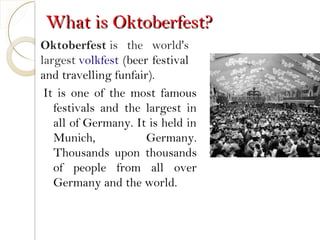
It is one of the most famous
festivals and the largest in
all of Germany. It is held in
Munich, Germany.
Thousands upon thousands
of people from all over
Germany and the world.
Oktoberfest is the world's
largest volkfest (beer festival
and travelling funfair).
HistoryHistory
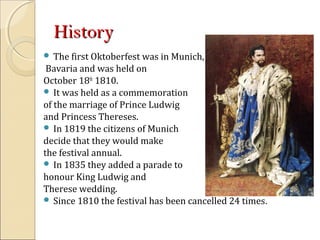
 The first Oktoberfest was in Munich,
Bavaria and was held on
October 18th
1810.
 It was held as a commemoration
of the marriage of Prince Ludwig
and Princess Thereses.
 In 1819 the citizens of Munich
decide that they would make
the festival annual.
 In 1835 they added a parade to
honour King Ludwig and
Therese wedding.
 Since 1810 the festival has been cancelled 24 times.
Where was it held?Where was it held?
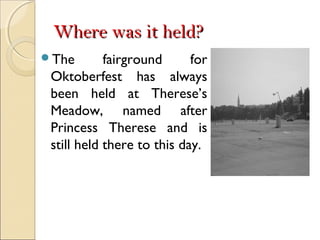
The fairground for
Oktoberfest has always
been held at Therese’s
Meadow, named after
Princess Therese and is
still held there to this day.
What is it likeWhat is it like..
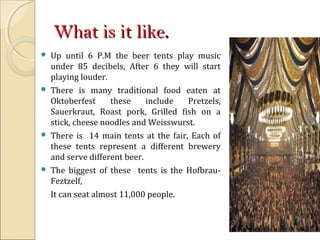
 Up until 6 P.M the beer tents play music
under 85 decibels, After 6 they will start
playing louder.
 There is many traditional food eaten at
Oktoberfest these include Pretzels,
Sauerkraut, Roast pork, Grilled fish on a
stick, cheese noodles and Weisswurst.
 There is 14 main tents at the fair, Each of
these tents represent a different brewery
and serve different beer.
 The biggest of these tents is the Hofbrau-
Feztzelf,
It can seat almost 11,000 people.
When is Oktoberfest?When is Oktoberfest?
It is usually the 3rd
Sunday in
September. It runs for sixteen
days through early October. This
year it will be the 176th
Oktoberfest and starts on
September 19 through October
4th
.
2010: September 18- October 3
2011: September 17- October 3
2012: September 22- October 7
How it all begins…How it all begins…
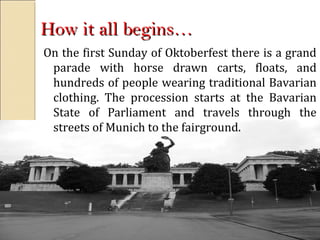
On the first Sunday of Oktoberfest there is a grand
parade with horse drawn carts, floats, and
hundreds of people wearing traditional Bavarian
clothing. The procession starts at the Bavarian
State of Parliament and travels through the
streets of Munich to the fairground.
How it all begins…(Contd.)How it all begins…(Contd.)
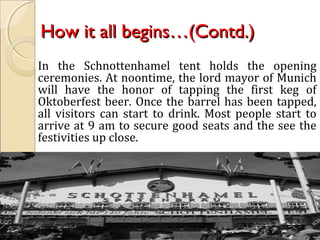
In the Schnottenhamel tent holds the opening
ceremonies. At noontime, the lord mayor of Munich
will have the honor of tapping the first keg of
Oktoberfest beer. Once the barrel has been tapped,
all visitors can start to drink. Most people start to
arrive at 9 am to secure good seats and the see the
festivities up close.
HOW MUCH MONEY SHOULD I SET ASIDE FOR AN EVENING AT
THE FEST?
 A typical evening for one person in 2014 was roughly 45 Euro:
 2 beers, or similar drinks @ 10 Euro 20.00 Euro
 1 chicken, or similar food @ 15 Euro 15.00 Euro
 1 Brez’n, or similar food @ 4.50 Euro 4.50 Euro
 2 trips on public transport @ 2.50 Euro 5.00 Euro Total 44.50 Euro
 Total 44.50 or 50 euro required for an evening in fest
What are the hours?What are the hours?
Beer Serving Hours:
Weekdays:10am-10:30pm
Weekends and Holidays:9am-10:30pm
Tent Closing Time: 11:30 pm
Sales Booth (souvenirs, cigarettes, etc.)
Mon.-Thurs.- 10am-11:30pm
Fri.- 10am- 12am
Sat.- 9am-12am
Sun. and Holidays-9am- 11:30pm
What are the hours?What are the hours?
Carnival and Rides
Mon.- Thurs: 10am-11:30pm
Fri., Sat.:10am-12 am
Sun. and Holidays: 10 am- 11:30 pm
Family Days
Every Tuesday for 12 pm until 6pm
(Discount rides, entrance, and sale prices).
Ceremony
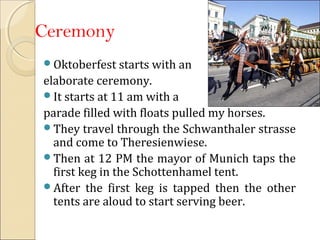
Oktoberfest starts with an
elaborate ceremony.
It starts at 11 am with a
parade filled with floats pulled my horses.
They travel through the Schwanthaler strasse
and come to Theresienwiese.
Then at 12 PM the mayor of Munich taps the
first keg in the Schottenhamel tent.
After the first keg is tapped then the other
tents are aloud to start serving beer.
The FairgroundThe Fairground
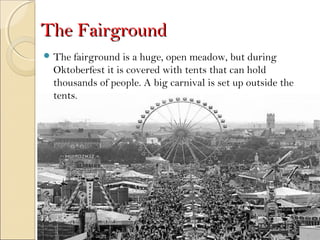
 The fairground is a huge, open meadow, but during
Oktoberfest it is covered with tents that can hold
thousands of people. A big carnival is set up outside the
tents.
The Carnival/FairgroundsThe Carnival/Fairgrounds
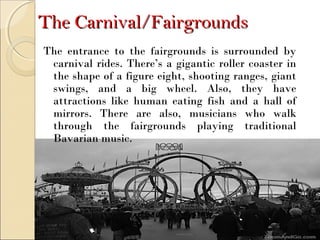
The entrance to the fairgrounds is surrounded by
carnival rides. There’s a gigantic roller coaster in
the shape of a figure eight, shooting ranges, giant
swings, and a big wheel. Also, they have
attractions like human eating fish and a hall of
mirrors. There are also, musicians who walk
through the fairgrounds playing traditional
Bavarian music.
FACTS & DATAFACTS & DATA
Management Of OktoberfestManagement Of Oktoberfest
Size:Size:
The Oktoberfest is known as the largest Volksfest (People's
Fair) in the World. In 1999 there were six and a half million
visitors to the 42 hectare Theresienwiese. 72% of the people
are from Bavaria.15% of visitors come from foreign countries
like the surrounding EU countries and other non-European
countries including the United States, Canada, Australia and
East Asia.
Besides the Oktoberfest, there are other public festivals that
take place at the same location. In April/May it's the
Munich Frühlingsfest(Spring Festival) and Tollwood
Festival in December with 650,000 visitors.
Security at the Oktoberfest:Security at the Oktoberfest:
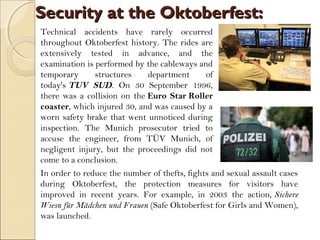
Technical accidents have rarely occurred
throughout Oktoberfest history. The rides are
extensively tested in advance, and the
examination is performed by the cableways and
temporary structures department of
today's TUV SUD. On 30 September 1996,
there was a collision on the Euro Star Roller
coaster, which injured 30, and was caused by a
worn safety brake that went unnoticed during
inspection. The Munich prosecutor tried to
accuse the engineer, from TÜV Munich, of
negligent injury, but the proceedings did not
come to a conclusion.
In order to reduce the number of thefts, fights and sexual assault cases
during Oktoberfest, the protection measures for visitors have
improved in recent years. For example, in 2003 the action, Sichere
Wiesn für Mädchen und Frauen (Safe Oktoberfest for Girls and Women),
was launched.
Security at the Oktoberfest (Contd):
In 2004, a new service center was placed in the authorities court, in which
the police, the Munich fire department, medical services, and a department
of district administration is located. During the Oktoberfest, a police station
specifically for the festival is installed, and can be reached with the
emergency number 5003220. Due to the numerous Italian visitors to the
Oktoberfest, since 2005 officers from Bolzano, Italy are also present. For
decades now, the Bavarian Red Cross has been responsible for the medical
service at the Oktoberfest. Additional medical services are located in
the Fischer Vroni tent (Aicher Ambulance), and the Munich U-Bahn has
commissioned additional backups in the rapid
transit station Theresienwiese provided by the Johanniter-Unfall-Hilfe. In the
authorities court, an ambulance and miniature hospital, complete
with operating theater, are readily available. During the Oktoberfest,
additional emergency vehicles are on the alert at the control centers, and
extra staff is on hand in case they are needed.
In 2010, as a "measure to public safety", a dog and animal ban was put into
place. 2012 brought the banning of glass bottles after the increase in the
number of injuries and cuts.
Security at the Oktoberfest (Contd):
The safety concepts of the event have been modified and adapted
continuously over the past decades. After the bombing in 1980, the main
entrance of the Oktoberfest was redesigned in 1981. In 2008,
the Theresienwiese was closed off to the public during the construction of the
Oktoberfest. In 2009, road blocks were raised, and access controls during
the festival, due to the perceived threat of attacks by Islamists, were
increased. 2010 brought the implementation of advances to the security
plan, including three lockdown rings around the Theresienwiese as well as
access control and flight bans over the festival grounds. In addition, 52 two-
meter high concrete pillars were placed in the access roads and pedestrian
entrances in order to prevent attackers from driving onto the fairgrounds.
In 2011, the security measures were once again increased, this time with
170 partially retractable bollards also designed to prevent forcible access to
the festival grounds with a vehicle. The Bavariaring is closed off, to allow
security forces adequate space to react. The police can quickly divert the
crowds, if needed, through radio communication, as well as close down train
stations.
Energy supply:Energy supply:
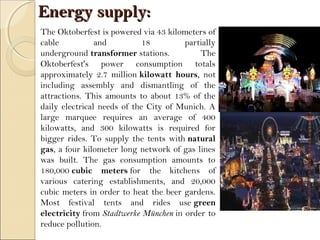
The Oktoberfest is powered via 43 kilometers of
cable and 18 partially
underground transformer stations. The
Oktoberfest's power consumption totals
approximately 2.7 million kilowatt hours, not
including assembly and dismantling of the
attractions. This amounts to about 13% of the
daily electrical needs of the City of Munich. A
large marquee requires an average of 400
kilowatts, and 300 kilowatts is required for
bigger rides. To supply the tents with natural
gas, a four kilometer long network of gas lines
was built. The gas consumption amounts to
180,000 cubic meters for the kitchens of
various catering establishments, and 20,000
cubic meters in order to heat the beer gardens.
Most festival tents and rides use green
electricity from Stadtwerke München in order to
reduce pollution.
Energy supply (Contd.):Energy supply (Contd.):
Because even a short power outage could lead to panic,
all power supplies are redundant and fed separately.
Even the lights of the individual marquees are supplied
from two different substations. Despite all the
precautions, on 25 September 2007, several hours of
power failure occurred after a cable channel had been
flooded due to heavy rains. Since the power outage
occurred in the morning, there were service shortages in
the catering areas, but no panic resulted.
In order to ensure sufficient capacity of cellular
networks, each year several mobile masts are set up in
the lawn areas surrounding the festival.
TransportationTransportation
The Münchner Verkehrsgesellschaft reports
transporting almost four million visitors, to and from,
the festival grounds each Oktoberfest. Especially at
night, the U- and S-Bahn trains are full. The
underground station, Theresienwiese, has trains
arriving at rush hour in three-minute intervals. The
station occasionally needs to be closed due to
overcrowding after the closure of the beer tents. In
order to ensure smooth operation and safety of
passengers, the Münchner Verkehrsgesellschaft and
the Deutsche Bahn have increased their security
personnel.
There are significant negative effects pertaining to
traffic. Since numerous festival goers make their
way home by car, despite having consumed
alcohol, the Bavarian State Police carries out large-
scale DUI controls. The city ring roads and
highways around Munich are periodically blocked
to allow only one lane of through traffic, which
leads to massive traffic congestion.
Transportation (Contd…):Transportation (Contd…):
Especially during the middle weekend of the festival,
many Italians arrive with caravans (this weekend is therefore
referred to by the residents of Munich as "Italian weekend"). In
response, the government imposes camping bans in many parts
of the city. At the same time special parking outside the city is
established, which can be reached by public transportation.
Large parking areas are available, for example, close to
the Allianz Arena. Nevertheless, the parking situation around the
festival grounds is critical. As a consequence, the effort for
controls and towing services is substantial. 2010, in coordination
with the new security concept, taxi stands were relocated. They
are now found outside of the security ring further away from the
fairground.It is highly recommended not to go directly to Oktoberfest in your own
car.
Park and Ride
MVV subways
Taxi
Train
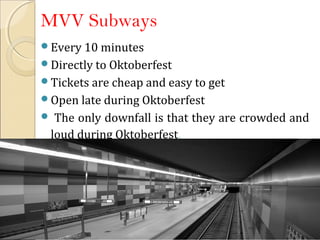
MVV Subways
Every 10 minutes
Directly to Oktoberfest
Tickets are cheap and easy to get
Open late during Oktoberfest
 The only downfall is that they are crowded and
loud during Oktoberfest.
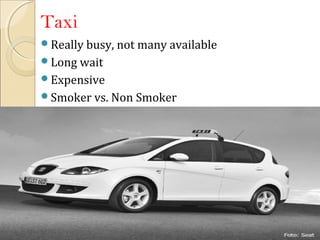
Taxi
Really busy, not many available
Long wait
Expensive
Smoker vs. Non Smoker
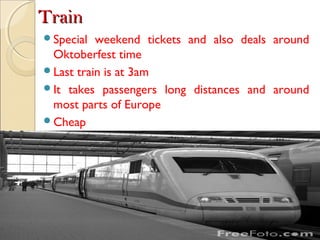
TrainTrain
Special weekend tickets and also deals around
Oktoberfest time
Last train is at 3am
It takes passengers long distances and around
most parts of Europe
Cheap
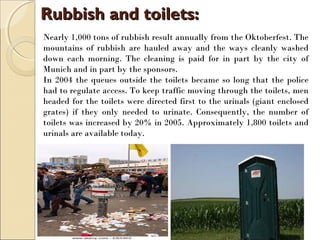
Rubbish and toilets:Rubbish and toilets:
Nearly 1,000 tons of rubbish result annually from the Oktoberfest. The
mountains of rubbish are hauled away and the ways cleanly washed
down each morning. The cleaning is paid for in part by the city of
Munich and in part by the sponsors.
In 2004 the queues outside the toilets became so long that the police
had to regulate access. To keep traffic moving through the toilets, men
headed for the toilets were directed first to the urinals (giant enclosed
grates) if they only needed to urinate. Consequently, the number of
toilets was increased by 20% in 2005. Approximately 1,800 toilets and
urinals are available today.
Rubbish and toilets (Contd…):Rubbish and toilets (Contd…):
Many Oktoberfest guests visit the quiet stalls in order to use their mobile
phones. For this reason there were plans in 2005 to install a Faraday
cage around the toilets or to use Mobile phone jammers to prevent
telephoning with those devices. Jamming devices are, however, illegal in
Germany, and Faraday cages made of copper would have been too
expensive, so these ambitious plans were dropped, and signs were placed
instead, warning toilet users not to use cellular phones in the stalls. More
recently, amplifying live music in the toilets has led to them no longer
representing a quiet retreat for telephoning.
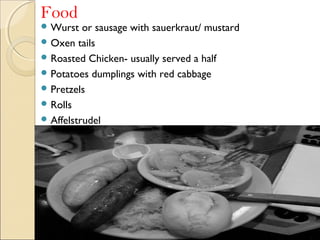
Food
 Wurst or sausage with sauerkraut/ mustard
 Oxen tails
 Roasted Chicken- usually served a half
 Potatoes dumplings with red cabbage
 Pretzels
 Rolls
 Affelstrudel
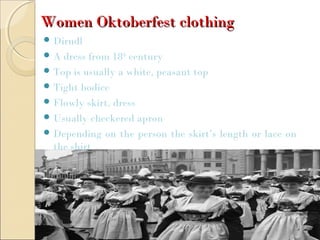
Women Oktoberfest clothingWomen Oktoberfest clothing
 Dirndl
 A dress from 18th
century
 Top is usually a white, peasant top
 Tight bodice
 Flowly skirt, dress
 Usually checkered apron
 Depending on the person the skirt’s length or lace on
the shirt
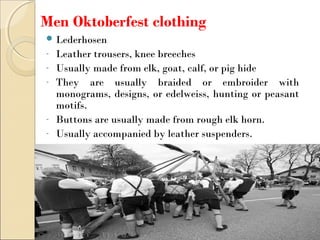
Men Oktoberfest clothing
 Lederhosen
- Leather trousers, knee breeches
- Usually made from elk, goat, calf, or pig hide
- They are usually braided or embroider with
monograms, designs, or edelweiss, hunting or peasant
motifs.
- Buttons are usually made from rough elk horn.
- Usually accompanied by leather suspenders.
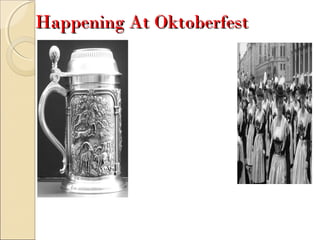
Happening At OktoberfestHappening At Oktoberfest
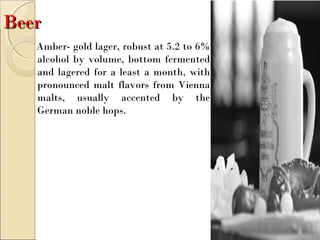
BeerBeer
Amber- gold lager, robust at 5.2 to 6%
alcohol by volume, bottom fermented
and lagered for a least a month, with
pronounced malt flavors from Vienna
malts, usually accented by the
German noble hops.
Oktoberfest beerOktoberfest beer
 It was first introduced in 1872, through a collaboration with
Spaten brewery’s Gabriel Sedlmayr, and Anton Dreher of
Vienna, Austria. Now a days, Oktoberfest beers tend to be
lighter in color and body than the traditional Marzen style,
while American craft breweries are creating festbiers that are
often slightly higher in alcohol, richer in hops aroma and
flavor, and redder in hue than European festbiers.
Cost of BeerCost of Beer
 The price of beer expected for Oktoberfest 2009 is 7.80
to 8.30 Euros per liter, varying on the beer tent.
 Last year, the price of beer was 7.30 to 7.90 Euros per
liter.
MusicMusic
Traditional Folk Music
Folk, marches, polkas
Brass
Disco
Rock n’ roll
Drinking songs
How do I get to the festival? Should I use aHow do I get to the festival? Should I use a
car, or public transportcar, or public transport??
You can just forget about getting there with your own car (taxi is OK, but be
prepared for severe traffic jams close to the Fest). You won't be able to find a
parking lot, and it makes absolutely no sense to park in the restricted zones
surrounding the Theresienwiese - your car will be towed away, mercilessly!
That's why the Fest is a real fest for the towing companies! Also keep in mind
that you might want a beer or two, so you should rather not drive home at
night.
Thus I recommend to go to the Fest by public transport, operated by the MVV.
There are basically two options to get there: either by suburban train ("S-
Bahn"), or by underground ("U-Bahn"). Please see the map at the end of this
page for a rough overview.
If you are not sure where to go once the train stops, just follow the stream of
people (dressed in the traditional Bavarian Tracht). They know how to get to
the Fest.
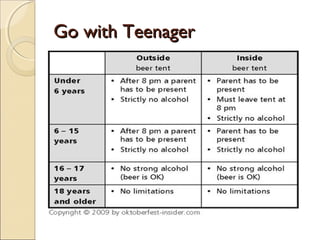
Go with TeenagerGo with Teenager
Breakdown of the economic impactBreakdown of the economic impact
of the beer festivalof the beer festivalVisitors spend about 954 million euros ($1.4 billion) during
Oktoberfest in Munich. About 300 million is spent on overnight
accommodation (although 6 percent choose to sleep in their cars.)
About 55 percent of foreign visitors return to Oktoberfest regularly.
Only about 5 percent of visitors to Munich combine Oktoberfest
with business.
The celebration creates about 12,000 jobs, of which 8,000 are
permanent.
Google returns nearly 1.3 million sites related to Oktoberfest.
The biggest worldwide Oktoberfest celebrations are Blumenau,
Brazil and Kitchener, Canada, both of which have about one million
visitors. The Oktoberfest in Cincinnati, Ohio draws about 500,000
visitors
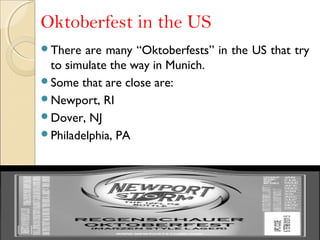
Oktoberfest in the US
There are many “Oktoberfests” in the US that try
to simulate the way in Munich.
Some that are close are:
Newport, RI
Dover, NJ
Philadelphia, PA
Works CitiedWorks Citied
Blashfield, Jean. Germany. New York: Children's
Press, 2003. Print.
Fuller, Barbara. Germany. 2. New York: Marshall
Cavendish, 1995. Print.
Gray, Susan. Germany. New York: Children's Press,
2003. Print.
Lord, Richard. Germany. Milwaukee: Gareth Stevens
Publishing, 1997. Print.
Schöninger, Tino. Oktoberfest.de. 2009.
datenwerk.de. 09 Apr 2009
<http://www.oktoberfest.de/en/00/imprint/index
.php>.

Oktoberfest

  • 1.
    OktoberfestOktoberfest A Germantown TraditionAGermantown Tradition Presented By : Govind Singh MBA (Gen) 2nd Sem
  • 2.
    What is Oktoberfest?Whatis Oktoberfest? It is one of the most famous festivals and the largest in all of Germany. It is held in Munich, Germany. Thousands upon thousands of people from all over Germany and the world. Oktoberfest is the world's largest volkfest (beer festival and travelling funfair).
  • 3.
    HistoryHistory  The firstOktoberfest was in Munich, Bavaria and was held on October 18th 1810.  It was held as a commemoration of the marriage of Prince Ludwig and Princess Thereses.  In 1819 the citizens of Munich decide that they would make the festival annual.  In 1835 they added a parade to honour King Ludwig and Therese wedding.  Since 1810 the festival has been cancelled 24 times.
  • 4.
    Where was itheld?Where was it held? The fairground for Oktoberfest has always been held at Therese’s Meadow, named after Princess Therese and is still held there to this day.
  • 5.
    What is itlikeWhat is it like..  Up until 6 P.M the beer tents play music under 85 decibels, After 6 they will start playing louder.  There is many traditional food eaten at Oktoberfest these include Pretzels, Sauerkraut, Roast pork, Grilled fish on a stick, cheese noodles and Weisswurst.  There is 14 main tents at the fair, Each of these tents represent a different brewery and serve different beer.  The biggest of these tents is the Hofbrau- Feztzelf, It can seat almost 11,000 people.
  • 6.
    When is Oktoberfest?Whenis Oktoberfest? It is usually the 3rd Sunday in September. It runs for sixteen days through early October. This year it will be the 176th Oktoberfest and starts on September 19 through October 4th . 2010: September 18- October 3 2011: September 17- October 3 2012: September 22- October 7
  • 7.
    How it allbegins…How it all begins… On the first Sunday of Oktoberfest there is a grand parade with horse drawn carts, floats, and hundreds of people wearing traditional Bavarian clothing. The procession starts at the Bavarian State of Parliament and travels through the streets of Munich to the fairground.
  • 8.
    How it allbegins…(Contd.)How it all begins…(Contd.) In the Schnottenhamel tent holds the opening ceremonies. At noontime, the lord mayor of Munich will have the honor of tapping the first keg of Oktoberfest beer. Once the barrel has been tapped, all visitors can start to drink. Most people start to arrive at 9 am to secure good seats and the see the festivities up close.
  • 9.
    HOW MUCH MONEYSHOULD I SET ASIDE FOR AN EVENING AT THE FEST?  A typical evening for one person in 2014 was roughly 45 Euro:  2 beers, or similar drinks @ 10 Euro 20.00 Euro  1 chicken, or similar food @ 15 Euro 15.00 Euro  1 Brez’n, or similar food @ 4.50 Euro 4.50 Euro  2 trips on public transport @ 2.50 Euro 5.00 Euro Total 44.50 Euro  Total 44.50 or 50 euro required for an evening in fest
  • 10.
    What are thehours?What are the hours? Beer Serving Hours: Weekdays:10am-10:30pm Weekends and Holidays:9am-10:30pm Tent Closing Time: 11:30 pm Sales Booth (souvenirs, cigarettes, etc.) Mon.-Thurs.- 10am-11:30pm Fri.- 10am- 12am Sat.- 9am-12am Sun. and Holidays-9am- 11:30pm
  • 11.
    What are thehours?What are the hours? Carnival and Rides Mon.- Thurs: 10am-11:30pm Fri., Sat.:10am-12 am Sun. and Holidays: 10 am- 11:30 pm Family Days Every Tuesday for 12 pm until 6pm (Discount rides, entrance, and sale prices).
  • 12.
    Ceremony Oktoberfest starts withan elaborate ceremony. It starts at 11 am with a parade filled with floats pulled my horses. They travel through the Schwanthaler strasse and come to Theresienwiese. Then at 12 PM the mayor of Munich taps the first keg in the Schottenhamel tent. After the first keg is tapped then the other tents are aloud to start serving beer.
  • 13.
    The FairgroundThe Fairground The fairground is a huge, open meadow, but during Oktoberfest it is covered with tents that can hold thousands of people. A big carnival is set up outside the tents.
  • 14.
    The Carnival/FairgroundsThe Carnival/Fairgrounds Theentrance to the fairgrounds is surrounded by carnival rides. There’s a gigantic roller coaster in the shape of a figure eight, shooting ranges, giant swings, and a big wheel. Also, they have attractions like human eating fish and a hall of mirrors. There are also, musicians who walk through the fairgrounds playing traditional Bavarian music.
  • 15.
  • 16.
  • 17.
    Size:Size: The Oktoberfest isknown as the largest Volksfest (People's Fair) in the World. In 1999 there were six and a half million visitors to the 42 hectare Theresienwiese. 72% of the people are from Bavaria.15% of visitors come from foreign countries like the surrounding EU countries and other non-European countries including the United States, Canada, Australia and East Asia. Besides the Oktoberfest, there are other public festivals that take place at the same location. In April/May it's the Munich Frühlingsfest(Spring Festival) and Tollwood Festival in December with 650,000 visitors.
  • 18.
    Security at theOktoberfest:Security at the Oktoberfest: Technical accidents have rarely occurred throughout Oktoberfest history. The rides are extensively tested in advance, and the examination is performed by the cableways and temporary structures department of today's TUV SUD. On 30 September 1996, there was a collision on the Euro Star Roller coaster, which injured 30, and was caused by a worn safety brake that went unnoticed during inspection. The Munich prosecutor tried to accuse the engineer, from TÜV Munich, of negligent injury, but the proceedings did not come to a conclusion. In order to reduce the number of thefts, fights and sexual assault cases during Oktoberfest, the protection measures for visitors have improved in recent years. For example, in 2003 the action, Sichere Wiesn für Mädchen und Frauen (Safe Oktoberfest for Girls and Women), was launched.
  • 19.
    Security at theOktoberfest (Contd): In 2004, a new service center was placed in the authorities court, in which the police, the Munich fire department, medical services, and a department of district administration is located. During the Oktoberfest, a police station specifically for the festival is installed, and can be reached with the emergency number 5003220. Due to the numerous Italian visitors to the Oktoberfest, since 2005 officers from Bolzano, Italy are also present. For decades now, the Bavarian Red Cross has been responsible for the medical service at the Oktoberfest. Additional medical services are located in the Fischer Vroni tent (Aicher Ambulance), and the Munich U-Bahn has commissioned additional backups in the rapid transit station Theresienwiese provided by the Johanniter-Unfall-Hilfe. In the authorities court, an ambulance and miniature hospital, complete with operating theater, are readily available. During the Oktoberfest, additional emergency vehicles are on the alert at the control centers, and extra staff is on hand in case they are needed. In 2010, as a "measure to public safety", a dog and animal ban was put into place. 2012 brought the banning of glass bottles after the increase in the number of injuries and cuts.
  • 20.
    Security at theOktoberfest (Contd): The safety concepts of the event have been modified and adapted continuously over the past decades. After the bombing in 1980, the main entrance of the Oktoberfest was redesigned in 1981. In 2008, the Theresienwiese was closed off to the public during the construction of the Oktoberfest. In 2009, road blocks were raised, and access controls during the festival, due to the perceived threat of attacks by Islamists, were increased. 2010 brought the implementation of advances to the security plan, including three lockdown rings around the Theresienwiese as well as access control and flight bans over the festival grounds. In addition, 52 two- meter high concrete pillars were placed in the access roads and pedestrian entrances in order to prevent attackers from driving onto the fairgrounds. In 2011, the security measures were once again increased, this time with 170 partially retractable bollards also designed to prevent forcible access to the festival grounds with a vehicle. The Bavariaring is closed off, to allow security forces adequate space to react. The police can quickly divert the crowds, if needed, through radio communication, as well as close down train stations.
  • 21.
    Energy supply:Energy supply: TheOktoberfest is powered via 43 kilometers of cable and 18 partially underground transformer stations. The Oktoberfest's power consumption totals approximately 2.7 million kilowatt hours, not including assembly and dismantling of the attractions. This amounts to about 13% of the daily electrical needs of the City of Munich. A large marquee requires an average of 400 kilowatts, and 300 kilowatts is required for bigger rides. To supply the tents with natural gas, a four kilometer long network of gas lines was built. The gas consumption amounts to 180,000 cubic meters for the kitchens of various catering establishments, and 20,000 cubic meters in order to heat the beer gardens. Most festival tents and rides use green electricity from Stadtwerke München in order to reduce pollution.
  • 22.
    Energy supply (Contd.):Energysupply (Contd.): Because even a short power outage could lead to panic, all power supplies are redundant and fed separately. Even the lights of the individual marquees are supplied from two different substations. Despite all the precautions, on 25 September 2007, several hours of power failure occurred after a cable channel had been flooded due to heavy rains. Since the power outage occurred in the morning, there were service shortages in the catering areas, but no panic resulted. In order to ensure sufficient capacity of cellular networks, each year several mobile masts are set up in the lawn areas surrounding the festival.
  • 23.
    TransportationTransportation The Münchner Verkehrsgesellschaft reports transporting almostfour million visitors, to and from, the festival grounds each Oktoberfest. Especially at night, the U- and S-Bahn trains are full. The underground station, Theresienwiese, has trains arriving at rush hour in three-minute intervals. The station occasionally needs to be closed due to overcrowding after the closure of the beer tents. In order to ensure smooth operation and safety of passengers, the Münchner Verkehrsgesellschaft and the Deutsche Bahn have increased their security personnel. There are significant negative effects pertaining to traffic. Since numerous festival goers make their way home by car, despite having consumed alcohol, the Bavarian State Police carries out large- scale DUI controls. The city ring roads and highways around Munich are periodically blocked to allow only one lane of through traffic, which leads to massive traffic congestion.
  • 24.
    Transportation (Contd…):Transportation (Contd…): Especiallyduring the middle weekend of the festival, many Italians arrive with caravans (this weekend is therefore referred to by the residents of Munich as "Italian weekend"). In response, the government imposes camping bans in many parts of the city. At the same time special parking outside the city is established, which can be reached by public transportation. Large parking areas are available, for example, close to the Allianz Arena. Nevertheless, the parking situation around the festival grounds is critical. As a consequence, the effort for controls and towing services is substantial. 2010, in coordination with the new security concept, taxi stands were relocated. They are now found outside of the security ring further away from the fairground.It is highly recommended not to go directly to Oktoberfest in your own car. Park and Ride MVV subways Taxi Train
  • 25.
    MVV Subways Every 10minutes Directly to Oktoberfest Tickets are cheap and easy to get Open late during Oktoberfest  The only downfall is that they are crowded and loud during Oktoberfest.
  • 26.
    Taxi Really busy, notmany available Long wait Expensive Smoker vs. Non Smoker
  • 27.
    TrainTrain Special weekend ticketsand also deals around Oktoberfest time Last train is at 3am It takes passengers long distances and around most parts of Europe Cheap
  • 28.
    Rubbish and toilets:Rubbishand toilets: Nearly 1,000 tons of rubbish result annually from the Oktoberfest. The mountains of rubbish are hauled away and the ways cleanly washed down each morning. The cleaning is paid for in part by the city of Munich and in part by the sponsors. In 2004 the queues outside the toilets became so long that the police had to regulate access. To keep traffic moving through the toilets, men headed for the toilets were directed first to the urinals (giant enclosed grates) if they only needed to urinate. Consequently, the number of toilets was increased by 20% in 2005. Approximately 1,800 toilets and urinals are available today.
  • 29.
    Rubbish and toilets(Contd…):Rubbish and toilets (Contd…): Many Oktoberfest guests visit the quiet stalls in order to use their mobile phones. For this reason there were plans in 2005 to install a Faraday cage around the toilets or to use Mobile phone jammers to prevent telephoning with those devices. Jamming devices are, however, illegal in Germany, and Faraday cages made of copper would have been too expensive, so these ambitious plans were dropped, and signs were placed instead, warning toilet users not to use cellular phones in the stalls. More recently, amplifying live music in the toilets has led to them no longer representing a quiet retreat for telephoning.
  • 30.
    Food  Wurst orsausage with sauerkraut/ mustard  Oxen tails  Roasted Chicken- usually served a half  Potatoes dumplings with red cabbage  Pretzels  Rolls  Affelstrudel
  • 31.
    Women Oktoberfest clothingWomenOktoberfest clothing  Dirndl  A dress from 18th century  Top is usually a white, peasant top  Tight bodice  Flowly skirt, dress  Usually checkered apron  Depending on the person the skirt’s length or lace on the shirt
  • 32.
    Men Oktoberfest clothing Lederhosen - Leather trousers, knee breeches - Usually made from elk, goat, calf, or pig hide - They are usually braided or embroider with monograms, designs, or edelweiss, hunting or peasant motifs. - Buttons are usually made from rough elk horn. - Usually accompanied by leather suspenders.
  • 33.
  • 34.
    BeerBeer Amber- gold lager,robust at 5.2 to 6% alcohol by volume, bottom fermented and lagered for a least a month, with pronounced malt flavors from Vienna malts, usually accented by the German noble hops.
  • 35.
    Oktoberfest beerOktoberfest beer It was first introduced in 1872, through a collaboration with Spaten brewery’s Gabriel Sedlmayr, and Anton Dreher of Vienna, Austria. Now a days, Oktoberfest beers tend to be lighter in color and body than the traditional Marzen style, while American craft breweries are creating festbiers that are often slightly higher in alcohol, richer in hops aroma and flavor, and redder in hue than European festbiers.
  • 36.
    Cost of BeerCostof Beer  The price of beer expected for Oktoberfest 2009 is 7.80 to 8.30 Euros per liter, varying on the beer tent.  Last year, the price of beer was 7.30 to 7.90 Euros per liter.
  • 37.
    MusicMusic Traditional Folk Music Folk,marches, polkas Brass Disco Rock n’ roll Drinking songs
  • 38.
    How do Iget to the festival? Should I use aHow do I get to the festival? Should I use a car, or public transportcar, or public transport?? You can just forget about getting there with your own car (taxi is OK, but be prepared for severe traffic jams close to the Fest). You won't be able to find a parking lot, and it makes absolutely no sense to park in the restricted zones surrounding the Theresienwiese - your car will be towed away, mercilessly! That's why the Fest is a real fest for the towing companies! Also keep in mind that you might want a beer or two, so you should rather not drive home at night. Thus I recommend to go to the Fest by public transport, operated by the MVV. There are basically two options to get there: either by suburban train ("S- Bahn"), or by underground ("U-Bahn"). Please see the map at the end of this page for a rough overview. If you are not sure where to go once the train stops, just follow the stream of people (dressed in the traditional Bavarian Tracht). They know how to get to the Fest.
  • 39.
    Go with TeenagerGowith Teenager
  • 40.
    Breakdown of theeconomic impactBreakdown of the economic impact of the beer festivalof the beer festivalVisitors spend about 954 million euros ($1.4 billion) during Oktoberfest in Munich. About 300 million is spent on overnight accommodation (although 6 percent choose to sleep in their cars.) About 55 percent of foreign visitors return to Oktoberfest regularly. Only about 5 percent of visitors to Munich combine Oktoberfest with business. The celebration creates about 12,000 jobs, of which 8,000 are permanent. Google returns nearly 1.3 million sites related to Oktoberfest. The biggest worldwide Oktoberfest celebrations are Blumenau, Brazil and Kitchener, Canada, both of which have about one million visitors. The Oktoberfest in Cincinnati, Ohio draws about 500,000 visitors
  • 41.
    Oktoberfest in theUS There are many “Oktoberfests” in the US that try to simulate the way in Munich. Some that are close are: Newport, RI Dover, NJ Philadelphia, PA
  • 42.
    Works CitiedWorks Citied Blashfield,Jean. Germany. New York: Children's Press, 2003. Print. Fuller, Barbara. Germany. 2. New York: Marshall Cavendish, 1995. Print. Gray, Susan. Germany. New York: Children's Press, 2003. Print. Lord, Richard. Germany. Milwaukee: Gareth Stevens Publishing, 1997. Print. Schöninger, Tino. Oktoberfest.de. 2009. datenwerk.de. 09 Apr 2009 <http://www.oktoberfest.de/en/00/imprint/index .php>.