Mastering OKR Goal Setting:
Beyond the Basics
Driving Alignment, Agility, and High Performance Across the Organization
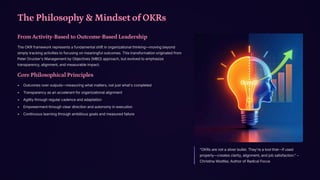
The Philosophy & Mindset of OKRs
From Activity-Based to Outcome-Based Leadership
The OKR framework represents a fundamental shift in organizational thinking4moving beyond
simply tracking activities to focusing on meaningful outcomes. This transformation originated from
Peter Drucker's Management by Objectives (MBO) approach, but evolved to emphasize
transparency, alignment, and measurable impact.
Core Philosophical Principles
Outcomes over outputs4measuring what matters, not just what's completed
Transparency as an accelerant for organizational alignment
Agility through regular cadence and adaptation
Empowerment through clear direction and autonomy in execution
Continuous learning through ambitious goals and measured failure
"OKRs are not a silver bullet. They're a tool that4if used
properly4creates clarity, alignment, and job satisfaction." 3
Christina Wodtke, Author of Radical Focus
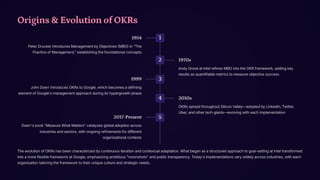
Origins & Evolution of OKRs
1
1954
Peter Drucker introduces Management by Objectives (MBO) in "The
Practice of Management," establishing the foundational concepts
2 1970s
Andy Grove at Intel refines MBO into the OKR framework, adding key
results as quantifiable metrics to measure objective success
3
1999
John Doerr introduces OKRs to Google, which becomes a defining
element of Google's management approach during its hypergrowth phase
4 2010s
OKRs spread throughout Silicon Valley4adopted by LinkedIn, Twitter,
Uber, and other tech giants4evolving with each implementation
5
2017-Present
Doerr's book "Measure What Matters" catalyzes global adoption across
industries and sectors, with ongoing refinements for different
organizational contexts
The evolution of OKRs has been characterized by continuous iteration and contextual adaptation. What began as a structured approach to goal-setting at Intel transformed
into a more flexible framework at Google, emphasizing ambitious "moonshots" and public transparency. Today's implementations vary widely across industries, with each
organization tailoring the framework to their unique culture and strategic needs.
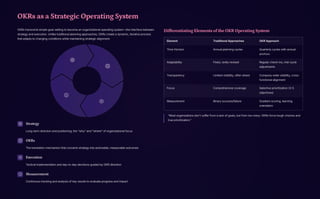
OKRs as a Strategic Operating System
OKRs transcend simple goal-setting to become an organizational operating system4the interface between
strategy and execution. Unlike traditional planning approaches, OKRs create a dynamic, iterative process
that adapts to changing conditions while maintaining strategic alignment.
Strategy
Long-term direction and positioning; the "why" and "where" of organizational focus
OKRs
The translation mechanism that converts strategy into actionable, measurable outcomes
Execution
Tactical implementation and day-to-day decisions guided by OKR direction
Measurement
Continuous tracking and analysis of key results to evaluate progress and impact
Differentiating Elements of the OKR Operating System
Element Traditional Approaches OKR Approach
Time Horizon Annual planning cycles Quarterly cycles with annual
anchors
Adaptability Fixed, rarely revised Regular check-ins, mid-cycle
adjustments
Transparency Limited visibility, often siloed Company-wide visibility, cross-
functional alignment
Focus Comprehensive coverage Selective prioritization (3-5
objectives)
Measurement Binary success/failure Gradient scoring, learning
orientation
"Most organizations don't suffer from a lack of goals, but from too many. OKRs force tough choices and
true prioritization."
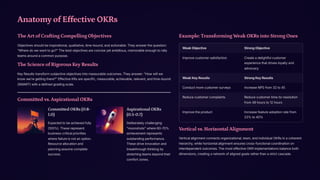
Anatomy of Effective OKRs
The Art of Crafting Compelling Objectives
Objectives should be inspirational, qualitative, time-bound, and actionable. They answer the question:
"Where do we want to go?" The best objectives are concise yet ambitious, memorable enough to rally
teams around a common purpose.
The Science of Rigorous Key Results
Key Results transform subjective objectives into measurable outcomes. They answer: "How will we
know we're getting there?" Effective KRs are specific, measurable, achievable, relevant, and time-bound
(SMART) with a defined grading scale.
Committed vs. Aspirational OKRs
Committed OKRs (0.8-
1.0)
Expected to be achieved fully
(100%). These represent
business-critical priorities
where failure is not an option.
Resource allocation and
planning assume complete
success.
Aspirational OKRs
(0.5-0.7)
Deliberately challenging
"moonshots" where 60-70%
achievement represents
outstanding performance.
These drive innovation and
breakthrough thinking by
stretching teams beyond their
comfort zones.
Example: Transforming Weak OKRs into Strong Ones
Weak Objective Strong Objective
Improve customer satisfaction Create a delightful customer
experience that drives loyalty and
advocacy
Weak Key Results Strong Key Results
Conduct more customer surveys Increase NPS from 32 to 45
Reduce customer complaints Reduce customer time-to-resolution
from 48 hours to 12 hours
Improve the product Increase feature adoption rate from
23% to 40%
Vertical vs. Horizontal Alignment
Vertical alignment connects organizational, team, and individual OKRs in a coherent
hierarchy, while horizontal alignment ensures cross-functional coordination on
interdependent outcomes. The most effective OKR implementations balance both
dimensions, creating a network of aligned goals rather than a strict cascade.
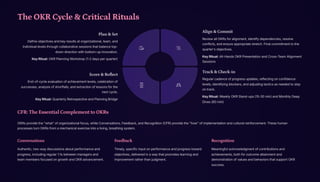
The OKR Cycle & Critical Rituals
CFR: The Essential Complement to OKRs
OKRs provide the "what" of organizational focus, while Conversations, Feedback, and Recognition (CFR) provide the "how" of implementation and cultural reinforcement. These human
processes turn OKRs from a mechanical exercise into a living, breathing system.
Conversations
Authentic, two-way discussions about performance and
progress, including regular 1:1s between managers and
team members focused on growth and OKR advancement.
Feedback
Timely, specific input on performance and progress toward
objectives, delivered in a way that promotes learning and
improvement rather than judgment.
Recognition
Meaningful acknowledgment of contributions and
achievements, both for outcome attainment and
demonstration of values and behaviors that support OKR
success.
Plan & Set
Define objectives and key results at organizational, team, and
individual levels through collaborative sessions that balance top-
down direction with bottom-up innovation.
Key Ritual: OKR Planning Workshop (1-2 days per quarter)
Align & Commit
Review all OKRs for alignment, identify dependencies, resolve
conflicts, and ensure appropriate stretch. Final commitment to the
quarter's objectives.
Key Ritual: All-Hands OKR Presentation and Cross-Team Alignment
Sessions
Track & Check-in
Regular cadence of progress updates, reflecting on confidence
levels, identifying blockers, and adjusting tactics as needed to stay
on track.
Key Ritual: Weekly OKR Stand-ups (15-30 min) and Monthly Deep
Dives (60 min)
Score & Reflect
End-of-cycle evaluation of achievement levels, celebration of
successes, analysis of shortfalls, and extraction of lessons for the
next cycle.
Key Ritual: Quarterly Retrospective and Planning Bridge
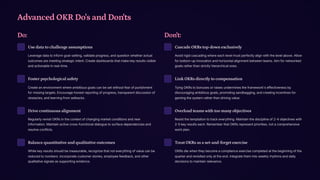
Advanced OKR Do's and Don'ts
Do:
Use data to challenge assumptions
Leverage data to inform goal-setting, validate progress, and question whether actual
outcomes are meeting strategic intent. Create dashboards that make key results visible
and actionable in real-time.
Foster psychological safety
Create an environment where ambitious goals can be set without fear of punishment
for missing targets. Encourage honest reporting of progress, transparent discussion of
obstacles, and learning from setbacks.
Drive continuous alignment
Regularly revisit OKRs in the context of changing market conditions and new
information. Maintain active cross-functional dialogue to surface dependencies and
resolve conflicts.
Balance quantitative and qualitative outcomes
While key results should be measurable, recognize that not everything of value can be
reduced to numbers. Incorporate customer stories, employee feedback, and other
qualitative signals as supporting evidence.
Don't:
Cascade OKRs top-down exclusively
Avoid rigid cascading where each level must perfectly align with the level above. Allow
for bottom-up innovation and horizontal alignment between teams. Aim for networked
goals rather than strictly hierarchical ones.
Link OKRs directly to compensation
Tying OKRs to bonuses or raises undermines the framework's effectiveness by
discouraging ambitious goals, promoting sandbagging, and creating incentives for
gaming the system rather than driving value.
Overload teams with too many objectives
Resist the temptation to track everything. Maintain the discipline of 2-4 objectives with
2-5 key results each. Remember that OKRs represent priorities, not a comprehensive
work plan.
Treat OKRs as a set-and-forget exercise
OKRs die when they become a compliance exercise completed at the beginning of the
quarter and revisited only at the end. Integrate them into weekly rhythms and daily
decisions to maintain relevance.
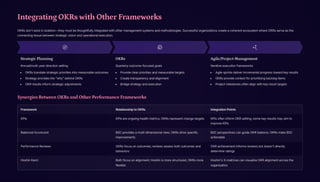
Integrating OKRs with Other Frameworks
OKRs don't exist in isolation4they must be thoughtfully integrated with other management systems and methodologies. Successful organizations create a coherent ecosystem where OKRs serve as the
connecting tissue between strategic vision and operational execution.
Strategic Planning
Annual/multi-year direction setting
OKRs translate strategic priorities into measurable outcomes
Strategy provides the "why" behind OKRs
OKR results inform strategic adjustments
OKRs
Quarterly outcome-focused goals
Provide clear priorities and measurable targets
Create transparency and alignment
Bridge strategy and execution
Agile/Project Management
Iterative execution frameworks
Agile sprints deliver incremental progress toward key results
OKRs provide context for prioritizing backlog items
Project milestones often align with key result targets
Synergies Between OKRs and Other Performance Frameworks
Framework Relationship to OKRs Integration Points
KPIs KPIs are ongoing health metrics; OKRs represent change targets KPIs often inform OKR setting; some key results may aim to
improve KPIs
Balanced Scorecard BSC provides a multi-dimensional view; OKRs drive specific
improvements
BSC perspectives can guide OKR balance; OKRs make BSC
actionable
Performance Reviews OKRs focus on outcomes; reviews assess both outcomes and
behaviors
OKR achievement informs reviews but doesn't directly
determine ratings
Hoshin Kanri Both focus on alignment; Hoshin is more structured, OKRs more
flexible
Hoshin's X-matrices can visualize OKR alignment across the
organization
Real-World OKR Case Studies
Google: OKRs at Scale
Implementation Approach: Public transparency with all OKRs visible
company-wide; embracing stretch goals (0.6-0.7 typical achievement);
quarterly rhythm with annual anchors
Key Success Factor: Separation of OKRs from compensation enabled
ambitious goal-setting without creating perverse incentives
Challenge Overcome: Managing the tension between moonshots and
predictable business outcomes by clearly distinguishing between
committed and aspirational OKRs
LinkedIn: Evolution and Adaptation
Implementation Approach: Started with company-level OKRs, gradually
extended to departments and teams; emphasized cross-functional
collaboration
Key Success Factor: "Small wins" approach that built confidence
through early successes before tackling more ambitious goals
Challenge Overcome: Initial resistance to transparency addressed
through leadership modeling vulnerability and celebrating learning from
failures
Gojek (Indonesia): Cultural Adaptation
Implementation Approach: Modified OKRs to fit local organizational
culture; emphasis on collaborative goal-setting with extensive
discussion
Key Success Factor: Localized training and facilitation in Bahasa
Indonesia that connected OKR concepts to familiar cultural references
Challenge Overcome: Hierarchical leadership traditions addressed by
creating structured forums for bottom-up input and empowering mid-
level champions
Comparative Analysis: Key Lessons from Global Implementations
While implementation details vary, successful OKR adoptions share common patterns: strong executive sponsorship, dedicated change management resources, patient capability building, and willingness to adapt the
framework to organizational context rather than forcing rigid adherence to textbook approaches.
The most significant differentiator between success and failure is whether organizations treat OKRs as a technical tool or as a cultural transformation. Those that recognize OKRs require shifts in leadership behavior,
decision-making processes, and organizational values achieve substantially better outcomes than those focused solely on the mechanics.
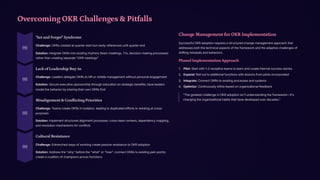
Overcoming OKR Challenges & Pitfalls
"Set and Forget" Syndrome
Challenge: OKRs created at quarter start but rarely referenced until quarter end
Solution: Integrate OKRs into existing rhythms (team meetings, 1:1s, decision-making processes)
rather than creating separate "OKR meetings"
Lack of Leadership Buy-in
Challenge: Leaders delegate OKRs to HR or middle management without personal engagement
Solution: Secure executive sponsorship through education on strategic benefits; have leaders
model the behavior by sharing their own OKRs first
Misalignment & Conflicting Priorities
Challenge: Teams create OKRs in isolation, leading to duplicated efforts or working at cross-
purposes
Solution: Implement structured alignment processes: cross-team reviews, dependency mapping,
and resolution mechanisms for conflicts
Cultural Resistance
Challenge: Entrenched ways of working create passive resistance to OKR adoption
Solution: Address the "why" before the "what" or "how"; connect OKRs to existing pain points;
create a coalition of champions across functions
Change Management for OKR Implementation
Successful OKR adoption requires a structured change management approach that
addresses both the technical aspects of the framework and the adaptive challenges of
shifting mindsets and behaviors.
Phased Implementation Approach
Pilot: Start with 1-2 receptive teams to learn and create internal success stories
1.
Expand: Roll out to additional functions with lessons from pilots incorporated
2.
Integrate: Connect OKRs to existing processes and systems
3.
Optimize: Continuously refine based on organizational feedback
4.
"The greatest challenge in OKR adoption isn't understanding the framework4it's
changing the organizational habits that have developed over decades."
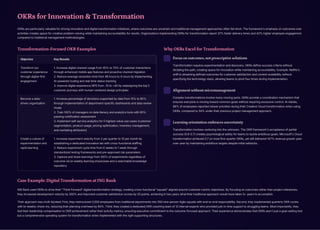
OKRs for Innovation & Transformation
OKRs are particularly valuable for driving innovation and digital transformation initiatives, where outcomes are uncertain and traditional management approaches often fall short. The framework's emphasis on outcomes over
activities creates space for creative problem-solving while maintaining accountability for results. Organizations implementing OKRs for transformation report 37% faster delivery times and 42% higher employee engagement
compared to traditional management methodologies.
Transformation-Focused OKR Examples
Objective Key Results
Transform our
customer experience
through digital-first
engagement
1. Increase digital channel usage from 40% to 70% of customer interactions
through enhanced mobile app features and proactive channel migration
2. Reduce average resolution time from 48 hours to 4 hours by implementing
AI-powered routing and real-time status tracking
3. Improve digital experience NPS from -10 to +40 by redesigning the top 5
customer journeys with human-centered design principles
Become a data-
driven organization
1. Increase percentage of decisions supported by data from 15% to 80%
through implementation of department-specific dashboards and data review
rituals
2. Train 100% of managers on data literacy and analytics tools with 85%
passing certification assessment
3. Implement self-service analytics for 5 highest-value use cases (customer
segmentation, product usage, pricing optimization, inventory management,
and marketing attribution)
Create a culture of
experimentation and
rapid learning
1. Increase experiment velocity from 2 per quarter to 10 per month by
establishing a dedicated innovation lab with cross-functional staffing
2. Reduce experiment cycle time from 6 weeks to 1 week through
standardized testing frameworks and pre-approved risk parameters
3. Capture and share learnings from 100% of experiments regardless of
outcome via bi-weekly learning showcases and a searchable knowledge
repository
Why OKRs Excel for Transformation
Focus on outcomes, not prescriptive solutions
Transformation requires experimentation and discovery. OKRs define success criteria without
dictating the path, creating space for innovation while maintaining accountability. Example: Netflix's
shift to streaming defined outcomes for customer satisfaction and content availability without
specifying the technology stack, allowing teams to pivot four times during implementation.
Alignment without micromanagement
Complex transformations involve many moving parts. OKRs provide a coordination mechanism that
ensures everyone is moving toward common goals without requiring excessive control. At Adobe,
89% of employees reported clearer priorities during their Creative Cloud transformation when using
OKRs, compared to 34% under their previous project management approach.
Learning orientation embraces uncertainty
Transformation involves venturing into the unknown. The OKR framework's acceptance of partial
success (0.6-0.7) creates psychological safety for teams to tackle ambitious goals. Microsoft's Cloud
transformation achieved 0.7 on most first-quarter OKRs, yet still delivered 147% revenue growth year-
over-year by maintaining ambitious targets despite initial setbacks.
Case Example: Digital Transformation at ING Bank
ING Bank used OKRs to drive their "Think Forward" digital transformation strategy, creating cross-functional "squads" aligned around customer-centric objectives. By focusing on outcomes rather than project milestones,
they increased development velocity by 300% and improved customer satisfaction scores by 20 points, achieving in two years what their traditional approach would have taken 5+ years to accomplish.
Their approach was multi-faceted: First, they restructured 3,500 employees from traditional departments into 350 nine-person Agile squads with end-to-end responsibility. Second, they implemented quarterly OKR cycles
with bi-weekly check-ins, reducing their planning overhead by 60%. Third, they created a dedicated OKR coaching team of 12 internal experts who provided just-in-time support to struggling teams. Most importantly, they
tied their leadership compensation to OKR achievement rather than activity metrics, ensuring executive commitment to the outcome-focused approach. Their experience demonstrates that OKRs aren't just a goal-setting tool
but a comprehensive operating system for transformation when implemented with the right supporting structures.
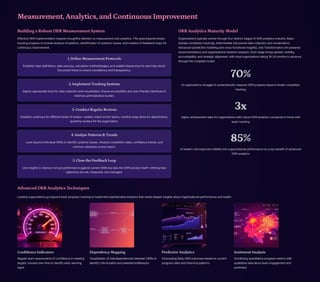
Measurement, Analytics, and Continuous Improvement
Building a Robust OKR Measurement System
Effective OKR implementation requires thoughtful attention to measurement and analytics. This goes beyond simply
tracking progress to include analysis of patterns, identification of systemic issues, and creation of feedback loops for
continuous improvement.
1. Define Measurement Protocols
Establish clear definitions, data sources, calculation methodologies, and update frequencies for each key result.
Document these to ensure consistency and transparency.
2. Implement Tracking Systems
Deploy appropriate tools for data collection and visualization. Ensure accessibility and user-friendly interfaces to
minimize administrative burden.
3. Conduct Regular Reviews
Establish cadences for different levels of review4weekly check-ins for teams, monthly deep dives for departments,
quarterly reviews for the organization.
4. Analyze Patterns & Trends
Look beyond individual OKRs to identify systemic issues. Analyze completion rates, confidence trends, and
common obstacles across teams.
5. Close the Feedback Loop
Use insights to improve not just performance against current OKRs but also the OKR process itself4refining how
objectives are set, measured, and managed.
OKR Analytics Maturity Model
Organizations typically evolve through four distinct stages of OKR analytics maturity: Basic
(simple completion tracking), Intermediate (structured data collection and visualization),
Advanced (predictive modeling and cross-functional insights), and Transformative (AI-powered
recommendations and organizational network analysis). Each stage brings greater visibility,
accountability, and strategic alignment, with most organizations taking 18-24 months to advance
through the complete model.
70%
of organizations struggle to systematically measure OKR progress beyond simple completion
tracking
3x
higher achievement rates for organizations with robust OKR analytics compared to those with
basic tracking
85%
of leaders cite improved visibility into organizational performance as a key benefit of advanced
OKR analytics
Advanced OKR Analytics Techniques
Leading organizations go beyond basic progress tracking to implement sophisticated analytics that reveal deeper insights about organizational performance and health:
Confidence Indicators
Regular team assessments of confidence in meeting
targets, tracked over time to identify early warning
signs
Dependency Mapping
Visualization of interdependencies between OKRs to
identify critical paths and potential bottlenecks
Predictive Analytics
Forecasting likely OKR outcomes based on current
progress rates and historical patterns
Sentiment Analysis
Combining quantitative progress metrics with
qualitative data about team engagement and
sentiment
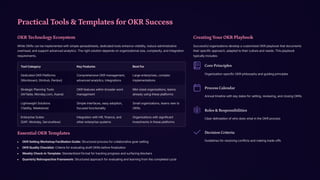
Practical Tools & Templates for OKR Success
OKR Technology Ecosystem
While OKRs can be implemented with simple spreadsheets, dedicated tools enhance visibility, reduce administrative
overhead, and support advanced analytics. The right solution depends on organizational size, complexity, and integration
requirements.
Tool Category Key Features Best For
Dedicated OKR Platforms
(Workboard, Gtmhub, Perdoo)
Comprehensive OKR management,
advanced analytics, integrations
Large enterprises, complex
implementations
Strategic Planning Tools
(AirTable, Monday.com, Asana)
OKR features within broader work
management
Mid-sized organizations, teams
already using these platforms
Lightweight Solutions
(Tability, Weekdone)
Simple interfaces, easy adoption,
focused functionality
Small organizations, teams new to
OKRs
Enterprise Suites
(SAP, Workday, ServiceNow)
Integration with HR, finance, and
other enterprise systems
Organizations with significant
investments in these platforms
Essential OKR Templates
OKR Setting Workshop Facilitation Guide: Structured process for collaborative goal-setting
OKR Quality Checklist: Criteria for evaluating draft OKRs before finalization
Weekly Check-in Template: Standardized format for tracking progress and surfacing blockers
Quarterly Retrospective Framework: Structured approach for evaluating and learning from the completed cycle
Creating Your OKR Playbook
Successful organizations develop a customized OKR playbook that documents
their specific approach, adapted to their culture and needs. This playbook
typically includes:
Core Principles
Organization-specific OKR philosophy and guiding principles
Process Calendar
Annual timeline with key dates for setting, reviewing, and closing OKRs
Roles & Responsibilities
Clear delineation of who does what in the OKR process
Decision Criteria
Guidelines for resolving conflicts and making trade-offs
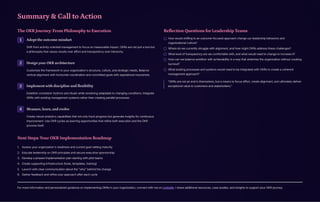
Summary & Call to Action
The OKR Journey: From Philosophy to Execution
1 Adopt the outcome mindset
Shift from activity-oriented management to focus on measurable impact. OKRs are not just a tool but
a philosophy that values results over effort and transparency over hierarchy.
2 Design your OKR architecture
Customize the framework to your organization's structure, culture, and strategic needs. Balance
vertical alignment with horizontal coordination and committed goals with aspirational moonshots.
3 Implement with discipline and flexibility
Establish consistent rhythms and rituals while remaining adaptable to changing conditions. Integrate
OKRs with existing management systems rather than creating parallel processes.
4 Measure, learn, and evolve
Create robust analytics capabilities that not only track progress but generate insights for continuous
improvement. Use OKR cycles as learning opportunities that refine both execution and the OKR
process itself.
Reflection Questions for Leadership Teams
How would shifting to an outcome-focused approach change our leadership behaviors and
organizational culture?
Where do we currently struggle with alignment, and how might OKRs address these challenges?
What level of transparency are we comfortable with, and what would need to change to increase it?
How can we balance ambition with achievability in a way that stretches the organization without creating
burnout?
What existing processes and systems would need to be integrated with OKRs to create a coherent
management approach?
"OKRs are not an end in themselves, but a means to focus effort, create alignment, and ultimately deliver
exceptional value to customers and stakeholders."
Next Steps: Your OKR Implementation Roadmap
Assess your organization's readiness and current goal-setting maturity
1.
Educate leadership on OKR principles and secure executive sponsorship
2.
Develop a phased implementation plan starting with pilot teams
3.
Create supporting infrastructure (tools, templates, training)
4.
Launch with clear communication about the "why" behind the change
5.
Gather feedback and refine your approach after each cycle
6.
For more information and personalized guidance on implementing OKRs in your organization, connect with me on LinkedIn. I share additional resources, case studies, and insights to support your OKR journey.

Mastering OKR Goal Setting Beyond the Basic

  • 1.
    Mastering OKR GoalSetting: Beyond the Basics Driving Alignment, Agility, and High Performance Across the Organization
  • 2.
    The Philosophy &Mindset of OKRs From Activity-Based to Outcome-Based Leadership The OKR framework represents a fundamental shift in organizational thinking4moving beyond simply tracking activities to focusing on meaningful outcomes. This transformation originated from Peter Drucker's Management by Objectives (MBO) approach, but evolved to emphasize transparency, alignment, and measurable impact. Core Philosophical Principles Outcomes over outputs4measuring what matters, not just what's completed Transparency as an accelerant for organizational alignment Agility through regular cadence and adaptation Empowerment through clear direction and autonomy in execution Continuous learning through ambitious goals and measured failure "OKRs are not a silver bullet. They're a tool that4if used properly4creates clarity, alignment, and job satisfaction." 3 Christina Wodtke, Author of Radical Focus
  • 3.
    Origins & Evolutionof OKRs 1 1954 Peter Drucker introduces Management by Objectives (MBO) in "The Practice of Management," establishing the foundational concepts 2 1970s Andy Grove at Intel refines MBO into the OKR framework, adding key results as quantifiable metrics to measure objective success 3 1999 John Doerr introduces OKRs to Google, which becomes a defining element of Google's management approach during its hypergrowth phase 4 2010s OKRs spread throughout Silicon Valley4adopted by LinkedIn, Twitter, Uber, and other tech giants4evolving with each implementation 5 2017-Present Doerr's book "Measure What Matters" catalyzes global adoption across industries and sectors, with ongoing refinements for different organizational contexts The evolution of OKRs has been characterized by continuous iteration and contextual adaptation. What began as a structured approach to goal-setting at Intel transformed into a more flexible framework at Google, emphasizing ambitious "moonshots" and public transparency. Today's implementations vary widely across industries, with each organization tailoring the framework to their unique culture and strategic needs.
  • 4.
    OKRs as aStrategic Operating System OKRs transcend simple goal-setting to become an organizational operating system4the interface between strategy and execution. Unlike traditional planning approaches, OKRs create a dynamic, iterative process that adapts to changing conditions while maintaining strategic alignment. Strategy Long-term direction and positioning; the "why" and "where" of organizational focus OKRs The translation mechanism that converts strategy into actionable, measurable outcomes Execution Tactical implementation and day-to-day decisions guided by OKR direction Measurement Continuous tracking and analysis of key results to evaluate progress and impact Differentiating Elements of the OKR Operating System Element Traditional Approaches OKR Approach Time Horizon Annual planning cycles Quarterly cycles with annual anchors Adaptability Fixed, rarely revised Regular check-ins, mid-cycle adjustments Transparency Limited visibility, often siloed Company-wide visibility, cross- functional alignment Focus Comprehensive coverage Selective prioritization (3-5 objectives) Measurement Binary success/failure Gradient scoring, learning orientation "Most organizations don't suffer from a lack of goals, but from too many. OKRs force tough choices and true prioritization."
  • 5.
    Anatomy of EffectiveOKRs The Art of Crafting Compelling Objectives Objectives should be inspirational, qualitative, time-bound, and actionable. They answer the question: "Where do we want to go?" The best objectives are concise yet ambitious, memorable enough to rally teams around a common purpose. The Science of Rigorous Key Results Key Results transform subjective objectives into measurable outcomes. They answer: "How will we know we're getting there?" Effective KRs are specific, measurable, achievable, relevant, and time-bound (SMART) with a defined grading scale. Committed vs. Aspirational OKRs Committed OKRs (0.8- 1.0) Expected to be achieved fully (100%). These represent business-critical priorities where failure is not an option. Resource allocation and planning assume complete success. Aspirational OKRs (0.5-0.7) Deliberately challenging "moonshots" where 60-70% achievement represents outstanding performance. These drive innovation and breakthrough thinking by stretching teams beyond their comfort zones. Example: Transforming Weak OKRs into Strong Ones Weak Objective Strong Objective Improve customer satisfaction Create a delightful customer experience that drives loyalty and advocacy Weak Key Results Strong Key Results Conduct more customer surveys Increase NPS from 32 to 45 Reduce customer complaints Reduce customer time-to-resolution from 48 hours to 12 hours Improve the product Increase feature adoption rate from 23% to 40% Vertical vs. Horizontal Alignment Vertical alignment connects organizational, team, and individual OKRs in a coherent hierarchy, while horizontal alignment ensures cross-functional coordination on interdependent outcomes. The most effective OKR implementations balance both dimensions, creating a network of aligned goals rather than a strict cascade.
  • 6.
    The OKR Cycle& Critical Rituals CFR: The Essential Complement to OKRs OKRs provide the "what" of organizational focus, while Conversations, Feedback, and Recognition (CFR) provide the "how" of implementation and cultural reinforcement. These human processes turn OKRs from a mechanical exercise into a living, breathing system. Conversations Authentic, two-way discussions about performance and progress, including regular 1:1s between managers and team members focused on growth and OKR advancement. Feedback Timely, specific input on performance and progress toward objectives, delivered in a way that promotes learning and improvement rather than judgment. Recognition Meaningful acknowledgment of contributions and achievements, both for outcome attainment and demonstration of values and behaviors that support OKR success. Plan & Set Define objectives and key results at organizational, team, and individual levels through collaborative sessions that balance top- down direction with bottom-up innovation. Key Ritual: OKR Planning Workshop (1-2 days per quarter) Align & Commit Review all OKRs for alignment, identify dependencies, resolve conflicts, and ensure appropriate stretch. Final commitment to the quarter's objectives. Key Ritual: All-Hands OKR Presentation and Cross-Team Alignment Sessions Track & Check-in Regular cadence of progress updates, reflecting on confidence levels, identifying blockers, and adjusting tactics as needed to stay on track. Key Ritual: Weekly OKR Stand-ups (15-30 min) and Monthly Deep Dives (60 min) Score & Reflect End-of-cycle evaluation of achievement levels, celebration of successes, analysis of shortfalls, and extraction of lessons for the next cycle. Key Ritual: Quarterly Retrospective and Planning Bridge
  • 7.
    Advanced OKR Do'sand Don'ts Do: Use data to challenge assumptions Leverage data to inform goal-setting, validate progress, and question whether actual outcomes are meeting strategic intent. Create dashboards that make key results visible and actionable in real-time. Foster psychological safety Create an environment where ambitious goals can be set without fear of punishment for missing targets. Encourage honest reporting of progress, transparent discussion of obstacles, and learning from setbacks. Drive continuous alignment Regularly revisit OKRs in the context of changing market conditions and new information. Maintain active cross-functional dialogue to surface dependencies and resolve conflicts. Balance quantitative and qualitative outcomes While key results should be measurable, recognize that not everything of value can be reduced to numbers. Incorporate customer stories, employee feedback, and other qualitative signals as supporting evidence. Don't: Cascade OKRs top-down exclusively Avoid rigid cascading where each level must perfectly align with the level above. Allow for bottom-up innovation and horizontal alignment between teams. Aim for networked goals rather than strictly hierarchical ones. Link OKRs directly to compensation Tying OKRs to bonuses or raises undermines the framework's effectiveness by discouraging ambitious goals, promoting sandbagging, and creating incentives for gaming the system rather than driving value. Overload teams with too many objectives Resist the temptation to track everything. Maintain the discipline of 2-4 objectives with 2-5 key results each. Remember that OKRs represent priorities, not a comprehensive work plan. Treat OKRs as a set-and-forget exercise OKRs die when they become a compliance exercise completed at the beginning of the quarter and revisited only at the end. Integrate them into weekly rhythms and daily decisions to maintain relevance.
  • 8.
    Integrating OKRs withOther Frameworks OKRs don't exist in isolation4they must be thoughtfully integrated with other management systems and methodologies. Successful organizations create a coherent ecosystem where OKRs serve as the connecting tissue between strategic vision and operational execution. Strategic Planning Annual/multi-year direction setting OKRs translate strategic priorities into measurable outcomes Strategy provides the "why" behind OKRs OKR results inform strategic adjustments OKRs Quarterly outcome-focused goals Provide clear priorities and measurable targets Create transparency and alignment Bridge strategy and execution Agile/Project Management Iterative execution frameworks Agile sprints deliver incremental progress toward key results OKRs provide context for prioritizing backlog items Project milestones often align with key result targets Synergies Between OKRs and Other Performance Frameworks Framework Relationship to OKRs Integration Points KPIs KPIs are ongoing health metrics; OKRs represent change targets KPIs often inform OKR setting; some key results may aim to improve KPIs Balanced Scorecard BSC provides a multi-dimensional view; OKRs drive specific improvements BSC perspectives can guide OKR balance; OKRs make BSC actionable Performance Reviews OKRs focus on outcomes; reviews assess both outcomes and behaviors OKR achievement informs reviews but doesn't directly determine ratings Hoshin Kanri Both focus on alignment; Hoshin is more structured, OKRs more flexible Hoshin's X-matrices can visualize OKR alignment across the organization
  • 9.
    Real-World OKR CaseStudies Google: OKRs at Scale Implementation Approach: Public transparency with all OKRs visible company-wide; embracing stretch goals (0.6-0.7 typical achievement); quarterly rhythm with annual anchors Key Success Factor: Separation of OKRs from compensation enabled ambitious goal-setting without creating perverse incentives Challenge Overcome: Managing the tension between moonshots and predictable business outcomes by clearly distinguishing between committed and aspirational OKRs LinkedIn: Evolution and Adaptation Implementation Approach: Started with company-level OKRs, gradually extended to departments and teams; emphasized cross-functional collaboration Key Success Factor: "Small wins" approach that built confidence through early successes before tackling more ambitious goals Challenge Overcome: Initial resistance to transparency addressed through leadership modeling vulnerability and celebrating learning from failures Gojek (Indonesia): Cultural Adaptation Implementation Approach: Modified OKRs to fit local organizational culture; emphasis on collaborative goal-setting with extensive discussion Key Success Factor: Localized training and facilitation in Bahasa Indonesia that connected OKR concepts to familiar cultural references Challenge Overcome: Hierarchical leadership traditions addressed by creating structured forums for bottom-up input and empowering mid- level champions Comparative Analysis: Key Lessons from Global Implementations While implementation details vary, successful OKR adoptions share common patterns: strong executive sponsorship, dedicated change management resources, patient capability building, and willingness to adapt the framework to organizational context rather than forcing rigid adherence to textbook approaches. The most significant differentiator between success and failure is whether organizations treat OKRs as a technical tool or as a cultural transformation. Those that recognize OKRs require shifts in leadership behavior, decision-making processes, and organizational values achieve substantially better outcomes than those focused solely on the mechanics.
  • 10.
    Overcoming OKR Challenges& Pitfalls "Set and Forget" Syndrome Challenge: OKRs created at quarter start but rarely referenced until quarter end Solution: Integrate OKRs into existing rhythms (team meetings, 1:1s, decision-making processes) rather than creating separate "OKR meetings" Lack of Leadership Buy-in Challenge: Leaders delegate OKRs to HR or middle management without personal engagement Solution: Secure executive sponsorship through education on strategic benefits; have leaders model the behavior by sharing their own OKRs first Misalignment & Conflicting Priorities Challenge: Teams create OKRs in isolation, leading to duplicated efforts or working at cross- purposes Solution: Implement structured alignment processes: cross-team reviews, dependency mapping, and resolution mechanisms for conflicts Cultural Resistance Challenge: Entrenched ways of working create passive resistance to OKR adoption Solution: Address the "why" before the "what" or "how"; connect OKRs to existing pain points; create a coalition of champions across functions Change Management for OKR Implementation Successful OKR adoption requires a structured change management approach that addresses both the technical aspects of the framework and the adaptive challenges of shifting mindsets and behaviors. Phased Implementation Approach Pilot: Start with 1-2 receptive teams to learn and create internal success stories 1. Expand: Roll out to additional functions with lessons from pilots incorporated 2. Integrate: Connect OKRs to existing processes and systems 3. Optimize: Continuously refine based on organizational feedback 4. "The greatest challenge in OKR adoption isn't understanding the framework4it's changing the organizational habits that have developed over decades."
  • 11.
    OKRs for Innovation& Transformation OKRs are particularly valuable for driving innovation and digital transformation initiatives, where outcomes are uncertain and traditional management approaches often fall short. The framework's emphasis on outcomes over activities creates space for creative problem-solving while maintaining accountability for results. Organizations implementing OKRs for transformation report 37% faster delivery times and 42% higher employee engagement compared to traditional management methodologies. Transformation-Focused OKR Examples Objective Key Results Transform our customer experience through digital-first engagement 1. Increase digital channel usage from 40% to 70% of customer interactions through enhanced mobile app features and proactive channel migration 2. Reduce average resolution time from 48 hours to 4 hours by implementing AI-powered routing and real-time status tracking 3. Improve digital experience NPS from -10 to +40 by redesigning the top 5 customer journeys with human-centered design principles Become a data- driven organization 1. Increase percentage of decisions supported by data from 15% to 80% through implementation of department-specific dashboards and data review rituals 2. Train 100% of managers on data literacy and analytics tools with 85% passing certification assessment 3. Implement self-service analytics for 5 highest-value use cases (customer segmentation, product usage, pricing optimization, inventory management, and marketing attribution) Create a culture of experimentation and rapid learning 1. Increase experiment velocity from 2 per quarter to 10 per month by establishing a dedicated innovation lab with cross-functional staffing 2. Reduce experiment cycle time from 6 weeks to 1 week through standardized testing frameworks and pre-approved risk parameters 3. Capture and share learnings from 100% of experiments regardless of outcome via bi-weekly learning showcases and a searchable knowledge repository Why OKRs Excel for Transformation Focus on outcomes, not prescriptive solutions Transformation requires experimentation and discovery. OKRs define success criteria without dictating the path, creating space for innovation while maintaining accountability. Example: Netflix's shift to streaming defined outcomes for customer satisfaction and content availability without specifying the technology stack, allowing teams to pivot four times during implementation. Alignment without micromanagement Complex transformations involve many moving parts. OKRs provide a coordination mechanism that ensures everyone is moving toward common goals without requiring excessive control. At Adobe, 89% of employees reported clearer priorities during their Creative Cloud transformation when using OKRs, compared to 34% under their previous project management approach. Learning orientation embraces uncertainty Transformation involves venturing into the unknown. The OKR framework's acceptance of partial success (0.6-0.7) creates psychological safety for teams to tackle ambitious goals. Microsoft's Cloud transformation achieved 0.7 on most first-quarter OKRs, yet still delivered 147% revenue growth year- over-year by maintaining ambitious targets despite initial setbacks. Case Example: Digital Transformation at ING Bank ING Bank used OKRs to drive their "Think Forward" digital transformation strategy, creating cross-functional "squads" aligned around customer-centric objectives. By focusing on outcomes rather than project milestones, they increased development velocity by 300% and improved customer satisfaction scores by 20 points, achieving in two years what their traditional approach would have taken 5+ years to accomplish. Their approach was multi-faceted: First, they restructured 3,500 employees from traditional departments into 350 nine-person Agile squads with end-to-end responsibility. Second, they implemented quarterly OKR cycles with bi-weekly check-ins, reducing their planning overhead by 60%. Third, they created a dedicated OKR coaching team of 12 internal experts who provided just-in-time support to struggling teams. Most importantly, they tied their leadership compensation to OKR achievement rather than activity metrics, ensuring executive commitment to the outcome-focused approach. Their experience demonstrates that OKRs aren't just a goal-setting tool but a comprehensive operating system for transformation when implemented with the right supporting structures.
  • 12.
    Measurement, Analytics, andContinuous Improvement Building a Robust OKR Measurement System Effective OKR implementation requires thoughtful attention to measurement and analytics. This goes beyond simply tracking progress to include analysis of patterns, identification of systemic issues, and creation of feedback loops for continuous improvement. 1. Define Measurement Protocols Establish clear definitions, data sources, calculation methodologies, and update frequencies for each key result. Document these to ensure consistency and transparency. 2. Implement Tracking Systems Deploy appropriate tools for data collection and visualization. Ensure accessibility and user-friendly interfaces to minimize administrative burden. 3. Conduct Regular Reviews Establish cadences for different levels of review4weekly check-ins for teams, monthly deep dives for departments, quarterly reviews for the organization. 4. Analyze Patterns & Trends Look beyond individual OKRs to identify systemic issues. Analyze completion rates, confidence trends, and common obstacles across teams. 5. Close the Feedback Loop Use insights to improve not just performance against current OKRs but also the OKR process itself4refining how objectives are set, measured, and managed. OKR Analytics Maturity Model Organizations typically evolve through four distinct stages of OKR analytics maturity: Basic (simple completion tracking), Intermediate (structured data collection and visualization), Advanced (predictive modeling and cross-functional insights), and Transformative (AI-powered recommendations and organizational network analysis). Each stage brings greater visibility, accountability, and strategic alignment, with most organizations taking 18-24 months to advance through the complete model. 70% of organizations struggle to systematically measure OKR progress beyond simple completion tracking 3x higher achievement rates for organizations with robust OKR analytics compared to those with basic tracking 85% of leaders cite improved visibility into organizational performance as a key benefit of advanced OKR analytics Advanced OKR Analytics Techniques Leading organizations go beyond basic progress tracking to implement sophisticated analytics that reveal deeper insights about organizational performance and health: Confidence Indicators Regular team assessments of confidence in meeting targets, tracked over time to identify early warning signs Dependency Mapping Visualization of interdependencies between OKRs to identify critical paths and potential bottlenecks Predictive Analytics Forecasting likely OKR outcomes based on current progress rates and historical patterns Sentiment Analysis Combining quantitative progress metrics with qualitative data about team engagement and sentiment
  • 13.
    Practical Tools &Templates for OKR Success OKR Technology Ecosystem While OKRs can be implemented with simple spreadsheets, dedicated tools enhance visibility, reduce administrative overhead, and support advanced analytics. The right solution depends on organizational size, complexity, and integration requirements. Tool Category Key Features Best For Dedicated OKR Platforms (Workboard, Gtmhub, Perdoo) Comprehensive OKR management, advanced analytics, integrations Large enterprises, complex implementations Strategic Planning Tools (AirTable, Monday.com, Asana) OKR features within broader work management Mid-sized organizations, teams already using these platforms Lightweight Solutions (Tability, Weekdone) Simple interfaces, easy adoption, focused functionality Small organizations, teams new to OKRs Enterprise Suites (SAP, Workday, ServiceNow) Integration with HR, finance, and other enterprise systems Organizations with significant investments in these platforms Essential OKR Templates OKR Setting Workshop Facilitation Guide: Structured process for collaborative goal-setting OKR Quality Checklist: Criteria for evaluating draft OKRs before finalization Weekly Check-in Template: Standardized format for tracking progress and surfacing blockers Quarterly Retrospective Framework: Structured approach for evaluating and learning from the completed cycle Creating Your OKR Playbook Successful organizations develop a customized OKR playbook that documents their specific approach, adapted to their culture and needs. This playbook typically includes: Core Principles Organization-specific OKR philosophy and guiding principles Process Calendar Annual timeline with key dates for setting, reviewing, and closing OKRs Roles & Responsibilities Clear delineation of who does what in the OKR process Decision Criteria Guidelines for resolving conflicts and making trade-offs
  • 14.
    Summary & Callto Action The OKR Journey: From Philosophy to Execution 1 Adopt the outcome mindset Shift from activity-oriented management to focus on measurable impact. OKRs are not just a tool but a philosophy that values results over effort and transparency over hierarchy. 2 Design your OKR architecture Customize the framework to your organization's structure, culture, and strategic needs. Balance vertical alignment with horizontal coordination and committed goals with aspirational moonshots. 3 Implement with discipline and flexibility Establish consistent rhythms and rituals while remaining adaptable to changing conditions. Integrate OKRs with existing management systems rather than creating parallel processes. 4 Measure, learn, and evolve Create robust analytics capabilities that not only track progress but generate insights for continuous improvement. Use OKR cycles as learning opportunities that refine both execution and the OKR process itself. Reflection Questions for Leadership Teams How would shifting to an outcome-focused approach change our leadership behaviors and organizational culture? Where do we currently struggle with alignment, and how might OKRs address these challenges? What level of transparency are we comfortable with, and what would need to change to increase it? How can we balance ambition with achievability in a way that stretches the organization without creating burnout? What existing processes and systems would need to be integrated with OKRs to create a coherent management approach? "OKRs are not an end in themselves, but a means to focus effort, create alignment, and ultimately deliver exceptional value to customers and stakeholders." Next Steps: Your OKR Implementation Roadmap Assess your organization's readiness and current goal-setting maturity 1. Educate leadership on OKR principles and secure executive sponsorship 2. Develop a phased implementation plan starting with pilot teams 3. Create supporting infrastructure (tools, templates, training) 4. Launch with clear communication about the "why" behind the change 5. Gather feedback and refine your approach after each cycle 6. For more information and personalized guidance on implementing OKRs in your organization, connect with me on LinkedIn. I share additional resources, case studies, and insights to support your OKR journey.