

1 
INVESTMENT ANALYSIS OF SMALL SCALE WIND TURBINE INSTALLATIONS IN URBAN AREAS IN EDINBURGH, SCOTLAND 
Submitted to Bahri Uzunoglu as part of the Wind Turbine Concepts and Applications 
Uppsala University 
Dept. of Earth Sciences, Campus Gotland 
OKOYE ELOCHUKWU OBINNA 
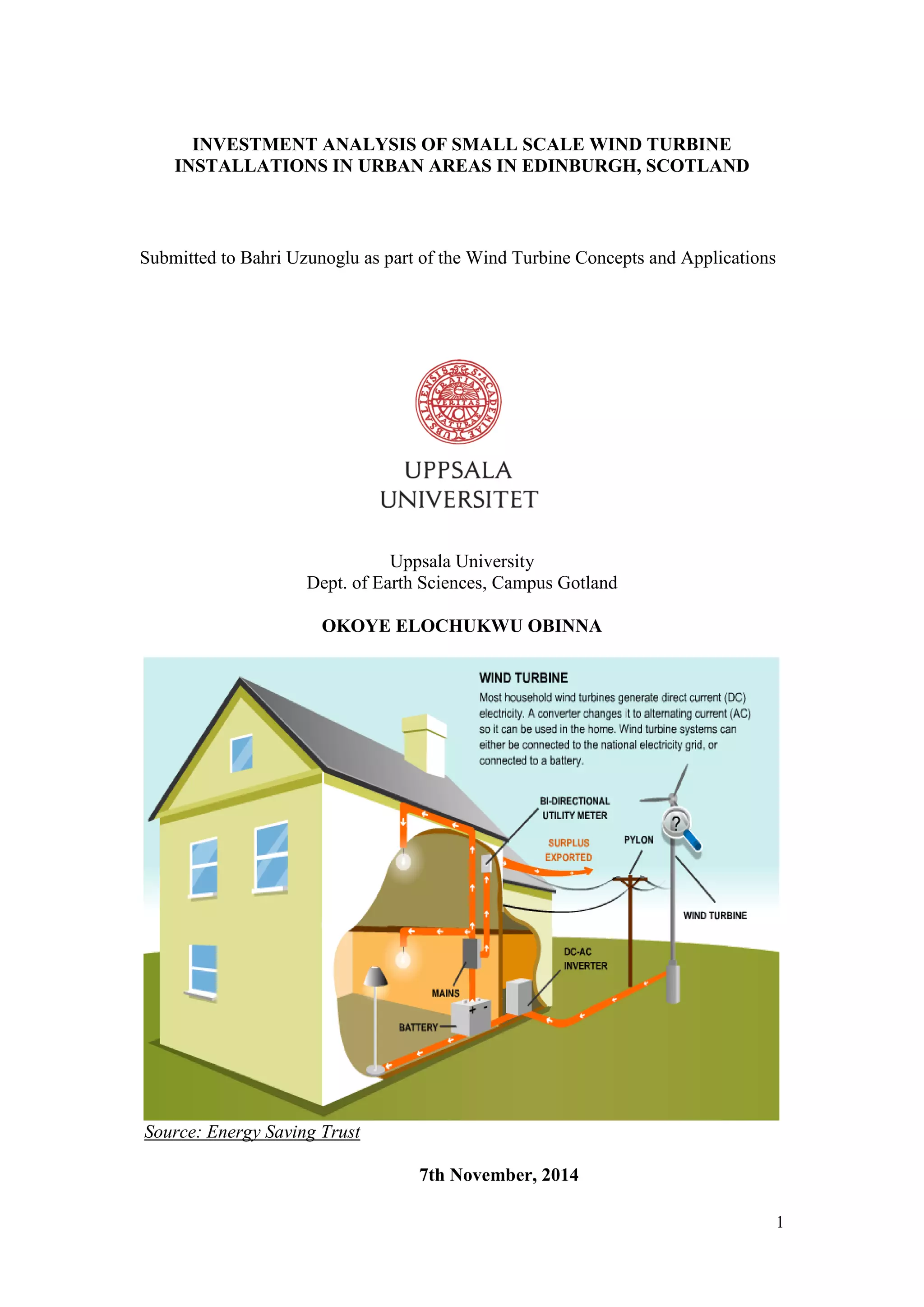
Source: Energy Saving Trust 
7th November, 2014
2 
Project summary 
This report will disscuss the investment analysis of small scale wind turbine installations in urban areas in Edinburgh,Scotland. It will feature the potential of micro/small scale wind turbine installations at a specific sites in chapter 3. An overview of the capital costs, savings and earnings will be discussed in chapter 4. However, the Cash back Calculator Summary from (Energy Savings Trust) will also used in chapter 4 to provide an estimate of what could potentially be earned and saved through the Clean Energy Cash back (Feed-In Tariff) scheme of the UK‟s government. 
In chapter 5, the economic and cost-benefit analysis will be discussed to present a detailed economic and cost-benefit analysis of micro/small wind turbine installations in urban areas. The presented economic analysis include: capital costs, power and energy outputs, feed-in tariffs, loan interest, and operation and maintenance (O&M) costs. 
Currently, small wind turbines of up to 1 kW installed capacity cost upwards of £1,500, while larger units from 2.5 to 6.0 kW tend to cost between £10,000 and £21,000 fully installed. Some lower priced models have much shorter design lifetimes than their higher priced competitors; figures quoted by manufacturers vary between 10 and 20 years. Some manufacturers specify that annual services are required for their turbines. The costs of services vary, but are generally likely to be between a few tens and a few hundred pounds per year . 
The periodic costs highlighted in this report in chapter 4 include maintenance, parts replacements, and transport costs related to the on-site work, the possible insurance costs (including the third party damage liability), the costs of any equipment replacements and the cost of a complete check of the system after 10 years of operation. Again, these costs have been estimated on the basis of information from suppliers and manufacturers for the purpose of this report and should be treated as indicative costs only. 
However, it should be noted that all costs are estimates for the purpose of this report and subject to change. Also, all calculations are only indicative, as the separately charged costs cannot be estimated.
3 
Therefore, this report has proven that investment in the small scale wind turbines in Edinburgh, Scotland is really something worth doing because you will be saving on your energy bill costs and will benefit financially in that way too through the UK FIT for any surplus electricity you export to the grid. 
Key words: Feed-in Tarrif(FIT),United Kingdom(UK) ,NOABL Numerical Objective Analysis of Boundary Layer (NOABL) database,Microgeneration Certification Scheme (MCS),Value Added Tax(VAT ), Renewable Obligation Order (ROO-FIT).
4 
TABLE OF CONTENTS 
CHAPTER 1. INTRODUCTION…………………………………………………… 6 
CHAPTER 2: DECSRIPTION OF ENDINBURGH…………………………………7 
CHAPTER 3: THE POTENTIAL OF SMALL WIND TURBINES AT SPECIFIC SITES………………………………………………………………………………….8 
CHAPTER 4: COSTS, SAVINGS AND EARNINGS………………………………9 
4.1 Costs……………………………………………………………………………….9 
4.2 The periodic costs………………………………………………………………….9 
4.3 Savings and income………………………………………………………………..9 
CHAPTER 5: ECONOMIC AND COST-BENEFIT ANALYSIS………………….11 
5.1 Micro wind turbine scenario…………………………………………..………….11 
5.2 Small wind turbine scenario………………………………………………..…….12 
CHAPTER 6: FINANCIAL INCENTIVES FOR SMALL SCALE WIND TURBINE INSTALLATIONS…………………………………………………………………...13 
6.1 Feed-in Tariffs……………………………………………………………………13 
CHAPTER 7: CALCULATED BENEFITS AND ANNUAL ENERGY PRODUCTION OF DIFFERENT SMALL SCALE WIND TURBINE…………….15 
CHAPTER 8: RECOMMENDATION AND CONCLUSION ……………………...18 
REFERENCES……………………………………………………………………….21 
APPENDICES……………………………………………………………………22-24
5 
LIST OF TABLES 
Table 1: Current rates for Wind Energy Feed-in Tariff in the UK 
LIST OF FIGURES 
Figure 1.1: Cash back Calculator Summary 
Figure 2.1: Power curve of Tozzi Nord TN535 10kW small scale wind turbine 
Figure 3.1: The main items making up capital costs
6 
CHAPTER 1. INTRODUCTION 
Apparently, UK has 40% of Europe's total wind energy but just 0.5% of the UK‟s electricity requirements are currently generated by wind power. Over the next few decades we can expect to see significant investments into Wind energy with the continuation of domestic and commercial Feed in Tariffs as well as large investment into wind farms. The BWEA estimates that if barriers to market growth are reduced, by 2020 the UK Small Wind Sector will be generating 1,700 Gwh of renewable electricity annually. This is the equivalent of over 600,000 micro and small wind turbines (BWEA,2014). 
It pays to do your homework before you make any investments. If you have a house or other property that either can't be connected to the grid, or would be very expensive to connect, then small scale, or micro generation is usually the cheapest, or only option. However if you are already connected to the grid then the upfront cost of setting up a small scale generation system means you are unlikely to get any reduction in energy cost over the life of the system.
7 
CHAPTER 2: WHY EDINBURGH? 
Source: Google Map 
Edinburgh is one of the fastest growing and most productive cities in the UK. It is the UK's most prosperous city outside London with highly competitive labour and property costs and an unrivalled quality of life. 
Edinburgh is the UK's second largest financial centre, a major European centre for asset management and asset servicing and home to the Headquarters of the UK Green Investment Bank. 
The financial services sector of Edinburgh is extremely diverse, and the city has critical mass in banking, life insurance and pensions, asset servicing and investment management. (More than 90% of all Scottish fund managers are based in the city region). It also has vibrant corporate finance, brokerage and professional services sectors.[1]
8 
CHAPTER 3: THE POTENTIAL OF SMALL WIND TURBINES AT SPECIFIC SITES. 
Due to the variability of winds across the UK, plus local effects such as sheltering and turbulence, only certain sites are suitable for small wind turbines. An initial evaluation of a site‟s suitability – sufficient for a „move forward/no go‟ decision – can be made following simple rules of thumb. The principal factor affecting the amounts of electricity generated and carbon saved by a small wind turbine is wind speed. 
This can be assessed in several ways, including by reference to the NOABL Numerical Objective Analysis of Boundary Layer (NOABL) database and applying a methodology developed for the Microgeneration Certification Scheme (MCS), (Carbon Trust 2014). 
The Carbon Trust is developing a new yield estimation tool which is based on a wind speed dataset preferable to NOABL database. The tool also improves on the MCS methodology (Carbon Trust 2014). 
Organisations considering installing small wind turbines in urban areas in Edinburgh are recommended to: 
 Use the Carbon Trust yield estimation tool to obtain initial quantitative estimates of a site‟s potential; And if the site appears attractive, 
 Install anemometry equipment and take measurements to give the greatest degree of certainty about potential energy yields and carbon savings. 
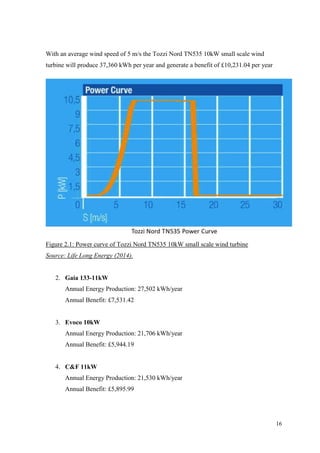
The yield and carbon savings of a turbine can be estimated using a measured or assumed wind speed distribution and the turbine power curve, obtained from the turbine manufacturer or installer(Carbon Trust 2014). 
Combining a yield estimate with cost data, it is possible to make an economic assessment. In doing so, it is important to take account of the amount of electricity likely to be exported (potentially 50%), since otherwise, the value of the yield must be reduced by the exported amount. 
Other considerations include planning, the structural integrity of the supporting building if the turbine is to be roof-mounted, and grid connect
9 
CHAPTER 4: COSTS, SAVINGS AND EARNINGS 
4.1 Costs 
In Edinburgh, the cost of a system will depend on the size and the mounting method: building-mounted small scale wind turbines cost less to install than pole-mounted ones. The average size is 6kW, which can cost between £21,000 and £30,000 for equipment and installation, with VAT at 5% (Energy Savings Trust,2014). 
4.2 The periodic costs 
Maintenance checks are necessary every few years, and will generally cost around £100 to £200 per year depending on turbine size. A well-maintained small scale wind turbine should last more than 20 years, but you may need to replace the inverter at some stage during this time, at a cost of £1,000 to £2,000 for a large system. 
For off-grid systems, batteries will also need replacing, typically every six to ten years. The cost of replacing batteries varies depending on the design and scale of the system. Any back-up generator will also have its own fuel and maintenance costs. 
4.3 Savings and income 
Building-mounted small scale wind turbines tend to produce less electricity per kW than pole-mounted ones. A well-sited 6kW turbine can generate around 10,000kWh and the equivalent of around 4.8 tonnes of carbondioxide a year. 
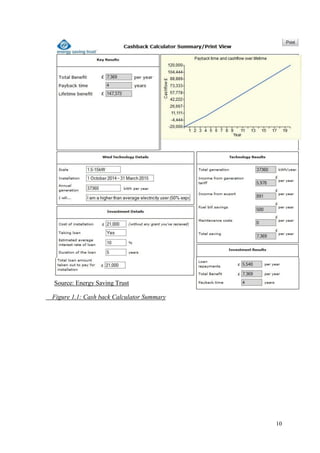
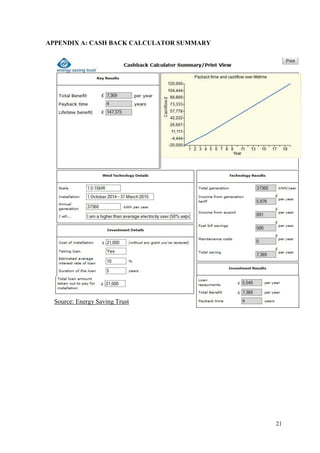
The calculator shown below in Figure 1.1 is intended to provide an estimate of what could potentially be earned and saved through the Clean Energy Cashback (Feed-In Tarrif) scheme. Actual savings and earnings will vary, depending on system efficiencies, location and other factors. The figures in the calculator are subject to change. The results are dependent on the information provided for the purpose of this report only and the maintenance costs were not included in the calculation. 
The Investment section is intended only to be an indicative loan calculator and used only to help calculate payback times (Energy saving Trust 2014).
10 
Figure 1.1: Cash back Calculator Summary 
Source: Energy Saving Trust
11 
CHAPTER 5: ECONOMIC AND COST-BENEFIT ANALYSIS 
This chapter will be used to expand chapter 4 by presenting a detailed economic and cost- benefit analysis of micro/small wind turbine installations in urban areas in Edinburgh. The presented economic analysis include: capital costs, power and energy outputs, feed-in tariffs, loan interest, and operation and maintenance (O&M) costs. 
Small/micro wind turbine systems range in cost from a few hundred pounds for a small battery charging system, to several thousand pounds for a larger system capable of meeting electricity needs for an entire household or business. A turbine rated at 600W-1.5kW might cost between £1,500- 3,000, whilst turbines rated at 2.5 kW to 20 kW can cost between £6,500 and £30,000. 
The amount of money a wind turbine will save you depends on the amount of initial capital outlay, electricity prices and how much electricity your turbine produces. Once a small/micro wind turbine has produced enough electricity to pay for its cost, it will then start to save you money. A turbine on a good windy site will pay for itself more quickly and start to generate free electricity sooner than on a poor site. 
If domestic electricity prices were to remain stable at the current cost of around 12 pence per kWh, a hypothetical micro wind turbine that costs £2,500 and has a rated capacity of 1 kW and a diameter of 2.3 m would take a varying amount of years to pay-off according to wind speed. 
The estimated initial capital cost of the micro and small wind turbine installation scenarios are set out below: 
5.1 Micro wind turbine scenario: 1 kW turbine, initial capital cost £2,500 
At 4 m/s average annual wind speed, 827 kWh is estimated to be produced per year with a value of £99, so a “simple payback” calculation suggests it would pay for itself in 2,500/99 or 25 years. 
For a good 5 m/s average wind speed, 1,557 kWh is produced with a saving of £187 therefore the turbine pays back in 13 years. On an exceptionally good site of 6 m/s, 2,386 kWh is estimated to be produced with an annual saving of £286 and a payback of 9 years.
12 
5.2 Small wind turbine scenario: 6.0 kW turbines, initial capital cost £21,000 
At 4 m/s average annual wind speed, 11,800 kWh is estimated to be produced per year with a value of £1416, so a payback calculation suggests it would pay for itself in 21,000/1,416 or 14.8 years. For a good 5 m/s average wind speed, 23,000 kWh is produced with a saving of £2760 therefore the turbine pays back in 7.2 years. 
On an exceptionally good site of 6 m/s, 35,700 kWh is estimated to be produced with an annual saving of £4,284 and a payback of 4.6 years. 
However, for small scale wind systems, 6 m/s average annual wind speed is considered to be exceptionally good due to the height of the mast and effect of local siting conditions. Within this annual average, wind speeds will vary through a range of 0–20 m/s or more. The examples above demonstrate that the economics of a small/micro wind system very much depend on wind speed, but sizes, prices and outputs vary considerably. 
Electricity prices are unlikely to remain stable, and any increase in prices will shorten the payback period of a small wind turbine. Grant funding may also contribute to the cost of capital outlay and shorten payback periods. A turbine with a longer payback period may be less economic; however there are many good reasons for installing a small/micro system in addition to potential savings. 
The interest rates on loans available for wind turbine developers currently offered by a number of investment companies and banks for different sizes of micro/small scale wind turbine projects are in this report assumed to be: 18% for loans up to £4999, 12% for loans £5000 to £7499, 11% for loans £7500 to £14 999, and 10% for loans greater than £15 000.
13 
CHAPTER 6: FINANCIAL INCENTIVES FOR SMALL SCALE WIND TURBINE INSTALLATIONS 
This section discusses about the UK Government's Feed-In Tariffs scheme (FITs) which could mean that you get money from your energy supplier. One can be paid for the electricity you generate, even if you use it yourself, and for any surplus electricity you export to the grid. Nevertheless, a grant can be obtained from the Low Carbon Building Programme (LCBP) in the UK, to cover up to 50% of the installation cost (Cace .J, 2007). 
However, some provinces and municipalities in UK provide additional subsidies as a part of their own renewable energy development programmes. Most commonly these subsidies are a part of local measures against climate change and are usually reconsidered yearly (Cace .J, 2007). 
6.1 Feed-in Tariffs 
The FiTs are a government incentive, aimed at encouraging the deployment of small scale renewable electricity generation by communities, individuals and organisations. 
Since its introduction in April 2010, the Feed-in Tarrif scheme has provided significant stimulus for small and medium wind developments in the UK. 
When installing an eligible wind turbine, the scheme guarantees payment for the electricity you generate and use, and an additional payment for any surplus electricity you export to the National Grid. 
To qualify for the Feed-in Tariff, you need to use a Microgeneration Certification Scheme (MCS) approved product and installer. MCS applies to installations up to 50kW. 
Installations greater than 50kW need to apply for accreditation through Ofgem‟s ROO-FIT process(Ofgem,2014). 
The scheme provides 20 years guaranteed revenue, with a return on investment within 3 to 8 years. Generally the better sited the turbine, the faster it will pay back the initial investment.
14 
If you are eligible for the Feed-in Tarrif you‟ll get paid in two ways: 
1. The generation tariff You will be paid a set rate by your energy supplier for every unit (kWh) of electricity you generate. The tariff levels are guaranteed for 25 years, are index linked, and VAT exempt. 
2. The export tariff Any electricity you generate that you don‟t use is automatically exported back to the national grid and you will receive an additional flat rate of 5p per kWh from your electricity supplier for this. At the moment there is no conclusive way to measure how much you export so an assumption is made that 50% of the electricity you generate is exported back to the grid, and you‟ll be paid on that basis. 
The appropriate bodies in the UK have announced that rates will remain as seen below in Table 1, for Wind Energy until 31st March 2015. 
Table 1: Current rates for Wind Energy Feed-in Tariff in the UK 
Source: Energy Saving Trust (2014). 
Wind Energy Feed-in Tarrif 
Until 31st March 2015 
Capacity 
Rate (p/kWh) 
≤1.5kW 
17.78 
>1.5-15kW 
17.78 
>15-100kW 
17.78 
>100-500kW 
13.34 
>500kW-1.5MW 
7.24 
>1.5MW 
3.07 
Export tariff 
4.77
15 
CHAPTER 7: CALCULATED BENEFITS AND ANNUAL ENERGY PRODUCTION OF DIFFERENT SMALL SCALE WIND TURBINES. 
This section presents a compared calculated benefits and annual production of 8 different small scale wind turbine installations in Edinburgh at the same average wind speed of 5m/s using Life Long Energy‟s Wind Turbine Calculator. 
SMALL 10KW 
Wind Speed = 5m/s 
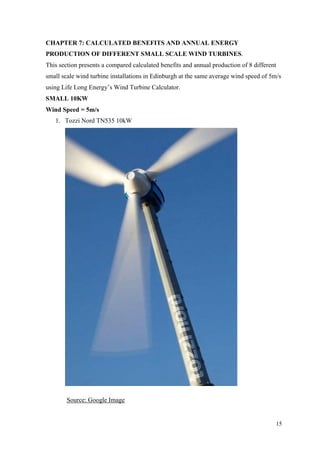
1. Tozzi Nord TN535 10kW 
Source: Google Image
16 
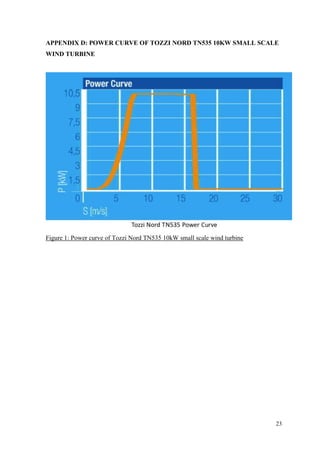
With an average wind speed of 5 m/s the Tozzi Nord TN535 10kW small scale wind turbine will produce 37,360 kWh per year and generate a benefit of £10,231.04 per year 
Figure 2.1: Power curve of Tozzi Nord TN535 10kW small scale wind turbine 
Source: Life Long Energy (2014). 
2. Gaia 133-11kW Annual Energy Production: 27,502 kWh/year Annual Benefit: £7,531.42 
3. Evoco 10kW Annual Energy Production: 21,706 kWh/year Annual Benefit: £5,944.19 
4. C&F 11kW Annual Energy Production: 21,530 kWh/year Annual Benefit: £5,895.99
17 
5. Xzeres 442SR Annual Energy Production: 17,418 kWh/year Annual Benefit: £4,769.92 
6. Aircon 10S Annual Energy Production: 17,488 kWh/year Annual Benefit: £4,789.09 
7. Westwind 10 Annual Energy Production: 13,971 kWh/year Annual Benefit: £3,825.96 
8. Bergey Excel 10 Annual Energy Production: 13,842 kWh/year Annual Benefit: £3,790.63 
The annual benefits assumes current Feed-in tariff rates per kWh plus 50% of Energy produced being exported at current export rate 
In addition, energy savings have to be considered to determine the Annual Benefits, therefore assumes 75% energy used on-site at £0.12 per kWh 
The annual Energy Production figures are based on 100% availability, air density of 1.225kg/m3 and a Rayleigh wind speed distribution (k=2) They have been obtained from MCS Accreditation certificate summaries and advertised data for each turbine,(Life Long Energy (2014).
18 
CHAPTER 8: RECOMMENDATION AND CONCLUSION 
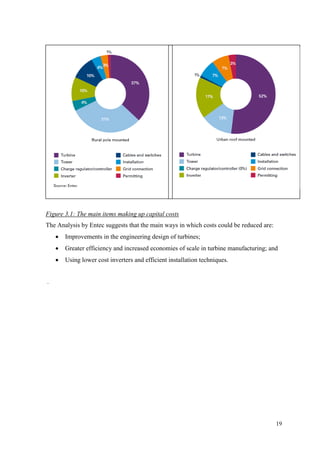
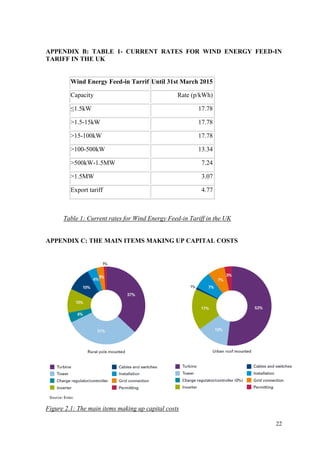
In conclusion, it has been discussed in this report the investment analysis of a small scale wind turbine installations in urban areas in terms of costs and paybacks. I will like to conclude with some suggestions for cost reduction on the price of small scale wind turbine installations to increase the benefits. The total UK small-scale wind energy resource reflects a combination of wind conditions and the performance of wind turbines. While the former is not controllable, some improvements to the latter are possible and could lead to marginal increases in energy generation ( Entec Global Group, 2014). However, such increases are unlikely to reduce costs of energy to a significant extent. To do this, one needs to reduce the costs of turbine installations. Since the costs of maintaining turbines tend to be low, upfront capital costs are the primary drivers of costs of energy, and capital cost reductions are most likely to lead to cost of energy reductions. The main items making up capital costs are shown in Figure 3.1.
19 
Figure 3.1: The main items making up capital costs 
The Analysis by Entec suggests that the main ways in which costs could be reduced are: 
 Improvements in the engineering design of turbines; 
 Greater efficiency and increased economies of scale in turbine manufacturing; and 
 Using lower cost inverters and efficient installation techniques. 
.
20 
REFERNCES 
1. Invest Edinburgh, http://www.investinedinburgh.com/industry-strengths/financial- services, accessed October, 2014. 
2. Cace J., 2007.Urban Wind Turbines guidelines for small wind turbines in the built environment, February, 2007. 
3. Renewable UK, http://www.renewableuk.com/en/renewable-energy/wind-energy/small- and-medium-scale-wind/financial-incentives.cfm#sthash.afsE3NQ1.dpuf, 2014. 
4. Energy Saving Trust, http://www.energysavingtrust.org.uk/Generating- energy/Choosing-a-renewable-technology/Wind-turbines, accessed on September,2014. 
5. Energy Saving Trust. http://www.energysavingtrust.org.uk/extension/estfrontend/design/est/flash/generate-your- own-energy/windPower.html accessed on October, 2014. 
6. Energy Saving Trust,http://www.energysavingtrust.org.uk/Generating-energy/Getting- money-back/Cashback-Calculator accessed on September,2014. 
7. Life Long Energy, http://www.lifelongenergy.co.uk/our-products/wind-energy/tozzi- nord-calculator.html accessed on November,2014. 
8. Life Long Energy, http://www.lifelongenergy.co.uk/our-products/wind- energy/incentives-wind.html. Accessed on November, 2014. 
9.Acosta J.L, Combe.K, Djoki´c S.Z, and Hernando-Gil.I.(2012).Performance Assessment of Micro and Small-Scale Wind Turbines in Urban Areas, IEEE Systems Journal, vol. 6, no. 1, March 2012. 
10. BWEA, Small Wind Turbine Performance and Safety Standard, BWEA Standard, 2008. 
11. The Carbon Trust, Small-scale Wind Report: Policy insights and practical guidance, 2008.
21 
APPENDIX A: CASH BACK CALCULATOR SUMMARY 
Source: Energy Saving Trust
22 
APPENDIX B: TABLE 1- CURRENT RATES FOR WIND ENERGY FEED-IN TARIFF IN THE UK 
Table 1: Current rates for Wind Energy Feed-in Tariff in the UK 
APPENDIX C: THE MAIN ITEMS MAKING UP CAPITAL COSTS 
Figure 2.1: The main items making up capital costs 
Wind Energy Feed-in Tarrif 
Until 31st March 2015 
Capacity 
Rate (p/kWh) 
≤1.5kW 
17.78 
>1.5-15kW 
17.78 
>15-100kW 
17.78 
>100-500kW 
13.34 
>500kW-1.5MW 
7.24 
>1.5MW 
3.07 
Export tariff 
4.77
23 
APPENDIX D: POWER CURVE OF TOZZI NORD TN535 10KW SMALL SCALE WIND TURBINE 
Figure 1: Power curve of Tozzi Nord TN535 10kW small scale wind turbine

INVESTMENT ANALYSIS OF SMALL SCALE WIND TURBINE INSTALLATIONS IN URBAN AREAS IN EDINBURGH, SCOTLAND by OKOYE ELOCHUKWU OBINNA

  • 1.
    1 INVESTMENT ANALYSISOF SMALL SCALE WIND TURBINE INSTALLATIONS IN URBAN AREAS IN EDINBURGH, SCOTLAND Submitted to Bahri Uzunoglu as part of the Wind Turbine Concepts and Applications Uppsala University Dept. of Earth Sciences, Campus Gotland OKOYE ELOCHUKWU OBINNA Source: Energy Saving Trust 7th November, 2014
  • 2.
    2 Project summary This report will disscuss the investment analysis of small scale wind turbine installations in urban areas in Edinburgh,Scotland. It will feature the potential of micro/small scale wind turbine installations at a specific sites in chapter 3. An overview of the capital costs, savings and earnings will be discussed in chapter 4. However, the Cash back Calculator Summary from (Energy Savings Trust) will also used in chapter 4 to provide an estimate of what could potentially be earned and saved through the Clean Energy Cash back (Feed-In Tariff) scheme of the UK‟s government. In chapter 5, the economic and cost-benefit analysis will be discussed to present a detailed economic and cost-benefit analysis of micro/small wind turbine installations in urban areas. The presented economic analysis include: capital costs, power and energy outputs, feed-in tariffs, loan interest, and operation and maintenance (O&M) costs. Currently, small wind turbines of up to 1 kW installed capacity cost upwards of £1,500, while larger units from 2.5 to 6.0 kW tend to cost between £10,000 and £21,000 fully installed. Some lower priced models have much shorter design lifetimes than their higher priced competitors; figures quoted by manufacturers vary between 10 and 20 years. Some manufacturers specify that annual services are required for their turbines. The costs of services vary, but are generally likely to be between a few tens and a few hundred pounds per year . The periodic costs highlighted in this report in chapter 4 include maintenance, parts replacements, and transport costs related to the on-site work, the possible insurance costs (including the third party damage liability), the costs of any equipment replacements and the cost of a complete check of the system after 10 years of operation. Again, these costs have been estimated on the basis of information from suppliers and manufacturers for the purpose of this report and should be treated as indicative costs only. However, it should be noted that all costs are estimates for the purpose of this report and subject to change. Also, all calculations are only indicative, as the separately charged costs cannot be estimated.
  • 3.
    3 Therefore, thisreport has proven that investment in the small scale wind turbines in Edinburgh, Scotland is really something worth doing because you will be saving on your energy bill costs and will benefit financially in that way too through the UK FIT for any surplus electricity you export to the grid. Key words: Feed-in Tarrif(FIT),United Kingdom(UK) ,NOABL Numerical Objective Analysis of Boundary Layer (NOABL) database,Microgeneration Certification Scheme (MCS),Value Added Tax(VAT ), Renewable Obligation Order (ROO-FIT).
  • 4.
    4 TABLE OFCONTENTS CHAPTER 1. INTRODUCTION…………………………………………………… 6 CHAPTER 2: DECSRIPTION OF ENDINBURGH…………………………………7 CHAPTER 3: THE POTENTIAL OF SMALL WIND TURBINES AT SPECIFIC SITES………………………………………………………………………………….8 CHAPTER 4: COSTS, SAVINGS AND EARNINGS………………………………9 4.1 Costs……………………………………………………………………………….9 4.2 The periodic costs………………………………………………………………….9 4.3 Savings and income………………………………………………………………..9 CHAPTER 5: ECONOMIC AND COST-BENEFIT ANALYSIS………………….11 5.1 Micro wind turbine scenario…………………………………………..………….11 5.2 Small wind turbine scenario………………………………………………..…….12 CHAPTER 6: FINANCIAL INCENTIVES FOR SMALL SCALE WIND TURBINE INSTALLATIONS…………………………………………………………………...13 6.1 Feed-in Tariffs……………………………………………………………………13 CHAPTER 7: CALCULATED BENEFITS AND ANNUAL ENERGY PRODUCTION OF DIFFERENT SMALL SCALE WIND TURBINE…………….15 CHAPTER 8: RECOMMENDATION AND CONCLUSION ……………………...18 REFERENCES……………………………………………………………………….21 APPENDICES……………………………………………………………………22-24
  • 5.
    5 LIST OFTABLES Table 1: Current rates for Wind Energy Feed-in Tariff in the UK LIST OF FIGURES Figure 1.1: Cash back Calculator Summary Figure 2.1: Power curve of Tozzi Nord TN535 10kW small scale wind turbine Figure 3.1: The main items making up capital costs
  • 6.
    6 CHAPTER 1.INTRODUCTION Apparently, UK has 40% of Europe's total wind energy but just 0.5% of the UK‟s electricity requirements are currently generated by wind power. Over the next few decades we can expect to see significant investments into Wind energy with the continuation of domestic and commercial Feed in Tariffs as well as large investment into wind farms. The BWEA estimates that if barriers to market growth are reduced, by 2020 the UK Small Wind Sector will be generating 1,700 Gwh of renewable electricity annually. This is the equivalent of over 600,000 micro and small wind turbines (BWEA,2014). It pays to do your homework before you make any investments. If you have a house or other property that either can't be connected to the grid, or would be very expensive to connect, then small scale, or micro generation is usually the cheapest, or only option. However if you are already connected to the grid then the upfront cost of setting up a small scale generation system means you are unlikely to get any reduction in energy cost over the life of the system.
  • 7.
    7 CHAPTER 2:WHY EDINBURGH? Source: Google Map Edinburgh is one of the fastest growing and most productive cities in the UK. It is the UK's most prosperous city outside London with highly competitive labour and property costs and an unrivalled quality of life. Edinburgh is the UK's second largest financial centre, a major European centre for asset management and asset servicing and home to the Headquarters of the UK Green Investment Bank. The financial services sector of Edinburgh is extremely diverse, and the city has critical mass in banking, life insurance and pensions, asset servicing and investment management. (More than 90% of all Scottish fund managers are based in the city region). It also has vibrant corporate finance, brokerage and professional services sectors.[1]
  • 8.
    8 CHAPTER 3:THE POTENTIAL OF SMALL WIND TURBINES AT SPECIFIC SITES. Due to the variability of winds across the UK, plus local effects such as sheltering and turbulence, only certain sites are suitable for small wind turbines. An initial evaluation of a site‟s suitability – sufficient for a „move forward/no go‟ decision – can be made following simple rules of thumb. The principal factor affecting the amounts of electricity generated and carbon saved by a small wind turbine is wind speed. This can be assessed in several ways, including by reference to the NOABL Numerical Objective Analysis of Boundary Layer (NOABL) database and applying a methodology developed for the Microgeneration Certification Scheme (MCS), (Carbon Trust 2014). The Carbon Trust is developing a new yield estimation tool which is based on a wind speed dataset preferable to NOABL database. The tool also improves on the MCS methodology (Carbon Trust 2014). Organisations considering installing small wind turbines in urban areas in Edinburgh are recommended to:  Use the Carbon Trust yield estimation tool to obtain initial quantitative estimates of a site‟s potential; And if the site appears attractive,  Install anemometry equipment and take measurements to give the greatest degree of certainty about potential energy yields and carbon savings. The yield and carbon savings of a turbine can be estimated using a measured or assumed wind speed distribution and the turbine power curve, obtained from the turbine manufacturer or installer(Carbon Trust 2014). Combining a yield estimate with cost data, it is possible to make an economic assessment. In doing so, it is important to take account of the amount of electricity likely to be exported (potentially 50%), since otherwise, the value of the yield must be reduced by the exported amount. Other considerations include planning, the structural integrity of the supporting building if the turbine is to be roof-mounted, and grid connect
  • 9.
    9 CHAPTER 4:COSTS, SAVINGS AND EARNINGS 4.1 Costs In Edinburgh, the cost of a system will depend on the size and the mounting method: building-mounted small scale wind turbines cost less to install than pole-mounted ones. The average size is 6kW, which can cost between £21,000 and £30,000 for equipment and installation, with VAT at 5% (Energy Savings Trust,2014). 4.2 The periodic costs Maintenance checks are necessary every few years, and will generally cost around £100 to £200 per year depending on turbine size. A well-maintained small scale wind turbine should last more than 20 years, but you may need to replace the inverter at some stage during this time, at a cost of £1,000 to £2,000 for a large system. For off-grid systems, batteries will also need replacing, typically every six to ten years. The cost of replacing batteries varies depending on the design and scale of the system. Any back-up generator will also have its own fuel and maintenance costs. 4.3 Savings and income Building-mounted small scale wind turbines tend to produce less electricity per kW than pole-mounted ones. A well-sited 6kW turbine can generate around 10,000kWh and the equivalent of around 4.8 tonnes of carbondioxide a year. The calculator shown below in Figure 1.1 is intended to provide an estimate of what could potentially be earned and saved through the Clean Energy Cashback (Feed-In Tarrif) scheme. Actual savings and earnings will vary, depending on system efficiencies, location and other factors. The figures in the calculator are subject to change. The results are dependent on the information provided for the purpose of this report only and the maintenance costs were not included in the calculation. The Investment section is intended only to be an indicative loan calculator and used only to help calculate payback times (Energy saving Trust 2014).
  • 10.
    10 Figure 1.1:Cash back Calculator Summary Source: Energy Saving Trust
  • 11.
    11 CHAPTER 5:ECONOMIC AND COST-BENEFIT ANALYSIS This chapter will be used to expand chapter 4 by presenting a detailed economic and cost- benefit analysis of micro/small wind turbine installations in urban areas in Edinburgh. The presented economic analysis include: capital costs, power and energy outputs, feed-in tariffs, loan interest, and operation and maintenance (O&M) costs. Small/micro wind turbine systems range in cost from a few hundred pounds for a small battery charging system, to several thousand pounds for a larger system capable of meeting electricity needs for an entire household or business. A turbine rated at 600W-1.5kW might cost between £1,500- 3,000, whilst turbines rated at 2.5 kW to 20 kW can cost between £6,500 and £30,000. The amount of money a wind turbine will save you depends on the amount of initial capital outlay, electricity prices and how much electricity your turbine produces. Once a small/micro wind turbine has produced enough electricity to pay for its cost, it will then start to save you money. A turbine on a good windy site will pay for itself more quickly and start to generate free electricity sooner than on a poor site. If domestic electricity prices were to remain stable at the current cost of around 12 pence per kWh, a hypothetical micro wind turbine that costs £2,500 and has a rated capacity of 1 kW and a diameter of 2.3 m would take a varying amount of years to pay-off according to wind speed. The estimated initial capital cost of the micro and small wind turbine installation scenarios are set out below: 5.1 Micro wind turbine scenario: 1 kW turbine, initial capital cost £2,500 At 4 m/s average annual wind speed, 827 kWh is estimated to be produced per year with a value of £99, so a “simple payback” calculation suggests it would pay for itself in 2,500/99 or 25 years. For a good 5 m/s average wind speed, 1,557 kWh is produced with a saving of £187 therefore the turbine pays back in 13 years. On an exceptionally good site of 6 m/s, 2,386 kWh is estimated to be produced with an annual saving of £286 and a payback of 9 years.
  • 12.
    12 5.2 Smallwind turbine scenario: 6.0 kW turbines, initial capital cost £21,000 At 4 m/s average annual wind speed, 11,800 kWh is estimated to be produced per year with a value of £1416, so a payback calculation suggests it would pay for itself in 21,000/1,416 or 14.8 years. For a good 5 m/s average wind speed, 23,000 kWh is produced with a saving of £2760 therefore the turbine pays back in 7.2 years. On an exceptionally good site of 6 m/s, 35,700 kWh is estimated to be produced with an annual saving of £4,284 and a payback of 4.6 years. However, for small scale wind systems, 6 m/s average annual wind speed is considered to be exceptionally good due to the height of the mast and effect of local siting conditions. Within this annual average, wind speeds will vary through a range of 0–20 m/s or more. The examples above demonstrate that the economics of a small/micro wind system very much depend on wind speed, but sizes, prices and outputs vary considerably. Electricity prices are unlikely to remain stable, and any increase in prices will shorten the payback period of a small wind turbine. Grant funding may also contribute to the cost of capital outlay and shorten payback periods. A turbine with a longer payback period may be less economic; however there are many good reasons for installing a small/micro system in addition to potential savings. The interest rates on loans available for wind turbine developers currently offered by a number of investment companies and banks for different sizes of micro/small scale wind turbine projects are in this report assumed to be: 18% for loans up to £4999, 12% for loans £5000 to £7499, 11% for loans £7500 to £14 999, and 10% for loans greater than £15 000.
  • 13.
    13 CHAPTER 6:FINANCIAL INCENTIVES FOR SMALL SCALE WIND TURBINE INSTALLATIONS This section discusses about the UK Government's Feed-In Tariffs scheme (FITs) which could mean that you get money from your energy supplier. One can be paid for the electricity you generate, even if you use it yourself, and for any surplus electricity you export to the grid. Nevertheless, a grant can be obtained from the Low Carbon Building Programme (LCBP) in the UK, to cover up to 50% of the installation cost (Cace .J, 2007). However, some provinces and municipalities in UK provide additional subsidies as a part of their own renewable energy development programmes. Most commonly these subsidies are a part of local measures against climate change and are usually reconsidered yearly (Cace .J, 2007). 6.1 Feed-in Tariffs The FiTs are a government incentive, aimed at encouraging the deployment of small scale renewable electricity generation by communities, individuals and organisations. Since its introduction in April 2010, the Feed-in Tarrif scheme has provided significant stimulus for small and medium wind developments in the UK. When installing an eligible wind turbine, the scheme guarantees payment for the electricity you generate and use, and an additional payment for any surplus electricity you export to the National Grid. To qualify for the Feed-in Tariff, you need to use a Microgeneration Certification Scheme (MCS) approved product and installer. MCS applies to installations up to 50kW. Installations greater than 50kW need to apply for accreditation through Ofgem‟s ROO-FIT process(Ofgem,2014). The scheme provides 20 years guaranteed revenue, with a return on investment within 3 to 8 years. Generally the better sited the turbine, the faster it will pay back the initial investment.
  • 14.
    14 If youare eligible for the Feed-in Tarrif you‟ll get paid in two ways: 1. The generation tariff You will be paid a set rate by your energy supplier for every unit (kWh) of electricity you generate. The tariff levels are guaranteed for 25 years, are index linked, and VAT exempt. 2. The export tariff Any electricity you generate that you don‟t use is automatically exported back to the national grid and you will receive an additional flat rate of 5p per kWh from your electricity supplier for this. At the moment there is no conclusive way to measure how much you export so an assumption is made that 50% of the electricity you generate is exported back to the grid, and you‟ll be paid on that basis. The appropriate bodies in the UK have announced that rates will remain as seen below in Table 1, for Wind Energy until 31st March 2015. Table 1: Current rates for Wind Energy Feed-in Tariff in the UK Source: Energy Saving Trust (2014). Wind Energy Feed-in Tarrif Until 31st March 2015 Capacity Rate (p/kWh) ≤1.5kW 17.78 >1.5-15kW 17.78 >15-100kW 17.78 >100-500kW 13.34 >500kW-1.5MW 7.24 >1.5MW 3.07 Export tariff 4.77
  • 15.
    15 CHAPTER 7:CALCULATED BENEFITS AND ANNUAL ENERGY PRODUCTION OF DIFFERENT SMALL SCALE WIND TURBINES. This section presents a compared calculated benefits and annual production of 8 different small scale wind turbine installations in Edinburgh at the same average wind speed of 5m/s using Life Long Energy‟s Wind Turbine Calculator. SMALL 10KW Wind Speed = 5m/s 1. Tozzi Nord TN535 10kW Source: Google Image
  • 16.
    16 With anaverage wind speed of 5 m/s the Tozzi Nord TN535 10kW small scale wind turbine will produce 37,360 kWh per year and generate a benefit of £10,231.04 per year Figure 2.1: Power curve of Tozzi Nord TN535 10kW small scale wind turbine Source: Life Long Energy (2014). 2. Gaia 133-11kW Annual Energy Production: 27,502 kWh/year Annual Benefit: £7,531.42 3. Evoco 10kW Annual Energy Production: 21,706 kWh/year Annual Benefit: £5,944.19 4. C&F 11kW Annual Energy Production: 21,530 kWh/year Annual Benefit: £5,895.99
  • 17.
    17 5. Xzeres442SR Annual Energy Production: 17,418 kWh/year Annual Benefit: £4,769.92 6. Aircon 10S Annual Energy Production: 17,488 kWh/year Annual Benefit: £4,789.09 7. Westwind 10 Annual Energy Production: 13,971 kWh/year Annual Benefit: £3,825.96 8. Bergey Excel 10 Annual Energy Production: 13,842 kWh/year Annual Benefit: £3,790.63 The annual benefits assumes current Feed-in tariff rates per kWh plus 50% of Energy produced being exported at current export rate In addition, energy savings have to be considered to determine the Annual Benefits, therefore assumes 75% energy used on-site at £0.12 per kWh The annual Energy Production figures are based on 100% availability, air density of 1.225kg/m3 and a Rayleigh wind speed distribution (k=2) They have been obtained from MCS Accreditation certificate summaries and advertised data for each turbine,(Life Long Energy (2014).
  • 18.
    18 CHAPTER 8:RECOMMENDATION AND CONCLUSION In conclusion, it has been discussed in this report the investment analysis of a small scale wind turbine installations in urban areas in terms of costs and paybacks. I will like to conclude with some suggestions for cost reduction on the price of small scale wind turbine installations to increase the benefits. The total UK small-scale wind energy resource reflects a combination of wind conditions and the performance of wind turbines. While the former is not controllable, some improvements to the latter are possible and could lead to marginal increases in energy generation ( Entec Global Group, 2014). However, such increases are unlikely to reduce costs of energy to a significant extent. To do this, one needs to reduce the costs of turbine installations. Since the costs of maintaining turbines tend to be low, upfront capital costs are the primary drivers of costs of energy, and capital cost reductions are most likely to lead to cost of energy reductions. The main items making up capital costs are shown in Figure 3.1.
  • 19.
    19 Figure 3.1:The main items making up capital costs The Analysis by Entec suggests that the main ways in which costs could be reduced are:  Improvements in the engineering design of turbines;  Greater efficiency and increased economies of scale in turbine manufacturing; and  Using lower cost inverters and efficient installation techniques. .
  • 20.
    20 REFERNCES 1.Invest Edinburgh, http://www.investinedinburgh.com/industry-strengths/financial- services, accessed October, 2014. 2. Cace J., 2007.Urban Wind Turbines guidelines for small wind turbines in the built environment, February, 2007. 3. Renewable UK, http://www.renewableuk.com/en/renewable-energy/wind-energy/small- and-medium-scale-wind/financial-incentives.cfm#sthash.afsE3NQ1.dpuf, 2014. 4. Energy Saving Trust, http://www.energysavingtrust.org.uk/Generating- energy/Choosing-a-renewable-technology/Wind-turbines, accessed on September,2014. 5. Energy Saving Trust. http://www.energysavingtrust.org.uk/extension/estfrontend/design/est/flash/generate-your- own-energy/windPower.html accessed on October, 2014. 6. Energy Saving Trust,http://www.energysavingtrust.org.uk/Generating-energy/Getting- money-back/Cashback-Calculator accessed on September,2014. 7. Life Long Energy, http://www.lifelongenergy.co.uk/our-products/wind-energy/tozzi- nord-calculator.html accessed on November,2014. 8. Life Long Energy, http://www.lifelongenergy.co.uk/our-products/wind- energy/incentives-wind.html. Accessed on November, 2014. 9.Acosta J.L, Combe.K, Djoki´c S.Z, and Hernando-Gil.I.(2012).Performance Assessment of Micro and Small-Scale Wind Turbines in Urban Areas, IEEE Systems Journal, vol. 6, no. 1, March 2012. 10. BWEA, Small Wind Turbine Performance and Safety Standard, BWEA Standard, 2008. 11. The Carbon Trust, Small-scale Wind Report: Policy insights and practical guidance, 2008.
  • 21.
    21 APPENDIX A:CASH BACK CALCULATOR SUMMARY Source: Energy Saving Trust
  • 22.
    22 APPENDIX B:TABLE 1- CURRENT RATES FOR WIND ENERGY FEED-IN TARIFF IN THE UK Table 1: Current rates for Wind Energy Feed-in Tariff in the UK APPENDIX C: THE MAIN ITEMS MAKING UP CAPITAL COSTS Figure 2.1: The main items making up capital costs Wind Energy Feed-in Tarrif Until 31st March 2015 Capacity Rate (p/kWh) ≤1.5kW 17.78 >1.5-15kW 17.78 >15-100kW 17.78 >100-500kW 13.34 >500kW-1.5MW 7.24 >1.5MW 3.07 Export tariff 4.77
  • 23.
    23 APPENDIX D:POWER CURVE OF TOZZI NORD TN535 10KW SMALL SCALE WIND TURBINE Figure 1: Power curve of Tozzi Nord TN535 10kW small scale wind turbine