Supply Chain Inventory Management & JIT 2009-04-23, Hebei Mill
Understanding Supply Chain Inventory Types of Inventory Raw material and semi-finished Items Work-in-Process Finished Goods Maintenance,Repair,and Operating Supplies Pipeline/In-Transit
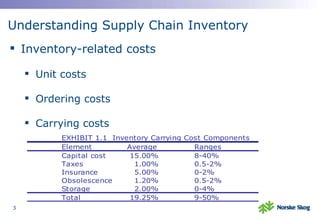
Understanding Supply Chain Inventory Inventory-related costs Unit costs Ordering costs Carrying costs
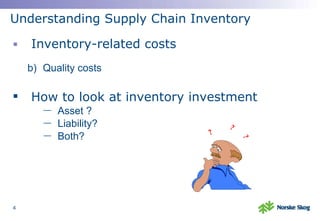
Understanding Supply Chain Inventory Inventory-related costs Quality costs How to look at inventory investment Asset ? Liability? Both? ? ? ?
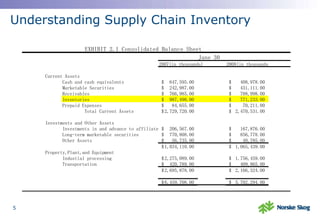
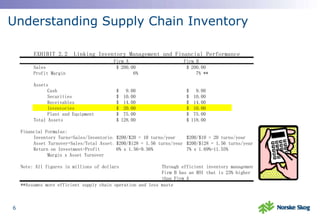
Understanding Supply Chain Inventory
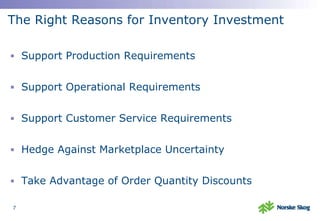
The Right Reasons for Inventory Investment Support Production Requirements Support Operational Requirements Support Customer Service Requirements Hedge Against Marketplace Uncertainty Take Advantage of Order Quantity Discounts
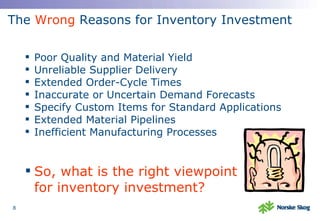
The  Wrong  Reasons for Inventory Investment Poor Quality and Material Yield Unreliable Supplier Delivery Extended Order-Cycle Times Inaccurate or Uncertain Demand Forecasts Specify Custom Items for Standard Applications Extended Material Pipelines Inefficient Manufacturing Processes So, what is the right viewpoint for inventory investment?
Coffee Time!
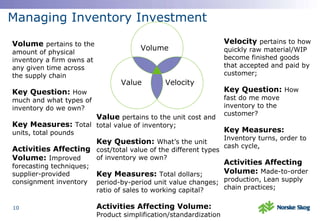
Managing Inventory Investment Volume Value Velocity Volume   pertains to the amount of physical inventory a firm owns at any given time across the supply chain Key Question:  How much and what types of inventory do we own? Key Measures:  Total units, total pounds Activities Affecting Volume:  Improved forecasting techniques; supplier-provided consignment inventory Value  pertains to the unit cost and total value of inventory; Key Question:  What’s the unit cost/total value of the different types of inventory we own? Key Measures:  Total dollars; period-by-period unit value changes; ratio of sales to working capital? Activities Affecting Volume:  Product simplification/standardization Velocity  pertains to how quickly raw material/WIP become finished goods that accepted and paid by customer; Key Question:  How fast do me move inventory to the customer? Key Measures:  Inventory turns, order to cash cycle, Activities Affecting Volume:  Made-to-order production, Lean supply chain practices;
Powerful Ways to Manage Inventory Achieve Perfect Record Integrity Improve Product Forecasting Leverage companywide Purchase Volumes Use Suppliers for On-Site Inventory Management Reduce Supplier-Buyer Cycle Times Expanded electronic capability Supplier development support Order-cycle time measurement Focus on second and third-tier suppliers
Creating the Lean Supply Chain What is lean? “ A philosophy that seeks to shorten the time between the customer order and the shipment to customer by eliminating waste”  Three primary elements Just-in-time Purchasing Just-in-time Transportation Just-in-time Production “ Just-in-time” is a management philosophy, not technique, and the philosophy is simple - inventory is defined to be waste
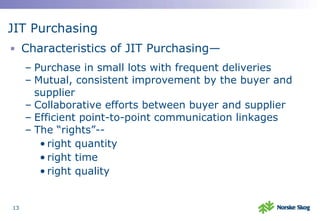
JIT Purchasing Characteristics of JIT Purchasing— Purchase in small lots with frequent deliveries Mutual, consistent improvement by the buyer and supplier Collaborative efforts between buyer and supplier Efficient point-to-point communication linkages The “rights”-- right quantity right time right quality
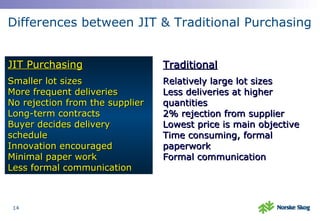
Differences between JIT & Traditional Purchasing JIT Purchasing Smaller lot sizes More frequent deliveries No rejection from the supplier Long-term contracts Buyer decides delivery schedule Innovation encouraged Minimal paper work Less formal communication Traditional Relatively large lot sizes Less deliveries at higher quantities 2% rejection from supplier Lowest price is main objective Time consuming, formal paperwork Formal communication
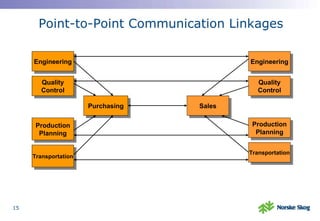
Point-to-Point Communication Linkages Engineering Quality Control Production Planning Transportation Engineering Quality Control Production Planning Transportation Purchasing Sales
 

Ojt0423a

  • 1.
    Supply Chain InventoryManagement & JIT 2009-04-23, Hebei Mill
  • 2.
    Understanding Supply ChainInventory Types of Inventory Raw material and semi-finished Items Work-in-Process Finished Goods Maintenance,Repair,and Operating Supplies Pipeline/In-Transit
  • 3.
    Understanding Supply ChainInventory Inventory-related costs Unit costs Ordering costs Carrying costs
  • 4.
    Understanding Supply ChainInventory Inventory-related costs Quality costs How to look at inventory investment Asset ? Liability? Both? ? ? ?
  • 5.
  • 6.
  • 7.
    The Right Reasonsfor Inventory Investment Support Production Requirements Support Operational Requirements Support Customer Service Requirements Hedge Against Marketplace Uncertainty Take Advantage of Order Quantity Discounts
  • 8.
    The Wrong Reasons for Inventory Investment Poor Quality and Material Yield Unreliable Supplier Delivery Extended Order-Cycle Times Inaccurate or Uncertain Demand Forecasts Specify Custom Items for Standard Applications Extended Material Pipelines Inefficient Manufacturing Processes So, what is the right viewpoint for inventory investment?
  • 9.
  • 10.
    Managing Inventory InvestmentVolume Value Velocity Volume pertains to the amount of physical inventory a firm owns at any given time across the supply chain Key Question: How much and what types of inventory do we own? Key Measures: Total units, total pounds Activities Affecting Volume: Improved forecasting techniques; supplier-provided consignment inventory Value pertains to the unit cost and total value of inventory; Key Question: What’s the unit cost/total value of the different types of inventory we own? Key Measures: Total dollars; period-by-period unit value changes; ratio of sales to working capital? Activities Affecting Volume: Product simplification/standardization Velocity pertains to how quickly raw material/WIP become finished goods that accepted and paid by customer; Key Question: How fast do me move inventory to the customer? Key Measures: Inventory turns, order to cash cycle, Activities Affecting Volume: Made-to-order production, Lean supply chain practices;
  • 11.
    Powerful Ways toManage Inventory Achieve Perfect Record Integrity Improve Product Forecasting Leverage companywide Purchase Volumes Use Suppliers for On-Site Inventory Management Reduce Supplier-Buyer Cycle Times Expanded electronic capability Supplier development support Order-cycle time measurement Focus on second and third-tier suppliers
  • 12.
    Creating the LeanSupply Chain What is lean? “ A philosophy that seeks to shorten the time between the customer order and the shipment to customer by eliminating waste” Three primary elements Just-in-time Purchasing Just-in-time Transportation Just-in-time Production “ Just-in-time” is a management philosophy, not technique, and the philosophy is simple - inventory is defined to be waste
  • 13.
    JIT Purchasing Characteristicsof JIT Purchasing— Purchase in small lots with frequent deliveries Mutual, consistent improvement by the buyer and supplier Collaborative efforts between buyer and supplier Efficient point-to-point communication linkages The “rights”-- right quantity right time right quality
  • 14.
    Differences between JIT& Traditional Purchasing JIT Purchasing Smaller lot sizes More frequent deliveries No rejection from the supplier Long-term contracts Buyer decides delivery schedule Innovation encouraged Minimal paper work Less formal communication Traditional Relatively large lot sizes Less deliveries at higher quantities 2% rejection from supplier Lowest price is main objective Time consuming, formal paperwork Formal communication
  • 15.
    Point-to-Point Communication LinkagesEngineering Quality Control Production Planning Transportation Engineering Quality Control Production Planning Transportation Purchasing Sales
  • 16.