Learning Bridges A common learning initiative between the Reconstruction Women’s Fund, the Slovak-Czech Women’s Fund and the Women’s Fund in Georgia  Funded by: Global Fund for Women, Mama Cash, filia.-die frauenstiftung  Time-Frame: January 2008 – June 2010
Executive summary The aim of the project was to develop a model of mutual learning for the feminist philanthropic actors rooted in respect, trust, transparency, and feminist approaches through site visits and extended exchange of experience and knowledge for self-improvement, lifelong learning and empowering the work of women’s movements in the countries they operate in. “ Learning Bridges” is a cross-regional project which was developed in partnership with three women’s Funds active in four countries – the Reconstruction Women’s Fund (Serbia), the Slovak-Czech Women’s Fund, and the Women’s Fund in Georgia, and can be applied to other women’s funds in other countries and regions. Each fund that participated in the project has different experiences and knowledge which they contributed to the project through extended relationships and decisive trends of cooperation within these funds. Two members from each fund were involved in the project and were given the opportunity to meet other grantees/partners, allies, and consultants,; to discuss, communicate, find and build new useful links. The goals of our exchanges were specific and two-fold: we shared what we consider to be our most developed structures and practices, and we sought solutions to some of our most pressing practical challenges by learning from what others have done to address similar problems.
 
PROJECT ACHIEVEMENTS   Over a period of 2,5 years each of the participant funds were to host the two other funds for extended site visits. In total, there were six site visits.  As a part of this process, we held a meeting as a a group immediately after the site visit had been completed and discussed key issues.
Site visits to the Slovak-Czech Women’s Fund  ( SCWF) The Slovak-Czech Women’s Fund hosted RWF and WFG in December 2009 and May  2010 and shared with the participating two funds:  SCWF PR and communications materials; SCWF original evaluation methodology; What has changed for women’s groups in the Czech and Slovak Republics since their EU accession in order to be prepared for the possibilities and pitfalls of Serbia’s eventual accession to the EU; SCWF’s work with explicitly feminist groups in terms of how, when, and why they engage in collaborative activities and events with these organizations; How to better network with women’s NGOs in countries with strong and more developed women’s movements;  What are the challenges and lessons learned  from preparation of the  database of grantees.
 
Site visits to the Reconstruction Women’s Fund (RWF) The Reconstruction Women’s Fund hosted the Slovak-Czech Women’s Fund (SCWF)  and the Women’s Fund in Georgia (WFG) in May and July 2008 respectively and shared  with the participating two funds the following lessons which they learned throughout their  working experience: How grant making can contribute to the further development of feminist activism and organizing; What the elements of a grant making program are that offer scholarships for young individuals and encourage them to become part of the feminist movement, and what are the challenges to running such a program?  How effective experiencing practical aspects is; best practices on how to manage such a program and how to cooperate further with alumni; How RWF has initiated and/or joined in collaborative activities and events with feminist groups in Serbia. How have these partnerships been forged and the specific activities these collaborations have focused on; The programmatic development of RWF and the actual methods that the Fund uses to award individual stipends to younger generations of feminist activists;  RWF’s experiences in reaching out and working with the most marginalized women’s groups in its country .
 
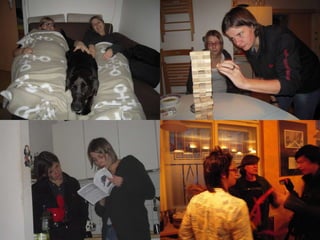
Site visits to the Women’s Fund in Georgia (WFG) The Women’s Fund in Georgia hosted RWF and SCWF in May 2009 and October 2009  and shared with the participating two funds:  What the landscape of women’s activism in Georgia looks like;  The different types of organizing women are involved in, why do they choose to focus on certain topics, and what the obstacles are they face; How the WFG reaches out to women organizing in remote and rural areas;  What the challenges and difficulties are they have had to overcome in reaching out to these groups;  WFG’s experiences in working with the most marginalized women’s groups in Georgia; How WFG plans and implements their program of building a community of local donors that are interested in funding women’s NGOs.
 
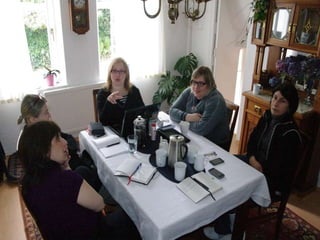
EVALUATION AND FOLLOW-UP MEETING   The evaluation and follow-up meeting was hosted by SCWF in May 2010. Two participants from each fund gathered  to discuss and assess the achievements, lessons learned, practical utilization of the gained experience in the framework of the project over the implementation of their own programs. Also, how each fund uses their exchanges as tools to guide their work towards their common vision of promoting women’s rights in their respective countries. A special evaluation questionnaire was developed during the meeting in order to better analyze in general the  overall impact of the project on the three participating funds’ work, the usefulness of the mutual visits, the problems and challenges encountered during the exchanges, to assess the stages of development as funds and the state of implementation or adjustment of our shared strategies, in particular. Most importantly, the terms of common follow- on activities of the three funds were discussed – the joint development of tools and/or strategies, to explore potential  cooperation with women’s funds at similar stages of development in other regions, and to identify possible expansion of the initiative to include more established women’s funds and other NGOs/ networks. The analysis of the responses will allow to more effectively to assess the performance of the participating funds in  the implementation of the project, its overall impact, the lessons learned, and will support us to further develop and  implement future activities.
The questionnaire consisted of six questions and is has been answered by each participant.  Below are the questions addressed during the evaluation of the project:  1. What did you learn while building bridges and how has it reinforced your foundations?  2. Where did the bridges lead you and where do you meet the others on this path? 3. What problems and challenges did you experience while crossing learning bridges? 4. What rivers do you want cross together in the future? 5. Where and why do you see future bridges over delta? 6. What have you learned about yourself as a bridge builder?
 
1. What did you learn while building bridges and how has it reinforced your foundations?
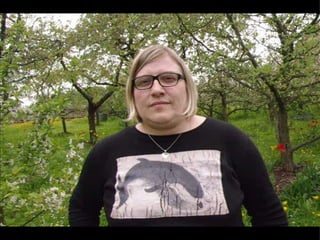
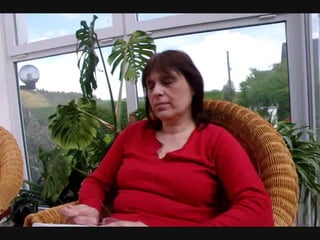
Zoe:
Nana:  The major result of our common project is that it enabled a non-virtual frameless partnership between our funds to come about. This kind of partnership is valuable in itself because it gives us strength to become more accepting rather than critical; to identify those objects and events that are more crucial amongst objects and events that lie on a single horizontal line; to accept things as they are and this way, to get even closer to your own self as a part of the whole. For me, this means to be empowered.
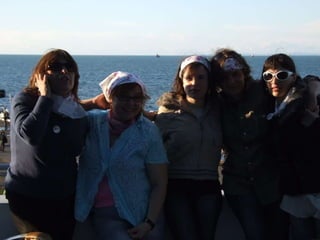
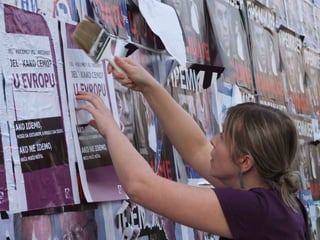
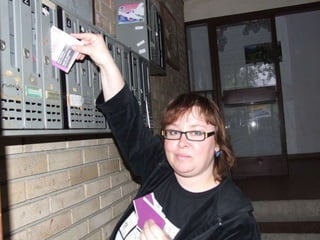
Mirjana:  One of the most important things that reinforced our Foundation as a result of Learning Bridges is the recognition that we have colleagues and friends that we can trust and lean on when we celebrate our accomplishments and when we struggle with our challenges, that our commonalities unite us and our differences make us stronger.  I will never forget the moments of Zoe’s deep, inspiring, philosophical explanation of the notion „dyke“ to Nana, Asmat and Vierka; the dedication of Ia, Guka, Mariam, Keta, Nana and Gio when travelling to various remote areas of Georgia and working on economic empowerment of women there, the faces of these women I saw on photos with so much joy and excitement that someone came to work with them, to give them the opportunity to learn something new, to start their own “honey production“, to gather with others and come out from isolation; Marketa and Vierka helping us in mixing the glue and go around Belgrade putting up the posters and leaflets in mail boxes, trying to be faster than the nationalists who were also using the opportunity of the last day of pre-election campaigns; Marketa’s generous spreading knowledge of all possible gadgets in this world – from Google ad to the functioning of a new coffee machine that I bought for my husband. We were directly inspired by SCWF to start to work more on PR and the visibility of our Fund, which arose somehow parallel with recommendations we got through our external evaluation. We realized that some of our steps are very similar and that we are using unconventional, funny, artistic and creative ways in the local philanthropy that we are developing. RWF‘s visit to SCWF in December last year was actually the first time I travelled together with my colleague Zoe and it was also a learning bridge between the two of us. It helped us a lot to get to know each other better and since then the joy of working together and becoming friends has been increasing, so we have one more added value to this initiative.
 
Viera:  The delicate connections, relationships, or as we call them now, bridges, which I thought are possible to build only between individual people, I suddenly saw growing also among legal entities – our organizations. The women’s funds were established under similar conditions, with similar challenges and question-marks that were fed through similar energy and passion.  It was inspiring to visit both partner funds and have the privilege to touch and feel the background in which they operate – their premises, the staff, community, local network, local political situation, listen to the flow of their language when preparing an interesting program for us visitors. The Learning Bridges project enabled me and Marketa to understand the subtle mechanisms behind the impressive results of the Georgian and Serbian women’s funds’ work: to see in what conditions the small teams of these WF’s undertake creative grant-making and daring plans with the aim of changing the philanthropic culture in their countries.  My biggest gain from this project during my visits is the very positive discovering that the honesty and feminist spirit I observed in my colleague’s personalities are a pre-condition and foundation of their working ethics as leaders in their organizations. And this is also the reason why WFG and RWF are so successful when organizing events for the public and giving grants for those women’s groups who are making a change in their countries. They do not strategize or play games while organizing public events, but develop connections with other players in the nonprofit sector, both donors and NGOs.  I could see and admire harmony between the personal beliefs and organizational vision and these living examples assured me that SCWF is also on the right path – not compromising its mission while communicating it to different actors in Slovakia and the Czech Republic.
Marketa:  There are many things I learned from my friends and colleagues during the Learning Bridges project and it would be impossible to enumerate all of them in this report.  To stress two very important points for myself and for our organization: One is the involvement of the Reconstruction Women’s Fund and the Women’s Fund in Georgia in the movement building, either through political activism and engagement or through interaction with the grantee partners. We could observe a higher level of “risk-taking” in articulating political stances or positions within the movement by both the funds while still keeping the necessary balance and position of the fund as a grant maker. Sometimes SCWF keeps, for the sake of objectivity, a too big of a distance.  The other thing which, besides many others, was and is very useful to our work and our own dealing with the work and the fund is how RWF and WFG manage to use to their advantage the age diversity in their organizations. SCWF’s core staff is of the same age group which makes the organization very young and dynamic but sometimes lacks the insight of a different generation. It would not be an overstatement to say that the long-time cooperation with the sister funds and the people and friends in WFG and RWF have for me often substituted the missing experience, advice and insight of a older tutor or mentor without feeling patronized or lectured.
 
Asmat:  While implementing the project I, and I believe all the participants knew a lot about each other, our foundations, our countries and our strategies. Through differences in our approaches we came up with common values and visions about women's rights and the role in development of a healthy society and progress in general.
 
2. Where did the bridges lead you and where do you meet the others on this path?
 
Marketa:  The Learning Bridges was a project in its happening for over almost three years. During this period we witnessed the move of all three funds from promising start-ups to young functioning organizations. All three funds are dealing with new stages in different ways and we are trying to implement new strategies to cope with these new challenges.  For SCWF it was very important to see the development and steps that RWF or WFG have been undertaking: employing a PR and Communications Manager at RWF or the task divisions in WFG after receiving the multi-year grant. We learned from very detail oriented discussions such as different ways in allocating budgets to strategic discussions about the next steps regarding grant-making and reflecting on the socio-political situation in our countries.  SCWF is currently on its own in a transition/crossroad situation and it is very important for us to see that although we are all taking different steps and paths, and are employing different strategies, we meet very naturally at the same crossroads all the time.
Asmat:  Bridges are built to reach their destination. While crossing the rivers we had an opportunity to meet very interesting people of diverse conceptions, ideas and philosophy.  It was a real chance to share our concepts with others, to give and receive knowledge, develop ourselves and support others. It was a process of mutual understanding, based on trust and friendship.
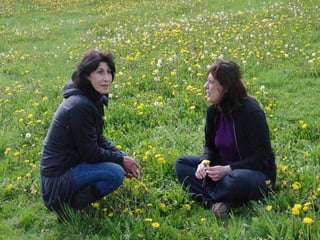
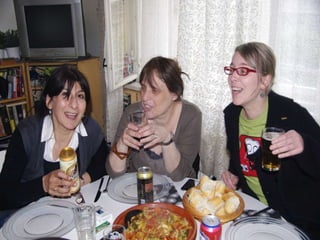
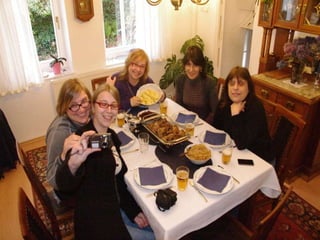
Zoe:  Getting to know other funds was really interesting for me because I spent most of my time in Marketa’s apartment or in her family’s house. Feminists usually begin their action planning in the kitchen. So in Marketa’s kitchen I was able to hear and see other women with whom we exchanged private and political experiences.  Where this bridge that we started building in Marketa’s kitchen will take us remains to be seen.
 
Viera:  Even though I had some knowledge about the political and cultural situation in Serbia and Georgia, I was truly impressed when seeing how courageously our friends from WFG and RWF are dealing with restrictions based on economical and social obstacles. This firsthand experience was invaluable to me – e.g., when learning about the rapid response grant-making after the conflict in Georgia, WFG’s outreach and cooperation with women’s groups in distant regions or when witnessing the pre-election activities of RWF in Belgrade.  I realized that although SCWF is a keen and active partner to other women’s NGOs, there is still room for SCWF to be more present and visible during various public protests and campaigns organized by NGO leaders in our two countries. Building bridges of understanding and mutual respect and walking them together with my colleagues was an unique opportunity to me.  The generous timeframe of three years for the implementation of this project should also be considered a key factor for its success. It allowed me to see the women’s funds mature from energetic but shy newcomers who sometimes behave too politely in need of support in various forms from more experienced organizations to well articulated leaders showing impressive autonomy and self-esteem.  For me these new bridges connecting us also symbolizes new directions for funding in the women’s movement in our region and globally: because all of us now feel stable support and tight connections beyond our national funds we feel more confident when creating crossborder strategies and fundraising plans for our region.
Nana:  We have been meeting each other even before we started to build the bridges, and a long time before this, we realized the need to free some space in the given formal environment for more human, honest and first hand relations.  And now, when the project is over, for us as donor organizations, it is very important to introduce this concept of  human relationships in the formal space  to our partners and also to popularize it among the donors’ bigger audiences.
 
3. What problems and challenges did you experience while crossing learning bridges?
 
Nana:  The main problem for implementing this project was its timing. The problem encountered by the funds in this respect was caused by the armed conflict in 2008 in Georgia and its negative consequences that delayed the implementation of the project by almost half a year.
Zoe:  I did not experience any problems, but there are always challenges. I am always interested in information regarding the role of women in society, sexual orientation, how dominant religion is…  It is always interesting to discuss issues with women from other funds who come from different social backgrounds and have diverse views.
 
Marketa:  When looking back at the three years, I identify very few challenges or obstacles. One which should have been expected, but was underestimated, was time management and coordinating with other engagements and obligations of the people involved. Very often the informal structure of the project and our mutual friendships made us more casual about keeping our own deadlines when having to plan priorities.  The other challenge of this project was how to involve, share and transfer the experience of the visits to the other members of the funds. We did manage to involve all the staff of the fund who were being visited, but only two persons per fund were able to travel when leaving to visit. So the experience was not the same for all and the dedication to the project and the feeling of its uniqueness was not transferable to all.
 
Asmat:  There were no problems in this "building" process. It was a lionizing process mixed with fun and interest in each other.
Mirjana:  One of the challenges was to stick to the original timeline of planned activities due to the war in Georgia. Also, we didn’t have time to go very much in depth during our meetings, but having in mind that this is the first step, I don’t consider this a challenge.  What is important is that our communication, exchanges of information and face-to-face meetings was quite constant, thanks to the Internet, skype conversations and travelling.
 
4. What rivers do you want cross together in the future?
Nana: NOTE:  THE VIDEO IS NOT AUDIBLE!  “One cannot step in a river twice“- they say... But probably that is the reason why bridges exist - to cross rivers, to overcome obstacles and then, to start everything over again in order to join them, who were with you when you first stepped in the river... as if you make your first step.  Now we are on the bridge, on the way, and of course, we have learned, we have been learning, we will be learning, how to do, why, and what for, what we need now as individuals and as a group. So, for two years, we have been building these bridges, developing ourselves, our relations and meanwhile we have grown up as a group.  When I think about it, hundreds of thoughts are in my mind. I realize how many things we can do together, jointly, to support each other and what is most important, how to unify our ideas... But, when the bridge is established and is strong enough – and I have feeling that this is the case – we can not only do a lot together, but also offer our bridge to others for them to try and use it, to be aware and cross the bridge. So then, let us work together!
 
Marketa: There were many plans made to continue this cooperation, some of them very concrete and some still in a “political” air-balloon shape. One very concrete step to be taken now and which has already been discussed within the funds is the creation and adaptation of a common database. It might seem technically challenging but we would like to explore this path because we think it could be very efficient, cost-effective and a human resource saving plan.  The second plan we are now unwrapping and looking into is the possibilities of a joint grant-making strategy for “youth-banks”. It would first combine joint fundraising for the project and then a common strategy in grant-making. Last but not least, more political, is the use of a deep coalition and knowledge of the broader networks and structures.  Learning about the other funds and having deeper knowledge of the way they work and their programs make us much stronger allies and advocates in different places we might present and represent.
 
Zoe:  I am mostly interested in networking with foundations and groups and to build bridges so as to make feminist energy something that can be seen and heard. I hope that the foundation will not fall into the classic corporate model and that it will keep its feminist spirit and continue to work with those because of who they are – women.
Asmat: It will be interesting to share our experience with other funds of same values and interests as ours. I wish to expand the geographical scope of the project involving people with common values and visions.
 
Viera: We all aim to continue to share our plans and work out strategies together even after our LB project is over. It now feels natural and easy to communicate even about certain delicate issues we are dealing with on the domestic level – our friendship and trust is so much deeper and so much more based on the real knowledge of the working conditions and the limits we face in everyday life.  This project allowed some of us also to be more in the spotlight at the international donors’ scene as our project gained significant attention from the side of larger European foundations, members of the European Foundation Centre network and the Grantmakers East Forum who are keen to find out more about peer learning among feminists.  Future projects we might carry out together can be also presented at international donors‘ conferences – now we are definitely ready to talk about these projects and our organizations as innovators with fresh concepts.  One idea ready to be transformed into reality is to cooperate on the creation of a common template for a database of our grantees and donors – something that can enhance our information office system and something that is needed in all our Funds.
Mirjana: One of the most certain common future activities is the creation of a common database (of grantees, donors, media...). We still need some time to define in detail what kind of database will be the most suitable for all of us and to start concrete negotiations with IT experts. After my last visit to Prague, and being a guest at the lesbian festival organized by the Czech NGO eLnadruhou, the idea to organize an exchange between LBTQ activists from Serbia and the Czech Republic came up. Talking about a joint proposal, we had an initial idea of a Roma and other marginalized Girls‘ Bank - a program that is designed to increase social cohesion of civil society through the social inclusion of Roma girls and young women.
 
5. Where and why do you see future bridges over delta?
 
Mirjana: The LB initiative could be used as an example of peer-learning for similar organizations. I think that there could be benefits from exchanges between other organizations despite them being different in terms of size or even having different thematic priorities. While it is undeniably helpful to speak to those with similar objectives, adding diversity to discussions can be precious. But on one condition: to share common values, to be open to share and learn (successes as well as challenges). Learning Bridges was promoted as a model among other women’s funds (WFN Conference in Denver, April 2010, European Regional Meeting in Prague 2008 and Tbilisi 2009), but also among other actors of civil societies (CEE Trust, EFC in Istanbul, May 2008, GEF in Dubrovnik, October 2008, Effect Magazine, issue 3, winter 2008). As a first step, I could see this model being imitated within the International Network of Women’s Funds for peer-learning between women’s funds situated in different regions and continents.
Nana: I believe that this model of Women’s Fund cooperation and its concept can serve as a base for real expansion for existing networks and beyond them – everywhere where the values are the same and everywhere where there is a need and readiness to overcome formal spaces. This delta is perceived by me as consisting of diverse channels in a big river of value systems.
Viera:  The Learning bridges as a pilot project, the first of its kind, developed and supported by three women’s funds, represents in my opinion a great way of new in depth thinking about feminist collaboration.  All of us brought our specific moods, ambitions, energies, ideas, problems, insecurities, and fears into this project, but most of all - open hearts and critical views. I realized that our very personal affairs became very much political material – we learned much more not only about ourselves as bridge builders but even more about the hidden streams in the rivers that we need to be aware of if we want to cross them.  And moreover, about our mutual power that can help us work more efficiently and quickly. This must be considered if we are serious about building a global movement. And if we want to build bridges over global delta, we need a tool that allows us to do this with perfect knowledge of our strengths and weaknesses.  Therefore, in my opinion, Learning bridges can be applied among many other types of donor agencies but especially women’s NGOs and women’s funds that are changing the world to the better for women and girls.
 
Zoe: I can see bridges everywhere: in private, social, political and cultural networking; with other foundations, with other organizations. I would like to see more cultural exchange between foundations.
Marketa:  Already when preparing the project together with WFG and RWF we were aware of the utmost importance of sharing and learning as an accelerator of development. Within the implementation of the project this became even clearer. The requests and expectations of outside players regarding the speed of development of organizational capacities and professionalism of women’s funds is higher and greater than ever. The creation of peer-learning and peer-coalitions, as well as sharing and exploring common resources seem to be one of the most efficient ways to keep pace with these expectations.
 
6. What have you learned about yourself as a bridge builder?
 
Zoe: That I am a part of a very interesting machine, but only a small part of it – a special part nonetheless.
Viera: I reassured myself how important it is to trust my own intuition and potential in such unusual projects as Learning Bridges. And how great it was that I could rely on the intuition and my colleague Marketa’s sense of perfect timing, who was also the initiator of this concept of peer learning.  I am also happy to learn how influential and formative special relationships with our colleagues can be, women who believe in similar values and principles and who are willing to be open and flexible and not share only victories but also failures.  During the visits I realized how very similar we are in all our differences and that we all share doubts which often slow down our progress as leaders and as women. I learned that this way of building bridges between professionals who are active in fundraising to enhance women’s status requires an unusually big portion of willingness to show one’s true personality, not what we are usually ready show to our colleagues at conferences where we all are behave formally and polite.  Building these bridges is a good metaphor not only for our readiness to know our colleagues in their world on the other side of the bridge, but also can be a symbol for our openness and growth that can be catalyzed much quicker when we allow others to see us truly and help us when needed. I am so glad that I could be a bridge builder in the special company of authentic women from three countries who found their way to reach me with their bridges and to let me reach out to them as well.
Asmat:  I myself have learnt that honesty and sharing, alongside with common values and trust to each other, is the basis of any initiative that will make you “cross a bridge” and open the horizons wide.
 
Mirjana: I’ve learned that I can beat my impatience, my impulse that everything has to be done over night; that I can be a very attentive listener and that I am a team player – feeling the most satisfied when I am surrounded by people that I respect and trust, who bring positive energy and constructive ideas – this is the situation in which I can give my best.  Also, I’ve learned that I can be quite competitive as well, especially when I have someone worth to compete with. I’m also appreciating myself more – since I became friends with such beautiful personalities, I noticed that I am not in favor of “old iron”.
Nana:  When we talk about the process, which is given in a certain time (meanwhile it is already 2 years that we have collaborated with each other), it is clear that we can also say we have learned new things about ourselves.  Such relationships are like mirrors and one can see herself better in her partners’ face. This relationship, above all, reassured me that our common funds’ values differentiate us in the large philanthropic ocean where our commitment to feminism shows us as unique actors of change.
 
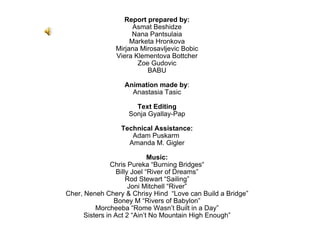
Report prepared by: Asmat Beshidze Nana Pantsulaia Marketa Hronkova Mirjana Mirosavljevic Bobic Viera Klementova Bottcher Zoe Gudovic BABU Animation made by : Anastasia Tasic Text Editing Sonja Gyallay-Pap Technical Assistance: Adam Puskarm  Amanda M. Gigler Music: Chris Pureka “Burning Bridges “ Billy Joel “River of Dreams” Rod Stewart “Sailing” Joni Mitchell “River” Cher, Neneh Chery & Chrisy Hind  “Love can Build a Bridge” Boney M “Rivers of Babylon” Morcheeba “Rome Wasn’t Built in a Day” Sisters in Act 2 “Ain’t No Mountain High Enough”
Reconstruction Women’s Fund www.rwfund.org Slovak-Czech Women’s Fund www.womensfund.sk Women’s Fund in Georgia www.womenfundgeorgia.org
Learning Bridges Project Supported by: filia die Frauenstiftung  www. filia - frauenstiftung .de  Global Fund for Women  www. globalfundforwomen .org  Mama Cash  www. mamacash .org

01 lb report_presentation

  • 1.
    Learning Bridges Acommon learning initiative between the Reconstruction Women’s Fund, the Slovak-Czech Women’s Fund and the Women’s Fund in Georgia Funded by: Global Fund for Women, Mama Cash, filia.-die frauenstiftung Time-Frame: January 2008 – June 2010
  • 2.
    Executive summary Theaim of the project was to develop a model of mutual learning for the feminist philanthropic actors rooted in respect, trust, transparency, and feminist approaches through site visits and extended exchange of experience and knowledge for self-improvement, lifelong learning and empowering the work of women’s movements in the countries they operate in. “ Learning Bridges” is a cross-regional project which was developed in partnership with three women’s Funds active in four countries – the Reconstruction Women’s Fund (Serbia), the Slovak-Czech Women’s Fund, and the Women’s Fund in Georgia, and can be applied to other women’s funds in other countries and regions. Each fund that participated in the project has different experiences and knowledge which they contributed to the project through extended relationships and decisive trends of cooperation within these funds. Two members from each fund were involved in the project and were given the opportunity to meet other grantees/partners, allies, and consultants,; to discuss, communicate, find and build new useful links. The goals of our exchanges were specific and two-fold: we shared what we consider to be our most developed structures and practices, and we sought solutions to some of our most pressing practical challenges by learning from what others have done to address similar problems.
  • 3.
  • 4.
    PROJECT ACHIEVEMENTS Over a period of 2,5 years each of the participant funds were to host the two other funds for extended site visits. In total, there were six site visits. As a part of this process, we held a meeting as a a group immediately after the site visit had been completed and discussed key issues.
  • 5.
    Site visits tothe Slovak-Czech Women’s Fund ( SCWF) The Slovak-Czech Women’s Fund hosted RWF and WFG in December 2009 and May 2010 and shared with the participating two funds: SCWF PR and communications materials; SCWF original evaluation methodology; What has changed for women’s groups in the Czech and Slovak Republics since their EU accession in order to be prepared for the possibilities and pitfalls of Serbia’s eventual accession to the EU; SCWF’s work with explicitly feminist groups in terms of how, when, and why they engage in collaborative activities and events with these organizations; How to better network with women’s NGOs in countries with strong and more developed women’s movements; What are the challenges and lessons learned  from preparation of the  database of grantees.
  • 6.
  • 7.
    Site visits tothe Reconstruction Women’s Fund (RWF) The Reconstruction Women’s Fund hosted the Slovak-Czech Women’s Fund (SCWF) and the Women’s Fund in Georgia (WFG) in May and July 2008 respectively and shared with the participating two funds the following lessons which they learned throughout their working experience: How grant making can contribute to the further development of feminist activism and organizing; What the elements of a grant making program are that offer scholarships for young individuals and encourage them to become part of the feminist movement, and what are the challenges to running such a program? How effective experiencing practical aspects is; best practices on how to manage such a program and how to cooperate further with alumni; How RWF has initiated and/or joined in collaborative activities and events with feminist groups in Serbia. How have these partnerships been forged and the specific activities these collaborations have focused on; The programmatic development of RWF and the actual methods that the Fund uses to award individual stipends to younger generations of feminist activists; RWF’s experiences in reaching out and working with the most marginalized women’s groups in its country .
  • 8.
  • 9.
    Site visits tothe Women’s Fund in Georgia (WFG) The Women’s Fund in Georgia hosted RWF and SCWF in May 2009 and October 2009 and shared with the participating two funds: What the landscape of women’s activism in Georgia looks like; The different types of organizing women are involved in, why do they choose to focus on certain topics, and what the obstacles are they face; How the WFG reaches out to women organizing in remote and rural areas; What the challenges and difficulties are they have had to overcome in reaching out to these groups; WFG’s experiences in working with the most marginalized women’s groups in Georgia; How WFG plans and implements their program of building a community of local donors that are interested in funding women’s NGOs.
  • 10.
  • 11.
    EVALUATION AND FOLLOW-UPMEETING The evaluation and follow-up meeting was hosted by SCWF in May 2010. Two participants from each fund gathered to discuss and assess the achievements, lessons learned, practical utilization of the gained experience in the framework of the project over the implementation of their own programs. Also, how each fund uses their exchanges as tools to guide their work towards their common vision of promoting women’s rights in their respective countries. A special evaluation questionnaire was developed during the meeting in order to better analyze in general the overall impact of the project on the three participating funds’ work, the usefulness of the mutual visits, the problems and challenges encountered during the exchanges, to assess the stages of development as funds and the state of implementation or adjustment of our shared strategies, in particular. Most importantly, the terms of common follow- on activities of the three funds were discussed – the joint development of tools and/or strategies, to explore potential cooperation with women’s funds at similar stages of development in other regions, and to identify possible expansion of the initiative to include more established women’s funds and other NGOs/ networks. The analysis of the responses will allow to more effectively to assess the performance of the participating funds in the implementation of the project, its overall impact, the lessons learned, and will support us to further develop and implement future activities.
  • 12.
    The questionnaire consistedof six questions and is has been answered by each participant. Below are the questions addressed during the evaluation of the project: 1. What did you learn while building bridges and how has it reinforced your foundations? 2. Where did the bridges lead you and where do you meet the others on this path? 3. What problems and challenges did you experience while crossing learning bridges? 4. What rivers do you want cross together in the future? 5. Where and why do you see future bridges over delta? 6. What have you learned about yourself as a bridge builder?
  • 13.
  • 14.
    1. What didyou learn while building bridges and how has it reinforced your foundations?
  • 15.
  • 16.
    Nana: Themajor result of our common project is that it enabled a non-virtual frameless partnership between our funds to come about. This kind of partnership is valuable in itself because it gives us strength to become more accepting rather than critical; to identify those objects and events that are more crucial amongst objects and events that lie on a single horizontal line; to accept things as they are and this way, to get even closer to your own self as a part of the whole. For me, this means to be empowered.
  • 17.
    Mirjana: Oneof the most important things that reinforced our Foundation as a result of Learning Bridges is the recognition that we have colleagues and friends that we can trust and lean on when we celebrate our accomplishments and when we struggle with our challenges, that our commonalities unite us and our differences make us stronger. I will never forget the moments of Zoe’s deep, inspiring, philosophical explanation of the notion „dyke“ to Nana, Asmat and Vierka; the dedication of Ia, Guka, Mariam, Keta, Nana and Gio when travelling to various remote areas of Georgia and working on economic empowerment of women there, the faces of these women I saw on photos with so much joy and excitement that someone came to work with them, to give them the opportunity to learn something new, to start their own “honey production“, to gather with others and come out from isolation; Marketa and Vierka helping us in mixing the glue and go around Belgrade putting up the posters and leaflets in mail boxes, trying to be faster than the nationalists who were also using the opportunity of the last day of pre-election campaigns; Marketa’s generous spreading knowledge of all possible gadgets in this world – from Google ad to the functioning of a new coffee machine that I bought for my husband. We were directly inspired by SCWF to start to work more on PR and the visibility of our Fund, which arose somehow parallel with recommendations we got through our external evaluation. We realized that some of our steps are very similar and that we are using unconventional, funny, artistic and creative ways in the local philanthropy that we are developing. RWF‘s visit to SCWF in December last year was actually the first time I travelled together with my colleague Zoe and it was also a learning bridge between the two of us. It helped us a lot to get to know each other better and since then the joy of working together and becoming friends has been increasing, so we have one more added value to this initiative.
  • 18.
  • 19.
    Viera: Thedelicate connections, relationships, or as we call them now, bridges, which I thought are possible to build only between individual people, I suddenly saw growing also among legal entities – our organizations. The women’s funds were established under similar conditions, with similar challenges and question-marks that were fed through similar energy and passion. It was inspiring to visit both partner funds and have the privilege to touch and feel the background in which they operate – their premises, the staff, community, local network, local political situation, listen to the flow of their language when preparing an interesting program for us visitors. The Learning Bridges project enabled me and Marketa to understand the subtle mechanisms behind the impressive results of the Georgian and Serbian women’s funds’ work: to see in what conditions the small teams of these WF’s undertake creative grant-making and daring plans with the aim of changing the philanthropic culture in their countries. My biggest gain from this project during my visits is the very positive discovering that the honesty and feminist spirit I observed in my colleague’s personalities are a pre-condition and foundation of their working ethics as leaders in their organizations. And this is also the reason why WFG and RWF are so successful when organizing events for the public and giving grants for those women’s groups who are making a change in their countries. They do not strategize or play games while organizing public events, but develop connections with other players in the nonprofit sector, both donors and NGOs. I could see and admire harmony between the personal beliefs and organizational vision and these living examples assured me that SCWF is also on the right path – not compromising its mission while communicating it to different actors in Slovakia and the Czech Republic.
  • 20.
    Marketa: Thereare many things I learned from my friends and colleagues during the Learning Bridges project and it would be impossible to enumerate all of them in this report. To stress two very important points for myself and for our organization: One is the involvement of the Reconstruction Women’s Fund and the Women’s Fund in Georgia in the movement building, either through political activism and engagement or through interaction with the grantee partners. We could observe a higher level of “risk-taking” in articulating political stances or positions within the movement by both the funds while still keeping the necessary balance and position of the fund as a grant maker. Sometimes SCWF keeps, for the sake of objectivity, a too big of a distance. The other thing which, besides many others, was and is very useful to our work and our own dealing with the work and the fund is how RWF and WFG manage to use to their advantage the age diversity in their organizations. SCWF’s core staff is of the same age group which makes the organization very young and dynamic but sometimes lacks the insight of a different generation. It would not be an overstatement to say that the long-time cooperation with the sister funds and the people and friends in WFG and RWF have for me often substituted the missing experience, advice and insight of a older tutor or mentor without feeling patronized or lectured.
  • 21.
  • 22.
    Asmat: Whileimplementing the project I, and I believe all the participants knew a lot about each other, our foundations, our countries and our strategies. Through differences in our approaches we came up with common values and visions about women's rights and the role in development of a healthy society and progress in general.
  • 23.
  • 24.
    2. Where didthe bridges lead you and where do you meet the others on this path?
  • 25.
  • 26.
    Marketa: TheLearning Bridges was a project in its happening for over almost three years. During this period we witnessed the move of all three funds from promising start-ups to young functioning organizations. All three funds are dealing with new stages in different ways and we are trying to implement new strategies to cope with these new challenges. For SCWF it was very important to see the development and steps that RWF or WFG have been undertaking: employing a PR and Communications Manager at RWF or the task divisions in WFG after receiving the multi-year grant. We learned from very detail oriented discussions such as different ways in allocating budgets to strategic discussions about the next steps regarding grant-making and reflecting on the socio-political situation in our countries. SCWF is currently on its own in a transition/crossroad situation and it is very important for us to see that although we are all taking different steps and paths, and are employing different strategies, we meet very naturally at the same crossroads all the time.
  • 27.
    Asmat: Bridgesare built to reach their destination. While crossing the rivers we had an opportunity to meet very interesting people of diverse conceptions, ideas and philosophy. It was a real chance to share our concepts with others, to give and receive knowledge, develop ourselves and support others. It was a process of mutual understanding, based on trust and friendship.
  • 28.
    Zoe: Gettingto know other funds was really interesting for me because I spent most of my time in Marketa’s apartment or in her family’s house. Feminists usually begin their action planning in the kitchen. So in Marketa’s kitchen I was able to hear and see other women with whom we exchanged private and political experiences. Where this bridge that we started building in Marketa’s kitchen will take us remains to be seen.
  • 29.
  • 30.
    Viera: Eventhough I had some knowledge about the political and cultural situation in Serbia and Georgia, I was truly impressed when seeing how courageously our friends from WFG and RWF are dealing with restrictions based on economical and social obstacles. This firsthand experience was invaluable to me – e.g., when learning about the rapid response grant-making after the conflict in Georgia, WFG’s outreach and cooperation with women’s groups in distant regions or when witnessing the pre-election activities of RWF in Belgrade. I realized that although SCWF is a keen and active partner to other women’s NGOs, there is still room for SCWF to be more present and visible during various public protests and campaigns organized by NGO leaders in our two countries. Building bridges of understanding and mutual respect and walking them together with my colleagues was an unique opportunity to me. The generous timeframe of three years for the implementation of this project should also be considered a key factor for its success. It allowed me to see the women’s funds mature from energetic but shy newcomers who sometimes behave too politely in need of support in various forms from more experienced organizations to well articulated leaders showing impressive autonomy and self-esteem. For me these new bridges connecting us also symbolizes new directions for funding in the women’s movement in our region and globally: because all of us now feel stable support and tight connections beyond our national funds we feel more confident when creating crossborder strategies and fundraising plans for our region.
  • 31.
    Nana: Wehave been meeting each other even before we started to build the bridges, and a long time before this, we realized the need to free some space in the given formal environment for more human, honest and first hand relations. And now, when the project is over, for us as donor organizations, it is very important to introduce this concept of human relationships in the formal space to our partners and also to popularize it among the donors’ bigger audiences.
  • 32.
  • 33.
    3. What problemsand challenges did you experience while crossing learning bridges?
  • 34.
  • 35.
    Nana: Themain problem for implementing this project was its timing. The problem encountered by the funds in this respect was caused by the armed conflict in 2008 in Georgia and its negative consequences that delayed the implementation of the project by almost half a year.
  • 36.
    Zoe: Idid not experience any problems, but there are always challenges. I am always interested in information regarding the role of women in society, sexual orientation, how dominant religion is… It is always interesting to discuss issues with women from other funds who come from different social backgrounds and have diverse views.
  • 37.
  • 38.
    Marketa: Whenlooking back at the three years, I identify very few challenges or obstacles. One which should have been expected, but was underestimated, was time management and coordinating with other engagements and obligations of the people involved. Very often the informal structure of the project and our mutual friendships made us more casual about keeping our own deadlines when having to plan priorities. The other challenge of this project was how to involve, share and transfer the experience of the visits to the other members of the funds. We did manage to involve all the staff of the fund who were being visited, but only two persons per fund were able to travel when leaving to visit. So the experience was not the same for all and the dedication to the project and the feeling of its uniqueness was not transferable to all.
  • 39.
  • 40.
    Asmat: Therewere no problems in this "building" process. It was a lionizing process mixed with fun and interest in each other.
  • 41.
    Mirjana: Oneof the challenges was to stick to the original timeline of planned activities due to the war in Georgia. Also, we didn’t have time to go very much in depth during our meetings, but having in mind that this is the first step, I don’t consider this a challenge. What is important is that our communication, exchanges of information and face-to-face meetings was quite constant, thanks to the Internet, skype conversations and travelling.
  • 42.
  • 43.
    4. What riversdo you want cross together in the future?
  • 44.
    Nana: NOTE: THE VIDEO IS NOT AUDIBLE! “One cannot step in a river twice“- they say... But probably that is the reason why bridges exist - to cross rivers, to overcome obstacles and then, to start everything over again in order to join them, who were with you when you first stepped in the river... as if you make your first step. Now we are on the bridge, on the way, and of course, we have learned, we have been learning, we will be learning, how to do, why, and what for, what we need now as individuals and as a group. So, for two years, we have been building these bridges, developing ourselves, our relations and meanwhile we have grown up as a group. When I think about it, hundreds of thoughts are in my mind. I realize how many things we can do together, jointly, to support each other and what is most important, how to unify our ideas... But, when the bridge is established and is strong enough – and I have feeling that this is the case – we can not only do a lot together, but also offer our bridge to others for them to try and use it, to be aware and cross the bridge. So then, let us work together!
  • 45.
  • 46.
    Marketa: There weremany plans made to continue this cooperation, some of them very concrete and some still in a “political” air-balloon shape. One very concrete step to be taken now and which has already been discussed within the funds is the creation and adaptation of a common database. It might seem technically challenging but we would like to explore this path because we think it could be very efficient, cost-effective and a human resource saving plan. The second plan we are now unwrapping and looking into is the possibilities of a joint grant-making strategy for “youth-banks”. It would first combine joint fundraising for the project and then a common strategy in grant-making. Last but not least, more political, is the use of a deep coalition and knowledge of the broader networks and structures. Learning about the other funds and having deeper knowledge of the way they work and their programs make us much stronger allies and advocates in different places we might present and represent.
  • 47.
  • 48.
    Zoe: Iam mostly interested in networking with foundations and groups and to build bridges so as to make feminist energy something that can be seen and heard. I hope that the foundation will not fall into the classic corporate model and that it will keep its feminist spirit and continue to work with those because of who they are – women.
  • 49.
    Asmat: It willbe interesting to share our experience with other funds of same values and interests as ours. I wish to expand the geographical scope of the project involving people with common values and visions.
  • 50.
  • 51.
    Viera: We allaim to continue to share our plans and work out strategies together even after our LB project is over. It now feels natural and easy to communicate even about certain delicate issues we are dealing with on the domestic level – our friendship and trust is so much deeper and so much more based on the real knowledge of the working conditions and the limits we face in everyday life. This project allowed some of us also to be more in the spotlight at the international donors’ scene as our project gained significant attention from the side of larger European foundations, members of the European Foundation Centre network and the Grantmakers East Forum who are keen to find out more about peer learning among feminists. Future projects we might carry out together can be also presented at international donors‘ conferences – now we are definitely ready to talk about these projects and our organizations as innovators with fresh concepts. One idea ready to be transformed into reality is to cooperate on the creation of a common template for a database of our grantees and donors – something that can enhance our information office system and something that is needed in all our Funds.
  • 52.
    Mirjana: One ofthe most certain common future activities is the creation of a common database (of grantees, donors, media...). We still need some time to define in detail what kind of database will be the most suitable for all of us and to start concrete negotiations with IT experts. After my last visit to Prague, and being a guest at the lesbian festival organized by the Czech NGO eLnadruhou, the idea to organize an exchange between LBTQ activists from Serbia and the Czech Republic came up. Talking about a joint proposal, we had an initial idea of a Roma and other marginalized Girls‘ Bank - a program that is designed to increase social cohesion of civil society through the social inclusion of Roma girls and young women.
  • 53.
  • 54.
    5. Where andwhy do you see future bridges over delta?
  • 55.
  • 56.
    Mirjana: The LBinitiative could be used as an example of peer-learning for similar organizations. I think that there could be benefits from exchanges between other organizations despite them being different in terms of size or even having different thematic priorities. While it is undeniably helpful to speak to those with similar objectives, adding diversity to discussions can be precious. But on one condition: to share common values, to be open to share and learn (successes as well as challenges). Learning Bridges was promoted as a model among other women’s funds (WFN Conference in Denver, April 2010, European Regional Meeting in Prague 2008 and Tbilisi 2009), but also among other actors of civil societies (CEE Trust, EFC in Istanbul, May 2008, GEF in Dubrovnik, October 2008, Effect Magazine, issue 3, winter 2008). As a first step, I could see this model being imitated within the International Network of Women’s Funds for peer-learning between women’s funds situated in different regions and continents.
  • 57.
    Nana: I believethat this model of Women’s Fund cooperation and its concept can serve as a base for real expansion for existing networks and beyond them – everywhere where the values are the same and everywhere where there is a need and readiness to overcome formal spaces. This delta is perceived by me as consisting of diverse channels in a big river of value systems.
  • 58.
    Viera: TheLearning bridges as a pilot project, the first of its kind, developed and supported by three women’s funds, represents in my opinion a great way of new in depth thinking about feminist collaboration. All of us brought our specific moods, ambitions, energies, ideas, problems, insecurities, and fears into this project, but most of all - open hearts and critical views. I realized that our very personal affairs became very much political material – we learned much more not only about ourselves as bridge builders but even more about the hidden streams in the rivers that we need to be aware of if we want to cross them. And moreover, about our mutual power that can help us work more efficiently and quickly. This must be considered if we are serious about building a global movement. And if we want to build bridges over global delta, we need a tool that allows us to do this with perfect knowledge of our strengths and weaknesses. Therefore, in my opinion, Learning bridges can be applied among many other types of donor agencies but especially women’s NGOs and women’s funds that are changing the world to the better for women and girls.
  • 59.
  • 60.
    Zoe: I cansee bridges everywhere: in private, social, political and cultural networking; with other foundations, with other organizations. I would like to see more cultural exchange between foundations.
  • 61.
    Marketa: Alreadywhen preparing the project together with WFG and RWF we were aware of the utmost importance of sharing and learning as an accelerator of development. Within the implementation of the project this became even clearer. The requests and expectations of outside players regarding the speed of development of organizational capacities and professionalism of women’s funds is higher and greater than ever. The creation of peer-learning and peer-coalitions, as well as sharing and exploring common resources seem to be one of the most efficient ways to keep pace with these expectations.
  • 62.
  • 63.
    6. What haveyou learned about yourself as a bridge builder?
  • 64.
  • 65.
    Zoe: That Iam a part of a very interesting machine, but only a small part of it – a special part nonetheless.
  • 66.
    Viera: I reassuredmyself how important it is to trust my own intuition and potential in such unusual projects as Learning Bridges. And how great it was that I could rely on the intuition and my colleague Marketa’s sense of perfect timing, who was also the initiator of this concept of peer learning. I am also happy to learn how influential and formative special relationships with our colleagues can be, women who believe in similar values and principles and who are willing to be open and flexible and not share only victories but also failures. During the visits I realized how very similar we are in all our differences and that we all share doubts which often slow down our progress as leaders and as women. I learned that this way of building bridges between professionals who are active in fundraising to enhance women’s status requires an unusually big portion of willingness to show one’s true personality, not what we are usually ready show to our colleagues at conferences where we all are behave formally and polite. Building these bridges is a good metaphor not only for our readiness to know our colleagues in their world on the other side of the bridge, but also can be a symbol for our openness and growth that can be catalyzed much quicker when we allow others to see us truly and help us when needed. I am so glad that I could be a bridge builder in the special company of authentic women from three countries who found their way to reach me with their bridges and to let me reach out to them as well.
  • 67.
    Asmat: Imyself have learnt that honesty and sharing, alongside with common values and trust to each other, is the basis of any initiative that will make you “cross a bridge” and open the horizons wide.
  • 68.
  • 69.
    Mirjana: I’ve learnedthat I can beat my impatience, my impulse that everything has to be done over night; that I can be a very attentive listener and that I am a team player – feeling the most satisfied when I am surrounded by people that I respect and trust, who bring positive energy and constructive ideas – this is the situation in which I can give my best. Also, I’ve learned that I can be quite competitive as well, especially when I have someone worth to compete with. I’m also appreciating myself more – since I became friends with such beautiful personalities, I noticed that I am not in favor of “old iron”.
  • 70.
    Nana: Whenwe talk about the process, which is given in a certain time (meanwhile it is already 2 years that we have collaborated with each other), it is clear that we can also say we have learned new things about ourselves. Such relationships are like mirrors and one can see herself better in her partners’ face. This relationship, above all, reassured me that our common funds’ values differentiate us in the large philanthropic ocean where our commitment to feminism shows us as unique actors of change.
  • 71.
  • 72.
    Report prepared by:Asmat Beshidze Nana Pantsulaia Marketa Hronkova Mirjana Mirosavljevic Bobic Viera Klementova Bottcher Zoe Gudovic BABU Animation made by : Anastasia Tasic Text Editing Sonja Gyallay-Pap Technical Assistance: Adam Puskarm Amanda M. Gigler Music: Chris Pureka “Burning Bridges “ Billy Joel “River of Dreams” Rod Stewart “Sailing” Joni Mitchell “River” Cher, Neneh Chery & Chrisy Hind “Love can Build a Bridge” Boney M “Rivers of Babylon” Morcheeba “Rome Wasn’t Built in a Day” Sisters in Act 2 “Ain’t No Mountain High Enough”
  • 73.
    Reconstruction Women’s Fundwww.rwfund.org Slovak-Czech Women’s Fund www.womensfund.sk Women’s Fund in Georgia www.womenfundgeorgia.org
  • 74.
    Learning Bridges ProjectSupported by: filia die Frauenstiftung www. filia - frauenstiftung .de Global Fund for Women www. globalfundforwomen .org Mama Cash www. mamacash .org