OILSEED MILLING
Maheshkumar Kadam
MGM College of Food Technology
Gandheli
Status
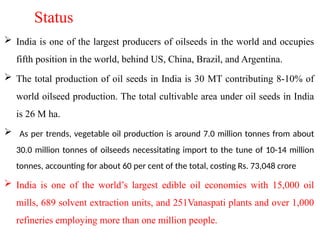
 India is one of the largest producers of oilseeds in the world and occupies
fifth position in the world, behind US, China, Brazil, and Argentina.
 The total production of oil seeds in India is 30 MT contributing 8-10% of
world oilseed production. The total cultivable area under oil seeds in India
is 26 M ha.
 As per trends, vegetable oil production is around 7.0 million tonnes from about
30.0 million tonnes of oilseeds necessitating import to the tune of 10-14 million
tonnes, accounting for about 60 per cent of the total, costing Rs. 73,048 crore
 India is one of the world’s largest edible oil economies with 15,000 oil
mills, 689 solvent extraction units, and 251Vanaspati plants and over 1,000
refineries employing more than one million people.
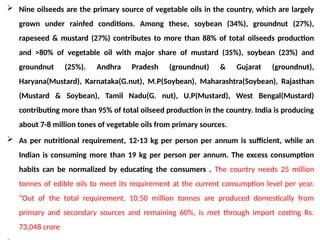
 Nine oilseeds are the primary source of vegetable oils in the country, which are largely
grown under rainfed conditions. Among these, soybean (34%), groundnut (27%),
rapeseed & mustard (27%) contributes to more than 88% of total oilseeds production
and >80% of vegetable oil with major share of mustard (35%), soybean (23%) and
groundnut (25%). Andhra Pradesh (groundnut) & Gujarat (groundnut),
Haryana(Mustard), Karnataka(G.nut), M.P(Soybean), Maharashtra(Soybean), Rajasthan
(Mustard & Soybean), Tamil Nadu(G. nut), U.P(Mustard), West Bengal(Mustard)
contributing more than 95% of total oilseed production in the country. India is producing
about 7-8 million tones of vegetable oils from primary sources.
 As per nutritional requirement, 12-13 kg per person per annum is sufficient, while an
Indian is consuming more than 19 kg per person per annum. The excess consumption
habits can be normalized by educating the consumers . The country needs 25 million
tonnes of edible oils to meet its requirement at the current consumption level per year.
“Out of the total requirement, 10.50 million tonnes are produced domestically from
primary and secondary sources and remaining 60%, is met through import costing Rs.
73,048 crore
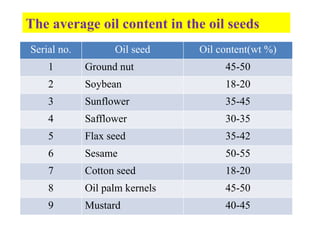
The average oil content in the oil seeds
Serial no. Oil seed Oil content(wt %)
1 Ground nut 45-50
2 Soybean 18-20
3 Sunflower 35-45
4 Safflower 30-35
5 Flax seed 35-42
6 Sesame 50-55
7 Cotton seed 18-20
8 Oil palm kernels 45-50
9 Mustard 40-45
• Oils and fats are composed of different mixtures of glyceriods and
fatty acids.
 Fat contain poly-unsaturated fatty acids (PUFA) which reduces blood
cholesterol and is important in prevention of coronary heart diseases. They
also contain essential fatty acids (EFA) which are required in the
maintenance of normal growth, reproduction and skin permeability.
 Apart from these fatty acids, fats are the only source of fat soluble vitamins
such as Vitamin A, D, E and K in our diet. The major role of edible oils
and fats in our diet is to supply energy. Fat provide 9 kilo calories for each
gram consumed. The natural flavour and odour of oil are due to the
presence of non fatty matter.
• All fats and oils are broadly classified as Edible & Non edible oil.
Edible oils are used for cooking and table purposes and Non edible are
used in soap, paints, varnishes and plasticizers industries. Some kind
of gum or wax are used in manufacture of shoe polishes, carbon
papers and candles.
World’s five major annual edible oilseeds are soybean (Glycine max (L.) Merr.),
cottonseed (Gossypium hirsutum L.), rapseed/canola (Brassica napus L. B. rapa L.
and B. juncea L.), sunflower seed (Helianthus annuus L. var. marcocarpus DC.) and
peanut/groundnut (Arachis hypogaea L.)
Canola is developed from Rapeseed for its nutritional values. Each Canola seed is
about 40% oil. The seeds are crushed to obtain canola oil for human consumption and
the remainder is processed into canola meal which is used as a high protein livestock
and poultry feed.
Soybeans are primarily grown for their meal while oil is a secondary product. Today
Soybean provides the vast majority of world’s protein meal supply.
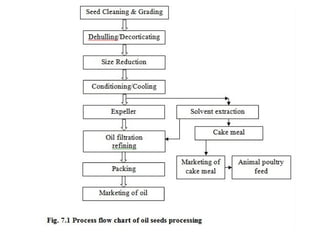
Almost all oilseeds are processed commercially by oil expellers. Oilseeds are made
up of tinny particles called cells. Oil glands are embedded in each cell which liberates
oil on rupturing. Thus, the primary object of oilseed processing is to rupture the
gland and cell wall which gives more yield of oil during processing. Recovery of
oil (primarily triglycerides and phospholipids) from oilseeds is facilitated by
rupturing the cell wall by heat and pressure during flaking, and by optional
extrusion with an expander, followed by pressing or solvent extraction.
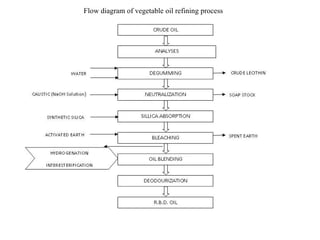
Flow diagram of vegetable oil refining process
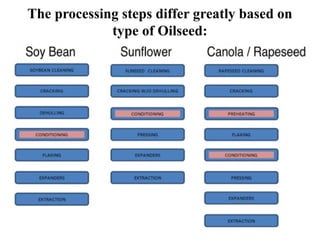
The processing steps differ greatly based on
type of Oilseed:
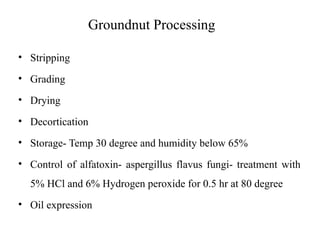
Groundnut Processing
• Stripping
• Grading
• Drying
• Decortication
• Storage- Temp 30 degree and humidity below 65%
• Control of alfatoxin- aspergillus flavus fungi- treatment with
5% HCl and 6% Hydrogen peroxide for 0.5 hr at 80 degree
• Oil expression
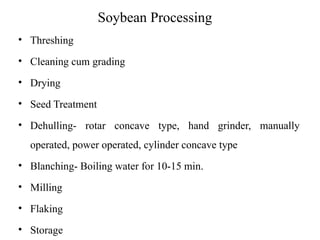
Soybean Processing
• Threshing
• Cleaning cum grading
• Drying
• Seed Treatment
• Dehulling- rotar concave type, hand grinder, manually
operated, power operated, cylinder concave type
• Blanching- Boiling water for 10-15 min.
• Milling
• Flaking
• Storage
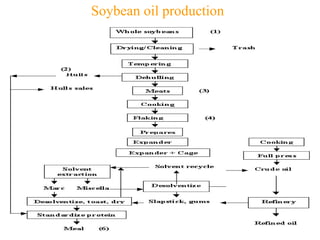
Soybean oil production
Rapeseed and Mustard
• Drying
• Cleaning and Grading
• Storage- kept in earthen pot, tar phinted polythelene lined
bamboo bin, bamboo cement bin, metal bin.
• Oil Expression
• Cake utilization
• Storage of oil
Rapeseed oil production
Rape seed
Cleaning foreign matter
Flaking
Cooking
Pressing crude oil
Oily cake
Solvent extraction cake l + solvent
Miscella Toaster solvent
Distllation solvent Cake
Crude oil
Safflower Processing
• Threshing
• Cleaning and grading
• Drying- thickness of 30- 40 mm
• Storage- earthen pitcher, gunny plastic bag and plastic
container
• Dehulling
• Oil expression
• Production of grade meal
Sunflower Processing
• Threshing- rasp bar type grain thresher, disc type thresher and
hand thresher
• Drying- moisture content of 7-9%
• Cleaning and grading- air drying 110 degree, steam drying at
130 degree
• Decortication
• Oil extraction- rose down max oil expeller
• Storage and packing of oil – in glass or plastic bottles for 1 yr
Sunflower oil production
Sunflower seed
Cleaning foreign matter
Dehulling hulls
Flaking
Cooking
Pressing crude oil
Oily cake
Solvent extraction cake l + solvent
Miscella Toaster solvent
Distllation solvent Cake
Crude oil
Linseed oil
• Storage at room temp in gunny bags, earthen pitcher.
• Immature Linseed contain linasi enzyme which releases
prussic acid from glucoside linamarin which can poison cattle
feed.
For production of Vanaspati
• Degumming
• Neutralization of fatty acids
• Washing
• Drying
• Blanching
• Filteration
• Winterization- cold ethanol, to remove waxes, lipids, chlorophyll
• Deodorization- to remove Free fatty acids and odour. Temp 210-274 degree
• Hydrogenation
• Neutralization
• Bleaching – crude oil
• Tempering- in vegetable oil
Raw Material Preparation
Oilseed and nut should be properly dried before storage, and
cleaned to remove sand, dust, leaves and other contaminants. All
raw materials should be sorted to remove stones and moudly nuts.
Some moulds, especially in the case of groundnuts, can cause
aflatoxin poisoning.
When storage is necessary, this should be in weather proof,
ventilated rooms which are protected against birds, insects and
rodents. Some raw materials (for example groundnuts, sunflower
seeds) need dehusking (or decorticating). Decortication is
important to give high yields of oil and reduce the bulk of material
to processed.
Handling, Drying and Storage
Proper handling and storage of oilseeds is important for their
processing into quality products since oilseeds are prone to auto—
catalytic deteriorative processes, enzyme action, microbial
spoilage, etc.
Immature seeds, harvested before their enzymes have become
dormant, deteriorate more rapidly than normal seeds during
storage.
The moisture content of oilseeds at the time of harvest is usually
high and uncongenial for their safe storage. Consequently all the
oilseeds need to be dried prior to their storage. Sun drying is the
traditional method used, however its limitations cannot be ruled out
Mechanical drying of oilseeds at 105—110°C is preferable to
minimize the quantitative and qualitative losses.
The dried seeds also require cleaning to remove sand, dirt, dust,
leaves sterns, weed seeds, stones, metal pieces and other
extraneous matter before storing.
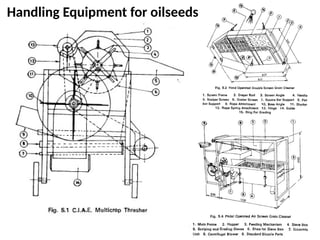
Handling Equipment for oilseeds
Cleaning
• Oilseeds received at mill may contain certain impurities
entering from field, during storage and transportation, or
accidentally.
• Frequently encountered impurities include:
straws, chaff, sticks, weed seeds, other grains, shrunken and
broken seeds, infected seeds, mud, dust, stones, metal objects,
etc.
• Cleaning of oilseeds comprises removal of all the impurities
mentioned above.
Cleaning
Normally, the oliseeds are mixed with a variety of foreign materials
viz, sand, stones, stalks, weed seeds, foilage, etc., during harvesting,
handling and transportation. It is ideal to clean seed before putting
it into store. Stone, iron and wood pieces mixed with seeds can disrupt
mechanical equipment during processing. Foreign matters may lower
protein content and increase fibre content of meal residue after extraction
of the oil. Moreover, foreign matters mixed with oilseeds may be
having high moisture content which may initiate overheating in storage.
The local hot spots in the oilseed damage the quality and constitute
a fire hazard if not properly detected and corrected by aeration or
rotation. Also, cleaning before storage of oils not required further
cleaning for processing and saves double handling of seeds. In
short, proper cleaning of oilseeds can increase in crushing capacity
of oil expelling units, reduce in-plant maintenance and improve the
quality of oil and cake.
Grading
Grading of oilseeds is required to establish their general quality
based on soundness, moisture content and freedom from impurities and
also to evaluate their oil milling quality based on yield and quality of oil.
The grade specifications of different oilseeds are based on
(i) quantity of non—prime seeds including damaged, insect-infested
seeds, slightly damaged seeds, shrivelled and immature seeds,
(ii) type and quantity of impurities or foreign matter,
(iii) moisture content of seeds,
(iv) oil content, and
(v) colour, acid value, iodine value and other indices of quality of
extracted oil.
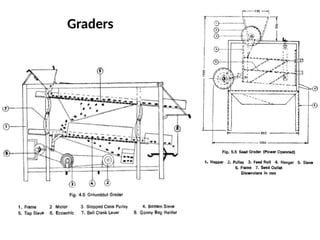
Graders
Conditioning/ Tempering
• The ground or flaked oilseeds are heated with live steam to about
90°C. The purpose of heating is to facilitate oil recovery. The heat
treatment ruptures all the cells, partly denatures the proteins and
inactivates most of the enzymes. It is very essential to maintain
the optimum temperature to avoid formation of undesirable
colouring compounds and aromas. After conditioning and
moisture adjustment to about 10-11%, the oil is obtained by
expression through expellers/ghanis.
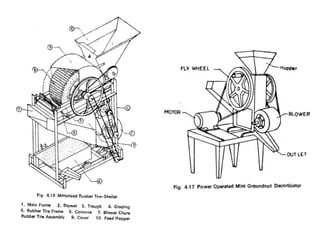
Dehulling (Decortication)
The hulls of oilseeds are fibrous and have low oil content.
Dehulling of oilseeds extraction is advantageous as the hulls, reduce
the total oil yields and the capacity of extraction equipment.
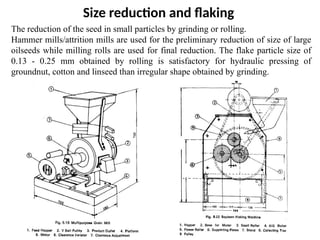
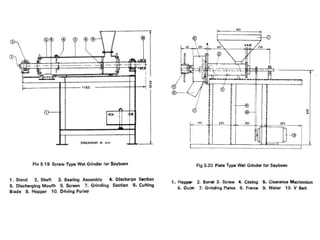
Size reduction and flaking
The reduction of the seed in small particles by grinding or rolling.
Hammer mills/attrition mills are used for the preliminary reduction of size of large
oilseeds while milling rolls are used for final reduction. The flake particle size of
0.13 - 0.25 mm obtained by rolling is satisfactory for hydraulic pressing of
groundnut, cotton and linseed than irregular shape obtained by grinding.
Heat Treatment
It ruptures the cell wall and expulsion of oil. 105 to 130 degree
Celsius for 30 to 120 min.
Recovery of oil
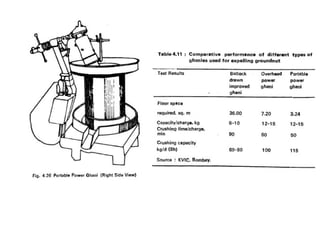
Ghanies
no size reduction and no cooking prior to crushing
The oil is allowed to settle for 24hrs.
Recovery of Oil
Oil from oilseeds in India is mostly extracted with
the help of Hydraulic press, traditional animal drawn
ghanies (Kohlus), power ghanies, rotary oilmills,
mechanical expellers and solvent extraction units.
However, the solvent extraction techniques are
also used for recovery of oil from soybean, rice
bran and pressed oilseed cakes
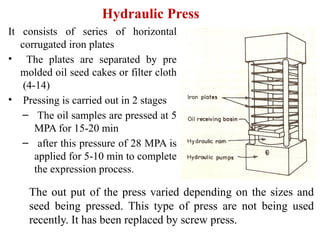
Hydraulic Press
It consists of series of horizontal
corrugated iron plates
• The plates are separated by pre
molded oil seed cakes or filter cloth
(4-14)
• Pressing is carried out in 2 stages
– The oil samples are pressed at 5
MPA for 15-20 min
– after this pressure of 28 MPA is
applied for 5-10 min to complete
the expression process.
The out put of the press varied depending on the sizes and
seed being pressed. This type of press are not being used
recently. It has been replaced by screw press.
Advantages of Hydraulic presses:
• It can be driven by hand or by electricity
• They are economical to operate.
• They are simple to operate and maintain.
• Operators require only minimum training.
• Recovery of oil from seeds is good.
Disadvantages:
• The cost of the machinery is substantial, and delivery time may
be long.
• Spare parts are difficult to obtain in remote areas
• Electric power, or generators to produce it, must be available to
operate the larger models.
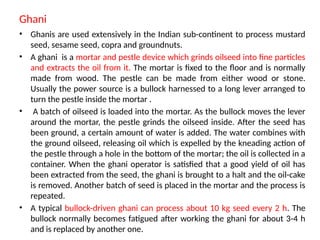
Ghani
• Ghanis are used extensively in the Indian sub-continent to process mustard
seed, sesame seed, copra and groundnuts.
• A ghani is a mortar and pestle device which grinds oilseed into fine particles
and extracts the oil from it. The mortar is fixed to the floor and is normally
made from wood. The pestle can be made from either wood or stone.
Usually the power source is a bullock harnessed to a long lever arranged to
turn the pestle inside the mortar .
• A batch of oilseed is loaded into the mortar. As the bullock moves the lever
around the mortar, the pestle grinds the oilseed inside. After the seed has
been ground, a certain amount of water is added. The water combines with
the ground oilseed, releasing oil which is expelled by the kneading action of
the pestle through a hole in the bottom of the mortar; the oil is collected in a
container. When the ghani operator is satisfied that a good yield of oil has
been extracted from the seed, the ghani is brought to a halt and the oil-cake
is removed. Another batch of seed is placed in the mortar and the process is
repeated.
• A typical bullock-driven ghani can process about 10 kg seed every 2 h. The
bullock normally becomes fatigued after working the ghani for about 3-4 h
and is replaced by another one.
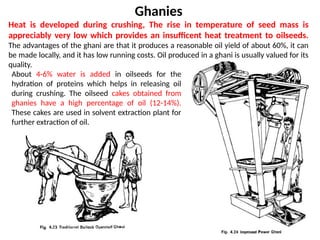
Ghanies
Heat is developed during crushing, The rise in temperature of seed mass is
appreciably very low which provides an insufficent heat treatment to oilseeds.
The advantages of the ghani are that it produces a reasonable oil yield of about 60%, it can
be made locally, and it has low running costs. Oil produced in a ghani is usually valued for its
quality.
About 4-6% water is added in oilseeds for the
hydration of proteins which helps in releasing oil
during crushing. The oilseed cakes obtained from
ghanies have a high percentage of oil (12-14%).
These cakes are used in solvent extraction plant for
further extraction of oil.
Mechanical Expression Devices
• Mechanical expression is the process of mechanically pressing
liquid out of liquid containing solids.
• During the process of mechanical expression oil seeds are
compressed in various types of compression devices
• The oil is stored at different places in the oil seed in the form of oil
globules surrounded by tough membranes
• There are two steps involved in the expression of oil through
expeller : 1. Dis-integration 2. Pressing
Under dis-integration process oil globules are separated
The tough membrane surrounding the oil droplet is exposed
and burst under pressure enabling the oil to ooze out
Different types of mechanical presses are
• Screw press
• Roller press
• Plate and frame filter press
• Disk mill
The advantage of mechanical expression over chemical
extraction is it gives the oil free of dissolved chemicals
Pressing
• The oil is removed by pressure from an expeller or screw
press.The residual oil in the resultant oilseed meal is about 4–
7%.
• It is, however, more economical to apply lower pressures and
to leave 15–20% of the oil in the flakes, and then to remove
this oil by a solvent extraction process (“prepress solvent
extraction” process).
Expellers
• Rotary mills, continuous expellers and screw presses are also used
In India.
• The oilseeds are passed through expellers which exerts pressure
in increasing order due to rotating screws or worms. Pressure and
heat generated in expeller result the drainage of oil from oilseeds and
the cake is ejected out of the barrel.
• The efficiency of oil expression depends on seed preparation.
• With a single pressing in an efficient expeller the cake obtained
contains 6 ± 1% oil
• Double pressing is followed in a rare case. Cake obtained after double
pressing contains about 4% oil.
Expellers
• Choice of double pressing depends on (i) the economics of the
processes (ii) oilseed type and (iii) the end use of the cake.
• Excessive use of pressures to express more oil in single or double
pressing also affects the quality of oil as well as the nutritional value
of the oilseed cake and reduces the capacity of expellers.
• Now a days, the press solvent extraction technique is also being used
where oil is first expelled at low pressure from oilseeds.
The cake obtained contains more than 8% oil and is used in solvent
extraction plant. This technique is advantageous as more oil is
expelled using less energy.
Screw Press
Screw- Construction
• Consists of horizontal main shaft, the screw assembly is formed
integrally with this shaft
• The screw rotates within the cage or barrel, the barrel is made of case
hardened steel bars or assembly of rings
• Spacers are provided between the lining bars or rings to allow the
drainage of oil as pressure on feed material is increased
• At the discharge end the movable choke controls the operating pressure.
It is achieved by changing the width of annular space through which oil
cake passes
• The choke is adjusted by hand wheel on the opposite end of the screw
Configuration of the screw
• Configuration of the screw is such that the volume displacement at the feed end
of press is considerably greater than the that at the discharge end
• As result of such configuration as the material is conveyed from feed to
discharge end it is subjected to increasing pressure
• As the pressure increases the material is compressed and oil is expelled through
the spacers between cage lining bars or rings
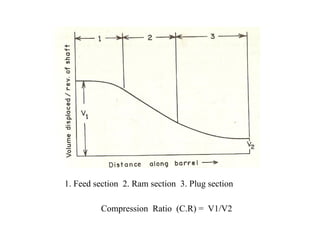
• The compression ratio or press is the volume displaced per revolution at feed
end to the volume displaced per revolution at discharge end
• Compression curve of a process is the plot of volume displacement to the base
of length along the barrel
1. Feed section 2. Ram section 3. Plug section
Compression Ratio (C.R) = V1/V2
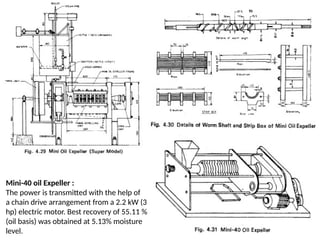
Mini-40 oil Expeller :
The power is transmitted with the help of
a chain drive arrangement from a 2.2 kW (3
hp) electric motor. Best recovery of 55.11 %
(oil basis) was obtained at 5.13% moisture
level.
Parameters to be considered
• Moisture content
• Pressing temperature
• Pressing time
• Pressing pressure
Advantages of expellers
• They require less labor than any other method.
• Where power is reasonable in cost, and labor is expensive, continuous expellers
are economical.
• Plant capacity is higher than with batch equipment.
• Expellers extract a greater proportion of the oil than do hydraulic batch presses.
Disadvantages of expellers
• Equipment cost will be more.
• Maintenance costs are high, and maintenance requires skilled mechanic.
• Electric Power is required for the press and for auxiliary equipment.
• Oil from an expeller has more impurities than oil from a batch press, and must
be heated and filtered to obtain a clean oil

oil seed milling- extraction and Refining

  • 1.
    OILSEED MILLING Maheshkumar Kadam MGMCollege of Food Technology Gandheli
  • 2.
    Status  India isone of the largest producers of oilseeds in the world and occupies fifth position in the world, behind US, China, Brazil, and Argentina.  The total production of oil seeds in India is 30 MT contributing 8-10% of world oilseed production. The total cultivable area under oil seeds in India is 26 M ha.  As per trends, vegetable oil production is around 7.0 million tonnes from about 30.0 million tonnes of oilseeds necessitating import to the tune of 10-14 million tonnes, accounting for about 60 per cent of the total, costing Rs. 73,048 crore  India is one of the world’s largest edible oil economies with 15,000 oil mills, 689 solvent extraction units, and 251Vanaspati plants and over 1,000 refineries employing more than one million people.
  • 3.
     Nine oilseedsare the primary source of vegetable oils in the country, which are largely grown under rainfed conditions. Among these, soybean (34%), groundnut (27%), rapeseed & mustard (27%) contributes to more than 88% of total oilseeds production and >80% of vegetable oil with major share of mustard (35%), soybean (23%) and groundnut (25%). Andhra Pradesh (groundnut) & Gujarat (groundnut), Haryana(Mustard), Karnataka(G.nut), M.P(Soybean), Maharashtra(Soybean), Rajasthan (Mustard & Soybean), Tamil Nadu(G. nut), U.P(Mustard), West Bengal(Mustard) contributing more than 95% of total oilseed production in the country. India is producing about 7-8 million tones of vegetable oils from primary sources.  As per nutritional requirement, 12-13 kg per person per annum is sufficient, while an Indian is consuming more than 19 kg per person per annum. The excess consumption habits can be normalized by educating the consumers . The country needs 25 million tonnes of edible oils to meet its requirement at the current consumption level per year. “Out of the total requirement, 10.50 million tonnes are produced domestically from primary and secondary sources and remaining 60%, is met through import costing Rs. 73,048 crore
  • 4.
    The average oilcontent in the oil seeds Serial no. Oil seed Oil content(wt %) 1 Ground nut 45-50 2 Soybean 18-20 3 Sunflower 35-45 4 Safflower 30-35 5 Flax seed 35-42 6 Sesame 50-55 7 Cotton seed 18-20 8 Oil palm kernels 45-50 9 Mustard 40-45
  • 5.
    • Oils andfats are composed of different mixtures of glyceriods and fatty acids.  Fat contain poly-unsaturated fatty acids (PUFA) which reduces blood cholesterol and is important in prevention of coronary heart diseases. They also contain essential fatty acids (EFA) which are required in the maintenance of normal growth, reproduction and skin permeability.  Apart from these fatty acids, fats are the only source of fat soluble vitamins such as Vitamin A, D, E and K in our diet. The major role of edible oils and fats in our diet is to supply energy. Fat provide 9 kilo calories for each gram consumed. The natural flavour and odour of oil are due to the presence of non fatty matter. • All fats and oils are broadly classified as Edible & Non edible oil. Edible oils are used for cooking and table purposes and Non edible are used in soap, paints, varnishes and plasticizers industries. Some kind of gum or wax are used in manufacture of shoe polishes, carbon papers and candles.
  • 6.
    World’s five majorannual edible oilseeds are soybean (Glycine max (L.) Merr.), cottonseed (Gossypium hirsutum L.), rapseed/canola (Brassica napus L. B. rapa L. and B. juncea L.), sunflower seed (Helianthus annuus L. var. marcocarpus DC.) and peanut/groundnut (Arachis hypogaea L.) Canola is developed from Rapeseed for its nutritional values. Each Canola seed is about 40% oil. The seeds are crushed to obtain canola oil for human consumption and the remainder is processed into canola meal which is used as a high protein livestock and poultry feed. Soybeans are primarily grown for their meal while oil is a secondary product. Today Soybean provides the vast majority of world’s protein meal supply. Almost all oilseeds are processed commercially by oil expellers. Oilseeds are made up of tinny particles called cells. Oil glands are embedded in each cell which liberates oil on rupturing. Thus, the primary object of oilseed processing is to rupture the gland and cell wall which gives more yield of oil during processing. Recovery of oil (primarily triglycerides and phospholipids) from oilseeds is facilitated by rupturing the cell wall by heat and pressure during flaking, and by optional extrusion with an expander, followed by pressing or solvent extraction.
  • 8.
    Flow diagram ofvegetable oil refining process
  • 9.
    The processing stepsdiffer greatly based on type of Oilseed:
  • 10.
    Groundnut Processing • Stripping •Grading • Drying • Decortication • Storage- Temp 30 degree and humidity below 65% • Control of alfatoxin- aspergillus flavus fungi- treatment with 5% HCl and 6% Hydrogen peroxide for 0.5 hr at 80 degree • Oil expression
  • 11.
    Soybean Processing • Threshing •Cleaning cum grading • Drying • Seed Treatment • Dehulling- rotar concave type, hand grinder, manually operated, power operated, cylinder concave type • Blanching- Boiling water for 10-15 min. • Milling • Flaking • Storage
  • 12.
  • 13.
    Rapeseed and Mustard •Drying • Cleaning and Grading • Storage- kept in earthen pot, tar phinted polythelene lined bamboo bin, bamboo cement bin, metal bin. • Oil Expression • Cake utilization • Storage of oil
  • 14.
    Rapeseed oil production Rapeseed Cleaning foreign matter Flaking Cooking Pressing crude oil Oily cake Solvent extraction cake l + solvent Miscella Toaster solvent Distllation solvent Cake Crude oil
  • 15.
    Safflower Processing • Threshing •Cleaning and grading • Drying- thickness of 30- 40 mm • Storage- earthen pitcher, gunny plastic bag and plastic container • Dehulling • Oil expression • Production of grade meal
  • 16.
    Sunflower Processing • Threshing-rasp bar type grain thresher, disc type thresher and hand thresher • Drying- moisture content of 7-9% • Cleaning and grading- air drying 110 degree, steam drying at 130 degree • Decortication • Oil extraction- rose down max oil expeller • Storage and packing of oil – in glass or plastic bottles for 1 yr
  • 17.
    Sunflower oil production Sunflowerseed Cleaning foreign matter Dehulling hulls Flaking Cooking Pressing crude oil Oily cake Solvent extraction cake l + solvent Miscella Toaster solvent Distllation solvent Cake Crude oil
  • 18.
    Linseed oil • Storageat room temp in gunny bags, earthen pitcher. • Immature Linseed contain linasi enzyme which releases prussic acid from glucoside linamarin which can poison cattle feed.
  • 19.
    For production ofVanaspati • Degumming • Neutralization of fatty acids • Washing • Drying • Blanching • Filteration • Winterization- cold ethanol, to remove waxes, lipids, chlorophyll • Deodorization- to remove Free fatty acids and odour. Temp 210-274 degree • Hydrogenation • Neutralization • Bleaching – crude oil • Tempering- in vegetable oil
  • 20.
    Raw Material Preparation Oilseedand nut should be properly dried before storage, and cleaned to remove sand, dust, leaves and other contaminants. All raw materials should be sorted to remove stones and moudly nuts. Some moulds, especially in the case of groundnuts, can cause aflatoxin poisoning. When storage is necessary, this should be in weather proof, ventilated rooms which are protected against birds, insects and rodents. Some raw materials (for example groundnuts, sunflower seeds) need dehusking (or decorticating). Decortication is important to give high yields of oil and reduce the bulk of material to processed.
  • 21.
    Handling, Drying andStorage Proper handling and storage of oilseeds is important for their processing into quality products since oilseeds are prone to auto— catalytic deteriorative processes, enzyme action, microbial spoilage, etc. Immature seeds, harvested before their enzymes have become dormant, deteriorate more rapidly than normal seeds during storage. The moisture content of oilseeds at the time of harvest is usually high and uncongenial for their safe storage. Consequently all the oilseeds need to be dried prior to their storage. Sun drying is the traditional method used, however its limitations cannot be ruled out Mechanical drying of oilseeds at 105—110°C is preferable to minimize the quantitative and qualitative losses. The dried seeds also require cleaning to remove sand, dirt, dust, leaves sterns, weed seeds, stones, metal pieces and other extraneous matter before storing.
  • 22.
  • 23.
    Cleaning • Oilseeds receivedat mill may contain certain impurities entering from field, during storage and transportation, or accidentally. • Frequently encountered impurities include: straws, chaff, sticks, weed seeds, other grains, shrunken and broken seeds, infected seeds, mud, dust, stones, metal objects, etc. • Cleaning of oilseeds comprises removal of all the impurities mentioned above.
  • 24.
    Cleaning Normally, the oliseedsare mixed with a variety of foreign materials viz, sand, stones, stalks, weed seeds, foilage, etc., during harvesting, handling and transportation. It is ideal to clean seed before putting it into store. Stone, iron and wood pieces mixed with seeds can disrupt mechanical equipment during processing. Foreign matters may lower protein content and increase fibre content of meal residue after extraction of the oil. Moreover, foreign matters mixed with oilseeds may be having high moisture content which may initiate overheating in storage. The local hot spots in the oilseed damage the quality and constitute a fire hazard if not properly detected and corrected by aeration or rotation. Also, cleaning before storage of oils not required further cleaning for processing and saves double handling of seeds. In short, proper cleaning of oilseeds can increase in crushing capacity of oil expelling units, reduce in-plant maintenance and improve the quality of oil and cake.
  • 25.
    Grading Grading of oilseedsis required to establish their general quality based on soundness, moisture content and freedom from impurities and also to evaluate their oil milling quality based on yield and quality of oil. The grade specifications of different oilseeds are based on (i) quantity of non—prime seeds including damaged, insect-infested seeds, slightly damaged seeds, shrivelled and immature seeds, (ii) type and quantity of impurities or foreign matter, (iii) moisture content of seeds, (iv) oil content, and (v) colour, acid value, iodine value and other indices of quality of extracted oil.
  • 26.
  • 27.
    Conditioning/ Tempering • Theground or flaked oilseeds are heated with live steam to about 90°C. The purpose of heating is to facilitate oil recovery. The heat treatment ruptures all the cells, partly denatures the proteins and inactivates most of the enzymes. It is very essential to maintain the optimum temperature to avoid formation of undesirable colouring compounds and aromas. After conditioning and moisture adjustment to about 10-11%, the oil is obtained by expression through expellers/ghanis.
  • 28.
    Dehulling (Decortication) The hullsof oilseeds are fibrous and have low oil content. Dehulling of oilseeds extraction is advantageous as the hulls, reduce the total oil yields and the capacity of extraction equipment.
  • 30.
    Size reduction andflaking The reduction of the seed in small particles by grinding or rolling. Hammer mills/attrition mills are used for the preliminary reduction of size of large oilseeds while milling rolls are used for final reduction. The flake particle size of 0.13 - 0.25 mm obtained by rolling is satisfactory for hydraulic pressing of groundnut, cotton and linseed than irregular shape obtained by grinding.
  • 32.
    Heat Treatment It rupturesthe cell wall and expulsion of oil. 105 to 130 degree Celsius for 30 to 120 min. Recovery of oil Ghanies no size reduction and no cooking prior to crushing The oil is allowed to settle for 24hrs.
  • 33.
    Recovery of Oil Oilfrom oilseeds in India is mostly extracted with the help of Hydraulic press, traditional animal drawn ghanies (Kohlus), power ghanies, rotary oilmills, mechanical expellers and solvent extraction units. However, the solvent extraction techniques are also used for recovery of oil from soybean, rice bran and pressed oilseed cakes
  • 34.
    Hydraulic Press It consistsof series of horizontal corrugated iron plates • The plates are separated by pre molded oil seed cakes or filter cloth (4-14) • Pressing is carried out in 2 stages – The oil samples are pressed at 5 MPA for 15-20 min – after this pressure of 28 MPA is applied for 5-10 min to complete the expression process. The out put of the press varied depending on the sizes and seed being pressed. This type of press are not being used recently. It has been replaced by screw press.
  • 35.
    Advantages of Hydraulicpresses: • It can be driven by hand or by electricity • They are economical to operate. • They are simple to operate and maintain. • Operators require only minimum training. • Recovery of oil from seeds is good. Disadvantages: • The cost of the machinery is substantial, and delivery time may be long. • Spare parts are difficult to obtain in remote areas • Electric power, or generators to produce it, must be available to operate the larger models.
  • 36.
    Ghani • Ghanis areused extensively in the Indian sub-continent to process mustard seed, sesame seed, copra and groundnuts. • A ghani is a mortar and pestle device which grinds oilseed into fine particles and extracts the oil from it. The mortar is fixed to the floor and is normally made from wood. The pestle can be made from either wood or stone. Usually the power source is a bullock harnessed to a long lever arranged to turn the pestle inside the mortar . • A batch of oilseed is loaded into the mortar. As the bullock moves the lever around the mortar, the pestle grinds the oilseed inside. After the seed has been ground, a certain amount of water is added. The water combines with the ground oilseed, releasing oil which is expelled by the kneading action of the pestle through a hole in the bottom of the mortar; the oil is collected in a container. When the ghani operator is satisfied that a good yield of oil has been extracted from the seed, the ghani is brought to a halt and the oil-cake is removed. Another batch of seed is placed in the mortar and the process is repeated. • A typical bullock-driven ghani can process about 10 kg seed every 2 h. The bullock normally becomes fatigued after working the ghani for about 3-4 h and is replaced by another one.
  • 37.
    Ghanies Heat is developedduring crushing, The rise in temperature of seed mass is appreciably very low which provides an insufficent heat treatment to oilseeds. The advantages of the ghani are that it produces a reasonable oil yield of about 60%, it can be made locally, and it has low running costs. Oil produced in a ghani is usually valued for its quality. About 4-6% water is added in oilseeds for the hydration of proteins which helps in releasing oil during crushing. The oilseed cakes obtained from ghanies have a high percentage of oil (12-14%). These cakes are used in solvent extraction plant for further extraction of oil.
  • 39.
    Mechanical Expression Devices •Mechanical expression is the process of mechanically pressing liquid out of liquid containing solids. • During the process of mechanical expression oil seeds are compressed in various types of compression devices • The oil is stored at different places in the oil seed in the form of oil globules surrounded by tough membranes • There are two steps involved in the expression of oil through expeller : 1. Dis-integration 2. Pressing
  • 40.
    Under dis-integration processoil globules are separated The tough membrane surrounding the oil droplet is exposed and burst under pressure enabling the oil to ooze out Different types of mechanical presses are • Screw press • Roller press • Plate and frame filter press • Disk mill The advantage of mechanical expression over chemical extraction is it gives the oil free of dissolved chemicals
  • 41.
    Pressing • The oilis removed by pressure from an expeller or screw press.The residual oil in the resultant oilseed meal is about 4– 7%. • It is, however, more economical to apply lower pressures and to leave 15–20% of the oil in the flakes, and then to remove this oil by a solvent extraction process (“prepress solvent extraction” process).
  • 42.
    Expellers • Rotary mills,continuous expellers and screw presses are also used In India. • The oilseeds are passed through expellers which exerts pressure in increasing order due to rotating screws or worms. Pressure and heat generated in expeller result the drainage of oil from oilseeds and the cake is ejected out of the barrel. • The efficiency of oil expression depends on seed preparation. • With a single pressing in an efficient expeller the cake obtained contains 6 ± 1% oil • Double pressing is followed in a rare case. Cake obtained after double pressing contains about 4% oil.
  • 43.
    Expellers • Choice ofdouble pressing depends on (i) the economics of the processes (ii) oilseed type and (iii) the end use of the cake. • Excessive use of pressures to express more oil in single or double pressing also affects the quality of oil as well as the nutritional value of the oilseed cake and reduces the capacity of expellers. • Now a days, the press solvent extraction technique is also being used where oil is first expelled at low pressure from oilseeds. The cake obtained contains more than 8% oil and is used in solvent extraction plant. This technique is advantageous as more oil is expelled using less energy.
  • 44.
  • 45.
    Screw- Construction • Consistsof horizontal main shaft, the screw assembly is formed integrally with this shaft • The screw rotates within the cage or barrel, the barrel is made of case hardened steel bars or assembly of rings • Spacers are provided between the lining bars or rings to allow the drainage of oil as pressure on feed material is increased • At the discharge end the movable choke controls the operating pressure. It is achieved by changing the width of annular space through which oil cake passes • The choke is adjusted by hand wheel on the opposite end of the screw
  • 46.
    Configuration of thescrew • Configuration of the screw is such that the volume displacement at the feed end of press is considerably greater than the that at the discharge end • As result of such configuration as the material is conveyed from feed to discharge end it is subjected to increasing pressure • As the pressure increases the material is compressed and oil is expelled through the spacers between cage lining bars or rings • The compression ratio or press is the volume displaced per revolution at feed end to the volume displaced per revolution at discharge end • Compression curve of a process is the plot of volume displacement to the base of length along the barrel
  • 47.
    1. Feed section2. Ram section 3. Plug section Compression Ratio (C.R) = V1/V2
  • 48.
    Mini-40 oil Expeller: The power is transmitted with the help of a chain drive arrangement from a 2.2 kW (3 hp) electric motor. Best recovery of 55.11 % (oil basis) was obtained at 5.13% moisture level.
  • 49.
    Parameters to beconsidered • Moisture content • Pressing temperature • Pressing time • Pressing pressure
  • 50.
    Advantages of expellers •They require less labor than any other method. • Where power is reasonable in cost, and labor is expensive, continuous expellers are economical. • Plant capacity is higher than with batch equipment. • Expellers extract a greater proportion of the oil than do hydraulic batch presses. Disadvantages of expellers • Equipment cost will be more. • Maintenance costs are high, and maintenance requires skilled mechanic. • Electric Power is required for the press and for auxiliary equipment. • Oil from an expeller has more impurities than oil from a batch press, and must be heated and filtered to obtain a clean oil