Q.What is an oil spill?
Q. Describe briefly the different types, causes &
effects of oil spill.
Q. Describe briefly the fate oil spill.
Q. Describe briefly the cleaning methods/ways to
remove oil spill.
Oil spills, not a very common term but a serious form of environmental pollution.
Oil spill/Oil Pollution
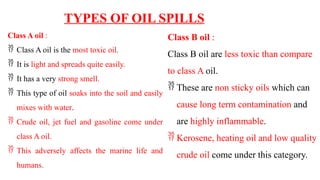
TYPES OF OIL SPILLS
Class A oil :
 Class A oil is the most toxic oil.
 It is light and spreads quite easily.
 It has a very strong smell.
 This type of oil soaks into the soil and easily
mixes with water.
 Crude oil, jet fuel and gasoline come under
class A oil.
 This adversely affects the marine life and
humans.
Class B oil :
Class B oil are less toxic than compare
to class A oil.
 These are non sticky oils which can
cause long term contamination and
are highly inflammable.
 Kerosene, heating oil and low quality
crude oil come under this category.
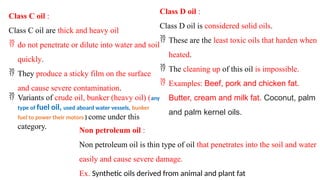
Class C oil :
Class C oil are thick and heavy oil
 do not penetrate or dilute into water and soil
quickly.
 They produce a sticky film on the surface
and cause severe contamination.
 Variants of crude oil, bunker (heavy oil) (any
type of fuel oil, used aboard water vessels, bunker
fuel to power their motors ) come under this
category.
Class D oil :
Class D oil is considered solid oils.
 These are the least toxic oils that harden when
heated.
 The cleaning up of this oil is impossible.
 Examples: Beef, pork and chicken fat.
Butter, cream and milk fat. Coconut, palm
and palm kernel oils.
Non petroleum oil :
Non petroleum oil is thin type of oil that penetrates into the soil and water
easily and cause severe damage.
Ex. Synthetic oils derived from animal and plant fat
Fuel oils include
heavy fuel oil (bunker fuel),
marine fuel oil (MFO),
 furnace oil (FO),
gas oil (gasoil),
heating oils (such as home heating oil),
diesel fuel, and
others.
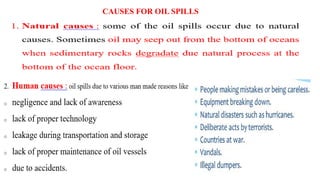
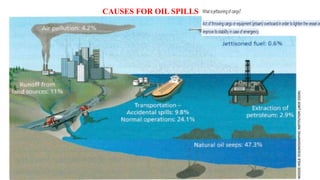
CAUSES FOR OIL SPILLS
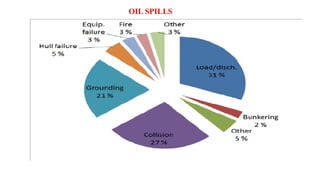
OIL SPILLS
Fate of
OIL SPILLS
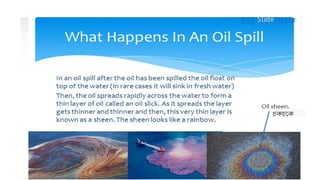
চকচকে
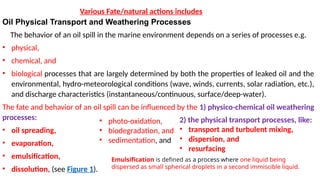
The reason behind oil spill toxicity is the presence of
 toxic compounds includes PAHs ( Polycyclic aromatic hydrocarbons),
 volatile organic compound etc.
Spilled oil does not mix immediately with water instead forms thick layers.
The thick layers need to be removed from aquatic ecosystem as responsible to block the
various pathways include
 oxygen,
 breakdown nervous system in marine animal (Masoora & Sommerville, 2009).
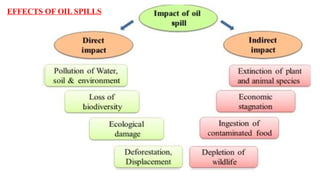
The Fig. 6.1 shows direct and indirect impact of oil spill.
Oil Physical Transport and Weathering Processes
The behavior of an oil spill in the marine environment depends on a series of processes e.g.
• physical,
• chemical, and
• biological processes that are largely determined by both the properties of leaked oil and the
environmental, hydro-meteorological conditions (wave, winds, currents, solar radiation, etc.),
and discharge characteristics (instantaneous/continuous, surface/deep-water).
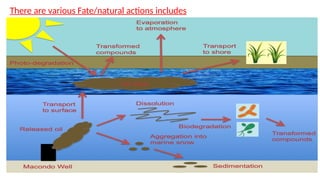
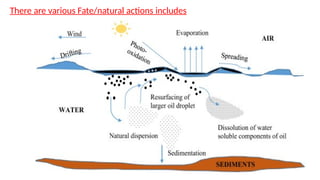
The fate and behavior of an oil spill can be influenced by the 1) physico-chemical oil weathering
processes:
• oil spreading,
• evaporation,
• emulsification,
• dissolution, (see Figure 1).
Various Fate/natural actions includes
• photo-oxidation,
• biodegradation, and
• sedimentation, and
2) the physical transport processes, like:
• transport and turbulent mixing,
• dispersion, and
• resurfacing
Emulsification is defined as a process where one liquid being
dispersed as small spherical droplets in a second immiscible liquid.
There are various Fate/natural actions includes
1.1. Spreading
Spreading refers to the creation of a thin film,
expanding over the sea surface, as soon as oil is
being released. Spreading algorithms in oil
spill models provide an estimate of the spill
thickness or surface area, used for modeling of
many transport and fate processes such as
evaporation, dispersion, and emulsification.
Spreading rate and oil spill thickness depend
on the sea surface temperature, oil viscosity,
and density .
1.2. Evaporation
Evaporation takes place when the volatile
elements of the oil diffuse from the oil and
entrain the gaseous stage, while the heavier
components of oil remain at sea.
Evaporation removes most of the volatile
fractions of oil to the atmosphere within a
few hours, leading to the reduction of oil
toxicity in the marine environment.
However, these compounds are transferred
to the atmosphere and in some cases (e.g.,
large spills close to densely-populated
areas), the effects of evaporation might be
more toxic.
1)Oil Weathering Processes
Emulsification
Emulsification is defined as a process where one liquid being
dispersed as small spherical droplets in a second immiscible liquid.
It occurs due to ----
• wave breaking,
• inducing sea surface turbulence,
• while oil composition,
• temperature, and
• viscosity play a significant role in the process. As
oil viscosity increases, a higher amount of oil
emulsifies and this additionally disrupts the rate of
evaporation.
1.4. Dissolution
Oil contains very small amounts of
soluble compounds (<1 mg/L), which
may dissolve in water, but is still
considered an important process, since
the lower molecular weight aromatic
hydrocarbons (monoaromatic and
polynuclear aromatic hydrocarbons,
MAHs and PAHs), which are both
highly volatile and soluble, are the
most toxic elements of oil to aquatic
organisms.
Therefore, dissolution plays a
significant role on environmental
impact assessment
1.5. Photo-Oxidation
Photo-oxidation occurs when oil under the
influence of the sunlight generates polar, water
soluble, oxygenated compounds.
The process depends on the type of oil and on
the thickness of the oil slick.
Thick slicks may partially oxidize, generating
tar balls, which are accumulated in bottom
sediments or leach off the coast long after a
leak.
Generally photo-oxidation has long been
considered a very slow process, with thin oil
films dissolving, even in bright sunlight, at rates
lower than 0.1% per day.
1.6. Biodegradation
Biodegradation of oil by native
microorganisms is one of the most significant
natural processes that can attenuate the
environmental effects of marine oil spills in
the long term.
The biodegradation rate of oil depends on the
• type of petroleum hydrocarbons,
• temperature,
• species of micro-organisms, and
• the availability of oxygen and nutrients.
1.7. Sedimentation
Sedimentation of oil droplets occurs as a result
of three processes:
• increased density of the entrained oil and
surface slicks due to weathering processes;
• incorporation of fecal pellets by means of
zooplankton or benthic organisms’ ingestion;
and
• oil adherence or flocculation and
agglomeration with suspended particulate
matter (SPM) aggregates (OSA).
2. Physical Transport Processes
2.1. Dispersion
Dispersion occurs when the waves or other turbulent events
break over the oil slick surface and generate droplets of several
sizes into the water column.
The large droplets resurface to their primary region while the
smaller spread and diffuse into the water
column. The rate of natural dispersion is influenced by
environmental frameworks (i.e., the sea state), but also by oil
properties and spill characteristics (oil-film thickness, density,
viscosity, oil/water surface tension), developing rapidly with
low-viscosity oils in the presence of breaking waves.
2.2. Resurfacing of Submerged Oil
Resurfacing of the entrained oil droplets has
as a result the movement of oil between the
sea surface and the water column.
The submerged oil droplets increase by virtue
of their buoyancy, which is forced by means
of their droplet size and the density difference
among oil and water.
It quickly proceeds for larger oil droplets,
although the small-scale droplets remain in
the subsurface for an extended period of time
and can only resurface when wave turbulence
decreases
2.3. Turbulent Mixing
Turbulent mixing moves oil and mixes it into
the water column. While buoyancy moves oil
droplets in one direction, turbulent mixing
transfers oil particles upwards and downwards.
It affects mainly smaller oil droplets,
diminishing their opportunity to resurface .
This process has a significant role in the vertical
interchange among the surface oil spill and the
vertical layers of the water column
Detail study with advantages and disadvantages
2.4. Transport
Horizontal and vertical transport of oil
spilled at sea are separate processes, which
are vital for the circulation of oil spills in the
sea water.
Horizontal transport includes spreading and
advection while vertical transport involves
vertical dispersion and wave entrainment,
turbulent mixing, and resurfacing.
Horizontal transport mainly depends on
advection due to ocean currents, waves, and
winds, while vertical transport has a crucial
aspect, affecting the horizontal transport of
oil slicks and generating a mixing layer at
the top of the water column via breaking
waves.
EFFECTS OF OIL SPILLS
Effect on environment :
oil spills is serious environmental pollution.
 A lot of toxins are flushed into the
atmosphere and soil.
 When oil is spilled, the soil absorbs it.
 This in turn mixes with the water table
below.
 The natural vegetation, agriculture,
plants, shrubs and even trees get affected
as they absorb this toxic water from
beneath.
 Thus the whole area become unsuitable
 The natural habitat of the birds, their nesting
and breeding grounds gets disrupted due to
oil spills on the ground.
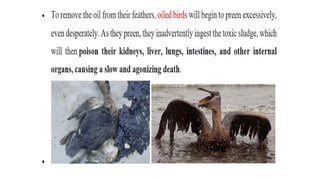
 This oil can be deadly to the flying birds
also. The birds sometimes get coated with oil
which makes them vulnerable to
hypothermia (fluctuations in body
temperature) and reduces the ability to fly.
The pray also gets coated with oil which
when consumed by the birds causes damage
to the internal organs leading to death.
To remove the oil from their feathers, oiled
birds will begin to preen excessively,
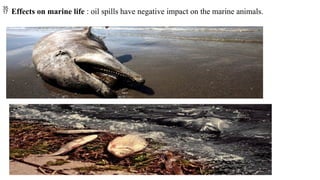
 Effects on marine life : oil spills have negative impact on the marine animals.
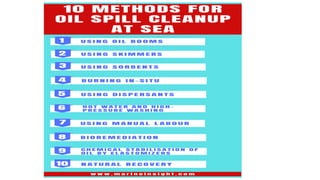
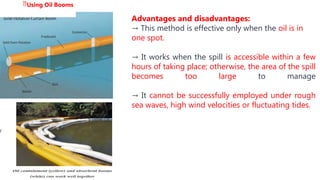
Using Oil Booms
Advantages and disadvantages:
→ This method is effective only when the oil is in
one spot.
→ It works when the spill is accessible within a few
hours of taking place; otherwise, the area of the spill
becomes too large to manage
→ It cannot be successfully employed under rough
sea waves, high wind velocities or fluctuating tides.
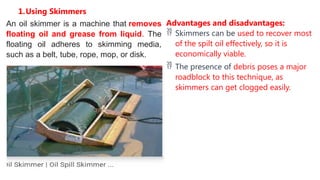
1.Using Skimmers
An oil skimmer is a machine that removes
floating oil and grease from liquid. The
floating oil adheres to skimming media,
such as a belt, tube, rope, mop, or disk.
Advantages and disadvantages:
 Skimmers can be used to recover most
of the spilt oil effectively, so it is
economically viable.
 The presence of debris poses a major
roadblock to this technique, as
skimmers can get clogged easily.
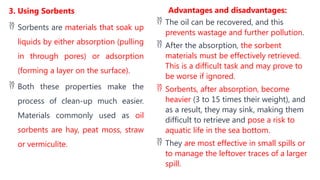
3. Using Sorbents
 Sorbents are materials that soak up
liquids by either absorption (pulling
in through pores) or adsorption
(forming a layer on the surface).
 Both these properties make the
process of clean-up much easier.
Materials commonly used as oil
sorbents are hay, peat moss, straw
or vermiculite.
Advantages and disadvantages:
 The oil can be recovered, and this
prevents wastage and further pollution.
 After the absorption, the sorbent
materials must be effectively retrieved.
This is a difficult task and may prove to
be worse if ignored.
 Sorbents, after absorption, become
heavier (3 to 15 times their weight), and
as a result, they may sink, making them
difficult to retrieve and pose a risk to
aquatic life in the sea bottom.
 They are most effective in small spills or
to manage the leftover traces of a larger
spill.
4. Burning In-situ
In this method, the oil floating on the
surface is ignited to burn it off. This in-situ
burning of oil can effectively remove up to
98% of an oil spill, which is more than most
other methods.
Advantages and disadvantages:
 The toxic fumes released from the burning can cause
significant damage to the environment and marine
life.
 The procedure works on relatively fresh spills before
the oil spreads to a larger area and decreases in
thickness.
5. Using Dispersants
When the spilt oil cannot be
contained by using booms, the only
option left is to accelerate the
disintegration of oil.
Dispersal agents, such as Corexit
9500, are chemicals that are sprayed
upon the spill with the help of aircraft
and boats, which aid the natural
breakdown of oil components.
Advantages and disadvantages:
 It can effectively be used for spills over large
areas.
 The use of dispersants can create tarballs. As
the oil combines with water, it also gets
mixed with sand and debris present in the
water. This results in the formation of large
tarballs floating on the water’s surface, which
often finds their way to the shores.
 The toxicity of dispersants can affect marine
organisms, especially the non-mobile ones
such as corals and seagrass.
Advantages and disadvantages:
 The released oil must be immediately
and adequately recovered to prevent any
further contamination.
 Organisms falling in the direct spray zone
have a high chance of adversely affecting
the hot water.
6. Hot Water and High-Pressure Washing
This procedure is mainly used in situations
where the oil is inaccessible to mechanical
removal methods such as using booms and
skimmers.
It is used to dislodge the trapped and
weathered oil from locations that are
generally inaccessible to machinery.
Water heaters are used to heat water to
around 170°C, then sprayed by hand with
high-pressure wands or nozzles.
The oil is thus flushed to the water surface,
which can be collected with skimmers or
sorbents.
7. Using Manual Labour
As the name suggests, the method requires hand-held tools and manual labour to
clean up the contaminants.
It involves using manual means like hands, rakes, shovels etc., to clean the surface
oil and oily debris and place them in special containers to be removed from the
shoreline.
Sometimes, mechanized equipment may be employed for providing any additional
help and reach out to any inaccessible areas.
Advantages and disadvantages:
 This method is applicable only for cleaning up the slick shorelines.
 The process is more economically viable, as unskilled workers with minimal
training can be employed for the process.
 Apart from being labour intensive, this process is also time-consuming.
 The use of heavy machinery can inflict damage upon shorelines, so they should
be avoided as much as possible.
8. Bioremediation
Bioremediation refers to the use of specific microorganisms to remove any toxic or
harmful substances.
For example, various bacteria, fungi, archaea, and algae degrade petroleum products
by metabolizing and breaking them into simpler and non-toxic molecules (mostly fatty
acids and carbon dioxide).
Sometimes, reagents and fertilizers may be added to the area.
These phosphorus-based and nitrogen-based fertilizers provide adequate nutrients for
the microbes to grow and multiply quickly.
This process is generally not used when the spill has happened in the deep seas and is
gradually implemented once the oil approaches the shoreline.
Advantages and disadvantages:
 It is a time taking procedure and may even take years, so quicker solutions like using
booms and skimmers or sorbents may be used if any urgent action is required.
 The fertilizers have an equally high chance of aiding the growth of unwanted algae,
which consume much of the available oxygen and cut off sunlight from going to the
deeper water levels. This can negatively impact marine life and prove to be counter-
9. Chemical Stabilisation of oil by Elastomizers
Right after an oil spill, the immediate concern is to prevent the oil from spreading
and contaminating the adjacent areas.
While mechanical methods like using oil booms effectively contain the oil, they have
certain limitations to their use.
Experts have recently been using compounds like ‘Elastol’, which is basically poly iso-
butylene (PIB) in a white powdered form, to confine oil spills.
The compound gelatinizes or solidifies the oil on the water surface, thus preventing it
from spreading or escaping.
In addition, the gelatin is easy to retrieve, and this makes the process highly efficient.
Advantages and disadvantages:
 It is a quick action method, with typical reaction times of 15-40 minutes.
 While PIB is non-toxic and commonly found in foodstuffs, the gelatin may risk
10. Natural Recovery
The simplest method of dealing with the oil spill cleanup operation is to use the
vagaries of nature like the sun, the wind, the weather, tides, or naturally occurring
microbes. It is used in certain cases when the shoreline is too remote or inaccessible,
or the environmental impact of cleaning up a spill could potentially far outweigh the
benefits.
Due to the constancy of these elements, the oil generally evaporates or is broken
down into simpler components.
Advantages and disadvantages:
 It is one of the most cost-effective methods.
 It is a highly time consuming and unreliable process and thus needs constant and
close monitoring. It should not be confused with ‘sitting down and doing nothing.
Detail study with advantages and disadvantages
For oil clean up-----word file

Oil Pollution.pptxpppppppppppppppppppppp

  • 2.
    Q.What is anoil spill? Q. Describe briefly the different types, causes & effects of oil spill. Q. Describe briefly the fate oil spill. Q. Describe briefly the cleaning methods/ways to remove oil spill.
  • 3.
    Oil spills, nota very common term but a serious form of environmental pollution. Oil spill/Oil Pollution
  • 5.
  • 7.
    TYPES OF OILSPILLS Class A oil :  Class A oil is the most toxic oil.  It is light and spreads quite easily.  It has a very strong smell.  This type of oil soaks into the soil and easily mixes with water.  Crude oil, jet fuel and gasoline come under class A oil.  This adversely affects the marine life and humans. Class B oil : Class B oil are less toxic than compare to class A oil.  These are non sticky oils which can cause long term contamination and are highly inflammable.  Kerosene, heating oil and low quality crude oil come under this category.
  • 8.
    Class C oil: Class C oil are thick and heavy oil  do not penetrate or dilute into water and soil quickly.  They produce a sticky film on the surface and cause severe contamination.  Variants of crude oil, bunker (heavy oil) (any type of fuel oil, used aboard water vessels, bunker fuel to power their motors ) come under this category. Class D oil : Class D oil is considered solid oils.  These are the least toxic oils that harden when heated.  The cleaning up of this oil is impossible.  Examples: Beef, pork and chicken fat. Butter, cream and milk fat. Coconut, palm and palm kernel oils. Non petroleum oil : Non petroleum oil is thin type of oil that penetrates into the soil and water easily and cause severe damage. Ex. Synthetic oils derived from animal and plant fat
  • 9.
    Fuel oils include heavyfuel oil (bunker fuel), marine fuel oil (MFO),  furnace oil (FO), gas oil (gasoil), heating oils (such as home heating oil), diesel fuel, and others.
  • 10.
  • 11.
  • 13.
  • 14.
  • 15.
  • 16.
  • 17.
    The reason behindoil spill toxicity is the presence of  toxic compounds includes PAHs ( Polycyclic aromatic hydrocarbons),  volatile organic compound etc. Spilled oil does not mix immediately with water instead forms thick layers. The thick layers need to be removed from aquatic ecosystem as responsible to block the various pathways include  oxygen,  breakdown nervous system in marine animal (Masoora & Sommerville, 2009). The Fig. 6.1 shows direct and indirect impact of oil spill.
  • 18.
    Oil Physical Transportand Weathering Processes The behavior of an oil spill in the marine environment depends on a series of processes e.g. • physical, • chemical, and • biological processes that are largely determined by both the properties of leaked oil and the environmental, hydro-meteorological conditions (wave, winds, currents, solar radiation, etc.), and discharge characteristics (instantaneous/continuous, surface/deep-water). The fate and behavior of an oil spill can be influenced by the 1) physico-chemical oil weathering processes: • oil spreading, • evaporation, • emulsification, • dissolution, (see Figure 1). Various Fate/natural actions includes • photo-oxidation, • biodegradation, and • sedimentation, and 2) the physical transport processes, like: • transport and turbulent mixing, • dispersion, and • resurfacing Emulsification is defined as a process where one liquid being dispersed as small spherical droplets in a second immiscible liquid.
  • 19.
    There are variousFate/natural actions includes
  • 20.
    There are variousFate/natural actions includes
  • 21.
    1.1. Spreading Spreading refersto the creation of a thin film, expanding over the sea surface, as soon as oil is being released. Spreading algorithms in oil spill models provide an estimate of the spill thickness or surface area, used for modeling of many transport and fate processes such as evaporation, dispersion, and emulsification. Spreading rate and oil spill thickness depend on the sea surface temperature, oil viscosity, and density . 1.2. Evaporation Evaporation takes place when the volatile elements of the oil diffuse from the oil and entrain the gaseous stage, while the heavier components of oil remain at sea. Evaporation removes most of the volatile fractions of oil to the atmosphere within a few hours, leading to the reduction of oil toxicity in the marine environment. However, these compounds are transferred to the atmosphere and in some cases (e.g., large spills close to densely-populated areas), the effects of evaporation might be more toxic. 1)Oil Weathering Processes
  • 22.
    Emulsification Emulsification is definedas a process where one liquid being dispersed as small spherical droplets in a second immiscible liquid. It occurs due to ---- • wave breaking, • inducing sea surface turbulence, • while oil composition, • temperature, and • viscosity play a significant role in the process. As oil viscosity increases, a higher amount of oil emulsifies and this additionally disrupts the rate of evaporation. 1.4. Dissolution Oil contains very small amounts of soluble compounds (<1 mg/L), which may dissolve in water, but is still considered an important process, since the lower molecular weight aromatic hydrocarbons (monoaromatic and polynuclear aromatic hydrocarbons, MAHs and PAHs), which are both highly volatile and soluble, are the most toxic elements of oil to aquatic organisms. Therefore, dissolution plays a significant role on environmental impact assessment
  • 23.
    1.5. Photo-Oxidation Photo-oxidation occurswhen oil under the influence of the sunlight generates polar, water soluble, oxygenated compounds. The process depends on the type of oil and on the thickness of the oil slick. Thick slicks may partially oxidize, generating tar balls, which are accumulated in bottom sediments or leach off the coast long after a leak. Generally photo-oxidation has long been considered a very slow process, with thin oil films dissolving, even in bright sunlight, at rates lower than 0.1% per day. 1.6. Biodegradation Biodegradation of oil by native microorganisms is one of the most significant natural processes that can attenuate the environmental effects of marine oil spills in the long term. The biodegradation rate of oil depends on the • type of petroleum hydrocarbons, • temperature, • species of micro-organisms, and • the availability of oxygen and nutrients.
  • 24.
    1.7. Sedimentation Sedimentation ofoil droplets occurs as a result of three processes: • increased density of the entrained oil and surface slicks due to weathering processes; • incorporation of fecal pellets by means of zooplankton or benthic organisms’ ingestion; and • oil adherence or flocculation and agglomeration with suspended particulate matter (SPM) aggregates (OSA).
  • 25.
    2. Physical TransportProcesses 2.1. Dispersion Dispersion occurs when the waves or other turbulent events break over the oil slick surface and generate droplets of several sizes into the water column. The large droplets resurface to their primary region while the smaller spread and diffuse into the water column. The rate of natural dispersion is influenced by environmental frameworks (i.e., the sea state), but also by oil properties and spill characteristics (oil-film thickness, density, viscosity, oil/water surface tension), developing rapidly with low-viscosity oils in the presence of breaking waves. 2.2. Resurfacing of Submerged Oil Resurfacing of the entrained oil droplets has as a result the movement of oil between the sea surface and the water column. The submerged oil droplets increase by virtue of their buoyancy, which is forced by means of their droplet size and the density difference among oil and water. It quickly proceeds for larger oil droplets, although the small-scale droplets remain in the subsurface for an extended period of time and can only resurface when wave turbulence decreases
  • 26.
    2.3. Turbulent Mixing Turbulentmixing moves oil and mixes it into the water column. While buoyancy moves oil droplets in one direction, turbulent mixing transfers oil particles upwards and downwards. It affects mainly smaller oil droplets, diminishing their opportunity to resurface . This process has a significant role in the vertical interchange among the surface oil spill and the vertical layers of the water column Detail study with advantages and disadvantages 2.4. Transport Horizontal and vertical transport of oil spilled at sea are separate processes, which are vital for the circulation of oil spills in the sea water. Horizontal transport includes spreading and advection while vertical transport involves vertical dispersion and wave entrainment, turbulent mixing, and resurfacing. Horizontal transport mainly depends on advection due to ocean currents, waves, and winds, while vertical transport has a crucial aspect, affecting the horizontal transport of oil slicks and generating a mixing layer at the top of the water column via breaking waves.
  • 27.
  • 28.
    Effect on environment: oil spills is serious environmental pollution.  A lot of toxins are flushed into the atmosphere and soil.  When oil is spilled, the soil absorbs it.  This in turn mixes with the water table below.  The natural vegetation, agriculture, plants, shrubs and even trees get affected as they absorb this toxic water from beneath.  Thus the whole area become unsuitable  The natural habitat of the birds, their nesting and breeding grounds gets disrupted due to oil spills on the ground.  This oil can be deadly to the flying birds also. The birds sometimes get coated with oil which makes them vulnerable to hypothermia (fluctuations in body temperature) and reduces the ability to fly. The pray also gets coated with oil which when consumed by the birds causes damage to the internal organs leading to death. To remove the oil from their feathers, oiled birds will begin to preen excessively,
  • 30.
     Effects onmarine life : oil spills have negative impact on the marine animals.
  • 33.
    Using Oil Booms Advantagesand disadvantages: → This method is effective only when the oil is in one spot. → It works when the spill is accessible within a few hours of taking place; otherwise, the area of the spill becomes too large to manage → It cannot be successfully employed under rough sea waves, high wind velocities or fluctuating tides.
  • 34.
    1.Using Skimmers An oilskimmer is a machine that removes floating oil and grease from liquid. The floating oil adheres to skimming media, such as a belt, tube, rope, mop, or disk. Advantages and disadvantages:  Skimmers can be used to recover most of the spilt oil effectively, so it is economically viable.  The presence of debris poses a major roadblock to this technique, as skimmers can get clogged easily.
  • 35.
    3. Using Sorbents Sorbents are materials that soak up liquids by either absorption (pulling in through pores) or adsorption (forming a layer on the surface).  Both these properties make the process of clean-up much easier. Materials commonly used as oil sorbents are hay, peat moss, straw or vermiculite. Advantages and disadvantages:  The oil can be recovered, and this prevents wastage and further pollution.  After the absorption, the sorbent materials must be effectively retrieved. This is a difficult task and may prove to be worse if ignored.  Sorbents, after absorption, become heavier (3 to 15 times their weight), and as a result, they may sink, making them difficult to retrieve and pose a risk to aquatic life in the sea bottom.  They are most effective in small spills or to manage the leftover traces of a larger spill.
  • 36.
    4. Burning In-situ Inthis method, the oil floating on the surface is ignited to burn it off. This in-situ burning of oil can effectively remove up to 98% of an oil spill, which is more than most other methods. Advantages and disadvantages:  The toxic fumes released from the burning can cause significant damage to the environment and marine life.  The procedure works on relatively fresh spills before the oil spreads to a larger area and decreases in thickness.
  • 37.
    5. Using Dispersants Whenthe spilt oil cannot be contained by using booms, the only option left is to accelerate the disintegration of oil. Dispersal agents, such as Corexit 9500, are chemicals that are sprayed upon the spill with the help of aircraft and boats, which aid the natural breakdown of oil components. Advantages and disadvantages:  It can effectively be used for spills over large areas.  The use of dispersants can create tarballs. As the oil combines with water, it also gets mixed with sand and debris present in the water. This results in the formation of large tarballs floating on the water’s surface, which often finds their way to the shores.  The toxicity of dispersants can affect marine organisms, especially the non-mobile ones such as corals and seagrass.
  • 38.
    Advantages and disadvantages: The released oil must be immediately and adequately recovered to prevent any further contamination.  Organisms falling in the direct spray zone have a high chance of adversely affecting the hot water. 6. Hot Water and High-Pressure Washing This procedure is mainly used in situations where the oil is inaccessible to mechanical removal methods such as using booms and skimmers. It is used to dislodge the trapped and weathered oil from locations that are generally inaccessible to machinery. Water heaters are used to heat water to around 170°C, then sprayed by hand with high-pressure wands or nozzles. The oil is thus flushed to the water surface, which can be collected with skimmers or sorbents.
  • 39.
    7. Using ManualLabour As the name suggests, the method requires hand-held tools and manual labour to clean up the contaminants. It involves using manual means like hands, rakes, shovels etc., to clean the surface oil and oily debris and place them in special containers to be removed from the shoreline. Sometimes, mechanized equipment may be employed for providing any additional help and reach out to any inaccessible areas. Advantages and disadvantages:  This method is applicable only for cleaning up the slick shorelines.  The process is more economically viable, as unskilled workers with minimal training can be employed for the process.  Apart from being labour intensive, this process is also time-consuming.  The use of heavy machinery can inflict damage upon shorelines, so they should be avoided as much as possible.
  • 40.
    8. Bioremediation Bioremediation refersto the use of specific microorganisms to remove any toxic or harmful substances. For example, various bacteria, fungi, archaea, and algae degrade petroleum products by metabolizing and breaking them into simpler and non-toxic molecules (mostly fatty acids and carbon dioxide). Sometimes, reagents and fertilizers may be added to the area. These phosphorus-based and nitrogen-based fertilizers provide adequate nutrients for the microbes to grow and multiply quickly. This process is generally not used when the spill has happened in the deep seas and is gradually implemented once the oil approaches the shoreline. Advantages and disadvantages:  It is a time taking procedure and may even take years, so quicker solutions like using booms and skimmers or sorbents may be used if any urgent action is required.  The fertilizers have an equally high chance of aiding the growth of unwanted algae, which consume much of the available oxygen and cut off sunlight from going to the deeper water levels. This can negatively impact marine life and prove to be counter-
  • 41.
    9. Chemical Stabilisationof oil by Elastomizers Right after an oil spill, the immediate concern is to prevent the oil from spreading and contaminating the adjacent areas. While mechanical methods like using oil booms effectively contain the oil, they have certain limitations to their use. Experts have recently been using compounds like ‘Elastol’, which is basically poly iso- butylene (PIB) in a white powdered form, to confine oil spills. The compound gelatinizes or solidifies the oil on the water surface, thus preventing it from spreading or escaping. In addition, the gelatin is easy to retrieve, and this makes the process highly efficient. Advantages and disadvantages:  It is a quick action method, with typical reaction times of 15-40 minutes.  While PIB is non-toxic and commonly found in foodstuffs, the gelatin may risk
  • 42.
    10. Natural Recovery Thesimplest method of dealing with the oil spill cleanup operation is to use the vagaries of nature like the sun, the wind, the weather, tides, or naturally occurring microbes. It is used in certain cases when the shoreline is too remote or inaccessible, or the environmental impact of cleaning up a spill could potentially far outweigh the benefits. Due to the constancy of these elements, the oil generally evaporates or is broken down into simpler components. Advantages and disadvantages:  It is one of the most cost-effective methods.  It is a highly time consuming and unreliable process and thus needs constant and close monitoring. It should not be confused with ‘sitting down and doing nothing.
  • 43.
    Detail study withadvantages and disadvantages For oil clean up-----word file