SEMINAR PRESENTATION ONSTUDENTS’ INDUSTRIAL
WORK EXPERIENCE SCHEME (SIWES)
CONDUCTED AT
LOWER USUMA DAM WATER WORKS, BWARI, ABUJA.
(LUD)
BY
OGALI OJONIMI DIVINE
MATRIC NO: SCI22ICH023
SUPERVISED BY
DR ETCHIE
DEPARTMENT OF INDUSTRIAL CHEMISTRY
FACULTY OF SCIENCE
FEDERAL UNIVERSITY LOKOJA
2.
2
● Introduction
● Overviewof Water Treatment Processes
● Benefits of Lower Usuma Dam Water Treatment Plant
● Challenges Encountered in Water Treatment
● Solutions to the Challenges
● Conclusion
Presentation Outline~
~
3.
Introduction
3
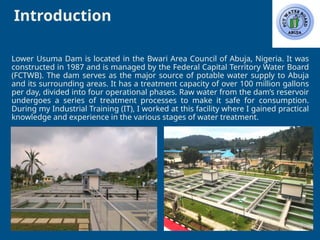
Lower Usuma Damis located in the Bwari Area Council of Abuja, Nigeria. It was
constructed in 1987 and is managed by the Federal Capital Territory Water Board
(FCTWB). The dam serves as the major source of potable water supply to Abuja
and its surrounding areas. It has a treatment capacity of over 100 million gallons
per day, divided into four operational phases. Raw water from the dam’s reservoir
undergoes a series of treatment processes to make it safe for consumption.
During my Industrial Training (IT), I worked at this facility where I gained practical
knowledge and experience in the various stages of water treatment.
4.
4
The five watertreatment processes at Lower
Usman Dam are:
1. Aeration
2. Clarification ( Coagulation and Flocculation)
3. Sedimentation
4. Filtration
5. Disinfection
Overview of Water
Treatment Processes
5.
Aeration
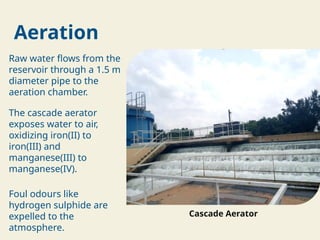
Raw water flowsfrom the
reservoir through a 1.5 m
diameter pipe to the
aeration chamber.
The cascade aerator
exposes water to air,
oxidizing iron(II) to
iron(III) and
manganese(III) to
manganese(IV).
Foul odours like
hydrogen sulphide are
expelled to the
atmosphere.
Cascade Aerator
6.
Coagulation and
Flocculation
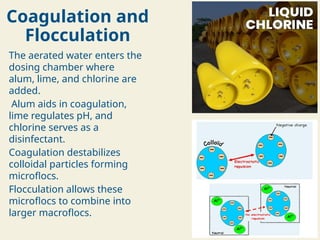
The aeratedwater enters the
dosing chamber where
alum, lime, and chlorine are
added.
Alum aids in coagulation,
lime regulates pH, and
chlorine serves as a
disinfectant.
Coagulation destabilizes
colloidal particles forming
microflocs.
Flocculation allows these
microflocs to combine into
larger macroflocs.
7.
Sedimentation (Clarification)
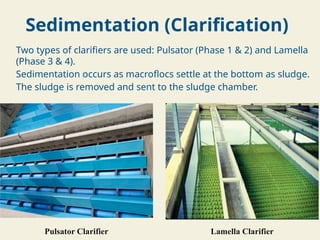
Two typesof clarifiers are used: Pulsator (Phase 1 & 2) and Lamella
(Phase 3 & 4).
Sedimentation occurs as macroflocs settle at the bottom as sludge.
The sludge is removed and sent to the sludge chamber.
Pulsator Clarifier Lamella Clarifier
8.
Filtration
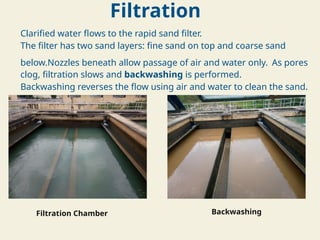
Clarified water flowsto the rapid sand filter.
The filter has two sand layers: fine sand on top and coarse sand
below.Nozzles beneath allow passage of air and water only. As pores
clog, filtration slows and backwashing is performed.
Backwashing reverses the flow using air and water to clean the sand.
Filtration Chamber Backwashing
9.
Disinfection and
Post Treatment
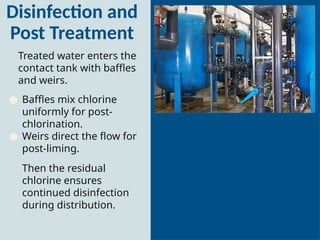
Treatedwater enters the
contact tank with baffles
and weirs.
● Baffles mix chlorine
uniformly for post-
chlorination.
● Weirs direct the flow for
post-liming.
Then the residual
chlorine ensures
continued disinfection
during distribution.
10.
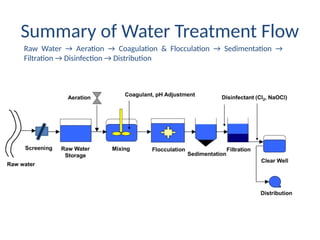
Summary of WaterTreatment Flow
Raw Water → Aeration → Coagulation & Flocculation → Sedimentation →
Filtration → Disinfection → Distribution
11.
Benefits of LowerUsuma
Dam Water Treatment
Plant
11
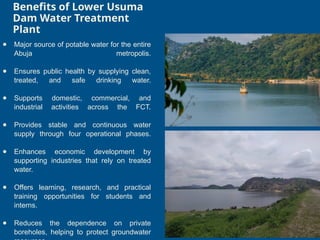
● Major source of potable water for the entire
Abuja metropolis.
● Ensures public health by supplying clean,
treated, and safe drinking water.
● Supports domestic, commercial, and
industrial activities across the FCT.
● Provides stable and continuous water
supply through four operational phases.
● Enhances economic development by
supporting industries that rely on treated
water.
● Offers learning, research, and practical
training opportunities for students and
interns.
● Reduces the dependence on private
boreholes, helping to protect groundwater
12.
Challenges Faced at
LowerUsuma Dam
Seasonal water scarcity during the dry
season leading to reduced reservoir levels.
Increased chemical demand due to
fluctuating raw-water quality.
Aging infrastructure in older treatment
phases (especially Phase 1).
High operational costs associated with
treatment processes and equipment
maintenance.
Population growth in Abuja, increasing daily
water demand beyond initial design capacity.
Occasional power supply issues affecting
pumping and treatment operations.
How These Challenges
Have Been Overcome
Gurara Inter-Basin Water Transfer Project:
Supplies additional raw water from Gurara Dam,
especially during dry seasons, stabilizing the reservoir
level.
Phase 2 Automation Upgrade:
Installation of automated chemical dosing pumps,
digital monitoring systems, and SCADA controls for
improved accuracy and efficiency.
Periodic equipment maintenance and replacement:
Old pumps, valves, and clarifier components are
upgraded to minimize breakdowns.
Improved sludge management systems:
Better drainage and disposal processes reduce
clogging and downtime.
Enhanced water quality monitoring:
Adoption of sensors and real-time analysis tools
ensures consistent compliance with WHO standards.
Solar Power Integration:
The plant now makes use of solar energy systems to
support pumping and monitoring operations, ensuring
continuous treatment activities during power shortages
and reducing dependence on the main electricity grid.
13.
Conclusion
13
Each stage ofwater
treatment at Lower
Usman Dam plays a
vital role in ensuring
clean, safe, and potable
water for consumers.
Proper operation and
maintenance of all
units are essential for
optimal performance.




![Student industrial work experience [siwes]](https://cdn.slidesharecdn.com/ss_thumbnails/studentindustrialworkexperiencesiwes-170508174832-thumbnail.jpg?width=640&height=640&fit=bounds)


![Lecture 9 -_centralized_water_treatment_(treatment_and_disinfection)[1]](https://cdn.slidesharecdn.com/ss_thumbnails/lecture9-centralizedwatertreatmenttreatmentanddisinfection1-150122150953-conversion-gate02-thumbnail.jpg?width=640&height=640&fit=bounds)


