Introduction to Exploration
PurposeYou are an exploration team in charge of a new petroleum province. Multidisciplinary challenge: Enhance your overall understanding of petroleum exploration and field development.Create a Return on Investment
Money/KP’sYou start with $200 millionCreate valueNet value of the oil and gas discovered MINUS all costs involvedKnowledge points awardedSensible decisions and correct answersKPs are a measure of ability and credibilityConsidered when bidding for blocksUse when applying for funds
You will learnWhere and how to find hydrocarbons Licensing rounds Farm-in and Partnerships - negotiationsDrilling rigs Sub-contractorsEnvironmental issuesEconomically viable volumesTeam work, Critical decision making, analytical skillsMulti-tasking
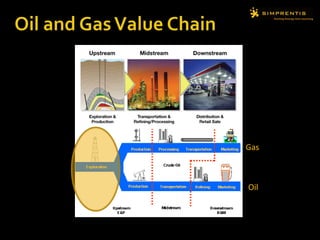
Oil and Gas Value ChainGasOil
Loginwww.oilsim.com
Loginwww.oilsim.com
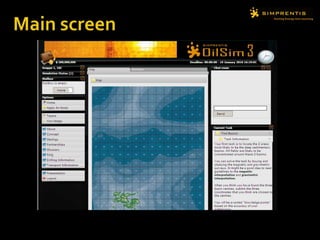
Main screen
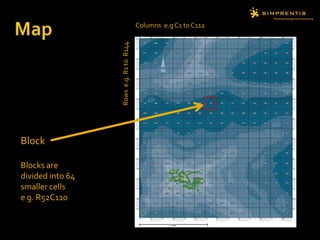
MapColumns  e.g C1 to C112 Rows  e.g. R1 to  R144BlockBlocks are dividedinto 64 smaller cellse g. R52C110
First taskChallenge: Find three sedimentary basins  Procedure: Buy and study magnetic and gravimetric surveys Submit the coordinates for each centreColumn and row number for each basin centre
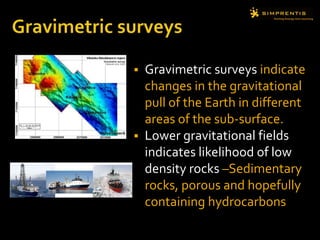
Gravimetric surveysGravimetric surveys indicate changes in the gravitational pull of the Earth in different areas of the sub-surface.
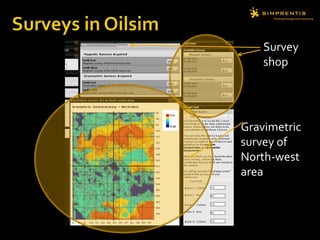
Lower gravitational fields  indicates likelihood of low density rocks –Sedimentary rocks, porous and hopefully containing hydrocarbonsSurveys in OilsimSurvey shopGravimetric survey of North-west area
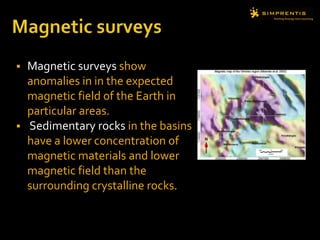
Magnetic surveysMagnetic surveys show anomalies in in the expected magnetic field of the Earth in particular areas. Sedimentary rocks in the basins have a lower concentration of magnetic materials and lower magnetic field than the surrounding crystalline rocks.
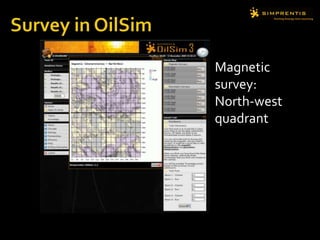
Survey in OilSimMagnetic survey:North-west quadrant
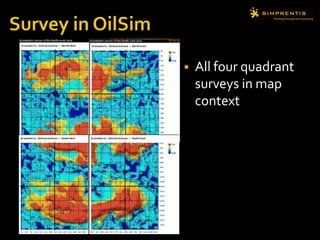
Survey in OilSimAll four quadrant surveys in map context
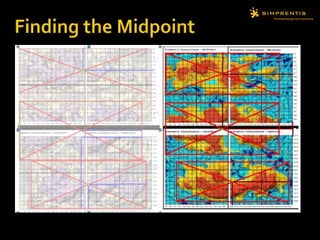
Finding the Midpoint
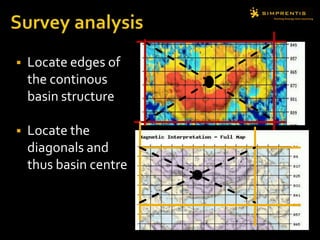
Survey analysisLocate edges of the continous basin structureLocate the diagonals and thus basin centre
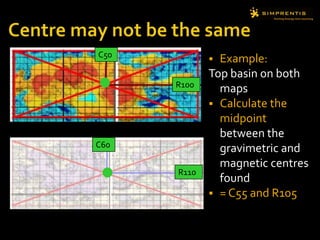
Centre may not be the sameExample:Top basin on both maps Calculate the midpoint between the gravimetric and magnetic centres found= C55 and R105C50R100C60R110
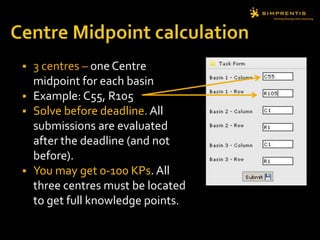
Centre Midpoint calculation3 centres – one Centre midpoint for each basinExample: C55, R105Solve before deadline. All submissions are evaluated after the deadline (and not before).You may get 0-100 KPs. All three centres must be located to get full knowledge points.
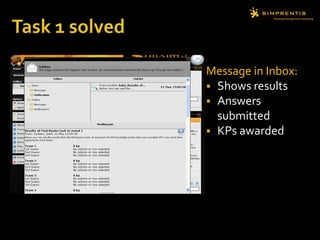
Task 1 solvedMessage in Inbox: Shows resultsAnswers submittedKPs awarded
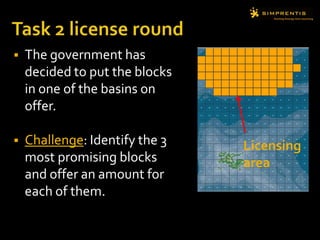
Task 2 license roundThe government has decided to put the blocks in one of the basins on offer.Challenge: Identify the 3 most promising blocks and offer an amount for each of them.Licensing area
Task 2 license roundAny restrictions involved?- Spawning groundsWhat are we looking for?  - ProspectsWhere do we find prospects? In basins, where hydrocarbons have been 1) are produced and 2) trappedHow do I find them?  - Geoscientific analysis2D seismic, Common Risk Segment maps
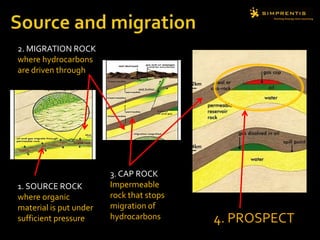
Source and migration2. MIGRATION ROCKwhere hydrocarbons are driven through3. CAP ROCKImpermeable rock that stops migration of hydrocarbons1. SOURCE ROCKwhere organic material is put under sufficient pressure4. PROSPECT
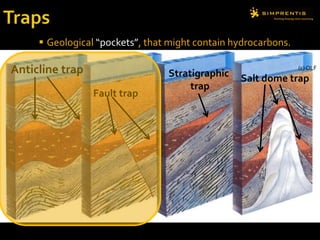
TrapsGeological “pockets”, that might contain hydrocarbons.Anticline trap(c) OLFStratigraphic trapSalt dome trapFault trap
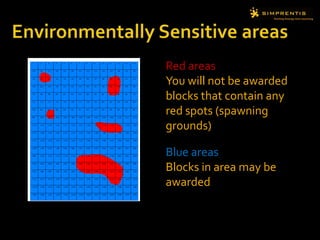
Environmentally Sensitive areasRed areasYou will not be awarded blocks that contain any red spots (spawning grounds)Blue areasBlocks in area may be awarded
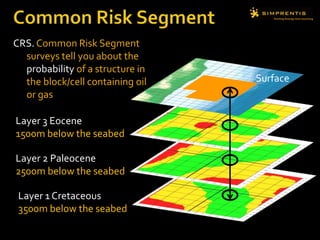
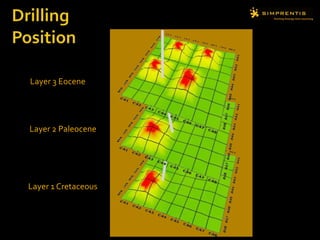
Common Risk SegmentCRS. Common Risk Segment surveys tell you about the probability of a structure in the block/cell containing oil or gasSurfaceLayer 3 Eocene1500m below the seabedLayer 2 Paleocene2500m below the seabedLayer 1 Cretaceous3500m below the seabed
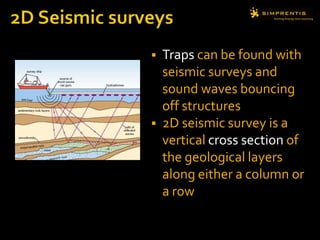
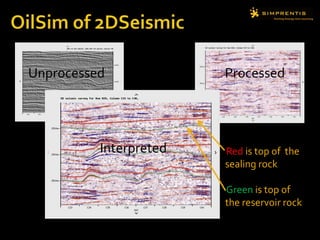
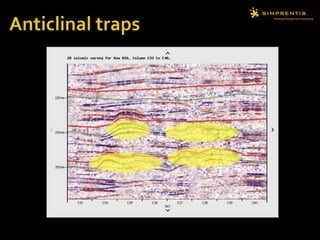
2D Seismic surveysTraps can be found with seismic surveys and sound waves bouncing off structures 2D seismic survey is a vertical cross section of the geological layers along either a column or a row
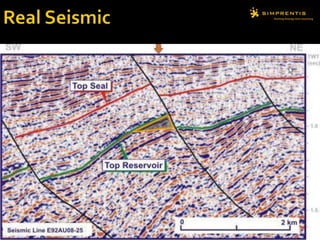
Real Seismic                                                                                                                                                                       
OilSim of 2DSeismic UnprocessedProcessedRed is top of  the sealing rockGreen is top of  the reservoir rockInterpreted
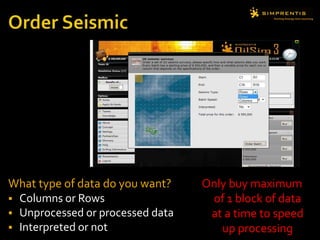
Order SeismicWhat type of data do you want?Columns or Rows
Unprocessed or processed data
Interpreted or notOnly buy maximum of 1 block of data at a time to speed up processing
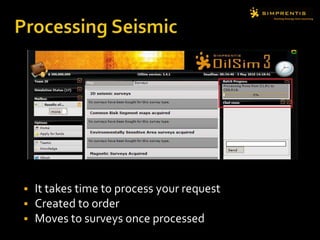
Processing SeismicIt takes time to process your request
Created to order
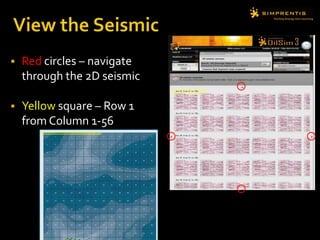
Moves to surveys once processedView the SeismicRed circles – navigate through the 2D seismic
Yellowsquare – Row 1 from Column 1-56Anticlinal traps
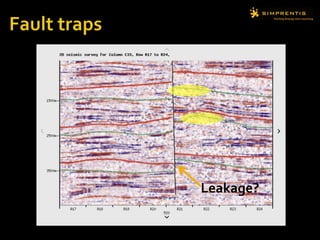
Fault trapsLeakage?
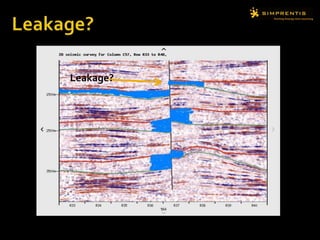
Leakage?Leakage?
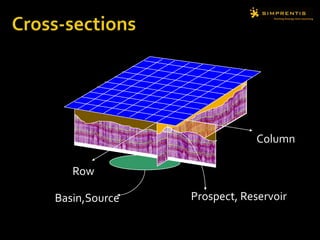
Cross-sectionsColumnRowProspect, ReservoirBasin,Source
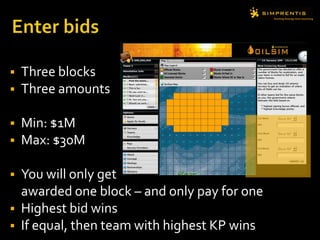
Enter bidsThree blocks
Three amounts
Min: $1M
Max: $30M
You will only getawarded one block – and only pay for one
Highest bid wins
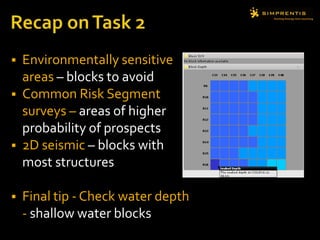
If equal, then team with highest KP winsRecap on Task 2Environmentally sensitive areas – blocks to avoid Common Risk Segment surveys – areas of higher probability of prospects 2D seismic – blocks with most structures Final tip - Check water depth - shallow water blocks
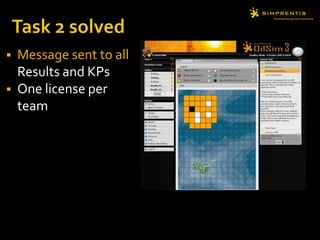
Task 2 solvedMessage sent to all Results and KPsOne license per team
Task 3 Exploration DrillingThe headquarters of your company has evaluated the license that you were awarded.Although the possibility of finding oil is fair, the costs involved are large. Thus the headquarters want you to spread the risk. Challenge: You shall farm-out minimum 20% from your license – and farm-in as much as you can in other good licenses.
Task 3a PartnershipsAcquire 3D Seismic interpretations for the block you operate, and study the results from the licensing roundFarm-out: Get others to invest 20% or more in your license – you can send them surveysFarm-in: Send offers to other teams to buy shares in their viable licenses. Submit an offer for each viable license, with amount offered and share wanted in whole %.
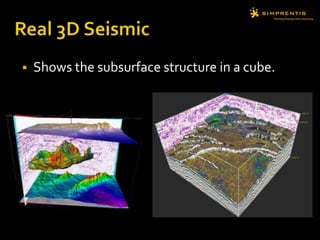
Real 3D SeismicShows the subsurface structure in a cube.
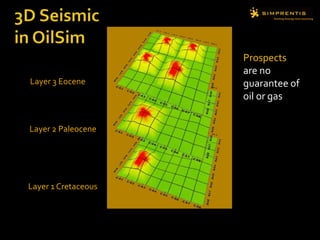
3D Seismicin OilSimProspects are no guarantee of oil or gasLayer 3 EoceneLayer 2 PaleoceneLayer 1 Cretaceous
PartnershipsSpread the risk: e.g Investing in other blocks divides the risks amongst all partners, much more  preferable than keeping 100% of one field and all the risk.Increase probability of profit: investment  in only 1 field which could be a dry prospect is possible, whereas  the likelihood of investing in 5 fields which are all dry is unlikely.
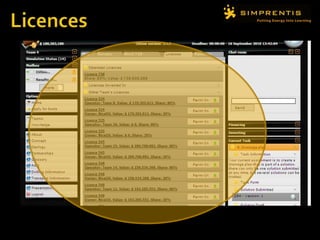
Licences
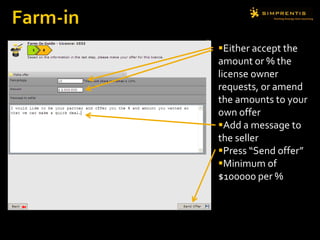
Farm-inEither accept the amount or % the license owner requests, or amend the amounts to your own offer
Add a message to the seller
Press “Send offer”
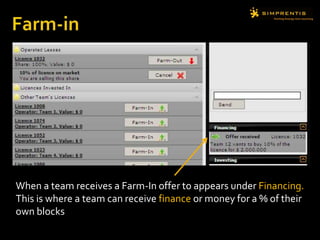
Minimum of $100000 per %Farm-inWhen a team receives a Farm-In offer to appears under Financing.  This is where a team can receive finance or money for a % of their own blocks
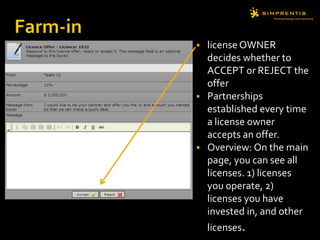
Farm-inlicense OWNER decides whether to ACCEPT or REJECT the offerPartnerships established every time a license owner accepts an offer.Overview: On the main page, you can see all licenses. 1) licenses you operate, 2) licenses you have invested in, and other licenses.
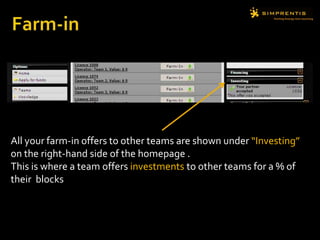
Farm-inAll your farm-in offers to other teams are shown under “Investing” on the right-hand side of the homepage . This is where a team offers investments to other teams for a % of  their  blocks
PartnershipsPartners pay a proportional share of all future costs incurred by the partnershipPartners receive a proportional share of the net proceedings from any oil or gas found on the license. The operator team makes all decisions regarding acquiring 3D seismics, drilling of wells and testing of wells. Information: partners in a block can access info about drilled wells and discovered oil and gas fields.
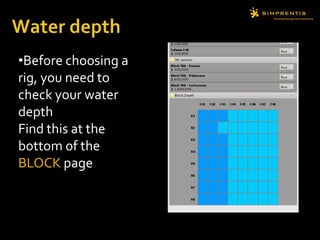
Water depthBefore choosing a rig, you need to check your water depth Find this at the bottom of the BLOCK page
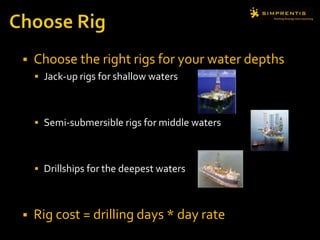
Choose RigChoose the right rigs for your water depthsJack-up rigs for shallow watersSemi-submersible rigs for middle watersDrillships for the deepest waters Rig cost = drilling days * day rate
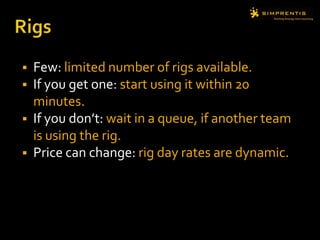
RigsFew: limited number of rigs available.If you get one: start using it within 20 minutes.If you don’t: wait in a queue, if another team is using the rig.Price can change: rig day rates are dynamic.
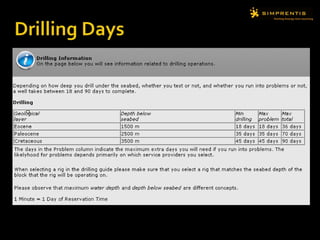
Drilling Days
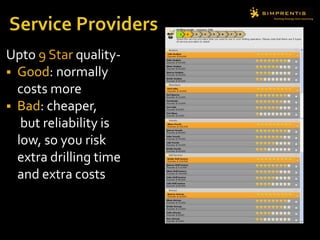
Service ProvidersUpto 9 Star quality-Good: normally costs moreBad: cheaper,      but reliability is low, so you risk extra drilling time and extra costs
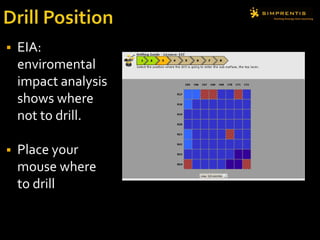
Environmental Impact AssessmentEIA survey: more knowledge about the area.Less probability for drilling problems.Less severe consequences if you run into problems.
Drill PositionEIA: enviromental impact analysis shows where not to drill.Place your mouse where  to drill
Penalties & FinesCertain problems can occur if Service Provider Selection is poor qualityOther penalties can occur if you drill in areas indicated as problematic in the Environmental Impact AssessmentAs in real life, problems can occur randomly and these are also applied with fines levied accordingly.
Drilling PositionLayer 3 EoceneLayer 2 PaleoceneLayer 1 Cretaceous
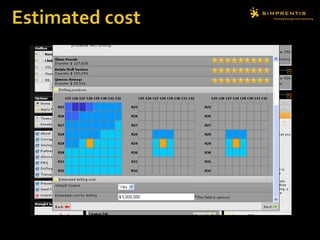
Estimated cost
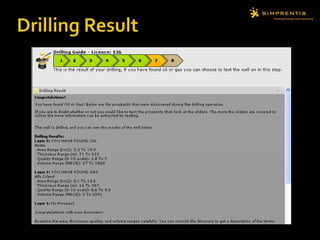
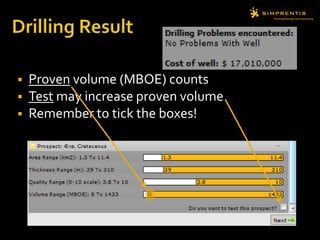
Drilling Result

Offshore 3.4 presentation intro to exploration