International PetroChallenge2010
PurposeYou are an exploration team in charge of a new petroleum province. Multidisciplinary challenge: Enhance your overall understanding of petroleum exploration and field development.Create a Return on Investment
Money/KP’sYou start with $200 millionCreate valueNet value of the oil and gas discovered MINUS all costs involvedKnowledge points awardedSensible decisions and correct answersKPs are a measure of ability and credibilityConsidered when bidding for blocksUse when applying for funds
You will learnWhere and how to find hydrocarbons Licensing rounds Farm-in and Partnerships - negotiationsDrilling rigs Sub-contractorsEnvironmental issuesEconomically viable volumesTeam work, Critical decision making, analytical skillsMulti-tasking
Oil and Gas Value ChainGasOil
Loginwww.oilsim.com
Loginwww.oilsim.com
Main screen
MapColumns  e.g C1 to C112 Rows  e.g. R1 to  R144BlockBlocks are dividedinto 64 smaller cellse g. R52C110
First taskChallenge: Find three sedimentary basins  Procedure: Buy and study magnetic and gravimetric surveys Submit the coordinates for each centreColumn and row number for each basin centre
Gravimetric surveysGravimetric surveys indicate changes in the gravitational pull of the Earth in different areas of the sub-surface.
Lower gravitational fields  indicates likelihood of low density rocks –Sedimentary rocks, porous and hopefully containing hydrocarbonsSurveys in OilsimSurvey shopGravimetric survey of North-west area
Magnetic surveysMagnetic surveys show anomalies in in the expected magnetic field of the Earth in particular areas. Sedimentary rocks in the basins have a lower concentration of magnetic materials and lower magnetic field than the surrounding crystalline rocks.
Survey in OilSimMagnetic survey:North-west quadrant
Survey in OilSimAll four quadrant surveys in map context
Finding the Midpoint
Survey analysisLocate edges of the continous basin structureLocate the diagonals and thus basin centre
Centre may not be the sameExample:Top basin on both maps Calculate the midpoint between the gravimetric and magnetic centres found= C55 and R105C50R100C60R110
Centre Midpoint calculation3 centres – one Centre midpoint for each basinExample: C55, R105Solve before deadline. All submissions are evaluated after the deadline (and not before).You may get 0-100 KPs. All three centres must be located to get full knowledge points.
Task 1 solvedMessage in Inbox: Shows resultsAnswers submittedKPs awarded
Task 2 license roundThe government has decided to put the blocks in one of the basins on offer.Challenge: Identify the 3 most promising blocks and offer an amount for each of them.Licensing area
Task 2 license roundAny restrictions involved?- Spawning groundsWhat are we looking for?  - ProspectsWhere do we find prospects? In basins, where hydrocarbons have been 1) are produced and 2) trappedHow do I find them?  - Geoscientific analysis2D seismic, Common Risk Segment maps
Source and migration2. MIGRATION ROCKwhere hydrocarbons are driven through3. CAP ROCKImpermeable rock that stops migration of hydrocarbons1. SOURCE ROCKwhere organic material is put under sufficient pressure4. PROSPECT
TrapsGeological “pockets”, that might contain hydrocarbons.Anticline trap(c) OLFStratigraphic trapSalt dome trapFault trap
Environmentally Sensitive areasRed areasYou will not be awarded blocks that contain any red spots (spawning grounds)Blue areasBlocks in area may be awarded
Common Risk SegmentCRS. Common Risk Segment surveys tell you about the probability of a structure in the block/cell containing oil or gasSurfaceLayer 3 Eocene1500m below the seabedLayer 2 Paleocene2500m below the seabedLayer 1 Cretaceous3500m below the seabed
2D Seismic surveysTraps can be found with seismic surveys and sound waves bouncing off structures 2D seismic survey is a vertical cross section of the geological layers along either a column or a row
Real Seismic                                                                                                                                                                       
OilSim of 2DSeismic UnprocessedProcessedRed is top of  the sealing rockGreen is top of  the reservoir rockInterpreted
Order SeismicWhat type of data do you want?Columns or Rows
Unprocessed or processed data
Interpreted or notOnly buy maximum of 1 block of data at a time to speed up processing
Processing SeismicIt takes time to process your request
Created to order
Moves to surveys once processedView the SeismicRed circles – navigate through the 2D seismic
Yellowsquare – Row 1 from Column 1-56Anticlinal traps
Fault trapsLeakage?
Leakage?Leakage?
Cross-sectionsColumnRowProspect, ReservoirBasin,Source
Enter bidsThree blocks
Three amounts
Min: $1M
Max: $30M
You will only getawarded one block – and only pay for one
Highest bid wins
If equal, then team with highest KP winsRecap on Task 2Environmentally sensitive areas – blocks to avoid Common Risk Segment surveys – areas of higher probability of prospects 2D seismic – blocks with most structures Final tip - Check water depth - shallow water blocks
Task 2 solvedMessage sent to all Results and KPsOne license per team
Task 3 Exploration DrillingThe headquarters of your company has evaluated the license that you were awarded.Although the possibility of finding oil is fair, the costs involved are large. Thus the headquarters want you to spread the risk. Challenge: You shall farm-out minimum 20% from your license – and farm-in as much as you can in other good licenses.
Task 3a PartnershipsAcquire 3D Seismic interpretations for the block you operate, and study the results from the licensing roundFarm-out: Get others to invest 20% or more in your license – you can send them surveysFarm-in: Send offers to other teams to buy shares in their viable licenses. Submit an offer for each viable license, with amount offered and share wanted in whole %.
Real 3D SeismicShows the subsurface structure in a cube.
3D Seismicin OilSimProspects are no guarantee of oil or gasLayer 3 EoceneLayer 2 PaleoceneLayer 1 Cretaceous
PartnershipsSpread the risk: e.g Investing in other blocks divides the risks amongst all partners, much more  preferable than keeping 100% of one field and all the risk.Increase probability of profit: investment  in only 1 field which could be a dry prospect is possible, whereas  the likelihood of investing in 5 fields which are all dry is unlikely.
Licences
Farm-inEither accept the amount or % the license owner requests, or amend the amounts to your own offer
Add a message to the seller
Press “Send offer”
Minimum of $100000 per %Farm-inWhen a team receives a Farm-In offer to appears under Financing.  This is where a team can receive finance or money for a % of their own blocks
Farm-inlicense OWNER decides whether to ACCEPT or REJECT the offerPartnerships established every time a license owner accepts an offer.Overview: On the main page, you can see all licenses. 1) licenses you operate, 2) licenses you have invested in, and other licenses.
Farm-inAll your farm-in offers to other teams are shown under “Investing” on the right-hand side of the homepage . This is where a team offers investments to other teams for a % of  their  blocks
PartnershipsPartners pay a proportional share of all future costs incurred by the partnershipPartners receive a proportional share of the net proceedings from any oil or gas found on the license. The operator team makes all decisions regarding acquiring 3D seismics, drilling of wells and testing of wells. Information: partners in a block can access info about drilled wells and discovered oil and gas fields.
Water depthBefore choosing a rig, you need to check your water depth Find this at the bottom of the BLOCK page
Choose RigChoose the right rigs for your water depthsJack-up rigs for shallow watersSemi-submersible rigs for middle watersDrillships for the deepest waters Rig cost = drilling days * day rate
RigsFew: limited number of rigs available.If you get one: start using it within 20 minutes.If you don’t: wait in a queue, if another team is using the rig.Price can change: rig day rates are dynamic.
Drilling Days
Service ProvidersUpto 9 Star quality-Good: normally costs moreBad: cheaper,      but reliability is low, so you risk extra drilling time and extra costs
Environmental Impact AssessmentEIA survey: more knowledge about the area.Less probability for drilling problems.Less severe consequences if you run into problems.
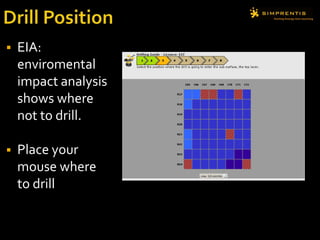
Drill PositionEIA: enviromental impact analysis shows where not to drill.Place your mouse where  to drill
Penalties & FinesCertain problems can occur if Service Provider Selection is poor qualityOther penalties can occur if you drill in areas indicated as problematic in the Environmental Impact AssessmentAs in real life, problems can occur randomly and these are also applied with fines levied accordingly.
Drilling PositionLayer 3 EoceneLayer 2 PaleoceneLayer 1 Cretaceous
Estimated cost
Drilling Result

Petro challengefinal 2010 ppt presentation

  • 1.
  • 2.
    PurposeYou are anexploration team in charge of a new petroleum province. Multidisciplinary challenge: Enhance your overall understanding of petroleum exploration and field development.Create a Return on Investment
  • 3.
    Money/KP’sYou start with$200 millionCreate valueNet value of the oil and gas discovered MINUS all costs involvedKnowledge points awardedSensible decisions and correct answersKPs are a measure of ability and credibilityConsidered when bidding for blocksUse when applying for funds
  • 4.
    You will learnWhereand how to find hydrocarbons Licensing rounds Farm-in and Partnerships - negotiationsDrilling rigs Sub-contractorsEnvironmental issuesEconomically viable volumesTeam work, Critical decision making, analytical skillsMulti-tasking
  • 5.
    Oil and GasValue ChainGasOil
  • 6.
  • 7.
  • 8.
  • 9.
    MapColumns e.gC1 to C112 Rows e.g. R1 to R144BlockBlocks are dividedinto 64 smaller cellse g. R52C110
  • 10.
    First taskChallenge: Findthree sedimentary basins Procedure: Buy and study magnetic and gravimetric surveys Submit the coordinates for each centreColumn and row number for each basin centre
  • 11.
    Gravimetric surveysGravimetric surveysindicate changes in the gravitational pull of the Earth in different areas of the sub-surface.
  • 12.
    Lower gravitational fields indicates likelihood of low density rocks –Sedimentary rocks, porous and hopefully containing hydrocarbonsSurveys in OilsimSurvey shopGravimetric survey of North-west area
  • 13.
    Magnetic surveysMagnetic surveysshow anomalies in in the expected magnetic field of the Earth in particular areas. Sedimentary rocks in the basins have a lower concentration of magnetic materials and lower magnetic field than the surrounding crystalline rocks.
  • 14.
    Survey in OilSimMagneticsurvey:North-west quadrant
  • 15.
    Survey in OilSimAllfour quadrant surveys in map context
  • 16.
  • 17.
    Survey analysisLocate edgesof the continous basin structureLocate the diagonals and thus basin centre
  • 18.
    Centre may notbe the sameExample:Top basin on both maps Calculate the midpoint between the gravimetric and magnetic centres found= C55 and R105C50R100C60R110
  • 19.
    Centre Midpoint calculation3centres – one Centre midpoint for each basinExample: C55, R105Solve before deadline. All submissions are evaluated after the deadline (and not before).You may get 0-100 KPs. All three centres must be located to get full knowledge points.
  • 20.
    Task 1 solvedMessagein Inbox: Shows resultsAnswers submittedKPs awarded
  • 21.
    Task 2 licenseroundThe government has decided to put the blocks in one of the basins on offer.Challenge: Identify the 3 most promising blocks and offer an amount for each of them.Licensing area
  • 22.
    Task 2 licenseroundAny restrictions involved?- Spawning groundsWhat are we looking for? - ProspectsWhere do we find prospects? In basins, where hydrocarbons have been 1) are produced and 2) trappedHow do I find them? - Geoscientific analysis2D seismic, Common Risk Segment maps
  • 23.
    Source and migration2.MIGRATION ROCKwhere hydrocarbons are driven through3. CAP ROCKImpermeable rock that stops migration of hydrocarbons1. SOURCE ROCKwhere organic material is put under sufficient pressure4. PROSPECT
  • 24.
    TrapsGeological “pockets”, thatmight contain hydrocarbons.Anticline trap(c) OLFStratigraphic trapSalt dome trapFault trap
  • 25.
    Environmentally Sensitive areasRedareasYou will not be awarded blocks that contain any red spots (spawning grounds)Blue areasBlocks in area may be awarded
  • 26.
    Common Risk SegmentCRS.Common Risk Segment surveys tell you about the probability of a structure in the block/cell containing oil or gasSurfaceLayer 3 Eocene1500m below the seabedLayer 2 Paleocene2500m below the seabedLayer 1 Cretaceous3500m below the seabed
  • 27.
    2D Seismic surveysTrapscan be found with seismic surveys and sound waves bouncing off structures 2D seismic survey is a vertical cross section of the geological layers along either a column or a row
  • 28.
  • 29.
    OilSim of 2DSeismicUnprocessedProcessedRed is top of the sealing rockGreen is top of the reservoir rockInterpreted
  • 30.
    Order SeismicWhat typeof data do you want?Columns or Rows
  • 31.
  • 32.
    Interpreted or notOnlybuy maximum of 1 block of data at a time to speed up processing
  • 33.
    Processing SeismicIt takestime to process your request
  • 34.
  • 35.
    Moves to surveysonce processedView the SeismicRed circles – navigate through the 2D seismic
  • 36.
    Yellowsquare – Row1 from Column 1-56Anticlinal traps
  • 37.
  • 38.
  • 39.
  • 40.
  • 41.
  • 42.
  • 43.
  • 44.
    You will onlygetawarded one block – and only pay for one
  • 45.
  • 46.
    If equal, thenteam with highest KP winsRecap on Task 2Environmentally sensitive areas – blocks to avoid Common Risk Segment surveys – areas of higher probability of prospects 2D seismic – blocks with most structures Final tip - Check water depth - shallow water blocks
  • 47.
    Task 2 solvedMessagesent to all Results and KPsOne license per team
  • 48.
    Task 3 ExplorationDrillingThe headquarters of your company has evaluated the license that you were awarded.Although the possibility of finding oil is fair, the costs involved are large. Thus the headquarters want you to spread the risk. Challenge: You shall farm-out minimum 20% from your license – and farm-in as much as you can in other good licenses.
  • 49.
    Task 3a PartnershipsAcquire3D Seismic interpretations for the block you operate, and study the results from the licensing roundFarm-out: Get others to invest 20% or more in your license – you can send them surveysFarm-in: Send offers to other teams to buy shares in their viable licenses. Submit an offer for each viable license, with amount offered and share wanted in whole %.
  • 50.
    Real 3D SeismicShowsthe subsurface structure in a cube.
  • 51.
    3D Seismicin OilSimProspectsare no guarantee of oil or gasLayer 3 EoceneLayer 2 PaleoceneLayer 1 Cretaceous
  • 52.
    PartnershipsSpread the risk:e.g Investing in other blocks divides the risks amongst all partners, much more preferable than keeping 100% of one field and all the risk.Increase probability of profit: investment in only 1 field which could be a dry prospect is possible, whereas the likelihood of investing in 5 fields which are all dry is unlikely.
  • 53.
  • 54.
    Farm-inEither accept theamount or % the license owner requests, or amend the amounts to your own offer
  • 55.
    Add a messageto the seller
  • 56.
  • 57.
    Minimum of $100000per %Farm-inWhen a team receives a Farm-In offer to appears under Financing. This is where a team can receive finance or money for a % of their own blocks
  • 58.
    Farm-inlicense OWNER decideswhether to ACCEPT or REJECT the offerPartnerships established every time a license owner accepts an offer.Overview: On the main page, you can see all licenses. 1) licenses you operate, 2) licenses you have invested in, and other licenses.
  • 59.
    Farm-inAll your farm-inoffers to other teams are shown under “Investing” on the right-hand side of the homepage . This is where a team offers investments to other teams for a % of their blocks
  • 60.
    PartnershipsPartners pay aproportional share of all future costs incurred by the partnershipPartners receive a proportional share of the net proceedings from any oil or gas found on the license. The operator team makes all decisions regarding acquiring 3D seismics, drilling of wells and testing of wells. Information: partners in a block can access info about drilled wells and discovered oil and gas fields.
  • 61.
    Water depthBefore choosinga rig, you need to check your water depth Find this at the bottom of the BLOCK page
  • 62.
    Choose RigChoose theright rigs for your water depthsJack-up rigs for shallow watersSemi-submersible rigs for middle watersDrillships for the deepest waters Rig cost = drilling days * day rate
  • 63.
    RigsFew: limited numberof rigs available.If you get one: start using it within 20 minutes.If you don’t: wait in a queue, if another team is using the rig.Price can change: rig day rates are dynamic.
  • 64.
  • 65.
    Service ProvidersUpto 9Star quality-Good: normally costs moreBad: cheaper, but reliability is low, so you risk extra drilling time and extra costs
  • 66.
    Environmental Impact AssessmentEIAsurvey: more knowledge about the area.Less probability for drilling problems.Less severe consequences if you run into problems.
  • 67.
    Drill PositionEIA: enviromentalimpact analysis shows where not to drill.Place your mouse where to drill
  • 68.
    Penalties & FinesCertainproblems can occur if Service Provider Selection is poor qualityOther penalties can occur if you drill in areas indicated as problematic in the Environmental Impact AssessmentAs in real life, problems can occur randomly and these are also applied with fines levied accordingly.
  • 69.
    Drilling PositionLayer 3EoceneLayer 2 PaleoceneLayer 1 Cretaceous
  • 70.
  • 71.

Editor's Notes

  • #6 The long and bumpy road for oil from the underground to your tank, is called the oil and gas industry value chain.The value chain is divided further into these parts:Upstream is about getting the hydrocarbons up from the ground, and comprises of activities related to exploration, field development, construction, production and abandonment. By its nature, the exploration phase is common for both oil and gas, but soon afterwards, the oil and gas value chain will segregate into two parallel value chains.Midstream is about transportation and storage, as well as oil refining and gas processing.Downstream is about distribution and retail sales of gas, fuels and lubricants, plastics and other hydrocarbon derivatives to industrial and consumer markets.OilSim Exploration is all about the exploration part of the oil and gas industry. Exploration is about finding the hydrocarbons and proving that they are in sufficient quantities to start producing. OilSim Field development and Production is about actually taking the oil or gas out of the subsurface.
  • #17 So this is what it looks like when you are trying to find the midpoints for the 3 basin centres.
  • #20 When you have found out where you think the basin centres are, you enter your centre coordinates into the form on the home page.When you press Submit, the simulation receives your guesses.If there is a green line across the right hand side of the page when you have submitted, the coordinates have been registered in the system.You can change your mind as long as the deadline has not passed and enter altered coordinates and press the Update button below the form.
  • #27 In real life to assess the exploration risks and prospects on a bain scale, geologists use “Basin and Play Fairway Analysis” and is conducted using special GIS software and other specialist programmes. In OilSim this analysis has been simplified into one Common risk segment map to show the probability of hydrocarbons in an area. The geologists ask a number of questions to determine the probability of finding oil or gas, including:Is there a sedimentary basin and a migration route into the prospects in the area?Is there porous reservoir rock so that the oil or gas can be stored?Is there a sealing rock, so that the oil and gas can be trapped?The CRS map helps to answer these questions by combining a number of maps, surveys, charts and data analysis into one map and represents the probability of finding oil and gas in a particular geological layer or horizon.If the answers to all 3 questions mentioned are ”YES”, then the area is shown as green – a high likelihood of finding hydrocardonsIf one is negative, then the area is shown in orange – with a medium probabilty of hydrocardonsIf the answers to 2 or 3 questions are “NO”- then the area is red and has a low probability of containing oil or gas.Since the CRS show the probabilities of prospects in only one particular horizon or layer, it is necessary to purchase the CRS for all 3 layers so that you can determine which area within the licensing area contains the highest probability of containing oil and gas. So on the CRS maps shown here the area circled in black on the OilSim map and each of the CRS shows that the area in question is within the licensing area and is green on all three CRS layers, indicating high probability of oil and gas on all 3 layers within the same area or blocks. Potentially an area that requires further investigation for individual prospects.
  • #29 Seismic surveys are made from sound waves that are sent into the subsurface, reflected, and measured when they get back to the surface.This slide shows an example of a real seismic line. It shows a cross-section of the subsurface with the blue and red lines indicating changes in velocity of the wave and therefore changes in geological structures in the subsurface.The black, red, and green lines are lines added as interpretation of the data by geologists.black lines are so-called faults, which have happened for instance after earth quakes or other dramatic geological events.green lines are where geologists think the reservoir rock beginsred lines are where the geologists think the sealing rock begins In this particular case there is a prospect indicated under the orange arrow, within the grey triangle.
  • #36 Here the area between the reservoir and the sealant rock has been shaded in to show you whether you still have a seal at the fault or a gap where leakage could occur.
  • #44 Your primary target is to find the limits of each prospects, not just plounge the drill string into the middle of each reservoir.Thus you shall drill into the periphery of each prospect, not in the middle.
  • #47 When reviewing a farm-out offer you can either accept the amount or % the license owner requests, or amend the amounts to your own offer. Add a message to the seller explaining why they should choose your team and press “Send offer”
  • #48 Financing – Is where a team is able to accept offers, and therefore receive money or “finance” for a % of their own blocks When a team receives a Farm-In offer it appears under financing on the right hand side of the homepage
  • #50 All your farm-in offers to other teams are shown under “Investing” on the right-hand side of the homepage . This is where a team offers investments to other teams for a % of their blocksRemember you must have farmed-out 20% of your own block before you can drill.
  • #52 Before you begin to drill you need to know the water depth so that you choose the right type of rig. You can find this information by clicking on your block and scrolling to the bottom of the screen where a map of the whole block’s water depths are shown. By scrolling over each cell you can see the water depth for each particular cell.
  • #53 The next task is to choose which rig to use to drill the exploration well, but you will need to know how deep the water is in the area you wish to drill, so check out the water depths under your block information.There are three types of rigs: jack-up rigs for shallow waters, semi-submersible rigs for middle waters and drillships for the deepest waters. When choosing the rig ,, and.The rigs have different costs per day, and the drilling days depend on how deep you drill into the subsurface and which service providers you choose
  • #54 In most cases there are fewer rigs than teams, so you need to be fast to get good and cheap rigs for your wells.When you order a rig you need to start using it within 20 minutes.If you do not use it within the 20 minutes, you will pay for 20 days of use.You can release a rig that you have ordered on the home page.The rig rates are dynamic, so that popular rigs tend to have increasing prices, while less popular rigs become cheaper.
  • #55 To determine how long it will probably take to complete drilling, check out the “drilling Information” tab. The water depth is the distance from the water line to the seabed.Layer 3 is approximately 1500 meters below the seabed, layer 2 is 1000 meters further down, and layer 1 is 3500 meters below seabed.
  • #57 Before you choose where to drill you should buy an Environmental Impact Assessment (EIA) survey to get more knowledge about the area. The benefit of an EIA survey is that you will be prepared for any environmental challenges you might encounter when drilling. With an EIA survey you will have lesser probability for drilling problems, and the extra costs will be less. Also, in the EIA survey you can see which drilling locations you should avoid. Some areas in your block are challenging to drill in. This can be because of strong currents, adverse conditions on the seabed or other local conditions. When you drill in those locations your costs go up 20%. You can see these locations in the EIA survey. You only have to buy one EIA survey for each license that you operate. You can find the EIA surveys under Surveys.
  • #60 As this figure illustrates, you can drill through all three horizons in one well.You can even drill a deviated well, so that the position is not exactly the same in all horizons.The deviation can be 1 cell for each horizon.When we get to the drilling phase and we get to drill exploration wells, the wells can go through all three horizons.If you choose to drill to the bottom most horizon, whatever is in the horizons above will be discovered as well.Only one in five prospects actually contain oil or gas, so you will encounter a lot of dry prospects.Thus, it makes sense to look out for prospects that are on top of each other in the 2D seismic surveys, as this increases your chances in finding something.
  • #61 Inputting estimated cost of drilling gives you knowledge points. You need to add all the costs of the rig and the service providers together and multiply this by the number of days you think it will take you to drill. The oil spill control is voluntary but costs 5% of the drilling amount per day but will earn you more knowledge points and cost you less to clear an oil spill if it happens.
  • #64 When you have discovered a field the first decision you need to make is whether you want more information about that field right away and BEFORE you drill another exploration well.You can get more information by doing a production test, which is a process in which you try to produce oil or gas from the field.In OilSim production tests take 10 days per oil and gas field and you use the same providers as before.
  • #69 However, if you can get the proven volume up, the block might become economically viable.This is done through production testing, and appraisal wellsWhen you have drilled the first well, you only have a small sample of the new-found oil or gas field. This is evident by the wide ranges of the area, thickness, quality, and volume variables. These wide ranges tell you that you actually do not know much about the field.After drilling and testing, your next step therefore is to drill another well – and test it. This is called an appraisal well.Normally it takes at least three or four wells into a field before the license block becomes economically viable.Sometimes it takes much more, and therefore you should not give up if the first wells into a field do not give any license value.However, you should give up if the upper boundaries of the field become so low that there is no chance that it becomes economically viable. This is often the case in deep-water blocks, where the CAPEX are very high.