FINAL REPORT


      Off Road Biodiesel Demonstration
             Agricultural Sector


         Co-Funded by Natural Resources Canada
under the National Renewable Diesel Demonstration Initiative

                     By Grant McVicar
              Saskatchewan Research Council
       Alternative Energy and Manufacturing Division

                     Dave Kutcher
                New Energy Consulting Inc.


              SRC Publication No. 12805-3C10


                     November 15, 2010
FINAL REPORT

      Off Road Biodiesel Demonstration
             Agricultural Sector


          Co-funded by Natural Resources Canada
under the National Renewable Diesel Demonstration Initiative

                     By Grant McVicar
              Saskatchewan Research Council
       Alternative Energy and Manufacturing Division


                     Dave Kutcher
                New Energy Consulting Inc.


              SRC Publication No. 12805-3C10


                     November 15, 2010


               Saskatchewan Research Council
                   129 – 6 Research Drive
                    Regina, SK S4S 7J7
                     Tel: 306-787-6033
                     Fax: 306-787-8811
Off Road Biodiesel Demonstration – Agricultural Sector


Table of Contents

DISCLAIMER .......................................................................................................................... 3 
Sponsors and Participants ...................................................................................................... 3 
Acknowledgements ................................................................................................................. 3 
Glossary of Terms ................................................................................................................... 4 
Executive Summary ................................................................................................................ 6 
Background ............................................................................................................................. 8 
Objectives ............................................................................................................................... 8 
Location................................................................................................................................... 9 
Timeframe ............................................................................................................................... 9 
Participating Agricultural Equipment ..................................................................................... 10 
Fuel Type(s) Investigated and Handling/Blending Strategy .................................................. 15 
Temperature.......................................................................................................................... 18 
Results of Fuel Quality Monitoring ........................................................................................ 21 
Tractor Results and Analysis ................................................................................................ 33 
Key Findings ......................................................................................................................... 46 
References ............................................................................................................................ 49 


Natural Resources Canada                                                                                                                   1
McVicar and Kutcher


List of Tables

1 – Participating Agricultural Producers and Equipment ....................................................... 11 
2 – Cold Weather Blend Testing .......................................................................................... 20 
3 – Producer Bulk Tank Test Results for BS&W ................................................................... 22 
4 – Producer Equipment Fuel Test Results ......................................................................... 24 
5 – Saturated Monoglyceride Test Results ........................................................................... 27 
6a – Farm Equipment Fuel Test Results: Tractors ............................................................... 29 
6b – Farm Equipment Fuel Test Results: Combines & Swathers ......................................... 31 
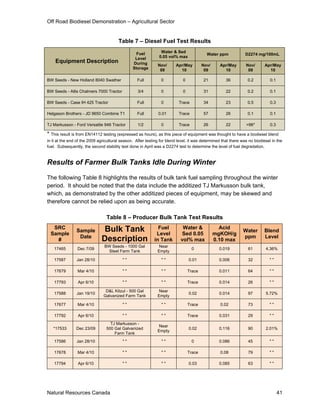
7 – Diesel Fuel Test Results ................................................................................................. 41 
8 – Producer Bulk Tank Test Results ................................................................................... 41 
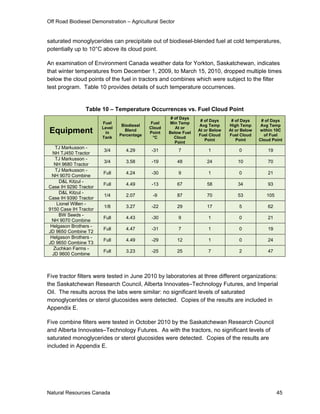
9 – Tractors and Combines in Fuel Filter Test Program ....................................................... 44 
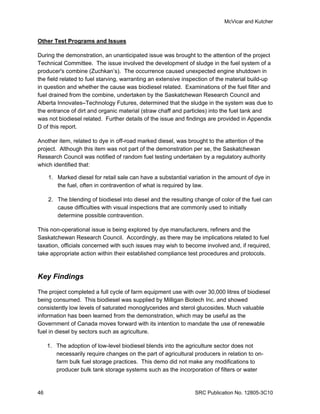
10 – Temperature Occurrences vs. Fuel Cloud Point ........................................................... 45 


List of Figures

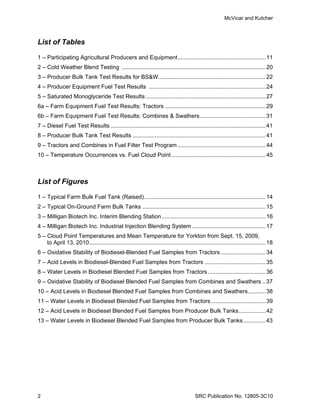
1 – Typical Farm Bulk Fuel Tank (Raised) ............................................................................ 14 
2 – Typical On-Ground Farm Bulk Tanks ............................................................................. 15 
3 – Milligan Biotech Inc. Interim Blending Station ................................................................. 16 
4 – Milligan Biotech Inc. Industrial Injection Blending System .............................................. 17 
5 – Cloud Point Temperatures and Mean Temperature for Yorkton from Sept. 15, 2009,
    to April 13, 2010 .............................................................................................................. 18 
6 – Oxidative Stability of Biodiesel-Blended Fuel Samples from Tractors ............................ 34 
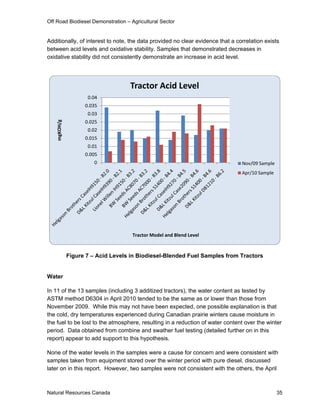
7 – Acid Levels in Biodiesel-Blended Fuel Samples from Tractors ...................................... 35 
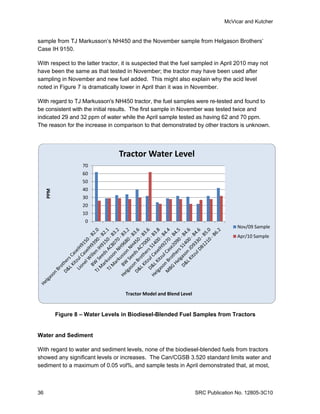
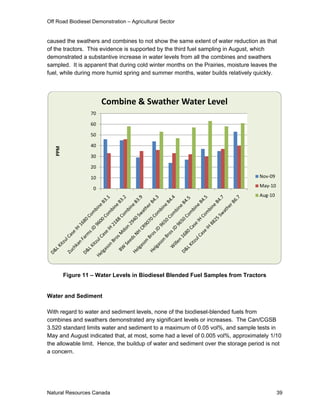
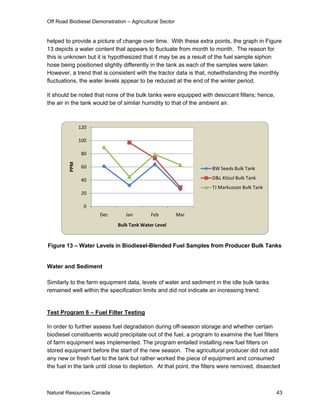
8 – Water Levels in Biodiesel Blended Fuel Samples from Tractors .................................... 36 
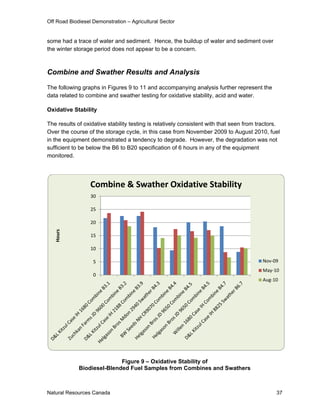
9 – Oxidative Stability of Biodiesel Blended Fuel Samples from Combines and Swathers .. 37 
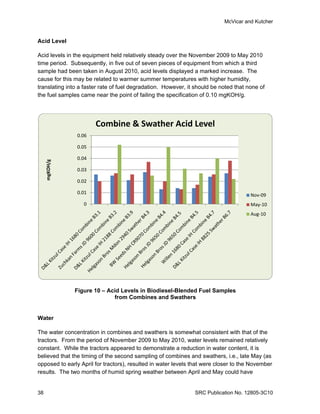
10 – Acid Levels in Biodiesel Blended Fuel Samples from Combines and Swathers ........... 38 
11 – Water Levels in Biodiesel Blended Fuel Samples from Tractors .................................. 39 
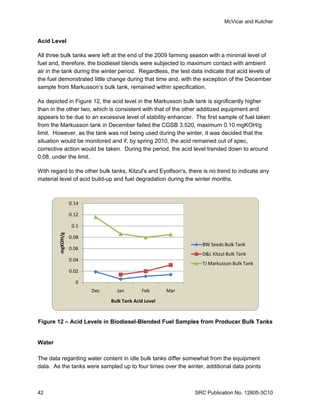
12 – Acid Levels in Biodiesel Blended Fuel Samples from Producer Bulk Tanks................. 42 
13 – Water Levels in Biodiesel Blended Fuel Samples from Producer Bulk Tanks .............. 43 


2                                                                                         SRC Publication No. 12805-3C10
Off Road Biodiesel Demonstration – Agricultural Sector


DISCLAIMER

This report does not necessarily reflect the views or positions of the Government of Canada.


Sponsors and Participants

The Saskatchewan Off Road Biodiesel Demonstration – Agriculture Sector has been made
possible through the participation and support of a number of organizations and individuals:

   Natural Resources Canada (NRCan)
   Saskatchewan Research Council
   Milligan Biotech Inc. (MBTI)
   Clearview Agro
   Saskatchewan Canola Development Commission
   Enterprise Saskatchewan

and eight agricultural producers:

   TJ Markusson Agro
   MBG Helgason Farm
   Helgason Brothers
   Dale and Laurie Kitzul
   Lionel Willen
   Zuchkan Farms Land and Livestock Limited
   BW Seeds
   Dagnall Farms


Acknowledgements

The demonstration would like to acknowledge the valuable contribution made to the project
by its Steering/Technical Committee consisting of the following individuals:

   Grant McVicar – Saskatchewan Research Council
   Zenneth Faye – Milligan Biotech Inc.
   Mark Stumborg – Agriculture and Agri-Food Canada
   Stu Porter – Canadian Renewable Fuels Association
   Pierre Sylvestre – Environment Canada
   Nik Ekstrom – Natural Resources Canada
   Gilles Morel – Canadian Petroleum Products Institute
   Dave Kutcher – New Energy Consulting
   Greg Northey – Canadian Federation of Agriculture
   Ron Kehrig – Enterprise Saskatchewan


Natural Resources Canada                                                                       3
McVicar and Kutcher


Glossary of Terms

Acid Level – The amount of harmful acids formed in fuel due to degradation

ASTM – American Society for Testing and Materials, the American standards body that
facilitates the development of and publishes consensus-based standards and test methods
for a wide number of products, including diesel, biodiesel and biodiesel blends

Biodiesel – The term commonly used for FAME, fatty acid methyl ester, a renewable diesel
substitute

Bxx – Finished blends of biodiesel and diesel fuel where xx represents the percentage of
biodiesel in the blend

CGSB – Canadian General Standards Board, the Canadian standards body that facilitates
the development of and publishes consensus-based standards and test methods for a wide
number of products, including diesel, biodiesel and biodiesel blends

Cloud Point – The temperature of a liquid specimen when the smallest observable cluster of
wax crystals first appears upon cooling under prescribed conditions

Filter Blocking Tendency – An ASTM test that determines a fuel's tendency to plug a filter

PPM – Parts per million

Oxidation – The interaction between oxygen molecules and various substances they may
contact; oxidation of biodiesel leads to fuel degradation

Oxidative Stability – A measure of fuel's resistance to oxidation

Precipitate – A solid that forms in a liquid

Repeatability – A formula that provides an acceptable range of test results from the same
sample on the same equipment by the same operator

Reproducibility – A formula that provides an acceptable range of test results from
homogeneous samples of the same fuel on the same equipment in a different lab by a
different operator

Saturated monoglycerides – Fatty acid monoesters of glycerol that have a high melting point

Seasonal Diesel – Diesel fuel made available to retail or bulk facilities that is temperature
adjusted to meet the 2.5% low-end temperature anticipated for a specific location and time
of use; also known as Type B diesel.

Temperature Maps – CGSB maps and geographic descriptions that provide guidance
related to temperature-specific fuel properties


4                                                              SRC Publication No. 12805-3C10
Off Road Biodiesel Demonstration – Agricultural Sector


Type A Diesel – Diesel intended for use in selected applications or when ambient
temperatures require better low-temperature properties than Type B

ULSD – Ultra Low Sulphur Diesel, diesel of which the sulphur content is equal to or less
than 15 mg/kg sulphur


Natural Resources Canada                                                                   5
McVicar and Kutcher


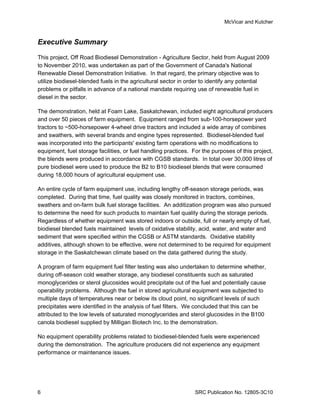
Executive Summary

This project, Off Road Biodiesel Demonstration - Agriculture Sector, held from August 2009
to November 2010, was undertaken as part of the Government of Canada's National
Renewable Diesel Demonstration Initiative. In that regard, the primary objective was to
utilize biodiesel-blended fuels in the agricultural sector in order to identify any potential
problems or pitfalls in advance of a national mandate requiring use of renewable fuel in
diesel in the sector.

The demonstration, held at Foam Lake, Saskatchewan, included eight agricultural producers
and over 50 pieces of farm equipment. Equipment ranged from sub-100-horsepower yard
tractors to ~500-horsepower 4-wheel drive tractors and included a wide array of combines
and swathers, with several brands and engine types represented. Biodiesel-blended fuel
was incorporated into the participants' existing farm operations with no modifications to
equipment, fuel storage facilities, or fuel handling practices. For the purposes of this project,
the blends were produced in accordance with CGSB standards. In total over 30,000 litres of
pure biodiesel were used to produce the B2 to B10 biodiesel blends that were consumed
during 18,000 hours of agricultural equipment use.

An entire cycle of farm equipment use, including lengthy off-season storage periods, was
completed. During that time, fuel quality was closely monitored in tractors, combines,
swathers and on-farm bulk fuel storage facilities. An additization program was also pursued
to determine the need for such products to maintain fuel quality during the storage periods.
Regardless of whether equipment was stored indoors or outside, full or nearly empty of fuel,
biodiesel blended fuels maintained levels of oxidative stability, acid, water, and water and
sediment that were specified within the CGSB or ASTM standards. Oxidative stability
additives, although shown to be effective, were not determined to be required for equipment
storage in the Saskatchewan climate based on the data gathered during the study.

A program of farm equipment fuel filter testing was also undertaken to determine whether,
during off-season cold weather storage, any biodiesel constituents such as saturated
monoglycerides or sterol glucosides would precipitate out of the fuel and potentially cause
operability problems. Although the fuel in stored agricultural equipment was subjected to
multiple days of temperatures near or below its cloud point, no significant levels of such
precipitates were identified in the analysis of fuel filters. We concluded that this can be
attributed to the low levels of saturated monoglycerides and sterol glucosides in the B100
canola biodiesel supplied by Milligan Biotech Inc. to the demonstration.

No equipment operability problems related to biodiesel-blended fuels were experienced
during the demonstration. The agriculture producers did not experience any equipment
performance or maintenance issues.


6                                                               SRC Publication No. 12805-3C10
Off Road Biodiesel Demonstration – Agricultural Sector


During the demonstration a number of issues were encountered which required action
and/or examination. These included:

       A cold weather blend issue that required the incorporation of a very low cloud point
        Type A diesel to blend with off-specification fuel that the demo had in inventory.
       A B10 fuel foaming issue that was determined to be caused by excessive flow into a
        confined space.
       A portable slip tank issue related to a faulty transfer pump.
       A B10 distillation issue that was related to existing ASTM specifications not
        correlating well with the Canadian situation. The Can/CGSB standard relating to B6
        to B20 fuels, currently under development, is expected to address this issue.
       A diesel fuel lubricity issue that was determined to be the result of an additive
        miscalculation at the source refinery.
       A fuel sludge issue in a combine that was determined to be a collection of dirt,
        metals and non-biodiesel related organics, which had been building up in the fuel
        tank over time.


Natural Resources Canada                                                                   7
McVicar and Kutcher


Background

Biodiesel is a fuel produced from renewable sources such as vegetable oils (canola, soy,
rapeseed, etc.) and/or animal fats that can be blended with petrol-diesel and utilized in
compression ignition engines without modification. Biodiesel is of particular interest to
agricultural producers for its potential to create new markets for agricultural crops, support
commodity prices, and provide business and employment opportunities in rural areas.

Governments, both federal and provincial across Canada, are moving forward with or
considering the adoption of policies or mandates to increase the use of biodiesel blended
fuels. Given the unique duty cycle of agricultural equipment and fuel consumption, a real-
world demonstration was important to determine the applicability of biodiesel to the sector
and ensure that the fuel would perform as required.

From a technical perspective, biodiesel can offer certain benefits such as good fuel lubricity,
high cetane value, and a significant reduction in exhaust and life cycle greenhouse gas
emissions. However, biodiesel's high cloud point, which can range from -5°C to +15°C,
requires management related to blending levels and practices in colder weather climates
such as those typical of a Canadian winter. A second critical concern, particularly for the
farm community, is oxidative stability of the fuel and its quality retention, as it is often stored
for long periods during the off-season, both summer and winter, in on-farm storage tanks
and in equipment such as tractors, sprayers, combines and windrowers (swathers).


Objectives

This off-road demonstration of biodiesel was intended to evaluate the suitability of biodiesel
blends within the Western Canadian agricultural sector prior to the initiation of a biodiesel
mandate.

More specifically, the objectives of this project were to:

    Primarily
    1. Evaluate B5 and B10 blends of canola-based biodiesel over a full cycle of farm
       equipment operations of approximately 12 months.
    2. Examine and determine blending and storage considerations with close regard to
       tank preparation and fuel stability and quality over time in accordance with the duty
       cycle of the blending, distribution and storage facilities.
    3. Determine the impact of off-season storage of equipment in relation to fuel quality
       and degradation in the fuel tank.
    4. Determine any issues specific to the use of biodiesel blends, including equipment
       performance (e.g., general operability), maintenance requirements and operator
       perceptions.


8                                                                 SRC Publication No. 12805-3C10
Off Road Biodiesel Demonstration – Agricultural Sector


   Secondarily
   5. Create significant hands-on experience for this sector.
   6. Develop best practice guidelines for biodiesel blends.
   7. Provide valuable data for equipment manufacturers and end users.


Location

The demonstration was completed at Foam Lake, Saskatchewan, a rural community
situated on the Yellowhead Highway #16 between Saskatoon and Yorkton. Foam Lake is
surrounded by agricultural producers growing cereal grains, oilseeds and legumes, as well
as raising various livestock such as cattle and buffalo. It was selected as the site for the
demonstration because it is a typical farming community and the location of Saskatchewan's
only biodiesel producer, Milligan Biotech Inc. The site also provided the ability to establish a
biodiesel blending site in cooperation with a local independent bulk fuel dealer, Clearview
Agro Ltd., which agreed to dedicate a delivery truck to the project.

The eight participating agricultural producers are located within a 50 km radius of Foam
Lake.


Timeframe

The demonstration period covered 16 months, from August of 2009 to November 2010, in
order to encompass a complete duty cycle of agricultural equipment and bulk fuel storage
use. Typically, the duty cycle of agricultural equipment on the Canadian prairies is as
follows:

Spring

        Farm tractors, which have been sitting idle since the previous fall, are started,
         serviced and used for land preparation and planting of the annual crop. The fuel in
         this equipment has typically been unused for (up to) approximately 4 to 6 months
         and subjected to temperatures as low as -40°C over the winter storage period.
        Spraying equipment, which has normally been stored since the previous spring, is
         started, serviced and used for the application of chemicals and herbicides on crops.
         The fuel in this equipment has been unused for (up to) approximately 9 to 11 months
         and has been subjected not only to winter temperature extremes but also to warmer
         summer weather as the machine sits idle.

Summer

        Small and large tractors are used during the summer months for jobs such as land
         maintenance and livestock operations. Equipment for these operations is likely to


Natural Resources Canada                                                                       9
McVicar and Kutcher


           have been used for spring work or throughout the winter season for a number of
           duties.
          Swathers, which have been stored since the previous harvest season, are started
           and serviced. Depending on whether the swather is also used for forage operations
           on the farm, the fuel can go unused for 10 to 11 months and has been subjected to
           extreme cold weather in winter and warm spring and summer weather.
          Late in the summer, combines are started and serviced for the harvest season.
           Typically, this equipment has not been operated since the previous year's harvest
           and the fuel has been unused for approximately 10 months. As with swathers, the
           fuel has experienced both extreme cold winter and warm spring and summer
           temperatures while idle.

Fall

          Fall work consists of harvest completion, preparation for winter, and potentially land
           work or seeding for the next crop year. Equipment used during this season may
           have been used in prior seasons and hence the fuel is likely to be relatively fresh.
           Larger tractors, however, may have been sitting idle since completion of spring
           seeding and hence the fuel may be 3 or 4 months old.

Winter

          During winter, the bulk of farm equipment is in storage. However, some tractors may
           be used for duties such as livestock operations, yard maintenance (i.e., snow
           removal) or grain handling. This equipment has typically been used throughout the
           other seasons of the year and hence the fuel is relatively fresh.

This report covers the results of the demonstration period from August 2009 to November
2010. During that period, all types of farm equipment targeted have seen use on a blend of
biodiesel fuel. Total hours of operation were approximately 18,000, consuming over 30,000
litres of biodiesel blended into 430,000 litres of diesel fuel.


Participating Agricultural Equipment

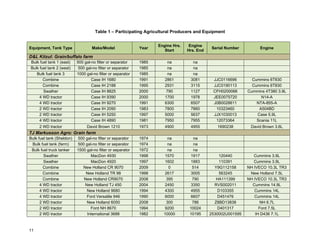
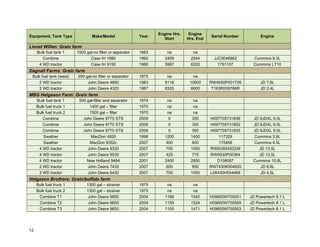
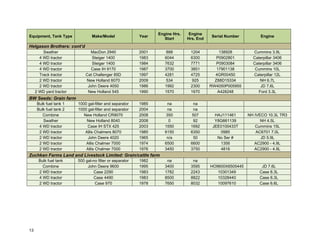
Details of farm equipment and on-farm bulk fuel storage facilities utilized in the demo are
outlined in the following Table 1.


10                                                                 SRC Publication No. 12805-3C10
Table 1 – Participating Agricultural Producers and Equipment


                                                                    Engine Hrs.    Engine
Equipment, Tank Type               Make/Model                Year                             Serial Number        Engine
                                                                       Start      Hrs. End
D&L Kitzul: Grain/buffalo farm
Bulk fuel tank 1 (east)    500 gal-no filter or separator    1985       na          na
Bulk fuel tank 2 (west)     500 gal-no filter or separator   1985       na          na
   Bulk fuel tank 3        1000 gal-no filter or separator   1985       na          na
       Combine                     Case IH 1680              1991      2861        3081       JJC0116696        Cummins 6T830
       Combine                     Case IH 2188              1995      2931        3115       JJC0190113        Cummins 6T830
       Swather                     Case IH 8825              2000       790        1127       CFH0200066      Cummins 4T380 3.9L
     4 WD tractor                  Case IH 9390              2000      1700        1978       JEE0075720            N14-A
     4 WD tractor                  Case IH 9270              1991      6300        6507       J0B0028611          NTA-855-A
     2 WD tractor                  Case IH 2090              1983      7800        7860        10323460            A504BD
     2 WD tractor                  Case IH 5250              1997      5000        5637       JJX1030013          Case 5.9L
     4 WD tractor                  Case IH 4890              1981      7950        7955        12073364           Scania 11L
     2 WD tractor               David Brown 1210             1973      4900        4955         1690238        David Brown 3.6L
TJ Markusson Agro: Grain farm
Bulk fuel tank (Sheldon)   500 gal-no filter or separator    1974      na            na
 Bulk fuel tank (farm)     500 gal-no filter or separator    1974      na            na
 Bulk fuel truck tanker    1500 gal-no filter or separator   1972      na            na
        Swather                   MacDon 4930                1998     1570         1917          120440          Cummins 3.9L
        Swather                   MacDon 4920                1997     1602         1883          110391          Cummins 3.9L
        Combine               New Holland CR 9070            2009       0           514        Y9G112158      NH IVECO 10.3L TR3
        Combine                New Holland TR 98             1998     2617         3005          563245        New Holland 7.5L
        Combine               New Holland CR9070             2008      395          790         HA111399      NH IVECO 10.3L TR3
      4 WD tractor             New Holland TJ 450            2004     2450         3350        RVS002011        Cummins 14.9L
      4 WD tractor              New Holland 9680             1994     4300         4955          D103355         Cummins 14L
      4 WD tractor              Ford Versatile 946           1990     6000         6607          D451476         Cummins 14L
      2 WD tractor              New Holland 6050             2008      300          786        Z8BD13838            NH 6.7L
      2 WD tractor                Ford NH 8670               1994     9200         10024         D401317            Ford 7.5L
      2 WD tractor              International 3688           1982     10000        10195     2530002U001595       IH D436 7.1L


11
Engine Hrs.    Engine
Equipment, Tank Type             Make/Model                Year                            Serial Number        Engine
                                                                     Start      Hrs. End

Lionel Willen: Grain farm
     Bulk fuel tank 1    1000 gal-no filter or separator   1983       na          na
        Combine                 Case IH 1680               1992      2409        2544       JJC0046962       Cummins 8.3L
      4 WD tractor              Case IH 9150               1989      5997        6203         1791107        Cummins LT10
Dagnall Farms: Grain farm
 Bulk fuel tank (west)   300 gal-no filter or separator    1975       na          na
     2 WD tractor             John Deere 4650              1983      9118        10600     RW4650P001726        JD 7.6L
     2 WD tractor             John Deere 4320              1967      8325        8600       T163R009766R        JD 2.4L
MBG Helgason Farm: Grain farm
     Bulk fuel tank 1     500 gal-filter and separator     1974       na          na
     Bulk fuel truck 1         1400 gal – filter           1970       na          na
     Bulk fuel truck 2         1500 gal – filter           1970       na          na
        Combine             John Deere 9770 STS            2009        0         350       H097705731836    JD 9JDXL 9.0L
        Combine             John Deere 9770 STS            2009        0         350       H097705731802    JD 9JDXL 9.0L
        Combine             John Deere 9770 STS            2009        0         350       H097705731935    JD 9JDXL 9.0L
         Swather                MacDon 4920                1998      1200        1400          117329       Cummins 3.9L
         Swather               MacDon 9352c                2007       400        600           175458       Cummins 4.5L
      4 WD tractor            John Deere 9330              2007       700        1050      RW9330H00339       JD 13.5L
      4 WD tractor            John Deere 9530              2007       425        775       RW9530P00364       JD 13.5L
      4 WD tractor            New Holland 9484             2001      2450        2850         D108087       Cummins 10.8L
      2 WD tractor            John Deere 7430              2007       600        950       RW7430K004820       JD 6.8L
      2 WD tractor            John Deere 6430              2007       700        1050      L06430H554668       JD 4.5L
Helgason Brothers: Grain/buffalo farm
     Bulk fuel truck 1        1300 gal – strainer          1975       na          na
     Bulk fuel truck 2        1300 gal – strainer          1975       na          na
      Combine T1               John Deere 9650             2004      1166        1540      H09650W700551   JD Powertech 8.1 L
      Combine T2               John Deere 9650             2004      1159        1524      H09650W700569   JD Powertech 8.1 L
      Combine T3               John Deere 9650             2004      1105        1471      H09650W700553   JD Powertech 8.1 L


12
Engine Hrs.    Engine
Equipment, Tank Type             Make/Model               Year                            Serial Number          Engine
                                                                    Start      Hrs. End
Helgason Brothers: cont’d
         Swather               MacDon 2940                2001       888        1204          138928         Cummins 3.9L
       4 WD tractor             Steiger 1400              1983      6044        6300         P0902801        Caterpillar 3406
       4 WD tractor             Steiger 1400              1984      7632        7771         P0903084        Caterpillar 3406
       4 WD tractor            Case IH 9170               1987      3700        3851         17901138         Cummins 10L
       Track tractor         Cat Challenger 85D           1997      4281        4725        4GR00450         Caterpillar 12L
       2 WD tractor          New Holland 6070             2009       534        925         Z88D15334           NH 6.7L
       2 WD tractor           John Deere 4050             1986      1992        2300      RW4050P005955         JD 7.6L
     2 WD yard tractor        New Holland 545             1990      1570        1670         A428248           Ford 3.3L
BW Seeds: Grain farm
      Bulk fuel tank 1   1000 gal-filter and separator    1985       na          na
      Bulk fuel tank 2   1000 gal-filter and separator    2004       na          na
         Combine            New Holland CR9070            2008       350        507         HAJ111461      NH IVECO 10.3L TR3
         Swather             New Holland 8040             2008        0          92         Y8G661139            NH 4.5L
       4 WD tractor          Case IH STX 425              2003      1550        1692       JEE0100433T        Cummins 15L
       2 WD tractor         Allis Chalmers 8070           1985      6150        6350          0985             AC6701 7.0L
       2 WD tractor           John Deere 4020             1965       n/a         50          No Ser #            JD 5.9L
       2 WD tractor          Allis Chalmer 7000           1974      6500        6600          1356            AC2900 - 4.9L
       2 WD tractor          Allis Chalmer 7000           1976      3450        3750          4816            AC2900 - 4.9L
Zuchkan Farms Land and Livestock Limited: Grain/cattle farm
      Bulk fuel tank     500 gal-no filter or separator   1982       na          na
        Combine               John Deere 9600             1995      3400        3595      HO9600X6505445         JD 7.6L
      2 WD tractor               Case 2290                1983      1782        2243         10301349           Case 8.3L
      4 WD tractor               Case 4490                1983      8500        8822         10328440           Case 8.3L
      2 WD tractor                Case 970                1978      7650        8032         10097610           Case 6.6L


13
McVicar and Kutcher


Equipment storage practices on the farm can vary considerably. Some producers have
unheated storage facilities in which to keep equipment during the off-season, while others
may leave certain pieces or all of their equipment parked outside. The equipment may be
full of fuel or parked with what was left in the tank at the end of its seasonal use. Hence,
agriculture equipment, and the fuel in it, is subjected to all types of weather elements,
including full exposure to wide variations in temperature and humidity, with significant
exposure to air inside the fuel tank. During the demo period, actual temperatures ranged
from -36°C in winter to +31°C in summer.

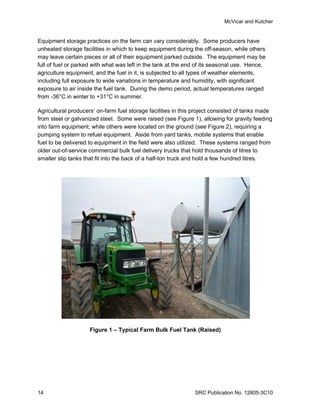
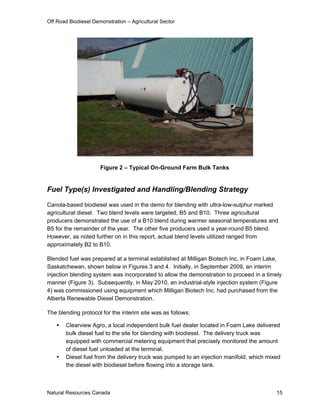
Agricultural producers’ on-farm fuel storage facilities in this project consisted of tanks made
from steel or galvanized steel. Some were raised (see Figure 1), allowing for gravity feeding
into farm equipment; while others were located on the ground (see Figure 2), requiring a
pumping system to refuel equipment. Aside from yard tanks, mobile systems that enable
fuel to be delivered to equipment in the field were also utilized. These systems ranged from
older out-of-service commercial bulk fuel delivery trucks that hold thousands of litres to
smaller slip tanks that fit into the back of a half-ton truck and hold a few hundred litres.


                     Figure 1 – Typical Farm Bulk Fuel Tank (Raised)


14                                                             SRC Publication No. 12805-3C10
Off Road Biodiesel Demonstration – Agricultural Sector


                      Figure 2 – Typical On-Ground Farm Bulk Tanks


Fuel Type(s) Investigated and Handling/Blending Strategy

Canola-based biodiesel was used in the demo for blending with ultra-low-sulphur marked
agricultural diesel. Two blend levels were targeted, B5 and B10. Three agricultural
producers demonstrated the use of a B10 blend during warmer seasonal temperatures and
B5 for the remainder of the year. The other five producers used a year-round B5 blend.
However, as noted further on in this report, actual blend levels utilized ranged from
approximately B2 to B10.

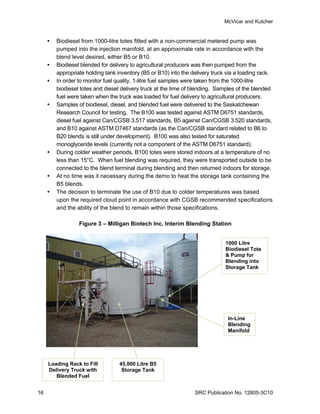
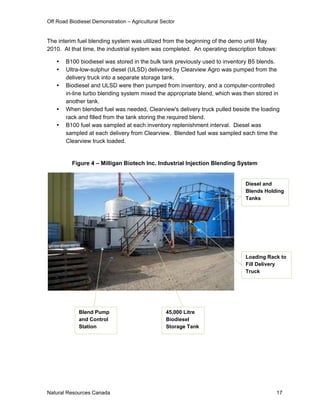
Blended fuel was prepared at a terminal established at Milligan Biotech Inc. in Foam Lake,
Saskatchewan, shown below in Figures 3 and 4. Initially, in September 2009, an interim
injection blending system was incorporated to allow the demonstration to proceed in a timely
manner (Figure 3). Subsequently, in May 2010, an industrial-style injection system (Figure
4) was commissioned using equipment which Milligan Biotech Inc. had purchased from the
Alberta Renewable Diesel Demonstration.

The blending protocol for the interim site was as follows:

      Clearview Agro, a local independent bulk fuel dealer located in Foam Lake delivered
       bulk diesel fuel to the site for blending with biodiesel. The delivery truck was
       equipped with commercial metering equipment that precisely monitored the amount
       of diesel fuel unloaded at the terminal.
      Diesel fuel from the delivery truck was pumped to an injection manifold, which mixed
       the diesel with biodiesel before flowing into a storage tank.


Natural Resources Canada                                                                 15
McVicar and Kutcher


        Biodiesel from 1000-litre totes fitted with a non-commercial metered pump was
         pumped into the injection manifold, at an approximate rate in accordance with the
         blend level desired, either B5 or B10.
        Biodiesel blended for delivery to agricultural producers was then pumped from the
         appropriate holding tank inventory (B5 or B10) into the delivery truck via a loading rack.
        In order to monitor fuel quality, 1-litre fuel samples were taken from the 1000-litre
         biodiesel totes and diesel delivery truck at the time of blending. Samples of the blended
         fuel were taken when the truck was loaded for fuel delivery to agricultural producers.
        Samples of biodiesel, diesel, and blended fuel were delivered to the Saskatchewan
         Research Council for testing. The B100 was tested against ASTM D6751 standards,
         diesel fuel against Can/CGSB 3.517 standards, B5 against Can/CGSB 3.520 standards,
         and B10 against ASTM D7467 standards (as the Can/CGSB standard related to B6 to
         B20 blends is still under development). B100 was also tested for saturated
         monoglyceride levels (currently not a component of the ASTM D6751 standard).
        During colder weather periods, B100 totes were stored indoors at a temperature of no
         less than 15°C. When fuel blending was required, they were transported outside to be
         connected to the blend terminal during blending and then returned indoors for storage.
        At no time was it necessary during the demo to heat the storage tank containing the
         B5 blends.
        The decision to terminate the use of B10 due to colder temperatures was based
         upon the required cloud point in accordance with CGSB recommended specifications
         and the ability of the blend to remain within those specifications.

                  Figure 3 – Milligan Biotech Inc. Interim Blending Station


                                                                               1000 Litre
                                                                               Biodiesel Tote
                                                                               & Pump for
                                                                               Blending into
                                                                               Storage Tank


                                                                                In-Line
                                                                                Blending
                                                                                Manifold


     Loading Rack to Fill          45,000 Litre B5
     Delivery Truck with            Storage Tank
        Blended Fuel


16                                                                SRC Publication No. 12805-3C10
Off Road Biodiesel Demonstration – Agricultural Sector


The interim fuel blending system was utilized from the beginning of the demo until May
2010. At that time, the industrial system was completed. An operating description follows:

      B100 biodiesel was stored in the bulk tank previously used to inventory B5 blends.
      Ultra-low-sulphur diesel (ULSD) delivered by Clearview Agro was pumped from the
       delivery truck into a separate storage tank.
      Biodiesel and ULSD were then pumped from inventory, and a computer-controlled
       in-line turbo blending system mixed the appropriate blend, which was then stored in
       another tank.
      When blended fuel was needed, Clearview's delivery truck pulled beside the loading
       rack and filled from the tank storing the required blend.
      B100 fuel was sampled at each inventory replenishment interval. Diesel was
       sampled at each delivery from Clearview. Blended fuel was sampled each time the
       Clearview truck loaded.


          Figure 4 – Milligan Biotech Inc. Industrial Injection Blending System


                                                                             Diesel and
                                                                             Blends Holding
                                                                             Tanks


                                                                             Loading Rack to
                                                                             Fill Delivery
                                                                             Truck


             Blend Pump                           45,000 Litre
             and Control                          Biodiesel
             Station                              Storage Tank


Natural Resources Canada                                                                 17
McVicar and Kutcher


Temperature

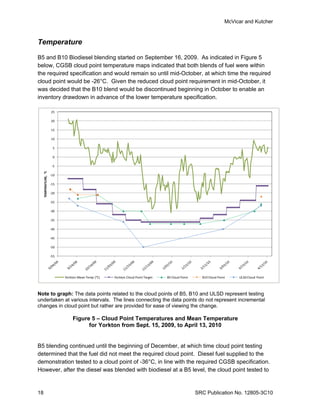
B5 and B10 Biodiesel blending started on September 16, 2009. As indicated in Figure 5
below, CGSB cloud point temperature maps indicated that both blends of fuel were within
the required specification and would remain so until mid-October, at which time the required
cloud point would be -26°C. Given the reduced cloud point requirement in mid-October, it
was decided that the B10 blend would be discontinued beginning in October to enable an
inventory drawdown in advance of the lower temperature specification.

                        25

                        20

                        15

                        10

                         5

                         0

                         ‐5
     TEMPERATURE,  °C


                        ‐10

                        ‐15

                        ‐20

                        ‐25

                        ‐30

                        ‐35

                        ‐40

                        ‐45

                        ‐50

                        ‐55


                              Yorkton Mean Temp (°C)   Yorkton Cloud Point Target   B5 Cloud Point     B10 Cloud Point    ULSD Cloud Point


Note to graph: The data points related to the cloud points of B5, B10 and ULSD represent testing
undertaken at various intervals. The lines connecting the data points do not represent incremental
changes in cloud point but rather are provided for ease of viewing the change.

                                  Figure 5 – Cloud Point Temperatures and Mean Temperature
                                        for Yorkton from Sept. 15, 2009, to April 13, 2010


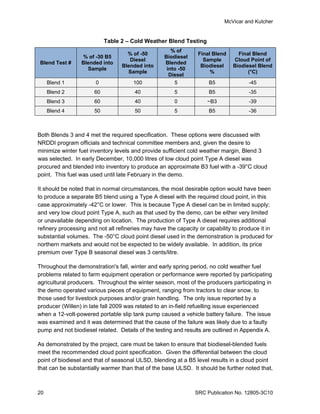
B5 blending continued until the beginning of December, at which time cloud point testing
determined that the fuel did not meet the required cloud point. Diesel fuel supplied to the
demonstration tested to a cloud point of -36°C, in line with the required CGSB specification.
However, after the diesel was blended with biodiesel at a B5 level, the cloud point tested to


18                                                                                                   SRC Publication No. 12805-3C10
Off Road Biodiesel Demonstration – Agricultural Sector


be -30°C, approximately 6 degrees off-spec. It should be noted that this error was due to a
fuel testing delay related to finalization of funding agreements for the project. Hence, this
situation would not be expected to occur in a mandated environment where blenders would
pay close regard to ensure that blended fuel meets the required temperature spec.
However, in this situation, immediate action was required, and in that regard a number of
options were considered:

   1. Type A Diesel – A number of fuel suppliers were contacted with regard to the
      provision of a low cloud point Type A diesel. Various suppliers stated having
      products with cloud points ranging from approximately -40 to -50°C. Experience
      from the demo indicated that adding biodiesel at a B5 blend level resulted in an
      approximate 6-degree increase in the final blend's cloud point; therefore, fuel with a
      cloud point of -42°C or lower would be required in order to produce a blended fuel to
      meet the -36°C CGSB spec.
   2. Ultra Low Sulphur Kerosene (ULSK) – The Alberta Renewable Diesel Demonstration
      utilized ultra low sulphur kerosene with a cloud point of -45°C to produce a blended
      fuel that met the required specification. Attempts were made to identify local sources
      of ULSK but were unsuccessful.
   3. Low Cloud Point Jet Fuel – This fuel was not vigorously pursued because the bulk
      fuel dealer in the demo had no access to secure a supply of it. As such, it was not
      confirmed whether the fuel would have been an acceptable option.

Given the foregoing, Option 1 was the most feasible to pursue. However, as the project had
an existing inventory of B5 with a -30°C cloud point, a decision on how to proceed was
necessary. Two directions were considered:

   1. Produce a separate batch of B5 fuel with Type A diesel having a cloud point of
      approximately -42°C or lower to meet the -36°C specification.
   2. Determine if a low cloud point Type A diesel could be blended with the existing
      inventory to bring the fuel back into specification.

Additional fuel storage at the Milligan Biotech Inc. blend station was unavailable. It was thus
decided to obtain a sample of very low cloud point Type A diesel (-50°C) available to the
demo and undertake testing to determine if the existing inventory of fuel could be brought
into spec with the addition of this low cloud point fuel and whether a B5 blend could be
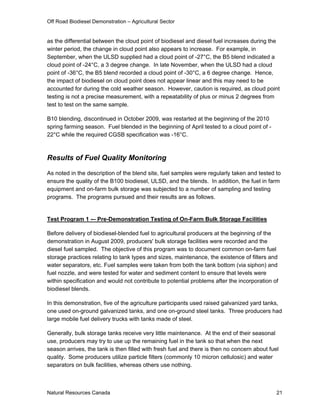
maintained. Table 2 outlines the results of this testing.


Natural Resources Canada                                                                     19
McVicar and Kutcher


                           Table 2 – Cold Weather Blend Testing
                                                      % of
                                    % of -50                    Final Blend     Final Blend
                 % of -30 B5                       Biodiesel
                                     Diesel                       Sample      Cloud Point of
 Blend Test #    Blended into                      Blended
                                  Blended into                   Biodiesel    Biodiesel Blend
                   Sample                           into -50
                                    Sample                           %              (°C)
                                                     Diesel
     Blend 1           0              100              5             B5              -45
     Blend 2          60               40              5             B5              -35
     Blend 3          60               40              0            ~B3              -39
     Blend 4          50               50              5             B5              -36


Both Blends 3 and 4 met the required specification. These options were discussed with
NRDDI program officials and technical committee members and, given the desire to
minimize winter fuel inventory levels and provide sufficient cold weather margin, Blend 3
was selected. In early December, 10,000 litres of low cloud point Type A diesel was
procured and blended into inventory to produce an approximate B3 fuel with a -39°C cloud
point. This fuel was used until late February in the demo.

It should be noted that in normal circumstances, the most desirable option would have been
to produce a separate B5 blend using a Type A diesel with the required cloud point, in this
case approximately -42°C or lower. This is because Type A diesel can be in limited supply;
and very low cloud point Type A, such as that used by the demo, can be either very limited
or unavailable depending on location. The production of Type A diesel requires additional
refinery processing and not all refineries may have the capacity or capability to produce it in
substantial volumes. The -50°C cloud point diesel used in the demonstration is produced for
northern markets and would not be expected to be widely available. In addition, its price
premium over Type B seasonal diesel was 3 cents/litre.

Throughout the demonstration's fall, winter and early spring period, no cold weather fuel
problems related to farm equipment operation or performance were reported by participating
agricultural producers. Throughout the winter season, most of the producers participating in
the demo operated various pieces of equipment, ranging from tractors to clear snow, to
those used for livestock purposes and/or grain handling. The only issue reported by a
producer (Willen) in late fall 2009 was related to an in-field refuelling issue experienced
when a 12-volt-powered portable slip tank pump caused a vehicle battery failure. The issue
was examined and it was determined that the cause of the failure was likely due to a faulty
pump and not biodiesel related. Details of the testing and results are outlined in Appendix A.

As demonstrated by the project, care must be taken to ensure that biodiesel-blended fuels
meet the recommended cloud point specification. Given the differential between the cloud
point of biodiesel and that of seasonal ULSD, blending at a B5 level results in a cloud point
that can be substantially warmer than that of the base ULSD. It should be further noted that,


20                                                             SRC Publication No. 12805-3C10
Off Road Biodiesel Demonstration – Agricultural Sector


as the differential between the cloud point of biodiesel and diesel fuel increases during the
winter period, the change in cloud point also appears to increase. For example, in
September, when the ULSD supplied had a cloud point of -27°C, the B5 blend indicated a
cloud point of -24°C, a 3 degree change. In late November, when the ULSD had a cloud
point of -36°C, the B5 blend recorded a cloud point of -30°C, a 6 degree change. Hence,
the impact of biodiesel on cloud point does not appear linear and this may need to be
accounted for during the cold weather season. However, caution is required, as cloud point
testing is not a precise measurement, with a repeatability of plus or minus 2 degrees from
test to test on the same sample.

B10 blending, discontinued in October 2009, was restarted at the beginning of the 2010
spring farming season. Fuel blended in the beginning of April tested to a cloud point of -
22°C while the required CGSB specification was -16°C.


Results of Fuel Quality Monitoring

As noted in the description of the blend site, fuel samples were regularly taken and tested to
ensure the quality of the B100 biodiesel, ULSD, and the blends. In addition, the fuel in farm
equipment and on-farm bulk storage was subjected to a number of sampling and testing
programs. The programs pursued and their results are as follows.


Test Program 1 -– Pre-Demonstration Testing of On-Farm Bulk Storage Facilities

Before delivery of biodiesel-blended fuel to agricultural producers at the beginning of the
demonstration in August 2009, producers' bulk storage facilities were recorded and the
diesel fuel sampled. The objective of this program was to document common on-farm fuel
storage practices relating to tank types and sizes, maintenance, the existence of filters and
water separators, etc. Fuel samples were taken from both the tank bottom (via siphon) and
fuel nozzle, and were tested for water and sediment content to ensure that levels were
within specification and would not contribute to potential problems after the incorporation of
biodiesel blends.

In this demonstration, five of the agriculture participants used raised galvanized yard tanks,
one used on-ground galvanized tanks, and one on-ground steel tanks. Three producers had
large mobile fuel delivery trucks with tanks made of steel.

Generally, bulk storage tanks receive very little maintenance. At the end of their seasonal
use, producers may try to use up the remaining fuel in the tank so that when the next
season arrives, the tank is then filled with fresh fuel and there is then no concern about fuel
quality. Some producers utilize particle filters (commonly 10 micron cellulosic) and water
separators on bulk facilities, whereas others use nothing.


Natural Resources Canada                                                                      21
McVicar and Kutcher


Of interest to note is that, prior to the start of the demo, participants were asked if they
would consider preparing their tanks for the adoption of biodiesel. Such would include the
adoption of filters and water separators and ensuring that materials are compatible with
biodiesel-blended fuels. Unanimously, the producers indicated they would prefer to adopt
biodiesel into their refuelling system as is and not incur any costs or make any changes to
their infrastructure or practices. Hence, this demonstration and the results from it are
expected to reflect a real-world situation whereby agricultural producers would not change
their systems or practices subsequent to any federal or provincial mandates requiring the
use of biodiesel-blended fuels.

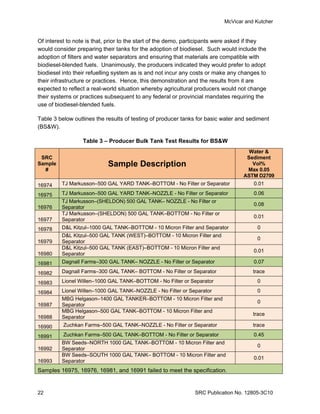
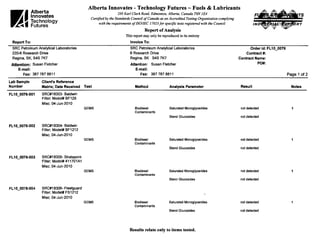
Table 3 below outlines the results of testing of producer tanks for basic water and sediment
(BS&W).

                  Table 3 – Producer Bulk Tank Test Results for BS&W
                                                                                    Water &
 SRC                                                                               Sediment
Sample                      Sample Description                                       Vol%
  #                                                                                Max 0.05
                                                                                  ASTM D2709
16974    TJ Markusson–500 GAL YARD TANK–BOTTOM - No Filter or Separator               0.01

16975    TJ Markusson–500 GAL YARD TANK–NOZZLE - No Filter or Separator               0.06
         TJ Markusson–(SHELDON) 500 GAL TANK– NOZZLE - No Filter or
                                                                                      0.08
16976    Separator
         TJ Markusson–(SHELDON) 500 GAL TANK–BOTTOM - No Filter or
                                                                                      0.01
16977    Separator
16978    D&L Kitzul–1000 GAL TANK–BOTTOM - 10 Micron Filter and Separator               0
         D&L Kitzul–500 GAL TANK (WEST)–BOTTOM - 10 Micron Filter and
                                                                                        0
16979    Separator
         D&L Kitzul–500 GAL TANK (EAST)–BOTTOM - 10 Micron Filter and
                                                                                      0.01
16980    Separator
16981    Dagnall Farms–300 GAL TANK– NOZZLE - No Filter or Separator                  0.07

16982    Dagnall Farms–300 GAL TANK– BOTTOM - No Filter or Separator                  trace

16983    Lionel Willen–1000 GAL TANK–BOTTOM - No Filter or Separator                    0

16984    Lionel Willen–1000 GAL TANK–NOZZLE - No Filter or Separator                    0
         MBG Helgason–1400 GAL TANKER–BOTTOM - 10 Micron Filter and
                                                                                        0
16987    Separator
         MBG Helgason–500 GAL TANK–BOTTOM - 10 Micron Filter and
                                                                                      trace
16988    Separator
16990     Zuchkan Farms–500 GAL TANK–NOZZLE - No Filter or Separator                  trace

16991     Zuchkan Farms–500 GAL TANK–BOTTOM - No Filter or Separator                  0.45
         BW Seeds–NORTH 1000 GAL TANK–BOTTOM - 10 Micron Filter and
                                                                                        0
16992    Separator
         BW Seeds–SOUTH 1000 GAL TANK– BOTTOM - 10 Micron Filter and
                                                                                      0.01
16993    Separator
Samples 16975, 16976, 16981, and 16991 failed to meet the specification.


22                                                             SRC Publication No. 12805-3C10
Off Road Biodiesel Demonstration – Agricultural Sector


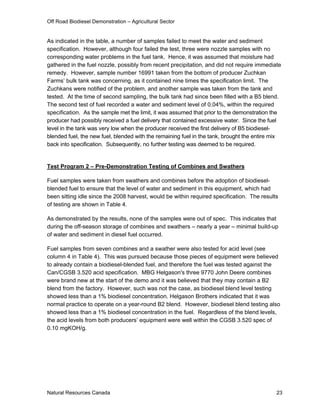
As indicated in the table, a number of samples failed to meet the water and sediment
specification. However, although four failed the test, three were nozzle samples with no
corresponding water problems in the fuel tank. Hence, it was assumed that moisture had
gathered in the fuel nozzle, possibly from recent precipitation, and did not require immediate
remedy. However, sample number 16991 taken from the bottom of producer Zuchkan
Farms’ bulk tank was concerning, as it contained nine times the specification limit. The
Zuchkans were notified of the problem, and another sample was taken from the tank and
tested. At the time of second sampling, the bulk tank had since been filled with a B5 blend.
The second test of fuel recorded a water and sediment level of 0.04%, within the required
specification. As the sample met the limit, it was assumed that prior to the demonstration the
producer had possibly received a fuel delivery that contained excessive water. Since the fuel
level in the tank was very low when the producer received the first delivery of B5 biodiesel-
blended fuel, the new fuel, blended with the remaining fuel in the tank, brought the entire mix
back into specification. Subsequently, no further testing was deemed to be required.


Test Program 2 – Pre-Demonstration Testing of Combines and Swathers

Fuel samples were taken from swathers and combines before the adoption of biodiesel-
blended fuel to ensure that the level of water and sediment in this equipment, which had
been sitting idle since the 2008 harvest, would be within required specification. The results
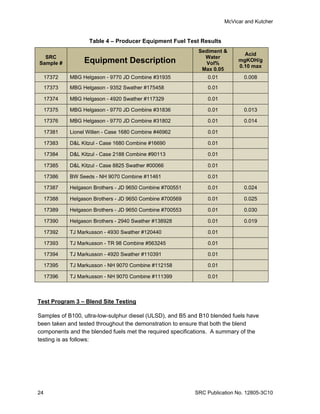
of testing are shown in Table 4.

As demonstrated by the results, none of the samples were out of spec. This indicates that
during the off-season storage of combines and swathers – nearly a year – minimal build-up
of water and sediment in diesel fuel occurred.

Fuel samples from seven combines and a swather were also tested for acid level (see
column 4 in Table 4). This was pursued because those pieces of equipment were believed
to already contain a biodiesel-blended fuel, and therefore the fuel was tested against the
Can/CGSB 3.520 acid specification. MBG Helgason's three 9770 John Deere combines
were brand new at the start of the demo and it was believed that they may contain a B2
blend from the factory. However, such was not the case, as biodiesel blend level testing
showed less than a 1% biodiesel concentration. Helgason Brothers indicated that it was
normal practice to operate on a year-round B2 blend. However, biodiesel blend testing also
showed less than a 1% biodiesel concentration in the fuel. Regardless of the blend levels,
the acid levels from both producers’ equipment were well within the CGSB 3.520 spec of
0.10 mgKOH/g.


Natural Resources Canada                                                                     23
McVicar and Kutcher


                    Table 4 – Producer Equipment Fuel Test Results
                                                            Sediment &
                                                                             Acid
  SRC                                                         Water
Sample #          Equipment Description                        Vol%
                                                                           mgKOH/g
                                                                           0.10 max
                                                             Max 0.05
     17372   MBG Helgason - 9770 JD Combine #31935             0.01          0.008
     17373   MBG Helgason - 9352 Swather #175458               0.01

     17374   MBG Helgason - 4920 Swather #117329               0.01

     17375   MBG Helgason - 9770 JD Combine #31836             0.01          0.013

     17376   MBG Helgason - 9770 JD Combine #31802             0.01          0.014

     17381   Lionel Willen - Case 1680 Combine #46962          0.01

     17383   D&L Kitzul - Case 1680 Combine #16690             0.01

     17384   D&L Kitzul - Case 2188 Combine #90113             0.01

     17385   D&L Kitzul - Case 8825 Swather #00066             0.01

     17386   BW Seeds - NH 9070 Combine #11461                 0.01

     17387   Helgason Brothers - JD 9650 Combine #700551       0.01          0.024

     17388   Helgason Brothers - JD 9650 Combine #700569       0.01          0.025

     17389   Helgason Brothers - JD 9650 Combine #700553       0.01          0.030

     17390   Helgason Brothers - 2940 Swather #138928          0.01          0.019

     17392   TJ Markusson - 4930 Swather #120440               0.01

     17393   TJ Markusson - TR 98 Combine #563245              0.01

     17394   TJ Markusson - 4920 Swather #110391               0.01

     17395   TJ Markusson - NH 9070 Combine #112158            0.01

     17396   TJ Markusson - NH 9070 Combine #111399            0.01


Test Program 3 – Blend Site Testing

Samples of B100, ultra-low-sulphur diesel (ULSD), and B5 and B10 blended fuels have
been taken and tested throughout the demonstration to ensure that both the blend
components and the blended fuels met the required specifications. A summary of the
testing is as follows:


24                                                         SRC Publication No. 12805-3C10
Off Road Biodiesel Demonstration – Agricultural Sector


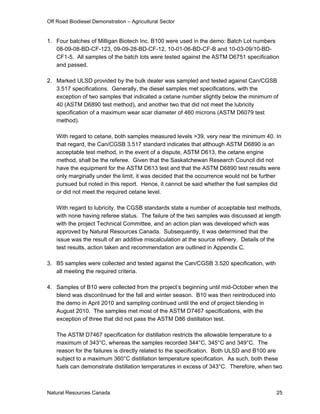
1. Four batches of Milligan Biotech Inc. B100 were used in the demo: Batch Lot numbers
   08-09-08-BD-CF-123, 09-09-28-BD-CF-12, 10-01-06-BD-CF-B and 10-03-09/10-BD-
   CF1-5. All samples of the batch lots were tested against the ASTM D6751 specification
   and passed.

2. Marked ULSD provided by the bulk dealer was sampled and tested against Can/CGSB
   3.517 specifications. Generally, the diesel samples met specifications, with the
   exception of two samples that indicated a cetane number slightly below the minimum of
   40 (ASTM D6890 test method), and another two that did not meet the lubricity
   specification of a maximum wear scar diameter of 460 microns (ASTM D6079 test
   method).

   With regard to cetane, both samples measured levels >39, very near the minimum 40. In
   that regard, the Can/CGSB 3.517 standard indicates that although ASTM D6890 is an
   acceptable test method, in the event of a dispute, ASTM D613, the cetane engine
   method, shall be the referee. Given that the Saskatchewan Research Council did not
   have the equipment for the ASTM D613 test and that the ASTM D6890 test results were
   only marginally under the limit, it was decided that the occurrence would not be further
   pursued but noted in this report. Hence, it cannot be said whether the fuel samples did
   or did not meet the required cetane level.

   With regard to lubricity, the CGSB standards state a number of acceptable test methods,
   with none having referee status. The failure of the two samples was discussed at length
   with the project Technical Committee, and an action plan was developed which was
   approved by Natural Resources Canada. Subsequently, it was determined that the
   issue was the result of an additive miscalculation at the source refinery. Details of the
   test results, action taken and recommendation are outlined in Appendix C.

3. B5 samples were collected and tested against the Can/CGSB 3.520 specification, with
   all meeting the required criteria.

4. Samples of B10 were collected from the project’s beginning until mid-October when the
   blend was discontinued for the fall and winter season. B10 was then reintroduced into
   the demo in April 2010 and sampling continued until the end of project blending in
   August 2010. The samples met most of the ASTM D7467 specifications, with the
   exception of three that did not pass the ASTM D86 distillation test.

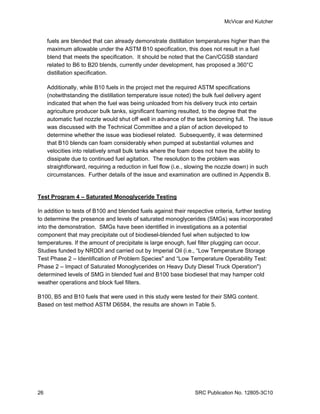
   The ASTM D7467 specification for distillation restricts the allowable temperature to a
   maximum of 343°C, whereas the samples recorded 344°C, 345°C and 349°C. The
   reason for the failures is directly related to the specification. Both ULSD and B100 are
   subject to a maximum 360°C distillation temperature specification. As such, both these
   fuels can demonstrate distillation temperatures in excess of 343°C. Therefore, when two


Natural Resources Canada                                                                  25
McVicar and Kutcher


     fuels are blended that can already demonstrate distillation temperatures higher than the
     maximum allowable under the ASTM B10 specification, this does not result in a fuel
     blend that meets the specification. It should be noted that the Can/CGSB standard
     related to B6 to B20 blends, currently under development, has proposed a 360°C
     distillation specification.

     Additionally, while B10 fuels in the project met the required ASTM specifications
     (notwithstanding the distillation temperature issue noted) the bulk fuel delivery agent
     indicated that when the fuel was being unloaded from his delivery truck into certain
     agriculture producer bulk tanks, significant foaming resulted, to the degree that the
     automatic fuel nozzle would shut off well in advance of the tank becoming full. The issue
     was discussed with the Technical Committee and a plan of action developed to
     determine whether the issue was biodiesel related. Subsequently, it was determined
     that B10 blends can foam considerably when pumped at substantial volumes and
     velocities into relatively small bulk tanks where the foam does not have the ability to
     dissipate due to continued fuel agitation. The resolution to the problem was
     straightforward, requiring a reduction in fuel flow (i.e., slowing the nozzle down) in such
     circumstances. Further details of the issue and examination are outlined in Appendix B.


Test Program 4 – Saturated Monoglyceride Testing

In addition to tests of B100 and blended fuels against their respective criteria, further testing
to determine the presence and levels of saturated monoglycerides (SMGs) was incorporated
into the demonstration. SMGs have been identified in investigations as a potential
component that may precipitate out of biodiesel-blended fuel when subjected to low
temperatures. If the amount of precipitate is large enough, fuel filter plugging can occur.
Studies funded by NRDDI and carried out by Imperial Oil (i.e., “Low Temperature Storage
Test Phase 2 – Identification of Problem Species" and “Low Temperature Operability Test:
Phase 2 – Impact of Saturated Monoglycerides on Heavy Duty Diesel Truck Operation")
determined levels of SMG in blended fuel and B100 base biodiesel that may hamper cold
weather operations and block fuel filters.

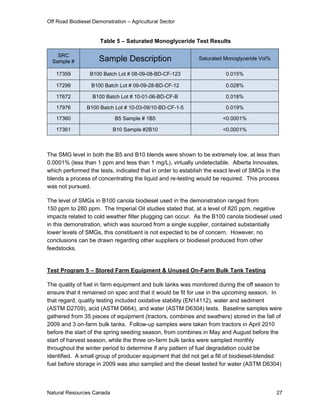
B100, B5 and B10 fuels that were used in this study were tested for their SMG content.
Based on test method ASTM D6584, the results are shown in Table 5.


26                                                              SRC Publication No. 12805-3C10
Off Road Biodiesel Demonstration – Agricultural Sector


                      Table 5 – Saturated Monoglyceride Test Results

    SRC
  Sample #           Sample Description                      Saturated Monoglyceride Vol%

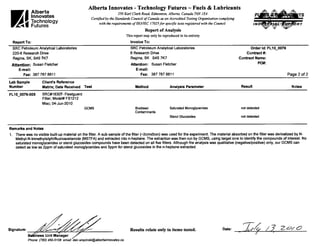
   17359          B100 Batch Lot # 08-09-08-BD-CF-123                   0.015%

   17299          B100 Batch Lot # 09-09-28-BD-CF-12                    0.028%

   17672           B100 Batch Lot # 10-01-06-BD-CF-B                    0.018%

   17976        B100 Batch Lot # 10-03-09/10-BD-CF-1-5                  0.019%

   17360                    B5 Sample # 1B5                           <0.0001%

   17361                   B10 Sample #2B10                           <0.0001%


The SMG level in both the B5 and B10 blends were shown to be extremely low, at less than
0.0001% (less than 1 ppm and less than 1 mg/L), virtually undetectable. Alberta Innovates,
which performed the tests, indicated that in order to establish the exact level of SMGs in the
blends a process of concentrating the liquid and re-testing would be required. This process
was not pursued.

The level of SMGs in B100 canola biodiesel used in the demonstration ranged from
150 ppm to 280 ppm. The Imperial Oil studies stated that, at a level of 820 ppm, negative
impacts related to cold weather filter plugging can occur. As the B100 canola biodiesel used
in this demonstration, which was sourced from a single supplier, contained substantially
lower levels of SMGs, this constituent is not expected to be of concern. However, no
conclusions can be drawn regarding other suppliers or biodiesel produced from other
feedstocks.


Test Program 5 – Stored Farm Equipment & Unused On-Farm Bulk Tank Testing

The quality of fuel in farm equipment and bulk tanks was monitored during the off season to
ensure that it remained on spec and that it would be fit for use in the upcoming season. In
that regard, quality testing included oxidative stability (EN14112), water and sediment
(ASTM D2709), acid (ASTM D664), and water (ASTM D6304) tests. Baseline samples were
gathered from 35 pieces of equipment (tractors, combines and swathers) stored in the fall of
2009 and 3 on-farm bulk tanks. Follow-up samples were taken from tractors in April 2010
before the start of the spring seeding season, from combines in May and August before the
start of harvest season, while the three on-farm bulk tanks were sampled monthly
throughout the winter period to determine if any pattern of fuel degradation could be
identified. A small group of producer equipment that did not get a fill of biodiesel-blended
fuel before storage in 2009 was also sampled and the diesel tested for water (ASTM D6304)


Natural Resources Canada                                                                    27
McVicar and Kutcher


and oxidative stability (ASTM test D2274). The results of fuel quality testing are highlighted
in Tables 6a, 6b, 7 and 8.

In addition to this testing, a program was undertaken to determine the potential need for
oxidative stability additives to maintain biodiesel-blended fuel quality during the off-season
storage of equipment. Oxidative stability provides an indication of fuel degradation, and
additives are designed to ensure that biodiesel and biodiesel blends maintain adequate
levels. While pure diesel and biodiesel-blended fuels ranging from B1 to B5 are not subject
to an oxidation stability standard, B100 and biodiesel blends from B6 to B20 are, as
measured by the EN14112 test method. The ASTM oxidation stability standard for B100
biodiesel is a minimum of three hours while the standard for blends B6 to B20 is six.
Accordingly, given the six hours set for higher level blends of biodiesel, lower level blends
should naturally indicate greater levels of oxidative stability (>6 hours).

The additive program entailed a number of pieces of farm equipment and one producer bulk
tank. Changes in fuel stability over the storage period in comparison to non-additized
equipment were monitored. At the recommendation of the additive supplier, fuel in
equipment was treated at a rate of 1000 ppm. Treatment consisted of calculating the
approximate amount of biodiesel-blended fuel in the equipment's tank, adding the
appropriate amount of additive, and then driving the machine to ensure that the product was
well mixed into the fuel. The equipment was then stored for the off season. The results of
the program are discussed in isolation further on.

The following Tables 6a and 6b highlight the findings of tractor, combine and swather fuel
sampling. As indicated in the tables, the biodiesel content in tractors, combines and
swathers ranged from B2 to B8. There are a number of reasons for this:

     1. The interim blend site established at Milligan Biotech Inc. that operated from
        September 2009 to May 2010 was developed without a commercial metering system
        on the biodiesel injection side. In order to produce a B5 blend, the valve on the 1000
        litre tote was set so that approximately 1/2 or 500 litres would be injected while
        10,000 litres of diesel fuel was pumped into the storage tank. This system therefore
        would provide some inconsistency to the final blend.

     2. Various pieces of equipment such as 4-wheel drive tractors were not used
        extensively before being stored at the end of the 2009 season. Hence, biodiesel-
        blended fuel may have been co-mixed with existing diesel fuel in the equipment tank,
        resulting in a lower level blend.

Equipment with blends greater than 5% are owned by agricultural participants who had
agreed to use B10 blends. As B10 was discontinued in October and harvest continued well
into November, these pieces may have been subsequently filled with a B5 blend which
diluted the B10.


28                                                             SRC Publication No. 12805-3C10
Table 6a – Farm Equipment Fuel Test Results: Tractors
                                                       Water & Sed
                                                                           Acid mgKOH/g                                   Oxidative Stability
                                              Fuel        Vol%                                       Water ppm
                                                                            0.10 max **                                       EN14112            Blend Level
                                             Level      0.05 max                                    ASTM D6304
    Equipment Description                                                   ASTM D664                                            hrs             ASTM D7371
                                            During     ASTM 2709
                                            Storage
                                                      Nov/09   Apr/10   Nov/09      Apr/10      Nov/09      Apr/10       Nov/09        Apr/10

       Willen - 9150 Case IH Tractor          1/8       0        0      0.020       0.013         33          29          22.6          14.53      3.27%

BW Seeds - Allis Chalmers 7000 Tractor        3/4       0        0      0.032       0.011         24          22          17.5           16.6      3.84%

BW Seeds - Allis Chalmers 8070 Tractor        1/2       0      Trace    0.015       0.016         34          28          19.2          12.85      3.24%

TJ Markusson - New Holland 9680 Tractor       3/4       0        0      0.070       0.056         40          30          >96*          81.39      3.58%
                                                                                                                                        0.3
TJ Markusson - Ford Versatile 946 Tractor     1/2       0      Trace    0.043       0.044         26          22          >96*        mg/100ml      <1%
                                                                                                                                       Note 1
   TJ Markusson - NH TJ450 Tractor            3/4       0      Trace    0.067       0.055         32          62          95.9*         50.58      4.29%

     D&L Kitzul - Case 2090 Tractor          Full       0        0      0.017       0.036         31          22          13.8          17.09      4.61%

   D&L Kitzul - Case IH 9390 Tractor          1/4       0      Trace    0.019       0.014         29          29          22.9          21.88      2.07%

   D&L Kitzul - Case IH 9270 Tractor         Full       0        0      0.029       0.018         32          28          26.7          28.98      4.49%

 D&L Kitzul - David Brown 1210 Tractor        3/4       0        0      0.021       0.021         42          32           8.3          14.58      6.22%

  Helgason Bros - Steiger 1400 Tractor        3/4       0        0      0.014       0.019         29          28          19.6          16.87      4.36%

  Helgason Bros - Steiger 1400 Tractor        1/2       0      Trace    0.020       0.023         22          27          21.8          21.23      4.59%

 Helgason Bros - Case IH 9150 Tractor         1/2      0.02    Trace    0.034       0.007         62          26          22.8          11.36      1.97%

MBG Helgason - NH 9484 Tractor - Note 2       NA        0      Trace    0.127        0.22         38          30         70-90*          NA        6.17%

    MBG Helgason - JD 9330 Tractor            1/8       0      Trace    0.069       0.055         32          28          >96*          39.03      4.98%

MBG Helgason - JD 9530 Tractor - Note 3       NA        0       NA      0.031        NA           36          NA          34.1*          NA        4.97%


  * This equipment was additized with an oxidative stability enhancer at a level of 1000 ppm.
  ** The B1 to B5 standard for acid level (ASTM D664 test method) is 0.10 mgKOH/g, while the B6 to B20 standard is 0.30 mg/KOH/g


  29
Note 1 - In November 2009 when sampled, it was believed this tractor contained a biodiesel blend, which was later determined not to be the case. Accordingly the
second sample was tested using ASTM test D2274, more suitable for diesel fuel to determine the level of degradation.

Note 2 - The producer decided not to park this tractor for the off-season and used it periodically. The second sample of fuel was tested for water and sediment,
acid and water to provide a basic indication of fuel quality. Hence, the results of testing between the two samples are not correlated.

Note 3 - After the first sample was taken in the fall of 2009, the tractor was traded and sold to another producer outside of the demo. Attempts were made to
obtain another sample from the tractor prior to the spring seeding season but were unsuccessful.


30
Table 6b – Farm Equipment Fuel Test Results: Combines & Swathers
                                                  Water & Sed Vol%           Acid mgKOH/g                                       Oxidative Stability      Blend
                                       Fuel                                                                Water ppm
                                                      0.05 max                0.10 max **                                           EN14112              Level
                                      Level                                                               ASTM D6304
 Equipment Description                              ASTM 2709                 ASTM D664                                                hrs               ASTM
                                     During
                                                Nov      Apr     Aug     Nov      Apr       Aug     Nov       Apr      Aug    Nov       Apr       Aug    D7371
                                     Storage
                                                 09      10       10      09      10         10      09       10        10     09       10         10

  Willen - 1680 Case IH Combine        1/8       0      Trace   0.005    0.024   0.026      0.040   35        37       58     18.6      8.73      6.66   4.72%

 BW Seeds - NH CR9070 Combine         Full       0      Trace   0.005    0.013    0.02      0.05    24        33       47     9.4      17.46     15.12   4.43%

 Zuchkan Farms - JD 9600 Combine      Full       0      Trace   0.005    0.025   0.027      0.052   45        46       58     22.5     20.94     18.64   3.23%

TJ Markusson - NH TR 98 Combine       Full       0        0          0   0.092   0.101      0.044   36        38       40    >96*       NA        NA     4.25%

TJ Markusson - NH CR9070 Combine      Full       0        0     0.005    0.096   0.075      0.099   33        44       78    >96*       NA       66.59   4.24%

 TJ Markusson - PStar 4920 Swather     3/4       0      Trace   0.005    0.073   0.077      0.048   39        40       62    >96*       NA        NA     3.36%

TJ Markusson - PStar 4930 Swather      3/4      .01       0     0.005    0.073   0.071      0.033   34        36       46    50-80*     NA       107.5   3.89%
TJ Markusson - NH CR9070 Combine
                                       1/4       0      Trace    NA      0.081   0.079       NA     35        37       NA    >96*       NA        NA     4.28%
               Note 1
 D&L Kitzul - Case IH 2188 Combine
                                      Full       0      Trace    NA      0.021   0.026       NA     29        35       NA     22.5     24.12      NA     3.89%
               Note 2
 D&L Kitzul - Case IH 1680 Combine
                                      Full       0      Trace    NA      0.026   0.020       NA     46        33       NA     21.7     23.57      NA     3.07%
               Note 2
 D&L Kitzul - Case IH 8825 Swather    Full      .01     Trace   0.005    0.027   0.038      0.022   53        40       61     8.8      10.53      10.2   6.68%

Helgason Bros - Mdon 2940 Swather     Full       0      Trace   0.005    0.028   0.037      0.025   44        36       53     18.2     10.34      14.1   4.32%

 Helgason Bros - JD 9650 Combine      Full       0      Trace   0.005    0.014   0.013      0.031   27        32       57     20.1     16.67     14.19   4.47%

 Helgason Bros - JD 9650 Combine      Full       0      Trace   0.005    0.014   0.017      0.027   37        30       63     20.4     17.07     15.00   4.49%
MBG Helgason - Mdon 9352 Swather
                                      <1/8       0       NA      NA      0.050    NA         NA     44        NA       NA    47.0*      NA        NA     8.36%
            Note 3
 MBG Helgason - JD 9770 Combine       < 1/8      0       0.03        0   0.069    0.02      0.044   26        66       40    >96*       0.1       0.2    <1%

 MBG Helgason - JD 9770 Combine       < 1/8     .02     0.005   0.005    0.073   0.028      0.065   75        50       40    90.2*       32      33.17   4.91%
 MBG Helgason - JD 9770 Combine
                                       NA        0       NA      NA      0.103    NA         NA     25        NA       NA    >96*       NA        NA     <1%
            Note 4
MBG Helgason - PStar 4920 Swather
                                     Empty     Note 1    NA      NA      0.100    NA         NA     42        NA       NA     NA*       NA        NA     7.95%
            Note 5


    31
* This equipment was additized with an oxidative stability enhancer at a level of 1000 ppm. In certain cases where second and third samples of fuel were taken
from the equipment, oxidative stability test results were inconclusive due to the excessive level of additive utilized. As such, the results are listed as not available
(NA).

** The B1 to B5 standard for acid level (ASTM D664 test method) is 0.10 mgKOH/g, while the B6 to B20 standard is 0.30 mg/KOH/g.

Note 1 - Before the 2010 harvest season, this combine was sold to another producer outside the demonstration. Attempts were made to obtain a third sample
from the equipment but were unsuccessful.

Note 2 - Subsequent to the second sampling of these combines, the producer notified the demonstration that the combines had been filled with diesel fuel.
Therefore, a third sample was not taken, as it would provide not meaningful correlation.

Note 3 - After the first sample was taken in the fall of 2009, this swather was traded and sold to another producer outside of the demo. Attempts were made to
obtain another sample prior to the 2010 harvest season but were unsuccessful.

Note 4 - After the first sample was taken in the fall of 2009, this combine was traded in. The dealership that took the trade rented the machine to another producer
who filled the tank with diesel fuel. Hence, no further samples were taken.

Note 5 - This piece of equipment contained an insufficient fuel level to obtain the required quantity of sample to undertake all the tests. As such, further sampling
was not able to be undertaken.


32
Off Road Biodiesel Demonstration – Agricultural Sector


Tractor Results and Analysis

The following Figures 6 to 8 and accompanying analysis further represent the data related to
tractor testing for oxidative stability, acid and water.

Oxidative Stability

The results of oxidative stability testing are relatively consistent with expectations that fuel in
farm equipment could demonstrate a quality reduction over the winter storage period.
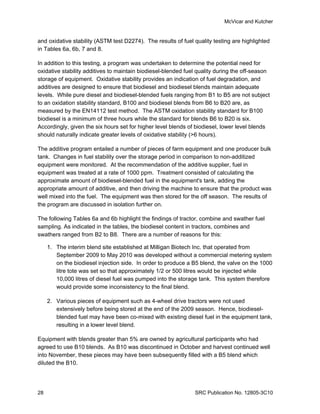
Samples taken in November 2009 before winter storage demonstrated a range from a low of
8 hours to a high of 27 hours of oxidative stability. Biodiesel blend levels in the tractors
varied from B2.0 to B6.2 and, as expected, the sample from the tractor with the highest
blend level, B6.2, demonstrated the lowest level of stability. However, samples from the
other tractors, with B2.0 to B4.6 blends, were relatively similar in oxidative stability: there
was little trend of a higher blend equating to materially reduced stability.

Samples taken from the tractors in April 2010 all demonstrated sufficient stability in excess
of the ASTM B6-20 standard of 6 hours indicating that during the winter off-season
excessive oxidation does not occur. (Note: The Can/CGSB 3.520 standard for blends B1-B5
does not contain an oxidative stability standard.) However, the degree of oxidation varied,
with some samples indicating little change while others dipped nearly 50%. Additionally, the
change in stability from November 2009 to April 2010 did not indicate a correlation between
higher blends and increased oxidation over the period.
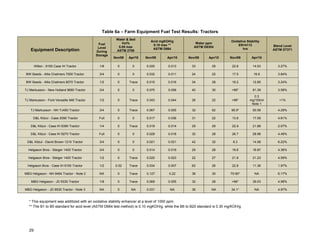
The fuel in three of D&L Kitzul’s tractors, the Case IH 2090, Case IH 9270, and David Brown
1210, did not match expectations, demonstrating increased as opposed to decreased
oxidative stability over the winter period. However, when the test results of two of the
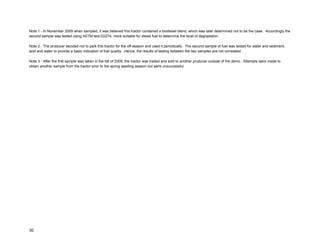
tractors, the Case IH 9270 and Case IH 2090, are taken and considered against an
acceptable range of reproducibility for the EN14112 test, the numbers fall within an
acceptable range. Hence, the samples can be considered as having similar stability and as
not having degraded over the winter. The results from the third tractor, however – the David
Brown 1210 – did not fall within the acceptable range. The two fuel samples from this
tractor were tested a total of eight times, five for the November 2009 sample and three for
the April 2010 sample. Results from the November sample varied from a low of 7.62 hours
to a high of 8.54 hours, with a mean average of 7.99. Results from the April 2010 sample
varied from a low of 13.55 hours to a high of 15.42, with an average of 14.52. As these
results could not be explained by test reproducibility and no logical explanation was evident,
three additional fuel samples from the tractor were procured for testing. The three samples
consisted of fuel siphoned from the top of the tank, bottom of the tank, and after the tractor
had been driven around the farmyard for approximately 5 minutes to agitate the fuel.
Oxidative stability tests on the fuel taken from the top, bottom and after being mixed showed
results of approximately 12 hours’ stability, falling within the acceptable range of test
reproducibility.


Natural Resources Canada                                                                        33
McVicar and Kutcher


The oxidative stability data of all the tractors did not demonstrate any trend with regard to
the fuel level or whether the machine was stored in an unheated shed or outside exposed to
the weather. Kitzul's Case IH 9390 and Case IH 9270 were stored inside an unheated shed,
while all other units remained outside during the winter, and fuel levels varied from a low of
1/8 tank to a full tank.


                            Tractor Oxidative Stability
                 35
                 30
                 25
                 20
     Hours


                 15
                 10
                  5
                  0
                                                                                    Nov/09 Sample
                                                                                    Apr/10 Sample


                                    Tractor Model and Blend Level


      Figure 6 – Oxidative Stability of Biodiesel-Blended Fuel Samples from Tractors


Acid Level

The data also did not demonstrate a clear trend in regard to changing acid levels over the
winter idle period. While acid numbers did increase on four out of ten samples, six
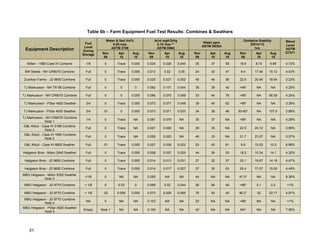
registered a decrease, opposite of an expected uptick which would indicate that the fuel is
degrading over time. Regardless of the results, all samples fell well below the Can/CGSB
3.520 (B1-B5) specification of a maximum of 0.10 mgKOH/g.

Although the data were inconsistent, it should be noted that the results fell within the
acceptable range of test reproducibility; therefore, it can be considered that acid levels in the
fuel did not materially change during the winter storage period.
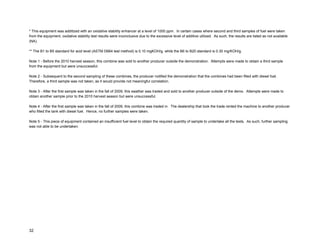


34                                                                  SRC Publication No. 12805-3C10
Off Road Biodiesel Demonstration – Agricultural Sector


Additionally, of interest to note, the data provided no clear evidence that a correlation exists
between acid levels and oxidative stability. Samples that demonstrated decreases in
oxidative stability did not consistently demonstrate an increase in acid level.


                                    Tractor Acid Level
                     0.04
                    0.035
                     0.03
    mgKOH/g


                    0.025
                     0.02
                    0.015
                     0.01
                    0.005
                       0                                                        Nov/09 Sample
                                                                                Apr/10 Sample


                                     Tractor Model and Blend Level


              Figure 7 – Acid Levels in Biodiesel-Blended Fuel Samples from Tractors


Water

In 11 of the 13 samples (including 3 additized tractors), the water content as tested by
ASTM method D6304 in April 2010 tended to be the same as or lower than those from
November 2009. While this may not have been expected, one possible explanation is that
the cold, dry temperatures experienced during Canadian prairie winters cause moisture in
the fuel to be lost to the atmosphere, resulting in a reduction of water content over the winter
period. Data obtained from combine and swather fuel testing (detailed further on in this
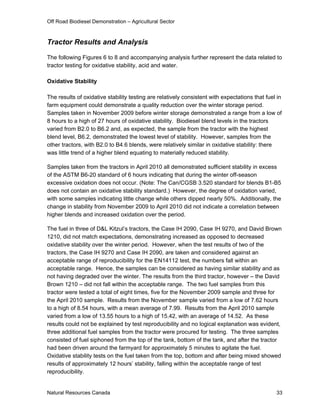
report) appear to add support to this hypothesis.
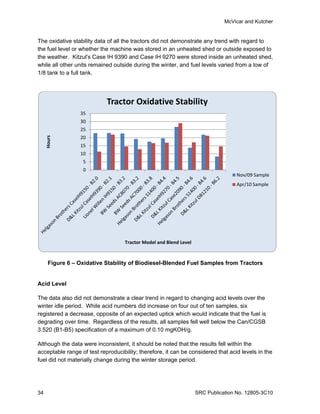
None of the water levels in the samples were a cause for concern and were consistent with
samples taken from equipment stored over the winter period with pure diesel, discussed
later on in this report. However, two samples were not consistent with the others, the April


Natural Resources Canada                                                                        35
McVicar and Kutcher


sample from TJ Markusson’s NH450 and the November sample from Helgason Brothers’
Case IH 9150.

With respect to the latter tractor, it is suspected that the fuel sampled in April 2010 may not
have been the same as that tested in November; the tractor may have been used after
sampling in November and new fuel added. This might also explain why the acid level
noted in Figure 7 is dramatically lower in April than it was in November.

With regard to TJ Markusson's NH450 tractor, the fuel samples were re-tested and found to
be consistent with the initial results. The first sample in November was tested twice and
indicated 29 and 32 ppm of water while the April sample tested as having 62 and 70 ppm.
The reason for the increase in comparison to that demonstrated by other tractors is unknown.


                                 Tractor Water Level
                    70
                    60
                    50
                    40
     PPM


                    30
                    20
                    10
                     0
                                                                                    Nov/09 Sample
                                                                                    Apr/10 Sample


                                    Tractor Model and Blend Level


           Figure 8 – Water Levels in Biodiesel-Blended Fuel Samples from Tractors


Water and Sediment

With regard to water and sediment levels, none of the biodiesel-blended fuels from tractors
showed any significant levels or increases. The Can/CGSB 3.520 standard limits water and
sediment to a maximum of 0.05 vol%, and sample tests in April demonstrated that, at most,


36                                                                  SRC Publication No. 12805-3C10
Off Road Biodiesel Demonstration – Agricultural Sector


some had a trace of water and sediment. Hence, the buildup of water and sediment over
the winter storage period does not appear to be a concern.


Combine and Swather Results and Analysis

The following graphs in Figures 9 to 11 and accompanying analysis further represent the
data related to combine and swather testing for oxidative stability, acid and water.

Oxidative Stability

The results of oxidative stability testing is relatively consistent with that seen from tractors.
Over the course of the storage cycle, in this case from November 2009 to August 2010, fuel
in the equipment demonstrated a tendency to degrade. However, the degradation was not
sufficient to be below the B6 to B20 specification of 6 hours in any of the equipment
monitored.


                  Combine & Swather Oxidative Stability
                  30

                  25

                  20
   Hours


                  15

                  10

                   5                                                                     Nov‐09
                                                                                         May‐10
                   0
                                                                                         Aug‐10


                            Figure 9 – Oxidative Stability of
             Biodiesel-Blended Fuel Samples from Combines and Swathers


Natural Resources Canada                                                                       37
McVicar and Kutcher


Acid Level

Acid levels in the equipment held relatively steady over the November 2009 to May 2010
time period. Subsequently, in five out of seven pieces of equipment from which a third
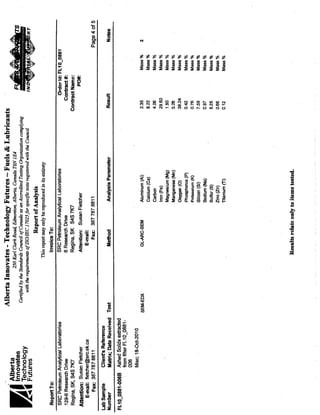
sample had been taken in August 2010, acid levels displayed a marked increase. The
cause for this may be related to warmer summer temperatures with higher humidity,
translating into a faster rate of fuel degradation. However, it should be noted that none of
the fuel samples came near the point of failing the specification of 0.10 mgKOH/g.


                       Combine & Swather Acid Level
                0.06

                0.05

                0.04
     mgKOH/g


                0.03

                0.02

                0.01                                                                  Nov‐09
                  0                                                                   May‐10
                                                                                      Aug‐10


               Figure 10 – Acid Levels in Biodiesel-Blended Fuel Samples
                             from Combines and Swathers


Water

The water concentration in combines and swathers is somewhat consistent with that of the
tractors. From the period of November 2009 to May 2010, water levels remained relatively
constant. While the tractors appeared to demonstrate a reduction in water content, it is
believed that the timing of the second sampling of combines and swathers, i.e., late May (as
opposed to early April for tractors), resulted in water levels that were closer to the November
results. The two months of humid spring weather between April and May could have


38                                                             SRC Publication No. 12805-3C10
Off Road Biodiesel Demonstration – Agricultural Sector


caused the swathers and combines to not show the same extent of water reduction as that
of the tractors. This evidence is supported by the third fuel sampling in August, which
demonstrated a substantive increase in water levels from all the combines and swathers
sampled. It is apparent that during cold winter months on the Prairies, moisture leaves the
fuel, while during more humid spring and summer months, water builds relatively quickly.


                       Combine & Swather Water Level
                  70

                  60

                  50

                  40
   PPM


                  30

                  20

                  10                                                                Nov‐09
                                                                                    May‐10
                   0
                                                                                    Aug‐10


         Figure 11 – Water Levels in Biodiesel Blended Fuel Samples from Tractors


Water and Sediment

With regard to water and sediment levels, none of the biodiesel-blended fuels from
combines and swathers demonstrated any significant levels or increases. The Can/CGSB
3.520 standard limits water and sediment to a maximum of 0.05 vol%, and sample tests in
May and August indicated that, at most, some had a level of 0.005 vol%, approximately 1/10
the allowable limit. Hence, the buildup of water and sediment over the storage period is not
a concern.


Natural Resources Canada                                                                     39
McVicar and Kutcher


Results of Tractors, Combines and Swathers with Stability Additive

In this test program, an oxidative stability additive was mixed into the fuel of tractors, combines
and swathers at a level of 1000 ppm in November 2009. However, after treatment and testing
of oxidative stability and acid level to establish a baseline, it was determined that the treat rate
was well in excess of what would have been required to ensure a sufficient level of oxidative
stability during equipment storage. Many of the fuel samples demonstrated an oxidative
stability greater than 96 hours. Furthermore, there were several samples from which a
reading using the EN14112 test method was indeterminable or could not be assigned with a
high degree of confidence. Therefore, as noted in the foregoing Tables 6a and 6b, the
oxidative stability was indicated as NA, meaning not available.

From the samples for which stability results were attainable, it is evident that the additive
was effective in maintaining fuel quality. However, the purpose of the test was not to
determine its effectiveness but rather to assess whether it would be prudent to recommend
to agricultural producers that an additive be used when storing equipment during the off-
season. In that regard, as demonstrated by the oxidative stability test results of unadditized
tractors, combines and swathers, at the end of their storage period, stability levels remained
sufficiently above the B6 to B20 specification of 6 hours. Additionally, acid levels of the
unadditized fuel remained well within specification, providing further evidence that the fuel
quality was maintained without the need for an additive. Therefore, it has not been
confirmed that an oxidative stability additive is required when storing farm equipment for the
off-season in a climate such as Saskatchewan's.


Results of Tractors, Combines and Swathers Stored with Diesel Fuel

For comparative purposes, Table 7 shows the results of fuel testing related to pieces of
equipment that had been stored for the off-season without biodiesel-blended fuel.

With regard to water and sediment and water content, test results from equipment
containing diesel fuel were somewhat consistent with those from equipment containing a
blend of biodiesel. Water and sediment levels did not show any material increase, and
water levels dropped in four out of five pieces of equipment.

Fuel stability as tested by ASTM D2274 has remained relatively constant over the period,
indicating that the fuel did not materially degrade.


40                                                                SRC Publication No. 12805-3C10
Off Road Biodiesel Demonstration – Agricultural Sector


                                        Table 7 – Diesel Fuel Test Results

                                                  Fuel          Water & Sed
                                                                                          Water ppm             D2274 mg/100mL
                                                 Level         0.05 vol% max
    Equipment Description                       During        Nov/      Apr/May         Nov/     Apr/May        Nov/       Apr/May
                                                Storage        09         10             09        10            09          10

BW Seeds - New Holland 8040 Swather                Full         0           0           21           36          0.2          0.1

BW Seeds - Allis Chalmers 7000 Tractor             3/4          0           0           31           22          0.2          0.1

BW Seeds - Case IH 425 Tractor                     Full         0         Trace         34           23          0.5          0.3

Helgason Brothers - JD 9650 Combine T1             Full       0.01        Trace         57           26          0.1          0.1

TJ Markusson - Ford Versatile 946 Tractor          1/2          0         Trace         26           22         >96*          0.3

* This result is from EN14112 testing (expressed as hours), as this piece of equipment was thought to have a biodiesel blend
in it at the end of the 2009 agricultural season. After testing for blend level, it was determined that there was no biodiesel in the
fuel. Subsequently, the second stability test done in April was a D2274 test to determine the level of fuel degradation.


Results of Farmer Bulk Tanks Idle During Winter

The following Table 8 highlights the results of bulk tank fuel sampling throughout the winter
period. It should be noted that the data include the additized TJ Markusson bulk tank,
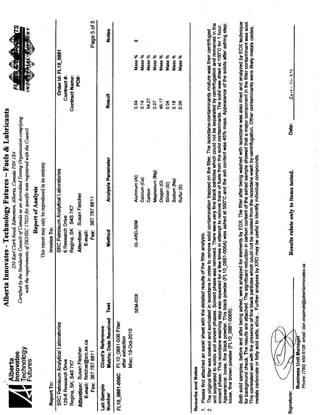
which, as demonstrated by the other additized pieces of equipment, may be skewed and
therefore cannot be relied upon as being accurate.

                                 Table 8 – Producer Bulk Tank Test Results
   SRC                         Bulk Tank                      Fuel          Water &              Acid
                Sample                                                                                        Water       Blend
  Sample                                                     Level          Sed 0.05           mgKOH/g
                 Date                                                                                         ppm         Level
    #                         Description                   in Tank        vol% max            0.10 max
                                BW Seeds - 1000 Gal            Near
    17465        Dec 7/09                                                         0              0.019           61        4.36%
                                  Steel Farm Tank             Empty

    17587       Jan 28/10                 ""                    ""              0.01             0.006           32          ""

    17679        Mar 4/10                 ""                    ""              Trace            0.011           64          ""

    17793        Apr 6/10                 ""                    ""              Trace            0.014           26          ""

                                D&L Kitzul - 500 Gal           Near
    17588       Jan 19/10                                                       0.02             0.014           97        5.72%
                               Galvanized Farm Tank           Empty

    17677        Mar 4/10                 ""                    ""              Trace             0.02           73          ""

    17792        Apr 6/10                 ""                    ""              Trace            0.031           29          ""
                                   TJ Markusson -
                                                               Near
   *17533       Dec 23/09        500 Gal Galvanized                             0.02             0.116           90        2.01%
                                                              Empty
                                     Farm Tank
    17586       Jan 28/10                 ""                    ""                0              0.086           45          ""

    17678        Mar 4/10                 ""                    ""              Trace             0.08           79          ""

    17794        Apr 6/10                 ""                    ""              0.03             0.085           63          ""


Natural Resources Canada                                                                                                            41
McVicar and Kutcher


Acid Level

All three bulk tanks were left at the end of the 2009 farming season with a minimal level of
fuel and, therefore, the biodiesel blends were subjected to maximum contact with ambient
air in the tank during the winter period. Regardless, the test data indicate that acid levels of
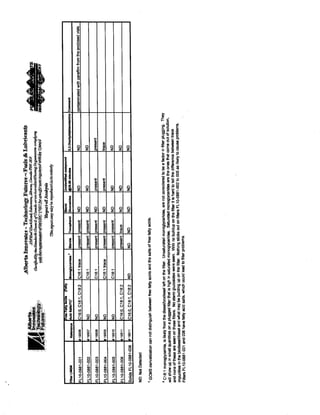
the fuel demonstrated little change during that time and, with the exception of the December
sample from Markusson’s bulk tank, remained within specification.

As depicted in Figure 12, the acid level in the Markusson bulk tank is significantly higher
than in the other two, which is consistent with that of the other additized equipment and
appears to be due to an excessive level of stability enhancer. The first sample of fuel taken
from the Markusson tank in December failed the CGSB 3.520, maximum 0.10 mgKOH/g
limit. However, as the tank was not being used during the winter, it was decided that the
situation would be monitored and if, by spring 2010, the acid remained out of spec,
corrective action would be taken. During the period, the acid level trended down to around
0.08, under the limit.

With regard to the other bulk tanks, Kitzul's and Eyolfson's, there is no trend to indicate any
material level of acid build-up and fuel degradation during the winter months.


                   0.14

                   0.12

                    0.1
         mgKOH/g


                   0.08
                                                                   BW Seeds Bulk Tank
                   0.06
                                                                   D&L Kitzul Bulk Tank
                   0.04
                                                                   TJ Markusson Bulk Tank
                   0.02

                     0
                          Dec     Jan        Feb       Mar
                                Bulk Tank Acid Level


Figure 12 – Acid Levels in Biodiesel-Blended Fuel Samples from Producer Bulk Tanks


Water

The data regarding water content in idle bulk tanks differ somewhat from the equipment
data. As the tanks were sampled up to four times over the winter, additional data points


42                                                              SRC Publication No. 12805-3C10
Off Road Biodiesel Demonstration – Agricultural Sector


helped to provide a picture of change over time. With these extra points, the graph in Figure
13 depicts a water content that appears to fluctuate from month to month. The reason for
this is unknown but it is hypothesized that it may be as a result of the fuel sample siphon
hose being positioned slightly differently in the tank as each of the samples were taken.
However, a trend that is consistent with the tractor data is that, notwithstanding the monthly
fluctuations, the water levels appear to be reduced at the end of the winter period.

It should be noted that none of the bulk tanks were equipped with desiccant filters; hence,
the air in the tank would be of similar humidity to that of the ambient air.


               120

               100

                80
         PPM


                60                                                  BW Seeds Bulk Tank

                40                                                  D&L Kitzul Bulk Tank
                                                                    TJ Markusson Bulk Tank
                20

                 0
                      Dec        Jan       Feb           Mar
                             Bulk Tank Water Level


Figure 13 – Water Levels in Biodiesel-Blended Fuel Samples from Producer Bulk Tanks


Water and Sediment

Similarly to the farm equipment data, levels of water and sediment in the idle bulk tanks
remained well within the specification limits and did not indicate an increasing trend.


Test Program 6 – Fuel Filter Testing

In order to further assess fuel degradation during off-season storage and whether certain
biodiesel constituents would precipitate out of the fuel, a program to examine the fuel filters
of farm equipment was implemented. The program entailed installing new fuel filters on
stored equipment before the start of the new season. The agricultural producer did not add
any new or fresh fuel to the tank but rather worked the piece of equipment and consumed
the fuel in the tank until close to depletion. At that point, the filters were removed, dissected


Natural Resources Canada                                                                       43
McVicar and Kutcher


and examined for the presence of constituents that may have resulted from cold weather
storage and/or that are products of oxidation related to long-term storage.

For this program a number of large 4-wheel drive tractors and combines were selected to
participate (see Table 9 below).


                  Table 9 – Tractors and Combines in Fuel Filter Test Program

                                            Fuel Level in   Biodiesel Blend   Fuel Cloud Point
            Equipment                          Tank               %                  °C

      TJ Markusson - NH TJ450 Tractor            3/4             4.29                -31

      TJ Markusson - NH 9680 Tractor             3/4             3.58                -19

     TJ Markusson - NH 9070 Combine             Full             4.24                -30

      D&L Kitzul - Case IH 9290 Tractor         Full             4.49                -13

      D&L Kitzul - Case IH 9390 Tractor          1/4             2.07                -9

     Lionel Willen - 9150 Case IH Tractor        1/8             3.27                -22

       BW Seeds - NH 9070 Combine               Full             4.43                -30

Helgason Brothers - JD 9650 Combine T2          Full             4.47                -31

Helgason Brothers - JD 9650 Combine T3          Full             4.49                -29

     Zuchkan Farms - JD 9600 Combine            Full             3.23                -25


With regard to winter storage, it is important to note the occurrence of cold weather events
when temperatures dropped to or below the cloud point of the fuel. The Imperial Oil study
entitled "Low Temperature Storage Test Phase 2 - Identification of Problem Species" noted
that "the 10-days storage study of bio-diesel fuels at 2-4 °C above cloud point and at 1 °C
resulted in the formation of precipitates." The study examined B100 canola, soy, tallow and
palm methyl esters, and blends with various diesel fuels at B5 to B20 levels. When the
methyl esters and biodiesel blends were cooled for 10 days, visible precipitates formed in
samples and in some did not return to solution when warmed to room temperature. The
samples were tested for their filter-blocking tendency, and the problem species were
identified as saturated monoglycerides. The Imperial Oil study entitled "Low Temperature
Operability Test: Phase 2 - Impact of Saturated Monoglycerides on Heavy Duty Diesel Truck
Operation" noted that "the performance of fuel delivery systems associated with the heavy
duty diesel truck tested was negatively impacted by phase separation of spiked SMG
(saturated monoglycerides) from the renewable diesel fuel at -16 C," or 10°C above its
-26°C cloud point. Hence, the Imperial Oil work indicates that biodiesel constituents such as


44                                                                 SRC Publication No. 12805-3C10
Off Road Biodiesel Demonstration – Agricultural Sector


saturated monoglycerides can precipitate out of biodiesel-blended fuel at cold temperatures,
potentially up to 10°C above its cloud point.

An examination of Environment Canada weather data for Yorkton, Saskatchewan, indicates
that winter temperatures from December 1, 2009, to March 15, 2010, dropped multiple times
below the cloud points of the fuel in tractors and combines which were subject to the filter
test program. Table 10 provides details of such temperature occurrences.


                Table 10 – Temperature Occurrences vs. Fuel Cloud Point
                                                     # of Days
                                                                  # of Days     # of Days     # of Days
                       Fuel                  Fuel   Min Temp
                                Biodiesel                         Avg Temp     High Temp      Avg Temp
                       Level                Cloud      At or
 Equipment              in
                                 Blend
                               Percentage
                                            Point   Below Fuel
                                                                 At or Below
                                                                 Fuel Cloud
                                                                               At or Below
                                                                               Fuel Cloud
                                                                                             within 10C
                                                                                               of Fuel
                       Tank                   °C       Cloud
                                                                    Point         Point      Cloud Point
                                                       Point
   TJ Markusson -
                        3/4      4.29        -31         7           1             0             19
  NH TJ450 Tractor
   TJ Markusson -
                        3/4      3.58        -19         48          24            10            70
   NH 9680 Tractor
   TJ Markusson -
                       Full      4.24        -30         9           1             0             21
 NH 9070 Combine
     D&L Kitzul -
                       Full      4.49        -13         67          58            34            93
Case IH 9290 Tractor
     D&L Kitzul -
                        1/4      2.07        -9          87          70            53           105
Case IH 9390 Tractor
    Lionel Willen -
                        1/8      3.27        -22         29          17            5             62
9150 Case IH Tractor
     BW Seeds -
                       Full      4.43        -30         9           1             0             21
 NH 9070 Combine
 Helgason Brothers -
                       Full      4.47        -31         7           1             0             19
JD 9650 Combine T2
 Helgason Brothers -
                       Full      4.49        -29         12          1             0             24
JD 9650 Combine T3
  Zuchkan Farms -
                       Full      3.23        -25         25          7             2             47
  JD 9600 Combine


Five tractor filters were tested in June 2010 by laboratories at three different organizations:
the Saskatchewan Research Council, Alberta Innovates–Technology Futures, and Imperial
Oil. The results across the labs were similar: no significant levels of saturated
monoglycerides or sterol glucosides were detected. Copies of the results are included in
Appendix E.

Five combine filters were tested in October 2010 by the Saskatchewan Research Council
and Alberta Innovates–Technology Futures. As with the tractors, no significant levels of
saturated monoglycerides or sterol glucosides were detected. Copies of the results are
included in Appendix E.


Natural Resources Canada                                                                              45
McVicar and Kutcher


Other Test Programs and Issues

During the demonstration, an unanticipated issue was brought to the attention of the project
Technical Committee. The issue involved the development of sludge in the fuel system of a
producer's combine (Zuchkan’s). The occurrence caused unexpected engine shutdown in
the field related to fuel starving, warranting an extensive inspection of the material build-up
in question and whether the cause was biodiesel related. Examinations of the fuel filter and
fuel drained from the combine, undertaken by the Saskatchewan Research Council and
Alberta Innovates–Technology Futures, determined that the sludge in the system was due to
the entrance of dirt and organic material (straw chaff and particles) into the fuel tank and
was not biodiesel related. Further details of the issue and findings are provided in Appendix
D of this report.

Another item, related to dye in off-road marked diesel, was brought to the attention of the
project. Although this item was not part of the demonstration per se, the Saskatchewan
Research Council was notified of random fuel testing undertaken by a regulatory authority
which identified that:

     1. Marked diesel for retail sale can have a substantial variation in the amount of dye in
        the fuel, often in contravention of what is required by law.

     2. The blending of biodiesel into diesel and the resulting change of color of the fuel can
        cause difficulties with visual inspections that are commonly used to initially
        determine possible contravention.

This non-operational issue is being explored by dye manufacturers, refiners and the
Saskatchewan Research Council. Accordingly, as there may be implications related to fuel
taxation, officials concerned with such issues may wish to become involved and, if required,
take appropriate action within their established compliance test procedures and protocols.


Key Findings

The project completed a full cycle of farm equipment use with over 30,000 litres of biodiesel
being consumed. This biodiesel was supplied by Milligan Biotech Inc. and showed
consistently low levels of saturated monoglycerides and sterol glucosides. Much valuable
information has been learned from the demonstration, which may be useful as the
Government of Canada moves forward with its intention to mandate the use of renewable
fuel in diesel by sectors such as agriculture.

     1. The adoption of low-level biodiesel blends into the agriculture sector does not
        necessarily require changes on the part of agricultural producers in relation to on-
        farm bulk fuel storage practices. This demo did not make any modifications to
        producer bulk tank storage systems such as the incorporation of filters or water


46                                                              SRC Publication No. 12805-3C10
Off Road Biodiesel Demonstration – Agricultural Sector


       separators, or conversion to compatible materials; and throughout the monitoring
       period, from August 2009 to October 2010, fuel quality was demonstrated to have
       been maintained.

       The participating producers indicated at the beginning of the demo that they did not
       wish to incur expenses related to changing or upgrading their bulk fuel storage
       facilities and practices. If biodiesel was to work, it would need to work within a
       "status quo" scenario. In that regard, there were variances in producer bulk storage
       equipment and practices ranging from tank materials (steel vs. galvanized) to
       whether or not filters and water separators were incorporated. Most of the tanks were
       older, with many of them being more than 20 or 30 years old, and none of the
       participating producers indicated that they practised periodic tank maintenance
       beyond a change of filters, if they used them.

       However, notwithstanding the foregoing, it is recommended that producers follow
       best practices for the storage and handling of fuel, such as the incorporation of
       particle filters and water separators on bulk tanks, the use of compatible materials,
       and regular fuel storage and maintenance, regardless of the fuel used.

   2. During off-season storage of equipment, there appears to be no substantive benefits
      related to filling equipment fuel tanks to minimize contact with air. Test data did not
      provide any clear evidence that tractors, combines, or swathers stored full of fuel
      maintained quality better than did those with depleted or partly depleted tanks.

   3. Although oxidative stability additives improved the stability of the canola biodiesel-
      blended fuel used in this demonstration, the quality of non-additized fuel blends in
      farm equipment remained sufficient over the storage periods. Therefore, the use of
      such products does not appear necessary in a climate such as Saskatchewan's.

   4. Producers indicated (via conversations and a survey) that equipment operated
      normally during the demo, and no changes as compared to operating on diesel were
      noted.

   5. Agriculture producers appear to be utilizing more diesel-powered equipment on a
      year-round basis than was expected when the study began. With the trend of
      increasing farm sizes, producers (even those without livestock operations) are using
      larger equipment during the winter off-season. Examples include the use of large
      four-wheel drive tractors to pull grain carts which transfer grain stored in fields to
      trucks waiting roadside; diesel tractors to power large power take-off driven grain
      augers; and large diesel-powered grain-hauling trucks. The impact of this apparent
      change in operation is that it is becoming a greater rarity for on-farm bulk fuel tanks
      to sit idle throughout the winter period. For tanks that do sit idle, producers seem to
      be attempting to use up all the fuel before letting them sit for the off-season.


Natural Resources Canada                                                                       47
McVicar and Kutcher


        Regardless of these apparent operational changes, testing and monitoring
        undertaken on three idle bulk tanks during the winter indicated that fuel quality was
        maintained.

     6. Water and/or sediment build-up in stored equipment and in unused bulk tanks does
        not appear to be a factor or cause for concern, particularly during the prairie winter
        period. None of the tractors, combines, swathers or tanks tested indicated an
        excessive build-up of water and/or sediment levels. Based on the results of the
        testing undertaken during this study, desiccant filters are not required on bulk tanks.

     7. Blends of biodiesel such as B10 may have a tendency to foam when pumped at high
        velocities and volumes into smaller bulk tanks. This is easily resolved by reducing
        the fuel flow.

     8. Fuel and fuel filter tests related to saturated monoglycerides and sterol glucosides
        indicate that these components are of no concern with the canola-based biodiesel
        used in this study at the B5 and B10 levels.

     9. The ASTM D7467 distillation specification for blends such as B10 is impractical in
        the Canadian context, given the limits set for both B100 and diesel fuel. Any B6 to
        B20 Can/CGSB distillation specification should be developed with such in mind.

     10. Care must be taken with regard to managing the cloud point of biodiesel-blended
         fuel. The demo found it necessary to procure very low cloud point diesel to meet the
         CGSB-recommended temperature specification. Diesel that had been supplied to
         the demo during winter had a cloud point that just met the required specification.
         Accordingly, after blending with biodiesel, the blended fuel became off-spec by a
         number of degrees, in this case 6°C. In order to properly plan for meeting the
         required cloud point, a diesel with a colder cloud point is necessary so that the fuel
         blended with biodiesel meets the spec. Such diesel may not be widely available in all
         regions.

     11. Fuel lubricity standards are utilized by refiners to ensure that they are providing a
         consistent quality product for their clients, by engine manufacturers to ensure that
         their engines are designed to operate properly on the basis of a consistent fuel, and
         by regulatory bodies, and consumers to protect their investments in expensive
         equipment and to ensure that they will operate and perform as designed within their
         specific warranty period. This demonstration utilized the HFRR (high frequency
         reciprocating rig) test method to determine if fuel in the field met the required
         specification. As a result, such testing clearly demonstrated the benefits of blending
         biodiesel with diesel fuel. However, as the HFRR test is only one of several
         accepted methodologies, it may be beneficial for further work to be done to confirm
         the lubricity benefits, if any, of biodiesel utilizing the other allowable test methods
         under Can/CGSB 3.517. Furthermore, based on the vigorous discussion that took


48                                                               SRC Publication No. 12805-3C10
Off Road Biodiesel Demonstration – Agricultural Sector


       place around the results presented in this area of the report, their interpretation, and
       the various test methodologies themselves, consideration should be given to
       developing and improving upon the current fuel lubricity test methodologies and
       protocols in order to ensure that fuel in the field meets the lubricity requirements for
       the equipment for which it is intended to be used. It is suggested that further support
       be provided to CGSB to continue its work on lubricity methods and standards .

   12. Independent bulk dealers generally have little knowledge regarding the properties of
       their diesel fuel supply. Should they become involved in the blending of biodiesel for
       retail sale or intermediate transfers of fuel prior to retail sale, there may be a need for
       them to become better informed about cloud point and fuel quality in order to protect
       the consumer.

   13. Although one of the secondary objectives identified at the start of this project was to
       develop best practice guidelines for biodiesel blends, this proved to be unnecessary
       based on the lack of identifiable issues within this project related to this objective.


References

Imperial Oil. 2009. Low Temperature Storage Test Phase 2 – Identification of Problem
Species. Report No. R498-2009. December.

Imperial Oil. 2009. Low Temperature Operability Test: Phase 2 – Impact of Saturated
Monoglycerides on Heavy Duty Diesel Truck Operation. Report No. R497-2009. December.

McVicar, G. and Kutcher, D. 2009. Off Road Biodiesel Demonstration – Agricultural Sector.
Progress Report. SRC Publication No. 12805-1C09. December.


Natural Resources Canada                                                                       49
McVicar and Kutcher


50   SRC Publication No. 12805-3C10
Off Road Biodiesel Demonstration – Agricultural Sector


                                      Appendix A
                            Fuel Transfer Pump Malfunction

Prairie farms commonly have land in varying locations and distances from what is commonly
referred to as the home quarter (160 acres). The home quarter is where bulk fuelling
infrastructure normally resides and as such is where equipment is fuelled when it is in or
near the yard. However, given the growth in size of prairie farms, it is not uncommon for a
producer to operate land that is 5, 10, 20 km or even greater distances from the home
quarter and refuelling site. Hence, it is not practical to move equipment home to refuel, and
farms have adopted mobile systems to refuel equipment in the field. Such equipment can
range from portable slip tanks that fit in the back of a common pickup truck and hold a few
hundred litres, to bulk tankers that hold up to 15,000 litres. Larger systems are becoming
more commonplace, as the fuel tanks on bigger farm equipment can hold more than 1,000
litres and multiple pieces of such equipment are operated by a single farm.

In order to transfer fuel from the mobile fuelling system, a pump is used. Pumps can be
manually operated (in the case of smaller systems) to electrically operated (normally by 12
volt vehicle power) or connected to a small gas engine or vehicle power take-off system.
One of the producers in the demonstration reported a problem related to his portable slip
tank (approx. 450 litre) and 12 volt vehicle powered pump.

The producer noted that his usual practice of refuelling equipment in the field was to shut
down his vehicle during refuelling. The slip tank pump would then be connected to the
vehicle’s battery and the farm equipment subsequently filled. During early October 2009
when the ambient outside temperature was approximately -3°C, this producer refuelled his
combine with a B10 blend and, subsequently, attempted to restart his vehicle. At that point
the battery had been drained and did not contain sufficient charge to restart the vehicle.
The producer noted that this had never occurred before.

As biodiesel is more viscous than diesel fuel, a test protocol was established with an
independent third-party laboratory to determine whether the impacts of increased fuel
viscosity and low temperatures may have combined to create significant additional
amperage draw by the 12 volt motor. It should be noted that the viscosity of B100 biodiesel
used in this demo tested within a range of 4.48 to 4.53 mm2/sec with an average of 4.51
mm2/sec. (Note. the Can/CGSB 3.517 diesel maximum viscosity specification is 4.10
mm2/sec.) Samples of ULSD and B5 and B10 blends averaged 2.64, 2.72 and 2.80
mm2/sec, respectively. Although the B10 blend technically demonstrates increased viscosity
over that of ULSD or B5, the difference is marginal. However, testing was performed to
determine whether the marginal difference could have an impact in the field and, if so,
producers would need to be aware when refuelling equipment so as not to experience
similar failures. The test program entailed monitoring the amperage draw and fuel flow


Natural Resources Canada                                                                  51
McVicar and Kutcher


volumes on the slip tank pump with B5 and B10 blends at fuel temperature intervals from
+15 to -20°C.

The test program was unable to show a direct correlation between amperage draw and/or
fuel flow and blend percentage. As B10 biodiesel has a higher viscosity than B5, there is
potential for it to cause the pump to both draw greater amperage and have reduced fuel flow
volume. Testing did indicate a slightly higher amperage draw while pumping B10, but also
demonstrated higher fuel flow volumes. Hence, testing did not conclude in a practical
situation, that any negative impact would be experienced. The overall drawdown on a 12
volt vehicle battery should be similar between the two blends over the course of refuelling
the combine.

Officials performing the tests indicated that the pump did not appear to operate in a normal
manner during the testing procedure. Hence, it is suspected that the excess battery
drawdown was related to a faulty pump or weak vehicle battery rather than to the biodiesel-
blended fuel. More testing would be required in order to draw a more definitive conclusion.

It should also be noted that discussions with slip tank pump manufacturers indicated that
there is potential for increased amperage draw due to cold weather and increased viscosity
related to biodiesel. They recommend that users leave their vehicle running during
equipment refuelling so as to not draw the battery down to insufficient levels.


52                                                            SRC Publication No. 12805-3C10
Off Road Biodiesel Demonstration – Agricultural Sector


                                      Appendix B
                                    B10 Fuel Foaming

Clearview Agro, the bulk fuel distributor responsible for delivering biodiesel-blended fuels to
participating agriculture producers, noted that, when filling certain producers' on-farm bulk
tanks with a blend of B10, the fuel would have a tendency to foam significantly and cause
the fuel nozzle to automatically shut off well in advance of the tank being completely filled.

In order to examine this issue, a test was undertaken on the delivery truck at the blending
terminal to assess if there might have been issues related to the truck's pumping system, i.e.
excessive air being allowed into the pumping system or other causes. In that regard, one of
the truck's fuel compartments was filled with B10 at the blend terminal. During filling, which
was pumped at a rate of approximately 200 litres/minute from the blend terminal, it was
noted that some foaming occurred, due to turbulence caused by the velocity and volume of
fuel being pumped into the compartment. However, the foam quickly dissipated and did not
tend to build. Once the first compartment was full, the blending station began filling a
second compartment in the truck with B10. During that time, the pumping system on the
delivery truck was set so that it would pump fuel from the first full compartment to a third
empty compartment. This was done to examine whether foaming would occur and how the
foaming compared to that caused by filling from the blend station.

The fuel being transferred by the truck pumping system into the third compartment
noticeably foamed more than that being pumped by the blend station into the second
compartment. However, the foaming appeared to be caused by a greater velocity and fuel
flow from the truck's pumping system. This was confirmed with Clearview, who indicated
that the truck’s pumping system flowed at a volume of 250 litres/minute or approximately
25% greater than the blend station's pump. From a visual perspective, the amount of foam
created was roughly proportional to the greater fuel volume flowing into the tank. It was also
noted that the foam did not build up but rather dissipated and was not cause for concern.

The second part of the examination entailed travelling to an agriculture producer's farm and
filling bulk tanks with B10. This was done at the MBG Helgason farm where fuel was added
to a three-compartment 1400 gallon mobile fuel tanker. During the filling of each
compartment, foaming was observed. Once again, this appeared due to the velocity and
volume of fuel flowing into the tank. The main difference between this experience and that
demonstrated at the blend site was the size and configuration of the fuel compartment. At
less than 500 gallons, the fuel pumped into the tank remained in a constant state of
agitation, which did not allow foam to dissipate while the tank was being filled. Hence, the
foam had a tendency to continue to build to the point of interrupting the fuel nozzle before
the tank was completely filled.


Natural Resources Canada                                                                     53
McVicar and Kutcher


The solution to the problem was straightforward. Once fuel flow volume to the tank was
reduced (i.e., the nozzle set on a slower flow rate), the problem disappeared.

The foaming experienced by the demonstration is not expected to be commonplace or
problematic as biodiesel is incorporated into the fuel distribution system in Canada. This is
due to the phenomenon only being noted with B10 blends; lower level blends did not
demonstrate foaming issues. Furthermore, the issue is easily resolved with a simple
slowing of the nozzle in the circumstances where the combination of a high fuel flow and
small bulk tank occur to cause excessive foaming.


54                                                             SRC Publication No. 12805-3C10
Off Road Biodiesel Demonstration – Agricultural Sector


                                      Appendix C
                                  Diesel Fuel Lubricity

Throughout the project, diesel fuel was supplied for blending with pure biodiesel in order to
produce the biodiesel blends that were being demonstrated. The protocol developed, and
approved by the project Steering/Technical Committee, was to have each batch of diesel
fuel tested against the standard suite of Can/CGSB 3.517 tests to establish the fuel's
baseline quality. In addition, the biodiesel used for blending and the blends themselves were
also subjected to an approved protocol of testing to establish their baseline quality in
accordance with established Can/CGSB or ASTM testing protocols and standards. Diesel
fuel, and biodiesel blends used during the demonstration were tested for lubricity using the
approved protocols and testing methodology.

During the demonstration, a total of eight separate batches of diesel were provided for
blending. Two separate batches of diesel fuel exhibited less lubricity than all the other
batches supplied to the demonstration. The batches, one of which was supplied and
sampled in May 2010 and another which was supplied and sampled in August 2010, were
tested using ASTM D6079, the high frequency reciprocating rig (HFRR) test methodology
that had been established as the test procedure for lubricity for the project. The Can/CGSB
3.517 Diesel standard states that when lubricity is tested using the HFRR test, the maximum
wear scar allowable is a diameter of 460 microns.

The results of multiple tests on each of the two diesel samples were as follows:

May 18, 2010 Sample 18296 - 471, 462, 430

August 3, 29010 Sample 19055 - 497, 520, 499

The other six batches of diesel fuel supplied and sampled during the project demonstrated
wear scar diameters ranging from 330 to 414 microns, with the mean average being 373.
As the results of the two samples noted above were higher than what was previously seen
in the demo, the issue required further examination.

A Technical Committee meeting was hosted to discuss the test results and Can/CGSB
requirements respecting fuel lubricity. The Can/CGSB standard allows for multiple test
methods to be used to assess lubricity, one of which is the HFRR test methodology.
Considerable discussion took place during the committee meeting regarding the ability of
the HFRR test methodology to properly assess actual lubricity of a fuel once additives were
incorporated into the base diesel fuel. One specific methodology discussed was the fuel
pump rig test. This test method is applied to the base fuel produced by a refinery and is
used by industry and lubricity additive suppliers to assess what fuel lubricity package is
required to be added to the base fuel at the terminal in order to meet lubricity requirements.
The pump rig test procedure is considered by some in the refinery industry to provide a


Natural Resources Canada                                                                     55
McVicar and Kutcher


better assessment of the full impact of lubricity additive packages, although both are
acceptable under CGSB. However, the pump rig test is both expensive to operate, and very
time consuming (24 days), and therefore those in the fuel industry that use the procedure do
not apply it to every batch of fuel produced and provided to the distribution terminal, nor is it
applied after the lubricity package is added at the terminal and when fuel is supplied to the
bulk fuel supplier or retail supplier.

Based on the discussion, it was suggested, and approved by the Committee, that the
appropriate course of action would be to investigate the situation further by tracing the fuel
back to the original refiner and discussing the situation. As the Can/CGSB standard allows
for multiple test methods to determine lubricity, the refiner may have utilized an alternate test
procedure and the results of that procedure could have indicated that the fuel met
specifications. Alternatively, if the refiner followed the same HFRR procedure used by the
Saskatchewan Research Council (SRC), their results could be compared against those
provided by SRC. In that regard, it is important to note that the HFRR test has a
reproducibility number of 136. In terms of precision, this means that the difference between
two single and independent results could vary by up to 136 microns and still be considered
to be correct if they were produced by different operators, correctly using the test method,
but working in different laboratories on the same sample of the fuel. Therefore, although the
results of testing at SRC demonstrated HFRR lubricity numbers in excess of the 460 micron
standard, another lab may have arrived at a number below 460 and no conclusion with
regard to whether the sample did not meet the standard could then be drawn.

The approved trace-back process started with Clearview Agro, the organization from which
the project procured diesel. From there the fuel was traced back through two additional fuel
suppliers, and then to a refinery and distribution terminal. A discussion with personnel from
the refinery indicated that they in fact do utilize the HFRR test method to determine lubricity.
The procedure followed by the refiner is as follows:

     1. Unadditized representative diesel fuel samples are sent to an additive supplier for
        testing and determination of the appropriate additive package and amount to be
        injected into the fuel to meet the required Can/CGSB HFRR specification.

     2. The refiner follows the recommendation of the additive package supplier and
        regularly monitors the amount of additive injected into their diesel at the distribution
        terminal.

     3. Periodic samples of additized diesel fuel are taken and sent to the additive supplier
        for HFRR testing to ensure that the fuel continues to meet lubricity specifications.

According to the refiner, what appears to have occurred is that on two occasions, both of
which coincide with the dates of fuel supplied for the demo, a cold weather diesel fuel with a
low temperature cloud point in inventory from winter was blended with seasonal diesel at the
distribution terminal to use up the inventory. Although the cold weather diesel had less


56                                                                SRC Publication No. 12805-3C10
Off Road Biodiesel Demonstration – Agricultural Sector


lubricity than the seasonal diesel, the refiner believed that the normal amount of additive
injected at the terminal would still be sufficient to result in an HFRR that would meet the
lubricity specification. However, the blended fuel was not sampled and sent to the additive
supplier to confirm this expectation. Given the demonstration's HFRR tests showing results
in excess of the 460 micron specification, the refiner indicated that they would be discussing
the performance of the additive with their supplier and were grateful that the situation was
brought to their attention. Report readers should note that the SRC supplied the refiner with
the above noted accounting of events, had them review it for accuracy, and received
confirmation that it was an accurate portrayal of the situation.

Although two batches of diesel fuel supplied to the demo were close to or exceeded the 460
micron HFRR standard, it should be noted that when diesel was blended with biodiesel for
the demonstration, HFRR results for the blended fuel indicated wear scar diameters ranging
from 265 to 328 microns. These scar diameters are substantially smaller than for the base
diesel and well below the required Can/CGSB specification for lubricity. Therefore, the
lubricity of all biodiesel-blended fuels provided to the agriculture producers during the
demonstration met fuel lubricity standards for their equipment.

As a result of the foregoing issue, the following recommendation is noted:

Fuel lubricity standards are utilized by refiners to ensure that they are providing a consistent
quality product for their clients, by engine manufacturers to ensure that their engines are
designed to operate properly on the basis of a consistent fuel, and by regulatory bodies, and
consumers to protect their investments in expensive equipment and to ensure that they will
operate and perform as designed within their specific warranty period. This demonstration
utilized the HFRR test method to determine if fuel in the field met the required specification.
As a result, such testing clearly demonstrated the benefits of blending biodiesel with diesel
fuel. However, as the HFRR test is only one of several accepted methodologies, it may be
beneficial for further work to be done to confirm the lubricity benefits, if any, of biodiesel
utilizing the other allowable test methods under Can/CGSB 3.517. Furthermore, based on
the vigorous discussion that took place around the results presented in this area of the
report, their interpretation, and the various test methodologies themselves, consideration
should be given to developing and improving upon the current fuel lubricity test
methodologies and protocols in order to ensure that fuel in the field meets the lubricity
requirements for the equipment for which it is intended to be used. It is suggested that
further support be provided to CGSB to continue its work on lubricity methods and standards
through a publicly funded developmental program.


Natural Resources Canada                                                                     57
McVicar and Kutcher


58   SRC Publication No. 12805-3C10
Off Road Biodiesel Demonstration – Agricultural Sector


                                  Appendix D
                     Material Accumulation in Fuel Tank of
                               JD9600 Combine

Near the start of the 2010 harvest season, Zuchkan Farms experienced a fuel-related
problem in their 1995 John Deere 9600 combine. The combine had been started, serviced
and operated in the field for approximately four hours (on the biodiesel blended fuel ~B4 that
had been in the tank when the combine was put away in the fall of 2009) when it was shut
down for the evening. Upon returning the next day to continue harvest, the farmer was able
to start and operate the machine, but it appeared to be losing power. After a few hours of
operation, the engine stopped unexpectedly. Zuchkan suspected a fuel problem and tried to
prime the engine to restart it; however, the fuel would not seem to flow. The hose leading to
the bottom of the fuel tank was then removed and it was discovered that fuel would not flow
out from the bottom of the tank. Zuchkan blew into the tank with an air compressor and the
fuel began to flow out the bottom. The hose was replaced, the machine started and was
driven home. At home the fuel filters were changed and fresh fuel added (approx. 1/2 tank).
The combine was then taken back to the field to continue harvest. Subsequently, the
engine stopped multiple times. After re-examination, Zuchkan removed a screen that
screws into the bottom of the fuel tank and discovered that it was full of sludge which
seemed to be the main source of the blockage problem. The sludge was cleaned out of the
screen, all of the fuel drained from the combine into 45 gallon drums, and new fuel (B5)
added. Subsequently, the machine was able to operate normally for the rest of the harvest
season.

The fuel in the combine at the start of harvest was previously sampled by the Saskatchewan
Research Council three times throughout the off-season storage period (Nov. 09, May 10
and Aug. 10) to monitor its quality and level of degradation. In that regard, as demonstrated
in Table 6b and Figures 9, 10 and 11, fuel quality with respect to oxidative stability, acid,
water and, water and sediment levels were not concerning and well within the Can/CGSB
specifications.

The fuel drained from the tank by Zuchkan and the filters were saved and delivered to the
Saskatchewan Research Council (SRC) for analysis to collect samples of the sludge,
determine its constituents and whether or not the problem was biodiesel related. The
primary filter, which had collected a substantial portion of the build-up in question, was
dissected and analyzed by SRC as well as Alberta Innovates–Technology Futures. The
drained fuel was tested against the full suite of Can/CGSB 3.520 standards.

The analytical procedure to determine the make-up of the material collected on the primary
fuel filter was as follows:


Natural Resources Canada                                                                     59
McVicar and Kutcher


     1. The material was scraped from the fuel filter element and collected. A picture of the
        filter element is depicted in Figure D-1.
     2. Two pathways were pursued. First, a portion of the material was ashed at 550°C
        and the inorganic residue examined. Second, a portion of the material was washed
        with iso-octane, dried at 50°C and then examined under a microscope to determine
        the existence of insoluble organics.

Subsequently, it was found that the material in question consisted predominantly of a
combination of dirt and organic material (chaff). The cause of this situation appears to be
related to a loose or faulty fuel filler cap that had allowed dust and chaff created during
combining to enter into the fuel tank and accumulate. Hence, the biodiesel-blended fuel
used in the combine had no relationship with this problem.


                                                                                        Small pieces of
                                                                                        material (chaff)
                                                                                        caught by filter.


                                                                                        Visible build-up
                                                                                        in filter crevices


Figure D-1 – Fuel Filter Element with Visible Signs of Foreign Material Build-up


60                                                             SRC Publication No. 12805-3C10
Off Road Biodiesel Demonstration – Agricultural Sector


                                      Appendix E
                                Fuel Filter Test Results


Natural Resources Canada                                   61
MEMORANDUM                                                IMPERIAL OIL
                                                 PRODUCTS AND CHEMICALS DIVISION
                                                     RESEARCH DEPARTMENT


   TO:     Charlie Lund                                      07/06/2010
           Peter Wright
           Brian Ahearn

FROM:      Marc-André Poirier                                R297-2010


    Analysis of Fuel Filters from the Off-Road Biodiesel Demo - Agricultural Sector
________________________________________________________________

Summary and Conclusions

Imperial Oil Limited has been asked trough CPPI to participate in the analysis of five fuel
filters from the off-road biodiesel demo in the agricultural sector. Very little information was
provided on this biodiesel program but we believe the filters were taken from idle tractors after
the winter period. Each filter unit was cut opened at the Saskatchewan Research Council
Laboratories and the pleated filter paper was devided into four equal portions going to each of
the three laboratories (Alberta Innovates-Technologies Futures, SRC Saskatoon Analytical and
Imperial Oil) and one portion was retained by SRC Petroleum Analytical Laboratories. The
fuel filters were analyzed for saturated monoglycerides (SMG) and sterol glucoside (SG). The
canola methyl ester (CME) B100 biodiesel from Milligan BioTech, Foam Lake, SK was used
in this study. The fuel filter analysis protocol was provided by Imperial Oil (Appendix 1).

Very small amounts of deposit ranging from about 1 to 10 mg/100cm2 were found on the fuel
filters. The filter deposits were found to be similar. The analytical results suggested the
presence of sterol glucoside and saturated monoglycerides in the filter deposits. The low level
of deposit on the filters was due to the good quality biodiesel (low saturated monoglycerides
content (150-280 wppm) and low cold soak filtration time (90-91seconds)) used in this study.

Results and Discussion

Five pre-cut fuel filter coupons, each in a Mason® jar, were received at Imperial Oil for
analysis. A 100 cm2 (10cm x 10cm) section was further cut for the analysis. It was assumed
that any deposit on the fuel filter would be distributed evenly on the surface. The filter coupon
was placed in a 500mL glass beaker and sufficient isooctane was added to the beaker to cover
the coupon. The beaker was sonicated at ambient temperature for 10 minutes. The isooctane
slurry was then filtered, under vaccum, through a pre-weighed 15 mm diameter GF/A 1.6µm
glass fiber filter. A description of the filters, tractors, engines, biodiesel fuels, volume used
and deposit weights from each filter is presented in Table 1.

Table 1 shows that very litte deposit was found on the fuel filter coupons. The deposit weights
range from about 1 mg to 10 mg/100 cm2. These results are attributed to the good quality
-2-
canola methyl ester (CME) biodiesel from Milligan BioTech used in this study. The
properties of the CME biodiesel used in this study are presented in the following Table.

             Biodiesel      Lot#               CSFT, sec           SMG, wppm
             CME            09-09-28-BD-CF-12     90                  280
             CME            08-09-08-BD-CF-123    91                  150

FTIR Analysis of the Filter Deposits

Each of the five filter deposits on the 1.6µm GF/A glass fiber filter were analyzed by Fourier
Transform InfraRed (FTIR) spectroscopy. Despite the very small amount of deposit on the
filter, it was possible to obtain an FTIR spectrum. The filters were placed onto a diamond
crystal (Smart Orbit HATR Accessory) and the reflectance IR spectra were obtained. The
FTIR contribution from the filter was substracted. The FTIR spectra are presented in Figures
1 to 5. All the FTIR spectra were found to be similar. The large band at about 3300 to 3400
cm-1 and the band at about 1020cm-1 suggest the presence of sterol glucoside (Figure 6).
The carbonyl ester peak at about 1725cm-1 also suggests the presence of saturated
monoglycerides (Figure 7). Because of the small level of deposits on the filters, it was not
possible to confirm the presence of the sterol glucoside by Thin Layer Chromatography
(TLC). The TLC analysis of the deposit on a portion of the 1.6µm glass fiber filter from TS-
58332 and TS-58228 (from TS-58334) did not reveal the presence of the sterol glucoside
(Figures 8 and 9).

       Figure 8. TLC for TS-58332              Figure 9. TLC for TS-58228


  TS-58332                           Ref. SG
                                                    TS-58228                        Ref. SG


The X-Ray ESD analysis of the filter deposits could not be done at this time. We also felt that
the analysis for inorganic material was not critical for the conclusion of the analysis.

.cc    Susan Fletcher - SRC Petroleum Analytical Laboratories
       Dave Kutcher - New Energy Consulting Inc.
       Grant McVicar - SRC BioEnergy & BioResources
       Gilles Morel - Canadian Petroleum Products Institute (CPPI)
       Joe Feimer
       Elizabeth Turner
       Will Rogers

                                                                                                 2
-3-

Table 1. Description of the Equipment from which the Fuel Filters were Taken


                                                                               3
-4-

Figure 1. FTIR Spectrum of Filter Deposit from Fuel Filter TS-58225

                     TS-58331 from Filter TS-58225


                                     1720cm-1


Figure 2. FTIR Spectrum of Filter Deposit from Fuel Filter TS-58226

                           TS-58332 from Filter TS-58226


                                                                      4
-5-


         Figure 3. FTIR Spectrum of Filter Deposit from Fuel Filter TS-58227


                                        TS-58333 from Filter TS-58227


                                           1730cm-1


Figure 1. FTIR Spectrum of Sterol Glucoside Reference Sample

              Figure 4. FTIR Spectrum of Filter Deposit from TS-58228


                             TS-58334 from Filter TS-58228


              Figure 5. FTIR Spectrum of Filter Deposit from TS-58229

                                                                               5
-6-

                                              TS-58335 from Filter TS-58229


                               Figure 6. FTIR Spectrum of the Sterol Glucoside

         *BIO-57405 Sterol Glucoside

  0.50                                          BIO-57405 Sterol Glucoside

  0.45


  0.40


  0.35
Absorbance
  0.30


  0.25


  0.20


  0.15


  0.10


  0.05

     4000              3500            3000      2500        2000         1500   1000   500
                                                   Wavenumbers (cm-1)


                                                                                              6
-7-
  Figure 7. FTIR Spectrum of Glyceryl Monostearate (Saturated monoglyceride)

         Chemical-51513 Glyceryl Monostearate 90%
         l
  0.26

  0.24

  0.22

  0.20

  0.18

  0.16
Absorbance

  0.14

  0.12

  0.10

  0.08

  0.06

  0.04

  0.02

  0.00
    4000               3500              3000             2500        2000      1500   1000   500
                                                           Wavenumbers (cm-1)


                                                                                                    7
Appendix 1

                Analytical Protocol for Fuel Filter Deposits
1. An approximate 10 cm x 10cm piece of the pleated filter is cut and placed in a 500 mL
   glass beaker with sufficient isooctane to cover the filter. The beaker is placed in an
   ultrasonic bath and sonicated for about 10 minutes.

2. The pleated paper coupon is removed and the isooctane slurry is filtered under vacuum
   over a pre-weighed 15 mm diameter GF/A 1.6µm glass fiber filter. After drying for a
   few minutes under vaccum, the filter with the deposits may look like the deposits in
   Figure 1. The filter is then weighed to determine the amount of deposits on this filter
   coupon. This process removes the residual fuel from the filter which dissolves in the
   isooctane. Any sterol glucoside (SG), saturated monoglycerides (SMG) and inorganic
   material are not soluble in isooctane.

          Figure 1. Filter Deposits Containing SG ( X 50 magnification)


3. The 1.6µm glass filter is examined using a JEOL JSM-6490LV Scanning Electron
   Microscope (SEM) with energy dispersive X-ray spectrometry (EDS), to provide
   morphological and compositional information for the surface solids. An example of
   EDS spectrum is presented in Figure 2.
-9-


                       Figure 2. EDS Spectrum of a Filter Deposit


       This particular sample was found to contain mainly organic material. The small    Si
and Al elements are associated to clay-like material.

   4. The solid deposit is analyzed by Fourier Transform InfraRed (FTIR) using an
      instrument such as the Thermo Nicolet 4700. A crystal of the deposits or the filter is
      placed onto a diamond crystal (Smart Orbit HATR Accessory) and the reflectance IR
      spectrum is obtained. An example of a FTIR spectrum is presented in Figure 3.

                     Figure 3. FTIR Spectra of Filter Deposits


                                                                                               9
- 10 -

               The strong OH peak around 3400 cm-1 is due to the SG and/or SMG
               The ester peak around 1735 cm-1 is only due to the SMG since the residual
                biodiesel fuel was removed by the isooctane.
               The strong peak around 1000 cm-1 is only due to the C-O band from the SG.

      The SMG was purchased from Spectrum, Cat. No. GL149, glyceryl
      momostearate, food grade. Few grams of sterol glucoside reference were obtained
      from Scott Fenwick, ADM (Tel.: 217-413-0874).

  5. The presence of SG was further confirmed by Thin Layer Chromatography (TLC). The
     1.6µm filter was soaked in about 1mL of pyridine to dissolve all the organic material on
     the filter. The sterol glucoside (50 mg) provided by ADM was dissolved in 1.0mL
     pyridine. 10-µL of each solution was placed on the Silica gel plate (BDH Pre-coated
     silica gel 60, F-254, 0.25 mm layer thickness) and the plate placed in a TLC tank and
     developed with chloroform:methanol: ammonia 25%, 65:30:4 solvent mixture. After the
     solvent traveled 150 mm the plate was allowed to dry and then sprayed with a solution of
     5% sulphuric acid in ethanol. The plate was then placed in an oven at 110°C for 30
     minutes. The sterol glucosides produced a purple spot at Rf = 0.46 while the saturate
     monoglycerides does not reveal on the plate. The TLC plate showing the presence of
     sterol glucosides in the sample and TLC equipment are illustrated in Figures 4 and 5.

                              Figure 4. TLC Plate with the SG


                                                                               Sterol
Sterol                                                                       glucosides
glucosides in                                                                reference
the deposits


                                 Figure 5. TLC Equipment

                                                                                            10
- 11 -


 TLC tank
 with TLC
plate inside            Vaporizator


                               TLC
syringe                      Template


                                11
SRC Group # 2010-4720

                                      SRC ANALYTICAL                                        Jun 28, 2010
                                               422 Downey Road
                                        Saskatoon, Saskatchewan, Canada
                                                   S7N 4N1
                                       (306) 933-6932 or 1-800-240-8808
                                              Fax: (306) 933-7922
Petroleum Analysis Laboratory, SRC
Lab Services Division
6 Research Drive
Regina, Saskatchewan S4S 7J7
  Attn: Susan Fletcher                                                                     Page 1 of 5

Sample #            16833                                    Client PO #:
Date Sampled:                                                Date Received: Jun 04, 2010
Sample Matrix:      FILTER
Description:        SRC REF# 18303 - BALDWIN FILTER; MODEL #BF129 - FROM A CASE IH 9150 TRACTOR, 10 L
                    CUMMINS ENGINE, APPROX 100 LITRES OF FUEL FILTERED, BIODIESEL 3.27%

   Analyte                       Units           Result                    DL


Organic Chemistry
   Time charge                   --              See Below                 0


The fuel filters from the "Off-Road Biodiesel Demo: Ag Sector" were
analysed following the extraction protocol from Imperial Oil and using
FTIR to determine if saturated monoglycerides (SMG) or sterol glucosides
(SG) are detected. If the FTIR indicated any SMG, then the residue
would be confirmed by GCMS. The test is qualitative only and is reported
as not detected, trace, or significant amount detected.
The FTIR test did not detect the presence of SMG or SG in any of the
samples.
SRC Group # 2010-4720

                                     SRC ANALYTICAL                                        Jun 28, 2010

Petroleum Analysis Laboratory, SRC, Lab Services Division                                 Page 2 of 5

Sample #            16834                                   Client PO #:
Date Sampled:                                               Date Received: Jun 04, 2010
Sample Matrix:      FILTER
Description:        SRC REF# 18304 BALDWIN FILTER; FILTER MODEL #BF1212 - FROM A NEW HOLLAND 9680
                    TRACTOR, 14 L CUMMINS ENGINE, APPROX 700 LITRES OF FUEL FILTERED, BIODIESEL 3.58%

   Analyte                      Units         Result                      DL


Organic Chemistry
   Time charge                  --            See Below                   0


The fuel filters from the "Off-Road Biodiesel Demo: Ag Sector" were
analysed following the extraction protocol from Imperial Oil and using
FTIR to determine if saturated monoglycerides (SMG) or sterol glucosides
(SG) are detected. If the FTIR indicated any SMG, then the residue
would be confirmed by GCMS. The test is qualitative only and is reported
as not detected, trace, or significant amount detected.
The FTIR test did not detect the presence of SMG or SG in any of the
samples.
SRC Group # 2010-4720

                                     SRC ANALYTICAL                                        Jun 28, 2010

Petroleum Analysis Laboratory, SRC, Lab Services Division                                 Page 3 of 5

Sample #            16835                                   Client PO #:
Date Sampled:                                               Date Received: Jun 04, 2010
Sample Matrix:      FILTER
Description:        SRC REF# 18305 - STRATAPORE FILTER; FILTER MODEL #411701A1 - FROM A NEW HOLLAND
                    TJ 450 TRACTOR, 14.9 L CUMMINS ENGINE, APPROX 800 LITRES OF FUEL FILTERED,
                    BIODIESEL 4.29%

   Analyte                      Units         Result                      DL


Organic Chemistry
   Time charge                  --            See Below                   0


The fuel filters from the "Off-Road Biodiesel Demo: Ag Sector" were
analysed following the extraction protocol from Imperial Oil and using
FTIR to determine if saturated monoglycerides (SMG) or sterol glucosides
(SG) are detected. If the FTIR indicated any SMG, then the residue
would be confirmed by GCMS. The test is qualitative only and is reported
as not detected, trace, or significant amount detected.
The FTIR test did not detect the presence of SMG or SG in any of the
samples.
SRC Group # 2010-4720

                                     SRC ANALYTICAL                                        Jun 28, 2010

Petroleum Analysis Laboratory, SRC, Lab Services Division                                 Page 4 of 5

Sample #            16836                                   Client PO #:
Date Sampled:                                               Date Received: Jun 04, 2010
Sample Matrix:      FILTER
Description:        SRC REF# 18306 - FLEETGUARD FILTER; MODEL #FS1212 - FROM A CASE IH 9270 TRACTOR,
                    14 L CUMMINS ENGINE, APPROX 900 LITRES OF FUEL FILTERED, BIODIESEL 4.49%

   Analyte                      Units          Result                     DL


Organic Chemistry
   Time charge                  --             See Below                  0


The fuel filters from the "Off-Road Biodiesel Demo: Ag Sector" were
analysed following the extraction protocol from Imperial Oil and using
FTIR to determine if saturated monoglycerides (SMG) or sterol glucosides
(SG) are detected. If the FTIR indicated any SMG, then the residue
would be confirmed by GCMS. The test is qualitative only and is reported
as not detected, trace, or significant amount detected.
The FTIR test did not detect the presence of SMG or SG in any of the
samples.
SRC Group # 2010-4720

                                     SRC ANALYTICAL                                        Jun 28, 2010

Petroleum Analysis Laboratory, SRC, Lab Services Division                                 Page 5 of 5

Sample #            16837                                   Client PO #:
Date Sampled:                                               Date Received: Jun 04, 2010
Sample Matrix:      FILTER
Description:        SRC REF# 18307 - FLEETGUARD FILTER; FILTER MODEL #FS1212 - FROM A CASE IH 9390
                    TRACTOR, 14 L CUMMINS ENGINE, APPROX 150 LITRES OF FUEL FILTERED, BIODIESEL 2.07%

   Analyte                      Units         Result                      DL


Organic Chemistry
   Time charge                  --            See Below                   0


The fuel filters from the "Off-Road Biodiesel Demo: Ag Sector" were
analysed following the extraction protocol from Imperial Oil and using
FTIR to determine if saturated monoglycerides (SMG) or sterol glucosides
(SG) are detected. If the FTIR indicated any SMG, then the residue
would be confirmed by GCMS. The test is qualitative only and is reported
as not detected, trace, or significant amount detected.
The FTIR test did not detect the presence of SMG or SG in any of the
samples.
Off-Road Biodiesel Demonstration - Agricultural Sector

Off-Road Biodiesel Demonstration - Agricultural Sector

  • 1.
    FINAL REPORT Off Road Biodiesel Demonstration Agricultural Sector Co-Funded by Natural Resources Canada under the National Renewable Diesel Demonstration Initiative By Grant McVicar Saskatchewan Research Council Alternative Energy and Manufacturing Division Dave Kutcher New Energy Consulting Inc. SRC Publication No. 12805-3C10 November 15, 2010
  • 3.
    FINAL REPORT Off Road Biodiesel Demonstration Agricultural Sector Co-funded by Natural Resources Canada under the National Renewable Diesel Demonstration Initiative By Grant McVicar Saskatchewan Research Council Alternative Energy and Manufacturing Division Dave Kutcher New Energy Consulting Inc. SRC Publication No. 12805-3C10 November 15, 2010 Saskatchewan Research Council 129 – 6 Research Drive Regina, SK S4S 7J7 Tel: 306-787-6033 Fax: 306-787-8811
  • 5.
    Off Road BiodieselDemonstration – Agricultural Sector Table of Contents DISCLAIMER .......................................................................................................................... 3  Sponsors and Participants ...................................................................................................... 3  Acknowledgements ................................................................................................................. 3  Glossary of Terms ................................................................................................................... 4  Executive Summary ................................................................................................................ 6  Background ............................................................................................................................. 8  Objectives ............................................................................................................................... 8  Location................................................................................................................................... 9  Timeframe ............................................................................................................................... 9  Participating Agricultural Equipment ..................................................................................... 10  Fuel Type(s) Investigated and Handling/Blending Strategy .................................................. 15  Temperature.......................................................................................................................... 18  Results of Fuel Quality Monitoring ........................................................................................ 21  Tractor Results and Analysis ................................................................................................ 33  Key Findings ......................................................................................................................... 46  References ............................................................................................................................ 49    Natural Resources Canada 1
  • 6.
    McVicar and Kutcher Listof Tables 1 – Participating Agricultural Producers and Equipment ....................................................... 11  2 – Cold Weather Blend Testing .......................................................................................... 20  3 – Producer Bulk Tank Test Results for BS&W ................................................................... 22  4 – Producer Equipment Fuel Test Results ......................................................................... 24  5 – Saturated Monoglyceride Test Results ........................................................................... 27  6a – Farm Equipment Fuel Test Results: Tractors ............................................................... 29  6b – Farm Equipment Fuel Test Results: Combines & Swathers ......................................... 31  7 – Diesel Fuel Test Results ................................................................................................. 41  8 – Producer Bulk Tank Test Results ................................................................................... 41  9 – Tractors and Combines in Fuel Filter Test Program ....................................................... 44  10 – Temperature Occurrences vs. Fuel Cloud Point ........................................................... 45  List of Figures 1 – Typical Farm Bulk Fuel Tank (Raised) ............................................................................ 14  2 – Typical On-Ground Farm Bulk Tanks ............................................................................. 15  3 – Milligan Biotech Inc. Interim Blending Station ................................................................. 16  4 – Milligan Biotech Inc. Industrial Injection Blending System .............................................. 17  5 – Cloud Point Temperatures and Mean Temperature for Yorkton from Sept. 15, 2009, to April 13, 2010 .............................................................................................................. 18  6 – Oxidative Stability of Biodiesel-Blended Fuel Samples from Tractors ............................ 34  7 – Acid Levels in Biodiesel-Blended Fuel Samples from Tractors ...................................... 35  8 – Water Levels in Biodiesel Blended Fuel Samples from Tractors .................................... 36  9 – Oxidative Stability of Biodiesel Blended Fuel Samples from Combines and Swathers .. 37  10 – Acid Levels in Biodiesel Blended Fuel Samples from Combines and Swathers ........... 38  11 – Water Levels in Biodiesel Blended Fuel Samples from Tractors .................................. 39  12 – Acid Levels in Biodiesel Blended Fuel Samples from Producer Bulk Tanks................. 42  13 – Water Levels in Biodiesel Blended Fuel Samples from Producer Bulk Tanks .............. 43  2 SRC Publication No. 12805-3C10
  • 7.
    Off Road BiodieselDemonstration – Agricultural Sector DISCLAIMER This report does not necessarily reflect the views or positions of the Government of Canada. Sponsors and Participants The Saskatchewan Off Road Biodiesel Demonstration – Agriculture Sector has been made possible through the participation and support of a number of organizations and individuals: Natural Resources Canada (NRCan) Saskatchewan Research Council Milligan Biotech Inc. (MBTI) Clearview Agro Saskatchewan Canola Development Commission Enterprise Saskatchewan and eight agricultural producers: TJ Markusson Agro MBG Helgason Farm Helgason Brothers Dale and Laurie Kitzul Lionel Willen Zuchkan Farms Land and Livestock Limited BW Seeds Dagnall Farms Acknowledgements The demonstration would like to acknowledge the valuable contribution made to the project by its Steering/Technical Committee consisting of the following individuals: Grant McVicar – Saskatchewan Research Council Zenneth Faye – Milligan Biotech Inc. Mark Stumborg – Agriculture and Agri-Food Canada Stu Porter – Canadian Renewable Fuels Association Pierre Sylvestre – Environment Canada Nik Ekstrom – Natural Resources Canada Gilles Morel – Canadian Petroleum Products Institute Dave Kutcher – New Energy Consulting Greg Northey – Canadian Federation of Agriculture Ron Kehrig – Enterprise Saskatchewan Natural Resources Canada 3
  • 8.
    McVicar and Kutcher Glossaryof Terms Acid Level – The amount of harmful acids formed in fuel due to degradation ASTM – American Society for Testing and Materials, the American standards body that facilitates the development of and publishes consensus-based standards and test methods for a wide number of products, including diesel, biodiesel and biodiesel blends Biodiesel – The term commonly used for FAME, fatty acid methyl ester, a renewable diesel substitute Bxx – Finished blends of biodiesel and diesel fuel where xx represents the percentage of biodiesel in the blend CGSB – Canadian General Standards Board, the Canadian standards body that facilitates the development of and publishes consensus-based standards and test methods for a wide number of products, including diesel, biodiesel and biodiesel blends Cloud Point – The temperature of a liquid specimen when the smallest observable cluster of wax crystals first appears upon cooling under prescribed conditions Filter Blocking Tendency – An ASTM test that determines a fuel's tendency to plug a filter PPM – Parts per million Oxidation – The interaction between oxygen molecules and various substances they may contact; oxidation of biodiesel leads to fuel degradation Oxidative Stability – A measure of fuel's resistance to oxidation Precipitate – A solid that forms in a liquid Repeatability – A formula that provides an acceptable range of test results from the same sample on the same equipment by the same operator Reproducibility – A formula that provides an acceptable range of test results from homogeneous samples of the same fuel on the same equipment in a different lab by a different operator Saturated monoglycerides – Fatty acid monoesters of glycerol that have a high melting point Seasonal Diesel – Diesel fuel made available to retail or bulk facilities that is temperature adjusted to meet the 2.5% low-end temperature anticipated for a specific location and time of use; also known as Type B diesel. Temperature Maps – CGSB maps and geographic descriptions that provide guidance related to temperature-specific fuel properties 4 SRC Publication No. 12805-3C10
  • 9.
    Off Road BiodieselDemonstration – Agricultural Sector Type A Diesel – Diesel intended for use in selected applications or when ambient temperatures require better low-temperature properties than Type B ULSD – Ultra Low Sulphur Diesel, diesel of which the sulphur content is equal to or less than 15 mg/kg sulphur Natural Resources Canada 5
  • 10.
    McVicar and Kutcher ExecutiveSummary This project, Off Road Biodiesel Demonstration - Agriculture Sector, held from August 2009 to November 2010, was undertaken as part of the Government of Canada's National Renewable Diesel Demonstration Initiative. In that regard, the primary objective was to utilize biodiesel-blended fuels in the agricultural sector in order to identify any potential problems or pitfalls in advance of a national mandate requiring use of renewable fuel in diesel in the sector. The demonstration, held at Foam Lake, Saskatchewan, included eight agricultural producers and over 50 pieces of farm equipment. Equipment ranged from sub-100-horsepower yard tractors to ~500-horsepower 4-wheel drive tractors and included a wide array of combines and swathers, with several brands and engine types represented. Biodiesel-blended fuel was incorporated into the participants' existing farm operations with no modifications to equipment, fuel storage facilities, or fuel handling practices. For the purposes of this project, the blends were produced in accordance with CGSB standards. In total over 30,000 litres of pure biodiesel were used to produce the B2 to B10 biodiesel blends that were consumed during 18,000 hours of agricultural equipment use. An entire cycle of farm equipment use, including lengthy off-season storage periods, was completed. During that time, fuel quality was closely monitored in tractors, combines, swathers and on-farm bulk fuel storage facilities. An additization program was also pursued to determine the need for such products to maintain fuel quality during the storage periods. Regardless of whether equipment was stored indoors or outside, full or nearly empty of fuel, biodiesel blended fuels maintained levels of oxidative stability, acid, water, and water and sediment that were specified within the CGSB or ASTM standards. Oxidative stability additives, although shown to be effective, were not determined to be required for equipment storage in the Saskatchewan climate based on the data gathered during the study. A program of farm equipment fuel filter testing was also undertaken to determine whether, during off-season cold weather storage, any biodiesel constituents such as saturated monoglycerides or sterol glucosides would precipitate out of the fuel and potentially cause operability problems. Although the fuel in stored agricultural equipment was subjected to multiple days of temperatures near or below its cloud point, no significant levels of such precipitates were identified in the analysis of fuel filters. We concluded that this can be attributed to the low levels of saturated monoglycerides and sterol glucosides in the B100 canola biodiesel supplied by Milligan Biotech Inc. to the demonstration. No equipment operability problems related to biodiesel-blended fuels were experienced during the demonstration. The agriculture producers did not experience any equipment performance or maintenance issues. 6 SRC Publication No. 12805-3C10
  • 11.
    Off Road BiodieselDemonstration – Agricultural Sector During the demonstration a number of issues were encountered which required action and/or examination. These included:  A cold weather blend issue that required the incorporation of a very low cloud point Type A diesel to blend with off-specification fuel that the demo had in inventory.  A B10 fuel foaming issue that was determined to be caused by excessive flow into a confined space.  A portable slip tank issue related to a faulty transfer pump.  A B10 distillation issue that was related to existing ASTM specifications not correlating well with the Canadian situation. The Can/CGSB standard relating to B6 to B20 fuels, currently under development, is expected to address this issue.  A diesel fuel lubricity issue that was determined to be the result of an additive miscalculation at the source refinery.  A fuel sludge issue in a combine that was determined to be a collection of dirt, metals and non-biodiesel related organics, which had been building up in the fuel tank over time. Natural Resources Canada 7
  • 12.
    McVicar and Kutcher Background Biodieselis a fuel produced from renewable sources such as vegetable oils (canola, soy, rapeseed, etc.) and/or animal fats that can be blended with petrol-diesel and utilized in compression ignition engines without modification. Biodiesel is of particular interest to agricultural producers for its potential to create new markets for agricultural crops, support commodity prices, and provide business and employment opportunities in rural areas. Governments, both federal and provincial across Canada, are moving forward with or considering the adoption of policies or mandates to increase the use of biodiesel blended fuels. Given the unique duty cycle of agricultural equipment and fuel consumption, a real- world demonstration was important to determine the applicability of biodiesel to the sector and ensure that the fuel would perform as required. From a technical perspective, biodiesel can offer certain benefits such as good fuel lubricity, high cetane value, and a significant reduction in exhaust and life cycle greenhouse gas emissions. However, biodiesel's high cloud point, which can range from -5°C to +15°C, requires management related to blending levels and practices in colder weather climates such as those typical of a Canadian winter. A second critical concern, particularly for the farm community, is oxidative stability of the fuel and its quality retention, as it is often stored for long periods during the off-season, both summer and winter, in on-farm storage tanks and in equipment such as tractors, sprayers, combines and windrowers (swathers). Objectives This off-road demonstration of biodiesel was intended to evaluate the suitability of biodiesel blends within the Western Canadian agricultural sector prior to the initiation of a biodiesel mandate. More specifically, the objectives of this project were to: Primarily 1. Evaluate B5 and B10 blends of canola-based biodiesel over a full cycle of farm equipment operations of approximately 12 months. 2. Examine and determine blending and storage considerations with close regard to tank preparation and fuel stability and quality over time in accordance with the duty cycle of the blending, distribution and storage facilities. 3. Determine the impact of off-season storage of equipment in relation to fuel quality and degradation in the fuel tank. 4. Determine any issues specific to the use of biodiesel blends, including equipment performance (e.g., general operability), maintenance requirements and operator perceptions. 8 SRC Publication No. 12805-3C10
  • 13.
    Off Road BiodieselDemonstration – Agricultural Sector Secondarily 5. Create significant hands-on experience for this sector. 6. Develop best practice guidelines for biodiesel blends. 7. Provide valuable data for equipment manufacturers and end users. Location The demonstration was completed at Foam Lake, Saskatchewan, a rural community situated on the Yellowhead Highway #16 between Saskatoon and Yorkton. Foam Lake is surrounded by agricultural producers growing cereal grains, oilseeds and legumes, as well as raising various livestock such as cattle and buffalo. It was selected as the site for the demonstration because it is a typical farming community and the location of Saskatchewan's only biodiesel producer, Milligan Biotech Inc. The site also provided the ability to establish a biodiesel blending site in cooperation with a local independent bulk fuel dealer, Clearview Agro Ltd., which agreed to dedicate a delivery truck to the project. The eight participating agricultural producers are located within a 50 km radius of Foam Lake. Timeframe The demonstration period covered 16 months, from August of 2009 to November 2010, in order to encompass a complete duty cycle of agricultural equipment and bulk fuel storage use. Typically, the duty cycle of agricultural equipment on the Canadian prairies is as follows: Spring  Farm tractors, which have been sitting idle since the previous fall, are started, serviced and used for land preparation and planting of the annual crop. The fuel in this equipment has typically been unused for (up to) approximately 4 to 6 months and subjected to temperatures as low as -40°C over the winter storage period.  Spraying equipment, which has normally been stored since the previous spring, is started, serviced and used for the application of chemicals and herbicides on crops. The fuel in this equipment has been unused for (up to) approximately 9 to 11 months and has been subjected not only to winter temperature extremes but also to warmer summer weather as the machine sits idle. Summer  Small and large tractors are used during the summer months for jobs such as land maintenance and livestock operations. Equipment for these operations is likely to Natural Resources Canada 9
  • 14.
    McVicar and Kutcher have been used for spring work or throughout the winter season for a number of duties.  Swathers, which have been stored since the previous harvest season, are started and serviced. Depending on whether the swather is also used for forage operations on the farm, the fuel can go unused for 10 to 11 months and has been subjected to extreme cold weather in winter and warm spring and summer weather.  Late in the summer, combines are started and serviced for the harvest season. Typically, this equipment has not been operated since the previous year's harvest and the fuel has been unused for approximately 10 months. As with swathers, the fuel has experienced both extreme cold winter and warm spring and summer temperatures while idle. Fall  Fall work consists of harvest completion, preparation for winter, and potentially land work or seeding for the next crop year. Equipment used during this season may have been used in prior seasons and hence the fuel is likely to be relatively fresh. Larger tractors, however, may have been sitting idle since completion of spring seeding and hence the fuel may be 3 or 4 months old. Winter  During winter, the bulk of farm equipment is in storage. However, some tractors may be used for duties such as livestock operations, yard maintenance (i.e., snow removal) or grain handling. This equipment has typically been used throughout the other seasons of the year and hence the fuel is relatively fresh. This report covers the results of the demonstration period from August 2009 to November 2010. During that period, all types of farm equipment targeted have seen use on a blend of biodiesel fuel. Total hours of operation were approximately 18,000, consuming over 30,000 litres of biodiesel blended into 430,000 litres of diesel fuel. Participating Agricultural Equipment Details of farm equipment and on-farm bulk fuel storage facilities utilized in the demo are outlined in the following Table 1. 10 SRC Publication No. 12805-3C10
  • 15.
    Table 1 –Participating Agricultural Producers and Equipment Engine Hrs. Engine Equipment, Tank Type Make/Model Year Serial Number Engine Start Hrs. End D&L Kitzul: Grain/buffalo farm Bulk fuel tank 1 (east) 500 gal-no filter or separator 1985 na na Bulk fuel tank 2 (west) 500 gal-no filter or separator 1985 na na Bulk fuel tank 3 1000 gal-no filter or separator 1985 na na Combine Case IH 1680 1991 2861 3081 JJC0116696 Cummins 6T830 Combine Case IH 2188 1995 2931 3115 JJC0190113 Cummins 6T830 Swather Case IH 8825 2000 790 1127 CFH0200066 Cummins 4T380 3.9L 4 WD tractor Case IH 9390 2000 1700 1978 JEE0075720 N14-A 4 WD tractor Case IH 9270 1991 6300 6507 J0B0028611 NTA-855-A 2 WD tractor Case IH 2090 1983 7800 7860 10323460 A504BD 2 WD tractor Case IH 5250 1997 5000 5637 JJX1030013 Case 5.9L 4 WD tractor Case IH 4890 1981 7950 7955 12073364 Scania 11L 2 WD tractor David Brown 1210 1973 4900 4955 1690238 David Brown 3.6L TJ Markusson Agro: Grain farm Bulk fuel tank (Sheldon) 500 gal-no filter or separator 1974 na na Bulk fuel tank (farm) 500 gal-no filter or separator 1974 na na Bulk fuel truck tanker 1500 gal-no filter or separator 1972 na na Swather MacDon 4930 1998 1570 1917 120440 Cummins 3.9L Swather MacDon 4920 1997 1602 1883 110391 Cummins 3.9L Combine New Holland CR 9070 2009 0 514 Y9G112158 NH IVECO 10.3L TR3 Combine New Holland TR 98 1998 2617 3005 563245 New Holland 7.5L Combine New Holland CR9070 2008 395 790 HA111399 NH IVECO 10.3L TR3 4 WD tractor New Holland TJ 450 2004 2450 3350 RVS002011 Cummins 14.9L 4 WD tractor New Holland 9680 1994 4300 4955 D103355 Cummins 14L 4 WD tractor Ford Versatile 946 1990 6000 6607 D451476 Cummins 14L 2 WD tractor New Holland 6050 2008 300 786 Z8BD13838 NH 6.7L 2 WD tractor Ford NH 8670 1994 9200 10024 D401317 Ford 7.5L 2 WD tractor International 3688 1982 10000 10195 2530002U001595 IH D436 7.1L 11
  • 16.
    Engine Hrs. Engine Equipment, Tank Type Make/Model Year Serial Number Engine Start Hrs. End Lionel Willen: Grain farm Bulk fuel tank 1 1000 gal-no filter or separator 1983 na na Combine Case IH 1680 1992 2409 2544 JJC0046962 Cummins 8.3L 4 WD tractor Case IH 9150 1989 5997 6203 1791107 Cummins LT10 Dagnall Farms: Grain farm Bulk fuel tank (west) 300 gal-no filter or separator 1975 na na 2 WD tractor John Deere 4650 1983 9118 10600 RW4650P001726 JD 7.6L 2 WD tractor John Deere 4320 1967 8325 8600 T163R009766R JD 2.4L MBG Helgason Farm: Grain farm Bulk fuel tank 1 500 gal-filter and separator 1974 na na Bulk fuel truck 1 1400 gal – filter 1970 na na Bulk fuel truck 2 1500 gal – filter 1970 na na Combine John Deere 9770 STS 2009 0 350 H097705731836 JD 9JDXL 9.0L Combine John Deere 9770 STS 2009 0 350 H097705731802 JD 9JDXL 9.0L Combine John Deere 9770 STS 2009 0 350 H097705731935 JD 9JDXL 9.0L Swather MacDon 4920 1998 1200 1400 117329 Cummins 3.9L Swather MacDon 9352c 2007 400 600 175458 Cummins 4.5L 4 WD tractor John Deere 9330 2007 700 1050 RW9330H00339 JD 13.5L 4 WD tractor John Deere 9530 2007 425 775 RW9530P00364 JD 13.5L 4 WD tractor New Holland 9484 2001 2450 2850 D108087 Cummins 10.8L 2 WD tractor John Deere 7430 2007 600 950 RW7430K004820 JD 6.8L 2 WD tractor John Deere 6430 2007 700 1050 L06430H554668 JD 4.5L Helgason Brothers: Grain/buffalo farm Bulk fuel truck 1 1300 gal – strainer 1975 na na Bulk fuel truck 2 1300 gal – strainer 1975 na na Combine T1 John Deere 9650 2004 1166 1540 H09650W700551 JD Powertech 8.1 L Combine T2 John Deere 9650 2004 1159 1524 H09650W700569 JD Powertech 8.1 L Combine T3 John Deere 9650 2004 1105 1471 H09650W700553 JD Powertech 8.1 L 12
  • 17.
    Engine Hrs. Engine Equipment, Tank Type Make/Model Year Serial Number Engine Start Hrs. End Helgason Brothers: cont’d Swather MacDon 2940 2001 888 1204 138928 Cummins 3.9L 4 WD tractor Steiger 1400 1983 6044 6300 P0902801 Caterpillar 3406 4 WD tractor Steiger 1400 1984 7632 7771 P0903084 Caterpillar 3406 4 WD tractor Case IH 9170 1987 3700 3851 17901138 Cummins 10L Track tractor Cat Challenger 85D 1997 4281 4725 4GR00450 Caterpillar 12L 2 WD tractor New Holland 6070 2009 534 925 Z88D15334 NH 6.7L 2 WD tractor John Deere 4050 1986 1992 2300 RW4050P005955 JD 7.6L 2 WD yard tractor New Holland 545 1990 1570 1670 A428248 Ford 3.3L BW Seeds: Grain farm Bulk fuel tank 1 1000 gal-filter and separator 1985 na na Bulk fuel tank 2 1000 gal-filter and separator 2004 na na Combine New Holland CR9070 2008 350 507 HAJ111461 NH IVECO 10.3L TR3 Swather New Holland 8040 2008 0 92 Y8G661139 NH 4.5L 4 WD tractor Case IH STX 425 2003 1550 1692 JEE0100433T Cummins 15L 2 WD tractor Allis Chalmers 8070 1985 6150 6350 0985 AC6701 7.0L 2 WD tractor John Deere 4020 1965 n/a 50 No Ser # JD 5.9L 2 WD tractor Allis Chalmer 7000 1974 6500 6600 1356 AC2900 - 4.9L 2 WD tractor Allis Chalmer 7000 1976 3450 3750 4816 AC2900 - 4.9L Zuchkan Farms Land and Livestock Limited: Grain/cattle farm Bulk fuel tank 500 gal-no filter or separator 1982 na na Combine John Deere 9600 1995 3400 3595 HO9600X6505445 JD 7.6L 2 WD tractor Case 2290 1983 1782 2243 10301349 Case 8.3L 4 WD tractor Case 4490 1983 8500 8822 10328440 Case 8.3L 2 WD tractor Case 970 1978 7650 8032 10097610 Case 6.6L 13
  • 18.
    McVicar and Kutcher Equipmentstorage practices on the farm can vary considerably. Some producers have unheated storage facilities in which to keep equipment during the off-season, while others may leave certain pieces or all of their equipment parked outside. The equipment may be full of fuel or parked with what was left in the tank at the end of its seasonal use. Hence, agriculture equipment, and the fuel in it, is subjected to all types of weather elements, including full exposure to wide variations in temperature and humidity, with significant exposure to air inside the fuel tank. During the demo period, actual temperatures ranged from -36°C in winter to +31°C in summer. Agricultural producers’ on-farm fuel storage facilities in this project consisted of tanks made from steel or galvanized steel. Some were raised (see Figure 1), allowing for gravity feeding into farm equipment; while others were located on the ground (see Figure 2), requiring a pumping system to refuel equipment. Aside from yard tanks, mobile systems that enable fuel to be delivered to equipment in the field were also utilized. These systems ranged from older out-of-service commercial bulk fuel delivery trucks that hold thousands of litres to smaller slip tanks that fit into the back of a half-ton truck and hold a few hundred litres. Figure 1 – Typical Farm Bulk Fuel Tank (Raised) 14 SRC Publication No. 12805-3C10
  • 19.
    Off Road BiodieselDemonstration – Agricultural Sector Figure 2 – Typical On-Ground Farm Bulk Tanks Fuel Type(s) Investigated and Handling/Blending Strategy Canola-based biodiesel was used in the demo for blending with ultra-low-sulphur marked agricultural diesel. Two blend levels were targeted, B5 and B10. Three agricultural producers demonstrated the use of a B10 blend during warmer seasonal temperatures and B5 for the remainder of the year. The other five producers used a year-round B5 blend. However, as noted further on in this report, actual blend levels utilized ranged from approximately B2 to B10. Blended fuel was prepared at a terminal established at Milligan Biotech Inc. in Foam Lake, Saskatchewan, shown below in Figures 3 and 4. Initially, in September 2009, an interim injection blending system was incorporated to allow the demonstration to proceed in a timely manner (Figure 3). Subsequently, in May 2010, an industrial-style injection system (Figure 4) was commissioned using equipment which Milligan Biotech Inc. had purchased from the Alberta Renewable Diesel Demonstration. The blending protocol for the interim site was as follows:  Clearview Agro, a local independent bulk fuel dealer located in Foam Lake delivered bulk diesel fuel to the site for blending with biodiesel. The delivery truck was equipped with commercial metering equipment that precisely monitored the amount of diesel fuel unloaded at the terminal.  Diesel fuel from the delivery truck was pumped to an injection manifold, which mixed the diesel with biodiesel before flowing into a storage tank. Natural Resources Canada 15
  • 20.
    McVicar and Kutcher  Biodiesel from 1000-litre totes fitted with a non-commercial metered pump was pumped into the injection manifold, at an approximate rate in accordance with the blend level desired, either B5 or B10.  Biodiesel blended for delivery to agricultural producers was then pumped from the appropriate holding tank inventory (B5 or B10) into the delivery truck via a loading rack.  In order to monitor fuel quality, 1-litre fuel samples were taken from the 1000-litre biodiesel totes and diesel delivery truck at the time of blending. Samples of the blended fuel were taken when the truck was loaded for fuel delivery to agricultural producers.  Samples of biodiesel, diesel, and blended fuel were delivered to the Saskatchewan Research Council for testing. The B100 was tested against ASTM D6751 standards, diesel fuel against Can/CGSB 3.517 standards, B5 against Can/CGSB 3.520 standards, and B10 against ASTM D7467 standards (as the Can/CGSB standard related to B6 to B20 blends is still under development). B100 was also tested for saturated monoglyceride levels (currently not a component of the ASTM D6751 standard).  During colder weather periods, B100 totes were stored indoors at a temperature of no less than 15°C. When fuel blending was required, they were transported outside to be connected to the blend terminal during blending and then returned indoors for storage.  At no time was it necessary during the demo to heat the storage tank containing the B5 blends.  The decision to terminate the use of B10 due to colder temperatures was based upon the required cloud point in accordance with CGSB recommended specifications and the ability of the blend to remain within those specifications. Figure 3 – Milligan Biotech Inc. Interim Blending Station 1000 Litre Biodiesel Tote & Pump for Blending into Storage Tank In-Line Blending Manifold Loading Rack to Fill 45,000 Litre B5 Delivery Truck with Storage Tank Blended Fuel 16 SRC Publication No. 12805-3C10
  • 21.
    Off Road BiodieselDemonstration – Agricultural Sector The interim fuel blending system was utilized from the beginning of the demo until May 2010. At that time, the industrial system was completed. An operating description follows:  B100 biodiesel was stored in the bulk tank previously used to inventory B5 blends.  Ultra-low-sulphur diesel (ULSD) delivered by Clearview Agro was pumped from the delivery truck into a separate storage tank.  Biodiesel and ULSD were then pumped from inventory, and a computer-controlled in-line turbo blending system mixed the appropriate blend, which was then stored in another tank.  When blended fuel was needed, Clearview's delivery truck pulled beside the loading rack and filled from the tank storing the required blend.  B100 fuel was sampled at each inventory replenishment interval. Diesel was sampled at each delivery from Clearview. Blended fuel was sampled each time the Clearview truck loaded. Figure 4 – Milligan Biotech Inc. Industrial Injection Blending System Diesel and Blends Holding Tanks Loading Rack to Fill Delivery Truck Blend Pump 45,000 Litre and Control Biodiesel Station Storage Tank Natural Resources Canada 17
  • 22.
    McVicar and Kutcher Temperature B5and B10 Biodiesel blending started on September 16, 2009. As indicated in Figure 5 below, CGSB cloud point temperature maps indicated that both blends of fuel were within the required specification and would remain so until mid-October, at which time the required cloud point would be -26°C. Given the reduced cloud point requirement in mid-October, it was decided that the B10 blend would be discontinued beginning in October to enable an inventory drawdown in advance of the lower temperature specification. 25 20 15 10 5 0 ‐5 TEMPERATURE,  °C ‐10 ‐15 ‐20 ‐25 ‐30 ‐35 ‐40 ‐45 ‐50 ‐55 Yorkton Mean Temp (°C) Yorkton Cloud Point Target B5 Cloud Point B10 Cloud Point ULSD Cloud Point Note to graph: The data points related to the cloud points of B5, B10 and ULSD represent testing undertaken at various intervals. The lines connecting the data points do not represent incremental changes in cloud point but rather are provided for ease of viewing the change. Figure 5 – Cloud Point Temperatures and Mean Temperature for Yorkton from Sept. 15, 2009, to April 13, 2010 B5 blending continued until the beginning of December, at which time cloud point testing determined that the fuel did not meet the required cloud point. Diesel fuel supplied to the demonstration tested to a cloud point of -36°C, in line with the required CGSB specification. However, after the diesel was blended with biodiesel at a B5 level, the cloud point tested to 18 SRC Publication No. 12805-3C10
  • 23.
    Off Road BiodieselDemonstration – Agricultural Sector be -30°C, approximately 6 degrees off-spec. It should be noted that this error was due to a fuel testing delay related to finalization of funding agreements for the project. Hence, this situation would not be expected to occur in a mandated environment where blenders would pay close regard to ensure that blended fuel meets the required temperature spec. However, in this situation, immediate action was required, and in that regard a number of options were considered: 1. Type A Diesel – A number of fuel suppliers were contacted with regard to the provision of a low cloud point Type A diesel. Various suppliers stated having products with cloud points ranging from approximately -40 to -50°C. Experience from the demo indicated that adding biodiesel at a B5 blend level resulted in an approximate 6-degree increase in the final blend's cloud point; therefore, fuel with a cloud point of -42°C or lower would be required in order to produce a blended fuel to meet the -36°C CGSB spec. 2. Ultra Low Sulphur Kerosene (ULSK) – The Alberta Renewable Diesel Demonstration utilized ultra low sulphur kerosene with a cloud point of -45°C to produce a blended fuel that met the required specification. Attempts were made to identify local sources of ULSK but were unsuccessful. 3. Low Cloud Point Jet Fuel – This fuel was not vigorously pursued because the bulk fuel dealer in the demo had no access to secure a supply of it. As such, it was not confirmed whether the fuel would have been an acceptable option. Given the foregoing, Option 1 was the most feasible to pursue. However, as the project had an existing inventory of B5 with a -30°C cloud point, a decision on how to proceed was necessary. Two directions were considered: 1. Produce a separate batch of B5 fuel with Type A diesel having a cloud point of approximately -42°C or lower to meet the -36°C specification. 2. Determine if a low cloud point Type A diesel could be blended with the existing inventory to bring the fuel back into specification. Additional fuel storage at the Milligan Biotech Inc. blend station was unavailable. It was thus decided to obtain a sample of very low cloud point Type A diesel (-50°C) available to the demo and undertake testing to determine if the existing inventory of fuel could be brought into spec with the addition of this low cloud point fuel and whether a B5 blend could be maintained. Table 2 outlines the results of this testing. Natural Resources Canada 19
  • 24.
    McVicar and Kutcher Table 2 – Cold Weather Blend Testing % of % of -50 Final Blend Final Blend % of -30 B5 Biodiesel Diesel Sample Cloud Point of Blend Test # Blended into Blended Blended into Biodiesel Biodiesel Blend Sample into -50 Sample % (°C) Diesel Blend 1 0 100 5 B5 -45 Blend 2 60 40 5 B5 -35 Blend 3 60 40 0 ~B3 -39 Blend 4 50 50 5 B5 -36 Both Blends 3 and 4 met the required specification. These options were discussed with NRDDI program officials and technical committee members and, given the desire to minimize winter fuel inventory levels and provide sufficient cold weather margin, Blend 3 was selected. In early December, 10,000 litres of low cloud point Type A diesel was procured and blended into inventory to produce an approximate B3 fuel with a -39°C cloud point. This fuel was used until late February in the demo. It should be noted that in normal circumstances, the most desirable option would have been to produce a separate B5 blend using a Type A diesel with the required cloud point, in this case approximately -42°C or lower. This is because Type A diesel can be in limited supply; and very low cloud point Type A, such as that used by the demo, can be either very limited or unavailable depending on location. The production of Type A diesel requires additional refinery processing and not all refineries may have the capacity or capability to produce it in substantial volumes. The -50°C cloud point diesel used in the demonstration is produced for northern markets and would not be expected to be widely available. In addition, its price premium over Type B seasonal diesel was 3 cents/litre. Throughout the demonstration's fall, winter and early spring period, no cold weather fuel problems related to farm equipment operation or performance were reported by participating agricultural producers. Throughout the winter season, most of the producers participating in the demo operated various pieces of equipment, ranging from tractors to clear snow, to those used for livestock purposes and/or grain handling. The only issue reported by a producer (Willen) in late fall 2009 was related to an in-field refuelling issue experienced when a 12-volt-powered portable slip tank pump caused a vehicle battery failure. The issue was examined and it was determined that the cause of the failure was likely due to a faulty pump and not biodiesel related. Details of the testing and results are outlined in Appendix A. As demonstrated by the project, care must be taken to ensure that biodiesel-blended fuels meet the recommended cloud point specification. Given the differential between the cloud point of biodiesel and that of seasonal ULSD, blending at a B5 level results in a cloud point that can be substantially warmer than that of the base ULSD. It should be further noted that, 20 SRC Publication No. 12805-3C10
  • 25.
    Off Road BiodieselDemonstration – Agricultural Sector as the differential between the cloud point of biodiesel and diesel fuel increases during the winter period, the change in cloud point also appears to increase. For example, in September, when the ULSD supplied had a cloud point of -27°C, the B5 blend indicated a cloud point of -24°C, a 3 degree change. In late November, when the ULSD had a cloud point of -36°C, the B5 blend recorded a cloud point of -30°C, a 6 degree change. Hence, the impact of biodiesel on cloud point does not appear linear and this may need to be accounted for during the cold weather season. However, caution is required, as cloud point testing is not a precise measurement, with a repeatability of plus or minus 2 degrees from test to test on the same sample. B10 blending, discontinued in October 2009, was restarted at the beginning of the 2010 spring farming season. Fuel blended in the beginning of April tested to a cloud point of - 22°C while the required CGSB specification was -16°C. Results of Fuel Quality Monitoring As noted in the description of the blend site, fuel samples were regularly taken and tested to ensure the quality of the B100 biodiesel, ULSD, and the blends. In addition, the fuel in farm equipment and on-farm bulk storage was subjected to a number of sampling and testing programs. The programs pursued and their results are as follows. Test Program 1 -– Pre-Demonstration Testing of On-Farm Bulk Storage Facilities Before delivery of biodiesel-blended fuel to agricultural producers at the beginning of the demonstration in August 2009, producers' bulk storage facilities were recorded and the diesel fuel sampled. The objective of this program was to document common on-farm fuel storage practices relating to tank types and sizes, maintenance, the existence of filters and water separators, etc. Fuel samples were taken from both the tank bottom (via siphon) and fuel nozzle, and were tested for water and sediment content to ensure that levels were within specification and would not contribute to potential problems after the incorporation of biodiesel blends. In this demonstration, five of the agriculture participants used raised galvanized yard tanks, one used on-ground galvanized tanks, and one on-ground steel tanks. Three producers had large mobile fuel delivery trucks with tanks made of steel. Generally, bulk storage tanks receive very little maintenance. At the end of their seasonal use, producers may try to use up the remaining fuel in the tank so that when the next season arrives, the tank is then filled with fresh fuel and there is then no concern about fuel quality. Some producers utilize particle filters (commonly 10 micron cellulosic) and water separators on bulk facilities, whereas others use nothing. Natural Resources Canada 21
  • 26.
    McVicar and Kutcher Ofinterest to note is that, prior to the start of the demo, participants were asked if they would consider preparing their tanks for the adoption of biodiesel. Such would include the adoption of filters and water separators and ensuring that materials are compatible with biodiesel-blended fuels. Unanimously, the producers indicated they would prefer to adopt biodiesel into their refuelling system as is and not incur any costs or make any changes to their infrastructure or practices. Hence, this demonstration and the results from it are expected to reflect a real-world situation whereby agricultural producers would not change their systems or practices subsequent to any federal or provincial mandates requiring the use of biodiesel-blended fuels. Table 3 below outlines the results of testing of producer tanks for basic water and sediment (BS&W). Table 3 – Producer Bulk Tank Test Results for BS&W Water & SRC Sediment Sample Sample Description Vol% # Max 0.05 ASTM D2709 16974 TJ Markusson–500 GAL YARD TANK–BOTTOM - No Filter or Separator 0.01 16975 TJ Markusson–500 GAL YARD TANK–NOZZLE - No Filter or Separator 0.06 TJ Markusson–(SHELDON) 500 GAL TANK– NOZZLE - No Filter or 0.08 16976 Separator TJ Markusson–(SHELDON) 500 GAL TANK–BOTTOM - No Filter or 0.01 16977 Separator 16978 D&L Kitzul–1000 GAL TANK–BOTTOM - 10 Micron Filter and Separator 0 D&L Kitzul–500 GAL TANK (WEST)–BOTTOM - 10 Micron Filter and 0 16979 Separator D&L Kitzul–500 GAL TANK (EAST)–BOTTOM - 10 Micron Filter and 0.01 16980 Separator 16981 Dagnall Farms–300 GAL TANK– NOZZLE - No Filter or Separator 0.07 16982 Dagnall Farms–300 GAL TANK– BOTTOM - No Filter or Separator trace 16983 Lionel Willen–1000 GAL TANK–BOTTOM - No Filter or Separator 0 16984 Lionel Willen–1000 GAL TANK–NOZZLE - No Filter or Separator 0 MBG Helgason–1400 GAL TANKER–BOTTOM - 10 Micron Filter and 0 16987 Separator MBG Helgason–500 GAL TANK–BOTTOM - 10 Micron Filter and trace 16988 Separator 16990 Zuchkan Farms–500 GAL TANK–NOZZLE - No Filter or Separator trace 16991 Zuchkan Farms–500 GAL TANK–BOTTOM - No Filter or Separator 0.45 BW Seeds–NORTH 1000 GAL TANK–BOTTOM - 10 Micron Filter and 0 16992 Separator BW Seeds–SOUTH 1000 GAL TANK– BOTTOM - 10 Micron Filter and 0.01 16993 Separator Samples 16975, 16976, 16981, and 16991 failed to meet the specification. 22 SRC Publication No. 12805-3C10
  • 27.
    Off Road BiodieselDemonstration – Agricultural Sector As indicated in the table, a number of samples failed to meet the water and sediment specification. However, although four failed the test, three were nozzle samples with no corresponding water problems in the fuel tank. Hence, it was assumed that moisture had gathered in the fuel nozzle, possibly from recent precipitation, and did not require immediate remedy. However, sample number 16991 taken from the bottom of producer Zuchkan Farms’ bulk tank was concerning, as it contained nine times the specification limit. The Zuchkans were notified of the problem, and another sample was taken from the tank and tested. At the time of second sampling, the bulk tank had since been filled with a B5 blend. The second test of fuel recorded a water and sediment level of 0.04%, within the required specification. As the sample met the limit, it was assumed that prior to the demonstration the producer had possibly received a fuel delivery that contained excessive water. Since the fuel level in the tank was very low when the producer received the first delivery of B5 biodiesel- blended fuel, the new fuel, blended with the remaining fuel in the tank, brought the entire mix back into specification. Subsequently, no further testing was deemed to be required. Test Program 2 – Pre-Demonstration Testing of Combines and Swathers Fuel samples were taken from swathers and combines before the adoption of biodiesel- blended fuel to ensure that the level of water and sediment in this equipment, which had been sitting idle since the 2008 harvest, would be within required specification. The results of testing are shown in Table 4. As demonstrated by the results, none of the samples were out of spec. This indicates that during the off-season storage of combines and swathers – nearly a year – minimal build-up of water and sediment in diesel fuel occurred. Fuel samples from seven combines and a swather were also tested for acid level (see column 4 in Table 4). This was pursued because those pieces of equipment were believed to already contain a biodiesel-blended fuel, and therefore the fuel was tested against the Can/CGSB 3.520 acid specification. MBG Helgason's three 9770 John Deere combines were brand new at the start of the demo and it was believed that they may contain a B2 blend from the factory. However, such was not the case, as biodiesel blend level testing showed less than a 1% biodiesel concentration. Helgason Brothers indicated that it was normal practice to operate on a year-round B2 blend. However, biodiesel blend testing also showed less than a 1% biodiesel concentration in the fuel. Regardless of the blend levels, the acid levels from both producers’ equipment were well within the CGSB 3.520 spec of 0.10 mgKOH/g. Natural Resources Canada 23
  • 28.
    McVicar and Kutcher Table 4 – Producer Equipment Fuel Test Results Sediment & Acid SRC Water Sample # Equipment Description Vol% mgKOH/g 0.10 max Max 0.05 17372 MBG Helgason - 9770 JD Combine #31935 0.01 0.008 17373 MBG Helgason - 9352 Swather #175458 0.01 17374 MBG Helgason - 4920 Swather #117329 0.01 17375 MBG Helgason - 9770 JD Combine #31836 0.01 0.013 17376 MBG Helgason - 9770 JD Combine #31802 0.01 0.014 17381 Lionel Willen - Case 1680 Combine #46962 0.01 17383 D&L Kitzul - Case 1680 Combine #16690 0.01 17384 D&L Kitzul - Case 2188 Combine #90113 0.01 17385 D&L Kitzul - Case 8825 Swather #00066 0.01 17386 BW Seeds - NH 9070 Combine #11461 0.01 17387 Helgason Brothers - JD 9650 Combine #700551 0.01 0.024 17388 Helgason Brothers - JD 9650 Combine #700569 0.01 0.025 17389 Helgason Brothers - JD 9650 Combine #700553 0.01 0.030 17390 Helgason Brothers - 2940 Swather #138928 0.01 0.019 17392 TJ Markusson - 4930 Swather #120440 0.01 17393 TJ Markusson - TR 98 Combine #563245 0.01 17394 TJ Markusson - 4920 Swather #110391 0.01 17395 TJ Markusson - NH 9070 Combine #112158 0.01 17396 TJ Markusson - NH 9070 Combine #111399 0.01 Test Program 3 – Blend Site Testing Samples of B100, ultra-low-sulphur diesel (ULSD), and B5 and B10 blended fuels have been taken and tested throughout the demonstration to ensure that both the blend components and the blended fuels met the required specifications. A summary of the testing is as follows: 24 SRC Publication No. 12805-3C10
  • 29.
    Off Road BiodieselDemonstration – Agricultural Sector 1. Four batches of Milligan Biotech Inc. B100 were used in the demo: Batch Lot numbers 08-09-08-BD-CF-123, 09-09-28-BD-CF-12, 10-01-06-BD-CF-B and 10-03-09/10-BD- CF1-5. All samples of the batch lots were tested against the ASTM D6751 specification and passed. 2. Marked ULSD provided by the bulk dealer was sampled and tested against Can/CGSB 3.517 specifications. Generally, the diesel samples met specifications, with the exception of two samples that indicated a cetane number slightly below the minimum of 40 (ASTM D6890 test method), and another two that did not meet the lubricity specification of a maximum wear scar diameter of 460 microns (ASTM D6079 test method). With regard to cetane, both samples measured levels >39, very near the minimum 40. In that regard, the Can/CGSB 3.517 standard indicates that although ASTM D6890 is an acceptable test method, in the event of a dispute, ASTM D613, the cetane engine method, shall be the referee. Given that the Saskatchewan Research Council did not have the equipment for the ASTM D613 test and that the ASTM D6890 test results were only marginally under the limit, it was decided that the occurrence would not be further pursued but noted in this report. Hence, it cannot be said whether the fuel samples did or did not meet the required cetane level. With regard to lubricity, the CGSB standards state a number of acceptable test methods, with none having referee status. The failure of the two samples was discussed at length with the project Technical Committee, and an action plan was developed which was approved by Natural Resources Canada. Subsequently, it was determined that the issue was the result of an additive miscalculation at the source refinery. Details of the test results, action taken and recommendation are outlined in Appendix C. 3. B5 samples were collected and tested against the Can/CGSB 3.520 specification, with all meeting the required criteria. 4. Samples of B10 were collected from the project’s beginning until mid-October when the blend was discontinued for the fall and winter season. B10 was then reintroduced into the demo in April 2010 and sampling continued until the end of project blending in August 2010. The samples met most of the ASTM D7467 specifications, with the exception of three that did not pass the ASTM D86 distillation test. The ASTM D7467 specification for distillation restricts the allowable temperature to a maximum of 343°C, whereas the samples recorded 344°C, 345°C and 349°C. The reason for the failures is directly related to the specification. Both ULSD and B100 are subject to a maximum 360°C distillation temperature specification. As such, both these fuels can demonstrate distillation temperatures in excess of 343°C. Therefore, when two Natural Resources Canada 25
  • 30.
    McVicar and Kutcher fuels are blended that can already demonstrate distillation temperatures higher than the maximum allowable under the ASTM B10 specification, this does not result in a fuel blend that meets the specification. It should be noted that the Can/CGSB standard related to B6 to B20 blends, currently under development, has proposed a 360°C distillation specification. Additionally, while B10 fuels in the project met the required ASTM specifications (notwithstanding the distillation temperature issue noted) the bulk fuel delivery agent indicated that when the fuel was being unloaded from his delivery truck into certain agriculture producer bulk tanks, significant foaming resulted, to the degree that the automatic fuel nozzle would shut off well in advance of the tank becoming full. The issue was discussed with the Technical Committee and a plan of action developed to determine whether the issue was biodiesel related. Subsequently, it was determined that B10 blends can foam considerably when pumped at substantial volumes and velocities into relatively small bulk tanks where the foam does not have the ability to dissipate due to continued fuel agitation. The resolution to the problem was straightforward, requiring a reduction in fuel flow (i.e., slowing the nozzle down) in such circumstances. Further details of the issue and examination are outlined in Appendix B. Test Program 4 – Saturated Monoglyceride Testing In addition to tests of B100 and blended fuels against their respective criteria, further testing to determine the presence and levels of saturated monoglycerides (SMGs) was incorporated into the demonstration. SMGs have been identified in investigations as a potential component that may precipitate out of biodiesel-blended fuel when subjected to low temperatures. If the amount of precipitate is large enough, fuel filter plugging can occur. Studies funded by NRDDI and carried out by Imperial Oil (i.e., “Low Temperature Storage Test Phase 2 – Identification of Problem Species" and “Low Temperature Operability Test: Phase 2 – Impact of Saturated Monoglycerides on Heavy Duty Diesel Truck Operation") determined levels of SMG in blended fuel and B100 base biodiesel that may hamper cold weather operations and block fuel filters. B100, B5 and B10 fuels that were used in this study were tested for their SMG content. Based on test method ASTM D6584, the results are shown in Table 5. 26 SRC Publication No. 12805-3C10
  • 31.
    Off Road BiodieselDemonstration – Agricultural Sector Table 5 – Saturated Monoglyceride Test Results SRC Sample # Sample Description Saturated Monoglyceride Vol% 17359 B100 Batch Lot # 08-09-08-BD-CF-123 0.015% 17299 B100 Batch Lot # 09-09-28-BD-CF-12 0.028% 17672 B100 Batch Lot # 10-01-06-BD-CF-B 0.018% 17976 B100 Batch Lot # 10-03-09/10-BD-CF-1-5 0.019% 17360 B5 Sample # 1B5 <0.0001% 17361 B10 Sample #2B10 <0.0001% The SMG level in both the B5 and B10 blends were shown to be extremely low, at less than 0.0001% (less than 1 ppm and less than 1 mg/L), virtually undetectable. Alberta Innovates, which performed the tests, indicated that in order to establish the exact level of SMGs in the blends a process of concentrating the liquid and re-testing would be required. This process was not pursued. The level of SMGs in B100 canola biodiesel used in the demonstration ranged from 150 ppm to 280 ppm. The Imperial Oil studies stated that, at a level of 820 ppm, negative impacts related to cold weather filter plugging can occur. As the B100 canola biodiesel used in this demonstration, which was sourced from a single supplier, contained substantially lower levels of SMGs, this constituent is not expected to be of concern. However, no conclusions can be drawn regarding other suppliers or biodiesel produced from other feedstocks. Test Program 5 – Stored Farm Equipment & Unused On-Farm Bulk Tank Testing The quality of fuel in farm equipment and bulk tanks was monitored during the off season to ensure that it remained on spec and that it would be fit for use in the upcoming season. In that regard, quality testing included oxidative stability (EN14112), water and sediment (ASTM D2709), acid (ASTM D664), and water (ASTM D6304) tests. Baseline samples were gathered from 35 pieces of equipment (tractors, combines and swathers) stored in the fall of 2009 and 3 on-farm bulk tanks. Follow-up samples were taken from tractors in April 2010 before the start of the spring seeding season, from combines in May and August before the start of harvest season, while the three on-farm bulk tanks were sampled monthly throughout the winter period to determine if any pattern of fuel degradation could be identified. A small group of producer equipment that did not get a fill of biodiesel-blended fuel before storage in 2009 was also sampled and the diesel tested for water (ASTM D6304) Natural Resources Canada 27
  • 32.
    McVicar and Kutcher andoxidative stability (ASTM test D2274). The results of fuel quality testing are highlighted in Tables 6a, 6b, 7 and 8. In addition to this testing, a program was undertaken to determine the potential need for oxidative stability additives to maintain biodiesel-blended fuel quality during the off-season storage of equipment. Oxidative stability provides an indication of fuel degradation, and additives are designed to ensure that biodiesel and biodiesel blends maintain adequate levels. While pure diesel and biodiesel-blended fuels ranging from B1 to B5 are not subject to an oxidation stability standard, B100 and biodiesel blends from B6 to B20 are, as measured by the EN14112 test method. The ASTM oxidation stability standard for B100 biodiesel is a minimum of three hours while the standard for blends B6 to B20 is six. Accordingly, given the six hours set for higher level blends of biodiesel, lower level blends should naturally indicate greater levels of oxidative stability (>6 hours). The additive program entailed a number of pieces of farm equipment and one producer bulk tank. Changes in fuel stability over the storage period in comparison to non-additized equipment were monitored. At the recommendation of the additive supplier, fuel in equipment was treated at a rate of 1000 ppm. Treatment consisted of calculating the approximate amount of biodiesel-blended fuel in the equipment's tank, adding the appropriate amount of additive, and then driving the machine to ensure that the product was well mixed into the fuel. The equipment was then stored for the off season. The results of the program are discussed in isolation further on. The following Tables 6a and 6b highlight the findings of tractor, combine and swather fuel sampling. As indicated in the tables, the biodiesel content in tractors, combines and swathers ranged from B2 to B8. There are a number of reasons for this: 1. The interim blend site established at Milligan Biotech Inc. that operated from September 2009 to May 2010 was developed without a commercial metering system on the biodiesel injection side. In order to produce a B5 blend, the valve on the 1000 litre tote was set so that approximately 1/2 or 500 litres would be injected while 10,000 litres of diesel fuel was pumped into the storage tank. This system therefore would provide some inconsistency to the final blend. 2. Various pieces of equipment such as 4-wheel drive tractors were not used extensively before being stored at the end of the 2009 season. Hence, biodiesel- blended fuel may have been co-mixed with existing diesel fuel in the equipment tank, resulting in a lower level blend. Equipment with blends greater than 5% are owned by agricultural participants who had agreed to use B10 blends. As B10 was discontinued in October and harvest continued well into November, these pieces may have been subsequently filled with a B5 blend which diluted the B10. 28 SRC Publication No. 12805-3C10
  • 33.
    Table 6a –Farm Equipment Fuel Test Results: Tractors Water & Sed Acid mgKOH/g Oxidative Stability Fuel Vol% Water ppm 0.10 max ** EN14112 Blend Level Level 0.05 max ASTM D6304 Equipment Description ASTM D664 hrs ASTM D7371 During ASTM 2709 Storage Nov/09 Apr/10 Nov/09 Apr/10 Nov/09 Apr/10 Nov/09 Apr/10 Willen - 9150 Case IH Tractor 1/8 0 0 0.020 0.013 33 29 22.6 14.53 3.27% BW Seeds - Allis Chalmers 7000 Tractor 3/4 0 0 0.032 0.011 24 22 17.5 16.6 3.84% BW Seeds - Allis Chalmers 8070 Tractor 1/2 0 Trace 0.015 0.016 34 28 19.2 12.85 3.24% TJ Markusson - New Holland 9680 Tractor 3/4 0 0 0.070 0.056 40 30 >96* 81.39 3.58% 0.3 TJ Markusson - Ford Versatile 946 Tractor 1/2 0 Trace 0.043 0.044 26 22 >96* mg/100ml <1% Note 1 TJ Markusson - NH TJ450 Tractor 3/4 0 Trace 0.067 0.055 32 62 95.9* 50.58 4.29% D&L Kitzul - Case 2090 Tractor Full 0 0 0.017 0.036 31 22 13.8 17.09 4.61% D&L Kitzul - Case IH 9390 Tractor 1/4 0 Trace 0.019 0.014 29 29 22.9 21.88 2.07% D&L Kitzul - Case IH 9270 Tractor Full 0 0 0.029 0.018 32 28 26.7 28.98 4.49% D&L Kitzul - David Brown 1210 Tractor 3/4 0 0 0.021 0.021 42 32 8.3 14.58 6.22% Helgason Bros - Steiger 1400 Tractor 3/4 0 0 0.014 0.019 29 28 19.6 16.87 4.36% Helgason Bros - Steiger 1400 Tractor 1/2 0 Trace 0.020 0.023 22 27 21.8 21.23 4.59% Helgason Bros - Case IH 9150 Tractor 1/2 0.02 Trace 0.034 0.007 62 26 22.8 11.36 1.97% MBG Helgason - NH 9484 Tractor - Note 2 NA 0 Trace 0.127 0.22 38 30 70-90* NA 6.17% MBG Helgason - JD 9330 Tractor 1/8 0 Trace 0.069 0.055 32 28 >96* 39.03 4.98% MBG Helgason - JD 9530 Tractor - Note 3 NA 0 NA 0.031 NA 36 NA 34.1* NA 4.97% * This equipment was additized with an oxidative stability enhancer at a level of 1000 ppm. ** The B1 to B5 standard for acid level (ASTM D664 test method) is 0.10 mgKOH/g, while the B6 to B20 standard is 0.30 mg/KOH/g 29
  • 34.
    Note 1 -In November 2009 when sampled, it was believed this tractor contained a biodiesel blend, which was later determined not to be the case. Accordingly the second sample was tested using ASTM test D2274, more suitable for diesel fuel to determine the level of degradation. Note 2 - The producer decided not to park this tractor for the off-season and used it periodically. The second sample of fuel was tested for water and sediment, acid and water to provide a basic indication of fuel quality. Hence, the results of testing between the two samples are not correlated. Note 3 - After the first sample was taken in the fall of 2009, the tractor was traded and sold to another producer outside of the demo. Attempts were made to obtain another sample from the tractor prior to the spring seeding season but were unsuccessful. 30
  • 35.
    Table 6b –Farm Equipment Fuel Test Results: Combines & Swathers Water & Sed Vol% Acid mgKOH/g Oxidative Stability Blend Fuel Water ppm 0.05 max 0.10 max ** EN14112 Level Level ASTM D6304 Equipment Description ASTM 2709 ASTM D664 hrs ASTM During Nov Apr Aug Nov Apr Aug Nov Apr Aug Nov Apr Aug D7371 Storage 09 10 10 09 10 10 09 10 10 09 10 10 Willen - 1680 Case IH Combine 1/8 0 Trace 0.005 0.024 0.026 0.040 35 37 58 18.6 8.73 6.66 4.72% BW Seeds - NH CR9070 Combine Full 0 Trace 0.005 0.013 0.02 0.05 24 33 47 9.4 17.46 15.12 4.43% Zuchkan Farms - JD 9600 Combine Full 0 Trace 0.005 0.025 0.027 0.052 45 46 58 22.5 20.94 18.64 3.23% TJ Markusson - NH TR 98 Combine Full 0 0 0 0.092 0.101 0.044 36 38 40 >96* NA NA 4.25% TJ Markusson - NH CR9070 Combine Full 0 0 0.005 0.096 0.075 0.099 33 44 78 >96* NA 66.59 4.24% TJ Markusson - PStar 4920 Swather 3/4 0 Trace 0.005 0.073 0.077 0.048 39 40 62 >96* NA NA 3.36% TJ Markusson - PStar 4930 Swather 3/4 .01 0 0.005 0.073 0.071 0.033 34 36 46 50-80* NA 107.5 3.89% TJ Markusson - NH CR9070 Combine 1/4 0 Trace NA 0.081 0.079 NA 35 37 NA >96* NA NA 4.28% Note 1 D&L Kitzul - Case IH 2188 Combine Full 0 Trace NA 0.021 0.026 NA 29 35 NA 22.5 24.12 NA 3.89% Note 2 D&L Kitzul - Case IH 1680 Combine Full 0 Trace NA 0.026 0.020 NA 46 33 NA 21.7 23.57 NA 3.07% Note 2 D&L Kitzul - Case IH 8825 Swather Full .01 Trace 0.005 0.027 0.038 0.022 53 40 61 8.8 10.53 10.2 6.68% Helgason Bros - Mdon 2940 Swather Full 0 Trace 0.005 0.028 0.037 0.025 44 36 53 18.2 10.34 14.1 4.32% Helgason Bros - JD 9650 Combine Full 0 Trace 0.005 0.014 0.013 0.031 27 32 57 20.1 16.67 14.19 4.47% Helgason Bros - JD 9650 Combine Full 0 Trace 0.005 0.014 0.017 0.027 37 30 63 20.4 17.07 15.00 4.49% MBG Helgason - Mdon 9352 Swather <1/8 0 NA NA 0.050 NA NA 44 NA NA 47.0* NA NA 8.36% Note 3 MBG Helgason - JD 9770 Combine < 1/8 0 0.03 0 0.069 0.02 0.044 26 66 40 >96* 0.1 0.2 <1% MBG Helgason - JD 9770 Combine < 1/8 .02 0.005 0.005 0.073 0.028 0.065 75 50 40 90.2* 32 33.17 4.91% MBG Helgason - JD 9770 Combine NA 0 NA NA 0.103 NA NA 25 NA NA >96* NA NA <1% Note 4 MBG Helgason - PStar 4920 Swather Empty Note 1 NA NA 0.100 NA NA 42 NA NA NA* NA NA 7.95% Note 5 31
  • 36.
    * This equipmentwas additized with an oxidative stability enhancer at a level of 1000 ppm. In certain cases where second and third samples of fuel were taken from the equipment, oxidative stability test results were inconclusive due to the excessive level of additive utilized. As such, the results are listed as not available (NA). ** The B1 to B5 standard for acid level (ASTM D664 test method) is 0.10 mgKOH/g, while the B6 to B20 standard is 0.30 mg/KOH/g. Note 1 - Before the 2010 harvest season, this combine was sold to another producer outside the demonstration. Attempts were made to obtain a third sample from the equipment but were unsuccessful. Note 2 - Subsequent to the second sampling of these combines, the producer notified the demonstration that the combines had been filled with diesel fuel. Therefore, a third sample was not taken, as it would provide not meaningful correlation. Note 3 - After the first sample was taken in the fall of 2009, this swather was traded and sold to another producer outside of the demo. Attempts were made to obtain another sample prior to the 2010 harvest season but were unsuccessful. Note 4 - After the first sample was taken in the fall of 2009, this combine was traded in. The dealership that took the trade rented the machine to another producer who filled the tank with diesel fuel. Hence, no further samples were taken. Note 5 - This piece of equipment contained an insufficient fuel level to obtain the required quantity of sample to undertake all the tests. As such, further sampling was not able to be undertaken. 32
  • 37.
    Off Road BiodieselDemonstration – Agricultural Sector Tractor Results and Analysis The following Figures 6 to 8 and accompanying analysis further represent the data related to tractor testing for oxidative stability, acid and water. Oxidative Stability The results of oxidative stability testing are relatively consistent with expectations that fuel in farm equipment could demonstrate a quality reduction over the winter storage period. Samples taken in November 2009 before winter storage demonstrated a range from a low of 8 hours to a high of 27 hours of oxidative stability. Biodiesel blend levels in the tractors varied from B2.0 to B6.2 and, as expected, the sample from the tractor with the highest blend level, B6.2, demonstrated the lowest level of stability. However, samples from the other tractors, with B2.0 to B4.6 blends, were relatively similar in oxidative stability: there was little trend of a higher blend equating to materially reduced stability. Samples taken from the tractors in April 2010 all demonstrated sufficient stability in excess of the ASTM B6-20 standard of 6 hours indicating that during the winter off-season excessive oxidation does not occur. (Note: The Can/CGSB 3.520 standard for blends B1-B5 does not contain an oxidative stability standard.) However, the degree of oxidation varied, with some samples indicating little change while others dipped nearly 50%. Additionally, the change in stability from November 2009 to April 2010 did not indicate a correlation between higher blends and increased oxidation over the period. The fuel in three of D&L Kitzul’s tractors, the Case IH 2090, Case IH 9270, and David Brown 1210, did not match expectations, demonstrating increased as opposed to decreased oxidative stability over the winter period. However, when the test results of two of the tractors, the Case IH 9270 and Case IH 2090, are taken and considered against an acceptable range of reproducibility for the EN14112 test, the numbers fall within an acceptable range. Hence, the samples can be considered as having similar stability and as not having degraded over the winter. The results from the third tractor, however – the David Brown 1210 – did not fall within the acceptable range. The two fuel samples from this tractor were tested a total of eight times, five for the November 2009 sample and three for the April 2010 sample. Results from the November sample varied from a low of 7.62 hours to a high of 8.54 hours, with a mean average of 7.99. Results from the April 2010 sample varied from a low of 13.55 hours to a high of 15.42, with an average of 14.52. As these results could not be explained by test reproducibility and no logical explanation was evident, three additional fuel samples from the tractor were procured for testing. The three samples consisted of fuel siphoned from the top of the tank, bottom of the tank, and after the tractor had been driven around the farmyard for approximately 5 minutes to agitate the fuel. Oxidative stability tests on the fuel taken from the top, bottom and after being mixed showed results of approximately 12 hours’ stability, falling within the acceptable range of test reproducibility. Natural Resources Canada 33
  • 38.
    McVicar and Kutcher Theoxidative stability data of all the tractors did not demonstrate any trend with regard to the fuel level or whether the machine was stored in an unheated shed or outside exposed to the weather. Kitzul's Case IH 9390 and Case IH 9270 were stored inside an unheated shed, while all other units remained outside during the winter, and fuel levels varied from a low of 1/8 tank to a full tank. Tractor Oxidative Stability 35 30 25 20 Hours 15 10 5 0 Nov/09 Sample Apr/10 Sample Tractor Model and Blend Level Figure 6 – Oxidative Stability of Biodiesel-Blended Fuel Samples from Tractors Acid Level The data also did not demonstrate a clear trend in regard to changing acid levels over the winter idle period. While acid numbers did increase on four out of ten samples, six registered a decrease, opposite of an expected uptick which would indicate that the fuel is degrading over time. Regardless of the results, all samples fell well below the Can/CGSB 3.520 (B1-B5) specification of a maximum of 0.10 mgKOH/g. Although the data were inconsistent, it should be noted that the results fell within the acceptable range of test reproducibility; therefore, it can be considered that acid levels in the fuel did not materially change during the winter storage period. 34 SRC Publication No. 12805-3C10
  • 39.
    Off Road BiodieselDemonstration – Agricultural Sector Additionally, of interest to note, the data provided no clear evidence that a correlation exists between acid levels and oxidative stability. Samples that demonstrated decreases in oxidative stability did not consistently demonstrate an increase in acid level. Tractor Acid Level 0.04 0.035 0.03 mgKOH/g 0.025 0.02 0.015 0.01 0.005 0 Nov/09 Sample Apr/10 Sample Tractor Model and Blend Level Figure 7 – Acid Levels in Biodiesel-Blended Fuel Samples from Tractors Water In 11 of the 13 samples (including 3 additized tractors), the water content as tested by ASTM method D6304 in April 2010 tended to be the same as or lower than those from November 2009. While this may not have been expected, one possible explanation is that the cold, dry temperatures experienced during Canadian prairie winters cause moisture in the fuel to be lost to the atmosphere, resulting in a reduction of water content over the winter period. Data obtained from combine and swather fuel testing (detailed further on in this report) appear to add support to this hypothesis. None of the water levels in the samples were a cause for concern and were consistent with samples taken from equipment stored over the winter period with pure diesel, discussed later on in this report. However, two samples were not consistent with the others, the April Natural Resources Canada 35
  • 40.
    McVicar and Kutcher samplefrom TJ Markusson’s NH450 and the November sample from Helgason Brothers’ Case IH 9150. With respect to the latter tractor, it is suspected that the fuel sampled in April 2010 may not have been the same as that tested in November; the tractor may have been used after sampling in November and new fuel added. This might also explain why the acid level noted in Figure 7 is dramatically lower in April than it was in November. With regard to TJ Markusson's NH450 tractor, the fuel samples were re-tested and found to be consistent with the initial results. The first sample in November was tested twice and indicated 29 and 32 ppm of water while the April sample tested as having 62 and 70 ppm. The reason for the increase in comparison to that demonstrated by other tractors is unknown. Tractor Water Level 70 60 50 40 PPM 30 20 10 0 Nov/09 Sample Apr/10 Sample Tractor Model and Blend Level Figure 8 – Water Levels in Biodiesel-Blended Fuel Samples from Tractors Water and Sediment With regard to water and sediment levels, none of the biodiesel-blended fuels from tractors showed any significant levels or increases. The Can/CGSB 3.520 standard limits water and sediment to a maximum of 0.05 vol%, and sample tests in April demonstrated that, at most, 36 SRC Publication No. 12805-3C10
  • 41.
    Off Road BiodieselDemonstration – Agricultural Sector some had a trace of water and sediment. Hence, the buildup of water and sediment over the winter storage period does not appear to be a concern. Combine and Swather Results and Analysis The following graphs in Figures 9 to 11 and accompanying analysis further represent the data related to combine and swather testing for oxidative stability, acid and water. Oxidative Stability The results of oxidative stability testing is relatively consistent with that seen from tractors. Over the course of the storage cycle, in this case from November 2009 to August 2010, fuel in the equipment demonstrated a tendency to degrade. However, the degradation was not sufficient to be below the B6 to B20 specification of 6 hours in any of the equipment monitored. Combine & Swather Oxidative Stability 30 25 20 Hours 15 10 5 Nov‐09 May‐10 0 Aug‐10 Figure 9 – Oxidative Stability of Biodiesel-Blended Fuel Samples from Combines and Swathers Natural Resources Canada 37
  • 42.
    McVicar and Kutcher AcidLevel Acid levels in the equipment held relatively steady over the November 2009 to May 2010 time period. Subsequently, in five out of seven pieces of equipment from which a third sample had been taken in August 2010, acid levels displayed a marked increase. The cause for this may be related to warmer summer temperatures with higher humidity, translating into a faster rate of fuel degradation. However, it should be noted that none of the fuel samples came near the point of failing the specification of 0.10 mgKOH/g. Combine & Swather Acid Level 0.06 0.05 0.04 mgKOH/g 0.03 0.02 0.01 Nov‐09 0 May‐10 Aug‐10 Figure 10 – Acid Levels in Biodiesel-Blended Fuel Samples from Combines and Swathers Water The water concentration in combines and swathers is somewhat consistent with that of the tractors. From the period of November 2009 to May 2010, water levels remained relatively constant. While the tractors appeared to demonstrate a reduction in water content, it is believed that the timing of the second sampling of combines and swathers, i.e., late May (as opposed to early April for tractors), resulted in water levels that were closer to the November results. The two months of humid spring weather between April and May could have 38 SRC Publication No. 12805-3C10
  • 43.
    Off Road BiodieselDemonstration – Agricultural Sector caused the swathers and combines to not show the same extent of water reduction as that of the tractors. This evidence is supported by the third fuel sampling in August, which demonstrated a substantive increase in water levels from all the combines and swathers sampled. It is apparent that during cold winter months on the Prairies, moisture leaves the fuel, while during more humid spring and summer months, water builds relatively quickly. Combine & Swather Water Level 70 60 50 40 PPM 30 20 10 Nov‐09 May‐10 0 Aug‐10 Figure 11 – Water Levels in Biodiesel Blended Fuel Samples from Tractors Water and Sediment With regard to water and sediment levels, none of the biodiesel-blended fuels from combines and swathers demonstrated any significant levels or increases. The Can/CGSB 3.520 standard limits water and sediment to a maximum of 0.05 vol%, and sample tests in May and August indicated that, at most, some had a level of 0.005 vol%, approximately 1/10 the allowable limit. Hence, the buildup of water and sediment over the storage period is not a concern. Natural Resources Canada 39
  • 44.
    McVicar and Kutcher Resultsof Tractors, Combines and Swathers with Stability Additive In this test program, an oxidative stability additive was mixed into the fuel of tractors, combines and swathers at a level of 1000 ppm in November 2009. However, after treatment and testing of oxidative stability and acid level to establish a baseline, it was determined that the treat rate was well in excess of what would have been required to ensure a sufficient level of oxidative stability during equipment storage. Many of the fuel samples demonstrated an oxidative stability greater than 96 hours. Furthermore, there were several samples from which a reading using the EN14112 test method was indeterminable or could not be assigned with a high degree of confidence. Therefore, as noted in the foregoing Tables 6a and 6b, the oxidative stability was indicated as NA, meaning not available. From the samples for which stability results were attainable, it is evident that the additive was effective in maintaining fuel quality. However, the purpose of the test was not to determine its effectiveness but rather to assess whether it would be prudent to recommend to agricultural producers that an additive be used when storing equipment during the off- season. In that regard, as demonstrated by the oxidative stability test results of unadditized tractors, combines and swathers, at the end of their storage period, stability levels remained sufficiently above the B6 to B20 specification of 6 hours. Additionally, acid levels of the unadditized fuel remained well within specification, providing further evidence that the fuel quality was maintained without the need for an additive. Therefore, it has not been confirmed that an oxidative stability additive is required when storing farm equipment for the off-season in a climate such as Saskatchewan's. Results of Tractors, Combines and Swathers Stored with Diesel Fuel For comparative purposes, Table 7 shows the results of fuel testing related to pieces of equipment that had been stored for the off-season without biodiesel-blended fuel. With regard to water and sediment and water content, test results from equipment containing diesel fuel were somewhat consistent with those from equipment containing a blend of biodiesel. Water and sediment levels did not show any material increase, and water levels dropped in four out of five pieces of equipment. Fuel stability as tested by ASTM D2274 has remained relatively constant over the period, indicating that the fuel did not materially degrade. 40 SRC Publication No. 12805-3C10
  • 45.
    Off Road BiodieselDemonstration – Agricultural Sector Table 7 – Diesel Fuel Test Results Fuel Water & Sed Water ppm D2274 mg/100mL Level 0.05 vol% max Equipment Description During Nov/ Apr/May Nov/ Apr/May Nov/ Apr/May Storage 09 10 09 10 09 10 BW Seeds - New Holland 8040 Swather Full 0 0 21 36 0.2 0.1 BW Seeds - Allis Chalmers 7000 Tractor 3/4 0 0 31 22 0.2 0.1 BW Seeds - Case IH 425 Tractor Full 0 Trace 34 23 0.5 0.3 Helgason Brothers - JD 9650 Combine T1 Full 0.01 Trace 57 26 0.1 0.1 TJ Markusson - Ford Versatile 946 Tractor 1/2 0 Trace 26 22 >96* 0.3 * This result is from EN14112 testing (expressed as hours), as this piece of equipment was thought to have a biodiesel blend in it at the end of the 2009 agricultural season. After testing for blend level, it was determined that there was no biodiesel in the fuel. Subsequently, the second stability test done in April was a D2274 test to determine the level of fuel degradation. Results of Farmer Bulk Tanks Idle During Winter The following Table 8 highlights the results of bulk tank fuel sampling throughout the winter period. It should be noted that the data include the additized TJ Markusson bulk tank, which, as demonstrated by the other additized pieces of equipment, may be skewed and therefore cannot be relied upon as being accurate. Table 8 – Producer Bulk Tank Test Results SRC Bulk Tank Fuel Water & Acid Sample Water Blend Sample Level Sed 0.05 mgKOH/g Date ppm Level # Description in Tank vol% max 0.10 max BW Seeds - 1000 Gal Near 17465 Dec 7/09 0 0.019 61 4.36% Steel Farm Tank Empty 17587 Jan 28/10 "" "" 0.01 0.006 32 "" 17679 Mar 4/10 "" "" Trace 0.011 64 "" 17793 Apr 6/10 "" "" Trace 0.014 26 "" D&L Kitzul - 500 Gal Near 17588 Jan 19/10 0.02 0.014 97 5.72% Galvanized Farm Tank Empty 17677 Mar 4/10 "" "" Trace 0.02 73 "" 17792 Apr 6/10 "" "" Trace 0.031 29 "" TJ Markusson - Near *17533 Dec 23/09 500 Gal Galvanized 0.02 0.116 90 2.01% Empty Farm Tank 17586 Jan 28/10 "" "" 0 0.086 45 "" 17678 Mar 4/10 "" "" Trace 0.08 79 "" 17794 Apr 6/10 "" "" 0.03 0.085 63 "" Natural Resources Canada 41
  • 46.
    McVicar and Kutcher AcidLevel All three bulk tanks were left at the end of the 2009 farming season with a minimal level of fuel and, therefore, the biodiesel blends were subjected to maximum contact with ambient air in the tank during the winter period. Regardless, the test data indicate that acid levels of the fuel demonstrated little change during that time and, with the exception of the December sample from Markusson’s bulk tank, remained within specification. As depicted in Figure 12, the acid level in the Markusson bulk tank is significantly higher than in the other two, which is consistent with that of the other additized equipment and appears to be due to an excessive level of stability enhancer. The first sample of fuel taken from the Markusson tank in December failed the CGSB 3.520, maximum 0.10 mgKOH/g limit. However, as the tank was not being used during the winter, it was decided that the situation would be monitored and if, by spring 2010, the acid remained out of spec, corrective action would be taken. During the period, the acid level trended down to around 0.08, under the limit. With regard to the other bulk tanks, Kitzul's and Eyolfson's, there is no trend to indicate any material level of acid build-up and fuel degradation during the winter months. 0.14 0.12 0.1 mgKOH/g 0.08 BW Seeds Bulk Tank 0.06 D&L Kitzul Bulk Tank 0.04 TJ Markusson Bulk Tank 0.02 0 Dec Jan Feb Mar Bulk Tank Acid Level Figure 12 – Acid Levels in Biodiesel-Blended Fuel Samples from Producer Bulk Tanks Water The data regarding water content in idle bulk tanks differ somewhat from the equipment data. As the tanks were sampled up to four times over the winter, additional data points 42 SRC Publication No. 12805-3C10
  • 47.
    Off Road BiodieselDemonstration – Agricultural Sector helped to provide a picture of change over time. With these extra points, the graph in Figure 13 depicts a water content that appears to fluctuate from month to month. The reason for this is unknown but it is hypothesized that it may be as a result of the fuel sample siphon hose being positioned slightly differently in the tank as each of the samples were taken. However, a trend that is consistent with the tractor data is that, notwithstanding the monthly fluctuations, the water levels appear to be reduced at the end of the winter period. It should be noted that none of the bulk tanks were equipped with desiccant filters; hence, the air in the tank would be of similar humidity to that of the ambient air. 120 100 80 PPM 60 BW Seeds Bulk Tank 40 D&L Kitzul Bulk Tank TJ Markusson Bulk Tank 20 0 Dec Jan Feb Mar Bulk Tank Water Level Figure 13 – Water Levels in Biodiesel-Blended Fuel Samples from Producer Bulk Tanks Water and Sediment Similarly to the farm equipment data, levels of water and sediment in the idle bulk tanks remained well within the specification limits and did not indicate an increasing trend. Test Program 6 – Fuel Filter Testing In order to further assess fuel degradation during off-season storage and whether certain biodiesel constituents would precipitate out of the fuel, a program to examine the fuel filters of farm equipment was implemented. The program entailed installing new fuel filters on stored equipment before the start of the new season. The agricultural producer did not add any new or fresh fuel to the tank but rather worked the piece of equipment and consumed the fuel in the tank until close to depletion. At that point, the filters were removed, dissected Natural Resources Canada 43
  • 48.
    McVicar and Kutcher andexamined for the presence of constituents that may have resulted from cold weather storage and/or that are products of oxidation related to long-term storage. For this program a number of large 4-wheel drive tractors and combines were selected to participate (see Table 9 below). Table 9 – Tractors and Combines in Fuel Filter Test Program Fuel Level in Biodiesel Blend Fuel Cloud Point Equipment Tank % °C TJ Markusson - NH TJ450 Tractor 3/4 4.29 -31 TJ Markusson - NH 9680 Tractor 3/4 3.58 -19 TJ Markusson - NH 9070 Combine Full 4.24 -30 D&L Kitzul - Case IH 9290 Tractor Full 4.49 -13 D&L Kitzul - Case IH 9390 Tractor 1/4 2.07 -9 Lionel Willen - 9150 Case IH Tractor 1/8 3.27 -22 BW Seeds - NH 9070 Combine Full 4.43 -30 Helgason Brothers - JD 9650 Combine T2 Full 4.47 -31 Helgason Brothers - JD 9650 Combine T3 Full 4.49 -29 Zuchkan Farms - JD 9600 Combine Full 3.23 -25 With regard to winter storage, it is important to note the occurrence of cold weather events when temperatures dropped to or below the cloud point of the fuel. The Imperial Oil study entitled "Low Temperature Storage Test Phase 2 - Identification of Problem Species" noted that "the 10-days storage study of bio-diesel fuels at 2-4 °C above cloud point and at 1 °C resulted in the formation of precipitates." The study examined B100 canola, soy, tallow and palm methyl esters, and blends with various diesel fuels at B5 to B20 levels. When the methyl esters and biodiesel blends were cooled for 10 days, visible precipitates formed in samples and in some did not return to solution when warmed to room temperature. The samples were tested for their filter-blocking tendency, and the problem species were identified as saturated monoglycerides. The Imperial Oil study entitled "Low Temperature Operability Test: Phase 2 - Impact of Saturated Monoglycerides on Heavy Duty Diesel Truck Operation" noted that "the performance of fuel delivery systems associated with the heavy duty diesel truck tested was negatively impacted by phase separation of spiked SMG (saturated monoglycerides) from the renewable diesel fuel at -16 C," or 10°C above its -26°C cloud point. Hence, the Imperial Oil work indicates that biodiesel constituents such as 44 SRC Publication No. 12805-3C10
  • 49.
    Off Road BiodieselDemonstration – Agricultural Sector saturated monoglycerides can precipitate out of biodiesel-blended fuel at cold temperatures, potentially up to 10°C above its cloud point. An examination of Environment Canada weather data for Yorkton, Saskatchewan, indicates that winter temperatures from December 1, 2009, to March 15, 2010, dropped multiple times below the cloud points of the fuel in tractors and combines which were subject to the filter test program. Table 10 provides details of such temperature occurrences. Table 10 – Temperature Occurrences vs. Fuel Cloud Point # of Days # of Days # of Days # of Days Fuel Fuel Min Temp Biodiesel Avg Temp High Temp Avg Temp Level Cloud At or Equipment in Blend Percentage Point Below Fuel At or Below Fuel Cloud At or Below Fuel Cloud within 10C of Fuel Tank °C Cloud Point Point Cloud Point Point TJ Markusson - 3/4 4.29 -31 7 1 0 19 NH TJ450 Tractor TJ Markusson - 3/4 3.58 -19 48 24 10 70 NH 9680 Tractor TJ Markusson - Full 4.24 -30 9 1 0 21 NH 9070 Combine D&L Kitzul - Full 4.49 -13 67 58 34 93 Case IH 9290 Tractor D&L Kitzul - 1/4 2.07 -9 87 70 53 105 Case IH 9390 Tractor Lionel Willen - 1/8 3.27 -22 29 17 5 62 9150 Case IH Tractor BW Seeds - Full 4.43 -30 9 1 0 21 NH 9070 Combine Helgason Brothers - Full 4.47 -31 7 1 0 19 JD 9650 Combine T2 Helgason Brothers - Full 4.49 -29 12 1 0 24 JD 9650 Combine T3 Zuchkan Farms - Full 3.23 -25 25 7 2 47 JD 9600 Combine Five tractor filters were tested in June 2010 by laboratories at three different organizations: the Saskatchewan Research Council, Alberta Innovates–Technology Futures, and Imperial Oil. The results across the labs were similar: no significant levels of saturated monoglycerides or sterol glucosides were detected. Copies of the results are included in Appendix E. Five combine filters were tested in October 2010 by the Saskatchewan Research Council and Alberta Innovates–Technology Futures. As with the tractors, no significant levels of saturated monoglycerides or sterol glucosides were detected. Copies of the results are included in Appendix E. Natural Resources Canada 45
  • 50.
    McVicar and Kutcher OtherTest Programs and Issues During the demonstration, an unanticipated issue was brought to the attention of the project Technical Committee. The issue involved the development of sludge in the fuel system of a producer's combine (Zuchkan’s). The occurrence caused unexpected engine shutdown in the field related to fuel starving, warranting an extensive inspection of the material build-up in question and whether the cause was biodiesel related. Examinations of the fuel filter and fuel drained from the combine, undertaken by the Saskatchewan Research Council and Alberta Innovates–Technology Futures, determined that the sludge in the system was due to the entrance of dirt and organic material (straw chaff and particles) into the fuel tank and was not biodiesel related. Further details of the issue and findings are provided in Appendix D of this report. Another item, related to dye in off-road marked diesel, was brought to the attention of the project. Although this item was not part of the demonstration per se, the Saskatchewan Research Council was notified of random fuel testing undertaken by a regulatory authority which identified that: 1. Marked diesel for retail sale can have a substantial variation in the amount of dye in the fuel, often in contravention of what is required by law. 2. The blending of biodiesel into diesel and the resulting change of color of the fuel can cause difficulties with visual inspections that are commonly used to initially determine possible contravention. This non-operational issue is being explored by dye manufacturers, refiners and the Saskatchewan Research Council. Accordingly, as there may be implications related to fuel taxation, officials concerned with such issues may wish to become involved and, if required, take appropriate action within their established compliance test procedures and protocols. Key Findings The project completed a full cycle of farm equipment use with over 30,000 litres of biodiesel being consumed. This biodiesel was supplied by Milligan Biotech Inc. and showed consistently low levels of saturated monoglycerides and sterol glucosides. Much valuable information has been learned from the demonstration, which may be useful as the Government of Canada moves forward with its intention to mandate the use of renewable fuel in diesel by sectors such as agriculture. 1. The adoption of low-level biodiesel blends into the agriculture sector does not necessarily require changes on the part of agricultural producers in relation to on- farm bulk fuel storage practices. This demo did not make any modifications to producer bulk tank storage systems such as the incorporation of filters or water 46 SRC Publication No. 12805-3C10
  • 51.
    Off Road BiodieselDemonstration – Agricultural Sector separators, or conversion to compatible materials; and throughout the monitoring period, from August 2009 to October 2010, fuel quality was demonstrated to have been maintained. The participating producers indicated at the beginning of the demo that they did not wish to incur expenses related to changing or upgrading their bulk fuel storage facilities and practices. If biodiesel was to work, it would need to work within a "status quo" scenario. In that regard, there were variances in producer bulk storage equipment and practices ranging from tank materials (steel vs. galvanized) to whether or not filters and water separators were incorporated. Most of the tanks were older, with many of them being more than 20 or 30 years old, and none of the participating producers indicated that they practised periodic tank maintenance beyond a change of filters, if they used them. However, notwithstanding the foregoing, it is recommended that producers follow best practices for the storage and handling of fuel, such as the incorporation of particle filters and water separators on bulk tanks, the use of compatible materials, and regular fuel storage and maintenance, regardless of the fuel used. 2. During off-season storage of equipment, there appears to be no substantive benefits related to filling equipment fuel tanks to minimize contact with air. Test data did not provide any clear evidence that tractors, combines, or swathers stored full of fuel maintained quality better than did those with depleted or partly depleted tanks. 3. Although oxidative stability additives improved the stability of the canola biodiesel- blended fuel used in this demonstration, the quality of non-additized fuel blends in farm equipment remained sufficient over the storage periods. Therefore, the use of such products does not appear necessary in a climate such as Saskatchewan's. 4. Producers indicated (via conversations and a survey) that equipment operated normally during the demo, and no changes as compared to operating on diesel were noted. 5. Agriculture producers appear to be utilizing more diesel-powered equipment on a year-round basis than was expected when the study began. With the trend of increasing farm sizes, producers (even those without livestock operations) are using larger equipment during the winter off-season. Examples include the use of large four-wheel drive tractors to pull grain carts which transfer grain stored in fields to trucks waiting roadside; diesel tractors to power large power take-off driven grain augers; and large diesel-powered grain-hauling trucks. The impact of this apparent change in operation is that it is becoming a greater rarity for on-farm bulk fuel tanks to sit idle throughout the winter period. For tanks that do sit idle, producers seem to be attempting to use up all the fuel before letting them sit for the off-season. Natural Resources Canada 47
  • 52.
    McVicar and Kutcher Regardless of these apparent operational changes, testing and monitoring undertaken on three idle bulk tanks during the winter indicated that fuel quality was maintained. 6. Water and/or sediment build-up in stored equipment and in unused bulk tanks does not appear to be a factor or cause for concern, particularly during the prairie winter period. None of the tractors, combines, swathers or tanks tested indicated an excessive build-up of water and/or sediment levels. Based on the results of the testing undertaken during this study, desiccant filters are not required on bulk tanks. 7. Blends of biodiesel such as B10 may have a tendency to foam when pumped at high velocities and volumes into smaller bulk tanks. This is easily resolved by reducing the fuel flow. 8. Fuel and fuel filter tests related to saturated monoglycerides and sterol glucosides indicate that these components are of no concern with the canola-based biodiesel used in this study at the B5 and B10 levels. 9. The ASTM D7467 distillation specification for blends such as B10 is impractical in the Canadian context, given the limits set for both B100 and diesel fuel. Any B6 to B20 Can/CGSB distillation specification should be developed with such in mind. 10. Care must be taken with regard to managing the cloud point of biodiesel-blended fuel. The demo found it necessary to procure very low cloud point diesel to meet the CGSB-recommended temperature specification. Diesel that had been supplied to the demo during winter had a cloud point that just met the required specification. Accordingly, after blending with biodiesel, the blended fuel became off-spec by a number of degrees, in this case 6°C. In order to properly plan for meeting the required cloud point, a diesel with a colder cloud point is necessary so that the fuel blended with biodiesel meets the spec. Such diesel may not be widely available in all regions. 11. Fuel lubricity standards are utilized by refiners to ensure that they are providing a consistent quality product for their clients, by engine manufacturers to ensure that their engines are designed to operate properly on the basis of a consistent fuel, and by regulatory bodies, and consumers to protect their investments in expensive equipment and to ensure that they will operate and perform as designed within their specific warranty period. This demonstration utilized the HFRR (high frequency reciprocating rig) test method to determine if fuel in the field met the required specification. As a result, such testing clearly demonstrated the benefits of blending biodiesel with diesel fuel. However, as the HFRR test is only one of several accepted methodologies, it may be beneficial for further work to be done to confirm the lubricity benefits, if any, of biodiesel utilizing the other allowable test methods under Can/CGSB 3.517. Furthermore, based on the vigorous discussion that took 48 SRC Publication No. 12805-3C10
  • 53.
    Off Road BiodieselDemonstration – Agricultural Sector place around the results presented in this area of the report, their interpretation, and the various test methodologies themselves, consideration should be given to developing and improving upon the current fuel lubricity test methodologies and protocols in order to ensure that fuel in the field meets the lubricity requirements for the equipment for which it is intended to be used. It is suggested that further support be provided to CGSB to continue its work on lubricity methods and standards . 12. Independent bulk dealers generally have little knowledge regarding the properties of their diesel fuel supply. Should they become involved in the blending of biodiesel for retail sale or intermediate transfers of fuel prior to retail sale, there may be a need for them to become better informed about cloud point and fuel quality in order to protect the consumer. 13. Although one of the secondary objectives identified at the start of this project was to develop best practice guidelines for biodiesel blends, this proved to be unnecessary based on the lack of identifiable issues within this project related to this objective. References Imperial Oil. 2009. Low Temperature Storage Test Phase 2 – Identification of Problem Species. Report No. R498-2009. December. Imperial Oil. 2009. Low Temperature Operability Test: Phase 2 – Impact of Saturated Monoglycerides on Heavy Duty Diesel Truck Operation. Report No. R497-2009. December. McVicar, G. and Kutcher, D. 2009. Off Road Biodiesel Demonstration – Agricultural Sector. Progress Report. SRC Publication No. 12805-1C09. December. Natural Resources Canada 49
  • 54.
    McVicar and Kutcher 50 SRC Publication No. 12805-3C10
  • 55.
    Off Road BiodieselDemonstration – Agricultural Sector Appendix A Fuel Transfer Pump Malfunction Prairie farms commonly have land in varying locations and distances from what is commonly referred to as the home quarter (160 acres). The home quarter is where bulk fuelling infrastructure normally resides and as such is where equipment is fuelled when it is in or near the yard. However, given the growth in size of prairie farms, it is not uncommon for a producer to operate land that is 5, 10, 20 km or even greater distances from the home quarter and refuelling site. Hence, it is not practical to move equipment home to refuel, and farms have adopted mobile systems to refuel equipment in the field. Such equipment can range from portable slip tanks that fit in the back of a common pickup truck and hold a few hundred litres, to bulk tankers that hold up to 15,000 litres. Larger systems are becoming more commonplace, as the fuel tanks on bigger farm equipment can hold more than 1,000 litres and multiple pieces of such equipment are operated by a single farm. In order to transfer fuel from the mobile fuelling system, a pump is used. Pumps can be manually operated (in the case of smaller systems) to electrically operated (normally by 12 volt vehicle power) or connected to a small gas engine or vehicle power take-off system. One of the producers in the demonstration reported a problem related to his portable slip tank (approx. 450 litre) and 12 volt vehicle powered pump. The producer noted that his usual practice of refuelling equipment in the field was to shut down his vehicle during refuelling. The slip tank pump would then be connected to the vehicle’s battery and the farm equipment subsequently filled. During early October 2009 when the ambient outside temperature was approximately -3°C, this producer refuelled his combine with a B10 blend and, subsequently, attempted to restart his vehicle. At that point the battery had been drained and did not contain sufficient charge to restart the vehicle. The producer noted that this had never occurred before. As biodiesel is more viscous than diesel fuel, a test protocol was established with an independent third-party laboratory to determine whether the impacts of increased fuel viscosity and low temperatures may have combined to create significant additional amperage draw by the 12 volt motor. It should be noted that the viscosity of B100 biodiesel used in this demo tested within a range of 4.48 to 4.53 mm2/sec with an average of 4.51 mm2/sec. (Note. the Can/CGSB 3.517 diesel maximum viscosity specification is 4.10 mm2/sec.) Samples of ULSD and B5 and B10 blends averaged 2.64, 2.72 and 2.80 mm2/sec, respectively. Although the B10 blend technically demonstrates increased viscosity over that of ULSD or B5, the difference is marginal. However, testing was performed to determine whether the marginal difference could have an impact in the field and, if so, producers would need to be aware when refuelling equipment so as not to experience similar failures. The test program entailed monitoring the amperage draw and fuel flow Natural Resources Canada 51
  • 56.
    McVicar and Kutcher volumeson the slip tank pump with B5 and B10 blends at fuel temperature intervals from +15 to -20°C. The test program was unable to show a direct correlation between amperage draw and/or fuel flow and blend percentage. As B10 biodiesel has a higher viscosity than B5, there is potential for it to cause the pump to both draw greater amperage and have reduced fuel flow volume. Testing did indicate a slightly higher amperage draw while pumping B10, but also demonstrated higher fuel flow volumes. Hence, testing did not conclude in a practical situation, that any negative impact would be experienced. The overall drawdown on a 12 volt vehicle battery should be similar between the two blends over the course of refuelling the combine. Officials performing the tests indicated that the pump did not appear to operate in a normal manner during the testing procedure. Hence, it is suspected that the excess battery drawdown was related to a faulty pump or weak vehicle battery rather than to the biodiesel- blended fuel. More testing would be required in order to draw a more definitive conclusion. It should also be noted that discussions with slip tank pump manufacturers indicated that there is potential for increased amperage draw due to cold weather and increased viscosity related to biodiesel. They recommend that users leave their vehicle running during equipment refuelling so as to not draw the battery down to insufficient levels. 52 SRC Publication No. 12805-3C10
  • 57.
    Off Road BiodieselDemonstration – Agricultural Sector Appendix B B10 Fuel Foaming Clearview Agro, the bulk fuel distributor responsible for delivering biodiesel-blended fuels to participating agriculture producers, noted that, when filling certain producers' on-farm bulk tanks with a blend of B10, the fuel would have a tendency to foam significantly and cause the fuel nozzle to automatically shut off well in advance of the tank being completely filled. In order to examine this issue, a test was undertaken on the delivery truck at the blending terminal to assess if there might have been issues related to the truck's pumping system, i.e. excessive air being allowed into the pumping system or other causes. In that regard, one of the truck's fuel compartments was filled with B10 at the blend terminal. During filling, which was pumped at a rate of approximately 200 litres/minute from the blend terminal, it was noted that some foaming occurred, due to turbulence caused by the velocity and volume of fuel being pumped into the compartment. However, the foam quickly dissipated and did not tend to build. Once the first compartment was full, the blending station began filling a second compartment in the truck with B10. During that time, the pumping system on the delivery truck was set so that it would pump fuel from the first full compartment to a third empty compartment. This was done to examine whether foaming would occur and how the foaming compared to that caused by filling from the blend station. The fuel being transferred by the truck pumping system into the third compartment noticeably foamed more than that being pumped by the blend station into the second compartment. However, the foaming appeared to be caused by a greater velocity and fuel flow from the truck's pumping system. This was confirmed with Clearview, who indicated that the truck’s pumping system flowed at a volume of 250 litres/minute or approximately 25% greater than the blend station's pump. From a visual perspective, the amount of foam created was roughly proportional to the greater fuel volume flowing into the tank. It was also noted that the foam did not build up but rather dissipated and was not cause for concern. The second part of the examination entailed travelling to an agriculture producer's farm and filling bulk tanks with B10. This was done at the MBG Helgason farm where fuel was added to a three-compartment 1400 gallon mobile fuel tanker. During the filling of each compartment, foaming was observed. Once again, this appeared due to the velocity and volume of fuel flowing into the tank. The main difference between this experience and that demonstrated at the blend site was the size and configuration of the fuel compartment. At less than 500 gallons, the fuel pumped into the tank remained in a constant state of agitation, which did not allow foam to dissipate while the tank was being filled. Hence, the foam had a tendency to continue to build to the point of interrupting the fuel nozzle before the tank was completely filled. Natural Resources Canada 53
  • 58.
    McVicar and Kutcher Thesolution to the problem was straightforward. Once fuel flow volume to the tank was reduced (i.e., the nozzle set on a slower flow rate), the problem disappeared. The foaming experienced by the demonstration is not expected to be commonplace or problematic as biodiesel is incorporated into the fuel distribution system in Canada. This is due to the phenomenon only being noted with B10 blends; lower level blends did not demonstrate foaming issues. Furthermore, the issue is easily resolved with a simple slowing of the nozzle in the circumstances where the combination of a high fuel flow and small bulk tank occur to cause excessive foaming. 54 SRC Publication No. 12805-3C10
  • 59.
    Off Road BiodieselDemonstration – Agricultural Sector Appendix C Diesel Fuel Lubricity Throughout the project, diesel fuel was supplied for blending with pure biodiesel in order to produce the biodiesel blends that were being demonstrated. The protocol developed, and approved by the project Steering/Technical Committee, was to have each batch of diesel fuel tested against the standard suite of Can/CGSB 3.517 tests to establish the fuel's baseline quality. In addition, the biodiesel used for blending and the blends themselves were also subjected to an approved protocol of testing to establish their baseline quality in accordance with established Can/CGSB or ASTM testing protocols and standards. Diesel fuel, and biodiesel blends used during the demonstration were tested for lubricity using the approved protocols and testing methodology. During the demonstration, a total of eight separate batches of diesel were provided for blending. Two separate batches of diesel fuel exhibited less lubricity than all the other batches supplied to the demonstration. The batches, one of which was supplied and sampled in May 2010 and another which was supplied and sampled in August 2010, were tested using ASTM D6079, the high frequency reciprocating rig (HFRR) test methodology that had been established as the test procedure for lubricity for the project. The Can/CGSB 3.517 Diesel standard states that when lubricity is tested using the HFRR test, the maximum wear scar allowable is a diameter of 460 microns. The results of multiple tests on each of the two diesel samples were as follows: May 18, 2010 Sample 18296 - 471, 462, 430 August 3, 29010 Sample 19055 - 497, 520, 499 The other six batches of diesel fuel supplied and sampled during the project demonstrated wear scar diameters ranging from 330 to 414 microns, with the mean average being 373. As the results of the two samples noted above were higher than what was previously seen in the demo, the issue required further examination. A Technical Committee meeting was hosted to discuss the test results and Can/CGSB requirements respecting fuel lubricity. The Can/CGSB standard allows for multiple test methods to be used to assess lubricity, one of which is the HFRR test methodology. Considerable discussion took place during the committee meeting regarding the ability of the HFRR test methodology to properly assess actual lubricity of a fuel once additives were incorporated into the base diesel fuel. One specific methodology discussed was the fuel pump rig test. This test method is applied to the base fuel produced by a refinery and is used by industry and lubricity additive suppliers to assess what fuel lubricity package is required to be added to the base fuel at the terminal in order to meet lubricity requirements. The pump rig test procedure is considered by some in the refinery industry to provide a Natural Resources Canada 55
  • 60.
    McVicar and Kutcher betterassessment of the full impact of lubricity additive packages, although both are acceptable under CGSB. However, the pump rig test is both expensive to operate, and very time consuming (24 days), and therefore those in the fuel industry that use the procedure do not apply it to every batch of fuel produced and provided to the distribution terminal, nor is it applied after the lubricity package is added at the terminal and when fuel is supplied to the bulk fuel supplier or retail supplier. Based on the discussion, it was suggested, and approved by the Committee, that the appropriate course of action would be to investigate the situation further by tracing the fuel back to the original refiner and discussing the situation. As the Can/CGSB standard allows for multiple test methods to determine lubricity, the refiner may have utilized an alternate test procedure and the results of that procedure could have indicated that the fuel met specifications. Alternatively, if the refiner followed the same HFRR procedure used by the Saskatchewan Research Council (SRC), their results could be compared against those provided by SRC. In that regard, it is important to note that the HFRR test has a reproducibility number of 136. In terms of precision, this means that the difference between two single and independent results could vary by up to 136 microns and still be considered to be correct if they were produced by different operators, correctly using the test method, but working in different laboratories on the same sample of the fuel. Therefore, although the results of testing at SRC demonstrated HFRR lubricity numbers in excess of the 460 micron standard, another lab may have arrived at a number below 460 and no conclusion with regard to whether the sample did not meet the standard could then be drawn. The approved trace-back process started with Clearview Agro, the organization from which the project procured diesel. From there the fuel was traced back through two additional fuel suppliers, and then to a refinery and distribution terminal. A discussion with personnel from the refinery indicated that they in fact do utilize the HFRR test method to determine lubricity. The procedure followed by the refiner is as follows: 1. Unadditized representative diesel fuel samples are sent to an additive supplier for testing and determination of the appropriate additive package and amount to be injected into the fuel to meet the required Can/CGSB HFRR specification. 2. The refiner follows the recommendation of the additive package supplier and regularly monitors the amount of additive injected into their diesel at the distribution terminal. 3. Periodic samples of additized diesel fuel are taken and sent to the additive supplier for HFRR testing to ensure that the fuel continues to meet lubricity specifications. According to the refiner, what appears to have occurred is that on two occasions, both of which coincide with the dates of fuel supplied for the demo, a cold weather diesel fuel with a low temperature cloud point in inventory from winter was blended with seasonal diesel at the distribution terminal to use up the inventory. Although the cold weather diesel had less 56 SRC Publication No. 12805-3C10
  • 61.
    Off Road BiodieselDemonstration – Agricultural Sector lubricity than the seasonal diesel, the refiner believed that the normal amount of additive injected at the terminal would still be sufficient to result in an HFRR that would meet the lubricity specification. However, the blended fuel was not sampled and sent to the additive supplier to confirm this expectation. Given the demonstration's HFRR tests showing results in excess of the 460 micron specification, the refiner indicated that they would be discussing the performance of the additive with their supplier and were grateful that the situation was brought to their attention. Report readers should note that the SRC supplied the refiner with the above noted accounting of events, had them review it for accuracy, and received confirmation that it was an accurate portrayal of the situation. Although two batches of diesel fuel supplied to the demo were close to or exceeded the 460 micron HFRR standard, it should be noted that when diesel was blended with biodiesel for the demonstration, HFRR results for the blended fuel indicated wear scar diameters ranging from 265 to 328 microns. These scar diameters are substantially smaller than for the base diesel and well below the required Can/CGSB specification for lubricity. Therefore, the lubricity of all biodiesel-blended fuels provided to the agriculture producers during the demonstration met fuel lubricity standards for their equipment. As a result of the foregoing issue, the following recommendation is noted: Fuel lubricity standards are utilized by refiners to ensure that they are providing a consistent quality product for their clients, by engine manufacturers to ensure that their engines are designed to operate properly on the basis of a consistent fuel, and by regulatory bodies, and consumers to protect their investments in expensive equipment and to ensure that they will operate and perform as designed within their specific warranty period. This demonstration utilized the HFRR test method to determine if fuel in the field met the required specification. As a result, such testing clearly demonstrated the benefits of blending biodiesel with diesel fuel. However, as the HFRR test is only one of several accepted methodologies, it may be beneficial for further work to be done to confirm the lubricity benefits, if any, of biodiesel utilizing the other allowable test methods under Can/CGSB 3.517. Furthermore, based on the vigorous discussion that took place around the results presented in this area of the report, their interpretation, and the various test methodologies themselves, consideration should be given to developing and improving upon the current fuel lubricity test methodologies and protocols in order to ensure that fuel in the field meets the lubricity requirements for the equipment for which it is intended to be used. It is suggested that further support be provided to CGSB to continue its work on lubricity methods and standards through a publicly funded developmental program. Natural Resources Canada 57
  • 62.
    McVicar and Kutcher 58 SRC Publication No. 12805-3C10
  • 63.
    Off Road BiodieselDemonstration – Agricultural Sector Appendix D Material Accumulation in Fuel Tank of JD9600 Combine Near the start of the 2010 harvest season, Zuchkan Farms experienced a fuel-related problem in their 1995 John Deere 9600 combine. The combine had been started, serviced and operated in the field for approximately four hours (on the biodiesel blended fuel ~B4 that had been in the tank when the combine was put away in the fall of 2009) when it was shut down for the evening. Upon returning the next day to continue harvest, the farmer was able to start and operate the machine, but it appeared to be losing power. After a few hours of operation, the engine stopped unexpectedly. Zuchkan suspected a fuel problem and tried to prime the engine to restart it; however, the fuel would not seem to flow. The hose leading to the bottom of the fuel tank was then removed and it was discovered that fuel would not flow out from the bottom of the tank. Zuchkan blew into the tank with an air compressor and the fuel began to flow out the bottom. The hose was replaced, the machine started and was driven home. At home the fuel filters were changed and fresh fuel added (approx. 1/2 tank). The combine was then taken back to the field to continue harvest. Subsequently, the engine stopped multiple times. After re-examination, Zuchkan removed a screen that screws into the bottom of the fuel tank and discovered that it was full of sludge which seemed to be the main source of the blockage problem. The sludge was cleaned out of the screen, all of the fuel drained from the combine into 45 gallon drums, and new fuel (B5) added. Subsequently, the machine was able to operate normally for the rest of the harvest season. The fuel in the combine at the start of harvest was previously sampled by the Saskatchewan Research Council three times throughout the off-season storage period (Nov. 09, May 10 and Aug. 10) to monitor its quality and level of degradation. In that regard, as demonstrated in Table 6b and Figures 9, 10 and 11, fuel quality with respect to oxidative stability, acid, water and, water and sediment levels were not concerning and well within the Can/CGSB specifications. The fuel drained from the tank by Zuchkan and the filters were saved and delivered to the Saskatchewan Research Council (SRC) for analysis to collect samples of the sludge, determine its constituents and whether or not the problem was biodiesel related. The primary filter, which had collected a substantial portion of the build-up in question, was dissected and analyzed by SRC as well as Alberta Innovates–Technology Futures. The drained fuel was tested against the full suite of Can/CGSB 3.520 standards. The analytical procedure to determine the make-up of the material collected on the primary fuel filter was as follows: Natural Resources Canada 59
  • 64.
    McVicar and Kutcher 1. The material was scraped from the fuel filter element and collected. A picture of the filter element is depicted in Figure D-1. 2. Two pathways were pursued. First, a portion of the material was ashed at 550°C and the inorganic residue examined. Second, a portion of the material was washed with iso-octane, dried at 50°C and then examined under a microscope to determine the existence of insoluble organics. Subsequently, it was found that the material in question consisted predominantly of a combination of dirt and organic material (chaff). The cause of this situation appears to be related to a loose or faulty fuel filler cap that had allowed dust and chaff created during combining to enter into the fuel tank and accumulate. Hence, the biodiesel-blended fuel used in the combine had no relationship with this problem. Small pieces of material (chaff) caught by filter. Visible build-up in filter crevices Figure D-1 – Fuel Filter Element with Visible Signs of Foreign Material Build-up 60 SRC Publication No. 12805-3C10
  • 65.
    Off Road BiodieselDemonstration – Agricultural Sector Appendix E Fuel Filter Test Results Natural Resources Canada 61
  • 66.
    MEMORANDUM IMPERIAL OIL PRODUCTS AND CHEMICALS DIVISION RESEARCH DEPARTMENT TO: Charlie Lund 07/06/2010 Peter Wright Brian Ahearn FROM: Marc-André Poirier R297-2010 Analysis of Fuel Filters from the Off-Road Biodiesel Demo - Agricultural Sector ________________________________________________________________ Summary and Conclusions Imperial Oil Limited has been asked trough CPPI to participate in the analysis of five fuel filters from the off-road biodiesel demo in the agricultural sector. Very little information was provided on this biodiesel program but we believe the filters were taken from idle tractors after the winter period. Each filter unit was cut opened at the Saskatchewan Research Council Laboratories and the pleated filter paper was devided into four equal portions going to each of the three laboratories (Alberta Innovates-Technologies Futures, SRC Saskatoon Analytical and Imperial Oil) and one portion was retained by SRC Petroleum Analytical Laboratories. The fuel filters were analyzed for saturated monoglycerides (SMG) and sterol glucoside (SG). The canola methyl ester (CME) B100 biodiesel from Milligan BioTech, Foam Lake, SK was used in this study. The fuel filter analysis protocol was provided by Imperial Oil (Appendix 1). Very small amounts of deposit ranging from about 1 to 10 mg/100cm2 were found on the fuel filters. The filter deposits were found to be similar. The analytical results suggested the presence of sterol glucoside and saturated monoglycerides in the filter deposits. The low level of deposit on the filters was due to the good quality biodiesel (low saturated monoglycerides content (150-280 wppm) and low cold soak filtration time (90-91seconds)) used in this study. Results and Discussion Five pre-cut fuel filter coupons, each in a Mason® jar, were received at Imperial Oil for analysis. A 100 cm2 (10cm x 10cm) section was further cut for the analysis. It was assumed that any deposit on the fuel filter would be distributed evenly on the surface. The filter coupon was placed in a 500mL glass beaker and sufficient isooctane was added to the beaker to cover the coupon. The beaker was sonicated at ambient temperature for 10 minutes. The isooctane slurry was then filtered, under vaccum, through a pre-weighed 15 mm diameter GF/A 1.6µm glass fiber filter. A description of the filters, tractors, engines, biodiesel fuels, volume used and deposit weights from each filter is presented in Table 1. Table 1 shows that very litte deposit was found on the fuel filter coupons. The deposit weights range from about 1 mg to 10 mg/100 cm2. These results are attributed to the good quality
  • 67.
    -2- canola methyl ester(CME) biodiesel from Milligan BioTech used in this study. The properties of the CME biodiesel used in this study are presented in the following Table. Biodiesel Lot# CSFT, sec SMG, wppm CME 09-09-28-BD-CF-12 90 280 CME 08-09-08-BD-CF-123 91 150 FTIR Analysis of the Filter Deposits Each of the five filter deposits on the 1.6µm GF/A glass fiber filter were analyzed by Fourier Transform InfraRed (FTIR) spectroscopy. Despite the very small amount of deposit on the filter, it was possible to obtain an FTIR spectrum. The filters were placed onto a diamond crystal (Smart Orbit HATR Accessory) and the reflectance IR spectra were obtained. The FTIR contribution from the filter was substracted. The FTIR spectra are presented in Figures 1 to 5. All the FTIR spectra were found to be similar. The large band at about 3300 to 3400 cm-1 and the band at about 1020cm-1 suggest the presence of sterol glucoside (Figure 6). The carbonyl ester peak at about 1725cm-1 also suggests the presence of saturated monoglycerides (Figure 7). Because of the small level of deposits on the filters, it was not possible to confirm the presence of the sterol glucoside by Thin Layer Chromatography (TLC). The TLC analysis of the deposit on a portion of the 1.6µm glass fiber filter from TS- 58332 and TS-58228 (from TS-58334) did not reveal the presence of the sterol glucoside (Figures 8 and 9). Figure 8. TLC for TS-58332 Figure 9. TLC for TS-58228 TS-58332 Ref. SG TS-58228 Ref. SG The X-Ray ESD analysis of the filter deposits could not be done at this time. We also felt that the analysis for inorganic material was not critical for the conclusion of the analysis. .cc Susan Fletcher - SRC Petroleum Analytical Laboratories Dave Kutcher - New Energy Consulting Inc. Grant McVicar - SRC BioEnergy & BioResources Gilles Morel - Canadian Petroleum Products Institute (CPPI) Joe Feimer Elizabeth Turner Will Rogers 2
  • 68.
    -3- Table 1. Descriptionof the Equipment from which the Fuel Filters were Taken 3
  • 69.
    -4- Figure 1. FTIRSpectrum of Filter Deposit from Fuel Filter TS-58225 TS-58331 from Filter TS-58225 1720cm-1 Figure 2. FTIR Spectrum of Filter Deposit from Fuel Filter TS-58226 TS-58332 from Filter TS-58226 4
  • 70.
    -5- Figure 3. FTIR Spectrum of Filter Deposit from Fuel Filter TS-58227 TS-58333 from Filter TS-58227 1730cm-1 Figure 1. FTIR Spectrum of Sterol Glucoside Reference Sample Figure 4. FTIR Spectrum of Filter Deposit from TS-58228 TS-58334 from Filter TS-58228 Figure 5. FTIR Spectrum of Filter Deposit from TS-58229 5
  • 71.
    -6- TS-58335 from Filter TS-58229 Figure 6. FTIR Spectrum of the Sterol Glucoside *BIO-57405 Sterol Glucoside 0.50 BIO-57405 Sterol Glucoside 0.45 0.40 0.35 Absorbance 0.30 0.25 0.20 0.15 0.10 0.05 4000 3500 3000 2500 2000 1500 1000 500 Wavenumbers (cm-1) 6
  • 72.
    -7- Figure7. FTIR Spectrum of Glyceryl Monostearate (Saturated monoglyceride) Chemical-51513 Glyceryl Monostearate 90% l 0.26 0.24 0.22 0.20 0.18 0.16 Absorbance 0.14 0.12 0.10 0.08 0.06 0.04 0.02 0.00 4000 3500 3000 2500 2000 1500 1000 500 Wavenumbers (cm-1) 7
  • 73.
    Appendix 1 Analytical Protocol for Fuel Filter Deposits 1. An approximate 10 cm x 10cm piece of the pleated filter is cut and placed in a 500 mL glass beaker with sufficient isooctane to cover the filter. The beaker is placed in an ultrasonic bath and sonicated for about 10 minutes. 2. The pleated paper coupon is removed and the isooctane slurry is filtered under vacuum over a pre-weighed 15 mm diameter GF/A 1.6µm glass fiber filter. After drying for a few minutes under vaccum, the filter with the deposits may look like the deposits in Figure 1. The filter is then weighed to determine the amount of deposits on this filter coupon. This process removes the residual fuel from the filter which dissolves in the isooctane. Any sterol glucoside (SG), saturated monoglycerides (SMG) and inorganic material are not soluble in isooctane. Figure 1. Filter Deposits Containing SG ( X 50 magnification) 3. The 1.6µm glass filter is examined using a JEOL JSM-6490LV Scanning Electron Microscope (SEM) with energy dispersive X-ray spectrometry (EDS), to provide morphological and compositional information for the surface solids. An example of EDS spectrum is presented in Figure 2.
  • 74.
    -9- Figure 2. EDS Spectrum of a Filter Deposit This particular sample was found to contain mainly organic material. The small Si and Al elements are associated to clay-like material. 4. The solid deposit is analyzed by Fourier Transform InfraRed (FTIR) using an instrument such as the Thermo Nicolet 4700. A crystal of the deposits or the filter is placed onto a diamond crystal (Smart Orbit HATR Accessory) and the reflectance IR spectrum is obtained. An example of a FTIR spectrum is presented in Figure 3. Figure 3. FTIR Spectra of Filter Deposits 9
  • 75.
    - 10 -  The strong OH peak around 3400 cm-1 is due to the SG and/or SMG  The ester peak around 1735 cm-1 is only due to the SMG since the residual biodiesel fuel was removed by the isooctane.  The strong peak around 1000 cm-1 is only due to the C-O band from the SG. The SMG was purchased from Spectrum, Cat. No. GL149, glyceryl momostearate, food grade. Few grams of sterol glucoside reference were obtained from Scott Fenwick, ADM (Tel.: 217-413-0874). 5. The presence of SG was further confirmed by Thin Layer Chromatography (TLC). The 1.6µm filter was soaked in about 1mL of pyridine to dissolve all the organic material on the filter. The sterol glucoside (50 mg) provided by ADM was dissolved in 1.0mL pyridine. 10-µL of each solution was placed on the Silica gel plate (BDH Pre-coated silica gel 60, F-254, 0.25 mm layer thickness) and the plate placed in a TLC tank and developed with chloroform:methanol: ammonia 25%, 65:30:4 solvent mixture. After the solvent traveled 150 mm the plate was allowed to dry and then sprayed with a solution of 5% sulphuric acid in ethanol. The plate was then placed in an oven at 110°C for 30 minutes. The sterol glucosides produced a purple spot at Rf = 0.46 while the saturate monoglycerides does not reveal on the plate. The TLC plate showing the presence of sterol glucosides in the sample and TLC equipment are illustrated in Figures 4 and 5. Figure 4. TLC Plate with the SG Sterol Sterol glucosides glucosides in reference the deposits Figure 5. TLC Equipment 10
  • 76.
    - 11 - TLC tank with TLC plate inside Vaporizator TLC syringe Template 11
  • 77.
    SRC Group #2010-4720 SRC ANALYTICAL Jun 28, 2010 422 Downey Road Saskatoon, Saskatchewan, Canada S7N 4N1 (306) 933-6932 or 1-800-240-8808 Fax: (306) 933-7922 Petroleum Analysis Laboratory, SRC Lab Services Division 6 Research Drive Regina, Saskatchewan S4S 7J7 Attn: Susan Fletcher Page 1 of 5 Sample # 16833 Client PO #: Date Sampled: Date Received: Jun 04, 2010 Sample Matrix: FILTER Description: SRC REF# 18303 - BALDWIN FILTER; MODEL #BF129 - FROM A CASE IH 9150 TRACTOR, 10 L CUMMINS ENGINE, APPROX 100 LITRES OF FUEL FILTERED, BIODIESEL 3.27% Analyte Units Result DL Organic Chemistry Time charge -- See Below 0 The fuel filters from the "Off-Road Biodiesel Demo: Ag Sector" were analysed following the extraction protocol from Imperial Oil and using FTIR to determine if saturated monoglycerides (SMG) or sterol glucosides (SG) are detected. If the FTIR indicated any SMG, then the residue would be confirmed by GCMS. The test is qualitative only and is reported as not detected, trace, or significant amount detected. The FTIR test did not detect the presence of SMG or SG in any of the samples.
  • 78.
    SRC Group #2010-4720 SRC ANALYTICAL Jun 28, 2010 Petroleum Analysis Laboratory, SRC, Lab Services Division Page 2 of 5 Sample # 16834 Client PO #: Date Sampled: Date Received: Jun 04, 2010 Sample Matrix: FILTER Description: SRC REF# 18304 BALDWIN FILTER; FILTER MODEL #BF1212 - FROM A NEW HOLLAND 9680 TRACTOR, 14 L CUMMINS ENGINE, APPROX 700 LITRES OF FUEL FILTERED, BIODIESEL 3.58% Analyte Units Result DL Organic Chemistry Time charge -- See Below 0 The fuel filters from the "Off-Road Biodiesel Demo: Ag Sector" were analysed following the extraction protocol from Imperial Oil and using FTIR to determine if saturated monoglycerides (SMG) or sterol glucosides (SG) are detected. If the FTIR indicated any SMG, then the residue would be confirmed by GCMS. The test is qualitative only and is reported as not detected, trace, or significant amount detected. The FTIR test did not detect the presence of SMG or SG in any of the samples.
  • 79.
    SRC Group #2010-4720 SRC ANALYTICAL Jun 28, 2010 Petroleum Analysis Laboratory, SRC, Lab Services Division Page 3 of 5 Sample # 16835 Client PO #: Date Sampled: Date Received: Jun 04, 2010 Sample Matrix: FILTER Description: SRC REF# 18305 - STRATAPORE FILTER; FILTER MODEL #411701A1 - FROM A NEW HOLLAND TJ 450 TRACTOR, 14.9 L CUMMINS ENGINE, APPROX 800 LITRES OF FUEL FILTERED, BIODIESEL 4.29% Analyte Units Result DL Organic Chemistry Time charge -- See Below 0 The fuel filters from the "Off-Road Biodiesel Demo: Ag Sector" were analysed following the extraction protocol from Imperial Oil and using FTIR to determine if saturated monoglycerides (SMG) or sterol glucosides (SG) are detected. If the FTIR indicated any SMG, then the residue would be confirmed by GCMS. The test is qualitative only and is reported as not detected, trace, or significant amount detected. The FTIR test did not detect the presence of SMG or SG in any of the samples.
  • 80.
    SRC Group #2010-4720 SRC ANALYTICAL Jun 28, 2010 Petroleum Analysis Laboratory, SRC, Lab Services Division Page 4 of 5 Sample # 16836 Client PO #: Date Sampled: Date Received: Jun 04, 2010 Sample Matrix: FILTER Description: SRC REF# 18306 - FLEETGUARD FILTER; MODEL #FS1212 - FROM A CASE IH 9270 TRACTOR, 14 L CUMMINS ENGINE, APPROX 900 LITRES OF FUEL FILTERED, BIODIESEL 4.49% Analyte Units Result DL Organic Chemistry Time charge -- See Below 0 The fuel filters from the "Off-Road Biodiesel Demo: Ag Sector" were analysed following the extraction protocol from Imperial Oil and using FTIR to determine if saturated monoglycerides (SMG) or sterol glucosides (SG) are detected. If the FTIR indicated any SMG, then the residue would be confirmed by GCMS. The test is qualitative only and is reported as not detected, trace, or significant amount detected. The FTIR test did not detect the presence of SMG or SG in any of the samples.
  • 81.
    SRC Group #2010-4720 SRC ANALYTICAL Jun 28, 2010 Petroleum Analysis Laboratory, SRC, Lab Services Division Page 5 of 5 Sample # 16837 Client PO #: Date Sampled: Date Received: Jun 04, 2010 Sample Matrix: FILTER Description: SRC REF# 18307 - FLEETGUARD FILTER; FILTER MODEL #FS1212 - FROM A CASE IH 9390 TRACTOR, 14 L CUMMINS ENGINE, APPROX 150 LITRES OF FUEL FILTERED, BIODIESEL 2.07% Analyte Units Result DL Organic Chemistry Time charge -- See Below 0 The fuel filters from the "Off-Road Biodiesel Demo: Ag Sector" were analysed following the extraction protocol from Imperial Oil and using FTIR to determine if saturated monoglycerides (SMG) or sterol glucosides (SG) are detected. If the FTIR indicated any SMG, then the residue would be confirmed by GCMS. The test is qualitative only and is reported as not detected, trace, or significant amount detected. The FTIR test did not detect the presence of SMG or SG in any of the samples.