+
Oakland
(Topeka, KS
66616)


              Presented by Brooke Brewer,
              Emily Brown, Meloni Montgomery,
              Amanda Rice, & Alexandra Tapang
+
    Boundaries
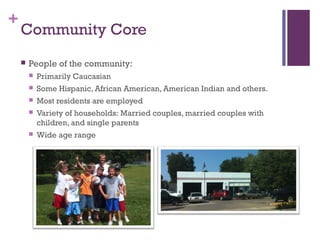
     North:   Kansas River
     South:   2nd Street
     East:   NE Strait Ave.
     West:    Kansas River
+
    Community Core
       People of the community:
           Primarily Caucasian
           Some Hispanic, African American, American Indian and others.
           Most residents are employed
           Variety of households: Married couples, married couples with
            children, and single parents
           Wide age range
+
    Community Core
                       Values, beliefs, & culture
       Churches in the community: Sacred Heart Parish, North Rock
        Baptist Temple, Oakland Church of the Nazarene, Joyful
        Harvest Church, Oakland Presbyterian Church, Oakland
        Christian Church, Oakland United Methodist Church, Our
        Land of Guadalupe, Grace Baptist Church

       Ethnicities: 30.1% German, 14.6% Irish, 10.5% Hispanic,
        9.5% English, & 3.5% French.

       96.3% of the community speak English and 3.6% speak
        Spanish.

       There are two Hispanic restaurants in this community: La
        Siesta Restaurant and La Fiesta
+
    Community Core
                      Lifestyle & Characteristics


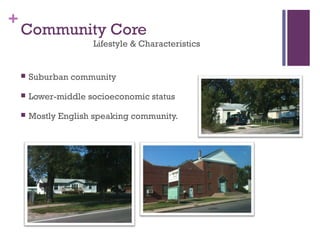
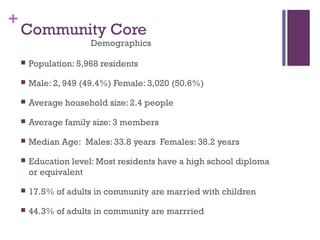
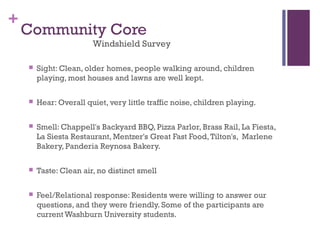
       Suburban community

       Lower-middle socioeconomic status

       Mostly English speaking community.
+
    Community Core
                       Demographics

       Population: 5,968 residents

       Male: 2, 949 (49.4%) Female: 3,020 (50.6%)

       Average household size: 2.4 people

       Average family size: 3 members

       Median Age:  Males: 33.8 years  Females: 38.2 years

       Education level: Most residents have a high school diploma
        or equivalent

       17.5% of adults in community are married with children

       44.3% of adults in community are marrried
+
    Community Core
                        Windshield Survey

       Sight: Clean, older homes, people walking around, children
        playing, most houses and lawns are well kept.

       Hear: Overall quiet, very little traffic noise, children playing.

       Smell: Chappell's Backyard BBQ, Pizza Parlor, Brass Rail, La Fiesta,
        La Siesta Restaurant, Mentzer's Great Fast Food, Tilton's,  Marlene
        Bakery, Panderia Reynosa Bakery.

       Taste: Clean air, no distinct smell

       Feel/Relational response: Residents were willing to answer our
        questions, and they were friendly. Some of the participants are
        current Washburn University students.
+
    Community Core
                            Neighborhood Interview


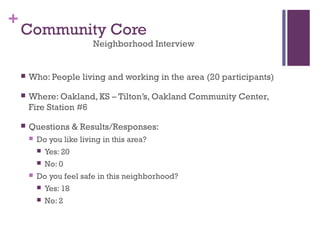
       Who: People living and working in the area (20 participants)

       Where: Oakland, KS – Tilton’s, Oakland Community Center,
        Fire Station #6

       Questions & Results/Responses:
           Do you like living in this area?
               Yes: 20
               No: 0
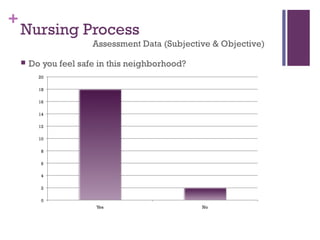
           Do you feel safe in this neighborhood?
               Yes: 18
               No: 2
+
    Community Core
                          Neighborhood Interview


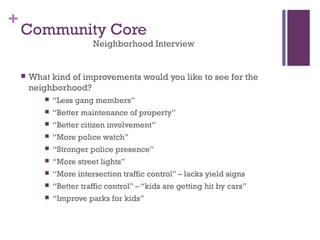
       What kind of improvements would you like to see for the
        neighborhood?
              “Less gang members”
              “Better maintenance of property”
              “Better citizen involvement”
              “More police watch”
              “Stronger police presence”
              “More street lights”
              “More intersection traffic control” – lacks yield signs
              “Better traffic control” – “kids are getting hit by cars”
              “Improve parks for kids”
+
    Community Core
                            Neighborhood Interview


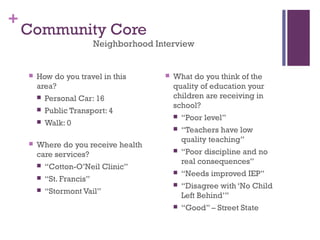
       How do you travel in this             What do you think of the
        area?                                  quality of education your
           Personal Car: 16                   children are receiving in
                                               school?
           Public Transport: 4
                                                  “Poor level”
           Walk: 0
                                                  “Teachers have low
                                                   quality teaching”
       Where do you receive health
        care services?
                                                  “Poor discipline and no
                                                   real consequences”
           “Cotton-O’Neil Clinic”
                                                  “Needs improved IEP”
           “St. Francis”
                                                  “Disagree with ‘No Child
           “Stormont Vail”
                                                   Left Behind’”
                                                  “Good” – Street State
+
    Subsystems
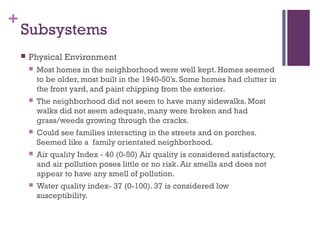
       Physical Environment
           Most homes in the neighborhood were well kept. Homes seemed
            to be older, most built in the 1940-50’s. Some homes had clutter in
            the front yard, and paint chipping from the exterior.
           The neighborhood did not seem to have many sidewalks. Most
            walks did not seem adequate, many were broken and had
            grass/weeds growing through the cracks.
           Could see families interacting in the streets and on porches.
            Seemed like a family orientated neighborhood.
           Air quality Index - 40 (0-50) Air quality is considered satisfactory,
            and air pollution poses little or no risk. Air smells and does not
            appear to have any smell of pollution.
           Water quality index- 37 (0-100). 37 is considered low
            susceptibility.
+
    Subsystems
       Education:
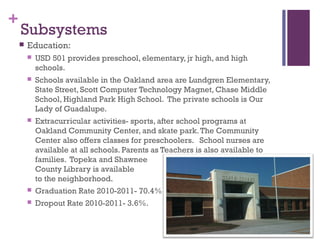
           USD 501 provides preschool, elementary, jr high, and high
            schools.
           Schools available in the Oakland area are Lundgren Elementary,
            State Street, Scott Computer Technology Magnet, Chase Middle
            School, Highland Park High School. The private schools is Our
            Lady of Guadalupe.
           Extracurricular activities- sports, after school programs at
            Oakland Community Center, and skate park. The Community
            Center also offers classes for preschoolers. School nurses are
            available at all schools. Parents as Teachers is also available to
            families. Topeka and Shawnee
            County Library is available
            to the neighborhood.
           Graduation Rate 2010-2011- 70.4%
           Dropout Rate 2010-2011- 3.6%.
+
    Subsystems
       Transportation & safety:
           Many residents have their vehicle and use that as a means for
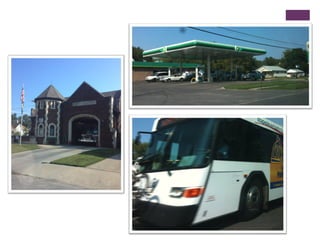
            transportation. Public transportation (Topeka Transit) is also
            available for the community to use.  School bus transportation is
            available for the children.
           Air/water quality monitored by KDHE Bureau of Air/Water.
           Fire Station #6, Topeka Police Department patrol the
            neighborhood.
           Garbage company (Waste Management) for sanitation.
           Sidewalks seemed to need repair, would not be able to easily
            ride a bike on.
           During interviews: 18 out of 20 felt safe in their neighborhood.
            We did not see many traffic lights or stop signs in the
            neighborhood during survey of neighborhood.
           Crime Rate: Topeka has a high crime rate -- mostly thefts.
+
    Subsystems

       Politics & government:
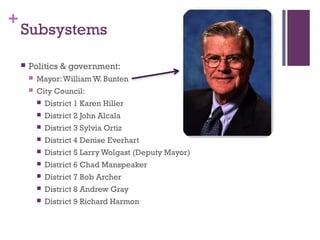
           Mayor: William W. Bunten
           City Council:
               District 1 Karen Hiller
               District 2 John Alcala
               District 3 Sylvia Ortiz
               District 4 Denise Everhart
               District 5 Larry Wolgast (Deputy Mayor)
               District 6 Chad Manspeaker
               District 7 Bob Archer
               District 8 Andrew Gray
               District 9 Richard Harmon 
+
    Subsystems
       Health & social services:
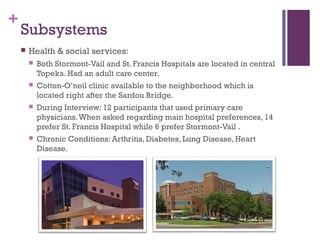
           Both Stormont-Vail and St. Francis Hospitals are located in central
            Topeka. Had an adult care center.
           Cotton-O’neil clinic available to the neighborhood which is
            located right after the Sardou Bridge.
           During Interview: 12 participants that used primary care
            physicians. When asked regarding main hospital preferences, 14
            prefer St. Francis Hospital while 6 prefer Stormont-Vail .
           Chronic Conditions: Arthritis, Diabetes, Lung Disease, Heart
            Disease.
+
    Subsystems
       Communications:
           Residents gather at many of the local churches, community center,
            and local school events.
           Newspaper: Topeka Capital Journal
           Formal communication: newspapers, radio, television, telephone,
            and postal service.
           Informal communication: word of mouth, school newsletters,
            bulletin boards at schools/local stores/community center, church,
            public library, personal/public email.

       Economics:
           Average hourly wage for Topeka: $19.24/hr. Average yearly
            income:$38,960
           Unemployment rate: 7.2%, Food stamps and WIC are used and
            accepted at the local stores in Topeka.
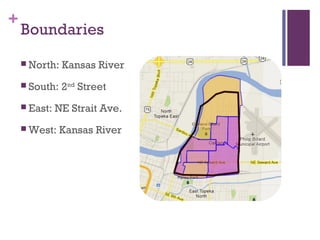
           Tilton is one of grocery stores in the Oakland neighborhood. Also
            has a small bakery.
+
    Subsystems
       Recreation:
           School sports and local summer sports through Shawnee County
            Parks & Rec local skate park and community center
           Neighborhood has community garden behind Oakland
            Community Center, playgrounds/school playgrounds for
            children,
           Public swimming pools in Topeka
           Children also play in their own yards.
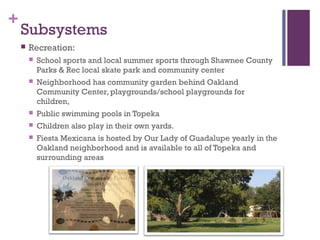
           Fiesta Mexicana is hosted by Our Lady of Guadalupe yearly in the
            Oakland neighborhood and is available to all of Topeka and
            surrounding areas
+
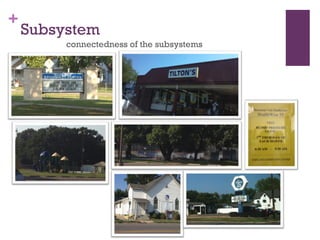
    Subsystem
         connectedness of the subsystems
+
    Boundaries
       Barriers
           Conceptual:
               Individuals are adaptive to their community to where other
                communities act as a culture shock to them. Many have lived in
                this community there whole life thus not giving them
                opportunities those other communities may have to offer.
               Oakland is becoming more and more prone to criminal activity
                as fewer people feel a sense of ownership toward the
                neighborhood, as stated in the Oakland Neighborhood Plan.
           Concrete
               No modern street drainage in parts of Oakland
               Street and sidewalks do not connect to neighborhood amenities
               High traffic speeds within the neighborhood
+
    Boundaries
       Normal line of defenses
           Community Building: The community comes together to make the
            neighborhood a stronger advocate for itself
           Neighborhood patrols and the Police Department assist with
            keeping the streets safe and protecting the neighborhood
           Community Gardens: encourages youth to participate with
            community garden.

       Flexible line of defenses
           The community worked together to “Clean-up” to avoid
            environmental code problems
           In the destruction of houses in the past, they developed a
            “neighbor-to-neighbor” housing Rehab Program
+
    Boundaries
       Lines of resistance
           Neighborhood Watch
           Crosswalks for school
           Speed bumps to prevent speeding
           More stop signs and yield signs
           More street lights

       Supporting services
           Church Services
           Community Projects
               Night Out Against Crime – funded by “Party in the Park”
               Neighborhood Clean up
+
    Nursing Process
                       Assessment Data (Subjective & Objective)

       Do you feel safe in this neighborhood?
+
    Nursing Process
                           Assessment Data (Subjective & Objective)

       What kind of improvements would you like to see for the
        neighborhood?
              “Less gang members”
              “Better maintenance of property”
              “Better citizen involvement”
            “More police watch”
            “Stronger police presence”
              “More street lights”
              “More intersection traffic control” – lacks yield signs
              “Better traffic control” – “kids are getting hit by cars”
              “Improve parks for kids”
+
    Nursing Process
       Community nursing diagnosis:
         Oakland    Community is at risk for ineffective
            protection related to lack of police presence.
       Rationale:
           Even though 90% of the interviewees stated they felt safe in their
            neighborhood half of the improvements stated were related to
            stronger police presence. If the police simply drove through the
            neighborhood more often, there may be less gang involvement or
            activity in the neighborhood. Also if there was a stronger police
            presence, the need for better traffic control may be recognized.
            After speaking with the firefighters, the need for stronger police
            presence magnified.
+
    Nursing Process
       Recommendations (research, education, practice):
           We recommend speaking with the police department or starting
            a petition to request stronger police presence in the
            neighborhood.

           Another way to raise awareness would be to ask the fire
            department to participate in any form.

           Include more community events promoting awareness against
            crime in the neighborhood.

           Present a nursing project at the community center regarding
            safety in the neighborhood

           Keeping track of crime rates through the police department
+
    Implementation
       Potential project based on assessment
           Participate in “Party in the Park.” It is a community event that
            helps raise money for “National Night Out Against Crime.”

       Rationale for implementation
           Along with increasing police presence in the neighborhood, this
            can help promote community spirit and police-community
            partnership for a safer neighborhood.
           This will provide a great opportunity for nursing students to learn
            more on how small contributions such as this event can positively
            influence the community’s spirit and health.
           Even with a diverse community, as a whole, everyone shows
            willingness to see change especially when it comes to their safety
            & security.

       Change agents
           Nursing students, police officers, fire fighters.
+
    The End
    Thank you for your time listening to our presentation. Enjoy your day!
+
    References
    https://www.topekapublicschools.net/schools/
    http://www.topeka.org/
    http://www.city-data.com/neighborhood/Oakland-Topeka-
    KS.html
    http://svapp15586.ksde.org/k12/CountyStatics.aspx?
    org_no=D0501
    http://www.kdheks.gov/arthritis/kohp.htm
    http://www.bls.gov/eag/eag.ks_topeka_msa.htm
     http://www.topeka.org/planning/oakland_neigh_plans.shtml
     http://www.neighborhoodscout.com/ks/topeka/oakland/#desc 
    https://sites.google.com/site/oaklandnia/annual-events/party-in-
    the-park

Official Oakland community assessment

  • 1.
    + Oakland (Topeka, KS 66616) Presented by Brooke Brewer, Emily Brown, Meloni Montgomery, Amanda Rice, & Alexandra Tapang
  • 2.
    + Boundaries  North: Kansas River  South: 2nd Street  East: NE Strait Ave.  West: Kansas River
  • 3.
    + Community Core  People of the community:  Primarily Caucasian  Some Hispanic, African American, American Indian and others.  Most residents are employed  Variety of households: Married couples, married couples with children, and single parents  Wide age range
  • 4.
    + Community Core Values, beliefs, & culture  Churches in the community: Sacred Heart Parish, North Rock Baptist Temple, Oakland Church of the Nazarene, Joyful Harvest Church, Oakland Presbyterian Church, Oakland Christian Church, Oakland United Methodist Church, Our Land of Guadalupe, Grace Baptist Church  Ethnicities: 30.1% German, 14.6% Irish, 10.5% Hispanic, 9.5% English, & 3.5% French.  96.3% of the community speak English and 3.6% speak Spanish.  There are two Hispanic restaurants in this community: La Siesta Restaurant and La Fiesta
  • 5.
    + Community Core Lifestyle & Characteristics  Suburban community  Lower-middle socioeconomic status  Mostly English speaking community.
  • 6.
    + Community Core Demographics  Population: 5,968 residents  Male: 2, 949 (49.4%) Female: 3,020 (50.6%)  Average household size: 2.4 people  Average family size: 3 members  Median Age:  Males: 33.8 years  Females: 38.2 years  Education level: Most residents have a high school diploma or equivalent  17.5% of adults in community are married with children  44.3% of adults in community are marrried
  • 7.
    + Community Core Windshield Survey  Sight: Clean, older homes, people walking around, children playing, most houses and lawns are well kept.  Hear: Overall quiet, very little traffic noise, children playing.  Smell: Chappell's Backyard BBQ, Pizza Parlor, Brass Rail, La Fiesta, La Siesta Restaurant, Mentzer's Great Fast Food, Tilton's,  Marlene Bakery, Panderia Reynosa Bakery.  Taste: Clean air, no distinct smell  Feel/Relational response: Residents were willing to answer our questions, and they were friendly. Some of the participants are current Washburn University students.
  • 8.
    + Community Core Neighborhood Interview  Who: People living and working in the area (20 participants)  Where: Oakland, KS – Tilton’s, Oakland Community Center, Fire Station #6  Questions & Results/Responses:  Do you like living in this area?  Yes: 20  No: 0  Do you feel safe in this neighborhood?  Yes: 18  No: 2
  • 9.
    + Community Core Neighborhood Interview  What kind of improvements would you like to see for the neighborhood?  “Less gang members”  “Better maintenance of property”  “Better citizen involvement”  “More police watch”  “Stronger police presence”  “More street lights”  “More intersection traffic control” – lacks yield signs  “Better traffic control” – “kids are getting hit by cars”  “Improve parks for kids”
  • 10.
    + Community Core Neighborhood Interview  How do you travel in this  What do you think of the area? quality of education your  Personal Car: 16 children are receiving in school?  Public Transport: 4  “Poor level”  Walk: 0  “Teachers have low quality teaching”  Where do you receive health care services?  “Poor discipline and no real consequences”  “Cotton-O’Neil Clinic”  “Needs improved IEP”  “St. Francis”  “Disagree with ‘No Child  “Stormont Vail” Left Behind’”  “Good” – Street State
  • 11.
    + Subsystems  Physical Environment  Most homes in the neighborhood were well kept. Homes seemed to be older, most built in the 1940-50’s. Some homes had clutter in the front yard, and paint chipping from the exterior.  The neighborhood did not seem to have many sidewalks. Most walks did not seem adequate, many were broken and had grass/weeds growing through the cracks.  Could see families interacting in the streets and on porches. Seemed like a family orientated neighborhood.  Air quality Index - 40 (0-50) Air quality is considered satisfactory, and air pollution poses little or no risk. Air smells and does not appear to have any smell of pollution.  Water quality index- 37 (0-100). 37 is considered low susceptibility.
  • 12.
    + Subsystems  Education:  USD 501 provides preschool, elementary, jr high, and high schools.  Schools available in the Oakland area are Lundgren Elementary, State Street, Scott Computer Technology Magnet, Chase Middle School, Highland Park High School. The private schools is Our Lady of Guadalupe.  Extracurricular activities- sports, after school programs at Oakland Community Center, and skate park. The Community Center also offers classes for preschoolers. School nurses are available at all schools. Parents as Teachers is also available to families. Topeka and Shawnee County Library is available to the neighborhood.  Graduation Rate 2010-2011- 70.4%  Dropout Rate 2010-2011- 3.6%.
  • 13.
    + Subsystems  Transportation & safety:  Many residents have their vehicle and use that as a means for transportation. Public transportation (Topeka Transit) is also available for the community to use.  School bus transportation is available for the children.  Air/water quality monitored by KDHE Bureau of Air/Water.  Fire Station #6, Topeka Police Department patrol the neighborhood.  Garbage company (Waste Management) for sanitation.  Sidewalks seemed to need repair, would not be able to easily ride a bike on.  During interviews: 18 out of 20 felt safe in their neighborhood. We did not see many traffic lights or stop signs in the neighborhood during survey of neighborhood.  Crime Rate: Topeka has a high crime rate -- mostly thefts.
  • 15.
    + Subsystems  Politics & government:  Mayor: William W. Bunten  City Council:  District 1 Karen Hiller  District 2 John Alcala  District 3 Sylvia Ortiz  District 4 Denise Everhart  District 5 Larry Wolgast (Deputy Mayor)  District 6 Chad Manspeaker  District 7 Bob Archer  District 8 Andrew Gray  District 9 Richard Harmon 
  • 16.
    + Subsystems  Health & social services:  Both Stormont-Vail and St. Francis Hospitals are located in central Topeka. Had an adult care center.  Cotton-O’neil clinic available to the neighborhood which is located right after the Sardou Bridge.  During Interview: 12 participants that used primary care physicians. When asked regarding main hospital preferences, 14 prefer St. Francis Hospital while 6 prefer Stormont-Vail .  Chronic Conditions: Arthritis, Diabetes, Lung Disease, Heart Disease.
  • 17.
    + Subsystems  Communications:  Residents gather at many of the local churches, community center, and local school events.  Newspaper: Topeka Capital Journal  Formal communication: newspapers, radio, television, telephone, and postal service.  Informal communication: word of mouth, school newsletters, bulletin boards at schools/local stores/community center, church, public library, personal/public email.  Economics:  Average hourly wage for Topeka: $19.24/hr. Average yearly income:$38,960  Unemployment rate: 7.2%, Food stamps and WIC are used and accepted at the local stores in Topeka.  Tilton is one of grocery stores in the Oakland neighborhood. Also has a small bakery.
  • 18.
    + Subsystems  Recreation:  School sports and local summer sports through Shawnee County Parks & Rec local skate park and community center  Neighborhood has community garden behind Oakland Community Center, playgrounds/school playgrounds for children,  Public swimming pools in Topeka  Children also play in their own yards.  Fiesta Mexicana is hosted by Our Lady of Guadalupe yearly in the Oakland neighborhood and is available to all of Topeka and surrounding areas
  • 19.
    + Subsystem connectedness of the subsystems
  • 20.
    + Boundaries  Barriers  Conceptual:  Individuals are adaptive to their community to where other communities act as a culture shock to them. Many have lived in this community there whole life thus not giving them opportunities those other communities may have to offer.  Oakland is becoming more and more prone to criminal activity as fewer people feel a sense of ownership toward the neighborhood, as stated in the Oakland Neighborhood Plan.  Concrete  No modern street drainage in parts of Oakland  Street and sidewalks do not connect to neighborhood amenities  High traffic speeds within the neighborhood
  • 21.
    + Boundaries  Normal line of defenses  Community Building: The community comes together to make the neighborhood a stronger advocate for itself  Neighborhood patrols and the Police Department assist with keeping the streets safe and protecting the neighborhood  Community Gardens: encourages youth to participate with community garden.  Flexible line of defenses  The community worked together to “Clean-up” to avoid environmental code problems  In the destruction of houses in the past, they developed a “neighbor-to-neighbor” housing Rehab Program
  • 22.
    + Boundaries  Lines of resistance  Neighborhood Watch  Crosswalks for school  Speed bumps to prevent speeding  More stop signs and yield signs  More street lights  Supporting services  Church Services  Community Projects  Night Out Against Crime – funded by “Party in the Park”  Neighborhood Clean up
  • 23.
    + Nursing Process Assessment Data (Subjective & Objective)  Do you feel safe in this neighborhood?
  • 24.
    + Nursing Process Assessment Data (Subjective & Objective)  What kind of improvements would you like to see for the neighborhood?  “Less gang members”  “Better maintenance of property”  “Better citizen involvement”  “More police watch”  “Stronger police presence”  “More street lights”  “More intersection traffic control” – lacks yield signs  “Better traffic control” – “kids are getting hit by cars”  “Improve parks for kids”
  • 25.
    + Nursing Process  Community nursing diagnosis:  Oakland Community is at risk for ineffective protection related to lack of police presence.  Rationale:  Even though 90% of the interviewees stated they felt safe in their neighborhood half of the improvements stated were related to stronger police presence. If the police simply drove through the neighborhood more often, there may be less gang involvement or activity in the neighborhood. Also if there was a stronger police presence, the need for better traffic control may be recognized. After speaking with the firefighters, the need for stronger police presence magnified.
  • 26.
    + Nursing Process  Recommendations (research, education, practice):  We recommend speaking with the police department or starting a petition to request stronger police presence in the neighborhood.  Another way to raise awareness would be to ask the fire department to participate in any form.  Include more community events promoting awareness against crime in the neighborhood.  Present a nursing project at the community center regarding safety in the neighborhood  Keeping track of crime rates through the police department
  • 27.
    + Implementation  Potential project based on assessment  Participate in “Party in the Park.” It is a community event that helps raise money for “National Night Out Against Crime.”  Rationale for implementation  Along with increasing police presence in the neighborhood, this can help promote community spirit and police-community partnership for a safer neighborhood.  This will provide a great opportunity for nursing students to learn more on how small contributions such as this event can positively influence the community’s spirit and health.  Even with a diverse community, as a whole, everyone shows willingness to see change especially when it comes to their safety & security.  Change agents  Nursing students, police officers, fire fighters.
  • 28.
    + The End Thank you for your time listening to our presentation. Enjoy your day!
  • 29.
    + References https://www.topekapublicschools.net/schools/ http://www.topeka.org/ http://www.city-data.com/neighborhood/Oakland-Topeka- KS.html http://svapp15586.ksde.org/k12/CountyStatics.aspx? org_no=D0501 http://www.kdheks.gov/arthritis/kohp.htm http://www.bls.gov/eag/eag.ks_topeka_msa.htm  http://www.topeka.org/planning/oakland_neigh_plans.shtml  http://www.neighborhoodscout.com/ks/topeka/oakland/#desc  https://sites.google.com/site/oaklandnia/annual-events/party-in- the-park

Editor's Notes

  • #11 IEP – Individualized Education Program Majority of the participants mentions “Cotton-O’Neil Clinic” as their preferred place for health care services but majority of them also mentioned their preference for St. Francis Hospital over Stormont-Vail The man who said “I disagree with ‘No Child Left Behind’ also mentions how “American children have it harder” due to the increased number of Hispanic speaking students in Street State.
  • #20 discuss the connectedness of the subsystems- The Oakland neighborhood seems to be very family oriented, and seem like their own “island” in part of Topeka. The people in this community seem to work through the subsystems as a whole to maintain what they have. Communication seems to be key in keeping this community current and up-to-date on events.