Research Report
Submitted by: Environment, Culture, and Conservation (ECCo), a Division of Science at The Field Museum
To: The City of Chicago Department of Environment
City of Chicago
Richard M. Daley, Mayor
Department of Environment
COMMUNITY #7: FOREST GLEN
Engaging Chicago’s Diverse Communities in
the Chicago Climate Action Plan
tableofcontents
Sponsored by
1	 PROJECT OVERVIEW
3	 COMMUNITY OVERVIEW
5	STAKEHOLDERS,
	 PARTNERSHIPS, AND
	RELATIONSHIP-BUILDING
8	 AWARENESS OF CLIMATE
	 CHANGE AND INTEREST IN
	 ADDRESSING IT
13	 COMMUNITY CONCERNS:
	 SPRINGBOARDS FOR
	 CLIMATE ACTION
19	ENVIRONMENTALLY-FRIENDLY
	 PRACTICES, VALUES, AND TRADITIONS
22	 COMMUNICATION AND
	DISSEMINATION
25	 CREATIVE MODELS FOR
	 COMMUNITY ENGAGEMENT
29	CONCLUSION
30	 COMMUNITY ASSET MAP
32	 REGIONAL ASSET MAP
34	 OUR TEAM
	CITATIONS
	
	 PARTICIPATING ORGANIZATIONS
This research was commissioned by the
City of Chicago Department of Environment.
Research was conducted by:
Environment, Culture, and Conservation (ECCo),
a Division of Science at The Field Museum
with our partners:
City of Chicago Department of Environment
Sauganash Chamber of Commerce
Sauganash Community Association
November 2011
Visit our Web site to download the Community and Regional Asset Maps,
and reports about other communities:
http://fieldmuseum.org/climateaction
Environment, Culture, and Conservation (ECCo) • The Field Museum • Research Report 1
project overview
Engaging Chicago Communities in the Chicago Climate Action Plan -
Community #7: Forest Glen is the seventh community study commissioned
by the City of Chicago Department of Environment (DOE) to identify strategies
for effectively engaging diverse communities throughout the city in the
implementation of the Chicago Climate Action Plan (CCAP). The plan lays out
ambitious goals for reducing greenhouse gas emissions by 80% of 1990 levels
by 2050, with an interim goal of a 25% reduction of 1990 levels by 2020.
Six qualitative research studies have been completed to date (South Chicago,
NKO/Bronzeville, Chicago’s Polish Community, the Latino community in Pilsen,
the South Asian community in West Ridge, and the African-American community
in Roseland). The Forest Glen Community Area, Area 12 on the Chicago
Community Areas Map, was selected for the seventh study for a number of
reasons. Geographically, we had not yet focused on an inland community
area on the edge of the city. The area is also unique for its close proximity to
a number of large forest preserves within the city, which greatly contribute to
its character. Although racial diversity has increased in the last decade, it is a
predominantly Euro-American middle-class and upper-middle-class area, in
contrast racially and economically with most of the other research areas to date.
Finally, the large proportion of single-family homes makes it a good area in
which to consider questions of homeowner participation in climate action, from
landscaping practices to energy retrofits. While the area has a large degree of
middle-class homogeneity, residents recognize multiple neighborhoods within it,
with just one of them being called Forest Glen by locals. Throughout this report,
“the community” and “the area” will reference the full research area. (See
Community Overview, p.3 and the accompanying Research Area map for further
discussion of the research and community boundaries.)
Ethnographic research activities were designed and conducted collaboratively
by a team including anthropologists from The Field Museum’s division of
Environment, Culture, and Conservation (ECCo) and our community partners,
the Sauganash Chamber of Commerce and the Sauganash Community
Association. While both are located in Sauganash, they had the operating
capacity to take on the project quickly and link us to other organizations
and individuals from across the entire area. Less formally, other residents’
associations, area schools, churches, businesses, and individuals collaborated
on the research.
Research was conducted over a six-month period, from September 2010
to February 2011. We engaged roughly 250 adults – including residents,
aldermen, site users, business and community leaders – and 136 children
through the following methods:
•	 Participant observation at over 10 community meetings and on more than a
dozen other occasions in a number of locations including forest preserves,
parks, business and residential districts, and the library
•	 10 focus groups, including an interim gathering of community leaders
to respond to findings and three field trip/focus groups for area public
elementary school fifth grade classrooms (see What Does Climate Change
Look Like to You? on p. 11) for more on the student groups
•	 Close to 90 individual interviews with residents and other stakeholders
Research partners are invaluable for engaging other community groups in
research and implementation. Here representatives of the Sauganash Community
Association and the Sauganash Chamber of Commerce listen to a local scout
master talk about his troop’s possible involvement in leading local climate action.
•	 65 responses to two online surveys distributed to by the Sauganash
Community Association and Historic Chicago Bungalow Association to
their members who live in the research area.
Our goal was to engage a diverse group of people in terms of gender, age,
education, income, home ownership and personal history. Overall we were
successful, having achieved the mix among participants shown in the table
below.
There is a bias for higher education. Age is less divergent than it appears,
in that the three classrooms of 5th graders who participated in the field trip/
focus groups are not included in the calculation. The biases are unsurprising,
since community leaders (a group we seek out) tend to be both older and
more educated. Finally, the foreign born population is underrepresented in our
sample. Some percentage of that population is Polish, a community we have
already covered in our report, community #3; the Polish community.
project overview
2 Environment, Culture, and Conservation (ECCo) • The Field Museum • Research Report
Census vs. Research Sample
Demographic
Characteristic
% in Census 2000 % in research sample
Male 48 32
Female 52 68
Owner-Occupied 86 86
Renter-Occupied	 13
Age 43 (median) 51 – 60 (median)
Bachelor’s /Graduate/
Professional Degree
45** 82
Foreign-Born 24** 11
**Based off of the 2005-2009 US Census Bureau American Community Survey for PUMA5 03504,
Illinois
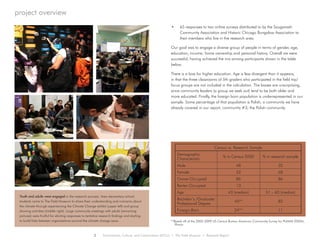
Youth and adults were engaged in the research process. Area elementary school
students came to The Field Museum to share their understanding and concerns about
the climate through experiencing the Climate Change exhibit (upper left) and group
drawing activities (middle right). Large community meetings with adults (remaining
pictures) were fruitful for eliciting responses to tentative research findings and starting
to build links between organizations around the climate change issue.
Environment, Culture, and Conservation (ECCo) • The Field Museum • Research Report 3
community overview
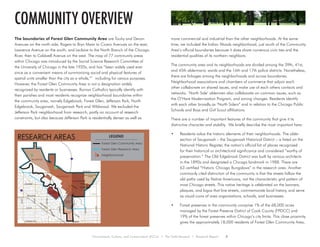
The boundaries of Forest Glen Community Area are Touhy and Devon
Avenues on the north side, Rogers to Bryn Mawr to Cicero Avenues on the east,
Lawrence Avenue on the south, and Leclaire to the North Branch of the Chicago
River, then to Caldwell Avenue on the west. The map of 77 community areas
within Chicago was introduced by the Social Science Research Committee of
the University of Chicago in the late 1920s, and has “been widely used ever
since as a convenient means of summarizing social and physical features of
spatial units smaller than the city as a whole,”1 including for census purposes.
However, the Forest Glen Community Area is not a designation widely
recognized by residents or businesses. Roman Catholics typically identify with
their parishes and most residents recognize neighborhood boundaries within
the community area, namely Edgebrook, Forest Glen, Jefferson Park, North
Edgebrook, Sauganash, Sauganash Park and Wildwood. We excluded the
Jefferson Park neighborhood from research, partly on account of research
constraints, but also because Jefferson Park is residentially denser as well as
more commercial and industrial than the other neighborhoods. At the same
time, we included the Indian Woods neighborhood, just south of the Community
Area’s official boundaries because it does share numerous civic ties and the
residential qualities of its northern neighbors.
The community area and its neighborhoods are divided among the 39th, 41st,
and 45th aldermanic wards and the 16th and 17th police districts. Nonetheless,
there are linkages among the neighborhoods and across boundaries.
Neighborhood associations and chambers of commerce that adjoin each
other collaborate on shared issues, and make use of each others contacts and
networks. ‘North Side’ aldermen also collaborate on common issues, such as
the O’Hare Modernization Program, and zoning changes. Residents identify
with each other broadly as ‘North Siders” and in relation to the Chicago Public
Schools and Boys and Girl Scout affiliations.
There are a number of important features of the community that give it its
distinctive character and stability. We briefly describe the most important here:
•	 Residents value the historic elements of their neighborhoods. The older
section of Sauganash – the Sauganash Historical District – is listed on the
National Historic Register, the nation’s official list of places recognized
for their historical or architectural significance and considered “worthy of
preservation.” The Old Edgebrook District was built by various architects
in the 1890s and designated a Chicago landmark in 1988. There are
63 certified “Historic Chicago Bungalows” in the research area. Another
commonly cited distinction of the community is that the streets follow the
old paths used by Native Americans, not the characteristic grid pattern of
most Chicago streets. This native heritage is celebrated on the banners,
plaques, and logos that line streets, commemorate local history, and serve
as visual icons of area organizations, schools, and businesses.
•	 Forest preserves in the community comprise 1% of the 68,000 acres
managed by the Forest Preserve District of Cook County (FPDCC) and
19% of the forest preserves within Chicago’s city limits. This close proximity
gives the approximately 18,000 residents of Forest Glen Community Area,
PETERSON
ELSTON
LAWRENCE AVE.
94
94
MONTROSE
FOSTER
SAUGANASH
ASHMORE
DEVON AVE
IO
NIA
Ave
90
0 0.4 0.80.2 Miles
EDGEBROOK
WILDWOOD
SAUGANASH
INDIAN
WOODS
FOREST
GLEN
JEFFERSON
PARK
SAUGANASH
PARK
NAGLE
NORTHW
EST
CICERO
CALDWELL
TOUHY
KOSTNER
LARAMIE
ROGERS
AUSTIN
CENTRAL
MILWAUKEE
PULASKI
OAKPARK
PETERSON
BRYN MAWR
RESEARCH AREAS
Forest Glen Research Area
Forest Glen Community Area
Neighborhoods
LEGEND
4 Environment, Culture, and Conservation (ECCo) • The Field Museum • Research Report
who make up 0.3% of the population of Cook County, more direct access
to the preserves than other Cook County residents. The preserves are a
distinctive feature of the neighborhoods, integral both to residents’ pride in
the proximity of natural areas as well as to higher real estate values.
•	 The Forest Glen Community Area lies against the City boundary, so it is
one of the farthest limits for City of Chicago employees who must reside in
the City for employment (such as police, fire, teachers and departmental
staff). The vast majority of the buildings are single-family homes, which
were constructed after the Second World War and are owner-occupied. As
a result, Forest Glen is less dense than most residential areas in Chicago
in terms of population. Described by residents and publications as “the
best of both worlds,” Forest Glen boasts easy access to the cultural
amenities of the city but with the perceived safety, quiet, and family-friendly
atmosphere of a suburb (~4,000 households, roughly 90% single-family
homes with yards, well respected public and private schools).
•	 Study participants typically describe the area as residentially stable, citing
factors like low foreclosure and vacancy rates, and a tendency for people
who grew up in the area to return to raise families or otherwise put down
roots. The high cost of real estate has helped to maintain the middle class
to upper middle class character of the area. According to knowledgeable
real estate agents, in the last three decades, in more upscale sections of the
community, the City firemen, police and teachers have tended to be replaced
by lawyers, doctors and salesmen. In the less upscale sections, professionals
like lawyers and doctors have moved to wealthier suburbs, and been replaced
by blue-collar workers. Although there has been some immigration of people
of different ethnic origins into the area, neighborhoods are primarily White
and ethnically stable. CPS elementary schools do reflect some growing ethnic
diversity of the area. At one school, about 50 of the parents speak Spanish
as a first language and about 30 families speak Polish. Approximately 20
different languages are spoken in the homes of children attending another
of the elementary schools, including Spanish, Arabic, Cantonese, Urdu,
Pilipino (Tagalog), Assyrian (Syriac, Aramaic), Farsi (Persian), Croatian,
Russian, Bosnian, Albanian, Tosk (Albania), Vietnamese, Guajarati, Serbian,
Portuguese, and Polish. Some of these families live outside the community
area and take advantage of open slots at local schools. The level of diversity
among students is in decline currently, as more local families are taking
advantage of their neighborhood public schools at a time when the schools’
reputations are rising and the economy continues to struggle.
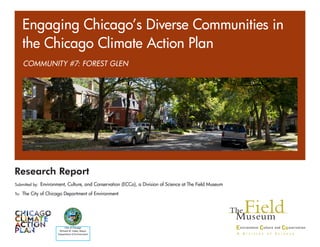
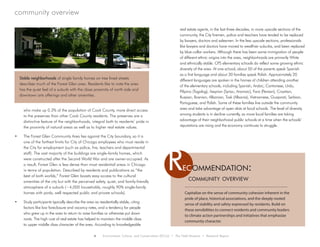
Stable neighborhoods of single family homes on tree lined streets
describes much of the Forest Glen area. Residents like to note the area
has the quiet feel of a suburb with the close proximity of north side and
downtown arts offerings and other amenities.
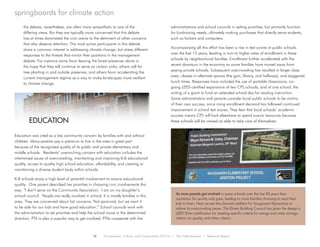
Rec ommendation:
Capitalize on the sense of community cohesion inherent in the
pride of place, historical associations, and the deeply rooted
sense of stability and safety expressed by residents. Build on
these sensibilities to connect residents and community leaders
to climate action partnerships and initiatives that emphasize
community character.
community overview
community overview
Environment, Culture, and Conservation (ECCo) • The Field Museum • Research Report 5
Influential and interconnected civic organizations, social groups,
schools, and religious organizations anchor community life in the research area,
supporting an ethic of self-help and civic involvement. Organizations do work
to ensure their constituents receive their share of city services but perhaps more
of their efforts are spent in overseeing and smoothing the way for additional
services and initiatives that originate and are carried through at the community
level.
•	 Founded at different times between 1910 and 1962, the six community
associations active in the research area have no official statutory authority.
Nonetheless, they play important roles in shaping local life. Associations
use modest annual membership dues ($20-$40), collected from roughly
half the households in the neighborhoods they serve, to supplement city
services, such as snow plowing and mosquito abatement, as necessary.
They work closely with Ward offices, the Zoning Advisory Board, CAPS,
the Chicago Parks District (CPD), and Chicago Public Schools (CPS)
programs, as well as with representatives of state and county government.
Within these collaborations, often by serving as a forum for different
stakeholders to express their views, they have had significant influence in
setting the direction for neighborhoods: impacting issues such as whether
to change dry precincts to wet, whether to expand the Edgebrook Metra
station, and whether to offer zoning variances in business districts. They
also enlist outside groups and resources to meet their goals, as when the
Sauganash Community Association partnered with the alderman, the City,
and the local chamber of commerce to attract Whole Foods as an anchor
for the redevelopment of the business district at Peterson and Cicero
avenues. Finally, community associations foster neighborhood cohesion
by coordinating community-wide programs, such as annual garage
sales, block and holiday parties, Fourth of July parades and picnics,
contests (e.g., awards for best Halloween/Christmas decorations), and the
distribution of “welcome packages” to new residents.
stakeholders,
PARTNERSHIPS, AND RELATIONSHIP-BUILDING
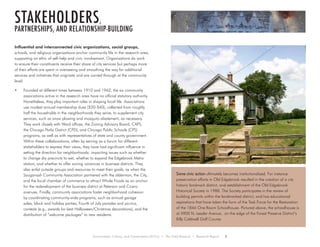
Some civic action ultimately becomes institutionalized. For instance
preservation efforts in Old Edgebrook resulted in the creation of a city
historic landmark district, and establishment of the Old Edgebrook
Historical Society in 1988. The Society participates in the review of
building permits within the landmarked district, and has educational
aspirations that have taken the form of the Task Force for the Restoration
of the 1846 One Room Schoolhouse. Pictured above, the schoolhouse is
at 5900 N. Leader Avenue, on the edge of the Forest Preserve District’s
Billy Caldwell Golf Course.
•	 The Sauganash and Edgebrook Chambers of Commerce regularly
collaborate with each other to promote the growth and sustainability of
area businesses both within and beyond the immediate boundaries of
their respective neighborhoods. For example, they promote awareness of
and participation in voter referenda to approve or reject zoning changes,
letting residents know the likely outcomes of proposed changes. Voter
approved changes in the last decade have been pivotal in the building of
the Whole Foods in Sauganash and the arrival of more upscale restaurants
in Edgebrook. Chambers of Commerce also highlight community assets,
those characteristics that make the area attractive to shoppers, visitors,
and prospective homeowners and businesses. The Chambers perform this
function by regularly building links among local businesses, residents, and
external resources to project community character and pride.
• 	 The community has highly rated public and private schools, which attract
young families to the area. Parents of school-aged children maintain an
active, highly visible, and vocal engagement with area schools through
their participation in a range of activities (in the classroom, after school,
and for special events), organized in great part though Parent Teacher
Associations and Local School Councils. Fundraising efforts to fill financial
gaps not covered by CPS budget allocations are widely supported by the
broader community and reflect the breadth of community investment in the
quality of area schools.
•	 Religion is an important part of life in the community. Two well-supported
Roman Catholic parishes, Queen of All Saints and St. Mary of the Woods,
as well as several Lutheran and non-denominational churches, are not
only centers of worship and spiritual life, but are also social centers and
facilities for a variety of groups, including men’s, women’s, garden,
and historical clubs; Boy and Girl Scout troops; and some of the areas’
community associations.
• 	 Given the proximity of the community to large preserves and parks, use
of Cook County Forest Preserve and Chicago Park District lands figures
prominently in community life. The value that residents attach to these
lands motivates many of them to become civically involved in their
management.
6 Environment, Culture, and Conservation (ECCo) • The Field Museum • Research Report
stakeholders, partnerships,
and relationship-building
ROUTES TO CIVIC ACTION
Stakeholder with
a concern
STANDING
ORGANIZATIONS
MEDIA
OUTLETS
POWER
BROKERS
AD HOC
COMMITTEE
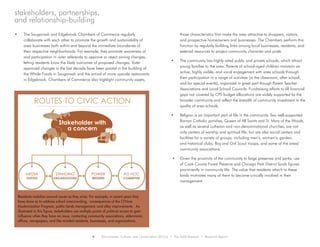
Residents mobilize around issues as they arise. For example, in recent years they
have done so to address school overcrowding, consequences of the O’Hare
Modernization Program, public lands management, and alley improvements. As
illustrated in this figure, stakeholders use multiple points of political access to gain
influence when they have an issue, contacting community associations, aldermanic
offices, newspapers, and like minded residents, businesses, and organizations.
Environment, Culture, and Conservation (ECCo) • The Field Museum • Research Report 7
stakeholders, partnerships,
and relationship - building
Rec ommendation:
1.	 Recognize that the high level of civic
engagement, including the many self-starting
initiatives, may be neighborhood-specific.
Build on this engagement by connecting
groups interested in similar issues across
neighborhoods.
2.	 Develop programs and messaging that build
upon the spirit of collaboration and strong
existing partnerships among community
associations, chambers of commerce, the
Old Edgebrook Historical Society, the Historic
Chicago Bungalow Association, Aldermanic
offices and their respective constituencies.
3.	 Establish partnerships with the governing
structures of religious organizations so that
the shared community interest in quality
of life issues that affect the environment
can be communicated on a parish and/or
congregational level.
stakeholders, partnerships, and
relationship-building
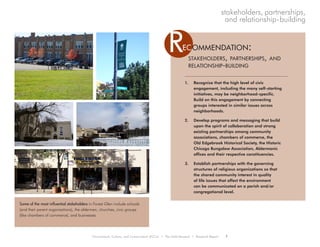
Some of the most influential stakeholders in Forest Glen include schools
(and their parent organizations), the aldermen, churches, civic groups
(like chambers of commerce), and businesses.
With exceptions, study participants are aware of climate change
as an environmental issue, one around which public discussion has become
increasingly contentious and confusing in recent years. A majority of participants
believe that humans probably have a major impact on the climate and view
climate change as a global threat that will ultimately have significant local
impacts. Residents, business people, and other stakeholders typically share a
desire to do what they can to address the issue and to achieve accompanying
co-benefits for their community. At the same time, they feel significant
uncertainty about what to believe in the face of conflicting messages, often
saying they do not know which messengers to trust or where to go for credible
information to guide specific action. Additionally, participants displayed different
levels of awareness of their individual carbon footprints and at times expressed
ambivalence about coming to know them better. Looking a little more deeply
at awareness and interest in climate action will clarify the relationship between
them.
•	 Participants often expressed a fairly detailed understanding of climate
change as a global issue that eventually will have a significant impact on
Chicago. Alongside the expected discussions of melting polar ice and
rising temperatures, a number of participants mentioned phenomena
such as perceived regional cooling, growing refugee problems around
the globe, latitudinal changes in flora and fauna, and even the Mountain
Pine Beetle’s destruction of forests in the western U.S. as probable results
of human-caused climate change (See Word Cloud on p. 9 for further
discussion). Many participants also explained that some of the most
significant and likely local impacts will be social and economic, such as
water wars with western states over Great Lakes water; rising food prices
due to crop destruction caused by drought and storms; and rising fuel
prices and shortages.
awareness
OF CLIMATE CHANGE AND
interestIN ADDRESSING IT
8 Environment, Culture, and Conservation (ECCo) • The Field Museum • Research Report
A minority of area residents are skeptical of climate science, and/or believe that
what they hear about climate change in the media comes from opposing interest
groups, not legitimate scientists. Among those who expressed either significant
uncertainty or real skepticism about climate science were community leaders,
including an elected official, a retired religious leader, and the head of a civic
organization. Though they have doubts, each of these leaders is open to learning
more about climate actions that are compatible with their existing environmental
sensibilities and that address other community concerns. For instance, the elected
official, when asked about doing a climate change interview made a remark to the
effect of, “I don’t know about global climate change, but I know not polluting and
saving energy are good ideas.” This official expressed these sentiments against
the backdrop of serving a number of constituents who are concerned about their
proximity to dirty industries and a barn for diesel buses, as well as a serving a high
percentage of senior citizens who live on fixed incomes in energy inefficient single
family homes.
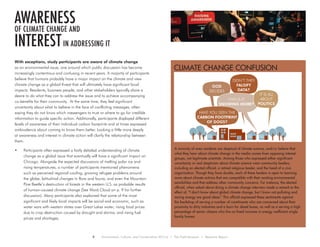
CLIMATE CHANGE CONFUSION
GOD
DECIDES
DIDN’T THEY
FALSIFY
DATA?
IT IS ALL
ABOUT
POLITICS
HAVE YOU SEEN THE
CARBON FOOTPRINT
OF DOGS?
WHY IS IT
SNOWING MORE?
Environment, Culture, and Conservation (ECCo) • The Field Museum • Research Report 9
awareness and interest
WHAT THREE WORDS COME TO MIND WHEN YOU HEAR “CLIMATE CHANGE”?
As part of our interviews and online survey, participants were asked, “What are three words that come to mind when you hear ‘climate change’?” In this word cloud, more frequently
occurring words appear larger. There are five notable patterns:
1.	 IT IS GETTING HOTTER, BUT THAT IS NOT ALL: The large size
of “Global,” “Warming,” and “Greenhouse” makes it clear that
respondents connect the new term ‘climate change’ to what it
used to be popularly called, while the large size and number
of variations on “Hot,” “Heating,” “Hotter,” “Warmer,” etc.
point to the fact that rising temperature is still the primary effect
many people think about. Other words, namely “Extremes” and
“Cooling,” reflect some respondents’ awareness that predicted
temperature changes will not be all in one direction. Also,
words like “Storms,” “Melting,” and the smaller “SeaLevelRise,”
“Flooding,” and “Droughts” point to other aspects of climate that
will change.
2.	 BROAD EFFECTS: There are quite a number of related references
to people moving, e.g. “Refugees,” “Migration,” “Immigration,”
“Open Borders,” and “Over population,” reflecting a concern
with demographic changes and human movements that will
potentially be exacerbated by climate change. There were also a
surprising number of references to the impacts of climate change
on nature, including “Extinction,” “Species,” and “Wildlife.” Even
the word “Map” was a reference to shifting zones on the map
where animals and plants will live, reflecting the concerns of
participants involved in advocacy and management around the
extensive forest preserves in Forest Glen.
3.	 EXTENT OF THE PROBLEM AND CAUSALITY: There are a large
number of terms like “Gloom” and “Doom” on the cloud (mostly small in size), reflecting the expectation of dire consequences. Other responses like “ImpossibleToMeasure,”
“Cyclical,” and even “Bulls#!t” and “Hogwash” reflect skepticism about both the science and the impact of human activity on the climate. (“Colorful” language appears exclusively
in mailed and emailed responses, not face-to-face interviews.)
4.	 CLIMATE AND POLLUTION: While heat is linked to some pollution issues, of which a few appear in the cloud (“Smog,” “Ozone,” “Air,” and “Quality”), the frequency of “Ozone”
and “Pollution,” the pairing of the latter with “Chemical,” and the references to “AcidRain,” “CarbonMonoxide,” and airborne pollutants illustrate how people try to understand
climate change causality through their existing models of air pollution and atmospheric degradation. At the same time, the large size of “CO2” and “Carbon” suggests that others
are aware that climate change is driven by the fairly inert products of combustion, not toxic or reactive substances fouling or radically changing the atmosphere.
5.	 THINKING ABOUT SOLUTIONS: References to “Recycling,” “SolarPower,”“EnergyEfficientAppliances” and other climate action strategies and technologies show some participants
looking towards solutions. These references are consistent with interviewees in conversation expressing faith in American or human ingenuity in creating technological solutions to
climate change. Others chose less specific words to express their optimism, such as one participant’s response of “Fear, Action, and Working Together.” She explained that she
had been quite fearful about climate change but that now “I see people doing things [to address climate change], so I am more at peace.”
10 Environment, Culture, and Conservation (ECCo) • The Field Museum • Research Report
awareness and interest
RANKING THE CCAP STRATEGIES
4
1
5
3
2
energy
efficiency
waste
reduction clean &
renewable
energy
sources
adaptation improved
transportation
options
(land and water)
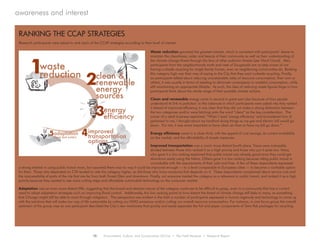
Waste reduction garnered the greatest interest, which is consistent with participants’ desire to
maintain the cleanliness, order and beauty of their community as well as their understanding of
the climate change threat through the lens of other pollution threats (see Word Cloud). Also,
participants from the neighborhoods north and west of Sauganash are acutely aware of not
having curbside recycling for single family homes, even as neighboring communities do. Ranking
this category high was their way of saying to the City that they want curbside recycling. Finally,
as participants talked about reducing unsustainable rates of resource consumption, their own or
others, it was usually in terms of needing to eliminate unnecessary or wasteful consumption, while
still maintaining an appropriate lifestyle. As such, the idea of reducing waste figures large in how
participants think about the whole range of their possible climate actions.
Clean and renewable energy came in second in great part also because of how people
understood its link to pollution. In the instances in which participants were asked why they ranked
it ahead of improved efficiency, it was clear that they did not make a strong distinction between
the two categories and/or were latching onto the word “clean” as the key consideration. The
owner of a retail business explained, “When I read ‘energy efficiency’ and (considered how it)
pertained to me, I thought about my landlord doing things so my gas and electric bill would go
down. For me, it was more important to have clean air than to have my bill go down.”
Energy efficiency came in a close third, with the appeal of cost savings, its current availability
on the market, and the affordability of simple measures.
Improved transportation was a much more distant fourth place. Views were noticeably
divided between those who ranked it as a high priority and those who put it quite low. Many
who gave it a low ranking explained that public transit was already good since they could get
downtown easily using the Metra. Others gave it a low ranking because riding public transit is
unworkable with the requirements of their jobs and lives. A few of these respondents expressed
a strong interest in using public transit more, but assumed there was no way it could be improved enough — to a level comparable to European cities — to become a workable option
for them. Those who depended on CTA tended to rate this category higher, as did those who know someone that depends on it. These respondents complained about service cuts and
the inaccessibility of parts of the city that are far from both Forest Glen and downtown. Finally, not everyone treated the category as a reference to public transit, and ranked it as a high
priority because they wanted to see more cutting edge and affordable automobile technology on the consumer market.
Adaptation was an even more distant fifth, suggesting that the broad and abstract nature of the category continues to be difficult to grasp, even in a community that has a current
need to adopt adaptation strategies such as improving flood control. Additionally, this low ranking points to how distant the threat of climate change still feels to many, as something
that Chicago might still be able to avert through mitigation. This perspective was evident in the faith a number of participants expressed in human ingenuity and technology to come up
with the solutions that will make our way of life sustainable by cutting our GHG emissions and/or cutting our overall resource consumption. For instance, in one focus group the overall
optimism of the group rose as one participant described the City’s new machinery that quickly and easily separates the foil and paper components of Tetra Pak packages for recycling.
Research participants were asked to rank each of the CCAP strategies according to their level of interest.
Environment, Culture, and Conservation (ECCo) • The Field Museum • Research Report 11
awareness and interest
•	 Participants have an uneven awareness of their own carbon footprints,
and many perceive few options to reduce them further. At most a
handful of participants had in any way calculated their overall carbon
footprints. Others seemed to underestimate theirs, considering themselves
comparatively frugal relative to other Americans’ energy consumption and
resulting CO2 output (e.g., the perception that they emit less CO2 than
people who drive SUVs as status markers). Finally, some have a sense that
their carbon footprint is larger than they would like it to be. In this last
group, a few people are ambivalent about knowing more precisely the size
of their footprint in the absence of either a discernible or realistic course of
action to reduce it further.
•	 Many residents are optimistic, even expectant, that technology will
ultimately provide a set of workable solutions to climate change that will
mitigate its most serious effects.
•	 Residents and businesses want more information from sources that they
see as neutral and appropriate experts, specifically on what they can do
to undertake additional climate action. Many area residents and business
people are skeptical of the motives of politicians and large companies,
particularly utility companies, who offer information on conserving
resources and saving money. Given study participants’ sense that they are
already doing what they can for the environment, it is no surprise that they
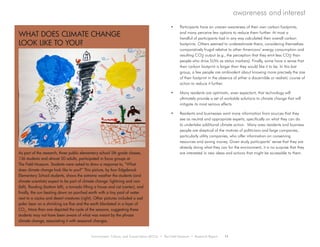
are interested in new ideas and actions that might be accessible to them.As part of the research, three public elementary school 5th grade classes,
136 students and almost 20 adults, participated in focus groups at
The Field Museum. Students were asked to draw a response to, “What
does climate change look like to you?” This picture, by four Edgebrook
Elementary School students, shows the extreme weather the students (and
climate scientists) expect to be part of climate change: lightning and rain
(left), flooding (bottom left), a tornado lifting a house and cat (center), and
finally, the sun beating down on parched earth with a tiny pool of water
next to a cactus and desert creatures (right). Other pictures included a sad
polar bear on a shrinking ice floe and the earth blanketed in a layer of
CO2
. More than one depicted the cycle of the seasons, suggesting these
students may not have been aware of what was meant by the phrase
climate change, associating it with seasonal changes.
WHAT DOES CLIMATE CHANGE
LOOK LIKE TO YOU?
12 Environment, Culture, and Conservation (ECCo) • The Field Museum • Research Report
awareness and interest
Rec ommendation:
1.	 Do outreach through organizations that will be viewed as
neutral and dependable by residents. Local organizations
like community associations, schools, and chambers
of commerce are particularly well positioned. Work
with neutral and reputable organizations to provide
technical expertise as well (e.g., Center for Neighborhood
Technology, Citizens Utility Board, Historic Chicago
Bungalow Association).
2.	 Make climate change feel more immediate and local.
Use outreach materials to draw residents’ attention to
the unprecedented warming trend of the last thirty years
(which most climate scientists attribute to the human
production of CO2 in the atmosphere) and to the local
effects on nature and people that are already apparent.
awareness of climate change and
interest in addressing it
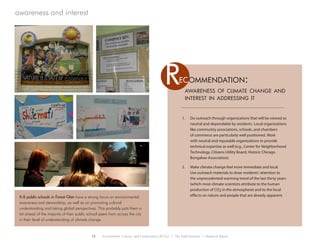
K-8 public schools in Forest Glen have a strong focus on environmental
awareness and stewardship, as well as on promoting cultural
understanding and taking global perspectives. This probably puts them a
bit ahead of the majority of their public school peers from across the city
in their level of understanding of climate change.
Environment, Culture, and Conservation (ECCo) • The Field Museum • Research Report 13
Residents, business people, and other community leaders identified a number
of community concerns that could serve as springboards for developing climate
action initiatives. The four areas of concern we highlight in this section are:
•	 Community Character
•	 Public Space
•	 Education
•	 Economic Opportunity
Of these, only ‘economic opportunity’ emerges in the national literature as a
significant co-benefit of climate action. We suggest that in the neighborhoods of
the Forest Glen community area, ‘economic opportunity’ takes on a particular
local twist. Other co-benefits that are routinely touted in national discussions
of climate action, such as cost savings or improved health, also emerge as
components of these local concerns. Looking more closely at these areas of
concern is important to understanding how to develop climate action strategies
that will be meaningful to stakeholders in the area and engender widespread
and sustained engagement.
QUIET, FRIENDLY, AND FAMILY ORIENTED
As described in Community Overview, residents especially value the suburban
quality of their neighborhoods. When asked what they like best about them,
participants typically used words like “quiet,” “friendly,” and “family oriented”
to describe their satisfaction. When pressed, some residents explain that by
quiet they are referring to the lack of through streets, so that there is not traffic
speeding through neighborhoods and people are not coming to the community
“without a purpose.” This is an indirect reference to keeping the crime rate
down (or lowering it) by limiting the access of nonresidents. “Friendly and
family oriented” were the words used in a story offered by one lay leader of a
local church club. At a church-sponsored block party, for example, the 5th and
6th grade girls gathered up the toddlers and took them off for games so that
the parents could have some adult time. His sense was that the girls took this
action without any significant adult prompting, reflecting how the community is
made up of nice families. Residents typically cited individual actions to illustrate
how friendly their community is: watching each others’ homes, reporting (to
neighbors or police) if someone they do not know is hanging around, and
taking care of one another when someone is incapacitated, e.g. aiding a
neighbor with a broken leg.
Residents participate at high rates in community associations through which they
work with aldermen and other government agencies to address variations on
the concern of community character. For instance, the Edgebrook Community
Association played a role in airing the competing feelings of residents over
expansion of the local Metra stop into a full station, particularly concerns
community concerns
SPRINGBOARDS FOR CLIMATE ACTION
COMMUNITY CHARACTER
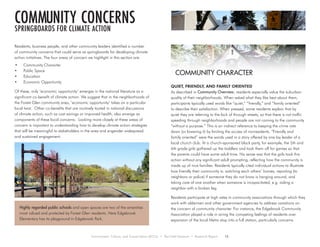
Highly regarded public schools and open spaces are two of the amenities
most valued and protected by Forest Glen residents. Here Edgebrook
Elementary has its playground in Edgebrook Park.
14 Environment, Culture, and Conservation (ECCo) • The Field Museum • Research Report
springboards for climate action
over the growth of its parking area. The project was ultimately not undertaken
because of some residents’ objections to changing the streetscape and the
possible worsening of parking congestion. Safety is also explicitly maintained
through participating in CAPS (Chicago Alternative Policing Strategy) programs
and letting officials know residents are opposed to the City’s proposed
reallocation of police resources away from the area.
SHOWING YOUR PRIDE
Another aspect of community character is the appearance of people’s homes
and yards. Residents take pride in the appearance of their neighborhoods
and acknowledge social pressure to appropriately keep up their property.
Maintaining appearances concerns both yards, especially where set-backs make
for sizeable front yards, and the houses themselves. Beyond maintaining houses
in good repair, which goes without saying, residents expressed pride in interior
renovations and completing historically sensitive maintenance or restoration.
In fact it is in relation to maintaining historic character that the concern over
appearances has been a point of resident activism. Alarmed by the tear down
and replacement of older modest homes with large “McMansions,” a number
of residents and board members of the Sauganash Community Association
(SCA) decided to take action. The SCA now produces a guide to historically
appropriate renovations, an effort which in turn led to the effort to get the area
declared a historic district.
The pride residents take in their yards is apparent in a number of ways. At least
a couple community associations give annual awards for best garden; there are
three formal garden clubs in the area through which members share advice and
swap clippings, and work on community gardens.; and even those residents
who say they do not care about their yards admit they or their spouses have
to keep them up because they feel it is expected. Some of the advice shared
among garden club members concerns how to manage landscape contractors
who come in to do mowing, leaf removal, or other labor intensive tasks. One
specific concern has been the noise and dust associated with contractors
operating blowers. Some residents perceive contractors as inefficient in their
approaches to removal. Others downplay assertions of inefficiency, noting that
in neighborhoods with many trees, leaf removal is a big job.
A number of the garden club members who use landscaping companies were
senior citizens, and the difficulty in keeping up yards and single family homes
was a challenge frequently cited by senior citizens participating in the research.
Some talked about having to stop gardening because they could not do it
anymore, while others mentioned moving to townhouses, condos, or single
story ranch houses because, at least in part, they could not or did not want to
maintain houses and yards anymore. Others were challenged by getting around
inside large homes with stairs. The 41st ward alderman had three staffers whose
jobs were partially devoted to helping senior citizens individually to address
issues with their homes or other aspects of gaining assistance.
AIRPORT EXPANSION
Another threat to community character that residents identified, particularly in
the Sauganash neighborhood, is the O’Hare Modernization Program (OMP).
Since the opening of a new runway, the number of low flying planes coming in
to land over Sauganash has increased considerably. One resident described
them as being like “beads on a string,” all descending together in a line. The
full completion of the project is expected to increase the number of planes
over Sauganash even more. Residents object to the increase in noise and
air pollution as well as the possible threat to property values. Noise levels in
Sauganash do not rise to the 65 decibel level that would make homeowners
eligible for government funded insulation and other sound-proofing measures,
and residents who object to all the over flights are not keen on changing
to a lifestyle of staying indoors, closing the windows, and turning on the air
conditioner even when the weather is nice. Nine community associations
on Chicago’s northwest side have succeeded in having five representatives
appointed to the O’Hare Noise Compatibility Commission. They hope to
influence landing procedures, to get a quieter gliding style landing authorized
for O’Hare, and to have more of the future changes in landing routes
distributed over less inhabited areas.
Environment, Culture, and Conservation (ECCo) • The Field Museum • Research Report 15
springboards for climate action
Residents and organizations value, use and care for the public spaces in and
around the Forest Glen Community area. The high level of involvement in
public space is indicative of the pride residents and members of organizations
feel for their community and the responsibility they feel to preserve and enhance
its unique character. This is apparent in the forms engagement takes.
•	 Residents often spoke of nearby natural areas as an important part of why
they chose to live in the community, or an important part of what they
value about living there. More tangibly, biking and walking paths through
the forest preserves are used extensively in good weather, and by the
intrepid even in bad conditions. Athletic facilities in area parks are used by
children’s sports leagues, individuals, and grade school students, as parks
are sometimes paired with public schools and serve as their playgrounds.
•	 Locals also take on a large part of caring for public spaces, with
individuals and civic groups investing significant energy and time in these
efforts. For instance, groups like the Indian Woods Community Association
regularly conduct trash clean-ups along neighborhood streets, in forest
preserves and parks, and along bike trails. Beyond the significant attention
many residents give to their own homes’ plantings, garden clubs maintain
plantings along the Metra right of way and create community gardens in
visible locations. Recently, the Forest Glen and Sauganash garden clubs
took 2nd place and 3rd place respectively for their community gardens in
Mayor Daley’s 2010 Landscape Awards. Other civic groups facilitate these
efforts, as when the Edgebrook and Forest Glen community associations
recruited Green Corps to provide resources to community gardening and
landscaping efforts, including those in the retail district of Edgebrook.
Finally, other residents volunteer in forest preserves on conservation
projects and/or advocate for changes in the preserves management plans,
practices that are sometimes at odds as discussed next.
•	 For well over a decade, there has been an ongoing, sometimes
acrimonious, debate in the community over the proper management
of Forest Preserve District of Cook County land, and to a lesser extent,
Chicago Park District land. Volunteers, including site stewards, from both
the research area and surrounding communities work with the Forest
Preserve District to promote ecosystem health, which is defined as a
functioning web of relationships among a diverse mix of species. Residents
who object to various aspects of this work have concerns over the use of
fire and herbicides as landscape management tools in an urban area, the
proper role of school children in the work, how rapidly transformational
work should proceed, whether living trees should be cut as part of site
management, and whether active management is even desirable at all.
Civically engaged residents who do not publicly align themselves within
	 PUBLIC SPACE
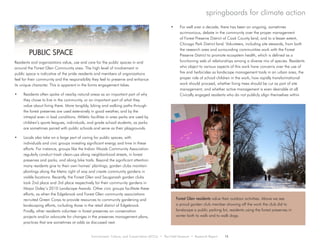
Forest Glen residents value their outdoor activities. Above we see
a proud garden club member showing off the work the club did to
landscape a public parking lot, residents using the forest preserves in
winter both to walk and to walk dogs.
16 Environment, Culture, and Conservation (ECCo) • The Field Museum • Research Report
springboards for climate action
the debate, nevertheless, are often more sympathetic to one of the
differing views. But they are typically more concerned that this debate
has at times dominated the civic arena to the detriment of other concerns
that also deserve attention. The most active participants in this debate
share a common interest in addressing climate change, but stress different
responses to the threats that mirror their positions in the management
debate. For instance some favor leaving the forest preserves alone in
the hope that they will continue to serve as carbon sinks, others call for
tree planting in and outside preserves, and others favor accelerating the
current management regime as a way to make landscapes more resilient
to climate change.
Education was cited as a key community concern by families with and without
children. Many parents pay a premium to live in the area in great part
because of the recognized quality of its public and private elementary and
middle schools. Residents’ overarching concern with education includes the
intertwined issues of overcrowding, maintaining and improving K-8 educational
quality, access to quality high school education, affordability, and creating or
maintaining a diverse student body within schools.
K-8 schools enjoy a high level of parental involvement to ensure educational
quality. One parent described her priorities in choosing civic involvements this
way: “I don’t serve on the Community Association. I am on my daughter’s
school council. People are really involved in school. It is mostly families in this
area. They are concerned about kid concerns. Not paranoid, but we want it
to be safe for our kids and have good education.” School councils work with
the administration to set priorities and help the school move in the determined
direction. PTA is also a popular way to get involved. PTAs cooperate with the
administrations and school councils in setting priorities, but primarily function
for fundraising needs, ultimately making purchases that directly serve students,
such as lockers and computers.
Accompanying all this effort has been a rise in test scores at public schools
over the last 15 years, leading in turn to higher rates of enrollment in these
schools by neighborhood families. Enrollment further accelerated with the
recent downturn in the economy as some families have moved away from
paying private schools. Subsequent overcrowding has resulted in larger class
sizes, classes in alternate spaces (the gym, library, and hallways), and staggered
lunch times. Responses have included the use of portable classrooms, on-
going LEED-certified expansions at two CPS schools, and at one school, the
writing of a grant to fund an extended school day for reading instruction.
Some administrators and parents consider local public schools to be victims
of their own success, since rising enrollment demand has followed continued
improvement in school test scores. They fear that local schools’ academic
success means CPS will look elsewhere to spend scarce resources because
these schools will be viewed as able to take care of themselves.	EDUCATION
As more parents got involved in areas schools over the last 20 years their
reputation for quality only grew, leading to more families choosing to send their
kids to them. Here we see the planned addition for Sauganash Elementary to
relieve its overcrowding issues. The Green Building Council has given the design a
LEED Silver certification for meeting specific criteria for energy and water savings,
interior air quality, and other criteria.
Environment, Culture, and Conservation (ECCo) • The Field Museum • Research Report 17
springboards for climate action
Parents of school children view having their children experience cultural diversity
as important for shaping their values and developing their ability to eventually
succeed in a global economy. At the same time, when experiencing diversity is
at odds with other core values (living in a safe, family oriented community, or
having their children in elementary schools with the highest possible test scores),
they often give it lower priority.
Study participants acknowledged that their neighborhoods are faring better in the
current economic downturn than many other communities and suburbs. Nonetheless,
a number of participants cited foreclosures, rising taxes and dropping home values,
unemployment, a slowdown in contract work, growing job demands, and job insecurity
as issues they or their neighbors face as a result of the poor economy since the collapse
of the real estate market.
The feeling was almost unanimous among business mangers and owners that the
two central business districts (focused around Peterson and Cicero for Sauganash and
Devon and Central for Edgebrook/Wildwood) could or should be doing better given
the affluence of the surrounding communities, and that under–performance has been
the case for decades. Commonly cited barriers to further development included: overly
high commercial rents, the small size of some commercial spaces, the three decade
long decline of manufacturing in neighboring communities and subsequent loss of those
workers as a customer base, the lack of customer parking and the backups in traffic
that occur at Devon and Central, and the persistence of “dry” precincts in parts of both
districts where upscale dining and entertainment might otherwise be feasible. Efforts
to improve this situation have been met with mixed success: for instance, landlords
are reluctant to reduce rents or create larger retail spaces by reducing their number.
At least one effort to change a precinct from dry to wet was successful allowing the
establishment of a bit more upscale restaurant than has previously been typical of the
area. In other precincts that are both commercial and residential, it is less clear residents
would support such a change in the numbers needed to make it happen, as ongoing
efforts have not reached a resolution one way or the other. Civic leaders, business
people, and most residents we asked view the recruiting and subsequent establishment
of Whole Foods at Cicero and Peterson as a big improvement that has the potential
to anchor more business development in that area, including possibly more “green”
businesses. At the same time, most of these supporters are not interested in establishing
more big box stores, wanting instead to have future gains be in the areas of small and
locally owned businesses.
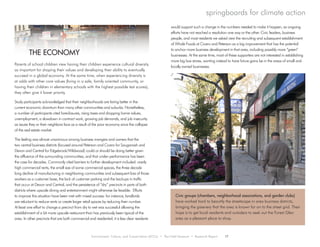
	 THE ECONOMY
Civic groups (chambers, neighborhood associations, and garden clubs)
have worked hard to beautify the streetscape in area business districts,
bringing the greenery that the area is known for on to the street grid. Their
hope is to get local residents and outsiders to seek out the Forest Glen
area as a pleasant place to shop.
18 Environment, Culture, and Conservation (ECCo) • The Field Museum • Research Report
springboards for climate action
1.	 Link garden clubs and community associations to landscape
specialists who can help them develop a guide to “green”
landscaping and yard care. To accommodate language or
other communication barriers, the guide could be developed
as a visual tool to help residents talk to yard care companies
about modifying their practices.
2.	 Include soundproofing in the list of advantages residents can
expect to achieve through retrofitting.
3.	 Work with area schools to develop new environmental and
climate curricula. Incorporate new LEED-certified buildings
into these curricula as well as student exchanges with other
CPS schools in which students can share their different
outlooks and experiences around issues of the environment
and how to respond to climate concerns.
4.	 Support and incentivize climate action that promotes green
business development, especially within the two central
business districts. Start by working with existing businesses
like hardware and grocery stores to promote green practices
for homes and lawns.
5.	 Support CCAP activities that link to residents’ deep concern
for open space conservation. These could be activities
around which there is currently some consensus such as
clean ups, drought-resistant plantings along public medians,
and community gardening activities in the Metra parking lots.
springboards for climate action
ec ommendations:R
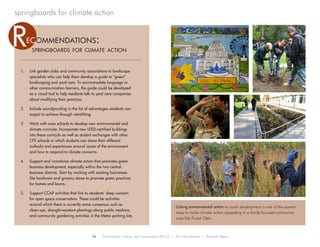
Linking environmental action to youth development is one of the easiest
ways to make climate action appealing in a family focused community
area like Forest Glen.
Environment, Culture, and Conservation (ECCo) • The Field Museum • Research Report 19
environmentally-
friendly
PRACTICES, VALUES, AND TRADITIONS
Study participants reported that they engage in a number of environmentally
- friendly practices that in great part reflect their circumstances as family-
focused middle-class homeowners in a community of large yards and
abundant public open space. For instance in Forest Glen, opening and closing
windows, hanging clothes to dry, and gardening are all relatively popular
compared to some of the other communities we have studied, reflecting the
greater accessibility of these options to home owners vs. residents of multiunit
buildings, the comparatively high level of safety people feel in this community,
and the value they attach to having access to fresh air and outdoor space.
Along with family amenities like good schools and churches, it was not
uncommon for participants to say that one of the reasons they were drawn
to their neighborhood was the abundance of trees or the proximity of the
forest preserves. At the same time, there are some gaps between the kinds of
activities residents indicated that they value and talk about doing, and those
that they actually do. For example, 48 out of 64 respondents said that they
think and talk about obtaining energy audits to find potential saving in energy
costs through retrofitting, while only 16 respondents actually have secured
energy audits. A closer look at residents’ motivations and outlooks will help us
better understand the choices they make that impact the environment.
•	 Motivations for retrofit upgrades to homes include comfort, cost savings
(more often motivated by a desire to have money for other things than
by a fear of becoming unable to pay bills), pride in taking care of one’s
house, concern for property value, and care for the environment.
•	 A majority of residents are concerned about their environmental impact,
even as they are not looking to radically alter the basics of their lifestyles
(e.g., single family home, car, and regular travel). In this context, the
ethic of not being wasteful – not using more resources than one needs
to maintain what is essential to one’s lifestyle – is often a typical way that
residents think about resource consumption. This ethic is apparent not just
in electricity and gas usage, but also in water and paper use, repairing or
restoring items, and donating or sharing things like clothes and toys.
•	 Some popular actions are taken for the sole purpose of benefitting
the environment. Most popular are various kinds of recycling, while
taking reusable bags for shopping is moderately popular (57 out of 88
respondents). Among adults, those who are involved in open space
management, whether as advocates for hands-off management or as
participants in habitat restoration, probably spend the highest percentage
of their time on a task dedicated to helping the natural environment.
•	 Scouting, and its accompanying focus on the stewardship of nature, is a
particularly popular part of the family-focused culture that residents value
across these neighborhoods. Scouting involves both children and large
numbers of adults in supervisory and supporting roles. Schools are also
important centers of collective environmental action, with kids, parents,
and administrators involved in a “no trash lunch” program, walking to
school initiatives, and two “no idling” campaigns that discourage both
parents and delivery drivers from idling their vehicles at the schools.
•	 As a way of coping with the expense of retrofitting, homeowners often
couple it with compatible remodeling efforts (e.g., adding insulation when
walls are being opened or rebuilt for other reasons).
•	 Barriers to climate action in the Forest Glen Community Area include:
•	 The high initial expenses of retrofits, particularly the financial and
structural challenges posed by retrofitting older brick homes
•	 The unavailability of products compatible with an environmentally
sustainable lifestyle (e.g., participants complained that automakers
environmentally-friendly practices,
values, and traditions
LEASTMOST
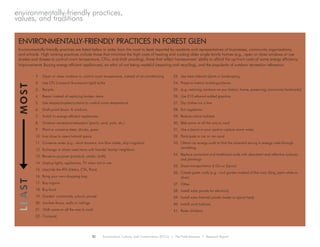
Environmentally-friendly practices are listed below in order from the most to least reported by residents and representatives of businesses, community organizations,
and schools. High ranking practices include those that minimize the high costs of heating and cooling older single family homes (e.g., open or close windows or use
shades and drapes to control room temperature, CFLs, and draft proofing), those that reflect homeowners’ ability to afford the up-front costs of some energy efficiency
improvements (buying energy efficient appliances), an ethic of not being wasteful (repairing and recycling), and the popularity of outdoor recreation relaxation.
ENVIRONMENTALLY-FRIENDLY PRACTICES IN FOREST GLEN
1.	 Open or close windows to control room temperature, instead of air-conditioning
2.	 Use CFL (compact fluorescent light) bulbs
3.	Recycle
4.	 Repair instead of replacing broken items
5.	 Use drapes/shades/curtains to control room temperature
6.	 Draft-proof doors & windows
7.	 Switch to energy–efficient appliances
8.	 Outdoor recreation/relaxation (porch, yard, park, etc.)
9.	 Plant or conserve trees, shrubs, grass
10.	 Live close to open/natural space
11.	 Conserve water (e.g.: short showers, low-flow toilets, drip irrigation)
12.	 Exchange or share used items with friends/ family/ neighbors
13.	 Reuse/re-purpose (practical, artistic, both)
14.	 Unplug lights, appliances, TV when not in use
15.	 Use/ride the RTA (Metra, CTA, Pace)
16.	 Bring your own shopping bag
17.	 Buy organic
18.	 Buy local
19.	 Garden: community, school, private
20.	 Insulate floors, walls or ceilings
21.	 Walk some or all the way to work
22.	Compost
23.	 Use heat tolerant plants in landscaping
24.	 Preserve historic buildings/places
25.	 (e.g: restoring windows on you historic home, preserving community landmarks)
26.	 Use E10 ethanol-added gasoline
27.	 Dry clothes on a line
28.	 Eat vegetarian
29.	 Restore native habitats
30.	 Bike some or all the way to work
31.	 Use a barrel or your yard to capture storm water
32.	 Participate in car or van pool
33.	 Obtain an energy audit to find the potential saving in energy costs through
retrofitting
34.	 Replace pavement and traditional roofs with absorbent and reflective surfaces
and plantings
35.	 Share transportation (I-Go or Zipcar)
36.	 Create green roofs (e.g.: roof garden instead of flat-roof, tiling, paint white or
silver)
37.	Other
38.	 Install solar panels for electricity
39.	 Install solar thermal panels (water or space heat)
40.	 Install wind turbines
41.	 Raise chickens
20 Environment, Culture, and Conservation (ECCo) • The Field Museum • Research Report
do not make cars that are as fuel-efficient as they could be, and that
products are made to break and be unrepairable so that consumers
are forced to buy new items more often than they would like)
•	 Residents’ perceptions that they are doing all that they can, coupled
with the lack of sources of comprehensive, comparative, and
accessible information on climate action, incentives, and service
providers
•	 The lack of appropriate incentives:
–	 In small businesses, the landlord is responsible for the building
and lessee for the utility bill, so the financial incentive for efficiency
upgrades is lost
–	 Government rebates are not scaled to improvement costs
•	 Negative reactions or fear of negative reactions to visible eco-friendly
practices, including clotheslines and rain barrels, which are viewed as
not consistent with the community’s upscale character
•	 Limited public transit connectivity to anywhere but downtown.
environmentally-friendly practices,
values, and traditions
environmentally-friendly practices,
values, and traditions
Rec ommendations:
1.	 Connect trusted and reputable organizations with technical expertise
(e.g., the Center for Neighborhood Technology, Citizens Utility Board,
Historic Chicago Bungalow Association) to community organizations
that serve residents’ interests and have expressed an interest in
addressing climate change (e.g., community associations, neighborhood
clubs, schools). Work with these collaborators to provide residents with
well-ordered, practical information on retrofits and energy consumption
in easy-to-read formats (e.g. convert the City’s energy conservation
code into a homeowner-friendly website and booklet). For retrofits, focus
on getting residents through a sequence of prioritizing improvements,
comparing payback periods, and selecting reputable contractors.
2.	 To promote retrofits and other energy efficient construction, connect
with zoning committees, residents, architects, and contractors through
the remodeling and new construction permitting process. Offer both
information and incentives (including rebates on building permits) for
those who agree to attend training sessions on energy saving or to
incorporate minimum numbers of energy conservation measures into
construction.
3.	 Promote and publicize residences, businesses, and non-profits that
exemplify best environmentally-friendly practices as demonstration
sites and resources. For instance, enlist a handful of influential
and trusted homeowners to get energy audits and share their
experiences with their communities; and highlight private and
nonprofit recycling and reuse options like the Resource Center
at North Park Village, Salvage One, My Sister’s Closet, the
ReBuilding Exchange, and FreeCycle, an online used goods
exchange.
4.	 Incorporate knowledge of green building into the licensing process
for contractors, or offer incentives such as discounts on licensing to
contractors who offer proof of additional comprehensive training in
green building practices.
Environment, Culture, and Conservation (ECCo) • The Field Museum • Research Report 21
Residents and business owners in the Forest Glen community
area tend to share information through multiple overlapping social and
civic networks, which they identify as their primary sources of community
specific information. Communications tend to be generated by well-regarded
community members and established organizations that are considered reliable
and trustworthy. While many of these sources may not address the issue of
climate change directly, they regularly address environmental concerns and
responses that are especially pertinent to the community. These include, but
are not limited to: noise management, energy efficiency, recycling, reuse/
repurposing, and beautification projects (for example, community gardening).
We found that information about local issues travels in the following ways:
1.	 Neighborhood Community Associations
Neighborhood community associations are primarily concerned with
maintaining and improving public property and services within the
various neighborhoods that comprise Forest Glen (see Stakeholders,
Partnerships and Relationship-building). They advocate for their respective
communities, and regularly communicate police alerts and a broad
range of neighborhood news through their websites, meetings, newsletter
mailings, and local newspapers. Electronic media comprise a part of most
associations’ (and other area organizations’) communications strategies.
However, several civic groups make deliberate efforts to be mindful of
constituents who do not use digital media, and use additional means
such as a dedicated “call-in” telephone number, targeted mailings, and
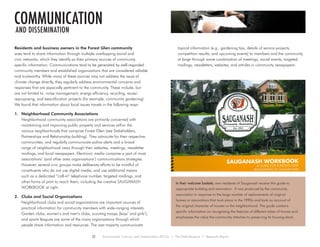
other forms of print to reach them, including the creative SAUGANASH
WORKBOOK at right.
2.	 Clubs and Social Organizations
Neighborhood clubs and social organizations are important sources of
practical information for community members with wide-ranging interests.
Garden clubs, women’s and men’s clubs, scouting troops (boys’ and girls’),
and sports leagues are some of the many organizations through which
people share information and resources. The vast majority communicate
topical information (e.g., gardening tips, details of service projects,
competition results, and upcoming events) to members and the community
at large through some combination of meetings, social events, targeted
mailings, newsletters, websites, and articles in community newspapers.
communication
 AND DISSEMINATION
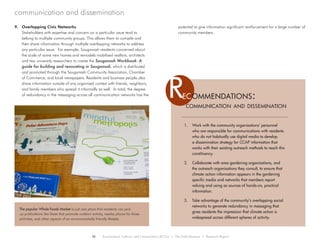
In their welcome baskets, new residents of Sauganash receive this guide to
appropriate building and renovation. It was produced by the community
association in response to the large number of replacements of original
homes or renovations that took place in the 1990s and took no account of
the original character of houses or the neighborhood. The guide contains
specific information on recognizing the features of different styles of homes and
emphasizes the value the community attaches to preserving its housing stock.
22 Environment, Culture, and Conservation (ECCo) • The Field Museum • Research Report
Environment, Culture, and Conservation (ECCo) • The Field Museum • Research Report 23
3.	 Business Organizations and Networks
Chambers of commerce actively engage local businesses in a broad
range of networking and marketing activities that bolster business
development and positively impact the quality of life in their communities.
Chambers regularly disseminate information to members through
meetings, newsletters, and electronic mail lists. Chambers and community
associations position themselves as a link between area businesses and
residents. Edgebrook, Forest Glen and Sauganash Community Associations
introduce residents to local businesses through print publications (e.g.
welcome packets for new residents) and through community-wide events
that are co-sponsored by the chambers and ward offices (e.g. holiday
festivals). Chambers of commerce also promote community history and
amenities through direct mail, newspapers, social media, e-mail and
websites.
4.	 Elected Officials
In addition to the aforementioned civic and social organizations, ward
superintendents, aldermen and county commissioners’ representatives keep
abreast of community concerns. They communicate directly with residents
and share information through community associations and other civic
organizations.
5.	Churches
Research participants affiliated with particular congregations identified
church bulletins and announcements as a way to reach community
members, although we did not have much success engaging congregation
members in our research through these means of communication.
Churches are popular meeting locations for lay ministries, social clubs,
and youth activities (e.g. scouting). The concentration and overlap of these
groups in church facilities may present other opportunities for dissemination
and engagement within the community.
6.	 Community Newspapers
Local newspapers tend to function as clearinghouses for community
information, and were frequently described as widely read sources of local
news. Community associations, schools, clubs and organizations frequently
cross-list information and events in these papers.
Nadig Newspapers is a family-run business located in Jefferson Park. They
publish two weekly papers:
•	 The Northwest Side Press, which covers Jefferson Park, Portage Park,
Gladstone Park, Norwood Park, Edison Park, Albany Park, Mayfair,
Forest Glen, and Belmont/Cragin
•	 The Reporter/Journal, which covers Edgebrook, Sauganash,
Wildwood, Skokie, Niles, and Lincolnwood. The Reporter/Journal is
published on Saturdays.
The not-for-profit corporation Sauganash Sounds, Inc. publishes The
Sounds twice a month. The paper is distributed free to residents of
Sauganash, Edgebrook, Sauganash Park, Lincolnwood Towers, Wildwood,
Sauganash Village, Brynford Park, Sauganash Woods, and Indian Woods.
Its managers and editors live in the distribution area and work from home.
7.	 Local Schools
Significant numbers of study participants identified local public and
private schools as a valuable source of community information. In the
most practical sense, information regarding curricular and extra-curricular
activities are regularly circulated to parents of school-aged children through
their classroom teachers and school administrators. Through Parent Teacher
Associations (PTAs) and Local School Councils (LSCs), school administrators
and parents also maintain a dialogue regarding important issues that
impact schools, students, and their families.
8.	 Topic Specific Organizations
Residents with particular environmental interests, such as gardening,
said that they receive and especially value information from citywide or
regional organizations with which they are affiliated. They regularly access
information about gardening education, planting schedules and guidelines,
funding opportunities for community gardens, and new opportunities
(such as participating in this CCAP research project) in newsletters, emails,
and other communications from organizations such as The University of
Illinois at Chicago Extension, the Chicago Botanic Garden, the Chicago
Conservation Corps (C3), and Greencorps.
communication and dissemination
9.	 Overlapping Civic Networks
Stakeholders with expertise and concern on a particular issue tend to
belong to multiple community groups. This allows them to compile and
then share information through multiple overlapping networks to address
any particular issue. For example, Sauganash residents concerned about
the scale of some new homes and remodels mobilized realtors, architects
and two university researchers to create the Sauganash Workbook: A
guide for building and renovating in Sauganash, which is distributed
and promoted through the Sauganash Community Association, Chamber
of Commerce, and local newspapers. Residents and business people also
share information outside of any organized context with friends, neighbors,
and family members who spread it informally as well. In total, the degree
of redundancy in the messaging across all communication networks has the
potential to give information significant reinforcement for a large number of
community members.
communication and dissemination
1.	 Work with the community organizations’ personnel
who are responsible for communications with residents
who do not habitually use digital media to develop
a dissemination strategy for CCAP information that
works with their existing outreach methods to reach this
constituency.
2.	 Collaborate with area gardening organizations, and
the outreach organizations they consult, to ensure that
climate action information appears in the gardening
specific media and networks that members report
valuing and using as sources of hands-on, practical
information.
3.	 Take advantage of the community’s overlapping social
networks to generate redundancy in messaging that
gives residents the impression that climate action is
widespread across different spheres of activity.
communication and dissemination
Rec ommendations:
The popular Whole Foods Market is just one place that residents can pick
up publications like these that promote outdoor activity, nearby places for those
activities, and other aspects of an environmentally friendly lifestyle.
24 Environment, Culture, and Conservation (ECCo) • The Field Museum • Research Report
FOR COMMUNITY ENGAGEMENT
Our research identified several models that organizations and
residents use to engage the community or tackle challenges. They are important
to highlight as a means of understanding how various groups within the Forest
Glen community area attend to community concerns. Some of the most popular
models include:
•	 Community as Demonstration Site
•	 The “Parcel” Approach to Community Gardening
•	 Service Learning/Youth as Sustainability Leaders
•	 Linking Green Practices to Other Causes
•	 Church Ministries
MODEL ONE: COMMUNITY AS DEMONSTRATION SITE
A significant number of public buildings and community gardens throughout the
community area demonstrate energy efficiency and a range of environmentally
friendly practices. Gardens like those using heat-tolerant plants managed by
community gardening clubs, are evidence of how small groups of individuals
have spontaneously mobilized resources to address the interconnected
concerns of community beautification and resource conservation. Turning to
buildings, Chicago Public Schools is responding to overcrowding concerns at
Edgebrooke Elementary Schools by building an addition that achieves a Silver
rating under the U.S. Green Building Council’s LEED (Leadership in Energy
and Environmental Design) rating system. Features of the addition include
reflective roofing to send warming radiation back into space, green roofing
planted with vegetation to absorb water and insulate the building, and the
use of natural light indoors. A parish committee at Queen of All Saints did
the extra fundraising and work that was necessary to install a new parking lot
and playground that are designed to mitigate flooding. Finally, a handful of
individual commercial property owners have installed solar panels on retail
buildings in both business districts. Through the combination of all these
efforts and more (see Cutting Edge Residence at right), the area is starting to
exemplify a number of ways that residents and businesses can realistically address
environmental challenges.
creative models
This roof in Indian Woods is an example of the green roofs promoted
by the Chicago Climate Action Plan since 2008. Fleshy-leaved succulent
plants (Sedum species) grow in a bed of gravel. The stones are small
enough to provide some water retention in the spaces, as well as aeration
for the roots. The plants are adapted to drought conditions, but when it
rains they and the stones filter the rainwater, which is then suitable for a
number of uses including watering gardens. This roof provides protection
from the suns rays and reduces the need for air-conditioning.
Environment, Culture, and Conservation (ECCo) • The Field Museum • Research Report 25
creative models
MODEL TWO: THE “PARCEL” APPROACH TO COMMUNITY
GARDENING
The Forest Glen Garden Club adopted a creative solution that made it more
convenient for community members to participate in maintaining community
garden plots. Initially, they scheduled workdays for community members to
come out and work the whole garden together, but this was hard to sustain.
Scheduling conflicts and long workdays exhausted and overwhelmed the all-
volunteer group, many of whom had full time jobs during the week. Garden
club members remedied this situation by dividing the full gardens into smaller
parcels, so that individual gardeners could focus their efforts in one parcel,
or buddy up to share or divide a parcel. The club also moved to an open
schedule that made it easier for members to garden whenever they had time,
without any need for prior approval. Some members took on responsibility for
a few garden-wide formal tasks (e.g., watering), and small hand tools were
stored on site, so that gardeners would not always have to transport everything
with them. This model of plot division has become increasingly popular within
the Chicago area in recent years as a practical solution to time and resource
management. (See The Forest Glen Garden Club, to the left)
MODEL THREE: SERVICE LEARNING/YOUTH AS SUSTAINABILITY
LEADERS
Local schools encourage students to initiate projects and campaigns that
engage community residents in environmentally-friendly practices. Likewise, a
number of youth organizations actively engage young people in service-learning
projects that promote character building by combining physically demanding
activity with environmental stewardship. By having these be youth led initiatives,
organizers leverage adult participation by linking sustainable practices to civic
responsibility, character development, health, and the educational needs of
children.
School Based Youth Initiatives
Two area schools are actively engaged in campaigns that ask parents to turn
off their car engines as they are waiting to drop off or pick up their children
from school. Several schools also participate in international “walk to school
days,” to promote physical fitness and encourage parents and students to be
The Forest Glen Garden Club began somewhat informally in 1999 as
the result of one woman’s effort to beautify a public space on Catalpa
Ave. She used her own money, ideas, and resources and started planting
on one corner. Her friends and neighbors started to help, and their group
began to grow. They reached out to organizations like Greencorps and
the Chicago Botanic Garden for seed grants to plant the garden. They
established a formal agreement with Metra to garden the land around
the Forest Glen Metra station parking lot. (A hand drawn diagram is
pictured here that also explains to gardeners the division of space and
labor.) They replanted clippings of plants and flowers from their own
gardens, and repurposed discarded materials that community gardeners
found in the alleys (even refinishing and sealing a teak bench, for the
Metra Garden). In 2010, the Forest Glen–Edens Parkway Garden took
second place in the Community Landscapes Region I category of Mayor
Daley’s Landscape Awards.
26 Environment, Culture, and Conservation (ECCo) • The Field Museum • Research Report
creative models
conscientious about the amount they drive. One school prides itself in the
success of its “no trash lunch” program, which promotes the use of reusable or
recyclable containers and utensils instead of disposable materials. This program
depends upon peer pressure among students and the enthusiasm that they take
home to leverage their families’ participation.
Scouting Based Initiatives
“We are a lot more than crafts and cookies. Girl Scouts do a whole lot more.”
–Forest Glen Girl Scout leader
The basic values and principles of the Girl Scouts undergird their most recent
focus, which one local leader summarized as “going green, saving the planet.”
The Girl Scouts’ new program, “Journeys,” consists of three activity sequences
for scouts to complete. In Forest Glen, they are working on the sequence
entitled: “Your planet, love it.” Each level has its own proficiency badges. The
Gold Award, which is the equivalent of the Boy Scouts’ Eagle badge, is for the
Senior and Ambassador levels. This award requires 80 hours of designing,
implementing, supervising and leading others in an individually-designed
project, which must in some way incorporate elements of sustainability. In order
to be successful, the Scout has to show a lot of initiative and leadership; she has
to accomplish quite a bit without the help of the Scout leader. In the 30 years
since the Gold Award was instituted, 47 girls from the Forest Glen troop have
received it. Forest Glen may still hold the record for the most Gold Awards from
one troop.
One community leader who has worked closely with the Boy Scouts for a
number of years has developed an environmental challenge model based on
his experience that combines service activities (such as building or renovating
a trail, habitat restoration, or planting native species) with a physical challenge
(e.g. canoeing, sailing on Lake Michigan, hiking, camping, or horseback
riding). This model is currently under consideration for adoption by the Army
National Guard. The goal of these activities is to educate youth and diversify
their involvement in the community.
MODEL FOUR: LINKING GREEN PRACTICES TO OTHER CONCERNS
Area businesses and organizations have successfully collaborated to link
environmentally-friendly practices with other concerns, so that they can in
effect leverage the same resources to serve multiple purposes. For example,
My Sister’s Closet, a family-owned resale clothing business in Edgebrook,
Environment, Culture, and Conservation (ECCo) • The Field Museum • Research Report 27
STUDENT ACTIVISM
In 2007-08 the Sauganash Elementary School Student Council did research
on the environmental impact of idling and spearheaded a campaign to
get drivers to stop idling when they are waiting at the school. Students
calculated hours of idling and the associated fuel consumption, expense,
and pollution levels during the months of December and January. Based on
their conservative finding that during this time 5.7 tons of greenhouse gases
were released, and over $1,800 were spend on gasoline used for idling,
they produced posters like the one seen here to discourage drivers from
idling around the school.
regularly collaborates with organizations, like the Edison Park Chamber of
Commerce and Edgebrook Community Association, to support local schools,
animal shelters, medical research, and other local or popular causes. The store
serves food at fundraising events and gives 25% of gross sales to the benefiting
group. In a community that was skeptical of welcoming resale 25 years ago,
these fundraisers generate goodwill and introduce new clientele to the idea
that resale (and thus reuse) can be chic. Businesses also typically support youth
programs, efforts to build community cohesion, and beautification initiatives, as
the latter two also promote the commercial districts as walkable destinations to
shop locally.
MODEL FIVE: CHURCH MINISTRIES
Formal and informal church ministries provide a forum for individuals to
apply their specialized skills, knowledge, and interests in a manner that both
benefits and builds the community. These ministries range in focus from
sacred practices that focus on liturgical readings to more secular interests, like
coaching basketball, teaching, and community organizing. The emeritus pastor
of Queen of All Saints, a Roman Catholic parish with 10,000 parishioners,
embraces a Jesuit understanding of how ministries are formed and how the
church helps form different levels of ministry so that all of the “gifts of church
are used properly.” The pastor explained that in I Corinthians, a New Testament
text within the Judeo-Christian Bible, St. Paul writes that Christ has richly gifted
everyone. In his interpretation of the text, the challenge in any community is
that of helping individuals to discern what their gifts are and how they can use
them in concert with one another in a way that benefits the community as a
whole. While the majority of lay ministry does not directly address the natural
environment, both Protestant and Catholic churches have strong scouting
programs, social justice groups, and lay leadership involved in infrastructure
maintenance and repair, which are concerns that link to climate action and
might be built upon.
creative models
1.	 Work with area churches to identify ministry connections to
climate action.
2.	 Support demonstration projects and sites within the community
area, especially those linked to community gardens, schools,
and youth leadership programs.
3.	 In light of the deep commitment of area businesses to
community improvement, develop climate projects merchants
will strongly support. Obvious areas in which to start include
community beautification as well as expanding and promoting
walkable local business districts.
creative models for community
engagement
Rec ommendations:
28 Environment, Culture, and Conservation (ECCo) • The Field Museum • Research Report
As noted before, residents of the Forest Glen Community Area much more
readily recognize their neighborhood or parish than the Community Area as
a place where they live, care about what happens outside their doors, and
have a tangible stake in the future. It is at these smaller geographic scales that
residents are among the most civically engaged we have encountered in our
research so far. Community associations, PTAs, scout troops, clubs, and issue
based groups all coexist, collaborate, or counter one another across the area.
It is this civic infrastructure, with its focus on a range of quality of life issues, that
has the potential to take up climate action from a variety of angles as members
come to better understand the local benefits of climate action and the specific
realistic steps they can take.
conclusion
Environment, Culture, and Conservation (ECCo) • The Field Museum • Research Report 29
community asset map
!!
!
!
!
!
!!
!
!
!
!!
!
!
!
!
!
!
!
!
!
!
!
!
!
!
! !
!
!
!
!
!!
!
!
!
!
!
!
!
!
!
!
!
!
!
!
!!
!
!
!!
!
!
! !
!
! !
!
!
!
!
!
!!
!!!!
!!
!
!
!
!
!
!
!
!
!
!
!
!
!!
! !
!
!
!
!
!
!
!
!!
!
!
!
!
!
!
!
!!
! !!
!
!!
BRYN MAWR
EDENS EXPRESSWAY
PETERSON
NORTHWEST HIGHWAY
FOSTER
KENNEDY EXPRESSWAY
PETERSON
ELSTON
BRYN MAWR
LARAMIE
LAWRENCE
MONTROSE
IRVING PARK
W DEVON AVE
W TOUHY AVE
NCENTRALAVE
N INDIAN ROAD
NKEATINGAVE
NLEHIGHAVE
N
LEROY
AVE
NKOSTNERAVE
N IONIA AVE
2
9 8
6
5
4
3 1
37
25
39
38
36
35
34
33
32
31
30
29
28
27
26
24
23
22
21
19
18
17
16
15
14
13
12
11
10
8
9
7
6
5
4
3
2
1
17
16
15
14
13
12
11
10
6
5
4
3
2
1
1
5
4
3
2
8
7
6
5
4
3
2
1
9
8
7
65
4
3
2
1 13
12
11
10
2
1
3
2
1
9
8
7
6
5
4
3
2
1
15
14
13
12 11
10
6
5
4
3
2
1
7
20
16
Margaret Laurino
39th Ward
John Arena
45th Ward
0 0.5 1 1.50.25 Miles
LEGEND
! Business
! Place of Worship
! Community Organization
! Garden
! Government Agency
! Green Building
! Health Care
! Historical Marker
! Other Non-Profit
! Public Park/Natural Area
! School/University
Major Streets
Park District
FG Roads
Research Area
Forest Preserve
Mary OʼConnor
41st Ward
!1
!7
!9
!3
!4
!5
!8
!6
N
FOREST
GLEN
AVE
30 Environment, Culture, and Conservation (ECCo) • The Field Museum • Research Report
community assetsASSETS INSIDE COMMUNITY AREA
Businesses
1.	 All Aboard Learning Express
2.	 Anne & Davids Studio
3.	 Associated Bank N.A.
4.	 BQS Realty
5.	 Charles’ Upholstery
6.	 Chocolate Shoppe Ice Cream
7.	 Donna’s Garden
8.	 East of Edens Restaurant
9.	 Edgebrook Coffee Shop & Diner
10.	 Edgebrook Cycle
11.	 Gallagher Travel Service
12.	 Gralak Concrete & Tuckpointing
13.	 Greenlawn Landscaping
14.	 Happy Foods
15.	 Imperial Realty
16.	 Janus Premiums
17.	 Kanellos Shoe Repair
18.	 Koenig & Strey
19.	 Michael H. Erde & Associates
P.C.
20.	 Monasteros Ristorante &
Banquets
21.	 My Sister’s Closet
22.	 North Shore Community Bank
23.	 Precision Plating Company Inc.
24.	 Quinn Construction
25.	 Rock Hair Scissors
26.	 Sam Diamond & Associates
27.	 Sanders IT Consulting
28.	 Shai Town Realty Group
29.	 Smartmed Corporation
30.	 Smith-Corcoran Funeral Home
31.	 Starbucks
32.	 State Farm Agency
33.	 Tandoor India
34.	 The Elephant
35.	 The Sauganash Sounds
36.	 TPH Global Solutions/The
Packaging House
37.	 Trading Post Tobacco and
Cigars
38.	 US Again Clothing (Drop Box)
39.	 Whole Foods
Places of Worship
1.	 Edgebrook Evangelical
Covenant Church
2.	 Edgebrook Lutheran Church
3.	 First Congregational Church of
Forest Glen
4.	 Forest Glen Community Church
5.	 Queen of All Saints Basilica
6.	 Sauganash Community Church
7.	 St Mary of the Woods Catholic
Church
8.	 St Odisho Church
9.	 St Richard’s Episcopal Church
Community Organizations
1.	 Boy Scout Troop 626
2.	 Boy Scout Troop 834
3.	 Edgebrook Community
Association
4.	 Edgebrook School LSC/PTA
5.	 Forest Glen Girl Scouts
6.	 Moms and Moppets
7.	 Natural Forest Advocates
8.	 Old Edgebrook Historical
Society: One Room
Schoolhouse
9.	 Queen of All Saints Mens Club
10.	 Sauganash Chamber of
Commerce
11.	 Sauganash Community
Association
12.	 Sauganash Elementary School
LSC/PTA
13.	 Sauganash Garden Club
14.	 Sauganash Park Community
Association
15.	 Sauganash Womens Club
16.	 Trees for Life
17.	 Wildwood LSC/PTA
Gardens
1.	 Forest Glen Community
Garden-2
2.	 Forest Glen Community
Garden-1
3.	 Kukla Memorial Garden
4.	 Lot A1 of Forest Glen Metra
Station
5.	 Sauganash School Garden
6.	 Wildwood Elementary School
Garden
Government Agencies
1.	 Caldwell Woods Recycling
Center
2.	 Edgebrook Metra Station
3.	 Edgebrook Public Library
4.	 Forest Glen Metra Station
5.	 FPDCC Volunteer Resource
Center
Green Buildings
1.	 BQS Realty
2.	 Edgebrook Elementary School
3.	 Edgebrook Public Library
4.	 Engine 79
5.	 Green Home
6.	 Queen of All Saints
7.	 Sauganash Elementary School
8.	 Whole Foods
Health Care
1.	 Associates for Dental Care
2.	 Bourdage Chiropractic
3.	 Connolly Cosmetic and Family
Dentistry
4.	 Foot Care Consultants
5.	 Healthful Alternatives P.C.
6.	 Illinois Allergy and Asthma
Center
7.	 Joyful Dental Care
8.	 ResCare Home Care
9.	 Sauganash Family Eye Center
10.	 Sauganash Wellness Center
11.	 St George Corrective Vision
Center
12.	 Tarpey’s Pharmacy
13.	 Vogel Richard LDDS
Historical Marker
1.	 Treaty Elm
2.	 WWII Memorial
Other Non-Profit
1.	 Leaning Tower YMCA
2.	 North Branch Restoration
Project
3.	 Polish National Alliance
Public Parks/Natural Areas
1.	 Billy Caldwell Golf Course
2.	 Caldwell Woods
3.	 Eagle Park
4.	 Edgebrook Forest Preserve
5.	 Edgebrook Golf Course
6.	 Edgebrook Woods
7.	 Edgebrook Park
8.	 Forest Glen Playlot Park
9.	 Forest Glen Woods
10.	 La Baugh Woods
11.	 Queen of All Saints Field
12.	 Quinn Park
13.	 Sauganash Park
14.	 Sidney Yates Flatwoods
15.	 Weber Spur Bike Trail
16.	 Wildwood Park
Schools/Universities
1.	 Edgebrook Elementary School
2.	 Queen of All Saints School
3.	 Sauganash Elementary School
4.	 Sauganash Montessori School
5.	 St Mary of the Woods School
6.	 Wildwood World Magnet
School
Environment, Culture, and Conservation (ECCo) • The Field Museum • Research Report 31
32 Environment, Culture, and Conservation (ECCo) • The Field Museum • Research Report
regional asset map
!! !
!
!
!
!
!
!
!
!!
!
! !
!!
!
!
!
!!
!
!
!
!
!
!
!
!
!
!
!
!
!
!
!
!
!
!
!
!
!
!
!!
!
!
!
!
!
!
!
! !
!
!! !
!
!
!
!
!
!
!
!
!
!
!
!
!
!
!
!
!
!
!
!
!!
!
!
!
!
!
!
!!
!
!
CHICAGO
138TH
55TH
119TH
47TH
103RD
71ST
87TH
BELMONT
WESTERN
63RD
MADISON
BRYN MAWR
111TH
HALSTED
95TH
PULASKI
NORTH
FULLERTON
DEVON
PERSHING
79TH
NARRAGANSETT
ROOSEVELT
STONYISLAND
CERMAK
127TH
COTTAGEGROVE
ASHLAND
TORRENCE
CENTRAL
IRVING PARK
31ST
CICERO
HARLEM
KEDZIE
31ST
§¨¦290
§¨¦90
§¨¦94
§¨¦90
9
8
7
6
5
2
1
4
3
36
35
34
33
32
31
30
29
27
26
25
24
23
22
20
19
18
17
16
14
13
12
10
28
15
11
9
7
6
5
4
2
18
3
19
18
16
15
14
13
12 11
10
178
9
7
6
5
4
3
2
1
10
11 8
7
4
3
2
1
6
6
5
4
3 2
9
1
7
6
5
4
2
3
1
21
12
5
7
8
LEGEND
! Business
! Community Organization
! Places of Worship
! Government
! Health Care
! Other Non-Profit
! Public Parks/Natural Area
! School/University
Forest Glen
Garden
7
6
3
2
9
8
1
5
45
4
3
2
1
3
1
6
5
4 2
Environment, Culture, and Conservation (ECCo) • The Field Museum • Research Report 33
ASSETS OUTSIDE COMMUNITY AREA
Businesses
1.	 Ameriprise Financial
2.	 Andy’s Deli
3.	 ASAP the Printing Source
4.	 Best Friends Veterinary Center
5.	 Buffalo Exchange
6.	 Cardinal Fitness of McCormick
7.	 Century 21 McMullen
8.	 Coldwell Banker
9.	 Comfort Heating and Cooling
10.	 Costco
11.	 DataVision Systems Inc
12.	 Gethsemane Garden Center
13.	 Green Depot
14.	 Harris Bank
15.	 Holiday Inn
16.	 Home Depot
17.	 I-Go Car Sharing
18.	 Jewel Osco
19.	 K-9 Lovers
20.	 Keller Williams
21.	 Lin-Mar Motors
22.	 Maddy’s Organic Meals
23.	 MD Technology Services
24.	 Menards
25.	 Mindful Metropolis Magazine
26.	 Mosaicos
27.	 Myron & Phil’s »Steakhouse
28.	 Nadig Newspapers Inc
29.	 Once Upon a Child
30.	 Parks Plumbing and Sewer Inc.
31.	 Print Shop 55
32.	 Prudential Rubloff Properties
33.	 Solar Service Inc.
34.	 The Antique and Resale Shoppe
35.	 Trader Joe’s
36.	 Unique Thrift Store
Places of Worship
1.	 Congregation Shaare Tikvah B’nai Zion
2.	 Elston Ave United Methodist
3.	 St Monicas
4.	 St Tarcissus Church
5.	 Trinity Lutheran Church
6.	 Yugoslavian Seventh Day Adventist
Church
Community Organizations
1.	 Albany Food Bank
2.	 Albany Park Community Center
3.	 Chicago’s Audobon Society
4.	 Chinese Cultural Center
5.	 Christopher House
6.	 Edison Park Chamber of Commerce
7.	 Energy Action Network
8.	 Eugene Field Civic Association
9.	 Friends of the Chicago River
10.	 Friends of the Forest Preserve
11.	 Friends of the Parks
12.	 Garfield Park Conservatory Alliance
13.	 Greencorps Chicago
14.	 Historic Chicago Bungalow Association
15.	 Jackson Park Advisory Committee
16.	 North River Commission
17.	 Peterson Pulaski Business and Industrial
Council
18.	 Pulaski Elston Business Association
19.	 St Vincent DePaul
Gardens
1.	 Community Garden
2.	 Community Garden
3.	 Ebinger School (Christian Sr.) Garden
4.	 Lincolnwood Informal Gardens
Government Agencies
1.	 16th District Police Headquarters
2.	 Blue Cart Recycling Committee
3.	 Central Recycling Station
4.	 Chicago Center for Green Technology
5.	 Cook County Commissioners Office
6.	 IL State Representative 20th District
7.	 Niles Public Library
8.	 North Park Village Recycling Station
9.	 Offices of the 39th Ward
10.	 Offices of the 41st Ward
11.	 Offices of the 45th Ward
12.	 State Representative John D’Amico
Health Care
1.	 Chicago Otolaryngology Associates
2.	 Harmony Healthcare and Rehabilitation
Center
3.	 Misericordia
4.	 Norwood Crossing
5.	 Pearle Vision
6.	 Peterson Park Healthcare Center
7.	 Safer Pest Control Project
8.	 Swedish Covenant Hospital
Other Non-Profit
1.	 Center for Neighborhood Technology
2.	 Chicago Humanities Festival
3.	 Chicago Wilderness
4.	 Inspiration Corp
5.	 Openlands
Public Parks/Natural Areas
1.	 Gompers Park
2.	 Green Briar Park
3.	 Hollywood Park
4.	 Indian Road Woods
5.	 La Baugh Woods West
6.	 Lake Michigan
7.	 Miami Woods
8.	 North Park Village Nature Center
9.	 Peterson Park
Schools/Universities
1.	 CICS Northtown Academy High School
2.	 DePaul University
3.	 Farnsworth Public School
4.	 North Park University
5.	 Northeastern Illinois University
6.	 St. Tarcissus Elementary School
7.	 Von Steuben Metropolitan Science Center
BEYOND THE CHICAGO REGION:
Businesses
AT&T
Marc
Possibility Place Nursery
The Natural Garden
Community Organizations
Backyard Nature Center
Government Agencies
Solid Waste Agency Committee of Northern
Cook County
Other Non-Profit
Caretakers of the Environment International/
USA
Chicago Botanic Garden
Environmental Education Association of Illinois
Illinois Science Teacher Association
Morton Arboretum
regional assets
PARTICIPATING ORGANIZATIONS
Our research in Chicago Community Area #12, Forest Glen, involved leaders and
residents affiliated with over 40 organizations active in the area, reflecting the diverse
interests and concerns of the community. Organizations include:
39th Ward Alderman’s Office
http://www.aldermanlaurino.com/
41st Ward Alderman’s Office
http://www.chicityclerk.com/citycouncil/alderman/ward41/index.html
45th Ward Alderman’s Office
http://www.chicityclerk.com/citycouncil/alderman/ward45/index.html
ASAP the Printing Source
http://www.facebook.com/pages/ASAP-Printing-The-Printing-Source/85706526364
ANN & DAVID (hair salon)
Chicago Park District – North Region
www.chicagoparkdistrict.com
Chicago Wilderness
http://www.chicagowilderness.org/members.php
Chocolate Shoppe Ice Cream
Edgebrook Community Association
http://edgebrookcommunity.org/
Edgebrook Cycle
http://www.edgebrookcycle.com
Edgebrook Elementary School
http://www.edgebrook.cps.k12.il.us/
Chicago Otolaryngology Associates
http://entchicago.com/
Forest Glen Community Club
http://www.forestglenchicago.org/
Forest Glen Garden Club
http://www.forestglenchicago.org/garden_2010/garden_2010.html
Friends of the Chicago River
www.chicagoriver.org
Friends of the Cook County Forest Preserve
http://www.fotfp.org/CITATIONS
* All image rights reserved. Visit fieldmuseum.org/ccuc for more information.
OUR TEAM
1. http://encyclopedia.chicagohistory.org/pages/1760.html
PRINCIPAL INVESTIGATORS:
Dr. Jennifer Hirsch, Environment, Culture, and Conservation (ECCo), The Field Museum
Commissioner Suzanne Malec-McKenna, City of Chicago Department of Environment
PROJECT MANAGERS:
Dr. Janette Bulkan, Environment, Culture, and Conservation (ECCo), The Field Museum
Mario Longoni, Environment, Culture, and Conservation (ECCo), The Field Museum
PROJECT TEAM:
Dr. Lori Baptista, Environment, Culture, and Conservation (ECCo), The Field Museum
Jennifer Herren Gatesman, Sauganash Chamber of Commerce
Lisa See Kim, Environment, Culture, and Conservation (ECCo), The Field Museum
Troy Peters, Global Philanthropy Partnership
Moira K. Pollard, Sauganash Community Association
Sarah Sommers, Environment, Culture, and Conservation (ECCo), The Field Museum
Sue Williamson, Sauganash Community Association
INTERNS:
Allison Coates, Alison Divino, Scott Alan Edsall, Izabela Grobelna, Nadine Ibrahim,
Sam McAleese, Asmah Mubarak, Brenna Townley, Taylor Wegrzyn, Juliana Wilhoit,
Alexandra Wong
34 Environment, Culture, and Conservation (ECCo) • The Field Museum • Research Report
Environment, Culture, and Conservation (ECCo) • The Field Museum • Research Report 35
Queen of All Saints Basilica Men’s Club
http://qasmensclub.com/
Queen of All Saints Women’s Auxiliary
http://www.qasbasilica.org/WAX_Home.aspx
Sauganash Chamber of Commerce
http://www.sauganashchamber.org
Sauganash Community Association
http://www.sauganash.org
Sauganash Community Church Boy Scout troop 834
http://www.packsonline.com/Il/3834/Pack_HTML/Pack_Announcements/
Pack_Announce_53318.html
Sauganash Elementary School
http://www.sauganash.cps.k12.il.us/
Sauganash Park Community Association
http://www.sauganashpark.com/
St. Mary of the Woods Faith Community
http://www.smow.org/
Starbucks Coffee (Sauganash)
The Sounds
www.soundsnewspaper.com
Trading Post: Tobacco and Cigars
http://www.tradingpostcigar.com
Trees for Life
www.treesforlife.org/
Urban Wildlife Coalition
http://urbanwildlifecoalition.org/
Whole Foods Market–Sauganash
http://wholefoodsmarket.com/stores/sauganash/
Wildwood Elementary School
http://www.wildwoodworldmagnet.org
Girl Scout Ambassador Troop 20804
www.girlscouts.org
First Congregational Church of Forest Glen
Historic Chicago Bungalow Association
http://www.chicagobungalow.org
Indian Woods Community Association
http://www.indianwoods.org
Keller Williams Lincoln Square
http://lincolnsquare.yourkwoffice.com
My Sisters Closet: Resale Boutique
http://mysistersclosetchicago.com
Nadig Newspapers – Press – Reporter/Journal
http://www.nadignewspapers.com
Natural Forest Advocates
North Branch Restoration Project
www.northbranchrestoration.org
North Park Village Nature Center/Chicago Park District
www.chicagoparkdistrict.com
North Park Village Advisory Council
Old Edgebrook Historical Society
http://www.oldedgebrookhistoricalsociety.com
Parent Teachers Association (PTA)
Edgebrook Elementary School
http://www.edgebrook.cps.k12.il.us
Parent Teachers Association (PTA)
Sauganash Elementary School
http://www.sauganash.cps.k12.il.us
Parent Teachers Association (PTA)
Wildwood Elementary School
http://www.wildwoodpta.org
Queen of All Saints Basilica
http://www.qasbasilica.org
Queen of All Saints Basilica Boy Scout Troop 626
http://bsatroop626.org/

DOE Forest Full Report_1110_1

  • 1.
    Research Report Submitted by:Environment, Culture, and Conservation (ECCo), a Division of Science at The Field Museum To: The City of Chicago Department of Environment City of Chicago Richard M. Daley, Mayor Department of Environment COMMUNITY #7: FOREST GLEN Engaging Chicago’s Diverse Communities in the Chicago Climate Action Plan
  • 2.
    tableofcontents Sponsored by 1 PROJECTOVERVIEW 3 COMMUNITY OVERVIEW 5 STAKEHOLDERS, PARTNERSHIPS, AND RELATIONSHIP-BUILDING 8 AWARENESS OF CLIMATE CHANGE AND INTEREST IN ADDRESSING IT 13 COMMUNITY CONCERNS: SPRINGBOARDS FOR CLIMATE ACTION 19 ENVIRONMENTALLY-FRIENDLY PRACTICES, VALUES, AND TRADITIONS 22 COMMUNICATION AND DISSEMINATION 25 CREATIVE MODELS FOR COMMUNITY ENGAGEMENT 29 CONCLUSION 30 COMMUNITY ASSET MAP 32 REGIONAL ASSET MAP 34 OUR TEAM CITATIONS PARTICIPATING ORGANIZATIONS This research was commissioned by the City of Chicago Department of Environment. Research was conducted by: Environment, Culture, and Conservation (ECCo), a Division of Science at The Field Museum with our partners: City of Chicago Department of Environment Sauganash Chamber of Commerce Sauganash Community Association November 2011 Visit our Web site to download the Community and Regional Asset Maps, and reports about other communities: http://fieldmuseum.org/climateaction
  • 3.
    Environment, Culture, andConservation (ECCo) • The Field Museum • Research Report 1 project overview Engaging Chicago Communities in the Chicago Climate Action Plan - Community #7: Forest Glen is the seventh community study commissioned by the City of Chicago Department of Environment (DOE) to identify strategies for effectively engaging diverse communities throughout the city in the implementation of the Chicago Climate Action Plan (CCAP). The plan lays out ambitious goals for reducing greenhouse gas emissions by 80% of 1990 levels by 2050, with an interim goal of a 25% reduction of 1990 levels by 2020. Six qualitative research studies have been completed to date (South Chicago, NKO/Bronzeville, Chicago’s Polish Community, the Latino community in Pilsen, the South Asian community in West Ridge, and the African-American community in Roseland). The Forest Glen Community Area, Area 12 on the Chicago Community Areas Map, was selected for the seventh study for a number of reasons. Geographically, we had not yet focused on an inland community area on the edge of the city. The area is also unique for its close proximity to a number of large forest preserves within the city, which greatly contribute to its character. Although racial diversity has increased in the last decade, it is a predominantly Euro-American middle-class and upper-middle-class area, in contrast racially and economically with most of the other research areas to date. Finally, the large proportion of single-family homes makes it a good area in which to consider questions of homeowner participation in climate action, from landscaping practices to energy retrofits. While the area has a large degree of middle-class homogeneity, residents recognize multiple neighborhoods within it, with just one of them being called Forest Glen by locals. Throughout this report, “the community” and “the area” will reference the full research area. (See Community Overview, p.3 and the accompanying Research Area map for further discussion of the research and community boundaries.) Ethnographic research activities were designed and conducted collaboratively by a team including anthropologists from The Field Museum’s division of Environment, Culture, and Conservation (ECCo) and our community partners, the Sauganash Chamber of Commerce and the Sauganash Community Association. While both are located in Sauganash, they had the operating capacity to take on the project quickly and link us to other organizations and individuals from across the entire area. Less formally, other residents’ associations, area schools, churches, businesses, and individuals collaborated on the research. Research was conducted over a six-month period, from September 2010 to February 2011. We engaged roughly 250 adults – including residents, aldermen, site users, business and community leaders – and 136 children through the following methods: • Participant observation at over 10 community meetings and on more than a dozen other occasions in a number of locations including forest preserves, parks, business and residential districts, and the library • 10 focus groups, including an interim gathering of community leaders to respond to findings and three field trip/focus groups for area public elementary school fifth grade classrooms (see What Does Climate Change Look Like to You? on p. 11) for more on the student groups • Close to 90 individual interviews with residents and other stakeholders Research partners are invaluable for engaging other community groups in research and implementation. Here representatives of the Sauganash Community Association and the Sauganash Chamber of Commerce listen to a local scout master talk about his troop’s possible involvement in leading local climate action.
  • 4.
    • 65 responsesto two online surveys distributed to by the Sauganash Community Association and Historic Chicago Bungalow Association to their members who live in the research area. Our goal was to engage a diverse group of people in terms of gender, age, education, income, home ownership and personal history. Overall we were successful, having achieved the mix among participants shown in the table below. There is a bias for higher education. Age is less divergent than it appears, in that the three classrooms of 5th graders who participated in the field trip/ focus groups are not included in the calculation. The biases are unsurprising, since community leaders (a group we seek out) tend to be both older and more educated. Finally, the foreign born population is underrepresented in our sample. Some percentage of that population is Polish, a community we have already covered in our report, community #3; the Polish community. project overview 2 Environment, Culture, and Conservation (ECCo) • The Field Museum • Research Report Census vs. Research Sample Demographic Characteristic % in Census 2000 % in research sample Male 48 32 Female 52 68 Owner-Occupied 86 86 Renter-Occupied 13 Age 43 (median) 51 – 60 (median) Bachelor’s /Graduate/ Professional Degree 45** 82 Foreign-Born 24** 11 **Based off of the 2005-2009 US Census Bureau American Community Survey for PUMA5 03504, Illinois Youth and adults were engaged in the research process. Area elementary school students came to The Field Museum to share their understanding and concerns about the climate through experiencing the Climate Change exhibit (upper left) and group drawing activities (middle right). Large community meetings with adults (remaining pictures) were fruitful for eliciting responses to tentative research findings and starting to build links between organizations around the climate change issue.
  • 5.
    Environment, Culture, andConservation (ECCo) • The Field Museum • Research Report 3 community overview The boundaries of Forest Glen Community Area are Touhy and Devon Avenues on the north side, Rogers to Bryn Mawr to Cicero Avenues on the east, Lawrence Avenue on the south, and Leclaire to the North Branch of the Chicago River, then to Caldwell Avenue on the west. The map of 77 community areas within Chicago was introduced by the Social Science Research Committee of the University of Chicago in the late 1920s, and has “been widely used ever since as a convenient means of summarizing social and physical features of spatial units smaller than the city as a whole,”1 including for census purposes. However, the Forest Glen Community Area is not a designation widely recognized by residents or businesses. Roman Catholics typically identify with their parishes and most residents recognize neighborhood boundaries within the community area, namely Edgebrook, Forest Glen, Jefferson Park, North Edgebrook, Sauganash, Sauganash Park and Wildwood. We excluded the Jefferson Park neighborhood from research, partly on account of research constraints, but also because Jefferson Park is residentially denser as well as more commercial and industrial than the other neighborhoods. At the same time, we included the Indian Woods neighborhood, just south of the Community Area’s official boundaries because it does share numerous civic ties and the residential qualities of its northern neighbors. The community area and its neighborhoods are divided among the 39th, 41st, and 45th aldermanic wards and the 16th and 17th police districts. Nonetheless, there are linkages among the neighborhoods and across boundaries. Neighborhood associations and chambers of commerce that adjoin each other collaborate on shared issues, and make use of each others contacts and networks. ‘North Side’ aldermen also collaborate on common issues, such as the O’Hare Modernization Program, and zoning changes. Residents identify with each other broadly as ‘North Siders” and in relation to the Chicago Public Schools and Boys and Girl Scout affiliations. There are a number of important features of the community that give it its distinctive character and stability. We briefly describe the most important here: • Residents value the historic elements of their neighborhoods. The older section of Sauganash – the Sauganash Historical District – is listed on the National Historic Register, the nation’s official list of places recognized for their historical or architectural significance and considered “worthy of preservation.” The Old Edgebrook District was built by various architects in the 1890s and designated a Chicago landmark in 1988. There are 63 certified “Historic Chicago Bungalows” in the research area. Another commonly cited distinction of the community is that the streets follow the old paths used by Native Americans, not the characteristic grid pattern of most Chicago streets. This native heritage is celebrated on the banners, plaques, and logos that line streets, commemorate local history, and serve as visual icons of area organizations, schools, and businesses. • Forest preserves in the community comprise 1% of the 68,000 acres managed by the Forest Preserve District of Cook County (FPDCC) and 19% of the forest preserves within Chicago’s city limits. This close proximity gives the approximately 18,000 residents of Forest Glen Community Area, PETERSON ELSTON LAWRENCE AVE. 94 94 MONTROSE FOSTER SAUGANASH ASHMORE DEVON AVE IO NIA Ave 90 0 0.4 0.80.2 Miles EDGEBROOK WILDWOOD SAUGANASH INDIAN WOODS FOREST GLEN JEFFERSON PARK SAUGANASH PARK NAGLE NORTHW EST CICERO CALDWELL TOUHY KOSTNER LARAMIE ROGERS AUSTIN CENTRAL MILWAUKEE PULASKI OAKPARK PETERSON BRYN MAWR RESEARCH AREAS Forest Glen Research Area Forest Glen Community Area Neighborhoods LEGEND
  • 6.
    4 Environment, Culture,and Conservation (ECCo) • The Field Museum • Research Report who make up 0.3% of the population of Cook County, more direct access to the preserves than other Cook County residents. The preserves are a distinctive feature of the neighborhoods, integral both to residents’ pride in the proximity of natural areas as well as to higher real estate values. • The Forest Glen Community Area lies against the City boundary, so it is one of the farthest limits for City of Chicago employees who must reside in the City for employment (such as police, fire, teachers and departmental staff). The vast majority of the buildings are single-family homes, which were constructed after the Second World War and are owner-occupied. As a result, Forest Glen is less dense than most residential areas in Chicago in terms of population. Described by residents and publications as “the best of both worlds,” Forest Glen boasts easy access to the cultural amenities of the city but with the perceived safety, quiet, and family-friendly atmosphere of a suburb (~4,000 households, roughly 90% single-family homes with yards, well respected public and private schools). • Study participants typically describe the area as residentially stable, citing factors like low foreclosure and vacancy rates, and a tendency for people who grew up in the area to return to raise families or otherwise put down roots. The high cost of real estate has helped to maintain the middle class to upper middle class character of the area. According to knowledgeable real estate agents, in the last three decades, in more upscale sections of the community, the City firemen, police and teachers have tended to be replaced by lawyers, doctors and salesmen. In the less upscale sections, professionals like lawyers and doctors have moved to wealthier suburbs, and been replaced by blue-collar workers. Although there has been some immigration of people of different ethnic origins into the area, neighborhoods are primarily White and ethnically stable. CPS elementary schools do reflect some growing ethnic diversity of the area. At one school, about 50 of the parents speak Spanish as a first language and about 30 families speak Polish. Approximately 20 different languages are spoken in the homes of children attending another of the elementary schools, including Spanish, Arabic, Cantonese, Urdu, Pilipino (Tagalog), Assyrian (Syriac, Aramaic), Farsi (Persian), Croatian, Russian, Bosnian, Albanian, Tosk (Albania), Vietnamese, Guajarati, Serbian, Portuguese, and Polish. Some of these families live outside the community area and take advantage of open slots at local schools. The level of diversity among students is in decline currently, as more local families are taking advantage of their neighborhood public schools at a time when the schools’ reputations are rising and the economy continues to struggle. Stable neighborhoods of single family homes on tree lined streets describes much of the Forest Glen area. Residents like to note the area has the quiet feel of a suburb with the close proximity of north side and downtown arts offerings and other amenities. Rec ommendation: Capitalize on the sense of community cohesion inherent in the pride of place, historical associations, and the deeply rooted sense of stability and safety expressed by residents. Build on these sensibilities to connect residents and community leaders to climate action partnerships and initiatives that emphasize community character. community overview community overview
  • 7.
    Environment, Culture, andConservation (ECCo) • The Field Museum • Research Report 5 Influential and interconnected civic organizations, social groups, schools, and religious organizations anchor community life in the research area, supporting an ethic of self-help and civic involvement. Organizations do work to ensure their constituents receive their share of city services but perhaps more of their efforts are spent in overseeing and smoothing the way for additional services and initiatives that originate and are carried through at the community level. • Founded at different times between 1910 and 1962, the six community associations active in the research area have no official statutory authority. Nonetheless, they play important roles in shaping local life. Associations use modest annual membership dues ($20-$40), collected from roughly half the households in the neighborhoods they serve, to supplement city services, such as snow plowing and mosquito abatement, as necessary. They work closely with Ward offices, the Zoning Advisory Board, CAPS, the Chicago Parks District (CPD), and Chicago Public Schools (CPS) programs, as well as with representatives of state and county government. Within these collaborations, often by serving as a forum for different stakeholders to express their views, they have had significant influence in setting the direction for neighborhoods: impacting issues such as whether to change dry precincts to wet, whether to expand the Edgebrook Metra station, and whether to offer zoning variances in business districts. They also enlist outside groups and resources to meet their goals, as when the Sauganash Community Association partnered with the alderman, the City, and the local chamber of commerce to attract Whole Foods as an anchor for the redevelopment of the business district at Peterson and Cicero avenues. Finally, community associations foster neighborhood cohesion by coordinating community-wide programs, such as annual garage sales, block and holiday parties, Fourth of July parades and picnics, contests (e.g., awards for best Halloween/Christmas decorations), and the distribution of “welcome packages” to new residents. stakeholders, PARTNERSHIPS, AND RELATIONSHIP-BUILDING Some civic action ultimately becomes institutionalized. For instance preservation efforts in Old Edgebrook resulted in the creation of a city historic landmark district, and establishment of the Old Edgebrook Historical Society in 1988. The Society participates in the review of building permits within the landmarked district, and has educational aspirations that have taken the form of the Task Force for the Restoration of the 1846 One Room Schoolhouse. Pictured above, the schoolhouse is at 5900 N. Leader Avenue, on the edge of the Forest Preserve District’s Billy Caldwell Golf Course.
  • 8.
    • The Sauganashand Edgebrook Chambers of Commerce regularly collaborate with each other to promote the growth and sustainability of area businesses both within and beyond the immediate boundaries of their respective neighborhoods. For example, they promote awareness of and participation in voter referenda to approve or reject zoning changes, letting residents know the likely outcomes of proposed changes. Voter approved changes in the last decade have been pivotal in the building of the Whole Foods in Sauganash and the arrival of more upscale restaurants in Edgebrook. Chambers of Commerce also highlight community assets, those characteristics that make the area attractive to shoppers, visitors, and prospective homeowners and businesses. The Chambers perform this function by regularly building links among local businesses, residents, and external resources to project community character and pride. • The community has highly rated public and private schools, which attract young families to the area. Parents of school-aged children maintain an active, highly visible, and vocal engagement with area schools through their participation in a range of activities (in the classroom, after school, and for special events), organized in great part though Parent Teacher Associations and Local School Councils. Fundraising efforts to fill financial gaps not covered by CPS budget allocations are widely supported by the broader community and reflect the breadth of community investment in the quality of area schools. • Religion is an important part of life in the community. Two well-supported Roman Catholic parishes, Queen of All Saints and St. Mary of the Woods, as well as several Lutheran and non-denominational churches, are not only centers of worship and spiritual life, but are also social centers and facilities for a variety of groups, including men’s, women’s, garden, and historical clubs; Boy and Girl Scout troops; and some of the areas’ community associations. • Given the proximity of the community to large preserves and parks, use of Cook County Forest Preserve and Chicago Park District lands figures prominently in community life. The value that residents attach to these lands motivates many of them to become civically involved in their management. 6 Environment, Culture, and Conservation (ECCo) • The Field Museum • Research Report stakeholders, partnerships, and relationship-building ROUTES TO CIVIC ACTION Stakeholder with a concern STANDING ORGANIZATIONS MEDIA OUTLETS POWER BROKERS AD HOC COMMITTEE Residents mobilize around issues as they arise. For example, in recent years they have done so to address school overcrowding, consequences of the O’Hare Modernization Program, public lands management, and alley improvements. As illustrated in this figure, stakeholders use multiple points of political access to gain influence when they have an issue, contacting community associations, aldermanic offices, newspapers, and like minded residents, businesses, and organizations.
  • 9.
    Environment, Culture, andConservation (ECCo) • The Field Museum • Research Report 7 stakeholders, partnerships, and relationship - building Rec ommendation: 1. Recognize that the high level of civic engagement, including the many self-starting initiatives, may be neighborhood-specific. Build on this engagement by connecting groups interested in similar issues across neighborhoods. 2. Develop programs and messaging that build upon the spirit of collaboration and strong existing partnerships among community associations, chambers of commerce, the Old Edgebrook Historical Society, the Historic Chicago Bungalow Association, Aldermanic offices and their respective constituencies. 3. Establish partnerships with the governing structures of religious organizations so that the shared community interest in quality of life issues that affect the environment can be communicated on a parish and/or congregational level. stakeholders, partnerships, and relationship-building Some of the most influential stakeholders in Forest Glen include schools (and their parent organizations), the aldermen, churches, civic groups (like chambers of commerce), and businesses.
  • 10.
    With exceptions, studyparticipants are aware of climate change as an environmental issue, one around which public discussion has become increasingly contentious and confusing in recent years. A majority of participants believe that humans probably have a major impact on the climate and view climate change as a global threat that will ultimately have significant local impacts. Residents, business people, and other stakeholders typically share a desire to do what they can to address the issue and to achieve accompanying co-benefits for their community. At the same time, they feel significant uncertainty about what to believe in the face of conflicting messages, often saying they do not know which messengers to trust or where to go for credible information to guide specific action. Additionally, participants displayed different levels of awareness of their individual carbon footprints and at times expressed ambivalence about coming to know them better. Looking a little more deeply at awareness and interest in climate action will clarify the relationship between them. • Participants often expressed a fairly detailed understanding of climate change as a global issue that eventually will have a significant impact on Chicago. Alongside the expected discussions of melting polar ice and rising temperatures, a number of participants mentioned phenomena such as perceived regional cooling, growing refugee problems around the globe, latitudinal changes in flora and fauna, and even the Mountain Pine Beetle’s destruction of forests in the western U.S. as probable results of human-caused climate change (See Word Cloud on p. 9 for further discussion). Many participants also explained that some of the most significant and likely local impacts will be social and economic, such as water wars with western states over Great Lakes water; rising food prices due to crop destruction caused by drought and storms; and rising fuel prices and shortages. awareness OF CLIMATE CHANGE AND interestIN ADDRESSING IT 8 Environment, Culture, and Conservation (ECCo) • The Field Museum • Research Report A minority of area residents are skeptical of climate science, and/or believe that what they hear about climate change in the media comes from opposing interest groups, not legitimate scientists. Among those who expressed either significant uncertainty or real skepticism about climate science were community leaders, including an elected official, a retired religious leader, and the head of a civic organization. Though they have doubts, each of these leaders is open to learning more about climate actions that are compatible with their existing environmental sensibilities and that address other community concerns. For instance, the elected official, when asked about doing a climate change interview made a remark to the effect of, “I don’t know about global climate change, but I know not polluting and saving energy are good ideas.” This official expressed these sentiments against the backdrop of serving a number of constituents who are concerned about their proximity to dirty industries and a barn for diesel buses, as well as a serving a high percentage of senior citizens who live on fixed incomes in energy inefficient single family homes. CLIMATE CHANGE CONFUSION GOD DECIDES DIDN’T THEY FALSIFY DATA? IT IS ALL ABOUT POLITICS HAVE YOU SEEN THE CARBON FOOTPRINT OF DOGS? WHY IS IT SNOWING MORE?
  • 11.
    Environment, Culture, andConservation (ECCo) • The Field Museum • Research Report 9 awareness and interest WHAT THREE WORDS COME TO MIND WHEN YOU HEAR “CLIMATE CHANGE”? As part of our interviews and online survey, participants were asked, “What are three words that come to mind when you hear ‘climate change’?” In this word cloud, more frequently occurring words appear larger. There are five notable patterns: 1. IT IS GETTING HOTTER, BUT THAT IS NOT ALL: The large size of “Global,” “Warming,” and “Greenhouse” makes it clear that respondents connect the new term ‘climate change’ to what it used to be popularly called, while the large size and number of variations on “Hot,” “Heating,” “Hotter,” “Warmer,” etc. point to the fact that rising temperature is still the primary effect many people think about. Other words, namely “Extremes” and “Cooling,” reflect some respondents’ awareness that predicted temperature changes will not be all in one direction. Also, words like “Storms,” “Melting,” and the smaller “SeaLevelRise,” “Flooding,” and “Droughts” point to other aspects of climate that will change. 2. BROAD EFFECTS: There are quite a number of related references to people moving, e.g. “Refugees,” “Migration,” “Immigration,” “Open Borders,” and “Over population,” reflecting a concern with demographic changes and human movements that will potentially be exacerbated by climate change. There were also a surprising number of references to the impacts of climate change on nature, including “Extinction,” “Species,” and “Wildlife.” Even the word “Map” was a reference to shifting zones on the map where animals and plants will live, reflecting the concerns of participants involved in advocacy and management around the extensive forest preserves in Forest Glen. 3. EXTENT OF THE PROBLEM AND CAUSALITY: There are a large number of terms like “Gloom” and “Doom” on the cloud (mostly small in size), reflecting the expectation of dire consequences. Other responses like “ImpossibleToMeasure,” “Cyclical,” and even “Bulls#!t” and “Hogwash” reflect skepticism about both the science and the impact of human activity on the climate. (“Colorful” language appears exclusively in mailed and emailed responses, not face-to-face interviews.) 4. CLIMATE AND POLLUTION: While heat is linked to some pollution issues, of which a few appear in the cloud (“Smog,” “Ozone,” “Air,” and “Quality”), the frequency of “Ozone” and “Pollution,” the pairing of the latter with “Chemical,” and the references to “AcidRain,” “CarbonMonoxide,” and airborne pollutants illustrate how people try to understand climate change causality through their existing models of air pollution and atmospheric degradation. At the same time, the large size of “CO2” and “Carbon” suggests that others are aware that climate change is driven by the fairly inert products of combustion, not toxic or reactive substances fouling or radically changing the atmosphere. 5. THINKING ABOUT SOLUTIONS: References to “Recycling,” “SolarPower,”“EnergyEfficientAppliances” and other climate action strategies and technologies show some participants looking towards solutions. These references are consistent with interviewees in conversation expressing faith in American or human ingenuity in creating technological solutions to climate change. Others chose less specific words to express their optimism, such as one participant’s response of “Fear, Action, and Working Together.” She explained that she had been quite fearful about climate change but that now “I see people doing things [to address climate change], so I am more at peace.”
  • 12.
    10 Environment, Culture,and Conservation (ECCo) • The Field Museum • Research Report awareness and interest RANKING THE CCAP STRATEGIES 4 1 5 3 2 energy efficiency waste reduction clean & renewable energy sources adaptation improved transportation options (land and water) Waste reduction garnered the greatest interest, which is consistent with participants’ desire to maintain the cleanliness, order and beauty of their community as well as their understanding of the climate change threat through the lens of other pollution threats (see Word Cloud). Also, participants from the neighborhoods north and west of Sauganash are acutely aware of not having curbside recycling for single family homes, even as neighboring communities do. Ranking this category high was their way of saying to the City that they want curbside recycling. Finally, as participants talked about reducing unsustainable rates of resource consumption, their own or others, it was usually in terms of needing to eliminate unnecessary or wasteful consumption, while still maintaining an appropriate lifestyle. As such, the idea of reducing waste figures large in how participants think about the whole range of their possible climate actions. Clean and renewable energy came in second in great part also because of how people understood its link to pollution. In the instances in which participants were asked why they ranked it ahead of improved efficiency, it was clear that they did not make a strong distinction between the two categories and/or were latching onto the word “clean” as the key consideration. The owner of a retail business explained, “When I read ‘energy efficiency’ and (considered how it) pertained to me, I thought about my landlord doing things so my gas and electric bill would go down. For me, it was more important to have clean air than to have my bill go down.” Energy efficiency came in a close third, with the appeal of cost savings, its current availability on the market, and the affordability of simple measures. Improved transportation was a much more distant fourth place. Views were noticeably divided between those who ranked it as a high priority and those who put it quite low. Many who gave it a low ranking explained that public transit was already good since they could get downtown easily using the Metra. Others gave it a low ranking because riding public transit is unworkable with the requirements of their jobs and lives. A few of these respondents expressed a strong interest in using public transit more, but assumed there was no way it could be improved enough — to a level comparable to European cities — to become a workable option for them. Those who depended on CTA tended to rate this category higher, as did those who know someone that depends on it. These respondents complained about service cuts and the inaccessibility of parts of the city that are far from both Forest Glen and downtown. Finally, not everyone treated the category as a reference to public transit, and ranked it as a high priority because they wanted to see more cutting edge and affordable automobile technology on the consumer market. Adaptation was an even more distant fifth, suggesting that the broad and abstract nature of the category continues to be difficult to grasp, even in a community that has a current need to adopt adaptation strategies such as improving flood control. Additionally, this low ranking points to how distant the threat of climate change still feels to many, as something that Chicago might still be able to avert through mitigation. This perspective was evident in the faith a number of participants expressed in human ingenuity and technology to come up with the solutions that will make our way of life sustainable by cutting our GHG emissions and/or cutting our overall resource consumption. For instance, in one focus group the overall optimism of the group rose as one participant described the City’s new machinery that quickly and easily separates the foil and paper components of Tetra Pak packages for recycling. Research participants were asked to rank each of the CCAP strategies according to their level of interest.
  • 13.
    Environment, Culture, andConservation (ECCo) • The Field Museum • Research Report 11 awareness and interest • Participants have an uneven awareness of their own carbon footprints, and many perceive few options to reduce them further. At most a handful of participants had in any way calculated their overall carbon footprints. Others seemed to underestimate theirs, considering themselves comparatively frugal relative to other Americans’ energy consumption and resulting CO2 output (e.g., the perception that they emit less CO2 than people who drive SUVs as status markers). Finally, some have a sense that their carbon footprint is larger than they would like it to be. In this last group, a few people are ambivalent about knowing more precisely the size of their footprint in the absence of either a discernible or realistic course of action to reduce it further. • Many residents are optimistic, even expectant, that technology will ultimately provide a set of workable solutions to climate change that will mitigate its most serious effects. • Residents and businesses want more information from sources that they see as neutral and appropriate experts, specifically on what they can do to undertake additional climate action. Many area residents and business people are skeptical of the motives of politicians and large companies, particularly utility companies, who offer information on conserving resources and saving money. Given study participants’ sense that they are already doing what they can for the environment, it is no surprise that they are interested in new ideas and actions that might be accessible to them.As part of the research, three public elementary school 5th grade classes, 136 students and almost 20 adults, participated in focus groups at The Field Museum. Students were asked to draw a response to, “What does climate change look like to you?” This picture, by four Edgebrook Elementary School students, shows the extreme weather the students (and climate scientists) expect to be part of climate change: lightning and rain (left), flooding (bottom left), a tornado lifting a house and cat (center), and finally, the sun beating down on parched earth with a tiny pool of water next to a cactus and desert creatures (right). Other pictures included a sad polar bear on a shrinking ice floe and the earth blanketed in a layer of CO2 . More than one depicted the cycle of the seasons, suggesting these students may not have been aware of what was meant by the phrase climate change, associating it with seasonal changes. WHAT DOES CLIMATE CHANGE LOOK LIKE TO YOU?
  • 14.
    12 Environment, Culture,and Conservation (ECCo) • The Field Museum • Research Report awareness and interest Rec ommendation: 1. Do outreach through organizations that will be viewed as neutral and dependable by residents. Local organizations like community associations, schools, and chambers of commerce are particularly well positioned. Work with neutral and reputable organizations to provide technical expertise as well (e.g., Center for Neighborhood Technology, Citizens Utility Board, Historic Chicago Bungalow Association). 2. Make climate change feel more immediate and local. Use outreach materials to draw residents’ attention to the unprecedented warming trend of the last thirty years (which most climate scientists attribute to the human production of CO2 in the atmosphere) and to the local effects on nature and people that are already apparent. awareness of climate change and interest in addressing it K-8 public schools in Forest Glen have a strong focus on environmental awareness and stewardship, as well as on promoting cultural understanding and taking global perspectives. This probably puts them a bit ahead of the majority of their public school peers from across the city in their level of understanding of climate change.
  • 15.
    Environment, Culture, andConservation (ECCo) • The Field Museum • Research Report 13 Residents, business people, and other community leaders identified a number of community concerns that could serve as springboards for developing climate action initiatives. The four areas of concern we highlight in this section are: • Community Character • Public Space • Education • Economic Opportunity Of these, only ‘economic opportunity’ emerges in the national literature as a significant co-benefit of climate action. We suggest that in the neighborhoods of the Forest Glen community area, ‘economic opportunity’ takes on a particular local twist. Other co-benefits that are routinely touted in national discussions of climate action, such as cost savings or improved health, also emerge as components of these local concerns. Looking more closely at these areas of concern is important to understanding how to develop climate action strategies that will be meaningful to stakeholders in the area and engender widespread and sustained engagement. QUIET, FRIENDLY, AND FAMILY ORIENTED As described in Community Overview, residents especially value the suburban quality of their neighborhoods. When asked what they like best about them, participants typically used words like “quiet,” “friendly,” and “family oriented” to describe their satisfaction. When pressed, some residents explain that by quiet they are referring to the lack of through streets, so that there is not traffic speeding through neighborhoods and people are not coming to the community “without a purpose.” This is an indirect reference to keeping the crime rate down (or lowering it) by limiting the access of nonresidents. “Friendly and family oriented” were the words used in a story offered by one lay leader of a local church club. At a church-sponsored block party, for example, the 5th and 6th grade girls gathered up the toddlers and took them off for games so that the parents could have some adult time. His sense was that the girls took this action without any significant adult prompting, reflecting how the community is made up of nice families. Residents typically cited individual actions to illustrate how friendly their community is: watching each others’ homes, reporting (to neighbors or police) if someone they do not know is hanging around, and taking care of one another when someone is incapacitated, e.g. aiding a neighbor with a broken leg. Residents participate at high rates in community associations through which they work with aldermen and other government agencies to address variations on the concern of community character. For instance, the Edgebrook Community Association played a role in airing the competing feelings of residents over expansion of the local Metra stop into a full station, particularly concerns community concerns SPRINGBOARDS FOR CLIMATE ACTION COMMUNITY CHARACTER Highly regarded public schools and open spaces are two of the amenities most valued and protected by Forest Glen residents. Here Edgebrook Elementary has its playground in Edgebrook Park.
  • 16.
    14 Environment, Culture,and Conservation (ECCo) • The Field Museum • Research Report springboards for climate action over the growth of its parking area. The project was ultimately not undertaken because of some residents’ objections to changing the streetscape and the possible worsening of parking congestion. Safety is also explicitly maintained through participating in CAPS (Chicago Alternative Policing Strategy) programs and letting officials know residents are opposed to the City’s proposed reallocation of police resources away from the area. SHOWING YOUR PRIDE Another aspect of community character is the appearance of people’s homes and yards. Residents take pride in the appearance of their neighborhoods and acknowledge social pressure to appropriately keep up their property. Maintaining appearances concerns both yards, especially where set-backs make for sizeable front yards, and the houses themselves. Beyond maintaining houses in good repair, which goes without saying, residents expressed pride in interior renovations and completing historically sensitive maintenance or restoration. In fact it is in relation to maintaining historic character that the concern over appearances has been a point of resident activism. Alarmed by the tear down and replacement of older modest homes with large “McMansions,” a number of residents and board members of the Sauganash Community Association (SCA) decided to take action. The SCA now produces a guide to historically appropriate renovations, an effort which in turn led to the effort to get the area declared a historic district. The pride residents take in their yards is apparent in a number of ways. At least a couple community associations give annual awards for best garden; there are three formal garden clubs in the area through which members share advice and swap clippings, and work on community gardens.; and even those residents who say they do not care about their yards admit they or their spouses have to keep them up because they feel it is expected. Some of the advice shared among garden club members concerns how to manage landscape contractors who come in to do mowing, leaf removal, or other labor intensive tasks. One specific concern has been the noise and dust associated with contractors operating blowers. Some residents perceive contractors as inefficient in their approaches to removal. Others downplay assertions of inefficiency, noting that in neighborhoods with many trees, leaf removal is a big job. A number of the garden club members who use landscaping companies were senior citizens, and the difficulty in keeping up yards and single family homes was a challenge frequently cited by senior citizens participating in the research. Some talked about having to stop gardening because they could not do it anymore, while others mentioned moving to townhouses, condos, or single story ranch houses because, at least in part, they could not or did not want to maintain houses and yards anymore. Others were challenged by getting around inside large homes with stairs. The 41st ward alderman had three staffers whose jobs were partially devoted to helping senior citizens individually to address issues with their homes or other aspects of gaining assistance. AIRPORT EXPANSION Another threat to community character that residents identified, particularly in the Sauganash neighborhood, is the O’Hare Modernization Program (OMP). Since the opening of a new runway, the number of low flying planes coming in to land over Sauganash has increased considerably. One resident described them as being like “beads on a string,” all descending together in a line. The full completion of the project is expected to increase the number of planes over Sauganash even more. Residents object to the increase in noise and air pollution as well as the possible threat to property values. Noise levels in Sauganash do not rise to the 65 decibel level that would make homeowners eligible for government funded insulation and other sound-proofing measures, and residents who object to all the over flights are not keen on changing to a lifestyle of staying indoors, closing the windows, and turning on the air conditioner even when the weather is nice. Nine community associations on Chicago’s northwest side have succeeded in having five representatives appointed to the O’Hare Noise Compatibility Commission. They hope to influence landing procedures, to get a quieter gliding style landing authorized for O’Hare, and to have more of the future changes in landing routes distributed over less inhabited areas.
  • 17.
    Environment, Culture, andConservation (ECCo) • The Field Museum • Research Report 15 springboards for climate action Residents and organizations value, use and care for the public spaces in and around the Forest Glen Community area. The high level of involvement in public space is indicative of the pride residents and members of organizations feel for their community and the responsibility they feel to preserve and enhance its unique character. This is apparent in the forms engagement takes. • Residents often spoke of nearby natural areas as an important part of why they chose to live in the community, or an important part of what they value about living there. More tangibly, biking and walking paths through the forest preserves are used extensively in good weather, and by the intrepid even in bad conditions. Athletic facilities in area parks are used by children’s sports leagues, individuals, and grade school students, as parks are sometimes paired with public schools and serve as their playgrounds. • Locals also take on a large part of caring for public spaces, with individuals and civic groups investing significant energy and time in these efforts. For instance, groups like the Indian Woods Community Association regularly conduct trash clean-ups along neighborhood streets, in forest preserves and parks, and along bike trails. Beyond the significant attention many residents give to their own homes’ plantings, garden clubs maintain plantings along the Metra right of way and create community gardens in visible locations. Recently, the Forest Glen and Sauganash garden clubs took 2nd place and 3rd place respectively for their community gardens in Mayor Daley’s 2010 Landscape Awards. Other civic groups facilitate these efforts, as when the Edgebrook and Forest Glen community associations recruited Green Corps to provide resources to community gardening and landscaping efforts, including those in the retail district of Edgebrook. Finally, other residents volunteer in forest preserves on conservation projects and/or advocate for changes in the preserves management plans, practices that are sometimes at odds as discussed next. • For well over a decade, there has been an ongoing, sometimes acrimonious, debate in the community over the proper management of Forest Preserve District of Cook County land, and to a lesser extent, Chicago Park District land. Volunteers, including site stewards, from both the research area and surrounding communities work with the Forest Preserve District to promote ecosystem health, which is defined as a functioning web of relationships among a diverse mix of species. Residents who object to various aspects of this work have concerns over the use of fire and herbicides as landscape management tools in an urban area, the proper role of school children in the work, how rapidly transformational work should proceed, whether living trees should be cut as part of site management, and whether active management is even desirable at all. Civically engaged residents who do not publicly align themselves within PUBLIC SPACE Forest Glen residents value their outdoor activities. Above we see a proud garden club member showing off the work the club did to landscape a public parking lot, residents using the forest preserves in winter both to walk and to walk dogs.
  • 18.
    16 Environment, Culture,and Conservation (ECCo) • The Field Museum • Research Report springboards for climate action the debate, nevertheless, are often more sympathetic to one of the differing views. But they are typically more concerned that this debate has at times dominated the civic arena to the detriment of other concerns that also deserve attention. The most active participants in this debate share a common interest in addressing climate change, but stress different responses to the threats that mirror their positions in the management debate. For instance some favor leaving the forest preserves alone in the hope that they will continue to serve as carbon sinks, others call for tree planting in and outside preserves, and others favor accelerating the current management regime as a way to make landscapes more resilient to climate change. Education was cited as a key community concern by families with and without children. Many parents pay a premium to live in the area in great part because of the recognized quality of its public and private elementary and middle schools. Residents’ overarching concern with education includes the intertwined issues of overcrowding, maintaining and improving K-8 educational quality, access to quality high school education, affordability, and creating or maintaining a diverse student body within schools. K-8 schools enjoy a high level of parental involvement to ensure educational quality. One parent described her priorities in choosing civic involvements this way: “I don’t serve on the Community Association. I am on my daughter’s school council. People are really involved in school. It is mostly families in this area. They are concerned about kid concerns. Not paranoid, but we want it to be safe for our kids and have good education.” School councils work with the administration to set priorities and help the school move in the determined direction. PTA is also a popular way to get involved. PTAs cooperate with the administrations and school councils in setting priorities, but primarily function for fundraising needs, ultimately making purchases that directly serve students, such as lockers and computers. Accompanying all this effort has been a rise in test scores at public schools over the last 15 years, leading in turn to higher rates of enrollment in these schools by neighborhood families. Enrollment further accelerated with the recent downturn in the economy as some families have moved away from paying private schools. Subsequent overcrowding has resulted in larger class sizes, classes in alternate spaces (the gym, library, and hallways), and staggered lunch times. Responses have included the use of portable classrooms, on- going LEED-certified expansions at two CPS schools, and at one school, the writing of a grant to fund an extended school day for reading instruction. Some administrators and parents consider local public schools to be victims of their own success, since rising enrollment demand has followed continued improvement in school test scores. They fear that local schools’ academic success means CPS will look elsewhere to spend scarce resources because these schools will be viewed as able to take care of themselves. EDUCATION As more parents got involved in areas schools over the last 20 years their reputation for quality only grew, leading to more families choosing to send their kids to them. Here we see the planned addition for Sauganash Elementary to relieve its overcrowding issues. The Green Building Council has given the design a LEED Silver certification for meeting specific criteria for energy and water savings, interior air quality, and other criteria.
  • 19.
    Environment, Culture, andConservation (ECCo) • The Field Museum • Research Report 17 springboards for climate action Parents of school children view having their children experience cultural diversity as important for shaping their values and developing their ability to eventually succeed in a global economy. At the same time, when experiencing diversity is at odds with other core values (living in a safe, family oriented community, or having their children in elementary schools with the highest possible test scores), they often give it lower priority. Study participants acknowledged that their neighborhoods are faring better in the current economic downturn than many other communities and suburbs. Nonetheless, a number of participants cited foreclosures, rising taxes and dropping home values, unemployment, a slowdown in contract work, growing job demands, and job insecurity as issues they or their neighbors face as a result of the poor economy since the collapse of the real estate market. The feeling was almost unanimous among business mangers and owners that the two central business districts (focused around Peterson and Cicero for Sauganash and Devon and Central for Edgebrook/Wildwood) could or should be doing better given the affluence of the surrounding communities, and that under–performance has been the case for decades. Commonly cited barriers to further development included: overly high commercial rents, the small size of some commercial spaces, the three decade long decline of manufacturing in neighboring communities and subsequent loss of those workers as a customer base, the lack of customer parking and the backups in traffic that occur at Devon and Central, and the persistence of “dry” precincts in parts of both districts where upscale dining and entertainment might otherwise be feasible. Efforts to improve this situation have been met with mixed success: for instance, landlords are reluctant to reduce rents or create larger retail spaces by reducing their number. At least one effort to change a precinct from dry to wet was successful allowing the establishment of a bit more upscale restaurant than has previously been typical of the area. In other precincts that are both commercial and residential, it is less clear residents would support such a change in the numbers needed to make it happen, as ongoing efforts have not reached a resolution one way or the other. Civic leaders, business people, and most residents we asked view the recruiting and subsequent establishment of Whole Foods at Cicero and Peterson as a big improvement that has the potential to anchor more business development in that area, including possibly more “green” businesses. At the same time, most of these supporters are not interested in establishing more big box stores, wanting instead to have future gains be in the areas of small and locally owned businesses. THE ECONOMY Civic groups (chambers, neighborhood associations, and garden clubs) have worked hard to beautify the streetscape in area business districts, bringing the greenery that the area is known for on to the street grid. Their hope is to get local residents and outsiders to seek out the Forest Glen area as a pleasant place to shop.
  • 20.
    18 Environment, Culture,and Conservation (ECCo) • The Field Museum • Research Report springboards for climate action 1. Link garden clubs and community associations to landscape specialists who can help them develop a guide to “green” landscaping and yard care. To accommodate language or other communication barriers, the guide could be developed as a visual tool to help residents talk to yard care companies about modifying their practices. 2. Include soundproofing in the list of advantages residents can expect to achieve through retrofitting. 3. Work with area schools to develop new environmental and climate curricula. Incorporate new LEED-certified buildings into these curricula as well as student exchanges with other CPS schools in which students can share their different outlooks and experiences around issues of the environment and how to respond to climate concerns. 4. Support and incentivize climate action that promotes green business development, especially within the two central business districts. Start by working with existing businesses like hardware and grocery stores to promote green practices for homes and lawns. 5. Support CCAP activities that link to residents’ deep concern for open space conservation. These could be activities around which there is currently some consensus such as clean ups, drought-resistant plantings along public medians, and community gardening activities in the Metra parking lots. springboards for climate action ec ommendations:R Linking environmental action to youth development is one of the easiest ways to make climate action appealing in a family focused community area like Forest Glen.
  • 21.
    Environment, Culture, andConservation (ECCo) • The Field Museum • Research Report 19 environmentally- friendly PRACTICES, VALUES, AND TRADITIONS Study participants reported that they engage in a number of environmentally - friendly practices that in great part reflect their circumstances as family- focused middle-class homeowners in a community of large yards and abundant public open space. For instance in Forest Glen, opening and closing windows, hanging clothes to dry, and gardening are all relatively popular compared to some of the other communities we have studied, reflecting the greater accessibility of these options to home owners vs. residents of multiunit buildings, the comparatively high level of safety people feel in this community, and the value they attach to having access to fresh air and outdoor space. Along with family amenities like good schools and churches, it was not uncommon for participants to say that one of the reasons they were drawn to their neighborhood was the abundance of trees or the proximity of the forest preserves. At the same time, there are some gaps between the kinds of activities residents indicated that they value and talk about doing, and those that they actually do. For example, 48 out of 64 respondents said that they think and talk about obtaining energy audits to find potential saving in energy costs through retrofitting, while only 16 respondents actually have secured energy audits. A closer look at residents’ motivations and outlooks will help us better understand the choices they make that impact the environment. • Motivations for retrofit upgrades to homes include comfort, cost savings (more often motivated by a desire to have money for other things than by a fear of becoming unable to pay bills), pride in taking care of one’s house, concern for property value, and care for the environment. • A majority of residents are concerned about their environmental impact, even as they are not looking to radically alter the basics of their lifestyles (e.g., single family home, car, and regular travel). In this context, the ethic of not being wasteful – not using more resources than one needs to maintain what is essential to one’s lifestyle – is often a typical way that residents think about resource consumption. This ethic is apparent not just in electricity and gas usage, but also in water and paper use, repairing or restoring items, and donating or sharing things like clothes and toys. • Some popular actions are taken for the sole purpose of benefitting the environment. Most popular are various kinds of recycling, while taking reusable bags for shopping is moderately popular (57 out of 88 respondents). Among adults, those who are involved in open space management, whether as advocates for hands-off management or as participants in habitat restoration, probably spend the highest percentage of their time on a task dedicated to helping the natural environment. • Scouting, and its accompanying focus on the stewardship of nature, is a particularly popular part of the family-focused culture that residents value across these neighborhoods. Scouting involves both children and large numbers of adults in supervisory and supporting roles. Schools are also important centers of collective environmental action, with kids, parents, and administrators involved in a “no trash lunch” program, walking to school initiatives, and two “no idling” campaigns that discourage both parents and delivery drivers from idling their vehicles at the schools. • As a way of coping with the expense of retrofitting, homeowners often couple it with compatible remodeling efforts (e.g., adding insulation when walls are being opened or rebuilt for other reasons). • Barriers to climate action in the Forest Glen Community Area include: • The high initial expenses of retrofits, particularly the financial and structural challenges posed by retrofitting older brick homes • The unavailability of products compatible with an environmentally sustainable lifestyle (e.g., participants complained that automakers
  • 22.
    environmentally-friendly practices, values, andtraditions LEASTMOST Environmentally-friendly practices are listed below in order from the most to least reported by residents and representatives of businesses, community organizations, and schools. High ranking practices include those that minimize the high costs of heating and cooling older single family homes (e.g., open or close windows or use shades and drapes to control room temperature, CFLs, and draft proofing), those that reflect homeowners’ ability to afford the up-front costs of some energy efficiency improvements (buying energy efficient appliances), an ethic of not being wasteful (repairing and recycling), and the popularity of outdoor recreation relaxation. ENVIRONMENTALLY-FRIENDLY PRACTICES IN FOREST GLEN 1. Open or close windows to control room temperature, instead of air-conditioning 2. Use CFL (compact fluorescent light) bulbs 3. Recycle 4. Repair instead of replacing broken items 5. Use drapes/shades/curtains to control room temperature 6. Draft-proof doors & windows 7. Switch to energy–efficient appliances 8. Outdoor recreation/relaxation (porch, yard, park, etc.) 9. Plant or conserve trees, shrubs, grass 10. Live close to open/natural space 11. Conserve water (e.g.: short showers, low-flow toilets, drip irrigation) 12. Exchange or share used items with friends/ family/ neighbors 13. Reuse/re-purpose (practical, artistic, both) 14. Unplug lights, appliances, TV when not in use 15. Use/ride the RTA (Metra, CTA, Pace) 16. Bring your own shopping bag 17. Buy organic 18. Buy local 19. Garden: community, school, private 20. Insulate floors, walls or ceilings 21. Walk some or all the way to work 22. Compost 23. Use heat tolerant plants in landscaping 24. Preserve historic buildings/places 25. (e.g: restoring windows on you historic home, preserving community landmarks) 26. Use E10 ethanol-added gasoline 27. Dry clothes on a line 28. Eat vegetarian 29. Restore native habitats 30. Bike some or all the way to work 31. Use a barrel or your yard to capture storm water 32. Participate in car or van pool 33. Obtain an energy audit to find the potential saving in energy costs through retrofitting 34. Replace pavement and traditional roofs with absorbent and reflective surfaces and plantings 35. Share transportation (I-Go or Zipcar) 36. Create green roofs (e.g.: roof garden instead of flat-roof, tiling, paint white or silver) 37. Other 38. Install solar panels for electricity 39. Install solar thermal panels (water or space heat) 40. Install wind turbines 41. Raise chickens 20 Environment, Culture, and Conservation (ECCo) • The Field Museum • Research Report
  • 23.
    do not makecars that are as fuel-efficient as they could be, and that products are made to break and be unrepairable so that consumers are forced to buy new items more often than they would like) • Residents’ perceptions that they are doing all that they can, coupled with the lack of sources of comprehensive, comparative, and accessible information on climate action, incentives, and service providers • The lack of appropriate incentives: – In small businesses, the landlord is responsible for the building and lessee for the utility bill, so the financial incentive for efficiency upgrades is lost – Government rebates are not scaled to improvement costs • Negative reactions or fear of negative reactions to visible eco-friendly practices, including clotheslines and rain barrels, which are viewed as not consistent with the community’s upscale character • Limited public transit connectivity to anywhere but downtown. environmentally-friendly practices, values, and traditions environmentally-friendly practices, values, and traditions Rec ommendations: 1. Connect trusted and reputable organizations with technical expertise (e.g., the Center for Neighborhood Technology, Citizens Utility Board, Historic Chicago Bungalow Association) to community organizations that serve residents’ interests and have expressed an interest in addressing climate change (e.g., community associations, neighborhood clubs, schools). Work with these collaborators to provide residents with well-ordered, practical information on retrofits and energy consumption in easy-to-read formats (e.g. convert the City’s energy conservation code into a homeowner-friendly website and booklet). For retrofits, focus on getting residents through a sequence of prioritizing improvements, comparing payback periods, and selecting reputable contractors. 2. To promote retrofits and other energy efficient construction, connect with zoning committees, residents, architects, and contractors through the remodeling and new construction permitting process. Offer both information and incentives (including rebates on building permits) for those who agree to attend training sessions on energy saving or to incorporate minimum numbers of energy conservation measures into construction. 3. Promote and publicize residences, businesses, and non-profits that exemplify best environmentally-friendly practices as demonstration sites and resources. For instance, enlist a handful of influential and trusted homeowners to get energy audits and share their experiences with their communities; and highlight private and nonprofit recycling and reuse options like the Resource Center at North Park Village, Salvage One, My Sister’s Closet, the ReBuilding Exchange, and FreeCycle, an online used goods exchange. 4. Incorporate knowledge of green building into the licensing process for contractors, or offer incentives such as discounts on licensing to contractors who offer proof of additional comprehensive training in green building practices. Environment, Culture, and Conservation (ECCo) • The Field Museum • Research Report 21
  • 24.
    Residents and businessowners in the Forest Glen community area tend to share information through multiple overlapping social and civic networks, which they identify as their primary sources of community specific information. Communications tend to be generated by well-regarded community members and established organizations that are considered reliable and trustworthy. While many of these sources may not address the issue of climate change directly, they regularly address environmental concerns and responses that are especially pertinent to the community. These include, but are not limited to: noise management, energy efficiency, recycling, reuse/ repurposing, and beautification projects (for example, community gardening). We found that information about local issues travels in the following ways: 1. Neighborhood Community Associations Neighborhood community associations are primarily concerned with maintaining and improving public property and services within the various neighborhoods that comprise Forest Glen (see Stakeholders, Partnerships and Relationship-building). They advocate for their respective communities, and regularly communicate police alerts and a broad range of neighborhood news through their websites, meetings, newsletter mailings, and local newspapers. Electronic media comprise a part of most associations’ (and other area organizations’) communications strategies. However, several civic groups make deliberate efforts to be mindful of constituents who do not use digital media, and use additional means such as a dedicated “call-in” telephone number, targeted mailings, and other forms of print to reach them, including the creative SAUGANASH WORKBOOK at right. 2. Clubs and Social Organizations Neighborhood clubs and social organizations are important sources of practical information for community members with wide-ranging interests. Garden clubs, women’s and men’s clubs, scouting troops (boys’ and girls’), and sports leagues are some of the many organizations through which people share information and resources. The vast majority communicate topical information (e.g., gardening tips, details of service projects, competition results, and upcoming events) to members and the community at large through some combination of meetings, social events, targeted mailings, newsletters, websites, and articles in community newspapers. communication  AND DISSEMINATION In their welcome baskets, new residents of Sauganash receive this guide to appropriate building and renovation. It was produced by the community association in response to the large number of replacements of original homes or renovations that took place in the 1990s and took no account of the original character of houses or the neighborhood. The guide contains specific information on recognizing the features of different styles of homes and emphasizes the value the community attaches to preserving its housing stock. 22 Environment, Culture, and Conservation (ECCo) • The Field Museum • Research Report
  • 25.
    Environment, Culture, andConservation (ECCo) • The Field Museum • Research Report 23 3. Business Organizations and Networks Chambers of commerce actively engage local businesses in a broad range of networking and marketing activities that bolster business development and positively impact the quality of life in their communities. Chambers regularly disseminate information to members through meetings, newsletters, and electronic mail lists. Chambers and community associations position themselves as a link between area businesses and residents. Edgebrook, Forest Glen and Sauganash Community Associations introduce residents to local businesses through print publications (e.g. welcome packets for new residents) and through community-wide events that are co-sponsored by the chambers and ward offices (e.g. holiday festivals). Chambers of commerce also promote community history and amenities through direct mail, newspapers, social media, e-mail and websites. 4. Elected Officials In addition to the aforementioned civic and social organizations, ward superintendents, aldermen and county commissioners’ representatives keep abreast of community concerns. They communicate directly with residents and share information through community associations and other civic organizations. 5. Churches Research participants affiliated with particular congregations identified church bulletins and announcements as a way to reach community members, although we did not have much success engaging congregation members in our research through these means of communication. Churches are popular meeting locations for lay ministries, social clubs, and youth activities (e.g. scouting). The concentration and overlap of these groups in church facilities may present other opportunities for dissemination and engagement within the community. 6. Community Newspapers Local newspapers tend to function as clearinghouses for community information, and were frequently described as widely read sources of local news. Community associations, schools, clubs and organizations frequently cross-list information and events in these papers. Nadig Newspapers is a family-run business located in Jefferson Park. They publish two weekly papers: • The Northwest Side Press, which covers Jefferson Park, Portage Park, Gladstone Park, Norwood Park, Edison Park, Albany Park, Mayfair, Forest Glen, and Belmont/Cragin • The Reporter/Journal, which covers Edgebrook, Sauganash, Wildwood, Skokie, Niles, and Lincolnwood. The Reporter/Journal is published on Saturdays. The not-for-profit corporation Sauganash Sounds, Inc. publishes The Sounds twice a month. The paper is distributed free to residents of Sauganash, Edgebrook, Sauganash Park, Lincolnwood Towers, Wildwood, Sauganash Village, Brynford Park, Sauganash Woods, and Indian Woods. Its managers and editors live in the distribution area and work from home. 7. Local Schools Significant numbers of study participants identified local public and private schools as a valuable source of community information. In the most practical sense, information regarding curricular and extra-curricular activities are regularly circulated to parents of school-aged children through their classroom teachers and school administrators. Through Parent Teacher Associations (PTAs) and Local School Councils (LSCs), school administrators and parents also maintain a dialogue regarding important issues that impact schools, students, and their families. 8. Topic Specific Organizations Residents with particular environmental interests, such as gardening, said that they receive and especially value information from citywide or regional organizations with which they are affiliated. They regularly access information about gardening education, planting schedules and guidelines, funding opportunities for community gardens, and new opportunities (such as participating in this CCAP research project) in newsletters, emails, and other communications from organizations such as The University of Illinois at Chicago Extension, the Chicago Botanic Garden, the Chicago Conservation Corps (C3), and Greencorps. communication and dissemination
  • 26.
    9. Overlapping CivicNetworks Stakeholders with expertise and concern on a particular issue tend to belong to multiple community groups. This allows them to compile and then share information through multiple overlapping networks to address any particular issue. For example, Sauganash residents concerned about the scale of some new homes and remodels mobilized realtors, architects and two university researchers to create the Sauganash Workbook: A guide for building and renovating in Sauganash, which is distributed and promoted through the Sauganash Community Association, Chamber of Commerce, and local newspapers. Residents and business people also share information outside of any organized context with friends, neighbors, and family members who spread it informally as well. In total, the degree of redundancy in the messaging across all communication networks has the potential to give information significant reinforcement for a large number of community members. communication and dissemination 1. Work with the community organizations’ personnel who are responsible for communications with residents who do not habitually use digital media to develop a dissemination strategy for CCAP information that works with their existing outreach methods to reach this constituency. 2. Collaborate with area gardening organizations, and the outreach organizations they consult, to ensure that climate action information appears in the gardening specific media and networks that members report valuing and using as sources of hands-on, practical information. 3. Take advantage of the community’s overlapping social networks to generate redundancy in messaging that gives residents the impression that climate action is widespread across different spheres of activity. communication and dissemination Rec ommendations: The popular Whole Foods Market is just one place that residents can pick up publications like these that promote outdoor activity, nearby places for those activities, and other aspects of an environmentally friendly lifestyle. 24 Environment, Culture, and Conservation (ECCo) • The Field Museum • Research Report
  • 27.
    FOR COMMUNITY ENGAGEMENT Ourresearch identified several models that organizations and residents use to engage the community or tackle challenges. They are important to highlight as a means of understanding how various groups within the Forest Glen community area attend to community concerns. Some of the most popular models include: • Community as Demonstration Site • The “Parcel” Approach to Community Gardening • Service Learning/Youth as Sustainability Leaders • Linking Green Practices to Other Causes • Church Ministries MODEL ONE: COMMUNITY AS DEMONSTRATION SITE A significant number of public buildings and community gardens throughout the community area demonstrate energy efficiency and a range of environmentally friendly practices. Gardens like those using heat-tolerant plants managed by community gardening clubs, are evidence of how small groups of individuals have spontaneously mobilized resources to address the interconnected concerns of community beautification and resource conservation. Turning to buildings, Chicago Public Schools is responding to overcrowding concerns at Edgebrooke Elementary Schools by building an addition that achieves a Silver rating under the U.S. Green Building Council’s LEED (Leadership in Energy and Environmental Design) rating system. Features of the addition include reflective roofing to send warming radiation back into space, green roofing planted with vegetation to absorb water and insulate the building, and the use of natural light indoors. A parish committee at Queen of All Saints did the extra fundraising and work that was necessary to install a new parking lot and playground that are designed to mitigate flooding. Finally, a handful of individual commercial property owners have installed solar panels on retail buildings in both business districts. Through the combination of all these efforts and more (see Cutting Edge Residence at right), the area is starting to exemplify a number of ways that residents and businesses can realistically address environmental challenges. creative models This roof in Indian Woods is an example of the green roofs promoted by the Chicago Climate Action Plan since 2008. Fleshy-leaved succulent plants (Sedum species) grow in a bed of gravel. The stones are small enough to provide some water retention in the spaces, as well as aeration for the roots. The plants are adapted to drought conditions, but when it rains they and the stones filter the rainwater, which is then suitable for a number of uses including watering gardens. This roof provides protection from the suns rays and reduces the need for air-conditioning. Environment, Culture, and Conservation (ECCo) • The Field Museum • Research Report 25
  • 28.
    creative models MODEL TWO:THE “PARCEL” APPROACH TO COMMUNITY GARDENING The Forest Glen Garden Club adopted a creative solution that made it more convenient for community members to participate in maintaining community garden plots. Initially, they scheduled workdays for community members to come out and work the whole garden together, but this was hard to sustain. Scheduling conflicts and long workdays exhausted and overwhelmed the all- volunteer group, many of whom had full time jobs during the week. Garden club members remedied this situation by dividing the full gardens into smaller parcels, so that individual gardeners could focus their efforts in one parcel, or buddy up to share or divide a parcel. The club also moved to an open schedule that made it easier for members to garden whenever they had time, without any need for prior approval. Some members took on responsibility for a few garden-wide formal tasks (e.g., watering), and small hand tools were stored on site, so that gardeners would not always have to transport everything with them. This model of plot division has become increasingly popular within the Chicago area in recent years as a practical solution to time and resource management. (See The Forest Glen Garden Club, to the left) MODEL THREE: SERVICE LEARNING/YOUTH AS SUSTAINABILITY LEADERS Local schools encourage students to initiate projects and campaigns that engage community residents in environmentally-friendly practices. Likewise, a number of youth organizations actively engage young people in service-learning projects that promote character building by combining physically demanding activity with environmental stewardship. By having these be youth led initiatives, organizers leverage adult participation by linking sustainable practices to civic responsibility, character development, health, and the educational needs of children. School Based Youth Initiatives Two area schools are actively engaged in campaigns that ask parents to turn off their car engines as they are waiting to drop off or pick up their children from school. Several schools also participate in international “walk to school days,” to promote physical fitness and encourage parents and students to be The Forest Glen Garden Club began somewhat informally in 1999 as the result of one woman’s effort to beautify a public space on Catalpa Ave. She used her own money, ideas, and resources and started planting on one corner. Her friends and neighbors started to help, and their group began to grow. They reached out to organizations like Greencorps and the Chicago Botanic Garden for seed grants to plant the garden. They established a formal agreement with Metra to garden the land around the Forest Glen Metra station parking lot. (A hand drawn diagram is pictured here that also explains to gardeners the division of space and labor.) They replanted clippings of plants and flowers from their own gardens, and repurposed discarded materials that community gardeners found in the alleys (even refinishing and sealing a teak bench, for the Metra Garden). In 2010, the Forest Glen–Edens Parkway Garden took second place in the Community Landscapes Region I category of Mayor Daley’s Landscape Awards. 26 Environment, Culture, and Conservation (ECCo) • The Field Museum • Research Report
  • 29.
    creative models conscientious aboutthe amount they drive. One school prides itself in the success of its “no trash lunch” program, which promotes the use of reusable or recyclable containers and utensils instead of disposable materials. This program depends upon peer pressure among students and the enthusiasm that they take home to leverage their families’ participation. Scouting Based Initiatives “We are a lot more than crafts and cookies. Girl Scouts do a whole lot more.” –Forest Glen Girl Scout leader The basic values and principles of the Girl Scouts undergird their most recent focus, which one local leader summarized as “going green, saving the planet.” The Girl Scouts’ new program, “Journeys,” consists of three activity sequences for scouts to complete. In Forest Glen, they are working on the sequence entitled: “Your planet, love it.” Each level has its own proficiency badges. The Gold Award, which is the equivalent of the Boy Scouts’ Eagle badge, is for the Senior and Ambassador levels. This award requires 80 hours of designing, implementing, supervising and leading others in an individually-designed project, which must in some way incorporate elements of sustainability. In order to be successful, the Scout has to show a lot of initiative and leadership; she has to accomplish quite a bit without the help of the Scout leader. In the 30 years since the Gold Award was instituted, 47 girls from the Forest Glen troop have received it. Forest Glen may still hold the record for the most Gold Awards from one troop. One community leader who has worked closely with the Boy Scouts for a number of years has developed an environmental challenge model based on his experience that combines service activities (such as building or renovating a trail, habitat restoration, or planting native species) with a physical challenge (e.g. canoeing, sailing on Lake Michigan, hiking, camping, or horseback riding). This model is currently under consideration for adoption by the Army National Guard. The goal of these activities is to educate youth and diversify their involvement in the community. MODEL FOUR: LINKING GREEN PRACTICES TO OTHER CONCERNS Area businesses and organizations have successfully collaborated to link environmentally-friendly practices with other concerns, so that they can in effect leverage the same resources to serve multiple purposes. For example, My Sister’s Closet, a family-owned resale clothing business in Edgebrook, Environment, Culture, and Conservation (ECCo) • The Field Museum • Research Report 27 STUDENT ACTIVISM In 2007-08 the Sauganash Elementary School Student Council did research on the environmental impact of idling and spearheaded a campaign to get drivers to stop idling when they are waiting at the school. Students calculated hours of idling and the associated fuel consumption, expense, and pollution levels during the months of December and January. Based on their conservative finding that during this time 5.7 tons of greenhouse gases were released, and over $1,800 were spend on gasoline used for idling, they produced posters like the one seen here to discourage drivers from idling around the school.
  • 30.
    regularly collaborates withorganizations, like the Edison Park Chamber of Commerce and Edgebrook Community Association, to support local schools, animal shelters, medical research, and other local or popular causes. The store serves food at fundraising events and gives 25% of gross sales to the benefiting group. In a community that was skeptical of welcoming resale 25 years ago, these fundraisers generate goodwill and introduce new clientele to the idea that resale (and thus reuse) can be chic. Businesses also typically support youth programs, efforts to build community cohesion, and beautification initiatives, as the latter two also promote the commercial districts as walkable destinations to shop locally. MODEL FIVE: CHURCH MINISTRIES Formal and informal church ministries provide a forum for individuals to apply their specialized skills, knowledge, and interests in a manner that both benefits and builds the community. These ministries range in focus from sacred practices that focus on liturgical readings to more secular interests, like coaching basketball, teaching, and community organizing. The emeritus pastor of Queen of All Saints, a Roman Catholic parish with 10,000 parishioners, embraces a Jesuit understanding of how ministries are formed and how the church helps form different levels of ministry so that all of the “gifts of church are used properly.” The pastor explained that in I Corinthians, a New Testament text within the Judeo-Christian Bible, St. Paul writes that Christ has richly gifted everyone. In his interpretation of the text, the challenge in any community is that of helping individuals to discern what their gifts are and how they can use them in concert with one another in a way that benefits the community as a whole. While the majority of lay ministry does not directly address the natural environment, both Protestant and Catholic churches have strong scouting programs, social justice groups, and lay leadership involved in infrastructure maintenance and repair, which are concerns that link to climate action and might be built upon. creative models 1. Work with area churches to identify ministry connections to climate action. 2. Support demonstration projects and sites within the community area, especially those linked to community gardens, schools, and youth leadership programs. 3. In light of the deep commitment of area businesses to community improvement, develop climate projects merchants will strongly support. Obvious areas in which to start include community beautification as well as expanding and promoting walkable local business districts. creative models for community engagement Rec ommendations: 28 Environment, Culture, and Conservation (ECCo) • The Field Museum • Research Report
  • 31.
    As noted before,residents of the Forest Glen Community Area much more readily recognize their neighborhood or parish than the Community Area as a place where they live, care about what happens outside their doors, and have a tangible stake in the future. It is at these smaller geographic scales that residents are among the most civically engaged we have encountered in our research so far. Community associations, PTAs, scout troops, clubs, and issue based groups all coexist, collaborate, or counter one another across the area. It is this civic infrastructure, with its focus on a range of quality of life issues, that has the potential to take up climate action from a variety of angles as members come to better understand the local benefits of climate action and the specific realistic steps they can take. conclusion Environment, Culture, and Conservation (ECCo) • The Field Museum • Research Report 29
  • 32.
    community asset map !! ! ! ! ! !! ! ! ! !! ! ! ! ! ! ! ! ! ! ! ! ! ! ! !! ! ! ! ! !! ! ! ! ! ! ! ! ! ! ! ! ! ! ! !! ! ! !! ! ! ! ! ! ! ! ! ! ! ! ! !! !!!! !! ! ! ! ! ! ! ! ! ! ! ! ! !! ! ! ! ! ! ! ! ! ! !! ! ! ! ! ! ! ! !! ! !! ! !! BRYN MAWR EDENS EXPRESSWAY PETERSON NORTHWEST HIGHWAY FOSTER KENNEDY EXPRESSWAY PETERSON ELSTON BRYN MAWR LARAMIE LAWRENCE MONTROSE IRVING PARK W DEVON AVE W TOUHY AVE NCENTRALAVE N INDIAN ROAD NKEATINGAVE NLEHIGHAVE N LEROY AVE NKOSTNERAVE N IONIA AVE 2 9 8 6 5 4 3 1 37 25 39 38 36 35 34 33 32 31 30 29 28 27 26 24 23 22 21 19 18 17 16 15 14 13 12 11 10 8 9 7 6 5 4 3 2 1 17 16 15 14 13 12 11 10 6 5 4 3 2 1 1 5 4 3 2 8 7 6 5 4 3 2 1 9 8 7 65 4 3 2 1 13 12 11 10 2 1 3 2 1 9 8 7 6 5 4 3 2 1 15 14 13 12 11 10 6 5 4 3 2 1 7 20 16 Margaret Laurino 39th Ward John Arena 45th Ward 0 0.5 1 1.50.25 Miles LEGEND ! Business ! Place of Worship ! Community Organization ! Garden ! Government Agency ! Green Building ! Health Care ! Historical Marker ! Other Non-Profit ! Public Park/Natural Area ! School/University Major Streets Park District FG Roads Research Area Forest Preserve Mary OʼConnor 41st Ward !1 !7 !9 !3 !4 !5 !8 !6 N FOREST GLEN AVE 30 Environment, Culture, and Conservation (ECCo) • The Field Museum • Research Report
  • 33.
    community assetsASSETS INSIDECOMMUNITY AREA Businesses 1. All Aboard Learning Express 2. Anne & Davids Studio 3. Associated Bank N.A. 4. BQS Realty 5. Charles’ Upholstery 6. Chocolate Shoppe Ice Cream 7. Donna’s Garden 8. East of Edens Restaurant 9. Edgebrook Coffee Shop & Diner 10. Edgebrook Cycle 11. Gallagher Travel Service 12. Gralak Concrete & Tuckpointing 13. Greenlawn Landscaping 14. Happy Foods 15. Imperial Realty 16. Janus Premiums 17. Kanellos Shoe Repair 18. Koenig & Strey 19. Michael H. Erde & Associates P.C. 20. Monasteros Ristorante & Banquets 21. My Sister’s Closet 22. North Shore Community Bank 23. Precision Plating Company Inc. 24. Quinn Construction 25. Rock Hair Scissors 26. Sam Diamond & Associates 27. Sanders IT Consulting 28. Shai Town Realty Group 29. Smartmed Corporation 30. Smith-Corcoran Funeral Home 31. Starbucks 32. State Farm Agency 33. Tandoor India 34. The Elephant 35. The Sauganash Sounds 36. TPH Global Solutions/The Packaging House 37. Trading Post Tobacco and Cigars 38. US Again Clothing (Drop Box) 39. Whole Foods Places of Worship 1. Edgebrook Evangelical Covenant Church 2. Edgebrook Lutheran Church 3. First Congregational Church of Forest Glen 4. Forest Glen Community Church 5. Queen of All Saints Basilica 6. Sauganash Community Church 7. St Mary of the Woods Catholic Church 8. St Odisho Church 9. St Richard’s Episcopal Church Community Organizations 1. Boy Scout Troop 626 2. Boy Scout Troop 834 3. Edgebrook Community Association 4. Edgebrook School LSC/PTA 5. Forest Glen Girl Scouts 6. Moms and Moppets 7. Natural Forest Advocates 8. Old Edgebrook Historical Society: One Room Schoolhouse 9. Queen of All Saints Mens Club 10. Sauganash Chamber of Commerce 11. Sauganash Community Association 12. Sauganash Elementary School LSC/PTA 13. Sauganash Garden Club 14. Sauganash Park Community Association 15. Sauganash Womens Club 16. Trees for Life 17. Wildwood LSC/PTA Gardens 1. Forest Glen Community Garden-2 2. Forest Glen Community Garden-1 3. Kukla Memorial Garden 4. Lot A1 of Forest Glen Metra Station 5. Sauganash School Garden 6. Wildwood Elementary School Garden Government Agencies 1. Caldwell Woods Recycling Center 2. Edgebrook Metra Station 3. Edgebrook Public Library 4. Forest Glen Metra Station 5. FPDCC Volunteer Resource Center Green Buildings 1. BQS Realty 2. Edgebrook Elementary School 3. Edgebrook Public Library 4. Engine 79 5. Green Home 6. Queen of All Saints 7. Sauganash Elementary School 8. Whole Foods Health Care 1. Associates for Dental Care 2. Bourdage Chiropractic 3. Connolly Cosmetic and Family Dentistry 4. Foot Care Consultants 5. Healthful Alternatives P.C. 6. Illinois Allergy and Asthma Center 7. Joyful Dental Care 8. ResCare Home Care 9. Sauganash Family Eye Center 10. Sauganash Wellness Center 11. St George Corrective Vision Center 12. Tarpey’s Pharmacy 13. Vogel Richard LDDS Historical Marker 1. Treaty Elm 2. WWII Memorial Other Non-Profit 1. Leaning Tower YMCA 2. North Branch Restoration Project 3. Polish National Alliance Public Parks/Natural Areas 1. Billy Caldwell Golf Course 2. Caldwell Woods 3. Eagle Park 4. Edgebrook Forest Preserve 5. Edgebrook Golf Course 6. Edgebrook Woods 7. Edgebrook Park 8. Forest Glen Playlot Park 9. Forest Glen Woods 10. La Baugh Woods 11. Queen of All Saints Field 12. Quinn Park 13. Sauganash Park 14. Sidney Yates Flatwoods 15. Weber Spur Bike Trail 16. Wildwood Park Schools/Universities 1. Edgebrook Elementary School 2. Queen of All Saints School 3. Sauganash Elementary School 4. Sauganash Montessori School 5. St Mary of the Woods School 6. Wildwood World Magnet School Environment, Culture, and Conservation (ECCo) • The Field Museum • Research Report 31
  • 34.
    32 Environment, Culture,and Conservation (ECCo) • The Field Museum • Research Report regional asset map !! ! ! ! ! ! ! ! ! !! ! ! ! !! ! ! ! !! ! ! ! ! ! ! ! ! ! ! ! ! ! ! ! ! ! ! ! ! ! ! !! ! ! ! ! ! ! ! ! ! ! !! ! ! ! ! ! ! ! ! ! ! ! ! ! ! ! ! ! ! ! ! ! !! ! ! ! ! ! ! !! ! ! CHICAGO 138TH 55TH 119TH 47TH 103RD 71ST 87TH BELMONT WESTERN 63RD MADISON BRYN MAWR 111TH HALSTED 95TH PULASKI NORTH FULLERTON DEVON PERSHING 79TH NARRAGANSETT ROOSEVELT STONYISLAND CERMAK 127TH COTTAGEGROVE ASHLAND TORRENCE CENTRAL IRVING PARK 31ST CICERO HARLEM KEDZIE 31ST §¨¦290 §¨¦90 §¨¦94 §¨¦90 9 8 7 6 5 2 1 4 3 36 35 34 33 32 31 30 29 27 26 25 24 23 22 20 19 18 17 16 14 13 12 10 28 15 11 9 7 6 5 4 2 18 3 19 18 16 15 14 13 12 11 10 178 9 7 6 5 4 3 2 1 10 11 8 7 4 3 2 1 6 6 5 4 3 2 9 1 7 6 5 4 2 3 1 21 12 5 7 8 LEGEND ! Business ! Community Organization ! Places of Worship ! Government ! Health Care ! Other Non-Profit ! Public Parks/Natural Area ! School/University Forest Glen Garden 7 6 3 2 9 8 1 5 45 4 3 2 1 3 1 6 5 4 2
  • 35.
    Environment, Culture, andConservation (ECCo) • The Field Museum • Research Report 33 ASSETS OUTSIDE COMMUNITY AREA Businesses 1. Ameriprise Financial 2. Andy’s Deli 3. ASAP the Printing Source 4. Best Friends Veterinary Center 5. Buffalo Exchange 6. Cardinal Fitness of McCormick 7. Century 21 McMullen 8. Coldwell Banker 9. Comfort Heating and Cooling 10. Costco 11. DataVision Systems Inc 12. Gethsemane Garden Center 13. Green Depot 14. Harris Bank 15. Holiday Inn 16. Home Depot 17. I-Go Car Sharing 18. Jewel Osco 19. K-9 Lovers 20. Keller Williams 21. Lin-Mar Motors 22. Maddy’s Organic Meals 23. MD Technology Services 24. Menards 25. Mindful Metropolis Magazine 26. Mosaicos 27. Myron & Phil’s »Steakhouse 28. Nadig Newspapers Inc 29. Once Upon a Child 30. Parks Plumbing and Sewer Inc. 31. Print Shop 55 32. Prudential Rubloff Properties 33. Solar Service Inc. 34. The Antique and Resale Shoppe 35. Trader Joe’s 36. Unique Thrift Store Places of Worship 1. Congregation Shaare Tikvah B’nai Zion 2. Elston Ave United Methodist 3. St Monicas 4. St Tarcissus Church 5. Trinity Lutheran Church 6. Yugoslavian Seventh Day Adventist Church Community Organizations 1. Albany Food Bank 2. Albany Park Community Center 3. Chicago’s Audobon Society 4. Chinese Cultural Center 5. Christopher House 6. Edison Park Chamber of Commerce 7. Energy Action Network 8. Eugene Field Civic Association 9. Friends of the Chicago River 10. Friends of the Forest Preserve 11. Friends of the Parks 12. Garfield Park Conservatory Alliance 13. Greencorps Chicago 14. Historic Chicago Bungalow Association 15. Jackson Park Advisory Committee 16. North River Commission 17. Peterson Pulaski Business and Industrial Council 18. Pulaski Elston Business Association 19. St Vincent DePaul Gardens 1. Community Garden 2. Community Garden 3. Ebinger School (Christian Sr.) Garden 4. Lincolnwood Informal Gardens Government Agencies 1. 16th District Police Headquarters 2. Blue Cart Recycling Committee 3. Central Recycling Station 4. Chicago Center for Green Technology 5. Cook County Commissioners Office 6. IL State Representative 20th District 7. Niles Public Library 8. North Park Village Recycling Station 9. Offices of the 39th Ward 10. Offices of the 41st Ward 11. Offices of the 45th Ward 12. State Representative John D’Amico Health Care 1. Chicago Otolaryngology Associates 2. Harmony Healthcare and Rehabilitation Center 3. Misericordia 4. Norwood Crossing 5. Pearle Vision 6. Peterson Park Healthcare Center 7. Safer Pest Control Project 8. Swedish Covenant Hospital Other Non-Profit 1. Center for Neighborhood Technology 2. Chicago Humanities Festival 3. Chicago Wilderness 4. Inspiration Corp 5. Openlands Public Parks/Natural Areas 1. Gompers Park 2. Green Briar Park 3. Hollywood Park 4. Indian Road Woods 5. La Baugh Woods West 6. Lake Michigan 7. Miami Woods 8. North Park Village Nature Center 9. Peterson Park Schools/Universities 1. CICS Northtown Academy High School 2. DePaul University 3. Farnsworth Public School 4. North Park University 5. Northeastern Illinois University 6. St. Tarcissus Elementary School 7. Von Steuben Metropolitan Science Center BEYOND THE CHICAGO REGION: Businesses AT&T Marc Possibility Place Nursery The Natural Garden Community Organizations Backyard Nature Center Government Agencies Solid Waste Agency Committee of Northern Cook County Other Non-Profit Caretakers of the Environment International/ USA Chicago Botanic Garden Environmental Education Association of Illinois Illinois Science Teacher Association Morton Arboretum regional assets
  • 36.
    PARTICIPATING ORGANIZATIONS Our researchin Chicago Community Area #12, Forest Glen, involved leaders and residents affiliated with over 40 organizations active in the area, reflecting the diverse interests and concerns of the community. Organizations include: 39th Ward Alderman’s Office http://www.aldermanlaurino.com/ 41st Ward Alderman’s Office http://www.chicityclerk.com/citycouncil/alderman/ward41/index.html 45th Ward Alderman’s Office http://www.chicityclerk.com/citycouncil/alderman/ward45/index.html ASAP the Printing Source http://www.facebook.com/pages/ASAP-Printing-The-Printing-Source/85706526364 ANN & DAVID (hair salon) Chicago Park District – North Region www.chicagoparkdistrict.com Chicago Wilderness http://www.chicagowilderness.org/members.php Chocolate Shoppe Ice Cream Edgebrook Community Association http://edgebrookcommunity.org/ Edgebrook Cycle http://www.edgebrookcycle.com Edgebrook Elementary School http://www.edgebrook.cps.k12.il.us/ Chicago Otolaryngology Associates http://entchicago.com/ Forest Glen Community Club http://www.forestglenchicago.org/ Forest Glen Garden Club http://www.forestglenchicago.org/garden_2010/garden_2010.html Friends of the Chicago River www.chicagoriver.org Friends of the Cook County Forest Preserve http://www.fotfp.org/CITATIONS * All image rights reserved. Visit fieldmuseum.org/ccuc for more information. OUR TEAM 1. http://encyclopedia.chicagohistory.org/pages/1760.html PRINCIPAL INVESTIGATORS: Dr. Jennifer Hirsch, Environment, Culture, and Conservation (ECCo), The Field Museum Commissioner Suzanne Malec-McKenna, City of Chicago Department of Environment PROJECT MANAGERS: Dr. Janette Bulkan, Environment, Culture, and Conservation (ECCo), The Field Museum Mario Longoni, Environment, Culture, and Conservation (ECCo), The Field Museum PROJECT TEAM: Dr. Lori Baptista, Environment, Culture, and Conservation (ECCo), The Field Museum Jennifer Herren Gatesman, Sauganash Chamber of Commerce Lisa See Kim, Environment, Culture, and Conservation (ECCo), The Field Museum Troy Peters, Global Philanthropy Partnership Moira K. Pollard, Sauganash Community Association Sarah Sommers, Environment, Culture, and Conservation (ECCo), The Field Museum Sue Williamson, Sauganash Community Association INTERNS: Allison Coates, Alison Divino, Scott Alan Edsall, Izabela Grobelna, Nadine Ibrahim, Sam McAleese, Asmah Mubarak, Brenna Townley, Taylor Wegrzyn, Juliana Wilhoit, Alexandra Wong 34 Environment, Culture, and Conservation (ECCo) • The Field Museum • Research Report
  • 37.
    Environment, Culture, andConservation (ECCo) • The Field Museum • Research Report 35 Queen of All Saints Basilica Men’s Club http://qasmensclub.com/ Queen of All Saints Women’s Auxiliary http://www.qasbasilica.org/WAX_Home.aspx Sauganash Chamber of Commerce http://www.sauganashchamber.org Sauganash Community Association http://www.sauganash.org Sauganash Community Church Boy Scout troop 834 http://www.packsonline.com/Il/3834/Pack_HTML/Pack_Announcements/ Pack_Announce_53318.html Sauganash Elementary School http://www.sauganash.cps.k12.il.us/ Sauganash Park Community Association http://www.sauganashpark.com/ St. Mary of the Woods Faith Community http://www.smow.org/ Starbucks Coffee (Sauganash) The Sounds www.soundsnewspaper.com Trading Post: Tobacco and Cigars http://www.tradingpostcigar.com Trees for Life www.treesforlife.org/ Urban Wildlife Coalition http://urbanwildlifecoalition.org/ Whole Foods Market–Sauganash http://wholefoodsmarket.com/stores/sauganash/ Wildwood Elementary School http://www.wildwoodworldmagnet.org Girl Scout Ambassador Troop 20804 www.girlscouts.org First Congregational Church of Forest Glen Historic Chicago Bungalow Association http://www.chicagobungalow.org Indian Woods Community Association http://www.indianwoods.org Keller Williams Lincoln Square http://lincolnsquare.yourkwoffice.com My Sisters Closet: Resale Boutique http://mysistersclosetchicago.com Nadig Newspapers – Press – Reporter/Journal http://www.nadignewspapers.com Natural Forest Advocates North Branch Restoration Project www.northbranchrestoration.org North Park Village Nature Center/Chicago Park District www.chicagoparkdistrict.com North Park Village Advisory Council Old Edgebrook Historical Society http://www.oldedgebrookhistoricalsociety.com Parent Teachers Association (PTA) Edgebrook Elementary School http://www.edgebrook.cps.k12.il.us Parent Teachers Association (PTA) Sauganash Elementary School http://www.sauganash.cps.k12.il.us Parent Teachers Association (PTA) Wildwood Elementary School http://www.wildwoodpta.org Queen of All Saints Basilica http://www.qasbasilica.org Queen of All Saints Basilica Boy Scout Troop 626 http://bsatroop626.org/