OERs SEARCH
Why OERs?
• Not only freely accessed, but they also
can be reused, modified, repurpose and
shared by anyone
• Save costs because it’s free!
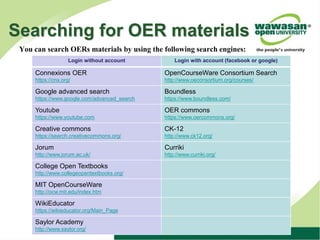
Searching for OER materials
You can search OERs materials by using the following search engines:
Login without account Login with account (facebook or google)
Connexions OER
https://cnx.org/
OpenCourseWare Consortium Search
http://www.oeconsortium.org/courses/
Google advanced search
https://www.google.com/advanced_search
Boundless
https://www.boundless.com/
Youtube
https://www.youtube.com
OER commons
https://www.oercommons.org/
Creative commons
https://search.creativecommons.org/
CK-12
http://www.ck12.org/
Jorum
http://www.jorum.ac.uk/
Curriki
http://www.curriki.org/
College Open Textbooks
http://www.collegeopentextbooks.org/
MIT OpenCourseWare
http://ocw.mit.edu/index.htm
WikiEducator
https://wikieducator.org/Main_Page
Saylor Academy
http://www.saylor.org/
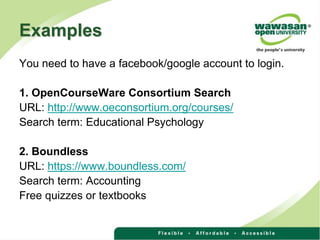
Examples
You need to have a facebook/google account to login.
1. OpenCourseWare Consortium Search
URL: http://www.oeconsortium.org/courses/
Search term: Educational Psychology
2. Boundless
URL: https://www.boundless.com/
Search term: Accounting
Free quizzes or textbooks
Examples
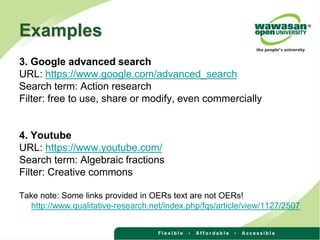
3. Google advanced search
URL: https://www.google.com/advanced_search
Search term: Action research
Filter: free to use, share or modify, even commercially
4. Youtube
URL: https://www.youtube.com/
Search term: Algebraic fractions
Filter: Creative commons
Take note: Some links provided in OERs text are not OERs!
http://www.qualitative-research.net/index.php/fqs/article/view/1127/2507
Activity
Use the four suggested search engines to
search and identify for OER materials that
are related to your teaching & learning
topics by inserting different keywords.
Happy trying!
Additional Information
What are ported and unported License (CC)?
• The verb ‘port’ applies to the adaptation of data to suit a
particular technological or policy
jurisdiction/territory/environment.
• ‘Unported’ licenses are licenses that are not associated
with any specific jurisdiction (e.g. country). They do not
mention any particular jurisdiction’s law.
Source: http://www.oerafrica.org/copyright-and-licensing-toolkit/what-are-ported-and-unported-licence-cc
Creative common licenses
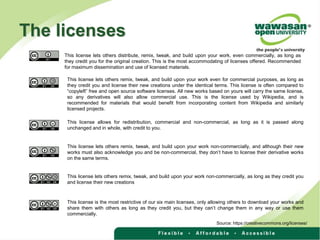
The licenses
This license lets others distribute, remix, tweak, and build upon your work, even commercially, as long as
they credit you for the original creation. This is the most accommodating of licenses offered. Recommended
for maximum dissemination and use of licensed materials.
This license lets others remix, tweak, and build upon your work even for commercial purposes, as long as
they credit you and license their new creations under the identical terms. This license is often compared to
“copyleft” free and open source software licenses. All new works based on yours will carry the same license,
so any derivatives will also allow commercial use. This is the license used by Wikipedia, and is
recommended for materials that would benefit from incorporating content from Wikipedia and similarly
licensed projects.
This license allows for redistribution, commercial and non-commercial, as long as it is passed along
unchanged and in whole, with credit to you.
This license lets others remix, tweak, and build upon your work non-commercially, and although their new
works must also acknowledge you and be non-commercial, they don’t have to license their derivative works
on the same terms.
This license lets others remix, tweak, and build upon your work non-commercially, as long as they credit you
and license their new creations
This license is the most restrictive of our six main licenses, only allowing others to download your works and
share them with others as long as they credit you, but they can’t change them in any way or use them
commercially.
Source: https://creativecommons.org/licenses/
Thank you!
Attribution-ShareAlike
CC BY-SA
This work is licensed under the Creative Commons Attribution-ShareAlike 3.0 Unported (CC BY-SA 3.0) license.

OERs search

  • 1.
  • 2.
    Why OERs? • Notonly freely accessed, but they also can be reused, modified, repurpose and shared by anyone • Save costs because it’s free!
  • 3.
    Searching for OERmaterials You can search OERs materials by using the following search engines: Login without account Login with account (facebook or google) Connexions OER https://cnx.org/ OpenCourseWare Consortium Search http://www.oeconsortium.org/courses/ Google advanced search https://www.google.com/advanced_search Boundless https://www.boundless.com/ Youtube https://www.youtube.com OER commons https://www.oercommons.org/ Creative commons https://search.creativecommons.org/ CK-12 http://www.ck12.org/ Jorum http://www.jorum.ac.uk/ Curriki http://www.curriki.org/ College Open Textbooks http://www.collegeopentextbooks.org/ MIT OpenCourseWare http://ocw.mit.edu/index.htm WikiEducator https://wikieducator.org/Main_Page Saylor Academy http://www.saylor.org/
  • 4.
    Examples You need tohave a facebook/google account to login. 1. OpenCourseWare Consortium Search URL: http://www.oeconsortium.org/courses/ Search term: Educational Psychology 2. Boundless URL: https://www.boundless.com/ Search term: Accounting Free quizzes or textbooks
  • 5.
    Examples 3. Google advancedsearch URL: https://www.google.com/advanced_search Search term: Action research Filter: free to use, share or modify, even commercially 4. Youtube URL: https://www.youtube.com/ Search term: Algebraic fractions Filter: Creative commons Take note: Some links provided in OERs text are not OERs! http://www.qualitative-research.net/index.php/fqs/article/view/1127/2507
  • 6.
    Activity Use the foursuggested search engines to search and identify for OER materials that are related to your teaching & learning topics by inserting different keywords. Happy trying!
  • 7.
  • 8.
    What are portedand unported License (CC)? • The verb ‘port’ applies to the adaptation of data to suit a particular technological or policy jurisdiction/territory/environment. • ‘Unported’ licenses are licenses that are not associated with any specific jurisdiction (e.g. country). They do not mention any particular jurisdiction’s law. Source: http://www.oerafrica.org/copyright-and-licensing-toolkit/what-are-ported-and-unported-licence-cc
  • 9.
  • 10.
    The licenses This licenselets others distribute, remix, tweak, and build upon your work, even commercially, as long as they credit you for the original creation. This is the most accommodating of licenses offered. Recommended for maximum dissemination and use of licensed materials. This license lets others remix, tweak, and build upon your work even for commercial purposes, as long as they credit you and license their new creations under the identical terms. This license is often compared to “copyleft” free and open source software licenses. All new works based on yours will carry the same license, so any derivatives will also allow commercial use. This is the license used by Wikipedia, and is recommended for materials that would benefit from incorporating content from Wikipedia and similarly licensed projects. This license allows for redistribution, commercial and non-commercial, as long as it is passed along unchanged and in whole, with credit to you. This license lets others remix, tweak, and build upon your work non-commercially, and although their new works must also acknowledge you and be non-commercial, they don’t have to license their derivative works on the same terms. This license lets others remix, tweak, and build upon your work non-commercially, as long as they credit you and license their new creations This license is the most restrictive of our six main licenses, only allowing others to download your works and share them with others as long as they credit you, but they can’t change them in any way or use them commercially. Source: https://creativecommons.org/licenses/
  • 11.
    Thank you! Attribution-ShareAlike CC BY-SA Thiswork is licensed under the Creative Commons Attribution-ShareAlike 3.0 Unported (CC BY-SA 3.0) license.