Open Domain-Specific
Architecture (ODSA)
Sub-project Launch
Bapi Vinnakota, Netronome
Server Track
ODSA: A New Server Subgroup (Incubation)
Extending Moore’s Law
• Domain-Specific Accelerators: Programmable ASICs to accelerate high-
intensity workloads (e.g. Tensorflow, Network Flow Processor, Antminer…)
• Chiplets: Build complex ASICs from multiple die, instead of as monolithic
devices, to reduce development time/costs and manufacturing costs.
Open Domain-Specific Architecture:
An architecture to build accelerators
• Today: All multi-chiplet products are based on proprietary interfaces
• Tomorrow: Select best-of-breed chiplets from multiple vendors
• Incubating a new group, to define a new open interface, build a PoC
SERVER
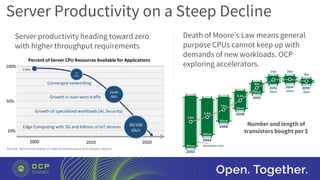
Server Productivity on a Steep Decline
Death of Moore’s Law means general
purpose CPUs cannot keep up with
demands of new workloads. OCP
exploring accelerators.
Number and length of
transistors bought per $
Server productivity heading toward zero
with higher throughput requirements
Source: Netronome based on internal benchmarks and industry reports
Domain-Specific Architectures
Tailor architecture to a domain
• Server-attached devices —
programmable, not hardwired
• Integrated application and
deployment-aware development
of devices, firmware, systems,
software
• 5-10X power performance
improvement
A New Golden Age for Computer Architecture
John L. Hennessy, David A. Patterson
Communications of the ACM, February 2019, Vol. 62 No. 2, Pages 48-60
Exponential Costs of Silicon Development
https://semiengineering.com/big-trouble-at-3nm/
• Designs are too costly at
advanced nodes
• Impossible to justify for
smaller markets
• Only the largest companies
can afford
• Stymies innovation
• Limits choice
Solution: Move From Monolithic to Chiplets
Shrink: Monolithic process shrink
Integration: Multi-chip on same process
Integration provides nearly all the benefits of a shrink at a fraction
of the cost, because of efficient inter-chiplet interconnect
https://www.netronome.com/media/documents/WP_ODSA_Open_Accelerator_Architecture.pdf
Chiplet Use Cases
High-Bandwidth Memory
• 3D stacked memory with
interposer and wide parallel
standard interface
• Open inter-chiplet interface
Xilinx Versal
• 3D stacked FPGA, SerDes,
Application Processor
Intel Foveros
• 3D stacked CPU, GPU,
Application Processor
3D INTEGRATION
All the benefits of 2D integration plus a new level of
density thanks to Foveros, allowing for a radical re-
architecture of systems-on-chips
Growing Interest in Chiplets
Great interest across the ecosystem Great confusion about how this all works
With an Open
System:
• More Choice
• Best-of-breed
• Leverage economies
of scale
• Cheaper
I want to… The biggest problem is…
Open Interface for Chiplet-Based Design
Multiple chiplets need to function as though they are on one die
ArchitectureInterface
Multi-Chiplet Reference Architecture for DSA
Design Function Value
IP Qualification Verified IP for inter-chiplet communication
Architecture Leverage reference architecture.
Focus investment on domain-specific
logic.
Reuse chiplets instead of IP for 40% of the
functions in a monolithic design
Verification
Physical
Software Open source firmware and software for
host-attached operation
Prototype Aim for reference package design with
area, power budgets and pinouts for
components
Test and Validation Develop workflow for chiplets
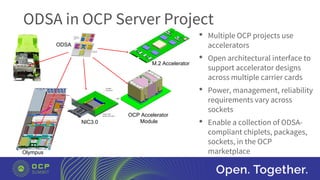
ODSA in OCP Server Project
• Multiple OCP projects use
accelerators
• Open architectural interface to
support accelerator designs
across multiple carrier cards
• Power, management, reliability
requirements vary across
sockets
• Enable a collection of ODSA-
compliant chiplets, packages,
sockets, in the OCP
marketplaceOlympus
NIC3.0
ODSA
OCP Accelerator
Module
M.2 Accelerator
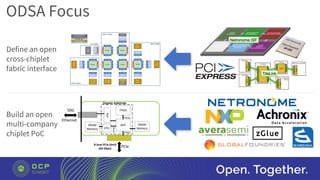
ODSA Focus
PCIe
Ethernet
PHY
NFP
FPGA
CPU
DRAM
Memory
Organic Substrate
8-lane PCIe Gen3
(64 Gbps)
50G
64Gbps
64Gbps
DRAM
Memory
64Gbps
Define an open
cross-chiplet
fabric interface
Build an open
multi-company
chiplet PoC
TileLink
Netronome ISF
How to Participate: Join a Workstream
Join Interface/Standards:
(Mark Kuemerle/Aaron Sullivan)
Develop
Packaging +
Socket, Dev Board
Provide FPGA IP
Provide
ODSA
chiplets
Provide PHY
technology
Join the PoC, Build fast:
(Quinn Jacobson/Jawad Nasrullah)
Join Business, IP and workflow:
(Sam Fuller/Jeff McGuire)
Develop software Define test and
assembly workflow
Provide Chiplet IP
Workstream contact information at the ODSA wiki
Define
Architectural
Interface
Call to Action
Timeline
• ODSA announced, 7 companies: 10/1/18
• White paper, 10 companies: 12/5/18
• Workshop, 35 companies: 1/28/19
• OCP Incubation: 3/15/19
How to Participate
• Wiki (WP, Videos, Survey) https://www.opencompute.org/wiki/Server/ODSA
• Subscribe to the Mailing list: https://ocp-all.groups.io/g/OCP-ODSA
• Attend the next workshop: 3/28/19 @ Samsung, - deep dive and where we need help
register at wiki, or search “ODSA” at www.eventbrite.com
• Join a workstream: PoC, Interface/Standards, Business IP/Workflow
Thanks to:
Achronix: Quinn Jacobson, Manoj Roge; Aquantia: Ramin Farjad; Avera Semi: Dan Greenberg, Mark Kuemerle, Wolfgang Sauter; Ayar Labs:
Shahab Ardalan; ESNet: Yatish Kumar; Kandou: Brian Holden, Jeff McGuire; Netronome : Sujal Das, Jim Finnegan, Jennifer Mendola,
Brian Sparks, Niel Viljoen; NXP: Sam Fuller; OCP: Bill Carter, Archna Haylock, Dharmesh Jani, Steve Roberts, Seth Sethapong, John
Stuewe, Aaron Sullivan, Siamak Tavallaei ; Samtec: Marc Verdiell; Sarcina: Larry Zu; zGlue: Jawad Nasrullah.
 ODSA Sub-Project Launch

ODSA Sub-Project Launch

  • 2.
    Open Domain-Specific Architecture (ODSA) Sub-projectLaunch Bapi Vinnakota, Netronome Server Track
  • 3.
    ODSA: A NewServer Subgroup (Incubation) Extending Moore’s Law • Domain-Specific Accelerators: Programmable ASICs to accelerate high- intensity workloads (e.g. Tensorflow, Network Flow Processor, Antminer…) • Chiplets: Build complex ASICs from multiple die, instead of as monolithic devices, to reduce development time/costs and manufacturing costs. Open Domain-Specific Architecture: An architecture to build accelerators • Today: All multi-chiplet products are based on proprietary interfaces • Tomorrow: Select best-of-breed chiplets from multiple vendors • Incubating a new group, to define a new open interface, build a PoC SERVER
  • 4.
    Server Productivity ona Steep Decline Death of Moore’s Law means general purpose CPUs cannot keep up with demands of new workloads. OCP exploring accelerators. Number and length of transistors bought per $ Server productivity heading toward zero with higher throughput requirements Source: Netronome based on internal benchmarks and industry reports
  • 5.
    Domain-Specific Architectures Tailor architectureto a domain • Server-attached devices — programmable, not hardwired • Integrated application and deployment-aware development of devices, firmware, systems, software • 5-10X power performance improvement A New Golden Age for Computer Architecture John L. Hennessy, David A. Patterson Communications of the ACM, February 2019, Vol. 62 No. 2, Pages 48-60
  • 6.
    Exponential Costs ofSilicon Development https://semiengineering.com/big-trouble-at-3nm/ • Designs are too costly at advanced nodes • Impossible to justify for smaller markets • Only the largest companies can afford • Stymies innovation • Limits choice
  • 7.
    Solution: Move FromMonolithic to Chiplets Shrink: Monolithic process shrink Integration: Multi-chip on same process Integration provides nearly all the benefits of a shrink at a fraction of the cost, because of efficient inter-chiplet interconnect https://www.netronome.com/media/documents/WP_ODSA_Open_Accelerator_Architecture.pdf
  • 8.
    Chiplet Use Cases High-BandwidthMemory • 3D stacked memory with interposer and wide parallel standard interface • Open inter-chiplet interface Xilinx Versal • 3D stacked FPGA, SerDes, Application Processor Intel Foveros • 3D stacked CPU, GPU, Application Processor 3D INTEGRATION All the benefits of 2D integration plus a new level of density thanks to Foveros, allowing for a radical re- architecture of systems-on-chips
  • 9.
    Growing Interest inChiplets Great interest across the ecosystem Great confusion about how this all works With an Open System: • More Choice • Best-of-breed • Leverage economies of scale • Cheaper I want to… The biggest problem is…
  • 10.
    Open Interface forChiplet-Based Design Multiple chiplets need to function as though they are on one die ArchitectureInterface
  • 11.
    Multi-Chiplet Reference Architecturefor DSA Design Function Value IP Qualification Verified IP for inter-chiplet communication Architecture Leverage reference architecture. Focus investment on domain-specific logic. Reuse chiplets instead of IP for 40% of the functions in a monolithic design Verification Physical Software Open source firmware and software for host-attached operation Prototype Aim for reference package design with area, power budgets and pinouts for components Test and Validation Develop workflow for chiplets
  • 12.
    ODSA in OCPServer Project • Multiple OCP projects use accelerators • Open architectural interface to support accelerator designs across multiple carrier cards • Power, management, reliability requirements vary across sockets • Enable a collection of ODSA- compliant chiplets, packages, sockets, in the OCP marketplaceOlympus NIC3.0 ODSA OCP Accelerator Module M.2 Accelerator
  • 13.
    ODSA Focus PCIe Ethernet PHY NFP FPGA CPU DRAM Memory Organic Substrate 8-lanePCIe Gen3 (64 Gbps) 50G 64Gbps 64Gbps DRAM Memory 64Gbps Define an open cross-chiplet fabric interface Build an open multi-company chiplet PoC TileLink Netronome ISF
  • 14.
    How to Participate:Join a Workstream Join Interface/Standards: (Mark Kuemerle/Aaron Sullivan) Develop Packaging + Socket, Dev Board Provide FPGA IP Provide ODSA chiplets Provide PHY technology Join the PoC, Build fast: (Quinn Jacobson/Jawad Nasrullah) Join Business, IP and workflow: (Sam Fuller/Jeff McGuire) Develop software Define test and assembly workflow Provide Chiplet IP Workstream contact information at the ODSA wiki Define Architectural Interface
  • 15.
    Call to Action Timeline •ODSA announced, 7 companies: 10/1/18 • White paper, 10 companies: 12/5/18 • Workshop, 35 companies: 1/28/19 • OCP Incubation: 3/15/19 How to Participate • Wiki (WP, Videos, Survey) https://www.opencompute.org/wiki/Server/ODSA • Subscribe to the Mailing list: https://ocp-all.groups.io/g/OCP-ODSA • Attend the next workshop: 3/28/19 @ Samsung, - deep dive and where we need help register at wiki, or search “ODSA” at www.eventbrite.com • Join a workstream: PoC, Interface/Standards, Business IP/Workflow Thanks to: Achronix: Quinn Jacobson, Manoj Roge; Aquantia: Ramin Farjad; Avera Semi: Dan Greenberg, Mark Kuemerle, Wolfgang Sauter; Ayar Labs: Shahab Ardalan; ESNet: Yatish Kumar; Kandou: Brian Holden, Jeff McGuire; Netronome : Sujal Das, Jim Finnegan, Jennifer Mendola, Brian Sparks, Niel Viljoen; NXP: Sam Fuller; OCP: Bill Carter, Archna Haylock, Dharmesh Jani, Steve Roberts, Seth Sethapong, John Stuewe, Aaron Sullivan, Siamak Tavallaei ; Samtec: Marc Verdiell; Sarcina: Larry Zu; zGlue: Jawad Nasrullah.