


QuerySets
Presenter: Ashok Kumar Samantray, Mindfire
Solutions
Date: 26/02/2015
Presenter: Ashok Kumar Samantray, Mindfire
Solutions
About me
Connect Me:
Facebook: https://www.facebook.com/ashokkumar.samantaray.50
Linkedin: https://www.linkedin.com/in/ashokkumarsamantray
Google+: https://plus.google.com/+AshokKumarSamantray117/
Contact Me:
Email: ashok.samantray@mindfiresolutions.com, mailashok117@gmail.com
Skype: mfsi_ashok
Ashok Kumar Samantray
Python Developer
Skills: Python, Django, Tastypie,
MySQL, PostgreSQL, MongoDB,
JQuery, JavaScript, AJAX
Creating Objects
Saving Changes to Objects
Retrieving Objects
Deleting Objects
Complex Lookups with Q Objects
Q&A
AgendaAgenda
Presenter: Ashok Kumar Samantray, Mindfire
Solutions
Creating ObjectsCreating Objects
Instance of a model class represents a record in DB
Instanciate a model class using the keyword argument to create an
object.
Instanciation generates an INSERT query.
Call the save() explicitly to run the query.
Insert record using the create(), get_or_create() in single step.
Saving Changes to ObjectsSaving Changes to Objects
To save changes to the record already present in the DB use save()
Save() performs the update query behind the scenes
Saving a Foreignkey works by assigning the object of the right
model instance.
Saving a ManyToMany field works a little different
– from blog.models import Author
– joe = Author.objects.create(name="Joe")
– entry.authors.add(joe)
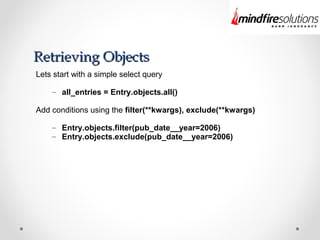
Retrieving ObjectsRetrieving Objects
Lets start with a simple select query
– all_entries = Entry.objects.all()
Add conditions using the filter(**kwargs), exclude(**kwargs)
– Entry.objects.filter(pub_date__year=2006)
– Entry.objects.exclude(pub_date__year=2006)
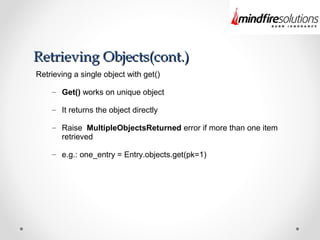
Retrieving Objects(cont.)Retrieving Objects(cont.)
Retrieving a single object with get()
– Get() works on unique object
– It returns the object directly
– Raise MultipleObjectsReturned error if more than one item
retrieved
– e.g.: one_entry = Entry.objects.get(pk=1)
Limit, Offset and OrderingLimit, Offset and Ordering
A Queryset is iterable.
Queryset can be sliced like all other iterables
Limit and Offset by slicing the queryset
e.g.:- Entry.objects.all()[5:10]
Negative indexing is not supported
e.g:- Entry.objects.all()[-1]
Use of step parameter is allowed and it evaluates the querysets
order_by() is used for order the result
e.g:- Entry.objects.order_by('headline')
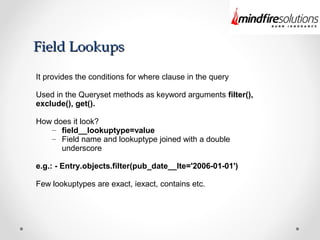
Field LookupsField Lookups
It provides the conditions for where clause in the query
Used in the Queryset methods as keyword arguments filter(),
exclude(), get().
How does it look?
– field__lookuptype=value
– Field name and lookuptype joined with a double
underscore
e.g.: - Entry.objects.filter(pub_date__lte='2006-01-01')
Few lookuptypes are exact, iexact, contains etc.
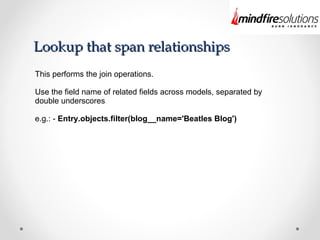
Lookup that span relationshipsLookup that span relationships
This performs the join operations.
Use the field name of related fields across models, separated by
double underscores
e.g.: - Entry.objects.filter(blog__name='Beatles Blog')
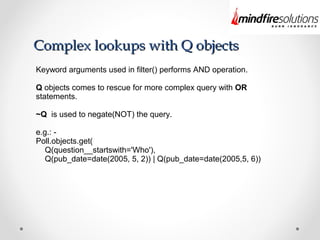
Complex lookups with Q objectsComplex lookups with Q objects
Keyword arguments used in filter() performs AND operation.
Q objects comes to rescue for more complex query with OR
statements.
~Q is used to negate(NOT) the query.
e.g.: -
Poll.objects.get(
Q(question__startswith='Who'),
Q(pub_date=date(2005, 5, 2)) | Q(pub_date=date(2005,5, 6))
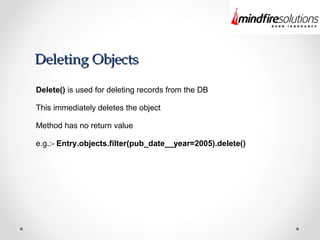
Deleting ObjectsDeleting Objects
Delete() is used for deleting records from the DB
This immediately deletes the object
Method has no return value
e.g.:- Entry.objects.filter(pub_date__year=2005).delete()
Some QuerySet methodsSome QuerySet methods
- values()
- values_list()
- distinct()
- only()
- defer()
Presenter: Ashok Kumar Samantray, Mindfire
Solutions
Question and
Answer
References LinkReferences Link
https://docs.djangoproject.com/en/1.7/topics/db/models/
Presenter: Ashok Kumar Samantray, Mindfire
Solutions
Thank you
Connect Us @Connect Us @
www.mindfiresolutions.com
https://www.facebook.com/MindfireSolutions
http://www.linkedin.com/company/mindfire-solutions
http://twitter.com/mindfires

Django-Queryset

  • 1.
    QuerySets Presenter: Ashok KumarSamantray, Mindfire Solutions Date: 26/02/2015
  • 2.
    Presenter: Ashok KumarSamantray, Mindfire Solutions About me Connect Me: Facebook: https://www.facebook.com/ashokkumar.samantaray.50 Linkedin: https://www.linkedin.com/in/ashokkumarsamantray Google+: https://plus.google.com/+AshokKumarSamantray117/ Contact Me: Email: ashok.samantray@mindfiresolutions.com, mailashok117@gmail.com Skype: mfsi_ashok Ashok Kumar Samantray Python Developer Skills: Python, Django, Tastypie, MySQL, PostgreSQL, MongoDB, JQuery, JavaScript, AJAX
  • 3.
    Creating Objects Saving Changesto Objects Retrieving Objects Deleting Objects Complex Lookups with Q Objects Q&A AgendaAgenda Presenter: Ashok Kumar Samantray, Mindfire Solutions
  • 4.
    Creating ObjectsCreating Objects Instanceof a model class represents a record in DB Instanciate a model class using the keyword argument to create an object. Instanciation generates an INSERT query. Call the save() explicitly to run the query. Insert record using the create(), get_or_create() in single step.
  • 5.
    Saving Changes toObjectsSaving Changes to Objects To save changes to the record already present in the DB use save() Save() performs the update query behind the scenes Saving a Foreignkey works by assigning the object of the right model instance. Saving a ManyToMany field works a little different – from blog.models import Author – joe = Author.objects.create(name="Joe") – entry.authors.add(joe)
  • 6.
    Retrieving ObjectsRetrieving Objects Letsstart with a simple select query – all_entries = Entry.objects.all() Add conditions using the filter(**kwargs), exclude(**kwargs) – Entry.objects.filter(pub_date__year=2006) – Entry.objects.exclude(pub_date__year=2006)
  • 7.
    Retrieving Objects(cont.)Retrieving Objects(cont.) Retrievinga single object with get() – Get() works on unique object – It returns the object directly – Raise MultipleObjectsReturned error if more than one item retrieved – e.g.: one_entry = Entry.objects.get(pk=1)
  • 8.
    Limit, Offset andOrderingLimit, Offset and Ordering A Queryset is iterable. Queryset can be sliced like all other iterables Limit and Offset by slicing the queryset e.g.:- Entry.objects.all()[5:10] Negative indexing is not supported e.g:- Entry.objects.all()[-1] Use of step parameter is allowed and it evaluates the querysets order_by() is used for order the result e.g:- Entry.objects.order_by('headline')
  • 9.
    Field LookupsField Lookups Itprovides the conditions for where clause in the query Used in the Queryset methods as keyword arguments filter(), exclude(), get(). How does it look? – field__lookuptype=value – Field name and lookuptype joined with a double underscore e.g.: - Entry.objects.filter(pub_date__lte='2006-01-01') Few lookuptypes are exact, iexact, contains etc.
  • 10.
    Lookup that spanrelationshipsLookup that span relationships This performs the join operations. Use the field name of related fields across models, separated by double underscores e.g.: - Entry.objects.filter(blog__name='Beatles Blog')
  • 11.
    Complex lookups withQ objectsComplex lookups with Q objects Keyword arguments used in filter() performs AND operation. Q objects comes to rescue for more complex query with OR statements. ~Q is used to negate(NOT) the query. e.g.: - Poll.objects.get( Q(question__startswith='Who'), Q(pub_date=date(2005, 5, 2)) | Q(pub_date=date(2005,5, 6))
  • 12.
    Deleting ObjectsDeleting Objects Delete()is used for deleting records from the DB This immediately deletes the object Method has no return value e.g.:- Entry.objects.filter(pub_date__year=2005).delete()
  • 13.
    Some QuerySet methodsSomeQuerySet methods - values() - values_list() - distinct() - only() - defer()
  • 14.
    Presenter: Ashok KumarSamantray, Mindfire Solutions Question and Answer
  • 15.
  • 16.
    Presenter: Ashok KumarSamantray, Mindfire Solutions Thank you
  • 17.
    Connect Us @ConnectUs @ www.mindfiresolutions.com https://www.facebook.com/MindfireSolutions http://www.linkedin.com/company/mindfire-solutions http://twitter.com/mindfires