THE GOVERNOR’S
OFFICE OF WORKFORCE
TRANSFORMATION:
STRATEGIC FRAMEWORK
AND THE WORKFORCE
SUCCESS MEASURES
May 5, 2015
ODJFS Conference
Making Research Work for Education
Dawn Larzelere (Governor’s Office of Workforce
Transformation)
Overview of OWT
Keith Ewald (Ohio Dept. Of Job and Family
Services)
Discussion of OhioAnalytics
Josh Hawley (Ohio State Univ.)
Overview of Workforce Success Measures
Coming Soon
Additional Agency Partners
Data Uses
Activity!!
2
AGENDA
Workforce Success Measures
A project of the
Governor’s Office of
Workforce Transformation
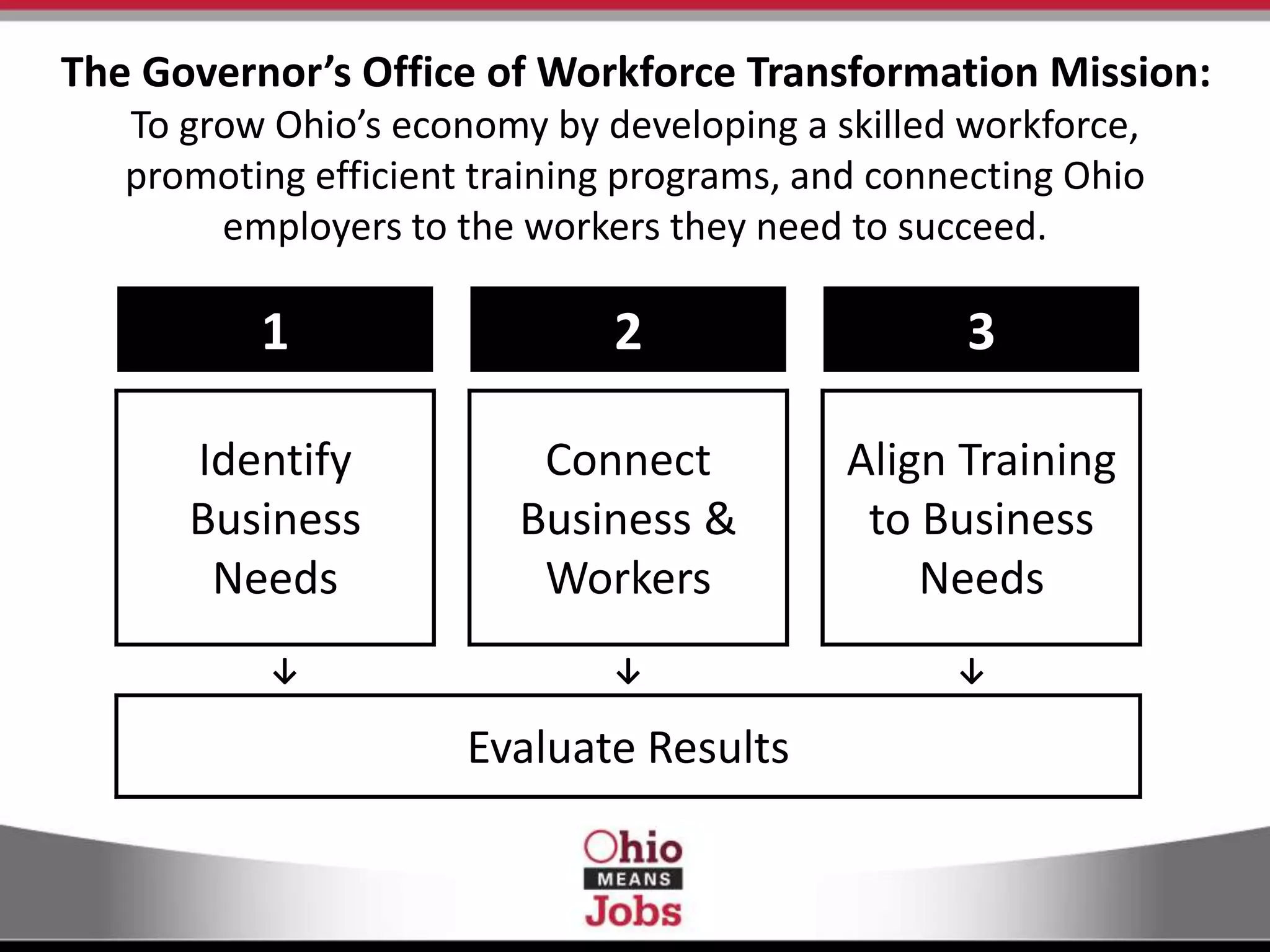
1 2 3
Identify
Business
Needs
Connect
Business &
Workers
Align Training
to Business
Needs
↓ ↓ ↓
Evaluate Results
The Governor’s Office of Workforce Transformation Mission:
To grow Ohio’s economy by developing a skilled workforce,
promoting efficient training programs, and connecting Ohio
employers to the workers they need to succeed.
Identify Business Needs
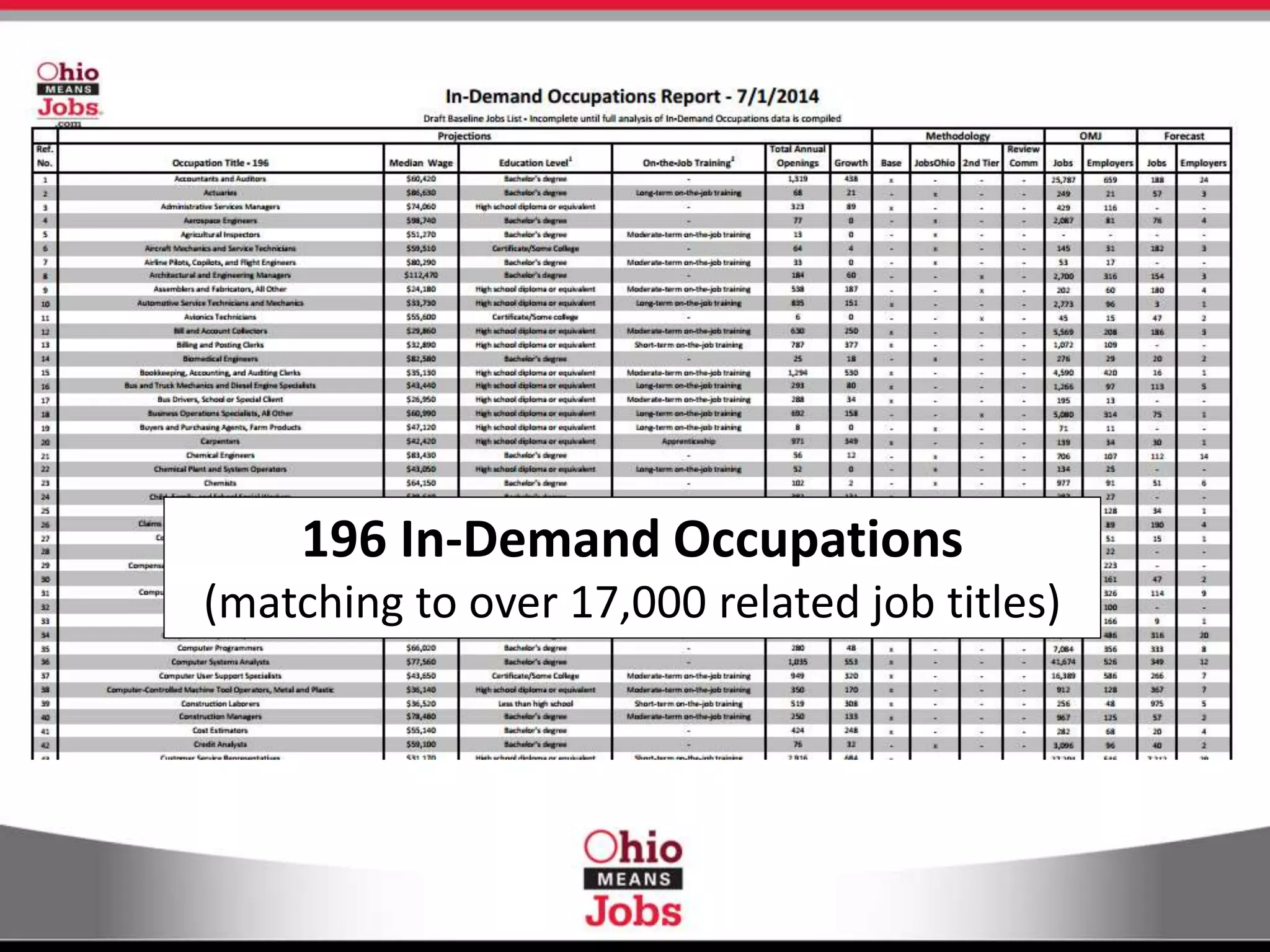
196 In-Demand Occupations
(matching to over 17,000 related job titles)
Connect Business and Workers
Industry Workforce Alliances
• Business-led dialogue to address specific in-
demand jobs and career pathways
• Brings together business, education and
training, and other stakeholders
• Develop innovate solutions to address short-
and long-term needs
Industry Workforce Alliance Partnership
Grant Award Recipients
Central Ohio: Insurance Industry Resource Council
Northeast Ohio: Mahoning Valley Manufacturers Coalition
Northwest Ohio: Allen Economic Development Group
Southwest Ohio: Partners for a Competitive Workforce
Western Ohio: Montgomery County Dept. of Community and
Economic Development
Southeast Ohio: Appalachian Ohio Health Professions Pathways
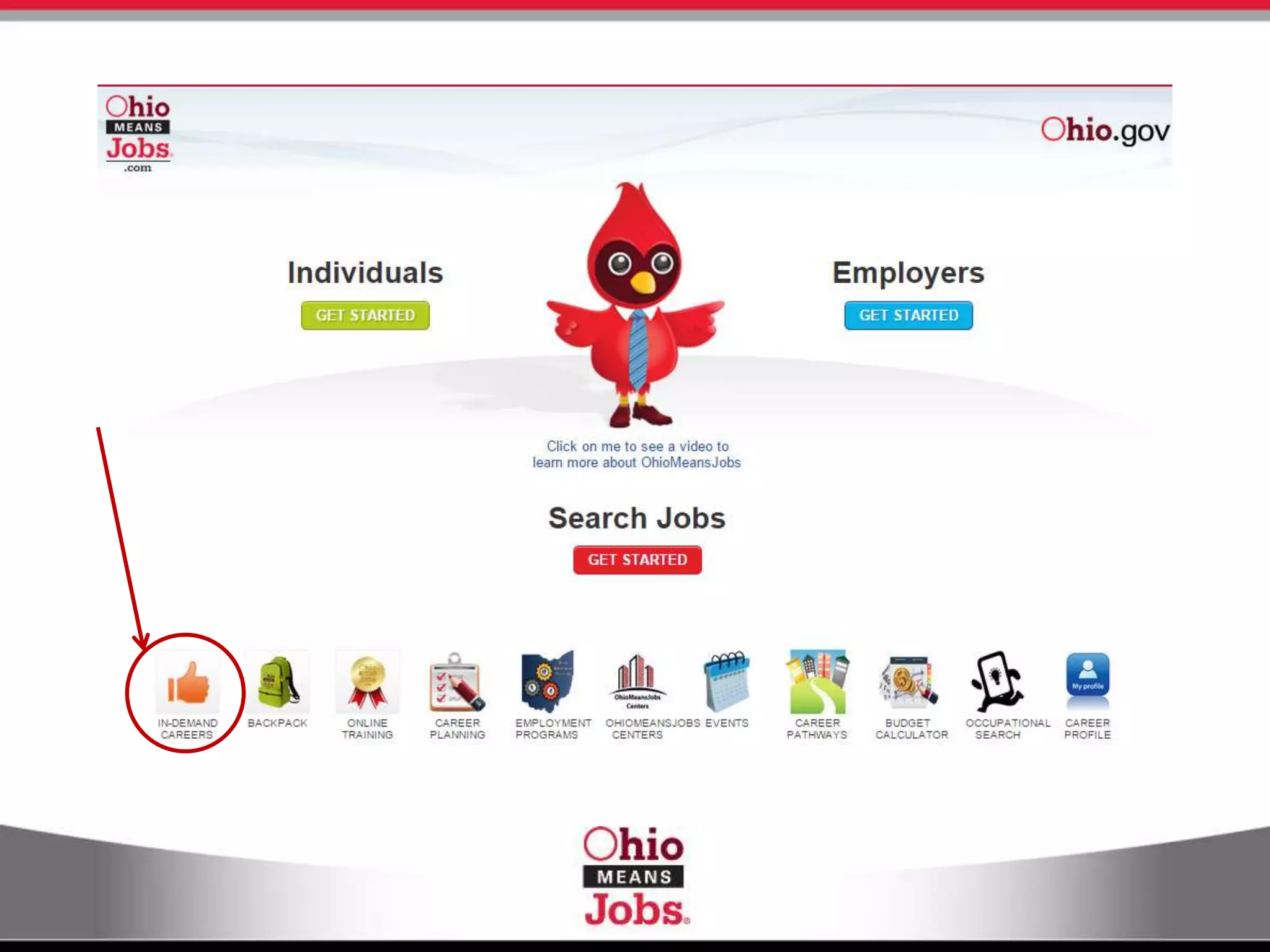
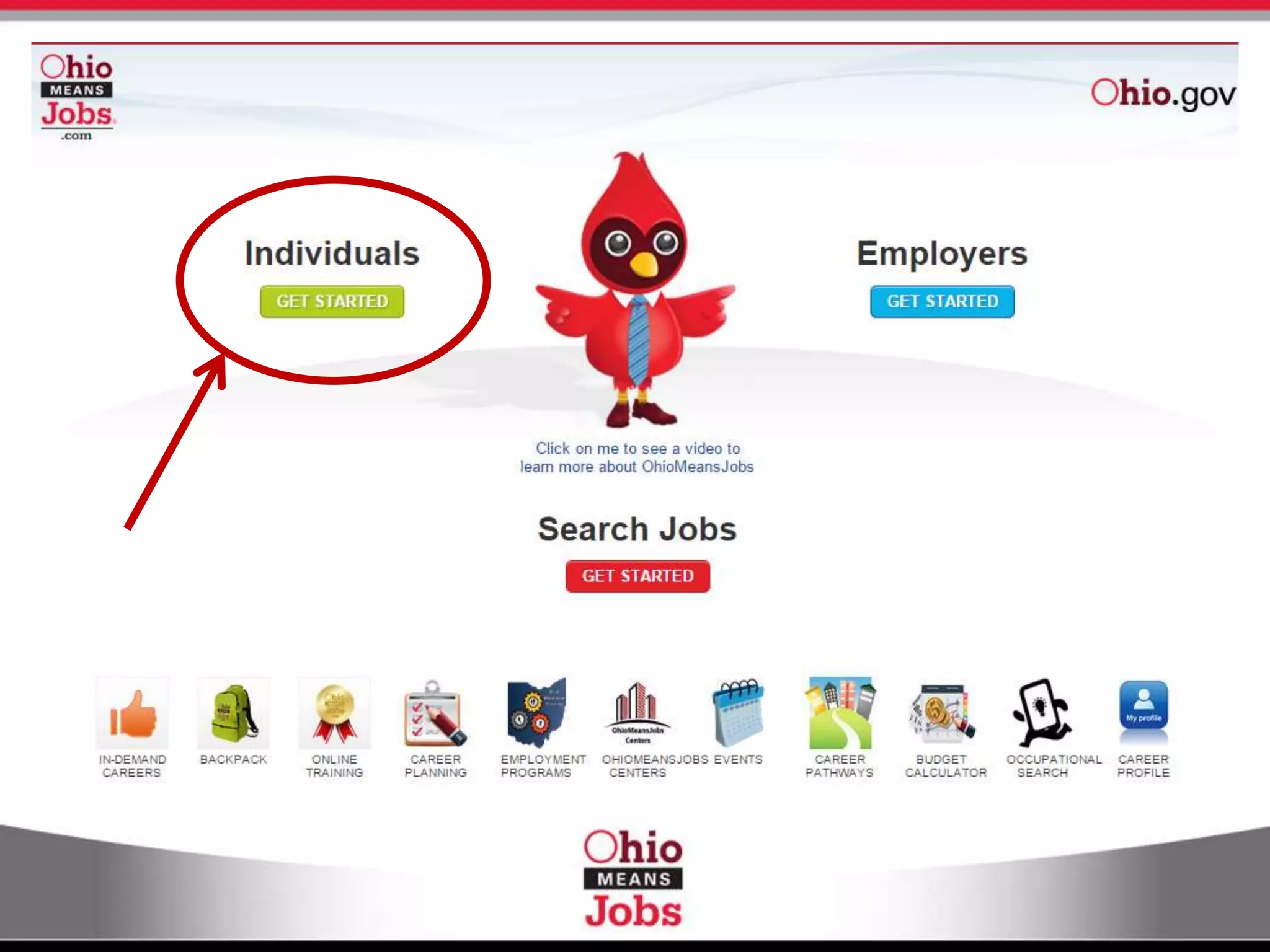
OhioMeansJobs.com
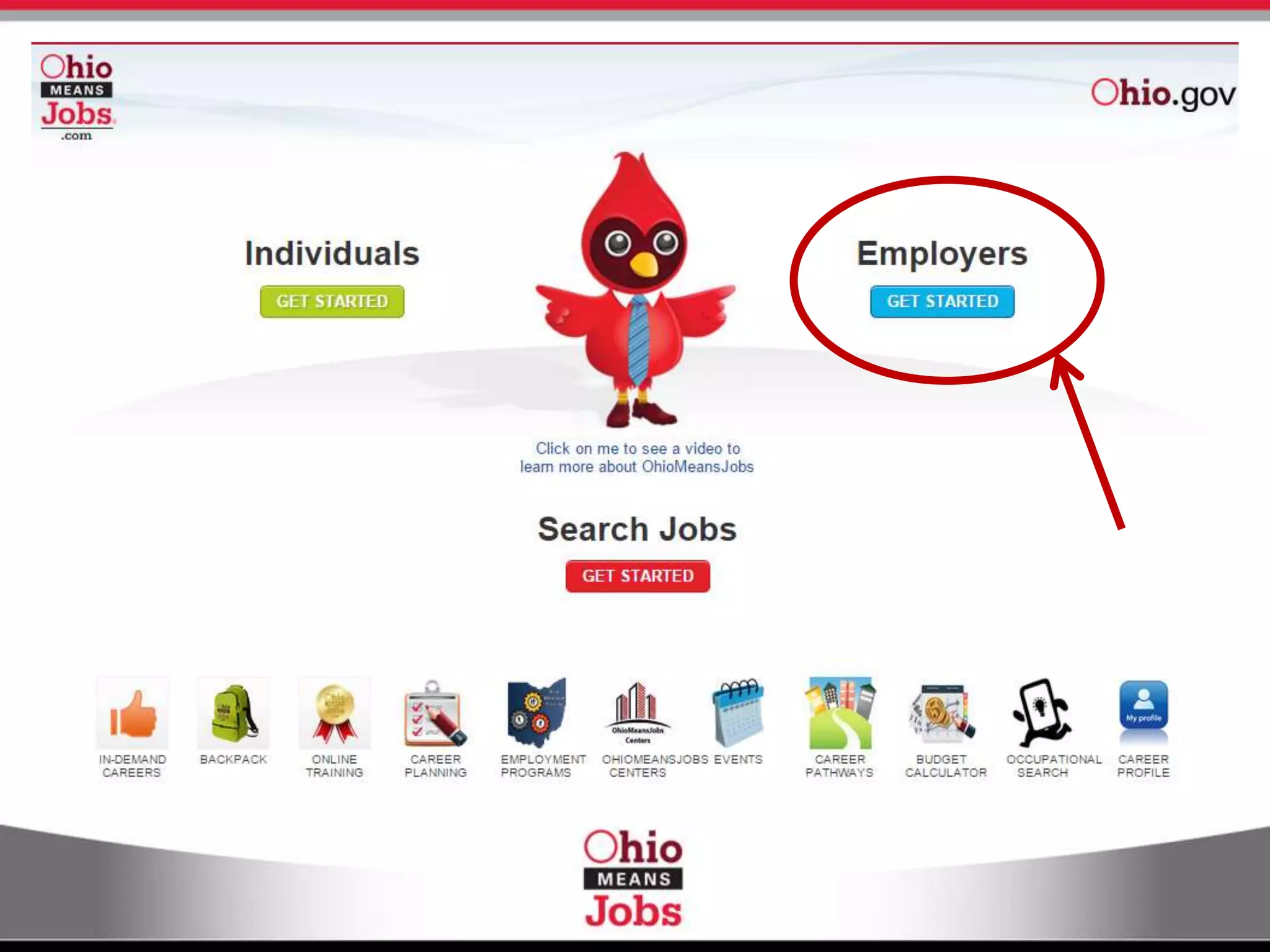
Employer Services at OhioMeansJobs.com
• Job Posting
• Resume Searching
• Employment Programs
• Business Support Center
Phone: 1-888-385-2588 (Monday – Friday 8am to 4pm)
Email: employerassistance@jfs.ohio.gov
Align Training to Business Needs
OhioMeansJobs.com
K-12 Students and Post Secondary
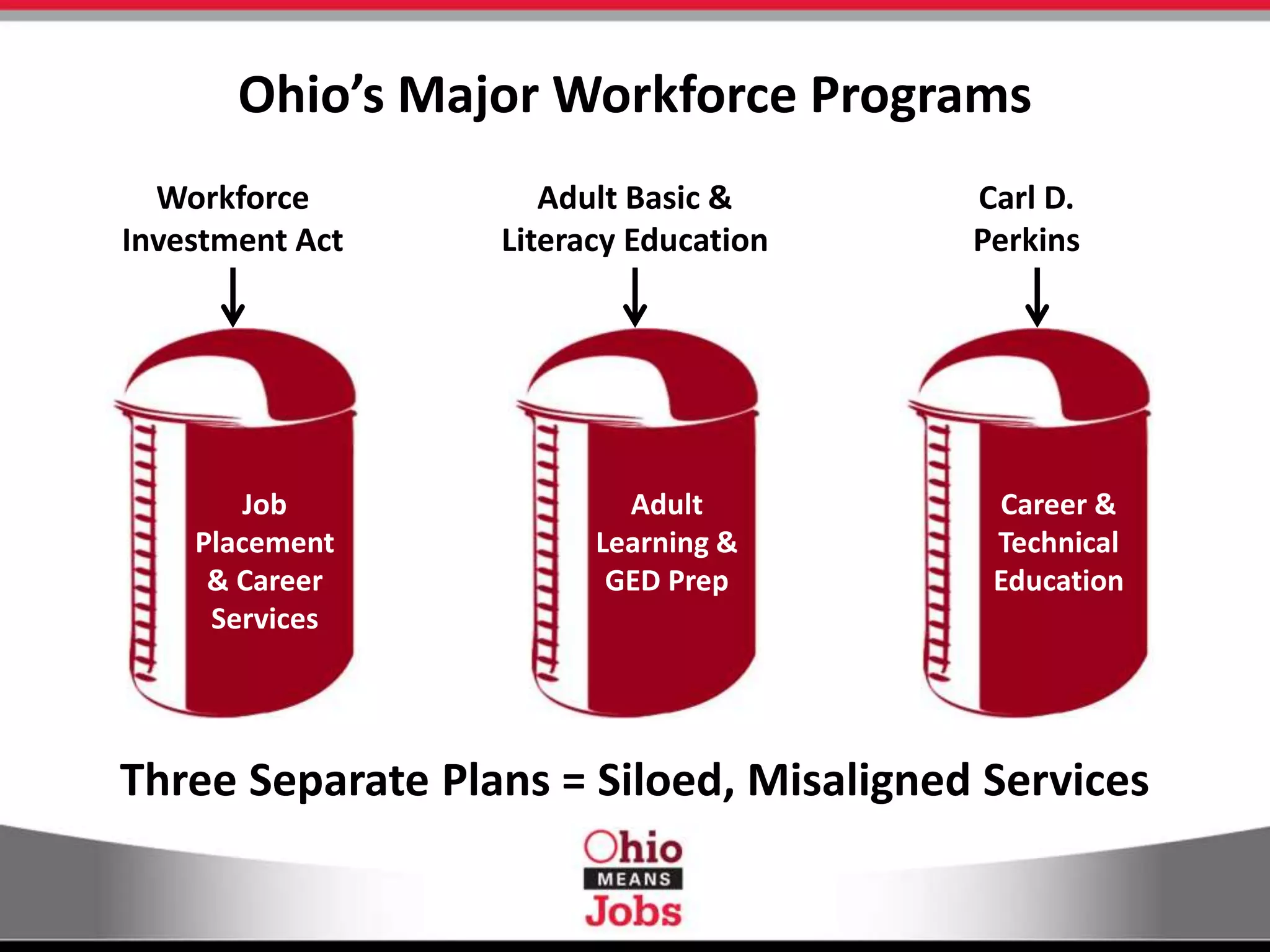
Ohio’s Major Workforce Programs
Three Separate Plans = Siloed, Misaligned Services
Job
Placement
& Career
Services
Workforce
Investment Act
Adult
Learning &
GED Prep
Adult Basic &
Literacy Education
Career &
Technical
Education
Carl D.
Perkins
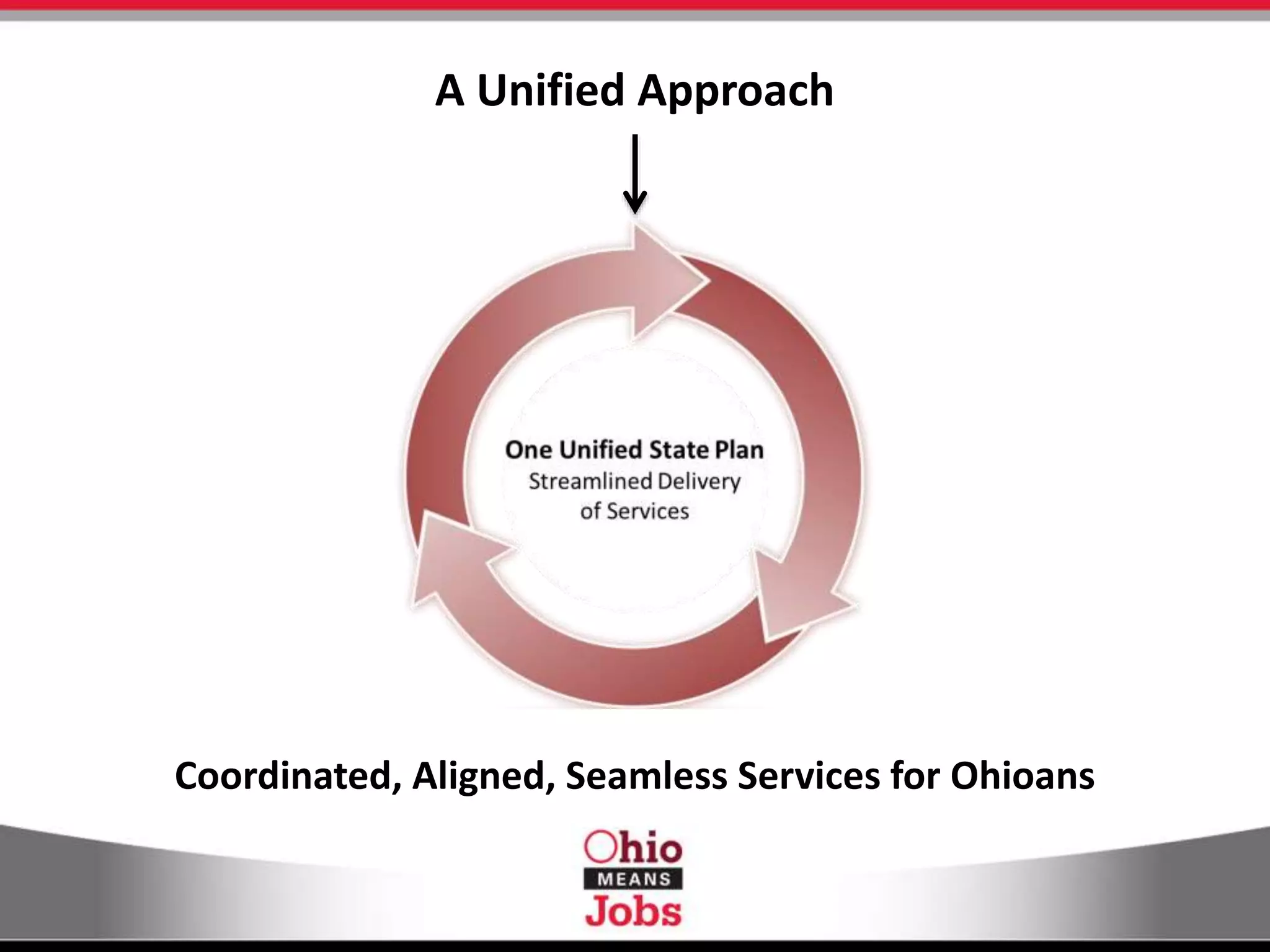
A Unified Approach
Coordinated, Aligned, Seamless Services for Ohioans
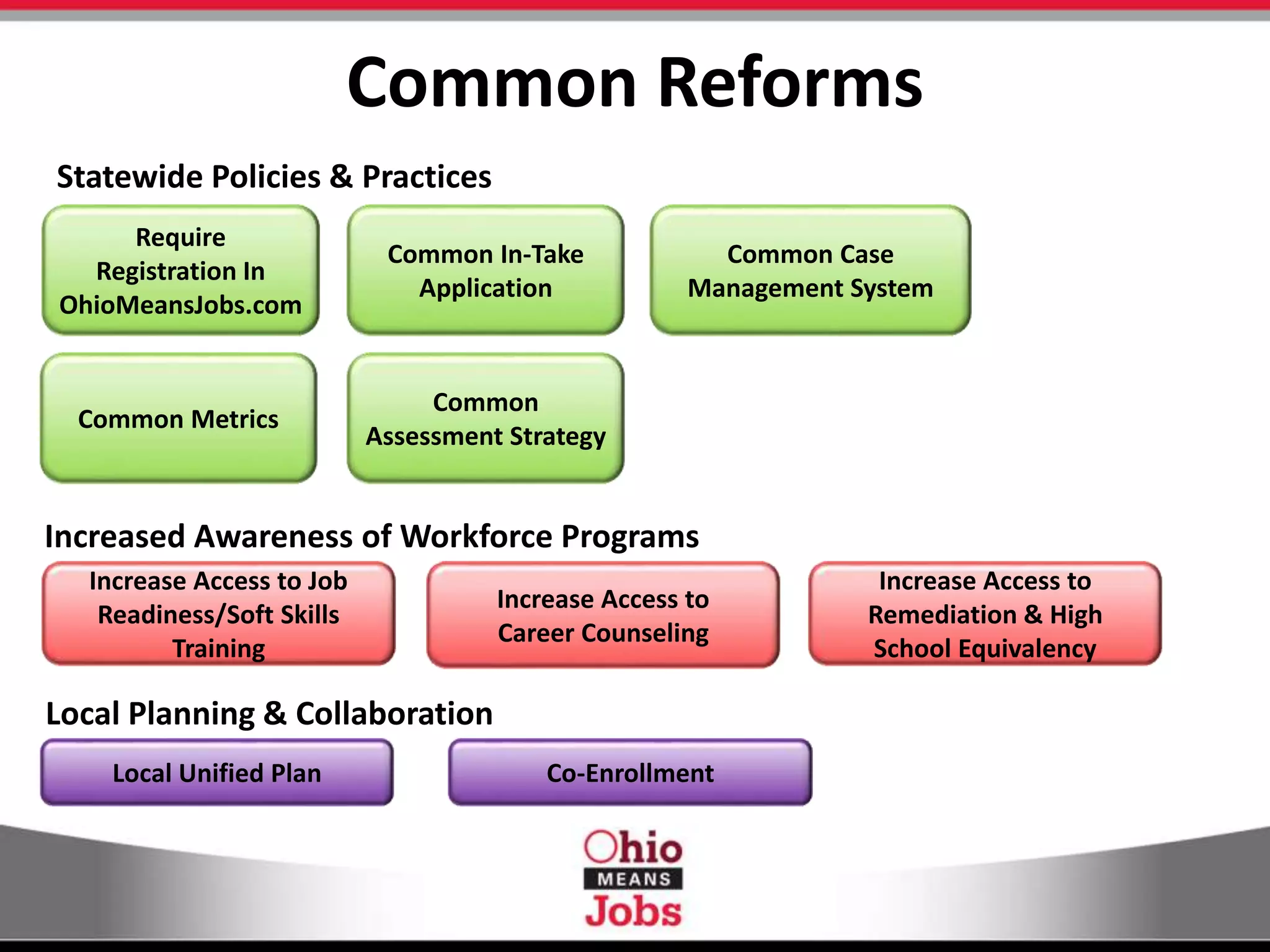
Statewide Policies & Practices
Increased Awareness of Workforce Programs
Local Planning & Collaboration
Common Metrics
Require
Registration In
OhioMeansJobs.com
Common In-Take
Application
Common Case
Management System
Common
Assessment Strategy
Increase Access to Job
Readiness/Soft Skills
Training
Increase Access to
Career Counseling
Increase Access to
Remediation & High
School Equivalency
Local Unified Plan Co-Enrollment
Common Reforms
Evaluate Results
Contact Information
Dawn Larzelere
Governor’s Office of Workforce Transformation
614-466-4208
dawn.larzelere@governor.ohio.gov
www.workforce.ohio.gov
 Agencies Partnerships
 Ohio Longitudinal Data Archive (OLDA)
 Advancing Research and Policy Analysis
 Brief Review of Data Products.
25
Ohio Analytics: Behind the Scenes of
Workforce Success Measures.
26
Agency Partnerships
 OhioAnalytics is an administrative data
partnership supporting education and workforce
research priorities of Ohio’s public agencies and
the Ohio Education Research Center.
 The Mission of Ohio Analytics is to expand
research-based knowledge by improving the
quality and accessibility of administrative data
from Ohio’s public agencies for use in policy and
programmatic decision-making.
 Pseudo IDs – De-identification
 Cross matching
 Archiving – Metadata
 Governance
27
Ohio Longitudinal Database Archive
 Partnering with research and policy analysis
entities
 De-identification and Data Access Procedures
 Publishing Product Outcomes
 Participating in National Forums
28
Advancing Research and Policy Analysis
 Postsecondary Outcomes of an Ohio City
School District
 Workforce Outcomes of WIA On-the-Job
Training in Ohio
 Ohio Higher Education Outcome
Visualizations
http://tinyurl.com/mv7whjq
http://tinyurl.com/olnzzrb 29
Brief Review of Data Products
30
For More see
http://www.ohioanalytics.gov/index.stm
Currently 40+ research project
underway
 Priority of the Governor’s Executive Workforce Board
 State agency working group
 National Governor’s Association/National Association of State
Workforce Agencies common measures proposal
 Engaging the Ohio Education Research Center at OSU
 Workforce Opportunity and Innovation Act (WIOA) - signed on
July 22, 2014
 Development of the dashboard and website
31
BACKGROUND ON WORKFORCE
SUCCESS MEASURES
As presented
to the
Governor’s
Executive
Workforce
Board
“What gets
measured gets
better”
32
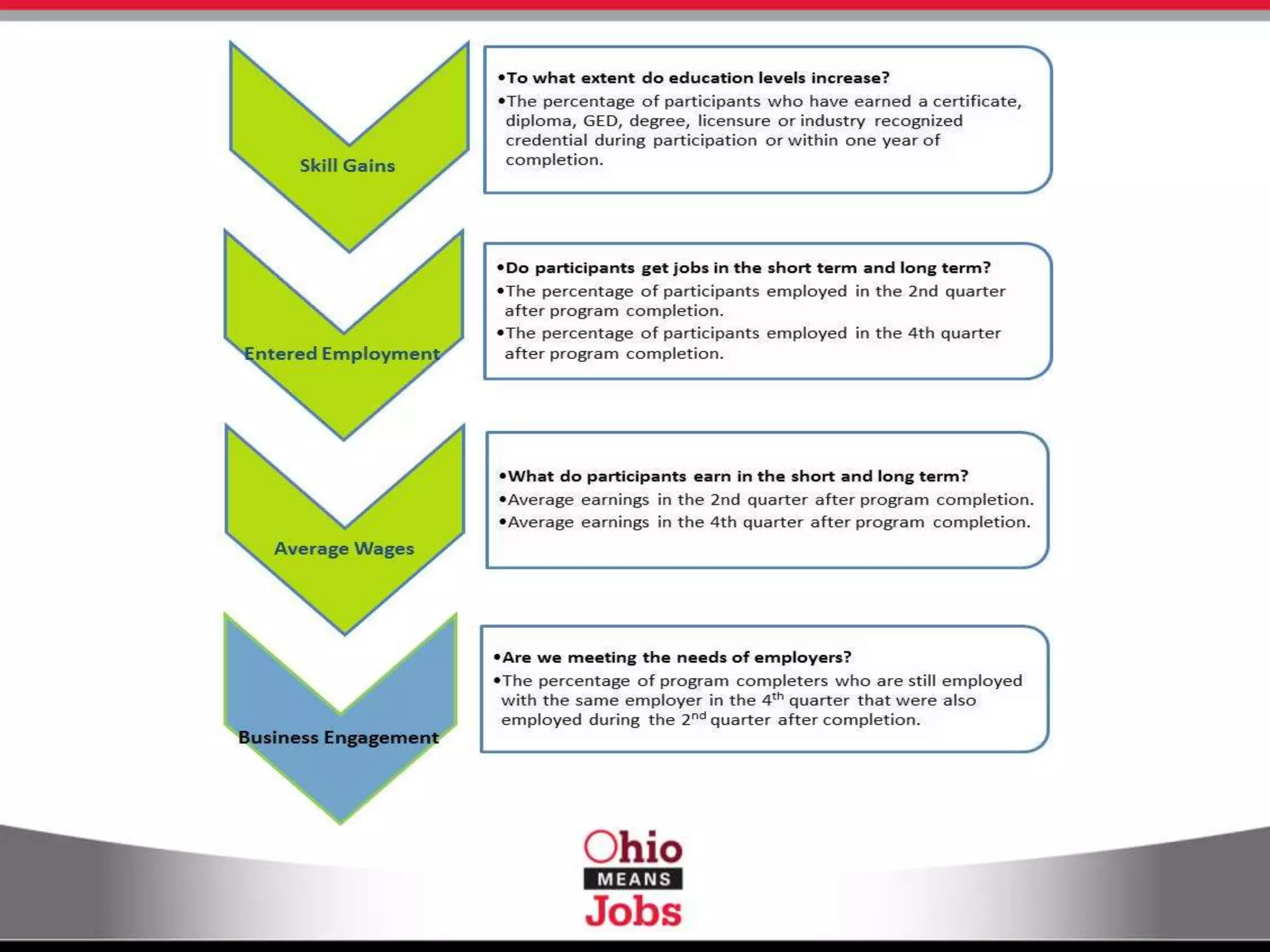
PERFORMANCE
METRICS
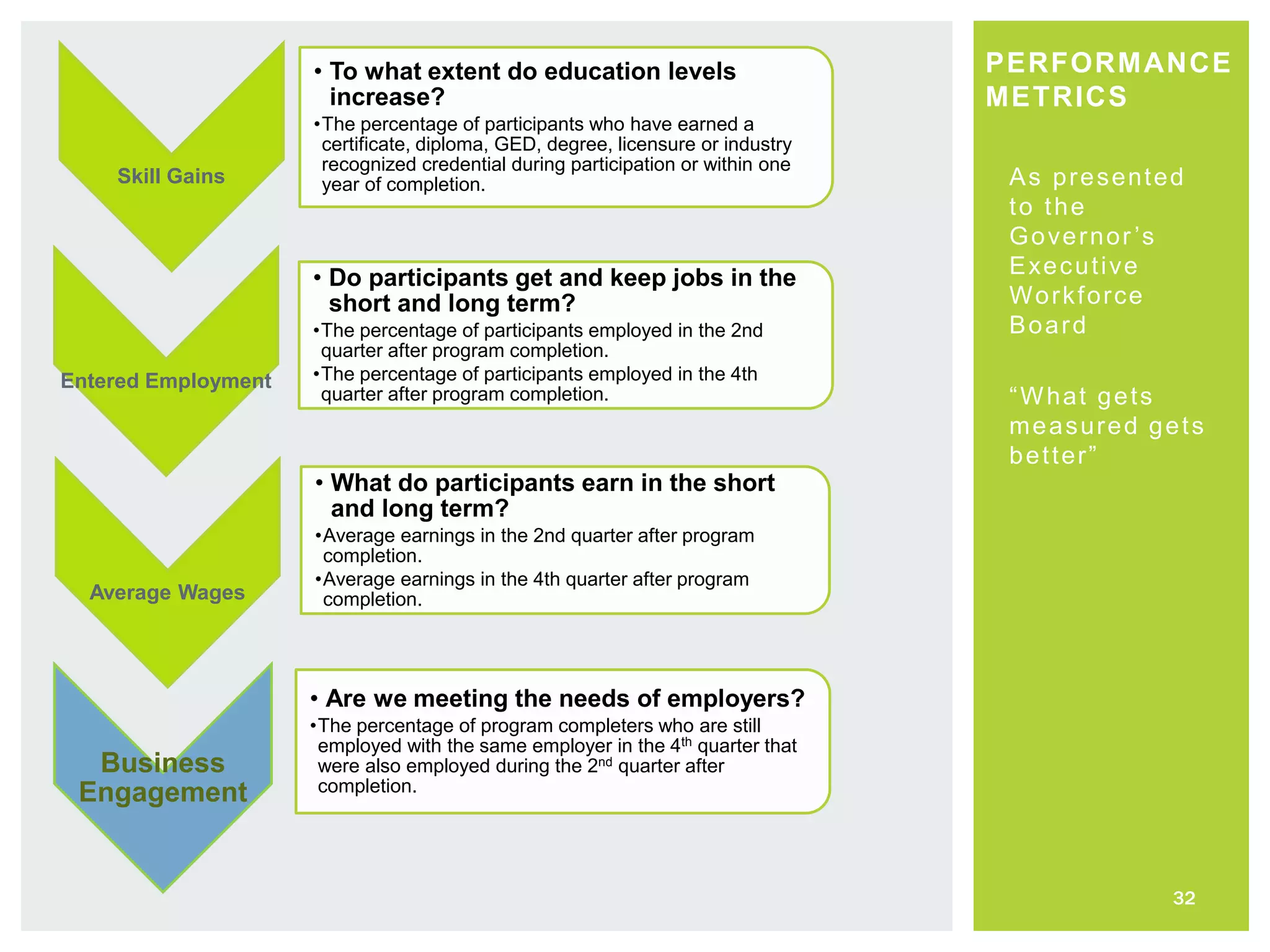
Skill Gains
• To what extent do education levels
increase?
•The percentage of participants who have earned a
certificate, diploma, GED, degree, licensure or industry
recognized credential during participation or within one
year of completion.
Entered Employment
• Do participants get and keep jobs in the
short and long term?
•The percentage of participants employed in the 2nd
quarter after program completion.
•The percentage of participants employed in the 4th
quarter after program completion.
Average Wages
• What do participants earn in the short
and long term?
•Average earnings in the 2nd quarter after program
completion.
•Average earnings in the 4th quarter after program
completion.
Business
Engagement
• Are we meeting the needs of employers?
•The percentage of program completers who are still
employed with the same employer in the 4th quarter that
were also employed during the 2nd quarter after
completion.
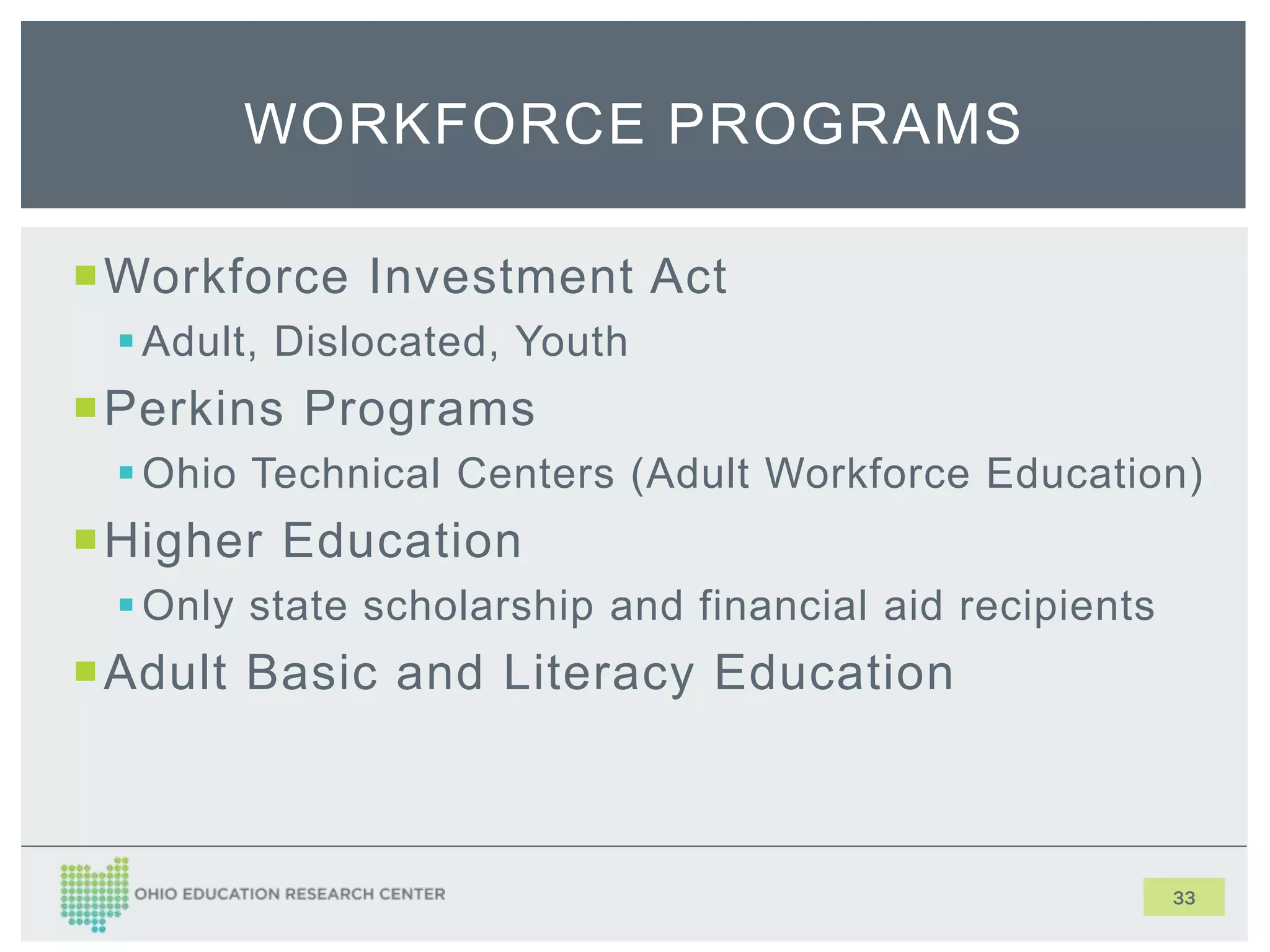
Workforce Investment Act
Adult, Dislocated, Youth
Perkins Programs
Ohio Technical Centers (Adult Workforce Education)
Higher Education
Only state scholarship and financial aid recipients
Adult Basic and Literacy Education
33
WORKFORCE PROGRAMS
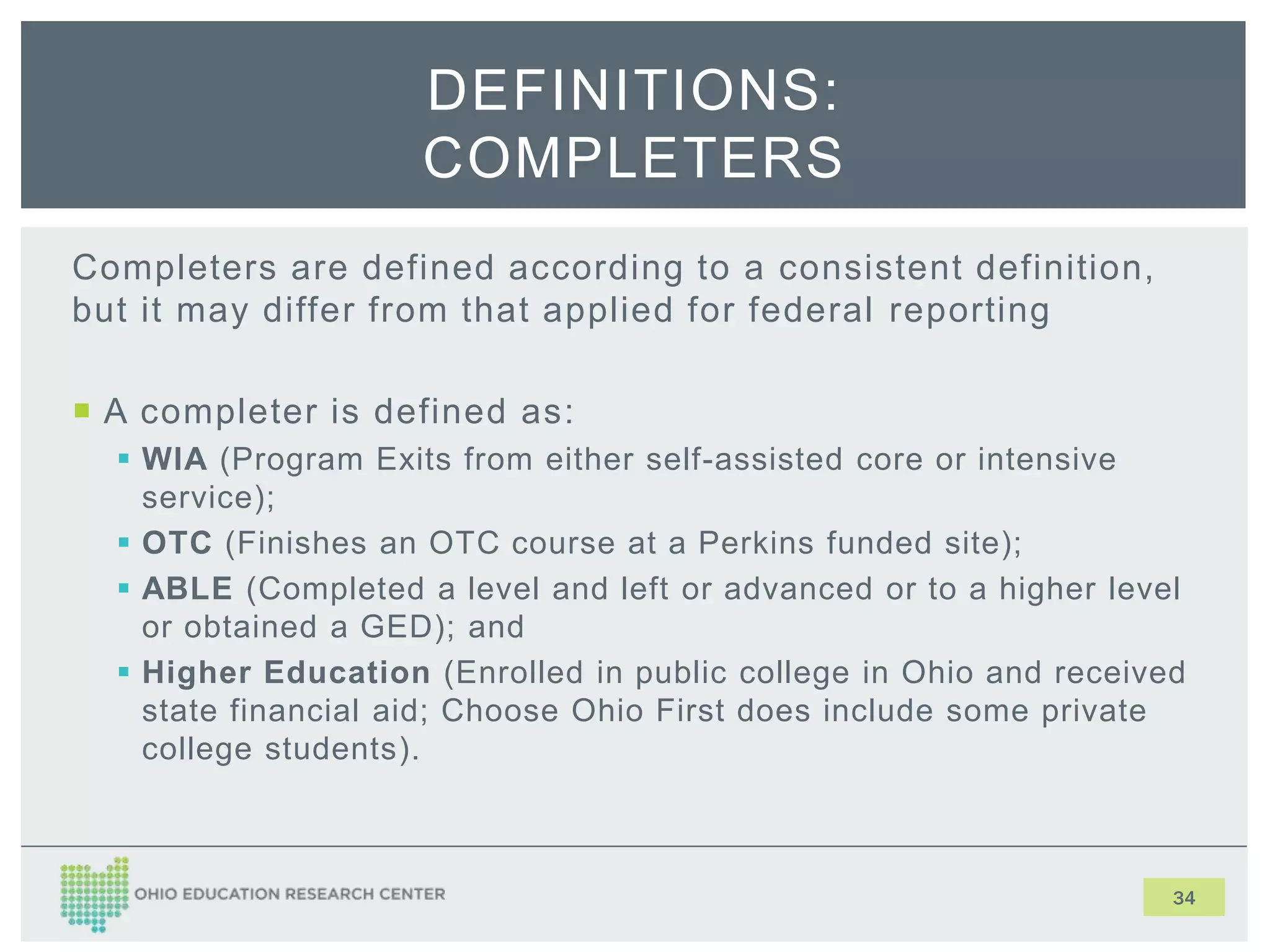
Completers are defined according to a consistent definition,
but it may differ from that applied for federal reporting
 A completer is defined as:
 WIA (Program Exits from either self-assisted core or intensive
service);
 OTC (Finishes an OTC course at a Perkins funded site);
 ABLE (Completed a level and left or advanced or to a higher level
or obtained a GED); and
 Higher Education (Enrolled in public college in Ohio and received
state financial aid; Choose Ohio First does include some private
college students).
34
DEFINITIONS:
COMPLETERS
 Skills Gains
 Higher Ed Enrollment – The percent of completers enrolled in a public
higher education institution in Ohio during each of the 2nd and 4th quarters
post-completion.
 Credentials Earned – The percent of completers who earned an ABLE
GED, a credential from an OTC, or a college degree or certificate during
the completion quarter or at any time up to and including the 4th quarter
post-completion.
 Employment and Wages ($2010)
 The percent of completers employed in Ohio during each of the 2nd and 4th
quarters.
 Retention
 The percent of completers employed during the 2nd quarter post-
completion and working for the same employer during the 4th quarter post-
completion. This is an indicator of employment stability, suggestive of a
successful hire.
35
METRICS
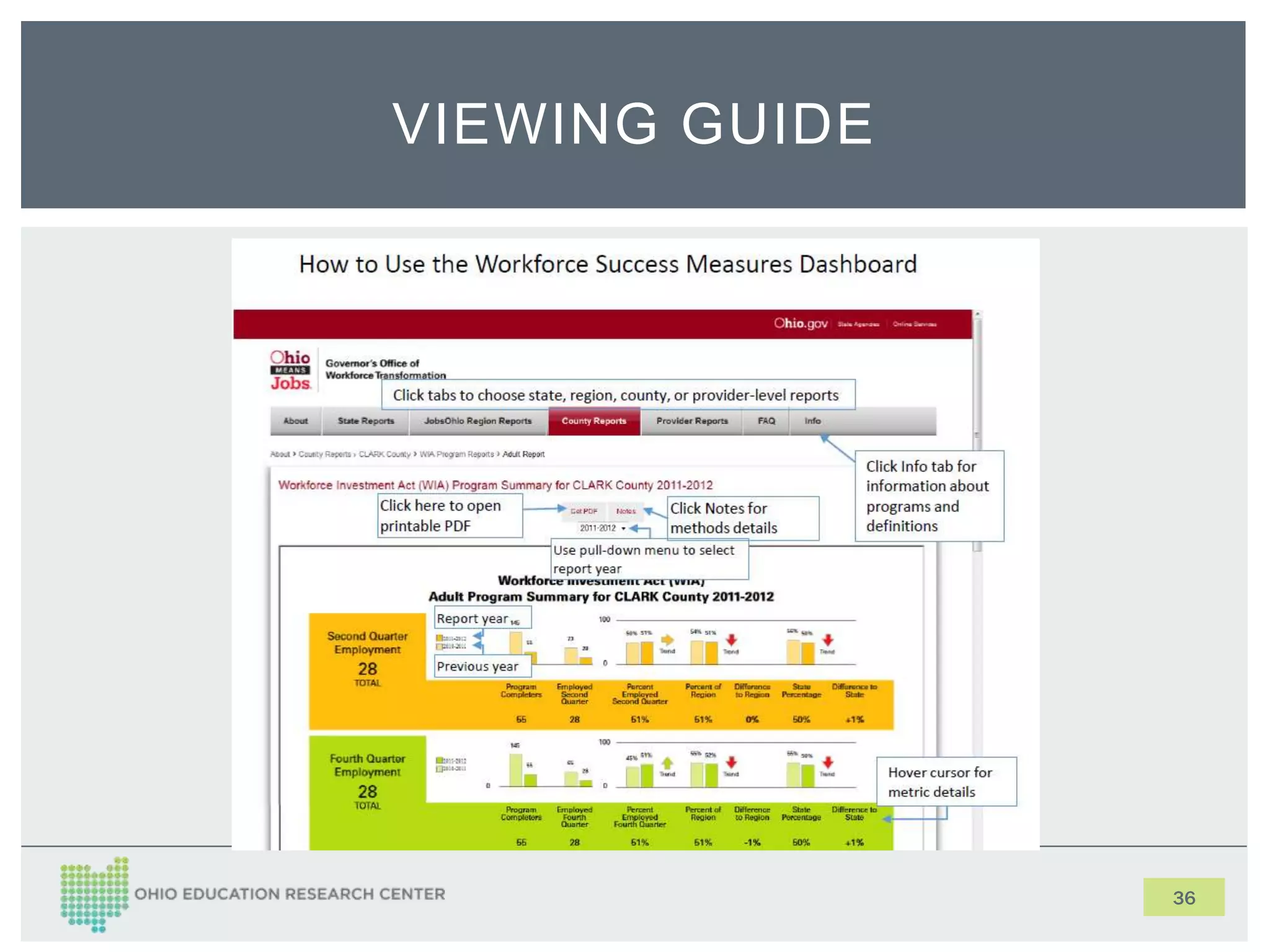
36
VIEWING GUIDE
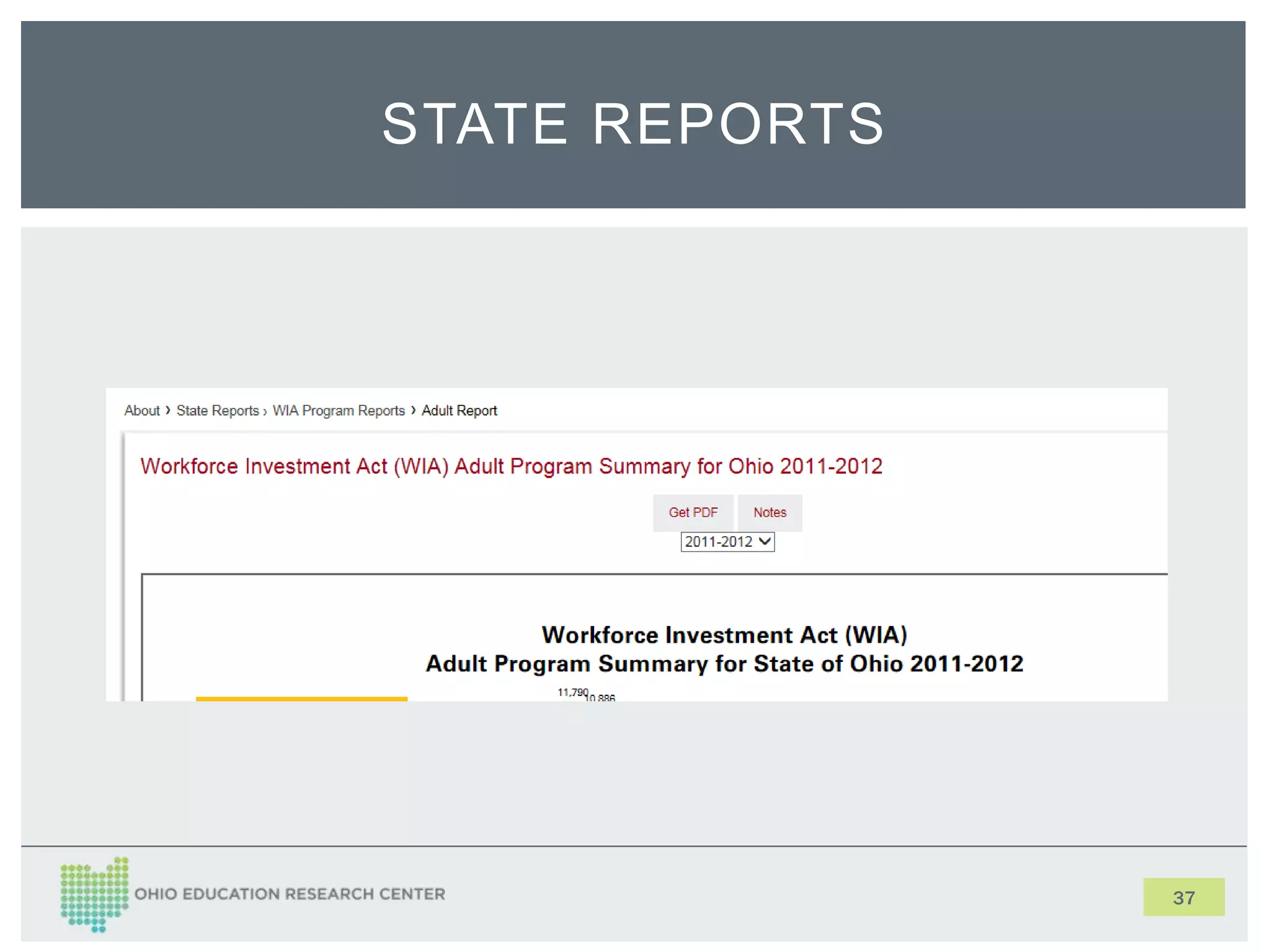
37
STATE REPORTS
38
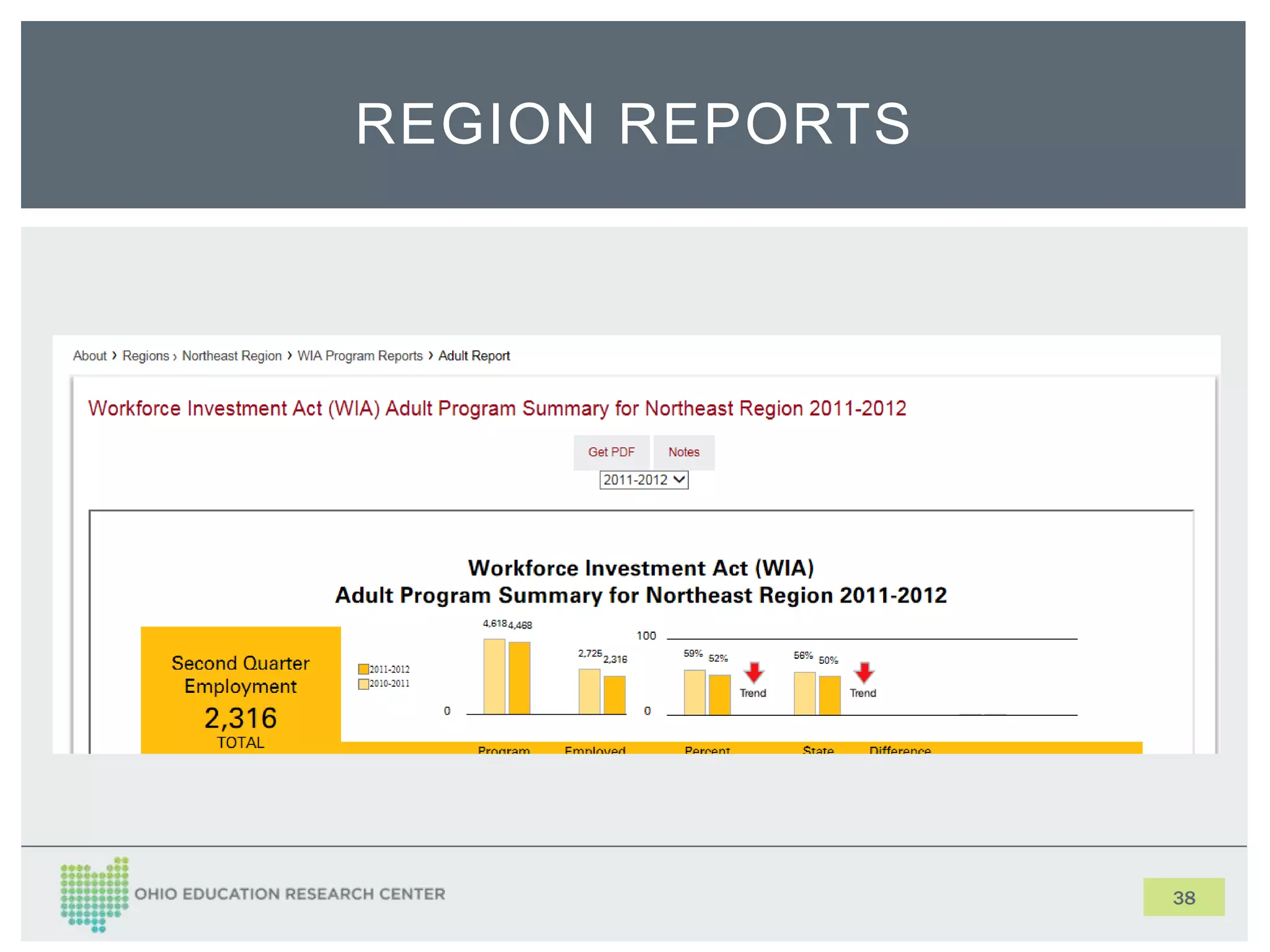
REGION REPORTS
39
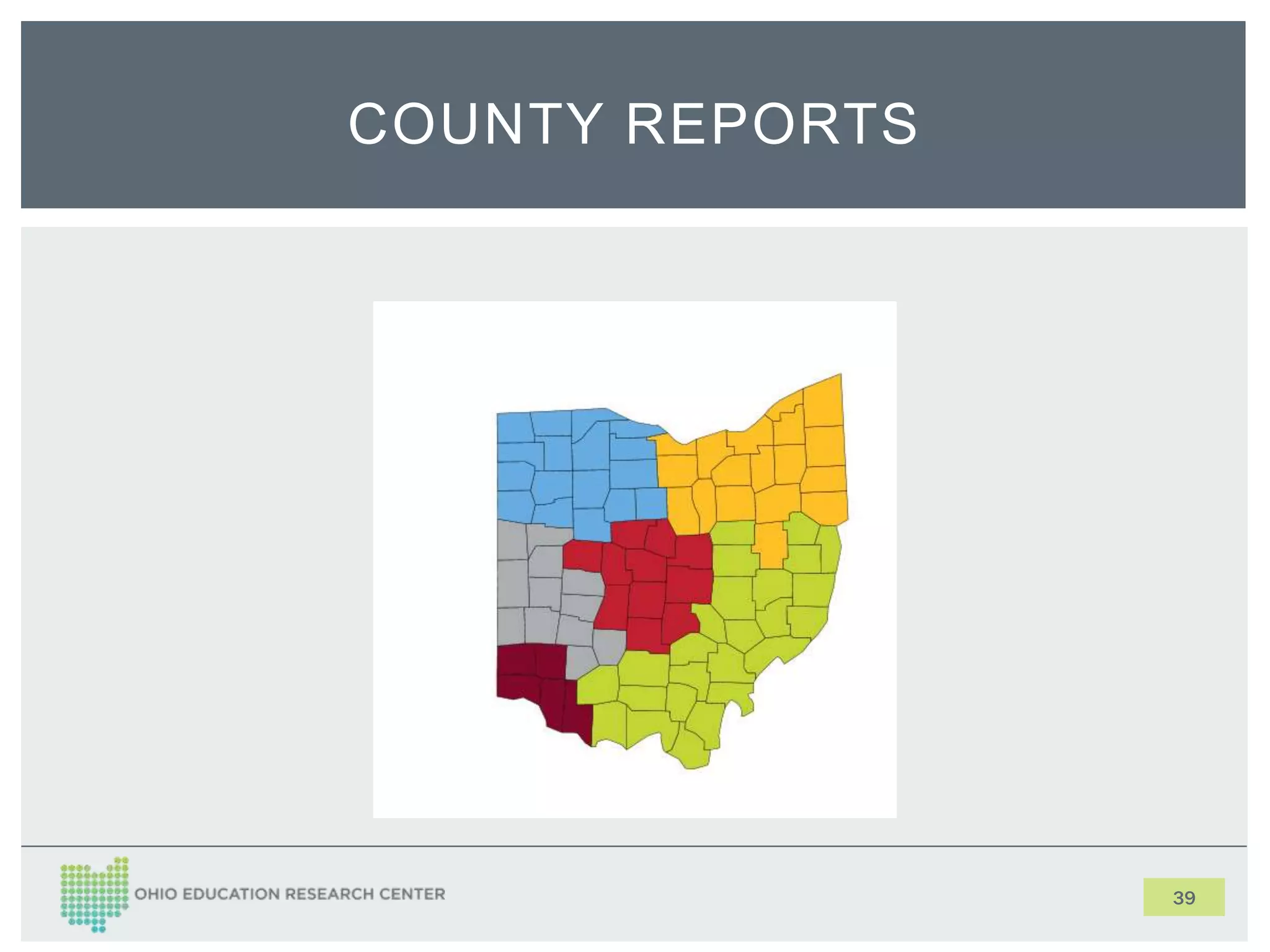
COUNTY REPORTS
40
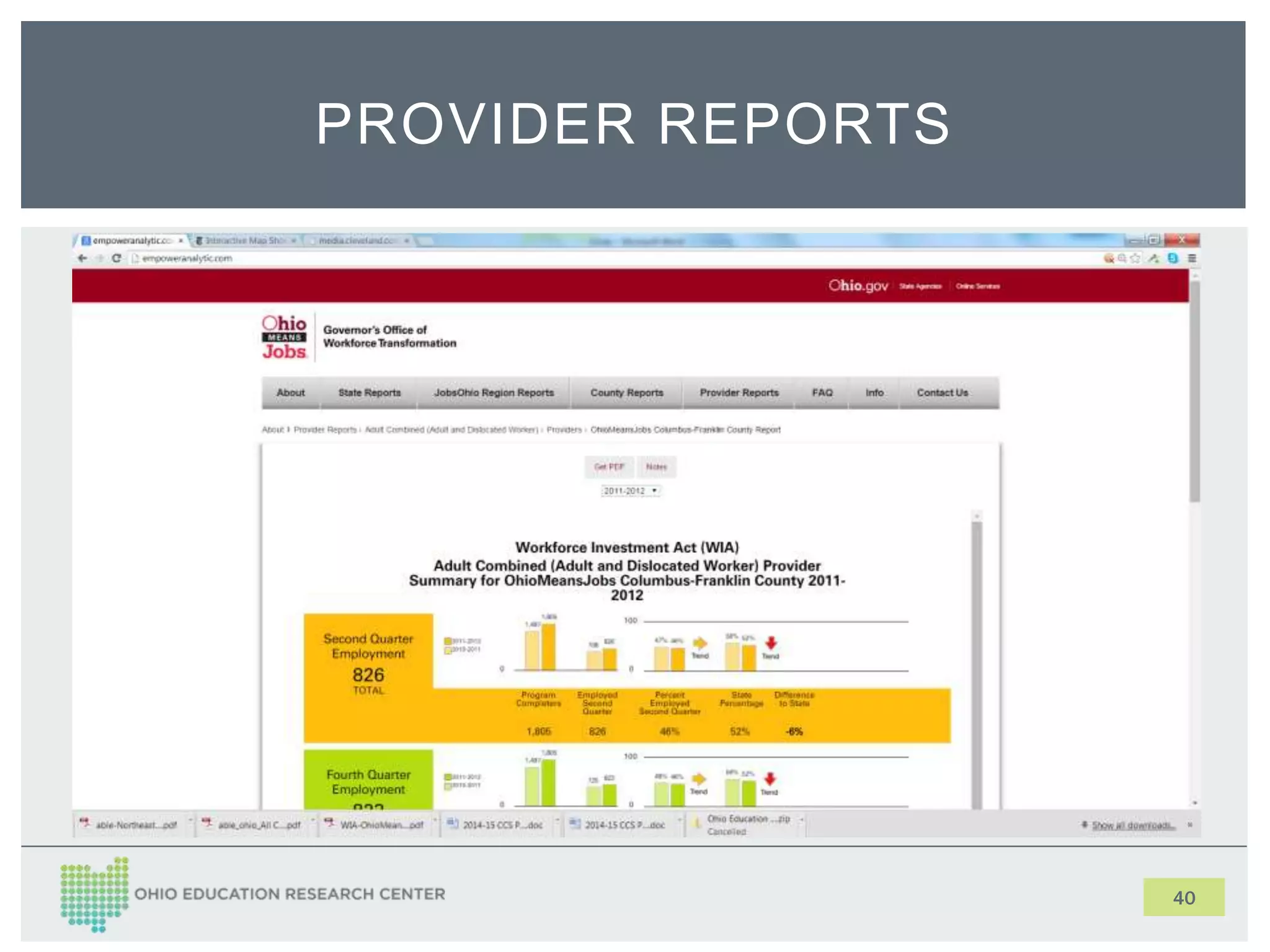
PROVIDER REPORTS
41
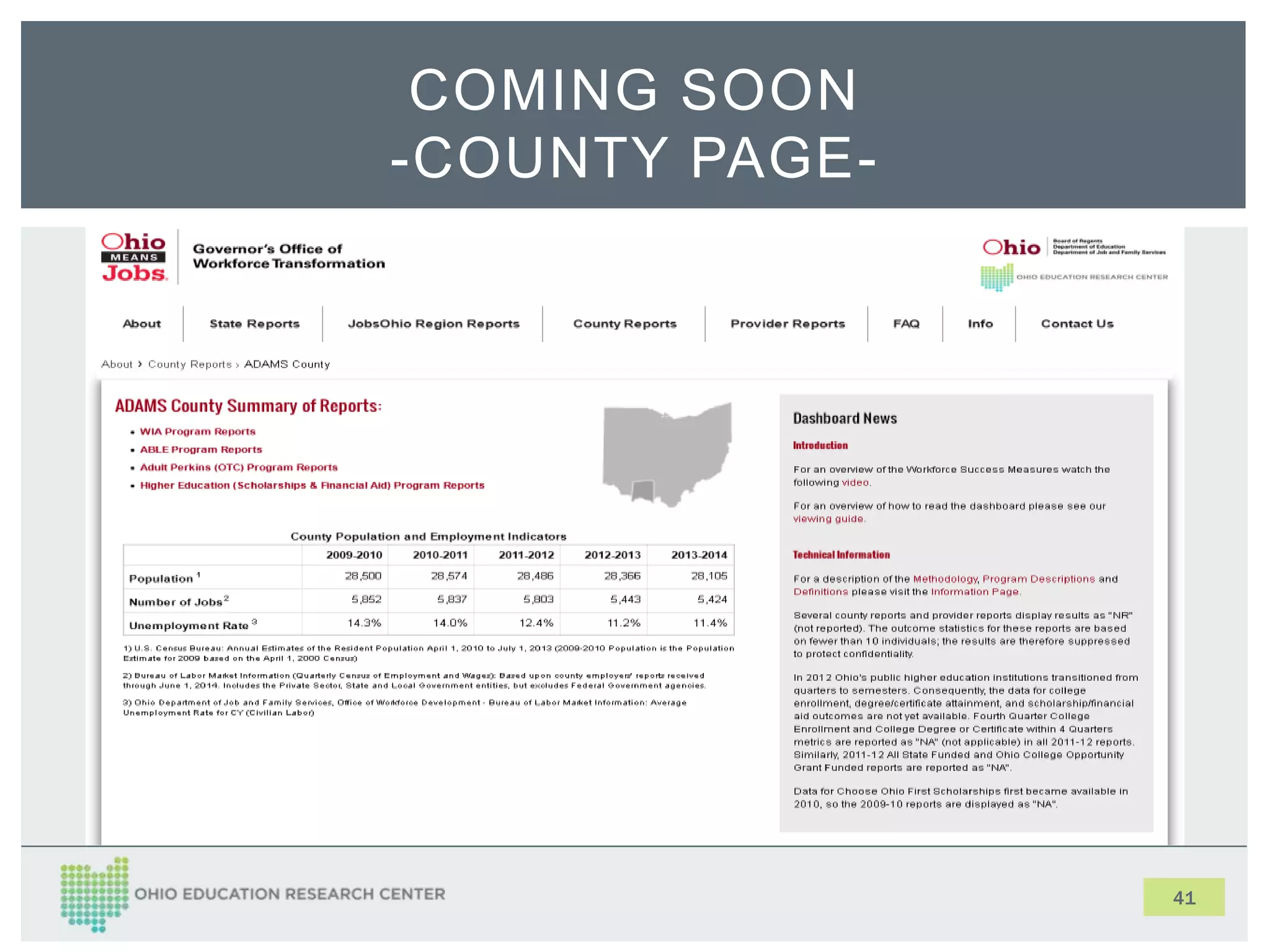
COMING SOON
-COUNTY PAGE-
42
COMING SOON
-COMPARISON TOOL-
 Opportunities for Ohioans with Disabilities
43
NEW AGENCY PARTNERS
44
DATA USES
 To explore our performance on key metrics
 To compare our performance over time
 To understand differences in outcomes between
programs
 To identify programs that we want to learn from
 To set goals on success measures
 Other (up to you)
45
HOW CAN WE USE THIS DATA
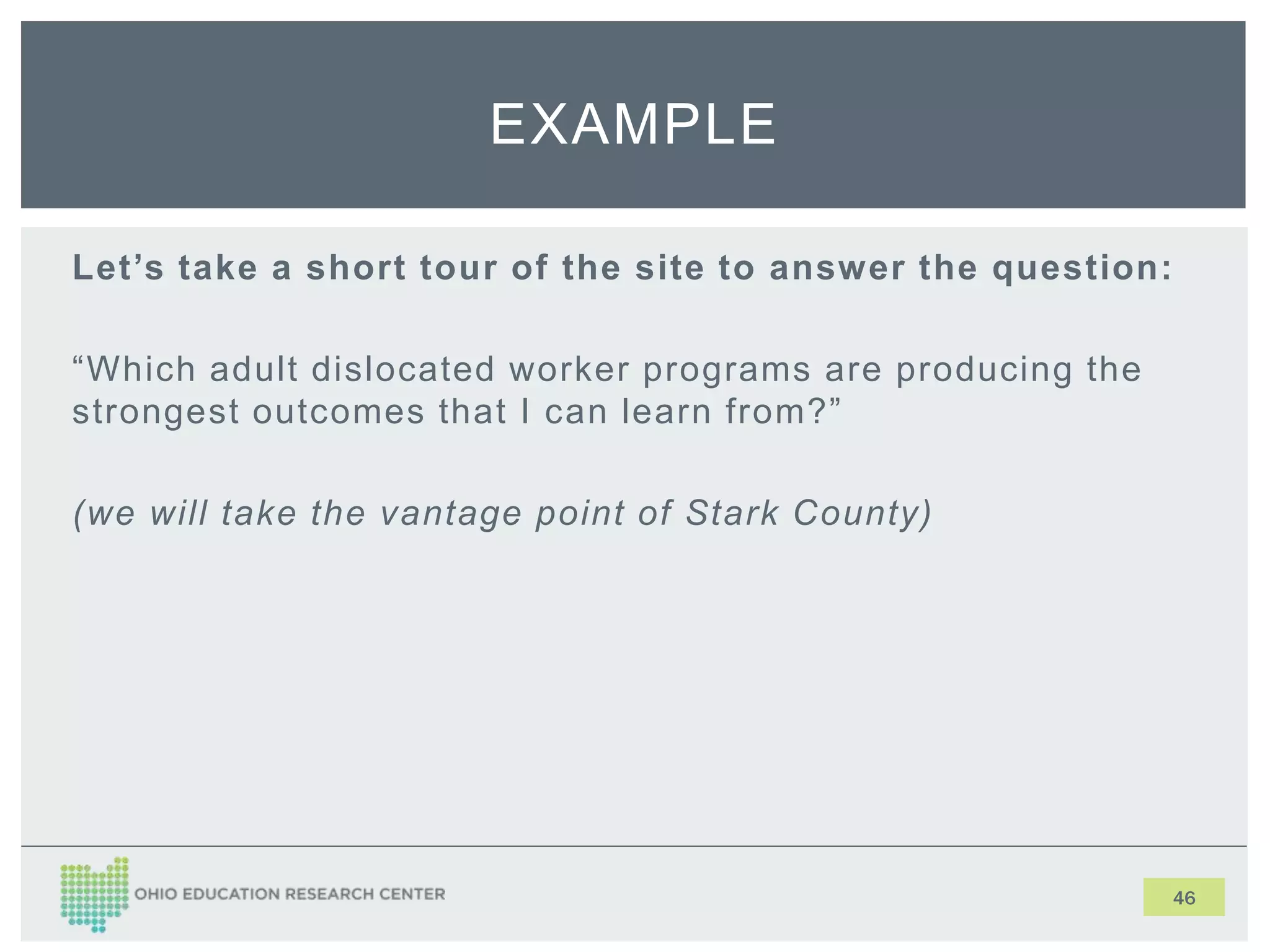
Let’s take a short tour of the site to answer the question:
“Which adult dislocated worker programs are producing the
strongest outcomes that I can learn from?”
(we will take the vantage point of Stark County)
46
EXAMPLE
47
48
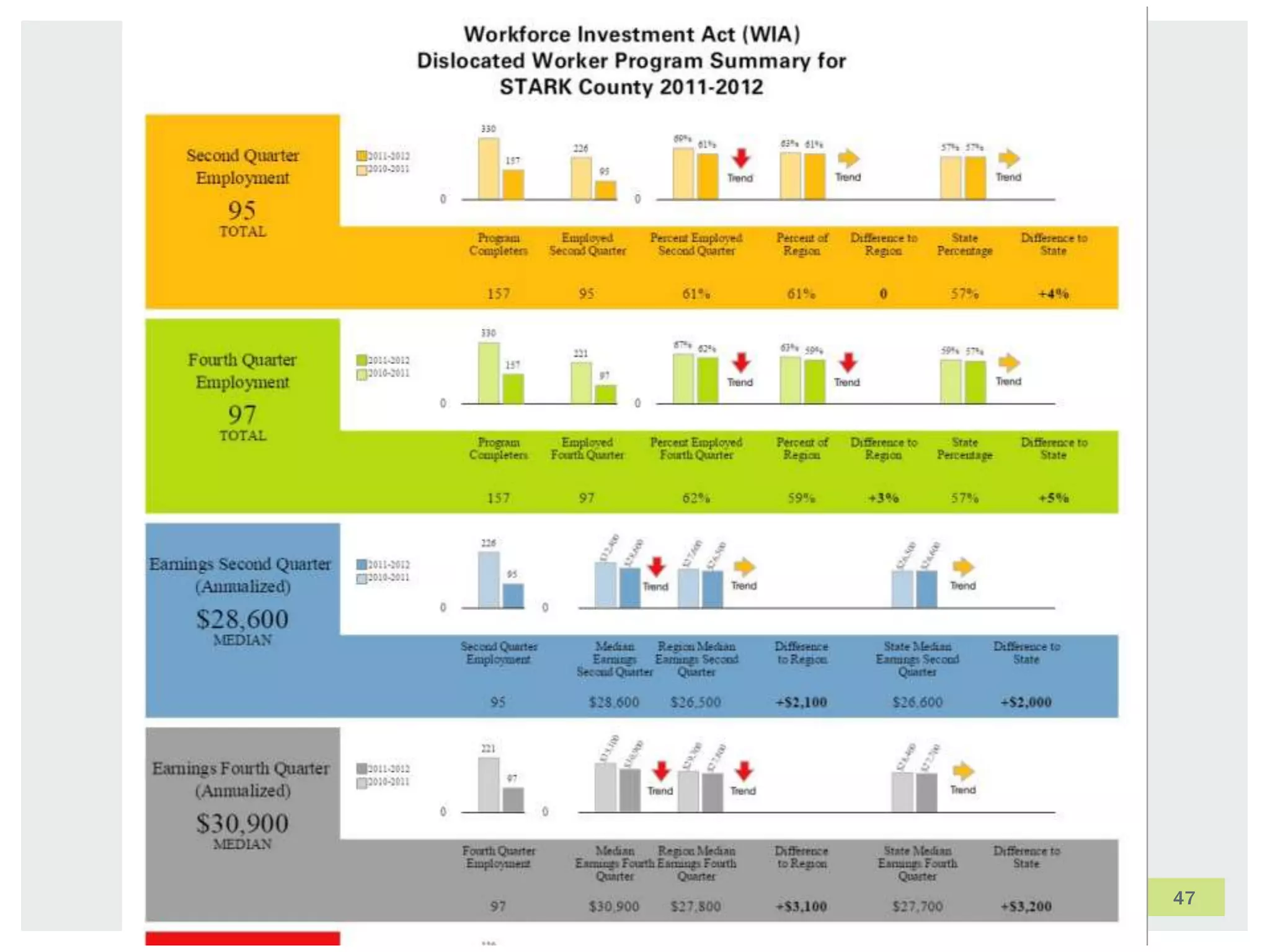
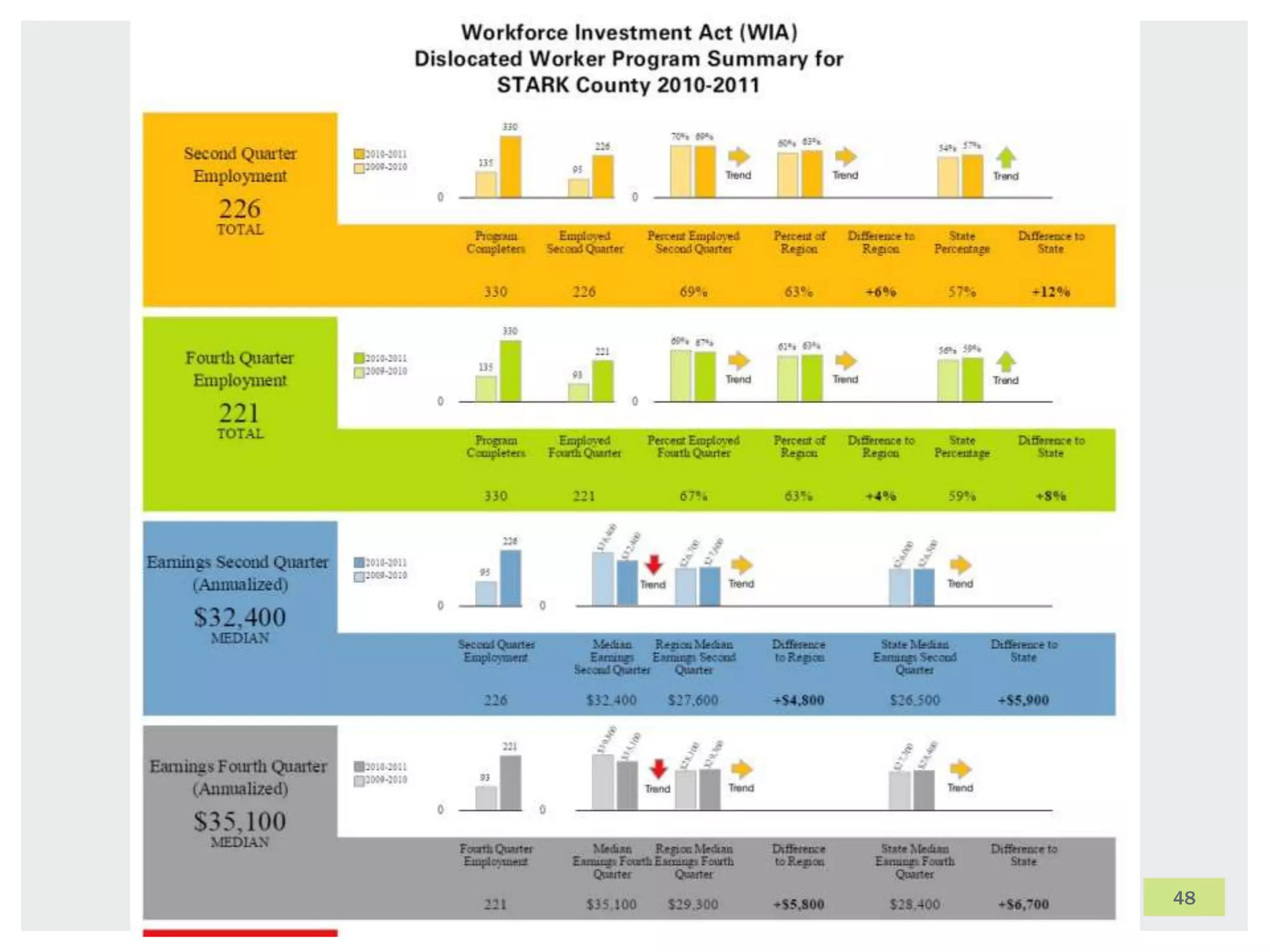
 In 2011-12, numbers are down from 2010-11 (90+ vs. 200+)
 The two and four quarter post completion wage numbers are
also different for the two years (32K vs. 28K)
 What is this telling us?
 The numbers of people using dislocated worker programs varied
over time
 The payoff after 2 and 4 quarters of work differs
 Questions we might ask:
 Are these numbers different from the state or region as a whole?
 How can we use these data?
 What data can we bring to the table that supplements this
information?
49
STARK RESULTS
50
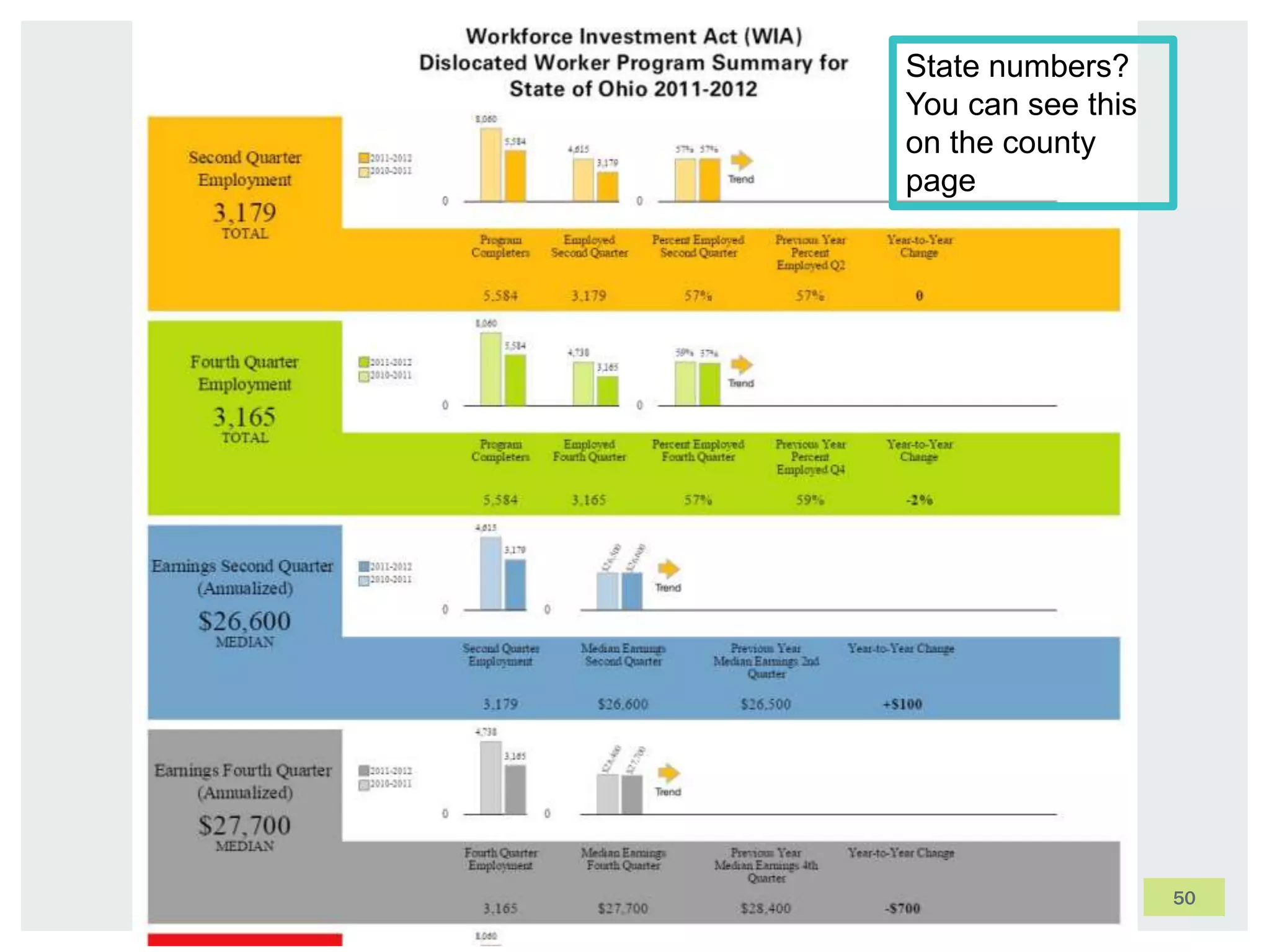
State numbers?
You can see this
on the county
page
51
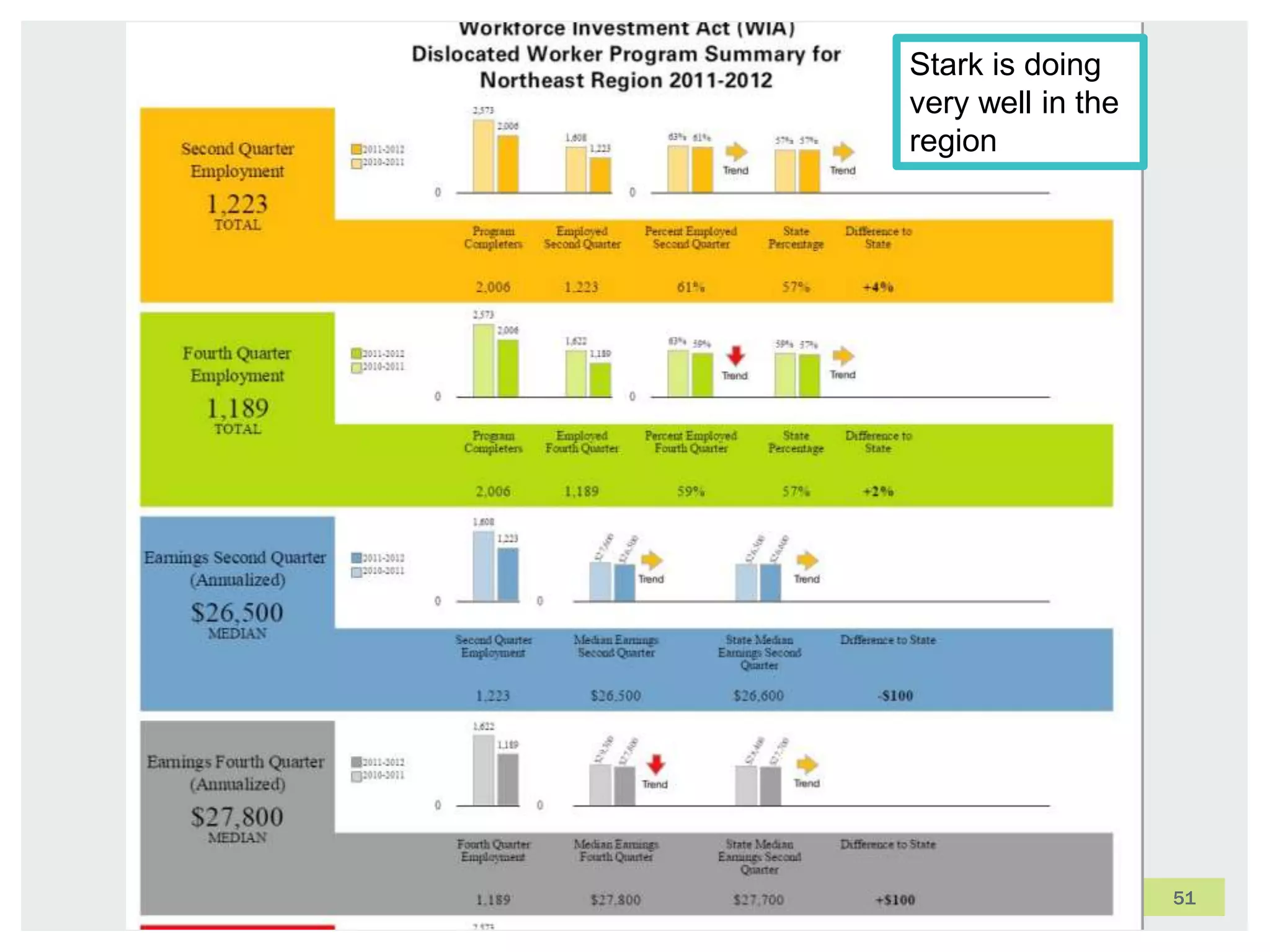
Stark is doing
very well in the
region
 We can pull standardized numbers on key metrics from
dashboard
 Comparison data are available on the site itself
 Counties or regions can use the data in conjunction with
other resources to ask critical questions about impact of
programs are variables of interest.
52
WHAT DID WE LEARN
 Contact: Ohio Analytics at: contact@ohioanalytics.gov for
more information about data we maintain from BOR, ODJFS
and other agencies.
 Follow the Workforce Success Measures at:
http://measures.workforce.ohio.gov/about.aspx
 Higher Ed Data:
http://tinyurl.com/mv7whjq
53
MORE INFORMATION
THANK YOU
QUESTIONS?
HAWLEY.32@OSU.EDU
614-247-8140
connect@oerc.osu.edu | www.oerc.osu.edu

ODJFS Conference Slides

  • 1.
    THE GOVERNOR’S OFFICE OFWORKFORCE TRANSFORMATION: STRATEGIC FRAMEWORK AND THE WORKFORCE SUCCESS MEASURES May 5, 2015 ODJFS Conference Making Research Work for Education
  • 2.
    Dawn Larzelere (Governor’sOffice of Workforce Transformation) Overview of OWT Keith Ewald (Ohio Dept. Of Job and Family Services) Discussion of OhioAnalytics Josh Hawley (Ohio State Univ.) Overview of Workforce Success Measures Coming Soon Additional Agency Partners Data Uses Activity!! 2 AGENDA
  • 3.
    Workforce Success Measures Aproject of the Governor’s Office of Workforce Transformation
  • 4.
    1 2 3 Identify Business Needs Connect Business& Workers Align Training to Business Needs ↓ ↓ ↓ Evaluate Results The Governor’s Office of Workforce Transformation Mission: To grow Ohio’s economy by developing a skilled workforce, promoting efficient training programs, and connecting Ohio employers to the workers they need to succeed.
  • 5.
  • 6.
    196 In-Demand Occupations (matchingto over 17,000 related job titles)
  • 8.
  • 9.
    Industry Workforce Alliances •Business-led dialogue to address specific in- demand jobs and career pathways • Brings together business, education and training, and other stakeholders • Develop innovate solutions to address short- and long-term needs
  • 10.
    Industry Workforce AlliancePartnership Grant Award Recipients Central Ohio: Insurance Industry Resource Council Northeast Ohio: Mahoning Valley Manufacturers Coalition Northwest Ohio: Allen Economic Development Group Southwest Ohio: Partners for a Competitive Workforce Western Ohio: Montgomery County Dept. of Community and Economic Development Southeast Ohio: Appalachian Ohio Health Professions Pathways
  • 11.
  • 13.
    Employer Services atOhioMeansJobs.com • Job Posting • Resume Searching • Employment Programs • Business Support Center Phone: 1-888-385-2588 (Monday – Friday 8am to 4pm) Email: employerassistance@jfs.ohio.gov
  • 14.
    Align Training toBusiness Needs
  • 16.
  • 18.
    Ohio’s Major WorkforcePrograms Three Separate Plans = Siloed, Misaligned Services Job Placement & Career Services Workforce Investment Act Adult Learning & GED Prep Adult Basic & Literacy Education Career & Technical Education Carl D. Perkins
  • 19.
    A Unified Approach Coordinated,Aligned, Seamless Services for Ohioans
  • 20.
    Statewide Policies &Practices Increased Awareness of Workforce Programs Local Planning & Collaboration Common Metrics Require Registration In OhioMeansJobs.com Common In-Take Application Common Case Management System Common Assessment Strategy Increase Access to Job Readiness/Soft Skills Training Increase Access to Career Counseling Increase Access to Remediation & High School Equivalency Local Unified Plan Co-Enrollment Common Reforms
  • 21.
  • 24.
    Contact Information Dawn Larzelere Governor’sOffice of Workforce Transformation 614-466-4208 dawn.larzelere@governor.ohio.gov www.workforce.ohio.gov
  • 25.
     Agencies Partnerships Ohio Longitudinal Data Archive (OLDA)  Advancing Research and Policy Analysis  Brief Review of Data Products. 25 Ohio Analytics: Behind the Scenes of Workforce Success Measures.
  • 26.
    26 Agency Partnerships  OhioAnalyticsis an administrative data partnership supporting education and workforce research priorities of Ohio’s public agencies and the Ohio Education Research Center.  The Mission of Ohio Analytics is to expand research-based knowledge by improving the quality and accessibility of administrative data from Ohio’s public agencies for use in policy and programmatic decision-making.
  • 27.
     Pseudo IDs– De-identification  Cross matching  Archiving – Metadata  Governance 27 Ohio Longitudinal Database Archive
  • 28.
     Partnering withresearch and policy analysis entities  De-identification and Data Access Procedures  Publishing Product Outcomes  Participating in National Forums 28 Advancing Research and Policy Analysis
  • 29.
     Postsecondary Outcomesof an Ohio City School District  Workforce Outcomes of WIA On-the-Job Training in Ohio  Ohio Higher Education Outcome Visualizations http://tinyurl.com/mv7whjq http://tinyurl.com/olnzzrb 29 Brief Review of Data Products
  • 30.
  • 31.
     Priority ofthe Governor’s Executive Workforce Board  State agency working group  National Governor’s Association/National Association of State Workforce Agencies common measures proposal  Engaging the Ohio Education Research Center at OSU  Workforce Opportunity and Innovation Act (WIOA) - signed on July 22, 2014  Development of the dashboard and website 31 BACKGROUND ON WORKFORCE SUCCESS MEASURES
  • 32.
    As presented to the Governor’s Executive Workforce Board “Whatgets measured gets better” 32 PERFORMANCE METRICS Skill Gains • To what extent do education levels increase? •The percentage of participants who have earned a certificate, diploma, GED, degree, licensure or industry recognized credential during participation or within one year of completion. Entered Employment • Do participants get and keep jobs in the short and long term? •The percentage of participants employed in the 2nd quarter after program completion. •The percentage of participants employed in the 4th quarter after program completion. Average Wages • What do participants earn in the short and long term? •Average earnings in the 2nd quarter after program completion. •Average earnings in the 4th quarter after program completion. Business Engagement • Are we meeting the needs of employers? •The percentage of program completers who are still employed with the same employer in the 4th quarter that were also employed during the 2nd quarter after completion.
  • 33.
    Workforce Investment Act Adult,Dislocated, Youth Perkins Programs Ohio Technical Centers (Adult Workforce Education) Higher Education Only state scholarship and financial aid recipients Adult Basic and Literacy Education 33 WORKFORCE PROGRAMS
  • 34.
    Completers are definedaccording to a consistent definition, but it may differ from that applied for federal reporting  A completer is defined as:  WIA (Program Exits from either self-assisted core or intensive service);  OTC (Finishes an OTC course at a Perkins funded site);  ABLE (Completed a level and left or advanced or to a higher level or obtained a GED); and  Higher Education (Enrolled in public college in Ohio and received state financial aid; Choose Ohio First does include some private college students). 34 DEFINITIONS: COMPLETERS
  • 35.
     Skills Gains Higher Ed Enrollment – The percent of completers enrolled in a public higher education institution in Ohio during each of the 2nd and 4th quarters post-completion.  Credentials Earned – The percent of completers who earned an ABLE GED, a credential from an OTC, or a college degree or certificate during the completion quarter or at any time up to and including the 4th quarter post-completion.  Employment and Wages ($2010)  The percent of completers employed in Ohio during each of the 2nd and 4th quarters.  Retention  The percent of completers employed during the 2nd quarter post- completion and working for the same employer during the 4th quarter post- completion. This is an indicator of employment stability, suggestive of a successful hire. 35 METRICS
  • 36.
  • 37.
  • 38.
  • 39.
  • 40.
  • 41.
  • 42.
  • 43.
     Opportunities forOhioans with Disabilities 43 NEW AGENCY PARTNERS
  • 44.
  • 45.
     To exploreour performance on key metrics  To compare our performance over time  To understand differences in outcomes between programs  To identify programs that we want to learn from  To set goals on success measures  Other (up to you) 45 HOW CAN WE USE THIS DATA
  • 46.
    Let’s take ashort tour of the site to answer the question: “Which adult dislocated worker programs are producing the strongest outcomes that I can learn from?” (we will take the vantage point of Stark County) 46 EXAMPLE
  • 47.
  • 48.
  • 49.
     In 2011-12,numbers are down from 2010-11 (90+ vs. 200+)  The two and four quarter post completion wage numbers are also different for the two years (32K vs. 28K)  What is this telling us?  The numbers of people using dislocated worker programs varied over time  The payoff after 2 and 4 quarters of work differs  Questions we might ask:  Are these numbers different from the state or region as a whole?  How can we use these data?  What data can we bring to the table that supplements this information? 49 STARK RESULTS
  • 50.
    50 State numbers? You cansee this on the county page
  • 51.
    51 Stark is doing verywell in the region
  • 52.
     We canpull standardized numbers on key metrics from dashboard  Comparison data are available on the site itself  Counties or regions can use the data in conjunction with other resources to ask critical questions about impact of programs are variables of interest. 52 WHAT DID WE LEARN
  • 53.
     Contact: OhioAnalytics at: contact@ohioanalytics.gov for more information about data we maintain from BOR, ODJFS and other agencies.  Follow the Workforce Success Measures at: http://measures.workforce.ohio.gov/about.aspx  Higher Ed Data: http://tinyurl.com/mv7whjq 53 MORE INFORMATION
  • 54.

Editor's Notes

  • #11 NW: Manuf Southwest Ohio: Distribution and Logistics Western Ohio: Montgomery County Dept. of Community and Economic Development Logistics