1
Related Party Transaction
by
Dipti Mehta
Partner
Company Secretaries
Disclaimer: This presentation is based on my internal research. It is notified that the presenter and any other person related to him shall be responsible
for any damage or loss of any action taken based on this presentation. It is suggested to seek professional advice before initiating any action.
About Us
Mehta & Mehta is leading
Company Secretaries Firm
registered with the Institute of
Company Secretaries of India.
Mehta & Mehta is providing its
services in the field of Companies
Act, Securities & Exchange Board of
India, National Company Law
Tribunal, Insolvency, revival and
closure, Human Resource, Mergers
andAcquisitions,Audits, etc.
2
Coverage
3
4
Companies Act, 2013
 Section 2(76) and 2(77) of the Companies Act, 2013
 Rule 4 of Companies (Specification of definition
details) Rules, 2014
 Section 177, 188 and 189 of the Companies Act, 2013
 Rule 6A, Rule 15 and Rule 16 of Companies
(Meetings) of Boards and its Powers) Rules, 2014
 Companies (Amendment) Bill, 2016
 Form MBP-4
 Disclosure in Board Report.
5
Who is a Related Party? [Section 2(76)]
(1/2)
Directors and KMPs
including their relatives
A firm in which a director,
manager and their relative
Director (excluding IDs) or
KMPs of holding company
and their relative
Private company in which a
director or manager or his
relative is a member or
director
Related
Party
6
Who is a Related Party? [Section 2(76)]
(2/2)
Public company in which a
director or manager is a director
and holds along with his
relatives, more than 2% of its
paid-up share capital
body corporate Board, MD or
manager is accustomed to act in
accordance with the advice of a
director or manager
any person on whose advice,
directions or instructions a
director or manager is
accustomed to act
company which is—
(A) a H / S / AC of such company;
or (B) subsidiary of holding
company to which it is
subsidiary*
Related
Party
*does not apply to a private company.
7
Relative [Section 2(77)]
read with Rule 4 of Chapter I Rules
 Members of HUF;
 Spouse;
 Father – including step-father;
 Mother – including step-mother;
 Son – including step-son;
 Son’s wife;
 Daughter;
 Daughter’s husband;
 Brother – including step-brother;
 Sister – including step-sister.
8
Who is not a related party?
 Directors and Key Managerial Personnel(s) of joint
venture and associate companies;
 Directors holding less than 2% in public companies;
 A person appointed as a senior managerial
personnel in
 the company;
 its holding company;
 its subsidiary company;
 its associate company.
9
Removal of dilemmas
 Previously, public companies having common
directors would be treated as related party to each
other.
 This was definitely not the intent of law.
 Therefore by way of Companies (Removal of
Difficulties) Fifth Order, 2014 – the lacuna was
removed by use of word **and** instead of **or**;
 Now Section 2(77)(v)reads:
 public company in which a director or manager is a
director and holds along with his relatives, more than
two percent of its paid-up share capital.
10
What are related party transactions?
Under section 188 of the Act
A
• Sale, purchase or supply of any goods or materials;
B
• Selling or otherwise disposing of, or buying, property of any kind;
C
• Leasing of property of any kind;
D
• Availing or rendering of any services;
E
• Appointment of any agent for purchase or sale of goods, materials, services or
property;
F
• Underwriting the subscription of any securities or derivatives thereof, of the
company;
G
• Such related party's appointment to any office or place of profit in the company, its
subsidiary company or associate company.
11
Members’ Approval – Ordinary Resolution
 Incase if the transactions exceed the following threshold,
members approval by way of ordinary resolution is desirous:
Sale, purchase or supply of any goods or materials directly or
through appointment of agents
10% of Annual turnover or Rs.
100 crore, w.e. lower
Selling or otherwise disposing of, or buying, property of any kind
directly or through appointment of age
10% of net worth or Rs. 100
crore; lower one
Leasing of property of any kind 10% of net worth or 10% of
turnover or Rs. 100, lower one
Availing or rendering any services directly or through appointment
of agents
10% of net worth or Rs. 50
crore; lower one
Appointment to any place of profit in the company, its subsidiary
or its associate at a monthly remuneration
Rs. 2.5 lakh
Remuneration for underwriting the subscription of any securities
or derivatives thereof of the company
1% of net worth
12
Office or place of profit
 Means any office or place—
 Where such office or place is held by a director:
 he receives from the company anything by way of
remuneration over and above remuneration to which he is
entitled as director,
 by way of salary, fee, commission, perquisites, any rent-free
accommodation, or otherwise.
 Where such office or place is held by an individual
other than a director (relative) or by any firm, private
company or other body corporate:
 it receives from the company anything by way of
remuneration, salary, fee, commission, perquisites, any
rent-free accommodation, or otherwise.
13
Arms’ Length Basis
 Any transaction entered into ordinary course of
business or on arm’s length basis shall not require
any approval of the Board or of members of
company;
 approval of Audit Committee shall still be necessitated;
 “Arm’s length” transaction should mean a
transaction between two related parties that is
conducted as if they were unrelated, without any
conflict of interest;
 Also, the word used is arm’s length basis and not arm’s
length price.
14
What is ordinary course of business?
 Ordinary course of business will not cover what is the object of
the company as defined in memorandum of association.
 As per general understanding, “ordinary course of business” will
cover the usual / routine transactions, customs and practices of
a business and of a company.
 Reference may be drawn to the judicial interpretation of the
term “ordinary course of business”, whereby the Allahabad
court in its ruling in the case of Kalapnath Singh vs. Surajpal
Singh and others [AIR 1949 ALL 425] has given interpretation
to term like ‘regular course of business’; ‘common course of
business’; ‘usual course of business’.
15
Omnibus Approval by Audit Committee
Rule 6A
(1/3)
 Audit Committee has been allowed with the power of
granting omnibus approval.
 The criteria shall include:
 maximum value of the transactions which can be allowed
under the omnibus route in a year;
 Maximum value per transaction which can be allowed
 Review, at such intervals as the audit committee may
deem fit, related party transaction entered into by the
company pursuant to each of the omnibus approval made
 Transactions which cannot be subject to the omnibus
approval by the audit committee
16
Omnibus Approval by Audit Committee
Rule 6A
(2/3)
 Care to be taken by Committee of the following:
 Name of the related parties;
 Nature and duration of the transaction;
 Maximum amount of transaction that can be entered into;
 Indicative base price or current contracted price and the
formula for variation in the price, if any;
 Any other information relevant to take a decision on the
proposed transaction.
17
Omnibus Approval by Audit Committee
Rule 6A
(3/3)
 The accorded omnibus approval is valid for one
financial year;
 Fresh approval shall be required after expiry of the
financial year
 Omnibus approval cannot be granted for selling of or
disposing of undertaking of the company.
 For transactions of unforeseen nature, the approval
shall be granted for transactions not exceeding Rs. 1
crore per transactions.
18
Sequence of approvals
 Contract in ordinary course of business and on arm’s length
basis
 Audit committee approval only
 has to be prior approval
 omnibus approval may be granted
 Either / neither in ordinary course or / nor arms length
 prior recommendation by audit committee
 Approval of Board of directors necessitated
 Shareholders approval incase it exceeds threshold
 If prior approval of Board of Directors or shareholders is not
obtained
 Needs to be ratified within 3 months from the date of
transactions.
19
Food for thought !!!
Q. A is a member of company X Ltd, and is also a related party to X Ltd. In this scenario,
can A vote on the resolution to be passed by X Ltd for entering into a RPT?
Q. Incase of a wholly owned subsidiary, which company will be required to pass ordinary
resolution under section 188 of the Act?
Q. Has the Act prescribed any criteria for determining the conditions pertaining to arm’s
length basis?
Q. Are the directors of the company liable to indemnify incase of any loss suffered by
the company for matters pertaining to RPTs?
Q. Will giving of loan, guarantee or security from holding company to subsidiary
company come under the purview of related party transactions?
20
Food for thought !!!
Q. A is a member of company X Ltd, and is also a related party to X Ltd. In this scenario,
can A vote on the resolution to be passed by X Ltd for entering into a RPT?
Answer:
Mr. A cannot note on such a resolution in compliance with the second proviso of section
188(1) of the Act.
However, other related parties who are not interested in the said contract may vote on
such resolution.The same was clarified in MCA circular dated July 17, 2014.
Q. Incase of a wholly owned subsidiary, which company will be required to pass ordinary
resolution under section 188 of the Act?
Answer:
Neither the holding company nor the subsidiary company will be required to pass the
resolution of members if:
a. Accounts of wholly owned subsidiary are consolidated with holding company;
b. and the said consolidated accounts are laid before members in the general meeting.
The said relaxation was provided upon enactment of Companies (Amendment) Act, 2015.
21
Food for thought !!! (Continued)
Q. Has the Act prescribed any criteria for determining the conditions pertaining to arm’s
length basis?
Answer: NO.
The 2013 Act is silent. Therefore, it is subjective upon the Board of the company as the
decision vests with them.
Q. Are the directors of the company liable to indemnify incase of any loss suffered by
the company for matters pertaining to RPTs?
Answer: Yes. Any RPT(s) entered into by a company without approval of Board or
shareholders, shall be ratified within 3 months of entering into such RTP(s). If not:
•the RPT shall become voidable at the instance of the Board; and
•if the same is with any director, or is authorised by any other director,
•the director(s) concerned shall be required to indemnify the company against any loss
incurred by it.
•the company has power to initiate any proceeding against director or employee who
has entered into such contract or arrangement.
•In terms of section 164, he shall be disqualified for appointment as a director of any other
company for 5 years.
22
Food for thought !!! (Continued)
Q. Will giving of loan, guarantee or security from holding company to subsidiary
company come under the purview of related party transactions?
Answer: NO.
 The Act draws a clear demarcation between financial nature transactions and business
nature transactions w.r.t. related party transactions.
 Section 188 deals with business nature transactions and approval board by way of board
resolution and / or members is desirous.
 However financial nature transactions are not covered under the ambit of section 188 and
therefore the board approval and shareholders are not mandated.
 However, audit committee approval will be mandated irrespective of the transaction
involved.
 However, there are different sections that deal with approvals for extension of loan /
guarantee / security, etc.
23
Disclosure in Board’s Report
 As per s. 188(2), the BoD shall be required to disclose
in their report desired information w.r.t. related party
transactions;
 S. 134(3)(h) mandates disclosure in relating to related
party transactions Form AOC-2;
 Form AOC-2 has been bifurcated into the following:
 contracts of contracts or arrangements not on arm’s
length basis;
 material contracts or arrangements on arm’s length basis.
 Form AOC-2 shall be signed by the same persons who
has signed the Board’s Report.
24
Non compliance of s. 188
 Punishment for violation of provisions of the section
 Any director or employee of listed company
 Imprisonment extending to 1 year or
 Fine Rs. 25,000 – Rs. 5 lakhs or with both
 Any director or employee of other company
 Fine Rs. 25,000 – Rs. 5 lakhs
 Penalty on any director or employee who enters into
or authorizes the contract in contravention of
provisions of the section
 Punishment levied even if no loss has been incurred
by Company from such RPT.
25
Role of Audit Committee
 Under s. 177 of the Act the committee shall have:
 Minimum 3 directors with the majority of independent directors
 majority of members of Audit Committee including its Chairperson shall be
persons with the ability to read and understand financial statements.
 Audit Committee proves significant in Related Party
Transactions. It is responsible for assessing the
modifications in the Accounting Policies and practices
adopted by the Company.
 It must monitor Company’s policies that are not in
accordance with the Accounting Standards issued by ICAI
and the reasons for their inconsistency with such standards.
 Audit Committee may grant omnibus approval for related
party transactions subject to certain conditions.
26
27
Companies (Amendment) Bill, 2016
In Nutshell !!
 RPT has been the hotbed for legislative action:
 RoD orders were notified amending the definition in s. 2(76)
 Companies (Amendment)Act, 2015
 Ordinary resolution against special resolution
 Omnibus approval by audit committee
 The new bill proposes
 Definition becomes commutative as now it includes an investing company
and venturer of a company.
 Process of ratification of contracts by audit committee under sec 177 (4) (iv);
puts focus on contracts not covered by sec. 188.
 Restricts all related parties from voting to a contact against the current
position wherein only the party related to the contract is abstained from
voting.
28
Prior approval by Audit Committee
 Current law does not require prior approval of AC:
 But omnibus approval insertion seemed to suggest that
transaction needs prior approval.
 Now the Bill:
 provides for provision of ratification;
 Also provides AC the power to avoid transactions not pre
approved.
 This makes the picture clear that no prior approval is
required.
29
Transactions other than s. 188 transactions
 Audit committee to recommend transactions to Board other than
that covered in s. 188:
 This creates a new board reference point altogether
 Existing law – transactions not covered by sec. 188 are not required to
go to the board at all
 They come to the audit committee
 Audit committee may approve
 May disapprove
 There was no scope for the board to approve something not approved
by the audit committee
 In matters of RPTs, for logical reasons, audit committee had the upper hand.
 The proposed amendment:
 Widens the scope of board, including transactions not covered in s. 188,
if not approved by the board.
 Seems to suggest that the board may even approve transactions not
approved by audit committee.
30
Transactions other than s. 188 –WoS
perspective31
 New proviso proposes for exemption of transactions not
covered by s. 188, if entered withWoS.
 Interestingly:
 LODR completely exempts transactions withWoS;
 S. 188 provides for exemption from shareholders approval for
transactions withWoS;
 Transactions not covered by s. 188 are financial
transactions; may involve substantial movement of
resources.
 Exemption from audit committee approval may not be
proper
Amendment in s. 188
32
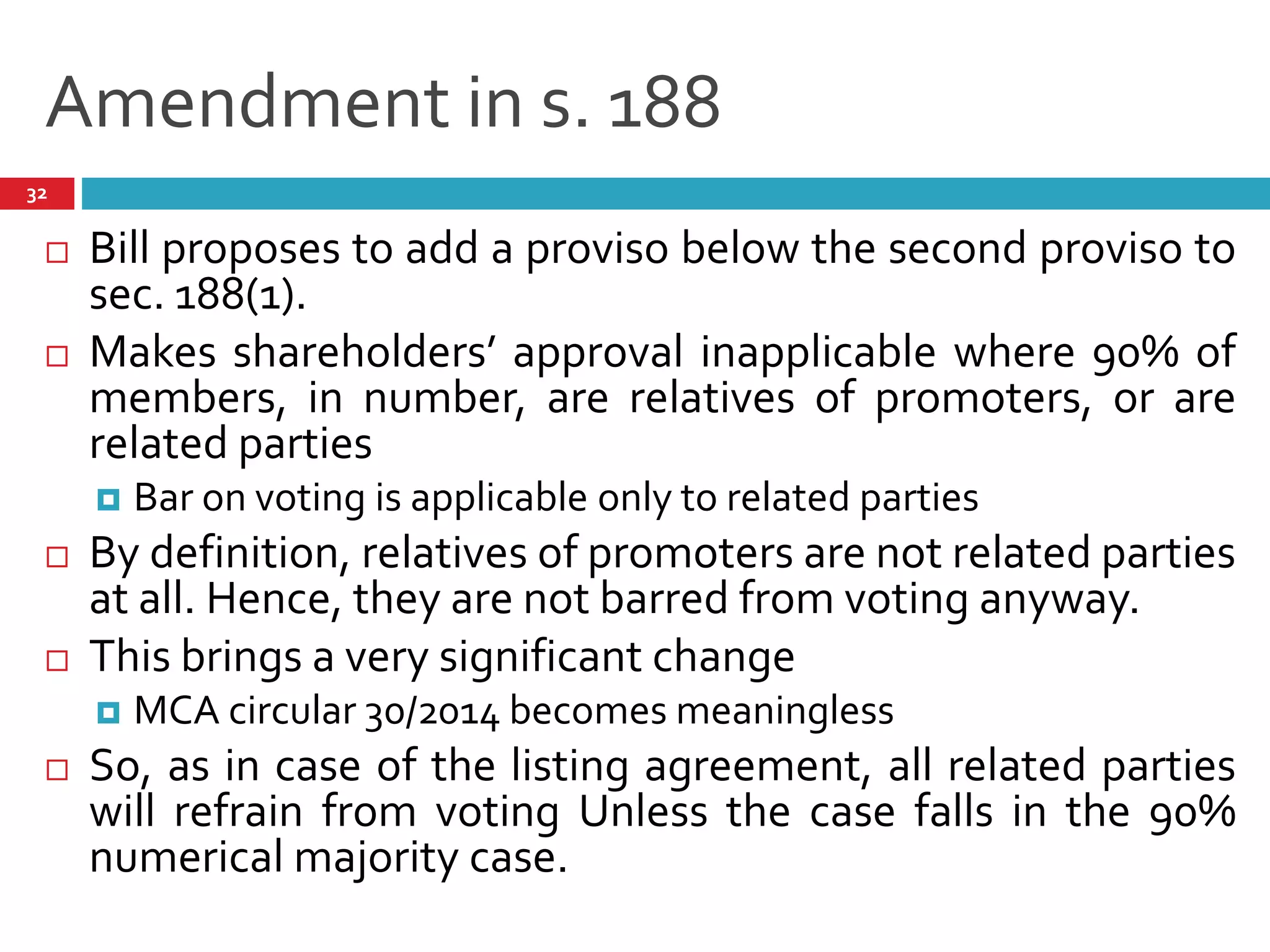
 Bill proposes to add a proviso below the second proviso to
sec. 188(1).
 Makes shareholders’ approval inapplicable where 90% of
members, in number, are relatives of promoters, or are
related parties
 Bar on voting is applicable only to related parties
 By definition, relatives of promoters are not related parties
at all. Hence, they are not barred from voting anyway.
 This brings a very significant change
 MCA circular 30/2014 becomes meaningless
 So, as in case of the listing agreement, all related parties
will refrain from voting Unless the case falls in the 90%
numerical majority case.
33
Secretarial Standard 1: Board Meetings
 Director shall not be reckoned for quorum in respect
of an item in which he is interested and
 He shall not be present during discussions and voting on
such item.
 Section 184(2) and Rule 15 of MBP Rules also talks about the
same
 In case of all the directors are interested
 To be decided at general meeting
 In general meeting voting entitlement shall be decided in
terms of Section 188 and SS-2
34
Secretarial Standard 2: General Meetings
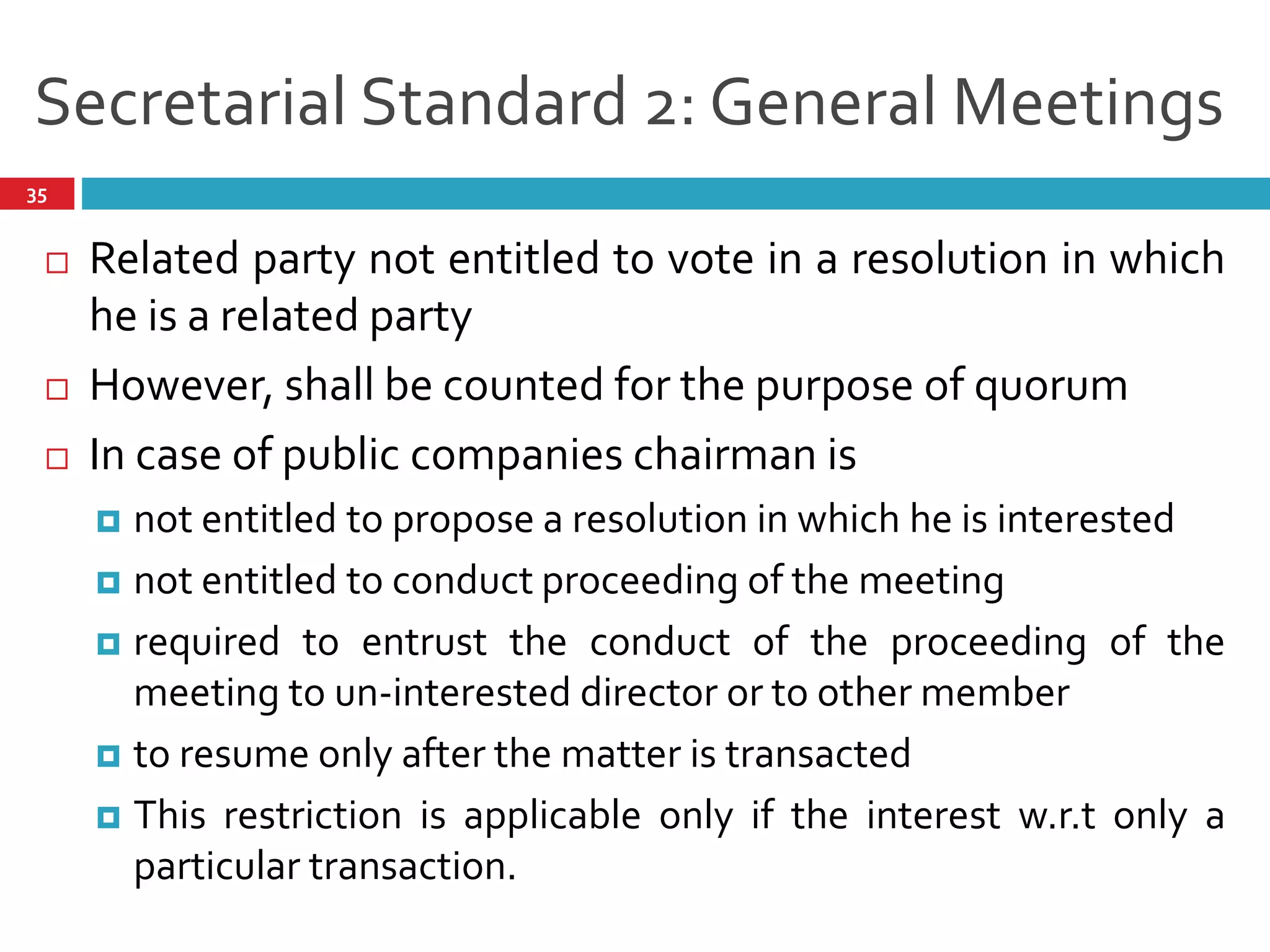
 Related party not entitled to vote in a resolution in which
he is a related party
 However, shall be counted for the purpose of quorum
 In case of public companies chairman is
 not entitled to propose a resolution in which he is interested
 not entitled to conduct proceeding of the meeting
 required to entrust the conduct of the proceeding of the
meeting to un-interested director or to other member
 to resume only after the matter is transacted
 This restriction is applicable only if the interest w.r.t only a
particular transaction.
35
Coverage
36
SEBI (LODR) Regulations, 2015
 Regulation 2(1)(zb) and 2(1)(zc)
 Regulation 23
 Schedule II
 Policy of Related PartyTransactions
 Corporate Governance Report provisions
 Omnibus Approval under LODR
37
Related Party and Related PartyTransactions
38
 Regulation 2(1)(zb):
 related party means a related party as defined under
 section 2(76) of Companies Act, 2013;
 under the applicable accounting standards.
 Regulation 2(1)(zc):
 “related party transaction” means transfer of
 resources
 services
 obligations
 between a listed entity and a related party
 regardless of whether a price is charged or not.
Regulation 23 – in brief
39
 Listed entity to formulate a policy on “materiality” and on dealing with
RPT
 Material RPT
 transaction during FY exceeds 10% of annual consolidated turnover
 All RPT shall require prior approval of the audit committee
 Audit committee may grant omnibus approval
 Quarterly review of RPTs pursuant to omnibus approval
 Resolution valid for 1 year
 Material RPT shall require approval of shareholders
 By way of ordinary resolution
 All related party are abstained from voting
 Exceptions
 transactions entered into between two government companies;
 transactions entered into between a holding company and its wholly owned
subsidiary whose accounts are consolidated with holding company and
placed before the shareholders at the general meeting for approval.
Omnibus Approval under LODR
40
 Audit Committee is authorised:
 to lay the criteria for accord of omnibus approval in sync
with RPT policy
 approval by Audit committee shall be for transactions
which are repetitive in nature
 Audit Committee shall
 satisfy itself that there is need of granting such omnibus
approval;
 review the omnibus approvals on quarterly basis
 Such omnibus approval is valid for 1 year
 as year is not defined
 as per General ClauseAct, it shall be calendar year.
Corporate Governance
41
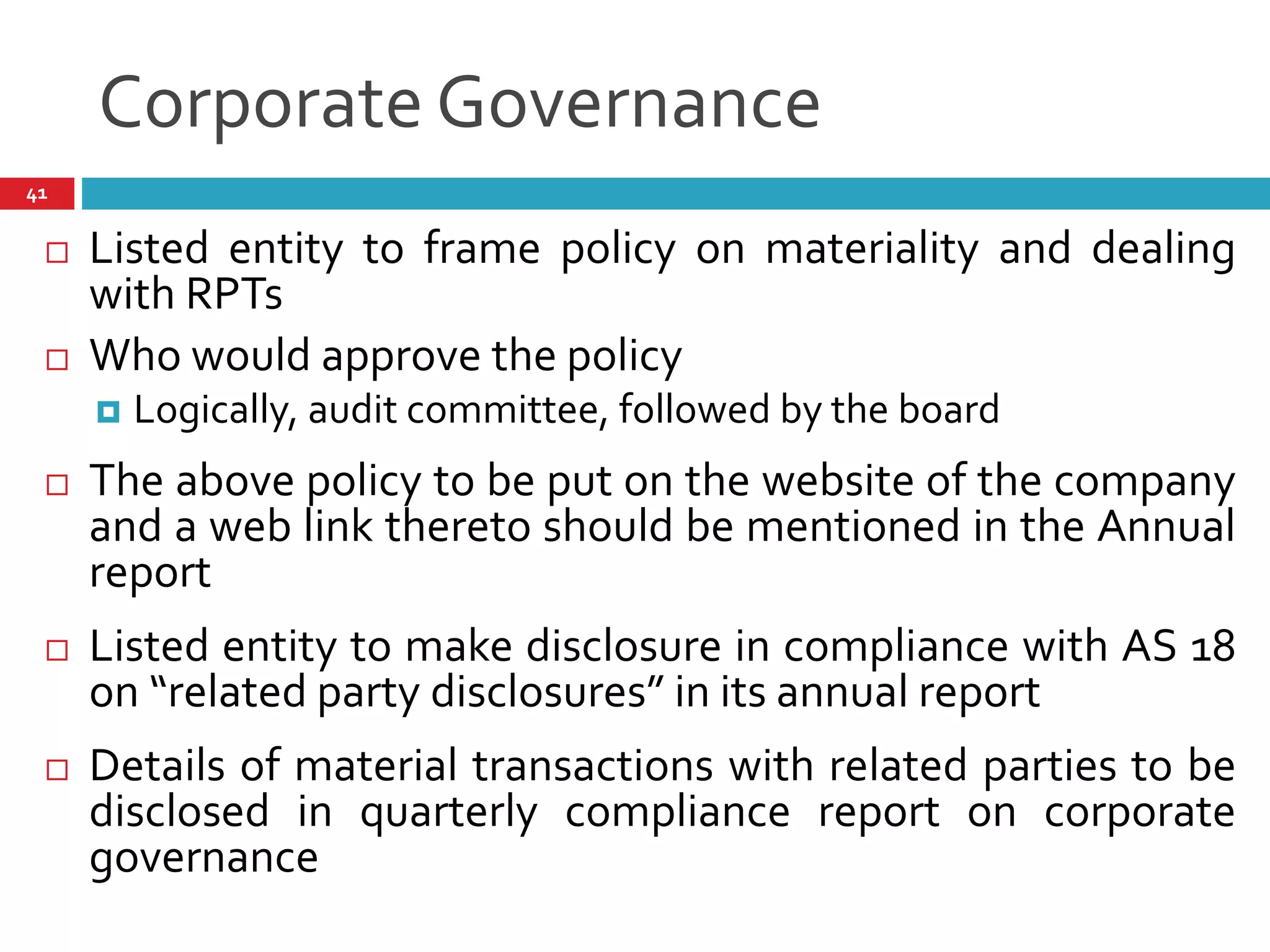
 Listed entity to frame policy on materiality and dealing
with RPTs
 Who would approve the policy
 Logically, audit committee, followed by the board
 The above policy to be put on the website of the company
and a web link thereto should be mentioned in the Annual
report
 Listed entity to make disclosure in compliance with AS 18
on “related party disclosures” in its annual report
 Details of material transactions with related parties to be
disclosed in quarterly compliance report on corporate
governance
Comparison under Act, 2013 and LODR
42
Particulars Companies Act, 2013 SEBI (LODR) Regulations, 2015
Who is related party? As defined under s. 2(76) As defined under s. 2(76) and AS-
18 / IND AS 24
What are related
party transactions?
As defined under s. 188 Transfer of resources, obligations
and services irrespective of
whether price is charged or not.
Terms of reference for
materiality
Limits as prescribed under
Rule 15
10% of annual consolidated
turnover
Carve outs for
materiality
Transactions in ordinary
course of business or arm’s
length basis
No such carve out
Abstention from
voting
Related parties that are party
to the contract
All related parties whether party
to contract or not
Policy on material
RPTs
No such requirement Regulation 23 mandates a policy
Comparison under Act, 2013 and LODR
43
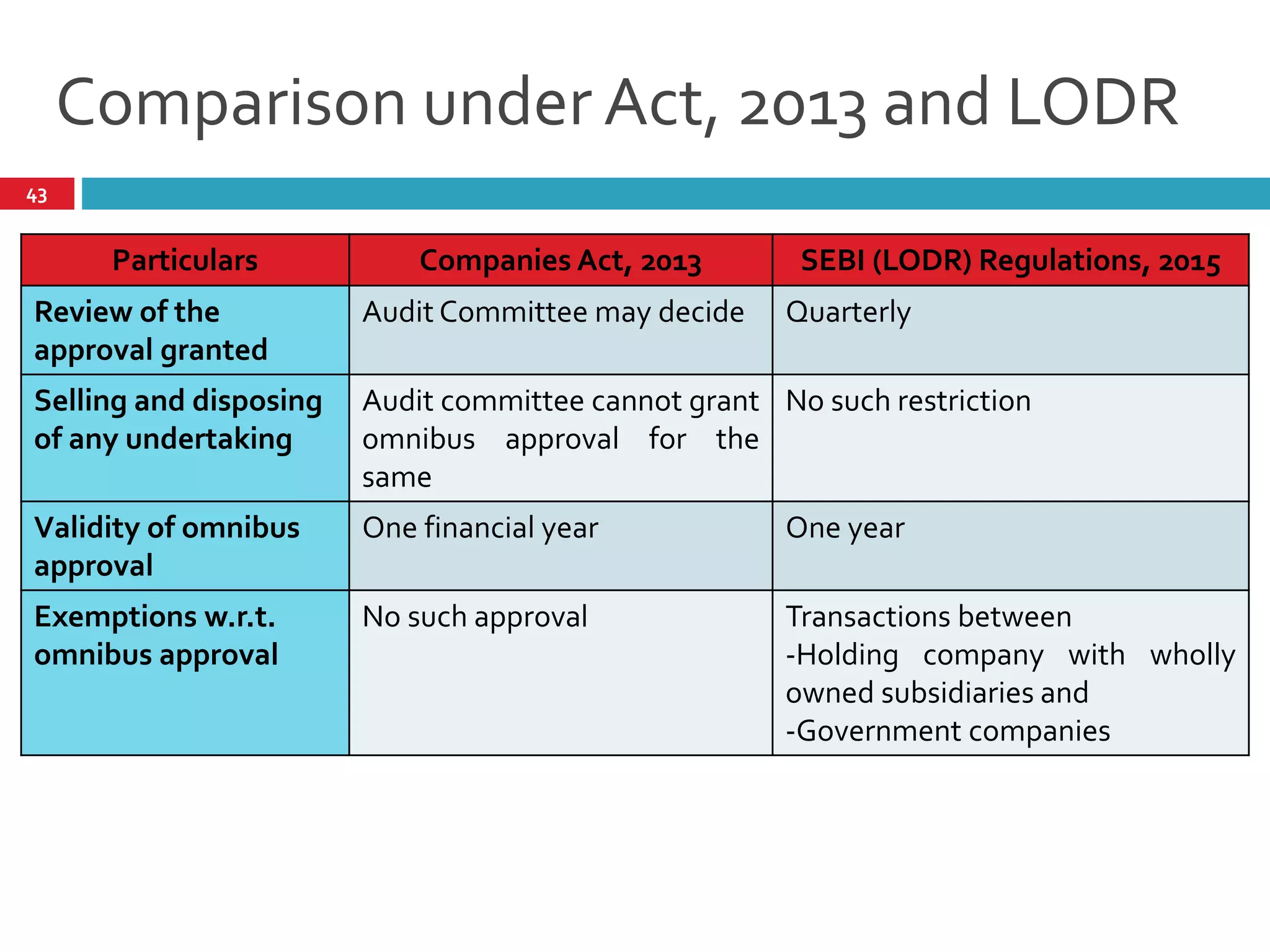
Particulars Companies Act, 2013 SEBI (LODR) Regulations, 2015
Review of the
approval granted
Audit Committee may decide Quarterly
Selling and disposing
of any undertaking
Audit committee cannot grant
omnibus approval for the
same
No such restriction
Validity of omnibus
approval
One financial year One year
Exemptions w.r.t.
omnibus approval
No such approval Transactions between
-Holding company with wholly
owned subsidiaries and
-Government companies
44
Sequential Snapshot
45
Related PartyTransactions
Audit Committee approval, if
applicable
Listed company
Is RPT
material?
Yes
Yes
No
Has the transaction been
entered in its ordinary course of
business?
Has the transaction been
entered in arm’s length basis?
Yes
Yes
Approval by Board of Directors
No No
Is the same under the limit as
prescribed under Rule 15?
Ordinary resolution
is not required to be
passed by members
Ordinary resolution
of the disinterested
shareholders for that
particular matter
Board Resolution to
be passed
Ordinary resolution
abstaining all the
related parties
involved
Yes
No
Neither the approval
of Board nor
shareholders is
required
46
Indian Accounting Standards
47
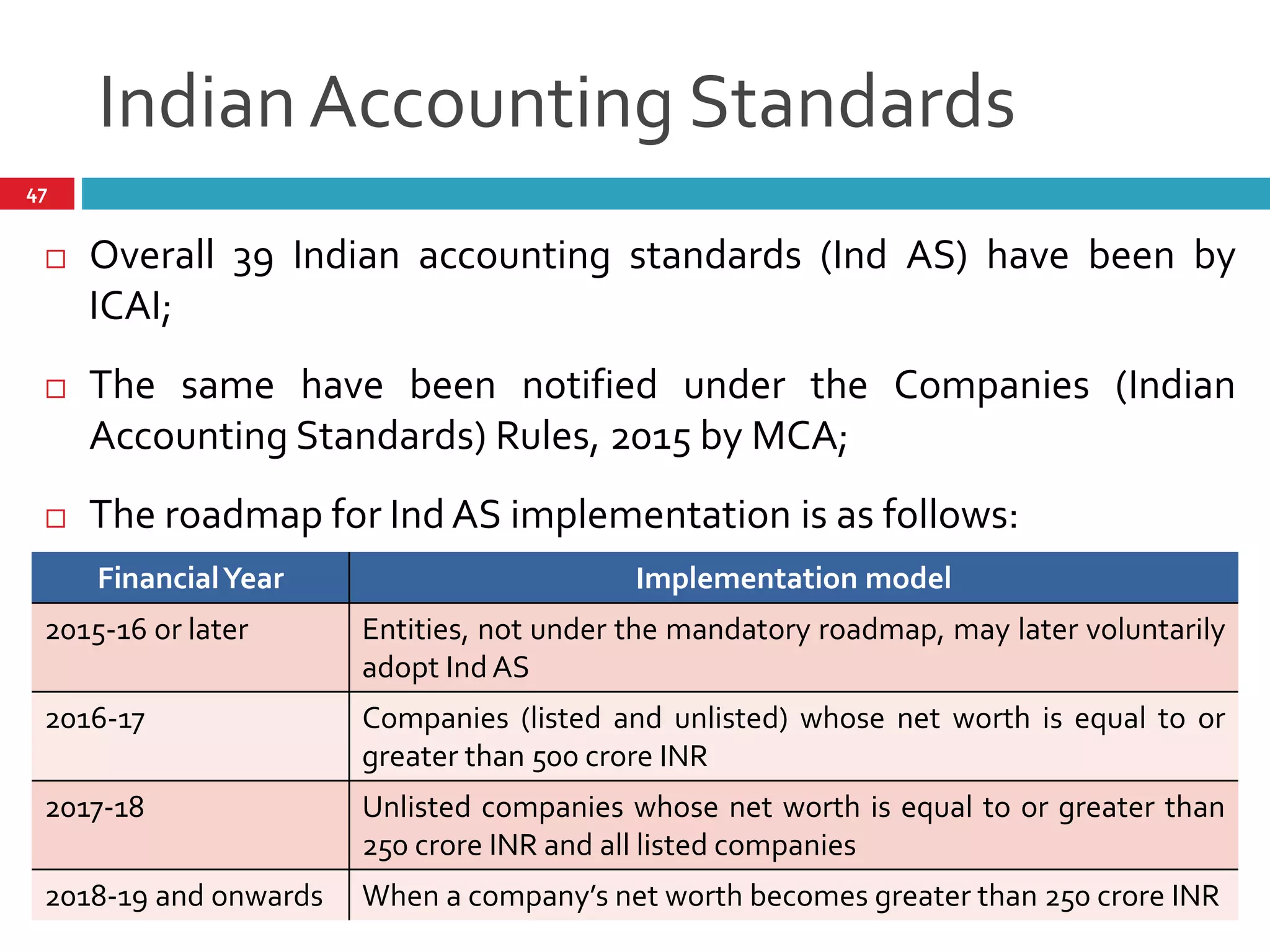
 Overall 39 Indian accounting standards (Ind AS) have been by
ICAI;
 The same have been notified under the Companies (Indian
Accounting Standards) Rules, 2015 by MCA;
 The roadmap for Ind AS implementation is as follows:
FinancialYear Implementation model
2015-16 or later Entities, not under the mandatory roadmap, may later voluntarily
adopt Ind AS
2016-17 Companies (listed and unlisted) whose net worth is equal to or
greater than 500 crore INR
2017-18 Unlisted companies whose net worth is equal to or greater than
250 crore INR and all listed companies
2018-19 and onwards When a company’s net worth becomes greater than 250 crore INR
Modalities: Ind AS
48
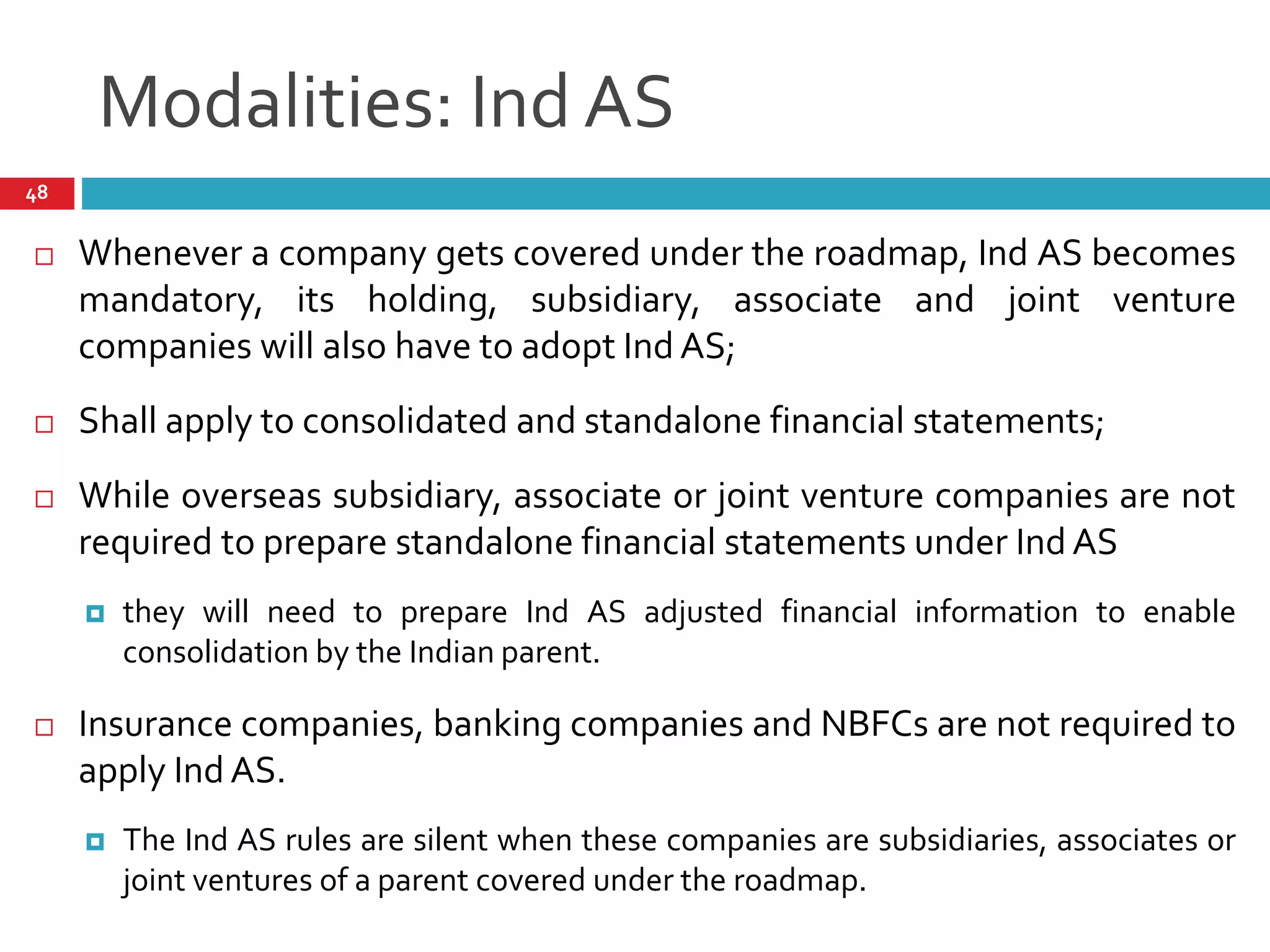
 Whenever a company gets covered under the roadmap, Ind AS becomes
mandatory, its holding, subsidiary, associate and joint venture
companies will also have to adopt Ind AS;
 Shall apply to consolidated and standalone financial statements;
 While overseas subsidiary, associate or joint venture companies are not
required to prepare standalone financial statements under Ind AS
 they will need to prepare Ind AS adjusted financial information to enable
consolidation by the Indian parent.
 Insurance companies, banking companies and NBFCs are not required to
apply Ind AS.
 The Ind AS rules are silent when these companies are subsidiaries, associates or
joint ventures of a parent covered under the roadmap.
Ind AS: Related PartyTransactions
49
Contents
50
 Key definitions
 Purpose of disclosure
 Transactions and disclosures
 Key management personnel
 Government related entities
Objective
51
Any outstanding balance(s) with related party and the nature of related party
transactions may affect the assessment of an entity’s operation.
The emphasis of Ind AS is that appropriate disclosure is made.
Though related party transactions are a normal feature of commerce and
business, therefore Ind AS does not attempt to prevent such transactions or
impute revised value to related party transactions.
A entity’s financial statement contains disclosures necessary for
understanding the financial position of the company, its profit and loss. Such
financial position may be impacted by existence of related party transactions.
Definition – Related Party (Para 24.9)
52
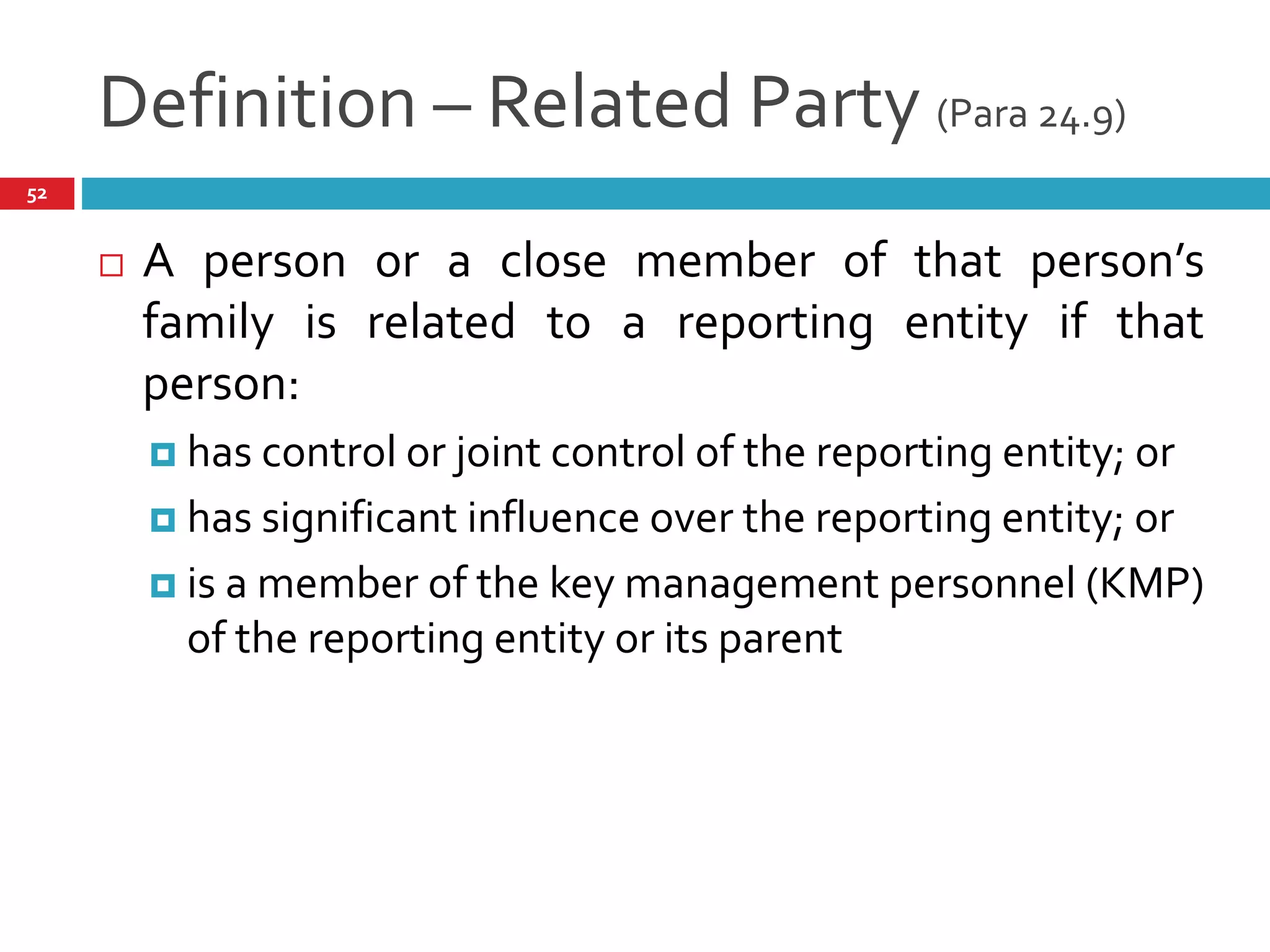
 A person or a close member of that person’s
family is related to a reporting entity if that
person:
 has control or joint control of the reporting entity; or
 has significant influence over the reporting entity; or
 is a member of the key management personnel (KMP)
of the reporting entity or its parent
Definition – Related Party (Para 24.9)
Entity is related if:
(1/2)
53
 they are members of the same group
 an entity is an associate or JV of the other entity (or an
associate or JV of a group in which the entity is a member)
 both entities are JV's of the same third party.
 one entity is a JV of a third entity and the other entity is an
associate of the third entity.
 it is a post-employment benefit plan for the benefit of
employees of the reporting entity or a related entity to the
reporting entity. If the reporting entity is itself such a plan,
the sponsoring employers are also related to the reporting
entity.
 it is controlled or jointly controlled by a related person.
 the entity or a group member, provides KMP services to
the reporting entity or to its parent.
Definition - Key Management Person (KMP)
54
 Key management personnel
 are those persons
 having authority and responsibility
 for planning, directing and controlling
 the activities of the entity,
 directly or indirectly,
 including any director (whether executive or otherwise) of that
entity.
 By virtue of the above definition, NEDs are also Key
Management Personnel
Definition - Close member of family
55
 Close members of the family of a person are
 those family members who may be expected to
influence, or be influenced by, that person in their
dealings with the entity including:
 that person’s children, spouse or domestic partner, brother,
sister, father and mother;
 children of that person’s spouse or domestic partner; and
 dependants of that person or that person’s spouse or domestic
partner.
Who is not related party?
56
 Two entities that have a common director.
 two venturers purely because they share joint venture.
 Significant volumes of business with a customer or
supplier do not necessarily create a related party
relationship with them.
 Providers of Finance , trade union, Public Utilities &
Government departments although they may
circumscribe the freedom of action of the enterprise or
participate in its decision making process.
 Customer , supplier , franchiser, distributor or general
agent who enter into dealing with the reported enterprise
by virtue of economic independence.
What are related party transactions?
57
 A related party transactions is defined as a
transfer of resources, services or obligations
between related parties, regardless of
whether a price is charged.
 Means even if transactions take place at a full
arm’s length price, i.e. at market price.
Having Discovered related party relation
–next question is what to disclose ?
58
 Disclose the nature of the related party
relationship as well as information about
those
 transactions and
 outstanding balances,
 including commitments,
 necessary for users to understand the potential effect
of the relationship on the financial statements.
Why disclose?
59
 Knowledge of related party transactions,
outstanding balances and relationships may
affect assessments of an entity's operations by
users of financial statements, including
assessments of the risks and opportunities facing
the entity.
Key disclosures
60
 relationships between parents and subsidiaries shall be
disclosed irrespective of whether there have been
transactions between those related parties (Ind-AS 24.13)
 disclose the name of the entity's parent and, if different,
the ultimate controlling party (Ind-AS 24.13).
 disclosures should be made separately for each of the
following categories (Ind-AS 24.19):
 the parent
 entities w. joint control or significant influence over the entity
 subsidiaries
 associates and joint ventures
 key management personnel of entity or parent
 other related parties
Transactions and disclosures
61
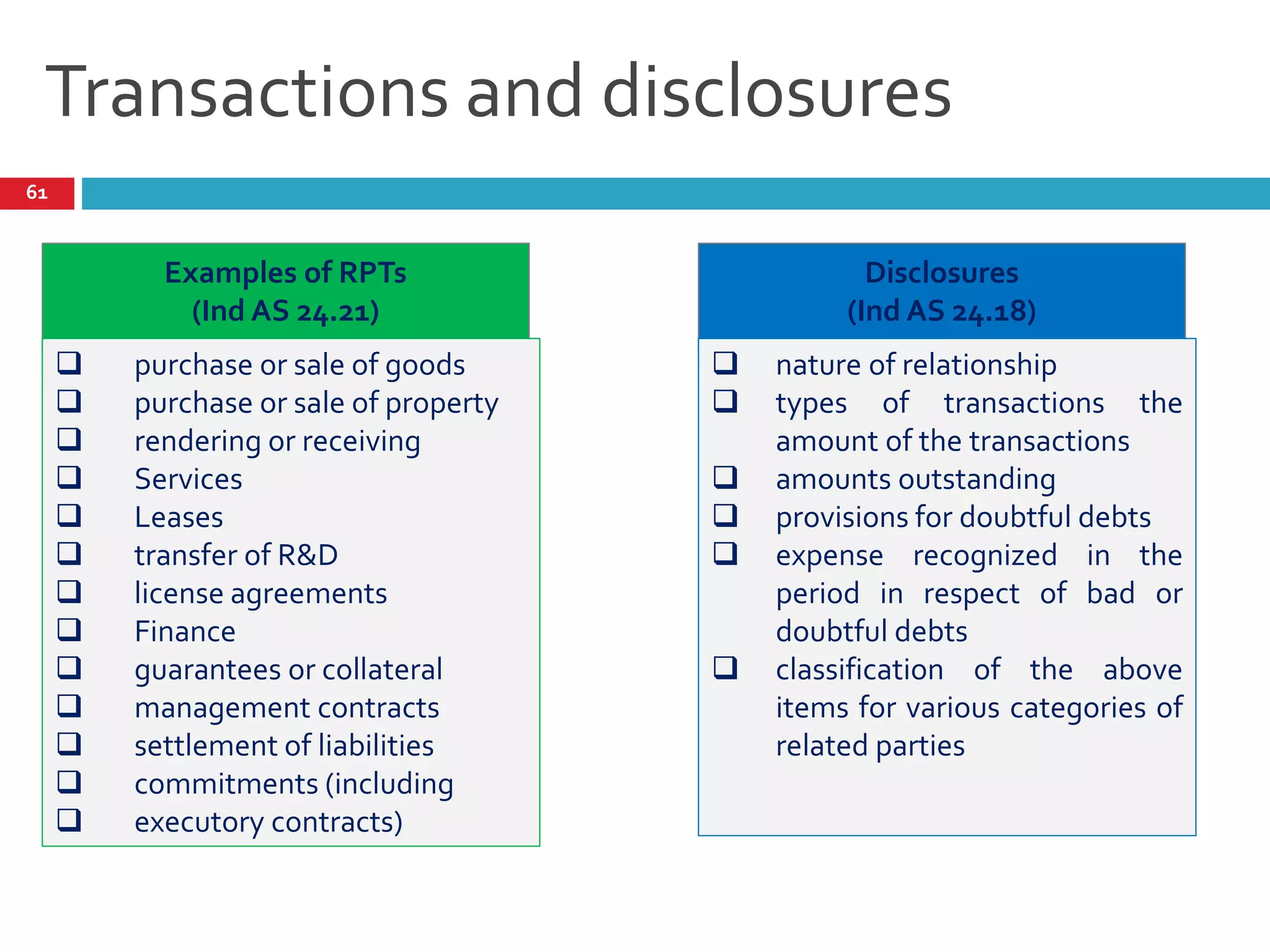
Examples of RPTs
(Ind AS 24.21)
 purchase or sale of goods
 purchase or sale of property
 rendering or receiving
 Services
 Leases
 transfer of R&D
 license agreements
 Finance
 guarantees or collateral
 management contracts
 settlement of liabilities
 commitments (including
 executory contracts)
Disclosures
(Ind AS 24.18)
 nature of relationship
 types of transactions the
amount of the transactions
 amounts outstanding
 provisions for doubtful debts
 expense recognized in the
period in respect of bad or
doubtful debts
 classification of the above
items for various categories of
related parties
Government related entities
62
 Ind-AS 24 provides exemptions for entities controlled,
jointly controlled or significantly influenced by a
government.
 Exemptions from disclosing transactions with:
 a government
 entities that are related parties due to government control,
joint control or significant influence.
 Disclosure required:
 name of government
 nature of relationship
 nature and amount of each individually significant transaction
 indication of extent of remaining transactions if collectively
significant

Related Party Transactions

  • 1.
    1 Related Party Transaction by DiptiMehta Partner Company Secretaries Disclaimer: This presentation is based on my internal research. It is notified that the presenter and any other person related to him shall be responsible for any damage or loss of any action taken based on this presentation. It is suggested to seek professional advice before initiating any action.
  • 2.
    About Us Mehta &Mehta is leading Company Secretaries Firm registered with the Institute of Company Secretaries of India. Mehta & Mehta is providing its services in the field of Companies Act, Securities & Exchange Board of India, National Company Law Tribunal, Insolvency, revival and closure, Human Resource, Mergers andAcquisitions,Audits, etc. 2
  • 3.
  • 4.
  • 5.
    Companies Act, 2013 Section 2(76) and 2(77) of the Companies Act, 2013  Rule 4 of Companies (Specification of definition details) Rules, 2014  Section 177, 188 and 189 of the Companies Act, 2013  Rule 6A, Rule 15 and Rule 16 of Companies (Meetings) of Boards and its Powers) Rules, 2014  Companies (Amendment) Bill, 2016  Form MBP-4  Disclosure in Board Report. 5
  • 6.
    Who is aRelated Party? [Section 2(76)] (1/2) Directors and KMPs including their relatives A firm in which a director, manager and their relative Director (excluding IDs) or KMPs of holding company and their relative Private company in which a director or manager or his relative is a member or director Related Party 6
  • 7.
    Who is aRelated Party? [Section 2(76)] (2/2) Public company in which a director or manager is a director and holds along with his relatives, more than 2% of its paid-up share capital body corporate Board, MD or manager is accustomed to act in accordance with the advice of a director or manager any person on whose advice, directions or instructions a director or manager is accustomed to act company which is— (A) a H / S / AC of such company; or (B) subsidiary of holding company to which it is subsidiary* Related Party *does not apply to a private company. 7
  • 8.
    Relative [Section 2(77)] readwith Rule 4 of Chapter I Rules  Members of HUF;  Spouse;  Father – including step-father;  Mother – including step-mother;  Son – including step-son;  Son’s wife;  Daughter;  Daughter’s husband;  Brother – including step-brother;  Sister – including step-sister. 8
  • 9.
    Who is nota related party?  Directors and Key Managerial Personnel(s) of joint venture and associate companies;  Directors holding less than 2% in public companies;  A person appointed as a senior managerial personnel in  the company;  its holding company;  its subsidiary company;  its associate company. 9
  • 10.
    Removal of dilemmas Previously, public companies having common directors would be treated as related party to each other.  This was definitely not the intent of law.  Therefore by way of Companies (Removal of Difficulties) Fifth Order, 2014 – the lacuna was removed by use of word **and** instead of **or**;  Now Section 2(77)(v)reads:  public company in which a director or manager is a director and holds along with his relatives, more than two percent of its paid-up share capital. 10
  • 11.
    What are relatedparty transactions? Under section 188 of the Act A • Sale, purchase or supply of any goods or materials; B • Selling or otherwise disposing of, or buying, property of any kind; C • Leasing of property of any kind; D • Availing or rendering of any services; E • Appointment of any agent for purchase or sale of goods, materials, services or property; F • Underwriting the subscription of any securities or derivatives thereof, of the company; G • Such related party's appointment to any office or place of profit in the company, its subsidiary company or associate company. 11
  • 12.
    Members’ Approval –Ordinary Resolution  Incase if the transactions exceed the following threshold, members approval by way of ordinary resolution is desirous: Sale, purchase or supply of any goods or materials directly or through appointment of agents 10% of Annual turnover or Rs. 100 crore, w.e. lower Selling or otherwise disposing of, or buying, property of any kind directly or through appointment of age 10% of net worth or Rs. 100 crore; lower one Leasing of property of any kind 10% of net worth or 10% of turnover or Rs. 100, lower one Availing or rendering any services directly or through appointment of agents 10% of net worth or Rs. 50 crore; lower one Appointment to any place of profit in the company, its subsidiary or its associate at a monthly remuneration Rs. 2.5 lakh Remuneration for underwriting the subscription of any securities or derivatives thereof of the company 1% of net worth 12
  • 13.
    Office or placeof profit  Means any office or place—  Where such office or place is held by a director:  he receives from the company anything by way of remuneration over and above remuneration to which he is entitled as director,  by way of salary, fee, commission, perquisites, any rent-free accommodation, or otherwise.  Where such office or place is held by an individual other than a director (relative) or by any firm, private company or other body corporate:  it receives from the company anything by way of remuneration, salary, fee, commission, perquisites, any rent-free accommodation, or otherwise. 13
  • 14.
    Arms’ Length Basis Any transaction entered into ordinary course of business or on arm’s length basis shall not require any approval of the Board or of members of company;  approval of Audit Committee shall still be necessitated;  “Arm’s length” transaction should mean a transaction between two related parties that is conducted as if they were unrelated, without any conflict of interest;  Also, the word used is arm’s length basis and not arm’s length price. 14
  • 15.
    What is ordinarycourse of business?  Ordinary course of business will not cover what is the object of the company as defined in memorandum of association.  As per general understanding, “ordinary course of business” will cover the usual / routine transactions, customs and practices of a business and of a company.  Reference may be drawn to the judicial interpretation of the term “ordinary course of business”, whereby the Allahabad court in its ruling in the case of Kalapnath Singh vs. Surajpal Singh and others [AIR 1949 ALL 425] has given interpretation to term like ‘regular course of business’; ‘common course of business’; ‘usual course of business’. 15
  • 16.
    Omnibus Approval byAudit Committee Rule 6A (1/3)  Audit Committee has been allowed with the power of granting omnibus approval.  The criteria shall include:  maximum value of the transactions which can be allowed under the omnibus route in a year;  Maximum value per transaction which can be allowed  Review, at such intervals as the audit committee may deem fit, related party transaction entered into by the company pursuant to each of the omnibus approval made  Transactions which cannot be subject to the omnibus approval by the audit committee 16
  • 17.
    Omnibus Approval byAudit Committee Rule 6A (2/3)  Care to be taken by Committee of the following:  Name of the related parties;  Nature and duration of the transaction;  Maximum amount of transaction that can be entered into;  Indicative base price or current contracted price and the formula for variation in the price, if any;  Any other information relevant to take a decision on the proposed transaction. 17
  • 18.
    Omnibus Approval byAudit Committee Rule 6A (3/3)  The accorded omnibus approval is valid for one financial year;  Fresh approval shall be required after expiry of the financial year  Omnibus approval cannot be granted for selling of or disposing of undertaking of the company.  For transactions of unforeseen nature, the approval shall be granted for transactions not exceeding Rs. 1 crore per transactions. 18
  • 19.
    Sequence of approvals Contract in ordinary course of business and on arm’s length basis  Audit committee approval only  has to be prior approval  omnibus approval may be granted  Either / neither in ordinary course or / nor arms length  prior recommendation by audit committee  Approval of Board of directors necessitated  Shareholders approval incase it exceeds threshold  If prior approval of Board of Directors or shareholders is not obtained  Needs to be ratified within 3 months from the date of transactions. 19
  • 20.
    Food for thought!!! Q. A is a member of company X Ltd, and is also a related party to X Ltd. In this scenario, can A vote on the resolution to be passed by X Ltd for entering into a RPT? Q. Incase of a wholly owned subsidiary, which company will be required to pass ordinary resolution under section 188 of the Act? Q. Has the Act prescribed any criteria for determining the conditions pertaining to arm’s length basis? Q. Are the directors of the company liable to indemnify incase of any loss suffered by the company for matters pertaining to RPTs? Q. Will giving of loan, guarantee or security from holding company to subsidiary company come under the purview of related party transactions? 20
  • 21.
    Food for thought!!! Q. A is a member of company X Ltd, and is also a related party to X Ltd. In this scenario, can A vote on the resolution to be passed by X Ltd for entering into a RPT? Answer: Mr. A cannot note on such a resolution in compliance with the second proviso of section 188(1) of the Act. However, other related parties who are not interested in the said contract may vote on such resolution.The same was clarified in MCA circular dated July 17, 2014. Q. Incase of a wholly owned subsidiary, which company will be required to pass ordinary resolution under section 188 of the Act? Answer: Neither the holding company nor the subsidiary company will be required to pass the resolution of members if: a. Accounts of wholly owned subsidiary are consolidated with holding company; b. and the said consolidated accounts are laid before members in the general meeting. The said relaxation was provided upon enactment of Companies (Amendment) Act, 2015. 21
  • 22.
    Food for thought!!! (Continued) Q. Has the Act prescribed any criteria for determining the conditions pertaining to arm’s length basis? Answer: NO. The 2013 Act is silent. Therefore, it is subjective upon the Board of the company as the decision vests with them. Q. Are the directors of the company liable to indemnify incase of any loss suffered by the company for matters pertaining to RPTs? Answer: Yes. Any RPT(s) entered into by a company without approval of Board or shareholders, shall be ratified within 3 months of entering into such RTP(s). If not: •the RPT shall become voidable at the instance of the Board; and •if the same is with any director, or is authorised by any other director, •the director(s) concerned shall be required to indemnify the company against any loss incurred by it. •the company has power to initiate any proceeding against director or employee who has entered into such contract or arrangement. •In terms of section 164, he shall be disqualified for appointment as a director of any other company for 5 years. 22
  • 23.
    Food for thought!!! (Continued) Q. Will giving of loan, guarantee or security from holding company to subsidiary company come under the purview of related party transactions? Answer: NO.  The Act draws a clear demarcation between financial nature transactions and business nature transactions w.r.t. related party transactions.  Section 188 deals with business nature transactions and approval board by way of board resolution and / or members is desirous.  However financial nature transactions are not covered under the ambit of section 188 and therefore the board approval and shareholders are not mandated.  However, audit committee approval will be mandated irrespective of the transaction involved.  However, there are different sections that deal with approvals for extension of loan / guarantee / security, etc. 23
  • 24.
    Disclosure in Board’sReport  As per s. 188(2), the BoD shall be required to disclose in their report desired information w.r.t. related party transactions;  S. 134(3)(h) mandates disclosure in relating to related party transactions Form AOC-2;  Form AOC-2 has been bifurcated into the following:  contracts of contracts or arrangements not on arm’s length basis;  material contracts or arrangements on arm’s length basis.  Form AOC-2 shall be signed by the same persons who has signed the Board’s Report. 24
  • 25.
    Non compliance ofs. 188  Punishment for violation of provisions of the section  Any director or employee of listed company  Imprisonment extending to 1 year or  Fine Rs. 25,000 – Rs. 5 lakhs or with both  Any director or employee of other company  Fine Rs. 25,000 – Rs. 5 lakhs  Penalty on any director or employee who enters into or authorizes the contract in contravention of provisions of the section  Punishment levied even if no loss has been incurred by Company from such RPT. 25
  • 26.
    Role of AuditCommittee  Under s. 177 of the Act the committee shall have:  Minimum 3 directors with the majority of independent directors  majority of members of Audit Committee including its Chairperson shall be persons with the ability to read and understand financial statements.  Audit Committee proves significant in Related Party Transactions. It is responsible for assessing the modifications in the Accounting Policies and practices adopted by the Company.  It must monitor Company’s policies that are not in accordance with the Accounting Standards issued by ICAI and the reasons for their inconsistency with such standards.  Audit Committee may grant omnibus approval for related party transactions subject to certain conditions. 26
  • 27.
  • 28.
    In Nutshell !! RPT has been the hotbed for legislative action:  RoD orders were notified amending the definition in s. 2(76)  Companies (Amendment)Act, 2015  Ordinary resolution against special resolution  Omnibus approval by audit committee  The new bill proposes  Definition becomes commutative as now it includes an investing company and venturer of a company.  Process of ratification of contracts by audit committee under sec 177 (4) (iv); puts focus on contracts not covered by sec. 188.  Restricts all related parties from voting to a contact against the current position wherein only the party related to the contract is abstained from voting. 28
  • 29.
    Prior approval byAudit Committee  Current law does not require prior approval of AC:  But omnibus approval insertion seemed to suggest that transaction needs prior approval.  Now the Bill:  provides for provision of ratification;  Also provides AC the power to avoid transactions not pre approved.  This makes the picture clear that no prior approval is required. 29
  • 30.
    Transactions other thans. 188 transactions  Audit committee to recommend transactions to Board other than that covered in s. 188:  This creates a new board reference point altogether  Existing law – transactions not covered by sec. 188 are not required to go to the board at all  They come to the audit committee  Audit committee may approve  May disapprove  There was no scope for the board to approve something not approved by the audit committee  In matters of RPTs, for logical reasons, audit committee had the upper hand.  The proposed amendment:  Widens the scope of board, including transactions not covered in s. 188, if not approved by the board.  Seems to suggest that the board may even approve transactions not approved by audit committee. 30
  • 31.
    Transactions other thans. 188 –WoS perspective31  New proviso proposes for exemption of transactions not covered by s. 188, if entered withWoS.  Interestingly:  LODR completely exempts transactions withWoS;  S. 188 provides for exemption from shareholders approval for transactions withWoS;  Transactions not covered by s. 188 are financial transactions; may involve substantial movement of resources.  Exemption from audit committee approval may not be proper
  • 32.
    Amendment in s.188 32  Bill proposes to add a proviso below the second proviso to sec. 188(1).  Makes shareholders’ approval inapplicable where 90% of members, in number, are relatives of promoters, or are related parties  Bar on voting is applicable only to related parties  By definition, relatives of promoters are not related parties at all. Hence, they are not barred from voting anyway.  This brings a very significant change  MCA circular 30/2014 becomes meaningless  So, as in case of the listing agreement, all related parties will refrain from voting Unless the case falls in the 90% numerical majority case.
  • 33.
  • 34.
    Secretarial Standard 1:Board Meetings  Director shall not be reckoned for quorum in respect of an item in which he is interested and  He shall not be present during discussions and voting on such item.  Section 184(2) and Rule 15 of MBP Rules also talks about the same  In case of all the directors are interested  To be decided at general meeting  In general meeting voting entitlement shall be decided in terms of Section 188 and SS-2 34
  • 35.
    Secretarial Standard 2:General Meetings  Related party not entitled to vote in a resolution in which he is a related party  However, shall be counted for the purpose of quorum  In case of public companies chairman is  not entitled to propose a resolution in which he is interested  not entitled to conduct proceeding of the meeting  required to entrust the conduct of the proceeding of the meeting to un-interested director or to other member  to resume only after the matter is transacted  This restriction is applicable only if the interest w.r.t only a particular transaction. 35
  • 36.
  • 37.
    SEBI (LODR) Regulations,2015  Regulation 2(1)(zb) and 2(1)(zc)  Regulation 23  Schedule II  Policy of Related PartyTransactions  Corporate Governance Report provisions  Omnibus Approval under LODR 37
  • 38.
    Related Party andRelated PartyTransactions 38  Regulation 2(1)(zb):  related party means a related party as defined under  section 2(76) of Companies Act, 2013;  under the applicable accounting standards.  Regulation 2(1)(zc):  “related party transaction” means transfer of  resources  services  obligations  between a listed entity and a related party  regardless of whether a price is charged or not.
  • 39.
    Regulation 23 –in brief 39  Listed entity to formulate a policy on “materiality” and on dealing with RPT  Material RPT  transaction during FY exceeds 10% of annual consolidated turnover  All RPT shall require prior approval of the audit committee  Audit committee may grant omnibus approval  Quarterly review of RPTs pursuant to omnibus approval  Resolution valid for 1 year  Material RPT shall require approval of shareholders  By way of ordinary resolution  All related party are abstained from voting  Exceptions  transactions entered into between two government companies;  transactions entered into between a holding company and its wholly owned subsidiary whose accounts are consolidated with holding company and placed before the shareholders at the general meeting for approval.
  • 40.
    Omnibus Approval underLODR 40  Audit Committee is authorised:  to lay the criteria for accord of omnibus approval in sync with RPT policy  approval by Audit committee shall be for transactions which are repetitive in nature  Audit Committee shall  satisfy itself that there is need of granting such omnibus approval;  review the omnibus approvals on quarterly basis  Such omnibus approval is valid for 1 year  as year is not defined  as per General ClauseAct, it shall be calendar year.
  • 41.
    Corporate Governance 41  Listedentity to frame policy on materiality and dealing with RPTs  Who would approve the policy  Logically, audit committee, followed by the board  The above policy to be put on the website of the company and a web link thereto should be mentioned in the Annual report  Listed entity to make disclosure in compliance with AS 18 on “related party disclosures” in its annual report  Details of material transactions with related parties to be disclosed in quarterly compliance report on corporate governance
  • 42.
    Comparison under Act,2013 and LODR 42 Particulars Companies Act, 2013 SEBI (LODR) Regulations, 2015 Who is related party? As defined under s. 2(76) As defined under s. 2(76) and AS- 18 / IND AS 24 What are related party transactions? As defined under s. 188 Transfer of resources, obligations and services irrespective of whether price is charged or not. Terms of reference for materiality Limits as prescribed under Rule 15 10% of annual consolidated turnover Carve outs for materiality Transactions in ordinary course of business or arm’s length basis No such carve out Abstention from voting Related parties that are party to the contract All related parties whether party to contract or not Policy on material RPTs No such requirement Regulation 23 mandates a policy
  • 43.
    Comparison under Act,2013 and LODR 43 Particulars Companies Act, 2013 SEBI (LODR) Regulations, 2015 Review of the approval granted Audit Committee may decide Quarterly Selling and disposing of any undertaking Audit committee cannot grant omnibus approval for the same No such restriction Validity of omnibus approval One financial year One year Exemptions w.r.t. omnibus approval No such approval Transactions between -Holding company with wholly owned subsidiaries and -Government companies
  • 44.
  • 45.
    45 Related PartyTransactions Audit Committeeapproval, if applicable Listed company Is RPT material? Yes Yes No Has the transaction been entered in its ordinary course of business? Has the transaction been entered in arm’s length basis? Yes Yes Approval by Board of Directors No No Is the same under the limit as prescribed under Rule 15? Ordinary resolution is not required to be passed by members Ordinary resolution of the disinterested shareholders for that particular matter Board Resolution to be passed Ordinary resolution abstaining all the related parties involved Yes No Neither the approval of Board nor shareholders is required
  • 46.
  • 47.
    Indian Accounting Standards 47 Overall 39 Indian accounting standards (Ind AS) have been by ICAI;  The same have been notified under the Companies (Indian Accounting Standards) Rules, 2015 by MCA;  The roadmap for Ind AS implementation is as follows: FinancialYear Implementation model 2015-16 or later Entities, not under the mandatory roadmap, may later voluntarily adopt Ind AS 2016-17 Companies (listed and unlisted) whose net worth is equal to or greater than 500 crore INR 2017-18 Unlisted companies whose net worth is equal to or greater than 250 crore INR and all listed companies 2018-19 and onwards When a company’s net worth becomes greater than 250 crore INR
  • 48.
    Modalities: Ind AS 48 Whenever a company gets covered under the roadmap, Ind AS becomes mandatory, its holding, subsidiary, associate and joint venture companies will also have to adopt Ind AS;  Shall apply to consolidated and standalone financial statements;  While overseas subsidiary, associate or joint venture companies are not required to prepare standalone financial statements under Ind AS  they will need to prepare Ind AS adjusted financial information to enable consolidation by the Indian parent.  Insurance companies, banking companies and NBFCs are not required to apply Ind AS.  The Ind AS rules are silent when these companies are subsidiaries, associates or joint ventures of a parent covered under the roadmap.
  • 49.
    Ind AS: RelatedPartyTransactions 49
  • 50.
    Contents 50  Key definitions Purpose of disclosure  Transactions and disclosures  Key management personnel  Government related entities
  • 51.
    Objective 51 Any outstanding balance(s)with related party and the nature of related party transactions may affect the assessment of an entity’s operation. The emphasis of Ind AS is that appropriate disclosure is made. Though related party transactions are a normal feature of commerce and business, therefore Ind AS does not attempt to prevent such transactions or impute revised value to related party transactions. A entity’s financial statement contains disclosures necessary for understanding the financial position of the company, its profit and loss. Such financial position may be impacted by existence of related party transactions.
  • 52.
    Definition – RelatedParty (Para 24.9) 52  A person or a close member of that person’s family is related to a reporting entity if that person:  has control or joint control of the reporting entity; or  has significant influence over the reporting entity; or  is a member of the key management personnel (KMP) of the reporting entity or its parent
  • 53.
    Definition – RelatedParty (Para 24.9) Entity is related if: (1/2) 53  they are members of the same group  an entity is an associate or JV of the other entity (or an associate or JV of a group in which the entity is a member)  both entities are JV's of the same third party.  one entity is a JV of a third entity and the other entity is an associate of the third entity.  it is a post-employment benefit plan for the benefit of employees of the reporting entity or a related entity to the reporting entity. If the reporting entity is itself such a plan, the sponsoring employers are also related to the reporting entity.  it is controlled or jointly controlled by a related person.  the entity or a group member, provides KMP services to the reporting entity or to its parent.
  • 54.
    Definition - KeyManagement Person (KMP) 54  Key management personnel  are those persons  having authority and responsibility  for planning, directing and controlling  the activities of the entity,  directly or indirectly,  including any director (whether executive or otherwise) of that entity.  By virtue of the above definition, NEDs are also Key Management Personnel
  • 55.
    Definition - Closemember of family 55  Close members of the family of a person are  those family members who may be expected to influence, or be influenced by, that person in their dealings with the entity including:  that person’s children, spouse or domestic partner, brother, sister, father and mother;  children of that person’s spouse or domestic partner; and  dependants of that person or that person’s spouse or domestic partner.
  • 56.
    Who is notrelated party? 56  Two entities that have a common director.  two venturers purely because they share joint venture.  Significant volumes of business with a customer or supplier do not necessarily create a related party relationship with them.  Providers of Finance , trade union, Public Utilities & Government departments although they may circumscribe the freedom of action of the enterprise or participate in its decision making process.  Customer , supplier , franchiser, distributor or general agent who enter into dealing with the reported enterprise by virtue of economic independence.
  • 57.
    What are relatedparty transactions? 57  A related party transactions is defined as a transfer of resources, services or obligations between related parties, regardless of whether a price is charged.  Means even if transactions take place at a full arm’s length price, i.e. at market price.
  • 58.
    Having Discovered relatedparty relation –next question is what to disclose ? 58  Disclose the nature of the related party relationship as well as information about those  transactions and  outstanding balances,  including commitments,  necessary for users to understand the potential effect of the relationship on the financial statements.
  • 59.
    Why disclose? 59  Knowledgeof related party transactions, outstanding balances and relationships may affect assessments of an entity's operations by users of financial statements, including assessments of the risks and opportunities facing the entity.
  • 60.
    Key disclosures 60  relationshipsbetween parents and subsidiaries shall be disclosed irrespective of whether there have been transactions between those related parties (Ind-AS 24.13)  disclose the name of the entity's parent and, if different, the ultimate controlling party (Ind-AS 24.13).  disclosures should be made separately for each of the following categories (Ind-AS 24.19):  the parent  entities w. joint control or significant influence over the entity  subsidiaries  associates and joint ventures  key management personnel of entity or parent  other related parties
  • 61.
    Transactions and disclosures 61 Examplesof RPTs (Ind AS 24.21)  purchase or sale of goods  purchase or sale of property  rendering or receiving  Services  Leases  transfer of R&D  license agreements  Finance  guarantees or collateral  management contracts  settlement of liabilities  commitments (including  executory contracts) Disclosures (Ind AS 24.18)  nature of relationship  types of transactions the amount of the transactions  amounts outstanding  provisions for doubtful debts  expense recognized in the period in respect of bad or doubtful debts  classification of the above items for various categories of related parties
  • 62.
    Government related entities 62 Ind-AS 24 provides exemptions for entities controlled, jointly controlled or significantly influenced by a government.  Exemptions from disclosing transactions with:  a government  entities that are related parties due to government control, joint control or significant influence.  Disclosure required:  name of government  nature of relationship  nature and amount of each individually significant transaction  indication of extent of remaining transactions if collectively significant