Over More than 40 years’ Experience in repair,
inspection, alteration of pressure vessels and
Pressure relief valves and the associated
damage Mechanisms, and external , internal and
NDE inspection and frequencies of inspection
and RBI . He Has trained a lot of Major Organi-
zations in India and in The gulf and recently in
Vietnam. He is a well-known specialist in Petro
chemical and Processing Industries.
He has been approved by API as Authorized
inspector in Pressure Vessel inspection, Pipeline
inspection, Storage tank inspection, Damage
mechanism specialization, Risk based inspec-
tion Training will involve a lot of Audio Visual
Aids, Power Points, animations, Simulation,
Case History Discussion, and Practical.
• API-510, Pressure Vessel Inspection Code - Mainte-
nance Inspection, Rating, Repair and Alteration
• API 571, Damage Mechanisms Affecting Fixed
Equipment in the Refining Industry
• API 572, Inspection of Pressure Vessels
• API 576, Inspection of Pressure-Relieving Devices
• API 577, Welding Inspection and Metallurgy
• ASME, Boiler and Pressure Vessel Code
• ASME Section V
• ASME Section VIII
• ASME Section IX
API Publication:
This five-day course will provide an intensive knowledge
regarding inspection, repair and alteration of Pressure
vessels.
The course fulfills the need for deciding the inspection
methods and Frequency of inspection based on the eval-
uation of the condition of the vessel
Entire course content will be consistent with the body of
knowledge for 510 examination. The course will help the
individuals to understand API Recommended Practice
510 along with other referenced standards like ASME.
The participants will be given a thorough coverage of API
510 with emphasis on understanding of ‘stated’ and
‘implied’ requirements in a simple straightforward manner
backed up with several practical examples and case
studies.
This course will employ latest audio visuals and anima-
tions and Mock quiz to give the candidates deep under-
standing. This course is designed to give the participants
the confidence to face the API 510 Pressure Vessel
Inspector Certification Examination and come out
successfully with excellent score.
Course Overview:
- AYT International, Qatar
- RAY International, Oman
- Saiba Engineering, Richards Bay
- Technique Inspection & Controle (Tic), Tunisia
- Mitech Instrument Company Limited, China
- Riversafe Solutions Nigeria Ltd., Nigeria
- Qatar Technical Petroleum Center, Qatar
- Bhp Billition Limited, Newman
- Engg Contra Kuwait Company, Kuwait
- Al-Hayathem General Trading & Contracting Group W.L.L., Kuwait
- Kupic For Scientific Consultancy, Kuwait
- Al-Babtain Power & Telecommunication Co., Saudi Arabia
- Cameron Services Middle East L.L.C., Oman
- Dimensi Barumas Perdana, Indonesia
- Gennesaret Resources Nigeria Limited, Nigeria
- Hyundai Heavy Industries Nigeria Limited, Nigeria
- Joint Venture Vietsovpetro (Vsp), Vietnam
- Larsen & Toubro (Jiangsu) Valve Co Ltd, China
- Nead Technology Application Development Company, Vietnam.
- Petrovietnam Cpse, Vietnam
- Rusayl Institute, Oman
- Vietnam Inspection Services Company Limited, Vietnam
CLIENT LIST:
OCS Training Instructor
All Rights Reserved. OCS GROUPAll Rights Reserved. OCS GROUP
For any registration:
CALL +6221 2555 5689
Email ayu.wulansari@ocsgroup.com
Web www.ocsgroup.com
API 510
PRESSURE VESSEL INSPECTION CODE
Sharpen your skills for Maintenance Inspection, Rating, Repair and Alteration of Pressure Vessel Systems!
API 510
PRESSURE VESSEL INSPECTION CODE
Sharpen your skills for Maintenance Inspection, Rating, Repair and Alteration of Pressure Vessel Systems!
All Rights Reserved. OCS GROUP
For any registration:
CALL +6221 2555 5689
Email ayu.wulansari@ocsgroup.com
Web www.ocsgroup.com
API 510 PRESSURE VESSEL INSPECTION CODE
Course Agenda :
MODULE – 1
1 Scope
3.1 Terms and Definitions
4 Owner/User Inspections Organization
4.1 Owner/User Organization Responsibilities
MODULE – 2
5.1 Inspection Plans
5.7 Condition Monitoring Methods
5.12 Inspection of Shell
MODULE – 3
6 Interval/Frequency and Extent of Inspection
6.5 Internal, On-stream, and Thickness Measurement
Inspections
6.6 Pressure-relieving Devices
6.7 Deferral of Inspection Due Dates.
MODULE – 4
7.1 Corrosion Rate Determination
7.2 Remaining Life Calculations
MODULE – 5
UG-16 General
UG-27 Thickness of Shells Under Internal Pressure
UG-32 Formed Heads, and Sections, Pressure on
Concave Side
UG-40 Limits of Reinforcement
Model QB
Open book QB
Closed book QB
MODULE – 1
UG-80 Permissible Out of Roundness of Cylindrical,
Conical, and Spherical
Shells
UG-81 Tolerance for Formed Heads
UG-99 Standard Hydrostatic Test
MODULE – 2
UG-100 Pneumatic Test
UG-101 Proof Tests to Establish Maximum Allowable
Working Pressure
UG-103 Nondestructive Testing
UG-116 Required Marking
MODULE – 3
UW-12 Joint Efficiencies
UW-16 Minimum Requirements for Attachment Welds
at Openings
UW-33 Alignment Tolerance
UW-35 Finished Longitudinal and Circumferential
Joints
MODULE – 4
UW-51 Radiographic Examination of Welded Joints
UW-52 Spot Examination of Welded Joints
UCS-56 Requirements for Postweld Heat Treatment
UCS-57 Radiographic Examination
MODULE – 5
UCS-66 Materials
UCS-68 Design
Model QB
Open book QB
Closed book QB
Day 1 Day 2
Course Objectives:
To prepare well for API 510 Exam & increase the Probability of Success
To understand basic design and the rules for correct fabrication, inspection and testing of pressure
vessels
To learn the basic requirements for inspection of pressure vessels placed in service.
To calculate corrosion rate, interval of inspection and similar parameters of Vessel inspection
To Perform all basic vessel calculations needed for the API exam (e.g. thinning, test pressure,
MAWP, static head, MDMT, corrosion rates, remaining life, etc)
To learn inspection, repair, alteration, & Re-rating of the Pressure Vessels in Service
To Review welding procedures (WPS/PQR) and welder performance qualifications (WPQ)
Who Should Attend :
This course specially designed for:
Mechanical Engineers involving Pressure
vessel Inspection
Metallurgists,
Corrosion engineers seeking broad
knowledge of damage mechanisms of the
PV used in petroleum and refining industries
Inspection Engineers
Maintenance engineers
Personnel involved in PV repair alteration
including Qualification of welding Procedure
Quality Managers,
Plant Engineer
All Rights Reserved. OCS GROUP
For any registration:
CALL +6221 2555 5689
Email ayu.wulansari@ocsgroup.com
Web www.ocsgroup.com
OCS Training understands that in current economic
climate, getting an excellent return on your training
investment is critical for all our clients. This excellent
training can be conducted exclusively for your organi-
zation. The training can be tailored to meet your specif-
ic needs at your preferred location and time. We will
meet you anywhere around the globe.
If you like to know more about this excellent program,
please contact us on +6221 2555 5772 or email at
sales@ocsgroup.com
IN-HOUSE SOLUTIONS
SAVE COST • IMPROVE PERFORMANCE • REDUCE RISK
API 510 PRESSURE VESSEL INSPECTION CODE
Course Agenda :
MODULE – 1
QW-150 Tension Tests
QW-153 Acceptance Criteria — Tension Tests
QW-200 General
MODULE – 2
QW-304 Welders
QW-306 Combination Of Welding Processes
QW-320 Retests And Renewal Of Qualification
QW-321 Retests
MODULE – 3
QW-350 Welding Variables For Welders
QW-406 Preheat
Table QW/QB-422
Ferrous/Nonferrous P-Numbers
Grouping of Base Metals for Qualification
MODULE – 4
QW-423 Alternate Base Materials For Welder
Qualification
QW-433 Alternate F-numbers For Welder Perfor-
mance Qualification
MODULE – 5
T-110 SCOPE
T-120 General Article 2
Radiographic Examination
Model QB
Open book QB
Closed book QB
MODULE – 1
Article 6 Liquid Penetrant Examination
Article 7 Magnetic Particle Examination
MODULE – 2
Article 23 Ultrasonic Standards
MODULE – 3
5. Reasons for Inspection.
5.2 Safety
5.4 Regulatory Requirements.
MODULE – 4
6.2 Inspection for Specific Types of Damage.
6.3 Developing Inspection Plans
7.1 General
8.1 Safety Precautions
MODULE – 5
9.2 Thickness Measurements.
9.3 External Inspection
9.4 Internal Inspection. 1
0.2 Visual Inspection.
Model QB
Open book QB
Closed book QB
Day 3 Day 4
“To improve management control of process unit inspection, repair,
alteration and rerating; and to reduce the potential for inspection delays
resulting from regulatory requirements.”
-- API.org on API 570 Certification
All Rights Reserved. OCS GROUP
For any registration:
CALL +6221 2555 5689
Email ayu.wulansari@ocsgroup.com
Web www.ocsgroup.com
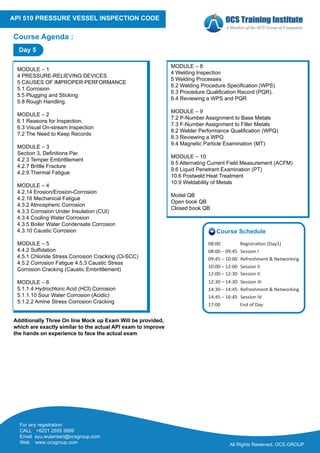
API 510 PRESSURE VESSEL INSPECTION CODE
Course Agenda :
MODULE – 1
4 PRESSURE-RELIEVING DEVICES
5 CAUSES OF IMPROPER PERFORMANCE
5.1 Corrosion
5.5 Plugging and Sticking
5.8 Rough Handling.
MODULE – 2
6.1 Reasons for Inspection.
6.3 Visual On-stream Inspection
7.2 The Need to Keep Records
MODULE – 3
Section 3, Definitions Par.
4.2.3 Temper Embrittlement
4.2.7 Brittle Fracture
4.2.9 Thermal Fatigue
MODULE – 4
4.2.14 Erosion/Erosion-Corrosion
4.2.16 Mechanical Fatigue
4.3.2 Atmospheric Corrosion
4.3.3 Corrosion Under Insulation (CUI)
4.3.4 Cooling Water Corrosion
4.3.5 Boiler Water Condensate Corrosion
4.3.10 Caustic Corrosion
MODULE – 5
4.4.2 Sulfidation
4.5.1 Chloride Stress Corrosion Cracking (Cl-SCC)
4.5.2 Corrosion Fatigue 4.5.3 Caustic Stress
Corrosion Cracking (Caustic Embrittlement)
MODULE – 6
5.1.1.4 Hydrochloric Acid (HCl) Corrosion
5.1.1.10 Sour Water Corrosion (Acidic)
5.1.2.2 Amine Stress Corrosion Cracking
MODULE – 8
4 Welding Inspection
5 Welding Processes
6.2 Welding Procedure Specification (WPS)
6.3 Procedure Qualification Record (PQR).
6.4 Reviewing a WPS and PQR
MODULE – 9
7.2 P-Number Assignment to Base Metals
7.3 F-Number Assignment to Filler Metals
8.2 Welder Performance Qualification (WPQ)
8.3 Reviewing a WPQ
9.4 Magnetic Particle Examination (MT)
MODULE – 10
9.5 Alternating Current Field Measurement (ACFM)
9.6 Liquid Penetrant Examination (PT)
10.6 Postweld Heat Treatment
10.9 Weldability of Metals
Model QB
Open book QB
Closed book QB
Day 5
Additionally Three On line Mock up Exam Will be provided,
which are exactly similar to the actual API exam to improve
the hands on experience to face the actual exam
Course Schedule
08:00 Registra�on (Day1)
08:00 – 09:45 Session I
09:45 – 10:00 Refreshment & Networking
10:00 – 12:00 Session II
12:00 – 12:30 Session II
12:30 – 14:30 Session III
14:30 – 14:45 Refreshment & Networking
14:45 – 16:45 Session IV
17:00 End of Day

OCS Training API 510 pressure vessel preparation course 2019

  • 1.
    Over More than40 years’ Experience in repair, inspection, alteration of pressure vessels and Pressure relief valves and the associated damage Mechanisms, and external , internal and NDE inspection and frequencies of inspection and RBI . He Has trained a lot of Major Organi- zations in India and in The gulf and recently in Vietnam. He is a well-known specialist in Petro chemical and Processing Industries. He has been approved by API as Authorized inspector in Pressure Vessel inspection, Pipeline inspection, Storage tank inspection, Damage mechanism specialization, Risk based inspec- tion Training will involve a lot of Audio Visual Aids, Power Points, animations, Simulation, Case History Discussion, and Practical. • API-510, Pressure Vessel Inspection Code - Mainte- nance Inspection, Rating, Repair and Alteration • API 571, Damage Mechanisms Affecting Fixed Equipment in the Refining Industry • API 572, Inspection of Pressure Vessels • API 576, Inspection of Pressure-Relieving Devices • API 577, Welding Inspection and Metallurgy • ASME, Boiler and Pressure Vessel Code • ASME Section V • ASME Section VIII • ASME Section IX API Publication: This five-day course will provide an intensive knowledge regarding inspection, repair and alteration of Pressure vessels. The course fulfills the need for deciding the inspection methods and Frequency of inspection based on the eval- uation of the condition of the vessel Entire course content will be consistent with the body of knowledge for 510 examination. The course will help the individuals to understand API Recommended Practice 510 along with other referenced standards like ASME. The participants will be given a thorough coverage of API 510 with emphasis on understanding of ‘stated’ and ‘implied’ requirements in a simple straightforward manner backed up with several practical examples and case studies. This course will employ latest audio visuals and anima- tions and Mock quiz to give the candidates deep under- standing. This course is designed to give the participants the confidence to face the API 510 Pressure Vessel Inspector Certification Examination and come out successfully with excellent score. Course Overview: - AYT International, Qatar - RAY International, Oman - Saiba Engineering, Richards Bay - Technique Inspection & Controle (Tic), Tunisia - Mitech Instrument Company Limited, China - Riversafe Solutions Nigeria Ltd., Nigeria - Qatar Technical Petroleum Center, Qatar - Bhp Billition Limited, Newman - Engg Contra Kuwait Company, Kuwait - Al-Hayathem General Trading & Contracting Group W.L.L., Kuwait - Kupic For Scientific Consultancy, Kuwait - Al-Babtain Power & Telecommunication Co., Saudi Arabia - Cameron Services Middle East L.L.C., Oman - Dimensi Barumas Perdana, Indonesia - Gennesaret Resources Nigeria Limited, Nigeria - Hyundai Heavy Industries Nigeria Limited, Nigeria - Joint Venture Vietsovpetro (Vsp), Vietnam - Larsen & Toubro (Jiangsu) Valve Co Ltd, China - Nead Technology Application Development Company, Vietnam. - Petrovietnam Cpse, Vietnam - Rusayl Institute, Oman - Vietnam Inspection Services Company Limited, Vietnam CLIENT LIST: OCS Training Instructor All Rights Reserved. OCS GROUPAll Rights Reserved. OCS GROUP For any registration: CALL +6221 2555 5689 Email ayu.wulansari@ocsgroup.com Web www.ocsgroup.com API 510 PRESSURE VESSEL INSPECTION CODE Sharpen your skills for Maintenance Inspection, Rating, Repair and Alteration of Pressure Vessel Systems! API 510 PRESSURE VESSEL INSPECTION CODE Sharpen your skills for Maintenance Inspection, Rating, Repair and Alteration of Pressure Vessel Systems!
  • 2.
    All Rights Reserved.OCS GROUP For any registration: CALL +6221 2555 5689 Email ayu.wulansari@ocsgroup.com Web www.ocsgroup.com API 510 PRESSURE VESSEL INSPECTION CODE Course Agenda : MODULE – 1 1 Scope 3.1 Terms and Definitions 4 Owner/User Inspections Organization 4.1 Owner/User Organization Responsibilities MODULE – 2 5.1 Inspection Plans 5.7 Condition Monitoring Methods 5.12 Inspection of Shell MODULE – 3 6 Interval/Frequency and Extent of Inspection 6.5 Internal, On-stream, and Thickness Measurement Inspections 6.6 Pressure-relieving Devices 6.7 Deferral of Inspection Due Dates. MODULE – 4 7.1 Corrosion Rate Determination 7.2 Remaining Life Calculations MODULE – 5 UG-16 General UG-27 Thickness of Shells Under Internal Pressure UG-32 Formed Heads, and Sections, Pressure on Concave Side UG-40 Limits of Reinforcement Model QB Open book QB Closed book QB MODULE – 1 UG-80 Permissible Out of Roundness of Cylindrical, Conical, and Spherical Shells UG-81 Tolerance for Formed Heads UG-99 Standard Hydrostatic Test MODULE – 2 UG-100 Pneumatic Test UG-101 Proof Tests to Establish Maximum Allowable Working Pressure UG-103 Nondestructive Testing UG-116 Required Marking MODULE – 3 UW-12 Joint Efficiencies UW-16 Minimum Requirements for Attachment Welds at Openings UW-33 Alignment Tolerance UW-35 Finished Longitudinal and Circumferential Joints MODULE – 4 UW-51 Radiographic Examination of Welded Joints UW-52 Spot Examination of Welded Joints UCS-56 Requirements for Postweld Heat Treatment UCS-57 Radiographic Examination MODULE – 5 UCS-66 Materials UCS-68 Design Model QB Open book QB Closed book QB Day 1 Day 2 Course Objectives: To prepare well for API 510 Exam & increase the Probability of Success To understand basic design and the rules for correct fabrication, inspection and testing of pressure vessels To learn the basic requirements for inspection of pressure vessels placed in service. To calculate corrosion rate, interval of inspection and similar parameters of Vessel inspection To Perform all basic vessel calculations needed for the API exam (e.g. thinning, test pressure, MAWP, static head, MDMT, corrosion rates, remaining life, etc) To learn inspection, repair, alteration, & Re-rating of the Pressure Vessels in Service To Review welding procedures (WPS/PQR) and welder performance qualifications (WPQ) Who Should Attend : This course specially designed for: Mechanical Engineers involving Pressure vessel Inspection Metallurgists, Corrosion engineers seeking broad knowledge of damage mechanisms of the PV used in petroleum and refining industries Inspection Engineers Maintenance engineers Personnel involved in PV repair alteration including Qualification of welding Procedure Quality Managers, Plant Engineer
  • 3.
    All Rights Reserved.OCS GROUP For any registration: CALL +6221 2555 5689 Email ayu.wulansari@ocsgroup.com Web www.ocsgroup.com OCS Training understands that in current economic climate, getting an excellent return on your training investment is critical for all our clients. This excellent training can be conducted exclusively for your organi- zation. The training can be tailored to meet your specif- ic needs at your preferred location and time. We will meet you anywhere around the globe. If you like to know more about this excellent program, please contact us on +6221 2555 5772 or email at sales@ocsgroup.com IN-HOUSE SOLUTIONS SAVE COST • IMPROVE PERFORMANCE • REDUCE RISK API 510 PRESSURE VESSEL INSPECTION CODE Course Agenda : MODULE – 1 QW-150 Tension Tests QW-153 Acceptance Criteria — Tension Tests QW-200 General MODULE – 2 QW-304 Welders QW-306 Combination Of Welding Processes QW-320 Retests And Renewal Of Qualification QW-321 Retests MODULE – 3 QW-350 Welding Variables For Welders QW-406 Preheat Table QW/QB-422 Ferrous/Nonferrous P-Numbers Grouping of Base Metals for Qualification MODULE – 4 QW-423 Alternate Base Materials For Welder Qualification QW-433 Alternate F-numbers For Welder Perfor- mance Qualification MODULE – 5 T-110 SCOPE T-120 General Article 2 Radiographic Examination Model QB Open book QB Closed book QB MODULE – 1 Article 6 Liquid Penetrant Examination Article 7 Magnetic Particle Examination MODULE – 2 Article 23 Ultrasonic Standards MODULE – 3 5. Reasons for Inspection. 5.2 Safety 5.4 Regulatory Requirements. MODULE – 4 6.2 Inspection for Specific Types of Damage. 6.3 Developing Inspection Plans 7.1 General 8.1 Safety Precautions MODULE – 5 9.2 Thickness Measurements. 9.3 External Inspection 9.4 Internal Inspection. 1 0.2 Visual Inspection. Model QB Open book QB Closed book QB Day 3 Day 4 “To improve management control of process unit inspection, repair, alteration and rerating; and to reduce the potential for inspection delays resulting from regulatory requirements.” -- API.org on API 570 Certification
  • 4.
    All Rights Reserved.OCS GROUP For any registration: CALL +6221 2555 5689 Email ayu.wulansari@ocsgroup.com Web www.ocsgroup.com API 510 PRESSURE VESSEL INSPECTION CODE Course Agenda : MODULE – 1 4 PRESSURE-RELIEVING DEVICES 5 CAUSES OF IMPROPER PERFORMANCE 5.1 Corrosion 5.5 Plugging and Sticking 5.8 Rough Handling. MODULE – 2 6.1 Reasons for Inspection. 6.3 Visual On-stream Inspection 7.2 The Need to Keep Records MODULE – 3 Section 3, Definitions Par. 4.2.3 Temper Embrittlement 4.2.7 Brittle Fracture 4.2.9 Thermal Fatigue MODULE – 4 4.2.14 Erosion/Erosion-Corrosion 4.2.16 Mechanical Fatigue 4.3.2 Atmospheric Corrosion 4.3.3 Corrosion Under Insulation (CUI) 4.3.4 Cooling Water Corrosion 4.3.5 Boiler Water Condensate Corrosion 4.3.10 Caustic Corrosion MODULE – 5 4.4.2 Sulfidation 4.5.1 Chloride Stress Corrosion Cracking (Cl-SCC) 4.5.2 Corrosion Fatigue 4.5.3 Caustic Stress Corrosion Cracking (Caustic Embrittlement) MODULE – 6 5.1.1.4 Hydrochloric Acid (HCl) Corrosion 5.1.1.10 Sour Water Corrosion (Acidic) 5.1.2.2 Amine Stress Corrosion Cracking MODULE – 8 4 Welding Inspection 5 Welding Processes 6.2 Welding Procedure Specification (WPS) 6.3 Procedure Qualification Record (PQR). 6.4 Reviewing a WPS and PQR MODULE – 9 7.2 P-Number Assignment to Base Metals 7.3 F-Number Assignment to Filler Metals 8.2 Welder Performance Qualification (WPQ) 8.3 Reviewing a WPQ 9.4 Magnetic Particle Examination (MT) MODULE – 10 9.5 Alternating Current Field Measurement (ACFM) 9.6 Liquid Penetrant Examination (PT) 10.6 Postweld Heat Treatment 10.9 Weldability of Metals Model QB Open book QB Closed book QB Day 5 Additionally Three On line Mock up Exam Will be provided, which are exactly similar to the actual API exam to improve the hands on experience to face the actual exam Course Schedule 08:00 Registra�on (Day1) 08:00 – 09:45 Session I 09:45 – 10:00 Refreshment & Networking 10:00 – 12:00 Session II 12:00 – 12:30 Session II 12:30 – 14:30 Session III 14:30 – 14:45 Refreshment & Networking 14:45 – 16:45 Session IV 17:00 End of Day