CONTBIPOMinf ART ROM OCEANIA
PAPUA NEW GUINEA * VANUATU • NEW CALEDONIA
           the October gallery
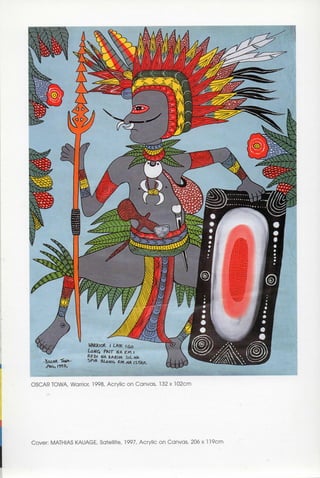
OSCAR TOWA Warrior, 1998, Acrylic on Canvas, 132 x 102cm


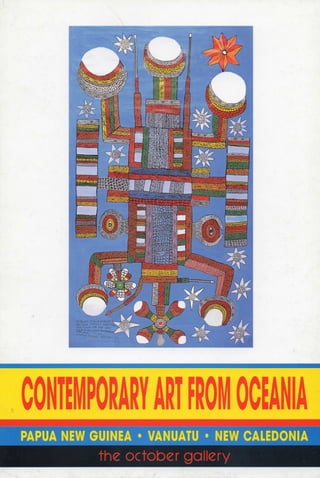
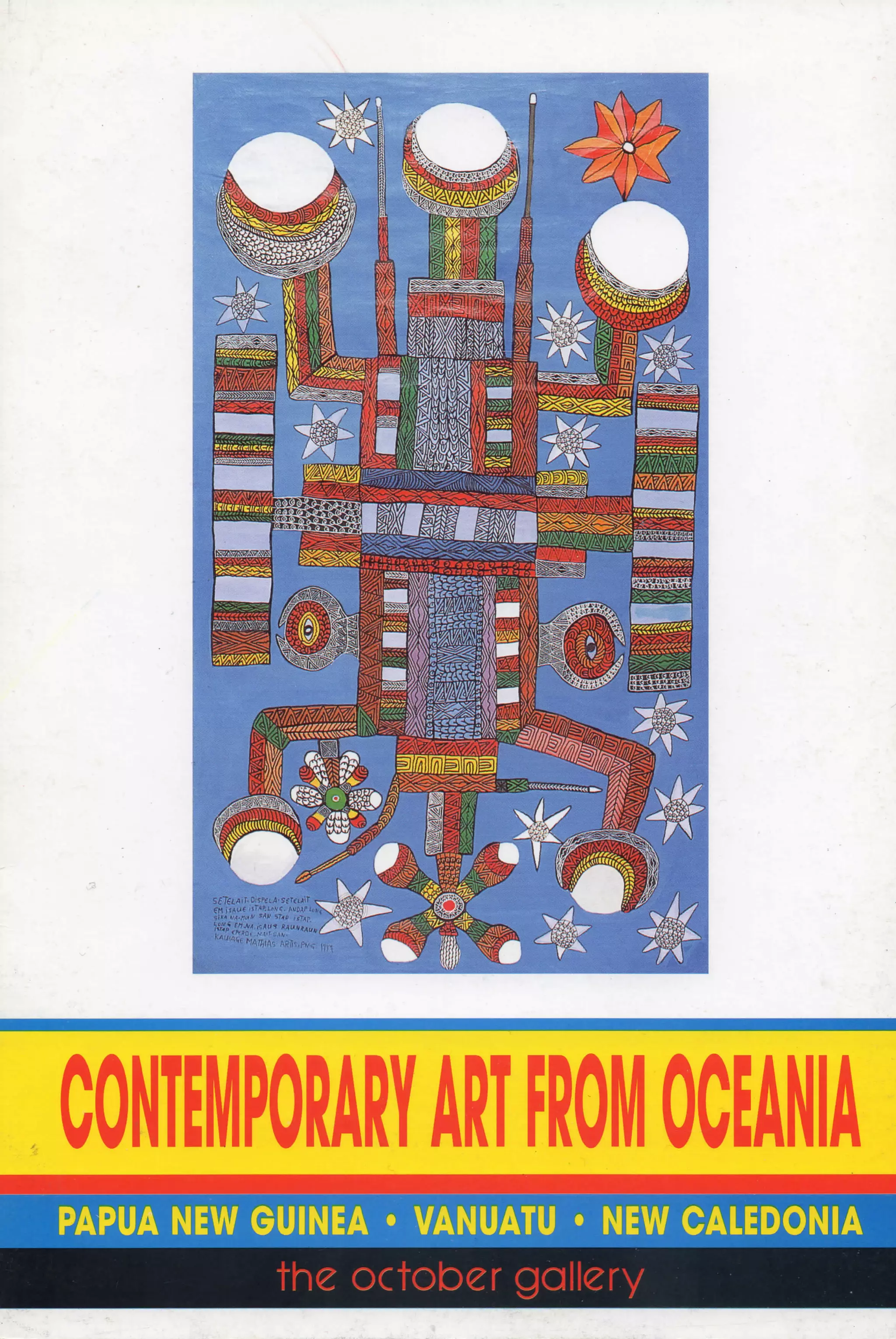
Cover: MATH IAS KAUAGE, Satellite, 1997, Acrylic on Canvas, 206 x 119cm
NEW COLOURS FROM OLD WORLDS
                 CONTEMPORARY ART FROM OCEANIA
                  PAPUA NEW GUINEA, VANUATU, NEW CALEDONIA
                      13 NOVEMBER 1998 - 23 JANUARY 1999

Artis Bilong Tude - Artists of Today
Almost a century has now passed since traditional art from the Melanesian region
of Oceania made such a profound impression on the avant-garde artists of Europe.
Today another phenomenon - perhaps of equal importance to that previous one -
is underway. Welcome to the new era of Pacific Art!
Although contemporary art movements have been steadily emerging in the
Melanesian countries of Papua New Guinea, Vanuatu, Fiji, the Solomon Islands and
New Caledonia since the 1970s, these developments have'gone largely unnoticed
by the European art world, This can be explained partly by the remoteness of these
islands from Europe and partly by a lack of resources and opportunities for artists
from the Melanesian region to promote their art effectively overseas.
There has, moreover, been an unfortunate tendency for European collectors to
dismiss the new art of the Pacific as being unimportant, especially when compared
to the phenomenal range of tribal art produced throughout Melanesia. Whatever
the case, tribal art and contemporary art are both equally valid expressions of
indigenous cultural values. While the tribal arts celebrate and maintain the
inherited traditions of the highly diverse cultures of Melanesia, the contemporary
art of today explores new experiences, and analyses the impact of events and
trends that become ever more common in the daily life of the indigenous peoples.


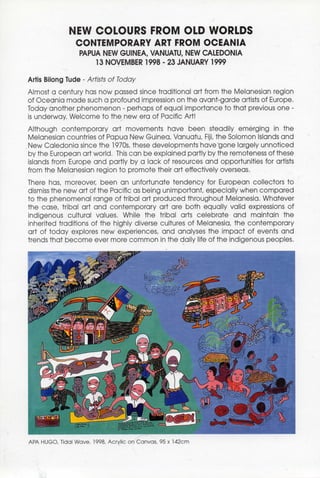
APA HUGO, Tidal Wave, 1998, Acrylic on Canvas, 95 x 142cm
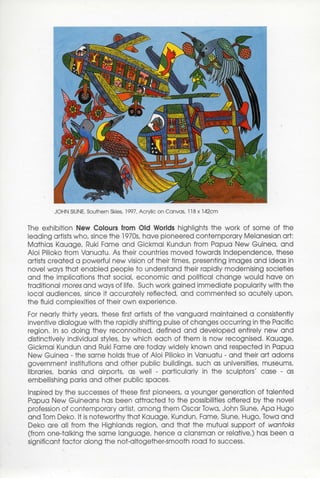
JOHN SIUNE, Southern Skies, 1997, Acrylic on Canvas, 118x142cm


The exhibition New Colours from Old Worlds highlights the work of some of the
leading artists who, since the 1970s, have pioneered contemporary Melanesian art:
Mathias Kauage, Ruki Fame and Gickmai Kundun from Papua New Guinea, and
Aloi Pilioko from Vanuatu. As their countries moved towards Independence, these
artists created a powerful new vision of their times, presenting images and ideas in
novel ways that enabled people to understand their rapidly modernising societies
and the implications that social, economic and political change would have on
traditional mores and ways of life. Such work gained immediate popularity with the
local audiences, since it accurately reflected, and commented so acutely upon,
the fluid complexities of their own experience.
For nearly thirty years, these first artists of the vanguard maintained a consistently
inventive dialogue with the rapidly shifting pulse of changes occurring in the Pacific
region. In so doing they reconnoitred, defined and developed entirely new and
distinctively individual styles, by which each of them is now recognised. Kauage,
Gickmai Kundun and Ruki Fame are today widely known and respected in Papua
New Guinea - the same holds true of Aloi Pilioko in Vanuatu - and their art adorns
government institutions and other public buildings, such as universities, museums,
libraries, banks and airports, as well - particularly in the sculptors' case - as
embellishing parks and other public spaces.
Inspired by the successes of these first pioneers, a younger generation of talented
Papua New Guineans has been attracted to the possibilities offered by the novel
profession of contemporary artist, among them Oscar Towa, John Siune, Apa Hugo
and Tom Deko. It is noteworthy that Kauage, Kundun, Fame, Siune, Hugo, Towa and
Deko are all from the Highlands region, and that the mutual support of wantoks
(from one-talking the same language, hence a clansman or relative,) has been a
significant factor along the not-altogether-smooth road to success.
Generally speaking there are certain cultural restraints that prevent Melanesian
women from succeeding in such an individualistic profession as that of the
contemporary artist. Juliette Pita is the only ni-Vanuatu woman so far to have followed
this course, and of the few women from Papua New Guinea to choose an artistic
career only Wendi Choulai, who now lives in Australia, has continued to produce
significant work. By contrast to other Melanesian countries, in New Caledonia, several
Kanak women have spearheaded the contemporary art movement. While men
continue to dominate the practice of sculpture, Kanak women, represented in this
exhibition by Yvette Bouquet, have found their strengths in painting and installation
work, neither of which forms of creative expression is traditional to Kanak society.
Writing from 'down under' in New Caledonia and from a privileged vantage point, I
am witness to and can report the achievements and rapidly spreading influence of
contemporary Melanesian artists both within and, increasingly, beyond the Asia
Pacific region. Kauage, Tom Deko and a number of talented artists that European
audiences have yet to discover, created a great impression at the 1993 and 1996 Asia
Pacific Triennales at the Queensland Art Gallery in Brisbane, Australia, the major
international arts event of the region. The indefatigable Pilioko, together with his
partner Nicolai Michoutouchkine, mounts regular exhibitions both in Pacific and Asian
countries. Yvette Bouquet has just returned from three months as artist-in-residence in
Basel, Switzerland. These highlights provide a background context to the exhibition
New Colours from Old Worlds at the October Gallery in London.
The first major collection of contemporary
Pacific art has recently been established by the
prestigious Tjibaou Cultural Centre in New
Caledonia, which institution will continue to play
an increasingly significant role in encouraging
and promoting contemporary Pacific art.
Important works by each artist represented in
this exhibition feature in the growing collection
held at this Cultural Centre. Furthermore, the
National Gallery of Australia as well as other
State and regional galleries, both in Australia
and New Zealand, have started to collect
contemporary Melanesian art seriously. Several
major exhibitions and events, including the
spectacular Festival of Pacific Arts and the
Sydney 2000 Olympic Festival are being
planned, that will both celebrate the year 2000
and confirm the opening of a new era of Pacific
contemporary art.
Whilst the old images and colours may have
been transformed, little has been lost in the
transmission, and the new millennium will
continue to witness the contemporary resurgence
of those powerful creative energies that have
been the inspirational source of Pacific art from
time immemorial.

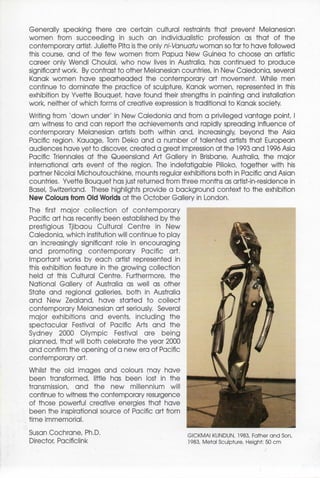
Susan Cochrane, Ph.D.                                GICKMAI KUNDUN, 1983, Father and Son,
Director, Pacificlink                                1983, Metal Sculpture, Height: 50 c m
This brochure is produced in partnership with Rio Tinto pic.


                        RIO
                       TINTO


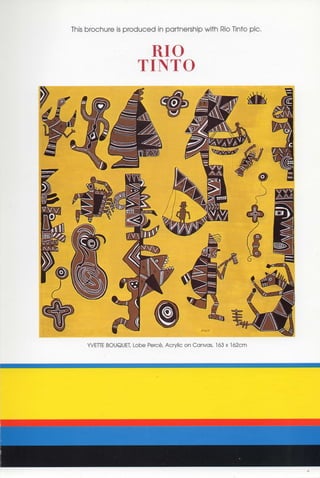
     YVETTE BOUQUET, Lobe Perce, Acrylic on Canvas, 163 x 162cm
New Colours from Old Worlds:
        The October Gallery gratefully acknowledges the support of
      The International Initiatives Fund of the Arts Council of England,
             Air Niugini, Qantas Airways Ltd. a n d Rio Tinto pic.
The October Gallery Education Programme is supported by Marks & Spencer,
the Esmee Fairbairn Charitable Trust and the Save & Prosper Educational Trust.


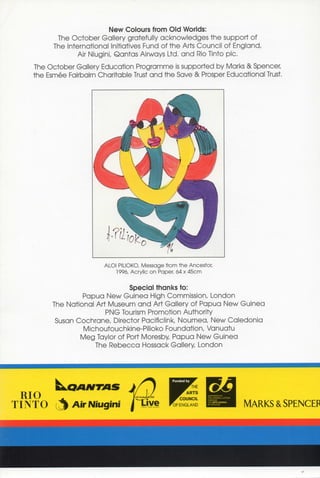
                      ALOI PILIOKO Message from the Ancestor,
                          1996, Acrylic on Paper, 64 x 45cm


                            Special thanks to:
              Papua New Guinea High Commission, London
     The National Art Museum a n d Art Gallery of Papua New Guinea
                     PNG Tourism Promotion Authority
      Susan Cochrane, Director Pacificlink, Noumea, New Caledonia
              Michoutouchkine-Pilioko Foundation, Vanuatu
             Meg Taylor of Port Moresby, Papua New Guinea
                  The Rebecca Hossack Gallery, London
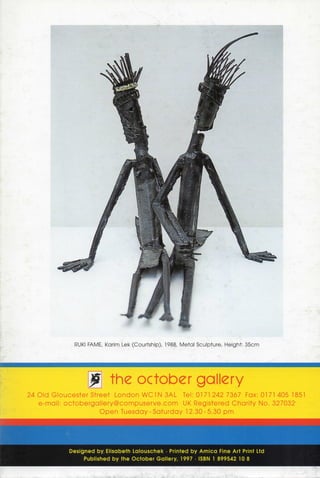
RUKI FAME, Karim Lek (Courtship), 1988, Metal Sculpture, Height: 35cm


                           J          the October gallery
24 O l d G l o u c e s t e r Street L o n d o n WC1 N 3AL Tel: 0171 242 7367 Fax: 0171 405 1851
   e - m a i l : o c t o b e r g a l l e r y @ c o m p u s e r v e . c o m UK Registered C h a r i t y No, 327032-
                                  O p e n Tuesday - S a t u r d a y 12.30-5.30 p m


                 D e s i g n e d by, E l i s a b e t h L a l o u s c h e k • Printed b y A r n i c a Fine Art Print Ltd
                        P u b l i s h e d b y t h e O c t o b e r G a l l e r y , 1997 • ISBN 1 8 9 9 5 4 2 10 8

New Colours from Old Worlds - Contemporary Art from Oceania

  • 1.
    CONTBIPOMinf ART ROMOCEANIA PAPUA NEW GUINEA * VANUATU • NEW CALEDONIA the October gallery
  • 2.
    OSCAR TOWA Warrior,1998, Acrylic on Canvas, 132 x 102cm Cover: MATH IAS KAUAGE, Satellite, 1997, Acrylic on Canvas, 206 x 119cm
  • 3.
    NEW COLOURS FROMOLD WORLDS CONTEMPORARY ART FROM OCEANIA PAPUA NEW GUINEA, VANUATU, NEW CALEDONIA 13 NOVEMBER 1998 - 23 JANUARY 1999 Artis Bilong Tude - Artists of Today Almost a century has now passed since traditional art from the Melanesian region of Oceania made such a profound impression on the avant-garde artists of Europe. Today another phenomenon - perhaps of equal importance to that previous one - is underway. Welcome to the new era of Pacific Art! Although contemporary art movements have been steadily emerging in the Melanesian countries of Papua New Guinea, Vanuatu, Fiji, the Solomon Islands and New Caledonia since the 1970s, these developments have'gone largely unnoticed by the European art world, This can be explained partly by the remoteness of these islands from Europe and partly by a lack of resources and opportunities for artists from the Melanesian region to promote their art effectively overseas. There has, moreover, been an unfortunate tendency for European collectors to dismiss the new art of the Pacific as being unimportant, especially when compared to the phenomenal range of tribal art produced throughout Melanesia. Whatever the case, tribal art and contemporary art are both equally valid expressions of indigenous cultural values. While the tribal arts celebrate and maintain the inherited traditions of the highly diverse cultures of Melanesia, the contemporary art of today explores new experiences, and analyses the impact of events and trends that become ever more common in the daily life of the indigenous peoples. APA HUGO, Tidal Wave, 1998, Acrylic on Canvas, 95 x 142cm
  • 4.
    JOHN SIUNE, SouthernSkies, 1997, Acrylic on Canvas, 118x142cm The exhibition New Colours from Old Worlds highlights the work of some of the leading artists who, since the 1970s, have pioneered contemporary Melanesian art: Mathias Kauage, Ruki Fame and Gickmai Kundun from Papua New Guinea, and Aloi Pilioko from Vanuatu. As their countries moved towards Independence, these artists created a powerful new vision of their times, presenting images and ideas in novel ways that enabled people to understand their rapidly modernising societies and the implications that social, economic and political change would have on traditional mores and ways of life. Such work gained immediate popularity with the local audiences, since it accurately reflected, and commented so acutely upon, the fluid complexities of their own experience. For nearly thirty years, these first artists of the vanguard maintained a consistently inventive dialogue with the rapidly shifting pulse of changes occurring in the Pacific region. In so doing they reconnoitred, defined and developed entirely new and distinctively individual styles, by which each of them is now recognised. Kauage, Gickmai Kundun and Ruki Fame are today widely known and respected in Papua New Guinea - the same holds true of Aloi Pilioko in Vanuatu - and their art adorns government institutions and other public buildings, such as universities, museums, libraries, banks and airports, as well - particularly in the sculptors' case - as embellishing parks and other public spaces. Inspired by the successes of these first pioneers, a younger generation of talented Papua New Guineans has been attracted to the possibilities offered by the novel profession of contemporary artist, among them Oscar Towa, John Siune, Apa Hugo and Tom Deko. It is noteworthy that Kauage, Kundun, Fame, Siune, Hugo, Towa and Deko are all from the Highlands region, and that the mutual support of wantoks (from one-talking the same language, hence a clansman or relative,) has been a significant factor along the not-altogether-smooth road to success.
  • 5.
    Generally speaking thereare certain cultural restraints that prevent Melanesian women from succeeding in such an individualistic profession as that of the contemporary artist. Juliette Pita is the only ni-Vanuatu woman so far to have followed this course, and of the few women from Papua New Guinea to choose an artistic career only Wendi Choulai, who now lives in Australia, has continued to produce significant work. By contrast to other Melanesian countries, in New Caledonia, several Kanak women have spearheaded the contemporary art movement. While men continue to dominate the practice of sculpture, Kanak women, represented in this exhibition by Yvette Bouquet, have found their strengths in painting and installation work, neither of which forms of creative expression is traditional to Kanak society. Writing from 'down under' in New Caledonia and from a privileged vantage point, I am witness to and can report the achievements and rapidly spreading influence of contemporary Melanesian artists both within and, increasingly, beyond the Asia Pacific region. Kauage, Tom Deko and a number of talented artists that European audiences have yet to discover, created a great impression at the 1993 and 1996 Asia Pacific Triennales at the Queensland Art Gallery in Brisbane, Australia, the major international arts event of the region. The indefatigable Pilioko, together with his partner Nicolai Michoutouchkine, mounts regular exhibitions both in Pacific and Asian countries. Yvette Bouquet has just returned from three months as artist-in-residence in Basel, Switzerland. These highlights provide a background context to the exhibition New Colours from Old Worlds at the October Gallery in London. The first major collection of contemporary Pacific art has recently been established by the prestigious Tjibaou Cultural Centre in New Caledonia, which institution will continue to play an increasingly significant role in encouraging and promoting contemporary Pacific art. Important works by each artist represented in this exhibition feature in the growing collection held at this Cultural Centre. Furthermore, the National Gallery of Australia as well as other State and regional galleries, both in Australia and New Zealand, have started to collect contemporary Melanesian art seriously. Several major exhibitions and events, including the spectacular Festival of Pacific Arts and the Sydney 2000 Olympic Festival are being planned, that will both celebrate the year 2000 and confirm the opening of a new era of Pacific contemporary art. Whilst the old images and colours may have been transformed, little has been lost in the transmission, and the new millennium will continue to witness the contemporary resurgence of those powerful creative energies that have been the inspirational source of Pacific art from time immemorial. Susan Cochrane, Ph.D. GICKMAI KUNDUN, 1983, Father and Son, Director, Pacificlink 1983, Metal Sculpture, Height: 50 c m
  • 6.
    This brochure isproduced in partnership with Rio Tinto pic. RIO TINTO YVETTE BOUQUET, Lobe Perce, Acrylic on Canvas, 163 x 162cm
  • 7.
    New Colours fromOld Worlds: The October Gallery gratefully acknowledges the support of The International Initiatives Fund of the Arts Council of England, Air Niugini, Qantas Airways Ltd. a n d Rio Tinto pic. The October Gallery Education Programme is supported by Marks & Spencer, the Esmee Fairbairn Charitable Trust and the Save & Prosper Educational Trust. ALOI PILIOKO Message from the Ancestor, 1996, Acrylic on Paper, 64 x 45cm Special thanks to: Papua New Guinea High Commission, London The National Art Museum a n d Art Gallery of Papua New Guinea PNG Tourism Promotion Authority Susan Cochrane, Director Pacificlink, Noumea, New Caledonia Michoutouchkine-Pilioko Foundation, Vanuatu Meg Taylor of Port Moresby, Papua New Guinea The Rebecca Hossack Gallery, London
  • 8.
    RUKI FAME, KarimLek (Courtship), 1988, Metal Sculpture, Height: 35cm J the October gallery 24 O l d G l o u c e s t e r Street L o n d o n WC1 N 3AL Tel: 0171 242 7367 Fax: 0171 405 1851 e - m a i l : o c t o b e r g a l l e r y @ c o m p u s e r v e . c o m UK Registered C h a r i t y No, 327032- O p e n Tuesday - S a t u r d a y 12.30-5.30 p m D e s i g n e d by, E l i s a b e t h L a l o u s c h e k • Printed b y A r n i c a Fine Art Print Ltd P u b l i s h e d b y t h e O c t o b e r G a l l e r y , 1997 • ISBN 1 8 9 9 5 4 2 10 8