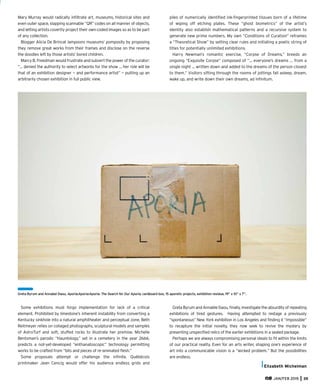
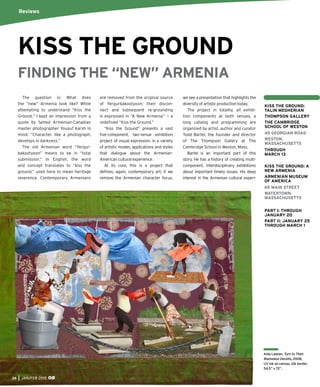
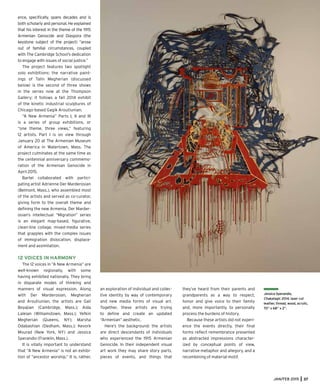
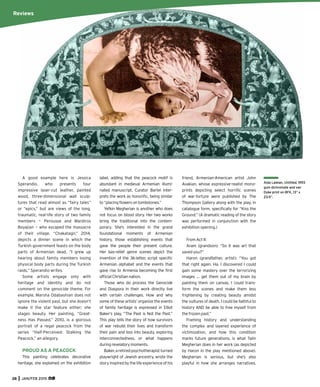
1
2 15
Download
app through
Apple Newsstand to get
your interactive tablet
edition on iOS
GO MOBILE!
January/February 2015 Free or $5.99 mailed copy
New England's Premier Culture Magazine
NEW ENGLAND PUBLIC
ART BREAKTHROUGH |
EXPANDING COLLECTIONS:
FULLER CRAFT & LAMONT
GALLERY | ARMENIAN ART’S
NEW GENERATION |
PROVIDENCE RENAISSANCE
PART 2? |
WE’RE ALL CURATORS, NOW |
WHO OWNS YOUR IMAGES
ONLINE?
COPLEY SOCIETY’S
CLASS OF 2015
INAUGURAL EXHIBITION OF WORK BY BFA ALUMNI
of the former Art Institute of Boston and the Lesley University College of Art and Design
JANUARY 29 – MARCH 22, 2015
Reception: Thursday, February 5, 6–8pm
LUNDER ARTS CENTER AT LESLEY UNIVERSITY
1801 Massachusetts Avenue | Porter Square | Cambridge, Massachusetts
617-349-8010 | lesley.edu/breakingground
Lesley University College of Art and Design is the new name for the Art Institute of Boston,
which for 100 years has shaped the ideas and career paths of visual artists and designers.
Our new Lunder Arts Center in Cambridge connects the arts throughout the university and our surrounding communities,
uniting the passion of the art school experience with the power of a Lesley education.
LESLEY UNIVERSITY COLLEGE OF ART AND DESIGN
LUNDER
ARTS
CENTER
above the fold
New Expressions in Origami
January 20–April 12 | D’Amour Museum of Fine Arts
NORTH AMERICAN DEBUT
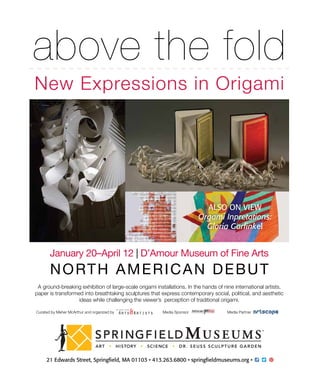
A ground-breaking exhibition of large-scale origami installations. In the hands of nine international artists,
paper is transformed into breathtaking sculptures that express contemporary social, political, and aesthetic
ideas while challenging the viewer’s perception of traditional origami.
Curated by Meher McArthur and organized by Media Sponsor Media Partner
ALSO ON VIEW
Orgami Inpretations:
Gloria Garfinkel
Image: Robert Maloney ‘96, Rescinder, mixed media (detail).
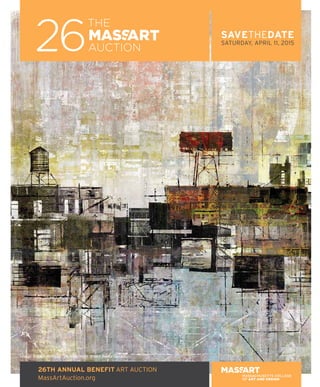
SAVETHEDATE
SATURDAY, APRIL 11, 2015
26TH ANNUAL BENEFIT ART AUCTION
MassArtAuction.org
Friday,  February  27,  7-­11  pm  
Tickets:  $20  museum  members,  
$50  non-­members,  space  is  limited!  
For  more  information  or  to
reserve  your  ticket  today  
visit  newportartmuseum.org  
or  call  401-­619-­7990
               
                  
a  mid-­winter’s  
white  party
76 Bellevue Ave. Newport, RI • newportartmuseum.org • Open: Tues.-Sat. 10-4pm, Sun. 12-4pm
2.27.15
          ESCAPE  THE  WINTER  DOLDRUMS     
    WITH  
                                                                                                                          AT  THE  
                                                          
NEWPORT  ART  MUSEUM
JOIN THE CONVERSATION
News feeds and more
VOLUME 9 — NUMBER 6
JANUARY & FEBRUARY 2015
Tweet @ascopemagazine
More coverage on the zine with your
social media commentary at
zine.artscopemagazine.com
Sign up for the AS email blast! and
have special artscope updates landing
in your inbox every two weeks!
To advertise, call 1.617.639.5771 or
email advertise@artscopemagazine.com
To subscribe, purchase online at
artscopemagazine.com or email
subscribe@artscopemagazine.com
Published by Boston Publishing House LLC
© Copyright 2015 Artscope magazine
All Rights Reserved. ISSN#1932-0582.
artscope reserves the right to edit all material
Reproduction in part or whole without
permission is strictly prohibited.
Subscribe to the
artscope magazine
tablet edition on
Newsstand to
receive each issue
instantly. Now
available world-
wide on your
iPad. Search Artscope
in your App Store.
GET THE MOBILE APP!
SUBSCRIBE TO NEWSSTAND!
FEATURES
Featured Exhibitions: 9
Members Show & Crafting
a Collection at Fuller Craft
Museum
Cover Story: 12
New Members’ Show 2015 at
Copley Society
Public Art: 24
Susan Champeny & The Myth
Makers
Artist Profile: 29
Leslie Fry
Behind the Screen: 34
The Perils of the Possible
EDITORIALS & EVENTS
Welcome Statement 8
Cornered: 20
FAWC Fellows Alexandria Smith
& Bridget Mullen
Centerfold: 40
Bruce Davidson’s Silos
Capsule Previews: 66
Ned Ward at the Gardner,
Candace Cotterman Thibeault
at Bridgewater State, Jeffrey
Marshall at Cape Ann Museum,
New Expressions in Origami
at Springfield Museums,
Michael Alfano at Attleboro
Arts Museum, Marc Chagall at
Spaightwood Galleries
Exhibits 69
Classifieds 78
Publisher KAVEH MOJTABAI
Managing Editor BRIAN GOSLOW
Copy Editor ANNE DALEY
Mobile App & Tablet Newsstand Media ARTSCOPE DESIGN GROUP
Design & Layout ARTSCOPE DESIGN GROUP
Email Blast! Editor LACEY DALEY
Media Development Associate VANESSA BOUCHER
Account Executive SHANI ABRAMOWITZ
Writers
CHRISTOPHER ARNOTT, LINDA CHESTNEY, MEREDITH CUTLER,
CATHERINE CREIGHTON, ARLENE DISTLER, DONNA DODSON,
JAMES DYMENT, JAMES FORITANO, FRANKLIN W. LIU, PAMELA
MANDELL, J. FATIMA MARTINS, ELIZABETH MICHELMAN, LISA
MIKULSKI, GREG MORELL, KRISTIN NORD, TARYN PLUMB, MARCIA
SANTORE, MARGUERITE SERKIN, LAURA SHABOTT, LEE STEELE,
ERIC J. TAUBERT, JAMIE THOMPSON, ALEXANDRA TURSI, SUZANNE
VOLMER, JAMIE WALLACE, DON WILKINSON.
CONTENTS
Artscope Magazine
809-B Hancock Street
Quincy, MA 02170
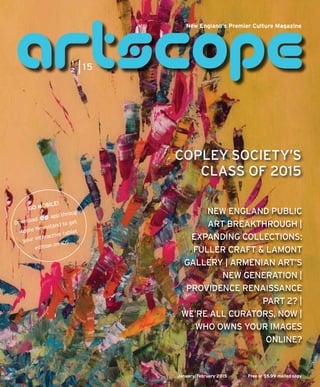
COVER: Kate Taylor, Tall Cosmos,
acrylic on panel with resin, 12” x 36”.
Page 15 Page 61
COMMUNITY
Providence, 2015 46
BUSINESS
Providence Entrepreneurial 42
Ventures
Protecting Your Creative 64
Work Online
REVIEWS
Peter Halley 15
at Griswold Museum
Bonnie Faulkner & 18
CarolAnn Tebbetts at Heartwood
Talin Megherian at 36
The Cambridge School of Weston
& Kiss the Ground at Armenian
Museum of America
Tracing the Thread & Goya 48
and Beethoven at Wheaton
College
Niho Kozuru 51
at Pine Manor
A Body in Fukushima 53
at Wesleyan
Julia Zanes 55
at Dianich Gallery
Open House: 58
A Portrait of Collecting
Universal Arts + Connecticut 61
People Learning Art at the
Gallery at Constitution Plaza
Page 48
8 JAN/FEB 2015
Artscope interactive
tablet edition gives
you pan and zoom,
slideshows, in-depth
audio/video, links to
maps of our wanderlust
reviews and more
anywhere worldwide on
your iPad. To subscribe
search Artscope in your
App Store.
Welcome to our first issue of 2015.
Between the holiday season and later
exhibition opening dates at the start of
the new year for many venues, putting
together our January/February issue
has traditionally been a challenge. This
time around, we decided to take advan-
tage of that challenge and allow our
writers to expand their coverage and
write about subjects that we otherwise
might not have had the space to feature
in these pages, wanting to provide
coverage that’ll make you want to hop in
your car or get on a bus or train to see a
show at a museum, gallery or performing
arts venue.
Hopefully, some of the articles in this
issue will assist those of you who’ve
looked for new ideas on how to bring
your art to a larger audience.
As more artists look toward the
Internet as a main means of promoting
their work, there is a lot of conflicting
information on who actually owns the
images once they’re posted on Facebook,
Twitter, Instagram and other social media
sites. Laura Shabott takes a look at the
policies of some of these sites and how
you can best protect your work.
With a growing number of cities and
communities seeking to rebrand their
images through public art, there are
a greater number of opportunities for
artists to get their work in front of the
public eye — and to get paid for those
efforts. I spoke with Susan Champeny,
whose “Snow Saucer Lady Bug” now sits
at the intersection of L and 2nd Streets in
Washington, D.C., and The Myth Makers
— Andy Moerlein and Donna Dodson
— who shared the process that led to
their “Avian Avatars” migrating to the
Garment District Plazas on Broadway in
New York City, where they’ll spend the
first three months of the year.
Dodson, who is also an Artscope
contributor, furthered the discussion
with a profile of Vermont sculptor Leslie
Fry, whose “Colossal AcornHead”
bronze sculpture graces the campus
of Tufts University in advance of her
upcoming shows in Brooklyn and NYC’s
Lower East Side.
Installation artists are amongst the
world’s greatest dreamers; as 2014 was
coming to a close, Artscope’s Elizabeth
Michelman, who is a sculptor and who
curated the 2013 HarborArts exhibi-
tion, participated in a show at the Eliza-
beth Foundation for the Arts, whose
“call for art” announcement sought
the “most audacious, outrageous or
impossible” proposals for an exhibition.
Since few of the artists had the means
to bring their ideas to fruition — or even
to the model stage — many of the gallery
walls only held printed proposals. Since
all great ideas, big or small, start in
this format, and since New York City
hosts corporations with the ability to
financially back making them real, this
story felt like it captured what goes on
inside the meeting of many municipal
groups working on a project that breaks
the mold and expectations for their
locations. As Elizabeth noted in an email
to me, “We are all curators, now.”
Back in the 1990s, Providence
reinvented itself through the financial
support and widespread promotion of its
arts community, and in doing so created
a model that cities and towns throughout
the country have been following ever
since. I asked Suzanne Volmer to look
back on what remains from that initial
period of activity and look forward
toward the galleries, shows and artists
you should look into at the start of the
new year.
Mindyou,therearealsoplentyofgreat
reviews and previews in the following
pages: J. Fatima Martins took on the
Herculean task of covering a series of
Armenian art exhibitions taking place
concurrently at the Armenian Museum
of America and The Cambridge School
of Weston, Mass., while pointing out the
exemplary curator’s class at Wheaton
College that put together its “Tracing
the Thread” and “Goya and Beethoven:
Finding a Voice Out of Silence” exhibi-
tions; Taryn Plumb spotlights two artists
featured in the Heartwood College of
Art’s MFA Degree Program Exhibition,
while Don Wilkinson explains why both
the Biennial Members and Crafting a
Collection exhibitions are worthy of a trip
to the Fuller Craft Museum.
Kristin Nord was all over Connecticut
to review and preview shows at the
Florence Griswold Museum (Peter
Halley), Wesleyan University (“A Body
in Fukushima”) and Hartford (Universal
Arts + Connecticut People Learning Art
Creative Entrepreneurs exhibition).
The issue’s cover art, Kate Taylor’s
acrylic-on-panel with resin “Tall Cosmos”
painting, is featured in the Copley
Society of Art’s New Members’ Show
2015, previewed by Marcia Santore.
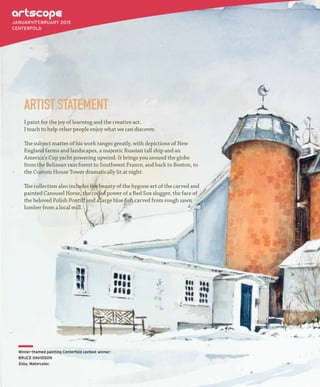
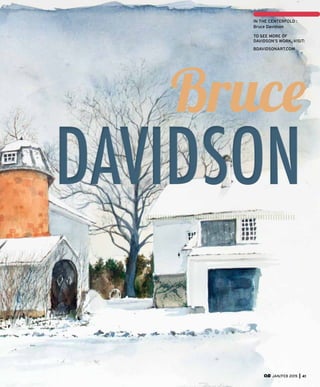
This issue’s centerfold contest winner,
with a winter-related painting theme, is
Bruce Davidson’s “Silos.” Thanks to our
jurors: Rachel Moore, assistant director
of the Helen Day Art Center, Sharon
Corwin, Carolyn Muzzy director and chief
curator at the Colby College Museum
of Art and Bill Everett, director of The
Guild of Boston Artists.
For our next contest, we’re looking for
your original 3-D paper work; full details
can be found in our Classifieds section.
As we were going to press, we were
pleased to learn that Artscope has been
accepted for inclusion at the Magazine
sector of the collective booth at this
year’s Art Basel, taking place from
June 18-21 in Basel, Switzerland.
With one of our major focuses in recent
years being the expansion of our publi-
cation’s reach by making it available
worldwide through Apple Newsstand,
and complementing it with social media
coverage on a variety of platforms which
allow us to expose New England’s visual
and performing artists, galleries and
institutions to a global audience — and
hopefully generating attention, shows
and sales in the process — we hope this
will contribute toward that goal.
Brian Goslow, managing editor
bgoslow@artscopemagazine.com
WELCOME
JAN/FEB 2015 9
There are any number of shifting
elements that contribute to the long-
term success of a non-profit art insti-
tution, including endowments and
fund raising, devoted trustees and
staff, public interest and support, and
forward-thinking curatorship. One
of the two most important pillars of
a museum may be the membership,
providing not only financial support
through the collection of dues, but
also offering input, contributing to
discourse and promoting patronage.
The other significant pillar is the collec-
tion itself, which must continue to grow
and evolve while maintaining true to
the mission of the institution.
The Fuller Craft Museum has recently
mounted two significant showings,
one devoted to member-artists, “The
2014 Biennial Members Exhibition,” and
“Crafting A Collection,” highlighting
recent acquisitions. Clearly, while there
are common threads between the two
exhibitions, each remains distinctive in
its focus while highlighting the works of
a staggering array of artisans and artists.
The “2014 Biennial Members Exhibi-
tion” was juried by Arthur Dion, the
director of Gallery NAGA in Boston, and
his smart and eclectic selections include
the usual craft museum media suspects
— woodworking, fiber arts, metalsmithing
and ceramics — and also painting,
drawing, photography and kinetic sculp-
ture. There are offerings by 47 artists.
Alan Weinstein’s “Kong” is a pedestal-
mounted, sad-faced gorilla, carved
from black marble. In this instance, the
mythical Hollywood great ape’s Fay
Wray is realized as a Barbie doll, and as
he clutches her in his massive paw-hand,
his pout and slouch of resignation
remind us that beauty has, indeed, killed
the beast — at least metaphorically.
“Knockabout” by David A. Lang is odd
and enchanting. Nineteen small antique
bottles that have held medicine or syrup
are partially clear, part chalky white,
leaning toward powdery blue. They are
set in a crude pine box, and as if by magic,
the bottles swerve, bow and dance.
SEEKING ABSOLUTION
Made of terracotta, porcelain and
copper luster, Dan Molyneux’s “Forgive
Me Daughter for I Have Sinned” creates
an unknowable fairy tale. The compo-
nents that make up the work are evoca-
tive. A man, carrying a lamb across his
shoulders and wearing a medieval-
looking tunic, approaches a sinewy
and twisted skyscraper. Atop a turret,
a young pigtailed girl in a pretty dress
and Mary Janes looks the other way and
plays a clarinet. Metallic-coated chess
pieces further complicate the story, and
one realizes the answers need not be
spelled out to appreciate the mystery.
Linda DiFrenna’s “Behind the
Screen” is also enveloped with enigma.
Mounted on the wall, gold-colored tight
mesh screen covers black-and-white
photographs of blindfolded women,
but whether they are hostages, kinky
participants in an erotic game or murky
embodiments of Justice is unclear.
Michael Pietragalla’s strikingly
handsome “Floating Table,” made of
sycamore, lacewood, purple heart and
FEATURED EXHIBITION
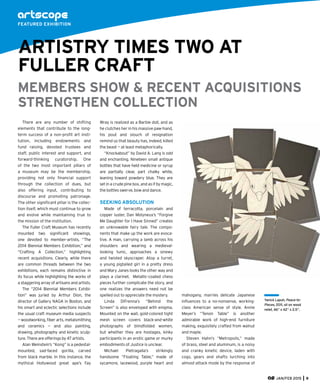
ARTISTRY TIMES TWO AT
FULLER CRAFT
Yanick Lapuh, Peace-to-
Pieces, 2011, oil on wood
relief, 46” x 42” x 2.5”.
mahogany, marries delicate Japanese
influences to a no-nonsense, working-
class American sense of style. Annie
Meyer’s “Tenon Table” is another
admirable work of high-end furniture
making, exquisitely crafted from walnut
and maple.
Steven Hahn’s “Metropolis,” made
of brass, steel and aluminum, is a noisy
and cranky kinetic device, laden with
cogs, gears and shafts lurching into
almost-attack mode by the response of
MEMBERS SHOW & RECENT ACQUISITIONS
STRENGTHEN COLLECTION
10 JAN/FEB 2015
Featured Exhibition
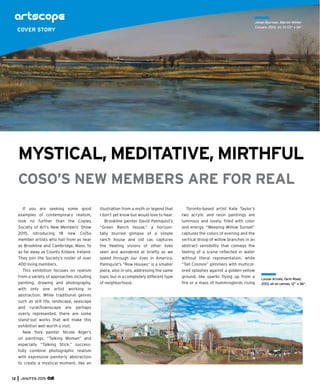
Linda Huey, Footprint, 2006, fire clay, glaze, cement, stones, epoxy, 4” x 7” x 6” (Gift of the artist;
photograph by Alex Hochstrasser).
a motion detector. It is threatening but
not so, like a mad dog on a short chain.
Something akin to the head of a silvery
raptor jerks and chomps relentlessly.
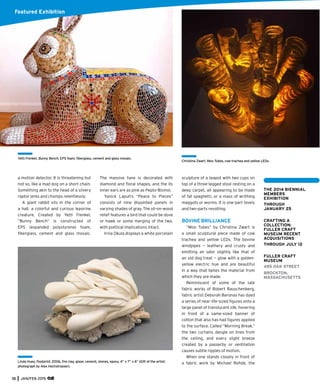
A giant rabbit sits in the corner of
a hall, a colorful and curious leporine
creature. Created by Yetti Frenkel,
“Bunny Bench” is constructed of
EPS (expanded polystyrene) foam,
fiberglass, cement and glass mosaic.
The massive hare is decorated with
diamond and floral shapes, and the its
inner ears are as pink as Pepto-Bismol.
Yanick Lapuh’s “Peace to Pieces”
consists of nine disjointed panels in
varying shades of gray. The oil-on-wood
relief features a bird that could be dove
or hawk or some merging of the two,
with political implications intact.
Irina Okula displays a white porcelain
sculpture of a teapot with two cups on
top of a three-legged stool resting on a
deep carpet, all appearing to be made
of fat spaghetti, or a mass of writhing
maggots or worms. It is one-part lovely
and two-parts revolting.
BOVINE BRILLIANCE
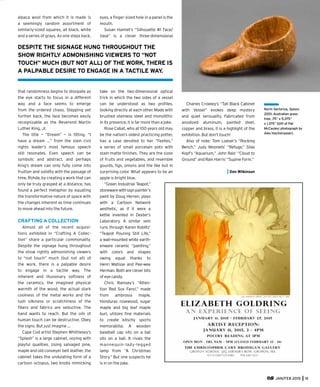
“Moo Tubes” by Christina Zwart is
a small sculptural piece made of cow
trachea and yellow LEDs. The bovine
windpipes — leathery and crusty and
emitting an odor slightly like that of
an old dog treat — glow with a golden-
yellow electric hue and are beautiful
in a way that belies the material from
which they are made.
Reminiscent of some of the late
fabric works of Robert Rauschenberg,
fabric artist Deborah Baronas has dyed
a series of near-life-sized figures onto a
large panel of translucent silk, hovering
in front of a same-sized banner of
cotton that also has had figures applied
to the surface. Called “Morning Break,”
the two curtains dangle on lines from
the ceiling, and every slight breeze
created by a passerby or ventilation
causes subtle ripples of motion.
When one stands closely in front of
a fabric work by Michael Rohde, the
Yetti Frenkel, Bunny Bench, EPS foam, fiberglass, cement and glass mosaic.
THE 2014 BIENNIAL
MEMBERS
EXHIBITION
THROUGH
JANUARY 25
CRAFTING A
COLLECTION:
FULLER CRAFT
MUSEUM RECENT
ACQUISITIONS
THROUGH JULY 12
FULLER CRAFT
MUSEUM
455 OAK STREET
BROCKTON,
MASSACHUSETTS
Christina Zwart, Moo Tubes, cow trachea and yellow LEDs.
Norm Sartorius, Spoon,
2001, Australian grass
tree, .75” x 5.375”
x 1.375” (Gift of Pat
McCauley; photograph by
Alex Hochstrasser).
DESPITE THE SIGNAGE HUNG THROUGHOUT THE
SHOW RIGHTLY ADMONISHING VIEWERS TO “NOT
TOUCH” MUCH (BUT NOT ALL) OF THE WORK, THERE IS
A PALPABLE DESIRE TO ENGAGE IN A TACTILE WAY.
JAN/FEB 2015 11
alpaca wool from which it is made is
a seemingly random assortment of
similarly-sized squares, all black, white
and a series of grays. As one steps back,
that randomness begins to dissipate as
the eye starts to focus in a different
way and a face seems to emerge
from the ordered chaos. Stepping yet
further back, the face becomes easily
recognizable as the Reverend Martin
Luther King, Jr.
The title — “Dream” — is fitting. “I
have a dream …” from the slain civil
rights leader’s most famous speech
still resonates. Even speech can be
symbolic and abstract, and perhaps
King’s dream can only fully come into
fruition and solidity with the passage of
time. Rohde, by creating a work that can
only be truly grasped at a distance, has
found a perfect metaphor by equating
the transformative nature of space with
the changes inherent as time continues
to move ahead into the future.
CRAFTING A COLLECTION
Almost all of the recent acquisi-
tions exhibited in “Crafting A Collec-
tion” share a particular commonality.
Despite the signage hung throughout
the show rightly admonishing viewers
to “not touch” much (but not all) of
the work, there is a palpable desire
to engage in a tactile way. The
inherent and illusionary softness of
the ceramics, the imagined physical
warmth of the wood, the actual stark
coolness of the metal works and the
lush silkiness or scratchiness of the
fibers and fabrics are seductive. The
hand wants to reach. But the oils of
human touch can be destructive. Obey
the signs. But just imagine ...
Cape Cod artist Stephen Whittlesey’s
“Splash” is a large cabinet, oozing with
playful qualities. Using salvaged pine,
maple and old conveyer belt leather, the
cabinet takes the undulating form of a
cartoon octopus, two knobs mimicking
eyes, a finger-sized hole in a panel is the
mouth.
Susan Hamlet’s “Silhouette #1 Face/
Vase” is a clever three-dimensional
take on the two-dimensional optical
trick in which the two sides of a vessel
can be understood as two profiles,
looking directly at each other. Made with
brushed stainless steel and monolithic
in its presence, it is far more than a joke.
Rose Cabat, who at 100 years old may
be the nation’s oldest practicing potter,
has a case devoted to her “Feelies,”
a series of small porcelain pots with
stain-matte finishes. They are the sizes
of fruits and vegetables, and resemble
gourds, figs, onions and the like but in
surprising color. What appears to be an
apple is bright blue.
“Green Industrial Teapot,”
stonewarewithsign painter’s
paint by Doug Herren, plays
with a Cartoon Network
aesthetic, as if it were a
kettle invented in Dexter’s
Laboratory. A similar vein
runs through Karen Koblitz’
“Teapot Pouring Still Life,”
a wall-mounted white earth-
enware ceramic “painting,”
with colors and shapes
owing equal thanks to
Henri Matisse and Pee-wee
Herman. Both are clever bits
of eye candy.
Chris Ramsey’s “Atten-
tion Red Sox Fans!,” made
from ambrosia maple,
Honduras rosewood, sugar
maple and big leaf maple
burl, utilizes fine materials
to create kitschy sports
memorabilia. A wooden
baseball cap sits on a bat
sits on a ball. It rivals the
mannequin-lady-legged
lamp from “A Christmas
Story.” But one suspects he
is in on the joke.
Charles Crowley’s “Tall Black Cabinet
with Vessel” evokes deep mystery
and quiet sensuality. Fabricated from
anodized aluminum, painted steel,
copper and brass, it is a highlight of the
exhibition. But don’t touch!
Also of note: Tom Loeser’s “Rocking
Bench,” Judy Moonelis’ “Refuge,” Silas
Kopf’s “Aquarium,” John Rais’ “Cloud to
Ground” and Rain Harris’ “Supine Form.”
Don Wilkinson
12 JAN/FEB 2015
If you are seeking some good
examples of contemporary realism,
look no further than the Copley
Society of Art’s New Members’ Show
2015, introducing 18 new Co|So
member artists who hail from as near
as Brookline and Cambridge, Mass. to
as far away as County Kildare, Ireland.
They join the Society’s roster of over
400 living members.
This exhibition focuses on realism
from a variety of approaches including
painting, drawing and photography,
with only one artist working in
abstraction. While traditional genres
such as still life, landscape, seascape
and rural/townscape are perhaps
overly represented, there are some
stand-out works that will make this
exhibition well worth a visit.
New York painter Nicole Alger’s
oil paintings, “Talking Woman” and
especially “Talking Stick,” success-
fully combine photographic realism
with expressive painterly abstraction
to create a mystical moment, like an
illustration from a myth or legend that
I don’t yet know but would love to hear.
Brookline painter David Palmquist’s
“Green Ranch House,” a horizon-
tally blurred glimpse of a simple
ranch house and old car, captures
the fleeting visions of other lives
seen and wondered at briefly as we
speed through our lives in America.
Palmquist’s “Row Houses” is a smaller
piece, also in oils, addressing the same
topic but in a completely different type
of neighborhood.
Johan Bjurman, Warren Winter
Estuary, 2012, oil, 10 1/2” x 26”.
MYSTICAL, MEDITATIVE, MIRTHFUL
COSO’S NEW MEMBERS ARE FOR REAL
Toronto-based artist Kate Taylor’s
two acrylic and resin paintings are
luminous and lovely, filled with color
and energy. “Weeping Willow Sunset”
captures the colors of evening and the
vertical droop of willow branches in an
abstract sensibility that conveys the
feeling of a scene reflected in water
without literal representation, while
“Tall Cosmos” glimmers with multicol-
ored splashes against a golden-yellow
ground, like sparks flying up from a
fire or a mass of hummingbirds rising
Louise Arnold, Farm Road,
2013, oil on canvas, 12” x 36”.
COVER STORY
JAN/FEB 2015 13
NEW MEMBERS’
SHOW 2015
COPLEY SOCIETY
OF ART
158 NEWBURY
STREET
BOSTON,
MASSACHUSETTS
JANUARY 10
THROUGH
FEBRUARY 23
Matthew McCosco,
Chuck Close, graphite
pencil and graphite
powder, 11” x 14”.
into the air. Though not particularly
large, Taylor’s paintings claim their
space and make themselves heard.
Several of the works in the show
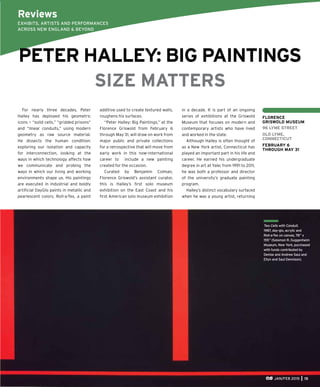
are refreshingly amusing. “Workday
Revolution” is Quincy-based artist
Timothy Rakarich’s oil painting from
a snapshot of a dissipated-looking
man in the costume of an 18th century
British Redcoat, clutching a plastic
cup, propped in a corner of a train car.
There’s a whole story here — of a man
who has gone perhaps a bit too far
celebrating after a Revolutionary War
reenactment. Rakarich’s other piece in
the show, “Neseman,” is also a photo-
based painting of a man with a drink,
but this one is distinctly a portrait,
capturing the world-weary and
skeptical expression of the subject,
a middle-aged man in glasses and a
porkpie hat, in the act of lowering his
just-emptied shot glass from his lips.
Another portrait that made me
smile was “Chuck Close” by Matthew
McCosco of Somerville, Mass. In this
graphite drawing, McCosco gently
sends up Chuck Close’s iconic “Big Self
Portrait” from 1969, borrowing the
backward tilt of the head, the horn-
rimmed glasses, the wild hair and the
upturned cigarette while forgoing
the huge scale, the patterns of light
and shadow on the subject’s face,
and the insistence on the “ugly mug”
of the character’s visage. McCosco
also includes a more straightforward
portrait, “Gwen Lu,” which again
makes use of graphite pencil and
graphite powder.
McCosco and Rakarich should make
good additions to the Copley Society’s
stable of portrait artists.
Diane Nelson, of Brighton, Mass., is
another painter who conveys a sense
of storytelling in her acrylic fantasy
landscapes, “Highland Meadows”
and “Overpass.” At just eight-by-
ten inches, these little paintings hint
at unknown fairy tales of far-away
places and strange adventures just
over the hills.
Also in this exhibition of new
Copley Society artists are rural
landscapes in oils by Louise Arnold
of Concord, Mass. (“Farm Road” and
“Lumsden Farm”) and Johan Bjurman
of Johnston, R.I. (“Warren Winter
Estuary” and “Farnham Farm”) and
tightly rendered drawings in ink
on scratchboard by Joe Smith of
Phillipston, Mass. (“Forever After-
noon” and “Branches”).
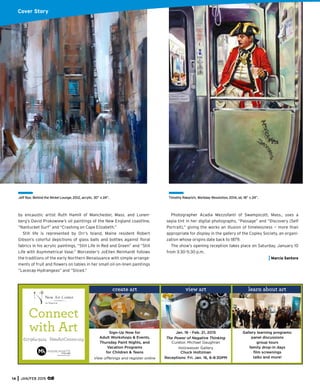
Loosely rendered city scenes by
Jeff Bye of Hershey, Penn. (“Behind
the Nickel Lounge” and “Sunday”
— both in acrylic) are paired with
oil paintings by Patrick Cahill from
County Kildare, Ireland (“Red Tram,
Prague” and “Ellis Quay, Dublin”) and
Cambridge, Mass. watercolor artist
Steven Foote’s “Montmartre Café” and
“A Break in the Clouds.”
Gloucester’s Katherine Coakely’s
acrylic paintings “Champagne Sail”
and “The Lily Pond” offer quiet visions
of water, in contrast to the wilder seas
in “Tide Coming Up” and “One Day”
THESE LITTLE PAINTINGS HINT AT UNKNOWN
FAIRY TALES OF FAR-AWAY PLACES AND STRANGE
ADVENTURES JUST OVER THE HILLS.
Joe Smith, Forever Afternoon, 2013, ink on scratchboard, 24” x 18”.
14 JAN/FEB 2015
by encaustic artist Ruth Hamill of Manchester, Mass. and Lunen-
berg’s David Prokowiew’s oil paintings of the New England coastline,
“Nantucket Surf” and “Crashing on Cape Elizabeth.”
Still life is represented by Orr’s Island, Maine resident Robert
Gibson’s colorful depictions of glass balls and bottles against floral
fabrics in his acrylic paintings, “Still Life in Red and Green” and “Still
Life with Asymmetrical Vase.” Worcester’s JoEllen Reinhardt follows
the traditions of the early Northern Renaissance with simple arrange-
ments of fruit and flowers on tables in her small oil-on-linen paintings
“Lacecap Hydrangeas” and “Sliced.”
Jeff Bye, Behind the Nickel Lounge, 2012, acrylic, 30” x 24”.
Cover Story
Timothy Rakarich, Workday Revolution, 2014, oil, 18” x 24”.
Photographer Acadia Mezzofanti of Swampscott, Mass., uses a
sepia tint in her digital photographs, “Passage” and “Discovery (Self
Portrait),” giving the works an illusion of timelessness — more than
appropriate for display in the gallery of the Copley Society, an organi-
zation whose origins date back to 1879.
The show’s opening reception takes place on Saturday, January 10
from 3:30-5:30 p.m.
Marcia Santore
Sign-Up Now for
Adult Workshops & Events,
Thursday Paint Nights, and
Vacation Programs
for Children & Teens
View offerings and register online
Connect
with Art
617-964-3424 NewArtCenter.org
Gallery learning programs:
panel discussions
group tours
family drop-in days
film screenings
talks and more!
Jan. 16 - Feb. 21, 2015
The Power of Negative Thinking
Curator, Michael Gaughran
Holzwasser Gallery
Chuck Holtzman
Receptions: Fri. Jan. 16, 6-8:30PM
create art view art learn about art
JAN/FEB 2015 15
For nearly three decades, Peter
Halley has deployed his geometric
icons — “solid cells,” “gridded prisons”
and “linear conduits,” using modern
geometry as raw source material.
He dissects the human condition:
exploring our isolation and capacity
for interconnection, looking at the
ways in which technology affects how
we communicate and probing the
ways in which our living and working
environments shape us. His paintings
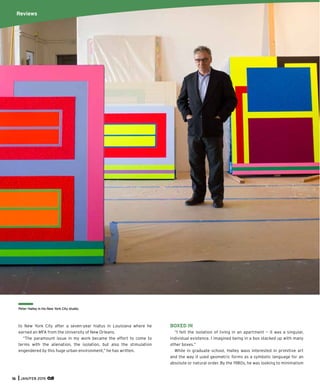
are executed in industrial and boldly
artificial DayGlo paints in metallic and
pearlescent colors. Roll-a-Tex, a paint
Two Cells with Conduit,
1987, day-glo, acrylic and
Roll-a-Tex on canvas, 78” x
155” (Solomon R. Guggenheim
Museum, New York, purchased
with funds contributed by
Denise and Andrew Saul and
Ellyn and Saul Dennison).
Reviews
EXHIBITS, ARTISTS AND PERFORMANCES
ACROSS NEW ENGLAND & BEYOND
FLORENCE
GRISWOLD MUSEUM
96 LYME STREET
OLD LYME,
CONNECTICUT
FEBRUARY 6
THROUGH MAY 31
PETER HALLEY: BIG PAINTINGS
SIZE MATTERS
additive used to create textured walls,
roughens his surfaces.
“Peter Halley: Big Paintings,” at the
Florence Griswold from February 6
through May 31, will draw on work from
major public and private collections
for a retrospective that will move from
early work in this now-international
career to include a new painting
created for the occasion.
Curated by Benjamin Colman,
Florence Griswold’s assistant curator,
this is Halley’s first solo museum
exhibition on the East Coast and his
first American solo museum exhibition
in a decade. It is part of an ongoing
series of exhibitions at the Griswold
Museum that focuses on modern and
contemporary artists who have lived
and worked in the state.
Although Halley is often thought of
as a New York artist, Connecticut has
played an important part in his life and
career. He earned his undergraduate
degree in art at Yale; from 1991 to 2011,
he was both a professor and director
of the university’s graduate painting
program.
Halley’s distinct vocabulary surfaced
when he was a young artist, returning
16 JAN/FEB 2015
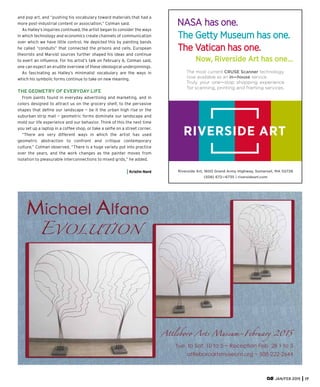
to New York City after a seven-year hiatus in Louisiana where he
earned an MFA from the University of New Orleans.
“The paramount issue in my work became the effort to come to
terms with the alienation, the isolation, but also the stimulation
engendered by this huge urban environment,” he has written.
BOXED IN
“I felt the isolation of living in an apartment — it was a singular,
individual existence. I imagined being in a box stacked up with many
other boxes.”
While in graduate school, Halley wass interested in primitive art
and the way it used geometric forms as a symbolic language for an
absolute or natural order. By the 1980s, he was looking to minimalism
Peter Halley in his New York City studio.
Reviews
JAN/FEB 2015 17
and pop art, and “pushing his vocabulary toward materials that had a
more post-industrial content or association,” Colman said.
As Halley’s inquiries continued, the artist began to consider the ways
in which technology and economics create channels of communication
over which we have little control. He depicted this by painting bands
he called “conduits” that connected the prisons and cells. European
theorists and Marxist sources further shaped his ideas and continue
to exert an influence. For his artist’s talk on February 6, Colman said,
one can expect an erudite overview of these ideological underpinnings.
As fascinating as Halley’s minimalist vocabulary are the ways in
which his symbolic forms continue to take on new meaning.
THE GEOMETRY OF EVERYDAY LIFE
From paints found in everyday advertising and marketing, and in
colors designed to attract us on the grocery shelf, to the pervasive
shapes that define our landscape — be it the urban high rise or the
suburban strip mall — geometric forms dominate our landscape and
mold our life experience and our behavior. Think of this the next time
you set up a laptop in a coffee shop, or take a selfie on a street corner.
“There are very different ways in which the artist has used
geometric abstraction to confront and critique contemporary
culture,” Colman observed. “There is a huge variety put into practice
over the years, and the work changes as the painter moves from
isolation to pleasurable interconnections to mixed grids,” he added.
Kristin Nord
IDENTITY SYSTEMS1 MAIN LOGO
IDENTITY SYSTEMS
IDENTITY SYSTEMS1 MAIN LOGO
IDENTITY SYSTEMS
C
M
Y
CM
MY
CY
CMY
K
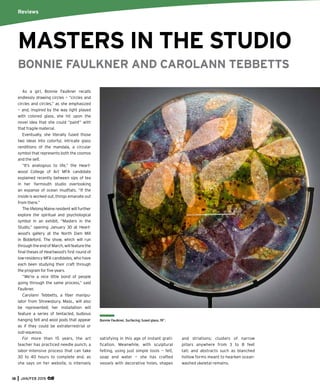
Bonnie Faulkner, Surfacing, fused glass, 19”.
As a girl, Bonnie Faulkner recalls
endlessly drawing circles — “circles and
circles and circles,” as she emphasized
— and, inspired by the way light played
with colored glass, she hit upon the
novel idea that she could “paint” with
that fragile material.
Eventually, she literally fused those
two ideas into colorful, intricate glass
renditions of the mandala, a circular
symbol that represents both the cosmos
and the self.
“It’s analogous to life,” the Heart-
wood College of Art MFA candidate
explained recently between sips of tea
in her Yarmouth studio overlooking
an expanse of ocean mudflats. “If the
inside is worked out, things emanate out
from there.”
The lifelong Maine resident will further
explore the spiritual and psychological
symbol in an exhibit, “Masters in the
Studio,” opening January 30 at Heart-
wood’s gallery at the North Dam Mill
in Biddeford. The show, which will run
through the end of March, will feature the
final theses of Heartwood’s first round of
low-residency MFA candidates, who have
each been studying their craft through
the program for five years.
“We’re a nice little bond of people
going through the same process,” said
Faulkner.
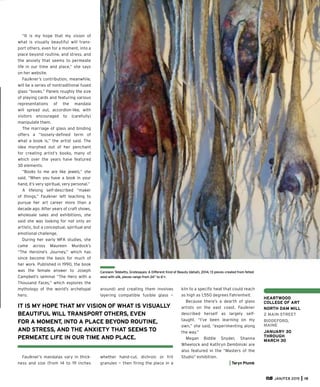
Carolann Tebbetts, a fiber manipu-
lator from Shrewsbury, Mass., will also
be represented; her installation will
feature a series of tentacled, bulbous
hanging felt and wool pods that appear
as if they could be extraterrestrial or
sub-aqueous.
For more than 15 years, the art
teacher has practiced needle punch, a
labor-intensive process that can take
30 to 40 hours to complete and, as
she says on her website, is intensely
satisfying in this age of instant grati-
fication. Meanwhile, with sculptural
felting, using just simple tools — felt,
soap and water — she has crafted
vessels with decorative holes, shapes
and striations; clusters of narrow
pillars anywhere from 3 to 8 feet
tall; and abstracts such as blanched
hollow forms meant to hearken ocean-
washed skeletal remains.
Reviews
MASTERS IN THE STUDIO
BONNIE FAULKNER AND CAROLANN TEBBETTS
18 JAN/FEB 2015
JAN/FEB 2015 19
HEARTWOOD
COLLEGE OF ART
NORTH DAM MILL
2 MAIN STREET
BIDDEFORD,
MAINE
JANUARY 30
THROUGH
MARCH 30
Carolann Tebbetts, Grotesques: A Different Kind of Beauty (detail), 2014, 13 pieces created from felted
wool with silk, pieces range from 24” to 6’+.
“It is my hope that my vision of
what is visually beautiful will trans-
port others, even for a moment, into a
place beyond routine, and stress, and
the anxiety that seems to permeate
life in our time and place,” she says
on her website.
Faulkner’s contribution, meanwhile,
will be a series of nontraditional fused
glass “books.” Panels roughly the size
of playing cards and featuring various
representations of the mandala
will spread out, accordion-like, with
visitors encouraged to (carefully)
manipulate them.
The marriage of glass and binding
offers a “loosely-defined term of
what a book is,” the artist said. The
idea morphed out of her penchant
for creating artist’s books, many of
which over the years have featured
3D elements.
“Books to me are like jewels,” she
said. “When you have a book in your
hand, it’s very spiritual, very personal.”
A lifelong self-described “maker
of things,” Faulkner left teaching to
pursue her art career more than a
decade ago. After years of craft shows,
wholesale sales and exhibitions, she
said she was looking for not only an
artistic, but a conceptual, spiritual and
emotional challenge.
During her early MFA studies, she
came across Maureen Murdock’s
“The Heroine’s Journey,” which has
since become the basis for much of
her work. Published in 1990, the book
was the female answer to Joseph
Campbell’s seminal “The Hero with a
Thousand Faces,” which explores the
mythology of the world’s archetypal
hero.
Faulkner’s mandalas vary in thick-
ness and size (from 14 to 19 inches
around) and creating them involves
layering compatible fusible glass —
whether hand-cut, dichroic or frit
granules — then firing the piece in a
kiln to a specific heat that could reach
as high as 1,550 degrees Fahrenheit.
Because there’s a dearth of glass
artists on the east coast, Faulkner
described herself as largely self-
taught. “I’ve been learning on my
own,” she said, “experimenting along
the way.”
Megan Biddle Snyder, Shanna
Wheelock and Kathryn Dembinski are
also featured in the “Masters of the
Studio” exhibition.
Taryn Plumb
IT IS MY HOPE THAT MY VISION OF WHAT IS VISUALLY
BEAUTIFUL WILL TRANSPORT OTHERS, EVEN
FOR A MOMENT, INTO A PLACE BEYOND ROUTINE,
AND STRESS, AND THE ANXIETY THAT SEEMS TO
PERMEATE LIFE IN OUR TIME AND PLACE.
FINE ARTS WORK CENTER FELLOWS
ALEXANDRIA SMITH AND BRIDGET MULLEN
Provincetown’s Fine Arts Work Center’s Fellowship Program
provides a unique opportunity for 10 artists and 10 writers to
serve seven-month residencies during the developmental
stages of their careers. Over 1,100 applications come in
annually with the hope of being selected for the cherished
experience that runs from October 1 through May 1. Over 800
fellowships have been served since FAWC’s inception in 1968.
There will be a FAWC Fellows at PAAM exhibition from
January 23 through February 22 at the Provincetown Art
Association and Museum, 460 Commercial Street,
Provincetown.
Artscope’s Laura Shabott spoke with Alexandria Smith and
Bridget Mullen, two second-year FAWC Fellows, about their
experiences with the program, two months into their current
residencies.
ALEXANDRIA SMITH
IN YOUR FIRST-YEAR RESIDENCY, DID YOU FIND OTHER
PEOPLE COMING IN TO WORK WITH YOU, OR DID YOU
FIND YOURSELF TO BE SOLITARY, AND THEN YOU WOULD
PRESENT YOURSELF?
ALEXANDRIA SMITH: I was definitely solitary. I’ve never
workedinacollaborativeway.I’minterestedinit,buttheprojects
I’ve been working on haven’t really called for any type of collabo-
ration. When I first got here, it was just me working and plugging
away and making paintings in the studio, and collages, which is
what I was doing before. And then some kind of shift happened
and I started to create these collage installations that existed on
the wall, which wasn’t confined to a rectangle or a square panel.
Being here allowed for something new.
AN OUT-OF-THE-BOX WAY OF THINKING…
AS: Exactly.
SO YOUR FIRST RESIDENCY HERE WAS IN 2013?
AS: I was here till May, and then I went to New York. Once I
found out that I got a second residency, I said, “Well, I just have
to make it through the summer.” I sold a few paintings and
made some small-scale stuff because I didn’t have a studio. But
I had some shows coming up — some big shows — so I had to find
a way to make art in an extra room at my parents. I had a solo
show in New York City on the Lower East Side at Scaramouche
Gallery — that was a big one — and I had an installation up here
at Tim’s Used Books. That will be up through my residency.
I had a group show at the Schomburg Center for Research in
Black Culture in Harlem and that was a big show.
ALL IN THE LAST YEAR?
AS: This was all in August! I did all that for
August. My solo show was works from here. I made one new
painting, but everything else was from my time at FAWC.
FINE ARTS WORK
CENTER (FAWC)
PROVINCETOWN,
MASSACHUSETTS
Clare Romano, On the Grass,
1978, collagraph; ed. 3/150,
10” x 30.5”.
Cornered
20 JAN/FEB 2015
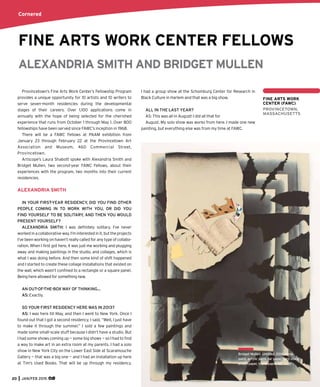
Bridget Mullen, Untitled, 2014, spray
paint, acrylic paint, tar paper, card stock,
brown paper, found paper, 52” x 36”.
YOU ARE NOT A WOMAN AFRAID OF A DEADLINE.
AS: No, I love deadlines.
EVERYONE HAS DIFFERENT ARTISTIC STYLES, SO FOR YOU, A
DEADLINE IS ENLIVENING…
AS: I set deadlines for myself even when I don’t have a show. It’s part of
what keeps me pushing.
TELL ME HOW YOU SEE YOUR ROLE IN THE ARTS. DO YOU
CONSIDER YOURSELF AS A ROLE MODEL FOR WOMEN?
AS: Definitely, I spent 10 years teaching.
WHERE?
AS: I taught in East Harlem and in the South Bronx. I taught at a
charter school, the New York City public school system, and I’ve been
an adjunct professor at Adelphi University. That was my career before
I started painting full-time: middle school, high school, undergrad and
graduate students.
I’ve been thrust into that role regardless of whether I want to be or not,
and I welcome it. There aren’t many of us that are being put out there,
visible. There are a lot of us who exist but it’s behind closed doors. It’s
increasingly problematic.
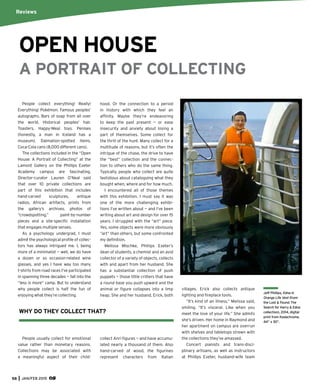
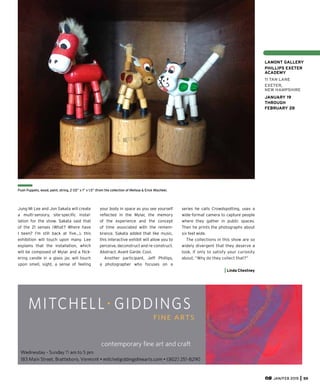
JAN/FEB 2015 21
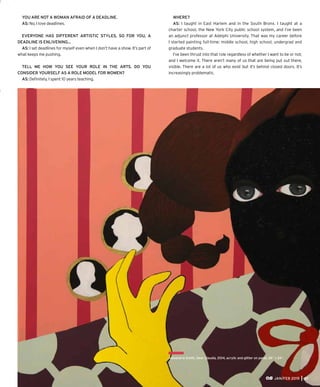
Alexandria Smith, Dear Claudia, 2014, acrylic and glitter on panel, 24” x 24”.
Cornered
22 JAN/FEB 2015
SO WHAT YOU ARE SAYING IS THAT FAWC IS MAKING YOU MORE
VISIBLE…
AS: FAWC has made me more visible in the art world in ways that I didn’t
expect. It’s kind of worked in tandem with my work evolving and the people
I’ve met here and the connections I’ve made. Going out into New York and
either everyone has heard of it or when I say I’m doing a residency, they say
“Wait, I’m not familiar with that.” So it’s both extremes. And when they’re not
familiar with it, they look it up and go “Oh my goodness. That’s amazing! I’m
surprised more people don’t know about it.”
WOULDN’T YOU ALSO SAY, WOW, THERE’S BEEN SOME LUCK
FOR YOU, YOU’VE HAD A SOLID, HEAVY-DUTY PRACTICE; YOU ARE
SOMEBODY WHO WORKS VERY HARD…
AS: I do, I do through it all. And I have an amazing support system of
women behind me and parents and friends. The community itself, I mean
New York, is what got me here, otherwise I wouldn’t have known about it.
BRIDGET MULLEN
YOU WERE HERE AT THE FINE ARTS WORK CENTER 2010/11 AND
THEN YOU WENT TO…
BRIDGET MULLEN: I went back to New York.
DO YOU HAVE A STUDIO AND AN APARTMENT THERE? WHAT DO YOU
DO FOR WORK?
BM: I’m subleasing my apartment in Brooklyn. Up until this past summer,
I had a studio quite close to my home, but lost my studio, so the last six
months I was in New York I worked out of my apartment. I work in museums
so that’s one of the biggest reasons I’m in New York.
WHAT’S THE LAST MUSEUM YOU WORKED AT?
BM: MOMA. I also work at the Guggenheim and at the Rubin.
WHAT DO YOU DO THERE?
BM: I’m an art installer.
DESCRIBE YOUR FIRST YEAR AT FAWC TO ME, A LITTLE BIT. WHAT
WAS IT LIKE?
BM: I remember feeling much like the way the other artists did. We were
all a bit stunned and overwhelmed, and had so much gratitude. At first, it
seemed indulgent to work in my studio for as long as I wanted. And then
that feeling faded, I got really into my work, and my world became smaller. I
became used to thinking about certain paintings for days on end — a part of a
painting for a whole day. I didn’t have to think about anything else. It sounds
so indulgent.
IT WOULD SEEM INDULGENT IF YOU WEREN’T INCREDIBLY SERIOUS
ABOUT WHAT YOU ARE DOING. THAT’S CLEAR BY LOOKING AROUND.
YOU HAVE A LOT OF WORK. DO YOU CONSIDER YOURSELF PROLIFIC?
BM: Yes.
HOW DO YOU SEE THIS NEW, SECOND YEAR AS DIFFERENT FROM
YOUR FIRST?
BM: This year I started working within the rectangle. In the past, I had been
working free-form, letting the shape of the character determine the shape of
the work. But I wanted to give myself something to consider, a constraint,
and it’s really opened things up. I feel more focused this year than the last
time I was here. I know how quickly the time goes. Every single day is really
important.
ARE YOU INFLUENCED BY OTHER ARTISTS?
BM: I was just talking to someone the other day about how hard it can be
when you really like another artist’s work. It’s satisfying to admire the way
someone else works, but also debilitating because it doesn’t have anything
to do with what’s in front of you — with what you are working on. It’s inspiring
to know that that artist exists, but I don’t want them to affect my work.
WHAT I HEAR YOU SAYING IS THAT WHEN YOU ARE IN THE MIDDLE
OF AN INTENSIVE TIME, THAT OTHER ARTISTS’ WORK ISN’T IN YOUR
STUDIO WITH YOU. YOU ARE WITH YOU. THE ABSOLUTE QUIET, THE
TIME TO SPEND WITH YOUR OWN ICONOGRAPHY, YOUR OWN WAY OF
LOOKING AT THE WORLD THROUGH YOUR PAINTING.
BM: Yes, that’s true. I’ve been working in silence. I’ll use music during
transitions, like when I just come into the studio, or am getting ready to
leave.
DO YOU HAVE ANY SHOWS SCHEDULED?
BM: I have a year-long residency in Roswell, New Mexico after this.
HAVE YOU DONE ANY JURY WORK?
BM: The second-year fellows are part of the jury process; they work with
the first round.
THERE ARE GOING TO BE A LOT OF PEOPLE WHO ARE READING THIS
THAT WISH THEY COULD BE YOU. WHAT ADVICE WOULD YOU GIVE TO
SERIOUS ARTISTS WHO WANT TO BE ABLE TO HAVE A RESIDENCY LIKE
THIS?
BM: I think you just have to keep making your work for as long as you can
and remember much of it is luck. Actually, I was thinking about something
similar this morning and I wrote it down. I’m going to read it to you: “There’s
no secret; no way to distill the great artists and use their formula for
thinking. Be yourself, actually, because that’s the only way it’s going to be
any good.”
Laura Shabott
JAN/FEB 2015 23
Celebrating 50 Years
of Excellence in
Arts Education
Jeff Frederick ’87
Erica Felicella ’96
Victoria Brenner (Viandara) ’99
An Alumni Exhibit
1.19.2015 – 2.27.2015
Reception for the Artists
Thursday 2.12.2015, 5:30–7:00 p.m.
2108 River Road, Manchester, NH
www.derryfield.org
The Derryfield School
Lyceum Gallery presents
The Journey
Three paths of creative discovery
203 Union Street . Clinton . Massachusetts
978.598.5000 www.museumofrussianicons.org
The VIBRANT ART and STORIED HISTORY
of ETHIOPIAN ICONS
60 Icons & Artifacts from a Private European Collection
Exhibition On View January 23 through April 18, 2015
ARTscopeETHIOPIA0102_15.indd 1 12/8/14 4:
Thomas Devaney
Hargate Art Center
January 9 -­ February 21
Opening Reception January 9th, 6 -­ 8 pm
Tuesday -­ Saturday, 9 am -­ 4 pm
Free and open to the public
St. Paul’s School
32 Library Road, Concord, New Hampshire
603.229.4644 . www.sps.edu/ nearts
Love © 2013
PLACEMAKING
NEW ENGLAND PUBLIC ARTISTS LAY THE GROUNDWORK
FOR OTHER REGIONAL ARTISTS TO FOLLOW
As the garage door to Susan
Champeny’s workshop studio opened,
it revealed the test version of her
“Snow Saucer Lady Bug” sculpture
now on display in Washington, D.C.,
along with a portion of her “Laundry
Bottle Totems” and two Hornbeck
Boats Adirondack-style canoes
used to install her “ReinCARna-
tion” hubcap lily pads in a pond
along Atlanta’s BeltLine Rail Trail
in 2012 and neighboring Elm Park in
Worcester, Mass. in 2013.
There’s also her secondhand drill
press, sharpening stone, three tool
boxes filled with yard sale and estate
sale finds, 10 cases of fasteners,
“weird objects I don’t know what to
do with” and the “table saw of death,”
so named because her father used to
flinch when he saw her use it to cut
non-traditional materials.
“It’s kind of a mess because I’m
finishing several projects at once,”
said Champeny, who’s working on
2015 proposals for Art in the Park
Worcester as well as BeltLine Atlanta,
which calls for bench designs ideally
to be built with materials local to the
Atlanta area — which is why she’s
accumulating hard plastic Coca-Cola
soda crates.
She’s not sure how realistic it is to
create benches that’ll last, since even
the hardiest of benches tend to be
vandalized. “It needs to be weather-
and people-proof,” Champeny said.
The first materials test was sched-
uled post-Christmas in western New
York, where “two civil engineers
and a mining engineer” — her sister,
brother-in-law and brother, respec-
tively, were going to try to figure out
how to build a bench that would meet
project requirements. “Most of my
projects usually start out as a family
project to see how to make it work,”
she said.
She learned about the BeltLine
call-for-proposals through an email
from its organizers; she also learns of
opportunities through a public art list
server run out of Washington, D.C.,
announcements by the Massachu-
setts Cultural Council and monthly
Internet searches for calls for art and
sculpture.
Her niece tipped her off to the
Washington, D.C. opportunity to
create a work for the D.C. Depart-
ment of Transportation. The call-for-
proposals for the This Place Has a
Voice/Capitol Hill Alphabet Animal
Art Project sought work representing
the corresponding letter of the street
where it would be installed.
She created her “Snow Saucer
Lady Bug,” which went on view last
June, from snow saucers she had
brought along to her second home
in Hilo, Hawaii; her biggest challenge
was having the work weigh the
required seven pounds so that it
wouldn’t damage the light pole on
which it would be stationed for the
next five years. Champeny was one of
10 artists selected.
Among the things Champeny
considers in submitting a proposal:
Is it fun? Does it invite travel? Does it
involve an area where there are family
or friends to stay with to save on
Susan Champeny with her
Snow Saucer Lady Bug
prototype.
Public Art
expenses and who might have a yard
that can be used as a staging area?
“None of these projects make big
money so I need to be couch surfing
or staying with friends,” she said.
Champeny’s found that the work
for most public art exhibitions is
selected based on the quality of your
proposal, and not your track record,
though one’s resume can come into
play if a show has a second series of
proposal reviews.
That changes when submitting
a proposal for a more permanent
installation. “If there are larger
commissions involved, they want
24 JAN/FEB 2015
JAN/FEB 2015 25
to see that you can execute a large
project,” said Champeny, who also
paints. Her “Aim High for the Tree
Tops,” a 9’ x 20’ spray paint mural
depicting five native New England
trees, was installed at Worcester
State University last year.
The Myth Makers, aka Donna
Dodson (an Artscope contributor)
and Andy Moerlein, have spent the
fall and early winter month assem-
bling their next public art project,
“Avian Avatars,” at the Save That
Stuff warehouse in Charlestown,
Mass. Each of the five large sculp-
tures, made from maple saplings,
wire ties and found objects, symbol-
izes a unique, mythical bird. They’ll
be transported to New York City for
a three-month stay on the Garment
District Plazas on Broadway between
36th to 41st streets.
Predecessors of “The Realist” (red
tail hawk), “The Great Spirit” (owl),
“The Scold” (crow), “The Tourist”
(Victoria crowned pigeon) and “The
Taste Maker” (falcon) have been seen
over the past half-decade on Boston’s
Christian Science Plaza, in New
Hampshire on Nashua’s Main Street
and in Portsmouth, where Gerald
Scupp, the Vice President of the
Garment District Alliance, saw their
“Moose Myth” sculpture.
“Gerald Scupp saw our sapling
sculptures and their spacious
transparent structure as a perfect
match with the stark cityscape of
Broadway in deep winter,” Moerlein
said. “He had a real vision for our
large works filling the streetside
vacancy that is usually abustle during
warmer months with food trucks and
merchants. The sculptural presence
will invigorate a seasonal void.”
It’ll be the seventh in a series of
Garment District Art on the Plazas,
part of New York City’s Department
of Transportation’s Arterventions art
program. Dodson said the program’s
sponsors typically cover costs up
to $50,000 for materials, artist
stipends, transportation, installa-
tion and removal, and theirs was no
different. “This is a very professional
opportunity,” Moerlein said. “Most of
these shows are highly sought after
and require a very deep professional
portfolio. We are very lucky.”
This is an instance where years of
hard work have paid off; in recent
years, there have been times when
The Myth Makers, Tastemaker.
it’s seemed that either individually
or as The Myth Makers, Dodson and
Moerlein’s work has been in multiple
states and locations at the same time.
“The previous work we have been
building — often on very limited
budgets — has allowed us to create a
Public Art
portfolio of note,” Moerlein said. “Our blogs and Facebook presence,
ads in many of the arts periodicals, and then the investment we have
made in our catalog, all contributed to a professional presence that
helped Mr. Scupp present our proposal to a discerning funding board.”
Dodson said Scupp, having been familiar with and having seen their
past work, had a vision for how it would activate the spaces on Broadway.
“We had just published our catalog, and he selected some of our mythic
avian sculptures for this project (from it).”
Dodson said it took about a month for each of the five works to be
constructed. “Each sculpture requires several hours of picking saplings
in the woods, fabricating the base, painting the base, assembling tools
and materials, setting up the scaffold and ladders, building the piece,
documenting the work while it’s being built with photographs and video,
and communicating with our sponsor about the process in addition to
our friends, fans and collectors,” she said.
Bringing their work to Manhattan meant meeting the requirements of
a busy, well-regulated city; the dexterity of the materials they work with
was a key factor in making it possible.
“Our sculptures can be fabricated by two people and are relatively light
so they can be driven into the city with a pickup truck and trailer. Larger
haulers need more complex permitting,” Moerlein said. “The loose-
gravel-filled bases allow us to secure the works in place with substantial
weight that again can he handled with light equipment (mostly human
power). Once the engineer was willing to wrap his head around the wind
forces and weight proportions, the DOT and others readily stamped our
permits.”
They had to invest a lot of careful attention to their application. “Every
expense, from small things like screws and paint, glue and rope, plus
the big items like liability and truckers, subcontractor obligations and
press, all need to be exactly documented to assure the funding structure
provides for the level of exposure that a very monumental exhibition
such as this deserves — and demands of us,” Moerlein said. “We wanted
to both do it right and make it possible.”
Moerlein said their past experiences in creating public art have proven
to them that their work leaves an imprint on the public’s memory, both
of the artist and the location in which it was placed. “When we show our
work to new audiences, we hear conversations of recognition and stories
of the time the audience has encountered one of our works,” he said.
“Iconic cities create a reputation of cultural value with their collec-
tions, attracting tourism and building pride in the population at large.”
For that to happen, people in positions of power have to be brave
enough to put their reputations on the line to make it happen.
“Public art takes risk and a thick skin to weather the sea of public
opinion — and art that truly transforms space and cities require this,”
noted Julie Burros, responding to a question from Dodson on the
lasting effect of Chicago’s Millennium Park — in which a large amount
of public art was commissioned and Burros was the project manager —
at a Dec. 15 event at ArtsEmerson’s Paramount Theater to welcome her
as the City of Boston’s Chief of Arts and Culture.
“If municipalities don’t devote the time to the selection process, they
won’t achieve the desired result of branding themselves as a vibrant
place to live. Otherwise, it is timid, bland and forgettable,” Dodson said.
“Art is also a placemaker and economic engine for communities, that
makes it a very worthy investment.”
Dodson said the key way she learns of opportunities to show her
work outside of the New England region is through networking, while
Moerlein added, “We read arts periodicals, follow FB and other social
media conversations, seek out public and private arts venues and
study the careers of arts professionals we admire.”
Brian Goslow
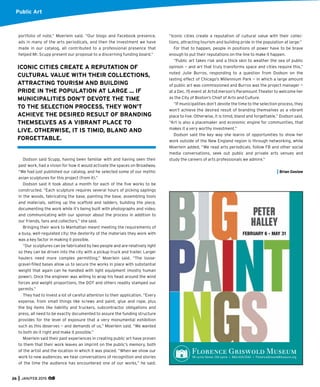
ICONIC CITIES CREATE A REPUTATION OF
CULTURAL VALUE WITH THEIR COLLECTIONS,
ATTRACTING TOURISM AND BUILDING
PRIDE IN THE POPULATION AT LARGE ... IF
MUNICIPALITIES DON’T DEVOTE THE TIME
TO THE SELECTION PROCESS, THEY WON’T
ACHIEVE THE DESIRED RESULT OF BRANDING
THEMSELVES AS A VIBRANT PLACE TO
LIVE. OTHERWISE, IT IS TIMID, BLAND AND
FORGETTABLE.
FEBRUARY 6 - MAY 31
96 Lyme Street, Old Lyme • 860.434.5542 • FlorenceGriswoldMuseum.org
26 JAN/FEB 2015
[ BOSTON PRIVATE BANK AT THE PRUDENTIAL CENTER ]
JANUARY 21 - MARCH 20, 2015
158 Newbury St, Boston, MA 02116
p:: 617-536-5049 e:: info@copleysociety.org w:: copleysociety.org
Tuesday -Saturday 11-6 | Sunday 12-5 | Monday by appointment
NEW
MEMBERS’
SHOW
SNOW BIRDS
BY NANCY COLELLA
SPONSORED BY
ImageDetail:WorkdayRevolutionbyTimRakarich
ImageDetail:WellGuardedbyNancyColella
1.10.15 - 2.23.15
CopleySocietyofArt
JAN/FEB 2015 27
SOUTH SHORE ART CENTER
119 Ripley Road, Cohasset, MA
Gallery Hours: M–S 10–4, Sun 12–4
781 383 2787 > www.ssac.org
::JOURNEYS::
juried by Zola Solamente, Arden Gallery
January 9–February 8, 2015
Pulse:  NEW  WORK  BY  FACULTY  ARTISTS
January  20  -­  April  10,  2015
Amy  Archambault  |  Michael  Beatty  |  Rachelle  Beaudoin  
Matthew  Gamber  |  Randy  Garber  |  Roger  Hankins  |  Cristi  Rinklin
Susan  Schmidt  |  Leslie  Schomp  |  Marguerite  White  |  Amy  Wynne
Faculty  member  Susan  Schmidt  and  a  student  at  work  in  the  Millard  Art  Center  print  studio.  Image  by  John  Buckingham.
holycross.edu/cantorartgallery
M  -­  F  10  a.m.  -­  5  p.m.,  Sat.  2  -­  5  p.m.
28 JAN/FEB 2015
OPENS JANUARY 22
Medford, MA | artgallery.tufts.edu beverly, ma | 978.867.9661 | montserrat.edu/continuing-ed
artwork by immersive faculty member dean nimmer
where creativity works®
SUMMER IMMERSIVE
ART WORKSHOPS
Devote yourself to art in the unique environment
only a working art college can provide.
Courses offered in June and July.
Educator Fellowship Award available.
MFA PROGRAMS
Photography (Cambridge, MA) Examine photographic history and
the fluid integration of contemporary media with traditional and
alternative photographic practice.
Visual Arts (Low-Residency) Investigate new media, develop your
own curriculum, and acquire the critical vocabulary to situate your
work within the contemporary art world.
EXPLORE
lesley.edu/mfa/create
CREATE SOMETHING ONLY
YOU ARE CAPABLE OF.
Lesley University College of Art and Design
The Lunder Arts Center in Cambridge is the new home of Lesley
University’s College of Art and Design, connecting the arts throughout the
university and our surrounding communities, and uniting the passion of the
art school experience with the power of a Lesley education.
JAN/FEB 2015 29
Leslie Fry had a vision for her work and
set out to find the means to realize it.
A temporary installation she created
at Wave Hill in the Bronx had given her
a taste for wanting to cast her five-foot-
long plaster “AcornHead” in bronze, so
Fry took matters into her own hands.
She created a GoFundMe campaign
through United States Artists in 2010 and
successfully raised over $15,000 to cast
her plaster “AcornHead” in bronze.
Since Tufts University had been one
of the biggest donors to her campaign, it
got the first loan of the piece in 2011. Amy
TWO HEADS ARE BETTER THAN ONE
THE STORY OF LESLIE FRY’S
COLOSSAL ACORNHEAD
Artist profile
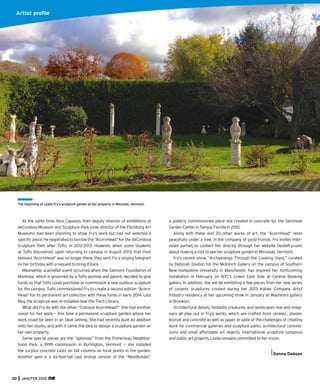
Colossal AcornHead, bronze,
edition of five, 40” x 60” x 30”.
Schlegel, director of galleries and collec-
tions at Tufts, had been a long-time fan
and supporter of Fry’s work, and placed
the first edition of Fry’s “Colossal Acorn-
Head” on its Medford/Somerville campus
during the 2011-2012 academic year as
part of a new public art initiative.
Artist profile
30 JAN/FEB 2015
At the same time, Nick Capasso, then deputy director of exhibitions at
deCordova Museum and Sculpture Park (now director of the Fitchburg Art
Museum), had been planning to show Fry’s work but had not selected a
specific piece. He negotiated to borrow the “AcornHead” for the deCordova
Sculpture Park after Tufts, in 2012-2013. However, when some students
at Tufts discovered, upon returning to campus in August 2013, that their
beloved “AcornHead” was no longer there, they sent Fry a singing telegram
on her birthday with a request to bring it back.
Meanwhile, a windfall event occurred when the Gelmont Foundation of
Montreal, which is governed by a Tufts alumna and parent, decided to give
funds so that Tufts could purchase or commission a new outdoor sculpture
for the campus. Tufts commissioned Fry to create a second edition “Acorn-
Head” for its permanent art collection with these funds in early 2014. Last
May, the sculpture was re-installed near the Tisch Library.
What did Fry do with the other “Colossal AcornHead?” She had another
vision for her work — this time a permanent sculpture garden where her
work could be seen in an ideal setting. She had recently built an addition
onto her studio, and with it came the idea to design a sculpture garden on
her own property.
Some special pieces are the “sphinxes” from the Pomerleau Neighbor-
hood Park, a 1999 commission in Burlington, Vermont — she installed
the surplus concrete casts on tall columns as focal points in the garden.
Another gem is a six-foot-tall cast bronze version of the “NestBuilder,”
The beginning of Leslie Fry’s sculpture garden at her property in Winooski, Vermont.
a publicly commissioned piece she created in concrete for the Seminole
Garden Center in Tampa, Florida in 2010.
Along with these and 20 other works of art, the “AcornHead” rests
peacefully under a tree, in the company of good friends. Fry invites inter-
ested parties to contact her directly through her website (lesliefry.com)
about making a visit to see her sculpture garden in Winooski, Vermont.
Fry’s recent show, “Archaeology Through the Looking Glass,” curated
by Deborah Disston for the McIninch Gallery on the campus of Southern
New Hampshire University in Manchester, has inspired her forthcoming
installation in February on NYC’s Lower East Side at Central Booking
gallery. In addition, she will be exhibiting a few pieces from her new series
of ceramic sculptures created during her 2013 Kohler Company Arts/
Industry residency at her upcoming show in January at Wayfarers gallery
in Brooklyn.
Architectural details, fantastic creatures, and landscapes real and imagi-
nary all play out in Fry’s works, which are crafted from ceramic, plaster,
bronze and concrete as well as paper. In spite of the challenges of creating
work for commercial galleries and sculpture parks, architectural commis-
sions and small affordable art objects, international sculpture symposia
and public art projects, Leslie remains committed to her vision.
Donna Dodson
Artist profile
JAN/FEB 2015 31
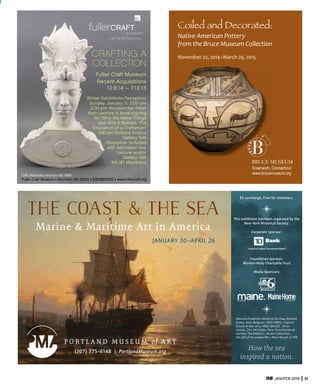
fullerCRAFT
museumTM
Let the art touch you
CRAFTING A
COLLECTION
Fuller Craft Museum
Recent Acquisitions
12.6.14 – 7.12.15
Winter Exhibitions Reception:
Sunday, January 11, 2:00 pm
2:00 pm Woodworker Peter
Korn Lecture & Book-signing
for “Why We Make Things
and Why It Matters: The
Education of a Craftsman”
3:30 pm Barbara Andrus
Gallery Talk
Reception included
with admission fee.
Lecture and/or
Gallery Talk
$15 ($7 Members)
Dirk Staschke, Anonym #3, 1999
Fuller Craft Museum ■ Brockton, MA 02301 ■ 508.588.6000 ■ www.fullercraft.org
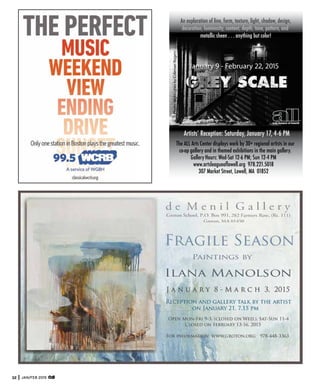
Coiled and Decorated:
Native	
  American	
  Pottery	
  
from	
  the	
  Bruce	
  Museum	
  Collection
November	
  22,	
  2014–March	
  29,	
  2015
BRUCE MUSEUM
Greenwich, Connecticut
www.brucemuseum.org
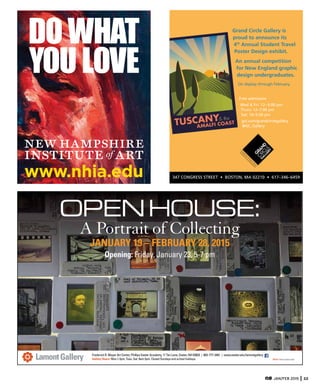
The Coast & the Sea
Marine & Maritime Art in America
(207) 775-6148 | PortlandMuseum.org
JANUARY 30–APRIL 26
This exhibition has been organized by the
New-York Historical Society.
Corporate Sponsor:
Foundation Sponsor:
Morton-Kelly Charitable Trust
Media Sponsors:
Maurice Frederick Hendrick De Haas (United
States, born Belgium, 1832-1895), Tropical
Sunset at Sea, circa 1862 (detail), oil on
canvas, 24 x 34 inches. New-York Historical
Society, The Robert L. Stuart Collection,
the gift of his widow Mrs. Mary Stuart, S-109
How the sea
inspired a nation.
$5 surcharge. Free for members.
32 JAN/FEB 2015
January 9 - February 22, 2015
An exploration of line, form, texture, light, shadow, design,
decoration, luminosity, content, depth, tone, pattern, and
metallic sheen . . . anything but color!
The ALL Arts Center displays work by 30+ regional artists in our
co-op gallery and in themed exhibitions in the main gallery.
Gallery Hours: Wed-Sat 12-6 PM; Sun 12-4 PM
www.artsleagueoflowell.org 978.221.5018
307 Market Street, Lowell, MA 01852
Ar y, January 17, 4-6 PM
Photo:NightLinesbyColemanRogers
JAN/FEB 2015 33
Grand Circle Gallery is
proud to announce its
4th
Annual Student Travel
Poster Design exhibit.
An annual competition
for New England graphic
design undergraduates.
On display through February.
Free admission
gct.com/grandcirclegallery
@GC_Gallery
EXHIBITING
VINTAG
E
TRAVEL
PO
STERS
&
PH
O
TO
G
RAPH
Y
Frederick R. Mayer Art Center, Phillips Exeter Academy, 11 Tan Lane, Exeter, NH 03833 | 603-777-3461 | www.exeter.edu/lamontgallery
Gallery Hours: Mon.1-5pm, Tues.-Sat. 9am-5pm. Closed Sundays and school holidaysLamontGallery CREDIT: Photo by Steve Lewis
OPENHOUSE:
A Portrait of Collecting
JANUARY 19 – FEBRUARY 28, 2015
Opening: Friday, January 23, 5-7 pm
PEA027_artscope_hlfH.qxp 12/15/14 1:52 PM Page 1
www.nhia.edu
DOWHAT
YOULOVE
NHIA628_artscp_qtrV.qxp 12/3/14 12:32 PM Page 1
34 JAN/FEB 2015
Behind the Screen
Artists and curators often seek
attention through impulses as subversive
as they are creative. In a recent attempt
to gather a range of curatorial concepts
that court the limits of the imaginable,
New York City’s Elizabeth Foundation for
the Arts called for a “Theoretical Show”
of the “most audacious, outrageous, or
impossible” ideas for an exhibition.
From 71 proposals, the jurors chose 15
works to be realized in a late fall exhibition
entitled “A Wicked Problem.” Those texts
that escaped selection were papered on
the gallery’s rear wall. (Disclosure, I was
among the latter artists.) I wondered — and
still wonder — about the gap between the
practicable and the impossible. Is it simply
the ease with which some people dwell in
protracted creative tension, while others
wish to resolve it as soon as possible?
Regardless, the Dada-esque results
were unpredictable and often charming.
Participants were commanded to use
five random phrases (“Piranesian,”
for one), explore Marcel Duchamp’s
obscure concept of the “inframince,” or
unpack his witticism, “Guest plus Host
equals Ghost.” Several offered playful
imagery, such as Oree Holban’s model
roller coaster racing at interstellar speed
through a dream-like exhibition of his
favorite artworks.
Not surprisingly, some artists
“realized” their impossible passion
through video or animation. There were
those who dreamed of enacting social
ideals. In Anuj Vaidya’s “ecological
cinema,” producing a movie of the
Ramayana is to be accomplished using
only sustainable human-scaled energy
sources like bicycle power. Although
absurdly anachronistic in an energy-rich
society, resituated in India, this concept
might well be economical.
Misha Rabinovich and Caitlin Foley
envision the world transformed by a
single moment when everyone jumps
at once. Implementing their first step, a
computer game in the gallery teaches
viewers to time their leaps and control
the moment of landing.
For some authors, “impossibility”
consists in ordinary impediments: lack of
money, time or space; access to the right
artorartists;orinstitutionalsponsorship.
Others play in a contemplative realm,
spinning out subversive or semi-serious
fantasies of art-historical inquiry,
philosophizing or poetry, or chasing after
a definition of the absurd.
For example, Edith Doove, a curator-
critic in Plymouth, England and admirer
of Duchamp, rejoices in constructing an
ideal exhibition focused on Duchamp’s
fascination for the insubstantial and
his proclivity for crossing boundaries
in ideas, dress and behavior. But lack of
institutional support or access to the
necessary works makes mounting it
“impossible” — for now.
Beth Reitmeyer, Not Your
Ordinary Sinkhole (cross
section diagram), 2014,
mixed media (photos,
decorative moss, acrylic
paint, ink) on paper mounted
on panel, 14” x 21”.
WE ARE ALL CURATORS, NOW!
THE PERILS OF THE POSSIBLE
I BELIEVE I CAN FLY
In a contrasting mood, Charis
Kanellopoulou, a meticulous Athenian
curator feeling starved for spontaneity,
luxuriates in an “impossibly” prolonged
wishful moment when she can fly down
any path in any museum, encounter any
form or object and effortlessly bring
them together — or not.
Usually we expect exhibitions to
occupy specific times and places, have
a finite duration and possess a clear
community and context. Artists push
these boundaries by imagining more
open museums permitting greater
opportunities in the world for creative
artists to show their art.
Far and beyond the Minneapolis
Institute of Art’s once-in-a-decade Foot-
in-the-Door show for statewide artists,
Art Vidrine recommends displacing great
art in all publicly-funded institutions for
a month-long exhibition of works by all
who wish to show in a public setting.
JAN/FEB 2015 35
Mary Murray would radically infiltrate art, museums, historical sites and
even outer space, slapping scannable “QR” codes on all manner of objects,
and letting artists covertly project their own coded images so as to be part
of any collection.
Blogger Alicia De Brincat lampoons museums’ pomposity by proposing
they remove great works from their frames and disclose on the reverse
the doodles left by those artists’ bored children.
Marcy B. Freedman would frustrate and subvert the power of the curator:
“… denied the authority to select artworks for the show … her role will be
that of an exhibition designer — and performance artist” — putting up an
arbitrarily chosen exhibition in full public view.
Some exhibitions must forgo implementation for lack of a critical
element. Prohibited by limestone’s inherent instability from converting a
Kentucky sinkhole into a natural amphitheater and perceptual zone, Beth
Reitmeyer relies on collaged photographs, sculptural models and samples
of AstroTurf and soft, stuffed rocks to illustrate her premise. Michelle
Bentsman’s parodic “Hauntology,” set in a cemetery in the year 2666,
predicts a not-yet-developed “enthanatoscopic” technology permitting
works to be crafted from “bits and pieces of re-animated flesh.”
Some proposals attempt or challenge the infinite. Québécois
printmaker Jean Cencig would offer his audience endless grids and
piles of numerically identified ink-fingerprinted tissues born of a lifetime
of wiping off etching plates. These “ghost biometrics” of the artist’s
identity also establish mathematical patterns and a recursive system to
generate new prime numbers. My own “Conditions of Curation” reframes
a “Theoretical Show” by setting clear rules and initiating a poetic string of
titles for potentially unlimited exhibitions.
Harry Newman’s romantic exercise, “Corpse of Dreams,” breeds an
ongoing “Exquisite Corpse” composed of “... everyone’s dreams ... from a
single night ... written down and added to the dreams of the person closest
to them.” Visitors sifting through the rooms of jottings fall asleep, dream,
wake up, and write down their own dreams, ad infinitum.
Greta Byrum and Annable Daou, finally, investigate the absurdity of repeating
exhibitions of tired gestures. Having attempted to restage a previously
“spontaneous” New York exhibition in Los Angeles and finding it “impossible”
to recapture the initial novelty, they now seek to revive the mystery by
presenting unspecified relics of the earlier exhibitions in a sealed package.
Perhaps we are always compromising personal ideals to fit within the limits
of our practical reality. Even for an arts writer, shaping one’s experience of
art into a communicable vision is a “wicked problem.” But the possibilities
are endless.
Elizabeth Michelman
Greta Byrum and Annabel Daou, Aporia:Aporia:Aporia: The Search for Our Aporia, cardboard box, 15 aporetic projects, exhibition residue, 19” x 10” x 7”.
36 JAN/FEB 2015
Aida Laleian, Turn to Their
Blameless Deceits, 2008,
UV ink on canvas, silk border,
54.5” x 72”.
The question is: What does
the “new” Armenia look like? While
attempting to understand “Kiss the
Ground,” I kept an impression from a
quote by famed Armenian-Canadian
master photographer Yousuf Karsh in
mind: ”Character, like a photograph,
develops in darkness.”
The old Armenian word “Yergur-
bakootyoon” means to be in “total
submission.” In English, the word
and concept translates to “kiss the
ground,” used here to mean heritage
reverence. Contemporary Armenians
are removed from the original source
of Yergurbakootyoon; their discon-
nect and subsequent re-grounding
is expressed in “A New Armenia” — a
redefined “Kiss the Ground.”
“Kiss the Ground” presents a vast
five-component, two-venue exhibition
project of visual expression, in a variety
of artistic modes, applications and styles
that dialogue about the Armenian-
American cultural experience.
At its core, this is a project that
defines, again, contemporary art; if we
remove the Armenian character focus,
we see a presentation that highlights the
diversity of artistic production today.
The project in totality, all exhibi-
tion components at both venues, a
long catalog and programming are
organized by artist, author and curator
Todd Bartel, the founder and director
of The Thompson Gallery at The
Cambridge School in Weston, Mass.
Bartel is an important part of this
story. He has a history of creating multi-
component, interdisciplinary exhibitions
about important timely issues. His deep
interest in the Armenian cultural experi-
Reviews
KISS THE GROUND:
TALIN MEGHERIAN
THOMPSON GALLERY
THE CAMBRIDGE
SCHOOL OF WESTON
45 GEORGIAN ROAD
WESTON,
MASSACHUSETTS
THROUGH
MARCH 13
KISS THE GROUND: A
NEW ARMENIA
ARMENIAN MUSEUM
OF AMERICA
65 MAIN STREET
WATERTOWN,
MASSACHUSETTS
PART I: THROUGH
JANUARY 20
PART II: JANUARY 25
THROUGH MARCH 1
KISS THE GROUND
FINDING THE “NEW” ARMENIA
JAN/FEB 2015 37
ence, specifically, spans decades and is
both scholarly and personal. He explained
that his interest in the theme of the 1915
Armenian Genocide and Diaspora (the
keystone subject of the project) “arose
out of familial circumstances, coupled
with The Cambridge School’s dedication
to engage with issues of social justice.”
The project features two spotlight
solo exhibitions: the narrative paint-
ings of Talin Megherian (discussed
below) is the second of three shows
in the series now at the Thompson
Gallery; it follows a fall 2014 exhibit
of the kinetic industrial sculptures of
Chicago-based Gagik Aroutiunian.
“A New Armenia” Parts I, II and III
is a series of group exhibitions, or
“one theme, three views,” featuring
12 artists. Part I is on view through
January 20 at The Armenian Museum
of America in Watertown, Mass. The
project culminates at the same time as
the centennial anniversary commemo-
ration of the Armenian Genocide in
April 2015.
Bartel collaborated with partici-
pating artist Adrienne Der Marderosian
(Belmont, Mass.), who assembled most
of the artists and served as co-curator,
giving form to the overall theme and
defining the new Armenia. Der Marder-
osian’s intellectual “Migration” series
is an elegant map-based, figurative,
clean-line collage, mixed-media series
that grapples with the complex issues
of immigration dislocation, displace-
ment and assimilation.
12 VOICES IN HARMONY
The 12 voices in “A New Armenia” are
well-known regionally, with some
having exhibited nationally. They bring
in disparate modes of thinking and
manners of visual expression. Along
with Der Marderosian, Megherian
and Aroutiunian, the artists are Gail
Boyajian (Cambridge, Mass.); Aida
Laleian (Williamstown, Mass.); Yefkin
Megherian (Queens, NY); Marsha
Odabashian (Dedham, Mass.); Kevork
Mourad (New York, NY) and Jessica
Sperandio (Franklin, Mass.).
It is vitally important to understand
that “A New Armenia” is not an exhibi-
tion of “ancestor worship.” It is, rather,
Jessica Sperandio,
Chakatagir, 2014, laser cut
leather, thread, wood, acrylic,
70” x 68” x 2”.
an exploration of individual and collec-
tive identity by way of contemporary
and new media forms of visual art.
Together, these artists are trying
to define and create an updated
“Armenian” aesthetic.
Here’s the background: the artists
are direct descendants of individuals
who experienced the 1915 Armenian
Genocide. In their independent visual
art work they may share story parts,
pieces of events, and things that
they’ve heard from their parents and
grandparents as a way to respect,
honor and give voice to their family
and, more importantly, to personally
process the burdens of history.
Because these artists did not experi-
ence the events directly, their final
forms reflect remembrance presented
as abstracted impressions character-
ized by conceptual points of view,
narrative metaphor and allegory, and a
recombining of material motif.
38 JAN/FEB 2015
A good example here is Jessica
Sperandio, who presents four
impressive laser-cut leather, painted
wood, three-dimensional wall sculp-
tures that read almost as “fairy tales”
or “epics,” but are views of the long,
traumatic, real-life story of two family
members — Perousse and Mardiros
Boyajian — who escaped the massacre
of their village. “Chakatagir,” 2014,
depicts a dinner scene in which the
Turkish government feasts on the body
parts of Armenian dead. “I grew up
hearing about family members losing
physical body parts during the Turkish
raids,” Sperandio writes.
Some artists engage only with
heritage and identity and do not
comment on the genocide theme. For
example, Marsha Odabashian does not
ignore the violent past, but she doesn’t
make it the star feature either; she
stages beauty. Her painting, “Great-
ness Has Passed,” 2010, is a glorious
portrait of a regal peacock from the
series “Half-Perceived: Stalking the
Peacock,” an allegory.
PROUD AS A PEACOCK
This painting celebrates decorative
heritage, she explained on the exhibition
label, adding that the peacock motif is
abundant in medieval Armenian illumi-
nated manuscript. Curator Bartel inter-
prets the work as honorific, being similar
to“placingflowersontombstones.”
Yefkin Megherian is another who does
not focus on blood story. Her two works
bring the traditional into the contem-
porary. She’s interested in the grand
foundational moments of Armenian
history, those establishing events that
gave the people their present culture.
Her bas-relief genre scenes depict the
invention of the 36-letter, script specific
Armenian alphabet and the events that
gave rise to Armenia becoming the first
officialChristiannation.
Those who do process the Genocide
and Diaspora in their work directly live
with certain challenges. How and why
some of these artists’ organize the events
of family heritage is expressed in Elliot
Baker’s play, “The Past is Not the Past.”
This play tells the story of how survivors
of war rebuild their lives and transform
their pain and loss into beauty, exploring
interconnectedness, or what happens
duringrevelatorymoments.
Baker,aretiredpsychotherapistturned
playwright of Jewish ancestry, wrote the
story inspired by the life experience of his
friend, Armenian-American artist John
Avakian, whose expressive-realist mono-
prints depicting select horrific scenes
of war-torture were published by The
Thompson Gallery along with the play, in
catalogue form, specifically for “Kiss the
Ground.” (A dramatic reading of the story
was performed in conjunction with the
exhibition opening.)
From Act II:
Aram (grandson): “So it was art that
saved you?”
Haron (grandfather, artist): “You got
that right again. Ha. I discovered I could
gain some mastery over the terrorizing
images … get them out of my brain by
painting them on canvas. I could trans-
form the scenes and make them less
frightening by creating beauty amidst
the vultures of death. I could be faithful to
history AND be able to free myself from
the frozen past.”
Framing history and understanding
the complex and layered experience of
victimization, and how this condition
marks future generations, is what Talin
Megherian does in her work (as depicted
by Haron in the play mentioned above).
Megherian is serious, but she’s also
playful in how she arranges narratives.
Aida Laleian, Untitled, 1993
gum dichromate and van
Dyke print on BFK, 13” x
23.5”.
Reviews
JAN/FEB 2015 39
Love and honor, with a slight defiance,
is the undercurrent of her history-rich,
tile-collage-assemblage paintings and
drawings on paper. Although not as
light-hearted and insubordinate as Aida
Laleian (discussed below), Megherian
does have an “edge.”
She’s the daughter of a traditional
Armenian family, and we can read this
characterizationinherwork.How?Meghe-
rian presents pictures that are exuberant
and engaging, that dive deep and pull out
truth,butshe’ssubtleandsecretive.
Megherian communicates with
“fragments.” Like chapters in a book,
each square or rectangular space
depicts a vignette that, when placed
next to another, reveals a “plot line.”
Her lexicon is a culturally specific
symbolic iconography that can be
read by those closest to the events
as a specific story, or read as a tale of
universal, collective, almost primal
understanding. A repeating motif is
braided hair, a very intimate subject:
hair carries the markers of personal
health as well as genetic story. It’s also
a design element.
Some of her stories depict tales of
horror, especially torture, layered and
interwoven with compassionate presen-
tations of landscape and homeland. Her
visual forms are design- and pattern-
driven with explosions and washings of
color, along with glittering and moving
tones of light and shadow,
organic interlacing line forms
counterpointed with geometric
structures, the Armenian
alphabet script, and figurative
representations taken from
traditional Armenian folk art
— and from the artist’s compre-
hensive arsenal of art history
knowledge. It’s layered, smart
work.
A good argument to Talin
Megherian is Aida Laleian.
Laleian does not re-harsh the
past or comment on what is
“Armenian”directly.Rather,her
focus is on new creations that
offer up rebellious forms, borrowing from
heritage and history in random ways. Her
mixed-media-print textile, the enigmatic,
“Turn to their Blameless Deceits,” from
the “Defying Gravity Series,” is an
example.
Laleian’s surreal composition is frolic-
some and amusing. She studies ideas
related to the Self. The body and the
circle motif connected by lines and ropes
are focus elements. The scene depicts
women, some pregnant, in what appears
as a circus performance, engaged in rope
tricks, walking on stilts — one riding a
flying-carpet and manipulating poles. We
can almost hear the lively, anxious, “Sabre
Dance” (from the ballet “Gayane,” by
Armenian composer Aram Khachaturian)
asthesoundtracktothisscene!
(Note: the women here do not touch
the ground. Leleian’s piece is wonderful
because the joyful spirit and mysterious
commentary [perhaps controversial]
offer a possible “rebirth” or definition of
what could be the “New Armenia.”)
The overall concern of “Kiss the
Ground” is connection: intertwining,
weaving and braiding together lines
of narrative. Heritage is utilized and
borrowed from and applied to modern,
newmediaandconceptualmethods.What
we learn: The New Armenia is about hope
moving forward, as Haron says in “The
PastisNotthePast”:
“Life, Aram, life. There is death ... but
there is life. And that’s what we have to
see ... create.”
J. Fatima Martins
Talin Megherian, Khatchkar No. 3, 2014, gouache, ink, tempera and gesso on tiled watercolor paper,
18.625” x 15.75”.
I paint for the joy of learning and the creative act.
I teach to help other people enjoy what we can discover.
The subject matter of his work ranges greatly, with depictions of New
England farms and landscapes, a majestic Russian tall ship and an
America’s Cup yacht powering upwind. It brings you around the globe
from the Belizean rain forest to Southwest France, and back to Boston, to
the Custom House Tower dramatically lit at night.
The collection also includes the beauty of the bygone art of the carved and
painted Carousel Horse, the coiled power of a Red Sox slugger, the face of
the beloved Polish Pontiff and a large blue fish carved from rough sawn
lumber from a local mill.
ARTISTSTATEMENT
JANUARY/FEBRUARY 2015
CENTERFOLD
Winter-themed painting Centerfold contest winner:
BRUCE DAVIDSON
Silos, Watercolor.
DAVIDSON
Bruce
IN THE CENTERFOLD :
Bruce Davidson
TO SEE MORE OF
DAVIDSON’S WORK, VISIT:
BDAVIDSONART.COM
JAN/FEB 2015 41
When Rhode Island found itself in the
recent recession with one of the highest
unemployment rates in the country,
Providence decided to re-brand itself
and make the transition from “Renais-
sance City” to “Creative Capital.” The
hope was that prosperity would follow.
The rationale was like Manhattan
turning its “Mean Streets,” Ad
Men-style, into the charismatically
approachable “Big Apple,” and later
driving that point home with its “I
Love New York” campaign. In the
present tense, as a marketing strategy,
“Creative Capital” embodies word
play in the cleverness of amalgamated
meanings to interface the pursuit of art
with entrepreneurial venture.
Tabitha Piseno recalls that in 2011,
when she and Sam Keller were running
RK Projects, everyone they talked to
discouraged them from developing
their gallery as a business enterprise.
She was told the only way to survive in
Providence was as a non-profit. Truth-
fully, at that time, Providence had very
few progressive art collectors in its
midst. Recently in conversation, Piseno
spoke about the strangeness of having
to close the doors of their gallery while
simultaneously getting the news that
RK Projects had received a seed grant
from the Robert Rauschenberg Founda-
tion, singling them out for having the
potential to spark change.
Neal Walsh, director of galleries at
AS220, forwarded the nomination of RK
Projects to the Rauschenberg Founda-
tion. Receiving this award made it
possible for Piseno and Keller to decamp
to Brooklyn, network in the avant-garde,
express their curatorial views with
exhibitions there and in Manhattan,
and allow them the freedom to travel
abroad, participating in an incubator-
style art fair in Brussels. By autumn
2014, they returned to Providence with
a new gallery concept for Proxy at 270
Westminster Street. Their plan is to
create a significant impact in the city’s
revitalization process.
COMING HOME
Piseno explains that connection
to friends within the RISD and Brown
communities factored into their return.
She also talks about loving narrative and
zine culture, both emblematic genres in
the city’s art. In 2015, Proxy will present
fine art as dialogue in blended situa-
tions that can be contoured to progres-
sively sell art.
When the city flat-lined into non-profit
oblivion, a kind of shell game continued
to suggest the illusion of creative
vibrancy. Interestingly, in the midst of
this, the Rauschenberg Foundation
gave RK Projects the luxury of choice
to develop contacts in art circles and
strengthen their curatorial perspectives.
Providence is conspicuously light on
the dimension of fine art entrepreneurs.
Gallery Z on Federal Hill has managed
42 JAN/FEB 2015
TIMING IS EVERYTHING
VARIOUS LOCATIONS
PROVIDENCE, RHODE
ISLAND
PROVIDENCE:
ENTREPRENEURIAL VENTURES ARE IN
AS220 Mercantile
Block, Washington
Street, DBVW Architects
(Photography by Heidi
Gumula).
Business
to remain solvent, as have eastside-
ensconced Bert Gallery and Cade
Tompkins Projects. Gallery Z recently
changed its original location into a
boutique-style art shop, with everything
there priced below a thousand dollars.
At the same time, it proactively opened
a second, larger, two-tiered renovated
space in a nearby warehouse district
as an assertive move to attract the one
percent investing in that part of town.
Providence mainstay AS220 is
celebrating its 30th anniversary year as
an alternative arts organization. This
enduring monolith is a dominant force
for the city with intentions of expanding
their presence in its two- and five-year
plans. In November, a 38 million dollar
bond issue passed to re-build arts infra-
structure in the state and cited that,
among five organizations, AS220 and
Waterfire do not even have to apply
— they will be automatic recipients of
funds. AS220 has proven itself adept at
finding ways to tap into the city’s specu-
lative nature, especially with real estate,
JAN/FEB 2015 43
and they have significantly shaped its
urban identity.
This is Brown University’s 250th
Anniversary year and to recognize that
milestone the university has commis-
sioned a temporary public outdoor
sculpture installation called “You” by
OrlyGenger.Thispiecehasadeepbluish/
graphite tone and meanders large-scale
across a lawn just inside the institution’s
imposing main wrought iron gates.
The gates obscure a clear sightline
so one must confidently enter to see
Genger’s gigantically braided and
knotted fiber sculpture, which wraps
around trees and fits the contours of
place. From that vantage point on historic
College Hill looking from the university
steps toward “You,” one notices aspects
of the Providence cityscape unfold below.
Brown and other educational institu-
tions continue to expand in the city and
certainly have a vested interest in adding
to urban appeal.
According to Lynne McCormack, the
city’s director of art, culture and tourism,
Providence received National Endow-
ment of the Arts (NEA) funding in the
form of Our Town Grants in 2011 and 2013
and has also received federal Art Place
funding. EPA funds have been allocated
for projects in the brownfield areas of
ValleyStreet—specificallyforWaterfireto
grow its headquarters and related facili-
ties. This will make the area a more viable
cultural corridor as important to the city
as Washington Street is as the arts and
culturaldistrictwhereAS220islocated.
In connection to all this federal help,
it has been a local decision to overhaul
art business incentives. There are many
overlapping PR specialists working
within city limits to re-brand Providence.
Considering the federal monies pushed
into Rhode Island, and the account-
ability side of things, it should be said
that instead of the trend being non-profit
status, entrepreneurial ventures are “in”
for 2015. Providence is in the midst of
improving its friendliness factor. These
changes may bode well for returning
innovators Piseno and Keller of Proxy.
Suzanne Volmer
Alumni  in  the  Arts  
Biennial  Exhibition  2015
Top  of  t he  Hop
Black  Family  visual  Ar ts  Cent er
January  10  -  April  30th,  2015
M a r k    B r o s s e a u
A n n a    L i n z e e    M a c D o n a l d
F r a n k    C h a n g
C a r r i e    F u c i l e
L a u r a    G r e y
A n n a    S c h u l e i t    H a b e r
G i s e l a    I n s u a s t e
M a t t h e w    J o n e s
T o r i n    P o r t e r
K a r y n    O l i v i e r
C a t h e r i n e    R o s s
K i r s t e n    S t r o m b e r g
A n n a    T s o u h l a r a k i s
DARTMOUTH
COLLEGE
AT YOUR FINGERTIPSAT YOUR FINGERTIPS
Download the tablet edition on Apple Newsstand
Subscribe Now!
search artscope in your app store
In addition to regular features:
- Explore interactive images, special
elements, audio and video
- Read each edition specially designed
for the tablet in a dynamic, on-the-go format
- Receive new issues instantly as they
become available on the Newsstand and
in circulation
- Search artscope in your App Store and get
a Free 30-Day Trial Subscription today!
- Connect daily to the art world with
multiple live news feeds
- Explore hundreds of featured
exhibits, galleries and artists
- Interact and communicate with
artscope & cultural outlets
through social platforms
- Purchase your favorite back issues,
schwag or subscriptions
http://kaywa.me/wMq1h
http://kaywa.me/0PqVg
DOWNLOAD FOR IPHONE
Scan this QR Code with your
device to download the app!
DOWNLOAD FOR ANDROID
Scan this QR Code with your
device to download the app!
Also get the free app!
It’s all in the details! Click to pan & zoom.
included three works by museum
founder Eleanor Norcross (1854-
1923): “Art Nouveau,” a painting
of a collection of art glass and
objects of the period, along with
two “Untitled” paintings that
show her love of the decorative
-
lain clock, ginger jars and vases.
The objects in the paintings are
not arranged as though carefully
positioned for a still life, but rather
are lined up with space between
HARBOR ARTS 2013
So snugly do the
sculptures dotted
along the coastline of
environment of the Boston
Harbor Shipyard that you
might think they were
a result of spontaneous
generation. Well, almost.
Steve Israel initiated
Harbor Arts in 2010 by
hefting his sculpture of
a giant cod up to the
Tara Sellios, Impulses,
Untitled No. 2, 2013, ed.
2, digital C-print, 50” x 40”
(each panel).
STILL LIFE LIVES
MORE THAN JUST A BOWL OF CHERRIES
“Still Life Lives!” features current
trends in still life as an art form
and also highlights work from
the Fitchburg Art Museum’s
permanent collection. “I put
works together that seem to have
conversations with each other,”
said curator Mary Tinti, who enthu-
siastically met me at the door for a
guided tour of the exhibit. “Things
that are connected both visually
and thematically.”
We started in the foyer, which
artscope
FEATURED MUSEUM
@ascopemagazine
#artscope
/artscopemagazine
/ascopemagazine
@artscopemagazine
#artscope
STILL LIFE LIVES
MORE THAN JUST A BOWL OF CHERRIES
artscope
FEATURED MUSEUM
in a curio setting; perhaps they were from her
own collections.
In contrast, another wall featured the photog-
raphy of Kimberly Witham. The photos are
intimate tablescapes with a little something you
wouldn’t expect: most have a small, creatively
posed animal as part of the composition. But
how did Witham get these animals to pose?
The secret, as it turns out, is that the animals are
deceased. No, she didn’t kill them. They were
collected from nature in their present condition
and repurposed as art.
“The juxtaposition of the dead animal to
the tapestry, wallpaper and carefully arranged
dish ware is a play on the stills you might see
in a Martha Stewart magazine,” Tinti said. It’s
a reminder of the mortality of life. “Still Life
with a Mouse” is one of the most striking of
“Still Life Lives!” features current trends in still life
as an art form and also highlights work from the
Fitchburg Art Museum’s permanent collection. “I
put works together that seem to have conver-
sations with each other,” said curator Mary
Tinti, who enthusiastically met me at the door
for a guided tour of the exhibit. “Things that
are connected both visually and thematically.”
We started in the foyer, which included three
works by museum founder Eleanor Norcross
(1854-1923): “Art Nouveau,” a painting of a
collection of art glass and objects of the period,
along with two “Untitled” paintings that show
china, a porcelain clock, ginger jars and vases.
The objects in the paintings are not arranged
as though carefully positioned for a still life, but
rather are lined up with space between them
Vault  Gallery  
413  854-­7744     marilynkalish.com
Marilyn  Kalish
46 JAN/FEB 2015
Heather Leigh McPherson, Strategic Gland, at Providence College.
It is noticeable, looking at artwork
made in Providence as we enter 2015,
that the flavor of the city is changing.
Facilitated by a re-branding process
that seems to also address anti-intel-
lectual posturing as an impediment to
global context, the city is willing, at the
moment, to entertain the concept of
varied aesthetic languages informing
its learning curve with sophistication
and surprise. Fresh curatorial perspec-
tives are afoot, both institutionally
and independently, that are beginning
to shape the art climate in ways that
comment upon and reflect this growing
dimensionality.
The appointment of Dominic Molon
as the Richard Brown Baker Curator of
Contemporary Art at RISD Museum is
an example of institutional leadership
change. Molon is making studio visits
and regularly meeting local artists in
their element, experiences he then
reflects on informally in a blog on the
museum’s website (RISDMuseum.org)
where he also shares images of the art
that he encounters.
Molon said that he came to Provi-
dence from the midwest because he
wanted to be actively involved with
an institution that made acquisitions.
He also liked that once they had been
appointed, past RISD Museum curators
had stayed on for a long time. These
two very practical points indicate
Molon’s desire to imbed in the commu-
nity and make a lasting curatorial mark.
Jamilee Polson Lacy, recently
appointed as director and curator of
the PC Art Galleries at Providence
College, is looking forward to the fast-
approaching solo exhibition of paintings
and new-media work by Providence
artist Heather Leigh McPherson, on
view from January 15 through February
25 in PC’s Reilly Gallery.
McPherson’s “A Platform for Traits”
expresses an atmospheric color sensi-
bility and layered space, and examines
the representational structure of
portraiture in an approach toward
technique that is reminiscent of James
Rosenquist’s paintings. Her disjointed
characteristics of body also seem to
connect with a territory of portraiture
for which the artist Summer Wheat
is known. McPherson’s work has fluid
sensuality, fleshiness of color and
depth of space while expressing how
the concept of likeness assembles in
the mind’s eye. The sense of action in
her work dissects painterly construct
while vamping the beauty of color.
FINDINGTHE HUMOR
Allison Bianco is also a colorist who is
making prints that combine the simple
and complex; she will be an interesting
artist to watch in 2015. Creating in small
editions, she engages an original voice
that matches humor with a cataclysmic
event. She elegantly cartoons-up serious
subject matter, often relating to ecological
consequence, and her narratives, though
charged, carry the lightness of pop anime
while moving through archived charac-
teristics of Japanese printmaking history.
Her work has a richness of content manip-
ulation and technique to which one can
returnandfindnewlysatisfying.
CLIMATE CHANGE IN PROVIDENCE, 2015
FRESH CURATORIAL AND ARTISTIC PERSPECTIVES
Community: Providence, RI
LOOKING AHEAD IN
2015
PROVIDENCE,
RHODE ISLAND
Allison and her husband Todd grew
up in Rhode Island and later attended
the University of Hawaii for their
graduate degrees. Hers was an MFA
and he received his PhD in geophysics.
They moved to Providence when Todd
received a National Science Founda-
tion Fellowship at Brown University.
His move from academics to policy
led them to live a year in Washington,
D.C., where Todd worked as a congres-
sional science fellow in the office of
Sen. Sheldon Whitehouse. The senator
liked the sensibly of Allison’s prints,
and that led to the opportunity for her
work to be on view in his Washington
office. In the summer and autumn of
2013, Allison’s prints were accepted for
inclusion in shows at the International
Print Center in New York City, and more
recently, she had a solo exhibition at
The Print Center in Philadelphia.
Allison creates her work at AS220’s
printmaking facilities, known for
their excellence, and she thrives in
its collaborative setting. Combining
intaglio etching and screen-printing
processes, she mixes techniques to
achieve remarkable depth and subtlety
of imagery. Her work is in the collec-
tion of the RISD Museum and, on the
alternative side of the tracks (literally),
her prints are in the corporate collec-
tion of Truth Box Architects, a green
development firm run by Peter Gill
Case located in a colorful, repurposed,
shipping-container structure visible
from Amtrak’s Northeast Corridor.
It took painter Ruth Dealy 20 years
to get a billboard project to happen
in Providence. Now, with the help of
funds from the Providence Tourism
Council, Lamar Advertising Company
has been engaged for use of their
boards. Every six weeks, throughout
2015, three artists will
have their work visible
on billboards positioned
in three inner-city neigh-
borhoods of desperate,
yet frankly fashionable,
economic intersec-
tion. Dealy’s view is
that exposure for the
artists involved can also
be a catalyst of racial,
cultural and economic
inclusiveness.
The same logic
is an aspect of the
Rhode Island Public
Transport Author-
Allison Bianco, Last
Leg (courtesy Cade
Tompkins).
JAN/FEB 2015 47
ity’s artfully addressed bus shelters
located along routes that have been
newly configured to create ease of
movement between neighborhoods
for RIPTA’s bus riders. Painter and
Providence Gallery Night coordinator
Ida Schmulowitz, who has spent years
documenting the landscape of Provi-
dence, is among the artists chosen for
billboard exposure for six weeks this
January and February.
Suzanne Volmer
Thanks to its cross-cultural and historically deep in-house
permanent collection of approximately 6,000 objects in a
wide variety of media, as well as a substantial archives depart-
ment and a superb on-site display area in the form of its Beard
and Weil Galleries, Wheaton College is a perfect setting for the
training of future art curators.
Wheaton’s Museum Studies department — directed by
professor Leah Niederstadt in collaboration with an extensive
team of colleagues that includes professor Evelyn Straudinger,
Chair in Humanities and Social Sciences and co-director of the
Wheaton Institute for the Interdisciplinary Humanities — bridges
art and the humanities.
Straudinger explained that Wheaton’s curriculum is nationally
known for its connected courses. Its Exhibition Design, Art History
335 class links the intellectual and academic/research focused,
object-based curatorial area with the technical and audience
(education)approachofexhibitionstructure(communication).
The course is broader in focus because students must
consider all elements of the exhibition process, including duties
typically handled by the registrar, collections manager, graphic
designer or preparatory department, Niederstadt said.
Thetwostudent-curatedexhibitionscurrentlyonviewareacollab-
orationbetweenthearthistory,musicandeducationdepartments.
“Tracing the Thread,” on display in the Beard Gallery, uses
objects and books associated with, made of, or depicting fiber,
cloth or its applications as its subject foundation, to discuss
greater universal human experiences across cultures and
history, and has a anthropological or sociological tone.
Reviews
SIGHT, SOUND AND TACTILITY
THE SENSES COALESCE AT BEARD AND WEIL
48 JAN/FEB 2015
Ann Chernow, Legacy,
7/50, 1985, lithograph.
(Wheaton College
Permanent Collection. A
gift from Nathan &
Patricia Shippee for the
Elizabeth Wright Shippee
‘37 Memorial.)
TRACING THE
THREAD, CURATED
BY ARTH335:
EXHIBITION DESIGN
GOYA AND
BEETHOVEN:
FINDING A VOICE
OUT OF SILENCE
BEARD AND WEIL
GALLERIES
WATSON FINE ARTS
WHEATON COLLEGE
26 EAST MAIN
STREET
NORTON,
MASSACHUSETTS
THROUGH
FEBRUARY 13
TheWeilGalleryhosts“GoyaandBeethoven:FindingaVoiceOutofSilence,”
anartandmusichistoryshowpresentinganexcitingintertwining:themusicof
BeethovenasthesoundtracktotheemotiveworkofGoya,orGoya’simages,as
givingvisualstothedramaticmusicalconstructionofBeethoven.
Niederstadt, along with college archives staff Zephorene L. Stickney and
Megan Wheaton-Book, originated the concept for “Tracing the Thread.”
“Goya and Beethoven” was “pre-curated” by professor Straudinger in
collaboration with professor of music Ann Sears and coincides with the
major Goya exhibition at the Museum of Fine Arts, Boston.
Objects were chosen collaboratively by the class. From the “class list,”
students were given freedom to refine their individual choices, writing
explanatory labels and in-depth podcasts. The semester-long projects
involved nearly 20 specific and technical steps to compilation. Everyone
worked closely with interim gallery director Elizabeth Keithline during the
highly technical part of exhibition installation.
What’s presented in “Tracing the Thread” is a nicely paced exhibition of
55 cultural objects and art, everything from Egyptian papyrus drawings
to Pre-Columbian artifacts to 19th century paintings, domestic textiles,
sculptures and even children’s toys, installed around the perimeter of the
gallery, and defined into three interconnected thematic components: Self &
Identity, Leisure & Warfare, and Controversy & Knowledge.
JAN/FEB 2015 49
Within these areas, objects are astutely grouped in cluster format,
highlighting specific stories that continue on (or “thread”) the overall linear
exhibition narrative. Betsy Balch, class of 2015, discussed the somewhat
complicated process of selecting an exhibition design (specific thematic
layout), describing how class “teams” participated in a design contest.
Rufus Chen, class of 2015, who researched the portrait of Wheaton
benefactor Mrs. Watson (from the permanent collection) that serves as an
opening statement to the exhibition, pointed out that “objects were placed
together due to their direct visual connections.”
The class of 2016’s Amanda Prue, whose selected object cluster
dialogues about gender specified how groupings were created, said, “Each
student had to pick a focus object and four supplemental objects associated
with it.” To explore the themes alluded to in her focus object, the controver-
sial wool felted banner, “When Better Men Are Made Wheaton Girls Make
Them,” Prue opted to display it near a 19th century opera singer’s corset, a
contemporary woman’s softball uniform, a woodblock print of a Japanese
courtesan and the 1633 French etching “La Dame Reformee.”
Another poignant object juxtaposition in the exhibition is the pairing of a
cotton handkerchief imprinted with Lucy Larcom’s anti-slavery poem “Call
to Kansas” set to the musical score of Stephen Foster’s “Nelly Bly,” with the
circa-1855 Alphonse Leon Noel lithograph “Power of Music.” This beautifully
rendered print alludes to the racial division of America: a black man stands
outsideabarn,behindthedoor,thoughtfullylisteningtowhitemusicianswho
are casually performing inside. Wheaton college archivist Stickney discusses
the irony of printing an anti-slavery message set to music on a cloth made of
cottoninanin-depthtalk,presentedinapodcastformat.
“Goya & Beethoven” features 21 Goya prints from the permanent collec-
tion or on loan from other institutions (including Smith, Amherst and
Wellesley colleges), all arranged with select compositions by Beethoven.
(The sound component can be heard by scanning QR Codes printed on the
explanatory labels.) The goal of this clever Goya-Beethoven coupling is to
Alphonse Léon Noël (after William Sidney Mount), The Power of Music (Music Hath
Charms), 1848, hand-colored lithograph. (Wheaton College Permanent Collection. Gift of
Barbara Coleman Donnelley, Class of 1963.)
Francisco Jose de Goya y Lucientes (1746-1828), El Amor y La Muerte (Love and Death),
plate 10 from Los Caprichos, 1799, etching, burnished aquatint and engraving printed in
black ink (Smith College Collections, purchased with gift of Albert H. Gordon).
50 JAN/FEB 2015
Art * Architecture * Bioethics * Cognitive Science * Computational Biology * Computer Science * Consciousness
*CulturalStudies*Design*DigitalCulture*DIYTechnology*Economics*Energy*EnvironmentalScience*GamesStudies*Gastronomy*GraphicD
esign*HistoryofScience*IntelligentSystems*Linguistics*Mathematics*Music*Nature*Neuroscience
*NewMedia*Philosophy*Photography*PhysicalSciences*Politics*Robotics*ScienceStudies*Technology*Urbanism*&LotsofSaleBooks!
the
mit press
bookstore
One of New England’s finest
selections of cutting-edge,
& engaging books; including
art, design, and architecture!
292 Main Street, Kendall Square, Cambridge
(617) 253-5249, books@mit.edu, 9-7 Mon-Fri, 10-6 Sat, 12-6 Sun
art * design * science * culture
The best bookstore you’ve never been to.
ARTH335 Exhibition Design students that curated the Tracing the Thread exhibition at its opening reception (Photography by Keith Nordstrom/Wheaton College).
highlight the structural and aesthetic similarities between some works of
the two artists, both of whom created while living in silent, isolating, private
worlds, a result of deteriorating health and progressive deafness.
The approach is to first consider the artists’ individual styles and then
note how their different production manners — one visual, the other
auditory — share commonalities in terms of formal elements and expres-
sion. We see how Goya achieves emotion and story by employing various
compositional and detailed print techniques (visual texture/ contrast), and
hear how Beethoven builds up and brings down dramatic effect by bringing
together (composing) notes and space to achieve sound texture/ contrast.
In simple terms: different modes, same principles.
Zara Goldberg, class of 2015, researched and wrote about Goya’s circa-
1799, “Que se la llevaron! (So they carried her off!), plate 8,” pointing out
how the artist manipulated light (tonal range) to elevate feeling. This print
is connected to Beethoven’s “Sonata for Piano in C Minor, Op. 13 (“Pathet-
ique”), 1798. Elliot Anderson, class of 2018, explained the association:
“Pathetique was conceived at the same time and its tragic sonorities strik-
ingly converse with the visual counterparts in this print.”
“Tracing the Thread” and “Goya & Beethoven” are concurrently imagina-
tive and scholarly. Student Hongting Wang, class of 2016, who researched
Goya’s “Love and Death” from Los Caprichos, a work that is considered to
be one of the artist’s most moving “portraits,” talked about the value of
interdisciplinary academic projects, saying simply, “I [also] learned how to
cooperate with a team.”
Reviews
By combining visual objects with music and substantial textual content,
along with supplemental in-depth podcasts, Wheaton’s student-curators
in partnership with their professors and college staff have created two
information-heavy innovative shows worthy of anyone’s attention and
close study.
J. Fatima Martins
THE GOAL OF THIS CLEVER GOYA-BEETHOVEN
COUPLING IS TO HIGHLIGHT THE STRUCTURAL
AND AESTHETIC SIMILARITIES BETWEEN
SOME WORKS OF THE TWO ARTISTS, BOTH
OF WHOM CREATED WHILE LIVING IN SILENT,
ISOLATING, PRIVATE WORLDS….
NIHO KOZURU:
CAST + LAYERED
HESS GALLERY
PINE MANOR
COLLEGE
400 HEATH
STREET
CHESTNUT HILL,
MASSACHUSETTS
THROUGH
JANUARY 28
Positive Vibration: Vibration 1-20, 2014, installation view, cast
rubber on panel, 12” x 12” x 1/4”, photo courtesy of the artist.
Niho Kozuru rides the razor’s edge
between craft and sculpture in a
purposeful and inquisitive way. Best
known in Boston’s art circles for her
otherworldly cast-rubber sculptures,
she also maintains a brisk, Etsy-
powered business selling beeswax
candles re-envisioned from the forms of
found wooden architectural elements.
Born in Japan to a family of
ceramic artists, the Boston-based
Kozuru takes her heritage seriously
and into the new millennium,
casting a gaze backward to the
turned and machine-worked forms
of earlier centuries, and forward
via material experiments with
rubber and mixed-media.
Reviews
GOOD VIBRATIONS
NIHOKOZURUAT HESSGALLERY
JAN/FEB 2015 51
Kozuru has installed a cross-section
of her sculptural and wall-hung work at
Pine Manor College’s Hess Gallery, on
view through January 28. Located in
the atrium of the Annenberg Library,
the gallery is festooned with working
sketches and examples from Kozuru’s
new “Positive Vibration” series of
poured rubber layered on panel, and
52 JAN/FEB 2015
Boston &
Surrounds
Cast & Layered installation view, works shown 1998-2014; foreground: Liquid Sunshine, Bright Cranberry; standing sculptures: Lantern
Columns; wall-mounted: Positive Vibration: Fireworks and Pink Passages (photography by Meredith Cutler).
peppered with a trio of old friends from
Kozuru’s “Liquid Sunshine” series.
Regarding the latter: I confess, I
loved these cast-rubber works when
I first encountered them at the 2008
deCordova Annual. Gazing into their
candy-colored, aspic interiors, I was
then, as I am now, hypnotized into
musings about the Jell-O Genera-
tion, investigating each component
of the stacked, machined forms and
pondering their mother mold origins.
That series is still good – noting
that it re-surfaces often in Boston
and surrounds. Making what feels like
a tour stop here, “Cranberry Burst,”
“Lotus” and “Lime” are glowing totems
from an alternate reality, like the gears
behind a mechanical rainbow. Or, the
absurd centerpieces from a ’50s house-
wife Jell-O-mold competition. Precise,
yet just shy of perfect. Looking closely,
one can read serial numbers from the
original cast parts: gears, wheels,
platters and cymbals. If you liked them
then, you’ll like them now, but what else
is there?
Kozuru’s new series, “Positive Vibra-
tion,” is a word play on the echoing,
bright colors and flickering positive vs.
negative spaces that result when the
artist casts hand-tinted rubber in layers
around machined forms on panel. Neat,
square panels are displayed singly, as
well as in diptych, triptych and a larger
wall installation. The largest consists of
20 panels, arranged in groups of four,
each sporting one thick layer of color
against a white ground. Hints of stars
and snowflakes emerge — but these
forms are all incomplete, bleeding
off the edges. The grouping recalls
Islamic tile-work in its geometric and
non-representational simplicity.
Other works from this series are
more playful and multi-layered.
Crescent moons and Easter eggs
surface in “Pink Passages” and
“Fireworks” among lurid color
combinations of acid yellow, orange,
bubblegum pink and opaque putty.
Kozuru is meticulous. Very rarely do
the colors bleed together. The poured
rubber seems opaque, but in areas
reveals sneaky transparency – like the
shock of an egg white against the yolk
when you crack it into a frying pan.
Here’s where things get difficult. The
Hess Gallery atrium has the less-than-ideal
combinationofchangingnaturallightfrom
aboveandCFLspotsagainstawoven,puce
wall covering that does nothing to flatter
anyworkexhibitedthere.
POLE POSITION
Also on view are “Lantern
Columns,” an installation of
free-standing totemic compo-
nents forged from glass
“lanterns,” cast-rubber jump
rings and metal strung on
posts. The work has evolved
from its original incarnation
circa 1998 at Forest Hills
Cemetery, now sporting
brightly colored, powder-
coated metal finials.
I want to like these, but
can’t help but feel they would
read better as standalones. In a group,
the yummy colors come off as too
Candy Land — like oversized lampwork
beads. The craftsmanship is superb,
but they lack the curious majesty of
their towering rubber counterparts.
Meredith Cutler
Reviews
Maggi Brown
Stealing Color
January 30 through April 11 • Reception: Saturday, february 21, 12pm - 3pm
CARNEY GALLERY | REGIS COLLEGE FINE ARTS CENTER
235 WELLESLEY STREET, WESTON MA 02493 | 781.768.7034 | WWW.REGISCOLLEGE.EDU
JAN/FEB 2015 53
CALCULATING THE HUMAN COST
The radioactive land cemetery that
is Fukushima may have been overshad-
owed in recent years as news outlets
have trained their lenses on other
human and natural disasters, but in
Japan, a country only 50 years removed
from the bombings of Hiroshima and
Nagasaki, the fallout is psychological
and physical — and ongoing.
“More than three years have passed
since the meltdown, and the ruined
facility is still spilling radioactive
waste into the ocean. A recent article
in The Guardian appeared under the
somber headline, ‘Fuku-shima Cleanup
Progresses, but there is No Cause for
Optimism,’” writes Wesleyan University
professor Andrew Szegedy-Maszak in a
compelling essay that will accompany
“A Body in Fukushima,” a combined
photography, video and performance
art work that will make its debut on the
Middletown campus in February.
The exhibition features the photo-
graphs of Bill Johnston and the perfor-
mance art of Eiko Otake, Wesleyan
faculty who have collaborated for a
number of years on seminars that
examine the human cost of environ-
mental degradation. Otake has just
begun a three-year appointment as
visiting artist in dance and professor
in the College of East Asian Studies,
while Johnston is a longtime professor
of history and East Asian studies. This
exhibition is an expansion of an enter-
prise entitled “Bodies in Places,” which
began with Otake’s solo performances
in Philadelphia’s bustling 30th Street
Station. Fukushima offered a parallel
universe that she hoped she might
illuminate, she said.
In two separate trips last year, Otake
and Johnston toured the evacuated
region, traversing the now-abandoned
rail line and taking in sights of ravaged
vacant towns and fields. Immersed in
this modern-day Pompeii, they found
the detritus of lives that had been
uprooted, with the only remaining
human enterprise the cleanup crews in
hazmat suits, bagging contaminated soil
in a perverse kind of busywork.
In more than 70 photographs, Otake
takes on the character of everyman/
everywoman, channeling the devasta-
tion all around her through gesture,
emotion and the barest of cultural refer-
ences. “By placing my body in these
places, I thought of the generations of
people who used to live there. I danced
so as not to forget,” she said.
At the same time, her presence has
the effect of asking the viewer to slow
down and contemplate the human costs
of this disaster.
Szegedy-Maszak believes the pair’s
academic partnership predisposed
them to working closely in the field.
“These pictures are not those of a
photographer who was on assignment
to document an artist’s performance,”
he said. “They are carefully composed
works of art that stem from mutual
effort and understanding.”
A BODY IN FUKUSHIMA
Reviews
Eiko in Fukushima, 24 July
2014, Yonomori, Tomioka,
No. 722 (photograph by Wm
Johnston).
EZRA AND CECILE
ZILKHA GALLERY,
SOUTH GALLERY
WESLEYAN
UNIVERSITY
283 WASHINGTON
TERRACE
MIDDLETOWN,
CONNECTICUT
FEBRUARY 3
THROUGH MARCH 1
54 JAN/FEB 2015
The photographs form the basis of this exhibition, which will be
displayed in both Wesleyan art galleries between February and May. Otake
will appear in solo performances in a number of non-theatrical venues on
campus, and an ongoing video of the photo archive will be running contin-
uously in the College of East Asian Studies Gallery at Mansfield Freeman
Center.
Otake and husband Takashi Koma Otake’s theater of movement has
been at the forefront of modern dance since the early 1970s, garnering
them two New York Dance and Performance Awards, and Guggenheim,
MacArthur and United States Artists fellowships. The couple has had a
longtime association with The Center for the Arts, which began with
Eiko & Koma “Offering” their response to 9/11.
This semester. Otake will be leading an interdisciplinary seminar
at Wesleyan that will tap into literature on the atomic bomb, post-war
Japan and environmental violence. “Her classes — which bring together
movement, politics and history — are among the most sought-after
within the entire curriculum,” said Andrew Curran, Wesleyan’s Dean of
the Arts and Humanities and Director of Curricular Initiatives.
Kristin Nord
Eiko in Fukushima, 23 July 2014, Yaburemachi, No. 753 (photograph by Wm Johnston).
Eiko in Fukushima, 22 July 2014, Tomioka, No. 1104 (photograph by Wm Johnston).
Reviews
JAN/FEB 2015 55
JULIA ZANES EMBRACES CONTRADICTIONS
There is a magical realm of flora, fauna, celestial bodies and
mystical beings at the Dianich Gallery in Brattleboro through
January, brought to you by sorcerer and painter Julia Zanes,
whose show, “The Blue Prophetic Alphabet,” consists of 52 (as in
a deck of cards) paintings on plastered board mounted to screen
printing frames.
Do not think Picasso’s Blue Period or blue as in “the blues.”
Zanes’ blue is light-emitting. She shared method: “If you use a
pure blue,” [my guess is its most often ultramarine here] “and
surround it with more neutral colors, even though it is the darkest
color in the visible spectrum, it glows.” She demonstrates this
again and again in these remarkable paintings. There is to them
almost an other-worldliness.
The artist told me she’d like to think her paintings are “about
language.” In some ways, though, they are anything but … at
least not language in the everyday sense. She cites Chinese
as an example of the kind of alphabet she is thinking of. That
is, elements of the alphabet are symbols, or pictograms, and
when several are put together, the “collision of simple images”
creates a new, possibly unforeseen, idea. Thus, the intention is
that the collection of work shown is more than the sum of its
parts. That may be the hope of most artists for their shows,
but it is seldom undertaken with so much forethought. Never-
theless, each painting in “Blue Prophetic Alphabet” is compel-
ling in its own right.
Zanes made a list of images she wanted to incorporate. They
included visual puns, such as “Starling,” the first painting in the
show. The bird’s feathers have shiny dots that seem to duplicate
THE BLUE PROPHETIC ALPHABET
Reviews
Night, 2014, 20” x 24”.
CATHERINE DIANICH
GALLERY
139 MAIN STREET
BRATTLEBORO,
VERMONT
THROUGH JANUARY
the surrounding stars. Trees double as a branching network of
veins. Visual puns and wordplay abound, as in the concept of
“medium” being at once a channeler of the spirit world, the role
of the artist in creation, and the substance used in a work of art.
While no painting is specifically titled as such, there are many
references to “medium,” such as “Angel with a Submarine Heart,”
“Saint” and “The Oracle.” Paintings pique the imagination and pull
in the viewer as dream, as spiritual journey, as personal hagiog-
raphy. The house that makes numerous appearances in her oeuvre
may or may not be because, “It is the first year since moving into
myhouseandmydreamshavebeenintense,”Zanessaid.
In classical Fruedian psychology, the house is often seen as
symbol of the soul. “Impending Storm: Birds Fly Upside Down” is
a quote from Zanes’ father, who always said this to his daughter
at a storm’s approach. Christian themes crop up, as in “Baptism,”
The Severed Head of Marie Antoinette Floats Above the Rubble, 2014, 20”
x 24”.
56 JAN/FEB 2015
but stronger is Egyptian iconography in the collective omnipresence of
birds, and celestial objects that interact with humans.
Another source of inspiration, says Zanes, is tantric painting. In that
religious art form images are used as points of meditation. “It’s about
association,” she continued, “where it leads you. I hope I, and my gallery-
goers, can be where the paintings lead the mind to a slightly higher place.”
But “Blue Alphabet” is an embrace of contradictions. Alongside the
mystical/spiritual dimension is the sensual — the spiraling tendrils of a lush
plant, as in “The Gesture,” or the lavish decoration on a woman’s gown
in “Saint,” the branches of a tree springing from her hands in deep red,
branching veins. Likewise, geometric elements intersect with the organic,
as in “Four Quarters,” where spirals of vegetation are divided by a large
cross.
There is a sense of the ancient in Zanes’ paintings — as if they were
unearthed from a long-buried temple. This is achieved by layering acrylic
paint and collaged elements, such as old maps or prints, with plaster. Oil
paint is the top-most medium. The final result is fresco-like. In some cases,
as in “In the Belly of the Fish,” the collaged print (of two birds) is in negative,
giving them a spectral appearance; not in any sense “creepy,” but rather
conveying, here and elsewhere, an absolute comfort with a world in which
nothing is completely known or knowable, except as spiritual or psycho-
logical insight.
The Dianich Gallery is open Saturdays from noon-4 p.m. or by
appointment.
Arlene Distler
In the Belly of the Fish 2, 2014, 20” x 24”.
Jane Paradise
This is Your Future: Women and Aging
January 2nd–January 31st, 2015
Opening Reception January 2nd, 6–8 pm
460 B Harrison Street, Boston, MA 02118
617 542 1500
FORTHCOMING:
OF STRENGTH AND GRACE
Elegy for Love
POETRY BY
TOM WHAYNE
PHOTOGRAPHS BY
JANE PARADISE
Shanti Arts Publishing
shantiarts.com
GALATEA
F I N E A R T
Reviews
JAN/FEB 2015 57
Alden Gallery
423CommercialSt.,Provincetown
508.487.4230
aldengallery.com
SharonWeiss Gallery
20 East LincolnSt.,Columbus,Ohio
614.291.5683
sharonweissgallery.com
Serena & Lily
866.597.2742
serenaandlily.com/Art
ORIGINALPAINTINGS
Studio 314
450 Harrison Ave.,Boston
617.480.7364
paulpedulla.com
ORIGINALPAINTINGSAND FRAMED PRINTS
Vizivel
855.849.4835
vizivel.com
SPECIALTY-SELECTED FRAMED PRINTS
PAUL PEDULLA
maureenS P I N A L E
fine art
boston
617 719 8839
maureen.spinale@me.com
maureenspinale.com
58 JAN/FEB 2015
People collect everything! Really!
Everything! Pokémon. Famous peoples’
autographs. Bars of soap from all over
the world. Historical peoples’ hair.
Toasters. Happy-Meal toys. Penises
(honestly, a man in Iceland has a
museum). Dalmation-spotted items.
Coca-Cola cans (8,000 different cans).
The collections included in the “Open
House: A Portrait of Collecting” at the
Lamont Gallery on the Phillips Exeter
Academy campus are fascinating.
Director-curator Lauren O’Neal said
that over 10 private collections are
part of this exhibition that includes
hand-carved sculptures, antique
radios, African artifacts, prints from
the gallery’s archives, photos of
“crowdspotting,” paint-by-number
pieces and a site-specific installation
that engages multiple senses.
As a psychology undergrad, I must
admit the psychological profile of collec-
tors has always intrigued me. I, being
more of a minimalist — well, we do have
a dozen or so occasion-related wine
glasses, and yes I have way too many
t-shirts from road races I’ve participated
in spanning three decades — fall into the
“less is more” camp. But to understand
why people collect is half the fun of
enjoying what they’re collecting.
People usually collect for emotional
value rather than monetary reasons.
Collections may be associated with
a meaningful aspect of their child-
hood. Or the connection to a period
in history with which they feel an
affinity. Maybe they’re endeavoring
to keep the past present — or ease
insecurity and anxiety about losing a
part of themselves. Some collect for
the thrill of the hunt. Many collect for a
multitude of reasons, but it’s often the
intrigue of the chase, the drive to have
the “best” collection and the connec-
tion to others who do the same thing.
Typically, people who collect are quite
fastidious about cataloguing what they
bought when, where and for how much.
I encountered all of those themes
with this exhibition. I must say it was
one of the more challenging exhibi-
tions I’ve written about — and I’ve been
writing about art and design for over 15
years. I struggled with the “art” piece.
Yes, some objects were more obviously
“art” than others, but some confronted
my definition.
Melissa Mischke, Phillips Exeter’s
dean of students, a chemist and an avid
collector of a variety of objects, collects
with and apart from her husband. She
has a substantial collection of push
puppets — those little critters that have
a round base you push upward and the
animal or figure collapses into a limp
heap. She and her husband, Erick, both
collect Anri figures — and have accumu-
lated nearly a thousand of them. Also
hand-carved of wood, the figurines
represent characters from Italian
Reviews
OPEN HOUSE
A PORTRAIT OF COLLECTING
villages. Erick also collects antique
lighting and fireplace tools.
“It’s kind of an illness,” Melissa said,
smiling. “It’s visceral. Like when you
meet the love of your life.” She admits
she’s driven. Her home in Raymond and
her apartment on campus are overrun
with shelves and tabletops strewn with
the collections they’ve amassed.
Concert pianists and trans-disci-
plinary artisans, as well as instructors
at Phillips Exeter, husband-wife team
Jeff Phillips, Edna in
Orange Life Vest (from
the Lost & Found: The
Search for Harry & Edna
collection), 2014, digital
print from Kodachrome,
44” x 30”.
WHY DO THEY COLLECT THAT?
JAN/FEB 2015 59
Jung Mi Lee and Jon Sakata will create
a multi-sensory, site-specific instal-
lation for the show. Sakata said that
of the 21 senses (What? Where have
I been? I’m still back at five…), this
exhibition will touch upon many. Lee
explains that the installation, which
will be composed of Mylar and a flick-
ering candle in a glass jar, will touch
upon smell, sight, a sense of feeling
your body in space as you see yourself
reflected in the Mylar, the memory
of the experience and the concept
of time associated with the remem-
brance. Sakata added that like music,
this interactive exhibit will allow you to
perceive, deconstruct and re-construct.
Abstract. Avant Garde. Cool.
Another participant, Jeff Phillips,
a photographer who focuses on a
series he calls Crowdspotting, uses a
wide-format camera to capture people
where they gather in public spaces.
Then he prints the photographs about
six feet wide.
The collections in this show are so
widely divergent that they deserve a
look, if only to satisfy your curiosity
about, “Why do they collect that?”
Linda Chestney
Push Puppets, wood, paint, string, 2 1/2” x 1” x 1.5” (from the collection of Melissa & Erick Mischke).
LAMONT GALLERY
PHILLIPS EXETER
ACADEMY
11 TAN LANE
EXETER,
NEW HAMPSHIRE
JANUARY 19
THROUGH
FEBRUARY 28
60 JAN/FEB 2015
FINE ART MUSEUM
Ed	  Oates
896 SANDWICH ROAD · PO BOX 486, SAGAMORE, MA 02561
BY APPOINTMENT
508.737.2015
EDOATESFINEART.COM
PAINTINGS|PRINTS|SCULPTURES
“Masters in the Studio”
HEARTWOOD COLLEGE OF ART
6 Credit semesters. Affordable tuition.
207-284-8800
heartwoodcollegeofart.org
JAN/FEB 2015 61
Liz Squillace, Shot Tower, 2014, screenprint on found fabric, 26”x 32”.
If the gathering felt a good bit like
a family reunion, there was good
reason. For more than 25 years,
Margaret Bodell, now on the staff of
the Connecticut Office of the Arts,
Department of Economic and Commu-
nity Development, has made it her
personal mission to support artists on
the autism spectrum.
Bodell founded one of the first
galleries in New York to feature
these New England-based, so-called
“outsider” artists and help gain recog-
nition for their cultural contributions.
Now, a number of them are clearly
on the radar, and in December, some
were featured in an exhibition that
opened in Hartford — co-sponsored by
UArts and the Connecticut Office of
the Arts — as part of a statewide initia-
tive to reach out to this largely under-
served population.
The show at The Gallery at Consti-
tution Plaza, which will run through
March 27, also has been curated to
focus on developing artists who are
facing a variety of other barriers. This
grouping is far-reaching, from new
arrivals within the state who don’t
speak English to people with psychi-
atric disabilities; it includes outreach
to veterans suffering from post-
traumatic stress disorder, and calls
for further development of creative
opportunities for people who are
elderly, or hearing- or vision-impaired,
Bodell said.
The potential of how much this
currently underserved group might
accomplish is on dramatic display,
whether in Kerri Quirk’s vibrant primi-
tives in acrylic or Vito Bonanno’s
vigorous abstractions. Quirk, who
has a gallery in Willimantic, Conn., is
deaf and autistic; she has exhibited
in Chicago and New York and is being
featured at the Metro Show in New
York this month.
Bonanno is autistic and was fresh
from a business trip in his Artmobile
that took him to downtown Miami,
where five of his works were included
in an exhibition at the McCormick Place
Art Gallery. With his mother behind the
wheel, the two were also on an advocacy
mission: Art Basel Miami Beach was in
full swing and the two were pushing for
greater accessibility to advanced art
education for people with autism.
Bonanno is one of luckier artists
with this disability, as he has
benefitted from private art instruction
as well as a wide array of programs
that have led to greater self-suffi-
ciency, his mother, Cindy Watson,
said. But not everyone can afford
the private tuition. “It’s time for the
barriers to come down,” she added.
A section of the gallery showcases
the colorful weaving being produced
at the Hartford Artisans Weaving
Center, a place that serves people with
REACHING OUT IN HARTFORD
DRIVING TOWARD GREATER ACCESSIBILITY
Reviews
Vito Bonanno, SECR Toilet.
62 JAN/FEB 2015
low or no vision as well as people over
55 years of age. Mentors teaching
in the program hail from some of
the world’s most prestigious textile
programs, and the products are a
fusion of tradition and innovation.
In the large gallery room are the
works of the newly appointed UArts
mentors — who include Ruben Marro-
quin, Liz Squillace, Michael Madore
and JAHANE, while a documentary
in an adjoining room captures the
work of Roman Baca, former United
States Marine and artistic
director of Exit 12 Dance
Company. Baca’s chore-
ography, a mix of art and
dance therapy, recently
included children’s dance
workshops in the regions in
Iraq where he had fought.
“We call this ‘creative
workforce development,’”
Bodell said, “I’m interested
in using artists who need
work to help generate jobs.”
In a final room, hand-
dyed scarves, jewelry,
candles, ornaments and
a variety of other crafts
generated in workshop
settings throughout
Connecticut were for sale.
Eight institutions within the state
participated in the exhibition.
“Our aim is to keep our artists
working in Connecticut and also to
reach talented kids who otherwise have
nowhere to go in terms of program-
ming when they turn 21,” she added.
Kristin Nord
RickShaefer:
Drawing
the LineRick Shaefer, Uprooted (Sycamore), 2013, charcoal on vellum, 65 x 84".
February12–March27
Ruben Marroquin, Red and Blue States, 2014, embroidery and collage on hand woven fabrics and stretched canvas, 32” x 50”.
Reviews
UNIVERSAL ARTS
+ CONNECTICUT
PEOPLE LEARNING
ART
CREATIVE
ENTREPRENEURS:
AN ART + ARTISAN
EXHIBITION
THE GALLERY AT
CONSTITUTION
PLAZA
1 CONSTITUTION
PLAZA
HARTFORD,
CONNECTICUT
THROUGH
MARCH 27
Kerri Quirk, Flower.
JAN/FEB 2015 63
December 18, 2014 - March 13, 2015 thompsongallery.csw.org
Talin  Megherian—Kiss  the  Ground
Thompson  Gallery
Sat., March 28, 2015 | 39 Tozer Road, Beverly, MA
The North Shore’s signature art event to benefit scholarship.
MONTSERRAT COLLEGE OF ART’S AUCTION PARTY
artrageous!29
Honorary Chair: Jack Barnes
President and CEO, People’s United Bank
Featured Artist: Bill Thompson
Host Committee Co-chairs
Rosemary Costello, Jodi Hess,
Devlyn LeBoeuf, Jayne Rice
and Jean Verbridge
Lead Sponsors
Presenting Diamond Sponsor:
People’s United Bank
Titanium Sponsor:
Windover Construction, Inc.
Platinum Sponsors:
Event Hosts John Drislane and
Chuck Thibeault, Footprint Power,
Hal and Jodi Hess, Pinck & Co.
auction.montserrat.edu
Bill Thompson, Marsh, 38 x 31 x 6 inches, urethane on polyurethane block, 2012, Barbara Krakow Gallery
DAVID ALLYN • KAREN RAND ANDERSON • CHARLIE BARMONDE • DAVID BARNES • ELLEN BLOMGREN • MEREDITH BROWER • DESIREE BRUNTON •
BEN BUTLER • BETH CLAVERIE • DIANA COLE • CRAIG CRAWFORD • MARK CUTLER • TOM DEININGER • BROOKE MULLINS DOHERTY • IRIS DONNELLY
•CYNTHIAFARNELL•RICKFARRELL•BEATRIZGIRALDO•DANGOSCH•KATEHUNTINGTON•
MICHAELHYATT•JOHNIRWIN•PENNYJACKIM•MARCKEHOE•TAMARKERN
•GINGERLACY•BENLEADBETTER•PATRICKMALIN•SALVATOREMANCINI•JOANMANN•ELIUDMARTINEZ•TOMMCALEER•DANMCMANUS•
DENNYMOERS•ARTHURMOORE•LUCIAO’REILLY•DANPOWELL•BRIANPITTS•RITAROGERS•DAVIDSEIBERT•NANCYHARTSHAND•ANNASHAPIRO•
GARRETTSHEEHAN•MATTHEWSMITH•KRISTINSTREET•PETERSTRICKMAN•NANCYWALKER•
MARKWHOLEY•JACKLYNWILLIAM•MILOWINTER•HARMONYWINTERS•JOHNWOJTOWICZ
VAN VESSEM GALLERY
63 MUSE WAY | TIVERTON RHODE ISLAND
401.835.6639 | vanvessemgallery@gmail.com
VVM
Thanks for a successful two years!
EXHIBITION OF SELECTED WORKS FROM JAN 17 - FEB 15, 2015
ARTISTS RECEPTION, SATURDAY JANUARY 17, FROM 5-8 PM
gallery hours: Thurs. - Sun. 12-5 pm or by appointment
Online image theft is one of greatest concerns for artists in this
digital age. How do we protect our intellectual property once it’s
uploaded onto the Internet? One solution is not to upload it at
all — to not put your work out into cyberspace. Does this solve the
problem of piracy? Yes. However, connecting through social media,
websites and blogs is, for many of us, a fundamental part of our
creative expression and how we do business.
Prior to the World Wide Web, an individual, organization or
publication had to find the artist in question and get usage permis-
sion because there was no other way. Even today, contacting the
copyright holder directly is still the best practice and easy to do.
A message through Twitter, for example, or sending an email only
takes a few minutes, with an answer usually forthcoming within a
business day.
But the temptations of our got-to-have-it-now culture compels
people to go to a search engine, find an image or content, right-
click, hit “save as” and transfer it onto an electronic device without
any form of permission or credit. While this is often innocent, it can
also be done for commercial gain or as a malicious action.
Your online ownership rights are defined and governed by the
1998 Digital Millennium Copyright Act (DMCA). Websites such
as Facebook provide a DMCA takedown specialist for copyright
disputes. This provision is part of the Safe Harbor Act, where the
website itself cannot be held liable for the alleged violation, but
supports the suspension of such activity. While Facebook highly
encourages a direct communication to the individual who appropri-
ated your work before filing a DMCA claim, it is in place to protect
you.
These same online ownership rights are limited by Section
107 contained in Title 17 of the U.S. Code of the Copyright Law
of the United States of America. It states that the “fair use of a
copyrighted work, including such use in reproduction of copies …
for purposes such as criticism, comment, news, reporting, teaching
(including multiple copies for classroom use), scholarship, or
research, is not an infringement of copyright.” Case in point: This
prior quote fits into the Fair Use Act. The source is acknowledged.
Its purpose is for reportage; therefore, it is legal to use without
direct permission.
Business
FIVE TIPS TO PROTECT YOUR
CREATIVE WORK ON THE INTERNET
64 JAN/FEB 2015
Eaden Huang, Closure, photograph. The photographer has watermarked his work taken at Antelope Canyon and placed the editions for sale online at vizivel.com.
Do you consider your pictures, for example, as public domain, for
limited use, or do you want full copyright protection? Here are some
actions that you can take to deter inappropriate use of your work:
Scour the search engines for violations. Google yourself and look
at the URL (Uniform Resource Locator) of your images. Is it linking
to your website or to someone else’s? Most of the time, an email to
the webmaster of that site will solve the problem. If not, a cease and
desist letter will be your next step, demanding either payment for
the use of the work or removal. Some artists use a piracy preven-
tion service, like dcma.com or muso.com, that creates alerts for
these issues.
Use a low resolution. If you only post .jpgs that are of a lower
resolution and small size, your images are difficult to reproduce.
The problem is that they don’t convey the quality of the original
work. An architecture firm or a fine artist needs to have high-
resolution, large photographs to showcase their portfolios, so this
is a limited solution.
Create a clear copyright page and license your work. Creating a
distinct copyright page with current contact information on your
website will cut down on problems. Also, consider getting inter-
national licensing agreements through the nonprofit Creative
Commons (free).
Overlay a watermark. Services like Shutterstock use a very clear
watermark. You can do this as well, with the downside being its
visual compromise. Some artists overlay a transparent .gif or .png
that protects their picture. When someone right-clicks and tries to
JAN/FEB 2015 65
ASHWINI BHAT: EARTH TOOK OF EARTH
Opening Reception for all exhibitions,
February 6, 5 - 7pm:
Nancy Friese: Encircling Trees and Radiant Skies
Deborah Baronas: Flowers in the Factory
Newport Annual Members’ Juried Exhibition
Newport Art Museum
WINTER EXHIBITIONS
76 Bellevue Ave. Newport, RI
newportartmuseum.org
Open: Tues.-Sat. 10-4pm,
Sun. 12-4pm
JANUARY 17– MAY 10, 2015
Love Seat, 2014
Stoneware, fired to cone 12
in an Anagama kiln with Chris
Gustin, South Dartmouth, MA
15 x 26 x 5 in.
save that image, they get a blank. To do this requires some basic
knowledge of HTML code, and it’s not foolproof. Anyone who
understands code can bypass the barrier, but it will deter your
average blogger looking to augment his content.
Register your images. copyright.gov/eco, the electronic regis-
tration division of the U.S. Copyright Office, now makes it possible
to register multiple images under one portfolio name, such as
“Portfolio 2010-2014,” for only $35.00 a group. The one stipula-
tion is that the images included in a claim are either all published
or all unpublished.
Why go through this tedious step? Even though an artist
automatically owns any original work, it is worth the trouble to
register your images for copyright because it is now inexpensive
and will carry weight in any infringement dispute.
The Internet allows creative people to share their art, connect
with their colleagues, create fans and attract patrons on a global
level. The consequence of such a reach is that there is no absolute
method to protect our intellectual property online. But we can
take preventative measures to insure that we can exercise our
rights to the fullest extent of the law.
Laura Shabott
Eaden Huang, Golden Passage, photograph. The photographer has watermarked his
work and placed the editions for sale online at vizivel.com.
66 JAN/FEB 2015
Capsule Previews
While creating his installation
“Divination X,” which will be
installed on the Anne H. Fitzpat-
rick Façade from January 6
through June 29 at the Isabella
Stewart Gardner Museum, 25
Evans Way, Boston, St. Andrews,
Jamaica-born Ned Ward explored
his personal responses to the
question, “What does my future
hold?” Described as “a contem-
porary piece that resembles an
x-ray of a cowrie shell reading,”
the work is the result of a recent
return stint as the Gardner’s
artist-in-residence by Ward, who
weaves personal narratives with
cultural and historic associations
from “systematically collected
material.” The show’s announce-
ment release notes, “In certain
cultures, cowrie shells were first
generally regarded as currency
and later as part of the parapher-
nalia of sacred practices in many
animistic religions. Although not
a devotee of these practices,
Ward has a profound regard for
the origins and spiritual dimen-
sions of these rituals and wants
us to consider how nature’s
mysterious designs can both
inspire reverence as well as the
yearning for control.”
Using petri dishes, plant life
and underwater creatures
as her inspiration, Candace
Cotterman Thibeault’s work
becomes an active playground
for the inhabitants of her imagi-
nation — and her work. “I enjoy
creating an environment where
different components can
co-exist together,” she explains
on her website. “Bacteria, molds,
and viruses are the terrain for
many of my works. Flat rendi-
tions of biological elements
are illustrated and embedded
between resin. Wax carvings are
placed between layers of resin
to emulate floating vessels. Clay
is manipulated, glazed and fired
before it becomes coral, strategi-
cally placed within layers of the
paintings. Resin is never evenly
poured, and the overall design of
my pieces are not strategically
planned out in advance.” They’ll
all come together from January
13 through February 12 when an
exhibition of Thibeault’s creations
will be displayed at the Wallace
L. Anderson Gallery at Bridge-
water State University, 40
School Street, Bridgewater, Mass.
We first were drawn to the work
of Jeffrey Marshall through his
“New Orleans Drawing Project”
that began in 2006 in response
to the devastation of Hurricane
Katrina — and which continues
to this day. The Gloucester
resident’s “Knots: Drawings and
Paintings” exhibition that runs
from January 15 through March
15 at the Cape Ann Museum,
27 Pleasant Street, Gloucester,
Mass., will bring warmth to
anyone who’s ever walked the
shoreline of Cape Ann and come
across remnants of the fishing
trade, especially lobster traps
that had been mauled by colli-
sions along the boundaries of
water and land. “I am attracted to
these mangled, man-made struc-
tures because they are echoes of
the frenetic energy and power
of the ocean waves,” Marshall
said. “In Gloucester, fishing
and lobstering are elements,
like the sea and air. Over time
these components combine into
molecules specific to this place.
These colorful, twisted wrecks
are portraits, and each one
reflects the insistent beauty of
this city.”
Building on the positive
response to Gloria Garfinkel’s
“Origami Interpretations” at
the neighboring George Walter
Vincent Smith Art Museum
(where it remains through April
26), the Springfield Museums
is also presenting “Above
the Fold: New Expressions in
Origami,” which will spotlight
large-scale installations by nine
international artists intended
to change the way you look at
the Japanese paper folding art
form. Curated by freelance art
curator Meher McArthur and
organized by International Arts
& Artists of Washington, D.C., a
non-profit organization dedicated
to increasing cross-cultural
understanding and exposure,
the show, which features Erik
Ned Ward, Divination X.
Candace Cotterman Thibeault, Untitled, wax, enamel, ink and polymer on board.
Jeffrey Marshall, Boardbook 1, pp. 3-4, 2010-2011, grease pencil on coated paper.
JAN/FEB 2015 67
Demaine and Martin Demaine,
Vincent Floderer, Miri Golan,
Paul Jackson, Dr. Robert J.
Lang, Yuko Nishimura, Richard
Sweeney and Jiangmei Wu, runs
from January 20 through April
20 at the D’Amour Museum
of Fine Arts, 21 Edwards St.,
Springfield, Mass.
Hopkinton, Mass.-based sculptor
Michael Alfano’s latest exhibition
explores the classical figure and
portrait in a modern style that
reinterprets the human image
to speak to timeless subjects in a
contemporary style. Two life-size
female torsos, “Torsos of Positive
and Negative Space,” that investi-
gate “the dualisms of the seen and
unseen, and the beautiful facades
within the hidden, industrial struc-
tural support,” were carved out
of building lumber. The show’s
central work is a series of faces within faces, standing over seven
feet high, made out of stainless
steel and granite. Made to slide
past each other, their overlapping
creates “a kaleidoscope of multi-
plying forms that imply growth
through interconnectedness” and
express “a rippling effect, where
there is a definite impact though
the outcome is uncertain.” Experi-
ence Alfano’s “Evolution” for
yourself from February 3 through
28 at the Attleboro Arts Museum,
86 Park Street, Attleboro, Mass.
Seeing the art of Marc
Chagall in person has to be
among life’s greatest pleasures.
Spaightwood Galleries, 120
Main Street, Upton, Mass., is
currently displaying over 130
Chagall original lithographs and
etchings — some hand-painted
by Chagall — made between 1923
and 1984. They include etchings
from early in Chagall’s career
as a printmaker, works from The
Fables of La Fontaine (1927-1930),
Lithographs for the Bible Verve
(1956 and 1960), and De Mauvais
Sujets, plus works from the
pages of literary texts (including
Longus’ Daphnis and Chloe and
Shakespeare’s A Midsummer
Night’s Dream) and depicting
places (particularly Paris and
rural Russia, small-town life, or
the circus). Along with those on
display through the end of March,
another 50 Chagall works are
viewable by request. The gallery
is open Saturday and Sunday
from noon-6 p.m. and by appoint-
ment at (800) 809-3343.
Brian Goslow
Michael Alfano, Torsos of Positive and
Negative Space.
Yuko Nishimura, Sparkle, 2004, paper.
Marc Chagall, Moses Strikes the Rock so the People May Drink from The Story of the Exodus,
1966.
68 JAN/FEB 2015
866-811-4111 or actorsshakespeareproject.org
by William Shakespeare directed by Megan Sandberg-Zakian
January 7 – February 1
Multicultural Arts Center, Cambridge
measurE
for
MeASURe
helenday.com | Stowe, VT
“Whole,” 2012, HD Video, 3:00 trt, Hillerbrand+Magsamen
Portland Museum of Art
Through January 4: “Treasures
of British Art 1400-2000: The
Berger Collection.”
January 30 to April 26: “The
Coast & the Sea: Marine and
Maritime Art in America.”
Through February 8: “Aaron T
Stephan: To Borrow, Cut, Copy,
and Steal.”
Hours: Tue-Sun: 10 a.m. to 5 p.m.;
Friday: 10 a.m. to 9 p.m. Third
Thursday: 10 a.m. to 9 p.m.
7 Congress Square
Portland, ME 04101
207.775.6148
info@portlandmuseum.org
portlandmuseum.org
Surroundings Art Gallery
Original Representational
Landscapes of the Lakes Region
and White Mountains, Folk Art,
Wood Carvings and more by
regionally connected artists.
Also, original children’s book
illustrations by David McPhail.
Surroundings is an on-line
gallery based in Sandwich, NH.
603.284.6888
davidmcphailillustrations.com
surroundingsart.com
Thorne-Sagendorph
Art Gallery
Ongoing-Intersection: Art,
Culture, and Identity. Object-
based learning using the
Thorne’s permanent collection.
Jan. 24-March 26:
Biennial Regional Jurors
Choice Competition. An
exhibition of juried work in all
media by artists living within
a 30 mile radius of Keene, NH.
Free admission.
Keene State College
Wyman Way
Keene, NH 03435
603.358.2720
thorne@keene.edu
keene.edu/tsag
University of New Hampshire
Museum of Art
January 23 - March 29 (Closed
March 13-22)
Reception: January 23, 6-8
p.m.
The Reductive Lens
Black and white photographs
by Gerda Peterich (1906-1974)
will be on view.
The Physicality of Color
Exhibiting artists Diane
Ayott, Carlos Jiménez Cahua,
Catherine Evans, Masako
Kamiya, Catherine Kehoe, Keira
Kotler, Paul McMullan, Laura
Moriarty, Lynn Richardson,
Victor Schrager, Nancy Murphy
Spicer, Matt Rich, and Bill
Thompson.
Hours: Mon - Wed, 10 a.m.- 4
p.m., Thurs, 10 a.m.- 8 p.m.,
Fri - closed, Sat - Sun, 1 - 5 p.m.
Paul Creative Arts Center
30 Academic Way
Durham, NH 03824
603.862.3712
www.unh.edu/moa
CENTRAL
NEW ENGLAND
Addison Gallery of
American Art
Light/Dark, White/Black
January 17 – July 31
Collection Intervention: Ellen
Gallagher’s DeLuxe
February 7 – May 17
Heaven and Earth/Heaven on
Earth
EXHIBITS PLUS LIVE FEEDS AROUND THE
NORTHEAST AT ARTSCOPEMAGAZINE.COM
AND MOBILE APP
NORTHERN
NEW ENGLAND
Colby College Museum of Art
January 27 – May 10: currents7:
Elizabeth Atterbury. February 12
– May 10: Terry Winters: Printed
Matters and Listen to this page.
Works by Bern Porter from Colby
College Special Collections. Open
House, Feb 12, 6pm. Valentine
Workshop, February 7, 10am–
noon. Southworth Lecture:
Daniel Harkett, February 17, 7pm.
Hours: Tue-Sat: 10am–5pm
Sunday noon–5pm. Open
Thursday until 9pm. Free.
5600 Mayflower Hill
Waterville, ME 04901
207.859.5600
colby.edu/museum
Lamont Gallery
Jan 19 - Feb 28: Open House:
A Portrait of Collecting. What
do we collect and why? What
happens when collections
intersect? Objects range from
paint-by-numbers and vintage
radios to wooden carvings and
pop art prints. Reception: Friday,
January 23, 5-7pm. Free.
M 1-5, TU-SA 9-5. Closed SU/
school holidays
Frederick R. Mayer Art Center,
Phillips Exeter Academy
11 Tan Lane
Exeter, NH 03833
603.777.3461
exeter.edu/lamontgallery
JAN/FEB 2015 69
DougTrump, Bike Path, 2013,
46” x 46”, oil an mixed media
on polymesh.
Maggie Lake, False Solomons
Seal, 2014, giclée on archival
paper.
Mitchell Giddings Fine Arts
RECENT WORK by featured
artist Doug Trump. Explores
world through grids, repeated
strokes and color fields, where
visual insistence creates new
perspective.
GONE TO SEED features prints of
preserved botanical specimens
by artist Maggie Lake, founder of
Vermont Botanical. Fleeting color
and transient detail arrested in
exquisite metaphorical splendor.
Opening Reception January 8.
Continues through March 1.
183 Main Street
Brattleboro, VT 05301
802.251.8290
mitchellgiddingsfinearts.com
70 JAN/FEB 2015
February 7–April 5. Opening
Reception: Friday, February 6,
6:00–8:00 pm.
Phillips Academy
180 Main Street
Andover, MA
978.749.4015
addison@andover.edu
addisongallery.org
Salvador Dalí, Number, Please?,
scarf, 1946.
American Textile History
Museum
Through March 29. Artist
Textiles: Picasso to Warhol.
An extraordinary exhibition
of 20th century art in textiles
and fashion, from Cubism and
Surrealism to Pop Art. Features
rare pieces – many for the first
time on public display – by Pablo
Picasso, Andy Warhol, Henri
Matisse, Salvador Dalí, and other
modern masters.
Hours: Wed-Sun 10 - 5 p.m.
491 Dutton Street
Lowell, MA 01854
978.441.0400
athm.org
Art Complex Museum
Through January 18:
Asian Connections explores the
enticing connections in Asian art
from the museum’s collection
Through February 15:
Moving Right Along… Kinetic
Sculpture by David A. Lang
February 8 through April 26:
Duxbury Art Association Annual
Winter Juried Show
Rotations: Objects from the
Permanent Collection including
Shaker items.
Hours: Wed - Sun 1 - 4 p.m.
189 Alden Street
PO Box 2814
Duxbury, MA 02331
781.934.6634
artcomplex.org
Coleman Rogers, Night Lines.
Arts League of Lowell
Grey Scale
January 9 – February 22
Reception:
Saturday, January 17, 4–6 pm.
An exploration of line, form,
texture, light, shadow, design,
decoration, luminosity, content,
depth, tone, pattern, and metallic
sheen - anything but color!
The ALL Arts Center displays
work by 30+ artists in our co-op
gallery and in themed exhibitions
in the main gallery. The co-op
exhibits a broad range of work
including photography, fiber art,
jewelry, collage, line drawing,
oil and watercolor painting, and
ceramic art.
Hours: Wed–Sat: 12–6 pm.
Sunday: 12–4 pm.
307 Market Street
Lowell, MA 01852
978.221.5018
info@artsleagueoflowell.org
artsleagueoflowell.org
ArtSpace Gallery
January 7 - 30: Visual
Expressions in Cloth, an exhibit
by fiber artist Valarie Maser-
Flanagan, whose work is
influenced by both open
spaces and flowing elegance of
nature and the congestion and
rhythm of the city. Opening
reception: Saturday, January 10,
5 – 7p.m.
February 12 – March 6: Abstract
Language, a group exhibit by
artists who approach abstract
painting as a means of finding a
way through an
imagined terrain, to convey space
or emotional place. Opening
reception: Saturday, February 15,
5 – 7p.m.
Hours: Wed - Sat, 11-3.
63 Summer Street
Maynard, MA
978.897.9828
artspace63@aol.com
artspacemaynard.com
Attleboro Arts Museum
Members’ Exhibition through
February 6. Selections from the
Museum’s Permanent Collection
on display from February 17 –
28. February 21 from 5 – 9pm:
Downtown Attleboro’s Winter
Night Festival – free admission to
art and cultural attractions, the
Museum’s Winter Craft Fair & Art
Sale and family entertainment.
All School Show featuring work
from students of all ages enrolled
in our W. Charles Thompson
Museum School on display
February 28 from 10am – 4pm;
reception from 2 – 4pm.
Hours: Tue – Sat 10 a.m. – 5 p.m.
86 Park Street
Attleboro, MA 02703
508.222.2644
attleboroartsmuseum.org
Beard and Weil Galleries
Nov. 19 – Feb. 13: Beard Gallery:
Tracing the Thread, curated by
ARTH335: Exhibition Design
Weil Gallery: Goya & Beethoven:
Finding A Voice Out of Silence.
Feb. 27 – Apr. 10: Wheaton
Biennnial 2015: Framing
Photography. Opening March 4
from 6:00 to 8:00 pm. Hours:
Mon. – Sat. 12:30-4:30 p.m.;
closed during school breaks
Watson Fine Arts
Wheaton College
26 East Main Street
Norton, MA 02766
508.286.5412
wheatoncollege.edu/gallery
Belmont Gallery of Art -
Celebrating 10 years
Call for details.
Hours: Thur & Fri 10 a.m - 4 p.m,
Sun 1 p.m - 4 p.m.
Town Hall Complex 3rd. flr.
Homer Bldg.
19 Moore Street
Belmont Center, MA
belmontgallery.org
Marc Barker, Cloudscape, oil on
board, 14” x 11”.
Blue Wave Art Gallery
“New Works. From Oklahoma
to Paris. International Artworks
from Germany, France, Denmark.
Artworks exhibited January 15 -
February 28.
For information on upcoming
events or to shop online please
visit our online art gallery: Give
the gift of art.
Hours: Tue-Thu, 11 a.m. - 6 p.m.,
Fri-Sat, 11 a.m. - 8 p.m., Sun 1-5 p.m.
52 Main Street
Amesbury, MA 01913
978.834.6070
bluewaveartgallery.com
The Brush Art Gallery &
Studios
Impressionism from the Cape
School of Art. Join us during
the winter months when the
landscape is lacking color. Cape
School Impressionism is sure to
create dramatic impact in contrast
to the weather.
Exhibits
This Invitational Exhibition
Includes: John Clayton, Robert
Louis Del Russo, Arthur Egeli, Rob
Longley, Dennis Lucas, Margaret
McWethy. Exhibit Runs – January
17 to February 28.
256 Market Street
Lowell, MA
978.459.7819
www.thebrush.org
Cantor Art Gallery
January 20 – April 10
Pulse: New Work by Faculty
Artists
The Cantor Art Gallery will exhibit
new work by full and part time
faculty artists Amy Archambault,
Michael Beatty, Rachelle
Beaudoin, Matthew Gamber,
Randy Garber, Roger Hankins,
Cristi Rinklin, Susan Schmidt,
Leslie Schomp, Marguerite White,
and Amy Wynne.
Hours: Mon - Fri 10 a.m - 5 p.m.,
Sat 2 - 5 p.m.
Iris & B. Gerald Cantor Art Gallery
College of the Holy Cross
O’Kane Hall
1 College Street
Worcester, MA 01610
508.793.3356
holycross.edu/cantorartgallery
Follow the Cantor Art Gallery
on Facebook & Twitter
Cape Ann Museum
Bill of Lading: The Art & Poetry
of Roger Martin opens Feb. 14
– A selection of visual art and
poetry by Rockport artist Roger
Martin.
On view in the lobby from Jan. 17
– Knots: Drawings and Paintings
by Jeffrey Marshall. The Cape
Ann Museum’s collections
represent the history of the
region – its people, its industries,
and especially its arts and
culture. Hours: Tues.-Sat. 10-5;
Sun. 1-4.
27 Pleasant Street
Gloucester, MA 01930
978.283.0455
capeannmuseum.org
CONCORD ART ASSOCIATION
JURIED SHOW SERIES
MJ1January 15– February 20, 2015
MJ2March 5– April 3, 2015
Concord Art Association
Gallery and Museum
2015 begins with an abundance
of the finest artwork in the
region on exhibit.
Concord Art’s Juried Show
Series opens January 15 -
February 20 with Members
Juried 1: Painting & Sculpture,
juried by Mary Tinti, Curator
of the Fitchburg Art Museum.
Continuing into the spring is
Members Juried 2: Photography,
Drawing, Mixed Media, Crafts &
Graphics, March 5-April 3, juried
by Mim Brooks Fawcett, ED,
Attleboro Arts Museum. Check
out our winter happenings
online--classes, workshops and
special programs. Our teachers
are top at their art and their
instruction, and our demos,
lectures and films provide
something for everybody. Hours:
Tue-Sat 10-4:30, Sun noon-4.
37 Lexington Road
Concord, MA 01742
978.369.2578
concordart.org
Danforth Art, Museum/School
Winter Exhibitions: Through
March 1 “Facial Expressions,”
representing changing
conventions in portraiture in
New England from the 19th
century to the present day; and
“Once Upon a Pop-Up: From the
Ellie G. Levine Moveable Book
Collection.” Also on view: Meta
Vaux Warrick Fuller and John
Wilson.
Hours: Wed-Sun 12-5 p.m.,
Thu 12 - 8:30 p.m.,
Fri - Sat 10 - 5 p.m.
123 Union Ave.
Framingham, MA 01702
508.620.0050
danforthart.org
Left: Lisa Barthelson, playa,
september 3 (detail) mixed
media monoprint, 24” x 30”
Right: Kay Hartung, Cells Alive 6
(detail), encaustic, graphite and
thread, 20” X 20”.
Fountain Street Fine Art
January 2 - 25
Visual Alchemy: tangible
evidence of experimentation,
discovery and transformation.
Juror Elizabeth Deviln of Flux-
Boston. Reception 1/3, 5-7pm.
January 29 - March 1 far and
near: lisa barthelson and
kay hartung. Barthelson’s
monoprints and mixed-media
embrace desert landscapes;
Hartung’s paintings explore
microscopic worlds, expanding
to the cosmos.
Reception 2/7(snow 2/8)
Artist Talk 2/28, 3pm (snow 3/1)
Hours: Thu - Sun, 11 a.m. - 5 p.m.
59 Fountain Street
Framingham, MA 01702
508.879.4200
fountainstreetfineart.com
Fuller Craft Museum
Fuller Craft Museum,
New England’s home for
contemporary craft.
Current Exhibitions: Crafting a
Collection: Fuller Craft Museum
Recent Acquisitions: Through
July 12. Barbara Andrus: Through
February 8. Holiday Shop:
Through January 11. 2014 Biennial
Members Exhibition: Through
January 25, 2015. Upcoming
Exhibitions. Legacy of Fire: Clay
Dragons Revisited: January
31 – April 26. SMARTS: February
8 – February 22. Continuum
of Innovation: Haystack Clay
Selects: February 27 – August
23. The State of Clay: Pushing
Boundaries: March 7 – May 24.
Little Dreams in Glass and Metal:
Selections from the Enamel Arts
Foundation: August 2 – November
29. Toothpick Town: Architectural
Toothpick Wonders of Stan
Munro: December 19 – March
27, 2016. Ongoing: Mark Davis:
Icarus. Ongoing: Traditions and
Innovations: Fuller Craft Collects
(permanent collection).
Hours: Tu-Sun, 10am-5pm,
Thursdays until 9pm. Closed Mon.
MBTA Commuter Rail to Brockton
station, then take Bus 4A.
455 Oak Street
Brockton, MA 02301
508.588.6000
fullercraft.org
Gallery Seven
February 24 - April 4:
REFLECTED. Featuring paintings,
drawings and photographs by 38
New England artists. Juried by
Kristina Durocher, director and
curator of the Museum of Art
at the University of NH. Artists’
Reception: Saturday, March 7,
7-9pm. Free and wheelchair
accessible.
Hours: Tue - Fri 10 a.m. - 6 p.m.
and Sat 10 a.m. - 5 p.m.
7 Nason Street
Maynard, MA 01754
978.897.9777
gallerysevenmaynard.com
Griffin Museum of Photography
ALL SHOWS: January 8 – March
1. Opening reception: January 10
at 7pm. Main Gallery: Brandon
Thibodeaux, When Morning
Comes and Magdalena Sole,
New Delta Rising (Courtesy of
Sous Les Toiles Gallery) Atelier
Gallery: Bryan David Griffith, The
Last Bookstores Griffin Gallery:
Kerry Mansfield, Expired Hall
Gallery: PHOTOBOOK 2014, in
conjunction with Davis Orton
Gallery Hours: Tue - Sun 12 - 4 p.m.
Admission free on Thu 2-4 p.m.
67 Shore Road
Winchester, MA 01890
781.729.1158
griffinmuseum.org
JAN/FEB 2015 71
72 JAN/FEB 2015
Exhibits
Lexington Arts and
Crafts Society
January 10-25: Lexington Arts
& Crafts Adult & Teen Student
Show.
January 25: Shauna Shane,
Demonstration in Acrylic
Sponge Under-Painting.
Free Demo: 2-4pm (*snow
date: Feb.8).
January 31–February 15: Spirit
of the East, Chinese Guild
Member Show.
February 21-March 8: Pots and
Paints, Ceramics & Painters
Show Admission and Parking
are free for all exhibits. Winter
Classes & Workshops for Adults
& Teens.
Visit our website for details
on all Classes, Workshops &
Parachute Classes.
Hours: Tues - Sun 12 – 4 p.m. &
Saturdays 10 a.m. – 4 p.m.
130 Waltham Street
Lexington, MA 02421
781.862.9696
LACSma.org
Montserrat College of Art
Galleries
SEVEN: A Performative Drawing
Project. January 12 - March 28.
Carol Schlosberg Alumni Gallery
(23 Essex St. Beverly, MA).
August Ventimiglia
January 8 - February 3
Joanna Tam.
February 6 - March 5.
301 Gallery (301 Cabot St.
Beverly, MA). Annual Alumni
Exhibition.
January 7 - January 21.
Illustration Theme Exhibition.
January 26 - February 6.
Sculpture Theme Exhibition.
February 11 – February 19.
Hours: Mon - Thu, 10 a.m. - 5
p.m., Fri 10 a.m. - 1 p.m.
301 Gallery Hours: Mon - Fri,
11:30 a.m. - 1:30 p.m. and 4 - 6
p.m., and Sat 12 - 5 p.m., during
exhibitions.
23 Essex Street
Beverly, MA 01915
montserrat.edu
978.921.4242 x3
gallery@montserrat.edu
Museum of Russian Icons
Through Jan 10:
Russian Photography: Siberia
Imagined & Reimagined.
Photographs spanning 130 years,
from the ordinary to the bizarre.
January 23 - April 18:
The Vibrant Art and Storied
History of Ethiopian Icons. 60
Icons & Artifacts from a private
European collection.
Hours: Tue, Wed, Fri, 11 a.m. - 3
p.m.; Thu, 11 a.m. - 7 p.m.; Sat, 9
a.m. - 3 p.m. Docent tours are
available during Museum hours.
203 Union Street
Clinton, MA 01510
978.598.5000
museumofrussianicons.org
Nesto Gallery
Elaine Spatz-Rabinowitz -
LOCATIONS UNKNOWN II
January 16–February 27
In recent work Spatz-Rabinowitz
paints worlds shattered by
violence. Beauty and horror
intertwine in these works. Our
collective visual memory of
deadly events is the root of
her images. Somehow out of
the billowing smoke, torn metal
and scattered household
items emerges a transcendent
landscape incredibly infused
with hope.
Opening reception: Friday,
January 16, 5:30-7:30 pm.
Artist Talk: Wednesday,
February 11, 9:15-10 am, ACC.
Hours: Mon - Fri, 8:30 a.m. -
3:30 p.m.
Milton Academy
Art & Media Center
170 Centre Street
Milton, MA 02186
www.milton.edu/art/nesto.cfm
Nesto_Director@milton.edu
Crowberries #2.
Paula Estey Gallery
Contemporary ART in the heart
of downtown Newburyport. A
neighborhood art gallery.
FRIDAY, January 16th, 6-8:30pm
Former Seattle artist Jessica
Hachmeister (photo) opens with
a major PEG exhibition.
Saturday, February 7, 3-5pm
PEG Online Co-Curator and
Artist Jennifer Costello,
Reception with the Artist.
Now Shop Peg Online Gallery
and Amazon Marketplace
Hours: Tue - Fri, 12 - 5 p.m. & by
appointment.
3 Harris Street
Newburyport, MA
978.376.4746
paulaesteygallery.com
Powers Gallery
NEW WORKS: 2015
January 24 - February 28
Join us as we start the new
year with new work from gallery
artists. There will be a wide
range of style and media
including oils, acrylics,
pastels, and mixed media.
Opening Reception:
Saturday, January 24, 4 - 7pm
Hours: Tue - Sat 10 a.m - 6 p.m,
Sun 1 p.m - 5 p.m. Closed Mon.
144 Great Road
Acton, MA 01720
978.263.5105
powersgallery.com
South Shore Art Center
Jan 9 – Feb 8
Gallery Artists – Journeys –
Juror Zola Solamente, Arden
Gallery. Juried show of work by
Gallery Artists only – selected
by distinguished gallerist
Jan 9 Opening Reception, 6 – 8 p.m.
Jan 9 – Feb 15
Dillon Gallery: Myth & Memory
- Danguole Rita Kuolas, Michele
Meister, Marie Peters, Judy
Rossman, Jess Hurley Scott
Faculty Feature: Lisa Goren.
119 Ripley Road
Cohasset, MA 02025
781.383.2787
ssac.org
Spaightwood Galleries, Inc.
Spaightwood Galleries (120 Main
St in Upton MA; 800-809-3343)
presents Marc Chagall: Original
Etchings and Lithographs
from 1923 to 1984. The show
will present over 100 works
including etchings early in
Chagall’s career as a printmaker
to lithographs from 1950
almost the end of his life. We
will show works from the Dead
Souls (1923-1927), The Fables
of La Fontaine (1927-1930),
and Etchings for The Bible
(1930-1939, 1952-1956). Most
of Chagall’s early prints were
published in unsigned editions
(although in some cases there
were parts of editions that were
either hand-colored or pencil
signed or both). Some were
published in large editions,
some in very small editions
(10 plus artist’s proofs). Some
are on subjects drawn from
the Bible (Lithographs for the
Bible Verve, 1956 and 1960),
The Story of The Exodus
[1966]), some from literary texts
(Longus’s Daphnis and Chloe,
Shakespeare’s A Midsummer
Night’s Dream, some from
places (particularly Paris and
Russia, small-town life, or
the circus), some focusing on
emotional states, especially
love). Spaightwood Galleries is
located in Upton MA (the first
exit off I-495 South of the Pike
in a de-consecrated Unitarian
Church on the corner of Main
Street (Hwy140) and Maple
Avenue). The show runs through
February 15. We are open from
noon to 6 p.m. on weekends and
other times by arrangement.
Since we live in the building, we
are readily available.
120 Main Street
Upton, MA 01568
800.809.3343
sptwd@verizon.net
spaightwoodgalleries.com
Thompson Gallery
Talin Megherian—Kiss the Ground.
Through March 13
Gallery Talk: Sat, February 21,
1 - 2 p.m.
The second exhibition in the
Kiss the Ground series focuses
on the paintings of Talin
Megherian (Watertown, MA)
and her interest in the stories
and traditions of the Armenian
people, compromised by the
atrocities of the 1915 Armenian
Diaspora and Genocide. Giving
voice to the memories of her
family and Armenian women in
general, Megherian’s colorful
abstractions are lavishly
bejeweled by representational
and symbolic images of
Armenian artifacts, braids,
textile designs and Khatchkars.
Hours: Mon - Fri 9 a.m. - 4:30
p.m., or by appointment.
School calendar applies.
The Cambridge School of
Weston
45 Georgian Road
Weston, MA
781.398.8316
thompsongallery.csw.org
Three Stones Gallery
“Faces and Places” from
January 7 through March 7.
Opening January 24 from 6:00
to 9:00 pm. Work by Merill
Comeau, George Herman,
Amy Ragu, Jennifer Johnston,
Allesandra Mariano, Rob
Houghton, Anne Johnstone,
and Lev Brown. Painting, fabric
art, photography and sculpture.
Hours: Monday through
Saturday 10 a.m. to 6 p.m.
115 Commonwealth Ave
Concord, MA
978.399.8611
threestonesgallery.com
Trident Gallery
Jan 29 – Mar 1: The Art of
Natural History. In partnership
with the Museum of American
Bird Art at Mass Audubon,
Trident Gallery will display
selections from the Museum’s
collection alongside works
for sale by gallery artists, on
the occasion of the Cape Ann
Winter Birding Weekend.
189 Main Street
Gloucester, MA 01930
978.491.7785
TridentGallery.com
director@TridentGallery.com
University Gallery at
UMASS Lowell
Sean Downey - Mars: January
22 – February 20.
Talk: Thursday, January 29 at
3pm in O’Leary Library 222.
Reception 4:15-6 pm.
Lalla Essaydi – Beyond the Veil:
February 25 – March 20.
Talk: Kristen Gresh, Assistant
Curator of Photographs at MFA
Boston, Thursday, February 26
at 3pm in O’Leary Library 222.
Reception 4:15-6 pm.
Hours: Mon- Wed 10 a.m. - 4
p.m., Thurs 10 a.m. - 9 p.m., Fri &
Sat 10 a.m. - 3 p.m.
Mahoney Hall, 1st Floor
870 Broadway Street
Lowell, MA 01854
978.934.3494
Deborah_Santoro@uml.edu
uml.edu/dept/art/galleries
The Small Cowper Madonna,
© National Gallery of Art, D.C.,
All Rights Reserved.
Worcester Art Museum
Jan 29 – Feb 1: Four days
only. Flora in Winter, Floral
interpretations of art works
throughout the Museum. On
view Jan 24: Raphael’s The
Small Cowper Madonna on loan
from the National Gallery of
Art.
Through March 1: Polly
Apfelbaum: Nevermind-
Work from the 90s – floor
installations (fallen paintings)
focusing on the artist’s work
from the 1990s. Through May
31: Africa’s Children of Arms
(with Pulitzer Center on Crisis
Reporting) Ongoing: Knights! –
new interpretation of arms and
armor from the John Woodman
Higgins Armory Museum.
Hours: W, Th, F, Su 11-5, Sa 10-5,
3rd Thus 11-8.
55 Salisbury Street
Worcester, MA
508.799.4406
information@worcesterart.org
worcesterart.org
Facebook.com/
WorcesterArtMuseum
BOSTON
METRO AREA
Armenian Museum of America
Kiss The Ground—A New Armenia
part 1
Through January 20
Kiss the Ground—A New Armenia
is a three part exhibition
series in two venues—ALMA
and the Thompson Gallery—
that examines and celebrates
contemporary Armenian art,
one hundred years after the
1915 Armenian Diaspora and
Genocide. Part I of Kiss the
Ground—A New Armenia series
brings together the work of
Gail Boyajian, Adrienne Der
Marderosian, Aida Laleian,
Talin Megherian, Yefkin
Megherian, Kevork Mourad,
Marsha Odabashian and Jessica
Sperandio.
Gallery Hours: Thursday to
Sunday: 12-6 PM
The Adele and Haig Der
Manuelian Gallery, 3rd floor
65 Main Street
Watertown, MA 02472
617.926.2562
www.armenianmuseum.org
Boston Athenaeum
Over Here: World War I
Posters from Around the
World, through January 31.
Opening February 26: American
Neoclassic Sculpture at the
Boston Athenæum. A selection
of the Athenæum’s important
collection of early 19th-century
American sculpture displayed
together for the first time.
Hours: Mon–Thu 9-8, Fri 9-5:30,
Sat 9-4.Sun 12 - 4 pm.
101/2 Beacon Street
Boston, MA 02108
617.720.7604
bostonathenaeum.org
Brickbottom Gallery
Through January 16, Resonance:
books in time II, Individual and
collaborative artists’ books by
Ann Forbush, Ania Gilmore, and
Annie Zeybekoglu.
January 25 – February 28,
Weathering Art: Artists Address
Catastrophic Climate Change.
John Craig Freeman, Lisa
Lunskaya Gordon, Gretchen
Greene, Denise Manseau,
Patrick Pierce, Anna Shapiro,
Andy Siegel, Sam Smiley, Ellen
Young & More.
Opening reception: Sunday,
January 25, 4–6 p.m.
Hours: Thu – Sat, 12 - 5 p.m.
1 Fitchburg Street
Somerville, MA 02143
617.776.3410
brickbottomartist@rcn.com
brickbottom.com
JAN/FEB 2015 73
74 JAN/FEB 2015
Exhibits
Jill Weber, Escalera blue/orange,
16” x 16”, oil on board, 2013.
Larry C. Volk, The 4 Questions,
archival pigment inkjet print,
20” x 20”, 2013.
Bromfield Gallery
JANUARY
Jan 2 – Feb 1
Reception: Friday, Jan 2, 6-830 pm.
SOLO 2015. Two winners of
competition.
FEBRUARY
Feb 4 - March 1. Reception:
Friday, Feb 6, 6-830 pm. Larry
C. Volk: “The 4 Questions”
Video and prints that explore
family. Jill Weber: “New
Paintings” Architectural details
create a disorienting sense.
Hours: Wed – Sun, 12 – 5 p.m.
450 Harrison Avenue
Boston, MA 02118
617.451.3605
info@bromfieldgallery.com
bromfieldgallery.com
Copley Society of Art
Boston Scenes
[Boston Private Bank & Trust]
Through January 20. New
Members’ Show 2015
[Upper Gallery]
January 10 - February 23
Co|So Artists’ Small Works:
Polaris
[Lower Gallery]
January 10 - April 22
Snow Birds by Nancy Colella
[Boston Private Bank & Trust]
January 21 - March 20
Hours: Tue-Sat 11 a.m. – 6 p.m.
Sun 12–5p.m. Closed Monday
(open by appointment).
158 Newbury Street
Boston, MA 02116
617.536.5049
info@copleysociety.org
copleysociety.org
Galatea Fine Art
January 2-31: Jane Paradise:
This is Your Future: Women
and Aging; Hilary Tait Norod:
Couplings; United South
End Artists at Galatea: Leika
Akiyama, Basil El-Halwagy,
Deborah van Auten, Charyl
Weissbach.
Reception: January 2, 6-8pm.
February 4-28: Terry Gips:
Quantum Entanglement; Visual
ConTEXT: Bren Bataclan, Alison
Horvitz, Karen Klein, Ronni
Komarow, Carol Wontkowski;
Youngsheen A. Jhe: Portraits of
Boston.
Reception: February 6, 6-8pm.
Hours: Wed - Fri 12 - 6 p.m., Sat
and Sun 12 - 5 p.m.
460B Harrison Avenue, #B-6
Boston, MA 02118
617.542.1500
galateafineart.com
Gallery 344
Magazine Beach – A Place Apart
Through February 27.
Cambridge Arts and the
Cambridgeport Neighborhood
Association present Magazine
Beach – A Place Apart, an
exhibition that invites you
to share your connection to
a defining public park along
the Charles Riverbank and to
deepen your knowledge of
its past, present, and future.
Gallery 344 is free and open to
the public.
Hours: Mon 8:30 a.m. - 8 p.m.,
Tue - Thu, 8:30 a.m. - 5 p.m.,
Fri 8:30 a.m. - 12 p.m.
Cambridge Arts Council
City Hall Annex
344 Broadway
(corner of Inman St.) 2nd Fl.
Cambridge, MA 02139
617.349.4380
cambridgeartscouncil.org
Grand Circle Gallery
Grand Circle Gallery is proud to
announce its 4th Annual Student
Travel Poster Design exhibit.
An annual competition for
New England graphic design
undergraduates.
On display through February.
Free admission.
Hours: Wed & Fri: 12– 6:00 pm
Thurs: 12–7:00 p.m.
Sat: 10–5:00 p.m.
347 Congress Street
Boston, MA 02210
617.346.6459
gct.com/grandcirclegallery
@GC_Gallery
HallSpace
Through January 24
Rhoda Rosenberg: Prints
950 Dorchester Avenue
Dorchester, MA 02125
MBTA: Red Line to JFK/
UMASS
617.288.2255
hallspace.org
Hess Gallery at Pine Manor
College
Elizabeth Awalt and Angelo
Fertitta
February 4 – March 18
Artists’ Talk and Reception:
Thurs., Feb. 19, 2 pm – 4 pm (snow
date Feb. 26)
Awalt’s paintings have always
been rooted in the natural world
and evolve from observational
studies to expressive, evocations
of nature. The micro and
macro view of nature exist
simultaneously in her recent
paintings which weave those two
worlds together. Oppositional
forces of growth and decay,
dark and light, and interior and
exterior create a tension both
visual and spiritual. Awalt’s
paintings are physical beings that
shift and change through sanded,
wiped, and sensually painted
surfaces. The image and process
share a language that transcends
and transforms her subject into
pure painterly experience.
Fertitta’s new work draws on a
modified version of the tradition
of “automatic writing.” It is not
referential, but rather a response
to the moment. The drawings
evolve one mark at a time, always
in response to the previous
marks. With The National Park
Series, Fertitta added modified
images taken of national parks
as part of the creation of the
paintings. The drawings overlaid
on the modified images become
the paintings, representing
the stream of consciousness
experienced while viewing the
landscapes. While painting, the
use of color follows a similar
process. The process for the artist
is both spiritual and meditative; a
means to be within himself.
Mon - Thu, 8am - 9:45 p.m.
Fri, 8 a.m. - 5 p.m.
Sat & Sun, 1 p.m. - 5 p.m.
Spring break (Mar. 14 - 22)
hours: Follow library hours.
400 Heath Street
Chestnut Hill, MA
617.731.7157
www.pmc.edu/hess-gallery
Kingston Gallery
A Department of Makers:
University of New Hampshire
Studio Faculty. Curated by Mary
Harding.
Through February 1.
First Friday Opening Reception:
January 2, 5:30–8:00 p.m.
Kathleen Gerdon Archer: As
Above, so Below
Members’ Gallery: Cree Bruins:
Drawn to Analog. February 4
– March 1. First Friday Opening
Reception: February 6, 5:30 –
7:30 p.m.
Hours: Wed – Sun, 12 – 5 p.m. and
by appointment.
450 Harrison Avenue, No. 43
Boston, MA 02118
617.423.4113
kingstongallery.com
Lanoue Gallery
Winter Group Show: Introducing
Canadian Abstract Landscape
Painter Karine Lèger. New
works by Melody Postma & Paul
Rousso.
Hours: Tuesday through
Saturday, 10:30–5:30 pm.
450 Harrison Avenue, No. 31
Boston, MA 02118
617.262.4400
info@lanouegallery.com
lanouegallery.com
New Art Center
January 16-February 21:
The Power of Negative Thinking,
a Curatorial Opportunity
Selection that celebrates the
joys of pessimism through bright
and bold works that challenge
societal notions of happiness
using humor, avoidance, or direct
confrontation. Also on view,
drawing and sculptures by Chuck
Holtzman.
Opening Reception: Friday,
January 16, 6PM
Hours: Tuesday through Sunday,
1 p.m. – 6 p.m.
61 Washington Park
Newtonville, MA
617.964.3424
info@newartcenter.org
newartcenter.org
facebook.com/newartcenter
twitter.com/newart1977
Robin Beckwith, Beneath the
Surface.
New England Watercolor Society
Signature Members’ Show
January 31 - February 27
Artists from the New England
Watercolor Society will exhibit
artwork displaying the finest
in classic and contemporary
water media paintings. Opening
reception is on Saturday, January
31 from 2:00 to 4:00. Several
painting demonstrations are
scheduled during the month. All
events are free and open to the
public.
Guild of Boston Artists
162 Newbury Street
Boston, MA
617.536.7660
newenglandwatercolorsociety.org
guildofbostonartists.org
SoWa Artists Guild
January 2nd and February 6th,
5-9 pm, the First Friday of each
month, Guild member artists open
their studios at 450 Harrison Ave.
Free, and parking available.
Steven Silver.
Stephen Silver’s works are
featured at The Sliding Door
Company, 409 Harrison Ave.
Boston through March. The art
is for sale and complements the
The Sliding Door Company’s high
end line of sliding door panels and
room partitions for residential
environments. Reception planned.
www.silverwoodsstudio.com for
more information.
Beverly Rippel.
Visual Alchemy, at Fountain Street
Fine Art, Framingham, Jan.2-25.
Reception Jan. 3rd from 7-9 p.m.
The Juror of Selection for this
national exhibition was Elizabeth
Devlin, Founder of Flux Boston.
www.fountainstreetfineart.com.
Tom Stocker.
Platinum 70th Anniversary
Show, Dec. 4 - Jan. 16, 2015.
Opening Reception Dec. 5 - 6-8
pm. Cambridge Art Association,
Kathryn Schultz Gallery, 25 Lowell
Street, Cambridge. Juried by
Alise Upitis, Asst. Curator MIT List
Visual Arts Center.
B. Glee Lucas.
B. Glee Lucas has four prints
in the 30th Annual Almost
Miniatures show at Francesca
Anderson Fine Arts Gallery, 56
Adams St., Lexington. Through
January 17.
450 Harrison Avenue
Boston, MA 02118
sowaartists.com
StoveFactory Gallery
Valentine’s Boutique and Jewelry
Show. Saturday, February 7th
from 11 to 5. Snow Date - Sunday,
February 8th from 11 to 5.
Handmade jewelry and crafts
from New England artists and
artisans. Open to the public,
free of charge, handicapped
assessable. Interested artisans
please call or email us at
stovefactorygallery@gmail.com.
523 Medford Street
Charlestown, MA 02129
617.241.0130
artistsgroupofcharlestown.com
Towne Art Gallery
January 28-February 21, 2015
Puppet Showplace Theater: The
40th Anniversary Exhibition
Gallery Talk: Wednesday February
11, 12-1pm.
Reception: January 31, 12-2pm.
This exhibition celebrates
Puppet Showplace Theater’s
40th anniversary by showcasing
decades of work by the theater’s
resident and affiliated artists.
Historic puppet characters made
by founder Mary Churchill and
master puppeteer Paul Vincent-
Davis will be presented alongside
the work of New England-based
puppet companies who have
made Puppet Showplace their
home. The exhibit will also
showcase innovative work by
young and emerging artists.
www.puppetshowplace.org
The exhibition will coincide
with Wheelock Family Theatre’s
production of Pinocchio, featuring
puppetry created in collaboration
with Puppet Showplace Theater.
Wheelchair Accessible
Free to the Public/Public
Transportation Suggested.
Hours: Tues-Thurs, 1-5 pm,
Saturday 2-5 pm, or by
appointment.
Gallery Closed: February 14.
Wheelock College
180 The Riverway
Boston, MA 02215
617.879.2219
wheelock.edu/art
Tufts University Art Gallery
January 22–May 17: Images Were
Introduced: An exhibition of film
and photography by Michael
Nyman. A cinematic installation
that synchronizes with Dziga
Vertov’s classic 1929 film Man with
A Movie Camera.
January 22–April 19: Manna
Remix. This exhibition is first in a
series of evolving selections from
the University’s Permanent Art
Collection.
Hours: Tue - Sun 11-5, Thurs 11-8
Aidekman Arts Center
40 Talbot Avenue
Medford, MA 02155
617.627.3518
artgallery@tufts.edu
artgallery.tufts.edu
Dina Shaposhnikova, Song, 9” x
12”. Collage, acrylic on paper.
Wedeman Gallery
at Lasell College
February 3 – February 21
Paper/Cut: The Collage Show
Artist Reception: Sunday, February
15, 5 – 7pm.
A group exhibition featuring
mixed media and collage work of
contemporary local and national
artists.
February 28 – March 21
ART/Word presents “Passages”
Artist Reception: Saturday,
February 28, 7 – 10 pm.
In keeping with the ART/Word
tradition of celebrating the union
of art and text, all entries will
include a presentation of both
artwork and words relating to a
certain theme.
Hours: Tue - Sat, 1 p.m - 4 p.m.
47 Myrtle Avenue
Newton, MA
617.243.2143
wedemangallery.com
SOUTHERN
NEW ENGLAND
Bruce Museum
Coiled and Decorated: Native
American Pottery from the
Bruce Museum Collection,
through March 29: A noteworthy
collection of Native American
pottery, including pieces by the
legendary potter Maria Martinez
and her family. Antarctica:
Photographs by Diane Tuft,
through February 1: Large-
format Nature photographs,
many more than three feet wide.
Northern Baroque Splendor. The
HOHENBUCHAU COLLECTION
from: LIECHTENSTEIN. The
Princely Collections, Vienna,
JAN/FEB 2015 75
DOUBLE VISION
E l i z a b e t h Aw a l t
A n g e l o Fe r t i t t a
February 4 - March 18
Artists’ Talk & Reception:
Thursday, February 19
2:00 - 4:00 pm
Snow date February 26
Hess Gallery
400 Heath St.,Chestnut Hill, MA
www.pmc.edu/hess-gallery
617.731.7157
hours: www.pmc.edu/library
through April 12: One of
the largest and most varied
collections of Northern Baroque
art assembled anywhere in
recent decades.
Hours: Tues-Sun, 10-5.
One Museum Drive
Greenwich, CT 06830
203.869.0376
brucemuseum.org
Chazan Gallery at Wheeler
January 22 - February 11:
Thirteen Way Of Looking At A
Blackbird, with works by Johnny
Adimando, Austin Ballard, Peter
Croteau, Jonathan Palmer, Justin
Sorensen and Raine Vasquez.
Reception: January 22, 5 - 7 p.m.
February 19 - March 11: Works by
Kate Blacklock, Suzanne
D¹Avanzo, Kirstin Lamb and
Wendy Seller. Reception:
February 19, 5- 7 pm.
Hours: Tue - Sat, 11 a.m. - 4 p.m.,
Sun, 2 - 4 p.m.
Closed until Jan 21.
The Wheeler School
228 Angell St.
Providence, RI 02906
401.421.9230
info@chazangallery.org
chazangallery.org
Gallery Z
January: AFFORDABLE
ORIGINAL ART.
Through Saturday, January 31
Reception: Thursday, January 15,
5 -9 pm.
Selected pieces from the stable
of the gallery & the collection
of the director (prices range
from $50-$1,500) February:
THE GRAND SHOW February 5 -
February 28, 2015.
Reception: Thursday, February
19, 5-9PM. Selected larger works
(prices range from $1,000 and
up).
25 Eagle Street
Butcher Block Mill
Providence, RI 02908
401.751.1970
Hera Gallery
XVIII: A Collection of Emerging
Artists. A group exhibition
featuring work by the University
of Rhode Island’s Fine Arts
Senior Thesis Class One Night
Only: January 24, 6-8pm.
CALL FOR ENTRY: WATER
Juror: Dina Deitsch
Submission Deadline: February
6th. Prospectus Available on
Website. The 27th Young Adults
Exhibition. Exhibition of High
School Students from across RI
February 7-28.
Opening reception: Saturday,
February 7, 6 - 8 p.m.
Hours: Wed - Fri 1 - 5 p.m., Sat 10
a.m. - 4 p.m.
Closed until February 7th
(excluding 1/24)
10 High Street
Wakefield, RI 02879
401.789.1488
heragallery@gmail.com
heragallery.org
Housatonic Museum of Art
February 12 – March 27:
Rick Shaefer: Drawing the Line.
900 Lafayette Blvd.
Bridgeport, CT
203-332-5052
housatonicmuseum.org
Monique Rolle Johnson, Change.
Krause Gallery
LYRICAL WARRIORS: ON THEIR
OWN TERMS
Simone Spruce-Torres and
Monique Rolle-Johnson
January 6 – 30
Reception Friday, January 9,
5-7 p.m.
RHODE ISLAND ART EDUCATION
ASSOCIATION TEACHERS
EXHIBIT
February 9 – March 8
Reception Sunday, March 8 2-4 p.m.
Award presentations @ 3:30PM
Gallery hours: M – F 8 a.m. - 4 p.m.
or by appointment.
Moses Brown School
250 Lloyd Avenue
Providence, RI 02906
401-831-7350
www.mosesbrown.org
Mystic Arts Center
January 16, 11:00 am
- February 28, 5:00 pm
Home: A Juried Exhibition with
a Theme.
MAC’s annual open juried show
will feature the theme, “Home.”
The theme is open to the artist’s
interpretation. All artists and
media welcome.
Opening Reception: Friday,
January 16, 5:30pm – 7:30pm.
9 Water Street
Mystic, CT 06355
860.536.7601
mysticarts.org
Nancy Friese, Morning Trees,
2013, watercolor on paper, 41” x
41”.
Newport Art Museum
Ashwini Bhat: Earth Took of
Earth. January 17– May 10.
Nancy Friese: Encircling Trees
and Radiant Skies. January
17 – May 3. Deborah Baronas:
Flowers in the Factory. January
31– May 17.
Newport Annual Members’
Juried Exhibition
February 7 – May 17.
Hours: Tue - Sat 10 a.m. - 4 p.m.,
Sun 12 - 4 p.m.
76 Bellevue Avenue
Newport, RI
401.848.8200
newportartmuseum.org
Providence Art Club
January 4 - 23: Class & Staff
Exhibition 2015. New Year, New
Members 2015. January 25 -
February 13: James Allen, Harley
Bartlett, and Jeremiah Eck: Three
Natures. Ruth Clegg & Barnet
Fain: Variations on a Theme:
Water & Sky. February 15 - March
6: Members’ Exhibition 2015
Hours: Weekdays 12 - 4 p.m.,
Weekends 2 - 4 p.m.
11 Thomas Street
Providence, RI 02903
401.331.1114
providenceartclub.org
URI Providence Campus Arts
and Culture Program
Presents A Double Black History
Month Exhibits:
LYRICAL WARRIORS 1: ON
THEIR OWN TERMS by Monique
Rolle-Johnson and Simone
Spruce-Torres interpret the lives
of 17 African-American Women
singer-songwriters who fought
for civil rights and human justice.
SYMBIOSIS FRAGMENTARY by
Nixon Ledgerb aims to describe
the beginning, the state of
progress and the matrix. In this
style the image is autonomous.
January 20 - February 27
Reception, Panel and
Performance February 5, 5:30-
7:30 p.m.
Hours: Mon - Thu 9 a.m. - 9 p.m.,
Fri and Sat 9 a.m. - 5 p.m.
Closed Sundays & Holidays
For more information, call or visit
our website, or email:
uri.artsandculture@gmail.com.
URI Providence Campus Gallery
1st and 2nd floor Lobby
80 Washington St.
Providence, RI 02903
401.277.5206
uri.artsandculture@gmail.com
uri.edu/prov/arts
Van Vessem Gallery
Through February 15: Works
of 30+ artists who have been
instrumental to the success of
the gallery over the last two
years (see ad).
Reception: Saturday, January 17
from 5-8 p.m.
Opening Saturday, February 28
5 - 8 p.m.:
Paintings by Patrick Malin.
Hours: Thursday through
Sunday 12 - 5 p.m. or by
appointmentHours: Thu - Sun 1 -
5 p.m. or by appointment.
63 Muse Way
Tiverton, RI 02878
401.835.6639
76 JAN/FEB 2015
Exhibits
SOLOMON’S COLLECTION & FINE RUGS
Old man selling rug
Fine, hand-knotted pictorial rug.
Wool with silk highlights.
2’ x 3’
809 Hancock Street (Rt 3A), Quincy, MA 02170
phone 617.779.1900 | fax 617.770.9100 | email info@solomonrugs.com
www.solomonrugs.com
78 JAN/FEB 2015
Your work could be artscope’s
next CENTERFOLD.
Work by established and emerging
artists welcome.
For the May/June 2015 issue
we will be accepting submissions
on 3D paper.
Please send up to three images
and your statement with contact
information to:
centerfold@artscopemagazine.com
no later than April 10, 2015.
Please send low resolution
images for review. High resolution
images must be available to be
reproduced up to 9” x 12”
dependent on your work selected.
No resumes please.
The centerfold will be selected based
on visual and/or conceptual quality,
by a panel of one Artscope staff
and two arts professionals.
classifieds
call for artists
10TH BIENNIAL INTERNATIONAL
MINIATURE PRINT EXHIBITION
TheCenterforContemporary
Printmakingisdelightedtoannouncethe
10thBiennialInternationalMiniaturePrint
CompetitionandExhibition.
Thisjuriedcompetitionandexhibition,
limitedtoworksthatarenomorethanfour
squareinches(25.8squarecm),encourages
artiststoexploretheminiatureprintformat.
Theexhibitionisanopportunityforartists
andthepublictoviewthecurrentconcerns
ofprintmakersfromaroundtheworld.
ENTRYDEADLINE:March14,2015
(Postmark)
JUROR:LyleWilliams,CuratorofPrints
andDrawingsattheMcNayArtMuseum,
SanAntonio,Texas
Visit www.contemprints.org
for entry information
CenterforContemporaryPrintmaking
MathewsPark
299WestAve,Norwalk,CT06850
203.899.7999
CALL to ARTISTS
AGC Annual Spring Art Exhibition
Spring2015
March14th&15th,21st&22nd
OpeningReception,FridayMarch13th
SubmissionsbyMarch2nd
emailtostovefactorygallery@gmail.com
subject“spring2015”
Open,Juriedshow
StoveFactoryGallery
523MedfordStreet,Charlestown,MA
Downloadprospectusandsubmission
requirementsat
www.artistsgroupofcharlestown.com
UMASS LOWELL
“FourByFourForEducation”raises
fundsfor“UMassLowellArtScholarship”
grantedtoaUMassstudentmajoringin
visualarts.
Requirements:Createone4”by4”
workofart.Weprovideyouwithone
stretchedcanvas.Youmayusewhatever
mediayoulike.
Deadline:Feb28th
Exhibition:3/7to4/11,2015
FundraisingEvent:April11,
(snow:April12)
Moredetails:www.thebrush.org
PROVINCETOWN
RequestforExpressionsofInterest:
ProvincetownAIDSMemorial
Seekingqualifiedartiststodevelopa
site-specificMemorialcommemorating
theliveslosttoAIDSandtheTown’s
responsetothiscrisis.
DeadlineMay1,2015.
www.ProvincetownAIDSMemorial.org
CALLING ALL CAMBRIDGE
ARTISTS
ArtistswholiveorworkinCambridge
areinvitedtoparticipateinthe7thannual
CambridgeArtsOpenStudios.
May9-10,2015
RegistrationDeadline:January31,2015
www.cambridgeartscouncil.org/
openstudios
THOMPSON GALLERY
Acceptingsubmissionsfora
three-partexhibitionseriesbetween
September2015andJune2016entitled
NowhereEverywhere.
Submissionsshouldexplorethe
subjectsofutopiaand/ordystopia,and
withinthisideathehumanconflictor
dilemmawithinsocietalstructures.
Submissionsthatreferencespecific
literaturearewelcome.
Allmediaconsidered.
Entriesmustbesubmittedviathe
CAFÉonlinesystemonorbefore
March31st,2015.
callforentry.org
CAFÉKeyword:“ThompsonGallery.”
NORTH ADAMS
“ArtAdventure/ArtAddress:near
MASSMoCA”1/4mile
Oneandtwobedroom:
sharedbathroom/kitchen.
airbnb.com /NorthAdams
CallHenry617-460-2711
CALL FOR ARTISTS AND
CURATORS
TheNewArtCenteriscurrently
acceptingcuratorialproposalsforgroup
exhibitions.Weprovidemarketing,PR,
andinstallationassistance,aswellasa
$1,000stipendtomakediversevisions
possibleinournon-profitandalterna-
tiveexhibitionspace.
SubmissionDeadline:April6,2015.
Formoreinformation:www.newart-
center/COPorcasey@newartcenter.org.
ANDREW  STEVOVICH
A D E L S O N G A L L E R I E S
B O S T O N
520 HARRISON AVENUE BOSTON, MA 02118 617.832.0633
www.adelsongalleriesboston.com
FEBRUARY 6 – MARCH 15, 2015

artscope54_JanFeb15_pdffinal3

  • 1.
    1 2 15 Download app through AppleNewsstand to get your interactive tablet edition on iOS GO MOBILE! January/February 2015 Free or $5.99 mailed copy New England's Premier Culture Magazine NEW ENGLAND PUBLIC ART BREAKTHROUGH | EXPANDING COLLECTIONS: FULLER CRAFT & LAMONT GALLERY | ARMENIAN ART’S NEW GENERATION | PROVIDENCE RENAISSANCE PART 2? | WE’RE ALL CURATORS, NOW | WHO OWNS YOUR IMAGES ONLINE? COPLEY SOCIETY’S CLASS OF 2015
  • 2.
    INAUGURAL EXHIBITION OFWORK BY BFA ALUMNI of the former Art Institute of Boston and the Lesley University College of Art and Design JANUARY 29 – MARCH 22, 2015 Reception: Thursday, February 5, 6–8pm LUNDER ARTS CENTER AT LESLEY UNIVERSITY 1801 Massachusetts Avenue | Porter Square | Cambridge, Massachusetts 617-349-8010 | lesley.edu/breakingground Lesley University College of Art and Design is the new name for the Art Institute of Boston, which for 100 years has shaped the ideas and career paths of visual artists and designers. Our new Lunder Arts Center in Cambridge connects the arts throughout the university and our surrounding communities, uniting the passion of the art school experience with the power of a Lesley education. LESLEY UNIVERSITY COLLEGE OF ART AND DESIGN LUNDER ARTS CENTER
  • 3.
    above the fold NewExpressions in Origami January 20–April 12 | D’Amour Museum of Fine Arts NORTH AMERICAN DEBUT A ground-breaking exhibition of large-scale origami installations. In the hands of nine international artists, paper is transformed into breathtaking sculptures that express contemporary social, political, and aesthetic ideas while challenging the viewer’s perception of traditional origami. Curated by Meher McArthur and organized by Media Sponsor Media Partner ALSO ON VIEW Orgami Inpretations: Gloria Garfinkel
  • 4.
    Image: Robert Maloney‘96, Rescinder, mixed media (detail). SAVETHEDATE SATURDAY, APRIL 11, 2015 26TH ANNUAL BENEFIT ART AUCTION MassArtAuction.org
  • 5.
    Friday,  February  27, 7-­11  pm   Tickets:  $20  museum  members,   $50  non-­members,  space  is  limited!   For  more  information  or  to reserve  your  ticket  today   visit  newportartmuseum.org   or  call  401-­619-­7990                                 a  mid-­winter’s   white  party 76 Bellevue Ave. Newport, RI • newportartmuseum.org • Open: Tues.-Sat. 10-4pm, Sun. 12-4pm 2.27.15          ESCAPE  THE  WINTER  DOLDRUMS        WITH                                                                                                                            AT  THE                                                             NEWPORT  ART  MUSEUM
  • 7.
    JOIN THE CONVERSATION Newsfeeds and more VOLUME 9 — NUMBER 6 JANUARY & FEBRUARY 2015 Tweet @ascopemagazine More coverage on the zine with your social media commentary at zine.artscopemagazine.com Sign up for the AS email blast! and have special artscope updates landing in your inbox every two weeks! To advertise, call 1.617.639.5771 or email advertise@artscopemagazine.com To subscribe, purchase online at artscopemagazine.com or email subscribe@artscopemagazine.com Published by Boston Publishing House LLC © Copyright 2015 Artscope magazine All Rights Reserved. ISSN#1932-0582. artscope reserves the right to edit all material Reproduction in part or whole without permission is strictly prohibited. Subscribe to the artscope magazine tablet edition on Newsstand to receive each issue instantly. Now available world- wide on your iPad. Search Artscope in your App Store. GET THE MOBILE APP! SUBSCRIBE TO NEWSSTAND! FEATURES Featured Exhibitions: 9 Members Show & Crafting a Collection at Fuller Craft Museum Cover Story: 12 New Members’ Show 2015 at Copley Society Public Art: 24 Susan Champeny & The Myth Makers Artist Profile: 29 Leslie Fry Behind the Screen: 34 The Perils of the Possible EDITORIALS & EVENTS Welcome Statement 8 Cornered: 20 FAWC Fellows Alexandria Smith & Bridget Mullen Centerfold: 40 Bruce Davidson’s Silos Capsule Previews: 66 Ned Ward at the Gardner, Candace Cotterman Thibeault at Bridgewater State, Jeffrey Marshall at Cape Ann Museum, New Expressions in Origami at Springfield Museums, Michael Alfano at Attleboro Arts Museum, Marc Chagall at Spaightwood Galleries Exhibits 69 Classifieds 78 Publisher KAVEH MOJTABAI Managing Editor BRIAN GOSLOW Copy Editor ANNE DALEY Mobile App & Tablet Newsstand Media ARTSCOPE DESIGN GROUP Design & Layout ARTSCOPE DESIGN GROUP Email Blast! Editor LACEY DALEY Media Development Associate VANESSA BOUCHER Account Executive SHANI ABRAMOWITZ Writers CHRISTOPHER ARNOTT, LINDA CHESTNEY, MEREDITH CUTLER, CATHERINE CREIGHTON, ARLENE DISTLER, DONNA DODSON, JAMES DYMENT, JAMES FORITANO, FRANKLIN W. LIU, PAMELA MANDELL, J. FATIMA MARTINS, ELIZABETH MICHELMAN, LISA MIKULSKI, GREG MORELL, KRISTIN NORD, TARYN PLUMB, MARCIA SANTORE, MARGUERITE SERKIN, LAURA SHABOTT, LEE STEELE, ERIC J. TAUBERT, JAMIE THOMPSON, ALEXANDRA TURSI, SUZANNE VOLMER, JAMIE WALLACE, DON WILKINSON. CONTENTS Artscope Magazine 809-B Hancock Street Quincy, MA 02170 COVER: Kate Taylor, Tall Cosmos, acrylic on panel with resin, 12” x 36”. Page 15 Page 61 COMMUNITY Providence, 2015 46 BUSINESS Providence Entrepreneurial 42 Ventures Protecting Your Creative 64 Work Online REVIEWS Peter Halley 15 at Griswold Museum Bonnie Faulkner & 18 CarolAnn Tebbetts at Heartwood Talin Megherian at 36 The Cambridge School of Weston & Kiss the Ground at Armenian Museum of America Tracing the Thread & Goya 48 and Beethoven at Wheaton College Niho Kozuru 51 at Pine Manor A Body in Fukushima 53 at Wesleyan Julia Zanes 55 at Dianich Gallery Open House: 58 A Portrait of Collecting Universal Arts + Connecticut 61 People Learning Art at the Gallery at Constitution Plaza Page 48
  • 8.
    8 JAN/FEB 2015 Artscopeinteractive tablet edition gives you pan and zoom, slideshows, in-depth audio/video, links to maps of our wanderlust reviews and more anywhere worldwide on your iPad. To subscribe search Artscope in your App Store. Welcome to our first issue of 2015. Between the holiday season and later exhibition opening dates at the start of the new year for many venues, putting together our January/February issue has traditionally been a challenge. This time around, we decided to take advan- tage of that challenge and allow our writers to expand their coverage and write about subjects that we otherwise might not have had the space to feature in these pages, wanting to provide coverage that’ll make you want to hop in your car or get on a bus or train to see a show at a museum, gallery or performing arts venue. Hopefully, some of the articles in this issue will assist those of you who’ve looked for new ideas on how to bring your art to a larger audience. As more artists look toward the Internet as a main means of promoting their work, there is a lot of conflicting information on who actually owns the images once they’re posted on Facebook, Twitter, Instagram and other social media sites. Laura Shabott takes a look at the policies of some of these sites and how you can best protect your work. With a growing number of cities and communities seeking to rebrand their images through public art, there are a greater number of opportunities for artists to get their work in front of the public eye — and to get paid for those efforts. I spoke with Susan Champeny, whose “Snow Saucer Lady Bug” now sits at the intersection of L and 2nd Streets in Washington, D.C., and The Myth Makers — Andy Moerlein and Donna Dodson — who shared the process that led to their “Avian Avatars” migrating to the Garment District Plazas on Broadway in New York City, where they’ll spend the first three months of the year. Dodson, who is also an Artscope contributor, furthered the discussion with a profile of Vermont sculptor Leslie Fry, whose “Colossal AcornHead” bronze sculpture graces the campus of Tufts University in advance of her upcoming shows in Brooklyn and NYC’s Lower East Side. Installation artists are amongst the world’s greatest dreamers; as 2014 was coming to a close, Artscope’s Elizabeth Michelman, who is a sculptor and who curated the 2013 HarborArts exhibi- tion, participated in a show at the Eliza- beth Foundation for the Arts, whose “call for art” announcement sought the “most audacious, outrageous or impossible” proposals for an exhibition. Since few of the artists had the means to bring their ideas to fruition — or even to the model stage — many of the gallery walls only held printed proposals. Since all great ideas, big or small, start in this format, and since New York City hosts corporations with the ability to financially back making them real, this story felt like it captured what goes on inside the meeting of many municipal groups working on a project that breaks the mold and expectations for their locations. As Elizabeth noted in an email to me, “We are all curators, now.” Back in the 1990s, Providence reinvented itself through the financial support and widespread promotion of its arts community, and in doing so created a model that cities and towns throughout the country have been following ever since. I asked Suzanne Volmer to look back on what remains from that initial period of activity and look forward toward the galleries, shows and artists you should look into at the start of the new year. Mindyou,therearealsoplentyofgreat reviews and previews in the following pages: J. Fatima Martins took on the Herculean task of covering a series of Armenian art exhibitions taking place concurrently at the Armenian Museum of America and The Cambridge School of Weston, Mass., while pointing out the exemplary curator’s class at Wheaton College that put together its “Tracing the Thread” and “Goya and Beethoven: Finding a Voice Out of Silence” exhibi- tions; Taryn Plumb spotlights two artists featured in the Heartwood College of Art’s MFA Degree Program Exhibition, while Don Wilkinson explains why both the Biennial Members and Crafting a Collection exhibitions are worthy of a trip to the Fuller Craft Museum. Kristin Nord was all over Connecticut to review and preview shows at the Florence Griswold Museum (Peter Halley), Wesleyan University (“A Body in Fukushima”) and Hartford (Universal Arts + Connecticut People Learning Art Creative Entrepreneurs exhibition). The issue’s cover art, Kate Taylor’s acrylic-on-panel with resin “Tall Cosmos” painting, is featured in the Copley Society of Art’s New Members’ Show 2015, previewed by Marcia Santore. This issue’s centerfold contest winner, with a winter-related painting theme, is Bruce Davidson’s “Silos.” Thanks to our jurors: Rachel Moore, assistant director of the Helen Day Art Center, Sharon Corwin, Carolyn Muzzy director and chief curator at the Colby College Museum of Art and Bill Everett, director of The Guild of Boston Artists. For our next contest, we’re looking for your original 3-D paper work; full details can be found in our Classifieds section. As we were going to press, we were pleased to learn that Artscope has been accepted for inclusion at the Magazine sector of the collective booth at this year’s Art Basel, taking place from June 18-21 in Basel, Switzerland. With one of our major focuses in recent years being the expansion of our publi- cation’s reach by making it available worldwide through Apple Newsstand, and complementing it with social media coverage on a variety of platforms which allow us to expose New England’s visual and performing artists, galleries and institutions to a global audience — and hopefully generating attention, shows and sales in the process — we hope this will contribute toward that goal. Brian Goslow, managing editor bgoslow@artscopemagazine.com WELCOME
  • 9.
    JAN/FEB 2015 9 Thereare any number of shifting elements that contribute to the long- term success of a non-profit art insti- tution, including endowments and fund raising, devoted trustees and staff, public interest and support, and forward-thinking curatorship. One of the two most important pillars of a museum may be the membership, providing not only financial support through the collection of dues, but also offering input, contributing to discourse and promoting patronage. The other significant pillar is the collec- tion itself, which must continue to grow and evolve while maintaining true to the mission of the institution. The Fuller Craft Museum has recently mounted two significant showings, one devoted to member-artists, “The 2014 Biennial Members Exhibition,” and “Crafting A Collection,” highlighting recent acquisitions. Clearly, while there are common threads between the two exhibitions, each remains distinctive in its focus while highlighting the works of a staggering array of artisans and artists. The “2014 Biennial Members Exhibi- tion” was juried by Arthur Dion, the director of Gallery NAGA in Boston, and his smart and eclectic selections include the usual craft museum media suspects — woodworking, fiber arts, metalsmithing and ceramics — and also painting, drawing, photography and kinetic sculp- ture. There are offerings by 47 artists. Alan Weinstein’s “Kong” is a pedestal- mounted, sad-faced gorilla, carved from black marble. In this instance, the mythical Hollywood great ape’s Fay Wray is realized as a Barbie doll, and as he clutches her in his massive paw-hand, his pout and slouch of resignation remind us that beauty has, indeed, killed the beast — at least metaphorically. “Knockabout” by David A. Lang is odd and enchanting. Nineteen small antique bottles that have held medicine or syrup are partially clear, part chalky white, leaning toward powdery blue. They are set in a crude pine box, and as if by magic, the bottles swerve, bow and dance. SEEKING ABSOLUTION Made of terracotta, porcelain and copper luster, Dan Molyneux’s “Forgive Me Daughter for I Have Sinned” creates an unknowable fairy tale. The compo- nents that make up the work are evoca- tive. A man, carrying a lamb across his shoulders and wearing a medieval- looking tunic, approaches a sinewy and twisted skyscraper. Atop a turret, a young pigtailed girl in a pretty dress and Mary Janes looks the other way and plays a clarinet. Metallic-coated chess pieces further complicate the story, and one realizes the answers need not be spelled out to appreciate the mystery. Linda DiFrenna’s “Behind the Screen” is also enveloped with enigma. Mounted on the wall, gold-colored tight mesh screen covers black-and-white photographs of blindfolded women, but whether they are hostages, kinky participants in an erotic game or murky embodiments of Justice is unclear. Michael Pietragalla’s strikingly handsome “Floating Table,” made of sycamore, lacewood, purple heart and FEATURED EXHIBITION ARTISTRY TIMES TWO AT FULLER CRAFT Yanick Lapuh, Peace-to- Pieces, 2011, oil on wood relief, 46” x 42” x 2.5”. mahogany, marries delicate Japanese influences to a no-nonsense, working- class American sense of style. Annie Meyer’s “Tenon Table” is another admirable work of high-end furniture making, exquisitely crafted from walnut and maple. Steven Hahn’s “Metropolis,” made of brass, steel and aluminum, is a noisy and cranky kinetic device, laden with cogs, gears and shafts lurching into almost-attack mode by the response of MEMBERS SHOW & RECENT ACQUISITIONS STRENGTHEN COLLECTION
  • 10.
    10 JAN/FEB 2015 FeaturedExhibition Linda Huey, Footprint, 2006, fire clay, glaze, cement, stones, epoxy, 4” x 7” x 6” (Gift of the artist; photograph by Alex Hochstrasser). a motion detector. It is threatening but not so, like a mad dog on a short chain. Something akin to the head of a silvery raptor jerks and chomps relentlessly. A giant rabbit sits in the corner of a hall, a colorful and curious leporine creature. Created by Yetti Frenkel, “Bunny Bench” is constructed of EPS (expanded polystyrene) foam, fiberglass, cement and glass mosaic. The massive hare is decorated with diamond and floral shapes, and the its inner ears are as pink as Pepto-Bismol. Yanick Lapuh’s “Peace to Pieces” consists of nine disjointed panels in varying shades of gray. The oil-on-wood relief features a bird that could be dove or hawk or some merging of the two, with political implications intact. Irina Okula displays a white porcelain sculpture of a teapot with two cups on top of a three-legged stool resting on a deep carpet, all appearing to be made of fat spaghetti, or a mass of writhing maggots or worms. It is one-part lovely and two-parts revolting. BOVINE BRILLIANCE “Moo Tubes” by Christina Zwart is a small sculptural piece made of cow trachea and yellow LEDs. The bovine windpipes — leathery and crusty and emitting an odor slightly like that of an old dog treat — glow with a golden- yellow electric hue and are beautiful in a way that belies the material from which they are made. Reminiscent of some of the late fabric works of Robert Rauschenberg, fabric artist Deborah Baronas has dyed a series of near-life-sized figures onto a large panel of translucent silk, hovering in front of a same-sized banner of cotton that also has had figures applied to the surface. Called “Morning Break,” the two curtains dangle on lines from the ceiling, and every slight breeze created by a passerby or ventilation causes subtle ripples of motion. When one stands closely in front of a fabric work by Michael Rohde, the Yetti Frenkel, Bunny Bench, EPS foam, fiberglass, cement and glass mosaic. THE 2014 BIENNIAL MEMBERS EXHIBITION THROUGH JANUARY 25 CRAFTING A COLLECTION: FULLER CRAFT MUSEUM RECENT ACQUISITIONS THROUGH JULY 12 FULLER CRAFT MUSEUM 455 OAK STREET BROCKTON, MASSACHUSETTS Christina Zwart, Moo Tubes, cow trachea and yellow LEDs.
  • 11.
    Norm Sartorius, Spoon, 2001,Australian grass tree, .75” x 5.375” x 1.375” (Gift of Pat McCauley; photograph by Alex Hochstrasser). DESPITE THE SIGNAGE HUNG THROUGHOUT THE SHOW RIGHTLY ADMONISHING VIEWERS TO “NOT TOUCH” MUCH (BUT NOT ALL) OF THE WORK, THERE IS A PALPABLE DESIRE TO ENGAGE IN A TACTILE WAY. JAN/FEB 2015 11 alpaca wool from which it is made is a seemingly random assortment of similarly-sized squares, all black, white and a series of grays. As one steps back, that randomness begins to dissipate as the eye starts to focus in a different way and a face seems to emerge from the ordered chaos. Stepping yet further back, the face becomes easily recognizable as the Reverend Martin Luther King, Jr. The title — “Dream” — is fitting. “I have a dream …” from the slain civil rights leader’s most famous speech still resonates. Even speech can be symbolic and abstract, and perhaps King’s dream can only fully come into fruition and solidity with the passage of time. Rohde, by creating a work that can only be truly grasped at a distance, has found a perfect metaphor by equating the transformative nature of space with the changes inherent as time continues to move ahead into the future. CRAFTING A COLLECTION Almost all of the recent acquisi- tions exhibited in “Crafting A Collec- tion” share a particular commonality. Despite the signage hung throughout the show rightly admonishing viewers to “not touch” much (but not all) of the work, there is a palpable desire to engage in a tactile way. The inherent and illusionary softness of the ceramics, the imagined physical warmth of the wood, the actual stark coolness of the metal works and the lush silkiness or scratchiness of the fibers and fabrics are seductive. The hand wants to reach. But the oils of human touch can be destructive. Obey the signs. But just imagine ... Cape Cod artist Stephen Whittlesey’s “Splash” is a large cabinet, oozing with playful qualities. Using salvaged pine, maple and old conveyer belt leather, the cabinet takes the undulating form of a cartoon octopus, two knobs mimicking eyes, a finger-sized hole in a panel is the mouth. Susan Hamlet’s “Silhouette #1 Face/ Vase” is a clever three-dimensional take on the two-dimensional optical trick in which the two sides of a vessel can be understood as two profiles, looking directly at each other. Made with brushed stainless steel and monolithic in its presence, it is far more than a joke. Rose Cabat, who at 100 years old may be the nation’s oldest practicing potter, has a case devoted to her “Feelies,” a series of small porcelain pots with stain-matte finishes. They are the sizes of fruits and vegetables, and resemble gourds, figs, onions and the like but in surprising color. What appears to be an apple is bright blue. “Green Industrial Teapot,” stonewarewithsign painter’s paint by Doug Herren, plays with a Cartoon Network aesthetic, as if it were a kettle invented in Dexter’s Laboratory. A similar vein runs through Karen Koblitz’ “Teapot Pouring Still Life,” a wall-mounted white earth- enware ceramic “painting,” with colors and shapes owing equal thanks to Henri Matisse and Pee-wee Herman. Both are clever bits of eye candy. Chris Ramsey’s “Atten- tion Red Sox Fans!,” made from ambrosia maple, Honduras rosewood, sugar maple and big leaf maple burl, utilizes fine materials to create kitschy sports memorabilia. A wooden baseball cap sits on a bat sits on a ball. It rivals the mannequin-lady-legged lamp from “A Christmas Story.” But one suspects he is in on the joke. Charles Crowley’s “Tall Black Cabinet with Vessel” evokes deep mystery and quiet sensuality. Fabricated from anodized aluminum, painted steel, copper and brass, it is a highlight of the exhibition. But don’t touch! Also of note: Tom Loeser’s “Rocking Bench,” Judy Moonelis’ “Refuge,” Silas Kopf’s “Aquarium,” John Rais’ “Cloud to Ground” and Rain Harris’ “Supine Form.” Don Wilkinson
  • 12.
    12 JAN/FEB 2015 Ifyou are seeking some good examples of contemporary realism, look no further than the Copley Society of Art’s New Members’ Show 2015, introducing 18 new Co|So member artists who hail from as near as Brookline and Cambridge, Mass. to as far away as County Kildare, Ireland. They join the Society’s roster of over 400 living members. This exhibition focuses on realism from a variety of approaches including painting, drawing and photography, with only one artist working in abstraction. While traditional genres such as still life, landscape, seascape and rural/townscape are perhaps overly represented, there are some stand-out works that will make this exhibition well worth a visit. New York painter Nicole Alger’s oil paintings, “Talking Woman” and especially “Talking Stick,” success- fully combine photographic realism with expressive painterly abstraction to create a mystical moment, like an illustration from a myth or legend that I don’t yet know but would love to hear. Brookline painter David Palmquist’s “Green Ranch House,” a horizon- tally blurred glimpse of a simple ranch house and old car, captures the fleeting visions of other lives seen and wondered at briefly as we speed through our lives in America. Palmquist’s “Row Houses” is a smaller piece, also in oils, addressing the same topic but in a completely different type of neighborhood. Johan Bjurman, Warren Winter Estuary, 2012, oil, 10 1/2” x 26”. MYSTICAL, MEDITATIVE, MIRTHFUL COSO’S NEW MEMBERS ARE FOR REAL Toronto-based artist Kate Taylor’s two acrylic and resin paintings are luminous and lovely, filled with color and energy. “Weeping Willow Sunset” captures the colors of evening and the vertical droop of willow branches in an abstract sensibility that conveys the feeling of a scene reflected in water without literal representation, while “Tall Cosmos” glimmers with multicol- ored splashes against a golden-yellow ground, like sparks flying up from a fire or a mass of hummingbirds rising Louise Arnold, Farm Road, 2013, oil on canvas, 12” x 36”. COVER STORY
  • 13.
    JAN/FEB 2015 13 NEWMEMBERS’ SHOW 2015 COPLEY SOCIETY OF ART 158 NEWBURY STREET BOSTON, MASSACHUSETTS JANUARY 10 THROUGH FEBRUARY 23 Matthew McCosco, Chuck Close, graphite pencil and graphite powder, 11” x 14”. into the air. Though not particularly large, Taylor’s paintings claim their space and make themselves heard. Several of the works in the show are refreshingly amusing. “Workday Revolution” is Quincy-based artist Timothy Rakarich’s oil painting from a snapshot of a dissipated-looking man in the costume of an 18th century British Redcoat, clutching a plastic cup, propped in a corner of a train car. There’s a whole story here — of a man who has gone perhaps a bit too far celebrating after a Revolutionary War reenactment. Rakarich’s other piece in the show, “Neseman,” is also a photo- based painting of a man with a drink, but this one is distinctly a portrait, capturing the world-weary and skeptical expression of the subject, a middle-aged man in glasses and a porkpie hat, in the act of lowering his just-emptied shot glass from his lips. Another portrait that made me smile was “Chuck Close” by Matthew McCosco of Somerville, Mass. In this graphite drawing, McCosco gently sends up Chuck Close’s iconic “Big Self Portrait” from 1969, borrowing the backward tilt of the head, the horn- rimmed glasses, the wild hair and the upturned cigarette while forgoing the huge scale, the patterns of light and shadow on the subject’s face, and the insistence on the “ugly mug” of the character’s visage. McCosco also includes a more straightforward portrait, “Gwen Lu,” which again makes use of graphite pencil and graphite powder. McCosco and Rakarich should make good additions to the Copley Society’s stable of portrait artists. Diane Nelson, of Brighton, Mass., is another painter who conveys a sense of storytelling in her acrylic fantasy landscapes, “Highland Meadows” and “Overpass.” At just eight-by- ten inches, these little paintings hint at unknown fairy tales of far-away places and strange adventures just over the hills. Also in this exhibition of new Copley Society artists are rural landscapes in oils by Louise Arnold of Concord, Mass. (“Farm Road” and “Lumsden Farm”) and Johan Bjurman of Johnston, R.I. (“Warren Winter Estuary” and “Farnham Farm”) and tightly rendered drawings in ink on scratchboard by Joe Smith of Phillipston, Mass. (“Forever After- noon” and “Branches”). Loosely rendered city scenes by Jeff Bye of Hershey, Penn. (“Behind the Nickel Lounge” and “Sunday” — both in acrylic) are paired with oil paintings by Patrick Cahill from County Kildare, Ireland (“Red Tram, Prague” and “Ellis Quay, Dublin”) and Cambridge, Mass. watercolor artist Steven Foote’s “Montmartre Café” and “A Break in the Clouds.” Gloucester’s Katherine Coakely’s acrylic paintings “Champagne Sail” and “The Lily Pond” offer quiet visions of water, in contrast to the wilder seas in “Tide Coming Up” and “One Day” THESE LITTLE PAINTINGS HINT AT UNKNOWN FAIRY TALES OF FAR-AWAY PLACES AND STRANGE ADVENTURES JUST OVER THE HILLS. Joe Smith, Forever Afternoon, 2013, ink on scratchboard, 24” x 18”.
  • 14.
    14 JAN/FEB 2015 byencaustic artist Ruth Hamill of Manchester, Mass. and Lunen- berg’s David Prokowiew’s oil paintings of the New England coastline, “Nantucket Surf” and “Crashing on Cape Elizabeth.” Still life is represented by Orr’s Island, Maine resident Robert Gibson’s colorful depictions of glass balls and bottles against floral fabrics in his acrylic paintings, “Still Life in Red and Green” and “Still Life with Asymmetrical Vase.” Worcester’s JoEllen Reinhardt follows the traditions of the early Northern Renaissance with simple arrange- ments of fruit and flowers on tables in her small oil-on-linen paintings “Lacecap Hydrangeas” and “Sliced.” Jeff Bye, Behind the Nickel Lounge, 2012, acrylic, 30” x 24”. Cover Story Timothy Rakarich, Workday Revolution, 2014, oil, 18” x 24”. Photographer Acadia Mezzofanti of Swampscott, Mass., uses a sepia tint in her digital photographs, “Passage” and “Discovery (Self Portrait),” giving the works an illusion of timelessness — more than appropriate for display in the gallery of the Copley Society, an organi- zation whose origins date back to 1879. The show’s opening reception takes place on Saturday, January 10 from 3:30-5:30 p.m. Marcia Santore Sign-Up Now for Adult Workshops & Events, Thursday Paint Nights, and Vacation Programs for Children & Teens View offerings and register online Connect with Art 617-964-3424 NewArtCenter.org Gallery learning programs: panel discussions group tours family drop-in days film screenings talks and more! Jan. 16 - Feb. 21, 2015 The Power of Negative Thinking Curator, Michael Gaughran Holzwasser Gallery Chuck Holtzman Receptions: Fri. Jan. 16, 6-8:30PM create art view art learn about art
  • 15.
    JAN/FEB 2015 15 Fornearly three decades, Peter Halley has deployed his geometric icons — “solid cells,” “gridded prisons” and “linear conduits,” using modern geometry as raw source material. He dissects the human condition: exploring our isolation and capacity for interconnection, looking at the ways in which technology affects how we communicate and probing the ways in which our living and working environments shape us. His paintings are executed in industrial and boldly artificial DayGlo paints in metallic and pearlescent colors. Roll-a-Tex, a paint Two Cells with Conduit, 1987, day-glo, acrylic and Roll-a-Tex on canvas, 78” x 155” (Solomon R. Guggenheim Museum, New York, purchased with funds contributed by Denise and Andrew Saul and Ellyn and Saul Dennison). Reviews EXHIBITS, ARTISTS AND PERFORMANCES ACROSS NEW ENGLAND & BEYOND FLORENCE GRISWOLD MUSEUM 96 LYME STREET OLD LYME, CONNECTICUT FEBRUARY 6 THROUGH MAY 31 PETER HALLEY: BIG PAINTINGS SIZE MATTERS additive used to create textured walls, roughens his surfaces. “Peter Halley: Big Paintings,” at the Florence Griswold from February 6 through May 31, will draw on work from major public and private collections for a retrospective that will move from early work in this now-international career to include a new painting created for the occasion. Curated by Benjamin Colman, Florence Griswold’s assistant curator, this is Halley’s first solo museum exhibition on the East Coast and his first American solo museum exhibition in a decade. It is part of an ongoing series of exhibitions at the Griswold Museum that focuses on modern and contemporary artists who have lived and worked in the state. Although Halley is often thought of as a New York artist, Connecticut has played an important part in his life and career. He earned his undergraduate degree in art at Yale; from 1991 to 2011, he was both a professor and director of the university’s graduate painting program. Halley’s distinct vocabulary surfaced when he was a young artist, returning
  • 16.
    16 JAN/FEB 2015 toNew York City after a seven-year hiatus in Louisiana where he earned an MFA from the University of New Orleans. “The paramount issue in my work became the effort to come to terms with the alienation, the isolation, but also the stimulation engendered by this huge urban environment,” he has written. BOXED IN “I felt the isolation of living in an apartment — it was a singular, individual existence. I imagined being in a box stacked up with many other boxes.” While in graduate school, Halley wass interested in primitive art and the way it used geometric forms as a symbolic language for an absolute or natural order. By the 1980s, he was looking to minimalism Peter Halley in his New York City studio. Reviews
  • 17.
    JAN/FEB 2015 17 andpop art, and “pushing his vocabulary toward materials that had a more post-industrial content or association,” Colman said. As Halley’s inquiries continued, the artist began to consider the ways in which technology and economics create channels of communication over which we have little control. He depicted this by painting bands he called “conduits” that connected the prisons and cells. European theorists and Marxist sources further shaped his ideas and continue to exert an influence. For his artist’s talk on February 6, Colman said, one can expect an erudite overview of these ideological underpinnings. As fascinating as Halley’s minimalist vocabulary are the ways in which his symbolic forms continue to take on new meaning. THE GEOMETRY OF EVERYDAY LIFE From paints found in everyday advertising and marketing, and in colors designed to attract us on the grocery shelf, to the pervasive shapes that define our landscape — be it the urban high rise or the suburban strip mall — geometric forms dominate our landscape and mold our life experience and our behavior. Think of this the next time you set up a laptop in a coffee shop, or take a selfie on a street corner. “There are very different ways in which the artist has used geometric abstraction to confront and critique contemporary culture,” Colman observed. “There is a huge variety put into practice over the years, and the work changes as the painter moves from isolation to pleasurable interconnections to mixed grids,” he added. Kristin Nord IDENTITY SYSTEMS1 MAIN LOGO IDENTITY SYSTEMS IDENTITY SYSTEMS1 MAIN LOGO IDENTITY SYSTEMS C M Y CM MY CY CMY K
  • 18.
    Bonnie Faulkner, Surfacing,fused glass, 19”. As a girl, Bonnie Faulkner recalls endlessly drawing circles — “circles and circles and circles,” as she emphasized — and, inspired by the way light played with colored glass, she hit upon the novel idea that she could “paint” with that fragile material. Eventually, she literally fused those two ideas into colorful, intricate glass renditions of the mandala, a circular symbol that represents both the cosmos and the self. “It’s analogous to life,” the Heart- wood College of Art MFA candidate explained recently between sips of tea in her Yarmouth studio overlooking an expanse of ocean mudflats. “If the inside is worked out, things emanate out from there.” The lifelong Maine resident will further explore the spiritual and psychological symbol in an exhibit, “Masters in the Studio,” opening January 30 at Heart- wood’s gallery at the North Dam Mill in Biddeford. The show, which will run through the end of March, will feature the final theses of Heartwood’s first round of low-residency MFA candidates, who have each been studying their craft through the program for five years. “We’re a nice little bond of people going through the same process,” said Faulkner. Carolann Tebbetts, a fiber manipu- lator from Shrewsbury, Mass., will also be represented; her installation will feature a series of tentacled, bulbous hanging felt and wool pods that appear as if they could be extraterrestrial or sub-aqueous. For more than 15 years, the art teacher has practiced needle punch, a labor-intensive process that can take 30 to 40 hours to complete and, as she says on her website, is intensely satisfying in this age of instant grati- fication. Meanwhile, with sculptural felting, using just simple tools — felt, soap and water — she has crafted vessels with decorative holes, shapes and striations; clusters of narrow pillars anywhere from 3 to 8 feet tall; and abstracts such as blanched hollow forms meant to hearken ocean- washed skeletal remains. Reviews MASTERS IN THE STUDIO BONNIE FAULKNER AND CAROLANN TEBBETTS 18 JAN/FEB 2015
  • 19.
    JAN/FEB 2015 19 HEARTWOOD COLLEGEOF ART NORTH DAM MILL 2 MAIN STREET BIDDEFORD, MAINE JANUARY 30 THROUGH MARCH 30 Carolann Tebbetts, Grotesques: A Different Kind of Beauty (detail), 2014, 13 pieces created from felted wool with silk, pieces range from 24” to 6’+. “It is my hope that my vision of what is visually beautiful will trans- port others, even for a moment, into a place beyond routine, and stress, and the anxiety that seems to permeate life in our time and place,” she says on her website. Faulkner’s contribution, meanwhile, will be a series of nontraditional fused glass “books.” Panels roughly the size of playing cards and featuring various representations of the mandala will spread out, accordion-like, with visitors encouraged to (carefully) manipulate them. The marriage of glass and binding offers a “loosely-defined term of what a book is,” the artist said. The idea morphed out of her penchant for creating artist’s books, many of which over the years have featured 3D elements. “Books to me are like jewels,” she said. “When you have a book in your hand, it’s very spiritual, very personal.” A lifelong self-described “maker of things,” Faulkner left teaching to pursue her art career more than a decade ago. After years of craft shows, wholesale sales and exhibitions, she said she was looking for not only an artistic, but a conceptual, spiritual and emotional challenge. During her early MFA studies, she came across Maureen Murdock’s “The Heroine’s Journey,” which has since become the basis for much of her work. Published in 1990, the book was the female answer to Joseph Campbell’s seminal “The Hero with a Thousand Faces,” which explores the mythology of the world’s archetypal hero. Faulkner’s mandalas vary in thick- ness and size (from 14 to 19 inches around) and creating them involves layering compatible fusible glass — whether hand-cut, dichroic or frit granules — then firing the piece in a kiln to a specific heat that could reach as high as 1,550 degrees Fahrenheit. Because there’s a dearth of glass artists on the east coast, Faulkner described herself as largely self- taught. “I’ve been learning on my own,” she said, “experimenting along the way.” Megan Biddle Snyder, Shanna Wheelock and Kathryn Dembinski are also featured in the “Masters of the Studio” exhibition. Taryn Plumb IT IS MY HOPE THAT MY VISION OF WHAT IS VISUALLY BEAUTIFUL WILL TRANSPORT OTHERS, EVEN FOR A MOMENT, INTO A PLACE BEYOND ROUTINE, AND STRESS, AND THE ANXIETY THAT SEEMS TO PERMEATE LIFE IN OUR TIME AND PLACE.
  • 20.
    FINE ARTS WORKCENTER FELLOWS ALEXANDRIA SMITH AND BRIDGET MULLEN Provincetown’s Fine Arts Work Center’s Fellowship Program provides a unique opportunity for 10 artists and 10 writers to serve seven-month residencies during the developmental stages of their careers. Over 1,100 applications come in annually with the hope of being selected for the cherished experience that runs from October 1 through May 1. Over 800 fellowships have been served since FAWC’s inception in 1968. There will be a FAWC Fellows at PAAM exhibition from January 23 through February 22 at the Provincetown Art Association and Museum, 460 Commercial Street, Provincetown. Artscope’s Laura Shabott spoke with Alexandria Smith and Bridget Mullen, two second-year FAWC Fellows, about their experiences with the program, two months into their current residencies. ALEXANDRIA SMITH IN YOUR FIRST-YEAR RESIDENCY, DID YOU FIND OTHER PEOPLE COMING IN TO WORK WITH YOU, OR DID YOU FIND YOURSELF TO BE SOLITARY, AND THEN YOU WOULD PRESENT YOURSELF? ALEXANDRIA SMITH: I was definitely solitary. I’ve never workedinacollaborativeway.I’minterestedinit,buttheprojects I’ve been working on haven’t really called for any type of collabo- ration. When I first got here, it was just me working and plugging away and making paintings in the studio, and collages, which is what I was doing before. And then some kind of shift happened and I started to create these collage installations that existed on the wall, which wasn’t confined to a rectangle or a square panel. Being here allowed for something new. AN OUT-OF-THE-BOX WAY OF THINKING… AS: Exactly. SO YOUR FIRST RESIDENCY HERE WAS IN 2013? AS: I was here till May, and then I went to New York. Once I found out that I got a second residency, I said, “Well, I just have to make it through the summer.” I sold a few paintings and made some small-scale stuff because I didn’t have a studio. But I had some shows coming up — some big shows — so I had to find a way to make art in an extra room at my parents. I had a solo show in New York City on the Lower East Side at Scaramouche Gallery — that was a big one — and I had an installation up here at Tim’s Used Books. That will be up through my residency. I had a group show at the Schomburg Center for Research in Black Culture in Harlem and that was a big show. ALL IN THE LAST YEAR? AS: This was all in August! I did all that for August. My solo show was works from here. I made one new painting, but everything else was from my time at FAWC. FINE ARTS WORK CENTER (FAWC) PROVINCETOWN, MASSACHUSETTS Clare Romano, On the Grass, 1978, collagraph; ed. 3/150, 10” x 30.5”. Cornered 20 JAN/FEB 2015 Bridget Mullen, Untitled, 2014, spray paint, acrylic paint, tar paper, card stock, brown paper, found paper, 52” x 36”.
  • 21.
    YOU ARE NOTA WOMAN AFRAID OF A DEADLINE. AS: No, I love deadlines. EVERYONE HAS DIFFERENT ARTISTIC STYLES, SO FOR YOU, A DEADLINE IS ENLIVENING… AS: I set deadlines for myself even when I don’t have a show. It’s part of what keeps me pushing. TELL ME HOW YOU SEE YOUR ROLE IN THE ARTS. DO YOU CONSIDER YOURSELF AS A ROLE MODEL FOR WOMEN? AS: Definitely, I spent 10 years teaching. WHERE? AS: I taught in East Harlem and in the South Bronx. I taught at a charter school, the New York City public school system, and I’ve been an adjunct professor at Adelphi University. That was my career before I started painting full-time: middle school, high school, undergrad and graduate students. I’ve been thrust into that role regardless of whether I want to be or not, and I welcome it. There aren’t many of us that are being put out there, visible. There are a lot of us who exist but it’s behind closed doors. It’s increasingly problematic. JAN/FEB 2015 21 Alexandria Smith, Dear Claudia, 2014, acrylic and glitter on panel, 24” x 24”.
  • 22.
    Cornered 22 JAN/FEB 2015 SOWHAT YOU ARE SAYING IS THAT FAWC IS MAKING YOU MORE VISIBLE… AS: FAWC has made me more visible in the art world in ways that I didn’t expect. It’s kind of worked in tandem with my work evolving and the people I’ve met here and the connections I’ve made. Going out into New York and either everyone has heard of it or when I say I’m doing a residency, they say “Wait, I’m not familiar with that.” So it’s both extremes. And when they’re not familiar with it, they look it up and go “Oh my goodness. That’s amazing! I’m surprised more people don’t know about it.” WOULDN’T YOU ALSO SAY, WOW, THERE’S BEEN SOME LUCK FOR YOU, YOU’VE HAD A SOLID, HEAVY-DUTY PRACTICE; YOU ARE SOMEBODY WHO WORKS VERY HARD… AS: I do, I do through it all. And I have an amazing support system of women behind me and parents and friends. The community itself, I mean New York, is what got me here, otherwise I wouldn’t have known about it. BRIDGET MULLEN YOU WERE HERE AT THE FINE ARTS WORK CENTER 2010/11 AND THEN YOU WENT TO… BRIDGET MULLEN: I went back to New York. DO YOU HAVE A STUDIO AND AN APARTMENT THERE? WHAT DO YOU DO FOR WORK? BM: I’m subleasing my apartment in Brooklyn. Up until this past summer, I had a studio quite close to my home, but lost my studio, so the last six months I was in New York I worked out of my apartment. I work in museums so that’s one of the biggest reasons I’m in New York. WHAT’S THE LAST MUSEUM YOU WORKED AT? BM: MOMA. I also work at the Guggenheim and at the Rubin. WHAT DO YOU DO THERE? BM: I’m an art installer. DESCRIBE YOUR FIRST YEAR AT FAWC TO ME, A LITTLE BIT. WHAT WAS IT LIKE? BM: I remember feeling much like the way the other artists did. We were all a bit stunned and overwhelmed, and had so much gratitude. At first, it seemed indulgent to work in my studio for as long as I wanted. And then that feeling faded, I got really into my work, and my world became smaller. I became used to thinking about certain paintings for days on end — a part of a painting for a whole day. I didn’t have to think about anything else. It sounds so indulgent. IT WOULD SEEM INDULGENT IF YOU WEREN’T INCREDIBLY SERIOUS ABOUT WHAT YOU ARE DOING. THAT’S CLEAR BY LOOKING AROUND. YOU HAVE A LOT OF WORK. DO YOU CONSIDER YOURSELF PROLIFIC? BM: Yes. HOW DO YOU SEE THIS NEW, SECOND YEAR AS DIFFERENT FROM YOUR FIRST? BM: This year I started working within the rectangle. In the past, I had been working free-form, letting the shape of the character determine the shape of the work. But I wanted to give myself something to consider, a constraint, and it’s really opened things up. I feel more focused this year than the last time I was here. I know how quickly the time goes. Every single day is really important. ARE YOU INFLUENCED BY OTHER ARTISTS? BM: I was just talking to someone the other day about how hard it can be when you really like another artist’s work. It’s satisfying to admire the way someone else works, but also debilitating because it doesn’t have anything to do with what’s in front of you — with what you are working on. It’s inspiring to know that that artist exists, but I don’t want them to affect my work. WHAT I HEAR YOU SAYING IS THAT WHEN YOU ARE IN THE MIDDLE OF AN INTENSIVE TIME, THAT OTHER ARTISTS’ WORK ISN’T IN YOUR STUDIO WITH YOU. YOU ARE WITH YOU. THE ABSOLUTE QUIET, THE TIME TO SPEND WITH YOUR OWN ICONOGRAPHY, YOUR OWN WAY OF LOOKING AT THE WORLD THROUGH YOUR PAINTING. BM: Yes, that’s true. I’ve been working in silence. I’ll use music during transitions, like when I just come into the studio, or am getting ready to leave. DO YOU HAVE ANY SHOWS SCHEDULED? BM: I have a year-long residency in Roswell, New Mexico after this. HAVE YOU DONE ANY JURY WORK? BM: The second-year fellows are part of the jury process; they work with the first round. THERE ARE GOING TO BE A LOT OF PEOPLE WHO ARE READING THIS THAT WISH THEY COULD BE YOU. WHAT ADVICE WOULD YOU GIVE TO SERIOUS ARTISTS WHO WANT TO BE ABLE TO HAVE A RESIDENCY LIKE THIS? BM: I think you just have to keep making your work for as long as you can and remember much of it is luck. Actually, I was thinking about something similar this morning and I wrote it down. I’m going to read it to you: “There’s no secret; no way to distill the great artists and use their formula for thinking. Be yourself, actually, because that’s the only way it’s going to be any good.” Laura Shabott
  • 23.
    JAN/FEB 2015 23 Celebrating50 Years of Excellence in Arts Education Jeff Frederick ’87 Erica Felicella ’96 Victoria Brenner (Viandara) ’99 An Alumni Exhibit 1.19.2015 – 2.27.2015 Reception for the Artists Thursday 2.12.2015, 5:30–7:00 p.m. 2108 River Road, Manchester, NH www.derryfield.org The Derryfield School Lyceum Gallery presents The Journey Three paths of creative discovery 203 Union Street . Clinton . Massachusetts 978.598.5000 www.museumofrussianicons.org The VIBRANT ART and STORIED HISTORY of ETHIOPIAN ICONS 60 Icons & Artifacts from a Private European Collection Exhibition On View January 23 through April 18, 2015 ARTscopeETHIOPIA0102_15.indd 1 12/8/14 4: Thomas Devaney Hargate Art Center January 9 -­ February 21 Opening Reception January 9th, 6 -­ 8 pm Tuesday -­ Saturday, 9 am -­ 4 pm Free and open to the public St. Paul’s School 32 Library Road, Concord, New Hampshire 603.229.4644 . www.sps.edu/ nearts Love © 2013
  • 24.
    PLACEMAKING NEW ENGLAND PUBLICARTISTS LAY THE GROUNDWORK FOR OTHER REGIONAL ARTISTS TO FOLLOW As the garage door to Susan Champeny’s workshop studio opened, it revealed the test version of her “Snow Saucer Lady Bug” sculpture now on display in Washington, D.C., along with a portion of her “Laundry Bottle Totems” and two Hornbeck Boats Adirondack-style canoes used to install her “ReinCARna- tion” hubcap lily pads in a pond along Atlanta’s BeltLine Rail Trail in 2012 and neighboring Elm Park in Worcester, Mass. in 2013. There’s also her secondhand drill press, sharpening stone, three tool boxes filled with yard sale and estate sale finds, 10 cases of fasteners, “weird objects I don’t know what to do with” and the “table saw of death,” so named because her father used to flinch when he saw her use it to cut non-traditional materials. “It’s kind of a mess because I’m finishing several projects at once,” said Champeny, who’s working on 2015 proposals for Art in the Park Worcester as well as BeltLine Atlanta, which calls for bench designs ideally to be built with materials local to the Atlanta area — which is why she’s accumulating hard plastic Coca-Cola soda crates. She’s not sure how realistic it is to create benches that’ll last, since even the hardiest of benches tend to be vandalized. “It needs to be weather- and people-proof,” Champeny said. The first materials test was sched- uled post-Christmas in western New York, where “two civil engineers and a mining engineer” — her sister, brother-in-law and brother, respec- tively, were going to try to figure out how to build a bench that would meet project requirements. “Most of my projects usually start out as a family project to see how to make it work,” she said. She learned about the BeltLine call-for-proposals through an email from its organizers; she also learns of opportunities through a public art list server run out of Washington, D.C., announcements by the Massachu- setts Cultural Council and monthly Internet searches for calls for art and sculpture. Her niece tipped her off to the Washington, D.C. opportunity to create a work for the D.C. Depart- ment of Transportation. The call-for- proposals for the This Place Has a Voice/Capitol Hill Alphabet Animal Art Project sought work representing the corresponding letter of the street where it would be installed. She created her “Snow Saucer Lady Bug,” which went on view last June, from snow saucers she had brought along to her second home in Hilo, Hawaii; her biggest challenge was having the work weigh the required seven pounds so that it wouldn’t damage the light pole on which it would be stationed for the next five years. Champeny was one of 10 artists selected. Among the things Champeny considers in submitting a proposal: Is it fun? Does it invite travel? Does it involve an area where there are family or friends to stay with to save on Susan Champeny with her Snow Saucer Lady Bug prototype. Public Art expenses and who might have a yard that can be used as a staging area? “None of these projects make big money so I need to be couch surfing or staying with friends,” she said. Champeny’s found that the work for most public art exhibitions is selected based on the quality of your proposal, and not your track record, though one’s resume can come into play if a show has a second series of proposal reviews. That changes when submitting a proposal for a more permanent installation. “If there are larger commissions involved, they want 24 JAN/FEB 2015
  • 25.
    JAN/FEB 2015 25 tosee that you can execute a large project,” said Champeny, who also paints. Her “Aim High for the Tree Tops,” a 9’ x 20’ spray paint mural depicting five native New England trees, was installed at Worcester State University last year. The Myth Makers, aka Donna Dodson (an Artscope contributor) and Andy Moerlein, have spent the fall and early winter month assem- bling their next public art project, “Avian Avatars,” at the Save That Stuff warehouse in Charlestown, Mass. Each of the five large sculp- tures, made from maple saplings, wire ties and found objects, symbol- izes a unique, mythical bird. They’ll be transported to New York City for a three-month stay on the Garment District Plazas on Broadway between 36th to 41st streets. Predecessors of “The Realist” (red tail hawk), “The Great Spirit” (owl), “The Scold” (crow), “The Tourist” (Victoria crowned pigeon) and “The Taste Maker” (falcon) have been seen over the past half-decade on Boston’s Christian Science Plaza, in New Hampshire on Nashua’s Main Street and in Portsmouth, where Gerald Scupp, the Vice President of the Garment District Alliance, saw their “Moose Myth” sculpture. “Gerald Scupp saw our sapling sculptures and their spacious transparent structure as a perfect match with the stark cityscape of Broadway in deep winter,” Moerlein said. “He had a real vision for our large works filling the streetside vacancy that is usually abustle during warmer months with food trucks and merchants. The sculptural presence will invigorate a seasonal void.” It’ll be the seventh in a series of Garment District Art on the Plazas, part of New York City’s Department of Transportation’s Arterventions art program. Dodson said the program’s sponsors typically cover costs up to $50,000 for materials, artist stipends, transportation, installa- tion and removal, and theirs was no different. “This is a very professional opportunity,” Moerlein said. “Most of these shows are highly sought after and require a very deep professional portfolio. We are very lucky.” This is an instance where years of hard work have paid off; in recent years, there have been times when The Myth Makers, Tastemaker. it’s seemed that either individually or as The Myth Makers, Dodson and Moerlein’s work has been in multiple states and locations at the same time. “The previous work we have been building — often on very limited budgets — has allowed us to create a
  • 26.
    Public Art portfolio ofnote,” Moerlein said. “Our blogs and Facebook presence, ads in many of the arts periodicals, and then the investment we have made in our catalog, all contributed to a professional presence that helped Mr. Scupp present our proposal to a discerning funding board.” Dodson said Scupp, having been familiar with and having seen their past work, had a vision for how it would activate the spaces on Broadway. “We had just published our catalog, and he selected some of our mythic avian sculptures for this project (from it).” Dodson said it took about a month for each of the five works to be constructed. “Each sculpture requires several hours of picking saplings in the woods, fabricating the base, painting the base, assembling tools and materials, setting up the scaffold and ladders, building the piece, documenting the work while it’s being built with photographs and video, and communicating with our sponsor about the process in addition to our friends, fans and collectors,” she said. Bringing their work to Manhattan meant meeting the requirements of a busy, well-regulated city; the dexterity of the materials they work with was a key factor in making it possible. “Our sculptures can be fabricated by two people and are relatively light so they can be driven into the city with a pickup truck and trailer. Larger haulers need more complex permitting,” Moerlein said. “The loose- gravel-filled bases allow us to secure the works in place with substantial weight that again can he handled with light equipment (mostly human power). Once the engineer was willing to wrap his head around the wind forces and weight proportions, the DOT and others readily stamped our permits.” They had to invest a lot of careful attention to their application. “Every expense, from small things like screws and paint, glue and rope, plus the big items like liability and truckers, subcontractor obligations and press, all need to be exactly documented to assure the funding structure provides for the level of exposure that a very monumental exhibition such as this deserves — and demands of us,” Moerlein said. “We wanted to both do it right and make it possible.” Moerlein said their past experiences in creating public art have proven to them that their work leaves an imprint on the public’s memory, both of the artist and the location in which it was placed. “When we show our work to new audiences, we hear conversations of recognition and stories of the time the audience has encountered one of our works,” he said. “Iconic cities create a reputation of cultural value with their collec- tions, attracting tourism and building pride in the population at large.” For that to happen, people in positions of power have to be brave enough to put their reputations on the line to make it happen. “Public art takes risk and a thick skin to weather the sea of public opinion — and art that truly transforms space and cities require this,” noted Julie Burros, responding to a question from Dodson on the lasting effect of Chicago’s Millennium Park — in which a large amount of public art was commissioned and Burros was the project manager — at a Dec. 15 event at ArtsEmerson’s Paramount Theater to welcome her as the City of Boston’s Chief of Arts and Culture. “If municipalities don’t devote the time to the selection process, they won’t achieve the desired result of branding themselves as a vibrant place to live. Otherwise, it is timid, bland and forgettable,” Dodson said. “Art is also a placemaker and economic engine for communities, that makes it a very worthy investment.” Dodson said the key way she learns of opportunities to show her work outside of the New England region is through networking, while Moerlein added, “We read arts periodicals, follow FB and other social media conversations, seek out public and private arts venues and study the careers of arts professionals we admire.” Brian Goslow ICONIC CITIES CREATE A REPUTATION OF CULTURAL VALUE WITH THEIR COLLECTIONS, ATTRACTING TOURISM AND BUILDING PRIDE IN THE POPULATION AT LARGE ... IF MUNICIPALITIES DON’T DEVOTE THE TIME TO THE SELECTION PROCESS, THEY WON’T ACHIEVE THE DESIRED RESULT OF BRANDING THEMSELVES AS A VIBRANT PLACE TO LIVE. OTHERWISE, IT IS TIMID, BLAND AND FORGETTABLE. FEBRUARY 6 - MAY 31 96 Lyme Street, Old Lyme • 860.434.5542 • FlorenceGriswoldMuseum.org 26 JAN/FEB 2015
  • 27.
    [ BOSTON PRIVATEBANK AT THE PRUDENTIAL CENTER ] JANUARY 21 - MARCH 20, 2015 158 Newbury St, Boston, MA 02116 p:: 617-536-5049 e:: info@copleysociety.org w:: copleysociety.org Tuesday -Saturday 11-6 | Sunday 12-5 | Monday by appointment NEW MEMBERS’ SHOW SNOW BIRDS BY NANCY COLELLA SPONSORED BY ImageDetail:WorkdayRevolutionbyTimRakarich ImageDetail:WellGuardedbyNancyColella 1.10.15 - 2.23.15 CopleySocietyofArt JAN/FEB 2015 27 SOUTH SHORE ART CENTER 119 Ripley Road, Cohasset, MA Gallery Hours: M–S 10–4, Sun 12–4 781 383 2787 > www.ssac.org ::JOURNEYS:: juried by Zola Solamente, Arden Gallery January 9–February 8, 2015 Pulse:  NEW  WORK  BY  FACULTY  ARTISTS January  20  -­  April  10,  2015 Amy  Archambault  |  Michael  Beatty  |  Rachelle  Beaudoin   Matthew  Gamber  |  Randy  Garber  |  Roger  Hankins  |  Cristi  Rinklin Susan  Schmidt  |  Leslie  Schomp  |  Marguerite  White  |  Amy  Wynne Faculty  member  Susan  Schmidt  and  a  student  at  work  in  the  Millard  Art  Center  print  studio.  Image  by  John  Buckingham. holycross.edu/cantorartgallery M  -­  F  10  a.m.  -­  5  p.m.,  Sat.  2  -­  5  p.m.
  • 28.
    28 JAN/FEB 2015 OPENSJANUARY 22 Medford, MA | artgallery.tufts.edu beverly, ma | 978.867.9661 | montserrat.edu/continuing-ed artwork by immersive faculty member dean nimmer where creativity works® SUMMER IMMERSIVE ART WORKSHOPS Devote yourself to art in the unique environment only a working art college can provide. Courses offered in June and July. Educator Fellowship Award available. MFA PROGRAMS Photography (Cambridge, MA) Examine photographic history and the fluid integration of contemporary media with traditional and alternative photographic practice. Visual Arts (Low-Residency) Investigate new media, develop your own curriculum, and acquire the critical vocabulary to situate your work within the contemporary art world. EXPLORE lesley.edu/mfa/create CREATE SOMETHING ONLY YOU ARE CAPABLE OF. Lesley University College of Art and Design The Lunder Arts Center in Cambridge is the new home of Lesley University’s College of Art and Design, connecting the arts throughout the university and our surrounding communities, and uniting the passion of the art school experience with the power of a Lesley education.
  • 29.
    JAN/FEB 2015 29 LeslieFry had a vision for her work and set out to find the means to realize it. A temporary installation she created at Wave Hill in the Bronx had given her a taste for wanting to cast her five-foot- long plaster “AcornHead” in bronze, so Fry took matters into her own hands. She created a GoFundMe campaign through United States Artists in 2010 and successfully raised over $15,000 to cast her plaster “AcornHead” in bronze. Since Tufts University had been one of the biggest donors to her campaign, it got the first loan of the piece in 2011. Amy TWO HEADS ARE BETTER THAN ONE THE STORY OF LESLIE FRY’S COLOSSAL ACORNHEAD Artist profile Colossal AcornHead, bronze, edition of five, 40” x 60” x 30”. Schlegel, director of galleries and collec- tions at Tufts, had been a long-time fan and supporter of Fry’s work, and placed the first edition of Fry’s “Colossal Acorn- Head” on its Medford/Somerville campus during the 2011-2012 academic year as part of a new public art initiative. Artist profile
  • 30.
    30 JAN/FEB 2015 Atthe same time, Nick Capasso, then deputy director of exhibitions at deCordova Museum and Sculpture Park (now director of the Fitchburg Art Museum), had been planning to show Fry’s work but had not selected a specific piece. He negotiated to borrow the “AcornHead” for the deCordova Sculpture Park after Tufts, in 2012-2013. However, when some students at Tufts discovered, upon returning to campus in August 2013, that their beloved “AcornHead” was no longer there, they sent Fry a singing telegram on her birthday with a request to bring it back. Meanwhile, a windfall event occurred when the Gelmont Foundation of Montreal, which is governed by a Tufts alumna and parent, decided to give funds so that Tufts could purchase or commission a new outdoor sculpture for the campus. Tufts commissioned Fry to create a second edition “Acorn- Head” for its permanent art collection with these funds in early 2014. Last May, the sculpture was re-installed near the Tisch Library. What did Fry do with the other “Colossal AcornHead?” She had another vision for her work — this time a permanent sculpture garden where her work could be seen in an ideal setting. She had recently built an addition onto her studio, and with it came the idea to design a sculpture garden on her own property. Some special pieces are the “sphinxes” from the Pomerleau Neighbor- hood Park, a 1999 commission in Burlington, Vermont — she installed the surplus concrete casts on tall columns as focal points in the garden. Another gem is a six-foot-tall cast bronze version of the “NestBuilder,” The beginning of Leslie Fry’s sculpture garden at her property in Winooski, Vermont. a publicly commissioned piece she created in concrete for the Seminole Garden Center in Tampa, Florida in 2010. Along with these and 20 other works of art, the “AcornHead” rests peacefully under a tree, in the company of good friends. Fry invites inter- ested parties to contact her directly through her website (lesliefry.com) about making a visit to see her sculpture garden in Winooski, Vermont. Fry’s recent show, “Archaeology Through the Looking Glass,” curated by Deborah Disston for the McIninch Gallery on the campus of Southern New Hampshire University in Manchester, has inspired her forthcoming installation in February on NYC’s Lower East Side at Central Booking gallery. In addition, she will be exhibiting a few pieces from her new series of ceramic sculptures created during her 2013 Kohler Company Arts/ Industry residency at her upcoming show in January at Wayfarers gallery in Brooklyn. Architectural details, fantastic creatures, and landscapes real and imagi- nary all play out in Fry’s works, which are crafted from ceramic, plaster, bronze and concrete as well as paper. In spite of the challenges of creating work for commercial galleries and sculpture parks, architectural commis- sions and small affordable art objects, international sculpture symposia and public art projects, Leslie remains committed to her vision. Donna Dodson Artist profile
  • 31.
    JAN/FEB 2015 31 fullerCRAFT museumTM Letthe art touch you CRAFTING A COLLECTION Fuller Craft Museum Recent Acquisitions 12.6.14 – 7.12.15 Winter Exhibitions Reception: Sunday, January 11, 2:00 pm 2:00 pm Woodworker Peter Korn Lecture & Book-signing for “Why We Make Things and Why It Matters: The Education of a Craftsman” 3:30 pm Barbara Andrus Gallery Talk Reception included with admission fee. Lecture and/or Gallery Talk $15 ($7 Members) Dirk Staschke, Anonym #3, 1999 Fuller Craft Museum ■ Brockton, MA 02301 ■ 508.588.6000 ■ www.fullercraft.org Coiled and Decorated: Native  American  Pottery   from  the  Bruce  Museum  Collection November  22,  2014–March  29,  2015 BRUCE MUSEUM Greenwich, Connecticut www.brucemuseum.org The Coast & the Sea Marine & Maritime Art in America (207) 775-6148 | PortlandMuseum.org JANUARY 30–APRIL 26 This exhibition has been organized by the New-York Historical Society. Corporate Sponsor: Foundation Sponsor: Morton-Kelly Charitable Trust Media Sponsors: Maurice Frederick Hendrick De Haas (United States, born Belgium, 1832-1895), Tropical Sunset at Sea, circa 1862 (detail), oil on canvas, 24 x 34 inches. New-York Historical Society, The Robert L. Stuart Collection, the gift of his widow Mrs. Mary Stuart, S-109 How the sea inspired a nation. $5 surcharge. Free for members.
  • 32.
    32 JAN/FEB 2015 January9 - February 22, 2015 An exploration of line, form, texture, light, shadow, design, decoration, luminosity, content, depth, tone, pattern, and metallic sheen . . . anything but color! The ALL Arts Center displays work by 30+ regional artists in our co-op gallery and in themed exhibitions in the main gallery. Gallery Hours: Wed-Sat 12-6 PM; Sun 12-4 PM www.artsleagueoflowell.org 978.221.5018 307 Market Street, Lowell, MA 01852 Ar y, January 17, 4-6 PM Photo:NightLinesbyColemanRogers
  • 33.
    JAN/FEB 2015 33 GrandCircle Gallery is proud to announce its 4th Annual Student Travel Poster Design exhibit. An annual competition for New England graphic design undergraduates. On display through February. Free admission gct.com/grandcirclegallery @GC_Gallery EXHIBITING VINTAG E TRAVEL PO STERS & PH O TO G RAPH Y Frederick R. Mayer Art Center, Phillips Exeter Academy, 11 Tan Lane, Exeter, NH 03833 | 603-777-3461 | www.exeter.edu/lamontgallery Gallery Hours: Mon.1-5pm, Tues.-Sat. 9am-5pm. Closed Sundays and school holidaysLamontGallery CREDIT: Photo by Steve Lewis OPENHOUSE: A Portrait of Collecting JANUARY 19 – FEBRUARY 28, 2015 Opening: Friday, January 23, 5-7 pm PEA027_artscope_hlfH.qxp 12/15/14 1:52 PM Page 1 www.nhia.edu DOWHAT YOULOVE NHIA628_artscp_qtrV.qxp 12/3/14 12:32 PM Page 1
  • 34.
    34 JAN/FEB 2015 Behindthe Screen Artists and curators often seek attention through impulses as subversive as they are creative. In a recent attempt to gather a range of curatorial concepts that court the limits of the imaginable, New York City’s Elizabeth Foundation for the Arts called for a “Theoretical Show” of the “most audacious, outrageous, or impossible” ideas for an exhibition. From 71 proposals, the jurors chose 15 works to be realized in a late fall exhibition entitled “A Wicked Problem.” Those texts that escaped selection were papered on the gallery’s rear wall. (Disclosure, I was among the latter artists.) I wondered — and still wonder — about the gap between the practicable and the impossible. Is it simply the ease with which some people dwell in protracted creative tension, while others wish to resolve it as soon as possible? Regardless, the Dada-esque results were unpredictable and often charming. Participants were commanded to use five random phrases (“Piranesian,” for one), explore Marcel Duchamp’s obscure concept of the “inframince,” or unpack his witticism, “Guest plus Host equals Ghost.” Several offered playful imagery, such as Oree Holban’s model roller coaster racing at interstellar speed through a dream-like exhibition of his favorite artworks. Not surprisingly, some artists “realized” their impossible passion through video or animation. There were those who dreamed of enacting social ideals. In Anuj Vaidya’s “ecological cinema,” producing a movie of the Ramayana is to be accomplished using only sustainable human-scaled energy sources like bicycle power. Although absurdly anachronistic in an energy-rich society, resituated in India, this concept might well be economical. Misha Rabinovich and Caitlin Foley envision the world transformed by a single moment when everyone jumps at once. Implementing their first step, a computer game in the gallery teaches viewers to time their leaps and control the moment of landing. For some authors, “impossibility” consists in ordinary impediments: lack of money, time or space; access to the right artorartists;orinstitutionalsponsorship. Others play in a contemplative realm, spinning out subversive or semi-serious fantasies of art-historical inquiry, philosophizing or poetry, or chasing after a definition of the absurd. For example, Edith Doove, a curator- critic in Plymouth, England and admirer of Duchamp, rejoices in constructing an ideal exhibition focused on Duchamp’s fascination for the insubstantial and his proclivity for crossing boundaries in ideas, dress and behavior. But lack of institutional support or access to the necessary works makes mounting it “impossible” — for now. Beth Reitmeyer, Not Your Ordinary Sinkhole (cross section diagram), 2014, mixed media (photos, decorative moss, acrylic paint, ink) on paper mounted on panel, 14” x 21”. WE ARE ALL CURATORS, NOW! THE PERILS OF THE POSSIBLE I BELIEVE I CAN FLY In a contrasting mood, Charis Kanellopoulou, a meticulous Athenian curator feeling starved for spontaneity, luxuriates in an “impossibly” prolonged wishful moment when she can fly down any path in any museum, encounter any form or object and effortlessly bring them together — or not. Usually we expect exhibitions to occupy specific times and places, have a finite duration and possess a clear community and context. Artists push these boundaries by imagining more open museums permitting greater opportunities in the world for creative artists to show their art. Far and beyond the Minneapolis Institute of Art’s once-in-a-decade Foot- in-the-Door show for statewide artists, Art Vidrine recommends displacing great art in all publicly-funded institutions for a month-long exhibition of works by all who wish to show in a public setting.
  • 35.
    JAN/FEB 2015 35 MaryMurray would radically infiltrate art, museums, historical sites and even outer space, slapping scannable “QR” codes on all manner of objects, and letting artists covertly project their own coded images so as to be part of any collection. Blogger Alicia De Brincat lampoons museums’ pomposity by proposing they remove great works from their frames and disclose on the reverse the doodles left by those artists’ bored children. Marcy B. Freedman would frustrate and subvert the power of the curator: “… denied the authority to select artworks for the show … her role will be that of an exhibition designer — and performance artist” — putting up an arbitrarily chosen exhibition in full public view. Some exhibitions must forgo implementation for lack of a critical element. Prohibited by limestone’s inherent instability from converting a Kentucky sinkhole into a natural amphitheater and perceptual zone, Beth Reitmeyer relies on collaged photographs, sculptural models and samples of AstroTurf and soft, stuffed rocks to illustrate her premise. Michelle Bentsman’s parodic “Hauntology,” set in a cemetery in the year 2666, predicts a not-yet-developed “enthanatoscopic” technology permitting works to be crafted from “bits and pieces of re-animated flesh.” Some proposals attempt or challenge the infinite. Québécois printmaker Jean Cencig would offer his audience endless grids and piles of numerically identified ink-fingerprinted tissues born of a lifetime of wiping off etching plates. These “ghost biometrics” of the artist’s identity also establish mathematical patterns and a recursive system to generate new prime numbers. My own “Conditions of Curation” reframes a “Theoretical Show” by setting clear rules and initiating a poetic string of titles for potentially unlimited exhibitions. Harry Newman’s romantic exercise, “Corpse of Dreams,” breeds an ongoing “Exquisite Corpse” composed of “... everyone’s dreams ... from a single night ... written down and added to the dreams of the person closest to them.” Visitors sifting through the rooms of jottings fall asleep, dream, wake up, and write down their own dreams, ad infinitum. Greta Byrum and Annable Daou, finally, investigate the absurdity of repeating exhibitions of tired gestures. Having attempted to restage a previously “spontaneous” New York exhibition in Los Angeles and finding it “impossible” to recapture the initial novelty, they now seek to revive the mystery by presenting unspecified relics of the earlier exhibitions in a sealed package. Perhaps we are always compromising personal ideals to fit within the limits of our practical reality. Even for an arts writer, shaping one’s experience of art into a communicable vision is a “wicked problem.” But the possibilities are endless. Elizabeth Michelman Greta Byrum and Annabel Daou, Aporia:Aporia:Aporia: The Search for Our Aporia, cardboard box, 15 aporetic projects, exhibition residue, 19” x 10” x 7”.
  • 36.
    36 JAN/FEB 2015 AidaLaleian, Turn to Their Blameless Deceits, 2008, UV ink on canvas, silk border, 54.5” x 72”. The question is: What does the “new” Armenia look like? While attempting to understand “Kiss the Ground,” I kept an impression from a quote by famed Armenian-Canadian master photographer Yousuf Karsh in mind: ”Character, like a photograph, develops in darkness.” The old Armenian word “Yergur- bakootyoon” means to be in “total submission.” In English, the word and concept translates to “kiss the ground,” used here to mean heritage reverence. Contemporary Armenians are removed from the original source of Yergurbakootyoon; their discon- nect and subsequent re-grounding is expressed in “A New Armenia” — a redefined “Kiss the Ground.” “Kiss the Ground” presents a vast five-component, two-venue exhibition project of visual expression, in a variety of artistic modes, applications and styles that dialogue about the Armenian- American cultural experience. At its core, this is a project that defines, again, contemporary art; if we remove the Armenian character focus, we see a presentation that highlights the diversity of artistic production today. The project in totality, all exhibi- tion components at both venues, a long catalog and programming are organized by artist, author and curator Todd Bartel, the founder and director of The Thompson Gallery at The Cambridge School in Weston, Mass. Bartel is an important part of this story. He has a history of creating multi- component, interdisciplinary exhibitions about important timely issues. His deep interest in the Armenian cultural experi- Reviews KISS THE GROUND: TALIN MEGHERIAN THOMPSON GALLERY THE CAMBRIDGE SCHOOL OF WESTON 45 GEORGIAN ROAD WESTON, MASSACHUSETTS THROUGH MARCH 13 KISS THE GROUND: A NEW ARMENIA ARMENIAN MUSEUM OF AMERICA 65 MAIN STREET WATERTOWN, MASSACHUSETTS PART I: THROUGH JANUARY 20 PART II: JANUARY 25 THROUGH MARCH 1 KISS THE GROUND FINDING THE “NEW” ARMENIA
  • 37.
    JAN/FEB 2015 37 ence,specifically, spans decades and is both scholarly and personal. He explained that his interest in the theme of the 1915 Armenian Genocide and Diaspora (the keystone subject of the project) “arose out of familial circumstances, coupled with The Cambridge School’s dedication to engage with issues of social justice.” The project features two spotlight solo exhibitions: the narrative paint- ings of Talin Megherian (discussed below) is the second of three shows in the series now at the Thompson Gallery; it follows a fall 2014 exhibit of the kinetic industrial sculptures of Chicago-based Gagik Aroutiunian. “A New Armenia” Parts I, II and III is a series of group exhibitions, or “one theme, three views,” featuring 12 artists. Part I is on view through January 20 at The Armenian Museum of America in Watertown, Mass. The project culminates at the same time as the centennial anniversary commemo- ration of the Armenian Genocide in April 2015. Bartel collaborated with partici- pating artist Adrienne Der Marderosian (Belmont, Mass.), who assembled most of the artists and served as co-curator, giving form to the overall theme and defining the new Armenia. Der Marder- osian’s intellectual “Migration” series is an elegant map-based, figurative, clean-line collage, mixed-media series that grapples with the complex issues of immigration dislocation, displace- ment and assimilation. 12 VOICES IN HARMONY The 12 voices in “A New Armenia” are well-known regionally, with some having exhibited nationally. They bring in disparate modes of thinking and manners of visual expression. Along with Der Marderosian, Megherian and Aroutiunian, the artists are Gail Boyajian (Cambridge, Mass.); Aida Laleian (Williamstown, Mass.); Yefkin Megherian (Queens, NY); Marsha Odabashian (Dedham, Mass.); Kevork Mourad (New York, NY) and Jessica Sperandio (Franklin, Mass.). It is vitally important to understand that “A New Armenia” is not an exhibi- tion of “ancestor worship.” It is, rather, Jessica Sperandio, Chakatagir, 2014, laser cut leather, thread, wood, acrylic, 70” x 68” x 2”. an exploration of individual and collec- tive identity by way of contemporary and new media forms of visual art. Together, these artists are trying to define and create an updated “Armenian” aesthetic. Here’s the background: the artists are direct descendants of individuals who experienced the 1915 Armenian Genocide. In their independent visual art work they may share story parts, pieces of events, and things that they’ve heard from their parents and grandparents as a way to respect, honor and give voice to their family and, more importantly, to personally process the burdens of history. Because these artists did not experi- ence the events directly, their final forms reflect remembrance presented as abstracted impressions character- ized by conceptual points of view, narrative metaphor and allegory, and a recombining of material motif.
  • 38.
    38 JAN/FEB 2015 Agood example here is Jessica Sperandio, who presents four impressive laser-cut leather, painted wood, three-dimensional wall sculp- tures that read almost as “fairy tales” or “epics,” but are views of the long, traumatic, real-life story of two family members — Perousse and Mardiros Boyajian — who escaped the massacre of their village. “Chakatagir,” 2014, depicts a dinner scene in which the Turkish government feasts on the body parts of Armenian dead. “I grew up hearing about family members losing physical body parts during the Turkish raids,” Sperandio writes. Some artists engage only with heritage and identity and do not comment on the genocide theme. For example, Marsha Odabashian does not ignore the violent past, but she doesn’t make it the star feature either; she stages beauty. Her painting, “Great- ness Has Passed,” 2010, is a glorious portrait of a regal peacock from the series “Half-Perceived: Stalking the Peacock,” an allegory. PROUD AS A PEACOCK This painting celebrates decorative heritage, she explained on the exhibition label, adding that the peacock motif is abundant in medieval Armenian illumi- nated manuscript. Curator Bartel inter- prets the work as honorific, being similar to“placingflowersontombstones.” Yefkin Megherian is another who does not focus on blood story. Her two works bring the traditional into the contem- porary. She’s interested in the grand foundational moments of Armenian history, those establishing events that gave the people their present culture. Her bas-relief genre scenes depict the invention of the 36-letter, script specific Armenian alphabet and the events that gave rise to Armenia becoming the first officialChristiannation. Those who do process the Genocide and Diaspora in their work directly live with certain challenges. How and why some of these artists’ organize the events of family heritage is expressed in Elliot Baker’s play, “The Past is Not the Past.” This play tells the story of how survivors of war rebuild their lives and transform their pain and loss into beauty, exploring interconnectedness, or what happens duringrevelatorymoments. Baker,aretiredpsychotherapistturned playwright of Jewish ancestry, wrote the story inspired by the life experience of his friend, Armenian-American artist John Avakian, whose expressive-realist mono- prints depicting select horrific scenes of war-torture were published by The Thompson Gallery along with the play, in catalogue form, specifically for “Kiss the Ground.” (A dramatic reading of the story was performed in conjunction with the exhibition opening.) From Act II: Aram (grandson): “So it was art that saved you?” Haron (grandfather, artist): “You got that right again. Ha. I discovered I could gain some mastery over the terrorizing images … get them out of my brain by painting them on canvas. I could trans- form the scenes and make them less frightening by creating beauty amidst the vultures of death. I could be faithful to history AND be able to free myself from the frozen past.” Framing history and understanding the complex and layered experience of victimization, and how this condition marks future generations, is what Talin Megherian does in her work (as depicted by Haron in the play mentioned above). Megherian is serious, but she’s also playful in how she arranges narratives. Aida Laleian, Untitled, 1993 gum dichromate and van Dyke print on BFK, 13” x 23.5”. Reviews
  • 39.
    JAN/FEB 2015 39 Loveand honor, with a slight defiance, is the undercurrent of her history-rich, tile-collage-assemblage paintings and drawings on paper. Although not as light-hearted and insubordinate as Aida Laleian (discussed below), Megherian does have an “edge.” She’s the daughter of a traditional Armenian family, and we can read this characterizationinherwork.How?Meghe- rian presents pictures that are exuberant and engaging, that dive deep and pull out truth,butshe’ssubtleandsecretive. Megherian communicates with “fragments.” Like chapters in a book, each square or rectangular space depicts a vignette that, when placed next to another, reveals a “plot line.” Her lexicon is a culturally specific symbolic iconography that can be read by those closest to the events as a specific story, or read as a tale of universal, collective, almost primal understanding. A repeating motif is braided hair, a very intimate subject: hair carries the markers of personal health as well as genetic story. It’s also a design element. Some of her stories depict tales of horror, especially torture, layered and interwoven with compassionate presen- tations of landscape and homeland. Her visual forms are design- and pattern- driven with explosions and washings of color, along with glittering and moving tones of light and shadow, organic interlacing line forms counterpointed with geometric structures, the Armenian alphabet script, and figurative representations taken from traditional Armenian folk art — and from the artist’s compre- hensive arsenal of art history knowledge. It’s layered, smart work. A good argument to Talin Megherian is Aida Laleian. Laleian does not re-harsh the past or comment on what is “Armenian”directly.Rather,her focus is on new creations that offer up rebellious forms, borrowing from heritage and history in random ways. Her mixed-media-print textile, the enigmatic, “Turn to their Blameless Deceits,” from the “Defying Gravity Series,” is an example. Laleian’s surreal composition is frolic- some and amusing. She studies ideas related to the Self. The body and the circle motif connected by lines and ropes are focus elements. The scene depicts women, some pregnant, in what appears as a circus performance, engaged in rope tricks, walking on stilts — one riding a flying-carpet and manipulating poles. We can almost hear the lively, anxious, “Sabre Dance” (from the ballet “Gayane,” by Armenian composer Aram Khachaturian) asthesoundtracktothisscene! (Note: the women here do not touch the ground. Leleian’s piece is wonderful because the joyful spirit and mysterious commentary [perhaps controversial] offer a possible “rebirth” or definition of what could be the “New Armenia.”) The overall concern of “Kiss the Ground” is connection: intertwining, weaving and braiding together lines of narrative. Heritage is utilized and borrowed from and applied to modern, newmediaandconceptualmethods.What we learn: The New Armenia is about hope moving forward, as Haron says in “The PastisNotthePast”: “Life, Aram, life. There is death ... but there is life. And that’s what we have to see ... create.” J. Fatima Martins Talin Megherian, Khatchkar No. 3, 2014, gouache, ink, tempera and gesso on tiled watercolor paper, 18.625” x 15.75”.
  • 40.
    I paint forthe joy of learning and the creative act. I teach to help other people enjoy what we can discover. The subject matter of his work ranges greatly, with depictions of New England farms and landscapes, a majestic Russian tall ship and an America’s Cup yacht powering upwind. It brings you around the globe from the Belizean rain forest to Southwest France, and back to Boston, to the Custom House Tower dramatically lit at night. The collection also includes the beauty of the bygone art of the carved and painted Carousel Horse, the coiled power of a Red Sox slugger, the face of the beloved Polish Pontiff and a large blue fish carved from rough sawn lumber from a local mill. ARTISTSTATEMENT JANUARY/FEBRUARY 2015 CENTERFOLD Winter-themed painting Centerfold contest winner: BRUCE DAVIDSON Silos, Watercolor.
  • 41.
    DAVIDSON Bruce IN THE CENTERFOLD: Bruce Davidson TO SEE MORE OF DAVIDSON’S WORK, VISIT: BDAVIDSONART.COM JAN/FEB 2015 41
  • 42.
    When Rhode Islandfound itself in the recent recession with one of the highest unemployment rates in the country, Providence decided to re-brand itself and make the transition from “Renais- sance City” to “Creative Capital.” The hope was that prosperity would follow. The rationale was like Manhattan turning its “Mean Streets,” Ad Men-style, into the charismatically approachable “Big Apple,” and later driving that point home with its “I Love New York” campaign. In the present tense, as a marketing strategy, “Creative Capital” embodies word play in the cleverness of amalgamated meanings to interface the pursuit of art with entrepreneurial venture. Tabitha Piseno recalls that in 2011, when she and Sam Keller were running RK Projects, everyone they talked to discouraged them from developing their gallery as a business enterprise. She was told the only way to survive in Providence was as a non-profit. Truth- fully, at that time, Providence had very few progressive art collectors in its midst. Recently in conversation, Piseno spoke about the strangeness of having to close the doors of their gallery while simultaneously getting the news that RK Projects had received a seed grant from the Robert Rauschenberg Founda- tion, singling them out for having the potential to spark change. Neal Walsh, director of galleries at AS220, forwarded the nomination of RK Projects to the Rauschenberg Founda- tion. Receiving this award made it possible for Piseno and Keller to decamp to Brooklyn, network in the avant-garde, express their curatorial views with exhibitions there and in Manhattan, and allow them the freedom to travel abroad, participating in an incubator- style art fair in Brussels. By autumn 2014, they returned to Providence with a new gallery concept for Proxy at 270 Westminster Street. Their plan is to create a significant impact in the city’s revitalization process. COMING HOME Piseno explains that connection to friends within the RISD and Brown communities factored into their return. She also talks about loving narrative and zine culture, both emblematic genres in the city’s art. In 2015, Proxy will present fine art as dialogue in blended situa- tions that can be contoured to progres- sively sell art. When the city flat-lined into non-profit oblivion, a kind of shell game continued to suggest the illusion of creative vibrancy. Interestingly, in the midst of this, the Rauschenberg Foundation gave RK Projects the luxury of choice to develop contacts in art circles and strengthen their curatorial perspectives. Providence is conspicuously light on the dimension of fine art entrepreneurs. Gallery Z on Federal Hill has managed 42 JAN/FEB 2015 TIMING IS EVERYTHING VARIOUS LOCATIONS PROVIDENCE, RHODE ISLAND PROVIDENCE: ENTREPRENEURIAL VENTURES ARE IN AS220 Mercantile Block, Washington Street, DBVW Architects (Photography by Heidi Gumula). Business
  • 43.
    to remain solvent,as have eastside- ensconced Bert Gallery and Cade Tompkins Projects. Gallery Z recently changed its original location into a boutique-style art shop, with everything there priced below a thousand dollars. At the same time, it proactively opened a second, larger, two-tiered renovated space in a nearby warehouse district as an assertive move to attract the one percent investing in that part of town. Providence mainstay AS220 is celebrating its 30th anniversary year as an alternative arts organization. This enduring monolith is a dominant force for the city with intentions of expanding their presence in its two- and five-year plans. In November, a 38 million dollar bond issue passed to re-build arts infra- structure in the state and cited that, among five organizations, AS220 and Waterfire do not even have to apply — they will be automatic recipients of funds. AS220 has proven itself adept at finding ways to tap into the city’s specu- lative nature, especially with real estate, JAN/FEB 2015 43 and they have significantly shaped its urban identity. This is Brown University’s 250th Anniversary year and to recognize that milestone the university has commis- sioned a temporary public outdoor sculpture installation called “You” by OrlyGenger.Thispiecehasadeepbluish/ graphite tone and meanders large-scale across a lawn just inside the institution’s imposing main wrought iron gates. The gates obscure a clear sightline so one must confidently enter to see Genger’s gigantically braided and knotted fiber sculpture, which wraps around trees and fits the contours of place. From that vantage point on historic College Hill looking from the university steps toward “You,” one notices aspects of the Providence cityscape unfold below. Brown and other educational institu- tions continue to expand in the city and certainly have a vested interest in adding to urban appeal. According to Lynne McCormack, the city’s director of art, culture and tourism, Providence received National Endow- ment of the Arts (NEA) funding in the form of Our Town Grants in 2011 and 2013 and has also received federal Art Place funding. EPA funds have been allocated for projects in the brownfield areas of ValleyStreet—specificallyforWaterfireto grow its headquarters and related facili- ties. This will make the area a more viable cultural corridor as important to the city as Washington Street is as the arts and culturaldistrictwhereAS220islocated. In connection to all this federal help, it has been a local decision to overhaul art business incentives. There are many overlapping PR specialists working within city limits to re-brand Providence. Considering the federal monies pushed into Rhode Island, and the account- ability side of things, it should be said that instead of the trend being non-profit status, entrepreneurial ventures are “in” for 2015. Providence is in the midst of improving its friendliness factor. These changes may bode well for returning innovators Piseno and Keller of Proxy. Suzanne Volmer Alumni  in  the  Arts   Biennial  Exhibition  2015 Top  of  t he  Hop Black  Family  visual  Ar ts  Cent er January  10  -  April  30th,  2015 M a r k   B r o s s e a u A n n a   L i n z e e   M a c D o n a l d F r a n k   C h a n g C a r r i e   F u c i l e L a u r a   G r e y A n n a   S c h u l e i t   H a b e r G i s e l a   I n s u a s t e M a t t h e w   J o n e s T o r i n   P o r t e r K a r y n   O l i v i e r C a t h e r i n e   R o s s K i r s t e n   S t r o m b e r g A n n a   T s o u h l a r a k i s DARTMOUTH COLLEGE
  • 44.
    AT YOUR FINGERTIPSATYOUR FINGERTIPS Download the tablet edition on Apple Newsstand Subscribe Now! search artscope in your app store In addition to regular features: - Explore interactive images, special elements, audio and video - Read each edition specially designed for the tablet in a dynamic, on-the-go format - Receive new issues instantly as they become available on the Newsstand and in circulation - Search artscope in your App Store and get a Free 30-Day Trial Subscription today! - Connect daily to the art world with multiple live news feeds - Explore hundreds of featured exhibits, galleries and artists - Interact and communicate with artscope & cultural outlets through social platforms - Purchase your favorite back issues, schwag or subscriptions http://kaywa.me/wMq1h http://kaywa.me/0PqVg DOWNLOAD FOR IPHONE Scan this QR Code with your device to download the app! DOWNLOAD FOR ANDROID Scan this QR Code with your device to download the app! Also get the free app! It’s all in the details! Click to pan & zoom. included three works by museum founder Eleanor Norcross (1854- 1923): “Art Nouveau,” a painting of a collection of art glass and objects of the period, along with two “Untitled” paintings that show her love of the decorative - lain clock, ginger jars and vases. The objects in the paintings are not arranged as though carefully positioned for a still life, but rather are lined up with space between HARBOR ARTS 2013 So snugly do the sculptures dotted along the coastline of environment of the Boston Harbor Shipyard that you might think they were a result of spontaneous generation. Well, almost. Steve Israel initiated Harbor Arts in 2010 by hefting his sculpture of a giant cod up to the Tara Sellios, Impulses, Untitled No. 2, 2013, ed. 2, digital C-print, 50” x 40” (each panel). STILL LIFE LIVES MORE THAN JUST A BOWL OF CHERRIES “Still Life Lives!” features current trends in still life as an art form and also highlights work from the Fitchburg Art Museum’s permanent collection. “I put works together that seem to have conversations with each other,” said curator Mary Tinti, who enthu- siastically met me at the door for a guided tour of the exhibit. “Things that are connected both visually and thematically.” We started in the foyer, which artscope FEATURED MUSEUM @ascopemagazine #artscope /artscopemagazine /ascopemagazine @artscopemagazine #artscope STILL LIFE LIVES MORE THAN JUST A BOWL OF CHERRIES artscope FEATURED MUSEUM in a curio setting; perhaps they were from her own collections. In contrast, another wall featured the photog- raphy of Kimberly Witham. The photos are intimate tablescapes with a little something you wouldn’t expect: most have a small, creatively posed animal as part of the composition. But how did Witham get these animals to pose? The secret, as it turns out, is that the animals are deceased. No, she didn’t kill them. They were collected from nature in their present condition and repurposed as art. “The juxtaposition of the dead animal to the tapestry, wallpaper and carefully arranged dish ware is a play on the stills you might see in a Martha Stewart magazine,” Tinti said. It’s a reminder of the mortality of life. “Still Life with a Mouse” is one of the most striking of “Still Life Lives!” features current trends in still life as an art form and also highlights work from the Fitchburg Art Museum’s permanent collection. “I put works together that seem to have conver- sations with each other,” said curator Mary Tinti, who enthusiastically met me at the door for a guided tour of the exhibit. “Things that are connected both visually and thematically.” We started in the foyer, which included three works by museum founder Eleanor Norcross (1854-1923): “Art Nouveau,” a painting of a collection of art glass and objects of the period, along with two “Untitled” paintings that show china, a porcelain clock, ginger jars and vases. The objects in the paintings are not arranged as though carefully positioned for a still life, but rather are lined up with space between them
  • 45.
    Vault  Gallery   413 854-­7744    marilynkalish.com Marilyn  Kalish
  • 46.
    46 JAN/FEB 2015 HeatherLeigh McPherson, Strategic Gland, at Providence College. It is noticeable, looking at artwork made in Providence as we enter 2015, that the flavor of the city is changing. Facilitated by a re-branding process that seems to also address anti-intel- lectual posturing as an impediment to global context, the city is willing, at the moment, to entertain the concept of varied aesthetic languages informing its learning curve with sophistication and surprise. Fresh curatorial perspec- tives are afoot, both institutionally and independently, that are beginning to shape the art climate in ways that comment upon and reflect this growing dimensionality. The appointment of Dominic Molon as the Richard Brown Baker Curator of Contemporary Art at RISD Museum is an example of institutional leadership change. Molon is making studio visits and regularly meeting local artists in their element, experiences he then reflects on informally in a blog on the museum’s website (RISDMuseum.org) where he also shares images of the art that he encounters. Molon said that he came to Provi- dence from the midwest because he wanted to be actively involved with an institution that made acquisitions. He also liked that once they had been appointed, past RISD Museum curators had stayed on for a long time. These two very practical points indicate Molon’s desire to imbed in the commu- nity and make a lasting curatorial mark. Jamilee Polson Lacy, recently appointed as director and curator of the PC Art Galleries at Providence College, is looking forward to the fast- approaching solo exhibition of paintings and new-media work by Providence artist Heather Leigh McPherson, on view from January 15 through February 25 in PC’s Reilly Gallery. McPherson’s “A Platform for Traits” expresses an atmospheric color sensi- bility and layered space, and examines the representational structure of portraiture in an approach toward technique that is reminiscent of James Rosenquist’s paintings. Her disjointed characteristics of body also seem to connect with a territory of portraiture for which the artist Summer Wheat is known. McPherson’s work has fluid sensuality, fleshiness of color and depth of space while expressing how the concept of likeness assembles in the mind’s eye. The sense of action in her work dissects painterly construct while vamping the beauty of color. FINDINGTHE HUMOR Allison Bianco is also a colorist who is making prints that combine the simple and complex; she will be an interesting artist to watch in 2015. Creating in small editions, she engages an original voice that matches humor with a cataclysmic event. She elegantly cartoons-up serious subject matter, often relating to ecological consequence, and her narratives, though charged, carry the lightness of pop anime while moving through archived charac- teristics of Japanese printmaking history. Her work has a richness of content manip- ulation and technique to which one can returnandfindnewlysatisfying. CLIMATE CHANGE IN PROVIDENCE, 2015 FRESH CURATORIAL AND ARTISTIC PERSPECTIVES Community: Providence, RI LOOKING AHEAD IN 2015 PROVIDENCE, RHODE ISLAND
  • 47.
    Allison and herhusband Todd grew up in Rhode Island and later attended the University of Hawaii for their graduate degrees. Hers was an MFA and he received his PhD in geophysics. They moved to Providence when Todd received a National Science Founda- tion Fellowship at Brown University. His move from academics to policy led them to live a year in Washington, D.C., where Todd worked as a congres- sional science fellow in the office of Sen. Sheldon Whitehouse. The senator liked the sensibly of Allison’s prints, and that led to the opportunity for her work to be on view in his Washington office. In the summer and autumn of 2013, Allison’s prints were accepted for inclusion in shows at the International Print Center in New York City, and more recently, she had a solo exhibition at The Print Center in Philadelphia. Allison creates her work at AS220’s printmaking facilities, known for their excellence, and she thrives in its collaborative setting. Combining intaglio etching and screen-printing processes, she mixes techniques to achieve remarkable depth and subtlety of imagery. Her work is in the collec- tion of the RISD Museum and, on the alternative side of the tracks (literally), her prints are in the corporate collec- tion of Truth Box Architects, a green development firm run by Peter Gill Case located in a colorful, repurposed, shipping-container structure visible from Amtrak’s Northeast Corridor. It took painter Ruth Dealy 20 years to get a billboard project to happen in Providence. Now, with the help of funds from the Providence Tourism Council, Lamar Advertising Company has been engaged for use of their boards. Every six weeks, throughout 2015, three artists will have their work visible on billboards positioned in three inner-city neigh- borhoods of desperate, yet frankly fashionable, economic intersec- tion. Dealy’s view is that exposure for the artists involved can also be a catalyst of racial, cultural and economic inclusiveness. The same logic is an aspect of the Rhode Island Public Transport Author- Allison Bianco, Last Leg (courtesy Cade Tompkins). JAN/FEB 2015 47 ity’s artfully addressed bus shelters located along routes that have been newly configured to create ease of movement between neighborhoods for RIPTA’s bus riders. Painter and Providence Gallery Night coordinator Ida Schmulowitz, who has spent years documenting the landscape of Provi- dence, is among the artists chosen for billboard exposure for six weeks this January and February. Suzanne Volmer
  • 48.
    Thanks to itscross-cultural and historically deep in-house permanent collection of approximately 6,000 objects in a wide variety of media, as well as a substantial archives depart- ment and a superb on-site display area in the form of its Beard and Weil Galleries, Wheaton College is a perfect setting for the training of future art curators. Wheaton’s Museum Studies department — directed by professor Leah Niederstadt in collaboration with an extensive team of colleagues that includes professor Evelyn Straudinger, Chair in Humanities and Social Sciences and co-director of the Wheaton Institute for the Interdisciplinary Humanities — bridges art and the humanities. Straudinger explained that Wheaton’s curriculum is nationally known for its connected courses. Its Exhibition Design, Art History 335 class links the intellectual and academic/research focused, object-based curatorial area with the technical and audience (education)approachofexhibitionstructure(communication). The course is broader in focus because students must consider all elements of the exhibition process, including duties typically handled by the registrar, collections manager, graphic designer or preparatory department, Niederstadt said. Thetwostudent-curatedexhibitionscurrentlyonviewareacollab- orationbetweenthearthistory,musicandeducationdepartments. “Tracing the Thread,” on display in the Beard Gallery, uses objects and books associated with, made of, or depicting fiber, cloth or its applications as its subject foundation, to discuss greater universal human experiences across cultures and history, and has a anthropological or sociological tone. Reviews SIGHT, SOUND AND TACTILITY THE SENSES COALESCE AT BEARD AND WEIL 48 JAN/FEB 2015 Ann Chernow, Legacy, 7/50, 1985, lithograph. (Wheaton College Permanent Collection. A gift from Nathan & Patricia Shippee for the Elizabeth Wright Shippee ‘37 Memorial.) TRACING THE THREAD, CURATED BY ARTH335: EXHIBITION DESIGN GOYA AND BEETHOVEN: FINDING A VOICE OUT OF SILENCE BEARD AND WEIL GALLERIES WATSON FINE ARTS WHEATON COLLEGE 26 EAST MAIN STREET NORTON, MASSACHUSETTS THROUGH FEBRUARY 13
  • 49.
    TheWeilGalleryhosts“GoyaandBeethoven:FindingaVoiceOutofSilence,” anartandmusichistoryshowpresentinganexcitingintertwining:themusicof BeethovenasthesoundtracktotheemotiveworkofGoya,orGoya’simages,as givingvisualstothedramaticmusicalconstructionofBeethoven. Niederstadt, along withcollege archives staff Zephorene L. Stickney and Megan Wheaton-Book, originated the concept for “Tracing the Thread.” “Goya and Beethoven” was “pre-curated” by professor Straudinger in collaboration with professor of music Ann Sears and coincides with the major Goya exhibition at the Museum of Fine Arts, Boston. Objects were chosen collaboratively by the class. From the “class list,” students were given freedom to refine their individual choices, writing explanatory labels and in-depth podcasts. The semester-long projects involved nearly 20 specific and technical steps to compilation. Everyone worked closely with interim gallery director Elizabeth Keithline during the highly technical part of exhibition installation. What’s presented in “Tracing the Thread” is a nicely paced exhibition of 55 cultural objects and art, everything from Egyptian papyrus drawings to Pre-Columbian artifacts to 19th century paintings, domestic textiles, sculptures and even children’s toys, installed around the perimeter of the gallery, and defined into three interconnected thematic components: Self & Identity, Leisure & Warfare, and Controversy & Knowledge. JAN/FEB 2015 49 Within these areas, objects are astutely grouped in cluster format, highlighting specific stories that continue on (or “thread”) the overall linear exhibition narrative. Betsy Balch, class of 2015, discussed the somewhat complicated process of selecting an exhibition design (specific thematic layout), describing how class “teams” participated in a design contest. Rufus Chen, class of 2015, who researched the portrait of Wheaton benefactor Mrs. Watson (from the permanent collection) that serves as an opening statement to the exhibition, pointed out that “objects were placed together due to their direct visual connections.” The class of 2016’s Amanda Prue, whose selected object cluster dialogues about gender specified how groupings were created, said, “Each student had to pick a focus object and four supplemental objects associated with it.” To explore the themes alluded to in her focus object, the controver- sial wool felted banner, “When Better Men Are Made Wheaton Girls Make Them,” Prue opted to display it near a 19th century opera singer’s corset, a contemporary woman’s softball uniform, a woodblock print of a Japanese courtesan and the 1633 French etching “La Dame Reformee.” Another poignant object juxtaposition in the exhibition is the pairing of a cotton handkerchief imprinted with Lucy Larcom’s anti-slavery poem “Call to Kansas” set to the musical score of Stephen Foster’s “Nelly Bly,” with the circa-1855 Alphonse Leon Noel lithograph “Power of Music.” This beautifully rendered print alludes to the racial division of America: a black man stands outsideabarn,behindthedoor,thoughtfullylisteningtowhitemusicianswho are casually performing inside. Wheaton college archivist Stickney discusses the irony of printing an anti-slavery message set to music on a cloth made of cottoninanin-depthtalk,presentedinapodcastformat. “Goya & Beethoven” features 21 Goya prints from the permanent collec- tion or on loan from other institutions (including Smith, Amherst and Wellesley colleges), all arranged with select compositions by Beethoven. (The sound component can be heard by scanning QR Codes printed on the explanatory labels.) The goal of this clever Goya-Beethoven coupling is to Alphonse Léon Noël (after William Sidney Mount), The Power of Music (Music Hath Charms), 1848, hand-colored lithograph. (Wheaton College Permanent Collection. Gift of Barbara Coleman Donnelley, Class of 1963.) Francisco Jose de Goya y Lucientes (1746-1828), El Amor y La Muerte (Love and Death), plate 10 from Los Caprichos, 1799, etching, burnished aquatint and engraving printed in black ink (Smith College Collections, purchased with gift of Albert H. Gordon).
  • 50.
    50 JAN/FEB 2015 Art* Architecture * Bioethics * Cognitive Science * Computational Biology * Computer Science * Consciousness *CulturalStudies*Design*DigitalCulture*DIYTechnology*Economics*Energy*EnvironmentalScience*GamesStudies*Gastronomy*GraphicD esign*HistoryofScience*IntelligentSystems*Linguistics*Mathematics*Music*Nature*Neuroscience *NewMedia*Philosophy*Photography*PhysicalSciences*Politics*Robotics*ScienceStudies*Technology*Urbanism*&LotsofSaleBooks! the mit press bookstore One of New England’s finest selections of cutting-edge, & engaging books; including art, design, and architecture! 292 Main Street, Kendall Square, Cambridge (617) 253-5249, books@mit.edu, 9-7 Mon-Fri, 10-6 Sat, 12-6 Sun art * design * science * culture The best bookstore you’ve never been to. ARTH335 Exhibition Design students that curated the Tracing the Thread exhibition at its opening reception (Photography by Keith Nordstrom/Wheaton College). highlight the structural and aesthetic similarities between some works of the two artists, both of whom created while living in silent, isolating, private worlds, a result of deteriorating health and progressive deafness. The approach is to first consider the artists’ individual styles and then note how their different production manners — one visual, the other auditory — share commonalities in terms of formal elements and expres- sion. We see how Goya achieves emotion and story by employing various compositional and detailed print techniques (visual texture/ contrast), and hear how Beethoven builds up and brings down dramatic effect by bringing together (composing) notes and space to achieve sound texture/ contrast. In simple terms: different modes, same principles. Zara Goldberg, class of 2015, researched and wrote about Goya’s circa- 1799, “Que se la llevaron! (So they carried her off!), plate 8,” pointing out how the artist manipulated light (tonal range) to elevate feeling. This print is connected to Beethoven’s “Sonata for Piano in C Minor, Op. 13 (“Pathet- ique”), 1798. Elliot Anderson, class of 2018, explained the association: “Pathetique was conceived at the same time and its tragic sonorities strik- ingly converse with the visual counterparts in this print.” “Tracing the Thread” and “Goya & Beethoven” are concurrently imagina- tive and scholarly. Student Hongting Wang, class of 2016, who researched Goya’s “Love and Death” from Los Caprichos, a work that is considered to be one of the artist’s most moving “portraits,” talked about the value of interdisciplinary academic projects, saying simply, “I [also] learned how to cooperate with a team.” Reviews By combining visual objects with music and substantial textual content, along with supplemental in-depth podcasts, Wheaton’s student-curators in partnership with their professors and college staff have created two information-heavy innovative shows worthy of anyone’s attention and close study. J. Fatima Martins THE GOAL OF THIS CLEVER GOYA-BEETHOVEN COUPLING IS TO HIGHLIGHT THE STRUCTURAL AND AESTHETIC SIMILARITIES BETWEEN SOME WORKS OF THE TWO ARTISTS, BOTH OF WHOM CREATED WHILE LIVING IN SILENT, ISOLATING, PRIVATE WORLDS….
  • 51.
    NIHO KOZURU: CAST +LAYERED HESS GALLERY PINE MANOR COLLEGE 400 HEATH STREET CHESTNUT HILL, MASSACHUSETTS THROUGH JANUARY 28 Positive Vibration: Vibration 1-20, 2014, installation view, cast rubber on panel, 12” x 12” x 1/4”, photo courtesy of the artist. Niho Kozuru rides the razor’s edge between craft and sculpture in a purposeful and inquisitive way. Best known in Boston’s art circles for her otherworldly cast-rubber sculptures, she also maintains a brisk, Etsy- powered business selling beeswax candles re-envisioned from the forms of found wooden architectural elements. Born in Japan to a family of ceramic artists, the Boston-based Kozuru takes her heritage seriously and into the new millennium, casting a gaze backward to the turned and machine-worked forms of earlier centuries, and forward via material experiments with rubber and mixed-media. Reviews GOOD VIBRATIONS NIHOKOZURUAT HESSGALLERY JAN/FEB 2015 51 Kozuru has installed a cross-section of her sculptural and wall-hung work at Pine Manor College’s Hess Gallery, on view through January 28. Located in the atrium of the Annenberg Library, the gallery is festooned with working sketches and examples from Kozuru’s new “Positive Vibration” series of poured rubber layered on panel, and
  • 52.
    52 JAN/FEB 2015 Boston& Surrounds Cast & Layered installation view, works shown 1998-2014; foreground: Liquid Sunshine, Bright Cranberry; standing sculptures: Lantern Columns; wall-mounted: Positive Vibration: Fireworks and Pink Passages (photography by Meredith Cutler). peppered with a trio of old friends from Kozuru’s “Liquid Sunshine” series. Regarding the latter: I confess, I loved these cast-rubber works when I first encountered them at the 2008 deCordova Annual. Gazing into their candy-colored, aspic interiors, I was then, as I am now, hypnotized into musings about the Jell-O Genera- tion, investigating each component of the stacked, machined forms and pondering their mother mold origins. That series is still good – noting that it re-surfaces often in Boston and surrounds. Making what feels like a tour stop here, “Cranberry Burst,” “Lotus” and “Lime” are glowing totems from an alternate reality, like the gears behind a mechanical rainbow. Or, the absurd centerpieces from a ’50s house- wife Jell-O-mold competition. Precise, yet just shy of perfect. Looking closely, one can read serial numbers from the original cast parts: gears, wheels, platters and cymbals. If you liked them then, you’ll like them now, but what else is there? Kozuru’s new series, “Positive Vibra- tion,” is a word play on the echoing, bright colors and flickering positive vs. negative spaces that result when the artist casts hand-tinted rubber in layers around machined forms on panel. Neat, square panels are displayed singly, as well as in diptych, triptych and a larger wall installation. The largest consists of 20 panels, arranged in groups of four, each sporting one thick layer of color against a white ground. Hints of stars and snowflakes emerge — but these forms are all incomplete, bleeding off the edges. The grouping recalls Islamic tile-work in its geometric and non-representational simplicity. Other works from this series are more playful and multi-layered. Crescent moons and Easter eggs surface in “Pink Passages” and “Fireworks” among lurid color combinations of acid yellow, orange, bubblegum pink and opaque putty. Kozuru is meticulous. Very rarely do the colors bleed together. The poured rubber seems opaque, but in areas reveals sneaky transparency – like the shock of an egg white against the yolk when you crack it into a frying pan. Here’s where things get difficult. The Hess Gallery atrium has the less-than-ideal combinationofchangingnaturallightfrom aboveandCFLspotsagainstawoven,puce wall covering that does nothing to flatter anyworkexhibitedthere. POLE POSITION Also on view are “Lantern Columns,” an installation of free-standing totemic compo- nents forged from glass “lanterns,” cast-rubber jump rings and metal strung on posts. The work has evolved from its original incarnation circa 1998 at Forest Hills Cemetery, now sporting brightly colored, powder- coated metal finials. I want to like these, but can’t help but feel they would read better as standalones. In a group, the yummy colors come off as too Candy Land — like oversized lampwork beads. The craftsmanship is superb, but they lack the curious majesty of their towering rubber counterparts. Meredith Cutler Reviews Maggi Brown Stealing Color January 30 through April 11 • Reception: Saturday, february 21, 12pm - 3pm CARNEY GALLERY | REGIS COLLEGE FINE ARTS CENTER 235 WELLESLEY STREET, WESTON MA 02493 | 781.768.7034 | WWW.REGISCOLLEGE.EDU
  • 53.
    JAN/FEB 2015 53 CALCULATINGTHE HUMAN COST The radioactive land cemetery that is Fukushima may have been overshad- owed in recent years as news outlets have trained their lenses on other human and natural disasters, but in Japan, a country only 50 years removed from the bombings of Hiroshima and Nagasaki, the fallout is psychological and physical — and ongoing. “More than three years have passed since the meltdown, and the ruined facility is still spilling radioactive waste into the ocean. A recent article in The Guardian appeared under the somber headline, ‘Fuku-shima Cleanup Progresses, but there is No Cause for Optimism,’” writes Wesleyan University professor Andrew Szegedy-Maszak in a compelling essay that will accompany “A Body in Fukushima,” a combined photography, video and performance art work that will make its debut on the Middletown campus in February. The exhibition features the photo- graphs of Bill Johnston and the perfor- mance art of Eiko Otake, Wesleyan faculty who have collaborated for a number of years on seminars that examine the human cost of environ- mental degradation. Otake has just begun a three-year appointment as visiting artist in dance and professor in the College of East Asian Studies, while Johnston is a longtime professor of history and East Asian studies. This exhibition is an expansion of an enter- prise entitled “Bodies in Places,” which began with Otake’s solo performances in Philadelphia’s bustling 30th Street Station. Fukushima offered a parallel universe that she hoped she might illuminate, she said. In two separate trips last year, Otake and Johnston toured the evacuated region, traversing the now-abandoned rail line and taking in sights of ravaged vacant towns and fields. Immersed in this modern-day Pompeii, they found the detritus of lives that had been uprooted, with the only remaining human enterprise the cleanup crews in hazmat suits, bagging contaminated soil in a perverse kind of busywork. In more than 70 photographs, Otake takes on the character of everyman/ everywoman, channeling the devasta- tion all around her through gesture, emotion and the barest of cultural refer- ences. “By placing my body in these places, I thought of the generations of people who used to live there. I danced so as not to forget,” she said. At the same time, her presence has the effect of asking the viewer to slow down and contemplate the human costs of this disaster. Szegedy-Maszak believes the pair’s academic partnership predisposed them to working closely in the field. “These pictures are not those of a photographer who was on assignment to document an artist’s performance,” he said. “They are carefully composed works of art that stem from mutual effort and understanding.” A BODY IN FUKUSHIMA Reviews Eiko in Fukushima, 24 July 2014, Yonomori, Tomioka, No. 722 (photograph by Wm Johnston). EZRA AND CECILE ZILKHA GALLERY, SOUTH GALLERY WESLEYAN UNIVERSITY 283 WASHINGTON TERRACE MIDDLETOWN, CONNECTICUT FEBRUARY 3 THROUGH MARCH 1
  • 54.
    54 JAN/FEB 2015 Thephotographs form the basis of this exhibition, which will be displayed in both Wesleyan art galleries between February and May. Otake will appear in solo performances in a number of non-theatrical venues on campus, and an ongoing video of the photo archive will be running contin- uously in the College of East Asian Studies Gallery at Mansfield Freeman Center. Otake and husband Takashi Koma Otake’s theater of movement has been at the forefront of modern dance since the early 1970s, garnering them two New York Dance and Performance Awards, and Guggenheim, MacArthur and United States Artists fellowships. The couple has had a longtime association with The Center for the Arts, which began with Eiko & Koma “Offering” their response to 9/11. This semester. Otake will be leading an interdisciplinary seminar at Wesleyan that will tap into literature on the atomic bomb, post-war Japan and environmental violence. “Her classes — which bring together movement, politics and history — are among the most sought-after within the entire curriculum,” said Andrew Curran, Wesleyan’s Dean of the Arts and Humanities and Director of Curricular Initiatives. Kristin Nord Eiko in Fukushima, 23 July 2014, Yaburemachi, No. 753 (photograph by Wm Johnston). Eiko in Fukushima, 22 July 2014, Tomioka, No. 1104 (photograph by Wm Johnston). Reviews
  • 55.
    JAN/FEB 2015 55 JULIAZANES EMBRACES CONTRADICTIONS There is a magical realm of flora, fauna, celestial bodies and mystical beings at the Dianich Gallery in Brattleboro through January, brought to you by sorcerer and painter Julia Zanes, whose show, “The Blue Prophetic Alphabet,” consists of 52 (as in a deck of cards) paintings on plastered board mounted to screen printing frames. Do not think Picasso’s Blue Period or blue as in “the blues.” Zanes’ blue is light-emitting. She shared method: “If you use a pure blue,” [my guess is its most often ultramarine here] “and surround it with more neutral colors, even though it is the darkest color in the visible spectrum, it glows.” She demonstrates this again and again in these remarkable paintings. There is to them almost an other-worldliness. The artist told me she’d like to think her paintings are “about language.” In some ways, though, they are anything but … at least not language in the everyday sense. She cites Chinese as an example of the kind of alphabet she is thinking of. That is, elements of the alphabet are symbols, or pictograms, and when several are put together, the “collision of simple images” creates a new, possibly unforeseen, idea. Thus, the intention is that the collection of work shown is more than the sum of its parts. That may be the hope of most artists for their shows, but it is seldom undertaken with so much forethought. Never- theless, each painting in “Blue Prophetic Alphabet” is compel- ling in its own right. Zanes made a list of images she wanted to incorporate. They included visual puns, such as “Starling,” the first painting in the show. The bird’s feathers have shiny dots that seem to duplicate THE BLUE PROPHETIC ALPHABET Reviews Night, 2014, 20” x 24”. CATHERINE DIANICH GALLERY 139 MAIN STREET BRATTLEBORO, VERMONT THROUGH JANUARY the surrounding stars. Trees double as a branching network of veins. Visual puns and wordplay abound, as in the concept of “medium” being at once a channeler of the spirit world, the role of the artist in creation, and the substance used in a work of art. While no painting is specifically titled as such, there are many references to “medium,” such as “Angel with a Submarine Heart,” “Saint” and “The Oracle.” Paintings pique the imagination and pull in the viewer as dream, as spiritual journey, as personal hagiog- raphy. The house that makes numerous appearances in her oeuvre may or may not be because, “It is the first year since moving into myhouseandmydreamshavebeenintense,”Zanessaid. In classical Fruedian psychology, the house is often seen as symbol of the soul. “Impending Storm: Birds Fly Upside Down” is a quote from Zanes’ father, who always said this to his daughter at a storm’s approach. Christian themes crop up, as in “Baptism,” The Severed Head of Marie Antoinette Floats Above the Rubble, 2014, 20” x 24”.
  • 56.
    56 JAN/FEB 2015 butstronger is Egyptian iconography in the collective omnipresence of birds, and celestial objects that interact with humans. Another source of inspiration, says Zanes, is tantric painting. In that religious art form images are used as points of meditation. “It’s about association,” she continued, “where it leads you. I hope I, and my gallery- goers, can be where the paintings lead the mind to a slightly higher place.” But “Blue Alphabet” is an embrace of contradictions. Alongside the mystical/spiritual dimension is the sensual — the spiraling tendrils of a lush plant, as in “The Gesture,” or the lavish decoration on a woman’s gown in “Saint,” the branches of a tree springing from her hands in deep red, branching veins. Likewise, geometric elements intersect with the organic, as in “Four Quarters,” where spirals of vegetation are divided by a large cross. There is a sense of the ancient in Zanes’ paintings — as if they were unearthed from a long-buried temple. This is achieved by layering acrylic paint and collaged elements, such as old maps or prints, with plaster. Oil paint is the top-most medium. The final result is fresco-like. In some cases, as in “In the Belly of the Fish,” the collaged print (of two birds) is in negative, giving them a spectral appearance; not in any sense “creepy,” but rather conveying, here and elsewhere, an absolute comfort with a world in which nothing is completely known or knowable, except as spiritual or psycho- logical insight. The Dianich Gallery is open Saturdays from noon-4 p.m. or by appointment. Arlene Distler In the Belly of the Fish 2, 2014, 20” x 24”. Jane Paradise This is Your Future: Women and Aging January 2nd–January 31st, 2015 Opening Reception January 2nd, 6–8 pm 460 B Harrison Street, Boston, MA 02118 617 542 1500 FORTHCOMING: OF STRENGTH AND GRACE Elegy for Love POETRY BY TOM WHAYNE PHOTOGRAPHS BY JANE PARADISE Shanti Arts Publishing shantiarts.com GALATEA F I N E A R T Reviews
  • 57.
    JAN/FEB 2015 57 AldenGallery 423CommercialSt.,Provincetown 508.487.4230 aldengallery.com SharonWeiss Gallery 20 East LincolnSt.,Columbus,Ohio 614.291.5683 sharonweissgallery.com Serena & Lily 866.597.2742 serenaandlily.com/Art ORIGINALPAINTINGS Studio 314 450 Harrison Ave.,Boston 617.480.7364 paulpedulla.com ORIGINALPAINTINGSAND FRAMED PRINTS Vizivel 855.849.4835 vizivel.com SPECIALTY-SELECTED FRAMED PRINTS PAUL PEDULLA maureenS P I N A L E fine art boston 617 719 8839 maureen.spinale@me.com maureenspinale.com
  • 58.
    58 JAN/FEB 2015 Peoplecollect everything! Really! Everything! Pokémon. Famous peoples’ autographs. Bars of soap from all over the world. Historical peoples’ hair. Toasters. Happy-Meal toys. Penises (honestly, a man in Iceland has a museum). Dalmation-spotted items. Coca-Cola cans (8,000 different cans). The collections included in the “Open House: A Portrait of Collecting” at the Lamont Gallery on the Phillips Exeter Academy campus are fascinating. Director-curator Lauren O’Neal said that over 10 private collections are part of this exhibition that includes hand-carved sculptures, antique radios, African artifacts, prints from the gallery’s archives, photos of “crowdspotting,” paint-by-number pieces and a site-specific installation that engages multiple senses. As a psychology undergrad, I must admit the psychological profile of collec- tors has always intrigued me. I, being more of a minimalist — well, we do have a dozen or so occasion-related wine glasses, and yes I have way too many t-shirts from road races I’ve participated in spanning three decades — fall into the “less is more” camp. But to understand why people collect is half the fun of enjoying what they’re collecting. People usually collect for emotional value rather than monetary reasons. Collections may be associated with a meaningful aspect of their child- hood. Or the connection to a period in history with which they feel an affinity. Maybe they’re endeavoring to keep the past present — or ease insecurity and anxiety about losing a part of themselves. Some collect for the thrill of the hunt. Many collect for a multitude of reasons, but it’s often the intrigue of the chase, the drive to have the “best” collection and the connec- tion to others who do the same thing. Typically, people who collect are quite fastidious about cataloguing what they bought when, where and for how much. I encountered all of those themes with this exhibition. I must say it was one of the more challenging exhibi- tions I’ve written about — and I’ve been writing about art and design for over 15 years. I struggled with the “art” piece. Yes, some objects were more obviously “art” than others, but some confronted my definition. Melissa Mischke, Phillips Exeter’s dean of students, a chemist and an avid collector of a variety of objects, collects with and apart from her husband. She has a substantial collection of push puppets — those little critters that have a round base you push upward and the animal or figure collapses into a limp heap. She and her husband, Erick, both collect Anri figures — and have accumu- lated nearly a thousand of them. Also hand-carved of wood, the figurines represent characters from Italian Reviews OPEN HOUSE A PORTRAIT OF COLLECTING villages. Erick also collects antique lighting and fireplace tools. “It’s kind of an illness,” Melissa said, smiling. “It’s visceral. Like when you meet the love of your life.” She admits she’s driven. Her home in Raymond and her apartment on campus are overrun with shelves and tabletops strewn with the collections they’ve amassed. Concert pianists and trans-disci- plinary artisans, as well as instructors at Phillips Exeter, husband-wife team Jeff Phillips, Edna in Orange Life Vest (from the Lost & Found: The Search for Harry & Edna collection), 2014, digital print from Kodachrome, 44” x 30”. WHY DO THEY COLLECT THAT?
  • 59.
    JAN/FEB 2015 59 JungMi Lee and Jon Sakata will create a multi-sensory, site-specific instal- lation for the show. Sakata said that of the 21 senses (What? Where have I been? I’m still back at five…), this exhibition will touch upon many. Lee explains that the installation, which will be composed of Mylar and a flick- ering candle in a glass jar, will touch upon smell, sight, a sense of feeling your body in space as you see yourself reflected in the Mylar, the memory of the experience and the concept of time associated with the remem- brance. Sakata added that like music, this interactive exhibit will allow you to perceive, deconstruct and re-construct. Abstract. Avant Garde. Cool. Another participant, Jeff Phillips, a photographer who focuses on a series he calls Crowdspotting, uses a wide-format camera to capture people where they gather in public spaces. Then he prints the photographs about six feet wide. The collections in this show are so widely divergent that they deserve a look, if only to satisfy your curiosity about, “Why do they collect that?” Linda Chestney Push Puppets, wood, paint, string, 2 1/2” x 1” x 1.5” (from the collection of Melissa & Erick Mischke). LAMONT GALLERY PHILLIPS EXETER ACADEMY 11 TAN LANE EXETER, NEW HAMPSHIRE JANUARY 19 THROUGH FEBRUARY 28
  • 60.
    60 JAN/FEB 2015 FINEART MUSEUM Ed  Oates 896 SANDWICH ROAD · PO BOX 486, SAGAMORE, MA 02561 BY APPOINTMENT 508.737.2015 EDOATESFINEART.COM PAINTINGS|PRINTS|SCULPTURES “Masters in the Studio” HEARTWOOD COLLEGE OF ART 6 Credit semesters. Affordable tuition. 207-284-8800 heartwoodcollegeofart.org
  • 61.
    JAN/FEB 2015 61 LizSquillace, Shot Tower, 2014, screenprint on found fabric, 26”x 32”. If the gathering felt a good bit like a family reunion, there was good reason. For more than 25 years, Margaret Bodell, now on the staff of the Connecticut Office of the Arts, Department of Economic and Commu- nity Development, has made it her personal mission to support artists on the autism spectrum. Bodell founded one of the first galleries in New York to feature these New England-based, so-called “outsider” artists and help gain recog- nition for their cultural contributions. Now, a number of them are clearly on the radar, and in December, some were featured in an exhibition that opened in Hartford — co-sponsored by UArts and the Connecticut Office of the Arts — as part of a statewide initia- tive to reach out to this largely under- served population. The show at The Gallery at Consti- tution Plaza, which will run through March 27, also has been curated to focus on developing artists who are facing a variety of other barriers. This grouping is far-reaching, from new arrivals within the state who don’t speak English to people with psychi- atric disabilities; it includes outreach to veterans suffering from post- traumatic stress disorder, and calls for further development of creative opportunities for people who are elderly, or hearing- or vision-impaired, Bodell said. The potential of how much this currently underserved group might accomplish is on dramatic display, whether in Kerri Quirk’s vibrant primi- tives in acrylic or Vito Bonanno’s vigorous abstractions. Quirk, who has a gallery in Willimantic, Conn., is deaf and autistic; she has exhibited in Chicago and New York and is being featured at the Metro Show in New York this month. Bonanno is autistic and was fresh from a business trip in his Artmobile that took him to downtown Miami, where five of his works were included in an exhibition at the McCormick Place Art Gallery. With his mother behind the wheel, the two were also on an advocacy mission: Art Basel Miami Beach was in full swing and the two were pushing for greater accessibility to advanced art education for people with autism. Bonanno is one of luckier artists with this disability, as he has benefitted from private art instruction as well as a wide array of programs that have led to greater self-suffi- ciency, his mother, Cindy Watson, said. But not everyone can afford the private tuition. “It’s time for the barriers to come down,” she added. A section of the gallery showcases the colorful weaving being produced at the Hartford Artisans Weaving Center, a place that serves people with REACHING OUT IN HARTFORD DRIVING TOWARD GREATER ACCESSIBILITY Reviews Vito Bonanno, SECR Toilet.
  • 62.
    62 JAN/FEB 2015 lowor no vision as well as people over 55 years of age. Mentors teaching in the program hail from some of the world’s most prestigious textile programs, and the products are a fusion of tradition and innovation. In the large gallery room are the works of the newly appointed UArts mentors — who include Ruben Marro- quin, Liz Squillace, Michael Madore and JAHANE, while a documentary in an adjoining room captures the work of Roman Baca, former United States Marine and artistic director of Exit 12 Dance Company. Baca’s chore- ography, a mix of art and dance therapy, recently included children’s dance workshops in the regions in Iraq where he had fought. “We call this ‘creative workforce development,’” Bodell said, “I’m interested in using artists who need work to help generate jobs.” In a final room, hand- dyed scarves, jewelry, candles, ornaments and a variety of other crafts generated in workshop settings throughout Connecticut were for sale. Eight institutions within the state participated in the exhibition. “Our aim is to keep our artists working in Connecticut and also to reach talented kids who otherwise have nowhere to go in terms of program- ming when they turn 21,” she added. Kristin Nord RickShaefer: Drawing the LineRick Shaefer, Uprooted (Sycamore), 2013, charcoal on vellum, 65 x 84". February12–March27 Ruben Marroquin, Red and Blue States, 2014, embroidery and collage on hand woven fabrics and stretched canvas, 32” x 50”. Reviews UNIVERSAL ARTS + CONNECTICUT PEOPLE LEARNING ART CREATIVE ENTREPRENEURS: AN ART + ARTISAN EXHIBITION THE GALLERY AT CONSTITUTION PLAZA 1 CONSTITUTION PLAZA HARTFORD, CONNECTICUT THROUGH MARCH 27 Kerri Quirk, Flower.
  • 63.
    JAN/FEB 2015 63 December18, 2014 - March 13, 2015 thompsongallery.csw.org Talin  Megherian—Kiss  the  Ground Thompson  Gallery Sat., March 28, 2015 | 39 Tozer Road, Beverly, MA The North Shore’s signature art event to benefit scholarship. MONTSERRAT COLLEGE OF ART’S AUCTION PARTY artrageous!29 Honorary Chair: Jack Barnes President and CEO, People’s United Bank Featured Artist: Bill Thompson Host Committee Co-chairs Rosemary Costello, Jodi Hess, Devlyn LeBoeuf, Jayne Rice and Jean Verbridge Lead Sponsors Presenting Diamond Sponsor: People’s United Bank Titanium Sponsor: Windover Construction, Inc. Platinum Sponsors: Event Hosts John Drislane and Chuck Thibeault, Footprint Power, Hal and Jodi Hess, Pinck & Co. auction.montserrat.edu Bill Thompson, Marsh, 38 x 31 x 6 inches, urethane on polyurethane block, 2012, Barbara Krakow Gallery DAVID ALLYN • KAREN RAND ANDERSON • CHARLIE BARMONDE • DAVID BARNES • ELLEN BLOMGREN • MEREDITH BROWER • DESIREE BRUNTON • BEN BUTLER • BETH CLAVERIE • DIANA COLE • CRAIG CRAWFORD • MARK CUTLER • TOM DEININGER • BROOKE MULLINS DOHERTY • IRIS DONNELLY •CYNTHIAFARNELL•RICKFARRELL•BEATRIZGIRALDO•DANGOSCH•KATEHUNTINGTON• MICHAELHYATT•JOHNIRWIN•PENNYJACKIM•MARCKEHOE•TAMARKERN •GINGERLACY•BENLEADBETTER•PATRICKMALIN•SALVATOREMANCINI•JOANMANN•ELIUDMARTINEZ•TOMMCALEER•DANMCMANUS• DENNYMOERS•ARTHURMOORE•LUCIAO’REILLY•DANPOWELL•BRIANPITTS•RITAROGERS•DAVIDSEIBERT•NANCYHARTSHAND•ANNASHAPIRO• GARRETTSHEEHAN•MATTHEWSMITH•KRISTINSTREET•PETERSTRICKMAN•NANCYWALKER• MARKWHOLEY•JACKLYNWILLIAM•MILOWINTER•HARMONYWINTERS•JOHNWOJTOWICZ VAN VESSEM GALLERY 63 MUSE WAY | TIVERTON RHODE ISLAND 401.835.6639 | vanvessemgallery@gmail.com VVM Thanks for a successful two years! EXHIBITION OF SELECTED WORKS FROM JAN 17 - FEB 15, 2015 ARTISTS RECEPTION, SATURDAY JANUARY 17, FROM 5-8 PM gallery hours: Thurs. - Sun. 12-5 pm or by appointment
  • 64.
    Online image theftis one of greatest concerns for artists in this digital age. How do we protect our intellectual property once it’s uploaded onto the Internet? One solution is not to upload it at all — to not put your work out into cyberspace. Does this solve the problem of piracy? Yes. However, connecting through social media, websites and blogs is, for many of us, a fundamental part of our creative expression and how we do business. Prior to the World Wide Web, an individual, organization or publication had to find the artist in question and get usage permis- sion because there was no other way. Even today, contacting the copyright holder directly is still the best practice and easy to do. A message through Twitter, for example, or sending an email only takes a few minutes, with an answer usually forthcoming within a business day. But the temptations of our got-to-have-it-now culture compels people to go to a search engine, find an image or content, right- click, hit “save as” and transfer it onto an electronic device without any form of permission or credit. While this is often innocent, it can also be done for commercial gain or as a malicious action. Your online ownership rights are defined and governed by the 1998 Digital Millennium Copyright Act (DMCA). Websites such as Facebook provide a DMCA takedown specialist for copyright disputes. This provision is part of the Safe Harbor Act, where the website itself cannot be held liable for the alleged violation, but supports the suspension of such activity. While Facebook highly encourages a direct communication to the individual who appropri- ated your work before filing a DMCA claim, it is in place to protect you. These same online ownership rights are limited by Section 107 contained in Title 17 of the U.S. Code of the Copyright Law of the United States of America. It states that the “fair use of a copyrighted work, including such use in reproduction of copies … for purposes such as criticism, comment, news, reporting, teaching (including multiple copies for classroom use), scholarship, or research, is not an infringement of copyright.” Case in point: This prior quote fits into the Fair Use Act. The source is acknowledged. Its purpose is for reportage; therefore, it is legal to use without direct permission. Business FIVE TIPS TO PROTECT YOUR CREATIVE WORK ON THE INTERNET 64 JAN/FEB 2015 Eaden Huang, Closure, photograph. The photographer has watermarked his work taken at Antelope Canyon and placed the editions for sale online at vizivel.com.
  • 65.
    Do you consideryour pictures, for example, as public domain, for limited use, or do you want full copyright protection? Here are some actions that you can take to deter inappropriate use of your work: Scour the search engines for violations. Google yourself and look at the URL (Uniform Resource Locator) of your images. Is it linking to your website or to someone else’s? Most of the time, an email to the webmaster of that site will solve the problem. If not, a cease and desist letter will be your next step, demanding either payment for the use of the work or removal. Some artists use a piracy preven- tion service, like dcma.com or muso.com, that creates alerts for these issues. Use a low resolution. If you only post .jpgs that are of a lower resolution and small size, your images are difficult to reproduce. The problem is that they don’t convey the quality of the original work. An architecture firm or a fine artist needs to have high- resolution, large photographs to showcase their portfolios, so this is a limited solution. Create a clear copyright page and license your work. Creating a distinct copyright page with current contact information on your website will cut down on problems. Also, consider getting inter- national licensing agreements through the nonprofit Creative Commons (free). Overlay a watermark. Services like Shutterstock use a very clear watermark. You can do this as well, with the downside being its visual compromise. Some artists overlay a transparent .gif or .png that protects their picture. When someone right-clicks and tries to JAN/FEB 2015 65 ASHWINI BHAT: EARTH TOOK OF EARTH Opening Reception for all exhibitions, February 6, 5 - 7pm: Nancy Friese: Encircling Trees and Radiant Skies Deborah Baronas: Flowers in the Factory Newport Annual Members’ Juried Exhibition Newport Art Museum WINTER EXHIBITIONS 76 Bellevue Ave. Newport, RI newportartmuseum.org Open: Tues.-Sat. 10-4pm, Sun. 12-4pm JANUARY 17– MAY 10, 2015 Love Seat, 2014 Stoneware, fired to cone 12 in an Anagama kiln with Chris Gustin, South Dartmouth, MA 15 x 26 x 5 in. save that image, they get a blank. To do this requires some basic knowledge of HTML code, and it’s not foolproof. Anyone who understands code can bypass the barrier, but it will deter your average blogger looking to augment his content. Register your images. copyright.gov/eco, the electronic regis- tration division of the U.S. Copyright Office, now makes it possible to register multiple images under one portfolio name, such as “Portfolio 2010-2014,” for only $35.00 a group. The one stipula- tion is that the images included in a claim are either all published or all unpublished. Why go through this tedious step? Even though an artist automatically owns any original work, it is worth the trouble to register your images for copyright because it is now inexpensive and will carry weight in any infringement dispute. The Internet allows creative people to share their art, connect with their colleagues, create fans and attract patrons on a global level. The consequence of such a reach is that there is no absolute method to protect our intellectual property online. But we can take preventative measures to insure that we can exercise our rights to the fullest extent of the law. Laura Shabott Eaden Huang, Golden Passage, photograph. The photographer has watermarked his work and placed the editions for sale online at vizivel.com.
  • 66.
    66 JAN/FEB 2015 CapsulePreviews While creating his installation “Divination X,” which will be installed on the Anne H. Fitzpat- rick Façade from January 6 through June 29 at the Isabella Stewart Gardner Museum, 25 Evans Way, Boston, St. Andrews, Jamaica-born Ned Ward explored his personal responses to the question, “What does my future hold?” Described as “a contem- porary piece that resembles an x-ray of a cowrie shell reading,” the work is the result of a recent return stint as the Gardner’s artist-in-residence by Ward, who weaves personal narratives with cultural and historic associations from “systematically collected material.” The show’s announce- ment release notes, “In certain cultures, cowrie shells were first generally regarded as currency and later as part of the parapher- nalia of sacred practices in many animistic religions. Although not a devotee of these practices, Ward has a profound regard for the origins and spiritual dimen- sions of these rituals and wants us to consider how nature’s mysterious designs can both inspire reverence as well as the yearning for control.” Using petri dishes, plant life and underwater creatures as her inspiration, Candace Cotterman Thibeault’s work becomes an active playground for the inhabitants of her imagi- nation — and her work. “I enjoy creating an environment where different components can co-exist together,” she explains on her website. “Bacteria, molds, and viruses are the terrain for many of my works. Flat rendi- tions of biological elements are illustrated and embedded between resin. Wax carvings are placed between layers of resin to emulate floating vessels. Clay is manipulated, glazed and fired before it becomes coral, strategi- cally placed within layers of the paintings. Resin is never evenly poured, and the overall design of my pieces are not strategically planned out in advance.” They’ll all come together from January 13 through February 12 when an exhibition of Thibeault’s creations will be displayed at the Wallace L. Anderson Gallery at Bridge- water State University, 40 School Street, Bridgewater, Mass. We first were drawn to the work of Jeffrey Marshall through his “New Orleans Drawing Project” that began in 2006 in response to the devastation of Hurricane Katrina — and which continues to this day. The Gloucester resident’s “Knots: Drawings and Paintings” exhibition that runs from January 15 through March 15 at the Cape Ann Museum, 27 Pleasant Street, Gloucester, Mass., will bring warmth to anyone who’s ever walked the shoreline of Cape Ann and come across remnants of the fishing trade, especially lobster traps that had been mauled by colli- sions along the boundaries of water and land. “I am attracted to these mangled, man-made struc- tures because they are echoes of the frenetic energy and power of the ocean waves,” Marshall said. “In Gloucester, fishing and lobstering are elements, like the sea and air. Over time these components combine into molecules specific to this place. These colorful, twisted wrecks are portraits, and each one reflects the insistent beauty of this city.” Building on the positive response to Gloria Garfinkel’s “Origami Interpretations” at the neighboring George Walter Vincent Smith Art Museum (where it remains through April 26), the Springfield Museums is also presenting “Above the Fold: New Expressions in Origami,” which will spotlight large-scale installations by nine international artists intended to change the way you look at the Japanese paper folding art form. Curated by freelance art curator Meher McArthur and organized by International Arts & Artists of Washington, D.C., a non-profit organization dedicated to increasing cross-cultural understanding and exposure, the show, which features Erik Ned Ward, Divination X. Candace Cotterman Thibeault, Untitled, wax, enamel, ink and polymer on board. Jeffrey Marshall, Boardbook 1, pp. 3-4, 2010-2011, grease pencil on coated paper.
  • 67.
    JAN/FEB 2015 67 Demaineand Martin Demaine, Vincent Floderer, Miri Golan, Paul Jackson, Dr. Robert J. Lang, Yuko Nishimura, Richard Sweeney and Jiangmei Wu, runs from January 20 through April 20 at the D’Amour Museum of Fine Arts, 21 Edwards St., Springfield, Mass. Hopkinton, Mass.-based sculptor Michael Alfano’s latest exhibition explores the classical figure and portrait in a modern style that reinterprets the human image to speak to timeless subjects in a contemporary style. Two life-size female torsos, “Torsos of Positive and Negative Space,” that investi- gate “the dualisms of the seen and unseen, and the beautiful facades within the hidden, industrial struc- tural support,” were carved out of building lumber. The show’s central work is a series of faces within faces, standing over seven feet high, made out of stainless steel and granite. Made to slide past each other, their overlapping creates “a kaleidoscope of multi- plying forms that imply growth through interconnectedness” and express “a rippling effect, where there is a definite impact though the outcome is uncertain.” Experi- ence Alfano’s “Evolution” for yourself from February 3 through 28 at the Attleboro Arts Museum, 86 Park Street, Attleboro, Mass. Seeing the art of Marc Chagall in person has to be among life’s greatest pleasures. Spaightwood Galleries, 120 Main Street, Upton, Mass., is currently displaying over 130 Chagall original lithographs and etchings — some hand-painted by Chagall — made between 1923 and 1984. They include etchings from early in Chagall’s career as a printmaker, works from The Fables of La Fontaine (1927-1930), Lithographs for the Bible Verve (1956 and 1960), and De Mauvais Sujets, plus works from the pages of literary texts (including Longus’ Daphnis and Chloe and Shakespeare’s A Midsummer Night’s Dream) and depicting places (particularly Paris and rural Russia, small-town life, or the circus). Along with those on display through the end of March, another 50 Chagall works are viewable by request. The gallery is open Saturday and Sunday from noon-6 p.m. and by appoint- ment at (800) 809-3343. Brian Goslow Michael Alfano, Torsos of Positive and Negative Space. Yuko Nishimura, Sparkle, 2004, paper. Marc Chagall, Moses Strikes the Rock so the People May Drink from The Story of the Exodus, 1966.
  • 68.
    68 JAN/FEB 2015 866-811-4111or actorsshakespeareproject.org by William Shakespeare directed by Megan Sandberg-Zakian January 7 – February 1 Multicultural Arts Center, Cambridge measurE for MeASURe helenday.com | Stowe, VT “Whole,” 2012, HD Video, 3:00 trt, Hillerbrand+Magsamen
  • 69.
    Portland Museum ofArt Through January 4: “Treasures of British Art 1400-2000: The Berger Collection.” January 30 to April 26: “The Coast & the Sea: Marine and Maritime Art in America.” Through February 8: “Aaron T Stephan: To Borrow, Cut, Copy, and Steal.” Hours: Tue-Sun: 10 a.m. to 5 p.m.; Friday: 10 a.m. to 9 p.m. Third Thursday: 10 a.m. to 9 p.m. 7 Congress Square Portland, ME 04101 207.775.6148 info@portlandmuseum.org portlandmuseum.org Surroundings Art Gallery Original Representational Landscapes of the Lakes Region and White Mountains, Folk Art, Wood Carvings and more by regionally connected artists. Also, original children’s book illustrations by David McPhail. Surroundings is an on-line gallery based in Sandwich, NH. 603.284.6888 davidmcphailillustrations.com surroundingsart.com Thorne-Sagendorph Art Gallery Ongoing-Intersection: Art, Culture, and Identity. Object- based learning using the Thorne’s permanent collection. Jan. 24-March 26: Biennial Regional Jurors Choice Competition. An exhibition of juried work in all media by artists living within a 30 mile radius of Keene, NH. Free admission. Keene State College Wyman Way Keene, NH 03435 603.358.2720 thorne@keene.edu keene.edu/tsag University of New Hampshire Museum of Art January 23 - March 29 (Closed March 13-22) Reception: January 23, 6-8 p.m. The Reductive Lens Black and white photographs by Gerda Peterich (1906-1974) will be on view. The Physicality of Color Exhibiting artists Diane Ayott, Carlos Jiménez Cahua, Catherine Evans, Masako Kamiya, Catherine Kehoe, Keira Kotler, Paul McMullan, Laura Moriarty, Lynn Richardson, Victor Schrager, Nancy Murphy Spicer, Matt Rich, and Bill Thompson. Hours: Mon - Wed, 10 a.m.- 4 p.m., Thurs, 10 a.m.- 8 p.m., Fri - closed, Sat - Sun, 1 - 5 p.m. Paul Creative Arts Center 30 Academic Way Durham, NH 03824 603.862.3712 www.unh.edu/moa CENTRAL NEW ENGLAND Addison Gallery of American Art Light/Dark, White/Black January 17 – July 31 Collection Intervention: Ellen Gallagher’s DeLuxe February 7 – May 17 Heaven and Earth/Heaven on Earth EXHIBITS PLUS LIVE FEEDS AROUND THE NORTHEAST AT ARTSCOPEMAGAZINE.COM AND MOBILE APP NORTHERN NEW ENGLAND Colby College Museum of Art January 27 – May 10: currents7: Elizabeth Atterbury. February 12 – May 10: Terry Winters: Printed Matters and Listen to this page. Works by Bern Porter from Colby College Special Collections. Open House, Feb 12, 6pm. Valentine Workshop, February 7, 10am– noon. Southworth Lecture: Daniel Harkett, February 17, 7pm. Hours: Tue-Sat: 10am–5pm Sunday noon–5pm. Open Thursday until 9pm. Free. 5600 Mayflower Hill Waterville, ME 04901 207.859.5600 colby.edu/museum Lamont Gallery Jan 19 - Feb 28: Open House: A Portrait of Collecting. What do we collect and why? What happens when collections intersect? Objects range from paint-by-numbers and vintage radios to wooden carvings and pop art prints. Reception: Friday, January 23, 5-7pm. Free. M 1-5, TU-SA 9-5. Closed SU/ school holidays Frederick R. Mayer Art Center, Phillips Exeter Academy 11 Tan Lane Exeter, NH 03833 603.777.3461 exeter.edu/lamontgallery JAN/FEB 2015 69 DougTrump, Bike Path, 2013, 46” x 46”, oil an mixed media on polymesh. Maggie Lake, False Solomons Seal, 2014, giclée on archival paper. Mitchell Giddings Fine Arts RECENT WORK by featured artist Doug Trump. Explores world through grids, repeated strokes and color fields, where visual insistence creates new perspective. GONE TO SEED features prints of preserved botanical specimens by artist Maggie Lake, founder of Vermont Botanical. Fleeting color and transient detail arrested in exquisite metaphorical splendor. Opening Reception January 8. Continues through March 1. 183 Main Street Brattleboro, VT 05301 802.251.8290 mitchellgiddingsfinearts.com
  • 70.
    70 JAN/FEB 2015 February7–April 5. Opening Reception: Friday, February 6, 6:00–8:00 pm. Phillips Academy 180 Main Street Andover, MA 978.749.4015 addison@andover.edu addisongallery.org Salvador Dalí, Number, Please?, scarf, 1946. American Textile History Museum Through March 29. Artist Textiles: Picasso to Warhol. An extraordinary exhibition of 20th century art in textiles and fashion, from Cubism and Surrealism to Pop Art. Features rare pieces – many for the first time on public display – by Pablo Picasso, Andy Warhol, Henri Matisse, Salvador Dalí, and other modern masters. Hours: Wed-Sun 10 - 5 p.m. 491 Dutton Street Lowell, MA 01854 978.441.0400 athm.org Art Complex Museum Through January 18: Asian Connections explores the enticing connections in Asian art from the museum’s collection Through February 15: Moving Right Along… Kinetic Sculpture by David A. Lang February 8 through April 26: Duxbury Art Association Annual Winter Juried Show Rotations: Objects from the Permanent Collection including Shaker items. Hours: Wed - Sun 1 - 4 p.m. 189 Alden Street PO Box 2814 Duxbury, MA 02331 781.934.6634 artcomplex.org Coleman Rogers, Night Lines. Arts League of Lowell Grey Scale January 9 – February 22 Reception: Saturday, January 17, 4–6 pm. An exploration of line, form, texture, light, shadow, design, decoration, luminosity, content, depth, tone, pattern, and metallic sheen - anything but color! The ALL Arts Center displays work by 30+ artists in our co-op gallery and in themed exhibitions in the main gallery. The co-op exhibits a broad range of work including photography, fiber art, jewelry, collage, line drawing, oil and watercolor painting, and ceramic art. Hours: Wed–Sat: 12–6 pm. Sunday: 12–4 pm. 307 Market Street Lowell, MA 01852 978.221.5018 info@artsleagueoflowell.org artsleagueoflowell.org ArtSpace Gallery January 7 - 30: Visual Expressions in Cloth, an exhibit by fiber artist Valarie Maser- Flanagan, whose work is influenced by both open spaces and flowing elegance of nature and the congestion and rhythm of the city. Opening reception: Saturday, January 10, 5 – 7p.m. February 12 – March 6: Abstract Language, a group exhibit by artists who approach abstract painting as a means of finding a way through an imagined terrain, to convey space or emotional place. Opening reception: Saturday, February 15, 5 – 7p.m. Hours: Wed - Sat, 11-3. 63 Summer Street Maynard, MA 978.897.9828 artspace63@aol.com artspacemaynard.com Attleboro Arts Museum Members’ Exhibition through February 6. Selections from the Museum’s Permanent Collection on display from February 17 – 28. February 21 from 5 – 9pm: Downtown Attleboro’s Winter Night Festival – free admission to art and cultural attractions, the Museum’s Winter Craft Fair & Art Sale and family entertainment. All School Show featuring work from students of all ages enrolled in our W. Charles Thompson Museum School on display February 28 from 10am – 4pm; reception from 2 – 4pm. Hours: Tue – Sat 10 a.m. – 5 p.m. 86 Park Street Attleboro, MA 02703 508.222.2644 attleboroartsmuseum.org Beard and Weil Galleries Nov. 19 – Feb. 13: Beard Gallery: Tracing the Thread, curated by ARTH335: Exhibition Design Weil Gallery: Goya & Beethoven: Finding A Voice Out of Silence. Feb. 27 – Apr. 10: Wheaton Biennnial 2015: Framing Photography. Opening March 4 from 6:00 to 8:00 pm. Hours: Mon. – Sat. 12:30-4:30 p.m.; closed during school breaks Watson Fine Arts Wheaton College 26 East Main Street Norton, MA 02766 508.286.5412 wheatoncollege.edu/gallery Belmont Gallery of Art - Celebrating 10 years Call for details. Hours: Thur & Fri 10 a.m - 4 p.m, Sun 1 p.m - 4 p.m. Town Hall Complex 3rd. flr. Homer Bldg. 19 Moore Street Belmont Center, MA belmontgallery.org Marc Barker, Cloudscape, oil on board, 14” x 11”. Blue Wave Art Gallery “New Works. From Oklahoma to Paris. International Artworks from Germany, France, Denmark. Artworks exhibited January 15 - February 28. For information on upcoming events or to shop online please visit our online art gallery: Give the gift of art. Hours: Tue-Thu, 11 a.m. - 6 p.m., Fri-Sat, 11 a.m. - 8 p.m., Sun 1-5 p.m. 52 Main Street Amesbury, MA 01913 978.834.6070 bluewaveartgallery.com The Brush Art Gallery & Studios Impressionism from the Cape School of Art. Join us during the winter months when the landscape is lacking color. Cape School Impressionism is sure to create dramatic impact in contrast to the weather. Exhibits
  • 71.
    This Invitational Exhibition Includes:John Clayton, Robert Louis Del Russo, Arthur Egeli, Rob Longley, Dennis Lucas, Margaret McWethy. Exhibit Runs – January 17 to February 28. 256 Market Street Lowell, MA 978.459.7819 www.thebrush.org Cantor Art Gallery January 20 – April 10 Pulse: New Work by Faculty Artists The Cantor Art Gallery will exhibit new work by full and part time faculty artists Amy Archambault, Michael Beatty, Rachelle Beaudoin, Matthew Gamber, Randy Garber, Roger Hankins, Cristi Rinklin, Susan Schmidt, Leslie Schomp, Marguerite White, and Amy Wynne. Hours: Mon - Fri 10 a.m - 5 p.m., Sat 2 - 5 p.m. Iris & B. Gerald Cantor Art Gallery College of the Holy Cross O’Kane Hall 1 College Street Worcester, MA 01610 508.793.3356 holycross.edu/cantorartgallery Follow the Cantor Art Gallery on Facebook & Twitter Cape Ann Museum Bill of Lading: The Art & Poetry of Roger Martin opens Feb. 14 – A selection of visual art and poetry by Rockport artist Roger Martin. On view in the lobby from Jan. 17 – Knots: Drawings and Paintings by Jeffrey Marshall. The Cape Ann Museum’s collections represent the history of the region – its people, its industries, and especially its arts and culture. Hours: Tues.-Sat. 10-5; Sun. 1-4. 27 Pleasant Street Gloucester, MA 01930 978.283.0455 capeannmuseum.org CONCORD ART ASSOCIATION JURIED SHOW SERIES MJ1January 15– February 20, 2015 MJ2March 5– April 3, 2015 Concord Art Association Gallery and Museum 2015 begins with an abundance of the finest artwork in the region on exhibit. Concord Art’s Juried Show Series opens January 15 - February 20 with Members Juried 1: Painting & Sculpture, juried by Mary Tinti, Curator of the Fitchburg Art Museum. Continuing into the spring is Members Juried 2: Photography, Drawing, Mixed Media, Crafts & Graphics, March 5-April 3, juried by Mim Brooks Fawcett, ED, Attleboro Arts Museum. Check out our winter happenings online--classes, workshops and special programs. Our teachers are top at their art and their instruction, and our demos, lectures and films provide something for everybody. Hours: Tue-Sat 10-4:30, Sun noon-4. 37 Lexington Road Concord, MA 01742 978.369.2578 concordart.org Danforth Art, Museum/School Winter Exhibitions: Through March 1 “Facial Expressions,” representing changing conventions in portraiture in New England from the 19th century to the present day; and “Once Upon a Pop-Up: From the Ellie G. Levine Moveable Book Collection.” Also on view: Meta Vaux Warrick Fuller and John Wilson. Hours: Wed-Sun 12-5 p.m., Thu 12 - 8:30 p.m., Fri - Sat 10 - 5 p.m. 123 Union Ave. Framingham, MA 01702 508.620.0050 danforthart.org Left: Lisa Barthelson, playa, september 3 (detail) mixed media monoprint, 24” x 30” Right: Kay Hartung, Cells Alive 6 (detail), encaustic, graphite and thread, 20” X 20”. Fountain Street Fine Art January 2 - 25 Visual Alchemy: tangible evidence of experimentation, discovery and transformation. Juror Elizabeth Deviln of Flux- Boston. Reception 1/3, 5-7pm. January 29 - March 1 far and near: lisa barthelson and kay hartung. Barthelson’s monoprints and mixed-media embrace desert landscapes; Hartung’s paintings explore microscopic worlds, expanding to the cosmos. Reception 2/7(snow 2/8) Artist Talk 2/28, 3pm (snow 3/1) Hours: Thu - Sun, 11 a.m. - 5 p.m. 59 Fountain Street Framingham, MA 01702 508.879.4200 fountainstreetfineart.com Fuller Craft Museum Fuller Craft Museum, New England’s home for contemporary craft. Current Exhibitions: Crafting a Collection: Fuller Craft Museum Recent Acquisitions: Through July 12. Barbara Andrus: Through February 8. Holiday Shop: Through January 11. 2014 Biennial Members Exhibition: Through January 25, 2015. Upcoming Exhibitions. Legacy of Fire: Clay Dragons Revisited: January 31 – April 26. SMARTS: February 8 – February 22. Continuum of Innovation: Haystack Clay Selects: February 27 – August 23. The State of Clay: Pushing Boundaries: March 7 – May 24. Little Dreams in Glass and Metal: Selections from the Enamel Arts Foundation: August 2 – November 29. Toothpick Town: Architectural Toothpick Wonders of Stan Munro: December 19 – March 27, 2016. Ongoing: Mark Davis: Icarus. Ongoing: Traditions and Innovations: Fuller Craft Collects (permanent collection). Hours: Tu-Sun, 10am-5pm, Thursdays until 9pm. Closed Mon. MBTA Commuter Rail to Brockton station, then take Bus 4A. 455 Oak Street Brockton, MA 02301 508.588.6000 fullercraft.org Gallery Seven February 24 - April 4: REFLECTED. Featuring paintings, drawings and photographs by 38 New England artists. Juried by Kristina Durocher, director and curator of the Museum of Art at the University of NH. Artists’ Reception: Saturday, March 7, 7-9pm. Free and wheelchair accessible. Hours: Tue - Fri 10 a.m. - 6 p.m. and Sat 10 a.m. - 5 p.m. 7 Nason Street Maynard, MA 01754 978.897.9777 gallerysevenmaynard.com Griffin Museum of Photography ALL SHOWS: January 8 – March 1. Opening reception: January 10 at 7pm. Main Gallery: Brandon Thibodeaux, When Morning Comes and Magdalena Sole, New Delta Rising (Courtesy of Sous Les Toiles Gallery) Atelier Gallery: Bryan David Griffith, The Last Bookstores Griffin Gallery: Kerry Mansfield, Expired Hall Gallery: PHOTOBOOK 2014, in conjunction with Davis Orton Gallery Hours: Tue - Sun 12 - 4 p.m. Admission free on Thu 2-4 p.m. 67 Shore Road Winchester, MA 01890 781.729.1158 griffinmuseum.org JAN/FEB 2015 71
  • 72.
    72 JAN/FEB 2015 Exhibits LexingtonArts and Crafts Society January 10-25: Lexington Arts & Crafts Adult & Teen Student Show. January 25: Shauna Shane, Demonstration in Acrylic Sponge Under-Painting. Free Demo: 2-4pm (*snow date: Feb.8). January 31–February 15: Spirit of the East, Chinese Guild Member Show. February 21-March 8: Pots and Paints, Ceramics & Painters Show Admission and Parking are free for all exhibits. Winter Classes & Workshops for Adults & Teens. Visit our website for details on all Classes, Workshops & Parachute Classes. Hours: Tues - Sun 12 – 4 p.m. & Saturdays 10 a.m. – 4 p.m. 130 Waltham Street Lexington, MA 02421 781.862.9696 LACSma.org Montserrat College of Art Galleries SEVEN: A Performative Drawing Project. January 12 - March 28. Carol Schlosberg Alumni Gallery (23 Essex St. Beverly, MA). August Ventimiglia January 8 - February 3 Joanna Tam. February 6 - March 5. 301 Gallery (301 Cabot St. Beverly, MA). Annual Alumni Exhibition. January 7 - January 21. Illustration Theme Exhibition. January 26 - February 6. Sculpture Theme Exhibition. February 11 – February 19. Hours: Mon - Thu, 10 a.m. - 5 p.m., Fri 10 a.m. - 1 p.m. 301 Gallery Hours: Mon - Fri, 11:30 a.m. - 1:30 p.m. and 4 - 6 p.m., and Sat 12 - 5 p.m., during exhibitions. 23 Essex Street Beverly, MA 01915 montserrat.edu 978.921.4242 x3 gallery@montserrat.edu Museum of Russian Icons Through Jan 10: Russian Photography: Siberia Imagined & Reimagined. Photographs spanning 130 years, from the ordinary to the bizarre. January 23 - April 18: The Vibrant Art and Storied History of Ethiopian Icons. 60 Icons & Artifacts from a private European collection. Hours: Tue, Wed, Fri, 11 a.m. - 3 p.m.; Thu, 11 a.m. - 7 p.m.; Sat, 9 a.m. - 3 p.m. Docent tours are available during Museum hours. 203 Union Street Clinton, MA 01510 978.598.5000 museumofrussianicons.org Nesto Gallery Elaine Spatz-Rabinowitz - LOCATIONS UNKNOWN II January 16–February 27 In recent work Spatz-Rabinowitz paints worlds shattered by violence. Beauty and horror intertwine in these works. Our collective visual memory of deadly events is the root of her images. Somehow out of the billowing smoke, torn metal and scattered household items emerges a transcendent landscape incredibly infused with hope. Opening reception: Friday, January 16, 5:30-7:30 pm. Artist Talk: Wednesday, February 11, 9:15-10 am, ACC. Hours: Mon - Fri, 8:30 a.m. - 3:30 p.m. Milton Academy Art & Media Center 170 Centre Street Milton, MA 02186 www.milton.edu/art/nesto.cfm Nesto_Director@milton.edu Crowberries #2. Paula Estey Gallery Contemporary ART in the heart of downtown Newburyport. A neighborhood art gallery. FRIDAY, January 16th, 6-8:30pm Former Seattle artist Jessica Hachmeister (photo) opens with a major PEG exhibition. Saturday, February 7, 3-5pm PEG Online Co-Curator and Artist Jennifer Costello, Reception with the Artist. Now Shop Peg Online Gallery and Amazon Marketplace Hours: Tue - Fri, 12 - 5 p.m. & by appointment. 3 Harris Street Newburyport, MA 978.376.4746 paulaesteygallery.com Powers Gallery NEW WORKS: 2015 January 24 - February 28 Join us as we start the new year with new work from gallery artists. There will be a wide range of style and media including oils, acrylics, pastels, and mixed media. Opening Reception: Saturday, January 24, 4 - 7pm Hours: Tue - Sat 10 a.m - 6 p.m, Sun 1 p.m - 5 p.m. Closed Mon. 144 Great Road Acton, MA 01720 978.263.5105 powersgallery.com South Shore Art Center Jan 9 – Feb 8 Gallery Artists – Journeys – Juror Zola Solamente, Arden Gallery. Juried show of work by Gallery Artists only – selected by distinguished gallerist Jan 9 Opening Reception, 6 – 8 p.m. Jan 9 – Feb 15 Dillon Gallery: Myth & Memory - Danguole Rita Kuolas, Michele Meister, Marie Peters, Judy Rossman, Jess Hurley Scott Faculty Feature: Lisa Goren. 119 Ripley Road Cohasset, MA 02025 781.383.2787 ssac.org Spaightwood Galleries, Inc. Spaightwood Galleries (120 Main St in Upton MA; 800-809-3343) presents Marc Chagall: Original Etchings and Lithographs from 1923 to 1984. The show will present over 100 works including etchings early in Chagall’s career as a printmaker to lithographs from 1950 almost the end of his life. We will show works from the Dead Souls (1923-1927), The Fables of La Fontaine (1927-1930), and Etchings for The Bible (1930-1939, 1952-1956). Most of Chagall’s early prints were published in unsigned editions (although in some cases there were parts of editions that were either hand-colored or pencil signed or both). Some were published in large editions, some in very small editions (10 plus artist’s proofs). Some are on subjects drawn from the Bible (Lithographs for the Bible Verve, 1956 and 1960), The Story of The Exodus [1966]), some from literary texts (Longus’s Daphnis and Chloe, Shakespeare’s A Midsummer Night’s Dream, some from places (particularly Paris and Russia, small-town life, or the circus), some focusing on emotional states, especially love). Spaightwood Galleries is located in Upton MA (the first exit off I-495 South of the Pike in a de-consecrated Unitarian Church on the corner of Main Street (Hwy140) and Maple Avenue). The show runs through February 15. We are open from noon to 6 p.m. on weekends and other times by arrangement. Since we live in the building, we are readily available. 120 Main Street Upton, MA 01568 800.809.3343 sptwd@verizon.net spaightwoodgalleries.com
  • 73.
    Thompson Gallery Talin Megherian—Kissthe Ground. Through March 13 Gallery Talk: Sat, February 21, 1 - 2 p.m. The second exhibition in the Kiss the Ground series focuses on the paintings of Talin Megherian (Watertown, MA) and her interest in the stories and traditions of the Armenian people, compromised by the atrocities of the 1915 Armenian Diaspora and Genocide. Giving voice to the memories of her family and Armenian women in general, Megherian’s colorful abstractions are lavishly bejeweled by representational and symbolic images of Armenian artifacts, braids, textile designs and Khatchkars. Hours: Mon - Fri 9 a.m. - 4:30 p.m., or by appointment. School calendar applies. The Cambridge School of Weston 45 Georgian Road Weston, MA 781.398.8316 thompsongallery.csw.org Three Stones Gallery “Faces and Places” from January 7 through March 7. Opening January 24 from 6:00 to 9:00 pm. Work by Merill Comeau, George Herman, Amy Ragu, Jennifer Johnston, Allesandra Mariano, Rob Houghton, Anne Johnstone, and Lev Brown. Painting, fabric art, photography and sculpture. Hours: Monday through Saturday 10 a.m. to 6 p.m. 115 Commonwealth Ave Concord, MA 978.399.8611 threestonesgallery.com Trident Gallery Jan 29 – Mar 1: The Art of Natural History. In partnership with the Museum of American Bird Art at Mass Audubon, Trident Gallery will display selections from the Museum’s collection alongside works for sale by gallery artists, on the occasion of the Cape Ann Winter Birding Weekend. 189 Main Street Gloucester, MA 01930 978.491.7785 TridentGallery.com director@TridentGallery.com University Gallery at UMASS Lowell Sean Downey - Mars: January 22 – February 20. Talk: Thursday, January 29 at 3pm in O’Leary Library 222. Reception 4:15-6 pm. Lalla Essaydi – Beyond the Veil: February 25 – March 20. Talk: Kristen Gresh, Assistant Curator of Photographs at MFA Boston, Thursday, February 26 at 3pm in O’Leary Library 222. Reception 4:15-6 pm. Hours: Mon- Wed 10 a.m. - 4 p.m., Thurs 10 a.m. - 9 p.m., Fri & Sat 10 a.m. - 3 p.m. Mahoney Hall, 1st Floor 870 Broadway Street Lowell, MA 01854 978.934.3494 Deborah_Santoro@uml.edu uml.edu/dept/art/galleries The Small Cowper Madonna, © National Gallery of Art, D.C., All Rights Reserved. Worcester Art Museum Jan 29 – Feb 1: Four days only. Flora in Winter, Floral interpretations of art works throughout the Museum. On view Jan 24: Raphael’s The Small Cowper Madonna on loan from the National Gallery of Art. Through March 1: Polly Apfelbaum: Nevermind- Work from the 90s – floor installations (fallen paintings) focusing on the artist’s work from the 1990s. Through May 31: Africa’s Children of Arms (with Pulitzer Center on Crisis Reporting) Ongoing: Knights! – new interpretation of arms and armor from the John Woodman Higgins Armory Museum. Hours: W, Th, F, Su 11-5, Sa 10-5, 3rd Thus 11-8. 55 Salisbury Street Worcester, MA 508.799.4406 information@worcesterart.org worcesterart.org Facebook.com/ WorcesterArtMuseum BOSTON METRO AREA Armenian Museum of America Kiss The Ground—A New Armenia part 1 Through January 20 Kiss the Ground—A New Armenia is a three part exhibition series in two venues—ALMA and the Thompson Gallery— that examines and celebrates contemporary Armenian art, one hundred years after the 1915 Armenian Diaspora and Genocide. Part I of Kiss the Ground—A New Armenia series brings together the work of Gail Boyajian, Adrienne Der Marderosian, Aida Laleian, Talin Megherian, Yefkin Megherian, Kevork Mourad, Marsha Odabashian and Jessica Sperandio. Gallery Hours: Thursday to Sunday: 12-6 PM The Adele and Haig Der Manuelian Gallery, 3rd floor 65 Main Street Watertown, MA 02472 617.926.2562 www.armenianmuseum.org Boston Athenaeum Over Here: World War I Posters from Around the World, through January 31. Opening February 26: American Neoclassic Sculpture at the Boston Athenæum. A selection of the Athenæum’s important collection of early 19th-century American sculpture displayed together for the first time. Hours: Mon–Thu 9-8, Fri 9-5:30, Sat 9-4.Sun 12 - 4 pm. 101/2 Beacon Street Boston, MA 02108 617.720.7604 bostonathenaeum.org Brickbottom Gallery Through January 16, Resonance: books in time II, Individual and collaborative artists’ books by Ann Forbush, Ania Gilmore, and Annie Zeybekoglu. January 25 – February 28, Weathering Art: Artists Address Catastrophic Climate Change. John Craig Freeman, Lisa Lunskaya Gordon, Gretchen Greene, Denise Manseau, Patrick Pierce, Anna Shapiro, Andy Siegel, Sam Smiley, Ellen Young & More. Opening reception: Sunday, January 25, 4–6 p.m. Hours: Thu – Sat, 12 - 5 p.m. 1 Fitchburg Street Somerville, MA 02143 617.776.3410 brickbottomartist@rcn.com brickbottom.com JAN/FEB 2015 73
  • 74.
    74 JAN/FEB 2015 Exhibits JillWeber, Escalera blue/orange, 16” x 16”, oil on board, 2013. Larry C. Volk, The 4 Questions, archival pigment inkjet print, 20” x 20”, 2013. Bromfield Gallery JANUARY Jan 2 – Feb 1 Reception: Friday, Jan 2, 6-830 pm. SOLO 2015. Two winners of competition. FEBRUARY Feb 4 - March 1. Reception: Friday, Feb 6, 6-830 pm. Larry C. Volk: “The 4 Questions” Video and prints that explore family. Jill Weber: “New Paintings” Architectural details create a disorienting sense. Hours: Wed – Sun, 12 – 5 p.m. 450 Harrison Avenue Boston, MA 02118 617.451.3605 info@bromfieldgallery.com bromfieldgallery.com Copley Society of Art Boston Scenes [Boston Private Bank & Trust] Through January 20. New Members’ Show 2015 [Upper Gallery] January 10 - February 23 Co|So Artists’ Small Works: Polaris [Lower Gallery] January 10 - April 22 Snow Birds by Nancy Colella [Boston Private Bank & Trust] January 21 - March 20 Hours: Tue-Sat 11 a.m. – 6 p.m. Sun 12–5p.m. Closed Monday (open by appointment). 158 Newbury Street Boston, MA 02116 617.536.5049 info@copleysociety.org copleysociety.org Galatea Fine Art January 2-31: Jane Paradise: This is Your Future: Women and Aging; Hilary Tait Norod: Couplings; United South End Artists at Galatea: Leika Akiyama, Basil El-Halwagy, Deborah van Auten, Charyl Weissbach. Reception: January 2, 6-8pm. February 4-28: Terry Gips: Quantum Entanglement; Visual ConTEXT: Bren Bataclan, Alison Horvitz, Karen Klein, Ronni Komarow, Carol Wontkowski; Youngsheen A. Jhe: Portraits of Boston. Reception: February 6, 6-8pm. Hours: Wed - Fri 12 - 6 p.m., Sat and Sun 12 - 5 p.m. 460B Harrison Avenue, #B-6 Boston, MA 02118 617.542.1500 galateafineart.com Gallery 344 Magazine Beach – A Place Apart Through February 27. Cambridge Arts and the Cambridgeport Neighborhood Association present Magazine Beach – A Place Apart, an exhibition that invites you to share your connection to a defining public park along the Charles Riverbank and to deepen your knowledge of its past, present, and future. Gallery 344 is free and open to the public. Hours: Mon 8:30 a.m. - 8 p.m., Tue - Thu, 8:30 a.m. - 5 p.m., Fri 8:30 a.m. - 12 p.m. Cambridge Arts Council City Hall Annex 344 Broadway (corner of Inman St.) 2nd Fl. Cambridge, MA 02139 617.349.4380 cambridgeartscouncil.org Grand Circle Gallery Grand Circle Gallery is proud to announce its 4th Annual Student Travel Poster Design exhibit. An annual competition for New England graphic design undergraduates. On display through February. Free admission. Hours: Wed & Fri: 12– 6:00 pm Thurs: 12–7:00 p.m. Sat: 10–5:00 p.m. 347 Congress Street Boston, MA 02210 617.346.6459 gct.com/grandcirclegallery @GC_Gallery HallSpace Through January 24 Rhoda Rosenberg: Prints 950 Dorchester Avenue Dorchester, MA 02125 MBTA: Red Line to JFK/ UMASS 617.288.2255 hallspace.org Hess Gallery at Pine Manor College Elizabeth Awalt and Angelo Fertitta February 4 – March 18 Artists’ Talk and Reception: Thurs., Feb. 19, 2 pm – 4 pm (snow date Feb. 26) Awalt’s paintings have always been rooted in the natural world and evolve from observational studies to expressive, evocations of nature. The micro and macro view of nature exist simultaneously in her recent paintings which weave those two worlds together. Oppositional forces of growth and decay, dark and light, and interior and exterior create a tension both visual and spiritual. Awalt’s paintings are physical beings that shift and change through sanded, wiped, and sensually painted surfaces. The image and process share a language that transcends and transforms her subject into pure painterly experience. Fertitta’s new work draws on a modified version of the tradition of “automatic writing.” It is not referential, but rather a response to the moment. The drawings evolve one mark at a time, always in response to the previous marks. With The National Park Series, Fertitta added modified images taken of national parks as part of the creation of the paintings. The drawings overlaid on the modified images become the paintings, representing the stream of consciousness experienced while viewing the landscapes. While painting, the use of color follows a similar process. The process for the artist is both spiritual and meditative; a means to be within himself. Mon - Thu, 8am - 9:45 p.m. Fri, 8 a.m. - 5 p.m. Sat & Sun, 1 p.m. - 5 p.m. Spring break (Mar. 14 - 22) hours: Follow library hours. 400 Heath Street Chestnut Hill, MA 617.731.7157 www.pmc.edu/hess-gallery Kingston Gallery A Department of Makers: University of New Hampshire Studio Faculty. Curated by Mary Harding. Through February 1. First Friday Opening Reception: January 2, 5:30–8:00 p.m. Kathleen Gerdon Archer: As Above, so Below Members’ Gallery: Cree Bruins: Drawn to Analog. February 4 – March 1. First Friday Opening Reception: February 6, 5:30 – 7:30 p.m. Hours: Wed – Sun, 12 – 5 p.m. and by appointment. 450 Harrison Avenue, No. 43 Boston, MA 02118 617.423.4113 kingstongallery.com Lanoue Gallery Winter Group Show: Introducing Canadian Abstract Landscape Painter Karine Lèger. New works by Melody Postma & Paul Rousso. Hours: Tuesday through Saturday, 10:30–5:30 pm. 450 Harrison Avenue, No. 31 Boston, MA 02118 617.262.4400 info@lanouegallery.com lanouegallery.com New Art Center January 16-February 21: The Power of Negative Thinking, a Curatorial Opportunity Selection that celebrates the joys of pessimism through bright and bold works that challenge societal notions of happiness using humor, avoidance, or direct confrontation. Also on view, drawing and sculptures by Chuck Holtzman. Opening Reception: Friday, January 16, 6PM Hours: Tuesday through Sunday,
  • 75.
    1 p.m. –6 p.m. 61 Washington Park Newtonville, MA 617.964.3424 info@newartcenter.org newartcenter.org facebook.com/newartcenter twitter.com/newart1977 Robin Beckwith, Beneath the Surface. New England Watercolor Society Signature Members’ Show January 31 - February 27 Artists from the New England Watercolor Society will exhibit artwork displaying the finest in classic and contemporary water media paintings. Opening reception is on Saturday, January 31 from 2:00 to 4:00. Several painting demonstrations are scheduled during the month. All events are free and open to the public. Guild of Boston Artists 162 Newbury Street Boston, MA 617.536.7660 newenglandwatercolorsociety.org guildofbostonartists.org SoWa Artists Guild January 2nd and February 6th, 5-9 pm, the First Friday of each month, Guild member artists open their studios at 450 Harrison Ave. Free, and parking available. Steven Silver. Stephen Silver’s works are featured at The Sliding Door Company, 409 Harrison Ave. Boston through March. The art is for sale and complements the The Sliding Door Company’s high end line of sliding door panels and room partitions for residential environments. Reception planned. www.silverwoodsstudio.com for more information. Beverly Rippel. Visual Alchemy, at Fountain Street Fine Art, Framingham, Jan.2-25. Reception Jan. 3rd from 7-9 p.m. The Juror of Selection for this national exhibition was Elizabeth Devlin, Founder of Flux Boston. www.fountainstreetfineart.com. Tom Stocker. Platinum 70th Anniversary Show, Dec. 4 - Jan. 16, 2015. Opening Reception Dec. 5 - 6-8 pm. Cambridge Art Association, Kathryn Schultz Gallery, 25 Lowell Street, Cambridge. Juried by Alise Upitis, Asst. Curator MIT List Visual Arts Center. B. Glee Lucas. B. Glee Lucas has four prints in the 30th Annual Almost Miniatures show at Francesca Anderson Fine Arts Gallery, 56 Adams St., Lexington. Through January 17. 450 Harrison Avenue Boston, MA 02118 sowaartists.com StoveFactory Gallery Valentine’s Boutique and Jewelry Show. Saturday, February 7th from 11 to 5. Snow Date - Sunday, February 8th from 11 to 5. Handmade jewelry and crafts from New England artists and artisans. Open to the public, free of charge, handicapped assessable. Interested artisans please call or email us at stovefactorygallery@gmail.com. 523 Medford Street Charlestown, MA 02129 617.241.0130 artistsgroupofcharlestown.com Towne Art Gallery January 28-February 21, 2015 Puppet Showplace Theater: The 40th Anniversary Exhibition Gallery Talk: Wednesday February 11, 12-1pm. Reception: January 31, 12-2pm. This exhibition celebrates Puppet Showplace Theater’s 40th anniversary by showcasing decades of work by the theater’s resident and affiliated artists. Historic puppet characters made by founder Mary Churchill and master puppeteer Paul Vincent- Davis will be presented alongside the work of New England-based puppet companies who have made Puppet Showplace their home. The exhibit will also showcase innovative work by young and emerging artists. www.puppetshowplace.org The exhibition will coincide with Wheelock Family Theatre’s production of Pinocchio, featuring puppetry created in collaboration with Puppet Showplace Theater. Wheelchair Accessible Free to the Public/Public Transportation Suggested. Hours: Tues-Thurs, 1-5 pm, Saturday 2-5 pm, or by appointment. Gallery Closed: February 14. Wheelock College 180 The Riverway Boston, MA 02215 617.879.2219 wheelock.edu/art Tufts University Art Gallery January 22–May 17: Images Were Introduced: An exhibition of film and photography by Michael Nyman. A cinematic installation that synchronizes with Dziga Vertov’s classic 1929 film Man with A Movie Camera. January 22–April 19: Manna Remix. This exhibition is first in a series of evolving selections from the University’s Permanent Art Collection. Hours: Tue - Sun 11-5, Thurs 11-8 Aidekman Arts Center 40 Talbot Avenue Medford, MA 02155 617.627.3518 artgallery@tufts.edu artgallery.tufts.edu Dina Shaposhnikova, Song, 9” x 12”. Collage, acrylic on paper. Wedeman Gallery at Lasell College February 3 – February 21 Paper/Cut: The Collage Show Artist Reception: Sunday, February 15, 5 – 7pm. A group exhibition featuring mixed media and collage work of contemporary local and national artists. February 28 – March 21 ART/Word presents “Passages” Artist Reception: Saturday, February 28, 7 – 10 pm. In keeping with the ART/Word tradition of celebrating the union of art and text, all entries will include a presentation of both artwork and words relating to a certain theme. Hours: Tue - Sat, 1 p.m - 4 p.m. 47 Myrtle Avenue Newton, MA 617.243.2143 wedemangallery.com SOUTHERN NEW ENGLAND Bruce Museum Coiled and Decorated: Native American Pottery from the Bruce Museum Collection, through March 29: A noteworthy collection of Native American pottery, including pieces by the legendary potter Maria Martinez and her family. Antarctica: Photographs by Diane Tuft, through February 1: Large- format Nature photographs, many more than three feet wide. Northern Baroque Splendor. The HOHENBUCHAU COLLECTION from: LIECHTENSTEIN. The Princely Collections, Vienna, JAN/FEB 2015 75 DOUBLE VISION E l i z a b e t h Aw a l t A n g e l o Fe r t i t t a February 4 - March 18 Artists’ Talk & Reception: Thursday, February 19 2:00 - 4:00 pm Snow date February 26 Hess Gallery 400 Heath St.,Chestnut Hill, MA www.pmc.edu/hess-gallery 617.731.7157 hours: www.pmc.edu/library
  • 76.
    through April 12:One of the largest and most varied collections of Northern Baroque art assembled anywhere in recent decades. Hours: Tues-Sun, 10-5. One Museum Drive Greenwich, CT 06830 203.869.0376 brucemuseum.org Chazan Gallery at Wheeler January 22 - February 11: Thirteen Way Of Looking At A Blackbird, with works by Johnny Adimando, Austin Ballard, Peter Croteau, Jonathan Palmer, Justin Sorensen and Raine Vasquez. Reception: January 22, 5 - 7 p.m. February 19 - March 11: Works by Kate Blacklock, Suzanne D¹Avanzo, Kirstin Lamb and Wendy Seller. Reception: February 19, 5- 7 pm. Hours: Tue - Sat, 11 a.m. - 4 p.m., Sun, 2 - 4 p.m. Closed until Jan 21. The Wheeler School 228 Angell St. Providence, RI 02906 401.421.9230 info@chazangallery.org chazangallery.org Gallery Z January: AFFORDABLE ORIGINAL ART. Through Saturday, January 31 Reception: Thursday, January 15, 5 -9 pm. Selected pieces from the stable of the gallery & the collection of the director (prices range from $50-$1,500) February: THE GRAND SHOW February 5 - February 28, 2015. Reception: Thursday, February 19, 5-9PM. Selected larger works (prices range from $1,000 and up). 25 Eagle Street Butcher Block Mill Providence, RI 02908 401.751.1970 Hera Gallery XVIII: A Collection of Emerging Artists. A group exhibition featuring work by the University of Rhode Island’s Fine Arts Senior Thesis Class One Night Only: January 24, 6-8pm. CALL FOR ENTRY: WATER Juror: Dina Deitsch Submission Deadline: February 6th. Prospectus Available on Website. The 27th Young Adults Exhibition. Exhibition of High School Students from across RI February 7-28. Opening reception: Saturday, February 7, 6 - 8 p.m. Hours: Wed - Fri 1 - 5 p.m., Sat 10 a.m. - 4 p.m. Closed until February 7th (excluding 1/24) 10 High Street Wakefield, RI 02879 401.789.1488 heragallery@gmail.com heragallery.org Housatonic Museum of Art February 12 – March 27: Rick Shaefer: Drawing the Line. 900 Lafayette Blvd. Bridgeport, CT 203-332-5052 housatonicmuseum.org Monique Rolle Johnson, Change. Krause Gallery LYRICAL WARRIORS: ON THEIR OWN TERMS Simone Spruce-Torres and Monique Rolle-Johnson January 6 – 30 Reception Friday, January 9, 5-7 p.m. RHODE ISLAND ART EDUCATION ASSOCIATION TEACHERS EXHIBIT February 9 – March 8 Reception Sunday, March 8 2-4 p.m. Award presentations @ 3:30PM Gallery hours: M – F 8 a.m. - 4 p.m. or by appointment. Moses Brown School 250 Lloyd Avenue Providence, RI 02906 401-831-7350 www.mosesbrown.org Mystic Arts Center January 16, 11:00 am - February 28, 5:00 pm Home: A Juried Exhibition with a Theme. MAC’s annual open juried show will feature the theme, “Home.” The theme is open to the artist’s interpretation. All artists and media welcome. Opening Reception: Friday, January 16, 5:30pm – 7:30pm. 9 Water Street Mystic, CT 06355 860.536.7601 mysticarts.org Nancy Friese, Morning Trees, 2013, watercolor on paper, 41” x 41”. Newport Art Museum Ashwini Bhat: Earth Took of Earth. January 17– May 10. Nancy Friese: Encircling Trees and Radiant Skies. January 17 – May 3. Deborah Baronas: Flowers in the Factory. January 31– May 17. Newport Annual Members’ Juried Exhibition February 7 – May 17. Hours: Tue - Sat 10 a.m. - 4 p.m., Sun 12 - 4 p.m. 76 Bellevue Avenue Newport, RI 401.848.8200 newportartmuseum.org Providence Art Club January 4 - 23: Class & Staff Exhibition 2015. New Year, New Members 2015. January 25 - February 13: James Allen, Harley Bartlett, and Jeremiah Eck: Three Natures. Ruth Clegg & Barnet Fain: Variations on a Theme: Water & Sky. February 15 - March 6: Members’ Exhibition 2015 Hours: Weekdays 12 - 4 p.m., Weekends 2 - 4 p.m. 11 Thomas Street Providence, RI 02903 401.331.1114 providenceartclub.org URI Providence Campus Arts and Culture Program Presents A Double Black History Month Exhibits: LYRICAL WARRIORS 1: ON THEIR OWN TERMS by Monique Rolle-Johnson and Simone Spruce-Torres interpret the lives of 17 African-American Women singer-songwriters who fought for civil rights and human justice. SYMBIOSIS FRAGMENTARY by Nixon Ledgerb aims to describe the beginning, the state of progress and the matrix. In this style the image is autonomous. January 20 - February 27 Reception, Panel and Performance February 5, 5:30- 7:30 p.m. Hours: Mon - Thu 9 a.m. - 9 p.m., Fri and Sat 9 a.m. - 5 p.m. Closed Sundays & Holidays For more information, call or visit our website, or email: uri.artsandculture@gmail.com. URI Providence Campus Gallery 1st and 2nd floor Lobby 80 Washington St. Providence, RI 02903 401.277.5206 uri.artsandculture@gmail.com uri.edu/prov/arts Van Vessem Gallery Through February 15: Works of 30+ artists who have been instrumental to the success of the gallery over the last two years (see ad). Reception: Saturday, January 17 from 5-8 p.m. Opening Saturday, February 28 5 - 8 p.m.: Paintings by Patrick Malin. Hours: Thursday through Sunday 12 - 5 p.m. or by appointmentHours: Thu - Sun 1 - 5 p.m. or by appointment. 63 Muse Way Tiverton, RI 02878 401.835.6639 76 JAN/FEB 2015 Exhibits
  • 77.
    SOLOMON’S COLLECTION &FINE RUGS Old man selling rug Fine, hand-knotted pictorial rug. Wool with silk highlights. 2’ x 3’ 809 Hancock Street (Rt 3A), Quincy, MA 02170 phone 617.779.1900 | fax 617.770.9100 | email info@solomonrugs.com www.solomonrugs.com
  • 78.
    78 JAN/FEB 2015 Yourwork could be artscope’s next CENTERFOLD. Work by established and emerging artists welcome. For the May/June 2015 issue we will be accepting submissions on 3D paper. Please send up to three images and your statement with contact information to: centerfold@artscopemagazine.com no later than April 10, 2015. Please send low resolution images for review. High resolution images must be available to be reproduced up to 9” x 12” dependent on your work selected. No resumes please. The centerfold will be selected based on visual and/or conceptual quality, by a panel of one Artscope staff and two arts professionals. classifieds call for artists 10TH BIENNIAL INTERNATIONAL MINIATURE PRINT EXHIBITION TheCenterforContemporary Printmakingisdelightedtoannouncethe 10thBiennialInternationalMiniaturePrint CompetitionandExhibition. Thisjuriedcompetitionandexhibition, limitedtoworksthatarenomorethanfour squareinches(25.8squarecm),encourages artiststoexploretheminiatureprintformat. Theexhibitionisanopportunityforartists andthepublictoviewthecurrentconcerns ofprintmakersfromaroundtheworld. ENTRYDEADLINE:March14,2015 (Postmark) JUROR:LyleWilliams,CuratorofPrints andDrawingsattheMcNayArtMuseum, SanAntonio,Texas Visit www.contemprints.org for entry information CenterforContemporaryPrintmaking MathewsPark 299WestAve,Norwalk,CT06850 203.899.7999 CALL to ARTISTS AGC Annual Spring Art Exhibition Spring2015 March14th&15th,21st&22nd OpeningReception,FridayMarch13th SubmissionsbyMarch2nd emailtostovefactorygallery@gmail.com subject“spring2015” Open,Juriedshow StoveFactoryGallery 523MedfordStreet,Charlestown,MA Downloadprospectusandsubmission requirementsat www.artistsgroupofcharlestown.com UMASS LOWELL “FourByFourForEducation”raises fundsfor“UMassLowellArtScholarship” grantedtoaUMassstudentmajoringin visualarts. Requirements:Createone4”by4” workofart.Weprovideyouwithone stretchedcanvas.Youmayusewhatever mediayoulike. Deadline:Feb28th Exhibition:3/7to4/11,2015 FundraisingEvent:April11, (snow:April12) Moredetails:www.thebrush.org PROVINCETOWN RequestforExpressionsofInterest: ProvincetownAIDSMemorial Seekingqualifiedartiststodevelopa site-specificMemorialcommemorating theliveslosttoAIDSandtheTown’s responsetothiscrisis. DeadlineMay1,2015. www.ProvincetownAIDSMemorial.org CALLING ALL CAMBRIDGE ARTISTS ArtistswholiveorworkinCambridge areinvitedtoparticipateinthe7thannual CambridgeArtsOpenStudios. May9-10,2015 RegistrationDeadline:January31,2015 www.cambridgeartscouncil.org/ openstudios THOMPSON GALLERY Acceptingsubmissionsfora three-partexhibitionseriesbetween September2015andJune2016entitled NowhereEverywhere. Submissionsshouldexplorethe subjectsofutopiaand/ordystopia,and withinthisideathehumanconflictor dilemmawithinsocietalstructures. Submissionsthatreferencespecific literaturearewelcome. Allmediaconsidered. Entriesmustbesubmittedviathe CAFÉonlinesystemonorbefore March31st,2015. callforentry.org CAFÉKeyword:“ThompsonGallery.” NORTH ADAMS “ArtAdventure/ArtAddress:near MASSMoCA”1/4mile Oneandtwobedroom: sharedbathroom/kitchen. airbnb.com /NorthAdams CallHenry617-460-2711 CALL FOR ARTISTS AND CURATORS TheNewArtCenteriscurrently acceptingcuratorialproposalsforgroup exhibitions.Weprovidemarketing,PR, andinstallationassistance,aswellasa $1,000stipendtomakediversevisions possibleinournon-profitandalterna- tiveexhibitionspace. SubmissionDeadline:April6,2015. Formoreinformation:www.newart- center/COPorcasey@newartcenter.org.
  • 80.
    ANDREW  STEVOVICH A DE L S O N G A L L E R I E S B O S T O N 520 HARRISON AVENUE BOSTON, MA 02118 617.832.0633 www.adelsongalleriesboston.com FEBRUARY 6 – MARCH 15, 2015