PROHEALTHCAREPRODUCTS.COM
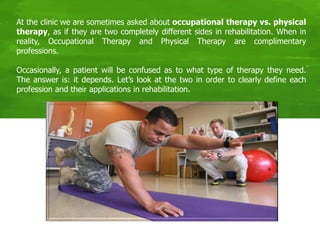
At the clinic we are sometimes asked about occupational therapy vs. physical
therapy, as if they are two completely different sides in rehabilitation. When in
reality, Occupational Therapy and Physical Therapy are complimentary
professions.
Occasionally, a patient will be confused as to what type of therapy they need.
The answer is: it depends. Let’s look at the two in order to clearly define each
profession and their applications in rehabilitation.
Definition of Occupational Therapy
Occupational therapy sounds like it would be designed to help people
perform their jobs to the best of their ability. In a way, this is correct in that
occupational therapy helps people perform the daily tasks needed both for
their daily living and in order to perform their job tasks.
For a more technical definition, occupational therapy assesses and treats
people who have a physical, mental or cognitive disorder that inhibits their
ability to maintain the necessary daily living and work skills.
Who Do Occupational
Therapists Treat?
Occupational therapists treat everyone from young children to elderly patients
across a broad range of abilities and needs. Some of the patients who would
seek treatment from an occupational therapist are:
 Children with Autism Spectrum Disorder
 Patients with Traumatic Brain Injury
 People suffering from Arthritis
 Patients recovering from Stroke
 Patients with soft tissue injuries that make daily tasks
difficult to do on one’s own
Some Of The Main Goals An
Occupational Therapist
Helps Their Patient’s Work
Towards Are:
For example, an occupational therapist would help a child with a
developmental disability work towards transitioning into a
diverse-skills class room.
 Achievement of Personal Goals:
 Maintain Health:
Living with a chronic illness, like Rheumatoid Arthritis, requires skills to
help a patient stay as healthy and remain as active as possible. An
occupational therapist can work with patients with chronic illnesses
manage their chronic condition.
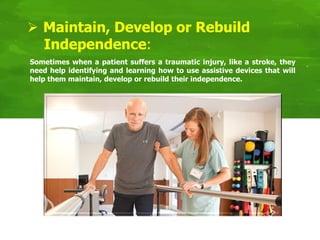
Sometimes when a patient suffers a traumatic injury, like a stroke, they
need help identifying and learning how to use assistive devices that will
help them maintain, develop or rebuild their independence.
 Maintain, Develop or Rebuild
Independence:
 Participate in the Everyday
Activities:
important to you, such as driving, visiting friends, going to
church, and other activities that keep you involved with your
community.
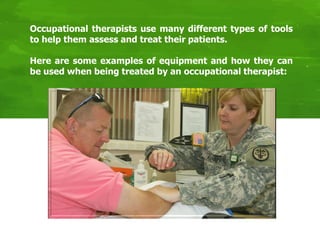
Occupational therapists use many different types of tools
to help them assess and treat their patients.
Here are some examples of equipment and how they can
be used when being treated by an occupational therapist:
Occupational
Therapy Tools
Used in assessment, Functional Capacity Equipment helps an
occupational therapist evaluate a patient’s ability to perform specific
functions and can give them a baseline for strength, position tolerance,
mobility, coordination, endurance as well as fine motor skills.
1. Functional Capacity Equipment:
2. Hand Evaluation Set:
Hand evaluation kits include tools like a hand dynamometer, pinch gauge,
finger goniometer provides a way to measure and identify deficits in hand
strength.
A paraffin bath is useful when treating patients who experience stiffness
in their hands, like those with arthritis, in order to decrease their pain and
increase the mobility of their fingers either before or after exercising the
hand as a part of occupational therapy.
2. Paraffin Bath:
Pegboard tests are useful for occupational therapists in order to evaluate
a patient’s dexterity and hand-eye coordination.
3. Pegboard Test:
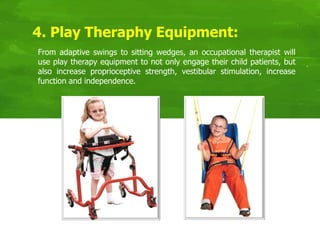
4. Play Theraphy Equipment:
From adaptive swings to sitting wedges, an occupational therapist will
use play therapy equipment to not only engage their child patients, but
also increase proprioceptive strength, vestibular stimulation, increase
function and independence.
While this list isn’t exhaustive, it gives a good sample of some of the tools
an occupational therapist will use to evaluate and treat their patients.
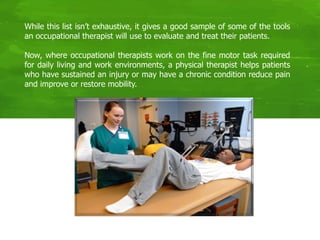
Now, where occupational therapists work on the fine motor task required
for daily living and work environments, a physical therapist helps patients
who have sustained an injury or may have a chronic condition reduce pain
and improve or restore mobility.
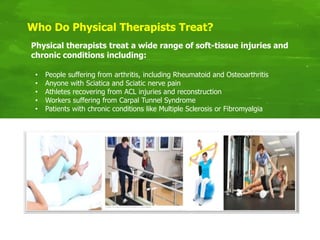
Who Do Physical Therapists Treat?
Physical therapists treat a wide range of soft-tissue injuries and
chronic conditions including:
• People suffering from arthritis, including Rheumatoid and Osteoarthritis
• Anyone with Sciatica and Sciatic nerve pain
• Athletes recovering from ACL injuries and reconstruction
• Workers suffering from Carpal Tunnel Syndrome
• Patients with chronic conditions like Multiple Sclerosis or Fibromyalgia
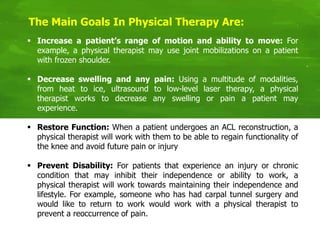
The Main Goals In Physical Therapy Are:
 Increase a patient’s range of motion and ability to move: For
example, a physical therapist may use joint mobilizations on a patient
with frozen shoulder.
 Decrease swelling and any pain: Using a multitude of modalities,
from heat to ice, ultrasound to low-level laser therapy, a physical
therapist works to decrease any swelling or pain a patient may
experience.
 Restore Function: When a patient undergoes an ACL reconstruction, a
physical therapist will work with them to be able to regain functionality of
the knee and avoid future pain or injury
 Prevent Disability: For patients that experience an injury or chronic
condition that may inhibit their independence or ability to work, a
physical therapist will work towards maintaining their independence and
lifestyle. For example, someone who has had carpal tunnel surgery and
would like to return to work would work with a physical therapist to
prevent a reoccurrence of pain.
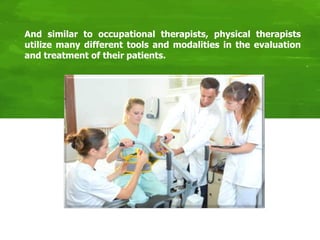
And similar to occupational therapists, physical therapists
utilize many different tools and modalities in the evaluation
and treatment of their patients.
Physical Therapy Tools
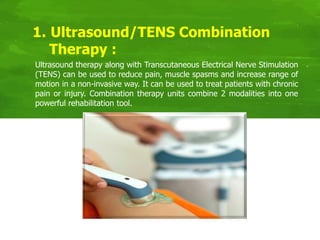
Ultrasound therapy along with Transcutaneous Electrical Nerve Stimulation
(TENS) can be used to reduce pain, muscle spasms and increase range of
motion in a non-invasive way. It can be used to treat patients with chronic
pain or injury. Combination therapy units combine 2 modalities into one
powerful rehabilitation tool.
1. Ultrasound/TENS Combination
Therapy :
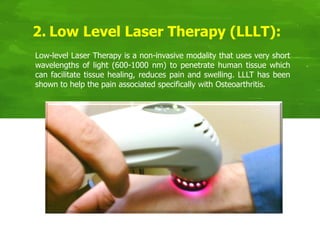
2. Low Level Laser Therapy (LLLT):
Low-level Laser Therapy is a non-invasive modality that uses very short
wavelengths of light (600-1000 nm) to penetrate human tissue which
can facilitate tissue healing, reduces pain and swelling. LLLT has been
shown to help the pain associated specifically with Osteoarthritis.
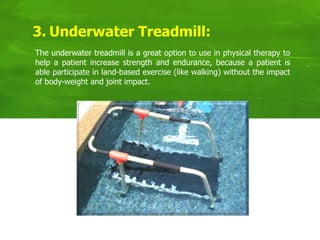
3. Underwater Treadmill:
The underwater treadmill is a great option to use in physical therapy to
help a patient increase strength and endurance, because a patient is
able participate in land-based exercise (like walking) without the impact
of body-weight and joint impact.
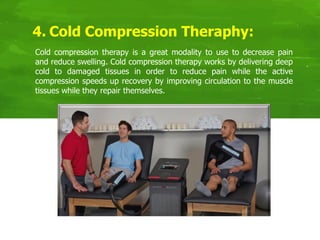
4. Cold Compression Theraphy:
Cold compression therapy is a great modality to use to decrease pain
and reduce swelling. Cold compression therapy works by delivering deep
cold to damaged tissues in order to reduce pain while the active
compression speeds up recovery by improving circulation to the muscle
tissues while they repair themselves.
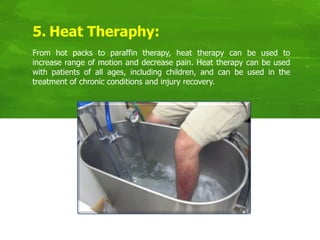
5. Heat Theraphy:
From hot packs to paraffin therapy, heat therapy can be used to
increase range of motion and decrease pain. Heat therapy can be used
with patients of all ages, including children, and can be used in the
treatment of chronic conditions and injury recovery.
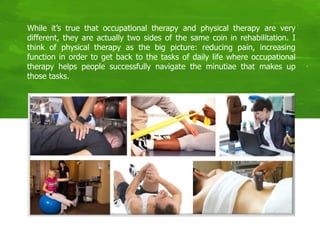
While it’s true that occupational therapy and physical therapy are very
different, they are actually two sides of the same coin in rehabilitation. I
think of physical therapy as the big picture: reducing pain, increasing
function in order to get back to the tasks of daily life where occupational
therapy helps people successfully navigate the minutiae that makes up
those tasks.
Shop ProHealthcareProducts.com

Occupational Therapy Vs. Physical Therapy Tools, Techniques &Amp; More

  • 1.
  • 2.
    At the clinicwe are sometimes asked about occupational therapy vs. physical therapy, as if they are two completely different sides in rehabilitation. When in reality, Occupational Therapy and Physical Therapy are complimentary professions. Occasionally, a patient will be confused as to what type of therapy they need. The answer is: it depends. Let’s look at the two in order to clearly define each profession and their applications in rehabilitation.
  • 3.
    Definition of OccupationalTherapy Occupational therapy sounds like it would be designed to help people perform their jobs to the best of their ability. In a way, this is correct in that occupational therapy helps people perform the daily tasks needed both for their daily living and in order to perform their job tasks. For a more technical definition, occupational therapy assesses and treats people who have a physical, mental or cognitive disorder that inhibits their ability to maintain the necessary daily living and work skills.
  • 4.
  • 5.
    Occupational therapists treateveryone from young children to elderly patients across a broad range of abilities and needs. Some of the patients who would seek treatment from an occupational therapist are:  Children with Autism Spectrum Disorder  Patients with Traumatic Brain Injury  People suffering from Arthritis  Patients recovering from Stroke  Patients with soft tissue injuries that make daily tasks difficult to do on one’s own
  • 6.
    Some Of TheMain Goals An Occupational Therapist Helps Their Patient’s Work Towards Are:
  • 7.
    For example, anoccupational therapist would help a child with a developmental disability work towards transitioning into a diverse-skills class room.  Achievement of Personal Goals:
  • 8.
     Maintain Health: Livingwith a chronic illness, like Rheumatoid Arthritis, requires skills to help a patient stay as healthy and remain as active as possible. An occupational therapist can work with patients with chronic illnesses manage their chronic condition.
  • 9.
    Sometimes when apatient suffers a traumatic injury, like a stroke, they need help identifying and learning how to use assistive devices that will help them maintain, develop or rebuild their independence.  Maintain, Develop or Rebuild Independence:
  • 10.
     Participate inthe Everyday Activities: important to you, such as driving, visiting friends, going to church, and other activities that keep you involved with your community.
  • 11.
    Occupational therapists usemany different types of tools to help them assess and treat their patients. Here are some examples of equipment and how they can be used when being treated by an occupational therapist:
  • 12.
  • 13.
    Used in assessment,Functional Capacity Equipment helps an occupational therapist evaluate a patient’s ability to perform specific functions and can give them a baseline for strength, position tolerance, mobility, coordination, endurance as well as fine motor skills. 1. Functional Capacity Equipment:
  • 14.
    2. Hand EvaluationSet: Hand evaluation kits include tools like a hand dynamometer, pinch gauge, finger goniometer provides a way to measure and identify deficits in hand strength.
  • 15.
    A paraffin bathis useful when treating patients who experience stiffness in their hands, like those with arthritis, in order to decrease their pain and increase the mobility of their fingers either before or after exercising the hand as a part of occupational therapy. 2. Paraffin Bath:
  • 16.
    Pegboard tests areuseful for occupational therapists in order to evaluate a patient’s dexterity and hand-eye coordination. 3. Pegboard Test:
  • 17.
    4. Play TheraphyEquipment: From adaptive swings to sitting wedges, an occupational therapist will use play therapy equipment to not only engage their child patients, but also increase proprioceptive strength, vestibular stimulation, increase function and independence.
  • 18.
    While this listisn’t exhaustive, it gives a good sample of some of the tools an occupational therapist will use to evaluate and treat their patients. Now, where occupational therapists work on the fine motor task required for daily living and work environments, a physical therapist helps patients who have sustained an injury or may have a chronic condition reduce pain and improve or restore mobility.
  • 19.
    Who Do PhysicalTherapists Treat? Physical therapists treat a wide range of soft-tissue injuries and chronic conditions including: • People suffering from arthritis, including Rheumatoid and Osteoarthritis • Anyone with Sciatica and Sciatic nerve pain • Athletes recovering from ACL injuries and reconstruction • Workers suffering from Carpal Tunnel Syndrome • Patients with chronic conditions like Multiple Sclerosis or Fibromyalgia
  • 20.
    The Main GoalsIn Physical Therapy Are:  Increase a patient’s range of motion and ability to move: For example, a physical therapist may use joint mobilizations on a patient with frozen shoulder.  Decrease swelling and any pain: Using a multitude of modalities, from heat to ice, ultrasound to low-level laser therapy, a physical therapist works to decrease any swelling or pain a patient may experience.  Restore Function: When a patient undergoes an ACL reconstruction, a physical therapist will work with them to be able to regain functionality of the knee and avoid future pain or injury  Prevent Disability: For patients that experience an injury or chronic condition that may inhibit their independence or ability to work, a physical therapist will work towards maintaining their independence and lifestyle. For example, someone who has had carpal tunnel surgery and would like to return to work would work with a physical therapist to prevent a reoccurrence of pain.
  • 21.
    And similar tooccupational therapists, physical therapists utilize many different tools and modalities in the evaluation and treatment of their patients.
  • 22.
  • 23.
    Ultrasound therapy alongwith Transcutaneous Electrical Nerve Stimulation (TENS) can be used to reduce pain, muscle spasms and increase range of motion in a non-invasive way. It can be used to treat patients with chronic pain or injury. Combination therapy units combine 2 modalities into one powerful rehabilitation tool. 1. Ultrasound/TENS Combination Therapy :
  • 24.
    2. Low LevelLaser Therapy (LLLT): Low-level Laser Therapy is a non-invasive modality that uses very short wavelengths of light (600-1000 nm) to penetrate human tissue which can facilitate tissue healing, reduces pain and swelling. LLLT has been shown to help the pain associated specifically with Osteoarthritis.
  • 25.
    3. Underwater Treadmill: Theunderwater treadmill is a great option to use in physical therapy to help a patient increase strength and endurance, because a patient is able participate in land-based exercise (like walking) without the impact of body-weight and joint impact.
  • 26.
    4. Cold CompressionTheraphy: Cold compression therapy is a great modality to use to decrease pain and reduce swelling. Cold compression therapy works by delivering deep cold to damaged tissues in order to reduce pain while the active compression speeds up recovery by improving circulation to the muscle tissues while they repair themselves.
  • 27.
    5. Heat Theraphy: Fromhot packs to paraffin therapy, heat therapy can be used to increase range of motion and decrease pain. Heat therapy can be used with patients of all ages, including children, and can be used in the treatment of chronic conditions and injury recovery.
  • 28.
    While it’s truethat occupational therapy and physical therapy are very different, they are actually two sides of the same coin in rehabilitation. I think of physical therapy as the big picture: reducing pain, increasing function in order to get back to the tasks of daily life where occupational therapy helps people successfully navigate the minutiae that makes up those tasks.
  • 29.