As in any other working environment, dental practice can be
associated with harmful effects to dentists, referred to as
occupational hazards. These hazards vary from mild and
easily or self curable, as influenza and mental fatigue, to
 . more serious and incurable as AIDS
Potential sources for occupational hazards to dentists


• -Working for long periods of time in physiologically improper
  positions.
• Contact with patients.
• Contact with certain chemicals and materials used in dental
  practice.
• Contact with X-ray.
• dental equipments and accessories produce sound noise at different
  sound levels.
• Dealing with different personalities.
Working for long periods of time in
          physiologically improper positions
Dentists have to contort their bodies while using a variety of
elaborate hand tools in order to perform work in the oral
cavity. They are required to maintain these positions for
prolonged periods of time. This creates a problem of having
static contractions and subsequently developing muscle
ischemia. Muscle ischemia is thought to be a primary cause
of myofacial trigger points, which can result in pain,
restriction of movement and muscular atrophy. Weakness of
the postural muscles may lead to a progressive of the
operator’s posture, when then leads to pain”. This can affect
the dentists’ legs, spines and shoulders, Leg spine shoulder
pain, flat foot and varicositiy .
How to mitigate the risk of musculoskeletal pains?

Maintain an erect posture :adjust your seating to minimise bending
forward, thereby preserving normal curves in your spine as you sit to treat your
patient.
Keep your body in a relaxed natural position:do not work with your arms
elevated and tensed. Try to bring your patient close to you so that your elbows
and arms stay close to your body.Ensure that your hands and wrists do not
remain contorted for an extended period of time.
Change posture as frequently as you can: frequent switching between sitting
and standing helps to reduce fatigue and the risk of problems associated with
static muscle ischemia.
Use dental equipment and tools that are easy on your hands:ergonomically
designed equipment are available.
Take regular breaks between treatment: These breaks will enable you to do
some stretching exercises. This will reduce muscular tension and give you time to
recompose.
Try to bring your patient close to you so that your elbows and
arms stay close to your body.
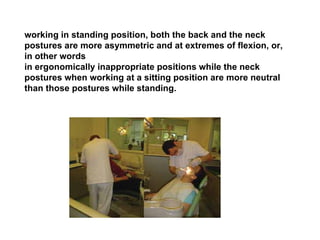
working in standing position, both the back and the neck
postures are more asymmetric and at extremes of flexion, or,
in other words
in ergonomically inappropriate positions while the neck
postures when working at a sitting position are more neutral
than those postures while standing.
Contact with patients
Infection Harmful effects Eye injury and/ or inflammation .
Infection Aerosolization is a process whereby mechanically
generated particles remain suspended in the air for prolonged
time periods and may be capable of transmitting an airborne
infection via inhalation. Aerosols are airborne particles, that may
travel for long distances. They may occur in liquid or solid forms.
Splash and spatter are large droplets that remain airborne but
contribute to infection of indirect contact.
Infection can be transmitted to dentist from infected patients who
have infectious potential. Infection transmission:
 A- Airborne: influenza, common cold, T.B . (Aerosols)
 B- Bloodborne : Syphilis, Hepatitis B and C, and AIDS. Infected
blood should contact dentist’s blood (needle prick after patient
injection, wound in dentist’s hands)
 C- Direct contact of hands with oral mucosal lesions : syphilis
and herpes simplex infection. Saliva and hepatiti
precautions should be taken to minimizing the risk of
                          infections

1-The dental surgeon should wear a face mask.
2-The use of high speed hand pieces with T.B. patients should
be avoided to minimize aerosols.
3-In dealing with a syphilitic patient, the dental surgeon should
wear rubber or vinyl gloves.
4-The dentist should not scrub his hands with a brush before or
after working on pt with AIDS,TB or hepatitis, since scrubbing
may produce minute abrasions which serve as a portal of entry
for microorganisms   .
5-clinical examination, mucosal lesions should never be touched
without gloves   .
  .
6- 5-Careful handling of sharp instruments   .
7-Eye glasses should always be used while treating the patients.
Golden role
“All patients should be treated as if they are infectious and routine

cross-infection control is necessary when dealing with everypatient”.


Universal cross Infection Control routines :

Sterilization; Barriers; Chemical Disinfectants ; Disposable of Wastes

note:
 barriers mean gloves; masks; goggles; protective clothing. These
serve as protective barriers against the transmission of diseases.
Gloves are disposed of after each patient.
Contact with certain chemicals


Direct contact with materials such as eugenol, phenol,
iodine, formalin, some impression materials, topical
anaesthia and others could cause allergic contact
dermatitis.
mercury exposure may lead to Hg poisoning.
Adverse health effects of this exposure including
neurological effects have also been well documented      .
How to protect contact dermatitis

• Use machinery and tools to clean equipment, rather than your
hands.
• Wear non-latex gloves where possible, especially when cleaning
(care needs to be taken when selecting gloves if you are allergic to
any materials used in gloves).
• Do not use abrasive skin cleaners and keep the use of
disinfectants to a minimum.
• Dry your hands thoroughly with a soft, disposable paper towel .
• Protect your hands by moisturising them regularly with an
emollient (soothing and softening skin product). Use a product that
is free from fragrances and preservatives
• Avoid sensitisers that you are allergic to (investigation by your
dermatologist will help identify these).
Dealing safely with Hg
-Use of water spray, high velocity evacuation and rubber dam reduce
exposure.
- All dental staff should wear face masks.
-carpeting and rugs in dental offices should be avoided as it is a major
repository of mercury.
-Never rinse elemental mercury down the drain.
-Never dispose of elemental mercury in the trash.
-Never dispose of elemental mercury in the sharps container or as
medical waste.
-Don't mix a double-use capsule if a single-use capsule will do.
-Keep the fillings cool during removal .
-Cutting the Amalgam into Chunks:
Most mercury-safe dentists use a removal process that’s commonly
referred to as chunking. This involves less drilling, because the dentist
only drills enough to cut the filling into chunks, which can then be easily
removed by a hand instrument or suction and minimize Hg vapouring.
 - Do not use latex gloves as mercury can penetrate latex.
Contact with X-ray
X-ray is an ionizing radiation that is capable of
initiating and producing damage to body cells, as well
as carcinogenic and genetic changes. Careless
dentists used to hold the dental X-ray films inside the
patient’s mouth (for obtaining better quality of image)
are at risk for developing radiation dermatitis on
hands, or on a long run squamous cell carcinoma of
the figures.
protection from radiation hazards

principles and means of radiation protection should be
applied and used during radiation exposure.
- Dentist should not hold the film in patient’s mouth.
 -Dentist should avoid direct exposure to X-ray beam.
 - proper position of the dentist in relation to either the X-
ray machine or the patients should be strictly applied.
 -Regular checking of leakage from X-ray machine
should always be performed.
- Radiation monitoring.
Perspnal protective equipments

• Medicalgloves(different types)


• Eye wears


• Masks


• Protective clothing(medical and
  lead aprons)
perilous auditory effect
The hearing threshold in humans varies with the frequency of
sound, and it is well known that dentists experience gradual
hearing loss during their working life, especially because high-
speed dental air turbines emit frequencies that can cause
.hearing loss
Dental laboratory machine, dental hand piece, ultrasonic
scalers, amalgamators, high-speed evacuation and other
dental equipments and accessories produce sound noise at
.different sound levels

it is imperative that dentists remain well versed regarding up-
to-date measures on how to deal with newer technologies and
 .dental equipments in clinical use
Pscychological hazards
a.   Stress:Coping with difficult or uncooperative patients,
     over workload, constant drive for technical perfection,
     underuse of skills, low self-esteem and challenging
     environment are important factors contributing to stress
     among dentist.
b.   Professional burnout: “A syndrome of emotional
     exhaustion, depersonalization and reduced personal
     accomplishment.it is best described as a gradual
     erosion of the person.
c.   Anxiety disorder and Depression:Two common and
     potentially overlapping anxiety disorders are panic
     disorder and generalized anxiety disorder, or GAD. In
     panic disorder, feelings of extreme fear and dread
     strike unexpectedly and repeatedly for no apparent
     reason They are accompanied by intense physical
     symptoms like feeling sweaty, weak, faint, dizzy,
     flushed or chilled; having nausea, chest pain,
     smothering sensations, or a tingly or numbfeeling in the
     hands. GAD is characterized by chronic exaggerated
     worry and tension, even though little or nothing has
     provoked it.
Coping with Psychological hazards

-Stress management :deep breathing exercises;
progressive effective relaxation of areas of the body;
listening to audiotapes of oral instructions on how to relax;
meditation; information on the topics of practice and
business management, time management, communication.
-Physical exercise, such as regular walking or working out.
People’s personalities and temperaments have a significant
impact on their perceptions of stress. Those who have
strong, positive self-images and know how to relax so as to
reduce mental and emotionalpressures also cope better
with stress,
-Stressors such as failing to meet personal expectations,
seeing more patients working quickly can be managed by
breaking the large task into small ones.
Occupational Hazards in Dentistry

Occupational Hazards in Dentistry

  • 2.
    As in anyother working environment, dental practice can be associated with harmful effects to dentists, referred to as occupational hazards. These hazards vary from mild and easily or self curable, as influenza and mental fatigue, to . more serious and incurable as AIDS
  • 3.
    Potential sources foroccupational hazards to dentists • -Working for long periods of time in physiologically improper positions. • Contact with patients. • Contact with certain chemicals and materials used in dental practice. • Contact with X-ray. • dental equipments and accessories produce sound noise at different sound levels. • Dealing with different personalities.
  • 4.
    Working for longperiods of time in physiologically improper positions Dentists have to contort their bodies while using a variety of elaborate hand tools in order to perform work in the oral cavity. They are required to maintain these positions for prolonged periods of time. This creates a problem of having static contractions and subsequently developing muscle ischemia. Muscle ischemia is thought to be a primary cause of myofacial trigger points, which can result in pain, restriction of movement and muscular atrophy. Weakness of the postural muscles may lead to a progressive of the operator’s posture, when then leads to pain”. This can affect the dentists’ legs, spines and shoulders, Leg spine shoulder pain, flat foot and varicositiy .
  • 5.
    How to mitigatethe risk of musculoskeletal pains? Maintain an erect posture :adjust your seating to minimise bending forward, thereby preserving normal curves in your spine as you sit to treat your patient. Keep your body in a relaxed natural position:do not work with your arms elevated and tensed. Try to bring your patient close to you so that your elbows and arms stay close to your body.Ensure that your hands and wrists do not remain contorted for an extended period of time. Change posture as frequently as you can: frequent switching between sitting and standing helps to reduce fatigue and the risk of problems associated with static muscle ischemia. Use dental equipment and tools that are easy on your hands:ergonomically designed equipment are available. Take regular breaks between treatment: These breaks will enable you to do some stretching exercises. This will reduce muscular tension and give you time to recompose.
  • 7.
    Try to bringyour patient close to you so that your elbows and arms stay close to your body.
  • 8.
    working in standingposition, both the back and the neck postures are more asymmetric and at extremes of flexion, or, in other words in ergonomically inappropriate positions while the neck postures when working at a sitting position are more neutral than those postures while standing.
  • 9.
    Contact with patients InfectionHarmful effects Eye injury and/ or inflammation . Infection Aerosolization is a process whereby mechanically generated particles remain suspended in the air for prolonged time periods and may be capable of transmitting an airborne infection via inhalation. Aerosols are airborne particles, that may travel for long distances. They may occur in liquid or solid forms. Splash and spatter are large droplets that remain airborne but contribute to infection of indirect contact. Infection can be transmitted to dentist from infected patients who have infectious potential. Infection transmission: A- Airborne: influenza, common cold, T.B . (Aerosols) B- Bloodborne : Syphilis, Hepatitis B and C, and AIDS. Infected blood should contact dentist’s blood (needle prick after patient injection, wound in dentist’s hands) C- Direct contact of hands with oral mucosal lesions : syphilis and herpes simplex infection. Saliva and hepatiti
  • 10.
    precautions should betaken to minimizing the risk of infections 1-The dental surgeon should wear a face mask. 2-The use of high speed hand pieces with T.B. patients should be avoided to minimize aerosols. 3-In dealing with a syphilitic patient, the dental surgeon should wear rubber or vinyl gloves. 4-The dentist should not scrub his hands with a brush before or after working on pt with AIDS,TB or hepatitis, since scrubbing may produce minute abrasions which serve as a portal of entry for microorganisms . 5-clinical examination, mucosal lesions should never be touched without gloves . . 6- 5-Careful handling of sharp instruments . 7-Eye glasses should always be used while treating the patients.
  • 12.
    Golden role “All patientsshould be treated as if they are infectious and routine cross-infection control is necessary when dealing with everypatient”. Universal cross Infection Control routines : Sterilization; Barriers; Chemical Disinfectants ; Disposable of Wastes note: barriers mean gloves; masks; goggles; protective clothing. These serve as protective barriers against the transmission of diseases. Gloves are disposed of after each patient.
  • 14.
    Contact with certainchemicals Direct contact with materials such as eugenol, phenol, iodine, formalin, some impression materials, topical anaesthia and others could cause allergic contact dermatitis. mercury exposure may lead to Hg poisoning. Adverse health effects of this exposure including neurological effects have also been well documented .
  • 15.
    How to protectcontact dermatitis • Use machinery and tools to clean equipment, rather than your hands. • Wear non-latex gloves where possible, especially when cleaning (care needs to be taken when selecting gloves if you are allergic to any materials used in gloves). • Do not use abrasive skin cleaners and keep the use of disinfectants to a minimum. • Dry your hands thoroughly with a soft, disposable paper towel . • Protect your hands by moisturising them regularly with an emollient (soothing and softening skin product). Use a product that is free from fragrances and preservatives • Avoid sensitisers that you are allergic to (investigation by your dermatologist will help identify these).
  • 16.
    Dealing safely withHg -Use of water spray, high velocity evacuation and rubber dam reduce exposure. - All dental staff should wear face masks. -carpeting and rugs in dental offices should be avoided as it is a major repository of mercury. -Never rinse elemental mercury down the drain. -Never dispose of elemental mercury in the trash. -Never dispose of elemental mercury in the sharps container or as medical waste. -Don't mix a double-use capsule if a single-use capsule will do. -Keep the fillings cool during removal . -Cutting the Amalgam into Chunks: Most mercury-safe dentists use a removal process that’s commonly referred to as chunking. This involves less drilling, because the dentist only drills enough to cut the filling into chunks, which can then be easily removed by a hand instrument or suction and minimize Hg vapouring. - Do not use latex gloves as mercury can penetrate latex.
  • 17.
    Contact with X-ray X-rayis an ionizing radiation that is capable of initiating and producing damage to body cells, as well as carcinogenic and genetic changes. Careless dentists used to hold the dental X-ray films inside the patient’s mouth (for obtaining better quality of image) are at risk for developing radiation dermatitis on hands, or on a long run squamous cell carcinoma of the figures.
  • 18.
    protection from radiationhazards principles and means of radiation protection should be applied and used during radiation exposure. - Dentist should not hold the film in patient’s mouth. -Dentist should avoid direct exposure to X-ray beam. - proper position of the dentist in relation to either the X- ray machine or the patients should be strictly applied. -Regular checking of leakage from X-ray machine should always be performed. - Radiation monitoring.
  • 21.
    Perspnal protective equipments •Medicalgloves(different types) • Eye wears • Masks • Protective clothing(medical and lead aprons)
  • 22.
    perilous auditory effect Thehearing threshold in humans varies with the frequency of sound, and it is well known that dentists experience gradual hearing loss during their working life, especially because high- speed dental air turbines emit frequencies that can cause .hearing loss Dental laboratory machine, dental hand piece, ultrasonic scalers, amalgamators, high-speed evacuation and other dental equipments and accessories produce sound noise at .different sound levels it is imperative that dentists remain well versed regarding up- to-date measures on how to deal with newer technologies and .dental equipments in clinical use
  • 23.
    Pscychological hazards a. Stress:Coping with difficult or uncooperative patients, over workload, constant drive for technical perfection, underuse of skills, low self-esteem and challenging environment are important factors contributing to stress among dentist. b. Professional burnout: “A syndrome of emotional exhaustion, depersonalization and reduced personal accomplishment.it is best described as a gradual erosion of the person. c. Anxiety disorder and Depression:Two common and potentially overlapping anxiety disorders are panic disorder and generalized anxiety disorder, or GAD. In panic disorder, feelings of extreme fear and dread strike unexpectedly and repeatedly for no apparent reason They are accompanied by intense physical symptoms like feeling sweaty, weak, faint, dizzy, flushed or chilled; having nausea, chest pain, smothering sensations, or a tingly or numbfeeling in the hands. GAD is characterized by chronic exaggerated worry and tension, even though little or nothing has provoked it.
  • 24.
    Coping with Psychologicalhazards -Stress management :deep breathing exercises; progressive effective relaxation of areas of the body; listening to audiotapes of oral instructions on how to relax; meditation; information on the topics of practice and business management, time management, communication. -Physical exercise, such as regular walking or working out. People’s personalities and temperaments have a significant impact on their perceptions of stress. Those who have strong, positive self-images and know how to relax so as to reduce mental and emotionalpressures also cope better with stress, -Stressors such as failing to meet personal expectations, seeing more patients working quickly can be managed by breaking the large task into small ones.