Forms of factual Programming.
News Broadcast.
When in a newsroom –or just observing, should that be on TV, computer, films- there
are specific things that people automatically associate with the News. All different
kinds of things that should be found within a newsroom. Some of these being;
-A well exposed presenter that
looks professional and serious.
However there can be presenters
that are more light hearted.
-A desk. There is always typically a
large desk that a presented is
situated behind.
-An array of papers. This goes with
the desk, on it, usually is a pile of
papers that would include
information that the presenter
would require to present effectively.
They can either be in a neat pile or
laid out across the surface.
-A back drop. Behind the presenter is
always a screen that shows different things.
Sometimes it’s like a window showing the
outside, other times it’s a window into the
behind the scenes. You can see all the other
staff going about their days, doing what
they have to do. But the screen sometime
also changed to emphasis and assist a
story.
There are many different type of Television shows that
have different codes and conventions/ formats.
INVESTIGATIVE SHOWS.
 Social.
 Infotainment.
 Reality
 Educational.
 Wildlife.
 Special
Interest.
 Make-over
 Magazine.
 Discussion.
 Review.
 Chat Show.
Social shows, are things like ‘Hunted,’ where people are able to interact Via social
media to communicate about that show. They express opinions and views.
Infotainment shows are like, ‘The One Show.’ It’s where they give you a mix between
Information and entertainment. They’re not completely serious.
Reality TV is shows like, ‘Geordie Shore and Made in Chelsea.’ Shows that try and
express the realism of life.
Educational, shows like, ‘Educating Cardiff, Countdown, Antiques Roadshow,’ shows
that have educational purposes and are informative.
Wildlife is shows like, ‘Wildlife Specials,’ TV shows the specialize in nature and
the Wildlife side of things.
Special interest shows like, ‘
Make-Over shows such as, ‘60 minutes makeovers,’ are based around shows
that revolved around, obviously, makeovers. Any kind, home, life, appearance.
Magazine shows have similar properties as Infotainment does, ‘The One Show,’
again, is a good example.
Discussion shows, for example, ‘Question time and Loose Women,’ are focused
around having deep conversations, talking about things.
Review show’s are designed to discuss products, TV shows, New released movies,
anything that requires people to give their opinion, shows like, ‘Watch Dog, Top Gear.’
Chat Show’s main focus is entertainment. They’re usually funny and not very serious. Good
examples of this is, ‘Jimmy Fallon, Alan Carr, Jonathan Ross.’
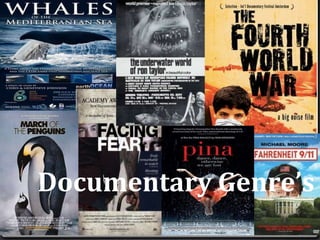
Documentary Genre’s
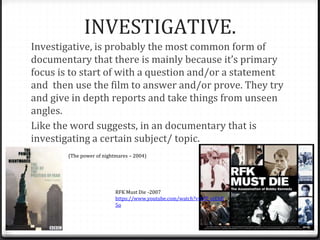
INVESTIGATIVE.
Investigative, is probably the most common form of
documentary that there is mainly because it’s primary
focus is to start of with a question and/or a statement
and then use the film to answer and/or prove. They try
and give in depth reports and take things from unseen
angles.
Like the word suggests, in an documentary that is
investigating a certain subject/ topic.
(The power of nightmares – 2004)
RFK Must Die -2007
https://www.youtube.com/watch?v=blP_ojEbR
5o
Ethnological.
Ethnological documentary is looking into peoples lives,
characteristics, societies and cultures – the different
kinds of people that live and then comparing the
relationships between them. It uses scientific and
analytical viewpoints.
http://psychoculturalcinema.com/20-
ethnographic-and-documentary-films-
psychological-anthropologists-should-be-
teaching/
Examples of
documentaries.
EXPOSITORY MODE.
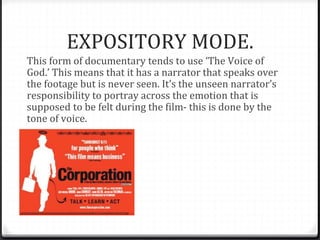
This form of documentary tends to use ‘The Voice of
God.’ This means that it has a narrator that speaks over
the footage but is never seen. It’s the unseen narrator’s
responsibility to portray across the emotion that is
supposed to be felt during the film- this is done by the
tone of voice.
Observational Mode.
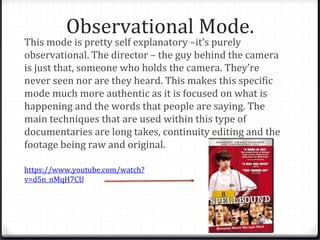
This mode is pretty self explanatory –it’s purely
observational. The director – the guy behind the camera
is just that, someone who holds the camera. They’re
never seen nor are they heard. This makes this specific
mode much more authentic as it is focused on what is
happening and the words that people are saying. The
main techniques that are used within this type of
documentaries are long takes, continuity editing and the
footage being raw and original.
https://www.youtube.com/watch?
v=d5n_nMqH7CU
INTERACTIVE.With this style it means what it says –it’s interactive. It’s
the complete opposite of ‘observational’ as the direction
is completely involved with the movie. They’re
interacting with the audience via talking directly to the
camera, they can converse with anyone that they want
to get maybe opinions, facts. It’s considerable strength is
most definitely the relationship the director has with
their interviewee.
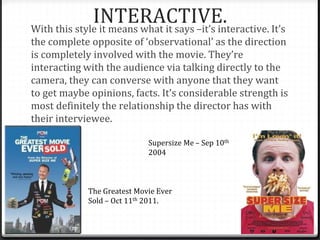
Supersize Me – Sep 10th
2004
The Greatest Movie Ever
Sold – Oct 11th 2011.
Docu-Drama
This is the form of documentary that re-tells a true story
but has added dramatized qualities to make it more
film-like. They use techniques that have been used
within Fiction film making. This includes Actors, Special
effects. And sometimes it even includes the voice of GOD.
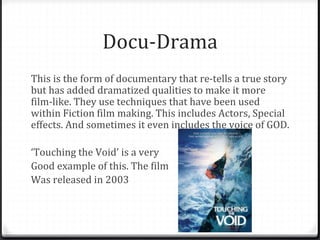
‘Touching the Void’ is a very
Good example of this. The film
Was released in 2003
BBC NEWS the NEWSROOM.
The BBC News and the Newsroom is incredible similar
in the way that they are produced and created. The
Newsroom was created mimic a real news show - like
the BBC. And it does a good job. It looks like a real news
studio with the pace that they move at and the way they
go about certain situations. We see the behind the
scenes and what goes into producing a successful
newsroom. The only different with the newsroom is that
it’s got fictitious values. We see their relationships with
each other that you definitely wouldn’t see on the BBC.

Codes and conventions paul carter.

  • 2.
    Forms of factualProgramming. News Broadcast. When in a newsroom –or just observing, should that be on TV, computer, films- there are specific things that people automatically associate with the News. All different kinds of things that should be found within a newsroom. Some of these being; -A well exposed presenter that looks professional and serious. However there can be presenters that are more light hearted. -A desk. There is always typically a large desk that a presented is situated behind. -An array of papers. This goes with the desk, on it, usually is a pile of papers that would include information that the presenter would require to present effectively. They can either be in a neat pile or laid out across the surface. -A back drop. Behind the presenter is always a screen that shows different things. Sometimes it’s like a window showing the outside, other times it’s a window into the behind the scenes. You can see all the other staff going about their days, doing what they have to do. But the screen sometime also changed to emphasis and assist a story.
  • 3.
    There are manydifferent type of Television shows that have different codes and conventions/ formats. INVESTIGATIVE SHOWS.  Social.  Infotainment.  Reality  Educational.  Wildlife.  Special Interest.  Make-over  Magazine.  Discussion.  Review.  Chat Show. Social shows, are things like ‘Hunted,’ where people are able to interact Via social media to communicate about that show. They express opinions and views. Infotainment shows are like, ‘The One Show.’ It’s where they give you a mix between Information and entertainment. They’re not completely serious. Reality TV is shows like, ‘Geordie Shore and Made in Chelsea.’ Shows that try and express the realism of life. Educational, shows like, ‘Educating Cardiff, Countdown, Antiques Roadshow,’ shows that have educational purposes and are informative. Wildlife is shows like, ‘Wildlife Specials,’ TV shows the specialize in nature and the Wildlife side of things. Special interest shows like, ‘ Make-Over shows such as, ‘60 minutes makeovers,’ are based around shows that revolved around, obviously, makeovers. Any kind, home, life, appearance. Magazine shows have similar properties as Infotainment does, ‘The One Show,’ again, is a good example. Discussion shows, for example, ‘Question time and Loose Women,’ are focused around having deep conversations, talking about things. Review show’s are designed to discuss products, TV shows, New released movies, anything that requires people to give their opinion, shows like, ‘Watch Dog, Top Gear.’ Chat Show’s main focus is entertainment. They’re usually funny and not very serious. Good examples of this is, ‘Jimmy Fallon, Alan Carr, Jonathan Ross.’
  • 4.
  • 5.
    INVESTIGATIVE. Investigative, is probablythe most common form of documentary that there is mainly because it’s primary focus is to start of with a question and/or a statement and then use the film to answer and/or prove. They try and give in depth reports and take things from unseen angles. Like the word suggests, in an documentary that is investigating a certain subject/ topic. (The power of nightmares – 2004) RFK Must Die -2007 https://www.youtube.com/watch?v=blP_ojEbR 5o
  • 6.
    Ethnological. Ethnological documentary islooking into peoples lives, characteristics, societies and cultures – the different kinds of people that live and then comparing the relationships between them. It uses scientific and analytical viewpoints. http://psychoculturalcinema.com/20- ethnographic-and-documentary-films- psychological-anthropologists-should-be- teaching/ Examples of documentaries.
  • 7.
    EXPOSITORY MODE. This formof documentary tends to use ‘The Voice of God.’ This means that it has a narrator that speaks over the footage but is never seen. It’s the unseen narrator’s responsibility to portray across the emotion that is supposed to be felt during the film- this is done by the tone of voice.
  • 8.
    Observational Mode. This modeis pretty self explanatory –it’s purely observational. The director – the guy behind the camera is just that, someone who holds the camera. They’re never seen nor are they heard. This makes this specific mode much more authentic as it is focused on what is happening and the words that people are saying. The main techniques that are used within this type of documentaries are long takes, continuity editing and the footage being raw and original. https://www.youtube.com/watch? v=d5n_nMqH7CU
  • 9.
    INTERACTIVE.With this styleit means what it says –it’s interactive. It’s the complete opposite of ‘observational’ as the direction is completely involved with the movie. They’re interacting with the audience via talking directly to the camera, they can converse with anyone that they want to get maybe opinions, facts. It’s considerable strength is most definitely the relationship the director has with their interviewee. Supersize Me – Sep 10th 2004 The Greatest Movie Ever Sold – Oct 11th 2011.
  • 10.
    Docu-Drama This is theform of documentary that re-tells a true story but has added dramatized qualities to make it more film-like. They use techniques that have been used within Fiction film making. This includes Actors, Special effects. And sometimes it even includes the voice of GOD. ‘Touching the Void’ is a very Good example of this. The film Was released in 2003
  • 11.
    BBC NEWS theNEWSROOM. The BBC News and the Newsroom is incredible similar in the way that they are produced and created. The Newsroom was created mimic a real news show - like the BBC. And it does a good job. It looks like a real news studio with the pace that they move at and the way they go about certain situations. We see the behind the scenes and what goes into producing a successful newsroom. The only different with the newsroom is that it’s got fictitious values. We see their relationships with each other that you definitely wouldn’t see on the BBC.