By
G J Kartheek
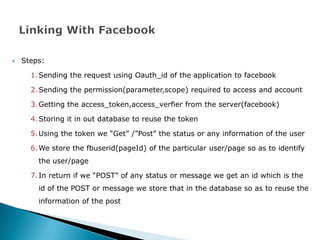
   Steps:

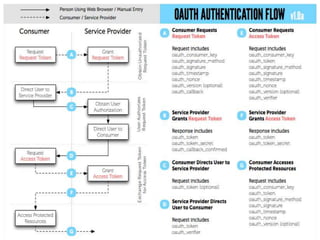
      1. Sending the request using Oauth_id of the application to facebook

      2. Sending the permission(parameter,scope) required to access and account

      3. Getting the access_token,access_verfier from the server(facebook)

      4. Storing it in out database to reuse the token

      5. Using the token we “Get” /”Post” the status or any information of the user

      6. We store the fbuserid(pageId) of the particular user/page so as to identify
        the user/page

      7. In return if we “POST” of any status or message we get an id which is the
        id of the POST or message we store that in the database so as to reuse the
        information of the post
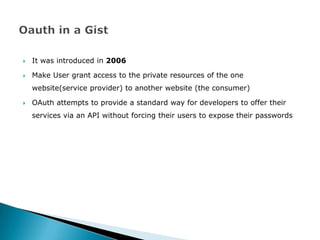
   It was introduced in 2006

   Make User grant access to the private resources of the one
    website(service provider) to another website (the consumer)

   OAuth attempts to provide a standard way for developers to offer their
    services via an API without forcing their users to expose their passwords
1.   Token: Unique Identifier issued by server

2.   CallBack Uri: Url to which the page is redirected after authentication or
     Authorization

3.   Oauth_token : Temporary credentials identifier

4.   Oauth_token_secret : Temporary Credentials shared secret

5.   Oauth_verifier: The verification code received from the server in the
     previous step.

6.   Oauth_callback_confirmed: It must be present and set value true. This
     parameter is used to differentiate from previous versions of protocol

7.   http/1.1 XXX: STATUS
                      1.   200 : Status Ok – Success

                      2.   403 : Status Not Ok – Un Authorized

                      3.   400: Status Not Ok – Bad Request
   The OAuth 1.0 Protocol – by E. Hammer-Lahav, Ed. ISSN: 2070-1721

   Oauth community Site - http://oauth.net/

   book can be downloaded at - http://tools.ietf.org/html/rfc5849

   Oauth core information site - http://oauth.net/core/1.0/

OAuth Linking-Social Networks

  • 1.
  • 2.
    Steps: 1. Sending the request using Oauth_id of the application to facebook 2. Sending the permission(parameter,scope) required to access and account 3. Getting the access_token,access_verfier from the server(facebook) 4. Storing it in out database to reuse the token 5. Using the token we “Get” /”Post” the status or any information of the user 6. We store the fbuserid(pageId) of the particular user/page so as to identify the user/page 7. In return if we “POST” of any status or message we get an id which is the id of the POST or message we store that in the database so as to reuse the information of the post
  • 3.
    It was introduced in 2006  Make User grant access to the private resources of the one website(service provider) to another website (the consumer)  OAuth attempts to provide a standard way for developers to offer their services via an API without forcing their users to expose their passwords
  • 4.
    1. Token: Unique Identifier issued by server 2. CallBack Uri: Url to which the page is redirected after authentication or Authorization 3. Oauth_token : Temporary credentials identifier 4. Oauth_token_secret : Temporary Credentials shared secret 5. Oauth_verifier: The verification code received from the server in the previous step. 6. Oauth_callback_confirmed: It must be present and set value true. This parameter is used to differentiate from previous versions of protocol 7. http/1.1 XXX: STATUS 1. 200 : Status Ok – Success 2. 403 : Status Not Ok – Un Authorized 3. 400: Status Not Ok – Bad Request
  • 6.
    The OAuth 1.0 Protocol – by E. Hammer-Lahav, Ed. ISSN: 2070-1721  Oauth community Site - http://oauth.net/  book can be downloaded at - http://tools.ietf.org/html/rfc5849  Oauth core information site - http://oauth.net/core/1.0/