ON HOW WE PERCEIVE
SCANDALS
Sebastián Vallejo
Fordham University
Figure 3. Plot chart of relation between Favorability and complete Feeling Thermometer
spread
4.VeryFavorable
3.SomewhatFavorable
2.SomewhatUnfavorable
1.VeryUnfavorable
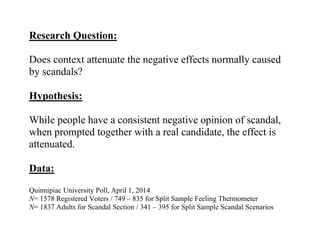
Research Question:
Does context attenuate the negative effects normally caused
by scandals?
Hypothesis:
While people have a consistent negative opinion of scandal,
when prompted together with a real candidate, the effect is
attenuated.
Data:
Quinnipiac University Poll, April 1, 2014
N= 1578 Registered Voters / 749 – 835 for Split Sample Feeling Thermometer
N= 1837 Adults for Scandal Section / 341 – 395 for Split Sample Scandal Scenarios
The survey research
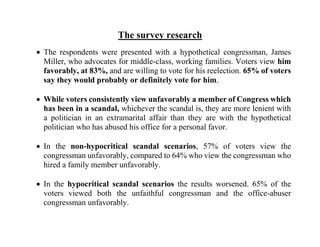
 The respondents were presented with a hypothetical congressman, James
Miller, who advocates for middle-class, working families. Voters view him
favorably, at 83%, and are willing to vote for his reelection. 65% of voters
say they would probably or definitely vote for him.
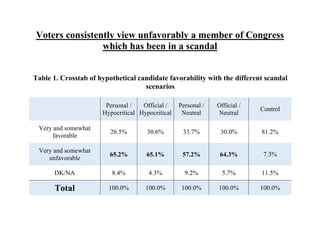
 While voters consistently view unfavorably a member of Congress which
has been in a scandal, whichever the scandal is, they are more lenient with
a politician in an extramarital affair than they are with the hypothetical
politician who has abused his office for a personal favor.
 In the non-hypocritical scandal scenarios, 57% of voters view the
congressman unfavorably, compared to 64% who view the congressman who
hired a family member unfavorably.
 In the hypocritical scandal scenarios the results worsened. 65% of the
voters viewed both the unfaithful congressman and the office-abuser
congressman unfavorably.
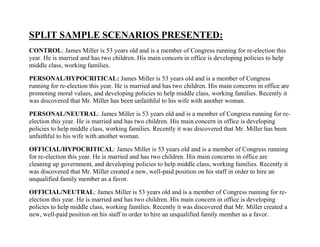
SPLIT SAMPLE SCENARIOS PRESENTED:
CONTROL: James Miller is 53 years old and is a member of Congress running for re-election this
year. He is married and has two children. His main concern in office is developing policies to help
middle class, working families.
PERSONAL/HYPOCRITICAL: James Miller is 53 years old and is a member of Congress
running for re-election this year. He is married and has two children. His main concerns in office are
promoting moral values, and developing policies to help middle class, working families. Recently it
was discovered that Mr. Miller has been unfaithful to his wife with another woman.
PERSONAL/NEUTRAL: James Miller is 53 years old and is a member of Congress running for re-
election this year. He is married and has two children. His main concern in office is developing
policies to help middle class, working families. Recently it was discovered that Mr. Miller has been
unfaithful to his wife with another woman.
OFFICIAL/HYPOCRITICAL: James Miller is 53 years old and is a member of Congress running
for re-election this year. He is married and has two children. His main concerns in office are
cleaning up government, and developing policies to help middle class, working families. Recently it
was discovered that Mr. Miller created a new, well-paid position on his staff in order to hire an
unqualified family member as a favor.
OFFICIAL/NEUTRAL: James Miller is 53 years old and is a member of Congress running for re-
election this year. He is married and has two children. His main concern in office is developing
policies to help middle class, working families. Recently it was discovered that Mr. Miller created a
new, well-paid position on his staff in order to hire an unqualified family member as a favor.
Voters consistently view unfavorably a member of Congress
which has been in a scandal
Table 1. Crosstab of hypothetical candidate favorability with the different scandal
scenarios
Personal /
Hypocritical
Official /
Hypocritical
Personal /
Neutral
Official /
Neutral
Control
Very and somewhat
favorable
26.5% 30.6% 33.7% 30.0% 81.2%
Very and somewhat
unfavorable
65.2% 65.1% 57.2% 64.3% 7.3%
DK/NA 8.4% 4.3% 9.2% 5.7% 11.5%
Total 100.0% 100.0% 100.0% 100.0% 100.0%
Figure 1. Crosstab of hypothetical candidate favorability with the different scandal
scenarios
0.0%
10.0%
20.0%
30.0%
40.0%
50.0%
60.0%
70.0%
80.0%
90.0%
Personal / Hypocritical Official / Hypocritical Personal / Neutral Official / Neutral Control
Very and somewhat favorable Very and somewhat unfavorable DK/NA
 The results were consistent across the different variables.
 Republicans viewed the Congressman slightly worse than Democrats
in all scandals, with the exception of the official/hypocritical, but with
no significant differences.
 The same with age, sex, race and levels of education, which are the
strong predictors of voting behavior.
Gov. Chris Christie Case Study
 The survey included a feeling thermometer of different candidates. Respondent were
asked to rate a candidate from 0 to 100. The higher the number, the warmer or more
favorable you feel toward that person, the lower the number, the colder or less
favorable.
 Using Gov. Chris Christie as a case study, the research analyze how people perceive
scandals when influenced by the behavior of a real politician whom they support.
 By comparing the different scenarios used in the national survey experiment and the
position taking by the respondents with their attitudes towards Gov. Christie, we can
broadly determine how much does contextual information about the politician affect
the attitudes of the respondents.
 Given the recent “Bridgegate” incident involving Gov. Chris Christie, we can
categorize it in Official / Hypocritical1
1
In a National Bloomberg poll, 63% of Americans said they don’t believe Christie’s claims that he was kept in the dark about plans laid by his top
aides to create an epic traffic jam aimed at a mayor who didn’t endorse his reelection bid.
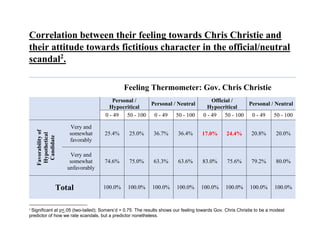
Correlation between their feeling towards Chris Christie and
their attitude towards fictitious character in the official/neutral
scandal2
.
Feeling Thermometer: Gov. Chris Christie
Personal /
Hypocritical
Personal / Neutral
Official /
Hypocritical
Personal / Neutral
0 - 49 50 - 100 0 - 49 50 - 100 0 - 49 50 - 100 0 - 49 50 - 100
Favorabilityof
Hypothetical
Candidate
Very and
somewhat
favorably
25.4% 25.0% 36.7% 36.4% 17.0% 24.4% 20.8% 20.0%
Very and
somewhat
unfavorably
74.6% 75.0% 63.3% 63.6% 83.0% 75.6% 79.2% 80.0%
Total 100.0% 100.0% 100.0% 100.0% 100.0% 100.0% 100.0% 100.0%
2
Significant at p<.05 (two-tailed); Somers’d = 0.75. The results shows our feeling towards Gov. Chris Christie to be a modest
predictor of how we rate scandals, but a predictor nonetheless.
Figure 2. Relation between the variance of favorability and Gov. Chris Christie’s rating.
0.0%
10.0%
20.0%
30.0%
40.0%
50.0%
60.0%
70.0%
80.0%
90.0%
Personal /
Hypocritical
Personal / Neutral Official /
Hypocritical
Personal / Neutral
Favorability of Hypothetical Candidate Very and somewhat favorably Favorability of Hypothetical Candidate Very and somewhat unfavorably
Conclusions and Recommendations
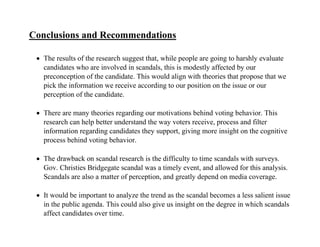
 The results of the research suggest that, while people are going to harshly evaluate
candidates who are involved in scandals, this is modestly affected by our
preconception of the candidate. This would align with theories that propose that we
pick the information we receive according to our position on the issue or our
perception of the candidate.
 There are many theories regarding our motivations behind voting behavior. This
research can help better understand the way voters receive, process and filter
information regarding candidates they support, giving more insight on the cognitive
process behind voting behavior.
 The drawback on scandal research is the difficulty to time scandals with surveys.
Gov. Christies Bridgegate scandal was a timely event, and allowed for this analysis.
Scandals are also a matter of perception, and greatly depend on media coverage.
 It would be important to analyze the trend as the scandal becomes a less salient issue
in the public agenda. This could also give us insight on the degree in which scandals
affect candidates over time.

On How We Perceive Scandal

  • 1.
    ON HOW WEPERCEIVE SCANDALS Sebastián Vallejo Fordham University
  • 2.
    Figure 3. Plotchart of relation between Favorability and complete Feeling Thermometer spread 4.VeryFavorable 3.SomewhatFavorable 2.SomewhatUnfavorable 1.VeryUnfavorable
  • 3.
    Research Question: Does contextattenuate the negative effects normally caused by scandals? Hypothesis: While people have a consistent negative opinion of scandal, when prompted together with a real candidate, the effect is attenuated. Data: Quinnipiac University Poll, April 1, 2014 N= 1578 Registered Voters / 749 – 835 for Split Sample Feeling Thermometer N= 1837 Adults for Scandal Section / 341 – 395 for Split Sample Scandal Scenarios
  • 4.
    The survey research The respondents were presented with a hypothetical congressman, James Miller, who advocates for middle-class, working families. Voters view him favorably, at 83%, and are willing to vote for his reelection. 65% of voters say they would probably or definitely vote for him.  While voters consistently view unfavorably a member of Congress which has been in a scandal, whichever the scandal is, they are more lenient with a politician in an extramarital affair than they are with the hypothetical politician who has abused his office for a personal favor.  In the non-hypocritical scandal scenarios, 57% of voters view the congressman unfavorably, compared to 64% who view the congressman who hired a family member unfavorably.  In the hypocritical scandal scenarios the results worsened. 65% of the voters viewed both the unfaithful congressman and the office-abuser congressman unfavorably.
  • 5.
    SPLIT SAMPLE SCENARIOSPRESENTED: CONTROL: James Miller is 53 years old and is a member of Congress running for re-election this year. He is married and has two children. His main concern in office is developing policies to help middle class, working families. PERSONAL/HYPOCRITICAL: James Miller is 53 years old and is a member of Congress running for re-election this year. He is married and has two children. His main concerns in office are promoting moral values, and developing policies to help middle class, working families. Recently it was discovered that Mr. Miller has been unfaithful to his wife with another woman. PERSONAL/NEUTRAL: James Miller is 53 years old and is a member of Congress running for re- election this year. He is married and has two children. His main concern in office is developing policies to help middle class, working families. Recently it was discovered that Mr. Miller has been unfaithful to his wife with another woman. OFFICIAL/HYPOCRITICAL: James Miller is 53 years old and is a member of Congress running for re-election this year. He is married and has two children. His main concerns in office are cleaning up government, and developing policies to help middle class, working families. Recently it was discovered that Mr. Miller created a new, well-paid position on his staff in order to hire an unqualified family member as a favor. OFFICIAL/NEUTRAL: James Miller is 53 years old and is a member of Congress running for re- election this year. He is married and has two children. His main concern in office is developing policies to help middle class, working families. Recently it was discovered that Mr. Miller created a new, well-paid position on his staff in order to hire an unqualified family member as a favor.
  • 6.
    Voters consistently viewunfavorably a member of Congress which has been in a scandal Table 1. Crosstab of hypothetical candidate favorability with the different scandal scenarios Personal / Hypocritical Official / Hypocritical Personal / Neutral Official / Neutral Control Very and somewhat favorable 26.5% 30.6% 33.7% 30.0% 81.2% Very and somewhat unfavorable 65.2% 65.1% 57.2% 64.3% 7.3% DK/NA 8.4% 4.3% 9.2% 5.7% 11.5% Total 100.0% 100.0% 100.0% 100.0% 100.0%
  • 7.
    Figure 1. Crosstabof hypothetical candidate favorability with the different scandal scenarios 0.0% 10.0% 20.0% 30.0% 40.0% 50.0% 60.0% 70.0% 80.0% 90.0% Personal / Hypocritical Official / Hypocritical Personal / Neutral Official / Neutral Control Very and somewhat favorable Very and somewhat unfavorable DK/NA
  • 8.
     The resultswere consistent across the different variables.  Republicans viewed the Congressman slightly worse than Democrats in all scandals, with the exception of the official/hypocritical, but with no significant differences.  The same with age, sex, race and levels of education, which are the strong predictors of voting behavior.
  • 9.
    Gov. Chris ChristieCase Study  The survey included a feeling thermometer of different candidates. Respondent were asked to rate a candidate from 0 to 100. The higher the number, the warmer or more favorable you feel toward that person, the lower the number, the colder or less favorable.  Using Gov. Chris Christie as a case study, the research analyze how people perceive scandals when influenced by the behavior of a real politician whom they support.  By comparing the different scenarios used in the national survey experiment and the position taking by the respondents with their attitudes towards Gov. Christie, we can broadly determine how much does contextual information about the politician affect the attitudes of the respondents.  Given the recent “Bridgegate” incident involving Gov. Chris Christie, we can categorize it in Official / Hypocritical1 1 In a National Bloomberg poll, 63% of Americans said they don’t believe Christie’s claims that he was kept in the dark about plans laid by his top aides to create an epic traffic jam aimed at a mayor who didn’t endorse his reelection bid.
  • 10.
    Correlation between theirfeeling towards Chris Christie and their attitude towards fictitious character in the official/neutral scandal2 . Feeling Thermometer: Gov. Chris Christie Personal / Hypocritical Personal / Neutral Official / Hypocritical Personal / Neutral 0 - 49 50 - 100 0 - 49 50 - 100 0 - 49 50 - 100 0 - 49 50 - 100 Favorabilityof Hypothetical Candidate Very and somewhat favorably 25.4% 25.0% 36.7% 36.4% 17.0% 24.4% 20.8% 20.0% Very and somewhat unfavorably 74.6% 75.0% 63.3% 63.6% 83.0% 75.6% 79.2% 80.0% Total 100.0% 100.0% 100.0% 100.0% 100.0% 100.0% 100.0% 100.0% 2 Significant at p<.05 (two-tailed); Somers’d = 0.75. The results shows our feeling towards Gov. Chris Christie to be a modest predictor of how we rate scandals, but a predictor nonetheless.
  • 11.
    Figure 2. Relationbetween the variance of favorability and Gov. Chris Christie’s rating. 0.0% 10.0% 20.0% 30.0% 40.0% 50.0% 60.0% 70.0% 80.0% 90.0% Personal / Hypocritical Personal / Neutral Official / Hypocritical Personal / Neutral Favorability of Hypothetical Candidate Very and somewhat favorably Favorability of Hypothetical Candidate Very and somewhat unfavorably
  • 12.
    Conclusions and Recommendations The results of the research suggest that, while people are going to harshly evaluate candidates who are involved in scandals, this is modestly affected by our preconception of the candidate. This would align with theories that propose that we pick the information we receive according to our position on the issue or our perception of the candidate.  There are many theories regarding our motivations behind voting behavior. This research can help better understand the way voters receive, process and filter information regarding candidates they support, giving more insight on the cognitive process behind voting behavior.  The drawback on scandal research is the difficulty to time scandals with surveys. Gov. Christies Bridgegate scandal was a timely event, and allowed for this analysis. Scandals are also a matter of perception, and greatly depend on media coverage.  It would be important to analyze the trend as the scandal becomes a less salient issue in the public agenda. This could also give us insight on the degree in which scandals affect candidates over time.