When it Hits the Fan: Extension’s Roles,
Resources, and Responsibilities in Disaster
Keith G. Tidball, PhD
Cornell University NY EDEN
CCE ELC 2019
“Be Relevant…” (Julie Suarez)
Will it be REMEMBERED as RELEVANT & RELIABLE?
Is it EVIDENCE –BASED? (Empirical)?
Is it VISIBLE & VIABLE?
Is it VALUABLE?
1987: Schoharie Creek bridge
collapse
A bridge on the New York
State Thruway over Schoharie
Creek collapsed into the
creek on Sunday, April 5,
1987 in Amsterdam. (AP
Photo)
On April 5, 1987, the bridge
on the New York State
Thruway over Schoharie
Creek in Fort Hunter
collapsed, killing 10 people.
The collapse was blamed on
flawed design that made the
bridge susceptible to erosion.
Instead of having piles in the
bedrock, the bridge only had
concrete footings dug six feet
into the riverbed, the Albany
Times-Union reported.
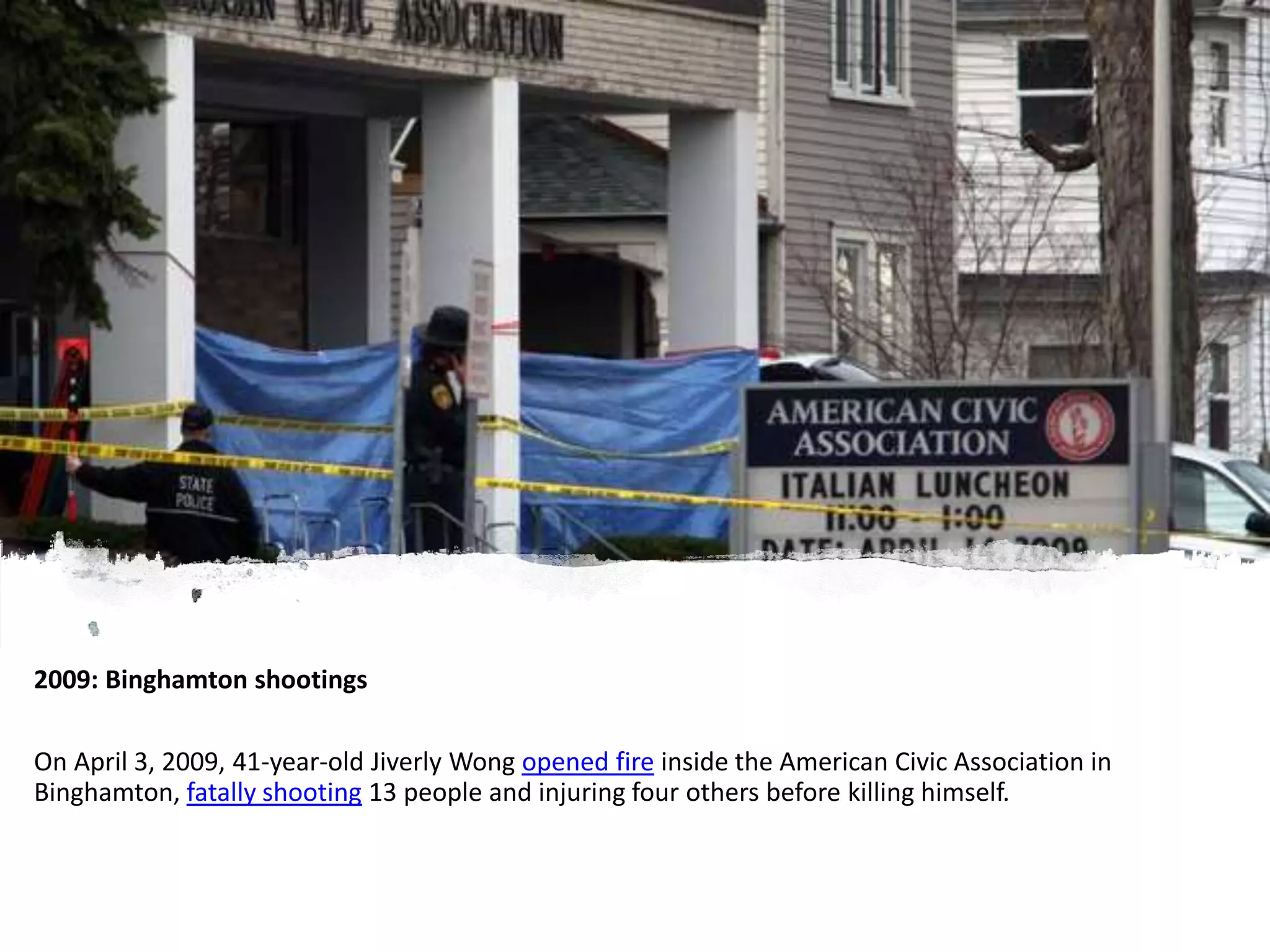
2009: Binghamton shootings
On April 3, 2009, 41-year-old Jiverly Wong opened fire inside the American Civic Association in
Binghamton, fatally shooting 13 people and injuring four others before killing himself.
2009: Colgan Air Flight 3407
On Feb. 12, 2009, Colgan Air Flight 3407 (Continental Connection Flight 3407) crashed into a home
in the tiny hamlet of Clarence Center, about 10 miles northeast of Buffalo Niagara International
Airport.
All 49 passengers and crew on-board were killed, as was one person on the ground.
The National Transportation Safety Board blamed the crash on the captain's "inappropriate
response to the activation of the stick shaker", which caused the plane to stall.
2012 Superstorm Sandy
Hurricane/Superstorm Sandy affected 24 states, including the entire eastern seaboard from Florida to Maine and west across the
Appalachian Mountains to Michigan and Wisconsin, with particularly severe damage in New Jersey and New York. Its storm surge hit
New York City on October 29, flooding streets, tunnels and subway lines and cutting power in and around the city.
There were 64 deaths in New York State.
Its just a matter of time…
Disaster Frequency and Type
Disasters
in NY
State?
Disasters in NY State?
In this image, only
10 counties have
escaped a
weather related
disaster between
2007 & 2012.
2013 thru 2019
have added to the
number.
It starts with the national NIFA-funded Extension Disaster Education Network…
EDEN is the premier provider of disaster education resources delivered through the
Land Grant University system…. https://eden.lsu.edu/
Mandate
Preparedness is the shared responsibility of our entire
nation. The whole community contributes, beginning with
individuals and communities, the private and nonprofit
sectors, faith-based organizations, and all governments
(local, regional/metropolitan, state, tribal, territorial,
insular area, and Federal).
The National Preparedness Goal is:
A secure and resilient Nation with the capabilities required
across the whole community to prevent, protect against,
mitigate, respond to, and recover from the threats and
hazards that pose the greatest risk.
The core capabilities [needed to meet the
National Preparedness Goal] are not
exclusive to any single government or
organization, but rather require the
combined efforts of the whole community.
https://www.fema.gov/media-library-
data/1443799615171-
2aae90be55041740f97e8532fc680d40/Nati
onal_Preparedness_Goal_2nd_Edition.pdf
National Incident
Management System
(NIMS)
Mandated by HSPD-5, in 2005,
NIMS is the organization through
which disaster management is
coordinated. It was designed
after the World Trade Center
attacks in September, 2001. NIMS
is designed to prepare for,
prevent, and manage response to
emergency and disaster
situations, and to coordinate
emergency response disaster
responders on the local, state and
federal levels
Extension
and NIMS
• The 15 Emergency Support Functions are:
• ESF 1 – Transportation
ESF 2 – Communications
ESF 3 – Public Works and Engineering
ESF 4 – Firefighting
ESF 5 – Emergency Management
ESF 6 – Mass Care, Emergency Assistance,
Housing, and Human Services
ESF 7 – Logistics Management and Resource
Support
ESF 8 – Public Health and Medical Services
ESF 9 – Search and Rescue
ESF 10 – Oil and Hazardous Materials
Response
ESF 11 – Agriculture and Natural Resources
ESF 12 – Energy
ESF 13 – Public Safety and Security
ESF 14 – Long-Term Community Recovery
ESF 15 – External Affairs
Extension Disaster
Competency: What
You Need to Know
Keith G. Tidball, PhD
Cornell University
Assistant Director,
Cornell Cooperative Extension
Disaster Education, Military Families,
and Veterans
Extension Disaster Education
Network (EDEN)
State NY POC/State Delegate
Watch it here:
https://www.youtube.com/watch?v=gIt
PUmZA3Q8
This is not
a new
mission …
1958 Extension Publication available here.
So What’s the Mission?
NY EDEN links
extension
educators,
emergency
managers, and
community officials
to enhance
resilience and
reduce the impact
of disasters in New
York communities.
What Are Our Roles?
1. State/regional incident command leadership within
CCE system, at multiple levels:
a. Support of higher levels of incident command
(State & Federal)
b. Transmit guidance from higher levels of incident
command thru CCE regional & county networks
2. Act as primary source for sector specific situational
information (agriculture & natural resources
primarily at this time)
OK, So How Does It Work?
National
EDEN
NY
Extension
Disaster
Education
Network
http://eden.cce.cornell.edu
http://eden.cce.cornell.edu/Pages/training.aspx
When Gotham NY State needs more
than a network…
Cornell Cooperative Extension’s DISASTER ALL-HAZARDS RESPONSE TEAM
CCE DART
CCE DART
At the first hint of crisis or emergency, we will:
1. Determine exact circumstances of the emergency/crisis.
2. Determine the status of CCE Administration and CCE County Association staff – whereabouts and
welfare.
3. Determine ability to function, e.g. telecommunication, vehicles, office premises, warehousing, access
and mobility etc.
4. Notify within CCE Admin those who need to be informed immediately of developments as they
emerge.
5. Activate CCE DART.
6. Ensure that a standard package of documentation is on stand-by (technical guidelines, checklists,
program guides, rules and procedures, etc.)
7. Begin assessment of situation, critical operations, and particular implications for Cornell, Cornell CCE
System, Cornell CCE Association (s), interagency, and NYS communities.
POINT IN CYCLE TASK DATE & PERSON ASSIGNED COMPLETED
Initial disaster
predicted/reported
1. Notify EXT DIR, request
activation of CCE DART
NY EDEN Coordinator
2. Coordinate CCE DART
meeting
NY EDEN Coordinator/ CCE
DART Incident Manager
3.Convene
meeting of
CCE DART
A. Assess
B. Plans
C. Messaging
D. Schedule
4. System wide announcement
- EXT DIR
EXT DIR
5. activation of CCE DART list
serve, email, and e-reporting
NY EDEN Coordinator/ CCE
DART Incident Manager
Disaster underway 6. Coordinate telecom w CCE
assoc & regional stakeholders
CCE DART
7. initiate interface with NY
EMO/ FEMA/NYS Ag& Mkts
NY EDEN Coordinator/ CCE
DART Incident Manager
8. conduct regular briefings CCE DART
9. reporting log – AG SENTINEL All hands
Disaster Ended 10. conduct
after-action
review
A. pros/cons
B. recovery plan
C. hand-off to
NY EDEN
CCE DART
11. deactivate CCE DART EXT DIR
12. final report NY EDEN Coordinator/ NY
EDEN Advisory Committee
Long Term Recovery NY EDEN Coordinator/ NY
EDEN Advisory Committee
CCE NY’S Standard Operating
Procedures – A Scenario
Let’s use a hurricane as an example.
One fine Autumn day, the morning news makes
mention of a strong tropical depression that
might hit the northeast.
“There is no clear
consensus of the
storm’s track, but it
is possible NY state
could take a hit.”
Level Yellow-- Guarded
Example of How it Works? Going to
Level Yellow
Given the possibility,
leadership (campus) does a few things -
1. Alert the entire CCE system that there might be
a severe weather incident and provide tailored
preparedness guidance (via disaster list serve
and via social media)
2. Warn members of the EDEN Advisory
Committee and the CCE Director that the
Disaster All-Hazards Response Team may be
activated.
3. Open communications with State partners and
National EDEN.
Example of How it Works?
1. Determine if your county will potentially be in or near harm’s
way.
2. Assign a staff person to become the county NY CCE EDEN Point
of Contact for the particular incident if needed.
3. Ensure that county website, social media (Facebook and
Twitter) and email lists are ready to serve as information
“repeaters” if needed.
4. Familiarize/re-familiarize with CCE NY EDEN website, CCE
DART AG SENTINEL website, CCE NY EDEN Facebook, and CCE NY
EDEN Twitter.
Example of How it Works?
So, the following days are filled with speculation on the
impending storm’s path, but most reliable news sources, the
National Weather Service, and NOAA are all indicating likelihood
of the storm having significant impacts upon NYS…
Example of How it Works? Going to
Level Orange
Now that the storm is likely ,
leadership (campus)
does a few things –
1. Seeks permission for activation CCE Disaster All-
Hazards Response Team from CCE Director
2. Activates CCE DART System-wide Standard
Operating Procedures (level orange)
3. Begins liaison with State Agencies in support of
their Incident Command Structure (mostly Ag &
Markets and DEC).
1. Notify County Office of Emergency Management (OEM) that you are
“up” for supporting them for the incident. In some cases, County
OEM will request CCE to assist in Emergency Operations Center with
Ag and other CCE expertise areas.
2. Notify NY CCE EDEN State Leadership that you are “up”.
3. Start reposting, sharing, retweeting, etc. information coming from
NY CCE EDEN HQ.
4. Assign an “Ag Sentinel” (may be additional role for EDEN
Incident POC or another individual) in case we go to level Red.
Example of How it Works? Going to
Level Orange
Example of How it Works
Ok, its really happening. The hurricane is bringing damaging
winds, extreme flooding, and this is a DISASTER. NYS has
declared disasters in multiple counties, and federal declarations
are imminent…
Example of How it Works? Going to
Level Red
Now that the storm is happening,
leadership (campus) does a few things –
1. Activation of Level RED CCE DART SOP, including identification of
key faculty and technical experts to include
2. Dedicated CCE Administration support team assists with incident
reporting
3. Regular communications established with impacted County CCE
Associations
4. Periodic situation reports to Cornell administration & State
Agencies in support of their Incident Command Structure (mostly
Ag & Markets and DEC).
5. Reponses to specific informational requests and technical
assistance
Example of How it Works? Going to
Level Red
1. Notify CCE NY EDEN/DART of the status of your association
staff and infrastructure
2. Continue reposting, sharing, retweeting, etc. information
coming from NY CCE EDEN HQ.
3. Conduct “Ag Sentinel” assessments and reporting during
and immediately following disaster (safely- this can be done
via phone or email, especially if conditions are unsafe for first
hand observations)
http://bit.do/agdamage
https://cornellprod.sharepoint.com/sites/cce/edendashbo
ard/SitePages/Home.aspx
http://teams.cce.cornell.edu/edendashboard/SitePages/disaster.aspx?disid=4
Funding for NY Ag Sentinel came from NY State Department of Agriculture and Markets
Keep in Touch!
Listserv - CCE-DISASTER-L@list.cornell.edu
E-mails from CCE NY EDEN disaster@cornell.edu
Twitter account: CCE_Disaster
CCE NY EDEN on Facebook:
https://www.facebook.com/CCE.NY.EDEN/
CCE NY EDEN Website http://eden.cce.cornell.edu
Caveat
!!Climate change mitigation is a different runner
in this race!!
REMEMBERED as RELEVANT & RELIABLE?
EVIDENCE –BASED? (Empirical)?
VISIBLE & VIABLE?
VALUABLE?
Extension Disaster Education
Programming in YOUR county…
Let’s Go!
Questions?
Thank You!

NY CCE All-hazards Preparedness & Response Education Program Overview

  • 1.
    When it Hitsthe Fan: Extension’s Roles, Resources, and Responsibilities in Disaster Keith G. Tidball, PhD Cornell University NY EDEN CCE ELC 2019
  • 2.
    “Be Relevant…” (JulieSuarez) Will it be REMEMBERED as RELEVANT & RELIABLE? Is it EVIDENCE –BASED? (Empirical)? Is it VISIBLE & VIABLE? Is it VALUABLE?
  • 3.
    1987: Schoharie Creekbridge collapse A bridge on the New York State Thruway over Schoharie Creek collapsed into the creek on Sunday, April 5, 1987 in Amsterdam. (AP Photo) On April 5, 1987, the bridge on the New York State Thruway over Schoharie Creek in Fort Hunter collapsed, killing 10 people. The collapse was blamed on flawed design that made the bridge susceptible to erosion. Instead of having piles in the bedrock, the bridge only had concrete footings dug six feet into the riverbed, the Albany Times-Union reported.
  • 4.
    2009: Binghamton shootings OnApril 3, 2009, 41-year-old Jiverly Wong opened fire inside the American Civic Association in Binghamton, fatally shooting 13 people and injuring four others before killing himself.
  • 5.
    2009: Colgan AirFlight 3407 On Feb. 12, 2009, Colgan Air Flight 3407 (Continental Connection Flight 3407) crashed into a home in the tiny hamlet of Clarence Center, about 10 miles northeast of Buffalo Niagara International Airport. All 49 passengers and crew on-board were killed, as was one person on the ground. The National Transportation Safety Board blamed the crash on the captain's "inappropriate response to the activation of the stick shaker", which caused the plane to stall.
  • 6.
    2012 Superstorm Sandy Hurricane/SuperstormSandy affected 24 states, including the entire eastern seaboard from Florida to Maine and west across the Appalachian Mountains to Michigan and Wisconsin, with particularly severe damage in New Jersey and New York. Its storm surge hit New York City on October 29, flooding streets, tunnels and subway lines and cutting power in and around the city. There were 64 deaths in New York State.
  • 7.
    Its just amatter of time…
  • 8.
  • 11.
  • 12.
    Disasters in NYState? In this image, only 10 counties have escaped a weather related disaster between 2007 & 2012. 2013 thru 2019 have added to the number.
  • 14.
    It starts withthe national NIFA-funded Extension Disaster Education Network… EDEN is the premier provider of disaster education resources delivered through the Land Grant University system…. https://eden.lsu.edu/
  • 15.
    Mandate Preparedness is theshared responsibility of our entire nation. The whole community contributes, beginning with individuals and communities, the private and nonprofit sectors, faith-based organizations, and all governments (local, regional/metropolitan, state, tribal, territorial, insular area, and Federal). The National Preparedness Goal is: A secure and resilient Nation with the capabilities required across the whole community to prevent, protect against, mitigate, respond to, and recover from the threats and hazards that pose the greatest risk.
  • 16.
    The core capabilities[needed to meet the National Preparedness Goal] are not exclusive to any single government or organization, but rather require the combined efforts of the whole community. https://www.fema.gov/media-library- data/1443799615171- 2aae90be55041740f97e8532fc680d40/Nati onal_Preparedness_Goal_2nd_Edition.pdf
  • 17.
    National Incident Management System (NIMS) Mandatedby HSPD-5, in 2005, NIMS is the organization through which disaster management is coordinated. It was designed after the World Trade Center attacks in September, 2001. NIMS is designed to prepare for, prevent, and manage response to emergency and disaster situations, and to coordinate emergency response disaster responders on the local, state and federal levels
  • 18.
    Extension and NIMS • The15 Emergency Support Functions are: • ESF 1 – Transportation ESF 2 – Communications ESF 3 – Public Works and Engineering ESF 4 – Firefighting ESF 5 – Emergency Management ESF 6 – Mass Care, Emergency Assistance, Housing, and Human Services ESF 7 – Logistics Management and Resource Support ESF 8 – Public Health and Medical Services ESF 9 – Search and Rescue ESF 10 – Oil and Hazardous Materials Response ESF 11 – Agriculture and Natural Resources ESF 12 – Energy ESF 13 – Public Safety and Security ESF 14 – Long-Term Community Recovery ESF 15 – External Affairs
  • 19.
    Extension Disaster Competency: What YouNeed to Know Keith G. Tidball, PhD Cornell University Assistant Director, Cornell Cooperative Extension Disaster Education, Military Families, and Veterans Extension Disaster Education Network (EDEN) State NY POC/State Delegate Watch it here: https://www.youtube.com/watch?v=gIt PUmZA3Q8
  • 20.
    This is not anew mission … 1958 Extension Publication available here.
  • 21.
    So What’s theMission? NY EDEN links extension educators, emergency managers, and community officials to enhance resilience and reduce the impact of disasters in New York communities.
  • 22.
    What Are OurRoles? 1. State/regional incident command leadership within CCE system, at multiple levels: a. Support of higher levels of incident command (State & Federal) b. Transmit guidance from higher levels of incident command thru CCE regional & county networks 2. Act as primary source for sector specific situational information (agriculture & natural resources primarily at this time)
  • 23.
    OK, So HowDoes It Work?
  • 24.
  • 25.
  • 26.
    When Gotham NYState needs more than a network… Cornell Cooperative Extension’s DISASTER ALL-HAZARDS RESPONSE TEAM CCE DART
  • 27.
    CCE DART At thefirst hint of crisis or emergency, we will: 1. Determine exact circumstances of the emergency/crisis. 2. Determine the status of CCE Administration and CCE County Association staff – whereabouts and welfare. 3. Determine ability to function, e.g. telecommunication, vehicles, office premises, warehousing, access and mobility etc. 4. Notify within CCE Admin those who need to be informed immediately of developments as they emerge. 5. Activate CCE DART. 6. Ensure that a standard package of documentation is on stand-by (technical guidelines, checklists, program guides, rules and procedures, etc.) 7. Begin assessment of situation, critical operations, and particular implications for Cornell, Cornell CCE System, Cornell CCE Association (s), interagency, and NYS communities.
  • 28.
    POINT IN CYCLETASK DATE & PERSON ASSIGNED COMPLETED Initial disaster predicted/reported 1. Notify EXT DIR, request activation of CCE DART NY EDEN Coordinator 2. Coordinate CCE DART meeting NY EDEN Coordinator/ CCE DART Incident Manager 3.Convene meeting of CCE DART A. Assess B. Plans C. Messaging D. Schedule 4. System wide announcement - EXT DIR EXT DIR 5. activation of CCE DART list serve, email, and e-reporting NY EDEN Coordinator/ CCE DART Incident Manager Disaster underway 6. Coordinate telecom w CCE assoc & regional stakeholders CCE DART 7. initiate interface with NY EMO/ FEMA/NYS Ag& Mkts NY EDEN Coordinator/ CCE DART Incident Manager 8. conduct regular briefings CCE DART 9. reporting log – AG SENTINEL All hands Disaster Ended 10. conduct after-action review A. pros/cons B. recovery plan C. hand-off to NY EDEN CCE DART 11. deactivate CCE DART EXT DIR 12. final report NY EDEN Coordinator/ NY EDEN Advisory Committee Long Term Recovery NY EDEN Coordinator/ NY EDEN Advisory Committee
  • 29.
    CCE NY’S StandardOperating Procedures – A Scenario Let’s use a hurricane as an example. One fine Autumn day, the morning news makes mention of a strong tropical depression that might hit the northeast. “There is no clear consensus of the storm’s track, but it is possible NY state could take a hit.”
  • 30.
  • 31.
    Example of Howit Works? Going to Level Yellow Given the possibility, leadership (campus) does a few things - 1. Alert the entire CCE system that there might be a severe weather incident and provide tailored preparedness guidance (via disaster list serve and via social media) 2. Warn members of the EDEN Advisory Committee and the CCE Director that the Disaster All-Hazards Response Team may be activated. 3. Open communications with State partners and National EDEN.
  • 32.
    Example of Howit Works? 1. Determine if your county will potentially be in or near harm’s way. 2. Assign a staff person to become the county NY CCE EDEN Point of Contact for the particular incident if needed. 3. Ensure that county website, social media (Facebook and Twitter) and email lists are ready to serve as information “repeaters” if needed. 4. Familiarize/re-familiarize with CCE NY EDEN website, CCE DART AG SENTINEL website, CCE NY EDEN Facebook, and CCE NY EDEN Twitter.
  • 33.
    Example of Howit Works? So, the following days are filled with speculation on the impending storm’s path, but most reliable news sources, the National Weather Service, and NOAA are all indicating likelihood of the storm having significant impacts upon NYS…
  • 34.
    Example of Howit Works? Going to Level Orange Now that the storm is likely , leadership (campus) does a few things – 1. Seeks permission for activation CCE Disaster All- Hazards Response Team from CCE Director 2. Activates CCE DART System-wide Standard Operating Procedures (level orange) 3. Begins liaison with State Agencies in support of their Incident Command Structure (mostly Ag & Markets and DEC).
  • 35.
    1. Notify CountyOffice of Emergency Management (OEM) that you are “up” for supporting them for the incident. In some cases, County OEM will request CCE to assist in Emergency Operations Center with Ag and other CCE expertise areas. 2. Notify NY CCE EDEN State Leadership that you are “up”. 3. Start reposting, sharing, retweeting, etc. information coming from NY CCE EDEN HQ. 4. Assign an “Ag Sentinel” (may be additional role for EDEN Incident POC or another individual) in case we go to level Red. Example of How it Works? Going to Level Orange
  • 36.
    Example of Howit Works Ok, its really happening. The hurricane is bringing damaging winds, extreme flooding, and this is a DISASTER. NYS has declared disasters in multiple counties, and federal declarations are imminent…
  • 37.
    Example of Howit Works? Going to Level Red Now that the storm is happening, leadership (campus) does a few things – 1. Activation of Level RED CCE DART SOP, including identification of key faculty and technical experts to include 2. Dedicated CCE Administration support team assists with incident reporting 3. Regular communications established with impacted County CCE Associations 4. Periodic situation reports to Cornell administration & State Agencies in support of their Incident Command Structure (mostly Ag & Markets and DEC). 5. Reponses to specific informational requests and technical assistance
  • 38.
    Example of Howit Works? Going to Level Red 1. Notify CCE NY EDEN/DART of the status of your association staff and infrastructure 2. Continue reposting, sharing, retweeting, etc. information coming from NY CCE EDEN HQ. 3. Conduct “Ag Sentinel” assessments and reporting during and immediately following disaster (safely- this can be done via phone or email, especially if conditions are unsafe for first hand observations)
  • 39.
  • 40.
  • 41.
    http://teams.cce.cornell.edu/edendashboard/SitePages/disaster.aspx?disid=4 Funding for NYAg Sentinel came from NY State Department of Agriculture and Markets
  • 42.
    Keep in Touch! Listserv- CCE-DISASTER-L@list.cornell.edu E-mails from CCE NY EDEN disaster@cornell.edu Twitter account: CCE_Disaster CCE NY EDEN on Facebook: https://www.facebook.com/CCE.NY.EDEN/ CCE NY EDEN Website http://eden.cce.cornell.edu
  • 43.
    Caveat !!Climate change mitigationis a different runner in this race!!
  • 44.
    REMEMBERED as RELEVANT& RELIABLE? EVIDENCE –BASED? (Empirical)? VISIBLE & VIABLE? VALUABLE? Extension Disaster Education Programming in YOUR county… Let’s Go!
  • 45.
  • 46.

Editor's Notes

  • #2 Rod can introduce and act as general host