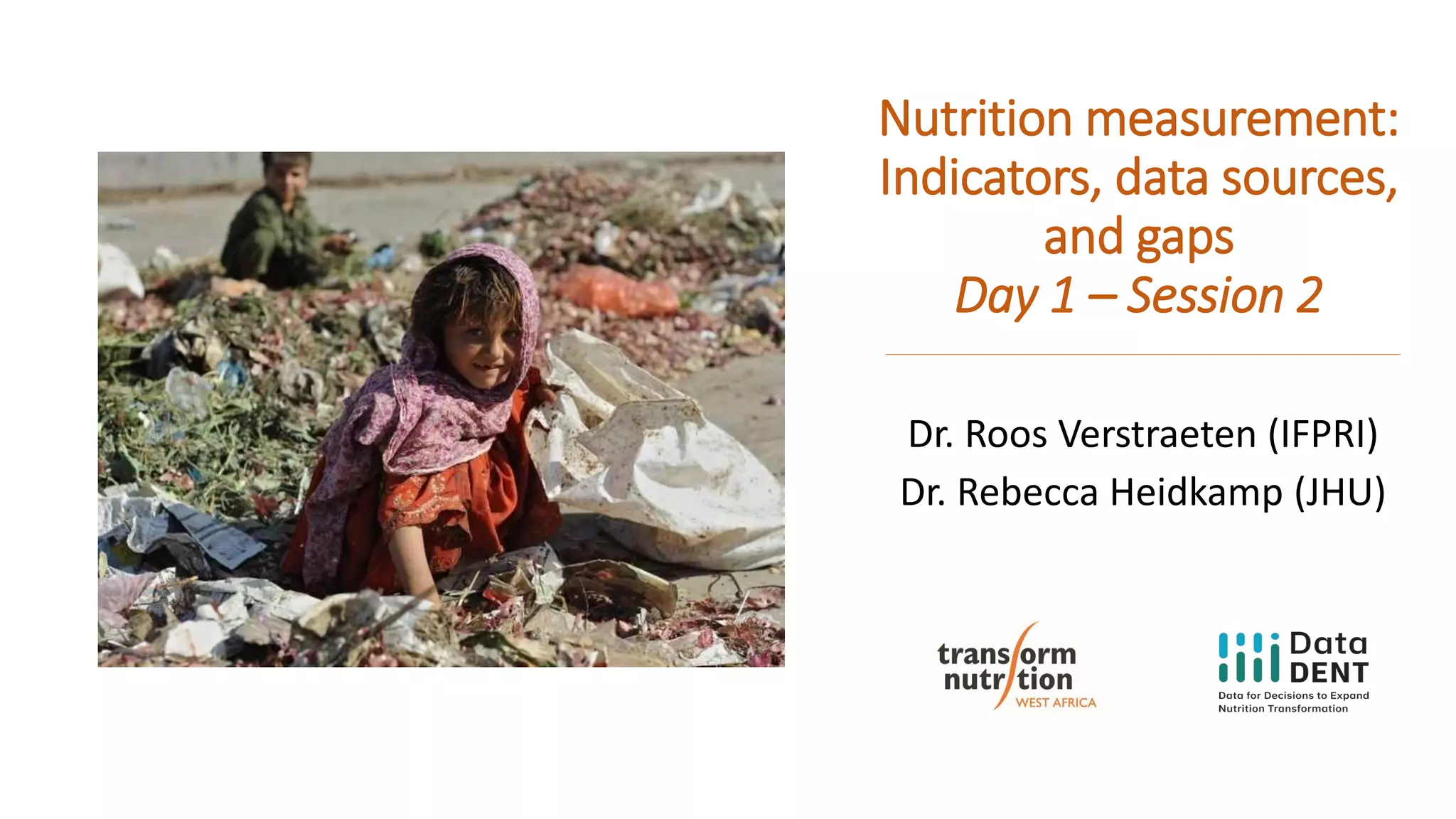
Nutrition measurement:
Indicators, data sources,
and gaps
Day 1 – Session 2
Dr. Roos Verstraeten (IFPRI)
Dr. Rebecca Heidkamp (JHU)
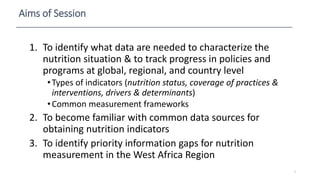
Aims of Session
1. To identify what data are needed to characterize the
nutrition situation & to track progress in policies and
programs at global, regional, and country level
•Types of indicators (nutrition status, coverage of practices &
interventions, drivers & determinants)
•Common measurement frameworks
2. To become familiar with common data sources for
obtaining nutrition indicators
3. To identify priority information gaps for nutrition
measurement in the West Africa Region
2
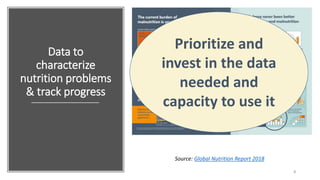
Data to
characterize
nutrition problems
& track progress
3
Source: Global Nutrition Report 2018
Prioritize and
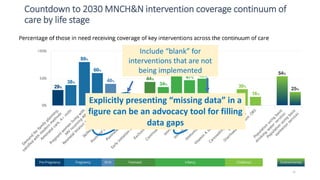
invest in the data
needed and
capacity to use it
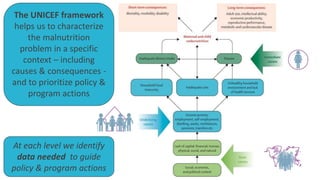
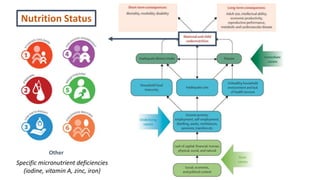
The UNICEF framework
helps us to characterize
the malnutrition
problem in a specific
context – including
causes & consequences -
and to prioritize policy &
program actions
At each level we identify
data needed to guide
policy & program actions
Nutrition Status
Specific micronutrient deficiencies
(iodine, vitamin A, zinc, iron)
Other
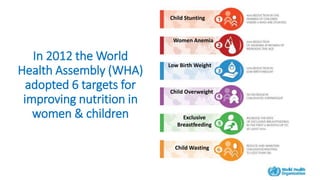
In 2012 the World
Health Assembly (WHA)
adopted 6 targets for
improving nutrition in
women & children
6
Child Stunting
Women Anemia
Low Birth Weight
Child Overweight
Exclusive
Breastfeeding
Child Wasting
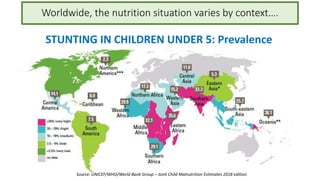
Worldwide, the nutrition situation varies by context….
7
STUNTING IN CHILDREN UNDER 5: Prevalence
Source: UNICEF/WHO/World Bank Group – Joint Child Malnutrition Estimates 2018 edition
8
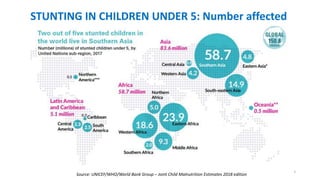
STUNTING IN CHILDREN UNDER 5: Number affected
Source: UNICEF/WHO/World Bank Group – Joint Child Malnutrition Estimates 2018 edition
9
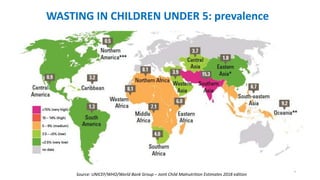
WASTING IN CHILDREN UNDER 5: prevalence
Source: UNICEF/WHO/World Bank Group – Joint Child Malnutrition Estimates 2018 edition
10
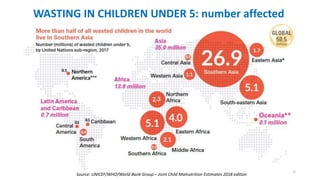
WASTING IN CHILDREN UNDER 5: number affected
Source: UNICEF/WHO/World Bank Group – Joint Child Malnutrition Estimates 2018 edition
11
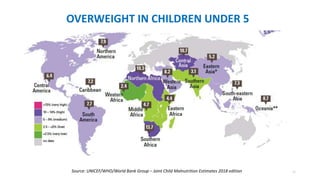
OVERWEIGHT IN CHILDREN UNDER 5
Source: UNICEF/WHO/World Bank Group – Joint Child Malnutrition Estimates 2018 edition
12
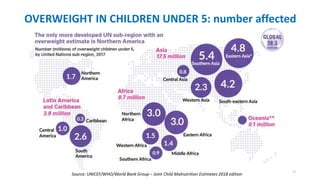
OVERWEIGHT IN CHILDREN UNDER 5: number affected
Source: UNICEF/WHO/World Bank Group – Joint Child Malnutrition Estimates 2018 edition
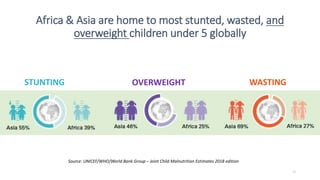
Africa & Asia are home to most stunted, wasted, and
overweight children under 5 globally
13
Source: UNICEF/WHO/World Bank Group – Joint Child Malnutrition Estimates 2018 edition
STUNTING OVERWEIGHT WASTING
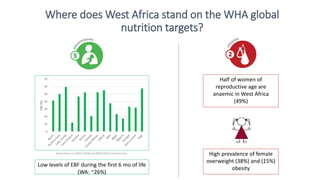
Half of women of
reproductive age are
anaemic in West Africa
(49%)
Where does West Africa stand on the WHA global
nutrition targets?
0
10
20
30
40
50
60
70
EBF(%)
Source: based on UNICEF 2016b and DNMS 2016 for Burkina Faso
Low levels of EBF during the first 6 mo of life
(WA: ~26%)
High prevalence of female
overweight (38%) and (15%)
obesity
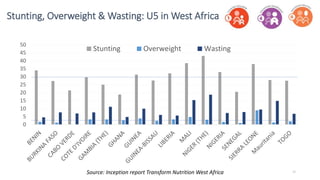
15Source: Inception report Transform Nutrition West Africa
0
5
10
15
20
25
30
35
40
45
50
Stunting Overweight Wasting
Stunting, Overweight & Wasting: U5 in West Africa
17
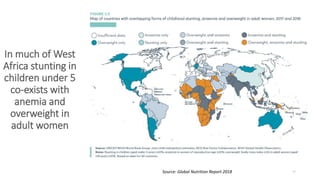
In much of West
Africa stunting in
children under 5
co-exists with
anemia and
overweight in
adult women
Source: Global Nutrition Report 2018
Low birth weight
Anaemia
Overweight
Stunting
B
Nigeria
Benin
C
Ivory Coast
Gambia
D
Guinea
Mali
Sierra Leone
Niger
E
Liberia
A
Burkina Faso
Senegal
Ghana
Togo
Mauritania
Guinea-Bissau
Cabo Verde
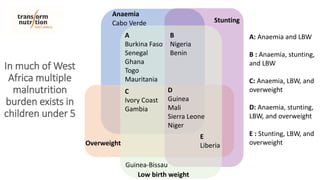
A: Anaemia and LBW
B : Anaemia, stunting,
and LBW
C: Anaemia, LBW, and
overweight
D: Anaemia, stunting,
LBW, and overweight
E : Stunting, LBW, and
overweight
In much of West
Africa multiple
malnutrition
burden exists in
children under 5
19
In much of West
Africa Research on
the WHA targets is
focused on
identifying the
problem, NOT on
programs and
policies. Lack of
research on the U5
obesity target
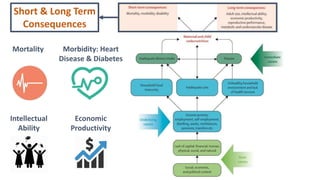
Short & Long Term
Consequences
Mortality Morbidity: Heart
Disease & Diabetes
Intellectual
Ability
Economic
Productivity
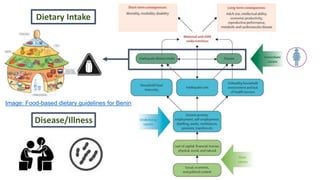
Image: Food-based dietary guidelines for Benin
Dietary Intake
Disease/Illness
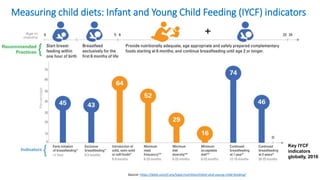
Source: https://data.unicef.org/topic/nutrition/infant-and-young-child-feeding/
Measuring child diets: Infant and Young Child Feeding (IYCF) indicators
Key IYCF
indicators
globally, 2016
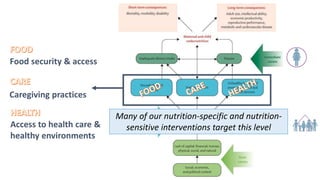
Food security & access
Caregiving practices
Access to health care &
healthy environments
Many of our nutrition-specific and nutrition-
sensitive interventions target this level
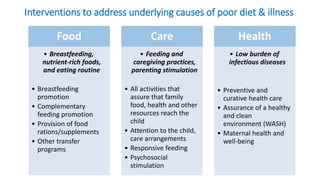
Interventions to address underlying causes of poor diet & illness
Food
• Breastfeeding,
nutrient-rich foods,
and eating routine
• Breastfeeding
promotion
• Complementary
feeding promotion
• Provision of food
rations/supplements
• Other transfer
programs
Care
• Feeding and
caregiving practices,
parenting stimulation
• All activities that
assure that family
food, health and other
resources reach the
child
• Attention to the child,
care arrangements
• Responsive feeding
• Psychosocial
stimulation
Health
• Low burden of
infectious diseases
• Preventive and
curative health care
• Assurance of a healthy
and clean
environment (WASH)
• Maternal health and
well-being
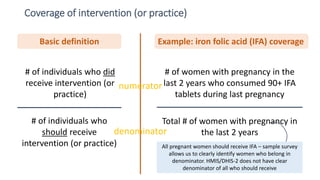
Coverage of intervention (or practice)
25
# of individuals who
should receive
intervention (or practice)
# of individuals who did
receive intervention (or
practice)
Total # of women with pregnancy in
the last 2 years
# of women with pregnancy in the
last 2 years who consumed 90+ IFA
tablets during last pregnancy
Basic definition Example: iron folic acid (IFA) coverage
All pregnant women should receive IFA – sample survey
allows us to clearly identify women who belong in
denominator. HMIS/DHIS-2 does not have clear
denominator of all who should receive
numerator
denominator
26
Countdown to 2030 MNCH&N intervention coverage continuum of
care by life stage
Include “blank” for
interventions that are not
being implemented
Explicitly presenting “missing data” in a
figure can be an advocacy tool for filling
data gaps
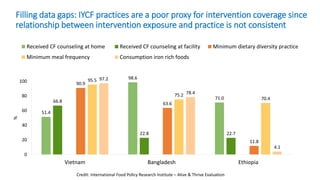
Filling data gaps: IYCF practices are a poor proxy for intervention coverage since
relationship between intervention exposure and practice is not consistent
51.4
98.6
71.0
66.8
22.8 22.7
90.9
63.6
11.8
95.5
75.2
70.4
97.2
78.4
4.1
0
20
40
60
80
100
Vietnam Bangladesh Ethiopia
%
Received CF counseling at home Received CF counseling at facility Minimum dietary diversity practice
Minimum meal frequency Consumption iron rich foods
Credit: International Food Policy Research Institute – Alive & Thrive Evaluation
Nigeria
Nigeria
Nigeria
Nigeria
Nigeria
Nigeria
Nigeria
Nigeria
Burkina F.
Burkina F.
Burkina F.
Burkina F.
Burkina F.
Burkina F.
Burkina F.
Burkina F.
Senegal
Senegal
Senegal
Senegal
Senegal
Senegal
Senegal
Senegal
Ghana
Ghana
Ghana
Ghana
Ghana
Ghana
Ghana
Ghana
Benin
Benin
Benin
Benin
Benin
Benin
Benin
Benin
Cote d'Iv.
Cote d'Iv.
Cote d'Iv.
Cote d'Iv.
Cote d'Iv.
Cote d'Iv.
Cote d'Iv.
Cote d'Iv.
Gambia
Gambia
Gambia
Gambia
Gambia
Gambia
Gambia
Gambia
Guinea
Guinea
Guinea
Guinea
Guinea
Guinea
Guinea
Guinea
Guinea-B.
Guinea-B.
Guinea-B.
Guinea-B.
Guinea-B.
Guinea-B.
Liberia
Liberia
Liberia
Liberia
Liberia
Liberia
Liberia
Mali
Mali
Mali
Mali
Mali
Mali
Niger
Niger
Niger
Niger
Niger
Niger
Niger
Sierra L.
Sierra L.
Sierra L.
Sierra L.
Sierra L.
Sierra L.
Sierra L.
Sierra L.
Togo
Togo
Togo
Togo
Togo
Togo
Togo Togo
0
10
20
30
40
50
60
70
80
90
100
Early initiation of
Breastfeeding
Exclusive
breastfeeding
Min. Acceptable
Compl. Feeding
Minimum dietary
diversity
Female
secondary
enrollment
Access to
improved source
of drinking water
Access to
improved use of
sanitation
facilities
Access to
handwashing
facility with soap
and water
%population
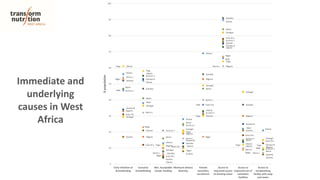
Immediate and
underlying
causes in West
Africa
Nigeria
Nigeria
Nigeria
Nigeria
Nigeria
Nigeria
Nigeria
Nigeria
Nigeria
Nigeria
B.F.
B.F.
B.F.
B.F.
B.F.
B.F.
B.F.
B.F.
B.F.
B.F.
Sen
Sen
Sen
Sen
Sen
Sen
Sen
Sen
Sen
Sen
Gh
Gh
Gh
Gh
Gh
Gh Gh
Gh
Gh
Gh
Ben
Ben
Ben
Ben
Ben
Ben Ben
Ben
Ben
BenC.B.
C.B.
C.B.
C.B.
C.B.
C.I.
C.I.
C.I.
C.I.
C.I.
C.I.
C.I.
C.I.
C.I.
C.I.
Gam.
Gam.
Gam.
Gam.
Gam.
Gam.
Gam.
Gam.
Gam.
Gui
Gui
Gui
Gui
Gui
Gui
Gui
Gui
Gui
Gui
G.B
G.B
G.B
G.B
G.B
G.B
Lib.
Lib.
Lib.
Lib.
Lib.
Lib.
Lib.
Lib.
Lib.
Lib.
Mali
Mali
Mali
Mali
Mali
Mali
Mali
Mali
Mali
Mali
Nig.
Nig.
Nig.
Nig.
Nig.
Nig.
Nig.
Nig.
Nig.
Nig.
S.L.
S.L.
S.L.
S.L. S.L.
S.L.
S.L.
S.L.
S.L.
S.L.
Togo
Togo
Togo
Togo
Togo
Togo
Togo
Togo
Togo
Togo
Maur.
Maur.
Maur.
Maur.
Maur.
Maur.
0
10
20
30
40
50
60
70
80
90
100
>=4 ANC IFA (90+ tablets)
/ pregnancy
IPTp 2 doses &
DOT /pregnancy
ITNs use /
pregnancy
Institutional
delivery
Vit A postpartum Vitamin A /
under 5
IFA suppl. /
under 5
Zinc / diarrhoea ITNs use / under
5
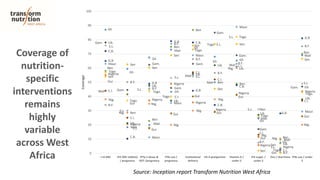
Coverage
Coverage of
nutrition-
specific
interventions
remains
highly
variable
across West
Africa
Source: Inception report Transform Nutrition West Africa
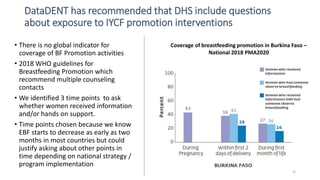
DataDENT has recommended that DHS include questions
about exposure to IYCF promotion interventions
• There is no global indicator for
coverage of BF Promotion activities
• 2018 WHO guidelines for
Breastfeeding Promotion which
recommend multiple counseling
contacts
• We identified 3 time points to ask
whether women received information
and/or hands on support.
• Time points chosen because we know
EBF starts to decrease as early as two
months in most countries but could
justify asking about other points in
time depending on national strategy /
program implementation
30
Coverage of breastfeeding promotion in Burkina Faso –
National 2018 PMA2020
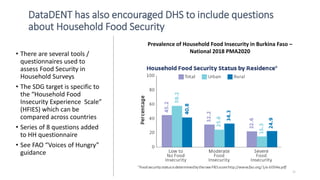
DataDENT has also encouraged DHS to include questions
about Household Food Security
• There are several tools /
questionnaires used to
assess Food Security in
Household Surveys
• The SDG target is specific to
the “Household Food
Insecurity Experience Scale”
(HFIES) which can be
compared across countries
• Series of 8 questions added
to HH questionnaire
• See FAO “Voices of Hungry”
guidance
31
Prevalence of Household Food Insecurity in Burkina Faso –
National 2018 PMA2020
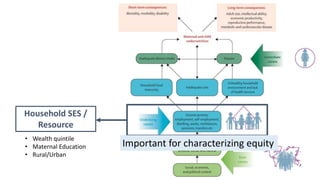
Household SES /
Resource
Important for characterizing equity
• Wealth quintile
• Maternal Education
• Rural/Urban
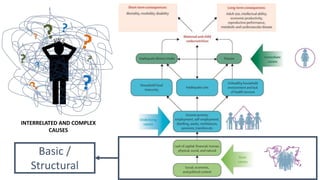
Basic /
Structural
INTERRELATED AND COMPLEX
CAUSES
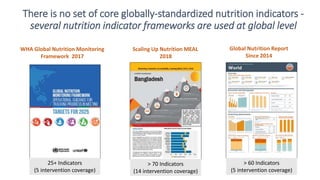
There is no set of core globally-standardized nutrition indicators -
several nutrition indicator frameworks are used at global level
WHA Global Nutrition Monitoring
Framework 2017
25+ Indicators
(5 intervention coverage)
Scaling Up Nutrition MEAL
2018
> 70 Indicators
(14 intervention coverage)
Global Nutrition Report
Since 2014
> 60 Indicators
(5 intervention coverage)
35
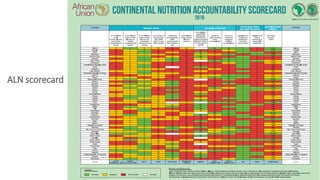
ALN scorecard
36
Common data
sources
37
• Vital
registration
• Exposure
registries
• Clinical or
community
records
• Laboratory
records
• Pharmacy
records
• Education,
agriculture
• Weather,
climate change
• Household
surveys (e.g. DHS, MICS,
SMART, LSMS)
Nutrition Information System
Registries
Health
Information
Systems /
DHIS-2
Other MIS
Household
surveys
Routine or “administrative” data
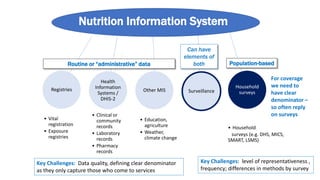
Key Challenges: level of representativeness ,
frequency; differences in methods by survey
Key Challenges: Data quality, defining clear denominator
as they only capture those who come to services
Surveillance
Can have
elements of
both Population-based
For coverage
we need to
have clear
denominator –
so often reply
on surveys
39
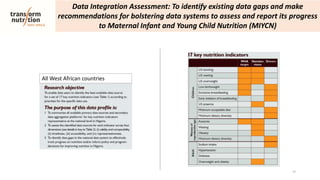
Data Integration Assessment: To identify existing data gaps and make
recommendations for bolstering data systems to assess and report its progress
to Maternal Infant and Young Child Nutrition (MIYCN)
All West African countries
Methodology
Process for identifying primary data sources
• Identification of national surveys through
Global Health Data Exchange and World
Bank Microdata search engines.
• Google search for indicators linked to the
country : [indicator]+[country]+ [data], to
identify sources we may have missed
• Cross-checking with experts for additional
data sources
• Validation through the sources from the
secondary data platforms
Process for identifying platforms
• Platforms identified through the
inception work
• DataDENT Visualization Tools profiling
(see www.datadent.org)
40
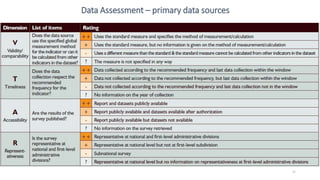
41
Data Assessment – primary data sources
42
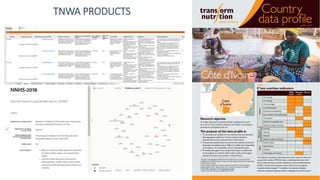
TNWA PRODUCTS
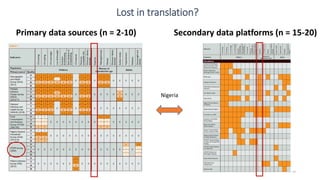
Lost in translation?
Primary data sources (n = 2-10) Secondary data platforms (n = 15-20)
43
Nigeria
Summary of results
•Accessibility: A publicly accessible report is available for all data
sources, yet almost half of these do not grant access to the datasets
•Representativeness: Data sources are mostly nationally
representative with a few that are subnational surveys (e.g. STEPS)
•Validity: All indicators are reported according to the specified global
measurement in at least one source per country, except for sodium
intake in all sources, wasting/thinness and obesity among WRA in
Cabo Verde and diabetes in Ghana.
•Timeliness: In general, over half the data sources are out of date and
not within the recommended frequency window.
Country Highlights vs Lowlights
HIGHLIGHTS
Burkina Faso
• 10 primary sources
• 17 indicators reported
Sierra Leone
• 6 primary sources
• National Nutrition Survey meets all
measurable data quality dimensions
LOWLIGHTS
Cabo Verde
• Very few indicators are covered in the
primary sources identified in Cabo Verde
• WHA targets not fully reported (U5
overweight missing)
Guinea Bissau
• 2 primary sources
• No data on diet related NCDs
• No data on minimum dietary diversity, and
anaemia among WRA; U5 anaemia;
hypertension, diabetes, and
overweight/obesity among the general
adult population
• WHA targets not fully reported (anaemia
among WRA missing)
Challenges and
gaps of
measurement in
nutrition in WA
47
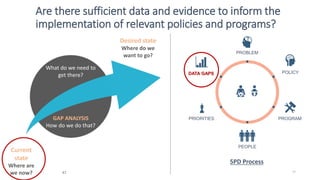
Are there sufficient data and evidence to inform the
implementation of relevant policies and programs?
DATA GAPS
PROBLEM
POLICY
PROGRAMPRIORITIES
PEOPLE
DATA GAPS
5PD Process
47
What do we need to
get there?
GAP ANALYSIS
How do we do that?
Current
state
Where are
we now?
Desired state
Where do we
want to go?
48
Challenges and gaps
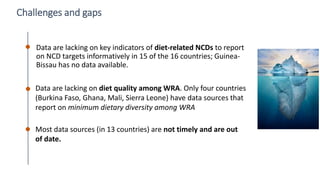
Data are lacking on key indicators of diet-related NCDs to report
on NCD targets informatively in 15 of the 16 countries; Guinea-
Bissau has no data available.
Data are lacking on diet quality among WRA. Only four countries
(Burkina Faso, Ghana, Mali, Sierra Leone) have data sources that
report on minimum dietary diversity among WRA
Most data sources (in 13 countries) are not timely and are out
of date.
49
Challenges and gaps
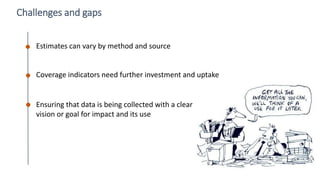
Estimates can vary by method and source
Ensuring that data is being collected with a clear
vision or goal for impact and its use
Coverage indicators need further investment and uptake
www.transformnutrition.org/westafrica www.datadent.org
50

Nutrition measurement:Indicators, data sources, and gaps

  • 1.
    Nutrition measurement: Indicators, datasources, and gaps Day 1 – Session 2 Dr. Roos Verstraeten (IFPRI) Dr. Rebecca Heidkamp (JHU)
  • 2.
    Aims of Session 1.To identify what data are needed to characterize the nutrition situation & to track progress in policies and programs at global, regional, and country level •Types of indicators (nutrition status, coverage of practices & interventions, drivers & determinants) •Common measurement frameworks 2. To become familiar with common data sources for obtaining nutrition indicators 3. To identify priority information gaps for nutrition measurement in the West Africa Region 2
  • 3.
    Data to characterize nutrition problems &track progress 3 Source: Global Nutrition Report 2018 Prioritize and invest in the data needed and capacity to use it
  • 4.
    The UNICEF framework helpsus to characterize the malnutrition problem in a specific context – including causes & consequences - and to prioritize policy & program actions At each level we identify data needed to guide policy & program actions
  • 5.
    Nutrition Status Specific micronutrientdeficiencies (iodine, vitamin A, zinc, iron) Other
  • 6.
    In 2012 theWorld Health Assembly (WHA) adopted 6 targets for improving nutrition in women & children 6 Child Stunting Women Anemia Low Birth Weight Child Overweight Exclusive Breastfeeding Child Wasting
  • 7.
    Worldwide, the nutritionsituation varies by context…. 7 STUNTING IN CHILDREN UNDER 5: Prevalence Source: UNICEF/WHO/World Bank Group – Joint Child Malnutrition Estimates 2018 edition
  • 8.
    8 STUNTING IN CHILDRENUNDER 5: Number affected Source: UNICEF/WHO/World Bank Group – Joint Child Malnutrition Estimates 2018 edition
  • 9.
    9 WASTING IN CHILDRENUNDER 5: prevalence Source: UNICEF/WHO/World Bank Group – Joint Child Malnutrition Estimates 2018 edition
  • 10.
    10 WASTING IN CHILDRENUNDER 5: number affected Source: UNICEF/WHO/World Bank Group – Joint Child Malnutrition Estimates 2018 edition
  • 11.
    11 OVERWEIGHT IN CHILDRENUNDER 5 Source: UNICEF/WHO/World Bank Group – Joint Child Malnutrition Estimates 2018 edition
  • 12.
    12 OVERWEIGHT IN CHILDRENUNDER 5: number affected Source: UNICEF/WHO/World Bank Group – Joint Child Malnutrition Estimates 2018 edition
  • 13.
    Africa & Asiaare home to most stunted, wasted, and overweight children under 5 globally 13 Source: UNICEF/WHO/World Bank Group – Joint Child Malnutrition Estimates 2018 edition STUNTING OVERWEIGHT WASTING
  • 14.
    Half of womenof reproductive age are anaemic in West Africa (49%) Where does West Africa stand on the WHA global nutrition targets? 0 10 20 30 40 50 60 70 EBF(%) Source: based on UNICEF 2016b and DNMS 2016 for Burkina Faso Low levels of EBF during the first 6 mo of life (WA: ~26%) High prevalence of female overweight (38%) and (15%) obesity
  • 15.
    15Source: Inception reportTransform Nutrition West Africa 0 5 10 15 20 25 30 35 40 45 50 Stunting Overweight Wasting Stunting, Overweight & Wasting: U5 in West Africa
  • 16.
    17 In much ofWest Africa stunting in children under 5 co-exists with anemia and overweight in adult women Source: Global Nutrition Report 2018
  • 17.
    Low birth weight Anaemia Overweight Stunting B Nigeria Benin C IvoryCoast Gambia D Guinea Mali Sierra Leone Niger E Liberia A Burkina Faso Senegal Ghana Togo Mauritania Guinea-Bissau Cabo Verde A: Anaemia and LBW B : Anaemia, stunting, and LBW C: Anaemia, LBW, and overweight D: Anaemia, stunting, LBW, and overweight E : Stunting, LBW, and overweight In much of West Africa multiple malnutrition burden exists in children under 5
  • 18.
    19 In much ofWest Africa Research on the WHA targets is focused on identifying the problem, NOT on programs and policies. Lack of research on the U5 obesity target
  • 19.
    Short & LongTerm Consequences Mortality Morbidity: Heart Disease & Diabetes Intellectual Ability Economic Productivity
  • 20.
    Image: Food-based dietaryguidelines for Benin Dietary Intake Disease/Illness
  • 21.
    Source: https://data.unicef.org/topic/nutrition/infant-and-young-child-feeding/ Measuring childdiets: Infant and Young Child Feeding (IYCF) indicators Key IYCF indicators globally, 2016
  • 22.
    Food security &access Caregiving practices Access to health care & healthy environments Many of our nutrition-specific and nutrition- sensitive interventions target this level
  • 23.
    Interventions to addressunderlying causes of poor diet & illness Food • Breastfeeding, nutrient-rich foods, and eating routine • Breastfeeding promotion • Complementary feeding promotion • Provision of food rations/supplements • Other transfer programs Care • Feeding and caregiving practices, parenting stimulation • All activities that assure that family food, health and other resources reach the child • Attention to the child, care arrangements • Responsive feeding • Psychosocial stimulation Health • Low burden of infectious diseases • Preventive and curative health care • Assurance of a healthy and clean environment (WASH) • Maternal health and well-being
  • 24.
    Coverage of intervention(or practice) 25 # of individuals who should receive intervention (or practice) # of individuals who did receive intervention (or practice) Total # of women with pregnancy in the last 2 years # of women with pregnancy in the last 2 years who consumed 90+ IFA tablets during last pregnancy Basic definition Example: iron folic acid (IFA) coverage All pregnant women should receive IFA – sample survey allows us to clearly identify women who belong in denominator. HMIS/DHIS-2 does not have clear denominator of all who should receive numerator denominator
  • 25.
    26 Countdown to 2030MNCH&N intervention coverage continuum of care by life stage Include “blank” for interventions that are not being implemented Explicitly presenting “missing data” in a figure can be an advocacy tool for filling data gaps
  • 26.
    Filling data gaps:IYCF practices are a poor proxy for intervention coverage since relationship between intervention exposure and practice is not consistent 51.4 98.6 71.0 66.8 22.8 22.7 90.9 63.6 11.8 95.5 75.2 70.4 97.2 78.4 4.1 0 20 40 60 80 100 Vietnam Bangladesh Ethiopia % Received CF counseling at home Received CF counseling at facility Minimum dietary diversity practice Minimum meal frequency Consumption iron rich foods Credit: International Food Policy Research Institute – Alive & Thrive Evaluation
  • 27.
    Nigeria Nigeria Nigeria Nigeria Nigeria Nigeria Nigeria Nigeria Burkina F. Burkina F. BurkinaF. Burkina F. Burkina F. Burkina F. Burkina F. Burkina F. Senegal Senegal Senegal Senegal Senegal Senegal Senegal Senegal Ghana Ghana Ghana Ghana Ghana Ghana Ghana Ghana Benin Benin Benin Benin Benin Benin Benin Benin Cote d'Iv. Cote d'Iv. Cote d'Iv. Cote d'Iv. Cote d'Iv. Cote d'Iv. Cote d'Iv. Cote d'Iv. Gambia Gambia Gambia Gambia Gambia Gambia Gambia Gambia Guinea Guinea Guinea Guinea Guinea Guinea Guinea Guinea Guinea-B. Guinea-B. Guinea-B. Guinea-B. Guinea-B. Guinea-B. Liberia Liberia Liberia Liberia Liberia Liberia Liberia Mali Mali Mali Mali Mali Mali Niger Niger Niger Niger Niger Niger Niger Sierra L. Sierra L. Sierra L. Sierra L. Sierra L. Sierra L. Sierra L. Sierra L. Togo Togo Togo Togo Togo Togo Togo Togo 0 10 20 30 40 50 60 70 80 90 100 Early initiation of Breastfeeding Exclusive breastfeeding Min. Acceptable Compl. Feeding Minimum dietary diversity Female secondary enrollment Access to improved source of drinking water Access to improved use of sanitation facilities Access to handwashing facility with soap and water %population Immediate and underlying causes in West Africa
  • 28.
    Nigeria Nigeria Nigeria Nigeria Nigeria Nigeria Nigeria Nigeria Nigeria Nigeria B.F. B.F. B.F. B.F. B.F. B.F. B.F. B.F. B.F. B.F. Sen Sen Sen Sen Sen Sen Sen Sen Sen Sen Gh Gh Gh Gh Gh Gh Gh Gh Gh Gh Ben Ben Ben Ben Ben Ben Ben Ben Ben BenC.B. C.B. C.B. C.B. C.B. C.I. C.I. C.I. C.I. C.I. C.I. C.I. C.I. C.I. C.I. Gam. Gam. Gam. Gam. Gam. Gam. Gam. Gam. Gam. Gui Gui Gui Gui Gui Gui Gui Gui Gui Gui G.B G.B G.B G.B G.B G.B Lib. Lib. Lib. Lib. Lib. Lib. Lib. Lib. Lib. Lib. Mali Mali Mali Mali Mali Mali Mali Mali Mali Mali Nig. Nig. Nig. Nig. Nig. Nig. Nig. Nig. Nig. Nig. S.L. S.L. S.L. S.L.S.L. S.L. S.L. S.L. S.L. S.L. Togo Togo Togo Togo Togo Togo Togo Togo Togo Togo Maur. Maur. Maur. Maur. Maur. Maur. 0 10 20 30 40 50 60 70 80 90 100 >=4 ANC IFA (90+ tablets) / pregnancy IPTp 2 doses & DOT /pregnancy ITNs use / pregnancy Institutional delivery Vit A postpartum Vitamin A / under 5 IFA suppl. / under 5 Zinc / diarrhoea ITNs use / under 5 Coverage Coverage of nutrition- specific interventions remains highly variable across West Africa Source: Inception report Transform Nutrition West Africa
  • 29.
    DataDENT has recommendedthat DHS include questions about exposure to IYCF promotion interventions • There is no global indicator for coverage of BF Promotion activities • 2018 WHO guidelines for Breastfeeding Promotion which recommend multiple counseling contacts • We identified 3 time points to ask whether women received information and/or hands on support. • Time points chosen because we know EBF starts to decrease as early as two months in most countries but could justify asking about other points in time depending on national strategy / program implementation 30 Coverage of breastfeeding promotion in Burkina Faso – National 2018 PMA2020
  • 30.
    DataDENT has alsoencouraged DHS to include questions about Household Food Security • There are several tools / questionnaires used to assess Food Security in Household Surveys • The SDG target is specific to the “Household Food Insecurity Experience Scale” (HFIES) which can be compared across countries • Series of 8 questions added to HH questionnaire • See FAO “Voices of Hungry” guidance 31 Prevalence of Household Food Insecurity in Burkina Faso – National 2018 PMA2020
  • 31.
    Household SES / Resource Importantfor characterizing equity • Wealth quintile • Maternal Education • Rural/Urban
  • 32.
  • 33.
    There is noset of core globally-standardized nutrition indicators - several nutrition indicator frameworks are used at global level WHA Global Nutrition Monitoring Framework 2017 25+ Indicators (5 intervention coverage) Scaling Up Nutrition MEAL 2018 > 70 Indicators (14 intervention coverage) Global Nutrition Report Since 2014 > 60 Indicators (5 intervention coverage)
  • 34.
  • 35.
  • 36.
  • 37.
    • Vital registration • Exposure registries •Clinical or community records • Laboratory records • Pharmacy records • Education, agriculture • Weather, climate change • Household surveys (e.g. DHS, MICS, SMART, LSMS) Nutrition Information System Registries Health Information Systems / DHIS-2 Other MIS Household surveys Routine or “administrative” data Key Challenges: level of representativeness , frequency; differences in methods by survey Key Challenges: Data quality, defining clear denominator as they only capture those who come to services Surveillance Can have elements of both Population-based For coverage we need to have clear denominator – so often reply on surveys
  • 38.
    39 Data Integration Assessment:To identify existing data gaps and make recommendations for bolstering data systems to assess and report its progress to Maternal Infant and Young Child Nutrition (MIYCN) All West African countries
  • 39.
    Methodology Process for identifyingprimary data sources • Identification of national surveys through Global Health Data Exchange and World Bank Microdata search engines. • Google search for indicators linked to the country : [indicator]+[country]+ [data], to identify sources we may have missed • Cross-checking with experts for additional data sources • Validation through the sources from the secondary data platforms Process for identifying platforms • Platforms identified through the inception work • DataDENT Visualization Tools profiling (see www.datadent.org) 40
  • 40.
    41 Data Assessment –primary data sources
  • 41.
  • 42.
    Lost in translation? Primarydata sources (n = 2-10) Secondary data platforms (n = 15-20) 43 Nigeria
  • 43.
    Summary of results •Accessibility:A publicly accessible report is available for all data sources, yet almost half of these do not grant access to the datasets •Representativeness: Data sources are mostly nationally representative with a few that are subnational surveys (e.g. STEPS) •Validity: All indicators are reported according to the specified global measurement in at least one source per country, except for sodium intake in all sources, wasting/thinness and obesity among WRA in Cabo Verde and diabetes in Ghana. •Timeliness: In general, over half the data sources are out of date and not within the recommended frequency window.
  • 44.
    Country Highlights vsLowlights HIGHLIGHTS Burkina Faso • 10 primary sources • 17 indicators reported Sierra Leone • 6 primary sources • National Nutrition Survey meets all measurable data quality dimensions LOWLIGHTS Cabo Verde • Very few indicators are covered in the primary sources identified in Cabo Verde • WHA targets not fully reported (U5 overweight missing) Guinea Bissau • 2 primary sources • No data on diet related NCDs • No data on minimum dietary diversity, and anaemia among WRA; U5 anaemia; hypertension, diabetes, and overweight/obesity among the general adult population • WHA targets not fully reported (anaemia among WRA missing)
  • 45.
  • 46.
    47 Are there sufficientdata and evidence to inform the implementation of relevant policies and programs? DATA GAPS PROBLEM POLICY PROGRAMPRIORITIES PEOPLE DATA GAPS 5PD Process 47 What do we need to get there? GAP ANALYSIS How do we do that? Current state Where are we now? Desired state Where do we want to go?
  • 47.
    48 Challenges and gaps Dataare lacking on key indicators of diet-related NCDs to report on NCD targets informatively in 15 of the 16 countries; Guinea- Bissau has no data available. Data are lacking on diet quality among WRA. Only four countries (Burkina Faso, Ghana, Mali, Sierra Leone) have data sources that report on minimum dietary diversity among WRA Most data sources (in 13 countries) are not timely and are out of date.
  • 48.
    49 Challenges and gaps Estimatescan vary by method and source Ensuring that data is being collected with a clear vision or goal for impact and its use Coverage indicators need further investment and uptake
  • 49.

Editor's Notes

  • #2 Introduction and discussion of a framework for nutrition measurements: core list of nutrition indicators, definitions, overview of available data sources for obtaining nutrition data, methodological issues and gaps:
  • #4 To identify what data are needed to characterize the nutrition situation & to track progress in policies and programs at global, regional & country level. Reference to the introduction session if relevant. The GNR 2018 highlighted that one of five critical steps is to prioritize and invest in the data needed and capacity to use it if we want to stay on track and maintain the progress made in nutrition at a global level. The next part will focus on introducing you to a framework for nutrition measurement. “2. Prioritise and invest in the data needed and capacity to use it. Designing actions that result in impact is impossible without adequate knowledge of who is affected by malnutrition and why. Without good data, we’re just guessing. We need to scale up the collection and use of more data and through this learn about what is driving change. This will help us identify where action is most needed and what is contributing to progress. In particular, disaggregated data – by geography, socioeconomic status and gender – and increased use of and increased use of geospatial and disaggregated subnational data, mean we can better understand where the burden of malnutrition lies, how it has changed, why it exists and what this means for reaching nutrition targets. Governments and research, multilateral and academic institutions must increase capacity to carry out data collection and analysis, and improve coverage and frequency of the collection of disaggregated data. They also need to make it easy to use and interpret by policymakers, businesses and NGOs who are making decisions about what to do next. The gap in micronutrient data urgently needs to be filled, and more and better data is needed now to stimulate investment and action to address malnutrition in adolescence. Building on potentially innovative work with adolescents, there is scope to increase the collection and use of qualitative data from people who experience malnutrition to help design more effective action. We need to consolidate progress on reporting on nutrition financing to ensure spending is going to the right places and having the best impact. Increasing the quantity and quality of data on financing requires ODA donors to use the new Creditor Reporting System (CRS) code and policy marker for nutrition spending to enable better tracking of funding, and national governments to open up data on domestic budget spending. The gap in data on funding of obesity and NCDs requires immediate action too.”
  • #5 The UNICEF conceptual framework, which the nutrition community has been using for programming for the past 29 years, identifies three levels of causes of undernutrition: immediate, underlying, and basic causes. Immediate causes operating at the individual level Underlying causes operating at the HH and communities level Basic causes operating at the structure and processes of society Data are needed to guide policies and programs to advance nutrition.
  • #7 Where does the world and WA stand on the WHA global nutrition targets?
  • #16 Half of the WA countries are experiencing a severe burden of stunting with over 30% and have an overweight prevalence more than 3% cut-off as set by the WHA 2030.
  • #17 If we now look at West Africa, we can see that the situation is mirroring this global pattern of multiple malnutrition burdens. The burden of child and maternal malnutrition remains high in West Africa (WA), with a high average stunting rate (despite progress being made), half of the WRA anaemic, and an increase over time in ov/ob.
  • #19 If we present this differently and add LBW to the picture, there are the same countries Guinea, Mali, Sierra Leone, and Niger the most heavily affected.
  • #21 Poor nutrition is an “underlying cause” for 45% all U5 deaths poor fetal growth; sub-optimal breastfeeding, stunting, wasting, deficiencies in vitamin A & zinc Poor maternal micronutrient status increases risk of maternal mortality Childhood stunting is associated with worse outcomes in adulthood (education, intellectual ability, economic productivity, delivery complications) Overweight & obesity increase risk of non-communicable diseases (e.g. diabetes, heart disease) and mortality in adulthood
  • #22 As of 2018, seven countries in Africa report having dietary guidelines. Considering the increasing double burden of malnutrition in the region, a significant number of countries are currently developing their first set of dietary guidelines. Nigeria, Benin, and Sierra Leone.
  • #23 This slide shows the recommended IYCF practices to minimize morbidity and mortality in the first 2 yrs of life and its indicators globally for 2016
  • #24 You can also say that Food Health & Care issues are impacting obesity - and even for undernutrition the same complex causal web of factors is at play Dietary and health determinants for optimal nutrition, growth , and development are affected by underlying food security, caregiving resources, and environmental conditions, which are in turn shaped by economic and social conditions, national and global contexts, resources, and governance. “Whether or not an individual gets enough food to eat or whether s/he is at risk of infection is mainly the result of factors operating at the household and community level. These are often referred to as ‘food’, ‘care’ and ‘health’ factors. Food, health and care issues underpin nutrition outcomes at the immediate and underlying level. These are NOT silos and often intertwined. Key to food is food security Care is underpinned by care resources and behaviours; while linked to gender issues, we also need to know more about men’s childcare Health comprises functioning health systems and clean water and sanitation nutrition-specific interventions that address the immediate causes of suboptimum growth and development. nutrition-sensitive interventions that address the underlying determinants of malnutrition and incorporate specific nutrition goals and actions.
  • #25 Immediate causes are not silos.
  • #27 Maternal, Newborn, and Child Health, and Nutrition:MNCH&N
  • #29 A variety of factors drive the burden of under and over nutrition, including low rates of EBF, inadequate dietary diversity among children 6-23 months, inadequate WASH practices, low access to sanitation (with Nigeria deteriorating), and insufficient access to health services; Key messages: low levels of EBF, early initiation, low number of children who meet the min acceptable diet and dietary diversity, access to drinking water improved, only about oa quarter have access to improved sanitation, Nigeria is the only country where this deteriorated. Discrepancies remain between rural and urban areas
  • #30 This slide shows that when it comes to nutrition specific interventions there is a wide range of coverage achieved by different countries. This is good and bad news. Bad news because we want more countries with high coverage. Good news in the sense that some countries have achieved high coverage but they are not obviously wealthier than the countries that have not. We need to understand more about why some countries are near the top of the lines and some are near the bottom An important heterogeneity is shown across countries for ANC, delivery, malaria prevention, and maternal and child micronutritent supplementation. Nigera’s coverage is consistenly towards the lower end fo the spectrum, with large disparities between rich and poor and urban/rural Overall, coverage of nutrition-specific interventions needs to be increased. Rural/urban and richest/poorest disparities are present, and especially high in Nigeria, and for interventions related to health services there is a clear impact of income;
  • #33 Underlying causes operating at the HH and communities level
  • #34 Basic causes operating at the structure and processes of society
  • #35 Rationale/guiding framework depends on partner focus Most are driven by what indicators are already available vs. what is needed
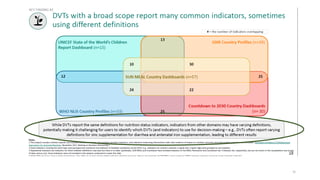
  • #37 Can use different indicator definitions & sources for same topic
  • #38 The next session will introduce common data sources at: -global/regional level -WA level
  • #39  Diagram: Adapted from the conceptual framework for public health surveillance CDC: Centers for Disease Control. (2012). CDC’s vision for public health surveillance in the 21st century. MMWR Morb Mortal Wkly Rep, 61, 1-44.
  • #40 But first, we had to establish a list of key nutrition indicators we will track. We have nine indicators at children level, five at WRA level and four at adult level (mainly non communicable diseases indicators)
  • #41 The strategy to find primary sources follow these steps. First, we use GHDX and World Bank search engines to find surveys that are likely to have a nutrition component. The identification of platforms used mainly the results of the inception work and the DataDent documents. DataDENT work focused on data visualization tools, while for this data assessment we look more broadly at all nutrition data aggregation platforms (including those without a visualization element).
  • #42 Now that we have identify our data sources, we aim to evaluate the quality, to determine wether they meet the quality required and are of the right type and quantity to be able to support their use for decision-making at national level. The evaluation is done through four dimensions.
  • #44 Data Availability:ranged from 2-10 sources per country Data platforms ranged from 15 – 20 data platforms per country
  • #47 Challenges and gaps of measurement: ask them for their thoughts
  • #49 Talk about age of data? The most recent data was collected in 2016. Shared drivers of double duty actions: biological, socioeconomic, environmental